
Crypto World
U.S. Strikes Iran in First Military Action in a Month


Before the Sunday strikes, the last time the U.S. military confirmed targeting Iran was on July 29, announcing a “heavy wave of strikes” on dozens of IRGC targets in Iran, including command centers, missile and drone facilities, and coastal surveillance and defense sites.
On Aug. 1, President Donald Trump said that he agreed to “hold off” strikes in Iran at the request of the U.S.’s regional allies in the Middle East.
The strikes mark the latest escalation of the war in Iran that began on Feb. 28, and from which Trump has struggled to find an off-ramp.
The war has led to a blockade of the Strait of Hormuz, which before the hostilities was one of the world’s most important energy transit routes, through which about a fifth of the world’s oil supply previously passed.
A U.S. naval blockade on Iranian ports was lifted in June, but it proved temporary, with the President reimposing the blockade after a deal to cease hostilities fell apart.

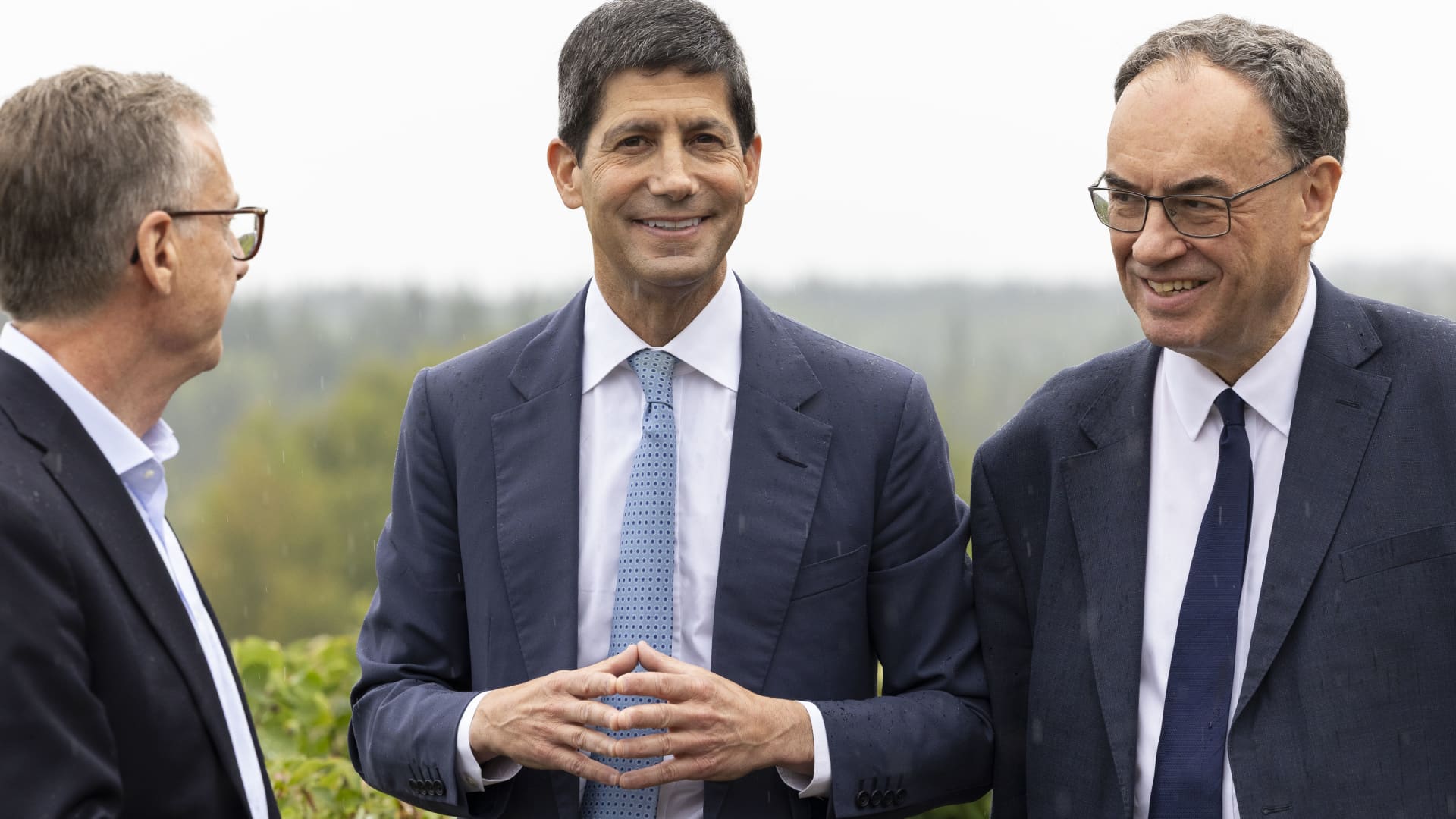
Tiff Macklem, governor of the Bank of Canada, left, Kevin Warsh, chairman of the US Federal Reserve, center, and Andrew Bailey, governor of the Bank of England at the Jackson Hole Economic Symposium in Moran, Wyoming, on Aug. 28, 2026.
David A. Grogan | CNBC
Federal Reserve Chair Kevin Warsh’s stance in his speech at the Jackson Hole meeting was unexpectedly hawkish, boosting market expectations for a rate hike next month.
Gold fell and Asian stocks declined on Monday. Traders of fed funds futures see a 60.4% chance of a quarter-point hike in September, up from around 56% on Friday, according to the CME’s FedWatch tool.
Here’s what market watchers are saying about Warsh’s speech:
Hawkish surprise
“Chair Warsh’s Jackson Hole address surprised us in its specificity about the economy and outlook and with its lean in a decidedly hawkish direction,” Deutsche Bank said. The firm continues to expect the Fed to hike 50 basis points this year, with increases at the September and December Federal Open Market Committee meetings.
“The emphasis on inflation risks, together with Warsh’s explicit commitment to achieving price stability and his reluctance to pre-commit to future policy actions, reinforces the elevated risks of policy tightening this year, although it could also be the case of talking without action, UOB said in a note.
Near-term data focus
“The sensitivity to near-term inflation data is high,” Nomura said in a note. “Warsh delivered hawkish remarks at the Jackson Hole economic symposium, emphasizing the importance of the inflation target and implying policy may need to react if disinflation is not occurring with speed.”
Reinforcing independence
Warsh’s assessment that U.S. economic performance has been robust “was seen as reducing the case for near-term rate cuts,” according to James Ooi, market strategist at Tiger Brokers. His “emphasis on the 2% inflation target could be read as an effort to reinforce the Fed’s independence and credibility, reassuring markets that monetary policy will not bend to fiscal pressures.”
Hike skepticism
Matthew J. Maley, chief market strategist at Miller Tabak + Co. however believes that “there remains no empirical basis for the rate hike.”
“Warsh appears to be talking up inflation so that he can claim credit for taming it when headline measures inevitably come down,” Maley said, adding that the labor market data has been weak while the inflation data has been better than expected since the last FOMC meeting.
Fed vs Treasury
Warsh’s reiteration that short-term interest rates should remain the main instrument of monetary policy implies that he will continue to shorten the average duration of the Fed’s balance sheet, Gavekal Research said in a note.
“This seems to put the Fed at odds with the US Treasury, which earlier in August announced that it will step up its buybacks of long-term treasury securities in an apparent attempt to prevent yields rising further at the long end,” Gavekal added.
Negative for gold
“Warsh pledged to return inflation to the 2% target and indicated rates could rise further, strengthening the dollar and reversing part of the debasement trade that had lifted gold roughly 14% in August—its strongest monthly gain this century,” according to Susquehanna.
—CNBC’s Joanna Ossinger contributed to this report.
Hair loss biotechs are racing to deliver the first new baldness treatments in nearly three decades, and investors are positioning for the payoff.
Veradermics, Absci, and Cosmo Pharmaceuticals are advancing a pill, an injection, and a topical drug for pattern hair loss, a condition with no newly approved therapy since the late 1990s.
Hair Loss Biotechs Eye A Market Waiting For A Cure
Pattern hair loss affects an estimated 50 million men and 30 million women in the United States, according to Bloomberg. Current options are limited to decades-old drugs minoxidil and finasteride. Both are tied to side effects that include heart palpitations and reduced sex drive.
Veradermics (NYSE: MANE) is developing an oral pill, VDPHL01, and its stock has climbed nearly 500% since its February IPO. Absci (NASDAQ: ABSI) is testing an injection dosed two to three times over six months, and its shares have more than doubled so far this year.
Cosmo Pharmaceuticals posted positive late-stage trial results for a topical solution but has traded more cautiously against its US rivals.
Investors Chase A GLP-1 Style Trade
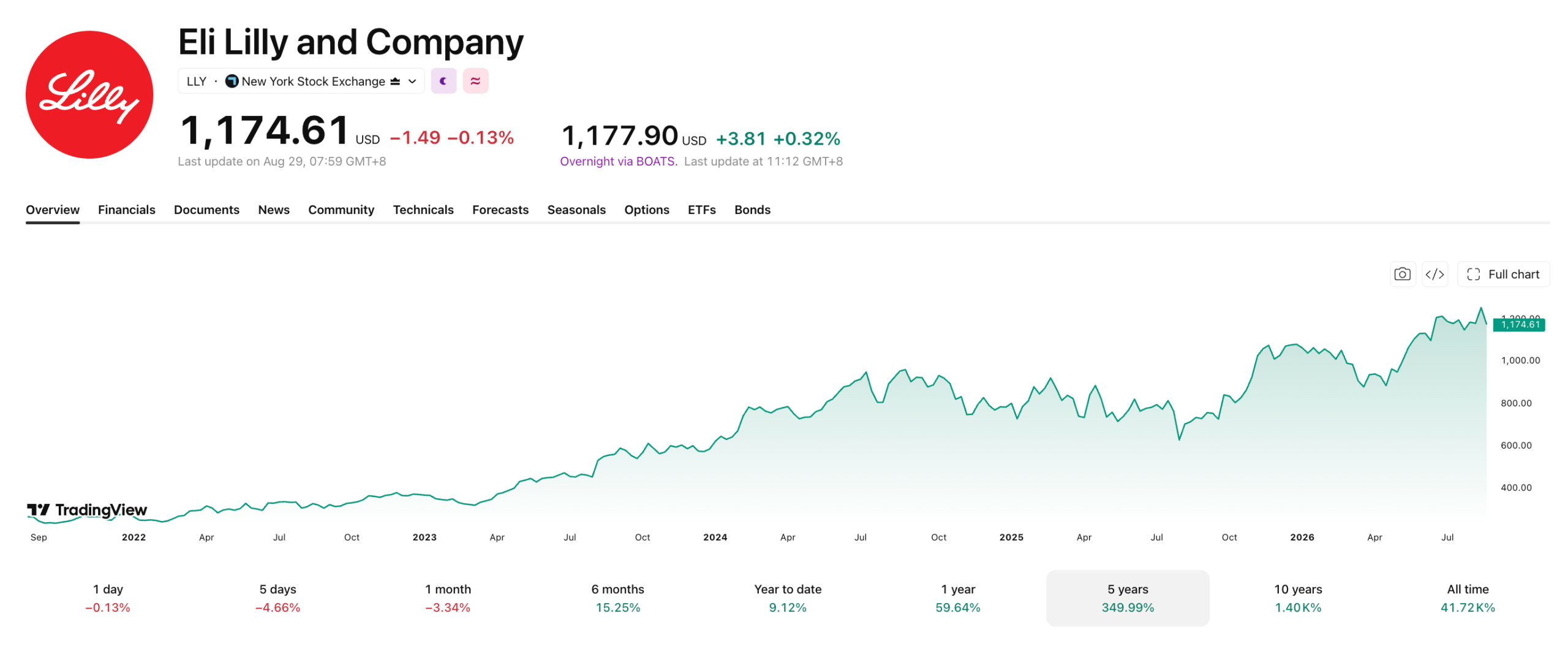
The enthusiasm echoes Eli Lilly’s stock rally, which reshaped investor appetite for consumer health biotech. Its weight loss drugs first drove that shift.

Eli Lilly has since invested $40 million in Absci, betting hair regrowth could follow a similar injectable playbook.
“Both obesity and hair loss are large consumer markets and that’s one reason why both of those categories can offer significant revenue potential.”
Geoff Hsu, portfolio manager at OrbiMed’s Biotech Growth Trust, Fortune
None of the three companies has an approved product yet. The earliest regulatory filings are not expected before 2027. Investors are pricing in demand years before any drug reaches pharmacy shelves.
The post Hair Loss Biotechs Emerge As Wall Street's Newest Growth Trade appeared first on BeInCrypto.


Crypto.com CEO Kris Marszalek said the company’s app and exchange were unaffected by the Tectonic breach and continued operating normally.
Eric Trump says American Bitcoin (ABTC) mines between 11 and 13 BTC daily at close to 49% gross margins, running nearly 90,000 miners. The company’s own quarterly filings largely support those figures.
Speaking on the Wolf Financial podcast, the co-founder and president’s son framed the output as proof of one of the sector’s most efficient mining operations, months after a public dispute over the firm’s true production costs.
Numbers Track With Recent Filings
American Bitcoin was founded in 2025 by Eric Trump and Donald Trump Jr. The venture merged with Gryphon Digital Mining to list on the Nasdaq under the ticker ABTC in September 2025. Hut 8 Corp, which backed the venture, remains the majority owner.
The company’s treasury has grown to about 8,300 BTC as of late August, according to Trump. That is up from roughly 5,401 BTC at the end of 2025, continuing an accumulation strategy that has drawn comparisons to Strategy.
It mined a record 932 BTC in the second quarter of 2026, its highest output yet. Gross margins that quarter landed near 49%, matching the figure Trump cited.
Bitcoin (BTC) traded near $77,696 as of writing, up 0.49% over 24 hours. That gives the reserve a paper value above $600 million.
A Disputed Cost Basis
The margin claim follows a spring dispute over the firm’s true production costs. Forbes alleged American Bitcoin’s all-in cost ran closer to $90,000 per coin, above the roughly $57,000 figure Trump has repeated. Trump rejected the report as politically motivated.
Neither side has published a fully reconciled cost breakdown since. American Bitcoin markets its no-sale treasury policy as proof that mining bitcoin is cheaper than buying it outright. That claim hinges on which cost figure holds up.
The post Eric Trump Says American Bitcoin Mines Up to 13 BTC Daily at 49% Margins appeared first on BeInCrypto.

BlackRock’s tokenized US Treasury fund, BUIDL, has reclaimed the top spot among products of its kind, with a market capitalization of roughly $2.8 billion.
Token Terminal data shows BUIDL now holds about 18.5% of the $15.1 billion tokenized Treasury market, narrowly ahead of Circle’s USYC.
A Fast-Changing Leaderboard
Tokenized Treasury funds let institutions hold short-term US government debt on a blockchain. Settlement happens around the clock, instead of the multi-day cycles typical of traditional bond markets.
That structure has made them a popular option for institutions parking idle cash or posting yield-bearing collateral.
USYC only briefly held the top spot. The fund grew from about $600 million to nearly $3 billion over the past year.
It reached roughly $2.9 billion by late August, edging past BUIDL’s $2.7 billion, according to Token Terminal data. It then lost the lead again this week.
BUIDL is BlackRock’s USD Institutional Digital Liquidity Fund, administered by Securitize. USYC, meanwhile, represents a share in Circle’s Hashnote-based fund, which Circle folded into its stablecoin business after acquiring Hashnote in 2025.
Why the Swap Matters
Neither fund has held the lead for long, and that instability is itself notable. It suggests institutions are actively comparing competing Treasury products rather than settling on a single default option.
That competition signals this corner of the tokenized asset market is maturing into a genuine, contested category. It is no longer a niche dominated by a single early mover.
The bigger question is whether institutional interest stays confined to government bond products. It could instead spread into other parts of on-chain finance.
So far, the growth has stayed concentrated in Treasuries, even as the broader real-world asset (RWA) sector expands.
The post BlackRock's BUIDL Reclaims Top Spot for Tokenized Treasuries, Bolstering RWA Market appeared first on BeInCrypto.

Nine of the 10 best-performing S&P 500 stocks over the past decade trace to one theme, the buildout of artificial intelligence infrastructure. There is also one clear winner out of the top 10: Nvidia.
Nvidia’s 10-year total return is near 13,589%, more than double the next-closest, AMD, at close to 6,000%. The other eight names span chipmakers, network gear, and one HVAC contractor.
The AI Common Thread
The top 10 best performers from the last 10 years:
Nvidia (NVDA) — +13,817%
AMD (AMD) — +6,099%
Micron (MU) — +5,486%
Comfort Systems (FIX) — +5,157%
Arista Networks (ANET) — +3,762%
Lam Research (LRCX) — +3,099%
Tesla (TSLA) — +2,545%
Lumentum (LITE) — +2,440%
KLA Corp (KLAC) — +2,401%
Seagate (STX) — +2,346%
Nvidia, AMD, Micron (MU), Lam Research (LRCX), and KLA Corp (KLAC) all supply chips or the equipment to make them. That equipment builds the servers inside AI data centers.
Arista Networks (ANET) sells networking switches for those same facilities. Lumentum (LITE) makes optical parts that move data between server racks. Seagate (STX), meanwhile, supplies the storage drives used in AI training clusters.
Comfort Systems (FIX), in contrast, benefits from a different angle. The mechanical and electrical contractor’s backlog climbed toward $12 billion as hyperscalers race to build and cool new data centers. That gives it AI exposure without selling a single chip.
Tesla (TSLA), however, is the outlier. Its return leans more on electric vehicle demand than AI infrastructure. Elon Musk’s push into self-driving and robotics does, however, add an AI angle of its own.
Two Years, Most of the Gains
Much of this run happened recently, not evenly across the decade. Nvidia’s market value rose from about $418 billion to over $4.5 trillion since the AI boom began in November 2022.
A similar acceleration shows up across the list, as hyperscaler spending on AI accelerated over the past two years.
Whether that pace continues depends on hyperscalers sustaining current construction schedules. JPMorgan analysts estimate that roughly 60% of data center capacity planned for 2027 has yet to break ground.
That gap could keep this group of stocks in focus through the back half of the decade.
The post Top 10 S&P 500 Stocks of the Past Decade Share One Clear Theme appeared first on BeInCrypto.
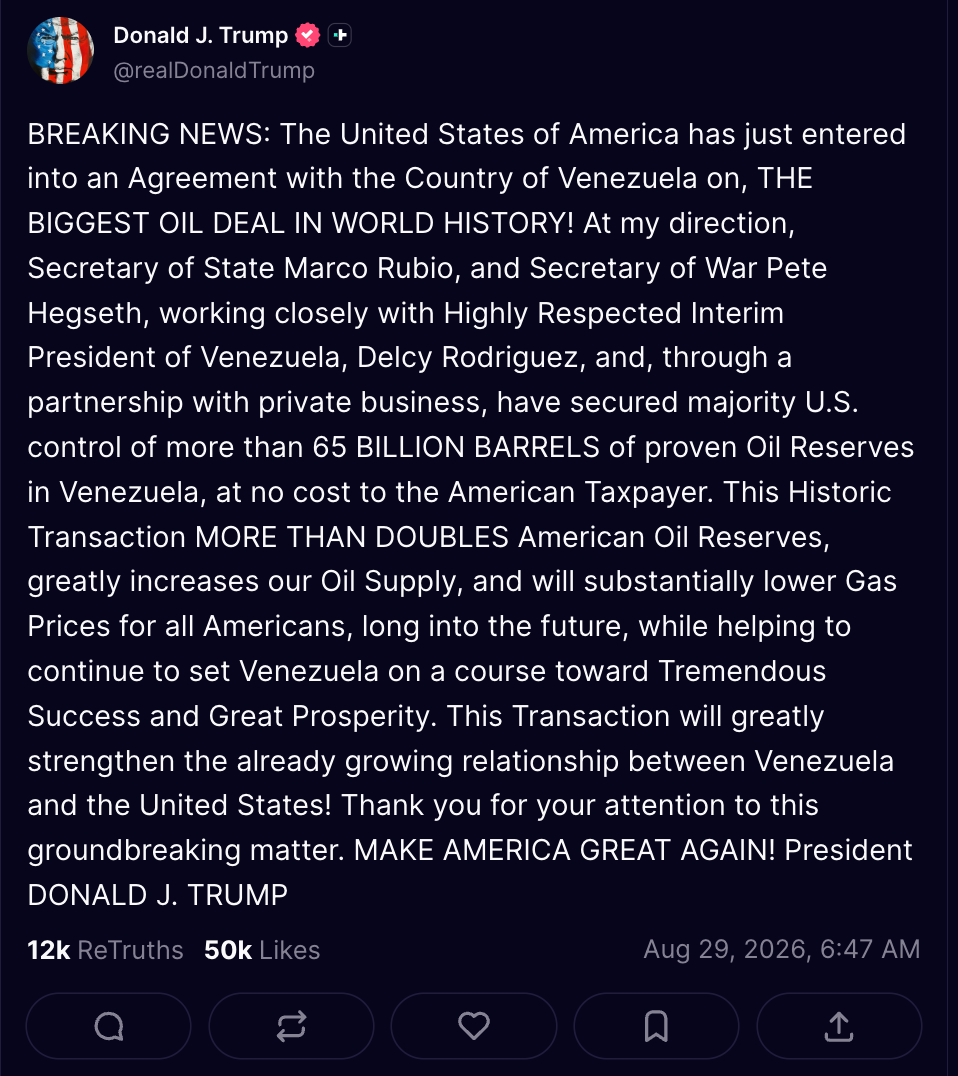
President Donald Trump said the United States secured majority control of more than 65 billion barrels of Venezuelan oil reserves. He announced the deal on August 28, calling it the biggest oil deal in history.
Brent crude, however, did not fall on the news. The benchmark instead climbed from about $88 to $90.48 by Monday, defying the deal’s promised supply boost.
The Barrels Are Reserves, Not Supply
The agreement gives a private venture a 100-year lease on 17 Venezuelan oil fields. The US holds a 55% stake in that venture, a US official told Newsweek.
Interim President Delcy Rodriguez said the fields hold proven potential of 65 billion barrels. She said the venture could draw more than $100 billion in investment.

None of that oil is flowing yet. Venezuela once pumped more than 3 million barrels a day in the late 1990s.
Output now sits close to 1 million barrels a day, according to OPEC data.
Rystad Energy projects production could rise only 17% by 2028. That growth depends on heavy investment in decayed infrastructure.
Patrick De Haan, head of petroleum analysis at GasBuddy, offered this assessment to Newsweek.
“While the hope of lower gas prices sounds promising, it still will take billions of investment to get that oil.”
Why Prices Jumped Anyway
Brent had fallen from above $93 a barrel in late August. That slide tracked easing fears around the Strait of Hormuz.

Goldman Sachs pegged Gulf oil exports at 15 million to 16 million barrels a day, roughly two-thirds of pre-conflict volume. Iran and Oman also struck a revenue-sharing deal over the waterway, though Tehran said it does not guarantee a reopening.
Sunday night’s rebound looks tied to that same risk story, not to Venezuela. The premium that drove oil for months has not fully unwound. Traders appear to be treating the distant Venezuelan barrels as background noise against a live supply threat elsewhere.
Two things will decide where Brent goes next. One is whether the Middle East risk premium keeps fading. The other is whether Venezuela’s oil venture attracts the investment Rodriguez is counting on.
The post Trump Announced the Biggest Oil Deal Ever: Why Did Prices Jump? appeared first on BeInCrypto.
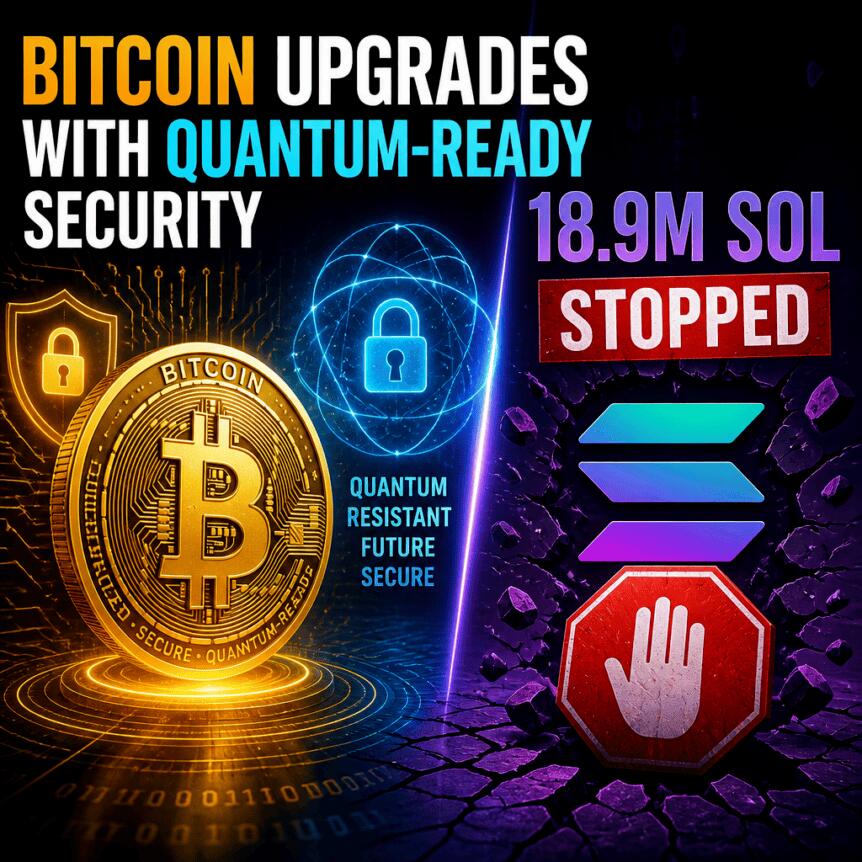
Efforts to make major blockchains more resilient against the long-discussed threat of quantum computing have accelerated, even as many Bitcoin users remain skeptical about how soon quantum risk becomes practical. This week, two separate threads underscored the direction of travel: experimental defenses for Bitcoin transactions and a new proposal aimed at upgrading Bitcoin’s signature technology.
At the same time, governance decisions and broader market signals continued to shape sentiment across the sector—from Solana’s vote to speed up disinflation to new disclosures and policy debates in the United States. Here are the developments investors and builders should keep on their radar.
Key takeaways
- StarkWare researcher Avihu Levy tested an experimental quantum-resistant Bitcoin transaction on mainnet, using a scheme designed to protect outputs during the mempool exposure window.
- Blockstream researchers published a Bitcoin Improvement Proposal (BIP) to incorporate the SHRINCS post-quantum signature scheme, significantly shrinking a large signature structure while still introducing trade-offs.
- Solana validators approved “Double Disinflation” (SGP-0002), doubling annual disinflation to target 1.5% terminal inflation in about 2.8 years.
- Polygon disclosed multiple security vulnerabilities fixed via recent hard forks, addressing risks that could have affected its proof-of-stake clients.
- US consumer advocacy group Public Citizen claims investors are “underwater” by at least $4.7 billion in connection with Donald Trump-linked crypto ventures since 2022, with losses attributed to specific token products.
Experimental quantum protection reaches Bitcoin mainnet
Earlier coverage focused on how quantum capabilities could threaten cryptographic signatures and public-key systems over time. This week’s milestone came from the practical side: StarkWare researcher Avihu Levy tested an experimental quantum-resistant transaction on Bitcoin mainnet designed to reduce risk during a specific vulnerability period.
According to a Cointelegraph report, Levy’s test used “Quantum Safe Bitcoin (QSB)” to protect an output in the brief interval when public keys are exposed in the mempool. The approach combines hash-based one-time signatures with computational search techniques that bind an authorization to a specific transaction. In other words, the system is not merely trying to replace signatures wholesale—it is attempting to manage exposure timing relative to how Bitcoin transactions propagate and are validated.
Onchain data referenced in the same report indicates that StarkWare spent a 10,000-satoshi output protected by the QSB scheme. However, the article also highlighted that the mechanism behaves more like a fallback than a broadly usable production-level solution: each transaction reportedly took hours to complete and cost an estimated $150 to $200.
For investors and system designers, the key takeaway is that “quantum-resistance” in Bitcoin is not arriving as a single upgrade button. Instead, it is emerging as layered experiments that tackle specific threat windows first—before longer-term changes to core cryptography can be rolled out through protocol governance.
A BIP aims to upgrade Bitcoin signatures with SHRINCS
Beyond short-term mitigation strategies, the second story points to the longer roadmap: a proposed change to Bitcoin’s signature scheme intended to improve post-quantum security across all transactions.
As described in a Cointelegraph piece, Blockstream researchers published a Bitcoin Improvement Proposal introducing the SHRINCS signature scheme. The researchers reportedly reduced a large hash-based post-quantum signature “by about 13.23 times.” Even with that improvement, the signature size is still described as at least nine times larger than Bitcoin’s existing signatures, and the proposal includes multiple trade-offs.
The same report quotes Blockstream Research’s Jonas Nick, who called it “the first concrete proposal” for a post-quantum signature designed specifically for Bitcoin. Nick acknowledged that it is “not optimal along every axis,” but argued it could represent a reasonable trade-off among available options.
Why this matters for the Bitcoin ecosystem is straightforward: any post-quantum signature upgrade must be weighed against bandwidth, validation costs, implementation complexity, and compatibility with current constraints. A key question for readers is whether future iterations can close the gap between security goals and performance limitations, or whether staged approaches like Levy’s mempool-window protection will remain the practical near-term path for high-value use cases.
Solana accelerates disinflation via validator vote
While Bitcoin-focused news centered on cryptographic evolution, Solana’s latest governance decision shifted attention to monetary policy. Solana validators approved a proposal to double the network’s annual disinflation rate—aimed at reducing issuance faster without changing the broad disinflation direction.
Cointelegraph reported that participation reached 60.7% of eligible stake, with 67% support and 25.16% voting against (7.84% abstained). The measure—known as SGP-0002 or Double Disinflation—increases Solana’s annual disinflation rate from 15% to 30%.
Under the new schedule, Solana is expected to reach a 1.5% terminal inflation rate in about 2.8 years, compared with roughly 5.7 years under the previous schedule. The proposal is also projected to reduce issuance by 18.9 million SOL over the next six years, according to the report.
The vote arrives amid signs that network usage is continuing to expand. Cointelegraph cited onchain data presented by The Kobeissi Letter showing Solana processed a record 4.2 billion transactions in July, up 13.5% month over month. Transaction counts reportedly rose by roughly 2 billion since December, representing a 91% increase.
For traders and long-term holders, the immediate relevance is that monetary-policy acceleration can alter expectations around supply growth, even if it does not directly determine short-term price. For builders, higher throughput combined with faster disinflation can influence incentive structures and the economics of running apps, validators, and infrastructure.
Security disclosure: Polygon patches vulnerabilities through hard forks
In another infrastructure-related update, Polygon disclosed previously private security issues that could have disrupted its proof-of-stake network. The vulnerabilities were reportedly fixed through two recent hard forks—Austin and Kyoto—deployed privately first and then activated on mainnet before public disclosure.
Cointelegraph reported that the affected components included Polygon’s Bor and Heimdall clients. The disclosure from Polygon Labs’ Validators Support Team indicated risks such as denial-of-service vectors, validator resource exhaustion, and flaws related to checkpoint and milestone processing.
From an investor and validator perspective, disclosures like this matter because they reveal where reliability and operational risk can concentrate—even if the network continues to run. The most useful next step for market participants is to watch whether validator operations, client updates, and monitoring guidance translate into any follow-up performance or incident reporting after these forks.
US policy and consumer scrutiny: Public Citizen alleges $4.7B in losses
Outside technical upgrades, consumer advocacy continues to influence the regulatory and public narrative around crypto. Public Citizen, a nonprofit consumer organization, claims that US President Donald Trump and related digital asset ventures left investors at least an estimated $4.7 billion “underwater” since 2022.
According to a Cointelegraph report, the group’s new filing attributes losses to multiple Trump-linked products: $3.2 billion from the Official Trump (TRUMP) memecoin; at least $1 billion on the World Liberty Financial governance token; $450 million on Trump Media’s digital asset treasury; and $9.3 million on Trump’s NFT trading cards launched in 2022. The article adds that holders of a USD1 stablecoin were reportedly “sitting pretty on $0 losses.”
The report also notes that Trump’s crypto profits are described as one of the factors supporting the continued progress of the CLARITY Act debate, with Democrats reportedly seeking stronger protections intended to prevent elected officials from profiting through cryptocurrency issuances.
Even for readers who are not focused on US election-era politics, this category of claims tends to affect both compliance pressure on token issuers and the willingness of traditional financial institutions to engage with crypto-linked structures.
Looking ahead, quantum-resistance proposals will likely remain a multi-year, iterative process—starting with narrow defensive experiments and moving toward full signature upgrades through governance. Meanwhile, validator-led disinflation votes and security-related hard fork disclosures offer clearer near-term implications for network economics and reliability; those are the areas to watch closely for follow-on data and operational updates.
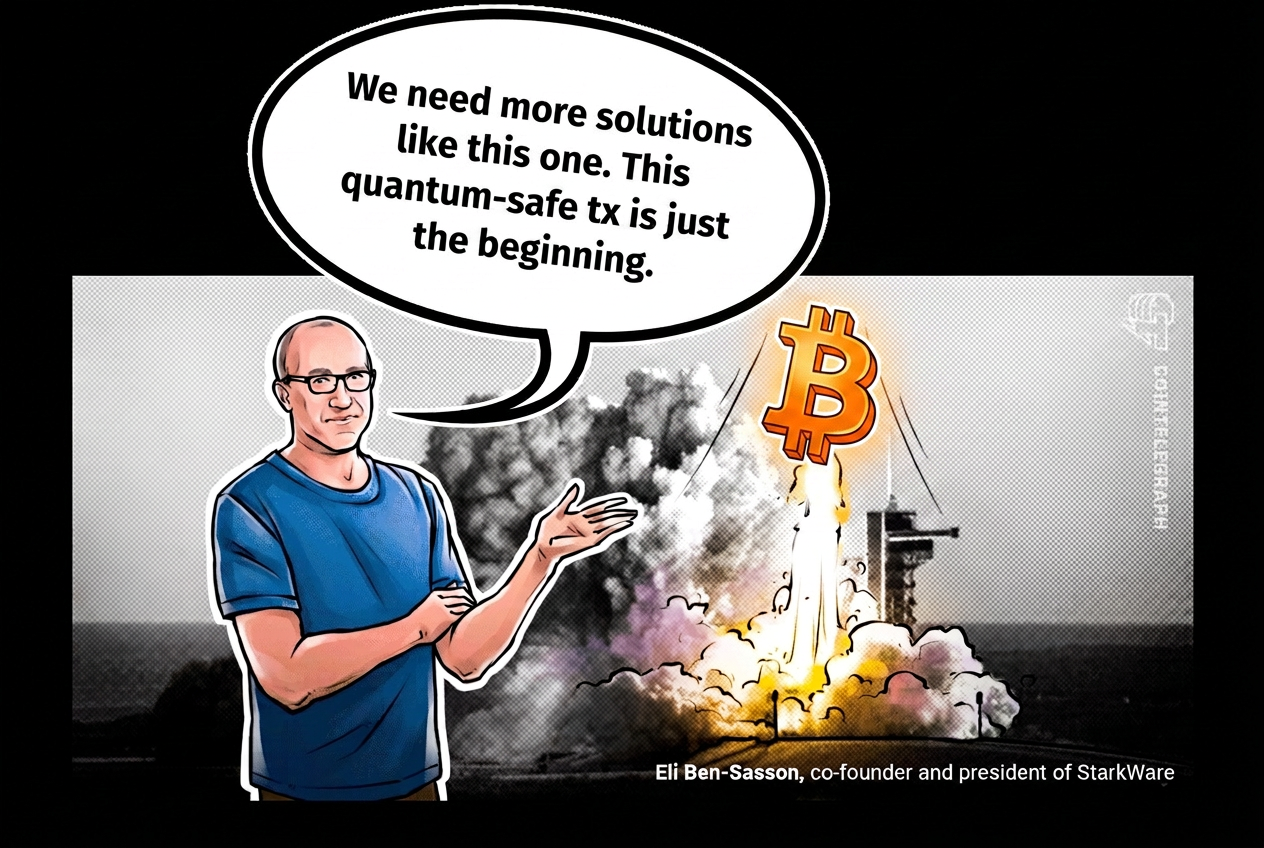
Bitcoin embraces post quantum future
Despite considerable skepticism among Bitcoiners about how close the quantum threat to Bitcoin is, two stories this week highlighted the progress being made toward upgrading the blockchain and protecting outputs from attack.
StarkWare researcher Avihu Levy tested an experimental quantum-resistant transaction on the Bitcoin mainnet that protects it during the brief period when public keys are exposed in the mempool.
Onchain data shows that StarkWSare spent a 10,000-satoshi output protected by Levy’s Quantum Safe Bitcoin (QSB) scheme which combines hash-based one-time signatures with computational searches that bind an authorization to a specific transaction. It’s more of a last resort than a practical measure, as each transaction takes hours and costs $150 to $200.
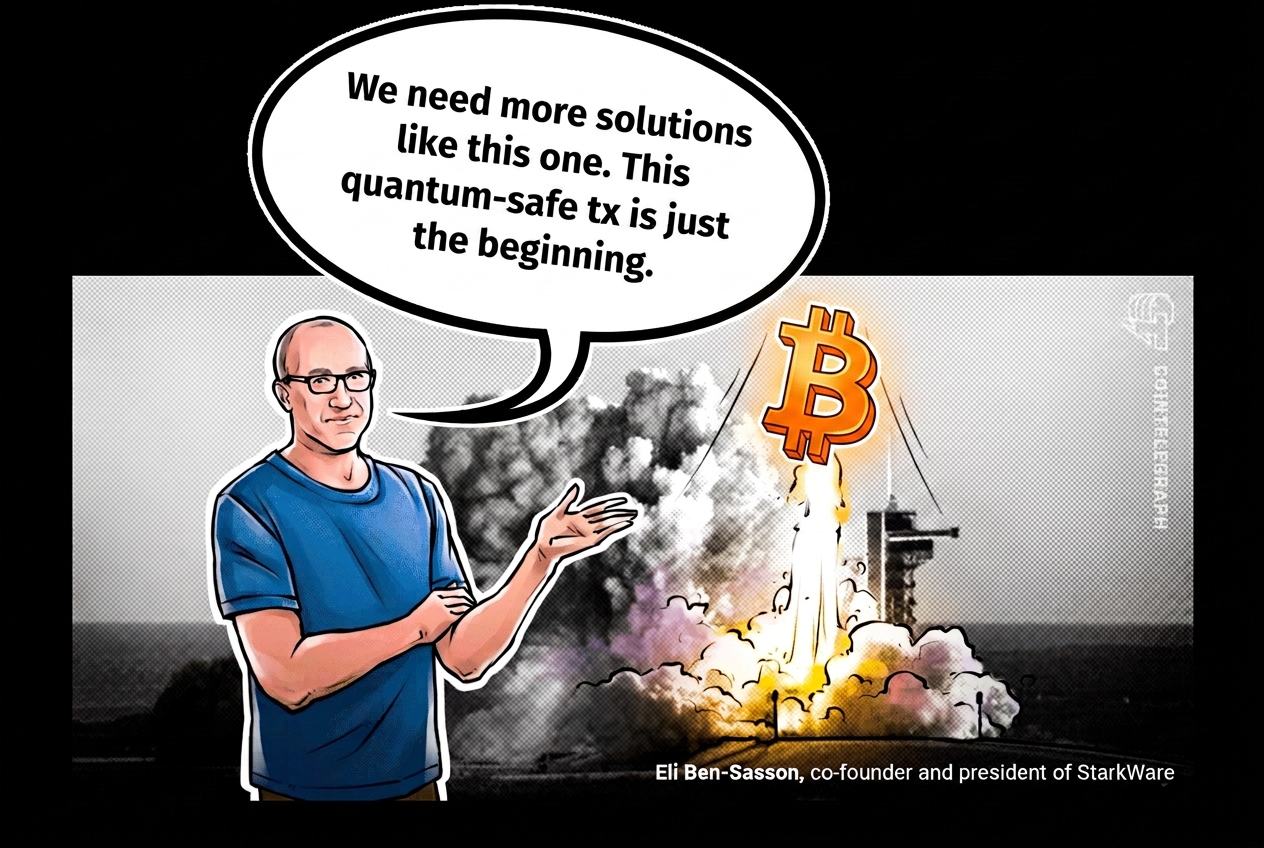
On August 27, Blockstream researchers published a Bitcoin Improvement Proposal to upgrade Bitcoin with the SHRINCS signature scheme. The researchers have slimmed down a huge hash based post quantum signature by about 13.23 times — but it’s still nine times larger than Bitcoin’s existing signatures and comes with a bunch of trade offs.
Blockstream Research’s Jonas Nick called it “the first concrete proposal for a post-quantum signature scheme designed specifically for Bitcoin.” While he said it was “not optimal along every axis” he added:
”I do think it is a very good trade-off among the options we have now,” he said.
Solana validators vote to cut inflation to 1.5% in 2.8 years
Solana validators have approved a proposal to double the network’s annual disinflation rate, reducing issuance by 18.9 million SOL over the next six years.
According to finalized voting results, the proposal received 67% support, with 25.16% voting against and 7.84% abstaining. Overall participation reached 60.7% of eligible stake.
The proposal, known as SGP-0002 or Double Disinflation, increases Solana’s annual disinflation rate from 15% to 30%, while leaving the network’s long-term inflation target of 1.5% unchanged.
Under the new schedule, Solana is expected to reach its 1.5% terminal inflation rate in about 2.8 years, compared with roughly 5.7 years under the previous schedule.
Transactions on Solana reached record highs in July. Onchain data presented by The Kobeissi Letter showed that Solana processed a record 4.2 billion transactions during the month, up 13.5% from June. Transaction counts have risen by roughly 2 billion since December, representing a 91% increase.
Trump cost investors $4.7B through crypto ‘schemes’: Public Citizen
Nonprofit consumer advocacy organization Public Citizen claims that US President Donald Trump “left investors at least an estimated $4.7 billion underwater” since 2022 through his and his family’s digital asset ventures.
It’s new report states that investors lost $3.2 billion via his memecoin Official Trump (TRUMP) memecoin, at least $1 billion on the World Liberty Financial governance token, $450 million on Trump Media’s digital asset treasury and $9.3 million on the president’s nonfungible token (NFT) trading cards launched in 2022.

Holders of the USD1 stablecoin however were sitting pretty on $0 losses.
Trump’s crypto profits are one of the key factors holding up passage of the CLARITY Act in September, with Democrats digging in on stronger protections to prevent elected officials from profiting by issuing cryptocurrencies.
Bitcoin rally only just getting started
BlocksBridge Consulting reported this week that that Bitcoin’s 23% rally over the past week had outpaced most AI-linked infrastructure stocks.
Three beaten-down Bitcoin mining companies — Canaan, American Bitcoin and Cango — gained between 41% and 67%. By comparison, CoreWeave rose about 21%, Nebius gained 17% and IREN advanced 15%.
The Bitcoin ETFs have minted more than $3.3 billion in August, for the strongest month since October 2025’s all time high. Outflows on Friday ended a nine day hot streak however.
Wall Street analysts from Bernstein predict we are at the start of a new four year cycle. It forecasts Bitcoin will reclaim $125,000 under both its base case and bull case scenario, and will peak at $300,000 in 2029 under the base case but top $500,000 that year under its bullish scenario.
Revolut rolls out euro stablecoin in 3 European markets
Revolut has begun rolling out its first stablecoin, a euro-pegged token called EURR, to around 2 million customers in Denmark, Poland and Portugal.
The phased rollout will expand to other European Economic Area (EEA) markets later this year, subject to product, operational and regulatory readiness.
EURR is issued by Bridge Building S.A., the Luxembourg-based entity of Stripe-owned stablecoin infrastructure company Bridge. Revolut said EURR will be integrated into its retail app, with plans to support multiple blockchain networks and transfers to external wallets. It’s launching on the Ethereum network.

Winners and Losers
At the end of the week, Bitcoin (BTC) is up 1.1% to trade at $78,420, Ethereum (ETH) is up 0.6% to trade at $2,469 and XRP (XRP) is down 8.7% to $1.38. The total market cap is at $2.64 trillion according to CoinMarketCap.
Among the biggest 100 cryptocurrencies, the top three altcoin winners of the week are VeChain (VET) with an 18.5% gain, SPX6900 (SPX) on 17.3%, and Uniswap (UNI) on 15.2%.
The top three altcoin losers of the week are Aptos (APT) which was down 16.4%, Stable (STABLE) down 14.7% and Morpho (MORPHO) down 13.6%.
Prediction of the Week
Bitcoin bear market ‘over’ as price metric copies 2023 recovery: CryptoQuant CEO
CryptoQuant CEO Ki Young Ju has flagged the first positive reading on CryptoQuant’s Bull/Bear Market Cycle Indicator since early October.
“The Bitcoin bear cycle is over,” he wrote.
The indicator measures onchain profitability metrics in comparison to a 365 day moving average, including the market value to realized value (MVRV) ratio, net unrealized profit/loss (NUPL) and the spent output profit ratio (SOPR). Values above zero for the Bull/Bear indicator point to bullish phases in the BTC price cycle as profitability improves.
Current cycle lows came on Feb. 5 as BTC/USD fell to $60,000, with a reading of -1.244 corresponding to “extreme bear” conditions. As of Aug. 26, the most recent date for which full data is available, Bull/Bear displayed a positive reading of 0.042, placing it in its “bull” bracket.
FUD of the Week
77% of Americans see crypto in retirement plans as risky: Survey
More than three-quarters of Americans view cryptocurrency in workplace retirement plans as risky, as concerns over retirement security mount across the United States, according to a new survey from The National Institute on Retirement Security.
The survey found that 77% of Americans consider crypto in workplace retirement plans risky, including 46% who view it as very risky, while 53% oppose employers offering crypto as an investment option.
The survey was conducted by Greenwald Research between Oct. 24 and Nov. 14, 2025, and included 1,203 Americans aged 25 and older, with results weighted by age, gender and income.
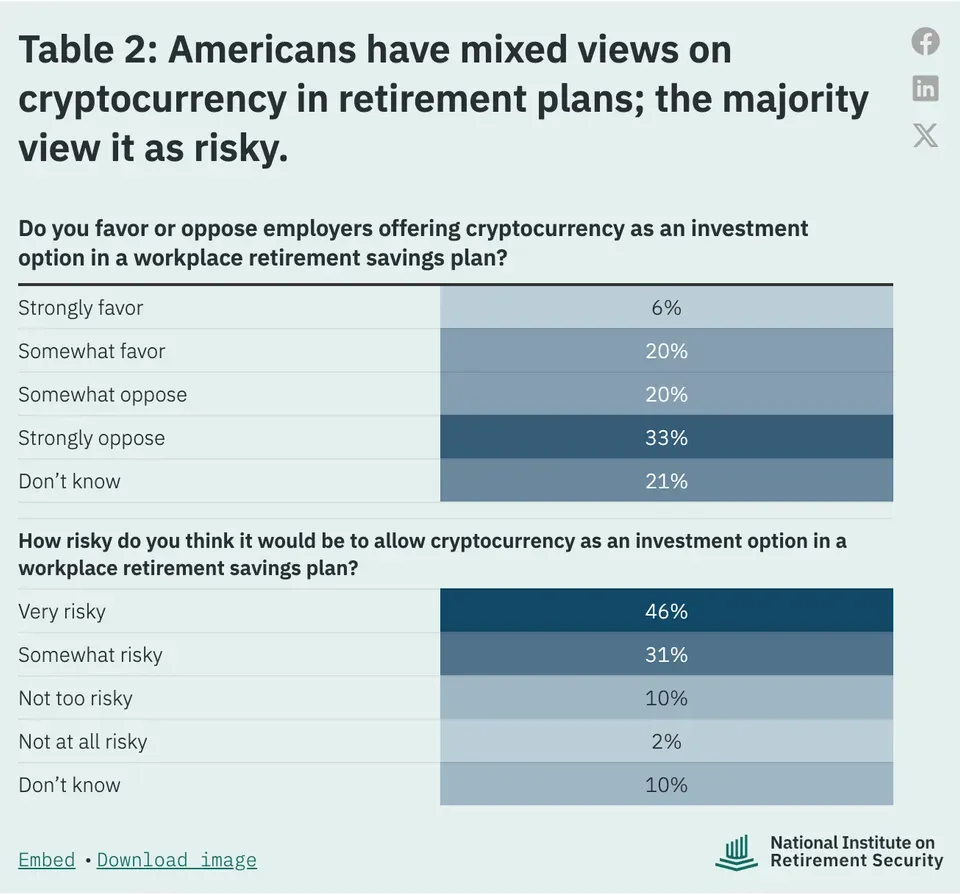
Americans view of crypto in retirement plans. Source: National Institute of Retirement Security
Real Trump Coins denies launching GOLD token, blames ‘bad actors’
Real Trump Coins has denied launching, promoting or authorizing the Trump Digital GOLD token that briefly appeared across its online presence before collapsing, blaming the promotion on “third-party bad actors.”
The denial came after the Real Trump Coins X account promoted the Solana-based token on Saturday and directed users to RealTrumpCoins.com, where GOLD was also advertised. The X posts were later deleted, while the account now links to a separate domain, TrumpCoins.com.
“Trump Coins has not authorized and will not launch, promote, or authorize any digital token,” Real Trump Coins said in an X post on Saturday, adding that it was working with authorities to investigate the matter.
Polygon discloses security flaws fixed in recent hard forks
Polygon has disclosed several previously private security vulnerabilities that could have disrupted its proof-of-stake network, after deploying fixes through two recent hard forks.
The vulnerabilities affected Polygon’s Bor and Heimdall clients and included denial-of-service risks, validator resource exhaustion and flaws affecting checkpoint and milestone processing, according to a Thursday disclosure from Polygon Labs’ Validators Support Team.
Polygon said the flaws were fixed through the Austin and Kyoto hard forks, which were deployed privately and tested before being activated on mainnet and publicly disclosed.
Top Magazine Stories of the Week
A new Bitcoin Improvement Proposal for the SHRINCS signature scheme has just been published to upgrade Bitcoin to quantum secure. Here’s everything you need to know.
Hugging Face relies on open weight Chinese models to defend itself from rogue AI agents. But a lack of safety guardrails makes those models potentially dangerous too.
If your personal AI agent goes rogue and causes harm or financial damage in the real world, can you be held liable?
Cointelegraph publishes long-form journalism, analysis and narrative reporting produced by Cointelegraph’s in-house editorial team with subject-matter expertise. All articles are edited and reviewed by Cointelegraph editors in line with our editorial standards. Some articles contain affiliate links, from which Cointelegraph may earn a commission. These relationships do not influence which products we review or our editorial conclusions. Content published in here does not constitute financial, legal or investment advice. Readers should conduct their own research and consult qualified professionals where appropriate. Cointelegraph maintains full editorial independence.
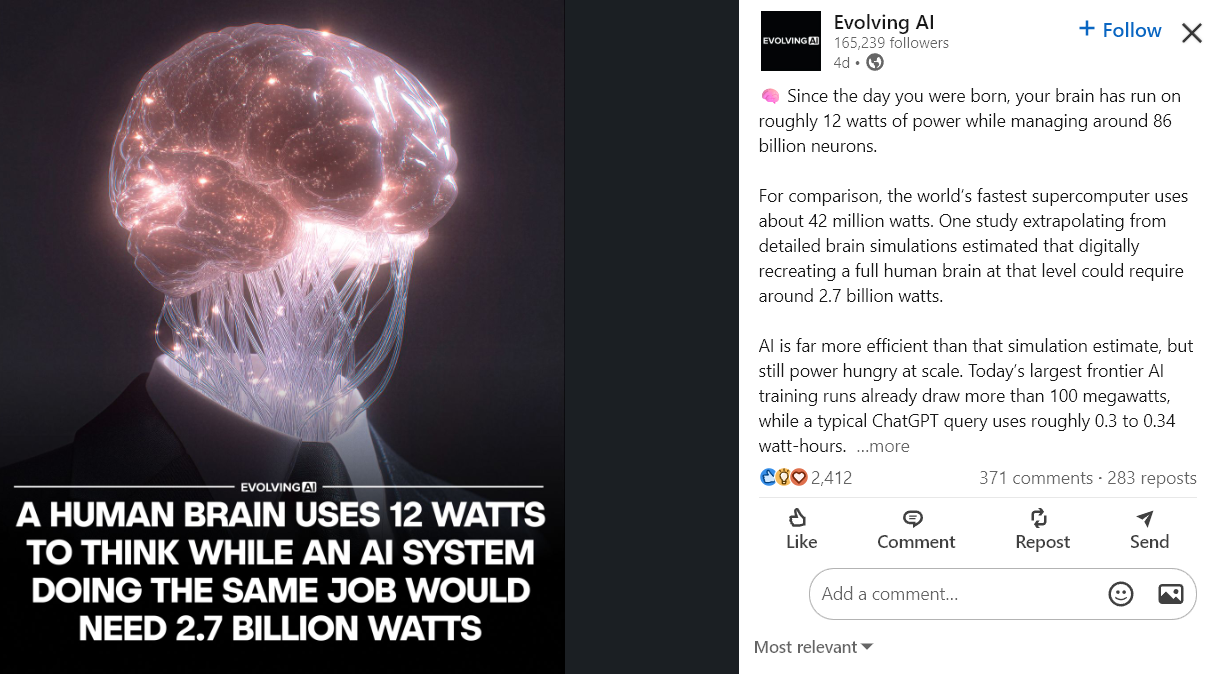
The human brain runs on roughly 20 watts. The world’s fastest supercomputer, LineShine in Shenzhen, draws 42.2 million watts. That gap has become the internet’s favorite argument about AI energy use, and most of it is wrong.
The comparison itself holds up. However, the numbers circulating on social media trace back to a single paper. The most striking one has been misattributed for three years.
AI Energy Use: What 20 Watts Actually Buys
The 20-watt figure rests on decades of metabolic measurement. The brain accounts for about 2% of body weight and roughly 20% of resting oxygen consumption.
Neuron counts are shakier than they appear. The widely quoted 86 billion rests on four male brains and is currently under dispute in the journal Brain.
Viral posts often use 12 watts rather than 20. That figure appears in a 2023 paper in Frontiers in Artificial Intelligence, stated without any citation at all.
The same paper produced the number everyone shares. Its authors estimated that digitally recreating a human brain would draw 2.7 billion watts.
That estimate came from extrapolating a 10-million-neuron simulation to mouse scale, then multiplying by a thousand.
The paper also states that the simulation ran about 30,000 times slower than biology. Social posts drop that detail. Secondary sources then credit the figure to the Blue Brain Project, which never published it.

Reliable numbers do exist elsewhere. Epoch AI estimated a typical ChatGPT query at 0.3 watt-hours in early 2025. A peer-reviewed study in Joule later landed on 0.31.
Two independent methods agreeing that closely is unusual. However, the figure changes sharply with workload, and reasoning models that produce longer answers can cost several times as much.
What Biology Does Differently, and What Silicon Copied
Cortical activity is sparse. Average firing rates are below 1 Hz, and energy follows change rather than clock cycles.
Modern AI reached the same conclusion independently. Kimi K2 activates 32.6 billion of its 1.04 trillion parameters per token, close to 3.1%.
That ratio is falling fast. Mixtral used roughly 28% of its parameters in 2023, while DeepSeek-V3 now uses 5.5%.
Biology also computes at low precision. Nothing inside a neuron resolves to 32 bits.
Chipmakers followed the same path. DeepSeek trained a 671-billion-parameter model in eight-bit precision. NVIDIA has since pretrained a 12-billion-parameter model in four-bit.

The third difference is the largest and the least copied. Brains hold memory and computation in the same physical place.
Digital machines separate them. Stanford’s Mark Horowitz showed the cost of that split. Fetching an operand from memory can consume hundreds of times more energy than the arithmetic itself.
The Brain-Shaped Chips That Never Arrived
Hardware built explicitly to imitate neurons has struggled. No neuromorphic or analog system has trained or run a frontier model in production.
Intel’s Hala Point packs 1.15 billion artificial neurons across 1,152 chips. It remains a research prototype installed at Sandia National Laboratories. Mike Davies, director of Intel’s Neuromorphic Computing Lab, speaking to The Register in 2024, said:
“We’re not mapping any LLM to Hala Point at this time. We don’t know how to do that.”
The commercial picture is thinner still. BrainChip is the sector’s flagship listed company. It reported $700,000 in customer receipts against $5.3 million of operating outflow last March quarter.
Others have stalled outright. Rain AI, which sought $150 million and failed to raise it, explored a sale in 2025.
Researchers inside the field describe a circular problem. Catherine Schuman, assistant professor of electrical engineering and computer science at the University of Tennessee, Knoxville, stated:
“The hardware companies are waiting for there to be a killer application, but it’s really hard to understand how to build those applications without having hardware to prototype on.”
More than 20 researchers signed a 2025 consensus paper in Nature. It argued that the field still lacks the ecosystem it needs.
Biology’s principles won. The hardware built to embody them did not.
Everyone Is Bidding for the Same Electrons
Efficiency matters now because electricity has become the binding constraint. The International Energy Agency put global data center consumption at 485 terawatt-hours in 2025.
AI-focused facilities grew 50% during that year alone. The agency expects them to triple by 2030.
Grid access, rather than chip supply, now gates construction. Median time from an interconnection request to commercial operation exceeds five years, according to Lawrence Berkeley National Laboratory.
Microsoft chief executive Satya Nadella said in November that his company holds processors it cannot plug in. The shortage is powered buildings, not silicon. Institutional investors have raised similar questions about grid readiness.
Bitcoin miners spent a decade solving exactly that problem. They hold energized sites, signed power agreements, and interconnection rights that newcomers wait years to secure.
The result has turned mining into an energy and infrastructure business. Retrofitting a working site costs roughly $3 million to $4 million per megawatt. Greenfield construction runs $10 million to $12 million, VanEck estimates.
Announced deal values are enormous. Public miners have signed AI contracts worth more than $70 billion in aggregate.
Delivered capacity tells a quieter story. Second-quarter 2026 filings show roughly 750 megawatts actually energized across the sector.
Core Scientific accounts for about 437 of those megawatts. Galaxy’s Helios campus delivered 133; TeraWulf 102; IREN 50; and Riot 25. Hut 8 has contracted 949 megawatts and energized none.

The pivot has been costly. Combined quarterly losses at miners MARA and CleanSpark reached $851 million in August.
Most mining capacity will never convert. Preliminary Cambridge survey data presented in July showed that about 10% of miners had allocated power to AI.
The obstacles are physical. Mining tolerates interruption, whereas AI tenants demand firm power, dense cooling, and fiber that remote sites rarely have.
Even so, the direction of travel is clear. Core Scientific now earns 83% of its revenue from colocation and just 13% from mining itself.
Investors have priced that shift in. Miners holding signed leases trade at far higher multiples of their energized power. Meanwhile, the next AI bet increasingly looks like electricity rather than chips.
Why Efficiency Will Not Fix AI Energy Use
Efficiency gains have absorbed demand growth in the past. Global data center compute grew by 550% between 2010 and 2018, while energy use rose by about 6%.
Then the pattern broke. United States data center consumption climbed from 58 terawatt-hours in 2014 to 176 in 2023.
Evolution optimized under a hard ceiling. A skull drawing 200 watts would have killed its owner, so efficiency became the only available answer.
AI has never faced that ceiling. It has faced a capital ceiling instead, and capital stretches far more easily than electricity does.
That is now changing. The open question is no longer whether biology is more efficient. It is what AI becomes once power, rather than money, decides what gets built.
The post Your Brain Runs on 20 Watts. AI Wants a Power Plant appeared first on BeInCrypto.

Politics And The Markets 08/31/26

US Open 2026 results: Toby Samuel earns first Grand Slam main-draw win but Cameron Norrie suffers early exit

MechLands Vibe99 review: a budget keyboard with premium performance

Weekend Open Thread – Corporette.com

Weekend Open Thread: Brooks Brothers

London Mayor Sadiq Khan handed a peerage by Keir Starmer alongside 15 other Labour figures… just days before the PM leaves No10

Only Allah Brings Happiness #muftimenk #motivation #money #future #rich #faith

Esta MA lo Confirma!! #bitcoin #shorts #crypto #trading

#forex #trading #forextrader #bitcoin #forextrading #money #forexsignals #trader #cryptocurrency
-

 Crypto World5 days ago
SpaceX stock could rise 75% to $240, JPMorgan says
-

 Fashion2 days ago
Weekend Open Thread: Maeve – Corporette.com
-

 Crypto World3 days ago
Bitcoin’s 22% rally now needs real demand to outlast Treasury liquidity boost
-

 Crypto World5 days ago
Warsh Jackson Hole keynote puts financial innovation first
-

 Crypto World6 days ago
A $30 Billion AI Fund Implodes, Now the SEC Is Investigating Wall Street’s Role
-

 Business3 days ago
Salesforce Stock Soars 19% as Blowout Earnings and Agentforce AI Growth Silence Software Skeptics
-

 Crypto World5 days ago
Did Trump Just Move SpaceX Stock With One Truth Social Post?
-

 Crypto World4 days ago
Elon Musk Grok Bot Promise: We Will Make You Whole if AI Loses Your Money
-

 Business5 days ago
Walmart takes aim at younger shoppers with new fashion brand
-

 Business3 days ago
Apple Confirms September 9 Keynote and Reveals Its Full Pre-Order Schedule
-
 NewsBeat4 days ago
Lindsay Clancy jury braces for closing arguments as judge tells court: ‘You’ve heard all the evidence’ – Live updates
-

 Crypto World2 days ago
Bitcoin price tests $82K resistance as Brandt stays long
-

 Business5 days ago
Thailand’s Eastern Economic Corridor Capital City (EECiti): Key Developments and Investment Opportunities
-

 Crypto World4 days ago
NVIDIA revenue hits $96.2B as AI demand doubles
-

 Business6 days ago
Moderna CEO warns China is pouring state money into mRNA technology
-

 Business2 days ago
Onto Innovation Stock: AI’s Next Bottleneck Is Yield (NYSE:ONTO)
-

 Business6 days ago
NVIDIA Stock Drops Nearly 2 Percent to $210 on Seventh Losing Day Ahead of Critical AI Earnings
-

 Business2 days ago
iPhone 18 Pro Pre-Orders Could Shift to Saturday as Apple Reportedly Avoids September 11 Anniversary
-

 NewsBeat5 days ago
Trump’s trade truce with China faces test with Iran effort
-
 Crypto World4 days ago
Nvidia Q2 Earnings Reveal $96.2 Billion Beat, So Why Is NVDA Falling?
You must be logged in to post a comment Login