

Crypto World
U.S. Treasury Sanctions Iran’s Nobitex Over Alleged Crypto Finance Links


TLDR
- The U.S. Treasury sanctioned Nobitex, which it described as Iran’s largest digital asset exchange.
- According to the Treasury, Nobitex handled more than half of Iranian digital asset inflows in 2025.
- OFAC alleged that Nobitex supported sanctions evasion, stablecoin transfers, and IRGC-linked crypto transactions.
- Treasury also designated Amir Hossein Rad and other Nobitex leaders in the sanctions action.
- The action forms part of the Economic Fury campaign targeting Iran-linked financial and digital asset networks.
The U.S. Treasury moved against Iran’s largest digital asset exchange, Nobitex, in a new sanctions action on Tuesday. The action targets alleged terror finance, sanctions evasion, and regime-linked crypto flows.
Treasury Targets Nobitex and Iranian Crypto Exchanges
According to the Department of the Treasury, OFAC designated Nobitex under counterterrorism and Iran financial-sector authorities. The release also named three other Iranian digital asset exchanges in the action. Treasury described Nobitex as Iran’s largest digital asset exchange. It also alleged that the platform handled more than half of Iranian digital asset inflows in 2025.
According to the release, Nobitex supported payments tied to Iran’s sanctioned activities and IRGC-linked transactions. Treasury also linked some activity to wallets associated with IRGC-affiliated ransomware actors.
The department also designated Amir Hossein Rad, Nobitex’s chairman, co-founder, and former chief executive. Treasury stated that other Nobitex leaders and officials also faced sanctions. Treasury Secretary Scott Bessent connected the action to the Trump administration’s Iran policy. “Treasury will continue to follow the money,” Bessent stated in the release.
OFAC Alleges Stablecoin Use and Sanctions Evasion
According to the Treasury, Nobitex helped the Central Bank of Iran access hundreds of millions of dollars in stablecoins. The department alleged those funds supported efforts tied to the falling value of the Iranian rial. The release also claimed that Nobitex helped regime insiders reach international digital asset exchanges. Treasury framed that activity as part of sanctions evasion across several jurisdictions.
According to OFAC, Nobitex acted as a vehicle for sanctions evasion through its earlier Central Bank links. The department also alleged that the platform contributed to repression inside Iran. Treasury claimed the exchange enabled the Iranian government to conduct warrantless surveillance of civilians.
Additionally, the release stated that two Nobitex co-founders had close links to Khamenei’s family. The department cited Executive Order 13224, as amended, in its Nobitex designation. It also cited Executive Order 13902, which covers Iran’s financial sector.
Economic Fury Expands Pressure on Iran
The sanctions form part of the Economic Fury and maximum pressure policy. The department stated that the campaign targets Iran’s ability to generate, move, and repatriate funds. Treasury reported that its actions have blocked access to tens of billions of dollars for Iran-linked networks. It also referenced actions that froze nearly half a billion dollars in regime-linked cryptocurrency.
The release stated that Treasury has targeted shadow banking networks, oil channels, military supply networks, and proxy groups. It also warned foreign companies against supporting illicit Iranian commerce. The administration now targets both traditional sanctions evasion and digital asset exploitation. The department also raised the possibility of secondary sanctions on foreign financial institutions.
Treasury also warned about payments tied to passage through the Strait of Hormuz. It listed fiat currency, digital assets, offsets, swaps, and in-kind payments among possible sanctions risks. On May 27, the Treasury designated Iran’s so-called Persian Gulf Strait Authority. The department described it as an IRGC-linked scheme tied to shipping through the Strait of Hormuz.
The release also stated that Nobitex played a role after U.S. combat operations in Iran began. Treasury alleged that the platform helped protect and move assets despite internet blackouts. According to OFAC, the action targets persons who materially assisted or supported the IRGC. The department also stated that Nobitex operated in Iran’s financial sector.




Exodus Movement has opened a tokenized-equities storefront inside its self-custody wallet, letting eligible users trade more than 200 tokenized stocks and ETFs on Solana. The product, Exodus Markets, runs on tokens issued by Ondo Finance and pushes a TradFi-style equity menu into an app where users… Read the full story at The Defiant


The Bank of England published its policy statement and draft Code of Practice for systemic stablecoin issuers on Monday, replacing the per-person holding caps it consulted on last year with an issuer-level issuance ceiling and a more generous reserve-asset mix. Industry feedback can be filed until… Read the full story at The Defiant


The U.S. Department of Justice has rejected warnings from four major law enforcement organizations, arguing that the CLARITY Act would not weaken criminal investigations and that claims about enforcement loopholes are factually incorrect.
Summary
- The DOJ rejected claims that the CLARITY Act would create enforcement loopholes, calling the criticism factually inaccurate.
- Four law enforcement organizations warned that Section 604 could reduce oversight and create opportunities for criminal misuse of digital assets.
- Senator Cynthia Lummis said the updated CLARITY Act text will be released on July 4 ahead of a planned Senate vote later in July.
According to the Blockchain Association, a DOJ spokesperson responded on June 24 to concerns raised by the National District Attorneys Association, National Association of Assistant U.S. Attorneys, International Association of Chiefs of Police, and National Sheriffs’ Association. The spokesperson said a recent letter from those groups “contains factual inaccuracies and mischaracterizes Administration policy.”
The dispute comes as lawmakers move closer to finalizing the CLARITY Act, a digital asset market structure bill that Senate negotiators are preparing to release for a final review period before seeking floor consideration later in July.
DOJ says criminal investigations remain unaffected
In a June 23 letter, the four law enforcement organizations urged the White House to reconsider parts of the legislation, including Section 604. The groups argued that certain exemptions could create regulatory blind spots that sophisticated criminal actors might exploit.
According to the letter, broad carve-outs could reduce oversight and accountability for some participants in the digital asset industry. The organizations also warned that the provision could interfere with enforcement structures currently used by investigators and prosecutors.
While raising those concerns, the groups stated that they were not opposed to software development or technological innovation. Instead, they said their objections centered on protections that could shield entities functioning as intermediaries from regulatory scrutiny. The letter also questioned provisions tied to the Blockchain Regulatory Certainty Act.
Pushing back against those arguments, the DOJ spokesperson said the legislation would not limit federal prosecutors or investigators. The spokesperson stated that law enforcement access to relevant information would remain unchanged under the proposal.
The DOJ further said the bill would not restrict its ability to investigate or prosecute criminal conduct involving digital assets, including drug trafficking, human smuggling, and terrorism financing.
Senate review advances as CBDC debate continues
As criticism from law enforcement groups draws attention to the bill, Senate negotiations have entered what lawmakers describe as the final drafting stage.
Senator Cynthia Lummis said negotiators plan to publish updated CLARITY Act text on July 4 after months of discussions involving lawmakers, industry participants, and banking representatives. According to Lummis, the release will allow one final round of feedback before Senate leaders pursue floor action later in July.
Lummis said negotiations have been underway since last Labor Day and have required thousands of hours of work on both the CLARITY Act and the GENIUS Act. She added that lawmakers have spent considerable time addressing concerns raised during the drafting process, including objections from parts of the banking sector.
At the same time, debate over federal digital asset policy continues elsewhere in Washington. President Donald Trump recently postponed signing the 21st Century ROAD to Housing Act, despite the measure passing Congress with 358 votes in the House and 85 votes in the Senate.
Although primarily focused on housing policy, the bill contains language that would prohibit the Federal Reserve from creating or issuing a central bank digital currency through 2030.
Trump said he would instead wait for Congress to advance the SAVE AMERICA Act, while Treasury Secretary Scott Bessent has separately stated that a U.S. CBDC is “off the table” under the current administration and has encouraged lawmakers to continue advancing digital asset legislation, including the CLARITY Act.
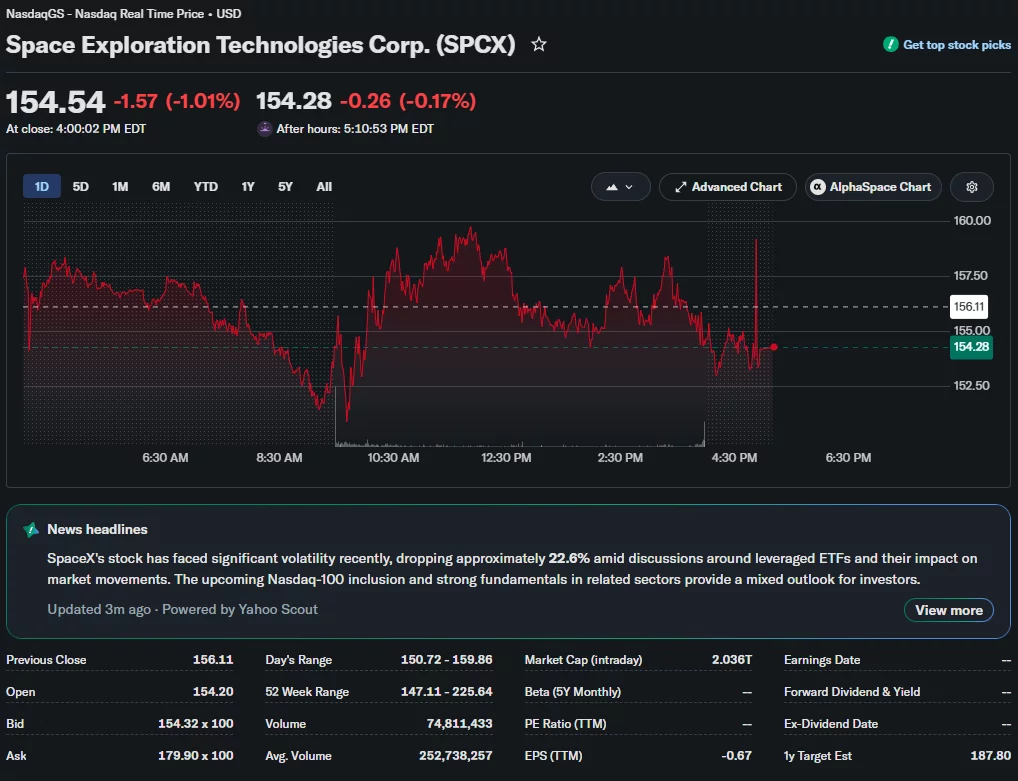
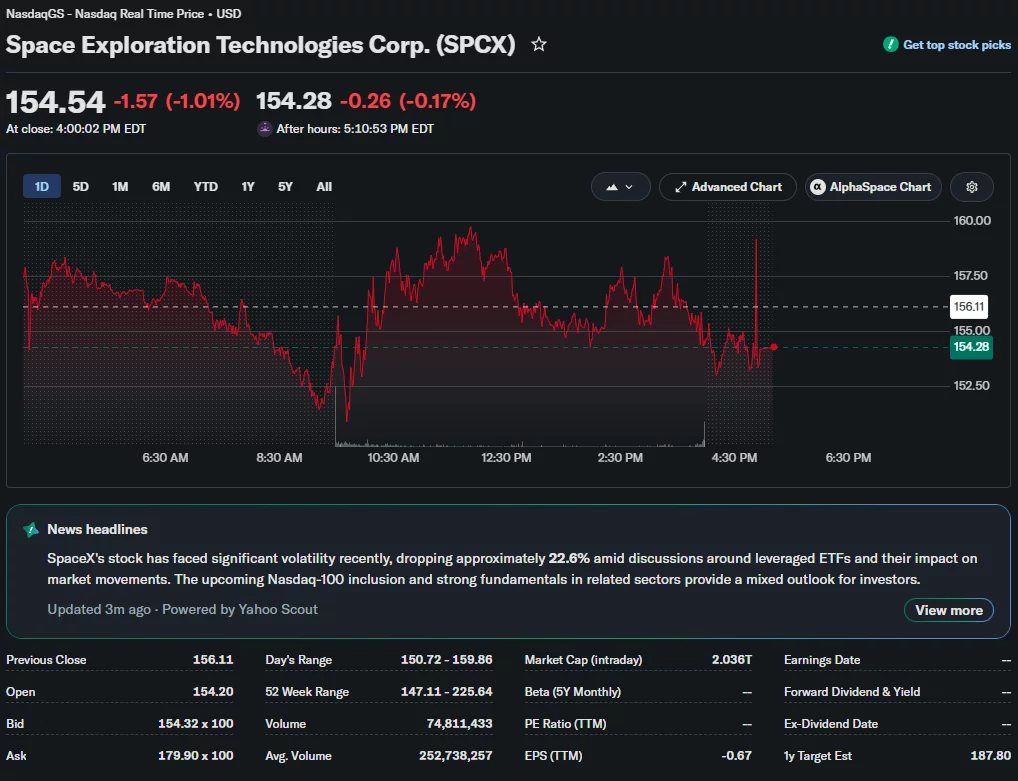
SpaceX shares have remained under pressure after short interest jumped to 13% of the publicly tradable float while the stock lost more than 25% over the past five trading sessions.
Summary
- Short interest in SpaceX has climbed to 13% of the public float as SPCX extends its post-IPO decline.
- Rising bearish bets have fueled debate over a potential short squeeze due to the stock’s limited tradable share supply.
- Susquehanna initiated coverage with a neutral rating, citing valuation concerns despite strong long-term growth drivers.
According to data from Ortex Technologies cited by Reuters, bearish bets against SpaceX have risen rapidly in recent days, pushing short interest from 8% in the previous session to 13% of the company’s public float. The increase comes as SPCX trades roughly 30% below its post-IPO high following a sharp rally after its market debut.
Reuters reported that Ortex co-founder Peter Hillerberg described the pace of short-selling activity as unusual for a company that has been public for only a few weeks.
Hillerberg attributed the move to a growing number of traders positioning for additional downside after the stock’s recent decline.
The selling pressure has coincided with profit-taking in newly listed stocks and a broader retreat across risk assets. Market participants who benefited from SpaceX’s early gains are now reassessing the company’s valuation after the stock’s rapid rise and subsequent pullback.
Limited float keeps short-squeeze risk alive
Despite the increase in bearish positioning, some market observers point to conditions that could make short positions vulnerable if buying demand returns.
Current market data shows approximately 83 million SpaceX shares have been sold short, while average daily trading volume stands near 270 million shares. Under those conditions, a sharp rally could force short sellers to repurchase stock to close positions, potentially accelerating gains through a short squeeze.
At the same time, concerns about future share supply have added another layer to the debate. Economist Peter Schiff argued that SpaceX’s strong first-day performance was partly supported by its relatively small public float. In recent comments, Schiff warned that the number of tradable shares could expand significantly over time.
According to Schiff, the public float may increase from roughly 640 million shares to 7.5 billion shares by Dec. 8, representing an almost twelvefold increase. He argued that a substantial rise in available shares could create additional selling pressure if demand fails to keep pace.
Analysts remain divided on valuation
Recent analyst coverage has highlighted the split between bullish long-term expectations and concerns about current pricing.
As crypto.news previously reported, Susquehanna initiated coverage of SpaceX with a neutral rating and a $170 price target. In a research note, the brokerage stated that the company’s valuation depends on aggressive growth assumptions and premium valuation multiples.
While Susquehanna said it would prefer to wait for a more attractive entry point before taking a more constructive stance, the firm also identified several factors supporting the company’s long-term outlook. Those factors include SpaceX’s dominant position in rocket launches, the growth potential of Starlink, early investments in artificial intelligence infrastructure, and the leadership of CEO Elon Musk.
Even with those strengths, Susquehanna cautioned that a significant portion of the expected growth may already be reflected in the current valuation.
Meanwhile, SPCX fell another 1% during the latest session to $154.54, extending its five-day loss to approximately 26%. Despite the recent decline, the company still carries a market capitalization of about $2.03 trillion.
Separately, the company has attracted investor attention after announcing plans to raise $20 billion through a bond offering, a move that adds another closely watched catalyst as traders debate whether the recent selloff has gone too far or not far enough.


Taiko's L2 bridge went dark early Sunday after an attacker used a signing key that had been left publicly exposed in the protocol's GitHub repository to forge withdrawal proofs and drain roughly $1.7 million from bridge contracts on Ethereum mainnet. The team urged all users to exit every bridge… Read the full story at The Defiant
Five senior Senate Democrats sent a formal letter to Republican committee chairs Tuesday demanding immediate hearings into a reported $500 million transaction in which Abu Dhabi royalty acquired a stake in World Liberty Financial, the crypto firm tied to President Donald Trump, and into the federal… Read the full story at The Defiant


Binance is refusing to retreat from Europe after its Greek bid for a MiCA license collapsed. Multiple reports claimed European Central Bank President Christine Lagarde pushed Athens to reject the world’s largest crypto exchange.
The reversal leaves the company barely a week to find another route into the bloc before its temporary permissions lapse on July 1. Binance insists it has no intention of leaving.
How Binance’s MiCA Bid Unraveled in Athens
Binance filed its Greek application in January 2026 through a local subsidiary. Approval there would have unlocked passporting rights across all 27 member states under the Markets in Crypto-Assets (MiCA) framework.
Without it, unlicensed platforms must stop serving EU clients once the MiCA transitional deadline passes.
Binance had reportedly cleared key reviews before Greece’s approval process unraveled in mid-June. The same reports allege Lagarde told Greek Prime Minister Kyriakos Mitsotakis the exchange was not welcome.
None of the ECB, Greek officials, or Binance has confirmed this claim.
Reuters reported that regulators balked at Binance’s past penalties for money laundering, its sprawling structure, and what they viewed as a risk-taking culture.
In 2023, it pleaded guilty in the US to Bank Secrecy Act and sanctions breaches, paid $4.3 billion, and founder Changpeng Zhao (CZ) stepped down.
“Binance is not leaving Europe,” Gillian Lynch, Head of Europe and UK, reportedly told Reuters.
Follow us on X to get the latest news as it happens
Can the European Central Bank Keep Binance Out?
Reports tie the resistance to Binance’s dominant role in dollar-pegged stablecoin liquidity. The ECB casts such dollar tokens as a threat to monetary sovereignty and is advancing its own digital euro, which it hopes to issue by 2029.
Still, the central bank holds no formal veto over MiCA approvals. National regulators grant the licenses, so Lagarde’s leverage runs through political pressure rather than direct authority.
That structure cuts both ways:
- One approval passports across all 27 states, and Binance needs a single yes.
- Meanwhile, blocking it everywhere would require pressure in every capital it approaches.
Dozens of rivals have already cleared MiCA, including Kraken in Ireland, leaving the biggest exchange a holdout.
Binance contacted four or five regulators but filed only in Greece. France is the likely next test, where Binance has held an AMF registration since 2022 but also faces an aggravated money-laundering investigation by French prosecutors.
Overriding a second national regulator would carry a higher political cost, and Binance has abandoned EU markets before.
Compliance Culture, Not Headcount
Binance’s defense leans on scale, pointing to heavy investment and about 1,500 compliance staff.
Critics argue that it misses the point, because hiring thousands of compliance staff means little if those teams lack authority.
This is much like Binance’s 2022 clash with UK regulators.
“Let’s see how Binance plays the regulatory arbitrage game again…Regulators are ultimately evaluating outcomes, not organizational charts,” OKX CEO and vocal CZ critic, Star Xu, chimed.
Not everyone sees a cliff edge. Analyst Paul Barron called the July cutoff a priced-in consolidation, arguing the headline “90%” counts dormant shell registrations, not active venues.
The coming days will show whether Binance can secure a foothold elsewhere, and how far the ECB’s informal reach extends across the bloc.
The post EU Central Bank President Reportedly Blocked Binance in Greece, Will France Approve? appeared first on BeInCrypto.


World has expanded access to AgentKit, a framework that has enabled verified users to connect AI agents to their digital identities and prove those agents represent real people rather than automated bot networks.
Summary
- World has expanded AgentKit, allowing AI agents to operate on behalf of verified human users through World ID.
- The framework supports AI tools such as Claude Code, Codex, Cursor, Hermes, and OpenClaw.
- A recent sale of 500 limited-edition hats demonstrated how verified AI agents can complete purchases while enforcing one-person limits.
According to World, the rollout comes as AI agents take on a growing number of online tasks, increasing demand for systems that can distinguish between software acting for a specific individual and large-scale automated operations.
The project, backed by OpenAI CEO Sam Altman, said AgentKit allows users to delegate actions to AI tools while keeping identity verification and user controls in place.
The release follows a period of increased attention for the project after major U.S. crypto trading platform Robinhood listed the World token, bringing additional visibility to the ecosystem.
Verified identities allow AI agents to act for users
Details published by World show that AgentKit links supported AI agents to a verified World ID, enabling websites and applications to confirm that an agent is acting on behalf of a unique human user. The company said the system is designed to help businesses enforce user-level rules and reduce abuse associated with automated accounts.
To access the framework, World stated that users need a verified World ID, a World App account, and a compatible AI agent. Supported options currently include Claude Code, Codex, Cursor, Hermes, and OpenClaw.
Through World’s ToolRouter interface, users can create credentials and authorize their agents to interact with supported services. According to the company, this process allows individuals to assign tasks to AI systems without giving up identity verification tied to their accounts.
Rather than relying solely on account credentials, the framework adds proof that an agent represents a verified person, which World said can help online services distinguish legitimate activity from coordinated bot behavior.
Demonstration shows AI agents completing purchases
To showcase the technology, World recently organized a limited-edition sale of 500 “Human in the Loop” hats. According to the company, AI agents handled the entire purchase process for participating users.
World said the agents discovered the product launch, checked eligibility requirements, navigated the online storefront, and completed transactions without direct user involvement during the purchase flow.
Identity checks remained active throughout the event. According to the World, World ID verification ensured that purchase limits were enforced on a one-person-per-item basis, preventing users from bypassing restrictions through multiple automated accounts.
The company reported that all 500 hats were claimed by verified users located in countries including the United States, Germany, Japan, and the United Kingdom. World said the event demonstrated how businesses can permit AI agents to perform online actions while maintaining controls intended to reduce bot-driven abuse and automated farming activity.
As AI-powered software takes on more responsibilities across digital platforms, World said AgentKit provides a way to connect those agents to verified human identities, allowing organizations to verify who is ultimately behind automated actions carried out online.
Quick Summary
-
Kalshi launches legal action against Illinois over state prediction market licensing requirements.
-
New Illinois statute mandates state licenses for prediction market operators.
-
Platform argues existing CFTC regulation preempts state-level requirements.
-
Company requests injunction before July 1 implementation date.
-
Legal battle intensifies ongoing disputes over sports prediction market jurisdiction.
The prediction market platform Kalshi has initiated legal proceedings against Illinois officials, contesting recently enacted licensing legislation governing prediction markets and imposing fees on specific digital asset activities. The platform maintains that its event-based contracts fall under exclusive federal jurisdiction via the Commodity Futures Trading Commission. The company is pursuing court intervention to prevent the regulations from becoming operational on July 1.
Legal Action Targets State Licensing Framework
This week, Kalshi submitted its legal filing to the U.S. District Court for the Northern District of Illinois. The defendants include Governor JB Pritzker, Attorney General Kwame Raoul, and additional state officials. The case targets specific sections of SB3019, legislation that Pritzker approved as part of a comprehensive budget and revenue package.
Under the statute, operators of prediction markets must secure state authorization before conducting business with Illinois residents. Additionally, the legislation implements a 0.2% fee on designated digital asset transactions and associated services. Kalshi contends these mandates undermine a regulatory domain that Congress designated for federal oversight.
The platform functions as a designated contract market with CFTC registration under the Commodity Exchange Act. Kalshi maintains that Illinois lacks authority to establish an independent licensing framework for its federally supervised event contracts. The company asserts that such measures generate contradictory obligations and undermine consistent standards for nationwide derivatives platforms.
Jurisdictional Conflict Between Federal and State Regulators
According to Kalshi, the Commodity Exchange Act grants the CFTC sole jurisdiction over contracts executed on registered exchanges. State authorities, however, classify certain sports-related event contracts as gambling instruments subject to state gaming statutes. This fundamental disagreement has generated multiple legal confrontations between prediction platforms and state enforcement agencies.
The company indicates that adhering to state requirements would necessitate discontinuing specific sports contracts for Illinois customers. Such action could potentially violate federal uniformity standards applicable to products on designated contract markets. Kalshi would also incur significant expenses for geographic restriction technology, regulatory compliance infrastructure, and jurisdiction-specific product modifications.
A jurisdiction-by-jurisdiction regulatory approach could compel nationwide platforms to customize offerings based on individual customer locations. As a result, operators might require distinct licenses, contract portfolios, and access management systems across multiple states. Kalshi contends that Congress established federal derivatives oversight specifically to avoid such fragmented market conditions.
Platform Pursues Emergency Relief Before Deadline
Kalshi has filed for a temporary restraining order preventing Illinois from implementing the challenged provisions. The company also pursues preliminary and permanent injunctive relief pending resolution of its federal preemption arguments. The platform asserts that enforcement would inflict immediate business damage and generate irreversible operational costs.
This legal challenge emerges amid broader litigation concerning sports-focused prediction markets and federal regulatory jurisdiction. The CFTC has contested measures by nine states, including Illinois, while asserting its authority over registered exchanges. States maintain that local consumer safeguards and gaming statutes govern sports outcome contracts.
Illinois officials have previously stated their intention to uphold state authority and pursue consumer protection efforts within their borders. Neither Pritzker nor Raoul have provided immediate statements regarding Kalshi’s current legal filing. The judiciary must now determine whether federal derivatives legislation supersedes the newly established state licensing requirements.

U.S. President Donald Trump has halted the signing of a housing bill that includes a temporary ban on central bank digital currencies (CBDCs), citing a need to prioritize another piece of legislation he is pushing in Congress. The development adds uncertainty to the near-term U.S. regulatory path for digital assets, even as lawmakers move forward on separate crypto bills.
Trump said on Wednesday that he would cancel the signing ceremony for the “21st Century ROAD to Housing Act” and hold it “until such time as we pass the desperately needed SAVE America Act,” according to a post on Truth Social. The housing measure—already passed by both chambers—contains a CBDC restriction through the end of 2030, but also includes a carve-out for certain stablecoins.
Key takeaways
- Trump has delayed signing the 21st Century ROAD to Housing Act due to his insistence that Congress pass the SAVE America Act first.
- The housing bill bans the Federal Reserve from issuing or creating a CBDC (or a substantially similar digital asset) until the end of 2030, while allowing “dollar-denominated” stablecoins that are open, permissionless, and private.
- Trump’s stance raises uncertainty over how (and whether) he will handle other digital-asset legislation pending in the Senate.
- The Digital Asset Market Clarity (CLARITY) Act remains awaiting a potential Senate vote, and Trump has previously signaled support for codifying a “future-proof” market structure.
- If Trump vetoes related legislation, Congress could potentially override with a two-thirds vote in both chambers.
Housing bill stalled despite approval from both chambers
The “21st Century ROAD to Housing Act” passed the U.S. House on Tuesday and had previously cleared the Senate. While many observers expected Trump to sign the bill without delay, his Wednesday announcement suggests he may treat the SAVE America Act as a prerequisite for other legislation.
In his Truth Social post, Trump linked the cancellation directly to the need to pass the SAVE America Act. The bill he referred to is associated with changes to voting procedures, including a requirement that voters provide proof of U.S. citizenship in person to register—an approach that critics have argued could disenfranchise eligible voters.
This is not the first time Trump has floated a broader “no other bills” condition. Earlier this year, he said he would not sign other measures until the SAVE America Act is enacted, a position that now appears to be affecting the timeline for the housing package as well.
What the housing bill does on CBDCs—and where stablecoins fit
Supporters of the housing bill included a CBDC-limiting provision that would restrict U.S. central bank digital currency issuance. As reported in earlier coverage by Cointelegraph, the legislation bars the Federal Reserve from issuing or creating a CBDC or “any digital asset that is substantially similar” until the end of 2030.
At the same time, the bill includes a narrow exception for stablecoins. The text described in Cointelegraph’s coverage allows “dollar-denominated currency that is open, permissionless and private,” a carve-out designed to permit certain stablecoin models even under the broader CBDC restriction.
For crypto market participants, the carve-out matters because it frames how Congress could draw a line between CBDC-style instruments and private stablecoin systems. However, with Trump delaying signing, that legal boundary is not yet locked in—meaning the practical effect of the CBDC timeline could remain uncertain until the housing bill becomes law.
Regulatory ripple effects: CLARITY and the broader “market structure” debate
Trump’s insistence on prioritizing the SAVE America Act has also introduced questions about how he might act on crypto-related legislation that is still moving through Congress. As of Wednesday, the U.S. Senate was reportedly awaiting a potential vote on the Digital Asset Market Clarity (CLARITY) Act, a bill intended to reshape how regulators handle and enforce digital asset-related rules.
Cointelegraph previously reported that Trump said in May he intended to codify a “future-proof digital asset market structure,” which was widely understood as aligning with proposals like CLARITY. While the housing bill’s CBDC provision reflects Congress carving out limitations on central bank-backed digital currency efforts, CLARITY is aimed at defining regulatory roles and enforcement frameworks for the broader digital asset ecosystem.
Given the president’s stated approach of linking bill signings to passage of the SAVE America Act, the immediate risk for crypto policy timelines is straightforward: even if Congress passes measures, final enactment may still depend on executive scheduling and broader political leverage.
Lawmakers may still be able to override a veto
If Trump ultimately vetoes the housing bill or any other digital-asset-related legislation, Congress has a constitutional route to respond. As noted in the source coverage, lawmakers could override a veto by securing a two-thirds majority in both chambers.
That possibility means the outcome is not solely dependent on presidential action. Still, the delay itself can be meaningful for the market: regulatory certainty affects compliance planning, investment decisions, and how institutions allocate resources toward particular product or infrastructure strategies.
For now, investors and builders should watch whether the Senate brings CLARITY to a vote and, crucially, whether Trump’s SAVE America Act condition changes execution timelines for bills affecting the digital asset sector.

Exodus Puts 200-Plus Tokenized Stocks and ETFs Inside Its Self-Custody Wallet via Ondo
The 9 best movie prequels you can stream right now

For Love & Lemons Upgrades Garden Style for the It Girl


-

 Fashion5 days ago
Weekend Open Thread: Miami – Corporette.com
-

 Entertainment4 days ago
Renter of Home in Anne Heche Crash Denies Settlement With Son
-

 Tech3 days ago
Microsoft accidentally kills epic Outlook email threads
-
 Sports1 day ago
Two goals and an assist by sheer aura: Cristiano Ronaldo just entered the World Cup chat
-

 Business4 days ago
Soccer-U.S. defends Iran World Cup travel restrictions, says discussions ongoing
-
Crypto World22 hours ago
Bitcoin (BTC) Dips Below $62K, Ethereum (ETH) Plunges 6% Daily: Market Watch
-

 Politics5 days ago
Andy Burnham and the meaning of Makerfield
-

 Politics6 days ago
BBC Reporter Discusses Cross Party Criticism Of Trumps Iran Deal
-

 Crypto World19 hours ago
Securitize Wraps Roubini's SEC-Registered ETF as Dubai VARA Digital Security
-
Business1 day ago
Entergy settles forward sale agreements, raises $672 million in cash proceeds
-
 Business5 days ago
Wall Street Week Ahead: Investors see Micron earnings as pulse check of AI rally momentum
-

 NewsBeat5 days ago
Keir Starmer Allies Question His Chances For No 10
-

 Tech6 days ago
AWS enters the context layer race with a graph that learns from agents, not manual curation
-
 Crypto World5 days ago
Can Charles Hoskinson Really Rescue Cardano?
-

 Crypto World5 days ago
HIVE shares jump as $220M AI deal speeds Bitcoin mining pivot
-

 Crypto World5 days ago
Jake Chervinsky accuses CME of protecting derivatives monopoly
-
 Tech4 days ago
Signal’s Meredith Whittaker says AI chatbots ‘are not your friends’ and calls Copilot agents a backdoor
-

 Entertainment5 days ago
Jose Alvarado Wants Taylor Swift at More Knicks Games
-

 Tech2 days ago
Nearly 7,000 fake Amazon domains registered ahead of Prime Day 2026, researchers warn
-

 Business6 days ago
Brexit cost 6% of UK economy, Bank of England company data suggests
You must be logged in to post a comment Login