
Crypto World
UK Sends 81,000 Crypto Tax Warnings as HMRC Targets Unpaid Bull Run Gains


HM Revenue and Customs (HMRC) has significantly increased its scrutiny of UK crypto users during the 2025-2026 financial year.
The tax authority reportedly sent more than 81,000 warning letters to holders it suspects may have unpaid tax, the BBC reported after reviewing a freedom of information request.
UK Holders on Notice
The number is nearly three times higher than the 27,714 letters sent in 2024. HMRC believes a large share of the unpaid tax relates to gains made during the crypto bull run between 2022 and 2025. The tax authority has reminded recipients that obligations can arise when crypto is sold, given away, exchanged, or used to make purchases.
Failure to pay can result in penalties of up to 100% of the tax owed, in addition to interest. Meanwhile, offshore transfers potentially carry greater consequences.
The crackdown is also set to become broader as HMRC prepares to receive new powers in 2027. Offshore firms will be required to hand over customer information to the UK tax authority, which estimates the measure could raise £315 million (or $430 million) by 2030.
Neela Chauhan, a partner at accounting firm UHY Hacker Young, told the BBC that many traders are young and have had little previous experience dealing with HMRC. She said some operate on the assumption that the agency has limited visibility into their crypto activity. Chauhan also said authorities suspect many investors of evading tax and suggested that identifying unpaid liabilities among wealthy holders could become considerably easier once the new powers take effect.
While HMRC is tightening oversight, banking access is becoming a serious concern for the industry.
Banking Roadblocks
Earlier this month, Parliament’s Crypto and Digital Assets All-Party Parliamentary Group asked the chief executives of major UK banks to explain how they deal with cryptocurrency businesses. Labour MP Gurinder Singh Josan and Lord Vaizey of Didcot sent the letter after hearing repeated complaints from firms unable to open bank accounts, alongside reports of restrictions on payments.
The group asked banks about their policies, transaction limits, reasons behind those decisions, and whether the country’s incoming crypto rules could change their approach. The MPs accepted that banks must tackle financial crime and protect customers, but asserted that firms should be judged on their individual risk rather than simply being part of the sector. Vaizey called the banking problems “an unnecessary piece of friction.”
Research from the UK Cryptoasset Business Council found that banks were blocking or delaying around 40% of attempted transfers to digital asset exchanges.
The post UK Sends 81,000 Crypto Tax Warnings as HMRC Targets Unpaid Bull Run Gains appeared first on CryptoPotato.


Bitwise Asset Management took in more than $1.8 billion of new money in the first half of 2026, chief executive Hunter Horsley said Sunday. Crypto prices fell through most of it.
Tom Lee called the result outstanding. However, the money did not chase prices, as three of the four Bitwise product lines behind that total pay investors an income instead.
Why Lee Called It Outstanding
Horsley posted the figure on Sunday. Net inflows measure new money in, minus money pulled out.
In H1 of this year, amidst a bear market, investors put over $1,800,000,000 into Bitwise products (“net inflows”),” the Bitwise executive shared.
Tom Lee, co-founder and head of research at Fundstrat Global Advisors, commented, lauding the team for growing significantly despite bearing market conditions.
Lee has stayed bullish through the slump. He ranked 17 crypto stocks earlier this week. Bitcoin (BTC) traded near $77,403 on Sunday, little changed.
What the Money Actually Bought
Horsley said four franchises each drew over $100 million. They were:
- ETFs and ETPs (exchange-traded funds and products)
- Private strategies
- Staking, and
- Vaults.
Three of them pay a yield. Bitwise numbers show how much.
Its vault, opened in January with the onchain lender Morpho, targets about 6% a year on stablecoins. Its tokenized Crypto Carry Fund held $259 million by late May and yielded 4%.
Carry sounds complex but is simple. The fund buys crypto, sells futures against it, and keeps the gap.
Staking drew the fastest money. Bitwise’s Solana staking fund passed $500 million just 18 days after listing last November. Rivals now rush to put Ethereum yield in ETPs.
The Fund That Sells Price Alone Shrank
One Bitwise product pays nothing. The Bitwise 10 Crypto Index ETF (BITW) holds a basket of large tokens. Bitcoin and ether are about 91% of it.
Its filings tell the story. Net assets fell from $1.03 billion on December 31 to $678 million on March 31. That is 34% gone in three months.
Two forces did it. Price per share dropped 24%. Investors also cashed out 2.25 million shares, about 13% of the fund.
Cost was not the reason. Bitwise had just cut the fee from 2.50% to 0.75% when the fund joined NYSE Arca in December. The same fund gained 94.8% in 2024.
Staff felt it too. A Bitwise workforce reduction on August 12 cut headcount from roughly 180 to 155.
Net inflows count deposits, not gains. Inside Bitwise, investors paid for yield and walked away from price.
The post Bitwise Just Took $1.8 Billion in a Bear Market, Tom Lee Noticed appeared first on BeInCrypto.


An artificial intelligence (AI) security firm went public with a Ledger Ethereum app bug. Ledger says it had already fixed the flaw quietly, two weeks earlier.
Chief technology officer Charles Guillemet called the disclosure fear-mongering. The patch shipped on August 12 with a one-line note and no security bulletin.
What the Ledger Ethereum App Bug Actually Did
Ledger sells one core promise. The screen shows you what you are signing. That promise has a name. Ledger calls it clear signing, and it turns raw transaction code into plain words on the device screen.
TestMachine says it found a way around that. The firm builds an AI agent called Azimuth that hunts exploits in smart contracts. On its own EVMBench benchmark, Azimuth catches 86.3% of known bugs with roughly 2.7% false positives.
Here is the flaw in plain terms. A malicious website could send the device a second command while you were still reading the first one.
The channel between browser and device is called the Application Protocol Data Unit, or APDU. It kept listening during the review. So it accepted the swap.
You would read a small transfer on screen. Then you would tap approve. And you would actually sign an unlimited token approval to a stranger.
That last part is why this matters. Chainalysis has traced roughly $1 billion in crypto stolen through approval phishing since May 2021. Those victims signed the approvals themselves.
TestMachine says it confirmed the bug on a Ledger Flex. Ledger has sold more than 7 million devices across 180 countries.
Ledger’s Donjon Team Says It Got There First
Guillemet flips the timeline. Donjon is Ledger’s in-house hacking team. He says it caught the bug with its own AI tools and shipped the fix first.
The public changelog backs the date. Version 1.22.2 landed on Aug. 12. Its entire security note says “Security issues.”
Donjon has published 22 numbered security bulletins. None of them covers this bug. The latest, dated June 4, deals with a Monero key-recovery issue instead.
That silence is the gap TestMachine walked into. Ledger closed the hole, then never told owners what it had closed.
Guillemet’s sharper complaint is about manners. He says TestMachine contacted the bounty program only after the patch shipped. It never spoke with the bounty team.
“…Then they published a thread implying the problem is unsolved. It is not. That’s not security research. That’s manufacturing fear for attention,” Charles Guillemet, Ledger CTO remarked.
Follow us on X to get the latest news as it happens
TestMachine praised the speed of the fix and turned down the reward. Ledger pays bounties in Bitcoin, at an amount it sets case by case.
AI Found the Bug Twice, But Humans Still Fought
Both sides used machine learning to reach the same defect. That is the part worth watching.
Ledger has made this argument before. Its executives have said for months that AI attackers threaten wallets more than weak hardware does.
Guillemet drew his line at discipline.
“AI-speed research only makes the ecosystem safer if the people doing it still follow basic security principles. Disclose responsibly. Verify before you publish. Don’t confuse noise with a finding.”
The fight itself is familiar. Security firms have gone loud after hacking a Trezor device, and CertiK researchers fought Kraken over disclosure terms in 2024.
So is the flaw. Back in January 2021, Donjon disclosed that this same Ethereum app failed to show transaction data for unsupported assets. Same app, same lesson. What you saw was not what you signed.
AI now surfaces these bugs in hours. Vendors and researchers still coordinate at human speed. That gap is where this argument lives.
For owners, the fix is dull. Open Ledger Live, update the Ethereum app, and check that it reads 1.22.2.
The post AI Firm Exposes Ledger Bug, CTO Calls It Fear-Mongering After Quiet Fix appeared first on BeInCrypto.

Crypto investors may be underestimating where the industry is heading, according to Bitwise Chief Investment Officer Matt Hougan, who has pointed to three mistakes he sees in the market right now.
In a recent post, Hougan said that investors are using today’s market size, established brands, and current activity to judge crypto’s future. Those are normally reasonable approaches, but the space is evolving so quickly that these assumptions are becoming outdated.
Investors Missing the Bigger Market
His first point is that investors are underestimating what crypto applications could eventually be used for. Uniswap, for example, was built as a platform for trading cryptocurrencies, but Hougan said it should not necessarily be valued only against the roughly $2 trillion market. As stocks, bonds, real estate, and other assets move onto blockchains, the addressable market for platforms such as Uniswap could become much larger.
The stock and bond markets are worth about $150 trillion and $350 trillion, respectively. Tapping these spaces could create an opportunity roughly 100x larger than crypto alone. Hougan said the same applies to applications such as Hyperliquid, Aave and Chainlink, which investors often view simply as crypto platforms.
The second mistake is assuming that the biggest TradFi companies will eventually take over crypto-native businesses. The exec pointed to PayPal’s stablecoin launch in 2023 as an example. Despite its global brand and position in payments, PYUSD only accounts for 1% of the stablecoin market, while Tether and Circle dominate 88%.
Fidelity faced a similar situation after launching its crypto custody service in 2019. While Fidelity has performed well in the market, Coinbase has become the largest crypto custodian in the US. The same goes for CME’s position in crypto derivatives and Bakkt, which was backed by Intercontinental Exchange, as examples of traditional finance companies that did not end up dominating their respective markets.
He said crypto-native firms have an advantage because they tend to move faster, focus entirely on crypto, and already have users and trust within the sector.
100x More Transactions?
The third mistake is using current transaction volumes to estimate how much activity blockchains will eventually handle. Tokenized stocks could trade around the clock, rather than during current market hours, with AI agents eventually monitoring portfolios and executing trades on behalf of investors. US stocks currently trade for 33 hours a week, compared with 168 hours in a 24/7 market.
While this alone does not mean volume will rise 5x, Hougan believes that the combination of round-the-clock trading and AI-driven activity could push stock transactions 10x higher. He added,
“I can imagine 50x or 100x.”
There exists a similar opportunity in payments, where activity involving AI agents could far exceed current levels. While higher volumes may bring lower fees, Hougan asserted that transaction growth of this scale is likely to more than offset that pressure.
The Bitwise CIO isn’t the only one pointing to artificial intelligence as a potential catalyst for crypto. Back in June, Binance founder CZ said that AI agents could rely on blockchain payments because TradFi systems often require human authentication and are not designed for autonomous software.
He expects agentic trading and payments to emerge within months, while AI-related activity could also add to blockchain trading volumes rather than compete with crypto.
The post Three Crypto Investing Mistakes Could Be Hiding a Much Bigger Opportunity appeared first on CryptoPotato.
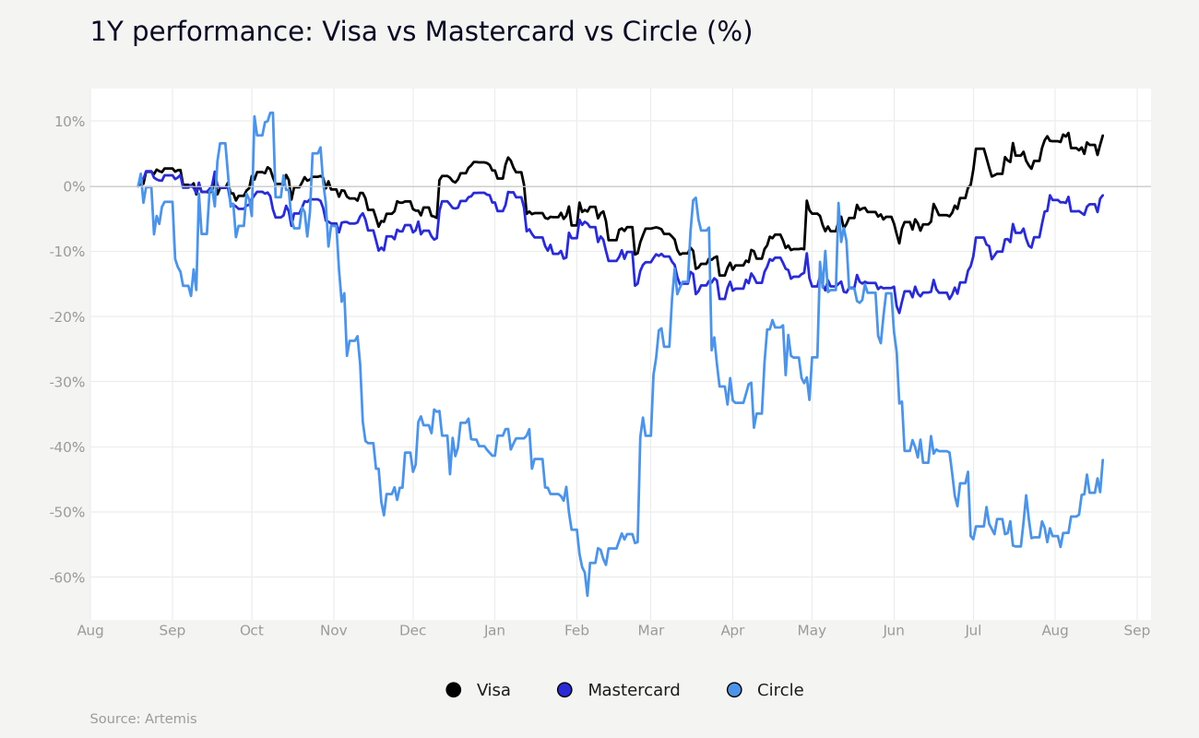
Cathie Wood has kept buying Circle as the stock fell 42% in a year. On Sunday she said why. Wall Street analysts who built their careers on Visa and Mastercard, she argued, cannot understand the company.
Circle issues USDC, a digital dollar backed by cash and short-term US government debt. Wood runs ARK Invest, and Circle is now the biggest crypto bet in her flagship fund.
Wood’s Case Against the Analysts
Wood was replying to a chart built from Artemis data, where analyst Alex Obchakevich indicated that the market was changing its mind about who actually earns money on stablecoins.

It tracked the three payment firms over a year. Visa was up about 5%, Mastercard about 1%. Circle was down 42%.
Though CRCL has appreciated 84% since its IPO, this one-year chart illustrates the inefficiency of public equity markets in the short term. Many financial services analysts have built their long-term track records off of $V and $MA and cannot fathom Circle, the disrupter,” Wood challenged.
Follow us on X to get the latest news as it happens
She then reached for history. Mastercard is up roughly 150 times since it listed, she said, and Visa roughly 33 times.
Analysts who told clients to buy those dips looked brilliant. Technology, not analyst skill, is now rewriting payments, and Circle should gain.
Her History Lesson Holds Up, But One Number Does Not
Both multiples survive a check. Mastercard priced its 2006 float at $39 a share. It later split its stock 10 ways, so that entry is worth $3.90 in today’s money. Against Friday’s close of $580.63, that is 149 times.
Visa sold shares at $44 in March 2008 and split them four ways in 2015, an adjusted $11. At $371.04 on Friday, that is 34 times. Wood’s arithmetic is sound.
Her Circle figure is not. Circle priced its June 2025 float at $31. The stock closed Friday at $87.98. That is a gain of about 184%, not 84%.

Wall Street Cannot Agree What Circle Is Worth
The sell side is not ignoring Circle, which weakens her framing. Of 21 analysts covering it, 11 call it a strong buy and two a buy. Five say hold. Three say sell.

Their price targets are stranger still. The most bullish is $173. The most bearish is $37. That is a 4.7-fold gap on the same company on the same day. The average sits at $98.61.
Analysts covering a mature payment network do not disagree by that much. On Circle they have no shared method. Much of its money comes from interest on reserves, which shrinks when rates fall. The rest rides on how fast digital dollars get used.
The accounts show that split. Revenue grew about 37% and the company is profitable after a Q2 earnings surprise in early August. Its market value still fell 30%.
Competition muddies it further. Circle is building a four-layer financial stack on its Arc blockchain. Open USD, a rival stablecoin consortium of more than 140 firms, wants the same rails.
Wood is not hedging. ARK’s flagship fund held 3,931,968 Circle shares on Friday, worth $329 million and 5.14% of the portfolio. That beats its Coinbase stake. She may be proved right. For now her money says what the $37 and $243 targets say. Nobody has settled what Circle is.
The post After Buying Circle Through a 42% Drop, Cathie Wood Says Analysts Cannot Fathom It appeared first on BeInCrypto.
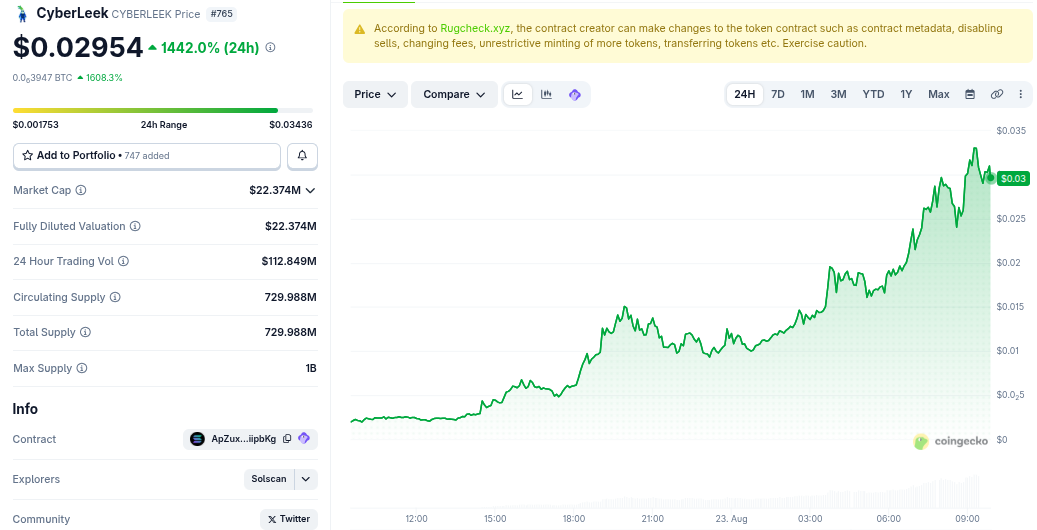
CyberLeek claims it will trigger an automatic worldwide release of a playable GTA VI build if legal action forces the group offline, even as its associated meme coin explodes 1,400%.
A fact-check has since found that the key piece of evidence behind that specific threat was fabricated.

What CyberLeek Claims and What’s Been Debunked
According to initial reports, complete copies of the build have already been distributed across global servers and hard drives, ready to be deployed automatically if it faces legal action or is shut down.
A leaked clip showing the protagonist, Jason, firing bullets into a wall to spell “LEEK” strongly suggests real-time control of an in-development version rather than pre-recorded footage. Additional clips have shown flying sequences over Vice City, high-speed driving, combat, and map details from the Leonida setting.
Follow us on X to get the latest news as it happens.
CyberLeek frames its actions as a protest against digital-only releases, “fake” single-player DLC, and the loss of offline access after server shutdowns.
A recent fact-check found that the specific “Notice to Rockstar” screenshot, cited as proof of the automatic release threat, does not appear on CyberLeek’s actual website and is considered fabricated.
Take-Two’s lawyers have escalated their legal response accordingly. A New York federal judge already approved subpoenas compelling Microsoft and Discord to hand over account and device data tied to the CyberLeek persona by September 4, and the company has since issued a similar subpoena to X, seeking to unmask the account behind the leaks.
Why the Meme Coin Is Drawing Scrutiny
Alongside the leaks, the associated Solana-based meme coin, CYBERLEEK, exploded in value. Launched around August 15, shortly before the first major footage dropped, the token has seen multiple surges driven by viral attention.
Early pumps exceeded 5,000% in short periods, with recent 24-hour gains surpassing 1,400%. Market cap has climbed from near-zero levels to $22 million amid heavy trading volume, with trading volume often exceeding $112 million, according to CoinGecko data.
Videos watermarked with QR codes and calls to buy the token link the hype directly to the leaks. Holders have even voted with CYBERLEEK donations to decide the next content drop, tying continued leaks to trading activity.
Critics, including consumer advocacy groups, have labeled the campaign a pump-and-dump scheme exploiting GTA VI excitement.
Subscribe to our YouTube channel to watch leaders and journalists provide expert insights.
Rockstar’s official Extended Look is scheduled for August 27 on Netflix, with the full game still set for November 19, 2026, on consoles.
As legal pressure mounts and speculation swirls, the dual narrative of high-stakes leaks and crypto frenzy continues to dominate gaming and crypto communities.
The post CYBERLEEK Meme Coin Explodes 1,400% Amid GTA VI Leak Controversy appeared first on BeInCrypto.
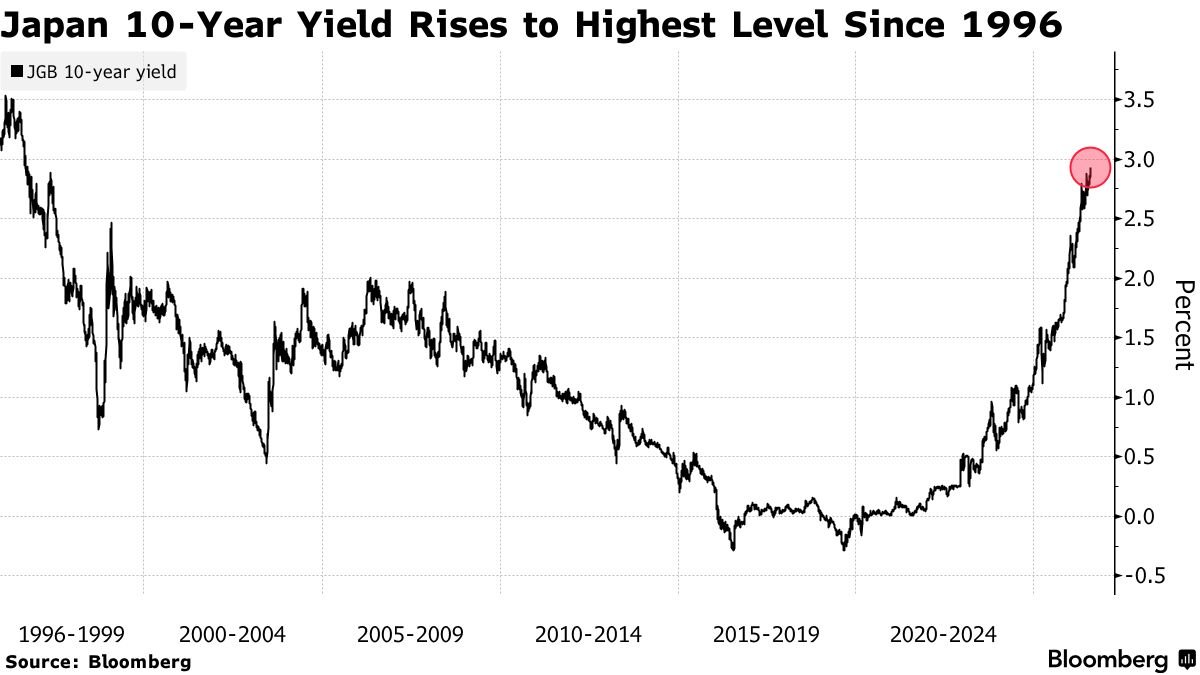
Japan’s 10-year government bond yield (JP10Y) touched 2.945%, its highest level since September 1996. The yen has since slipped back toward 159 per dollar, undoing almost half of this month’s rescue rally.
Bitcoin (BTC) has ignored all of it. The pioneer crypto is up 22% in seven days. That gap between Japan’s stress and crypto’s calm is the real story.
Follow us on X to get the latest news as it happens
A 30-Year Record, Broken Twice Over
Data puts the peak at 2.945%, a level last seen in September 1996. Japan’s 30-year yield hit 4.115% the same morning.

“Japan’s bond market is flashing another major warning…10-year government bond yield has surged above 2.95% for the first time since 1996…At the same time, the Yen has given back much of its recent intervention-driven gains, adding another potential source of pressure on Treasuries,” analysts at the Global Markets Investor noted.
The cause is simple. Prices are climbing again. Core inflation reached 1.8% in July, up from 1.6% in June.
Strip out food and fuel and the figure was 1.9%. Traders read that as a green light for the Bank of Japan.
The BOJ meets on Sept. 17 and 18. Economists widely expect it to lift its policy rate from 1% to 1.25%, its next step in the exit from ultra-low rates.
Why Bitcoin Traders Watch the Yen
For years, investors borrowed yen at almost no cost. They swapped it for dollars and bought riskier assets. Traders call this the carry trade.
The Bank for International Settlements sized yen loans to offshore non-banks at roughly $250 billion. Broader measures reached about $500 billion.
When the yen jumps, those positions turn loss-making within hours.
“Your entire annualized carry just wiped out in one move,” Praneet Shah said. He is global head of FX options trading at Goldman Sachs.
August 2024 showed the damage. Bitcoin opened that month near $64,600 and wicked down to $49,000 on Aug. 5, according to VanEck. Tokyo’s TOPIX index fell 12% in one session.
The Trigger Has Not Arrived Yet
Tokyo and Washington intervened together in early August, their first joint operation since 2011. Goldman strategist Karen Fishman estimated Japan spent about $85 billion over two days.
It bought roughly three weeks. The yen reached 155.20, then drifted back above 158.
Japan funded part of that defence by selling US debt. Its Treasury holdings fell $26.4 billion in June to $1.117 trillion, the deepest monthly cut by any country.
American borrowing costs followed. The 10-year Treasury yield hit 4.74% on August 21, and Washington has since widened its long-dated bond buybacks.
“The debt CRISIS is not just a US story,” the analysts added.
The Bitcoin market price sits near $77,355 through all of this. Ray Dalio reads the same debt data as a reason to own Bitcoin, pairing a small position with 10% to 15% in gold.

History suggests the danger comes from a yen that surges, not one that sinks. Right now it is sinking. September is where Japan’s overlapping battles could flip that.
The post Japan Borrowing Costs Reach 1996 Highs: Will the Weak Yen Hurt Bitcoin? appeared first on BeInCrypto.

“Yesterday’s new mail-in voting rule is an attempt to weaponize USPS as part of the Trump administration’s efforts to take over elections,” Michael McNulty, the senior policy director for government-reform nonprofit Issue One, said in a statement Saturday.
McNulty argues that the rule would shift postal workers “from neutral transporters of a state-led process to a federal gatekeeper of states’ outbound mail ballots.”
However, the USPS has asserted in the final rule that the requirements “do not amount to election administration, nor do they usurp state resources.”
“Rather, they regulate the use of the mail to improve operational efficiency and support the faithful execution of federal law,” it says within the rule.
Voting-rights groups challenge the USPS mail-in ballot rule
A coalition of voting-rights organizations has filed an emergency motion asking the federal district court to enforce its Aug. 11 injunction against USPS. The plaintiffs argue that issuing an immediately effective final rule, intended for possible use in November, violated the injunction.
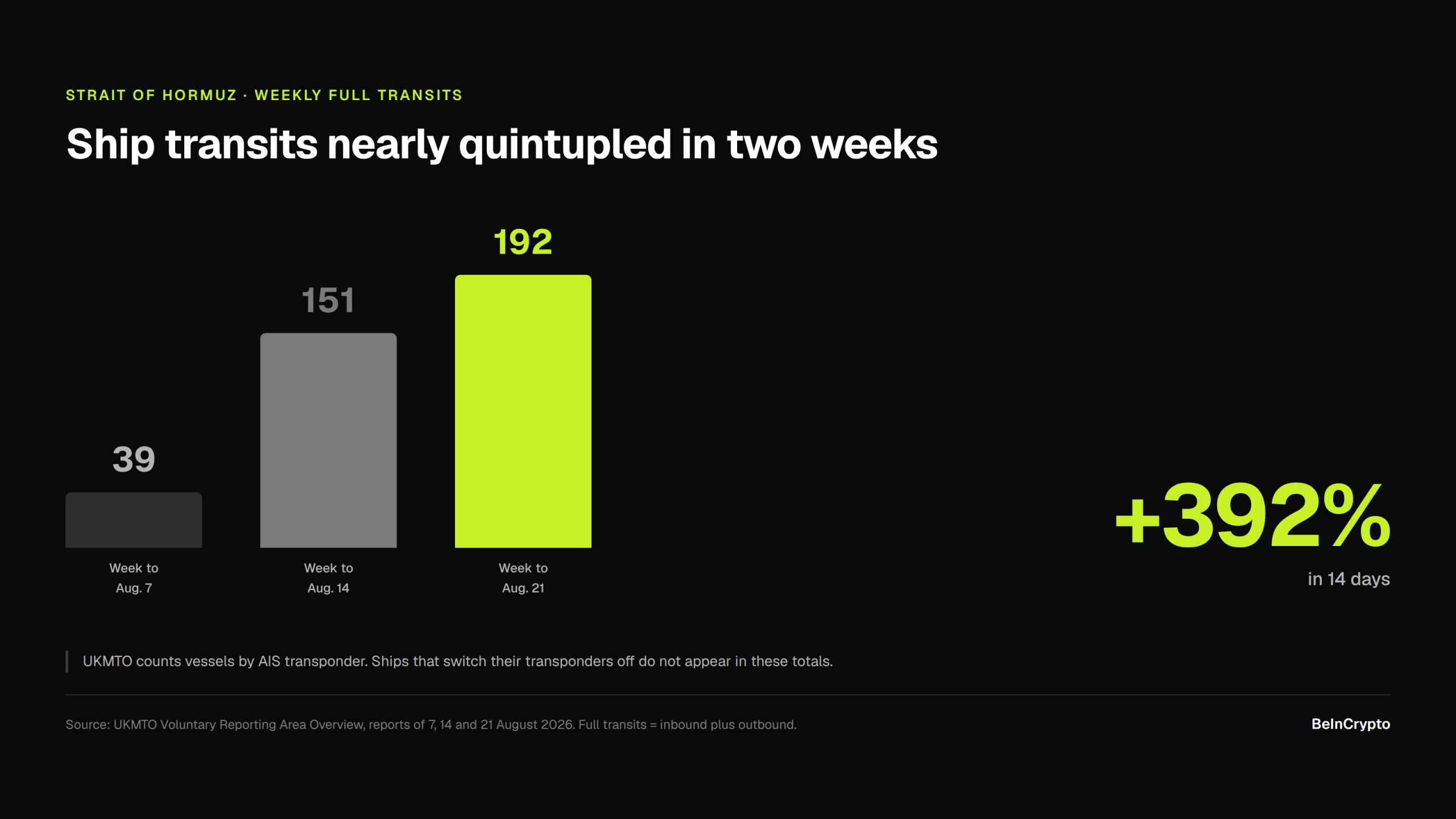
Ship traffic through the Strait of Hormuz jumped almost 400% in two weeks. The report landed on Saturday, with oil markets shut. Monday is the first chance traders get to price it.
On the surface, that should ease supply fears and pull crude lower. More ships means more oil. Yet the shipping data carries a catch that argues the drop may never arrive.
Hormuz Traffic Recovers But Stays Far Below Pre-War Levels
The surge is real, and it is easy to check. UK Maritime Trade Operations (UKMTO), the British naval body that tracks merchant shipping in the Gulf, publishes a weekly transit count.
In the week to August 7, it logged 39 full transits. A week later, 151. In the week to August 21, 192, according to its latest report. That is a rise of 392% in 14 days, so the headline number holds up.

The baseline is another matter. Before the war, roughly 20.9 million barrels a day moved through the strait, EIA figures show. That is close to a fifth of everything the world burns.
Today’s traffic sits about 90% below that mark, by UKMTO’s own reckoning. Going from almost nothing to slightly more than almost nothing still produces a spectacular percentage.
Most of the returning ships hug Oman’s coast, on a corridor backed by Washington and rejected by Tehran, which cannot levy a toll on it.
The arrangement has a precedent. In 1987 the US reflagged 11 Kuwaiti tankers and sent the Navy to escort them through the same water. The first convoy sailed on July 22. Two days later the tanker Bridgeton struck a mine.
“It increasingly looks like Iran has at least partially lost control of the strait,” Homayoun Falakshahi, head of crude oil analysis at Kpler, told CNN.
Follow us on X to get the latest news as it happens
Why the 400% Is Weaker Than It Looks
Start with how the count is made. UKMTO tracks vessels by their transponders, and in a war zone many captains simply switch them off.
Windward, a maritime data firm, recorded nine ships crossing the southern corridor dark overnight on August 21. It called that the largest single night on record.
So part of the 400% is not new ships at all. It is old ships turning their signals back on. The count has risen faster than the cargo, a gap earlier analyst timelines for Hormuz had already flagged.
Barrels tell the sober version. Energy Secretary Chris Wright puts outflows near 9 million a day. Rory Johnston, who writes the Commodity Context newsletter, reckons the peak is closer to 7 million.
Either way, the strait is running at under half its pre-war norm.
Refined fuel is tighter still. The US diesel crack spread, the margin refiners earn turning crude into diesel, hit an all-time high of $102.20 on August 17, Reuters reported. In calmer periods it sits in the teens or low twenties.
That squeeze, rather than any shortage of crude itself, is what has been setting Brent crude prices.
Both benchmarks gained about 5% across the week, so crude enters Monday with momentum behind it rather than against it.
Prices held up once before, when supertankers resumed Hormuz transit earlier in the war. That remains the closest precedent for Monday.
WTI and Brent Test the May Downtrend Before Monday
US crude spot settled at $87.57 on Friday, up 0.43%. UK crude spot closed at $92.40, up 0.75%. Both are spot contracts, the series these charts track, and they run a little under the front-month futures.

Those are the levels Monday opens from. Each sits just below a descending trendline drawn from the May highs. Brent has already breached its line, while WTI trades a fraction beneath its own.
Futures reopen on Sunday evening in New York, which makes Monday the first full session. It opens with a policy headline attached.
Treasury Secretary Scott Bessent has called a Monday press conference to unveil new Iran sanctions. Mohsen Rezaei, who runs Iran’s Supreme National Security Council, has warned Tehran will strike at the interests of any country that joins in.
Speaking in South Carolina on Friday, President Donald Trump restated his claim on the waterway.
“We don’t even know if we won, because I view the Strait of Hormuz as an American territory right now,” Trump, quoted by UPI.
So which way does Monday cut? Sanctions restrict supply, and that argues for higher prices rather than lower ones.
For oil to break lower, the package would have to land softer than trailed, or carry a hint that talks are back on.
A rejection at the trendline would be the first confirmation. It keeps May’s pattern of lower highs alive and puts $71.25 on WTI and $77.78 on Brent back in view.
A close above the line does the opposite. It would mark the first genuine break since the war began, and every Brent price forecast built on that downtrend would need rewriting.
The post 400% Strait Traffic Surge Eases Supply Fears, Will Oil Break Lower Monday? appeared first on BeInCrypto.
The SEC published its Reg Crypto proposal last week, giving the public 60 days to comment.
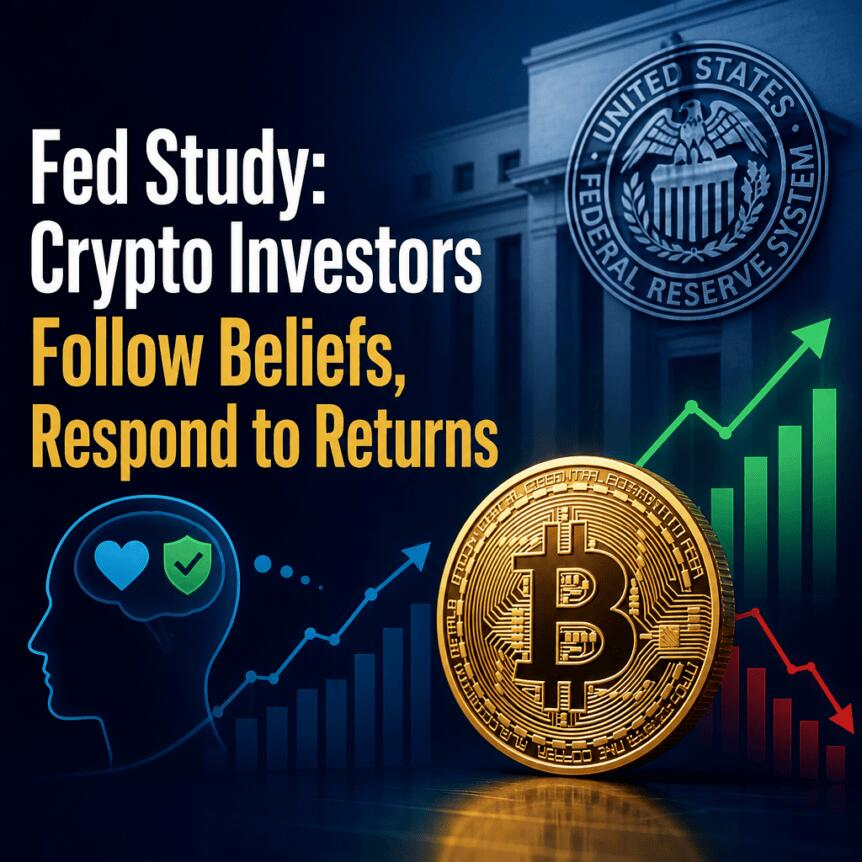
A new working paper from the Federal Reserve Bank of Cleveland argues that the main reason cryptocurrencies don’t behave like other financial assets may have less to do with demographics and more to do with beliefs. According to the authors, Americans who own crypto—and those who plan to buy—often hold sharply different expectations about what digital assets will return, and those expectations help explain who participates in the market in the first place.
The paper also presents experimental evidence suggesting that information about Bitcoin’s recent performance can meaningfully change what households say they want to hold, and can translate into higher actual purchases. If those findings are broadly applicable, they offer a mechanism for why crypto can stay volatile and why rallies can pull in new buyers in a reinforcing loop.
Key takeaways
- Beliefs about future crypto returns explain participation better than standard demographics, according to a Cleveland Fed study using large household survey waves.
- Most non-owners report they don’t know what crypto returns to expect, while crypto owners forecast substantially higher returns.
- In an information experiment, showing households Bitcoin’s past 12-month return increased desired allocation and subsequent purchases.
- The study frames crypto volatility as partly driven by disagreement and learning, not only fundamentals.
Return expectations are the clearest predictor of ownership
Researchers Michael Weber, Bernardo Candia, Olivier Coibion, and Yuriy Gorodnichenko analyze repeated surveys of up to 25,000 U.S. households per wave. Their central finding is straightforward: expectations about crypto returns account for more of the differences in who owns cryptocurrency than a wide range of demographic characteristics.
In the paper, the authors highlight that the typical person outside the crypto market struggles to form a return forecast at all. In a 2021 Federal Reserve survey referenced by the authors, 87% of people who did not own crypto said they didn’t know what return to expect over the following year. Among crypto owners, the share who didn’t know was still high at 54%. The gap in knowledge is large, but the gap in forecasts that do exist is even larger.
For people willing to estimate returns, crypto ownership aligns with materially higher expectations. The study reports that crypto owners expected an average 22% return over the next year, versus 7% among non-owners. Owners also tended to judge crypto as less risky than non-owners did.
Most importantly for understanding market behavior, the authors show that these expectations are unusually powerful statistically. They find that a one-percentage-point increase in an individual’s expected crypto return is associated with a 0.8-percentage-point increase in the probability of owning cryptocurrency. When return expectations and perceived risk are considered together, they explain far more variation in ownership than observable characteristics such as age, income, and gender.
The researchers argue this makes crypto an outlier relative to other asset classes. For stocks, bonds, and gold, standard demographic and financial factors typically have more explanatory power than differences in expected returns. In crypto, the direction of explanatory power appears to flip.
Crypto participation still looks demographic—but beliefs dominate
Even with expectations taking center stage, the paper does not claim ownership is entirely divorced from who people are. The demographic pattern remains distinct after controlling for other variables. People under 40 are reported as 13 percentage points more likely to own cryptocurrency than those over 60.
Gender and household wealth also show up in the data. The study finds that men are about 4 percentage points more likely than women to own crypto, and that higher-income and wealthier households participate at higher rates. But the authors’ comparison is that these effects—distinct as they may be—are secondary to the role of beliefs about returns and risk.
This matters because it reframes a common debate. Instead of treating crypto’s unusual ownership pattern as mainly a story about who is “more risk tolerant,” the paper pushes investors to focus on what market participants think crypto will do—and how those beliefs differ from one another.
Information about recent Bitcoin returns can change behavior
The paper’s most actionable evidence comes from a randomized information experiment described by the authors. In 2025, households were randomly assigned to receive information that included Bitcoin’s previous 12-month return, alongside other choices that related to stocks and topics such as GameStop or inflation. The paper reports that participants shown Bitcoin’s recent performance increased both what they wanted to hold and what they went on to buy.
Specifically, the treatment increased desired crypto allocation by about 2 percentage points—roughly a 47% increase relative to the 4.3% desired allocation among the control group. The authors also report an increase in subsequent crypto purchases of about 2.5 percentage points.
The paper describes the result as induced demand: “providing information about recent Bitcoin returns induces some households to start buying cryptocurrency.” The effect is not uniform, however. It is concentrated among individuals who said they did not own crypto because they lacked sufficient information. Those who already believed crypto was a bad investment did not meaningfully respond to the information treatment.
In practical terms, the study suggests that crypto participation can be changed by what people are told about what happened recently—not just by long-term narratives or individual risk preferences. For traders and market observers, that implies that retail demand may be unusually sensitive to framing, past performance information, and perceived signal quality during momentum periods.
Why volatility may persist: learning, disagreement, and “past gains”
Beyond ownership and demand, the paper connects its survey and experimental findings to a broader market question: why crypto markets can produce persistent volatility. The authors describe a mechanism often discussed in behavioral finance—past positive returns can attract new participants, whose purchases can push prices higher and potentially draw still more buyers.
They present the logic explicitly, writing that “positive returns attract new participants, which raises the price further.” The authors further argue that this dynamic may be particularly relevant because crypto remains poorly understood by a large share of the population, and beliefs about future returns are therefore likely to be fragmented.
The study also examines whether crypto gains show up in household spending in a way consistent with lasting wealth effects. It reports that when a household’s entire financial portfolio was in crypto, a doubling of Bitcoin’s price increased the probability of buying a durable good by 1.4 percentage points—about a 7% increase relative to the unconditional likelihood of such a purchase. However, the effect did not persist into everyday spending.
That pattern leads the authors to a sharp interpretation: crypto gains appear to be treated more like gambling income or lottery winnings than as a stable increase in wealth. If the market consistently attracts new entrants based on recent performance, the resulting buying-and-repricing cycle could reinforce the very uncertainty and disagreement that make volatility more likely.
What to watch next
Investors will likely want to monitor whether crypto demand remains highly responsive to messages about recent performance—and how quickly beliefs converge or diverge after price moves. The Cleveland Fed paper’s central warning is that if disagreement and learning continue to shape participation, volatility may remain one of crypto’s defining features for the foreseeable future.

Review launched into how pub and hotel business rates calculated

Cowboys’ CeeDee Lamb’s Home Burglarized Amid Training Camp

Pensioner, 84, is found dead in bus ‘after being left inside on scorching hot day’ in Spain

Weekend Open Thread – Corporette.com

Weekend Open Thread: Brooks Brothers

London Mayor Sadiq Khan handed a peerage by Keir Starmer alongside 15 other Labour figures… just days before the PM leaves No10

Business Finance Mega Masterclass Before You Start a Business in 2026

HISTORIC SEC CRYPTO RULE DROPS Ahead of White House Crypto Meeting! US Treasury $4B BUYBACK Scare!

XRP BREAKING NOW!! URGENCY for xrp holders. BIG CRYPTO NEWS
-

 Fashion2 days ago
Weekend Open Thread: Madewell – Corporette.com
-

 Crypto World2 days ago
anatomy of crypto’s biggest liquidation event since 2021
-

 Business5 days ago
SMA Solar Technology AG (SMTGY) Q2 2026 Earnings Call Transcript
-

 Tech6 days ago
Qwen3.8-27B runs frontier-class coding agents and reasoning locally, no cloud API required
-

 Crypto World6 days ago
OCC Greenlights Trump Family Crypto Firm for Trust Charter
-

 Politics2 days ago
6 months on, Irish renters crushed by effects of government housing bill
-

 Business1 day ago
Musk’s Tesla, SpaceX Confirm $16.8 Billion ‘Terafab’ Chip Plant as World’s Largest Building in Texas
-
 NewsBeat2 days ago
The ‘Lucky Dip Gang’ causing carnage for clicks: After five thugs were killed speeding in the wrong direction on a motorway, GUY ADAMS investigates a sick new trend… and why police aren’t even allowed to pursue them
-

 Crypto World6 days ago
NAVI Prime launches institutional lending framework on Sui
-

 Crypto World7 days ago
Data of 54K Wallet Users Leaked, Clarity Odds Just 10%: Hodler’s Digest, Aug. 16
-

 News Videos4 days ago
Don’t Leave Your Financial Future To Chance | August 19, 2026
-

 Tech5 days ago
GLM-5.3 hits the API at $1.4/$4.4 per million tokens
-
 Crypto World6 days ago
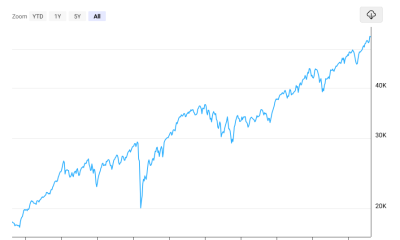
Dow’s 3-Year Winning Run Isn’t a Crash Signal, Still 49% Odds of Double-Digit Gains
-
Tech6 days ago
5 Of The Most Reliable Car Brands To Consider If You’re Buying A Used SUV
-

 Business5 days ago
Stock Market Today: Tech Futures Slide As Treasury Yields Jump; Nvidia, Micron, Sandisk Sell Off
-

 Tech6 days ago
Straight Up the Cliff, Yunnan’s New Fuyao Ladder Turns a Three-Hour Climb Into a 50-Second Ride for Students
-

 Tech6 days ago
Keychron K8 Ultra 8K review: a great value keyboard with comfort issues
-
 Tech6 days ago
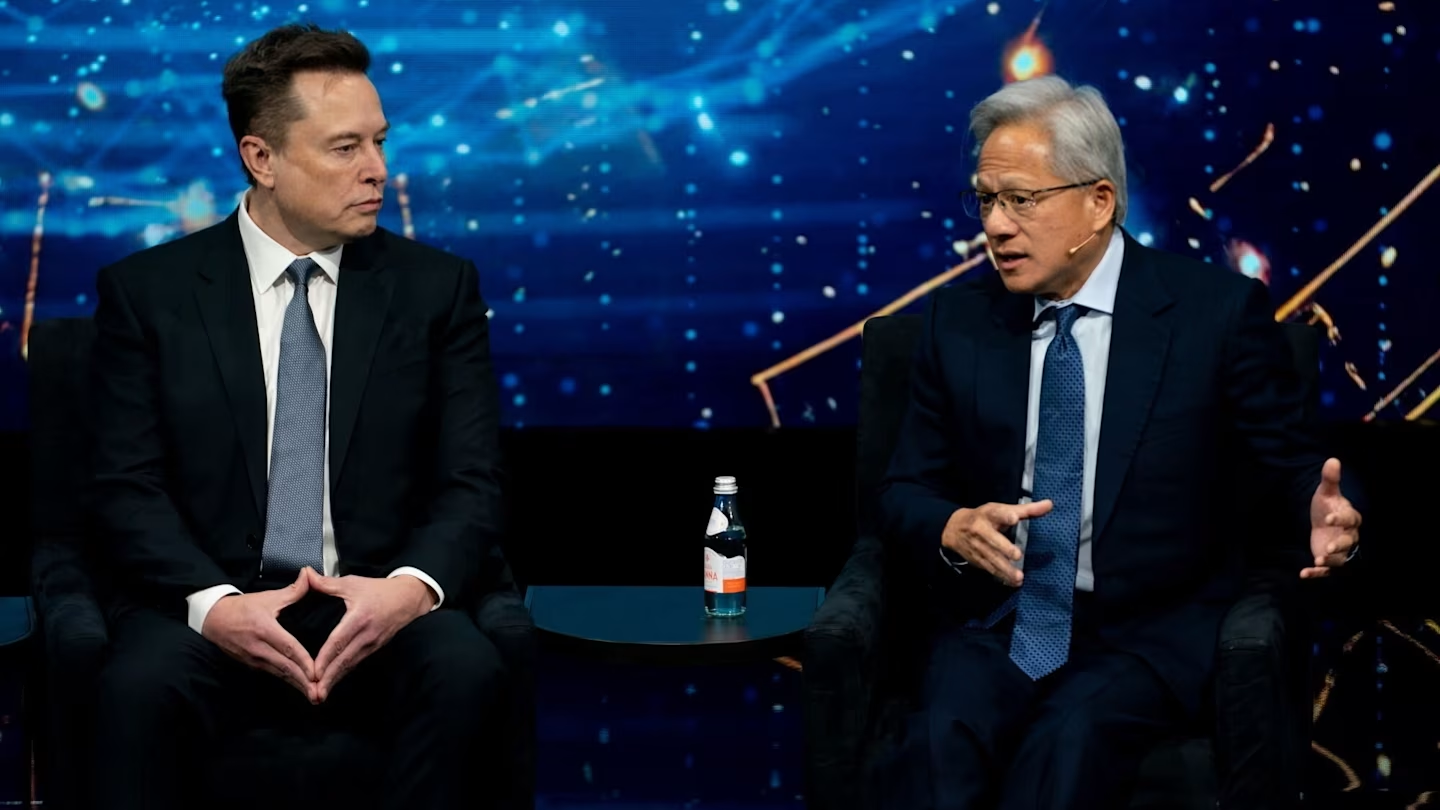
Nvidia discloses $21B stake in SpaceX
-
 NewsBeat6 days ago
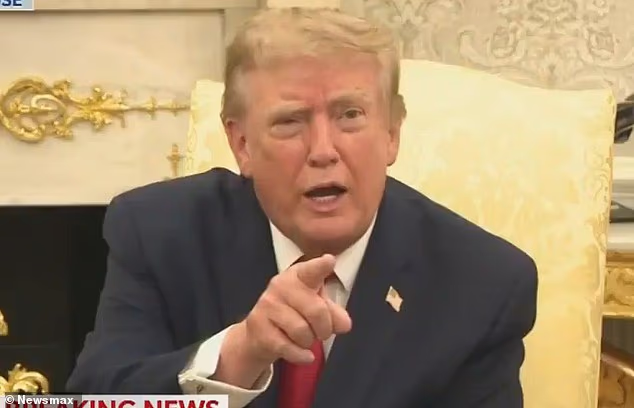
Trump explodes at CNN reporter after question about young blonde aide who wrote him besotted letters
-

 Business3 days ago
Five Below: Kids Discount Retailer Reaps Rich Rewards
You must be logged in to post a comment Login