
Crypto World
Ukraine Launches One of the War’s Largest Drone Attacks, Killing 6


Russia also carried out an intense barrage against Ukraine over the weekend, killing two people at a steel plant in Kryvyi Rih, which is the hometown of President Volodymyr Zelenskyy. The plant, ArcelorMittal Kryvyi Rih, posted about the incident on Telegram, sharing that 13 employees were injured.
“As a result of the attack, the main production facilities of energy and blast furnace production were damaged and the production processes of the plant were partially stopped,” the company wrote.
Russian attacks also sparked fires throughout Kyiv, wounding six people. In total, at least seven people were killed and 51 injured in Russian strikes over the weekend, according to casualty figures reported by regional Ukrainian authorities.
“Wherever the Russians can reach with their ballistic missiles, they strike civilian infrastructure,” Zelenskyy said on X in the aftermath of the attacks.
A NATO jet on an air policing mission also shot down an unidentified drone in Romanian airspace on Saturday—the fourth unmanned aircraft shot down over the country this year, Romania’s defense ministry said Sunday.

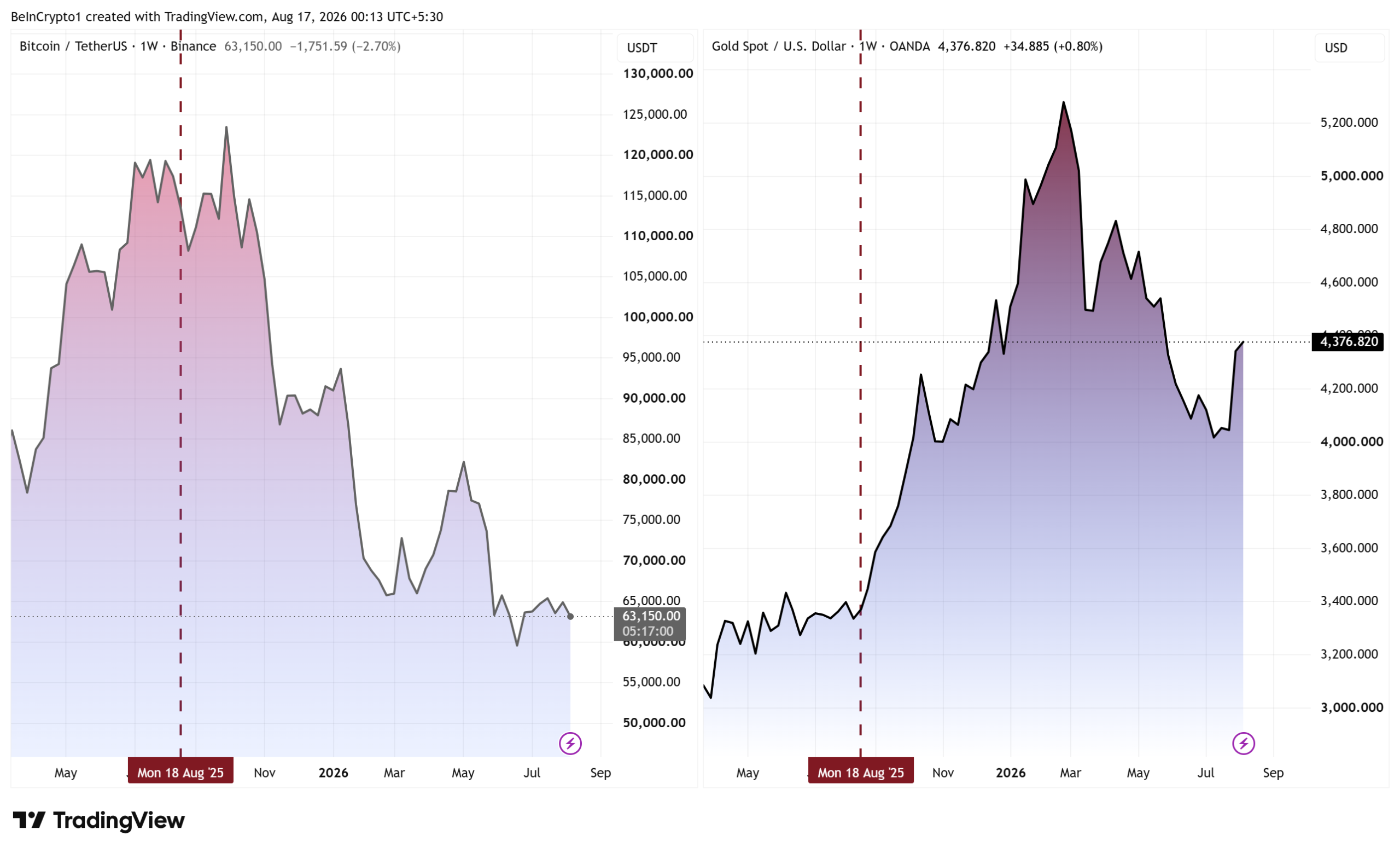
Global bond yields have reached levels last seen in July 2008. Bitcoin (BTC) did not exist then. The asset has never traded through borrowing costs this high, and it is not benefiting now.
Gold rose 32% over the past year. Bitcoin fell 46%. Investors who expected a debt squeeze to lift a scarce asset backed the wrong one.

Bond Yields Return to a Level Bitcoin Has Never Seen
A bond yield is what a government pays to borrow. Those costs are now the heaviest in almost two decades.
A Bloomberg gauge of long-dated government debt hit its highest yield since July 2008 in May. It tracks sovereign bonds maturing in 10 years or more.
Bitcoin’s whitepaper appeared that October. The first block followed on January 3, 2009, six months after the peak.
Satoshi Nakamoto stamped that block with a newspaper line.
“The Times 03/Jan/2009 Chancellor on brink of second bailout for banks,” source, genesis block.
Bitcoin was built as an answer to failing government finances. Those finances are strained again. This time the answer is the asset falling.
The move is global, though not uniform. UK 10-year gilts pay 5.05%, the highest of the major markets. Germany sits at 3.21%, a high only since 2011.
Japan pays 2.88% after decades pinned near zero.

“We’re seeing a broader repricing of duration driven by fiscal realities, persistent inflation risks and some political uncertainty,” Bloomberg reported, citing Barclays strategist Patrick Coffey, who named the driver when the gauge first broke out.
Why Elevated Real Yields Cap Bitcoin
Compare the two eras directly. The US 10-year paid 2.46% on January 2, 2009, per Treasury records. It now pays 4.69%. The long end moved further. The 30-year paid 2.83% in Bitcoin’s first week.
The Treasury sold $25 billion of the same bond on August 13 at 5.216%, the highest since 2001.
Demand was soft, part of the global bond selloff. Bids covered the auction 2.39 times against a 2.43 average. Dealers absorbed 11.6% instead of the usual 10.6%.
Real yields make the squeeze concrete. A real yield is what a bond pays after inflation. The 10-year real yield reached 2.41% on August 14. Two years earlier it paid 1.77%.
That is the bar Bitcoin has to clear. Investors can now beat inflation using government debt and take almost no risk. Bitcoin pays nothing. BTC traded at $63,072 with a market value of $1.27 trillion, down 46% in a year.

Foreign yields bite the same way. Japanese and European investors can now earn at home, which shrinks the global risk pool crypto draws on. Japanese government bond losses show the strain.
What Would Flip the Setup
Cause decides the outcome. Yields driven by growth punish Bitcoin. Yields driven by doubt over solvency should favor a scarce alternative.
Gold has taken that trade. The metal traded for $4,376 as of this writing, after a 32% year, even as U.S. debt interest costs keep climbing.
So watch auctions, not charts. Stronger demand for long-dated debt would ease the pressure on the Bitcoin price.
Until then the test is simple. Bitcoin was designed for a moment like this. It has never had to prove that at these yields.
The post Bitcoin Has Never Faced Global Bond Yields This High Since It Was Born appeared first on BeInCrypto.
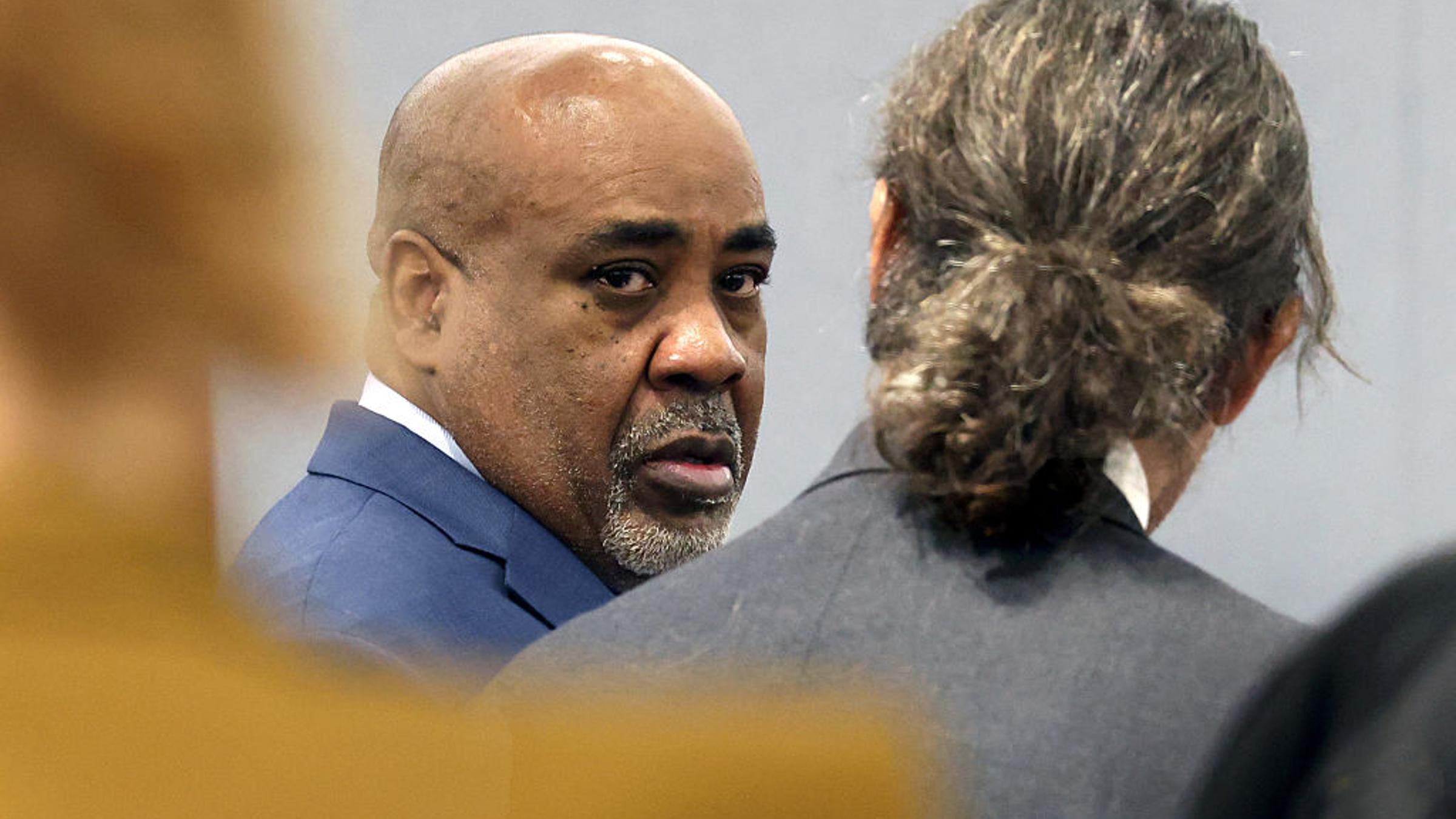
Chief Deputy District Attorney Marc DiGiacomo told the court: “Had he decided to never write the book, he would not probably have ever been prosecuted for the crime.”
Davis pleaded not guilty; however, if he is convicted, he could face life in prison without parole.
What to know about the key players in the courtroom
The jury, which was selected last week, consists of six men and 10 women—four of whom are alternates.
Davis’s defense is led by Michael Sanft, who took the case pro bono, and the prosecution is led by DiGiacomo.
A partial witness list was shared with potential jurors last week. It included Knight, who is serving a 28-year prison sentence in California after pleading “no contest” to voluntary manslaughter for fatally striking the owner of Heavyweight Records, Terry Carter, with his car in 2015. He told ABC News last week that he would not testify.
“This trial has nothing to do with me and if somebody brings me there, it’s gonna hurt whoever brings me there. I promise you that,” Knight said in the interview.
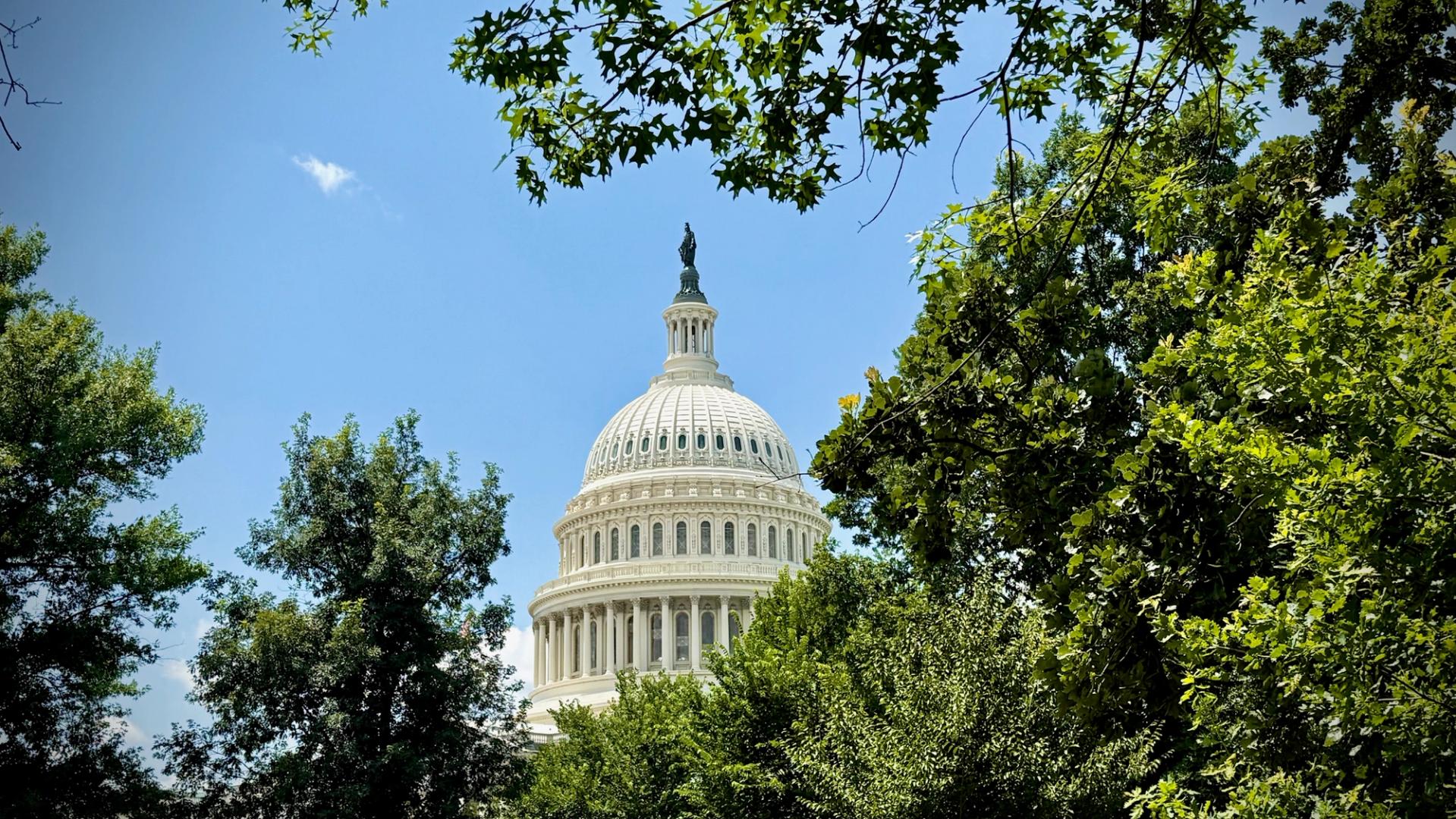
Earlier this month, as it became clear that the Digital Asset Market Clarity Act would not receive a vote prior to the Senate’s August recess, industry participants suggested that if Congress didn’t act, regulators could. It wouldn’t be exactly the same; regulators’ actions could be challenged in court and will be easier to undo by a subsequent administration than legislation would be, but the argument is that entrenched regulations would be difficult to undo.
Breaking it down
That argument above presupposes that the SEC and CFTC are actually able to finalize proposed rules in time for them to kick around for a bit prior to a future SEC changing its mind.
But that isn’t guaranteed. The SEC announced late Thursday it was canceling its planned meeting and would reschedule at a later date.
CoinDesk and others also reported on Thursday that the SEC was holding off on rolling out its innovation exemption indefinitely.
Individuals familiar with the situation told CoinDesk that concerns about the Clarity Act led to the SEC’s postponement. The White House and lawmakers are specifically concerned that any SEC action could further complicate ongoing negotiations over the Clarity Act ahead of the Senate’s first vote on the legislation next month.
A seed phrase can be replaced. A password can be reset. A home address cannot. The SafePal data breach disclosed Sunday exposed nearly 40,000 of them.
Three days earlier, Trezor leaked 13,689 more. Together the two hardware wallet makers put 53,487 customer records into the open. Neither company lost a single coin.
What the SafePal Data Breach Exposed
SafePal said 39,798 customers were affected. The leak covered names, emails, phone numbers, shipping addresses, and order details.
The cause was a flaw in the plugin SafePal uses to track orders. In some cases, one customer could open another customer’s record.
Affected orders ran from March 2, 2025 to April 11, 2026. That window stayed open for more than 13 months.
Seed phrases, private keys, bank details, and card numbers were not touched. SafePal has patched the flaw and cut order data retention to 90 days, according to its disclosure.

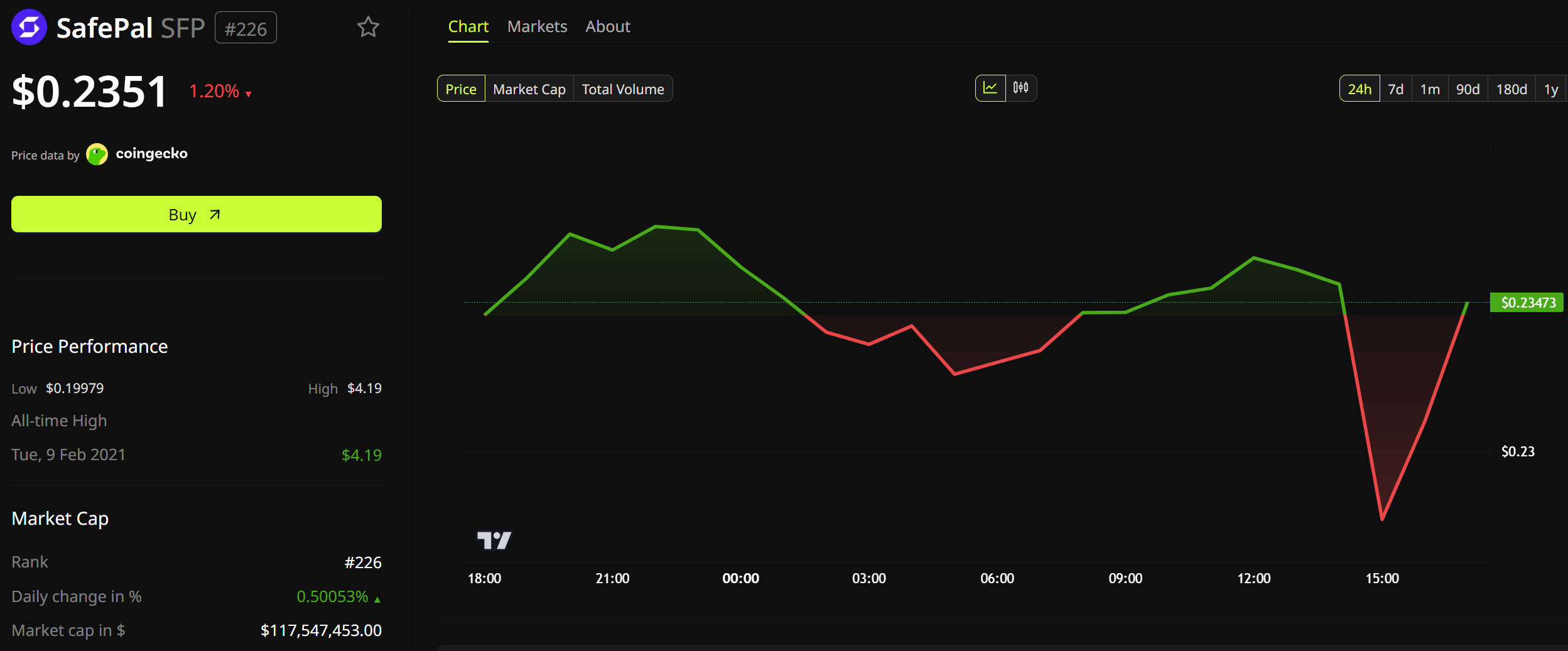
SafePal Token (SFP) barely moved on Sunday, trading near $0.23. That is the point. Nothing financial happened here.
Why Leaked Addresses Outlast Leaked Passwords
Trezor learned of its own customer data breach on August 10. Its shipping partner, ShipMonk, had been compromised.
Full details leaked for 11,742 Trezor buyers, according to the company’s notice. Names, emails, phone numbers, and home addresses all went out.
The two failures differ at the root. Trezor’s data left through a supplier. SafePal’s left through a system it ran itself.
However, both lists are worth the same to an attacker. Buying a hardware wallet suggests you hold enough crypto to move it off an exchange.

So these records are narrower than a typical exchange leak. They match a likely self-custody holder to a confirmed front door.
Prosecutors Have Already Seen This Playbook
In May, US prosecutors announced charges against three Tennessee men over a $6.5 million robbery spree across California.
The men posed as delivery people to reach victims inside their homes, the indictment says.
A leaked shipping record hands that script to the next crew. It names the buyer, gives the address, and says what arrived in the box.
Phishing is the smaller problem. SafePal has removed more than 30 fake websites and scam links tied to the stolen data.
Real notices came from security@safepal.com. Anything from another address should be treated as an attack.
Ledger shows how long this tail runs. Its 2020 breach exposed roughly 272,000 postal addresses, names, and phone numbers, per the company’s statement.
Six years on, Ledger still warns customers about phishing letters arriving by post. The company does not tie those letters to the 2020 leak.
Scam domains come down. Inboxes get filtered. Addresses do not expire.
Trezor now plans an anonymous delivery option, reaching the European Union in September and the US by year end. It arrives too late for the 53,487 records already in circulation.
The post Over 53,000 Crypto Owners Lost Something This Week That Isn’t Money appeared first on BeInCrypto.

Equity perpetual futures on major digital asset exchanges reached about $250 billion in monthly volume in July. That marks a seventeenfold jump from roughly $15 billion in April, showing how quickly the market has expanded in just three months.
According to analytics firm CryptoQuant, that expansion has turned crypto exchanges into round-the-clock venues for contracts linked to traditional equities. The products give users continuous access to familiar stocks without being limited by conventional market trading hours.
Binance Leads as AI and Chip Stocks Dominate Volume
Binance remained the dominant venue in July, handling roughly $193 billion in equity perpetual futures volume, equivalent to about 76% of the total market. Bitfer, Bybit, and Gate followed at a considerable distance.
CryptoQuant identified Gate as the fastest-growing venue during the month. Its equity perpetual futures volume increased by about 308% from June, compared with 176% for Bybit and 59% for Binance. The report also noted that Gate had recorded consecutive monthly growth since May.
Despite the broader rise in activity, trading remains concentrated across a small group of technology and semiconductor-related assets. SanDisk, SK Hynix, Micron, and the leveraged semiconductor ETF SOXL made up the core of what analysts describe as the AI-memory complex.
On Gate, in particular, the concentration was especially pronounced. SanDisk and SK Hynix together accounted for 53% of the exchange’s total equity perpetual futures volume last month.
Beyond Gate, the broader market also remained focused on companies linked to artificial intelligence and memory chips. This narrow concentration has made these assets the main focus of activity across the emerging equity perpetual market.
Crypto Platforms Push Beyond Traditional Assets
The products also reflect a broader shift in how digital asset exchanges are expanding beyond traditional cryptocurrency markets. Rather than focusing only on assets such as BTC and Ether, exchanges are offering perpetual contracts linked to traditional financial instruments.
At the same time, the approach allows crypto-native capital to access equity-linked products through infrastructure that operates continuously. The contracts therefore provide exposure to selected traditional assets while retaining the always-on structure associated with crypto markets.
However, CryptoQuant’s report shows a market that has expanded rapidly while remaining focused on a narrow group of assets. Whether activity eventually spreads across a broader range of equity perpetual contracts will depend on how the market develops beyond its current concentration.
The post Crypto Equity Perpetual Volume Hits $250B in July, Up 17x in Three Months: CryptoQuant appeared first on CryptoPotato.
Perpetual-futures volumes still run at a multiple of spot across most major tokens, while funding, positioning and liquidations set the tone intraday, he said
Over the past 12 to 18 months, however, attention has moved from infrastructure toward applications and appchains that fit more familiar fintech and venture-capital frameworks, De Maere said.
Fundamentals are starting to carry more weight in areas including decentralized finance, perpetual-futures exchanges and decentralized physical infrastructure networks.
“Fundamentals set the floor and the shortlist, while flows set the price,” De Maere said. Revenue and usage can determine which tokens survive drawdowns or make it onto allocator shortlists, but they rarely determine the price on a given day, he added.”
Wintermute’s flow data suggests the clearest change is in who is trading. Rather than a wholesale migration from spot to derivatives, institutional counterparties accounted for roughly 72% of its spot over-the-counter flow in the first half of 2026, up from around 59% a year earlier, De Maere revealed.
Those flows have concentrated in major cryptocurrencies and a shortlist of revenue-generating tokens, with tokenized real-world assets emerging as the main new category, he said.
“Part of the outperformance of revenue-generating tokens reflects fundamentals being rewarded, and part reflects the fact that fundamentals are the current narrative, so those tokens attract the flows,” De Maere cautioned. “The two are hard to separate.”
Bitcoin remains trapped in a low-momentum environment, with price action increasingly characterized by choppy consolidation rather than a decisive directional move. The lack of liquidity and volume continues to limit follow-through, while the current structure leaves room for another liquidity-driven move before a stronger trend develops.
Bitcoin Price Analysis: The Daily Chart
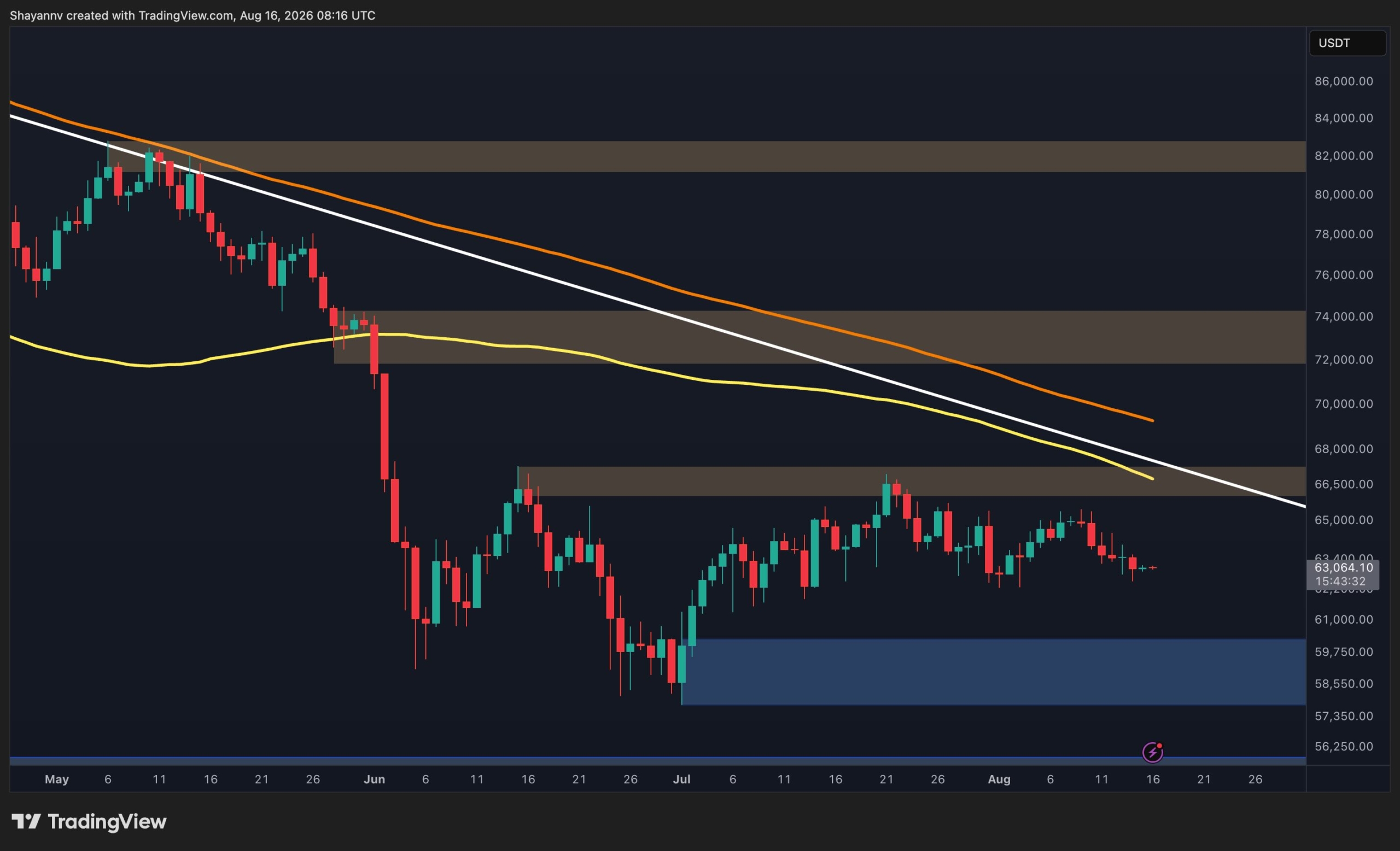
On the daily timeframe, BTC is still moving sideways after the sharp correction from the $66K area. The broader structure remains compressed, with the price currently around $63K and trading well below the major descending moving averages. The 100-day MA is still acting as an important overhead reference, while the declining white trendline reinforces the broader resistance structure.
The main scenario remains a lack of momentum. With market liquidity and volume appearing limited, the asset has been unable to establish a sustained breakout in either direction, resulting in a prolonged and choppy sideways phase. The first significant resistance is located around $66.2K-$67.2K, where the horizontal supply zone and descending trendline converge.
On the downside, the $58.5K-$59.8K region remains the most important major demand area visible on the chart. A deeper move into this zone would not necessarily invalidate the broader recovery structure, but a decisive breakdown below it would significantly weaken the bullish case.
For now, the absence of volume and momentum favors continued consolidation rather than an immediate breakout.
BTC/USDT 4-Hour Chart
The 4-hour structure provides a more defined setup. BTC has been compressing between a descending upper trendline and an ascending lower trendline, creating a tightening range. The asset is currently trading close to the lower boundary of this structure, around $63K, making the ascending trendline the key near-term support.
A break below this trendline would introduce a bearish scenario. If the breakdown is confirmed with follow-through, BTC could first revisit the $60.3K-$60.9K support zone, followed by the broader $58.1K-$59.6K area. This would also bring the lower liquidity clusters highlighted on the liquidation heatmap into focus.
On the upside, the descending trendline around $64.5K-$65K is the first obstacle. Above that, the $66.2K-$67.2K zone represents a much stronger resistance area. A breakout through this region would be required to materially improve the short-term structure.
Therefore, the immediate setup is largely defined by the two converging trendlines. A break below the ascending support would favor a deeper correction, while a breakout above the descending resistance would invalidate the near-term bearish structure.

Sentiment Analysis
The Binance liquidation heatmap highlights a significant concentration of liquidity around the current consolidation range, with particularly notable clusters extending through the $53K-$56K region. There is also substantial liquidity above the market around $66K-$67K and at higher levels.
This distribution is important because the market has spent an extended period moving sideways without generating a decisive directional impulse. In such an environment, liquidity clusters can become potential targets before the next sustained move develops.
The lower liquidity concentration is particularly notable. The heatmap suggests that a liquidity hunt below the $58K region remains possible if the current 4-hour support structure fails. Such a move could sweep leveraged positions and provide the liquidity needed for a subsequent recovery. However, this remains a potential scenario rather than a confirmed bottom signal.
Overall, the charts continue to point toward a market lacking momentum and volume. A downside liquidity sweep, potentially extending below $58K, could precede a stronger bullish cycle, but BTC would first need to reclaim the key resistance zones and demonstrate meaningful volume expansion to confirm that transition.

The post Bitcoin Price Analysis: Will BTC Finally Break Out of Consolidation Next Week? appeared first on CryptoPotato.


SafePal disclosed on Aug. 16 that an authorization flaw in an order-tracking plugin exposed customer order information belonging to approximately 39,798 people.
Summary
- Nearly forty thousand SafePal customers had order information exposed through an authorization flaw in software.
- Exposed records included names, emails, shipping addresses, phone numbers and detailed SafePal purchase information externally.
- Seed phrases, private keys, wallet passwords, payment details and government identification numbers were not exposed.
- SafePal removed over 30 phishing websites and shortened personal data retention to 90 days afterward.
- SafePal received a phishing report in May before confirming the authorization flaw during July investigations.
The affected records covered orders placed between March 2, 2025, and April 11, 2026, and included names, email addresses, shipping addresses, phone numbers and purchase details. SafePal said it emailed affected customers individually on Sunday and launched a tool allowing buyers to check orders using their order number and shipping country.
The wallet provider said seed phrases, private keys, wallet passwords, payment card numbers, bank account information and government-issued identification numbers were not exposed. SafePal also said it found no evidence that the incident itself compromised wallet access or customer funds.
SafePal traced the exposure to an order-tracking flaw
SafePal said the issue involved an authorization defect in a plugin used to track orders. Under certain conditions, the flaw allowed unauthorized access to another customer’s order information. The company said it fixed the vulnerability and introduced additional access controls after identifying it.
The company’s incident FAQ provides a longer timeline. SafePal said it first received a phishing report consistent with the problem in early May. It initially treated the report as an isolated case before escalating it into a formal security investigation. In July, the company began a full review and rebuild of its order-processing pipeline and confirmed the plugin flaw during that investigation.
Data-retention failure widened the affected period
SafePal separately disclosed that a scheduled data-cleanup process stopped working correctly between September 2025 and April 2026 because of a configuration error. According to the company, that failure did not cause the unauthorized access but left older order records stored longer than intended, helping extend the affected range back to March 2025.
SafePal has now reduced personal-data retention in the relevant order-processing environment to 90 days, subject to legal requirements. It said affected customers’ personal information has been removed from active e-commerce servers, while an encrypted offline copy is being retained to support potential investigations.
Phishing is now the main risk for customers
The exposed information could help attackers create more convincing phishing attempts using genuine names, addresses and purchase details. SafePal said it has already identified and taken down more than 30 fraudulent websites and phishing links tied to scam activity and continues monitoring for new domains.
The risk resembles other recent wallet-industry incidents. As crypto.news reported, a third-party shipping breach exposed personal information belonging to 13,689 Trezor customers, including names, emails, phone numbers and shipping addresses. In related coverage, scammers have also mailed fake Trezor and Ledger letters containing QR codes designed to steal recovery phrases.
SafePal stressed that it never asks customers for seed phrases, private keys or passwords. It said users do not need to move assets solely because their order information was exposed. However, anyone who has already entered a seed phrase or private key into a suspicious website should “treat that wallet as compromised,” create a new wallet and transfer remaining assets.
What happens next
SafePal said it is engaging an independent third-party security firm to validate its fix and conduct a broader review of its order-processing systems. The firm has not yet been named publicly. SafePal also contacted logistics and fulfillment partners and said it has found no evidence so far that the incident extended into their systems.
The company has opened a dedicated support channel and says it is contacting on-chain asset-tracing specialists for customers reporting financial losses. SafePal cautioned that this “does not represent any admission of liability or commitment to compensation.” It has not identified the unauthorized party or disclosed a confirmed amount lost through follow-on phishing. Further findings are expected through its official security updates.
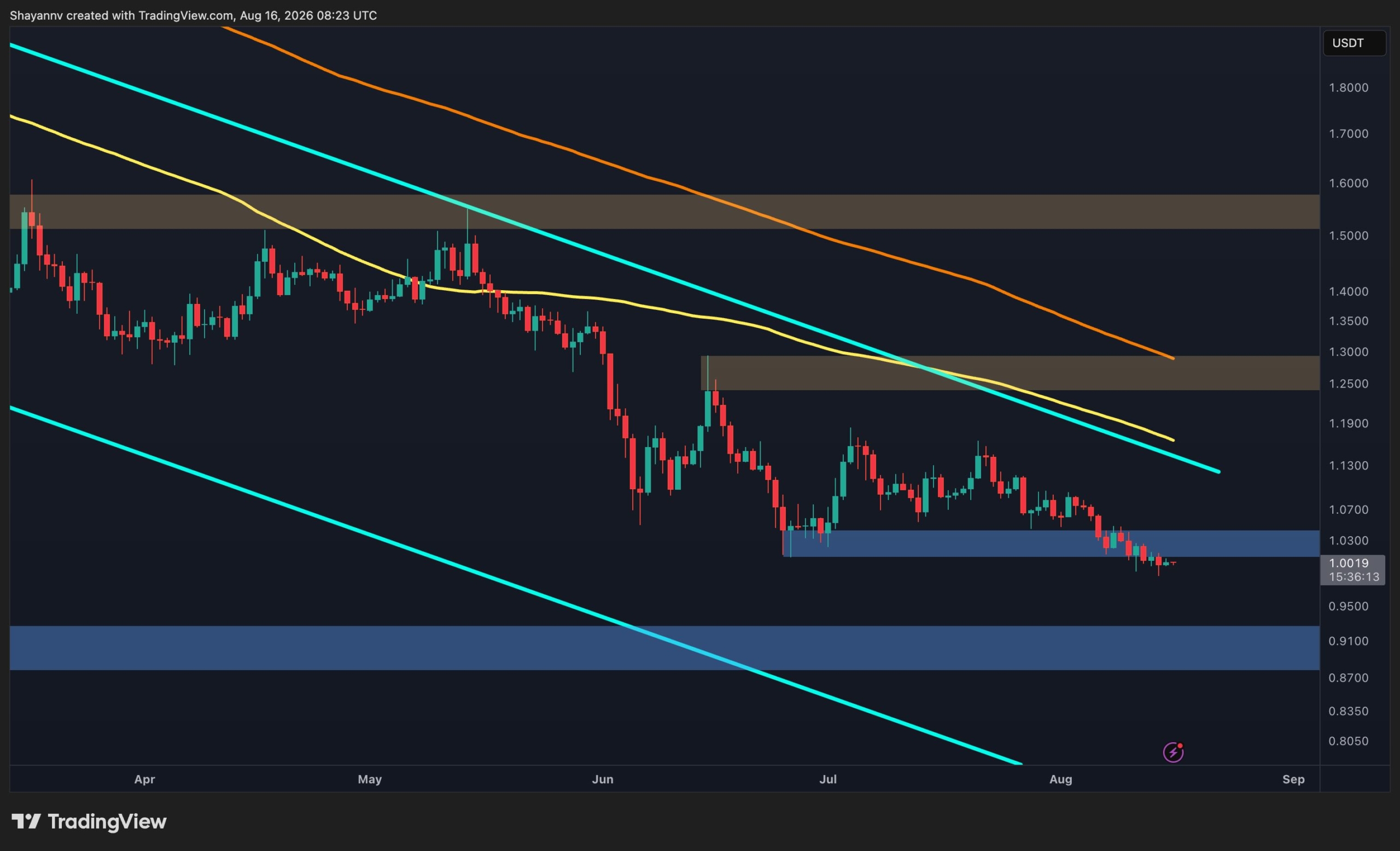
XRP remains under pressure, with the broader structure still favoring the bears as the asset trades near the $1.00 area. The market has lost momentum after the previous decline, and the latest price action suggests that a sustained recovery has yet to develop.
Ripple Price Analysis: The Daily Chart
On the daily timeframe, XRP remains inside a clearly defined descending structure. The price is trading well below the major moving averages. This keeps the broader trend bearish despite the consolidation seen over the past several weeks.
The $1.02-$1.04 area is now an important resistance zone. XRP previously traded around this region before breaking lower, and the latest candles remain below it. A recovery above this zone would be an initial sign that buyers are attempting to regain control, although the descending trendline would remain a larger obstacle.
On the downside, the immediate structure is becoming increasingly important around the $1.00 psychological level. A sustained move below this area could expose the blue demand zone around $0.91-$0.97. This region represents the next major support visible on the chart and could become relevant if the current consolidation resolves to the downside.
For now, the lack of a meaningful bullish reversal suggests that the market is still in a corrective phase. A break above the descending trendline and the $1.02-$1.04 resistance zone would be needed to materially improve the daily structure. Otherwise, another test of the lower support area remains possible.
XRP/USDT 4-Hour Chart
The 4-hour chart provides a more immediate bearish picture. XRP has been forming lower highs beneath a descending trendline, while the recent rebound attempts have repeatedly failed to produce a meaningful structural breakout.
The asset is currently hovering around $1.00 and has already moved below the $1.02-$1.03 support area shown on the chart. This former support could now act as resistance if XRP attempts to recover. The descending trendline overhead further reinforces the bearish structure, making the $1.02-$1.07 region an important area for any potential reversal.
The current consolidation just below $1.00 suggests that sellers have not completely lost control, but momentum is also becoming compressed. If the $1.00 area fails decisively, the next major downside reference is the $0.91-$0.97 support zone visible on the daily chart.
Conversely, reclaiming $1.02-$1.03 and subsequently breaking the descending trendline would weaken the bearish setup. A stronger recovery above the $1.06-$1.08 area would provide a more convincing signal that the current downtrend is losing momentum. Until then, the path of least resistance remains tilted to the downside.

The post Ripple Price Prediction: Can XRP Defend $1 or Will $0.90 Come Into Play Next? appeared first on CryptoPotato.
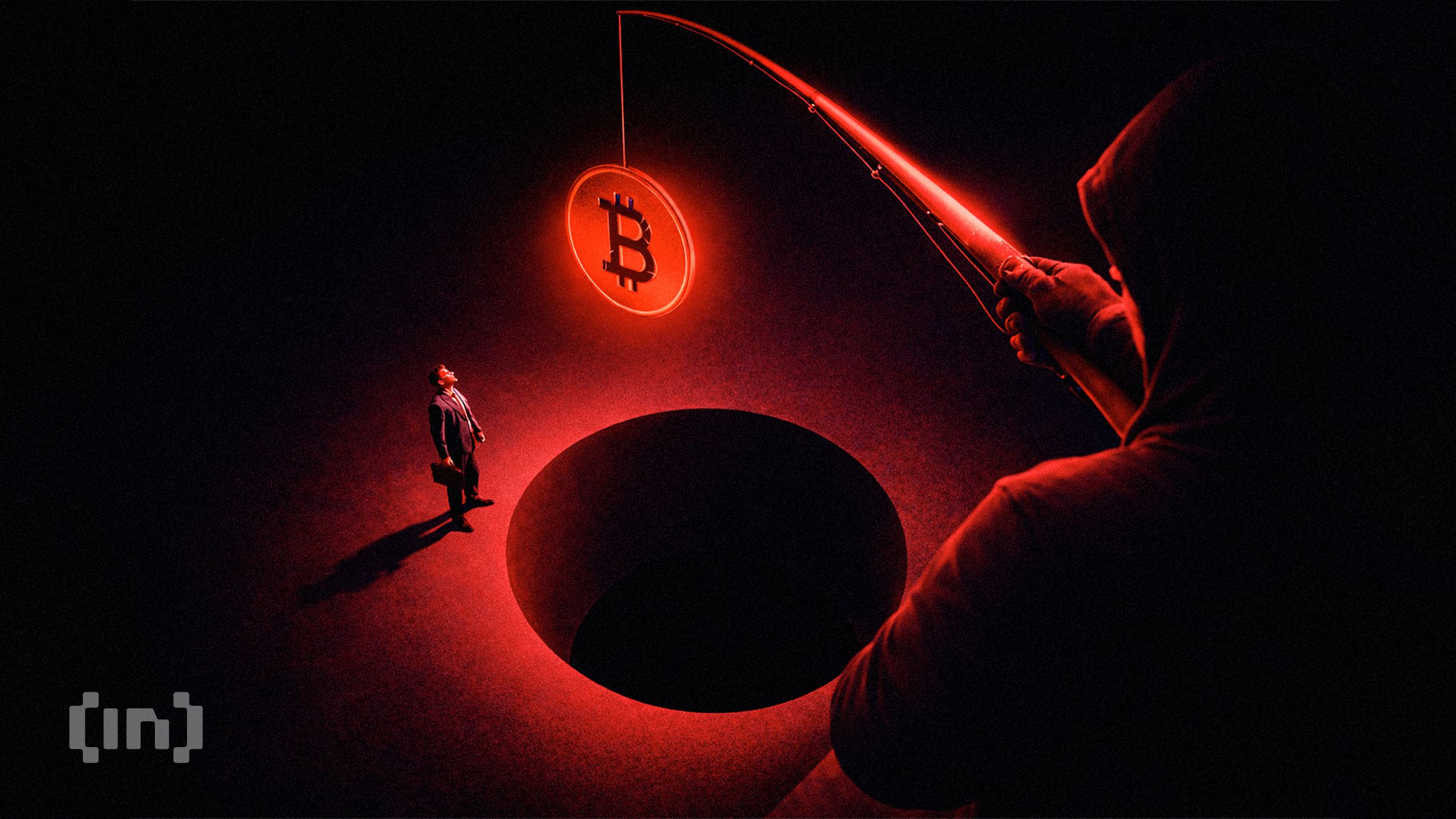

DeFiLlama’s team loaded a wallet with real crypto, handed it to a counterfeit version of their own app, and watched the money vanish. Apple removed the scam listing days later.
Months of trademark and impersonation complaints had achieved nothing. Only documented theft moved Apple’s reviewers, according to a post from DeFiLlama developer 0xngmi.
How the Fake DeFiLlama App Drained a Real Wallet
DeFiLlama tracks capital locked across decentralized finance (DeFi) protocols, and traders treat its dashboards as a reference point. That trust made the brand worth copying.
The clone was crude. It simply asked users to enter their seed phrase—the 12 or 24 words that control a wallet—and then emptied whatever it found.
No legitimate wallet or analytics app ever requests that phrase. However, an App Store badge lends the kind of credibility a phishing website cannot buy, which is why iPhone wallet exploits keep paying off for attackers.
The operators also walked through Apple’s identity checks. They registered the developer account using a small shoe shop incorporated 40 years ago and long since dissolved, 0xngmi said. The same crew has targeted other major crypto brands.
So the team stopped filing reports and instead built a case. They funded a throwaway wallet, installed the fake app, entered the phrase, lost the coins, and sent Apple the evidence. The listing disappeared within days.
Subscribe to our YouTube channel to watch leaders and journalists provide expert insights
Review Process Faces Growing Pressure
This case is not isolated. Kaspersky counted 26 fraudulent wallet apps on the App Store in April, with several impersonating Ledger, MetaMask, and Trust Wallet, according to its research.
Victims are rarely careless. In April, a fake Ledger app cost musician G. Love nearly 6 BTC after he trusted an App Store download. Copycat websites work the same way, and one Uniswap phishing clone took roughly $400,000 from traders in May.
Meanwhile, three Bitcoin holders sued Apple in late July over a counterfeit Sparrow Wallet listing they say cost them $1.8 million combined.
Therefore, the incentive gap looks stark. Brands absorb the reputational damage, users absorb the losses, and the store keeps collecting fees.
Security teams keep flagging the same weak point. Binance’s chief security officer recently argued that phishing and malware, not exotic cryptographic attacks, are what drain wallets today. Fake ads and spoofed sites, including a recent Trezor phishing campaign, reinforce that point.
DeFiLlama held back its own iOS release for months so no user would grab an imposter first. That caution cost the project time and momentum. Whether rival teams now copy the drain-yourself playbook says more about Apple’s process than about crypto.
The post DeFiLlama Sacrificed Real Crypto to Force Apple Into Action appeared first on BeInCrypto.
SharkNinja CCO Neil Shah sells $5.5m in company stock

Islam Makhachev sets UFC record for consecutive wins

Kanto Obi3G2 Turntable Arrives Less Than a Year After the Original. What Changed?


-

 Fashion2 days ago
Weekend Open Thread: Ann Taylor
-
 NewsBeat5 days ago
Communication cards help banking customers access services or report scams
-
 Business6 days ago
Oil Price Today (August 11): Crude oil rises to $88 after Trump’s compensation demand dents Hormuz opening. Here’s why
-

 Crypto World6 days ago
Revolut wins French banking licence, creates second EU banking hub
-
 Crypto World6 days ago
Why Did Nvidia Stock Fall on Monday Despite a $500 Billion Wall Street AI Deal?
-
 Sports3 days ago
This U.S. Amateur is a glimpse into golf’s future in more ways than you think
-

 Politics7 days ago
Ben-Gvir’s crocodile project halted but abuses at Ketziot Prison continue
-

 Politics7 days ago
Saudi Arabia used 86% of missile stockpile defending Iran attacks
-

 Sports2 days ago
Birmingham 2026: Day 6 Timetable for Irish Athletes
-
 NewsBeat2 days ago
Myanmar says over 300,000 Rohingya refugees verified for repatriation as exodus enters ninth year
-

 Politics1 day ago
SEQ Code: The Three Letter Boarding Pass Code That Could Give You The Worst Seat
-
 Entertainment4 days ago
Keke Palmer Subtly Hints At Sean Evans Drama With Cryptic Post
-
 Crypto World7 days ago
USDC and USDT Now Own 84% of Crypto Card Spend as the Euro Retreats
-
 Crypto World6 days ago
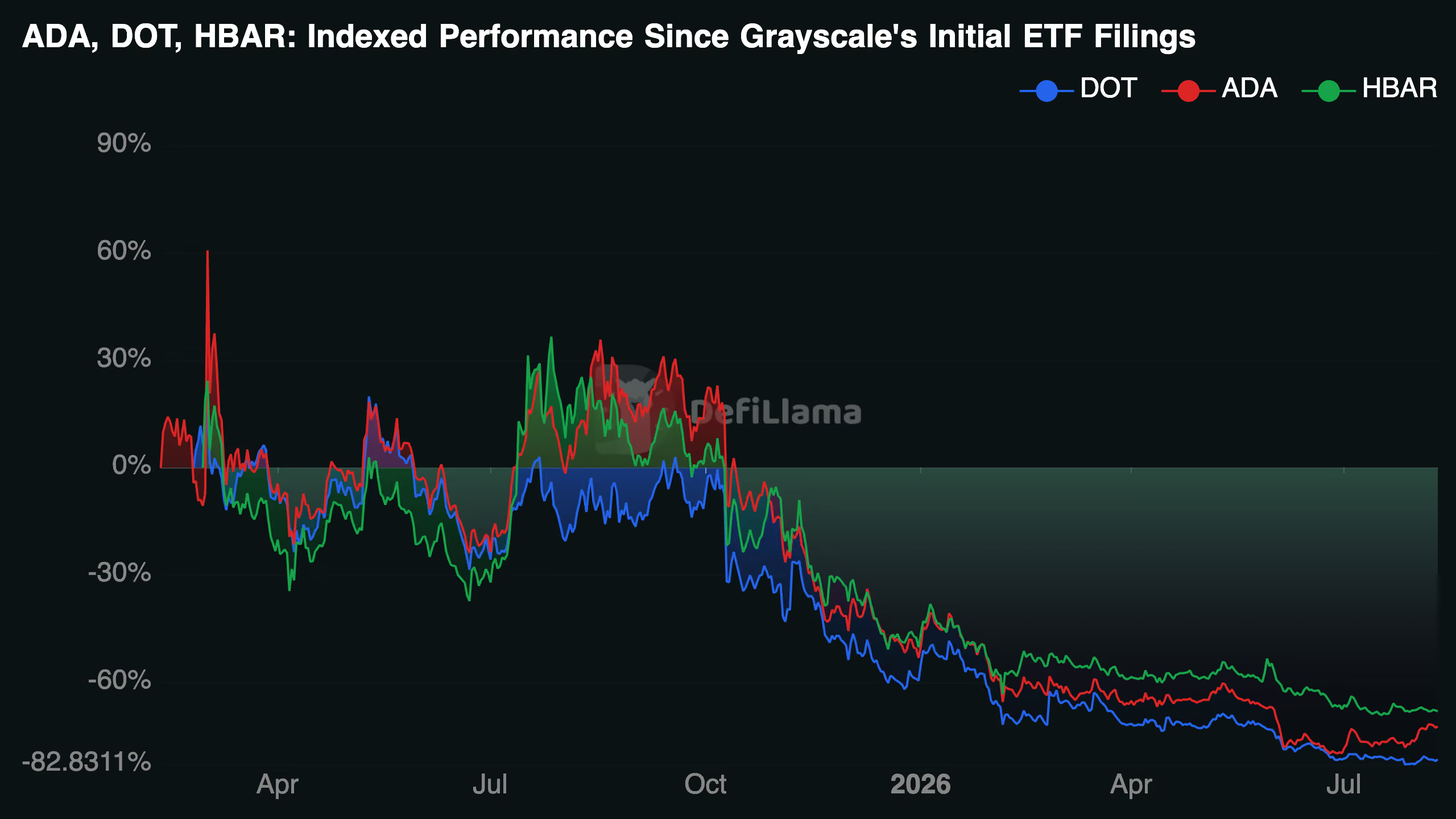
Grayscale quietly drops Cardano, Polkadot and Hedera ETF plans
-

 Fashion6 days ago
Can You Wear Double Cloth Gauze Clothing To Your Office?
-
 Entertainment6 days ago
57 Years Later, the Best Sitcom Ever Made Still Deserves a Reboot
-

 Fashion5 days ago
Claire Life: Kicking Off MVAAFF With the C Suite Luncheon Featuring Phylicia Rashad, Letoya Luckett, and More!
-

 Tech5 days ago
Zoom Screen-Sharing Bug Let People Fully Take Over Other Devices On A Call
-

 Crypto World7 days ago
Kraken Delisting Deadline Nears: Holders of 21 Tokens Risk Near-Zero Payouts
-

 Business7 days ago
More than 1.27M Ram 1500 pickups recalled over possible seat belt issue
You must be logged in to post a comment Login