
Crypto World
Uniswap slides 9% as weak retail demand threatens key support



Key takeaways
- Uniswap falls nearly 6% on Wednesday after declining 5% in the previous session.
- Uniswap has launched Continuous Clearing Auctions on Avalanche, allowing teams to conduct on-chain token sales and bootstrap liquidity.
- UNI’s social dominance and volume have fallen sharply, signaling weaker retail attention.
Uniswap (UNI) faces intense selling pressure on Wednesday, falling nearly 9% after recording a 5% decline the previous day.
The pullback comes despite Uniswap’s continued product expansion, including the introduction of Continuous Clearing Auctions on Avalanche. The feature allows blockchain projects to conduct fully on-chain token auctions and establish initial liquidity through Uniswap v4.
However, declining social activity and derivatives demand suggest the launch has not been enough to offset the cryptocurrency market’s broader risk-averse mood.
Continuous clearing auctions launch on Avalanche
Uniswap’s Continuous Clearing Auctions provide Avalanche developers with a new mechanism for launching tokens and bootstrapping liquidity onchain.
The model is designed to reduce friction during token distribution by allowing teams to conduct auctions transparently through smart contracts. Projects can then connect their newly distributed tokens with Uniswap v4 liquidity.
The launch expands Uniswap’s presence on Avalanche and strengthens its role as infrastructure for token issuance, trading and liquidity management.
It follows the recent launch of the TradePools platform on Robinhood, which allows users to deposit USDC, USDT or ETH in pursuit of yield.
While these developments may support Uniswap’s long-term utility, they have yet to produce a meaningful improvement in near-term demand for UNI.
Retail interest in Uniswap is weakening as traders prepare for the release of July’s US Consumer Price Index report, scheduled for Wednesday at approximately 12:30 GMT.
The CPI reading could influence the Federal Reserve’s next interest-rate decision and affect demand for risk assets. A hotter-than-expected report could strengthen expectations for tighter monetary policy, while softer inflation could improve sentiment across cryptocurrency markets.
Santiment data shows Uniswap’s social dominance fell to 0.08% on Tuesday from 0.19%. Social volume also declined to 40 from 152.
The sharp contraction indicates that UNI accounts for a smaller share of cryptocurrency discussions and is attracting less attention from retail traders.
Uniswap’s derivatives market reinforces the decline in retail participation.
CoinGlass data shows UNI futures open interest fell more than 3% over the past 24 hours to $261.60 million. The decline indicates traders are closing positions and reducing their leveraged exposure.
Long liquidations reached $2.88 million during the same period, significantly exceeding short liquidations of just $1,950. The imbalance shows that falling prices have disproportionately forced bullish traders out of their positions.
However, UNI’s open-interest-weighted funding rate improved to 0.0016% from negative 0.0054% the previous day.
The return to positive funding indicates that the remaining leveraged market carries a slight bullish bias. Still, falling open interest and heavy long liquidations suggest overall sentiment remains fragile.
Uniswap Technical outlook: UNI tests 100-day EMA
Uniswap is testing its 100-day Exponential Moving Average at $3.55, an important near-term support level.
UNI remains below the 50-day EMA at $3.65 and the 200-day EMA at $3.93. These moving averages create overhead resistance and reinforce the prevailing bearish structure.
The Relative Strength Index has declined to 40, placing it below the neutral midpoint of 50 and indicating growing selling momentum. However, the indicator remains above the oversold threshold of 30.
The Moving Average Convergence Divergence indicator has also fallen below its signal line, while its expanding bearish profile suggests downside momentum is strengthening.
A decisive daily close below the 100-day EMA at $3.55 could extend Uniswap’s decline toward the 50% Fibonacci retracement level at $3.25. This level is measured from UNI’s advance between $2.31 and $4.57.

A successful defense of $3.55 could allow buyers to attempt a recovery. However, UNI must reclaim the 50-day EMA at $3.65 to ease immediate selling pressure.
Above that level, the 23.6% Fibonacci retracement at $3.89 and the 200-day EMA at $3.93 form a significant resistance cluster.
Until Uniswap recovers above these moving averages with stronger trading activity, the short-term outlook is likely to remain bearish.



You’re reading Crypto for Advisors, CoinDesk’s weekly newsletter that unpacks digital assets for financial advisors. Subscribe here to get it every Thursday.
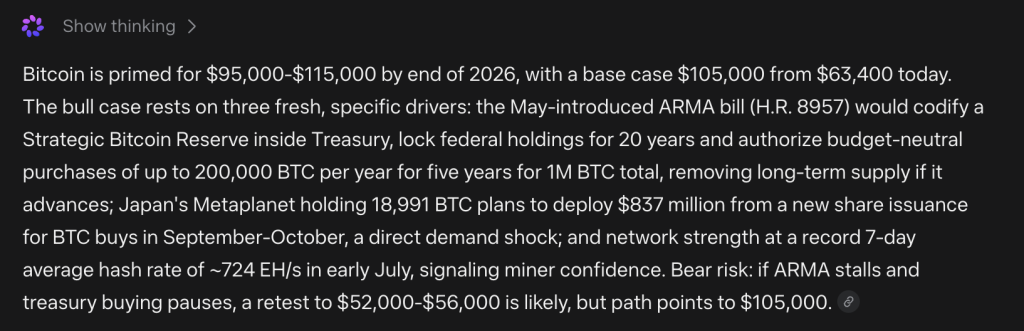
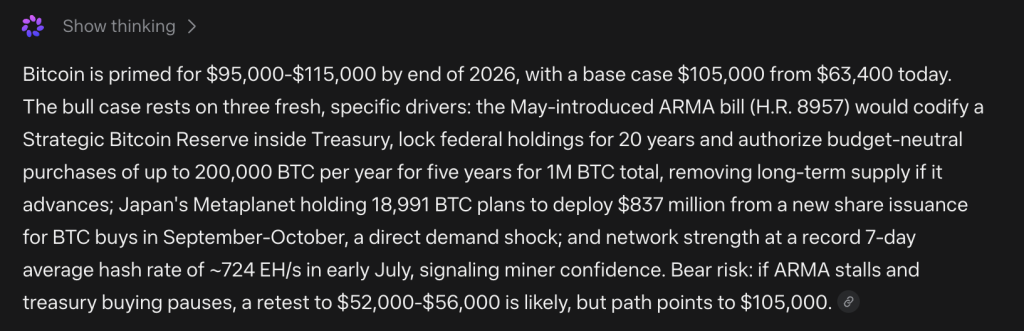
Bitcoin has spent months bleeding from above $120,000, yet Meta sees the market setting up for a sharp reversal. Meta AI Predicts Bitcoin can reach $95,000-$115,000 by the end of 2026, with its latest Bitcoin Price Prediction centering on $105,000.
That would mean a roughly 66% recovery from $63,367. Mark Zuckerberg’s Meta AI sees the fuel coming from an unusual combination: Washington potentially locking away Bitcoin while corporations prepare to buy more of it.
The ARMA bill, H.R. 8957, sits at the heart of that thesis. If advanced, it would codify a Strategic Bitcoin Reserve inside the Treasury, lock federal holdings for 20 years and authorize budget-neutral purchases of up to 200,000 BTC annually for 5 years.
That is up to 1 million BTC potentially meeting a market with fixed supply. The impact would not just come from buying pressure, but from removing a huge pool of Bitcoin from long-term circulation.
Corporate demand could hit sooner. Japan’s Metaplanet already holds 18,991 BTC and plans to deploy $837 million from a new share issuance toward additional Bitcoin purchases in September and October.
Underneath the price weakness, miners are not backing away either. Bitcoin’s 7-day average hash rate reached roughly 724 EH/s in early July, signaling continued commitment to securing the network.
The bull case breaks if policy and corporate demand both disappoint. If ARMA stalls and treasury accumulation slows, Meta AI sees Bitcoin revisiting $52,000-$56,000 instead.

Discover: Everyone’s Got a Take. Get Free $25 to Actually Trade Yours
Bitcoin Price Prediction: Meta AI Predicts $105,000, but $68,000 Comes First
The chart shows just how much work Bitcoin has left. After peaking above $120,000, BTC built a relentless sequence of lower highs before crashing toward $60,000 and settling into a narrow base.
That base now stretches roughly from $60,000 to $68,000. Holding $60,000 keeps the recovery thesis alive, but Bitcoin needs to break $68,000 before the structure starts looking like anything more than consolidation inside a broader downtrend.
Bitcoin closed at $63,367, down 0.28% after trading between $63,240 and $64,411. The tight session shows neither side has managed to force a decisive break.
RSI reads 45.25 against a 49.57 signal line. That 4.32-point deficit keeps momentum tilted toward sellers, although Bitcoin remains comfortably above oversold territory.
There is no breakout yet. Reclaiming $68,000 would give buyers their first opening toward the $72,000-$80,000 region, and only then does Meta AI’s road toward $105,000 start looking technically credible.
Discover: Your Market Calls Are Worth Something. Start With Free $25 on Kalshi
Kalshi Turns Bitcoin’s $105,000 Call Into a Market
Meta AI can make the forecast. Kalshi lets traders decide whether they actually believe it.
Prediction markets turn future outcomes into tradable probabilities, giving traders another way to express views on crypto, economics, politics and major events. Instead of simply arguing over whether Bitcoin reaches six figures, market participants can put capital behind their conviction.
For Bitcoin traders staring at the gap between $63,367 and Meta AI’s $105,000 target, that adds another layer to the forecast: what people are actually willing to risk on what happens next.
→ Think Meta AI has Bitcoin right? Get up to $25 to trade your first market on Kalshi
Don’t Miss Out on Our $1,000 USDT Airdrop on ByBit
The post Mark Zuckerberg Meta AI Predicts Bitcoin Price by The End of 2026 appeared first on Cryptonews.
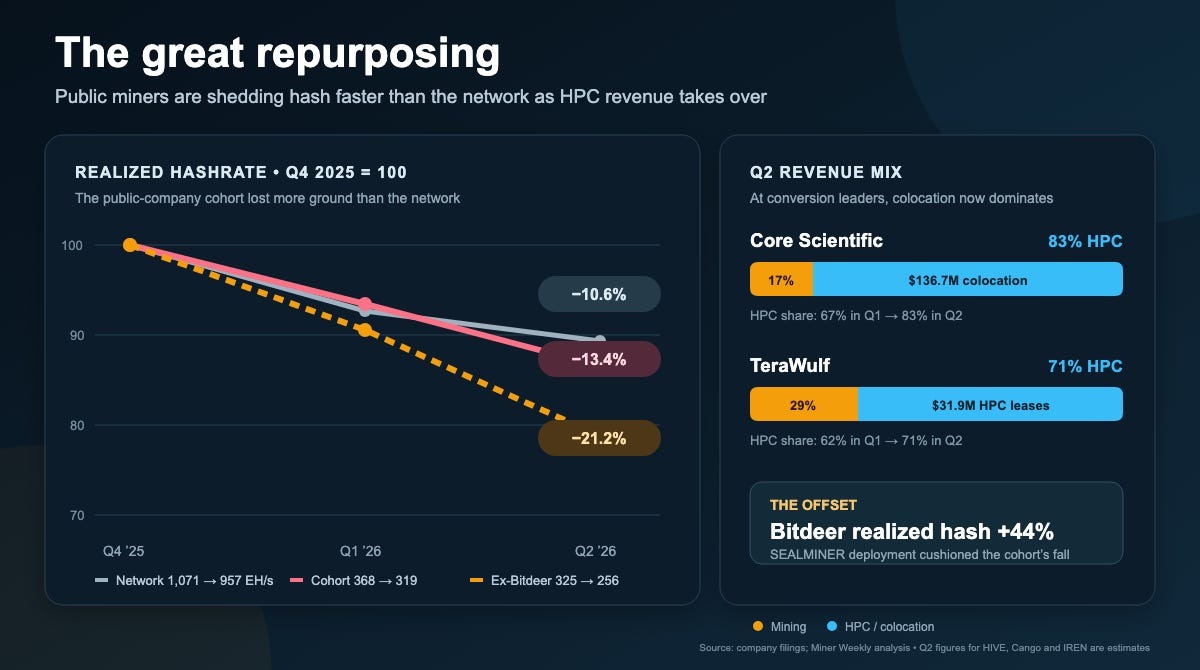
Publicly traded Bitcoin miners are cutting mining capacity faster than the Bitcoin network overall, suggesting that more operators are redirecting electricity and infrastructure toward data centers and high-performance computing (HPC), in another sign of the sector’s evolution beyond creating more crypto.
In the latest Miner Weekly newsletter, BlocksBridge Consulting reported that realized hashrate among a cohort of public Bitcoin miners fell from 368.3 exahashes per second (EH/s) in the fourth quarter of 2025 to 319 EH/s in the second quarter of 2026, a 13.4% decline.
The contraction was even sharper when excluding Bitdeer, which continued to expand its mining operations. Without Bitdeer, the cohort’s realized hashrate fell 21.2% over the six-month period, from 324.6 EH/s to 255.9 EH/s. Bitdeer’s realized hashrate, meanwhile, increased 44% to 63 EH/s.
By comparison, the Bitcoin network’s average hashrate declined 10.6% over the same period.
The shift comes as more miners report a growing share of revenue from non-mining activities. Core Scientific generated $136.7 million in colocation revenue during the second quarter, compared with just $27.5 million from Bitcoin mining. TeraWulf reported $31.9 million in HPC lease revenue, compared with $12.8 million from mining.
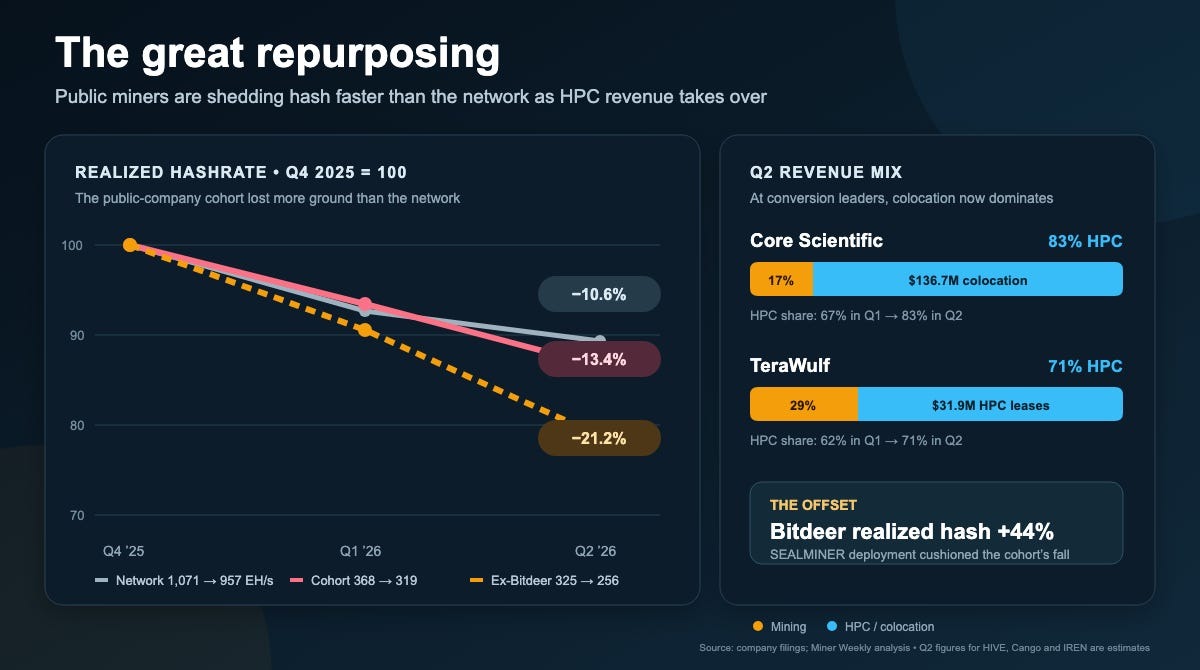
Core Scientific and TeraWulf are now generating the majority of their revenue from non-mining activities.
Source: TheEnergyMag
Riot Platforms and Bitdeer remain much earlier in the transition, with Bitcoin mining continuing to account for the vast majority of their revenue in the most recent quarter.
Related: CoreWeave shows how crypto-era infrastructure quietly became AI’s backbone
Unwinding post-China mining boom
BlocksBridge framed the current pullback as an unwinding of the expansion cycle that followed China’s Bitcoin mining ban in 2021, which triggered one of the sharpest declines in network hashrate before a rapid recovery as miners relocated overseas.
In North America, that migration helped fuel an expansion among public miners, which raised capital and acquired new power sites to expand their operations.
One halving cycle later, the economics have shifted significantly. Weaker mining profitability, coupled with surging demand for AI infrastructure since 2022, has prompted several public miners to repurpose sites and power capacity away from Bitcoin mining entirely.
Related: Crypto Biz: Crypto’s biggest business is starting to look a lot like banking


Key takeaways
- Hyperliquid gained 2% on Thursday after advancing nearly 3% in the previous session.
- Hyperion DeFi’s HYPE holdings recorded a $31 million fair-value increase during the second quarter.
- HYPE futures Open Interest rose more than 4% to $2.38 billion, while trading volume jumped 45%.
Hyperliquid (HYPE) extended its recovery on Thursday as sustained corporate demand and improving derivatives activity supported bullish momentum.
The token gained approximately 2%, building on its nearly 3% advance during the previous session. HYPE is now approaching its 50-day Exponential Moving Average (EMA) near $58.37, which represents the next major obstacle to further gains.
A decisive break above this level could allow Hyperliquid to target the $62.58 supply zone.
Corporate treasuries maintain strong HYPE exposure
Corporate interest in Hyperliquid remains firm, with HYPE-focused digital-asset treasuries increasing their exposure while benefiting from the token’s rising market value.
Hyperliquid Strategies held 17.60 million HYPE, up from 12.50 million in January. The market value of its holdings climbed from $703 million at the end of the first quarter to approximately $980 million in the second quarter.
Hyperion DeFi also increased its treasury holdings from 1.88 million HYPE to 1.93 million. The value of its position rose from $77 million at the end of the first quarter to $107 million in Q2, representing a $31 million fair-value increase.
The stability and growth of these corporate positions indicate continued confidence in the Hyperliquid ecosystem.
Digital-asset treasury companies can provide sustained demand by accumulating and holding tokens over longer periods. However, concentrated corporate holdings may also create selling risks if treasury firms later reduce their exposure.
Retail and derivatives activity has strengthened alongside the price recovery. CoinGlass data shows HYPE futures Open Interest rose more than 4% over the past 24 hours to $2.39 billion. Increasing Open Interest indicates that the notional value of active contracts is rising, potentially reflecting the creation of new positions.
Trading volume also jumped 45% to $1.60 billion over the same period, showing that traders are becoming more active as HYPE approaches key resistance.
The simultaneous rise in price, trading volume and Open Interest supports the view that fresh capital is entering the market rather than the recovery being driven solely by traders closing existing positions.
Hyperliquid’s liquidation data reflects a bullish short-term bias. Short liquidations reached $1.34 million over the previous 24 hours, significantly exceeding the $251,040 in liquidated long positions. The imbalance suggests rising prices forced bearish traders to close leveraged positions.
HYPE’s funding rate remained positive at 0.0080%, despite experiencing brief moves into negative territory. Positive funding means traders holding long positions are paying shorts, showing a willingness to pay a premium for bullish exposure.
While the data supports further gains, rising leverage could increase volatility. An unexpected reversal could trigger long liquidations and place renewed pressure on the token.
HYPE remains above long-term support
HYPE continues to trade above its 200-day EMA at $51.29 and a rising trendline near $53.05.
These levels reinforce the token’s broader constructive structure and could attract buyers if the recovery loses momentum.
The Moving Average Convergence Divergence indicator has crossed above its signal line, while its histogram remains positive. The shift indicates that bullish momentum is gradually rebuilding.
The Relative Strength Index stands near 50, reflecting neutral conditions and leaving room for further gains before the token enters overbought territory.
The 50-day EMA at approximately $58.37 remains the immediate resistance level controlling HYPE’s short-term outlook.
A decisive daily close above the moving average could confirm strengthening bullish momentum and open the way toward the $62.58 supply zone.

Failure to reclaim the 50-day EMA could produce another pullback toward the rising trendline at $53.05. Below that level, the 200-day EMA at $51.29 would provide the next important support.
Buyers would need to defend this support cluster to preserve Hyperliquid’s wider bullish structure.
For now, growing corporate holdings and improving derivatives metrics favor the recovery, but a breakout above $58.37 remains necessary to confirm its continuation.


Morph has launched a non-custodial payments platform that supports USDC and USDT, lets businesses connect their own wallets, and settles customer payments directly on-chain.
Summary
- USDC and USDT payments settle directly into wallets controlled by users.
- Morph Payments includes invoices, payment links, and a transaction dashboard.
- The platform does not require businesses to deposit stablecoins with Morph.
- Visa data cited by Morph put adjusted stablecoin volume at $10.2 trillion over 12 months.
Morph Payments leaves funds in users’ wallets
According to an Aug. 12 press release from Morph shared with crypto.news, the service is available to online businesses, freelancers, and distributed organizations that want to accept, send, and monitor stablecoin payments.
Morph Payments works by connecting a self-custodial wallet to the platform rather than requiring a business to transfer its funds into an account controlled by Morph. When a customer completes a payment, the stablecoins move directly to the wallet selected by the recipient.
Morph said the initial release supports USDC and USDT, the two stablecoins named in the announcement. Businesses can create an invoice or payment link that directs customers to a checkout page, while completed transactions appear in a single dashboard.
Under the setup described in the release, Morph provides the payment interface but does not hold the funds sent through it. Businesses retain control of the private wallet receiving the payment, and the stablecoins become available once the blockchain confirms the transaction.
Such a model differs from a custodial processor, which receives money on behalf of a merchant and later releases the balance. Morph said direct settlement can reduce the time businesses wait to access incoming funds, although the announcement did not provide transaction-speed tests or comparisons with specific payment companies.
The release also did not disclose the platform’s fees, transaction limits, supported jurisdictions, identity-verification requirements, wallet compatibility, or smart-contract audit details. Morph said businesses and entrepreneurs could begin registering through its website on Aug. 12.
Invoices and payment links target online businesses
Alongside wallet settlement, the first version lets users send stablecoins and monitor incoming and outgoing payments. The dashboard is designed to put payment records, invoices, and checkout links in one place, according to the company.
For freelancers, a payment request can be created as an invoice or a link and sent directly to a client. Online businesses can use the same process to collect USDC or USDT without giving Morph control over the receiving wallet.
Morph presented the service as an option for cross-border payments and remote work, where bank transfers may pass through several institutions before reaching the recipient. Claims about payments arriving within minutes and providing faster access to working capital came from the company; the press release did not include independent performance data or customer results.
Renna Ba, Morph’s head of ecosystem, said businesses could eventually work with several stablecoins in much the same way that companies now handle different national currencies.
“The challenge isn’t creating more payment options—it’s making that complexity invisible so businesses can focus on growing, not managing payments.”
Although the comment points to support for multiple assets, the initial product is limited to USDC and USDT. Morph did not identify other stablecoins it may add or provide a schedule for expanding the list.
Morph Payments follows earlier network programs
The launch adds a user-facing product to Morph’s existing work on stablecoin infrastructure. In January, the network selected Cobo as its first partner for the Morph Payment Accelerator, a performance-based program tied to verified stablecoin volume on Morph’s mainnet.
Cobo provides custodial wallets, multi-party computation wallets, and wallet infrastructure across more than 80 blockchains. The January announcement said the partnership would focus on institutional stablecoin activity, including cross-border payouts and high-frequency settlement.
Morph Payments takes a different approach at the user-account level because the new service does not take custody of a business’s assets. Customers can still move stablecoins received through the platform to trading services or yield products built on Morph’s network, the company said. Participation in such services would involve separate platforms and risks not detailed in the payments announcement.
The company has not disclosed transaction targets, expected user numbers, or revenue projections for the product. Additional functions are planned over the coming months, but Morph did not specify which tools will be added or when they will become available.
Stablecoin payment tools are reaching more businesses
Morph cited Visa’s on-chain analytics showing $10.2 trillion in adjusted stablecoin transaction volume during the previous 12 months, a 65% increase from the comparable period. Visa’s adjusted measure is designed to filter activity that its methodology identifies as inorganic.
Separate research published by Morph in April estimated that stablecoins handled $33 trillion in total on-chain volume during 2025. As previously covered by crypto.news, the report attributed about 60% of the measured flows to business-to-business activity and projected more than $50 trillion in settlement volume during 2026. The figures are company estimates rather than audited financial results.
Other payment providers have also introduced stablecoin tools for corporate users. In July, Ramp launched stablecoin business accounts on Solana, allowing customers to hold USDC and USDT and send payments to vendors in more than 140 countries. Ramp also said its system could convert payments into more than 40 local currencies.
Ramp’s product combines stablecoin balances with its existing approval and accounting tools, while Morph’s release focuses on direct settlement to a wallet controlled by the business. Morph did not announce local-currency conversion, bank-account funding, or accounting software integrations.
U.S. stablecoin rules remain unfinished
American businesses considering stablecoin payment products operate under a federal framework that is still being implemented. President Donald Trump signed the GENIUS Act into law on July 18, 2025, establishing federal requirements for payment stablecoin issuers, including reserve, redemption, disclosure, and supervision standards.
The law primarily regulates issuers rather than every business that receives stablecoins. Its treatment of distribution remains relevant, however, because U.S. digital asset service providers will face restrictions on offering payment stablecoins from non-permitted issuers beginning in July 2028.
USDC and USDT are issued by Circle and Tether, respectively, rather than by Morph. The launch announcement did not state whether Morph Payments would be available in every U.S. state or identify the licenses and compliance procedures that could apply to American customers.
Federal regulators missed a July deadline for completing several rules required under the GENIUS Act. As of July 19, proposals covering reserves, redemptions, custody, customer identification, anti-money laundering controls, and state supervision had not all been finalized. The statute is scheduled to take effect by Jan. 18, 2027, unless final regulations start an earlier 120-day implementation period.
Crypto World
BloFin Research: Circle’s Q2, Arc Token Presale Lifts Guidance and Bridges the Crypto Downturn
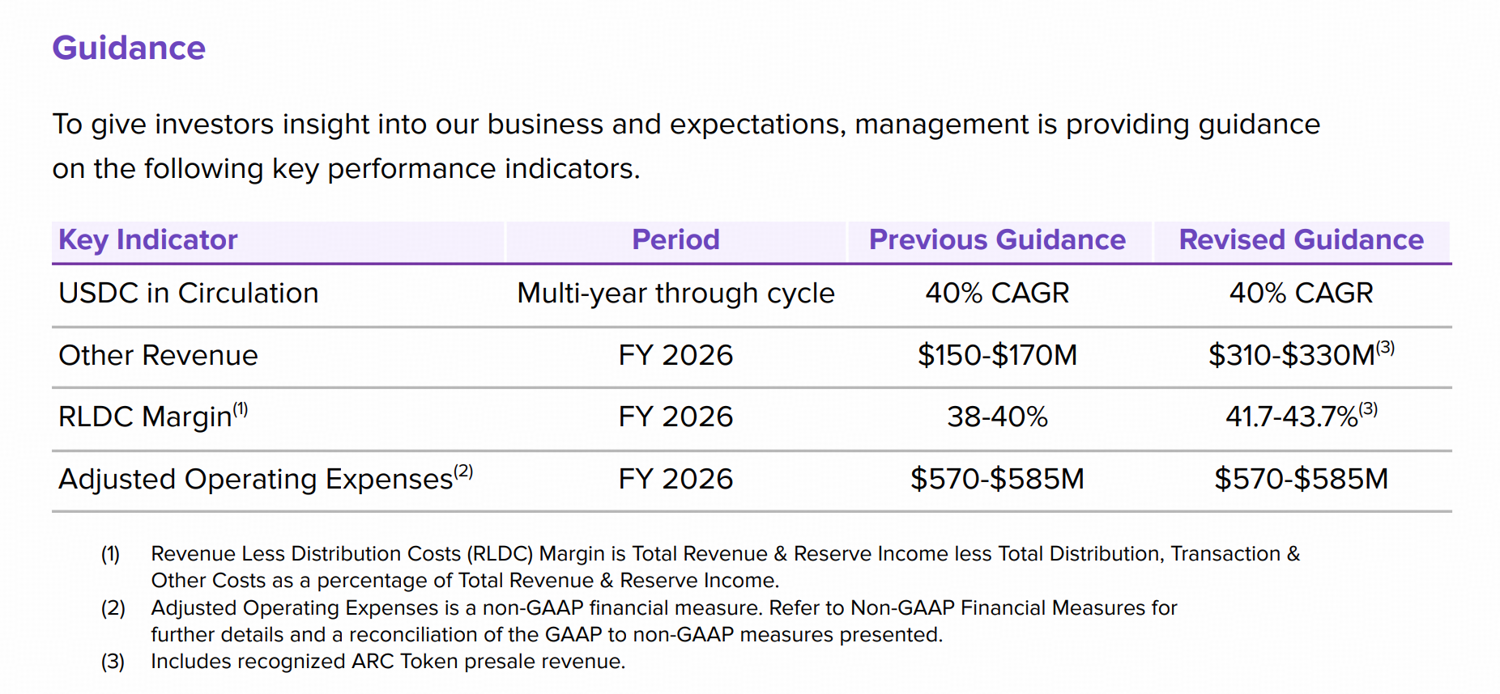
In its Q2 earnings release, management raised guidance for both other revenue and RLDC margin, which surprised us. A closer look shows that the increase is driven by one-time Arc token presale revenue. This buys Circle time through the 2026 crypto bear market. If the crypto cycle bottoms in Q4 and on-chain activity recovers next year, USDC will be well positioned for the next crypto bull market.
- Q2 results were stable, while the increase in FY2026 guidance was driven primarily by Arc token presale revenue.
- Interest-rate and distribution-cost risks appear contained through year-end, while USDC circulation remains under pressure from the current crypto bear market.
- USDC is well positioned to benefit from the next recovery in crypto activity. Its concentration in trading, collateral, and DeFi makes circulation highly pro-cyclical and particularly responsive to a rebound in on-chain liquidity.
Circle reported $701 million in total revenue and reserve income, while adjusted EBITDA rose 8% year over year to $143 million. The more significant update came from guidance: FY2026 other revenue was raised to $310–330 million from $150–170 million, and the revenue less distribution costs (RLDC) margin outlook increased to 41.7–43.7% from 38–40%. The revisions point to stronger non-reserve monetization and better operating leverage than previously expected.

Source: Circle
Arc will be a new engin, but the first fuel is a token presale
Arc is Circle’s own Layer-1 blockchain, a settlement network purpose-built for stablecoin finance with USDC as the native gas token. It moves Circle up the stack, from issuing a token that lives on other chains to operating the chain itself, where it can capture block space gas revenue rather than reserve yield alone. Gas is the fee users pay to transact on a blockchain; today those fees flow to the networks that host USDC, such as Ethereum and Solana, while on Arc USDC is the gas asset and Circle collects them. Circle expects these economics to be shared with validators and other network participants, giving it direct exposure to Arc activity without capturing every transaction fee.
Arc’s public mainnet is scheduled for September 16 with institutional validators including BlackRock and DTCC. DTCC plans to enable the tokenization of DTC-custodied assets on Arc, while BlackRock expects to deploy BUIDL with native USDC integration. These commitments give Arc credible launch distribution and clear institutional use cases across tokenized securities, collateral, and settlement.
The near-term number, though, comes from selling the token. Ahead of mainnet Circle ran an Arc token presale, placing the network’s native token with investors before launch, and roughly $180 million of the other revenue guidance raise is that presale revenue.
The token sale lifted 2026 other revenue and margin. Recurring Arc economics, staking, transaction fees, and commercial services generated by actual network usage, arrive after launch and remain dependent on adoption.
Rate and distribution risk have turned gentler
Circle’s earnings are driven by three variables: USDC circulation, the yield earned on reserve assets, and the share of that yield retained after distribution costs. For every USDC in circulation, Circle holds an equivalent amount of cash and short-duration U.S. Treasuries, with reserve income generated from the yield on those assets.
The reserve return rate was 3.48% in Q2, down with SOFR, and reserve income remains the core of the business. Rates are not expected to fall materially in the near term, so the yield on Circle’s reserves holds up. And the distribution cost that eats into that yield just cleared its biggest question: the Coinbase agreement renewed on existing terms, removing the scenario where Circle’s largest partner extracts a larger cut.
Management’s guidance reinforces that stability. Excluding the Arc token presale contribution, full-year revenue less distribution costs, or RLDC, margin is expected to land around the midpoint of the previous 38–40% range, implying roughly 39%. With reserve yields holding up and distribution economics risk moderated, near-term earnings growth increasingly depends on a recovery in USDC supply.
Falling USDC Circulating Supply

Source: Defillama
USDC Supply Remains Under Pressure Amid Weak On-Chain Activity, With Strong Recovery Potential as the Crypto Cycle Turns
Circle’s long-term base case assumes a 40% compound annual growth rate in USDC circulation. Circulation is currently contracting. The investment debate therefore hinges on whether emerging USDC-native use cases can scale fast enough to overcome the cyclical decline in broader on-chain activity.
USDC and USDT increasingly serve different functions within the on-chain dollar market. At the end of June, USDT supply was roughly split between Tron and Ethereum at $89.9 billion and $86.7 billion, respectively. USDC was more concentrated on Ethereum at $47.4 billion, followed by Solana at $7.8 billion, HyperEVM at $5.4 billion, and Base at $4.2 billion. This distribution reflects a broader difference in how the two stablecoins are used.
USDT Supply by Chain

Source: Defillama
USDC Supply by Chain

Source: Defillama
USDT acts primarily as a payment and transfer rail. On Tron, approximately 93% of USDT sits in ordinary wallets, while 79% of transfers are simple token movements with limited interaction with DeFi protocols. During the first half of 2026, USDT settled about $95 billion of identified commerce and payment volume, compared with $14 billion for USDC, and represented approximately 92% of the $48 billion in identified B2B payments. These patterns are consistent with USDT’s role in remittances, peer-to-peer transfers, offshore exchange settlement, and cross-border commerce.
USDC functions more like a trading, collateral, and settlement asset. In June alone, USDC generated approximately $2.6 trillion of transfer volume on Base and $1.6 trillion on Ethereum. USDC on Base turned over as much as 20 times per day, with activity dominated by DEX liquidity and flash loans. The same pattern appears on HyperEVM, where USDC supply rose to $5.4 billion after becoming the principal stablecoin supporting Hyperliquid’s trading ecosystem.
This specialization makes USDC more sensitive to crypto-native risk appetite than USDT. That sensitivity is currently a headwind: the market remains in a deep bear phase, liquidity has contracted, and on-chain trading activity has fallen sharply from cycle highs. Crypto markets have historically followed pronounced boom-and-bust cycles, and the current downturn could approach a durable bottom in Q4 if previous cycle patterns remain relevant. Until then, weaker risk appetite is likely to keep pressure on USDC circulation.
Total Value Locked in DeFi also follows Crypto bull-bust cycle

Even within the downturn, several areas of on-chain activity continue to expand. Perpetual DEXs are among the strongest. The category has become a core venue for leveraged trading, with USDC widely used as collateral, margin, and settlement liquidity. Hyperliquid is the largest example, processing roughly $200 billion in trailing 30-day perpetual volume, but the broader significance lies in the growth of decentralized derivatives as a sector. As perp DEXs gain liquidity, users, and market share, they create recurring demand for USDC balances across trading accounts, liquidity pools, and market-making strategies.
Prediction markets provide a second source of structural demand. Polymarket uses pUSD, a fully USDC-backed collateral asset, and processed approximately $3 billion in trading volume over the latest 30-day period.
USDC is therefore well positioned for the next recovery in crypto activity. Its concentration in trading, collateral, DeFi, and settlement makes circulation highly pro-cyclical: supply contracts when on-chain liquidity falls, but it can reaccelerate rapidly when trading volumes, leverage, and capital return.
Disclaimer: The information provided herein does not constitute investment advice, financial advice, trading advice, or any other sort of advice, and should not be treated as such. All content set out below is for informational purposes only.
The post BloFin Research: Circle’s Q2, Arc Token Presale Lifts Guidance and Bridges the Crypto Downturn appeared first on BeInCrypto.


Trezor has disclosed that personal information belonging to 13,689 customers was exposed after an unauthorized actor gained access to systems operated by its shipping provider ShipMonk.
Summary
- ShipMonk breach exposed personal information belonging to 13,689 Trezor customers.
- Names, emails, phone numbers, and shipping addresses were among the data accessed.
- Trezor said its systems and hardware wallets were not compromised in the incident.
- Affected customers have been warned about potentially more convincing phishing attempts.
- Trezor plans to launch Anonymous Delivery in the EU by September 2026 and the U.S. by year-end.
Trezor said in an Aug. 13 security notice that ShipMonk informed the hardware wallet maker on Aug. 10 about unauthorized access to systems containing customer order data, with an investigation into the incident still underway.
The breach affected customers who received Trezor orders between May 10 and Aug. 8 in the United States, United Kingdom, Sweden, Colombia, Brazil, Italy and Portugal. Trezor said its own systems were not compromised and its hardware wallets remain secure.
Of the affected customers, 11,742 had their names, email addresses, phone numbers and shipping addresses exposed. Another 1,947 customers had partial information compromised, consisting of their names, cities and email addresses.
Order numbers were also among the information held by ShipMonk for deliveries, according to Trezor’s explanation of the incident.
ShipMonk breach exposed recent Trezor order data
ShipMonk serves as a logistics provider that stores Trezor products and handles deliveries in the U.S., U.K., and several other markets. The fulfillment company requires customer names, addresses, phone numbers, and email addresses to process shipments.
According to Trezor, the number of exposed customers was limited by its 90-day data retention policy, which it also requires fulfillment partners to follow. Customer information associated with older orders had already been deleted or anonymized and was therefore not stored in the affected ShipMonk systems.
Trezor said the 90-day period was designed to cover the full order process, including delivery, returns, refunds and product replacements. Once the period ends, purchase-related customer information is deleted or anonymized because the company no longer needs the address or phone number for fulfillment purposes.
Affected customers have been notified separately through emails sent from [email protected]. Customers who did not receive the security notification were not affected by the incident, according to the company.
ShipMonk has since secured the affected systems and strengthened its security following the breach, Trezor said. Both companies remain in contact as they work to establish how the unauthorized access occurred and determine the exact information that was accessed.
The incident represents the first time since Trezor was founded in 2013 that a breach involving the company or one of its providers has exposed customer phone numbers and shipping addresses.
“We absolutely understand how serious this is and the potential risks it poses to our customers and are deeply sorry to those affected,” Trezor said.
Trezor warns exposed data could support phishing attacks
Although wallet devices and Trezor’s infrastructure were unaffected, the company warned that exposed personal information could be used to create more convincing phishing attempts.
Attackers could use a customer’s name, phone number, email or home address to impersonate Trezor, a cryptocurrency exchange or a bank. The company said fraudulent approaches could arrive through emails, phone calls or physical letters.
Such attacks have previously targeted hardware wallet owners using personal information and official-looking communications. In February, crypto.news reported on fake letters sent to Trezor and Ledger customers that directed recipients to phishing websites through QR codes.
The letters told recipients that they needed to complete an authentication or transaction check and attempted to create urgency by warning about possible problems with wallet functionality. The linked phishing pages requested 12-, 20- or 24-word recovery phrases, which would give attackers control over a wallet once submitted.
Physical letters present a particular concern when attackers already possess a victim’s mailing details. An April 2025 Ledger phishing campaign similarly involved fraudulent letters carrying Ledger branding, a business address and individual reference numbers.
Recipients in that campaign were instructed to scan a QR code and provide their 24-word recovery phrase under the claim that a critical security update was required.
Trezor has told customers affected by the ShipMonk breach to treat communications demanding immediate action or personal information with suspicion. It also advised users to verify messages against its official communications and never provide a wallet backup through a website or to another person.
Previous Trezor incidents have also led to phishing warnings
Trezor has dealt with customer information exposure through third-party services before, although the company said the ShipMonk incident was its first involving leaked phone numbers and shipping addresses.
In January 2024, an unauthorized party accessed a third-party support ticket portal used by Trezor, potentially exposing contact information belonging to about 66,000 customers who had interacted with the support team since late 2021.
The company notified affected contacts at the time and said digital assets had not been compromised. The incident involved the external support system rather than Trezor hardware wallets.
Another phishing method emerged in June 2025 when attackers abused Trezor’s contact form by submitting support requests using targeted users’ email addresses. The process triggered legitimate automated replies from Trezor’s system, making the resulting phishing communications appear more credible.
Trezor said at the time that its email infrastructure had not been breached and that the contact form remained secure. Attackers instead exploited the support workflow to make fraudulent messages appear connected to legitimate correspondence.
Hardware security has separately remained under scrutiny. In June, Trezor and Tropic Square disclosed a chip flaw affecting the TROPIC01 Secure Element used in the Trezor Safe 7 after researchers from Ledger Donjon found the weakness during an independent audit.
Ledger Donjon used laser fault injection under laboratory conditions to extract some chip secrets and bypass firmware signature checks. Trezor said the attack required physical access and specialized equipment, while two other independent security layers continued to protect access to the wallet. Users were not required to take action.
The ShipMonk incident, by comparison, involved order information held by a fulfillment provider rather than the hardware or software responsible for securing private keys.
Trezor plans anonymous delivery option
Following the latest disclosure, Trezor also detailed ways customers can reduce the amount of personal information connected to future hardware wallet purchases.
The company recommended using an email address that is not linked to a customer’s primary identity and suggested cryptocurrency payments as an alternative to credit cards. Where available, customers can also use a P.O. Box to reduce the exposure of their home address, although identification requirements and postal service records may still apply.
Trezor is also preparing an Anonymous Delivery service designed to reduce the customer information retained during hardware wallet shipments.
Under the planned system, orders would use a dedicated checkout process, locker collection, neutral packaging and generic sender information. Shipping identifiers would then be automatically deleted after delivery.
Trezor said it plans to make Anonymous Delivery available in the European Union by September 2026, followed by a U.S. rollout by the end of 2026.


Four companies within Mitsubishi UFJ Financial Group have launched a proof of concept to test Japanese government bond repo transactions on the Canton Network, with the project targeting automated processing and 24-hour on-chain settlement.
Summary
- Four MUFG companies will test Japanese government bond repo transactions on the Canton Network.
- The proof of concept will examine automated transaction processing and real time settlement available 24/7.
- Digital Asset Holdings and Progmat will participate in the trial alongside MUFG, Mitsubishi UFJ Morgan Stanley Securities, Mitsubishi UFJ Trust and Banking and MUFG Bank.
- The project is part of Japan’s FSA backed Payment Innovation Project for testing blockchain based payments and settlement.
According to a Thursday announcement from MUFG, Mitsubishi UFJ Morgan Stanley Securities, Mitsubishi UFJ Trust and Banking and MUFG Bank will work with Digital Asset Holdings and Progmat on the trial.
The companies plan to examine whether blockchain infrastructure can automate more of the repo transaction lifecycle while allowing transactions to settle in real time throughout the day. The participants will also assess whether the model can improve the use of funding and capital.
Repo transactions generally involve one party selling securities to another while agreeing to repurchase them later. In the planned trial, Japanese government bonds will form the securities side of a transaction process being tested through blockchain infrastructure.
MUFG tests JGB repo settlement on Canton Network
Using Canton Network, the participating companies will test a model that can process Japanese government bond repo transactions on-chain rather than relying entirely on existing market infrastructure.
Digital Asset developed Canton as an institutional blockchain network designed for financial applications, including tokenized assets, collateral management, repo transactions and settlement.
The technology has already been tested with Japanese government bonds. In April, crypto.news reported on a trial involving Japan Securities Clearing Corporation, Mizuho Financial Group, Nomura Holdings and Digital Asset that used Canton to examine JGBs as digital collateral.
Under that proof of concept, the participants began testing whether transfers of rights and updates to book-entry records could be carried out using blockchain while complying with Japan’s existing legal framework. The project also covered the potential use of JGB collateral across borders and outside conventional operating hours.
Japan Exchange Group said at the time that the trial concerned JGBs whose rights are transferred under the country’s Act on Book-Entry Transfer of Corporate Bonds and Shares. Testing was designed to determine, from legal and operational perspectives, whether transfers and book-entry updates involving several account-management institutions could be handled through blockchain technology.
MUFG’s latest project moves the focus directly to repo transactions, where government bonds can be used in short-term financing arrangements.
Alongside settlement speed, the companies will examine automation across the transaction lifecycle. The participants said real-time intraday settlement operating 24 hours a day could improve funding efficiency by reducing the time assets and cash remain tied up during processing.
Japan’s FSA is supporting blockchain settlement tests
The proof of concept forms part of the Payment Innovation Project, a regulatory program operated by Japan’s Financial Services Agency under its FinTech Proof-of-Concept Hub.
Japan’s FSA launched the Payment Innovation Project in November 2025 to provide dedicated support for experiments involving payment infrastructure. The regulator has said the program helps companies address questions involving legal interpretation, compliance and supervision while they test new financial technology.
In February, the FSA selected an advanced securities settlement project for support under PIP. Financial Services Minister Satsuki Katayama said at the time that the project would examine transfers of rights to Japanese government bonds, corporate bonds, investment trusts and stocks through blockchain records.
The project also covers linking securities transfers with payments made using stablecoins, according to the regulator. Japan’s FSA said its support includes helping participants address legal and regulatory questions during the demonstration stage.
PIP has also covered stablecoin projects involving Japan’s major banks. A joint yen stablecoin project involving MUFG Bank, Sumitomo Mitsui Banking Corporation and Mizuho Bank has targeted live transactions during fiscal 2026, which ends in March 2027.
The three banks have been working on common rules covering issuance, governance and systems, with the structure intended to support corporate payment use cases. An earlier FSA-backed proof of concept examined joint stablecoin issuance and cross-border payments involving Mitsubishi Corporation’s operations in Japan and overseas.
Mitsubishi UFJ Trust and Banking handled the proposed trust-based issuance structure in that pilot, while Progmat supplied blockchain infrastructure.
Japan’s FSA said in June that PIP projects already included joint stablecoin issuance by major banks, cross-border stablecoin payments, blockchain-based securities transfers settled with stablecoins and interbank settlement involving tokenized deposits.
Progmat is already working on tokenized JGB repo markets
MUFG’s involvement also connects the trial with Progmat’s existing work on tokenized government securities.
Progmat established a Tokenized JGB / On-chain Repo Working Group under the Digital Asset Co-Creation Consortium in May. Participants have been studying how rights linked to Japanese government bonds could be tokenized and used as collateral in repo transactions, with stablecoins considered for the cash side.
The group includes MUFG Bank, Mizuho Bank, Sumitomo Mitsui Banking Corporation, State Street Trust and Banking, SBI Securities and Japan Exchange Group’s Market Innovation & Research division, among other institutions.
Zenith, an infrastructure provider connected to Canton Network, joined the group in June. The group has been examining T+0 settlement, 24-hour availability and cross-border access for a JGB repo market estimated at roughly 250 trillion yen to 270 trillion yen.
A report on the working group’s findings is expected in October 2026, while tokenized JGB issuance pilots have been targeted for later in the year.
Canton has also been used outside Japan for tokenized government securities. Earlier this year, S&P Dow Jones Indices and Kaiko moved a Treasury index onto Canton, with the iBoxx U.S. Treasuries index represented through smart-contract infrastructure alongside other tokenized Treasury activity on the network.
Digital Asset has continued to attract institutional funding while expanding Canton. In June, the company raised $355 million in a funding round led by Andreessen Horowitz, with the company focused on tokenized issuance, settlement, and collateral infrastructure.
MUFG has built its blockchain plans around Progmat
MUFG’s work with Progmat dates back several years. In June 2023, the Japanese financial group was discussing stablecoin issuance with companies through its Progmat platform, which was designed to support digital assets under Japan’s regulated stablecoin framework.
At the time, MUFG’s Progmat plans included enabling banks and other eligible institutions to issue stablecoins after Japan introduced rules limiting issuance to licensed banks, registered money transfer businesses and trust companies.
The stablecoin work followed MUFG’s decision in February 2022 to discontinue GO-Net Japan, a blockchain payment project that had been developed with Akamai Technologies. MUFG subsequently concentrated more of its digital asset work around Progmat and regulated token issuance.
By September 2024, MUFG Bank, Mizuho and SMBC were also preparing a cross-border stablecoin transfer trial under Project Pax. The project involved Progmat and Datachain and was designed to use Swift’s API as part of the transfer infrastructure.
Japan’s institutional stablecoin market has since moved closer to commercial use. MUFG, SMBC and Mizuho have targeted joint yen-denominated stablecoin transactions during fiscal 2026, with Progmat providing infrastructure for the project.


Steve Eisman is warning that the artificial intelligence boom has become increasingly dependent on the fortunes of just two companies: OpenAI and Anthropic.
The investor, best known for his bet against the housing market ahead of the global financial crisis, said the two AI startups account for roughly 70% of AI-related revenue at Microsoft, Amazon, Alphabet‘s Google and Oracle — and as much as 25% to 35% of their cloud revenue.
“The futures of these massive companies, in a sense, are a bet that OpenAI, Anthropic are going to succeed,” Eisman said late Tuesday on CNBC’s “Fast Money.”
“The Real Eisman Playbook” podcast host and former Neuberger Berman senior portfolio manager believes that the biggest revenue threat could come from China, as Chinese open-source AI models are significantly cheaper and appear to be gaining market share.
“The Achilles heel of this whole story … is if something bad happens to Anthropic and OpenAI … the Chinese open end models, open weight models are much cheaper. And if they start really taking a lot of market share and it sounds like, from what I’m hearing, that they’re starting to, you could have a big price war. And then we have a problem,” he said
Eisman’s warning adds another prominent voice to a growing debate over whether the extraordinary spending behind the AI boom can generate sufficient returns.
Michael Burry, another investor whose wager against the housing bubble was chronicled in The Big Short, has taken an even more bearish view. Burry has questioned whether much of current and future AI demand ultimately comes from end customers, arguing instead that a significant portion is financed through what he has described as circular arrangements.
Burry is putting his money where his mouth is, placing bearish bets against some of the biggest beneficiaries of the AI boom, including Nvidia, while also disclosing bearish positions tied to the broader semiconductor sector.


Major financial publications appeared to be in disagreement this month, publishing three different dates for when 319 million additional shares of SpaceX would unlock this month.
At Wednesday’s share price, that unlock is worth about $46 billion — a figure that should certainly motivate shareholders to decide on an exact date for the expansion of the float.
However, nobody seemed to know.
- CNBC reported, “On Aug. 20, another 319 million shares could unlock, according to the prospectus.”
- Quartz guessed earlier, crediting Barron’s, “A second release of 319 million shares is scheduled for Aug. 12.”
- TechTimes and TradingKey went with August 12, too.
- Motley Fool guessed a later date, telling readers, “On the 70th calendar day following SpaceX’s debut, which is nine days from now on Aug. 21, another 7% of early release-eligible insider shares are available to be sold.”
- A website tracking SpaceX dated the unlock “~August 21, 2026,” indicating obvious confusion.
The unlock, as described in the prospectus, isn’t precisely 319 million but “up to 319 million shares” plus the possibility of more given that the figure “excludes shares held by ‘affiliates.’”
For practical purposes, we’ll adopt that convention below.
When to expect the SpaceX float to increase
The earliest guess, August 12, is easy to invalidate.
The current number of SPCX shares outstanding is 7.7 billion and that number is unchanged from three days ago. Every major financial website agrees that the float of SpaceX didn’t increase by 319 million yesterday.
The next two guesses are August 20 and 21.
Well, we know that SpaceX priced its IPO on the evening of June 11, and Nasdaq trading opened the following morning.
The cover of that prospectus reads, “Prospectus Dated June 11, 2026.”
Every lockup trigger inside it counts from that June 11 date while the release table sets the 319 million share tranche at the “70th day after the date of this prospectus.”
Putting it all together, June 11, 2026 plus 70 days is August 20.
Read more: SpaceX IPO banks yell ‘buy’ as stock craters
The same June 11 anchor produces confirmed dates for additional unlocks after elapsed times: September 9, October 24, and December 8.
All of these dates are printed in the filing, confirming that June 11 is the correct anchor.
The SpaceX unlock is next week
Although the August 21 cohort got pretty close, the August 12 camp were nowhere near.
TradingKey reblogged the error anyway, saying, “Approximately 319 million shares could be released as soon as August 12.”
So did Asbury Capital, an advisory firm of Steven Engle. Its client-guidance post incorrectly dates the unlock of 319 million shares to “roughly August 12.”
Peter Singlehurst, who heads a private companies team at Baillie Gifford, told Bloomberg, “We’ve never seen anything like it, we’ve never seen anything of this scale, we’ve never seen a lock-up being phased in this way.”
Unprecedented, perhaps. Unpublished, no.
Got a tip? Send us an email securely via Protos Leaks. For more informed news and investigations, follow us on X, Bluesky, and Google News, or subscribe to our YouTube channel.

Autism Could Be Linked To ‘Hyper-Empathy,’ Says Lecturer

Valero Stock Makes A Case For Bullish Butterfly Spread

Aussie shares fall as CommBank, miners drag on market


-

 Fashion6 days ago
Weekend Open Thread: Mattifying Sunscreen
-

 Fashion6 days ago
Frugal Friday’s Workwear Report: Cap-Sleeve Pointelle Crewneck Sweater
-

 News Videos5 days ago
Can Astrology Help Find Gold and Silver Trends? A Financial Astrology Guide
-

 Tech6 days ago
Rinn Pharma & Biopharma to join NordicPharmaTrain network
-

 Business5 days ago
How to Start a Cleaning Business: A Step-by-Step Guide
-

 Business4 days ago
Datadog: Best Of Breed For Multiple Reasons
-

 Business5 days ago
BDC Weekly Review: Private BDC Q2 Numbers Are Strong
-
 NewsBeat2 days ago
Communication cards help banking customers access services or report scams
-

 Business7 days ago
Brightwater secures funding for WA-first dementia projects
-

 Tech7 days ago
Price Hikes May Be Coming for PC Motherboards Next
-
 Business3 days ago
Oil Price Today (August 11): Crude oil rises to $88 after Trump’s compensation demand dents Hormuz opening. Here’s why
-

 Business6 days ago
Aussie shares lose steam to close record-breaking week
-

 Fashion6 days ago
Weekly News Update, 8.6.26 – Corporette.com
-

 Entertainment7 days ago
Coastal House Media Can Disney Redeem Live Action Dragon Ball?
-

 Fashion7 days ago
The Best Stores Like Ann Taylor
-

 Fashion6 days ago
Irina Shayk Wows in REVOLVE Los Angeles’ Summer Styles
-
 Entertainment6 days ago
Brand New Day’ Characters, Ranked
-

 Fashion6 days ago
Burberry Fall 2026 Takes On Commuter Style
-

 Fashion7 days ago
Coffee Break: Sienna Saddle – Corporette.com
-

 Politics5 days ago
Be quiet, Miriam! – spiked
You must be logged in to post a comment Login