
Crypto World
US inflation hits 3.3% as Bitcoin jumps above $72K after CPI

The US Bureau of Labor Statistics reported that headline Consumer Price Index inflation rose 0.9% in March from the previous month.
Summary
- US March CPI rose 3.3% yearly as energy prices surged and gasoline costs jumped sharply.
- Bitcoin climbed above $72,000 after the inflation report despite rising pressure on Federal Reserve policy.
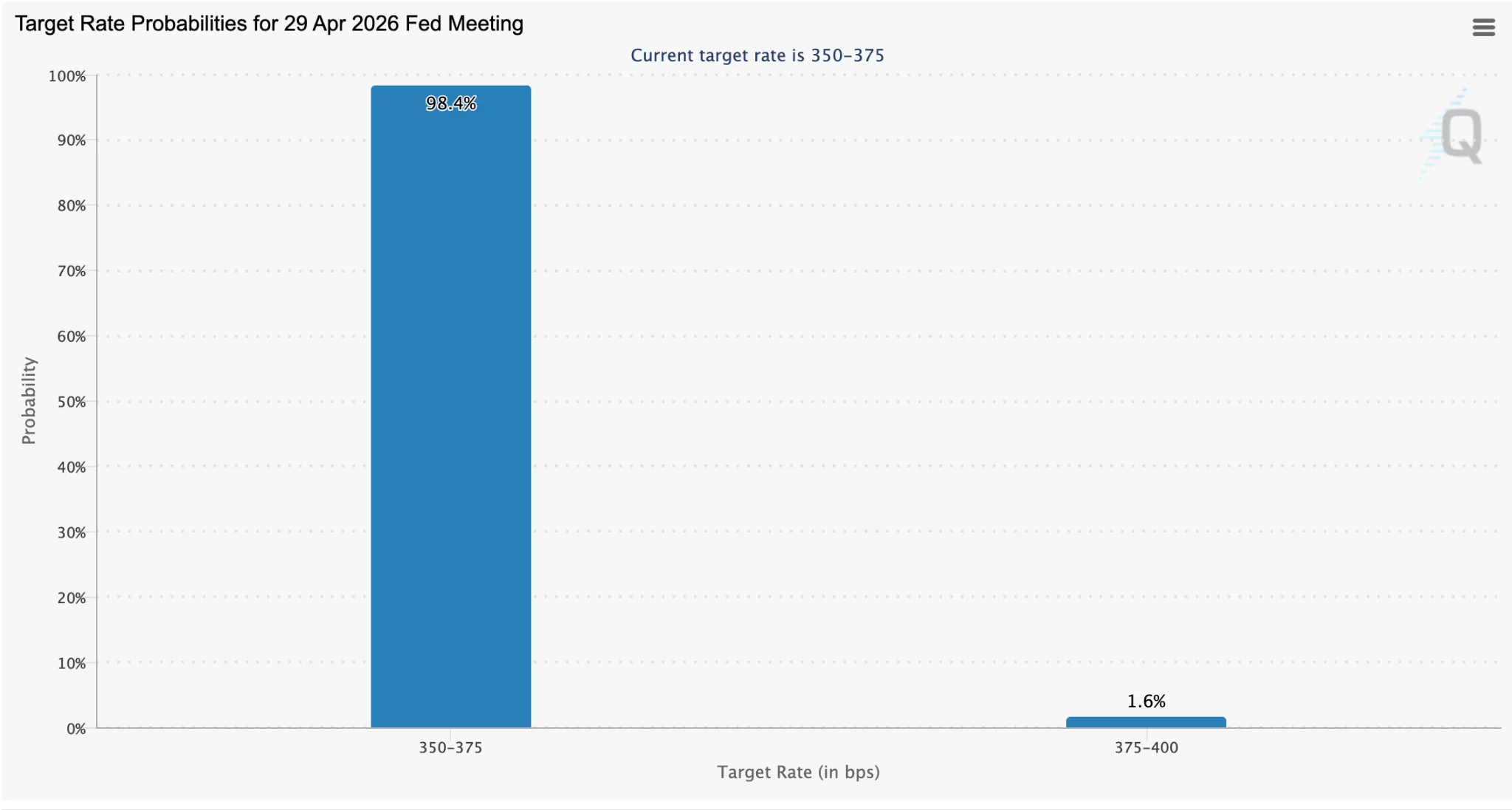
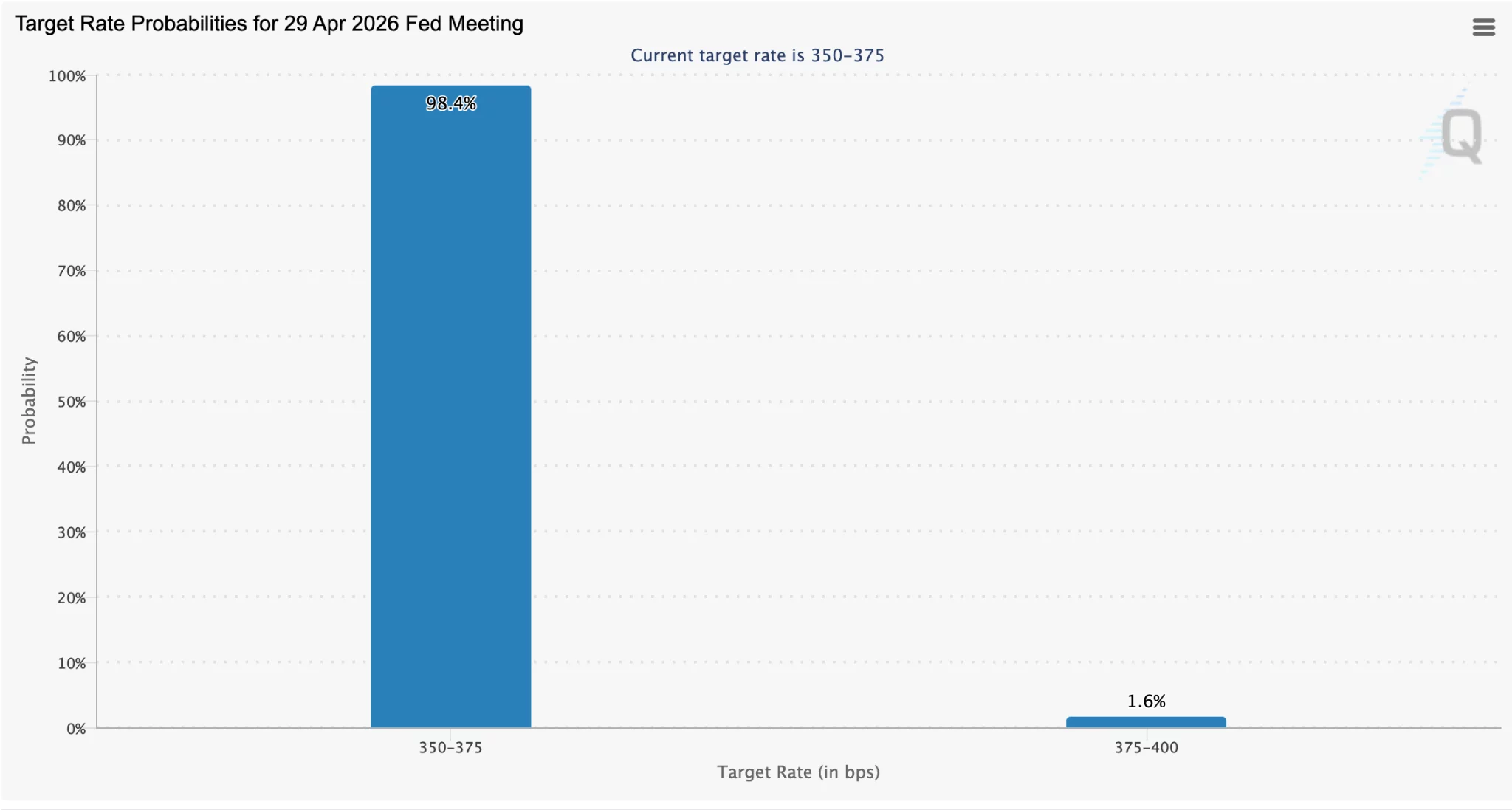
- Traders see a 98.4% chance the Fed will keep rates unchanged in April.
On a yearly basis, CPI increased 3.3%, keeping inflation above the Federal Reserve’s 2% target.
The report showed that energy costs drove much of the monthly increase. The energy index rose nearly 11% during the month, while gasoline prices climbed 21.2%, making fuel the main source of price pressure in the latest reading.
March marked the first full month in which the US-Iran war shaped inflation data. Higher fuel costs pushed the headline number above the pace seen in February, when CPI rose 0.3% on the month and 2.4% from a year earlier.
At the same time, core CPI came in slightly lower than forecast. Core inflation, which excludes food and energy, rose 2.6% on a yearly basis, compared with market expectations of 2.7%. That reading showed that underlying price growth remained more stable even as energy prices surged.
Moreover, the inflation report kept attention on the Federal Reserve’s next policy move. Price stability remains part of the central bank’s dual mandate, alongside maximum employment, and inflation above target has continued to shape rate expectations.
According to CME Group’s FedWatch tool, traders see almost no chance of a rate cut at the April Federal Open Market Committee meeting. Market pricing showed a 98.4% probability that the Fed will leave rates unchanged, while officials have also not ruled out further tightening if inflation stays elevated.
Bitcoin rises after CPI release
Bitcoin moved higher after the CPI data was released, even as the inflation reading pointed to ongoing pressure on consumer prices. The asset briefly touched the $73,000 level and continued to trade above $72,000 later in the session.
At the time of writing, Bitcoin traded at $72,780, up 1 % over 24 hours and 9% over seven days.


TLDR
- Tesla’s Q1 2026 vehicle deliveries reached 358,000 units, marking a 6% yearly increase but falling short of the 365,000 analyst consensus
- TSLA shares have declined 29% from record highs amid weakening EV demand, tax credit expiration, and intensifying competition
- Bank of America resumed coverage with a $460 target price, highlighting Tesla’s camera-based robotaxi technology as a scalable competitive edge
- Morgan Stanley calculates Tesla’s cost-per-mile advantage at $0.81, significantly undercutting Waymo’s $1.43 and conventional rideshare’s $1.71
- Tesla’s Energy Storage division substantially underperformed — delivering 8.8 GWh against expectations of 14.4 GWh, representing a 40% gap
Tesla’s first-quarter 2026 delivery report showed 358,000 vehicles handed over to customers, representing a 6% improvement versus the prior year but narrowly missing Wall Street’s 365,000-unit forecast. This marked the second straight quarter where actual deliveries trailed analyst projections.
The electric vehicle manufacturer has encountered substantial headwinds. The elimination of federal tax incentives, escalating competitive pressures, and CEO Elon Musk’s controversial political involvement have all dampened consumer appetite. Throughout 2025, Tesla relinquished its position as the globe’s leading EV manufacturer, with deliveries, revenue, and profitability all trending downward.
TSLA shares currently trade 29% beneath their all-time peak. Yet two prominent Wall Street institutions have issued optimistic assessments — and their focus centers on future opportunities rather than recent performance.
Bank of America analyst Alexander Perry resumed coverage in March with a $460 valuation target, suggesting approximately 33% appreciation potential from the current $345 price level. This target aligns with the median forecast among 56 analysts tracking the stock, per The Wall Street Journal data.
Perry’s fundamental thesis revolves around autonomous vehicle technology. Tesla presently operates robotaxi services in only two American cities — Austin and San Francisco — placing it considerably behind Alphabet’s Waymo, which maintains operations across 11 cities. However, Perry identifies Tesla’s camera-exclusive methodology as the critical distinguishing factor.
Most autonomous taxi providers employ a combination of cameras, lidar sensors, and radar systems. Tesla relies exclusively on cameras. While technically more challenging, this approach dramatically reduces costs. The strategy eliminates expensive sensor installations and removes the requirement to pre-map urban environments with lidar before entering new markets.
“Tesla’s camera-only approach is technically harder but much cheaper and leverages a consumer-fleet data engine. Tesla’s strategy should allow it to scale more profitably compared to robotaxi competitors,” Perry said.
Cost Advantage Could Be Decisive
Morgan Stanley analyst Andrew Percoco reinforces this perspective. His analysis estimates Tesla’s robotaxi operating cost at $0.81 per mile, contrasted with $1.43 for Waymo and $1.71 for conventional rideshare services. He anticipates this metric will decrease further once Cybercab manufacturing achieves scale.
Percoco additionally identifies the robotaxi deployment as creating a reinforcing cycle: expanded ride volume produces enhanced real-world operational data, which refines Tesla’s artificial intelligence systems, which advances the Full Self-Driving (FSD) capabilities offered to traditional vehicle purchasers, which stimulates demand in the primary automotive business.
Musk has indicated the autonomous transportation network could extend to “dozens of major cities” encompassing between one-quarter and one-half of the United States by year’s conclusion. Morgan Stanley forecasts Tesla will secure 25% of U.S. autonomous transportation trips annually by 2032, trailing Waymo’s projected 34% market share.
Energy Storage Was the Real Miss
While automotive delivery figures dominated headlines, Tesla’s Energy Storage division experienced a challenging quarter. Megapack installations totaled merely 8.8 GWh, a 40% shortfall compared to the 14.4 GWh consensus projection. This represented Tesla’s first year-over-year contraction in storage deployments since 2022.
Analysts characterize this as an isolated occurrence, attributing it to the irregular timing inherent in large-scale utility agreements and project schedules. Nevertheless, this metric warrants continued monitoring.
Morgan Stanley has revised its full-year 2026 delivery projection to 1.60 million vehicles, still indicating a 2.2% year-over-year decrease. The firm’s extended-term framework anticipates a mid-teens volume compound annual growth rate through 2030, propelled by upcoming model introductions including a prospective “Model YL” and a refreshed Cybertruck.

Ripple’s native token traded at $1.35 on April 11 after posting a slight daily gain and a 3% weekly rise.
Summary
- XRP held near $1.35 as traders prepared for a busy week around Congress and crypto policy.
- Market focus shifted to the CLARITY Act as lawmakers returned after a two-week recess.
- Analyst EGRAG CRYPTO shared long-range XRP targets, while traders weighed price history and market size.
The US Congress is due to reconvene on April 13. Traders are watching that date closely because the CLARITY Act may return to the agenda during the coming week.
The Senate Banking Committee could review changes to the bill before another vote takes place. That process has kept XRP in focus because Ripple’s token often reacts to US crypto policy news and market sentiment tied to regulation.
Recent support for the bill from financial officials, White House economists, and some lawmakers has added to market attention. That setup has increased expectations of a busy week for digital assets.
XRP may see stronger price swings if lawmakers move the discussion forward. Traders often react quickly when policy headlines affect the outlook for the broader crypto market.
Analyst shares wide XRP price targets
At the same time, analyst EGRAG CRYPTO shared a new long-term XRP outlook. The analyst said the chart structure points to several possible targets across different time frames.
In the post, EGRAG wrote that the targets are “NOT random numbers” and described them as “harmonic targets from different scales.” The analyst listed a non-logarithmic measured move in the $4 to $7 range and larger expansion targets at $13 and $27.
The post also referred to a macro repricing case of $100 and a measured move of $225. EGRAG said that “$225 is TA… it’s a SYSTEM SHIFT bet,” placing the higher target in a separate category from the near-term projections.
Those levels have drawn attention because XRP has a large and active community that often follows bold market calls. The latest post added another round of discussion around long-range XRP forecasts.
Market watches price history and bill progress
Even the lower end of EGRAG’s target range would require a sharp move from current levels. XRP has delivered strong rallies before, but those gains came when the asset had a smaller market profile.
Recent commentary around the forecast said the framework relies on a broad multi-year structure rather than a short-term setup.
Similar past analysis from the same analyst used large formations and Fibonacci expansion levels, including a prior call that placed XRP at $27 by August 2027.
Disclosure: This article does not represent investment advice. The content and materials featured on this page are for educational purposes only.


Iran is demanding cryptocurrency payments from tankers transiting the Strait of Hormuz. Hamid Hosseini, spokesperson for Iran’s Oil, Gas and Petrochemical Products Exporters’ Union, specifically named Bitcoin (BTC) in a recent statement.
However, Chainalysis suggests that stablecoins could be the instrument of choice, consistent with how the Islamic Revolutionary Guard Corps (IRGC) has historically moved money.
Stablecoins Fit Iran’s Playbook
Chainalysis argues that stablecoins, not BTC, will likely serve as the IRGC’s toll collection instrument. The firm pointed to the regime’s well-documented preference for dollar-pegged tokens across years of illicit trade.
The reasoning is straightforward. Dollar-pegged stablecoins preserve value in ways BTC cannot. Iran’s rial has lost substantial value against the dollar, making price stability essential for large-scale commercial revenue.
Bitcoin’s regular volatility would expose toll proceeds to unpredictable losses between collection and conversion.
“The regime has leveraged stablecoins because their backing by the US dollar guarantees preservation of value and provides the liquidity necessary for use at scale,” the report read. “Bitcoin, by contrast, experiences regular price volatility.”
Chainalysis noted that the IRGC has historically relied on stablecoins across oil sales, weapons procurement, and proxy financing. Bitcoin, by contrast, has served a different function within Iran’s crypto operations.
The report primarily linked it to Iranian cyber actors running ransomware campaigns and other malicious operations. That is a fundamentally different use case from high-volume, commerce-oriented toll collection.
Follow us on X to get the latest news as it happens
Billions Already on Chain
The scale of the IRGC’s existing crypto operations reinforces why stablecoins may be the likely choice. Chainalysis estimated that IRGC-associated wallet addresses received over $2 billion in 2024.
That figure spiked above $3 billion in 2025, representing roughly half of Iran’s total crypto ecosystem by the fourth quarter.
Those numbers are considered lower-bound estimates. They include only addresses identified through OFAC designations and Israel’s National Bureau for Counter Terror Financing seizure lists. The full network of shell companies and intermediary wallets remains larger.
Before the closure, the Strait of Hormuz handled around 20 million barrels of oil per day, roughly 20% of the global seaborne oil trade. At $1 per barrel, even partial toll collection on current volumes could generate billions annually. Stablecoins offer the throughput and liquidity that kind of scale demands.
“These oil shipments could generate sorely needed revenue for the regime during the most severe threat to the Islamic Republic in decades,” Chainalysis added.
However, stablecoins carry their own risk for Tehran. Unlike BTC, stablecoin issuers can freeze assets held in designated wallets. Chainalysis flagged this as a key intervention point for regulators and law enforcement if the stablecoin toll program materializes.
Subscribe to our YouTube channel to watch leaders and journalists provide expert insights
The post Iran’s Hormuz Toll Could be In Stablecoins, Not Bitcoin appeared first on BeInCrypto.
Key Takeaways
- The WLFI token plunged 12% to reach an all-time low since its 2025 debut
- The project leveraged its native WLFI tokens as collateral for stablecoin loans on the Dolomite platform
- This borrowing activity exhausted Dolomite’s USD1 liquidity pool, preventing other users from accessing withdrawals
- Tron’s Justin Sun saw his locked WLFI position decline by more than $11 million within 24 hours
- Treasury repurchase operations are currently underwater by approximately 48%
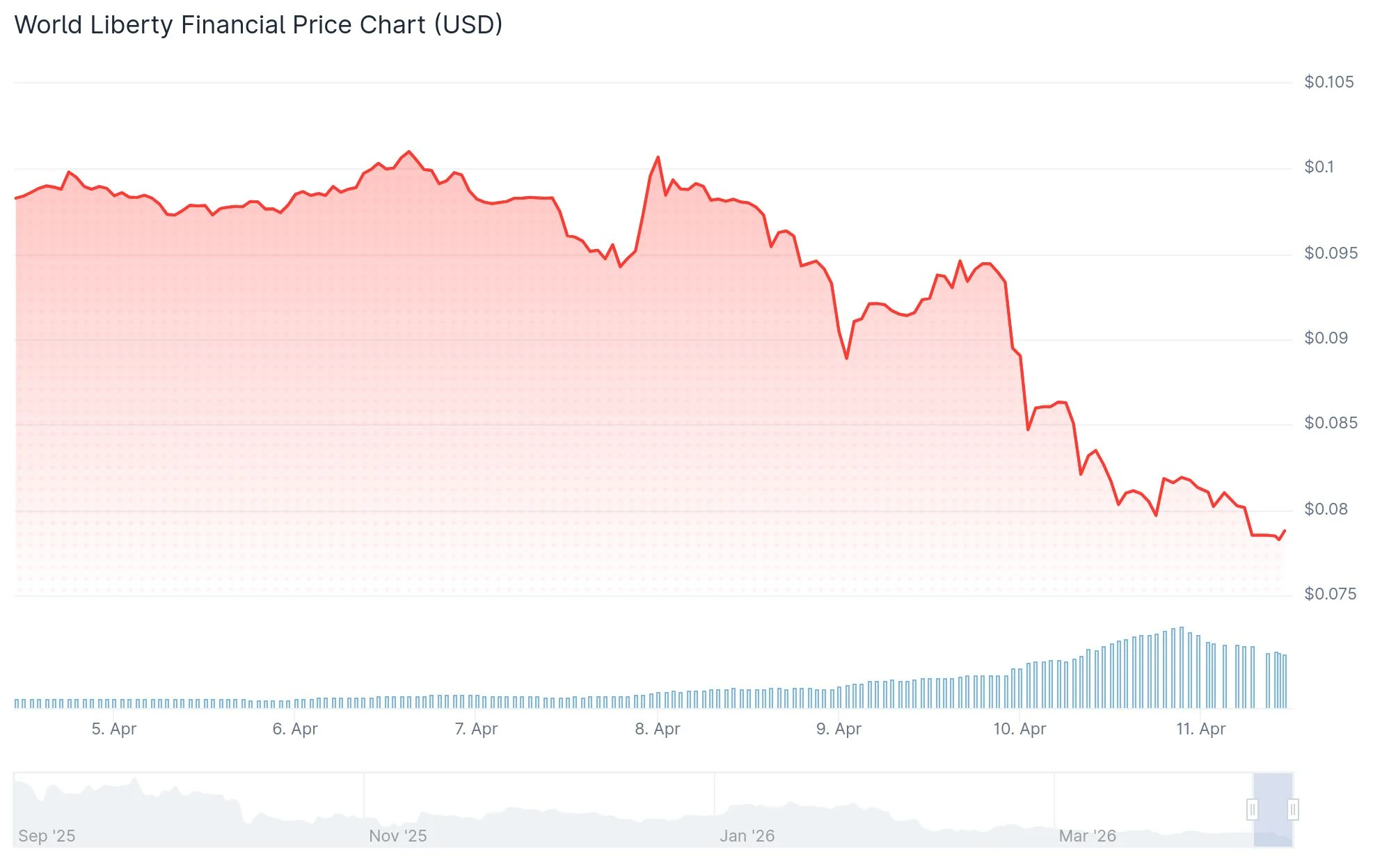
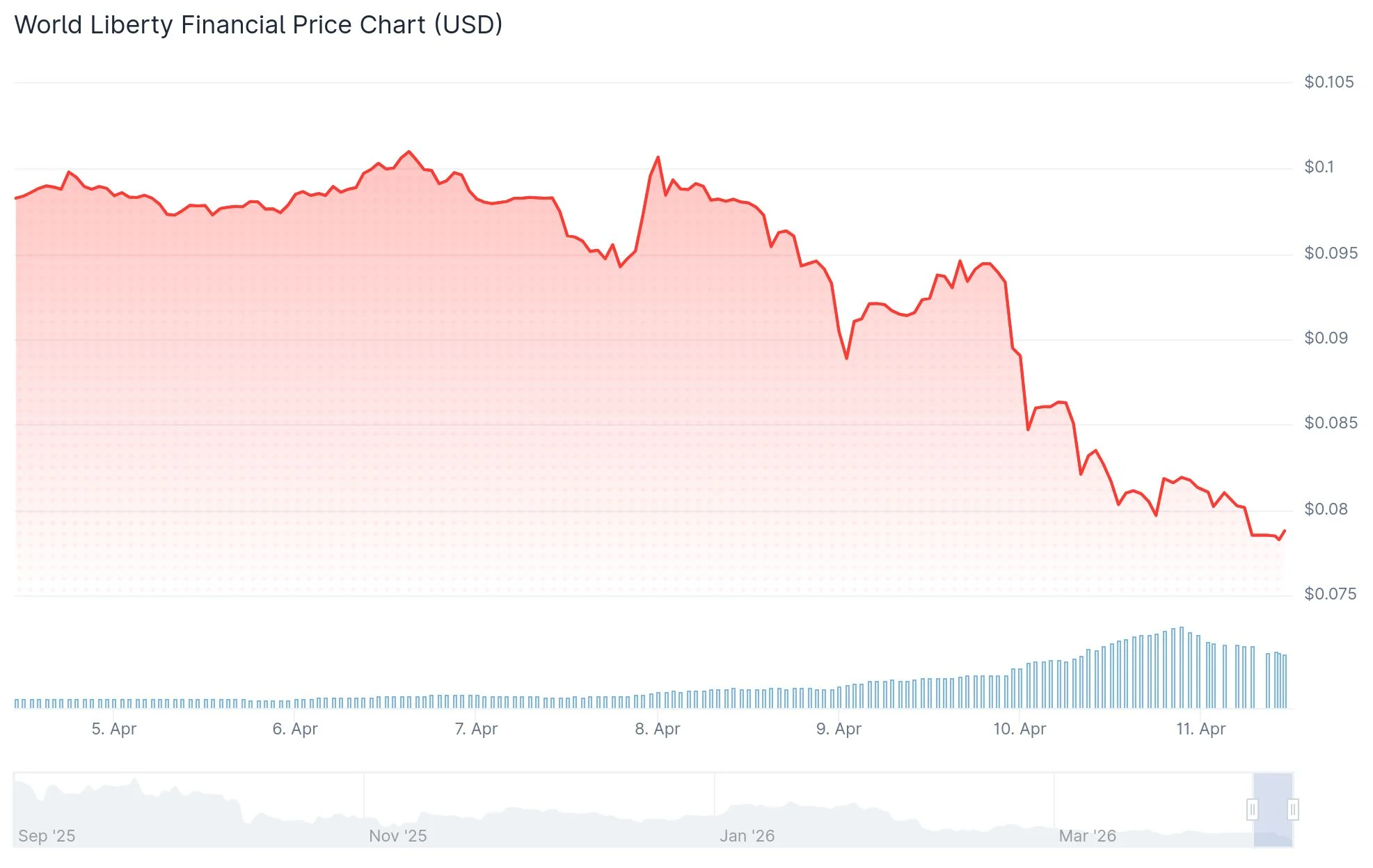
The World Liberty Financial token experienced a sharp 12% decline over a 24-hour period, reaching its lowest valuation since its 2025 introduction. The digital asset traded around $0.0818, compounding weekly declines of 15% and monthly losses totaling 17%.
The dramatic price movement followed a CoinDesk investigation revealing that WLFI had pledged billions of its proprietary governance tokens as collateral within the Dolomite lending infrastructure. Using this collateral base, the initiative secured substantial stablecoin loans, including USDC and its proprietary USD1 token, totaling tens of millions of dollars.
Blockchain intelligence from Arykham verified that a project-controlled wallet deposited 5 billion WLFI tokens as collateral on Dolomite, facilitating approximately $75 million in stablecoin borrowings. Subsequently, more than $40 million of these borrowed assets were moved to Coinbase Prime.
This substantial borrowing activity maxed out Dolomite’s available lending capacity, creating a liquidity crisis that temporarily prevented other protocol participants from accessing their deposited capital.
Project Team Addresses Growing Concerns
World Liberty Financial published a detailed response thread on X, characterizing the criticism as baseless fearmongering. The organization emphasized that liquidation risks remain minimal.
“In the event of significant market volatility against our position, we maintain the capability to supply additional collateral,” the team explained. However, skeptics noted that pledging more WLFI tokens to support existing WLFI-backed positions—particularly on a platform where a WLFI advisor holds leadership—compounds circular risk rather than mitigating it.
Adding to the controversy, Dolomite co-founder Corey Caplan simultaneously serves in an advisory capacity for World Liberty Financial, intensifying questions about potential conflicts of interest among industry observers.
According to project disclosures, WLFI allocated $65.58 million toward repurchasing 435.3 million tokens across six months, achieving an average acquisition price of $0.1507. With current market prices hovering near $0.078, these buyback initiatives represent unrealized losses of roughly 48%.
Significant Losses for Justin Sun
Justin Sun, the founder of Tron, witnessed his immobilized WLFI holdings depreciate by over $11 million in a single trading session. Sun initially committed $30 million to World Liberty Financial during late 2024, subsequently expanding his stake to approximately $75 million.
Following the movement of roughly $9 million in WLFI from Sun’s wallet last year, World Liberty Financial blacklisted his address, effectively freezing his token holdings. According to blockchain analytics provider Bubblemaps, Sun currently possesses approximately 545 million frozen WLFI tokens valued at roughly $45 million—representing a decline exceeding $80 million from previous valuations.
An additional 3 billion WLFI tokens remain in an intermediary wallet following treasury operations conducted on April 2 and April 7, presently valued at approximately $234 million.
Technical indicators show the Relative Strength Index approaching 30, nearing oversold conditions, while the MACD reflects persistent bearish momentum. Immediate support is positioned at $0.079, with potential downside objectives at $0.075 and $0.070 should selling intensity persist.

WLFI, the native token of World Liberty Financial—the Donald Trump–backed platform—took a deeper slide over the weekend as new on-chain disclosures raised questions about the project’s use of its own tokens as loan collateral. Trading near $0.078, WLFI marked an all-time low after sinking roughly 83% from its September peak around $0.46, according to data tracked by CoinMarketCap. The fresh selloff followed revelations that wallets tied to World Liberty Financial deposited substantial WLFI holdings on Dolomite, a DeFi lending protocol co-founded by the project’s chief technology officer, Corey Caplan, and then used those tokens as collateral to borrow USD1 and USDC stablecoins. The proceeds were partly moved to Coinbase Prime, fueling concerns about liquidity and risk in a relatively obscure DeFi niche.
On-chain analytics from Arkham show a wallet associated with World Liberty Financial placing a colossal 5 billion WLFI tokens on Dolomite. The same wallet subsequently borrowed about $75 million in USD1 and USDC and transferred more than $40 million to Coinbase Prime. The size of the position ignited debate among DeFi observers about whether WLFI’s price could withstand a material move in liquidation risk should the token’s liquidity prove insufficient to cover a rapid margin call.
Key takeaways
- WLFI traded around $0.078 after hitting an all-time low near $0.077, marking an 83% decline from its September high of about $0.46 (CoinMarketCap).
- On-chain data from Arkham indicates a wallet linked to World Liberty Financial deposited roughly 5 billion WLFI on Dolomite and used the collateral to borrow around $75 million in USD1 and USDC, with more than $40 million moved to Coinbase Prime.
- Dolomite’s footprint remains modest within DeFi, ranking about 19th by total value locked (TVL) among lending protocols, per DefiLlama.
- World Liberty acknowledges its lending activity, asserting that its positions sit well above liquidation thresholds and characterizes itself as an “anchor borrower” intended to generate yield for users amid low traditional-market activity.
- A governance proposal is planned to implement a phased unlock schedule for WLFI held by early retail buyers, replacing immediate access with a long-term vesting plan subject to community vote.
On-chain activity and the liquidity question
The core concern centers on the scale of WLFI used as collateral and what a price move could trigger for lenders on Dolomite. Analysts have warned that a 5% or larger forced sale of WLFI from such a large collateral position could compress liquidity quickly, given WLFI’s market depth and the token’s relatively modest liquidity profile. While World Liberty’s public communications emphasize that the loan book remains well above liquidation thresholds, observers note that a sudden price shock or a cascade of liquidations could expose both the Dolomite pool and other users who rely on its lending markets.
Dolomite’s standing in the DeFi universe is notable but not outsized. It sits far below leaders by TVL, a reality that can complicate risk management for lenders that rely on single-asset collateral with limited trading liquidity. This backdrop amplifies the importance of robust risk controls and transparent governance, especially when a token possesses a high narrative premium but limited natural liquidity.
World Liberty’s stance and the governance plan ahead
World Liberty Financial responded to the disclosures through social channels, arguing that the firm’s positions are prudent and that the strategy serves as a mechanism to provide outsized stablecoin yields in an environment where traditional assets often yield little. The project described itself as an “anchor borrower,” a role intended to stabilize the WLFI ecosystem while delivering yield to everyday users who participate in the platform’s offerings.
In a move to address investor concerns about token dynamics, World Liberty said on X that it would soon submit a governance proposal aimed at altering token unlock mechanics. The plan would replace the immediate access enjoyed by early retail WLFI holders with a phased unlock schedule, implemented through a community-driven vote. If approved, the long-term vesting framework could help reduce the likelihood of abrupt, large-scale WLFI selling pressure tied to token distribution, potentially easing some market anxiety in the near term.
Broader implications for WLFI holders and DeFi markets
The episode underscores several recurring themes in crypto markets: the tension between tokenomics and practical liquidity, the risk of using a highly concentrated or illiquid token as the backbone for large-margin loans, and the sensitivity of retail holders to governance decisions that affect token accessibility.
For investors and traders, the development highlights a few practical considerations. First, even seemingly large, high-profile projects can face liquidity strains when a significant portion of the supply is deployed as collateral on a single DeFi venue. Second, governance proposals—especially those that affect vesting and unlock schedules—can materially shape perceived risk and price dynamics. Third, the ongoing move to clarify and formalize unlock mechanics signals a maturation process in a sector where tokenized projects have historically offered broad access with less emphasis on long-term holder alignment.
From a market structure perspective, the Dolomite exposure calls into question the risk budgeting of smaller DeFi lending platforms that might rely on a handful of large positions. While Dolomite remains a relatively small player by TVL, the event illustrates how collateral quality and token liquidity can become systemic concerns when a project is positioned as a solar-anchored yield generator for a broad user base.
In the context of broader regulatory and market developments, observers will be watching for how governance shifts are implemented and whether additional disclosures accompany on-chain activity into future quarters. The balance between encouraging user-friendly yields and maintaining robust risk controls will likely shape both WLFI’s trajectory and the wider DeFi lending landscape as platforms evaluate collateral standards and liquidity risk frameworks.
As WLFI navigates this period of scrutiny, investors should monitor price action, liquidity cues, and the outcomes of forthcoming governance discussions. The unfolding narrative will help determine whether the project can restore confidence in its tokenomics, or whether tighter risk management and more transparent capital practices will become the baseline expectation for participants in WLFI’s ecosystem.
Source notes: WLFI’s price data tracked by CoinMarketCap; on-chain activity and collateral details drawn from Arkham analytics; the project’s DeFi footprint cited via DefiLlama; official responses and governance plans referenced through World Liberty Financial’s public statements.


Grayscale has updated its list of digital assets under consideration for future investment products.
Summary
- Grayscale named HYPE, TON, TRX and ENA among digital assets under consideration this quarter today.
- The asset manager also filed with the SEC to launch a spot HYPE ETF.
- Zcash surged over 30% after reports linked Grayscale activity to renewed demand in markets.
The latest Q2 2026 list includes several large and emerging tokens, while a separate filing tied to Hyperliquid’s HYPE token has added more attention to the asset manager’s next product moves.
Grayscale said its latest Q2 2026 review covers digital assets it may include in future investment products. The company grouped the list under its crypto sector framework and said it plans to refresh the list as often as 15 days after each quarter ends.
The new watchlist includes CC, CELO, MNT, MON, TON, TRX, ENA, HYPE, JUP, KMNO, SYRUP, MORPHO and PENDLE. It also names other assets such as ROBO, FLOCK, GRASS, KAITO, KITE, VVV, VIRTUAL, WLD, GEOD, HNT, JTO, ZRO and W.
Grayscale said the list includes assets not yet held in its current product suite. It added that the list remains subject to change during the quarter as multi-asset funds reconstitute and as new single-asset products launch.
The company also named MegaETH, Nous Research and Poseidon with an asterisk. That suggests those projects remain under review but may not yet trade as standard liquid tokens in the same way as others on the list.
HYPE ETF filing adds new focus
Attention around the Grayscale update increased after reports said the firm filed with the US Securities and Exchange Commission for a spot HYPE ETF in March. The proposed fund would track Hyperliquid’s native token if regulators approve the product.
That filing places HYPE in two active discussions at the same time. It appears on Grayscale’s Q2 assets under consideration list, and it is also linked to a separate exchange-traded fund proposal.
Bitwise is signaling the imminent launch of a US exchange-traded fund (ETF) tied to the decentralized trading network Hyperliquid.
In an amended registration statement filed with the SEC, the digital asset index fund manager disclosed critical operational details for the proposed product.
BHYP Ticker For Bitwise’s Hyperliquid ETF
Bitwise’s filing says the trust’s primary objective is to provide exposure to the value of Hyperliquid held by the vehicle. The fund’s secondary objective is to earn staking rewards.
“In connection with its investment objective of seeking to derive additional Hyperliquid through staking, the Trust will stake some or all of the Hyperliquid held in the Trust Hyperliquid Accounts,” the filing stated.
Meanwhile, the new filing introduces the ticker symbol BHYP and establishes a sponsor fee of 67 basis points.
Industry experts noted that these inclusions represent one of the final procedural hurdles before a fund goes live on national exchanges.
If approved by securities regulators, the Hyperliquid fund will integrate into a rapidly expanding suite of Bitwise investment vehicles.
Over the past year, the asset manager has aggressively expanded its product lineup beyond legacy assets such as Bitcoin and Ethereum. The firm has been providing regulated exposure for alternative layer-one networks and protocols, including Solana, Chainlink, and XRP.
Meanwhile, the push for a US spot product follows closely on the heels of Bitwise’s international expansion.
On April 9, the firm listed the Bitwise Hyperliquid Staking physically backed product on the Deutsche Börse Xetra. That instrument tracks the Kaiko HYPE Reference Rate LDNLF index.
The fund automatically captures on-chain staking yields, sparing institutional allocators the operational friction of managing private keys and self-custody infrastructure.
HYPE Outperforms Crypto Bear Market
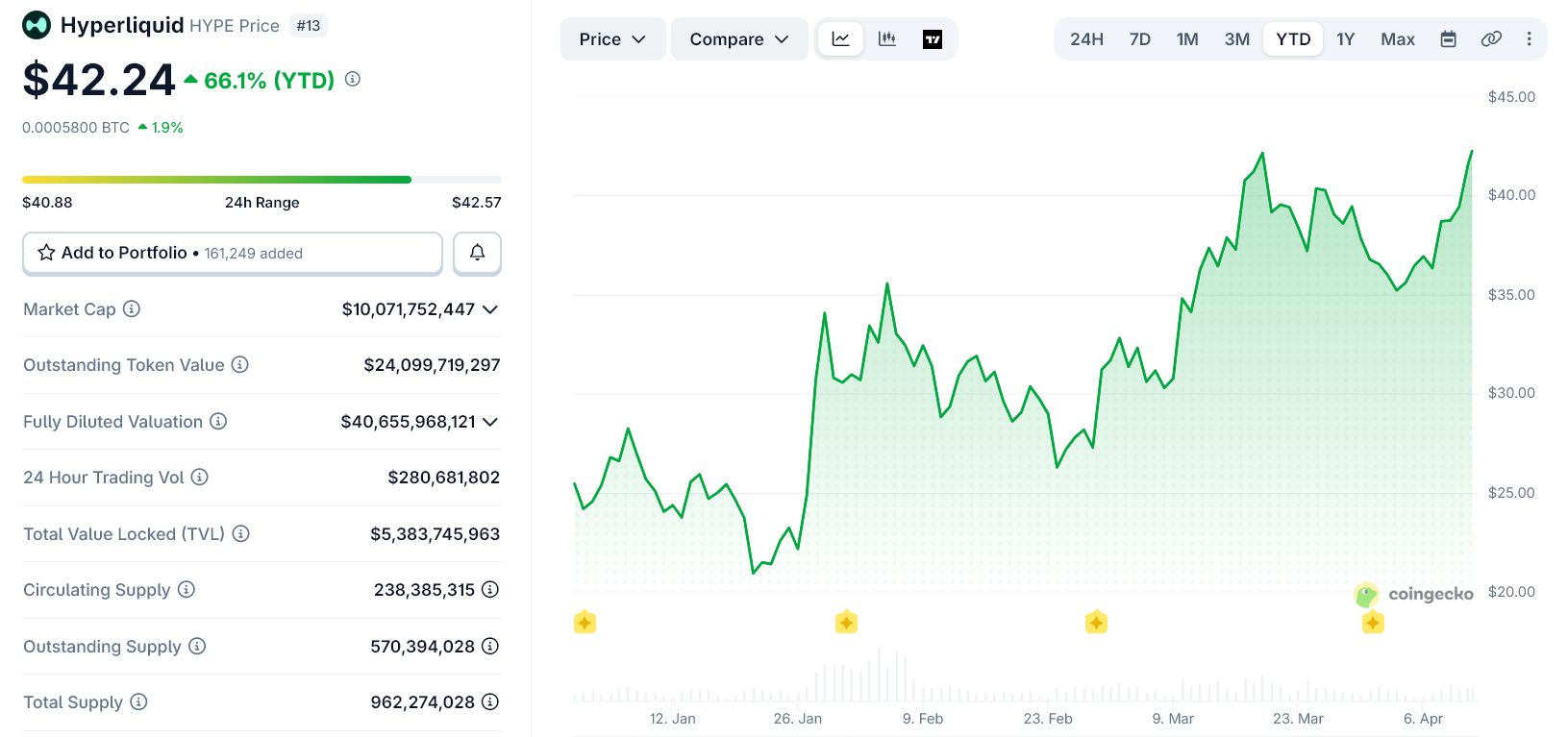
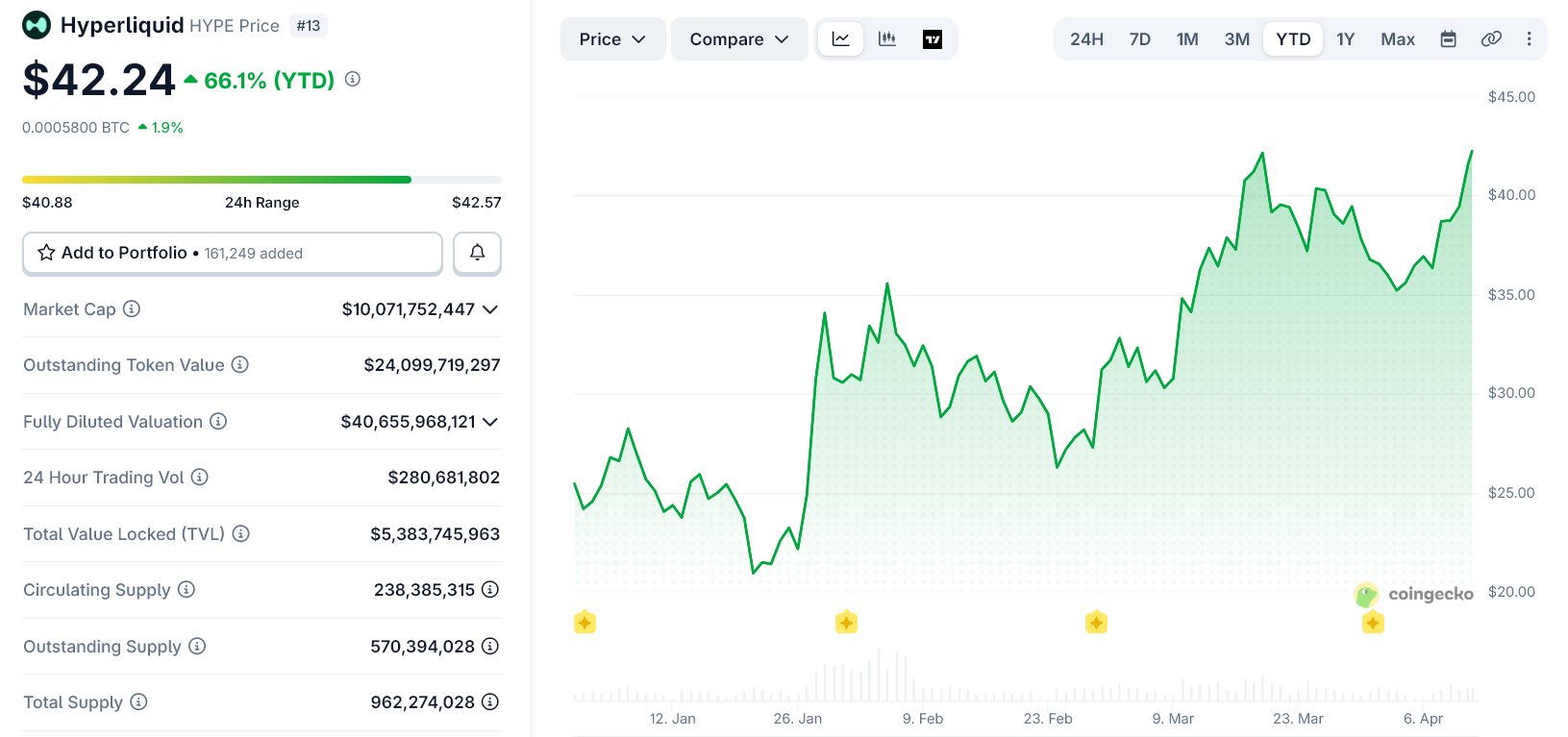
Since the beginning of the year, Hyperliquid’s HYPE has emerged as one of the best-performing digital assets.
The altcoin has surged 66% since the beginning of 2026. This demonstrates distinct relative strength against a broader digital asset market that has struggled to find its footing early in the year.
A significant catalyst for Hyperliquid’s recent outperformance is its underlying utility during periods of acute macroeconomic stress. As military hostilities flared in the Middle East involving the US, Israel, and Iran, traditional financial markets were shuttered for the weekend.
During that liquidity gap, institutional and retail participants aggressively rotated into Hyperliquid’s blockchain-based infrastructure.
The decentralized platform became a critical venue for traders seeking to hedge geopolitical risks. They used synthetic perpetual futures contracts to gain exposure to global benchmarks such as Brent crude and gold before the recent Pakistan-brokered ceasefire took effect.
The post Bitwise Is Launching Its Hyperliquid ETF Soon appeared first on BeInCrypto.
Crypto World
Monad Crypto Whales Just Hit a 90-Day Accumulation Peak: Is MON About to Break Its All-Time High?
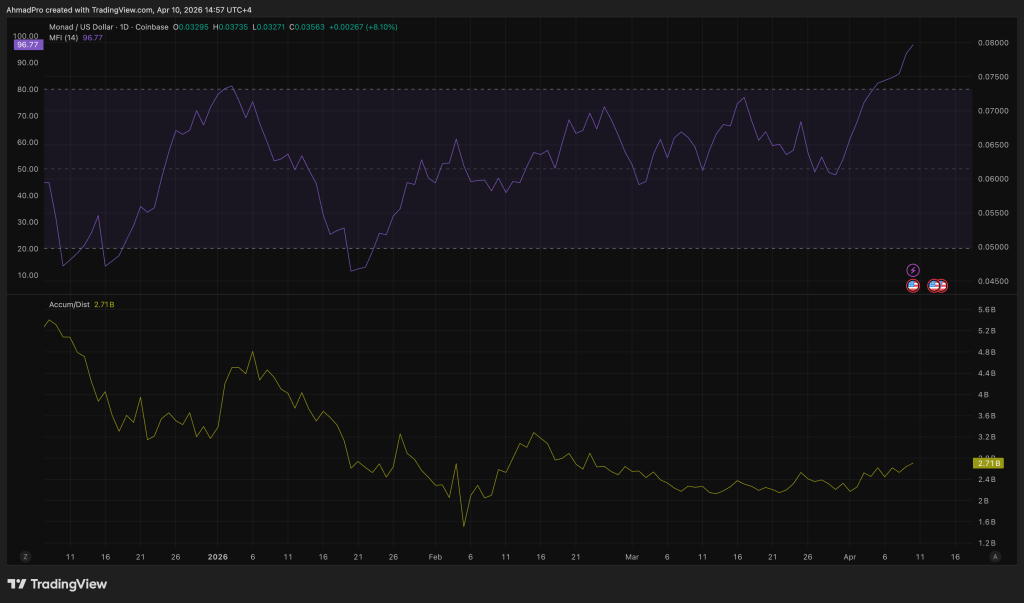
Monad Crypto (MON) is trading near $0.035 after a 18% surge in 24 hours, with large holder netflow on-chain data registering its highest reading in 90 days – a level not seen since the token’s initial post-launch run.
Exchange outflows have spiked alongside that number, indicating cold storage accumulation rather than positioning for a near-term exit.
The complicating factor is immediate: MON price is pressing into the $0.035–$0.040 resistance block that capped its last local peak, and the all-time high of $0.049 sits another 15% above that ceiling. Is this whale accumulation the real setup, or is the market running ahead of confirmation?
The Accumulation/Distribution indicator is trending higher in tandem with price, a structurally bullish read.
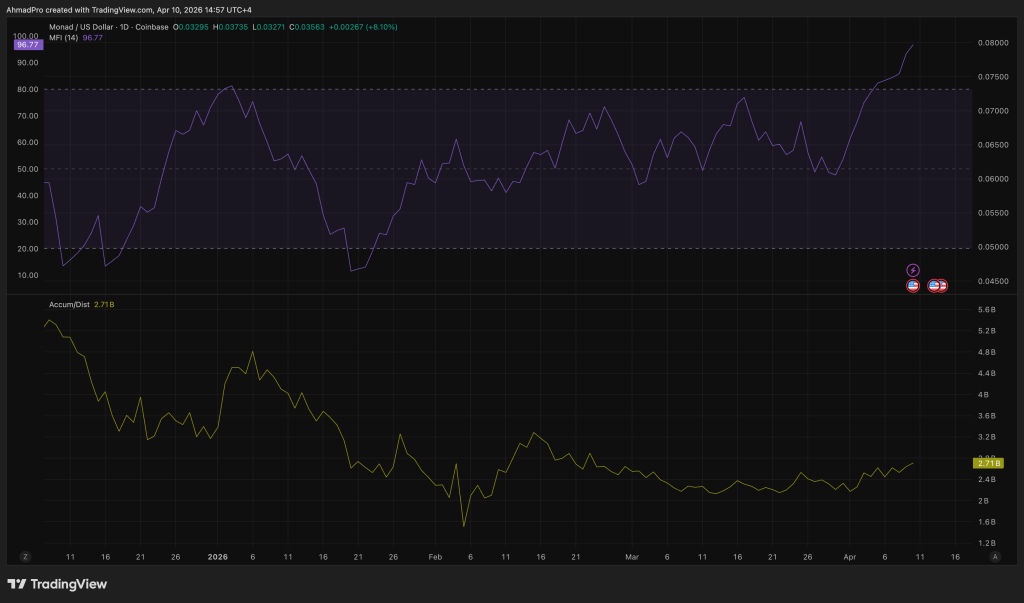
Trading volume exceeded $2.69 billion in the past day, and the Money Flow Index is holding slightly above 80, suggesting capital is still entering rather than rotating out. What the on-chain data doesn’t yet confirm is whether this print translates into a clean breakout or a high-volume rejection at resistance.
Discover: The best pre-launch token sales
Can Monad Crypto Clear $0.040 Resistance or Does the Overbought Signal Force a Reset for MON Crypto?
The price analysis starts at the 200-day EMA, currently clustered near $0.0345. MON is trading just above that level, which means the immediate battle is confirming it as support rather than ceiling.
A hold here with successive closes above $0.035 starts building the structure needed for a run at $0.040.
If MON clears $0.040 on volume comparable to today’s session, the path to the all-time high near $0.049 opens without a major structural obstacle in between.
If $0.035 fails to hold as support after the current push, the $0.0293 liquidity cluster becomes the next relevant floor, and below that the $0.023–$0.025 zone enters the picture.
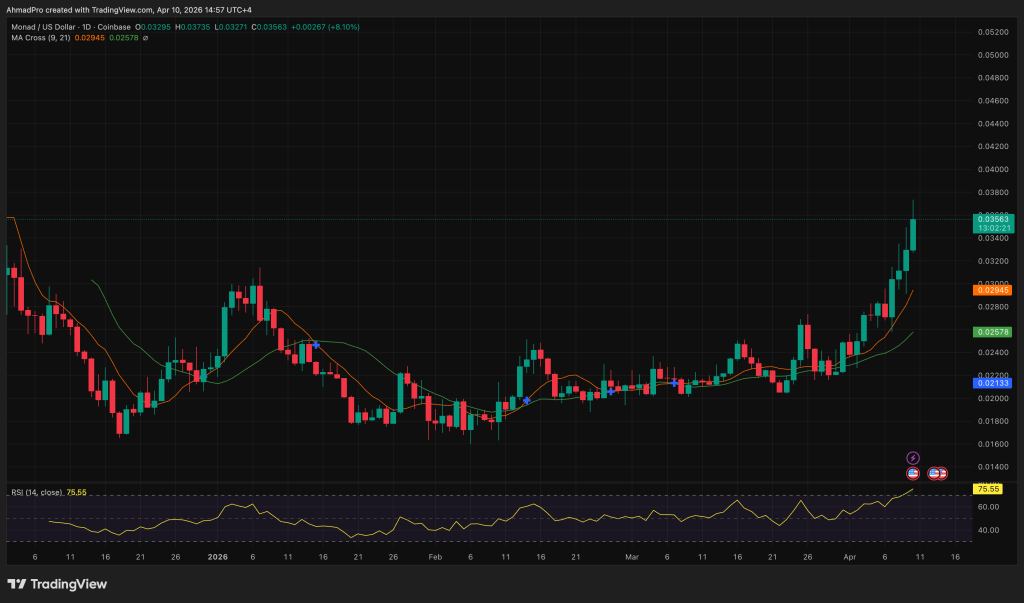
The Bollinger Bands are the counterweight here. MON has entered the overbought region – price is pressing the upper band – which historically signals either a short consolidation or an outright pullback before the next leg.
The band position doesn’t invalidate the bull case; it narrows the path. For us, the invalidation is a daily close back below $0.0293 on elevated volume. That would suggest distribution, not accumulation, is driving the flows.
The Monad crypto ecosystem is adding weight to the technical setup. Neverland, the flagship DeFi protocol on the network, is approaching $40 million in Total Value Locked, and TVL across integrated protocols has grown roughly 15% this week.
That’s utility keeping pace with speculation – a healthier signal than price momentum running on narrative alone.
Discover: The best crypto to diversify your portfolio with
Missed Monad Crypto? Liquid Chain Raises $700,000 Heading Into The First Week
Liquid Chain built a Unified Liquidity Layer that aggregates capital across multiple Layer-2 networks using Chainlink’s Cross-Chain Interoperability Protocol (CCIP) as the messaging backbone.
The core problem it solves is real and expensive – assets stranded on individual L2s require manual bridging, creating slippage, delay, and trust assumptions that institutional allocators won’t accept.
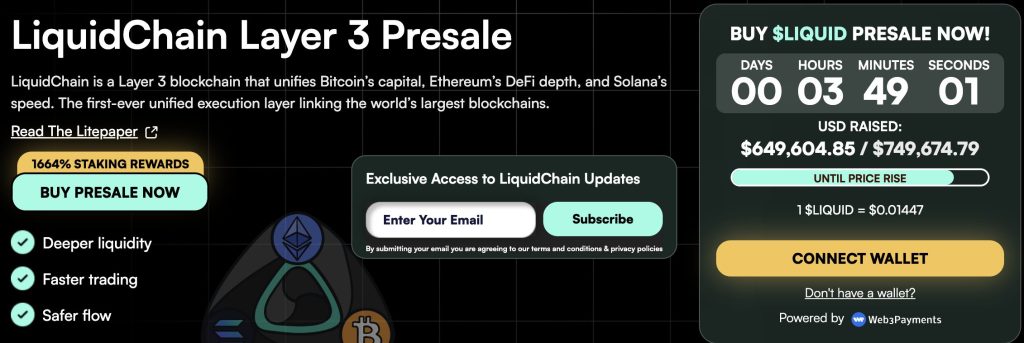
Liquid Chain’s architecture lets users move assets seamlessly across chains without manual bridge interactions, with CCIP handling the verification and message-passing layer beneath the surface.
The project has been pitching its Layer-3 DeFi buildout as a credible answer to the fragmentation problem, and the Convergence judges agreed.
The Order grows. The Order evolves. ⟁ — LiquidChain (@getliquidchain) April 8, 2026
 https://t.co/vqvBcdSQYC pic.twitter.com/stB6CDGAVD
Other notable hackathon submissions concentrated on Real-World Asset tokenization and DeFi automation – a consistent signal that Chainlink’s developer community is orienting toward institutional-grade infrastructure rather than consumer speculation. The CCIP adoption rate implied by the hackathon submissions validates Chainlink’s cross-chain positioning at exactly the moment demand for tamper-proof oracle settlement is breaking records on Polymarket.
Explore the LiquidChain presale and current allocation terms here.
The post Monad Crypto Whales Just Hit a 90-Day Accumulation Peak: Is MON About to Break Its All-Time High? appeared first on Cryptonews.

TLDR:
- Attackers socially engineered OVHcloud support to remove hardware 2FA, enabling full account access within an hour.
- The phishing site used an Inferno Drainer kit and ran live for roughly four hours on March 30, 2026.
- ICANN’s five-day domain transfer lock gave Steakhouse Financial time to cancel an outbound transfer filed by the attacker.
- Steakhouse vaults on Morpho operated independently throughout; no depositor funds were at risk at any point.
A social engineering attack briefly redirected Steakhouse Financial’s website to a phishing page on March 30, 2026.
Attackers manipulated the domain registrar’s support team to strip account security protections. The phishing site ran for roughly four hours before the team reclaimed control. No user funds were lost, and no onchain contracts were touched.
How Attackers Broke Into Steakhouse Financial’s Domain Registrar
The attacker called OVHcloud, the domain registrar used by Steakhouse Financial, and posed as the account owner. They provided enough personal information to pass OVH’s phone-based identity check.
An OVH support agent then removed the hardware-based two-factor authentication on the account.
Within seconds of logging in, the attacker ran automated scripts. These deleted every second-factor device on the account and enrolled their own. The speed pointed to a pre-planned operation.
The attacker then redirected the domain’s nameservers to servers under their control.
They pointed the site’s A records to a cloned version of the Steakhouse website hosted on Hostinger. That cloned site carried a wallet drainer linked to Inferno Drainer, a known drainer-as-a-service operation.
Let’s Encrypt TLS certificates were obtained within minutes. This made the phishing site appear legitimate to standard browsers. Wallet extensions from Phantom, MetaMask, and Rabby flagged the site as malicious independently and quickly.
Steakhouse Financial Regained Control Within Hours, Funds Remained Safe
Steakhouse Financial’s team spotted the unauthorized email-change notification at 08:47 UTC and contacted OVH immediately. The phishing site went live around 09:59 UTC.
The team posted a public warning on X at 10:34 UTC, under 30 minutes after the site became operational.
The Security Alliance (SEAL) was brought in at 11:25 UTC while the attack was still active. The team worked across multiple parallel tracks. These included account recovery, DNS forensics, and transfer cancellation.
The attacker had filed an outbound domain transfer. ICANN’s five-day transfer timelock gave the team time to cancel it.
The team contacted Hostinger directly to reject the transfer on the receiving end. Hostinger later confirmed the offending account was frozen and closed.
By 12:56 UTC, the team had reclaimed the OVH account. DNS was fully restored by approximately 13:55 UTC. Steakhouse Financial confirmed all domains were safe to use by April 1.
The company has since migrated to a registrar supporting hardware-key MFA and registrar-level locks. A continuous DNS monitoring system now watches all Steakhouse domains in real time. According to the post-mortem published by Steakhouse Financial on X, a full vendor security review process is now being established across all supply-chain vendors.
Adrian Cachinero Vasiljevic, the partner responsible for operations at Steakhouse Financial, issued a personal apology. He stated that identifying this attack vector was his responsibility and committed to driving the security hardening work going forward.
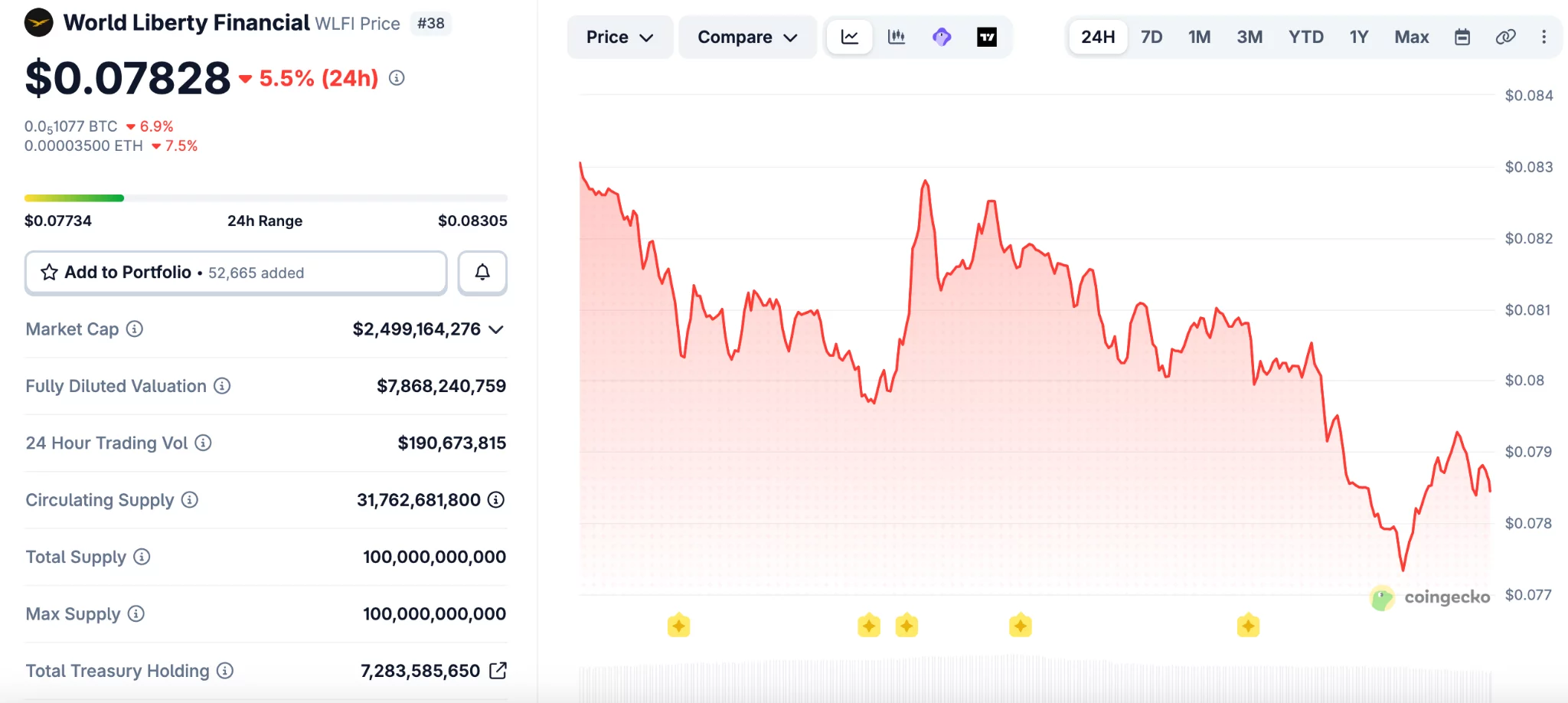
WLFI (WLFI) fell to a new all-time low on Saturday after onchain data showed wallets linked to World Liberty Financial used large token holdings to borrow stablecoins.
Summary
- WLFI fell to a record low after a self-backed loan raised fresh market risk questions.
- Onchain data showed linked wallets used 5 billion WLFI tokens to borrow stablecoins on Dolomite.
- World Liberty said its positions remain safe and framed the lending move as yield strategy.
The move added pressure to the Trump-linked project as traders weighed the risk tied to using its own token as collateral.
WLFI dropped to about $0.077, its lowest level on record, before trading near $0.079. The token is now down 76% from its peak of $0.33 reached in September, based on CoinGecko data.
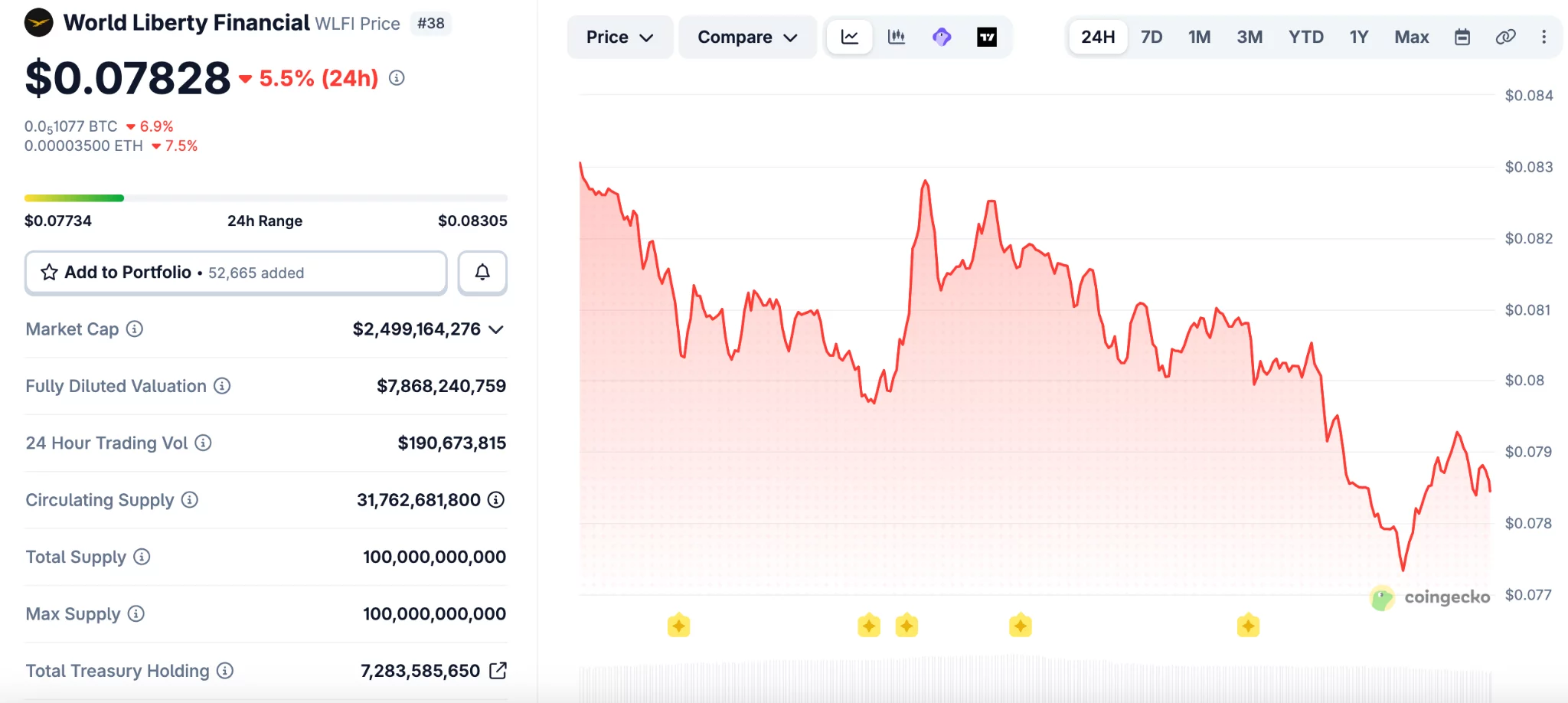
The decline followed reports that wallets tied to World Liberty Financial deposited about 5 billion WLFI tokens on Dolomite. The same position was then used to borrow $75 million in USD1 and USDC.\
Arkham data showed that more than $40 million of the borrowed funds later moved to Coinbase Prime. That transfer drew more attention to the project’s financing activity and the size of its exposure.
The market reaction was swift because WLFI is not viewed as a deeply liquid asset. A large collateral position tied to price swings can increase pressure if the token falls further.
DeFi users on X said the structure could create risk for lenders if WLFI moves closer to liquidation levels. Some pointed to the token’s high fully diluted valuation and limited trading depth as a weak point.
“WLFI has almost a $10 billion FDV, but it is not an extremely liquid asset,” wrote one user. “So imagine what would happen if 5% of WLFI’s total supply would suddenly need to be sold to liquidate the position.”
Another user compared the setup to borrowing cash against self-created value. The user said,
“It’s the financial equivalent of printing casino chips, borrowing cash against them, and telling everyone else not to panic because the house still believes in the chips.”
Dolomite remains a smaller player in DeFi lending. DefiLlama ranks it 19th among lending platforms by total value locked, which added more focus to the size of the WLFI-linked position.
World Liberty defends the strategy
World Liberty Financial responded on social media and said its positions remain well above liquidation thresholds. The project described itself as an “anchor borrower” and said the strategy supports yield generation.
The team wrote,
“Everyday users are earning outsized stablecoin yields right now — at a time when traditional markets are offering very little.” It added, “That’s the whole point.”
The project also said it plans to introduce a governance proposal for early retail holders. The proposal would replace immediate token access with a phased vesting schedule, subject to a community vote.
Disclosure: This article does not represent investment advice. The content and materials featured on this page are for educational purposes only.
InvestingPro Fair Value analysis nails 62% gain on First Horizon

10 Action Movies That Are Flawless From Start to Finish
Tesla (TSLA) Stock: Wall Street Banks Bet Big on Robotaxi Despite Delivery Weakness

Why Israel is blocking foreign journalists from entering

Bitcoin: We’re Entering The Most Dangerous Phase

Alan Cumming Brands Baftas Ceremony A ‘Triggering S**tshow’

Emas batangan vs Perhiasan #tipskeuangan #samasamabelajar #finance

Btc prediction | Bitcoin price prediction in Hindi #india #btc #crypto #bitcoin

Dale makes money by selling bee stings.#foryou #comedy #shortvideo #shorts #shortvideos
-

 Business6 days ago
Three Gulf funds agree to back Paramount’s $81 billion takeover of Warner, WSJ reports
-

 Sports7 days ago
India men’s 4x400m and mixed 4x100m relay teams register big progress | Other Sports News
-

 Politics17 hours ago
US brings back mandatory military draft registration
-

 Fashion18 hours ago
Weekend Open Thread: Veronica Beard
-

 Tech4 days ago
How Long Can You Drive With Expired Registration? What Florida Law Says
-

 Business6 days ago
No Jackpot Winner, Prize to Climb to $231 Million
-

 Fashion5 days ago
Massimo Dutti Offers Inspiration for Your Summer Mood Board
-
 Sports18 hours ago
Man United discover Nico Schlotterbeck transfer fee as defender reaches Dortmund agreement
-

 Fashion4 days ago
Let’s Discuss: DEI in 2026
-

 Crypto World3 days ago
Bitcoin recovers as US and Iran Agree a Ceasefire Deal
-

 Crypto World2 days ago
Canary Capital Files SEC Registration for PEPE ETF
-

 Business15 hours ago
Tesla Model Y Tops China Auto Sales in March 2026 With 39,827 Registrations, Beating Cheaper EVs and Gas Cars
-

 Business7 days ago
Akebia Therapeutics, Inc. (AKBA) Discusses Pipeline Progress and Strategic Focus on Kidney Disease Treatments at R&D Day – Slideshow
-

 Business24 hours ago
OpenAI Halts Stargate UK Data Centre Project Over Energy Costs and Copyright Row
-

 Tech5 days ago
Gamer Restores the Original PlayStation Portal From Two Decades Ago
-

 Tech5 days ago
Haier is betting big that your next TV purchase will be one of these
-

 Tech5 days ago
The Xiaomi 17 Ultra has some impressive add-ons that make snapping photos really fun
-

 Tech5 days ago
Samsung just gave up on its own Messages app
-

 Politics1 day ago
Malcolm In The Middle OG Turned Down ‘Buckets Of Money’ To Appear In Reboot
-

 Tech5 days ago
Save $130 on the Samsung Galaxy Watch 8 Classic: rotating bezel, sleep coaching, and running coach for $369
You must be logged in to post a comment Login