
Crypto World
US Lawmakers Move Bill to Codify a Trump-Era Bitcoin Reserve


U.S. lawmakers moved a step closer to turning President Donald Trump’s proposal for a strategic Bitcoin reserve into law after the American Reserve Modernization Act of 2026 (H.R. 8957) cleared the House Committee on Financial Services on Wednesday.
The committee approved the bill in a 28–21 vote, setting up the next phase of legislative review in the full House and, later, the Senate. If enacted, the measure would create a Strategic Bitcoin Reserve and a separate Digital Asset Stockpile inside the Department of the Treasury to hold federally forfeited Bitcoin and other digital assets.
Key takeaways
- The American Reserve Modernization Act of 2026 (H.R. 8957) advanced after a 28–21 vote in the House Financial Services Committee.
- It would establish a Strategic Bitcoin Reserve for Bitcoin held by the federal government for at least 20 years.
- The proposal aims to improve oversight via agency-wide asset accounting, quarterly “proof of reserve” reporting, and third-party audits.
- It would also commission a study on budget-neutral strategies for expanding the reserve and allow states to store their Bitcoin with the Federal Reserve.
- The bill explicitly affirms private Bitcoin ownership and the importance of self-custody and private key control.
From executive idea to draft legislation
The bill, introduced by Representative Nicholas Begich on May 21, is designed to address what supporters describe as fragmented and inconsistent custody practices for Bitcoin currently held under federal authority. Begich argued that allowing federal Bitcoin holdings to remain scattered across custody arrangements creates unacceptable cybersecurity risks and undermines accurate accounting of what the government actually owns.
In his view, the legislation would help make Bitcoin a durable part of U.S. reserve policy—while providing a clearer framework for how those assets are stored, reported, and secured.
What the bill would create at Treasury
According to the bill text described in coverage, H.R. 8957 would establish two related structures inside the Department of the Treasury:
- A Strategic Bitcoin Reserve for federally held Bitcoin; and
- A Digital Asset Stockpile for other digital assets acquired through criminal or civil forfeiture.
The proposal also sets a minimum holding period: Bitcoin placed in the federal reserve would have to remain there for at least 20 years. That requirement indicates the act is not being framed as a short-term treasury maneuver, but as a long-duration policy shift.
For investors and market participants, the key point is less about immediate market effects and more about the administrative pathway: if H.R. 8957 becomes law, it would standardize federal custody and governance around digital assets acquired through forfeiture—potentially reducing uncertainty about how such holdings are managed over time.
Transparency and audits built into the framework
The act would also require federal agencies to provide a comprehensive accounting of digital assets they currently hold or control. It further introduces transparency mechanisms that include:
- Quarterly “proof of reserve” reports; and
- Third-party audits.
Supporters appear to see these provisions as a direct response to custody and reporting gaps. By mandating recurring disclosures and independent verification, the bill attempts to make the reserve more measurable and harder to obscure through fragmented reporting.
Some context for why this matters: the U.S. government is estimated to hold 324,527 Bitcoin, worth $24.7 billion at the time of writing, according to Arkham Intelligence. While estimates can vary by methodology, the broad takeaway is that the federal government’s on-chain footprint is large enough that custody and reporting practices can become politically and operationally consequential.
Custody rules, self-custody rights, and what still needs to happen
Beyond reserve creation and transparency requirements, H.R. 8957 would direct a study of budget-neutral acquisition strategies for expanding the Strategic Bitcoin Reserve. The bill would also affirm that states could store their Bitcoin in the Federal Reserve.
Just as notably, the legislation would explicitly recognize private ownership and self-custody rights of Bitcoin, describing control of private keys as fundamental to “financial sovereignty, privacy, and personal liberty in the digital age.” That language is likely intended to address concerns that any federal Bitcoin framework could be interpreted as limiting individual control over assets.
Bitcoin Policy Institute executive director Connor Brown described the committee vote as a “genuinely historic step for Bitcoin policy,” while Strive CEO Matt Cole previously called the measure “the single most important crypto legislation that can come out of DC.”
However, the committee approval is only an intermediate milestone. The bill still has to pass the full U.S. House and then the Senate before it can reach President Trump for a final decision.
As lawmakers consider the next stages, readers should watch two things closely: whether the reserve and audit requirements survive amendments in the full House and Senate, and how negotiators balance federal reserve objectives with the bill’s explicit protections for private self-custody and key ownership.

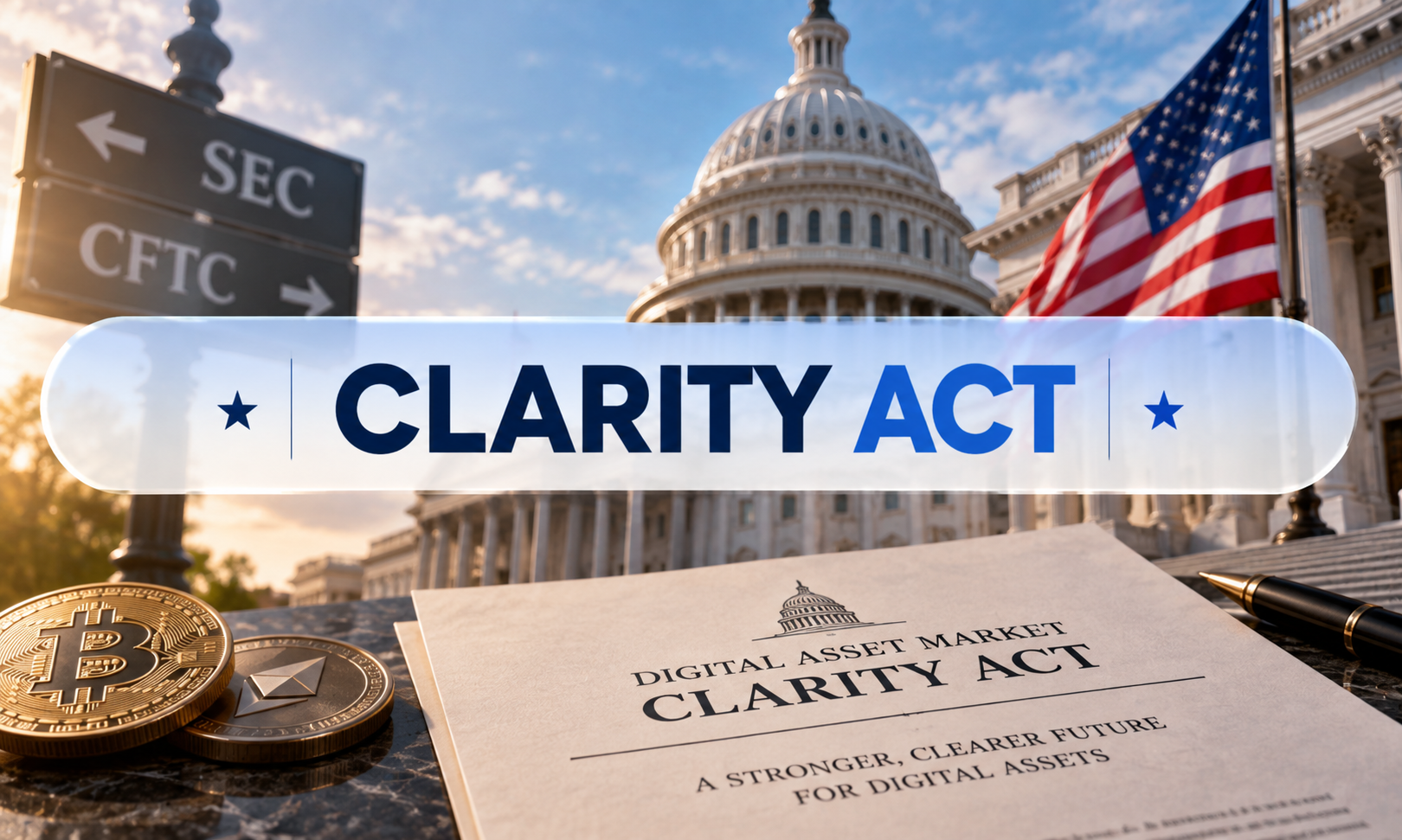
The latest stage of negotiations over the CLARITY Act has moved the bill toward a key vote while major disagreements remain. Senate Democrats sent Republicans their counterproposal late Monday after reviewing the newest Republican draft released a day earlier.
The timing came just before the legislation’s first scheduled Senate vote on Tuesday afternoon.
CLARITY Act Negotiations Heat Up
The counterproposal’s details were not disclosed. Much of the disagreement centers on its revised ethics language. Concerns were raised about a provision involving the Office of Government Ethics that could allow senior government officials to keep their existing crypto business connections.
Senator Cynthia Lummis, who is one of the Republicans leading the negotiations, said Monday that Democrats were continuing to seek additional concessions. She maintained that the legislation was still ready to move to a vote.
The White House has also defended the latest version. Patrick Witt, the White House’s top crypto advisor, spoke at a Solana Policy Institute summit in Washington and said the administration had worked to address the concerns that emerged during negotiations.
While expressing confidence about the Senate beginning its consideration of the highly anticipated cryptocurrency regulation, he said that the question of securing 60 votes would ultimately be political rather than a matter of policy since he viewed the bill as genuinely bipartisan and deserving of support.
His remarks come a day after a 635-page Republican draft that made changes to several provisions that had become contentious.
Banking Groups and States Raise Alarms
The changes have drawn complaints from different groups. For instance, banking groups are mainly focused on the rules for stablecoin rewards. Eight trade associations sent their concerns to Senate leaders John Thune and Chuck Schumer on Monday. The groups also asked lawmakers to make several changes to the bill.
Separately, New York Attorney General Letitia James and 17 other attorneys general urged senators to reject the legislation. They warned that federal preemption could weaken state anti-fraud, investigative, and enforcement authority, including administrative, civil, and criminal powers that form the basis of state police powers. They also claimed that it could leave the SEC with “broad preemptive power” to decide where the rules apply.
Despite those reactions, Witt said that it was the “best and final offer.”
The post CLARITY Act Hits Final Stretch as Democrats Push Back Before Senate Vote appeared first on CryptoPotato.
Somewhat surprisingly, bitcoin’s price jumped quite hard on Monday, reaching a multi-day peak of almost $80,000 before it was halted once again and pushed below $77,000 ahead of today’s crucial CLARITY Act vote in the US Senate.
Most altcoins tried to follow suit but were rejected at their local peaks. Still, some, such as XRP, XLM, and UNI, are still in the green on a daily scale.
BTC Braces for CLARITY Vote
The primary cryptocurrency experienced some intense volatility at the end of the previous business week as all eyes had turned to the US Consumer Price Index numbers. Once they came out, which were actually in line with expectations, BTC first dumped from $77,000 to $76,000 before it suddenly skyrocketed to $79,800, where its progress came to a screeching halt and dropped back to its starting point.
The weekend, as most previous ones, was quite sluggish, with BTC trading sideways at around $77,000. It dipped again on Monday twice to $76,500, where the bulls finally stepped up and didn’t allow another leg down.
Just the opposite; the cryptocurrency started to gain traction, especially during the early US trading hours, and jumped to over $79,500. However, the Friday scenario repeated, and the bears pushed it south hard, with BTC currently struggling at $77,000 once again. More volatility is expected today, with the CLARITY Act vote in the US Senate, and tomorrow when the US Fed will announce its interest rate decision.
For now, bitcoin’s market cap remains at $1.540 trillion on CMC, while its dominance over the alts has retreated slightly to 58.85%

ETH Below $2.5K Again
The leading altcoin exploded on Friday to an eight-month peak of $2,670, where it was rejected and slipped back to $2,500 almost immediately. It has dipped below that level now, after another 1.5% daily decline. XRP pumped to $1.46 yesterday, but it was stopped there, and now it fights for the $1.40 level. BNB, SOL, TRX, HYPE, and DOGE are slightly in the red, while RAIN has plummeted by over 11%.
In contrast, ZEC, XMR, and LINK have marked minor gains, while XLM and UNI are up by around 4%-5% to $0.19 and $6.55, respectively.
The total crypto market cap has remained essentially the same as yesterday, at $2.650 trillion on CMC.

The post Bitcoin Rejected at $80K Again Ahead of Crucial CLARITY Act Senate Vote: Market Watch appeared first on CryptoPotato.
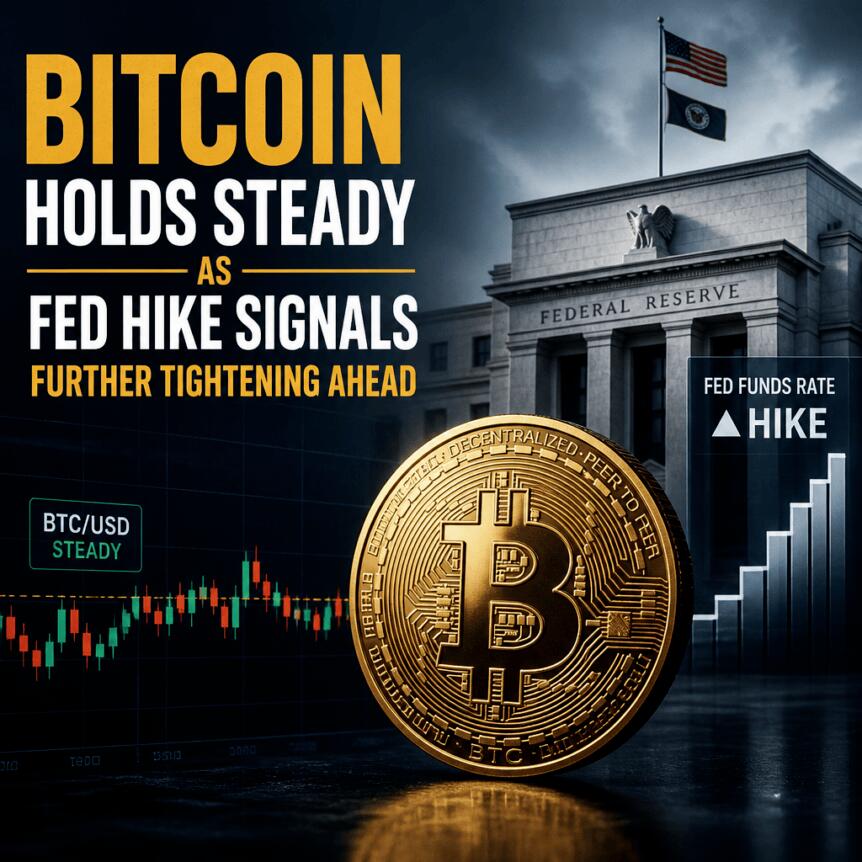
Bitcoin traded close to its levels prior to the US Federal Reserve’s announcement on Wednesday, even after the Fed lifted its benchmark interest rate for the first time since 2023. The market largely appeared to have priced in the move: at the time of writing, BTC was around $76,663, up about 1.35% over 24 hours.
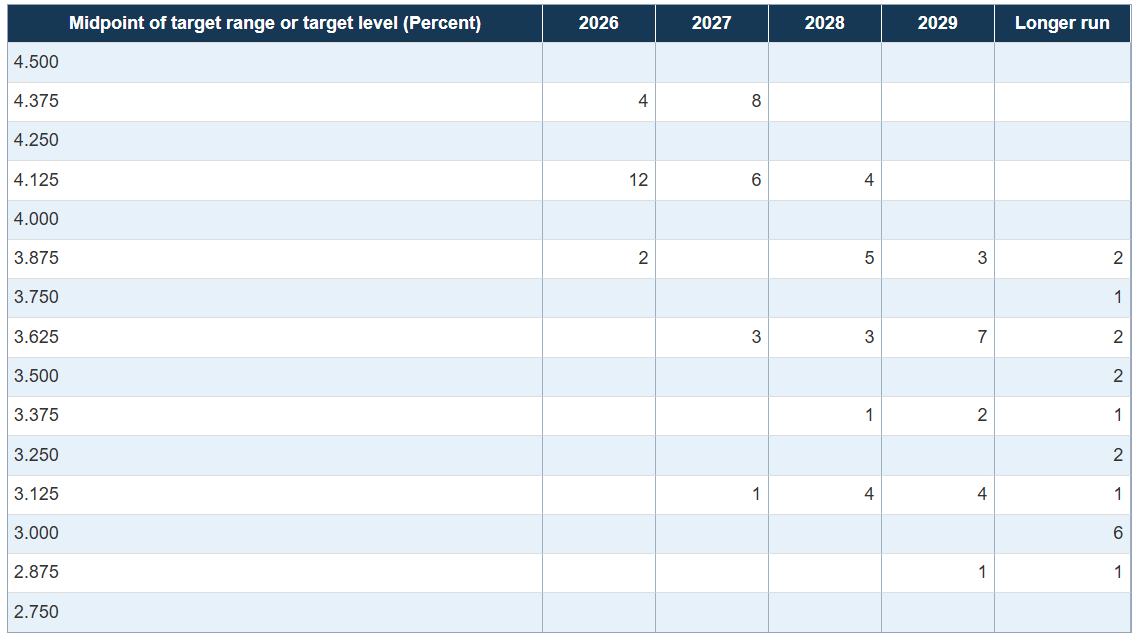
The Federal Open Market Committee voted unanimously to raise rates by 25 basis points to a target range of 3.75% to 4%. While rate hikes typically weigh on stocks and other risk assets, crypto analysts told Cointelegraph that Bitcoin’s immediate reaction was muted and near pre-announcement price levels.
Key takeaways
- Bitcoin held around pre-Fed levels near $76,000 after a unanimous 25bp hike to 3.75%–4%.
- Analysts said the decision looked “largely anticipated,” limiting the immediate downside in BTC.
- Derivatives activity showed net selling in perpetual futures, partially offset by net spot buying.
- FOMC projections pointed to at least one more potential hike before year-end for many officials.
Bitcoin shrugs off a widely expected Fed hike
According to Talos research analyst Cooper Duschang, the lack of dramatic price movement suggested that crypto markets had already incorporated the Fed’s decision. “The initial reaction suggests the Fed’s decision was largely anticipated by crypto markets,” he said in comments shared with Cointelegraph. He added that Bitcoin remained relatively resilient, “holding broadly around pre-announcement levels even as equities moved lower.”
At the same time, US equities slipped during Wednesday’s trading session, following the Fed announcement. Crypto traders are watching for any shift from this “priced-in” backdrop—especially if future Fed communication turns more restrictive than expected.
What the Fed signaled: inflation still too high, economy strengthening
During the post-decision press conference, Fed Chair Kevin Warsh said inflation remains too high, while the US economy appears to be strengthening. The Fed’s updated economic projections indicated that a majority of officials foresee at least one more rate hike before the end of the year.
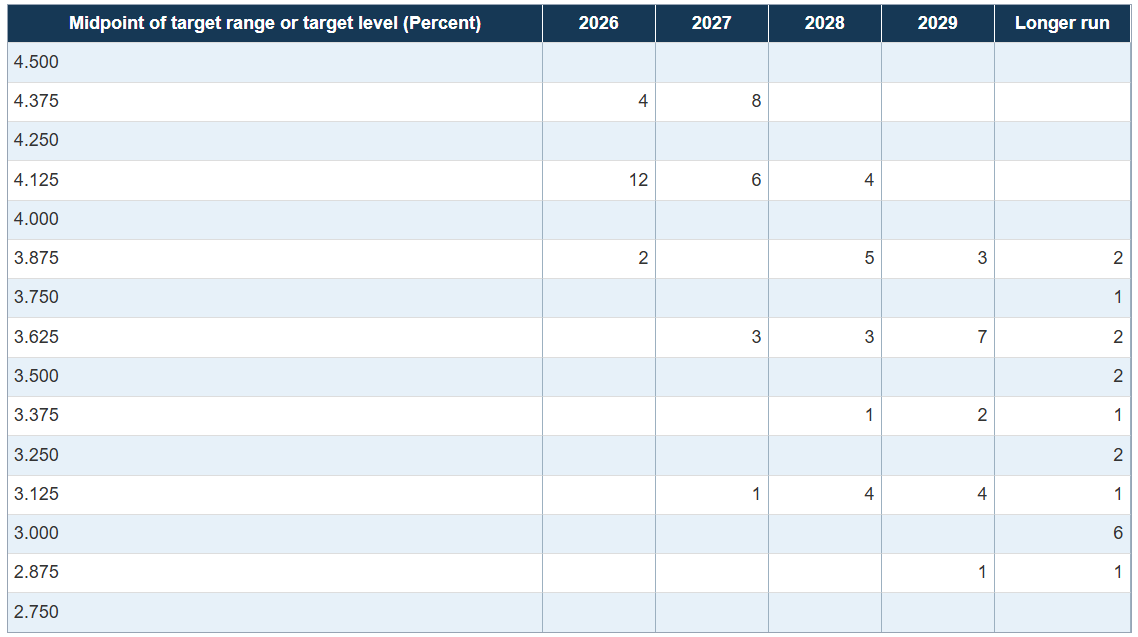
The same theme appears in the FOMC participation expectations cited in the article: 16 of 18 FOMC participants were reported as expecting at least one more rate increase this year, based on the Fed’s FOMC projections table available on the Federal Reserve’s website: US Federal Reserve.
Block Scholes’ Andrew Melville characterized the overall policy direction by arguing that an additional increase would be a “more hawkish surprise than today’s 25bp hike,” underscoring the market’s sensitivity to changes from expectation rather than the first move itself.
Spot and derivatives tell a more mixed story than the price chart
While Bitcoin’s headline price response looked subdued, Duschang said activity in spot and derivatives suggested investors were repositioning rather than simply stepping aside. He pointed to a short-term shift in perpetual futures positioning toward net selling over the hour following the announcement—about $82 million net selling in Bitcoin and $68 million in Ether.
However, that selling pressure did not translate cleanly into broader downside because net spot flows appeared to be absorbing some of the impact. Duschang reported roughly $15.5 million of net spot buying in Bitcoin, which he said could be helping counterbalance the derivatives-led pressure.
Exchange flow data reinforced the idea of active adjustment. Duschang noted that around 2,170 Bitcoin moved onto exchanges after the rate decision, followed by withdrawals of about 1,260 Bitcoin. Interpreting these movements, he argued that rather than one uniform “risk-off” reaction, investors were “actively repositioning as they digest the Fed’s message.”
“Higher for longer” raises the stakes for later
Even if Wednesday’s hike did not move BTC much, analysts warned that the bigger question is what happens next—especially as attention shifts from a move widely expected by markets to the possibility of further tightening.
Martin Lee, market insights lead at DWF Labs, suggested that a renewed hawkish posture associated with “higher for longer” rates would likely force risk assets to “repricing this new reality.” In practice, that means future price action may depend less on the existence of rate hikes and more on how the Fed frames the path ahead and how traders judge probabilities for additional moves.
Duschang framed the near-term watchpoints similarly: the key issue is whether Bitcoin’s resilience and spot demand remain intact as investors reassess tightening expectations beyond the immediate decision.
For now, traders appear to be separating the first hike—already priced by many—from the next steps implied by Fed projections and subsequent communication. The next catalyst to monitor is whether spot demand continues to offset derivatives selling if markets start to price in an additional hike with higher confidence.
Crypto World
NBKR and CertiK Establish Long-Term Strategic Partnership on Digital Som Security and Digital Asset Oversight
[PRESS RELEASE – Bishkek, Kyrgyzstan, September 15th, 2026]
The National Bank of the Kyrgyz Republic (NBKR) and CertiK have signed a Memorandum of Understanding (MoU), establishing a long-term strategic partnership to advance cooperation on Digital Som security and digital asset oversight. The partnership brings CertiK into a central-bank environment shaped by stringent security, compliance, and operational requirements, serving as a model for similar engagements with other highly regulated institutions.
Sanzhar Abdygaziev, Member of the NBKR Management Board (left), and Jason Jiang, Chief Business Officer of CertiK, at the MoU signing

“The Memorandum of Understanding that we are signing today establishes a framework for further dialogue and cooperation,” said Mr. Sanzhar Abdygaziev, Member of the Board (Management Board) of the NBKR. “We see particular value in exchanging experience and expertise in blockchain and digital asset security, cybersecurity, AML/CFT, and the analysis and monitoring of digital asset transactions.”
“Digital asset infrastructure requires security and risk management to be considered from the earliest stages of design through ongoing operation,” said Ronghui Gu, Co-Founder and CEO of CertiK. “We look forward to bringing CertiK’s expertise and experience to our long-term cooperation with the NBKR, supporting the secure development of the country’s digital asset ecosystem.”
Under the MoU, the parties intend to exchange expertise and explore cooperation in areas including blockchain and digital asset security, security assessments, formal verification, cybersecurity, and operational resilience. Drawing on its experience in digital asset security and risk management, CertiK will provide technical and strategic support across these areas.
The partnership will also extend to digital asset oversight and regulatory advisory support, covering areas such as AML/CFT, digital asset custody, security standards, and licensing requirements. The parties will also explore the deployment of CertiK’s Supervision and Compliance solutions to strengthen ongoing risk monitoring and regulatory oversight, alongside training and knowledge transfer in relevant technical and regulatory areas.
Beyond its work with the NBKR, CertiK has contributed to digital asset regulatory and policy discussions across multiple markets. This includes providing technical advisory support to regulators in the United States and responding to regulatory consultations issued by the Monetary Authority of Singapore (MAS). Together, these engagements reflect the growing role of technical security expertise in supporting regulated digital asset markets and infrastructure.
About National Bank of the Kyrgyz Republic (NBKR)
The National Bank of the Kyrgyz Republic (NBKR) is the country’s central bank and the primary authority responsible for maintaining price stability, safeguarding the stability of the banking and payment systems, and supporting the sustainable development of Kyrgyzstan’s financial sector. The NBKR regulates and supervises financial institutions, manages monetary policy and international reserves, and oversees the national payment infrastructure. It is also advancing financial innovation through its Digital Som central bank digital currency (CBDC) initiative, aimed at modernizing payments, expanding financial inclusion, and strengthening the resilience and efficiency of the country’s financial ecosystem.
About CertiK
CertiK is the largest Web3 security services provider and a trusted risk management partner for regulators, institutions, and Web3 innovators worldwide. Since 2017, CertiK has protected over $600 billion in digital assets across 150+ countries and regions, while providing full-lifecycle security and risk management solutions for institutional clients. Operating under SOC 2 Type II and ISO 27001 standards, CertiK works closely with regulators worldwide on digital asset policy development and regulatory consultation.
The post NBKR and CertiK Establish Long-Term Strategic Partnership on Digital Som Security and Digital Asset Oversight appeared first on CryptoPotato.
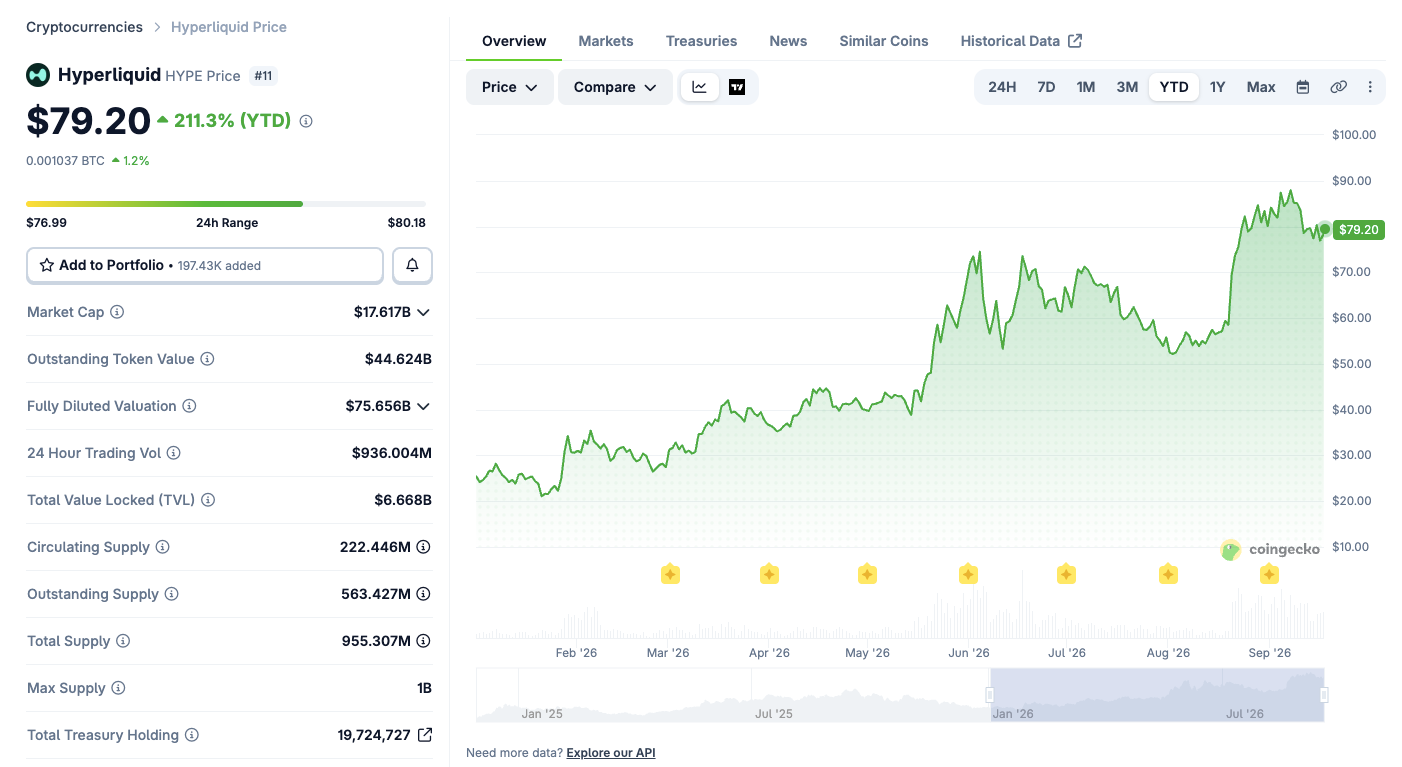
Payward, the parent company of Kraken, plans to deploy onchain perpetual futures for United States clients, starting with markets built on Hyperliquid’s HIP-3 framework, the protocol’s first builder-deployed permissioned markets.
Bitnomial, the exchange regulated by the Commodity Futures Trading Commission (CFTC) that Payward acquired last April, would deploy and clear the new markets. NinjaTrader Clearing, a registered futures broker, would onboard client accounts.
A Regulatory Route, Not a New Rulebook
Hyperliquid processed more than $200 billion in trading volume over the past 30 days. That scale makes it the busiest onchain derivatives venue in the world, yet it remains officially closed to US traders.
Multiple platforms already run builder-deployed markets on Hyperliquid, and one holds 98% of that open interest. None of them is a registered US exchange or clearinghouse, which is the gap Payward says its structure closes.

That gap is also what Kraken’s earlier Hyperliquid entry plan aimed to close last month. It built on President Trump’s August comments that the CFTC was working toward a compliant path for the exchange.
Payward already lists its own crypto perpetual futures for US clients through the same clearing setup. It acquired Bitnomial last April for $550 million, giving it in-house CFTC infrastructure rather than a third party’s.
“Payward intends to be the first, holding the keys and carrying the regulatory obligations”
Arjun Sethi, Co-CEO of Payward
Compliance Still an Open Question
The plan still needs regulatory approval, and no launch date has been set. It also arrives shortly after North Korea-linked wallet activity drew scrutiny to Hyperliquid’s compliance record.
Whether Bitnomial’s structure satisfies regulators may decide how quickly Hyperliquid reaches US traders, not how loudly the plan is announced.
The post Kraken Finds the Compliant Route Trump Promised for Hyperliquid in the US appeared first on BeInCrypto.


Two Prime has launched an institutional Bitcoin lending vault on Pareto targeting annual returns of 1.5% to 2%, with roughly $10 million of the firm’s own capital committed to absorb initial credit losses.
Summary
- Two Prime launched a Pareto WBTC vault targeting 1.5% to 2% annual institutional lending yields.
- Two Prime committed roughly $10 million in first-loss capital to absorb initial borrower credit losses.
- The Axiom vault requires at least five WBTC, placing entry near $380,000 at current prices.
- ICE Digital Trust and Copper Technologies will provide custody for assets supporting the lending strategy.
- Pareto currently tracks roughly $227 million in active private-credit loans across its onchain credit infrastructure.
CoinDesk reported on Sept. 16 that the Axiom WBTC Yield Vault accepts Wrapped Bitcoin and requires a minimum investment of 5 WBTC, putting the entry level near $380,000 with Bitcoin trading around $76,000 at publication. The quoted yield is a target tied to lending conditions and is not guaranteed.
The product takes Two Prime’s existing institutional credit business onto blockchain-based infrastructure, with Pareto handling the private-credit rails and ICE Digital Trust and Copper Technologies providing custody. Two Prime plans to lend deposited assets to institutional counterparties that can include public companies, credit-rated borrowers and diversified financial firms.
Two Prime puts $10 million behind the WBTC vault
Two Prime’s capital commitment gives the Axiom vault a first-loss layer before participating investors bear certain credit losses. CoinDesk placed the commitment at roughly $10 million, although the report did not disclose the precise size of the vault, its maximum capacity or how much of that capital had already been deployed when the product was announced.
The structure does not make the targeted return risk-free. Its 1.5% to 2% annual return depends on lending terms, borrower performance and market conditions. Investors retain exposure to credit risk, operational risk and risks tied to the wrapped Bitcoin used as the vault’s deposit asset.
Five WBTC is the minimum contribution. At a Bitcoin price close to $76,000, that represents approximately $380,000, although the dollar amount changes with Bitcoin because WBTC is designed to track the underlying asset.
Wrapped Bitcoin allows BTC value to move through smart contracts on networks such as Ethereum. The token is backed by Bitcoin held in custody, creating an additional custody and tokenization layer that does not exist when an investor holds native BTC directly.
As crypto.news explained in its recent WBTC guide, WBTC brings Bitcoin liquidity into lending and other decentralized-finance applications through a token intended to maintain a one-to-one relationship with BTC. The structure comes with custodial and smart-contract considerations that differ from native Bitcoin ownership.
Pareto supplies the onchain private-credit infrastructure
Pareto provides the blockchain infrastructure through which the new vault connects investor deposits with private-credit borrowers.
Current DefiLlama data for Pareto Credit shows approximately $227 million in active loans. The tracker classifies Pareto Credit as an uncollateralized lending marketplace serving institutional lenders and borrowers. Capital already deployed to borrowers is reported separately from the smaller amount of assets sitting idle inside its vault contracts.
That accounting distinction explains why Pareto’s conventional TVL figure can appear much lower than its outstanding credit book. DefiLlama’s methodology excludes deployed loans from its default TVL reading and records those balances under active loans instead.
Pareto’s infrastructure was already supporting large institutional credit products before the Two Prime launch. Earlier in September, RedStone introduced pricing feeds for a Pareto FalconX credit vault carrying more than $170 million in exposure across several networks.
As crypto.news reported in its coverage of the FalconX vault, Pareto’s permissioned private-credit products are designed for professional investors, asset managers, digital-asset funds and fintech firms. Transfer restrictions can require approved participants for redemptions or liquidations.
The Axiom vault extends that model into WBTC lending. Two Prime supplies the lending and borrower-selection expertise, while Pareto provides the tokenized infrastructure used to administer the onchain product.
ICE Digital Trust and Copper handle custody
The custody layer uses two established institutional providers. ICE Digital Trust describes itself as a New York state-chartered trust company and qualified custodian. Its infrastructure supports custody of Bitcoin and other digital assets through offline key storage, transaction reviews and multi-step authorization controls.
Intercontinental Exchange’s 2025 annual filing confirms that ICE Digital Trust operates under New York Department of Financial Services supervision. The filing says the business provides custody for assets including Bitcoin, Ether and USDC and falls under New York virtual-currency, cybersecurity and anti-money-laundering rules.
Copper supplies another institutional custody and financing layer. Its platform combines MPC-based custody with lending, settlement and collateral-management tools. Copper says its controls prevent a complete private key from being created in one location and require governed transaction approvals.
The two providers address asset safekeeping, while borrower repayment remains a separate source of risk. Custody controls do not guarantee the performance of loans made through the vault.
Launch extends Two Prime’s institutional lending business
Two Prime enters the onchain vault market with an existing institutional Bitcoin credit operation.
Its SEC adviser record lists Two Prime Inc. as an SEC-registered investment adviser with registration effective since February 2022. The firm expanded its regulatory profile in February 2026 when it registered with the CFTC as a commodity trading adviser and became an NFA member. Two Prime’s SEC registration can be viewed through IAPD.
The firm’s lending affiliate had issued more than $2.55 billion of Bitcoin-backed loans and credit facilities by the end of the third quarter of 2025. That total included $827 million during the quarter alone, according to Two Prime’s announcement at the time.
As crypto.news previously reported, borrowers have included Bitcoin miners, trading firms, asset managers, family offices and corporate treasuries. The lending business has historically focused on institutional bilateral credit backed by Bitcoin collateral.
A more recent transaction involved MARA Holdings. Two Prime supplied a $300 million two-year term loan carrying a fixed 7.65% rate as part of $600 million in new borrowing secured by MARA’s Bitcoin.
MARA initially pledged 18,750 BTC across facilities provided by Two Prime and Coinbase. Two Prime’s loan matures in August 2028.
The onchain product therefore changes how lender capital reaches Two Prime’s credit operation without replacing its institutional underwriting model.
Two Prime’s onchain strategy has developed during 2026
The launch follows several months of public discussion inside Two Prime about how institutional finance could use blockchain vault infrastructure.
At Consensus Miami in May, founder and CEO Alexander Blume argued that institutional borrowers tend to demand conventional legal agreements, transparent custody and identifiable counterparties. Blume said institutions often reject structures they consider operationally difficult to explain to boards and risk committees.
By July, Blume was publicly discussing vaults as a way to place financial strategies into blockchain-based wrappers. Two Prime’s own publication list described onchain vaults as emerging financial infrastructure, while continuing to emphasize regulated custody and identifiable counterparties for institutional users.
Axiom combines those elements. The product uses an onchain vault but places the credit strategy with a known institutional manager and the assets with named custodians.
The approach resembles other recent Bitcoin yield structures connecting tokenized BTC with institutional borrowing demand. In August, crypto.news reported that Flow Traders was testing a Bitcoin-backed stablecoin credit strategy through Lombard’s Bitcoin Earn vault. That product accepts several forms of tokenized Bitcoin and allocates capital through professionally managed credit strategies.
Realized yield will depend on borrower performance
The next measurable data for the Axiom WBTC Yield Vault will come from deposits, credit deployment, borrower repayment and the yield actually delivered to investors.
Two Prime has set a 1.5% to 2% annual target, but CoinDesk explicitly noted that returns are subject to market conditions and are not guaranteed. The company has not published a fixed maturity schedule, final vault capacity or a guaranteed rate for depositors in the materials reviewed.
Pareto’s existing credit platform provides a reference point for onchain lending activity, not a forecast for Axiom. DefiLlama currently records close to $227 million of active Pareto Credit loans and an average supply APY of approximately 6.4% across the pools it tracks. Individual Pareto products carry different borrower exposures, structures and yields, so that aggregate rate should not be treated as the expected return for Two Prime’s vault.
WBTC’s underlying reserve position supplies another independently observable data point. The WBTC transparency dashboard showed 116,499.1917 WBTC in circulation against 116,511.9929 BTC held in reserves in its Sept. 11 update. Most of the outstanding token supply, roughly 116,132 WBTC, was issued on Ethereum.
Bitcoin held near its pre-Fed announcement levels of around $76,000 on Wednesday despite the US Federal Reserve raising its benchmark interest rate for the first time since 2023 to address persistently high inflation.
The Fed’s Federal Open Market Committee on Wednesday voted unanimously to raise rates by 25 basis points to a target range of 3.75% to 4%, a move that typically puts pressure on stocks and other risk assets. However, Bitcoin showed little immediate reaction to the announcement and was trading at $76,663 at the time of writing, up 1.35% in 24 hours.
“The initial reaction suggests the Fed’s decision was largely anticipated by crypto markets. Bitcoin has remained relatively resilient, holding broadly around pre-announcement levels even as equities moved lower,” said Cooper Duschang, research analyst at Talos in comments shared with Cointelegraph.
Bitcoin’s price resilience came despite US stocks slipping on Wednesday. Crypto analysts said this resilience could be tested again if the Fed raises rates further this year.
During the FOMC press conference, Fed Chair Kevin Warsh said that inflation remains too high while the US economy looks to be strengthening. The Fed’s updated economic projections show a majority of officials see at least one more rate hike before the end of the year.
Andrew Melville, head of research at Block Scholes, said another increase in rates would be a “more hawkish surprise than today’s 25bp hike.”
However, Duschang said that while Bitcoin’s price action was muted, there was movement in the spot and derivatives markets.
“Perpetual futures have shifted towards net selling, led by approximately $82 million in Bitcoin and $68 million in Ether over the past hour,” he said. “In contrast, Bitcoin recorded around $15.5 million of net spot buying, suggesting spot demand is absorbing some of the selling pressure coming through derivatives.”
Related: Bitcoin awaits Fed rate decision below $76K as analysis discounts ‘dovish surprise’ odds
Duschang also noted significant Bitcoin exchange flows, with around 2,170 Bitcoin moving onto exchanges following the rate increase, followed by a withdrawal of 1,260 Bitcoin.
“Rather than a uniform risk-off response, investors appear to be actively repositioning as they digest the Fed’s message,” he said. “The key question now is whether Bitcoin’s resilience and spot demand hold as attention shifts from today’s widely anticipated hike to the prospect of further tightening.”
Martin Lee, market insights lead at DWF Labs, said the renewed “hawkish stance” of “higher for longer” rates would lead to risk-on assets “repricing this new reality.”
Magazine: HYPE price could suffer as Binance takes its revenue: Alice Liu
Crypto World
BingX Evolves into a Multi-Asset Trading Platform, Connecting Users to Global Opportunities

[PRESS RELEASE – PANAMA CITY, Panama, September 15th, 2026]
BingX today announced its strategic evolution into a multi-asset trading platform and will further its strategy through “Connect Markets. Unlock Opportunities.”, bringing crypto and traditional markets together through an integrated trading experience. The move reflects BingX’s ambition to help traders identify emerging market opportunities, understand the forces shaping them and act across asset classes through a united platform.
Guided by its mission to empower traders to navigate and act on global markets, BingX envisions a world where every market is within reach. The company’s expanded offering reflects this vision, bringing together crypto and traditional markets in one place as the boundaries between asset classes continue to narrow.
As economic developments, market narratives and investment opportunities become increasingly interconnected, monetary policy, macroeconomic conditions and market sentiment can influence both digital and traditional assets. BingX is expanding beyond its crypto-native foundations, combining broader market access with deep liquidity, AI-powered trading tools and market expertise.
The BingX multi-asset platform is built around four strategic pillars:
Trading: Trade Confidently with Multi-Asset Market Access
BingX combines its crypto-native offering, including crypto futures, spot and copy trading, with an expanding range of TradFi products across stocks, forex, indices and commodities. The platform offers one of the industry’s broadest perpetual futures selections across traditional assets, alongside deep order-book liquidity across selected major TradFi futures assets.
Experience: Connecting Market Intelligence with Execution
AI-powered insights, signals and trading tools help traders navigate market developments and identify potential opportunities. TradingView integration provides advanced charting and analysis, while deep liquidity supports execution across key markets. Together, these capabilities give traders a more direct path from market analysis to execution.
Opportunities: Capture What’s Moving Across Markets
BingX brings together market research, industry expertise, educational resources and community engagement to give traders a broader view of developments across crypto and traditional finance. By covering the narratives and forces shaping different markets, BingX aims to make it easier for users to identify areas of interest and explore opportunities beyond a single asset class.
Reliability: Built on Trust
As BingX broadens its market coverage, reliability remains a core foundation of the platform. BingX supports its trading environment with 100% Proof of Reserves and its Shield Fund. These measures reflect the company’s continued focus on security, transparency and operational resilience as it evolves into a multi-asset trading platform.
“Our evolution into multi-asset is a natural progression for BingX as markets become increasingly interconnected,” said Kevin Lee, Chief Strategy Officer at BingX. “Traders today are not necessarily thinking in terms of one asset class. They are looking at the broader market and considering where conditions, narratives and opportunities are developing. Our role is to give them access, infrastructure and perspective to navigate that landscape from one platform.”
About BingX
Founded in 2018, BingX is the world’s leading multi-asset trading platform, serving more than 40 million users worldwide. From crypto to traditional markets, BingX connects users with a broad range of assets and opportunities across global markets through one unified platform.
With perpetual futures, TradFi offerings, spot trading and copy trading, alongside AI-powered innovations, BingX delivers a reliable, intelligent, and responsive trading experience designed to help traders navigate evolving markets and act on opportunities with greater confidence and efficiency.
BingX has been the Principal Partner of Chelsea FC since 2024 and became the Official Team Partner of Scuderia Ferrari HP in 2026.
For media inquiries, users can contact: media@bingx.com
For more information, users can visit: https://bingx.com/
The post BingX Evolves into a Multi-Asset Trading Platform, Connecting Users to Global Opportunities appeared first on CryptoPotato.
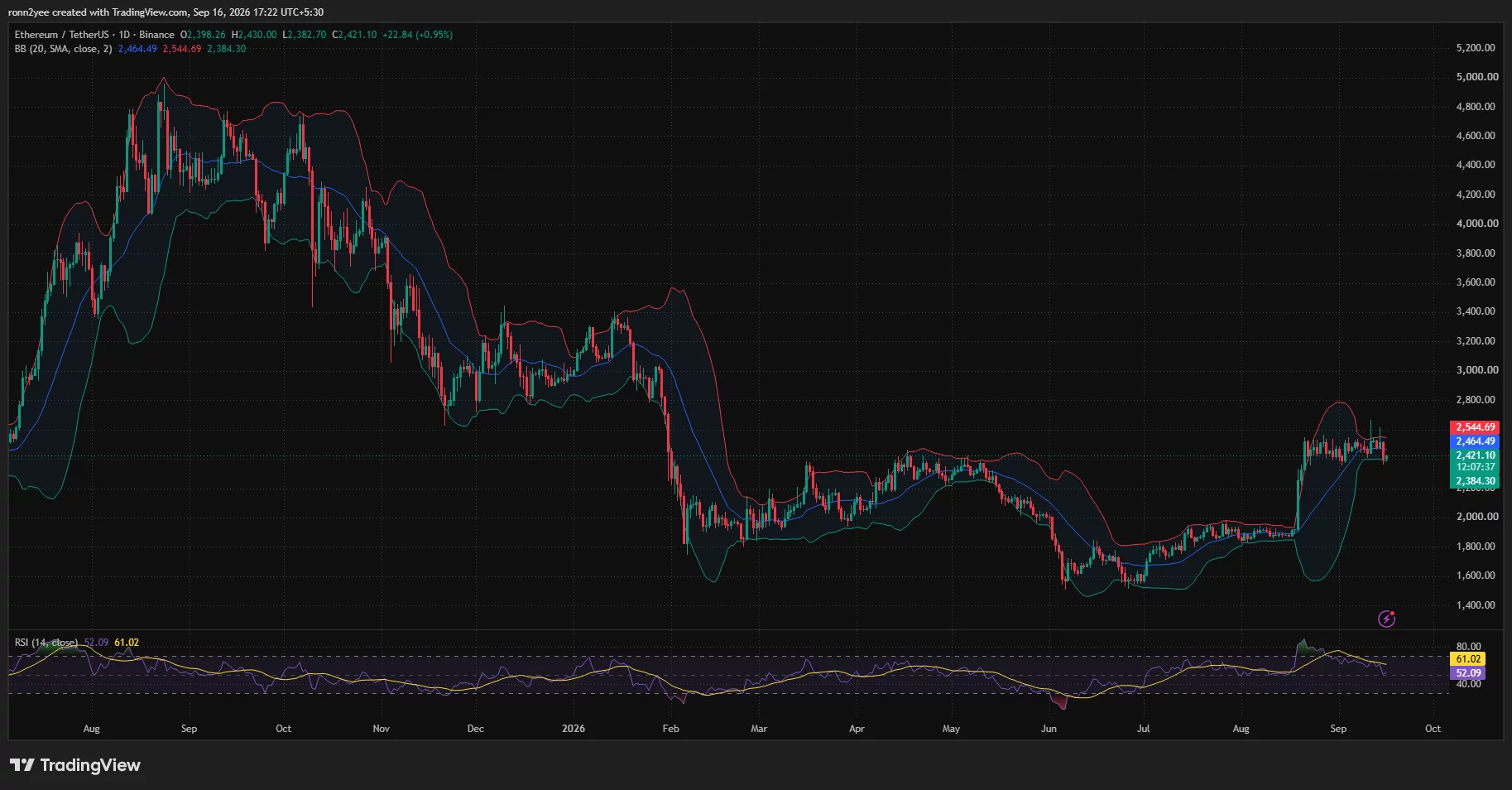
Ethereum price rebounded toward $2,420 after a sharp sell-off, but weak capital flows and resistance near $2,465 leave ETH exposed to another correction.
Summary
- Ethereum price fell below $2,400 before recovering to about $2,421 during Tuesday’s session.
- The daily RSI dropped to 52.09 as momentum weakened from its recent overbought reading.
- 4-hour Supertrend resistance stands at $2,526, while Chaikin Money Flow remains negative.
- Analysts see downside toward $2,143 or lower if ETH loses its weekly support.
Ethereum price action today
Ethereum (ETH) price was trading near $2,421 on Sep. 16 after recovering from an intraday low of $2,382.70, according to Binance data shown on TradingView. ETH opened the current daily candle at $2,398.26 and rose about 0.95%, partially reversing the previous decline.
The rebound followed a broader sell-off that briefly pulled ETH below the $2,400 psychological level. Market pressure intensified after the Digital Asset Market CLARITY Act failed to advance in the U.S. Senate.
The bill’s cloture motion reportedly failed in a 49-50 vote, short of the 60 votes needed to proceed. Its defeat weakened expectations that Congress would soon establish clearer divisions between the Securities and Exchange Commission and the Commodity Futures Trading Commission.
Ethereum was particularly vulnerable because the pullback followed several failed attempts to remain above the $2,500 area. The token recently traded as high as roughly $2,660 before sellers pushed it back toward its current range.
Derivatives added to the pressure. Ethereum accounted for about $250 million in liquidations during the broader market decline, as the loss of $2,450 forced leveraged long positions to close.
Technical indicators point to fading momentum
Ethereum’s daily chart shows that the recovery remains below the Bollinger Bands’ middle line at $2,464.49. That level now forms the first technical barrier above the market.
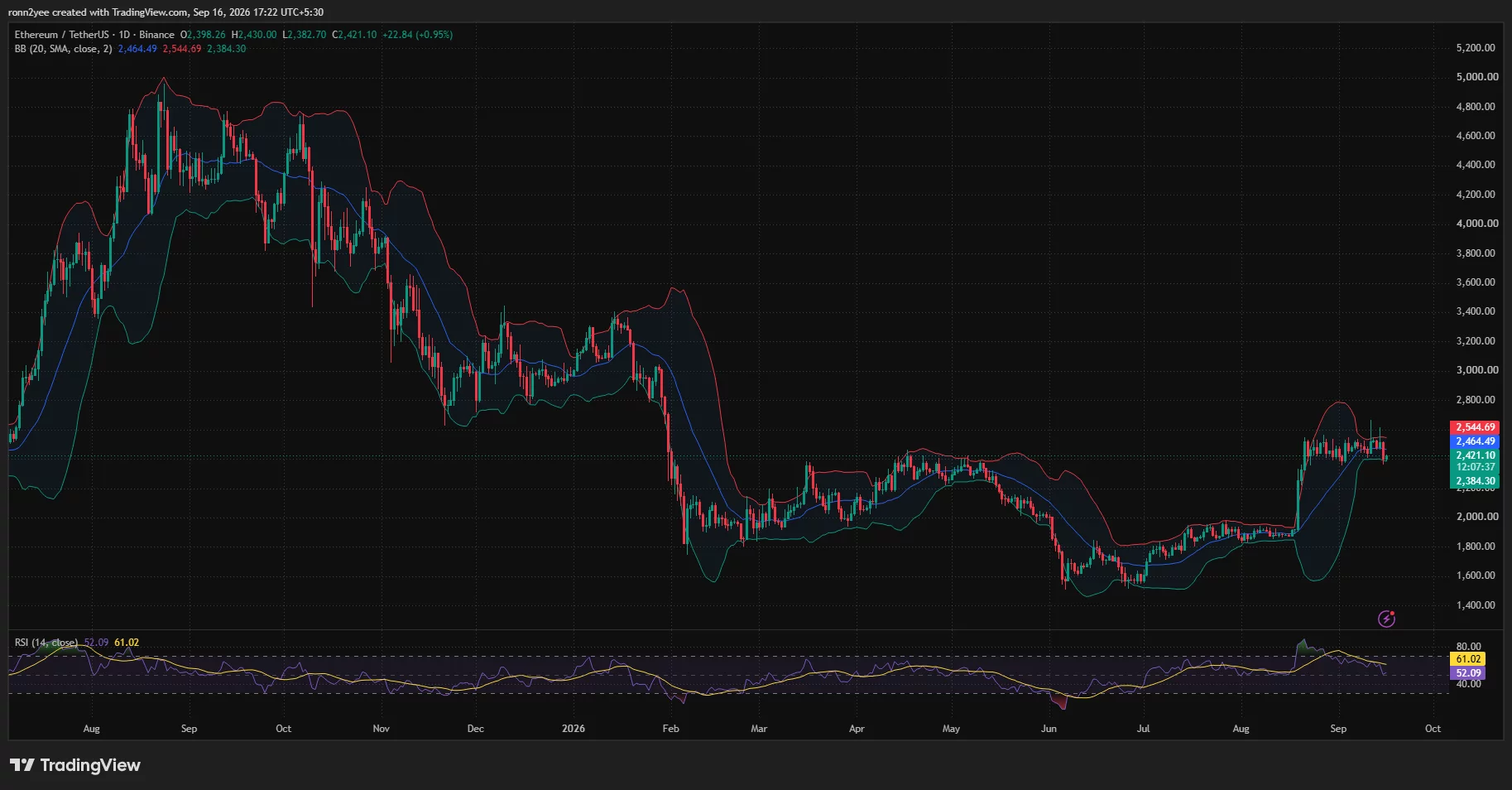
The upper Bollinger Band sits at $2,544.69, placing the broader resistance zone between approximately $2,465 and $2,545. A daily close above that range would strengthen the case that the correction has ended.
ETH is also holding just above the lower Bollinger Band at $2,384.30. Buyers defended that level during Tuesday’s decline, with the session low reaching $2,382.70 before price recovered.
The daily relative strength index stands at 52.09. Although the reading remains above the neutral 50 mark, it has fallen below its moving average of 61.02 after retreating from overbought territory. The decline shows that bullish momentum has faded since ETH’s late-August rally.
Conditions look weaker on the 4-hour chart. Ethereum trades below Supertrend resistance at $2,526.61, while the indicator’s former support near $2,441.90 has been lost. ETH would need to reclaim both levels to weaken the short-term bearish setup.
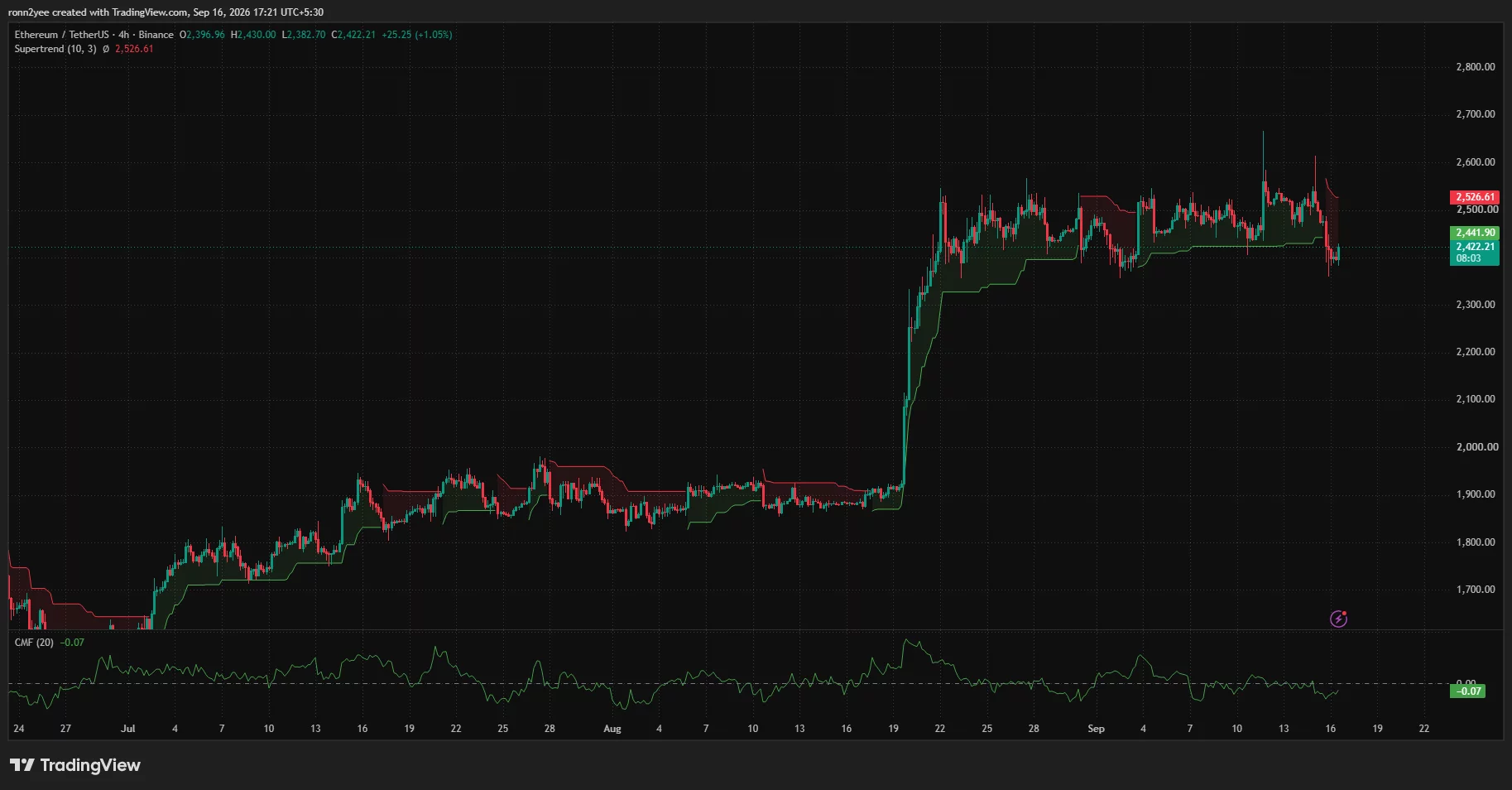
Chaikin Money Flow stands at minus 0.07 on the same timeframe. The negative reading indicates that selling pressure is slightly stronger than buying pressure, limiting the conviction behind the latest rebound.
Ethereum must defend the $2,380 support zone
The immediate support area lies between $2,380 and $2,400. Both the daily lower Bollinger Band and Tuesday’s intraday low fall within this range, making it the first level buyers need to defend.
A sustained breakdown below $2,380 could expose the August breakout region near $2,300. The weekly chart shared by analyst Ted Pillows identifies another support zone around $2,230, with a lower level near $2,056 if selling accelerates.
The bullish path begins with a move back above the daily Bollinger midpoint at $2,464. ETH would then need to clear the psychological $2,500 level and 4-hour Supertrend resistance at $2,526.
Further gains could place the recent $2,550-$2,660 rejection zone back in focus. Acceptance above that supply area would invalidate much of the current bearish structure and open a possible move toward $2,800.
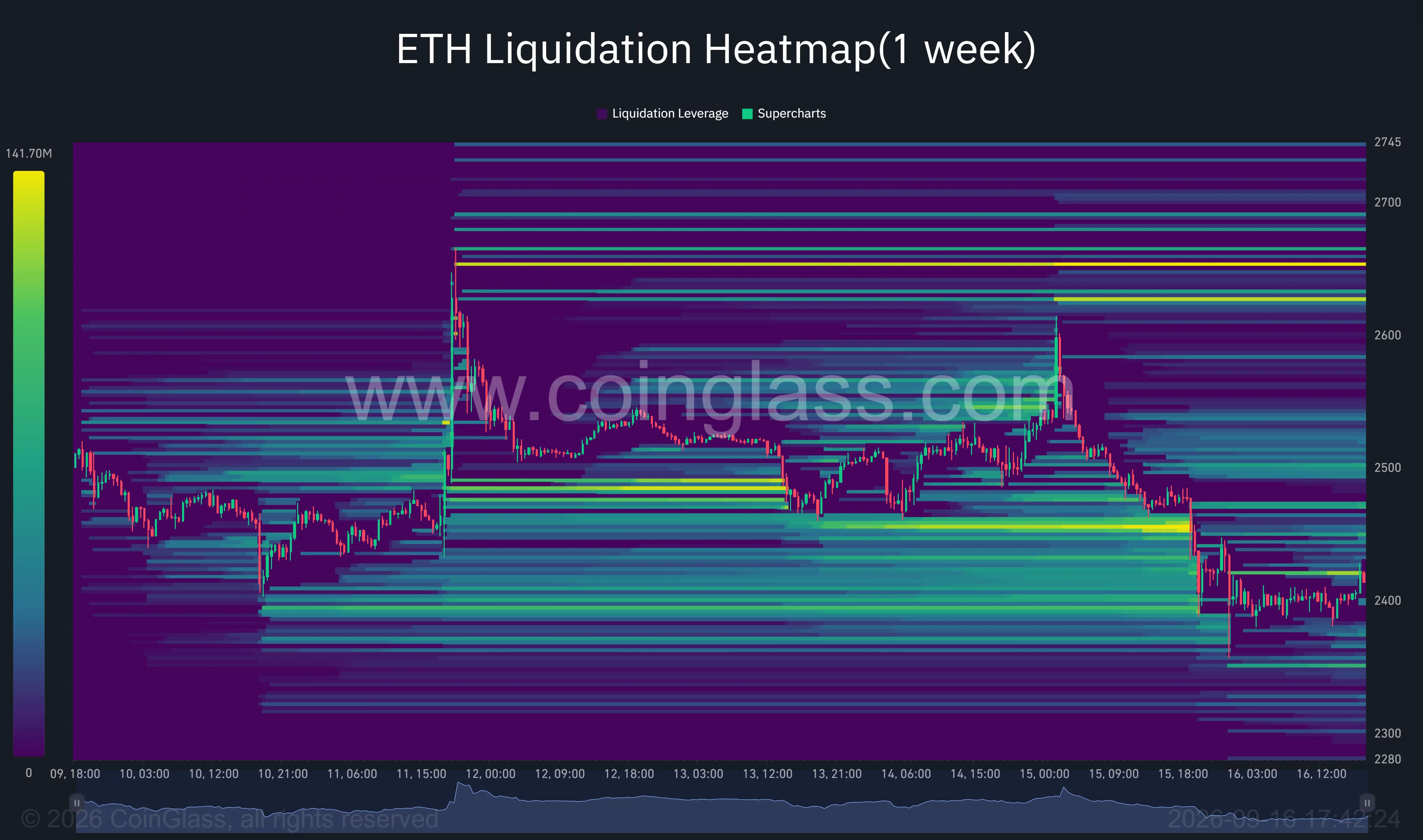
Ethereum’s one-week liquidation heatmap shows ETH trading near $2,420 after sweeping several leveraged positions during its drop from above $2,500. The closest liquidity is concentrated around $2,420-$2,450, while additional clusters appear near $2,500 and $2,625-$2,660. Below the market, liquidity is visible around $2,350-$2,400, leaving ETH vulnerable to further volatility if either side is breached.
Analysts warn of a deeper Ethereum correction
Crypto analyst Ted Pillows said ETH was testing its 50-week exponential moving average. He warned that a weekly close below the indicator could produce an 8% to 10% correction.
An 8% decline from approximately $2,420 would place Ethereum near $2,226, closely matching the first weekly support zone on his chart. A 10% pullback would take the token toward $2,178.
Crypto Patel offered a more bearish scenario after ETH was rejected from the $2,550-$2,660 resistance zone. The analyst identified $2,143, $2,000, and $1,870 as possible downside targets, with $1,800 as a deeper level to monitor.
Patel said the bearish scenario would remain active unless Ethereum reclaimed and held above $2,670. His longer-term outlook remains bullish, with targets between $10,000 and $15,000, although the forecast is speculative and depends on future market conditions.
US rate expectations and ETF outflows weigh on ETH
The CLARITY Act setback arrived as U.S. investors were already preparing for the Federal Reserve’s interest-rate decision. The probability of a 25-basis-point increase at about 80%, although the final decision will determine whether that expectation was justified.
Higher interest rates and Treasury yields can pressure crypto assets by increasing the return available from lower-risk instruments. Ethereum could therefore remain sensitive to changes in Fed expectations even if its technical support holds.
U.S. spot Ethereum exchange-traded funds also recorded approximately $141.5 million to $142.3 million in net outflows during the reported session. BlackRock’s ETHA accounted for about $98 million, while Bitwise’s ETHW recorded around $34.4 million in withdrawals.
Roughly 140,000 ETH, valued at about $350 million, was reportedly withdrawn from exchanges over recent days. Lower exchange balances may reduce immediately available selling supply, but the daily and 4-hour charts show that ETH must reclaim $2,465-$2,526 before buyers regain firm control.
Disclosure: This article does not represent investment advice. The content and materials featured on this page are for educational purposes only.

The landmark crypto legislation, the CLARITY Act, will face a crucial vote in the US Senate later today (September 15) and could trigger significant volatility across the digital asset sector.
The vote itself doesn’t mean that the bill will be enacted, but it could pave the way for formal discussion. However, Democrats don’t seem thrilled by the proposed framework and keep insisting on additional changes, significantly reducing the CLARITY Act’s chances of being signed into law before the end of the year. That said, some crypto traders have started preparing for the possible impact.
Brace for a Collapse?
X user Max Crypto revealed that an anonymous whale has opened a $47 million short position on Bitcoin (BTC), a $22 million short on Ethereum (ETH), and a $4 million short on Zcash (ZEC) ahead of the vote.
What’s interesting is that the market participant has made almost 2,300 trades so far and has a 100% win rate. Of course, such a successful streak has caused Max Crypto to wonder whether the whale is an “insider,” with many others sharing the same theory.
Numerous analysts expect the legislation to be rejected today and project a serious downfall for BTC in response. X user Midas thinks the primary cryptocurrency would “dump brutally” on such news, break below $70,000, and move toward new lows.
“Once $70K breaks, most of the remaining liquidity sits below $60K. That’s where the real fear should finally hit the market. And that’s exactly what we still need to form the 2026 macro bottom. I still expect one final capitulation before this cycle is over,” they added.
Before that, Midas argued that BTC trades inside a descending structure seen before and warned of an ultimate flashout to $50,000 “soon.” The analyst views $55K as the area where the bear market finally ends, and until then, “every aggressive bounce still looks like another trap.”
A Pump Instead?
Contrary to the prevailing pessimism, the analytics platform Lookonchain revealed another unknown market participant who moved in the opposite direction.
The whale closed their $58.4 million short position on BTC for a $266,000 profit, then flipped to a 40x long on 900 BTC. The major player has opened 914 trades so far and has a win rate of around 51.72%.
The post Preparing for a Post-CLARITY Crash? Whale Opens Massive BTC, ETH, and ZEC Shorts appeared first on CryptoPotato.

Pig owner from Goole banned from keeping animals for decade

The Campbell’s Co. debuts canned sauces
CLARITY Act Hits Final Stretch as Democrats Push Back Before Senate Vote



-

 Fashion5 days ago
Weekend Open Thread – Corporette.com
-

 Tech4 days ago
The Latest Weird Thing to Play Doom Is the Mapped-Out Brain of a Fruit Fly
-

 Business6 days ago
10 Most-Streamed Songs On Spotify In 2026 So Far, Led By Ella Langley’s Dominant Run On The Charts This Year
-

 Crypto World6 days ago
XAG/USD: Silver’s Short-Term Rally Meets Its Moment of Truth
-

 Crypto World7 days ago
2 Chip Stocks Broke Out This Week. Neither Was Nvidia
-

 Tech6 days ago
Battery life is the only iPhone 18 Pro and iPhone Duo upgrade I care about. Apple didn’t disappoint
-

 Crypto World6 days ago
OKX launches 10x OpenAI, Anthropic X-Perps in Europe
-

 Crypto World6 days ago
Diesel Tops $6 a Gallon for the First Time as 28 States Set Records
-

 News Videos6 days ago
Facing Financial Fears
-

 Business7 days ago
Western Digital Slips 2.7% as AI Storage Rally Cools After Record Cash and Guidance
-

 Crypto World3 days ago
Elon Musk Drops a Bombshell: Grok 5 Could Be the AGI Breakthrough
-

 Business4 days ago
Rivals Sam Altman and Elon Musk Rally Behind Dario Amodei’s Call for a Slowdown in AI Development
-

 Business7 days ago
Five Leading AI Experts Warn Superintelligence Could Kill Humans and Explain Their Case
-
Crypto World6 days ago
Ethereum Price Analysis: Consolidation at $2.5K Tests Momentum as On-Chain Activity Surges
-

 Crypto World7 days ago
Ant International joins Visa, Mastercard to build AI agent payment standards
-
 NewsBeat3 days ago
‘Sick conspiracy’: Trump says only guardrails AI needs is ‘a strong and smart (High IQ!) president’ in all-caps rant
-

 Crypto World5 days ago
Can AI Build a Startup in 72 Hours? Elon Musk's Team Will Livestream the Test
-

 Entertainment5 days ago
News Specials, Movies, Shows, More
-

 Crypto World6 days ago
US CPI forecast at 3.4% as tariff risks build
-

 Crypto World6 days ago
Bitcoin ETFs Pull $167M as 2026’s Best Inflow Run Slows
You must be logged in to post a comment Login