

Crypto World
US margin debt reached all-time highs as crypto lost $2 trillion

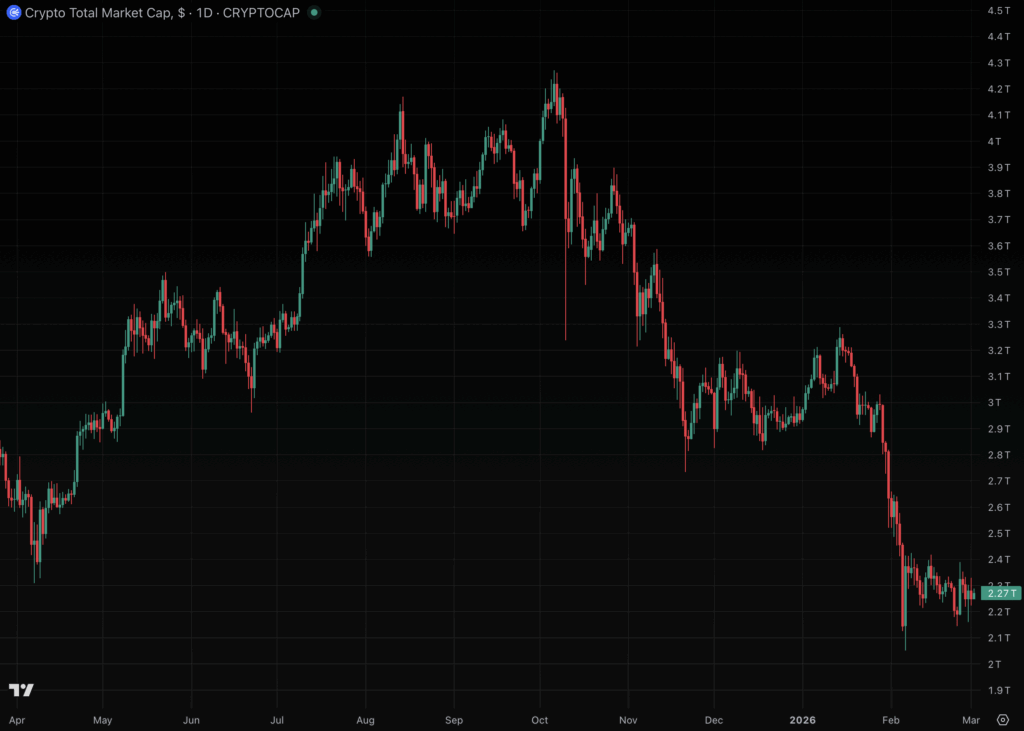
The highest level of margin utilization by US traders in history has, unfortunately, led to historic underperformance in crypto prices as speculators re-learned timeless wisdom: leverage works both ways.
After spending 2025 through January 2026 building their largest leveraged positions in history, bets on digital assets have unraveled with unnerving speed.
In January 2026, US margin debt had surged to a record $1.28 trillion — its ninth consecutive monthly increase and a 50% rise from April 2025. That financial leverage added bids to crypto assets which made new all-time highs in May, July, August, and October 2025.
Then, despite investors continuing to pile on more margin debt than ever, prices collapsed 47% and shed $2 trillion in combined market capitalization as a sector rotation to AI and precious metals ensued.
Crypto losses since October are staggering.
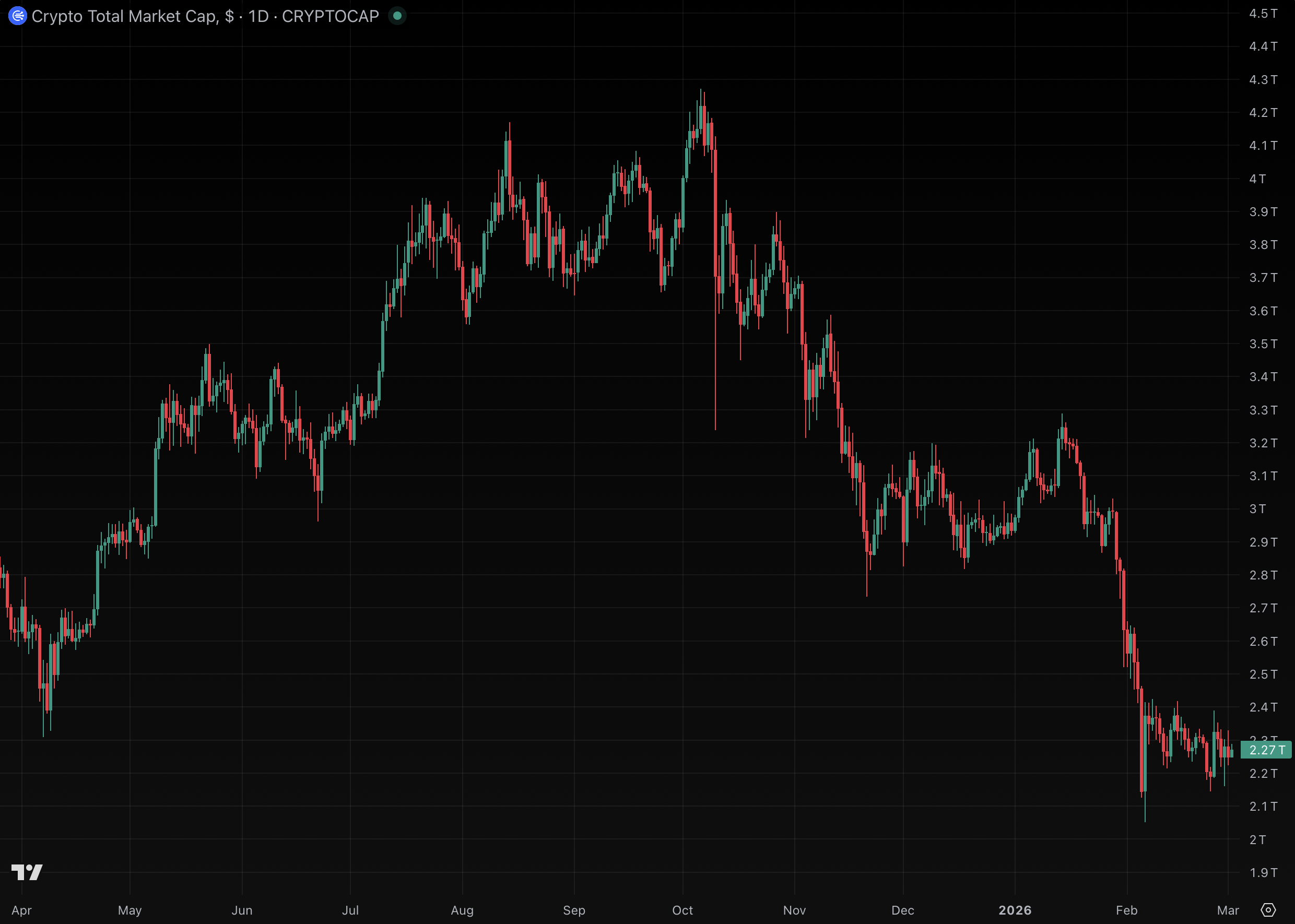
US margin debt increased $53 billion from December to January alone. Worse, the ratio of margin to real disposable personal income exceeded 6.0% in January for the first time on record.
That ratio measures more financial leverage in January 2026 relative to income than the dot-com mania.
Leverage-fueled demand flows into crypto instruments like bitcoin (BTC) futures, spot and leveraged ETFs, call options, and publicly traded crypto companies. Although more leverage can amplify gains, it also amplifies crashes.
Although traditional margin statistics are an incomplete measure of total systemic risk on crypto, which has vast quantities of opaque exchanges and trade data APIs controlled by offshore entities with little to no regulatory oversight, it can nonetheless inform some analysis about the causes of crypto volatility.
A supernova of crypto leverage that wiped out $2 trillion
Some crypto derivatives traders spent mid-2025 building their largest leveraged positions in history, then watched all of their paper gains evaporate.
Aggregate crypto futures open interest peaked above $220 billion on October 6, 2025. Within a week, the industry began to crash and never looked back.
October 10 produced more than $19 billion in total liquidations across exchanges, according to CoinGlass data — the single largest day of forced closures in crypto history.
Many saw Binance as a convenient scapegoat.
Read more: Crypto traders consider lawsuits after $600B market meltdown
Record-setting volatility continued amid record-setting margin levels. On February 5, 2026, another flash-crash drove BTC from $73,000 to $62,000 and wiped out 10-figure position values within a single day.
Worst day of realized losses from BTC liquidations
Glassnode estimated that February 5’s crash produced $3.2 billion in realized losses from liquidated BTC trades — the largest single-day realized loss in Glassnode’s recorded history that surpassed even October 10, 2025, the FTX bankruptcy in November 2022, or the May 2022 collapse of Terra/Luna.
By late February, crypto’s margin trading hangover had set in.
CoinGlass’ Crypto Fear & Greed Index fell to five out of 100 — a never-before-seen rating that exceeded its Three Arrows Capital bankruptcy low of six in June 2022, and its COVID-19 low of seven in March 2020.
As of writing, the index still remains near historic lows at nine, or “extreme fear.”
Losses amid record margin levels have also drawn out spot BTC from US ETFs. Specifically, spot BTC ETFs lost $4.5 billion in net outflows through the first eight weeks of 2026, according to Investing.com.
The leveraged unwind of Strategy
Adding insult to injury, software company-turned-leveraged BTC acquirer Strategy became the most-shorted large cap stock in the US last month, according to data from FactSet cited by multiple outlets.
The company held 717,722 BTC over this weekend, purchased at an average cost near $76,020 per coin. With BTC trading in the mid-$60,000s, the company faces unrealized losses in the billions.
Margined short-sales against Strategy and its BTC, in this case, have actually stood out as a rare success story amid crypto’s margin mania of January 2026.
Leverage always works both ways. Although US margin debt at $1.28 trillion is an incredible headline, the real story is that leverage has seeped into every layer of crypto valuations — from listed securities in brokerage accounts to perpetual swap venues in tax havens.
With losses liquidating collateral and forcing cascading sales, each layer’s losses have been feeding the next since October.
Got a tip? Send us an email securely via Protos Leaks. For more informed news, follow us on X, Bluesky, and Google News, or subscribe to our YouTube channel.

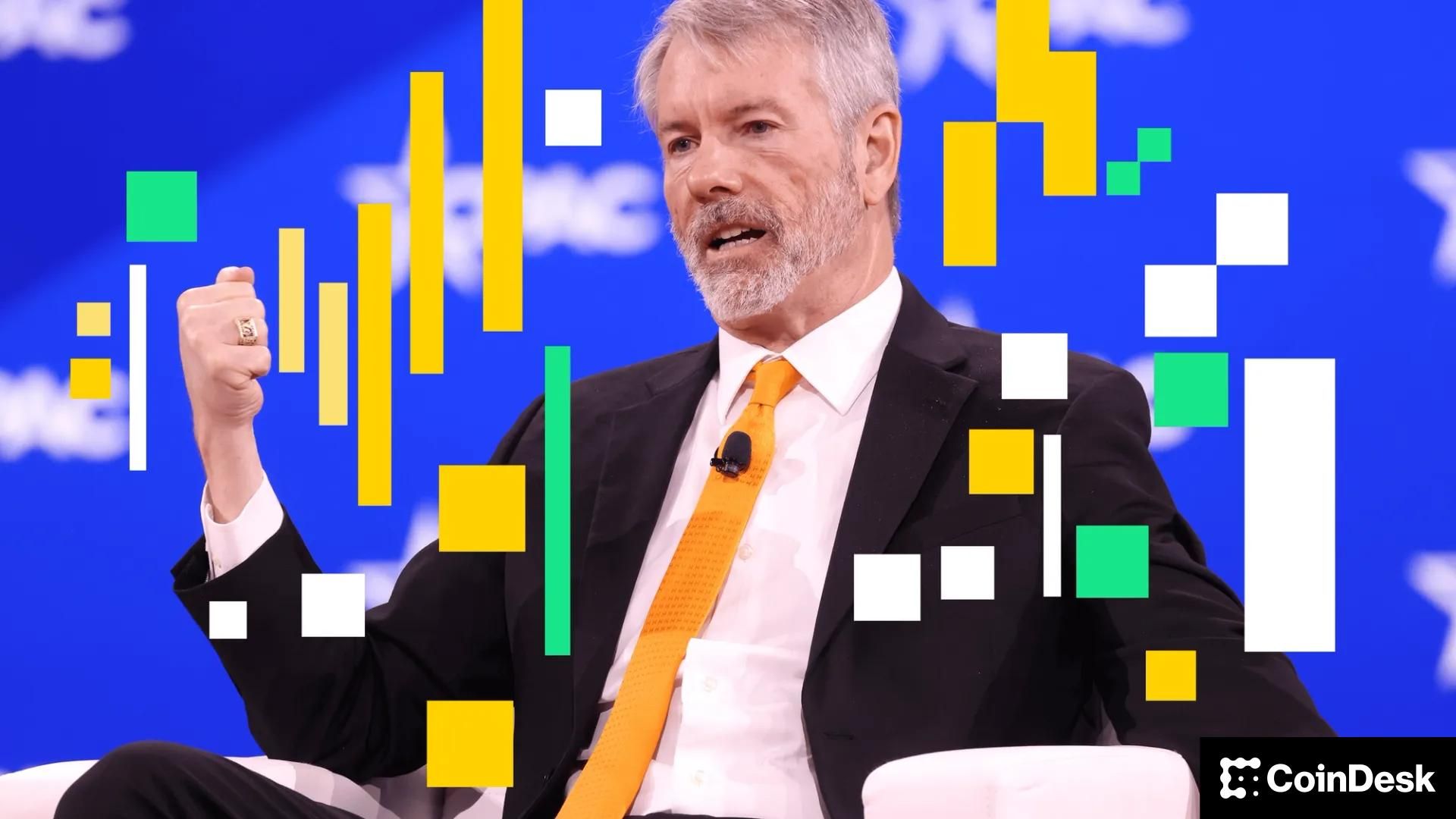
Strategy (MSTR), the world’s largest publicly traded corporate holder of bitcoin, expanded its position last week by acquiring 3,015 BTC for approximately $204.1 million, or an average price of $67,700 each.
Bitcoin is trading at $66,000 on Monday morning, with MSTR shares flat in early action.
To fund the buys, Strategy raised roughly $229.9 million through common stock sales, along with $7.1 million in net proceeds of its Variable Rate Series A Perpetual Stretch Preferred Stock, STRC, according to a Monday filing.
Following the latest purchase, the company now holds 720,737 BTC acquired for roughly $54.77 billion, or an average price of approximately $75,985 per coin.


Magic Eden is winding down its Ethereum, Polygon, and Bitcoin NFT marketplaces to pivot resources toward its Solana operations and growing iGaming platform, Dicey.
The decision, confirmed by CEO Jack Lu, is that the platform will cease support for non-Solana chains by early April 2025, following a broad collapse in cross-chain trading volumes.
- Magic Eden will terminate support for Bitcoin and EVM marketplaces starting March 9, with full wallet shutdowns scheduled for April 1.
- The pivot follows internal data showing Solana markets account for over 85% of volume while multi-chain maintenance costs remained high.
- Resources will be reallocated to Dicey, a crypto gambling platform that processed $15 million in wagers during its closed beta.
In his post, CEO Jack Lu outlined a phased sunset for EVM and Bitcoin-based Runes and Ordinals markets.
Trading support will end on March 9, followed by the Bitcoin API on March 27. The platform’s crypto wallet will switch to an export-only mode in the middle of March before a full shutdown on April 1.
Lu stated the company is “doubling down” on Dicey, citing a “massive opportunity” in the intersection of finance and entertainment. The casino platform’s closed beta recently saw 200 users wager over $15 million in just two months.
The strategic shift mirrors a broader trend where crypto funds and companies are diversifying revenue streams; for instance, venture firm Paradigm plans to expand into AI and robotics to capture value beyond traditional digital assets.
Magic Eden plans to replicate this diversification by launching a sportsbook to compete with blockchain gambling heavyweights like Stake.
Discover: The next crypto to explode
Falling NFT Volume Forces Strategic Realignment
The retreat from multi-chain operations reflects a stark consolidation of NFT liquidity on Solana.
Despite raising over $130 million to expand support for Ethereum and Bitcoin Ordinals, market data indicates that Solana assets continued to drive over 85% of the platform’s trading volume in late 2024.
While Ethereum retains dominance in stablecoin infrastructure, its NFT sector has suffered prolonged decline, making the maintenance of cross-chain compatibility technically burdensome for decreasing returns.
Lu noted that the shift was ultimately driven by the fact that most of the platform’s non-Solana products were not contributing significantly to revenues.
The marketplace had briefly ranked No. 1 globally in early 2024 following its Bitcoin expansion, but sustained engagement failed to materialize as the Ordinals and Runes hype cycles cooled.
Going forward, the platform will exclusively focus on NFT packs that bundle random assets, attempting to gamify the remaining trading experience.
Will Magic Eden Exit Cause Token Volatility and Liquidity Concerns?
The announcement precipitated severe volatility for the ME token, which reportedly fell nearly 2.5% in the last 24 hours, although this was broadly in line with Ethereum’s losses over the period.
The exit also leaves a significant vacuum in the Bitcoin Ordinals market, which may strengthen competitors like OKX and UniSat that remain committed to the Bitcoin ecosystem.
Magic Eden’s long-term valuation now hinges on its ability to convert NFT traders into active gamblers on Dicey.
The platform’s user retention metrics after April 1 will be most insightful; if the pivot fails to capture the high volume gambling cohort, the total loss of the multichain user base could isolate the protocol from future liquidity cycles on Bitcoin and Ethereum.
Discover: The best Solana meme coins
The post Magic Eden Winds Down EVM and Bitcoin NFT Markets in Strategic Pivot appeared first on Cryptonews.


Prediction market Kalshi apparently allowed traders to bet on the ousting of Iranian Supreme Leader Ayatollah Ali Khamenei, racked up $54 million in trades, then voided the result the moment he was killed in a US-Israeli airstrike.
Kalshi listed its “Ali Khamenei out as Supreme Leader?” prediction market contract before he was killed on Saturday.
Although a fiery death at the business end of a US or Israeli missile would certainly, in most people’s eyes, count as being “out,” Kalshi’s rules technically contained a death carve-out.
Specifically, the fine print specified that if Khamenei’s removal happened via death, the contract wouldn’t pay out.
Traders were predictably furious. “Getting rugged on a 100% correct prediction because of a fine-print ‘death carveout’ is wild,” one user wrote on Kalshi’s Discord.
“What you’re doing is stealing,” wrote another.
Critics accused Kalshi of trying to have its cake and eat it too by platforming a contract in the first place that involved bets on human death, then hiding behind compliance language when reality hit.
It had the option all along to not list the market for trading, after all. It decided to list it and accept trades.
Using crypto to profit from death
Even though the market involved potential death, Kalshi promoted it on social media for days. Users wagered $54 million on it.
US Senator Chris Murphy called it “insane this is legal.”
Ex-SEC Chief of Staff Amanda Fischer told NPR that prediction markets are “promoting opportunities to bet on events that can only be seen as a proxy for war or assassination… this betting market shouldn’t exist in the first place”
Six Democratic senators had already urged the CFTC in late February to ban contracts tied to anyone’s death. Wagers on Khamenei’s killing made their letter prophetic.
On Polymarket, Kalshi’s less-regulated offshore competitor, the numbers were uglier.
Roughly half a billion dollars changed hands on contracts tied to when US forces would strike Iran which, again, has obvious ramifications on human life.
Crypto keeps building death markets
Sadly, crypto wagers on death are nothing new. Early concepts of cryptographic assassination markets have circulated since at least a 1995 essay by cypherpunk Jim Bell.
In 2018, crypto prediction platform Augur launched with assassination markets appearing almost immediately.
Read more: Lord Miles wants YouTubers to help settle Polymarket scandal
In September 2025, Polymarket hosted a multimillion-dollar market on whether YouTuber Lord Miles would survive a 40-day desert fast . Trading odds crashed when fears spread that he had actually died.
Hivemind progenitor Paul Sztorc repeated his multi-year call for a “fully peer-to-peer prediction market system that cannot be shut off by anyone under any circumstances.”
More recently, in January 2026, an anonymous Polymarket trader made $400,000 on a suspiciously well-timed bet on Venezuelan leader Nicolás Maduro’s downfall.
In February, Israeli authorities indicted two people for using IDF classified information to bet on Polymarket during military conflict last June between Israel and Iran.
Got a tip? Send us an email securely via Protos Leaks. For more informed news, follow us on X, Bluesky, and Google News, or subscribe to our YouTube channel.

TLDR
- Bitcoin moved near $70,000 while holders showed no panic during rising Middle East tensions.
- Short-term holder loss transfers dropped to a 2- week low as selling pressure eased.
- Realized losses fell to 3,700 BTC even as geopolitical risks increased across the region.
- BTC derivatives showed reduced risk as Binance open interest declined by 25 %.
- The leverage ratio reached a low weekly average that aligned with ongoing deleveraging.
Bitcoin traded near $70,000 on Monday as war fears grew across the Middle East, and the market held steady and pushed higher. Traders watched exchange activity closely because short-term flows shifted again. The latest chain data showed cooling loss-driven selling, and futures activity kept falling as open interest reset lower during the session.
Short-term Flows Shift as Loss Transfers Fall
Short-term holder loss transfers dropped to a two-week low, and this shift aligned with slowing exchange flows across major venues. Realized losses fell to 3,700 BTC on March 1 as tensions rose, and traders kept BTC above $63,000 as inflows stayed muted.
The reduction contrasted with early February, and that period saw 89,000 BTC sent at a loss within one day. Analysts said the current environment showed reduced stress and “zero panic,” and loss-driven inflows kept compressing into March.
This decline showed less pressure from recent buyers, and the market tracked whether losses would surge again. The steadier flows set a calmer tone, and traders watched if the pattern would hold under geopolitical pressure.
Bitcoin Holders Watch Liquidity Bands
BTC moved through $70,000 on the four-hour chart, and the price approached liquidity between $70,000 and $71,500. Traders said this area could turn into support, and they pointed to past supply reactions near $80,000.
Analysts highlighted growing clusters near the range highs, and these pockets sat between $70,000 and $73,000. They said these areas often pull price when they grow, and the market kept scanning for reactions.
Spot flows supported the move, and Binance recorded $7.79 million in positive delta during the breakout. Coinbase added $1.16 million, and OKX logged $3.7 million, and this pattern pointed to steady spot demand.
The activity showed stronger bidding across venues, and the move came while leverage decreased again. Traders then turned to the $71,500 band, and they watched for a reaction if buyers held the zone.
Derivatives Reset as Leverage Drops for Bitcoin holders
Futures data showed a clear reduction in risk, and analysts tracked a 25% contraction in Binance open interest since the year began. The metric fell from 130,800 BTC to 97,680 BTC, and the reset aligned with calmer positioning.
The estimated leverage ratio slipped to a 0.146 weekly average, and past cycles tied low readings with heavy deleveraging. This trend revealed a lighter market structure, and traders monitored the shift as BTC tested key monthly metrics.
BTC attempted to reclaim its Monthly RVWAP in the high-$68,000 zone, and trading above it placed the month’s average buyer in profit. Analysts said this move often changes positioning, and they watched to see if BTC could stabilize above the level.
The session ended with BTC near the $71,500 liquidity band, and the market focused on spot flows as the price tested the region.


After dipping over the weekend as the U.S. began strikes against Iran, bitcoin shot higher on Monday, at one point nearing $70,000 before pulling back to the current $69,000.
While any rally in bitcoin is welcome by the bulls, today’s move comes after a relentless months-long slide that has halved the price and weighed on sentiment. One analyst suggests Monday’s quick gains carry the hallmarks of a positioning squeeze, with traders who had bet on further downside forced to unwind those trades as prices rose.
“This is clearly a flushing of shorts due to the confluence of the Iranian attacks causing a rebalancing across the whole capital stack with bitcoin having a tailwind from a reversal of spot bitcoin ETF outflows,” said Mark Connors, chief investment officer at Risk Dimensions. In other words, macro shocks triggered repositioning across markets, and bitcoin benefited as some investors rotated back into risk, and recent spot bitcoin ETF outflows slowed or reversed.
A short flush can create sharp, fast rallies. When traders who borrowed to bet on falling prices rush to close their positions, they must buy back the asset, adding fuel to the move. That dynamic can push prices higher than fundamentals alone would justify, at least in the short term.
“This is not a signal of the march back to $100,000 and through the very important 75,000 resistance,” said a cautious Connors In his view, the rally does not yet mark a decisive break from the broader downtrend. Key resistance levels remain overhead, and without sustained spot demand, the bounce could stall as quickly as it began.
Market positioning data underscores his caution and shows how tightly wound the derivatives market has become.
Data from CoinGlass’ liquidation heat map shows a $218 million cluster of positions that will be liquidated if price tumbles to between $65,250 and $64,650, which was the base from which Mondays’ rally began.
This, coupled with open interest rising by 6% over the past 24 hours while price increased by 3.8%, suggests the move is backed by leverage rather than spot buying, leading a number of traders to take profits at the psychological $70,000 level of resistance.
On the other hand, a break above $70,000 would trigger around $90 million worth of short liquidations — likely enough fuel to challenge February’s high of $72,000.
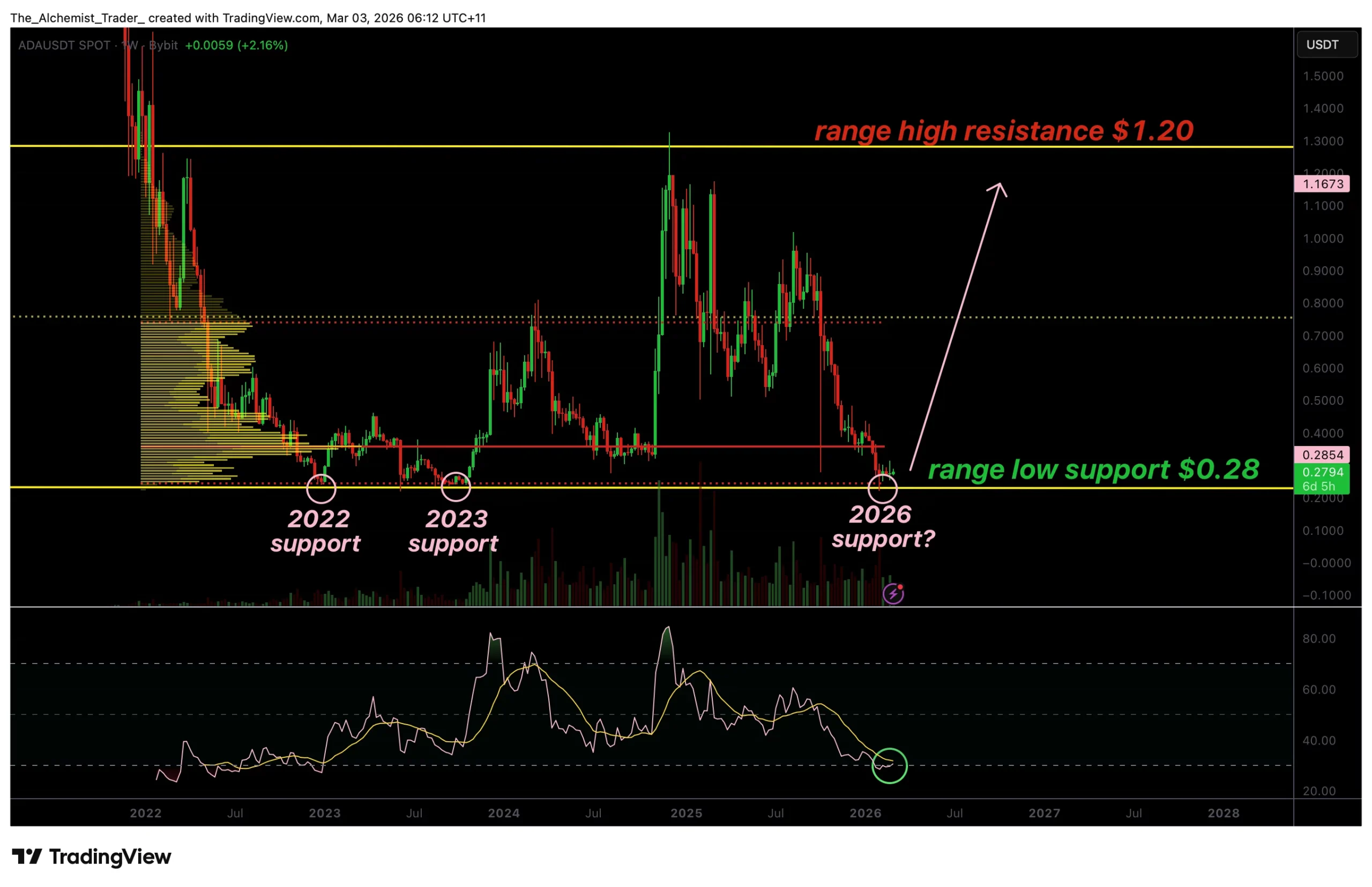
Cardano price has returned to a major historical support zone near $0.28 as RSI plunges into extreme oversold territory.
Summary
- $0.28 aligns with 2022 and 2023 historical support
- RSI in extreme oversold conditions
- Holding support opens bounce toward range midpoint
Cardano (ADA) is once again testing a long-term demand zone that previously acted as a structural bottom during the 2022 bear market. The same region later served as a foundation for the 2023 cycle low, reinforcing its significance as a high timeframe support area.
Cardano price key technical points
- Major Support: $0.28 aligns with the historical 2022 and 2023 demand zone.
- Oversold Signal: RSI in extreme oversold territory.
- Range Structure: Price remains within a broader high timeframe trading range.
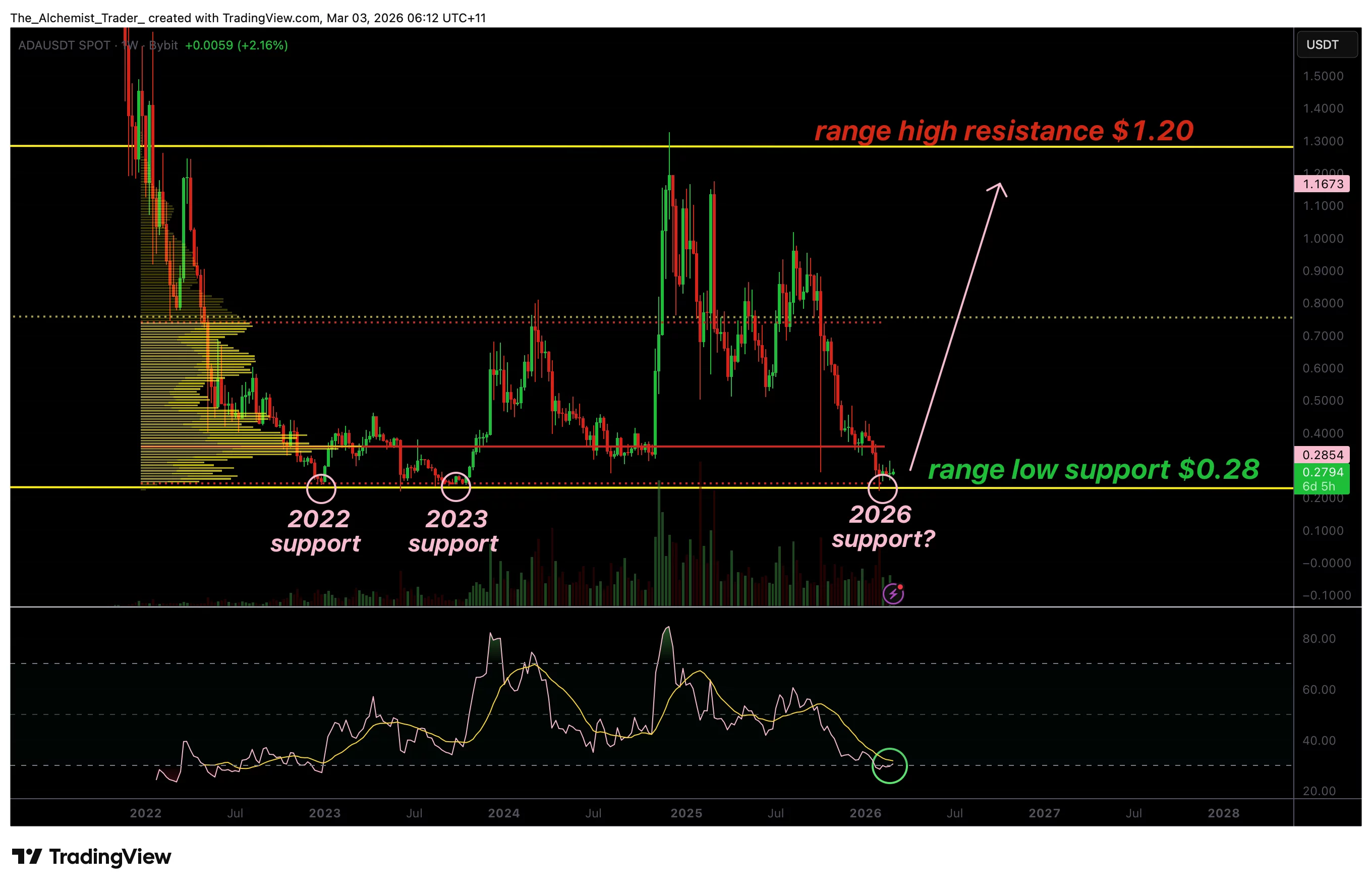
Cardano’s current price action reflects heightened selling pressure, but it is unfolding at a technically important location. The $0.28 region represents both the value area low and the broader range low within the current high timeframe structure. Historically, this level provided a strong base during the 2022 downturn and later marked the 2023 cycle bottom, establishing it as a critical liquidity zone.
Momentum indicators further strengthen the case for a potential reversal. The Relative Strength Index (RSI) has entered extreme oversold territory, signaling that selling pressure may be approaching exhaustion. While oversold conditions alone do not guarantee an immediate rebound, they often precede periods of relief rallies, particularly when aligned with significant structural support.
From a market structure perspective, Cardano continues to trade within a larger consolidation range rather than a confirmed breakdown trend. As long as price remains above the $0.28 range support, the probability favors continuation within this established structure.
Markets frequently rotate between range extremes before deciding on longer-term direction, and the current setup mirrors previous historical rotations, even as Cardano price remains under pressure despite the Midnight Foundation unveiling major blue-chip companies as node operators.
If support holds and RSI begins to recover through a bullish crossover, the first upside target would likely be the range midpoint, followed by the upper boundary of the trading range. Previous cycles have demonstrated that once oversold momentum unwinds, Cardano can produce sharp relief rallies toward equilibrium zones.
However, traders should remain cautious. A confirmed breakdown below the historical support would invalidate the bullish reversal thesis and expose deeper downside levels. For now, the technical evidence leans toward a potential bounce scenario, given the confluence of oversold momentum and long-standing demand.
Volume dynamics will be critical in determining the strength of any recovery. A rise in buying participation near $0.28 would confirm accumulation behavior, while continued weak demand could delay reversal attempts.
Overall, Cardano finds itself at a decisive inflection point. The combination of historical support and extreme oversold readings creates conditions favorable for a relief rally, but confirmation depends on whether buyers can defend the range low.
What to expect in the coming price action
As long as Cardano holds above the $0.28 range support, the probability favors a short-term rebound toward the range midpoint and potentially the range high. A breakdown below this level would shift structure bearish and increase downside risk, but current oversold conditions suggest a bounce remains likely in the near term.
TLDR
- The CFTC appointed former federal prosecutor David Miller to lead its enforcement division as its crypto oversight role expands.
- Chair Michael Selig said Miller will focus on policing fraud, abuse, and manipulation while the agency increases staffing efforts.
- Miller stated he is honored to join the CFTC during what he described as a major period of change for digital asset regulation.
- Lawmakers continued advancing bills that could broaden CFTC authority over crypto markets and related platforms.
- Recent reports raised concerns about enforcement staffing at both the CFTC and the SEC after reductions in crypto cases.
The Commodity Futures Trading Commission (CFTC) advanced its enforcement plans on Monday as Chair Michael Selig appointed David Miller to lead the division. The move came as the agency expanded its oversight of digital assets and prediction markets. The appointment followed rising questions about enforcement capacity across federal market regulators.
CFTC Enforcement Leadership Shift
The agency named Miller after he handled complex digital asset matters in both government and private practice. The CFTC said his background supports its effort to direct more resources toward market oversight.
Selig stated that Miller brings “decades of experience” that will guide work on fraud, abuse, and manipulation cases. He added that Miller’s approach will reflect a focus on policing markets rather than shaping policy.
Miller said he was “honored and thrilled” to join the agency during what he called a major moment. He also said he appreciated the trust placed in him by Selig.
Crypto Oversight and Agency Staffing
Lawmakers continued to work on bills that could expand CFTC jurisdiction over crypto markets. These proposals would broaden federal roles and create clearer oversight rules. The industry watched staffing levels closely as both the CFTC and Securities and Exchange Commission restructured their enforcement teams. Reports said the CFTC’s Chicago office recently operated without enforcement attorneys after several departures.
Selig addressed those concerns and said the agency has enough resources to handle its caseload. He also said the CFTC will keep adding personnel to strengthen supervision.
At the SEC, Chair Paul Atkins faced questions about reduced enforcement activity. Lawmakers asked about the drop in digital asset cases and demanded clarity.
Enforcement Trends Across Federal Regulators
Cornerstone Research reported a 30% drop in SEC enforcement actions during 2025. Its data also showed a 60% decrease in crypto cases year over year. Atkins responded by saying the agency maintains a “robust enforcement effort” across its portfolio. He said the agency continues to follow existing rules.
Miller previously served at Greenberg Traurig and Morgan Lewis as a litigation partner. He focused on commodities, securities, digital assets, and national security. He also worked for nearly a decade as an assistant U.S. attorney in the Southern District of New York. The CFTC said this experience strengthens its enforcement program.
Selig said Miller has a proven record of defending market participants from aggressive legal theories. He also said the appointment strengthens the division during rapid industry change. Miller will direct the agency’s enforcement priorities as regulators refine their approach to digital assets. His work begins as both federal regulators assess evolving market conditions.

Let’s discuss three upcoming events that may impact market activity across currencies, equities, and commodities.
✔️Washington and Israel struck Iran, the supreme leader of Iran Ayatollah Khamenei was killed. Iran retaliated, escalating tensions.
Oil jumped over 8%, global stocks fell, and so-called safe-haven assets rose. A Strait of Hormuz disruption could push oil sharply higher and increase recession risks (in our previous video, we outlined possible scenarios if US–Iran tensions escalate further.
✔️ The US Nonfarm Payrolls and Unemployment Rate will arrive on 6 March.
January’s strong jobs data pushed rate-cut expectations further out and caused a mixed market reaction. This week’s report could drive sharp moves in major USD pairs and US stock indices.
✔️The ISM Manufacturing PMI and ISM Services PMI will be released on 2 March and 4 March, respectively.
Following the first expansion signal in US manufacturing activity in twelve months — and the strongest improvement since 2022 — the upcoming ISM Manufacturing PMI release may become an early-week catalyst for US dollar positioning.
January’s ISM Services PMI confirmed resilience in the dominant sector of the US economy, and another strong reading would reinforce expectations that Federal Reserve policy will remain restrictive for longer, underpinning the USD.
Traders should stay alert — disciplined risk management will be key in the days ahead.
Gain insights to strengthen your trading knowledge.
Watch it now and stay updated with FXOpen.
💬 Don’t forget to like, comment, and subscribe for more professional market insights every week.
This article represents the opinion of the Companies operating under the FXOpen brand only. It is not to be construed as an offer, solicitation, or recommendation with respect to products and services provided by the Companies operating under the FXOpen brand, nor is it to be considered financial advice.
Northern Trust Asset Management has launched a tokenized share class of its NIF Treasury Instruments Portfolio, marking its entry into the digital assets market, according to the company.
The structure uses distributed ledger technology to maintain a digital mirror of share ownership, while the underlying portfolio continues to invest in short-term US Treasurys.
According to Monday’s announcement, the shares will initially be offered through BNY’s LiquidityDirect platform, which operates on Goldman Sachs’ Digital Asset Platform. The fund itself does not use blockchain technology or invest in crypto assets. Instead, authorized intermediaries are expected to maintain a blockchain-based mirror of ownership records for clients.
The NIF Treasury Instruments Portfolio invests in a diversified pool of short-term US Treasury instruments and seeks to maintain a $1.00 per-share value, though it is not FDIC-insured and may lose value.
Northern Trust Asset Management is the asset management arm of Northern Trust Corporation and manages about $1.4 trillion in assets as of Dec. 31, including $355 billion in liquidity strategies, according to the company.
The launch marks Northern Trust Asset Management’s entry into the digital assets market, according to the company.
Tokenized money market funds use blockchain technology to represent traditional money market portfolios, giving investors onchain access to short-term, yield-bearing assets such as US Treasurys.
Related: Tokenized gold drives weekend price signals while CME futures are closed
Tokenized Treasurys funds expand
Tokenized money market funds have become one of the most significant applications of blockchain technology in traditional finance. By using blockchain-based ownership records, these funds aim to make settlement and transfers more efficient.
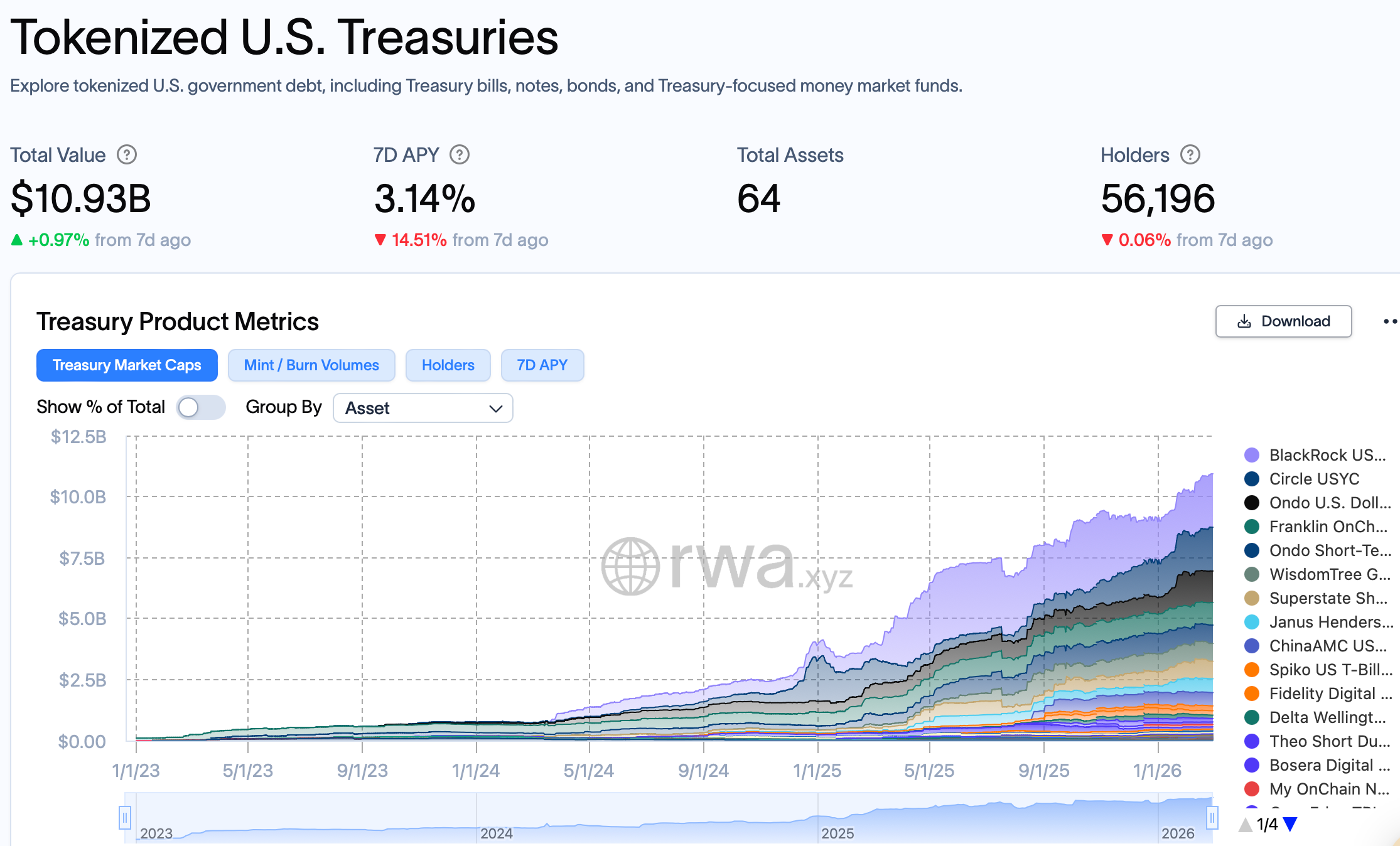
According to RWA.xyz data, nearly $11 billion in US Treasury debt is currently represented on public blockchains, making it the largest category of tokenized real-world assets.
Some of the world’s largest asset managers dominate the segment. BlackRock’s USD Institutional Digital Liquidity Fund holds about $2.2 billion in tokenized Treasurys exposure, followed by Franklin Templeton’s OnChain US Government Money Fund at just over $920 million.

Other companies have expanded the structure further. On Feb. 24, WisdomTree introduced 24/7 trading and instant settlement for its WisdomTree Treasury Money Market Digital Fund (WTGXX), enabling round-the-clock secondary trading of a registered tokenized mutual fund under the Investment Company Act of 1940.
As the sector expands, central banking institutions are examining potential risks. In November, the Bank for International Settlements warned that tokenized money market funds could introduce operational and liquidity vulnerabilities if redemptions accelerate or onchain liquidity thins.
Magazine: Would Bitcoin really be at $200K if not for Jane Street? Trade Secrets
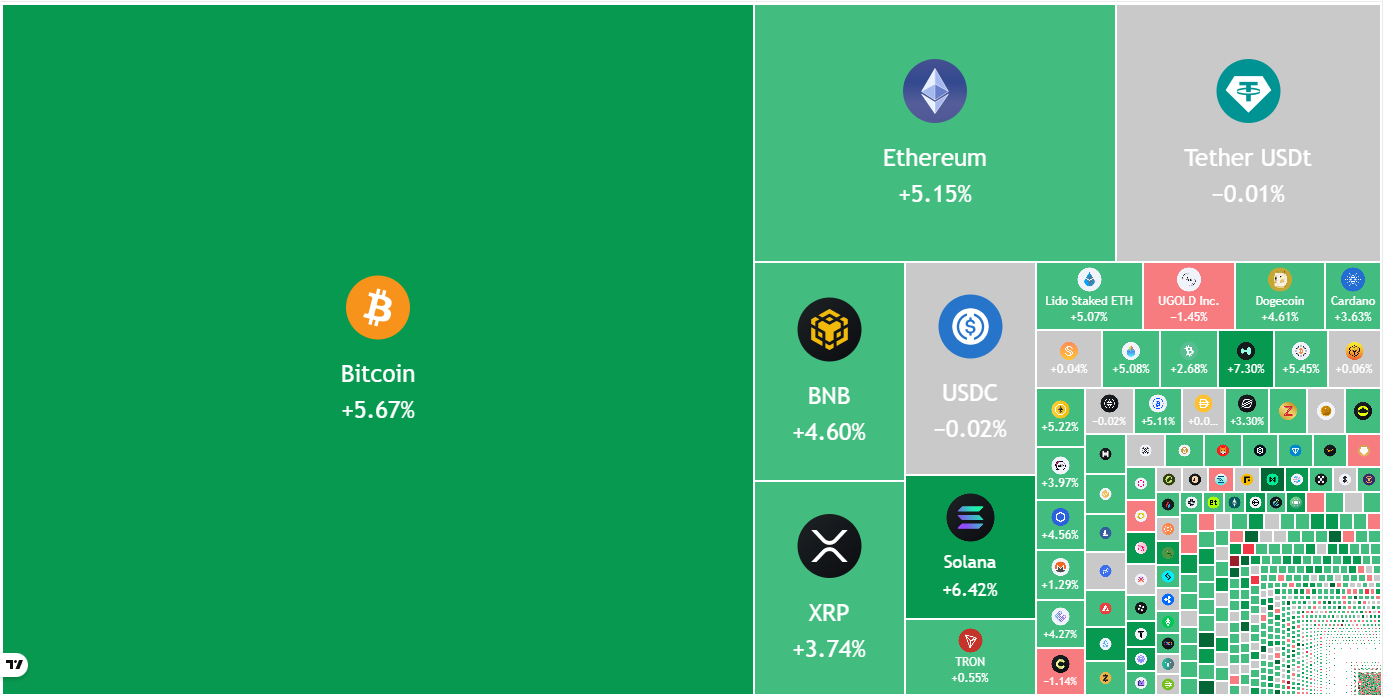
War in the Middle East failed to sink Bitcoin (BTC) below the $63,000 level. That may have attracted buyers who are attempting to maintain the price above $69,000. However, a quick recovery is unlikely. Macroeconomic newsletter Ecoinometrics said in a post on X that deep drawdowns generally unfold slowly, advising “patience rather than urgency.”
Data shared by Bitwise Europe head of research André Dragosch shows that when investors buy and hold BTC for at least three years, the probability of loss drops to 0.70%. Although BTC is down roughly 50% from its all-time high, its three-to-five year realized price of $34,780 shows that investors who bought and held during the period are sitting on large profits.

The big question on traders’ minds is when to buy BTC. BitMEX co-founder Arthur Hayes said in a blog post that every military action by the US Presidents in the Middle East since 1985 has resulted in monetary expansion by the Federal Reserve. If the current conflict stretches, the likelihood of a similar action by the Fed increases.
Could buyers push BTC and major altcoins above their resistance levels? Let’s analyze the charts of the top 10 cryptocurrencies to find out.
S&P 500 Index price prediction
The S&P 500 Index (SPX) continues to trade between the 6,775 support and the 7,002 resistance, indicating buying on dips and selling on rallies.

The longer the time spent inside the range, the stronger the eventual breakout from it. If the price turns down and breaks below the 6,775 level, it suggests that the bears have overpowered the bulls. That may start a deeper correction toward the 6,550 level.
Buyers will have to push and maintain the price above the 7,002 resistance to signal the start of the next leg of the uptrend. The index may then surge to the 7,290 level.
US Dollar Index price prediction
The US Dollar Index (DXY) skyrocketed above the 50-day simple moving average (97.91), indicating aggressive buying by the bulls.

The index might rally to the 99.50 level and thereafter to the 100.54 resistance. Sellers are expected to fiercely defend the 100.54 level, as a close above it suggests the start of a new uptrend.
This positive view will be negated in the near term if the price turns down and breaks below the 20-day exponential moving average (97.67). That opens the doors for a drop to the 96.21 to 95.55 support zone.
Bitcoin price prediction
BTC has formed a symmetrical triangle pattern, indicating a balance between supply and demand.

The bulls are attempting to strengthen their position by pushing the Bitcoin price above the resistance line. If they manage to do that, the BTC/USDT pair may surge to the breakdown level of $74,508. A close above the $74,508 level will be the first sign that the pair may have bottomed out at $60,000.
Alternatively, if the price turns down from the $74,508 level and breaks below the 20-day EMA, it suggests that the bears remain active at higher levels. That may result in a range formation between $60,000 and $74,508.
Ether price prediction
Ether (ETH) remains range-bound between $1,750 and $2,111, indicating a tough battle between the bulls and the bears.

The bulls will have to secure a close above the $2,111 resistance to seize control. If they manage to do that, the ETH/USDT pair may rally to the 50-day SMA ($2,427) and, after that, to $3,045.
Contrary to this assumption, if the Ether price turns down from the $2,111 level, it suggests that the consolidation may continue for a few more days. The bears will be back in the driver’s seat on a close below $1,750. That clears the path for a collapse to the $1,537 level.
XRP price prediction
XRP (XRP) is struggling to rise above the 20-day EMA ($1.42), but a positive sign is that the bulls continue to exert pressure.

If buyers push the XRP price above the 20-day EMA, the XRP/USDT pair may rise to the 50-day SMA ($1.63) and later to the downtrend line. A close above the downtrend line will signal a potential trend change.
Instead, if the price turns down from the 20-day EMA and breaks below the support line, it indicates that the bears remain in control. There is support at $1.11, but if the level gives way, the decline may extend to $1.
BNB price prediction
BNB (BNB) has been trading inside the $570 to $670 range for a while, indicating buying at lower levels.

The 20-day EMA ($633) is flattening out, and the relative strength index (RSI) is gradually climbing higher. That suggests the selling pressure may be reducing. The bulls will attempt to drive the BNB price above the $670 level. If they can pull it off, the BNB/USDT pair may soar to the 50-day SMA ($742).
Sellers are likely to have other plans. They will attempt to defend the $670 level and pull the price below the $570 support. If they succeed, the pair may plummet to psychological support at $500.
Solana price prediction
Buyers have pushed Solana (SOL) above the 20-day EMA ($86), indicating demand at lower levels.

Sellers will attempt to halt the relief rally at $95, but if the bulls prevail, the SOL/USDT pair may soar toward $117. Such a move suggests that the Solana price may have bottomed out in the short term.
Contrary to this assumption, if the price turns down from the overhead resistance, the pair may swing between $76 and $95 for a while longer. A break below the $76 support signals the resumption of the downtrend to $67.
Related: Will Bitcoin crash if oil prices hit $100 per barrel?
Dogecoin price prediction
Dogecoin (DOGE) has been trading between the 20-day EMA ($0.10) and the $0.09 support for the past few days.

If the $0.09 level gives way, the DOGE/USDT pair may retest the Feb. 6 low of $0.08. Buyers are expected to vigorously defend the $0.08 level, as a close below it may start the next leg of the downtrend to $0.06.
The bulls will have to propel the Dogecoin price above the 20-day EMA to signal strength. The pair may then rally to the breakdown level of $0.12, where the bears are expected to step in.
Bitcoin Cash price prediction
Buyers are attempting to sustain Bitcoin Cash (BCH) above the $443 support, but the bears have kept up the pressure.

The downsloping moving averages and the RSI near the oversold zone increase the likelihood of a breakdown. There is minor support at $423, but it is likely to be broken. The BCH/USDT pair may then plunge to $377.
Any rebound off the $443 level is expected to face selling at the moving averages. Buyers will have to push the Bitcoin Cash price above the 50-day SMA ($546) to gain the upper hand.
Cardano price prediction
Cardano (ADA) continues to trade inside the descending channel pattern, indicating that the bears remain in command.

If the Cardano price sustains below the 20-day EMA ($0.28), the bears will attempt to tug the ADA/USDT pair below the $0.25 support. If they manage to do that, the pair may tumble to the support line. A strong rebound off the support line suggests that the pair may remain inside the channel for a while longer.
The bulls will have to push and retain the price above the downtrend line to signal a potential trend change. The pair may then climb toward $0.43.
This article does not contain investment advice or recommendations. Every investment and trading move involves risk, and readers should conduct their own research when making a decision. While we strive to provide accurate and timely information, Cointelegraph does not guarantee the accuracy, completeness, or reliability of any information in this article. This article may contain forward-looking statements that are subject to risks and uncertainties. Cointelegraph will not be liable for any loss or damage arising from your reliance on this information.

BREAKING: Bitcoin Price Suppression & Crypto Market Manipulation LIFTED!

Federal court rejects Trump administration attempt to slow tariff refund process

Michael Saylor’s MSTR added 3,015 BTC for $204.1 million


-

 Fashion3 days ago
Weekend Open Thread: Iris Top
-

 Politics4 days ago
ITV enters Gaza with IDF amid ongoing genocide
-

 Business6 days ago
True Citrus debuts functional drink mix collection
-

 Tech2 days ago
Unihertz’s Titan 2 Elite Arrives Just as Physical Keyboards Refuse to Fade Away
-
Sports3 days ago
The Vikings Need a Duck
-

 Crypto World7 days ago
XRP price enters “dead zone” as Binance leverage hits lows
-
 NewsBeat2 days ago
Dubai flights cancelled as Brit told airspace closed ’10 minutes after boarding’
-

 NewsBeat5 days ago
Cuba says its forces have killed four on US-registered speedboat | World News
-

 Tech6 days ago
Unsurprisingly, Apple's board gets what it wants in 2026 shareholder meeting
-
 NewsBeat5 days ago
Manchester Central Mosque issues statement as it imposes new measures ‘with immediate effect’ after armed men enter
-
 NewsBeat2 days ago
The empty pub on busy Cambridge road that has been boarded up for years
-

 NewsBeat1 day ago
‘Significant’ damage to boarded-up Horden house after fire
-

 NewsBeat2 days ago
Abusive parents will now be treated like sex offenders and placed on a ‘child cruelty register’ | News UK
-
 NewsBeat6 days ago
Police latest as search for missing woman enters day nine
-

 Entertainment12 hours ago
Baby Gear Guide: Strollers, Car Seats
-

 Business5 days ago
Discord Pushes Implementation of Global Age Checks to Second Half of 2026
-

 Business4 days ago
Only 4% of women globally reside in countries that offer almost complete legal equality
-
 Tech3 days ago
NASA Reveals Identity of Astronaut Who Suffered Medical Incident Aboard ISS
-

 Crypto World6 days ago
Entering new markets without increasing payment costs
-
Politics2 days ago
FIFA hypocrisy after Israel murder over 400 Palestinian footballers