
Crypto World
US Treasury Sanctions Two Iranian Crypto Exchanges Over IRGC Money Laundering



The US Treasury sanctioned two Iranian digital asset exchanges, Shelbit and Aban Tether, along with network operator Siavash Kayvanpour, over crypto transfers tied to Iran’s Islamic Revolutionary Guard Corps (IRGC).
The Office of Foreign Assets Control (OFAC) issued the designations on Friday. The designations mark the latest US strike on Iran’s crypto rails this year.
How The Shelbit Network Moved Crypto
IRGC crypto addresses sent more than $1 million into the Shelbit Exchange. Over $2 million then flowed from Shelbit back to Guard wallets, according to OFAC.
Kayvanpour, an Iranian-born operator, ran Shelbit from Georgia and built front companies in Poland and the UAE. His wallets sent more than $2 million to Nobitex, Iran’s largest crypto exchange, which OFAC blocked in June.
OFAC also said Shelbit laundered tens of millions for a Persian-language gambling network. Reuters earlier reported that Shelbit routed $676 million to Binance.
Follow us on X to get the latest news as it happens
Aban Tether and The Iran Sanctions Campaign
Aban Tether, a separate Iran-based exchange, processed millions in transactions with previously blocked platforms Nobitex, Wallex, Bitpin, and Ramzinex. Treasury cited Executive Order 13902, which targets firms operating in Iran’s financial sector.
“Whether in dollars, rials, or crypto, Treasury will hunt down and dismantle illicit financial networks,” Scott Bessent, Treasury Secretary, said.
The move extends the US maximum pressure campaign on Iran, carried out under National Security Presidential Memorandum 2 (NSPM-2). Stablecoin issuers have moved fast on past listings, freezing Iranian wallets after the designation.
Subscribe to our YouTube channel to watch leaders and journalists provide expert insights
The post US Treasury Sanctions Two Iranian Crypto Exchanges Over IRGC Money Laundering appeared first on BeInCrypto.

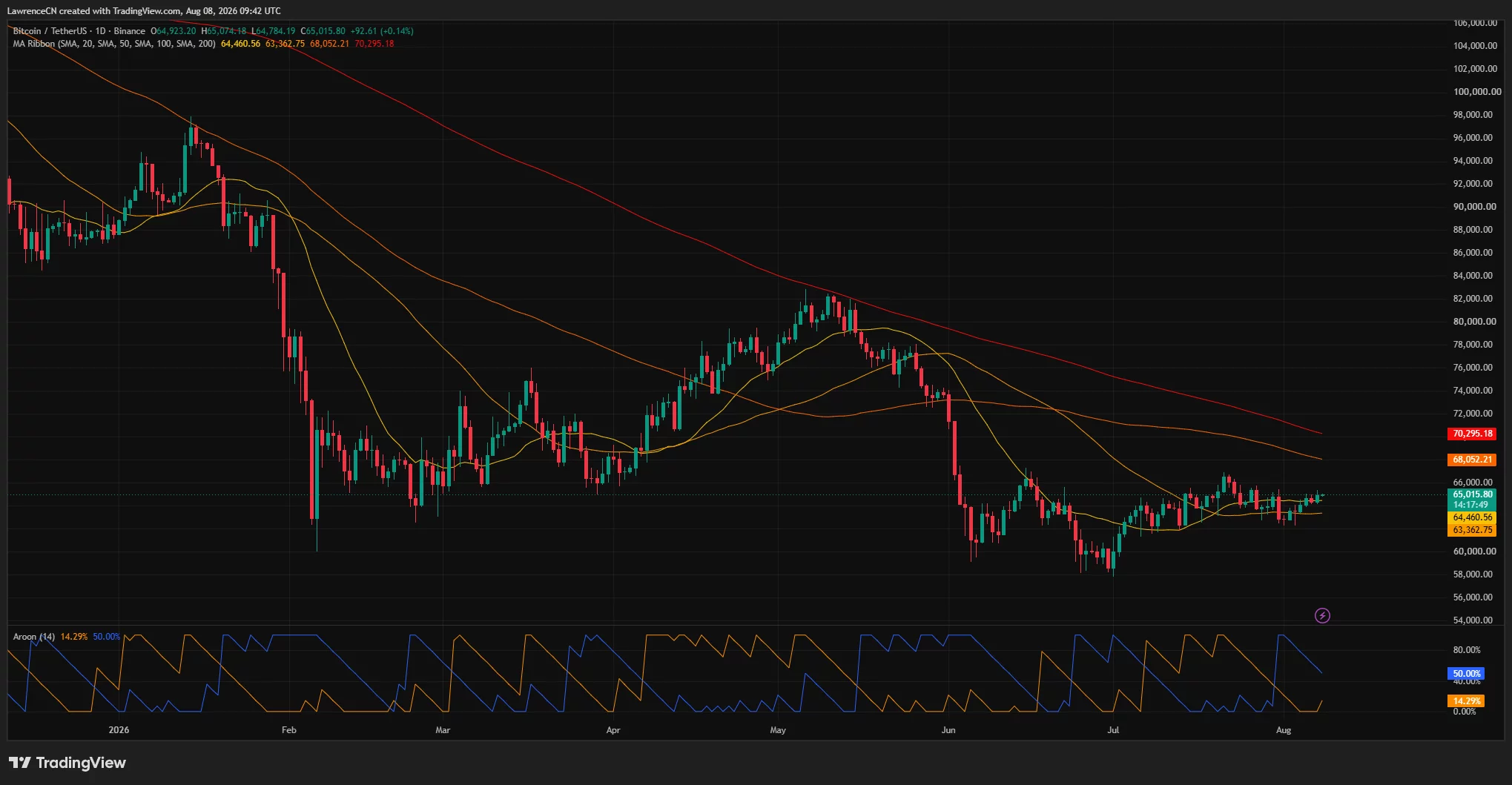
Bitcoin price held near $65,000 on Aug. 8, but its failure to reclaim the short-term holder cost basis left the recovery exposed to renewed selling.
Summary
- Bitcoin price traded near $65,015, about 3.7% below the short-term holder realized price.
- The $67,523 cost basis could attract selling from holders seeking to exit near breakeven.
- 4-hour momentum remains positive, with the RSI at 61.8 and price above the Bollinger midline.
- Liquidation clusters near $65,600 and $63,000–$63,800 could determine the next move.
Bitcoin price struggles to hold above $65,000
According to data from crypto.news, Bitcoin (BTC) price was trading near $65,015 at the time of writing after repeatedly testing the $65,000 area. The daily candle had traded between $64,784 and $65,075, showing limited volatility following the rebound from its late-July lows.
The price has recovered from an Aug. 2 low near $62,200, but sellers continue to defend the area immediately above $65,000. In an Aug. 8 X post, analyst Ted Pillows said Bitcoin had failed to establish a firm hold above that threshold.
“BTC failed to hold above the $65,000 level. Sellers are still active in this zone, and Bitcoin needs to reclaim it for stronger upside.”
The daily chart shows BTC trading above its 20-day and 50-day simple moving averages at $64,461 and $63,363, respectively. Those averages form an initial support zone between approximately $63,300 and $64,500.
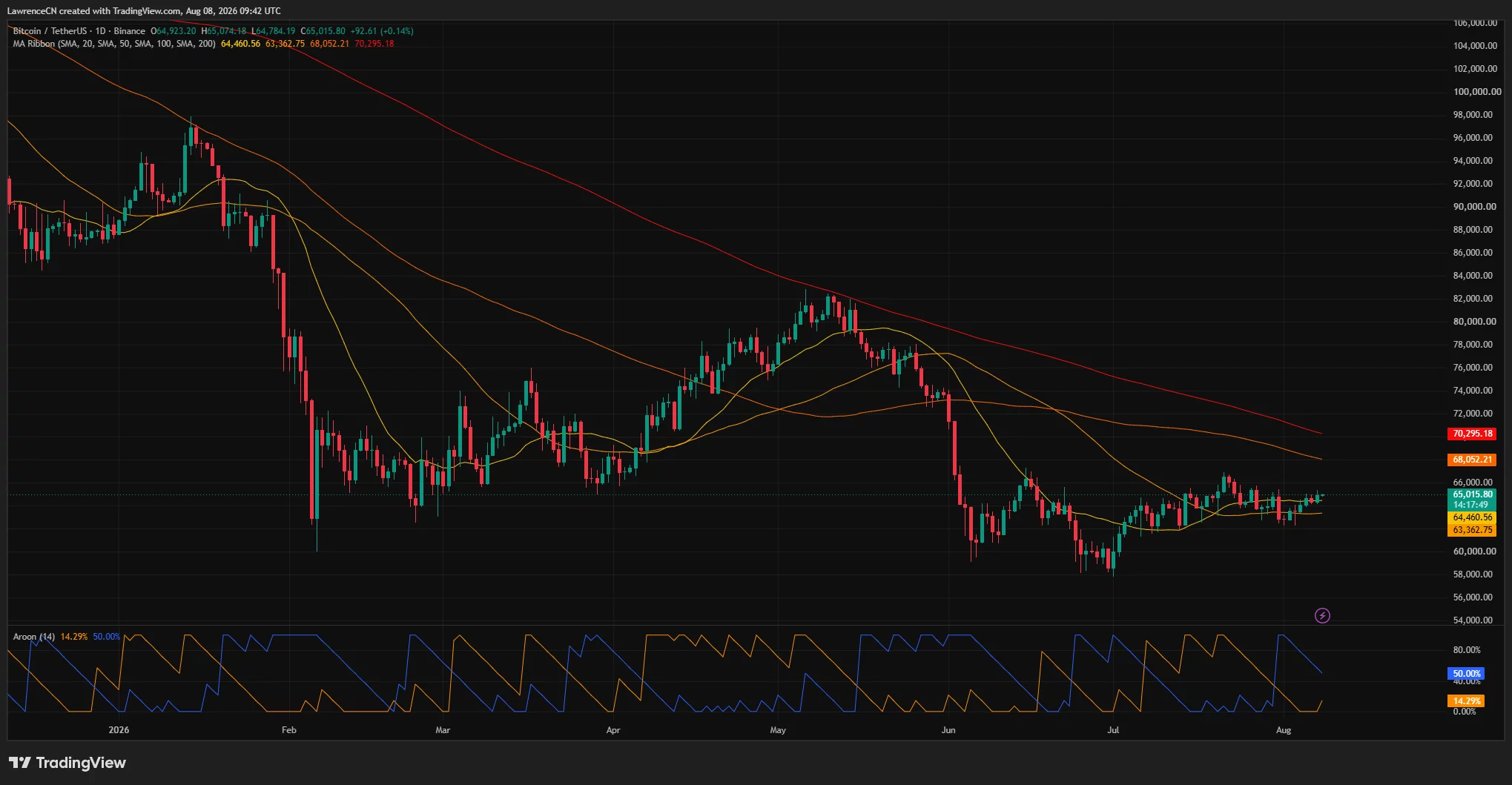
Bitcoin remains below its 100-day SMA at $68,052 and its 200-day SMA at $70,295. That structure shows that the short-term recovery has not yet reversed the broader downtrend that began after BTC reached approximately $82,000 in May.
Short-term holders could sell near $67,523
CryptoQuant analyst Axel Adler Jr. said Bitcoin remained below the realized price of short-term holders, which measures the average acquisition price of coins held for less than 155 days.
As of Aug. 8, Adler placed the short-term holder realized price at $67,523, compared with a BTC spot price of $64,952. That left Bitcoin $2,571, or 3.8%, below the cost basis.
The gap was the narrowest since July 21, bringing more short-term holders closer to breakeven. Investors who bought above the current price may use a recovery toward $67,500 to reduce exposure without taking a large loss.
Adler said Bitcoin had closed below the short-term holder realized price during 279 of the previous 284 days. He expects selling pressure to increase as the market approaches the cost line.
“STHs will start dumping into the market to close their positions at breakeven.”
The forecast is not guaranteed, but the cost basis creates a visible resistance area. Bitcoin would need to absorb potential holder selling and establish support above $67,523 to improve the medium-term structure.
BTC technical indicators favor a $65,250 test
The 4-hour chart offers a more constructive short-term picture. Bitcoin is trading above the Bollinger Band midline at $64,647 and close to the upper band at $65,257.
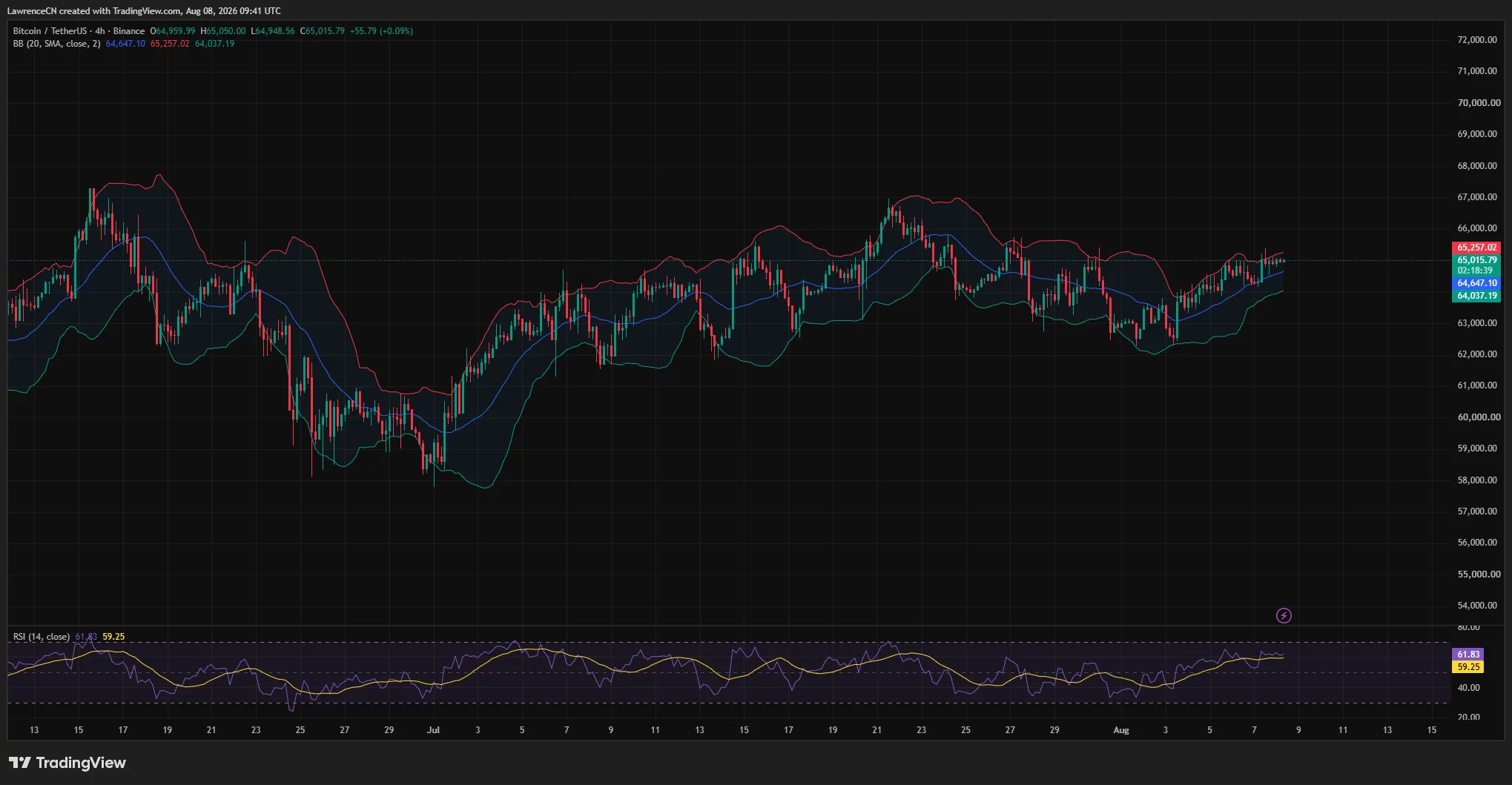
A 4-hour close above the upper band could support a move toward $65,600, followed by $66,000. The next major resistance would sit around the short-term holder cost basis between $67,500 and $67,600.
The relative strength index stood at 61.83, above its moving average of 59.25. That reading shows buyers currently have the momentum advantage without pushing BTC into overbought territory.
Momentum on the daily timeframe remains less decisive. Aroon Up stood at 50%, while Aroon Down was at 14.29%. The difference favors buyers, but the moderate Aroon Up reading does not yet confirm a strong daily uptrend.
BTC must first turn $65,000 into support and clear the $65,250–$65,600 range. A rejection could send the price back toward the Bollinger midline at $64,647, followed by the lower band at $64,037.
A deeper decline would expose $63,360, where the daily 50-day SMA is located. Pillows identified a broader demand zone near $62,000–$63,000, with further support around $59,000 if that area fails.
Liquidation heatmap shows pressure on both sides
CoinGlass’ one-week liquidation heatmap shows leveraged positions concentrated above and below Bitcoin’s current price.
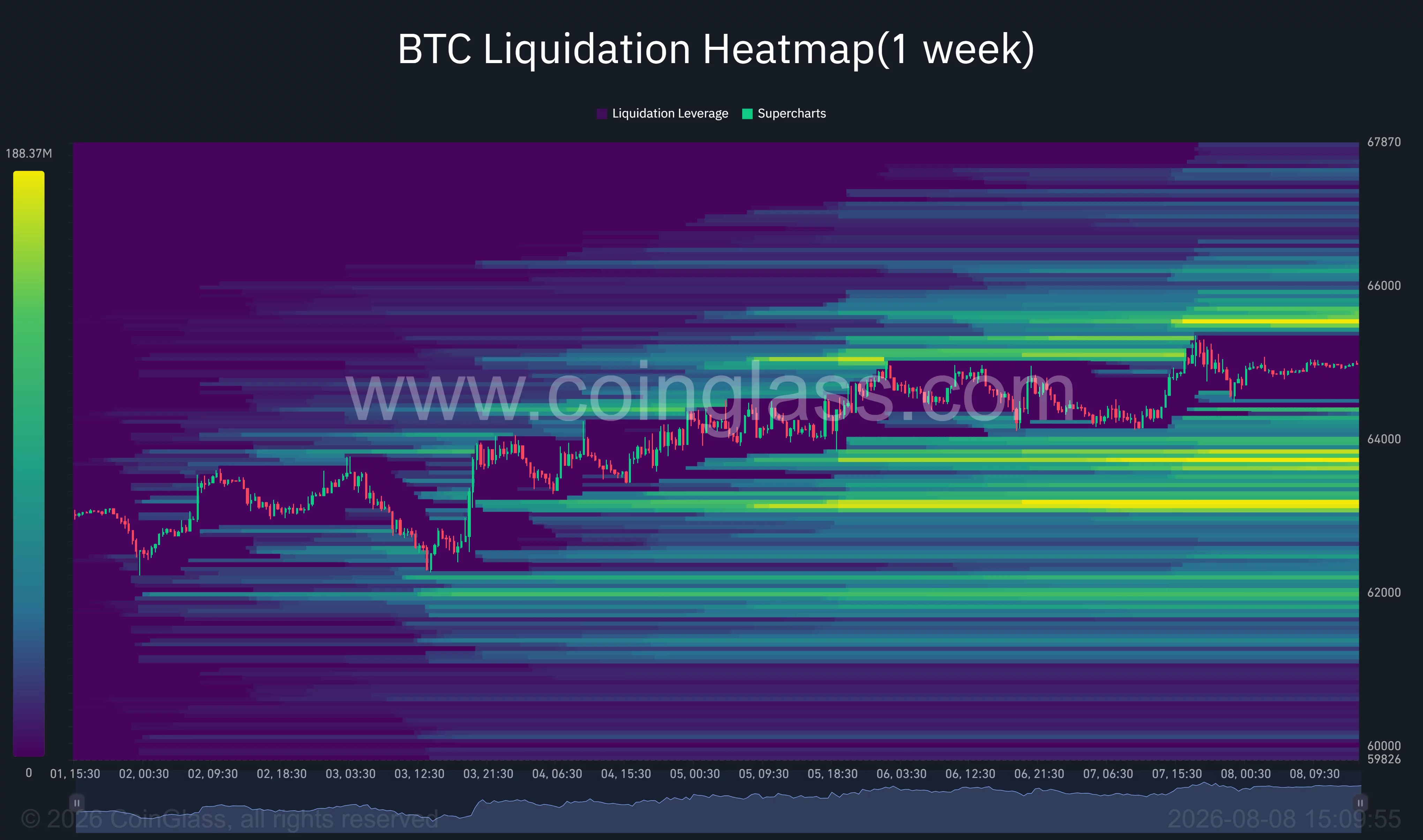
The nearest major upside cluster appears around $65,500–$65,700. A move through that zone could liquidate short positions and accelerate a test of $66,000. Additional liquidity is visible above $66,000, although the concentration is weaker.
Larger downside clusters are located around $63,700–$63,900 and close to $63,000. These areas could attract price if Bitcoin loses the 4-hour Bollinger midline and the $64,000 level.
This positioning leaves BTC between competing liquidity pools. A breakout above $65,600 would favor a short squeeze, while a loss of $64,000 could pull the market toward the denser downside clusters.
For U.S. investors, the weekend move will occur while spot Bitcoin ETFs and CME futures are closed. Any sharp breakout before Monday could therefore produce a gap between Bitcoin’s continuously traded spot market and the reopening of regulated U.S. products.
The immediate bias remains mildly bullish while BTC holds above $64,000. However, the short-term holder cost basis at $67,523 and the long-term moving averages above $68,000 remain major barriers to a broader recovery.
Disclosure: This article does not represent investment advice. The content and materials featured on this page are for educational purposes only.
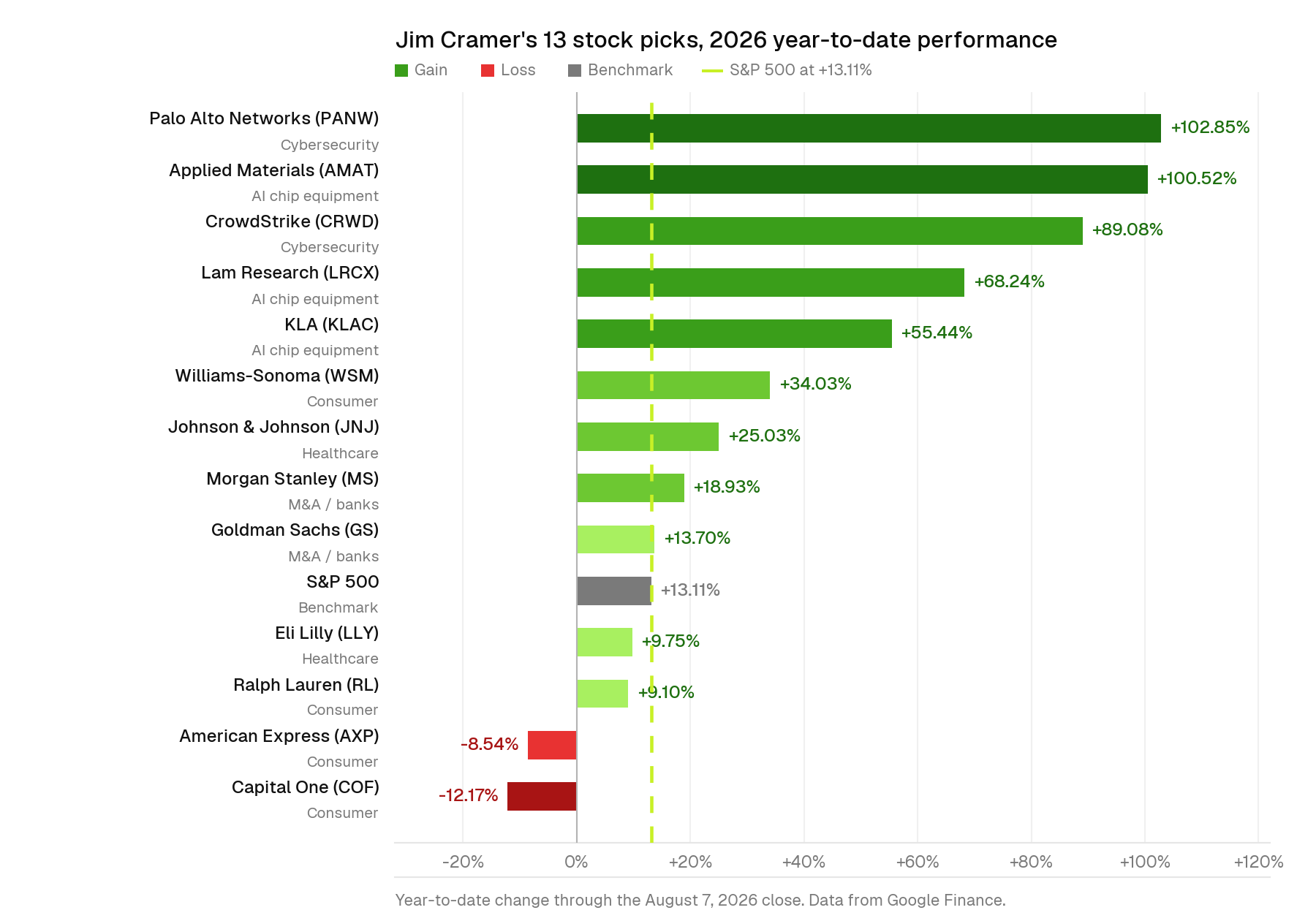
Jim Cramer named 5 investing themes and 13 stocks to buy on Thursday’s Mad Money. The picks span consumer spending, AI infrastructure, cybersecurity, mergers and acquisitions, and healthcare.
The CNBC host said this earnings season reinforced each trend. Market data shows his selections range from stocks that doubled in 2026 to names carrying double-digit losses.
Momentum Leaders and Contrarian Consumer Bets
Cramer’s cybersecurity names top the group in year-to-date performance. Palo Alto Networks has gained 102.85% in 2026, and CrowdStrike has climbed 89.08%.
Rising AI-driven threats revived demand after investors questioned the sector earlier this year. Semiconductor equipment ranks close behind.
Applied Materials has advanced 100.52%, Lam Research has added 68.24%, and KLA has risen 55.44%. Cramer pointed to a shortage of every type of data center memory as the driver.
His consumer theme looks different. Capital One has dropped 12.17% this year, and American Express has lost 8.54%. Ralph Lauren, up 9.10%, also trails the S&P 500’s 13.11% gain. Only Williams-Sonoma outperforms, rising 34.03%.
Cramer argued that earnings from banks, travel companies, and retailers paint a different picture despite persistent concerns about inflation and weaker consumer spending.
American Express, for example, reported a 9% increase in higher card-member spending in the second quarter, marking its strongest growth in three years.
Follow us on X to get the latest news as it happens

M&A Revival and the Healthcare Rotation
Cramer also expects dealmaking to lift Wall Street banks. Goldman Sachs posted a 55% jump in second-quarter investment banking fees to $3.4 billion.
The bank projects global merger volume will reach $3.8 trillion in 2026. Goldman shares are up 18% this year, while Morgan Stanley has gained 22%.
Healthcare rounds out his list as a diversification play. Johnson & Johnson has risen 25% and set record closes in June. His other pick, Eli Lilly, is up 10% this year.
“I just think this quarter’s information is fresh enough that you can pick a travel stock, a semiconductor capital equipment maker, a cybersecurity company, something that works in the M&A world, or medtech, and you’ll greatly increase your chances of making money for the rest of 2026,” he said.
Five of the 13 names sit in Cramer’s own Charitable Trust. That overlap is worth remembering. The themes provide a way to sort a crowded market into five clear bets. The stocks behind them now have to prove the trends hold.
Subscribe to our YouTube channel to watch leaders and journalists provide expert insights
The post Jim Cramer Names 5 Investing Themes and 13 Stocks to Buy for 2026 appeared first on BeInCrypto.


The U.S. Senate has initiated the process for considering the CLARITY Act, setting up an initial procedural vote after lawmakers return from their August recess.
Summary
- Senate leadership filed a motion to begin considering the CLARITY Act late Friday.
- The procedural step positions the bill for an initial vote in September.
- Negotiations remain divided over ethics, enforcement and stablecoin rewards.
- The legislation needs 60 Senate votes to overcome the chamber’s cloture threshold.
CLARITY Act moves toward September vote
Senate Majority Leader John Thune submitted the motion after a late-night voting session, according to reports released Saturday. The timing prevented the Senate from holding a procedural vote before lawmakers began their August recess.
The filing nevertheless allows leadership to place the crypto market structure bill near the front of the Senate’s September agenda. Senators are expected to return to Washington on Sept. 14.
Thune had previously confirmed that the chamber would not vote on the legislation before the recess but said leaders intended to prepare it for action upon their return.
“We’re getting that queued up first thing when we come back,” Thune said in a statement reported before the recess.
An initial vote would concern whether the Senate should proceed with consideration of the legislation. It would not amount to final passage. Senators would still need to debate the bill, consider amendments and hold a separate vote on approving the final text.
Unresolved disputes could block progress
The procedural filing does not indicate that Republicans and Democrats have reached an agreement on the provisions that delayed the August vote.
Lawmakers remain divided over ethics restrictions covering government officials’ crypto interests, enforcement powers, illicit-finance safeguards and stablecoin rewards. Democrats have sought stronger conflict-of-interest rules and additional consumer protections.
Sen. Elizabeth Warren has said she supports federal crypto legislation but opposes the current CLARITY Act. She cited concerns involving government corruption, consumer protection, national security and financial stability.
Stablecoin rewards remain another major obstacle. Banking groups have pushed lawmakers to restrict payments offered for holding stablecoins, arguing that such products could pull deposits from traditional banks. Crypto companies maintain that broader restrictions could reduce competition.
The current compromise would restrict passive yield paid solely for holding stablecoins while allowing certain rewards tied to customer activity. crypto.news previously reported that changes to these rules could affect Coinbase’s USDC rewards business, which generates an estimated $1.35 billion in annual revenue.
Bill would divide SEC and CFTC authority
The CLARITY Act would establish a federal framework for determining when digital assets fall under the authority of the Securities and Exchange Commission or the Commodity Futures Trading Commission.
The House passed an earlier version of the bill by a 294–134 vote in July 2025. The Senate Banking Committee later advanced its version 15–9 in May 2026, with Republicans joined by Democratic Sens. Ruben Gallego and Angela Alsobrooks.
However, clearing the committee did not guarantee sufficient support on the Senate floor. Thune would generally need 60 votes to invoke cloture and limit debate, requiring support from several Democrats.
Without the legislation, U.S. crypto companies would continue operating under the existing combination of SEC and CFTC oversight, court decisions and state-level requirements.
Crypto markets hold steady after Senate filing
Bitcoin traded near $64,980 on Saturday, up about 0.4%, after moving between approximately $64,507 and $65,312.
Crypto-related stocks also finished Friday higher. Coinbase closed at $153.60, gaining about 5.7%, while Circle ended the session at $66.67, up roughly 5.4%. Those moves followed broader market trading and cannot be attributed solely to the Senate development.
The next test will come when senators return in September. Lawmakers must settle the remaining policy disputes and secure enough bipartisan support before the bill can advance beyond its initial procedural vote.


A wallet linked to the Aztec Private Rollup Bridge exploit deposited another 300 ETH into Tornado Cash, bringing its total transfers to the mixer to 500 ETH.
Summary
- The exploiter sent another 300 ETH, worth about $572,000, to Tornado Cash.
- Total deposits linked to the wallet have now reached 500 ETH, worth about $953,000 at the reported price.
- The Private Rollup Bridge lost approximately $2.165 million in a June exploit.
- Aztec said the affected legacy product was separate from its current network and AZTEC token.
Aztec exploiter deposits 300 ETH into Tornado Cash
Blockchain security firm PeckShield reported on Aug. 8 that an address labeled as the Aztec Private Rollup Bridge exploiter deposited 300 Ether into Tornado Cash.
The ETH was worth approximately $572,000 when PeckShield issued the alert. On-chain data included in the firm’s report showed three separate deposits of 100 ETH each.
PeckShield said the latest transactions raised the wallet’s cumulative Tornado Cash deposits to 500 ETH. Based on the valuation attached to its alert, the total was worth roughly $953,000 at press time.
Tornado Cash pools deposits and allows users to withdraw funds through different addresses. This process can obscure the direct connection between the original sending wallet and subsequent recipients, making asset tracking and recovery more difficult.
PeckShield did not identify the person or group controlling the address. There was also no immediate indication that any of the transferred funds had been recovered.
Private Rollup Bridge lost $2.165 million
The latest transfers relate to an exploit that affected Aztec’s Private Rollup Bridge in June. Reports at the time placed the loss at approximately $2.165 million.
The stolen assets reportedly included 1,158 ETH, 150,000 DAI and 0.47 renBTC. Aztec said the affected bridge was a legacy product with no connection to the current Aztec network or its AZTEC token.
The Private Rollup Bridge incident followed a separate attack on Aztec Connect, another discontinued part of the project’s earlier infrastructure.
As crypto.news previously reported, an attacker drained around $2.1 million from Aztec Connect’s old RollupProcessor contract on June 14. The affected system had been discontinued about three years earlier and was no longer used by Aztec’s active network.
Security researchers said that the exploit involved a mismatch between the transactions covered by a zero-knowledge proof and those processed during settlement. The weakness allowed the attacker to create unbacked balances and withdraw assets from the contract.
Aztec Labs could not pause or upgrade the deprecated contract because it had surrendered its administrative keys. The design made the contract immutable but also removed the team’s ability to intervene after the flaw was exploited.
Tornado Cash transfers follow wider exploit surge
The two Aztec incidents formed part of a wider increase in crypto security breaches during June.
Crypto.news reported that DefiLlama recorded $74.9 million in losses across 29 exploits during the month. Its data included two separate Aztec incidents valued at approximately $2.1 million each.
Other exploiters have also used Tornado Cash to move stolen assets. In July, a wallet associated with the Drift Protocol exploit deposited 23,095 ETH, then worth around $44.4 million, into the mixer after months of inactivity.
A wallet linked to the Radiant Capital attack previously transferred 2,834 ETH into Tornado Cash, while the Cork Protocol exploiter routed approximately 4,520 ETH through the service.
The latest Aztec deposits therefore follow an established pattern in which attackers convert stolen assets into ETH before sending them through mixing protocols.
Tornado Cash remains under US scrutiny
The U.S. Treasury removed Tornado Cash and associated smart-contract addresses from its sanctions list in March 2025. The decision followed a federal appeals court ruling that the Treasury exceeded its authority by sanctioning immutable smart contracts.
However, U.S. authorities have continued to examine the use of crypto mixers in money laundering, sanctions evasion and cybercrime cases. Treasury officials have also maintained concerns about their use by North Korea-linked hacking groups.
The 500 ETH transferred by the Aztec exploiter represents less than half of the value reportedly taken from the Private Rollup Bridge. Further activity from the labeled address could show whether the remaining assets will also be routed through Tornado Cash or moved to other services.
Crypto World
U.S. Senate opens first stage of crypto Clarity Act voting to give bill a chance next month
The U.S. Senate is finally leaping into the first procedural votes on the crypto Digital Assets Market Clarity Act, after the leadership moved early Saturday to start official floor action on the crypto market structure bill, marking the farthest progress yet for the industry’s central policy effort.
But this key advance announced after a marathon overnight voting session comes after the bill has missed its window to get a vote before the Senate’s summer break, leaving it in a long-shot position to get approval in September. Though the Clarity Act’s chances are hanging by a thread, it would likely have been declared dead for 2026 without at least this first important movement.
“We, the undersigned senators … hereby move to bring to a close debate on the motion to proceed to calendar number 423, [House Resolution] 3633, an act to provide for a system of regulation of the offer and sale of digital commodities by the Securities and Exchange Commission and the Commodity Futures Trading Commission, and so forth and for other purposes,” the clerk said reading the filing.


Coinbase CEO Brian Armstrong said crypto adoption will continue through stablecoins, tokenization and expanding digital asset markets despite the Senate delaying the CLARITY Act.
Summary
- Armstrong said crypto momentum continues regardless of the congressional timetable.
- Senate leaders postponed the CLARITY Act vote until September after negotiations failed to produce an agreement.
- Stablecoin rewards, political ethics and illicit finance safeguards remain central points of dispute.
- Coinbase shares closed Friday at $153.60, gaining about 5.7% during the session.
Armstrong points to adoption beyond Congress
Armstrong described the Senate’s failure to advance the CLARITY Act before its August recess as disappointing but argued that the delay had not stopped companies and consumers from adopting digital assets.
In an Aug. 7 post on X, the Coinbase executive pointed to increased stablecoin use, developing markets for tokenized real-world assets and broader access to perpetual futures. He also said regulators were already providing companies with greater clarity in some areas.
“The momentum behind this technology keeps growing with or without a congressional calendar,” Armstrong said.
His remarks separated the industry’s commercial growth from the legislative timetable. Companies can continue building products under existing rules, but Armstrong maintained that Congress still has an important role in creating a consistent federal framework.
Clear legislation could encourage investment and employment while providing stronger protections for U.S. consumers, according to the Coinbase CEO.
CLARITY Act vote moves to September
Senate Majority Leader John Thune said the bill would be queued when lawmakers return from recess. As crypto.news reported, the Senate postponed consideration after Democrats declined to support an accelerated pre-recess process.
The legislation needs 60 votes to overcome the Senate’s cloture threshold. Republicans therefore require support from at least seven Democrats, assuming every Republican senator backs the measure.
Democratic lawmakers have sought stronger provisions covering political conflicts of interest, consumer protection, illicit finance and market integrity. Negotiations over restrictions involving President Donald Trump’s crypto interests have become one of the main obstacles.
Senator Elizabeth Warren has also rejected the current CLARITY Act, arguing that it does not adequately address corruption, national security and risks to consumers.
Stablecoin rewards remain a Coinbase concern
The CLARITY Act would divide oversight between the Securities and Exchange Commission and Commodity Futures Trading Commission. It would also establish federal rules for crypto exchanges, brokers, dealers, advisers and qualified digital asset custodians.
Stablecoin rewards remain particularly important for Coinbase. The latest draft generally prohibits companies from paying interest or yield solely for holding payment stablecoins. It may continue allowing rewards tied to activities such as payments, remittances, liquidity provision, staking and loyalty programs.
Armstrong previously supported that compromise, saying banks and crypto companies had preserved their central priorities. However, several banking groups argued that permitted rewards could still draw deposits away from traditional financial institutions.
The outcome could affect Coinbase’s USDC business. A recent crypto.news analysis estimated that the exchange generates about $1.35 billion annually through its USDC rewards arrangement.
Tokenization supports Armstrong’s adoption argument
Recent institutional activity provides evidence for Armstrong’s broader tokenization claim. BlackRock launched two tokenized money-market products holding cash, short-term U.S. Treasuries and Treasury-backed repurchase agreements.
The Depository Trust and Clearing Corporation is also preparing to launch a tokenization service in October. Its industry working group has expanded to more than 100 members and partners, including Nasdaq, Charles Schwab, BlackRock and Circle.
As crypto.news reported, DTCC completed production transactions in July involving tokenized Treasuries, equities, collateral, securities lending and margin processes. The trials used securities already held within established U.S. market infrastructure.
Coinbase shares also rose alongside the broader adoption narrative. COIN closed Friday at $153.60, up approximately 5.7% for the session, although the move cannot be attributed solely to Armstrong’s remarks or the CLARITY Act outlook.
What comes next for the CLARITY Act
Attention now turns to whether Senate negotiators can resolve their differences during the August recess. Thune has committed to prioritizing the legislation when lawmakers return, but a floor vote has not been formally scheduled.
The remaining negotiations will determine whether the bill can secure enough Democratic support without losing Republican votes. Ethics restrictions, illicit finance controls, consumer safeguards and stablecoin rewards are likely to remain central to those talks.
A September vote would still represent only one stage of the process. Any Senate version would need to be reconciled with the measure previously passed by the House before it could reach the president.
Armstrong’s comments suggest Coinbase expects crypto adoption to continue during that process. However, the delay leaves U.S. companies without the unified federal market structure the legislation is intended to create.


Ondo Finance is facing a corporate control battle in Delaware after Kathleen Allman, mother of late founder Nathan Allman, sued to remove Ian De Bode as chief executive and establish authority over the company.
Summary
- Kathleen Allman seeks control of Ondo and removal of CEO Ian De Bode in Delaware.
- Three Delaware Chancery filings ask judges to determine lawful control and preserve Ondo’s status quo.
- De Bode calls the estate’s allegations meritless and says key stakeholders continue supporting current leadership.
- Ondo’s website still identifies Ian De Bode as chief executive while the Delaware dispute continues.
- Allman’s estate gained voting authority after Kathleen became personal representative in Hawaii on June 26.
The complaint was filed July 24 in the Delaware Court of Chancery, roughly two months after Ondo announced Allman’s death and said De Bode would assume the CEO role.
The dispute centers on who lawfully controls Ondo after Allman’s death. Kathleen Allman argues that, as personal representative of her son’s estate, she controls his voting interest and therefore had authority to reconstitute the board. De Bode rejects those claims, calling them “meritless” and saying current leadership retains support from key stakeholders, lead investors and the Ondo Foundation.
Allman’s estate says it controls Ondo’s voting power
According to the complaint, Nathan Allman was serving as Ondo’s CEO and a director when he died. The filing says the company’s second board seat was vacant, leaving no sitting directors after his death. Kathleen Allman was later appointed personal representative of his estate by a Hawaii court, which she says gave her authority to exercise the voting rights attached to his shares.
The estate says Kathleen used that authority to appoint herself as sole director before expanding the board. She later appointed Tahnee Towill, Nathan Allman’s sister, while another proposed director, Gordon Liao, declined the appointment for reasons described as unrelated to the dispute. On July 24, Kathleen Allman and Towill voted to remove De Bode from officer, employee and consultant positions and appointed Kathleen as chair, CEO, secretary and treasurer.
De Bode disputes the attempted removal
De Bode has rejected the estate’s account and continues to identify himself as Ondo’s CEO. He told The Block that Kathleen Allman’s allegations are “meritless” and said the company continues to have backing from important investors, other stakeholders and the Ondo Foundation. Those assertions remain contested and have not been confirmed by a court ruling.
Ondo’s official leadership page also continued to list De Bode as chief executive as of Aug. 7. In a June 1 company statement, De Bode said he was stepping into the CEO role following Allman’s death and that Ondo’s existing leadership team and roadmap would continue. As previously reported, Ondo announced De Bode’s succession shortly after confirming its founder had died in late May.
The dispute arrives during Ondo’s U.S. expansion
The corporate fight comes while Ondo is expanding its tokenized securities business and engaging with U.S. regulators. In related coverage, Ondo has continued building products tied to tokenized stocks, exchange traded funds and U.S. Treasury exposure, placing the company among the more visible firms in the real world asset market.
Ondo also submitted a no action request to the U.S. Securities and Exchange Commission in April seeking regulatory relief for a structure using Ethereum to record tokenized security entitlements while established broker dealer records remain authoritative. The SEC published the submission through its Crypto Task Force portal, confirming that Ondo is actively pursuing a framework for blockchain based securities infrastructure.
What happens next in the Ondo control case
The Delaware Court of Chancery must now determine which side has lawful authority over Ondo’s board and executive leadership. Reporting on the dispute indicates that three filings ask the court to resolve control questions and preserve the company’s status quo while litigation continues. As of Aug. 7, no published ruling had settled the dispute.
The court may need to consider the legal effect of Nathan Allman’s estate ownership, the validity of Kathleen Allman’s written stockholder consent and the authority behind De Bode’s appointment. Until a ruling or settlement changes the position, the public record remains divided: the estate says De Bode was removed, while Ondo’s current public materials continue to identify him as CEO.
The dispute also raises practical questions over who can authorize major corporate actions while litigation remains active. Kathleen Allman’s side has argued that uncertainty could affect contracts, spending, equity issuances and other decisions. De Bode, meanwhile, says current management remains focused on operations and preserving Nathan Allman’s vision for the company.
No verified evidence reviewed for this report showed that the governance fight had disrupted Ondo’s tokenized products, changed the backing of its assets or altered the legal status of the ONDO governance token. The immediate development to watch is therefore the Delaware proceeding, where a ruling, negotiated settlement or later corporate filing could clarify who controls the company and who can lawfully serve as its chief executive during this period.


U.S. Senate leaders have postponed a planned vote on the CLARITY Act until September, pushing a major crypto legislative priority beyond the August recess.
Summary
- Senate leaders postponed the CLARITY Act vote until September after Democrats withheld pre-recess procedural support.
- Thune said the crypto market structure bill will be queued when senators return in September.
- The bill still needs bipartisan backing to clear the Senate’s 60-vote threshold and advance further.
- Democrats continue seeking stronger ethics rules covering officials’ crypto interests alongside changes to enforcement provisions.
- Senate Banking advanced the legislation 15-9 in May before negotiators released merged text in July.
Senate Majority Leader John Thune confirmed the delay late Aug. 6, saying Democrats would not agree to bring the bill up before lawmakers leave Washington in the chamber.
Thune said the measure would be “queued” for consideration when senators return. His comments reverse earlier expectations from Senate Banking Committee Chair Tim Scott, who wanted a vote before recess. The delay raises pressure on both parties to reach agreement before spending fights and the 2026 midterm campaign crowd the fall calendar.
Democratic opposition blocked the pre-recess vote
Seven Democratic senators rejected the Republican draft on July 22, saying provisions on ethics, consumer protection, illicit finance, conflicts of interest and market integrity needed strengthening. The group included Angela Alsobrooks and Ruben Gallego, the two Democrats who had joined Republicans to advance the legislation through the Senate Banking Committee.
That opposition matters because Senate leadership needs 60 votes to invoke cloture and overcome a filibuster. Republicans therefore require Democratic support to advance the bill. Politico reported that Democrats also declined to approve a time agreement that would have accelerated remaining Senate business before recess, making it harder to fit the CLARITY Act onto the floor schedule.
The ethics fight remains difficult. Democrats have pushed for tougher restrictions involving elected officials’ crypto interests, including concerns tied to President Donald Trump and his family’s digital asset businesses. Reuters reported that a proposed divestiture approach remained under negotiation with the White House. Any such requirement is still a proposal and has not been enacted.
CLARITY Act already cleared major Senate hurdle
The postponement comes after months of legislative progress. The House passed H.R. 3633 by a 294-134 vote in July 2025. The Senate Banking Committee then advanced an amended version 15-9 on May 14, 2026, with all committee Republicans and two Democrats supporting it.
Senator Cynthia Lummis released updated merged text on July 22 combining work from the Banking and Agriculture committees. The legislation would establish a federal market structure for digital assets and divide oversight responsibilities between the Securities and Exchange Commission and Commodity Futures Trading Commission. It also includes provisions covering stablecoin rewards, anti-money laundering controls, decentralized finance and tokenized securities.
As previously reported, the bill’s Senate math had already made Democratic votes central to its prospects. law enforcement groups also pressed lawmakers over developer protections and investigative powers before some organizations later backed revised language. Those disputes remain part of the negotiations surrounding the final package.
September creates a tighter political window
Thune’s decision does not kill the bill. He said Republicans intend to bring it back when the Senate returns in September. However, the delay removes the clean legislative window supporters had spent months targeting and places the measure closer to the November midterm elections.
The Senate could still take procedural action before leaving, including filing cloture to prepare a later vote. Politico reported that Thune had not confirmed whether he would take that step. Filing cloture would not pass the CLARITY Act by itself, but it could help position the legislation for floor consideration when senators reconvene.
September also leaves negotiators with unresolved disagreements beyond ethics. Democrats have sought changes related to law enforcement concerns and the commodities portion of the legislation. Banking interests and crypto companies have separately fought over rules governing rewards on stablecoin balances, although the July draft attempted to distinguish passive interest from transaction-based rewards.
What happens next for the CLARITY Act
The next major deadline is the Senate’s return in September. Lawmakers will need to determine whether negotiators can produce language capable of attracting enough Democratic support for cloture while keeping Republican backing intact. Thune’s statement indicates leadership intends to prioritize the bill, but that timetable remains a political commitment rather than a scheduled vote.
Even Senate passage would not finish the process. Because senators have amended the House-passed legislation, the chambers would still need to resolve differences before a final version could reach President Trump. That leaves limited time for floor debate, reconciliation and another congressional vote before the midterm election period intensifies.
For now, the CLARITY Act remains the most advanced comprehensive U.S. crypto market structure proposal in Congress, but its timeline has shifted again. The August push ended without a floor vote, and the September session now becomes the next test of whether bipartisan negotiations can turn committee-level support into enough votes for final Senate action.


Thailand’s five-year crypto tax exemption has returned to the spotlight after Binance founder Changpeng Zhao drew fresh attention to the policy this week, prompting new claims that the country has become a “0% crypto tax haven.”
Summary
- Thailand exempts qualifying individual crypto gains through 2029 when transactions use locally licensed asset operators.
- Ministerial Regulation No. 399 became law in September 2025 but applies retroactively from January 2025.
- Unlicensed offshore exchanges, staking rewards, mining income and corporate profits are not automatically tax exempt.
- Thailand’s SEC continues tightening local oversight while developing crypto ETFs, derivatives and custody infrastructure nationwide.
- Americans abroad generally remain subject to U.S. tax on worldwide income, including taxable crypto gains.
The exemption is real, but it is neither new nor unlimited. Thailand’s Cabinet approved the measure on June 17, 2025, and Ministerial Regulation No. 399 was published in the Royal Gazette on September 5, 2025.
The rule exempts qualifying personal income derived from gains on cryptocurrency and digital-token transfers from January 1, 2025, through December 31, 2029. Crucially, the transaction must take place on a digital asset exchange, through a broker, or with a dealer licensed under Thai law. That condition makes the policy less a blanket tax holiday than an incentive to move trading activity into Thailand’s supervised market.
🇹🇭 Thailand is betting that tax policy can pull crypto capital, builders, and exchanges into the country. Our latest article breaks down the 0% gains exemption, its limits, and what it means for the global crypto race. 👇
🔗 Insight Link: https://t.co/xqpqau233k pic.twitter.com/gsxASOUQEx
— Santiment Intelligence (@SantimentData) August 7, 2026
Thailand’s 0% crypto tax is an existing five-year rule
Thailand’s Ministry of Finance described the measure as part of a plan to establish the country as a global “Digital Asset Hub.” The Cabinet approved the principle in June 2025, while the final regulation entered the legal framework months later. Because the rule applies to assessable income received from the start of 2025, its tax benefit reaches back to January even though the regulation itself was published in September.
The Revenue Department’s current regulation now includes the exemption added by Regulation No. 399. It covers the benefit above an investor’s cost from transferring cryptocurrency or digital tokens through eligible licensed operators. The wording matters because the rule concerns qualifying gains from transfers; it does not, by its terms, erase tax on every type of crypto-related income.
That means descriptions of Thailand as universally “tax free” for crypto can mislead. Staking rewards, mining income, employment paid in tokens, business receipts and corporate profits are not automatically covered by the transfer-gain exemption. Their treatment depends on other Thai tax rules and the taxpayer’s facts. Residency, source of income and cross-border obligations can also change what a person ultimately owes.
The government’s objective is broader than reducing an individual trader’s bill. In its June 2025 statement, the Finance Ministry said the policy was intended to channel trading through Thai operators supervised by the Securities and Exchange Commission and anti-money-laundering authorities. It also said the change could increase economic activity and deliver “not less than 1 billion baht” in additional tax revenue over the medium term. That figure is a government forecast, not a verified outcome.
Licensed exchanges are the gatekeepers to the tax break
The biggest practical condition is where a qualifying disposal occurs. Thailand’s SEC maintains a current register of licensed digital asset exchanges, brokers and dealers. The exemption applies to transfers conducted within those regulated categories, giving domestic licensed firms a clear advantage over offshore venues that do not hold Thai authorization.
That structure fits Thailand’s wider enforcement approach. In 2025, regulators moved to block access to several unlicensed foreign exchanges, as previously reported. In April 2026, the SEC again warned investors ahead of the blocking of Exmix, saying the platform lacked a required Thai digital asset license. The message is consistent: Thailand wants crypto trading, but it wants more of that activity routed through entities it can supervise.
Thailand’s five-year crypto capital-gains exemption was announced in June 2025 with the same licensed-operator condition. The renewed social-media attention in August 2026 therefore does not represent a new Cabinet decision or an extension beyond 2029. It is a rediscovery of a policy that has been in force for more than a year.
The regulatory perimeter is still evolving. In May 2026, the SEC proposed changes to net-capital and custody rules that it said would support more local trading and customer-asset custody while reducing reliance on foreign service providers. That proposal reinforces the economic logic behind the tax break: lower the tax cost for eligible individuals while building more of the trading, custody and compliance stack inside Thailand.
Thailand is opening crypto markets without removing controls
The tax exemption sits alongside other measures intended to expand regulated digital assets. In April, the SEC opened a consultation on a domestic crypto ETF framework, covering fund management, trustees and other operational requirements. Thailand has also moved toward crypto derivatives and tokenized-asset infrastructure, giving regulated institutions more ways to participate without opening every activity to unrestricted use.
At the same time, Thailand has not adopted crypto as ordinary money. Bank of Thailand policy continues to discourage digital assets as a broad means of payment for goods and services, and SEC rules restrict digital asset businesses from facilitating that use outside approved frameworks. This distinction is important because a favorable investment tax policy does not amount to unrestricted crypto commerce.
TouristDigiPay shows how the government is trying to bridge those positions. As crypto.news reported, the program lets eligible foreign visitors convert digital assets into baht before spending through Thailand’s QR payment infrastructure. Merchants receive local currency rather than crypto. The model expands crypto-linked activity while keeping the final payment inside the regulated baht system.
Regulatory tightening is continuing in August. SEC KYC and customer-monitoring guidelines are due to take effect on August 16, 2026, requiring stronger beneficial-owner checks, source-of-funds review and transaction monitoring. In June, the regulator also proposed a digital-asset Travel Rule for transfer data.
Thailand’s approach is therefore best understood as regulated onshoring. The state is using tax relief, licensed exchanges, ETF development, tokenization projects and controlled payment experiments to attract capital while preserving supervision. That is different from a classic tax haven model built mainly around secrecy or minimal oversight. Thailand’s Finance Ministry has also said the Revenue Department is working toward the OECD Crypto-Asset Reporting Framework, which is designed to increase cross-border tax-data exchange.
Moving to Thailand does not erase U.S. crypto taxes
The contrast with the U.S. is clearest at the individual tax level. The Internal Revenue Service treats digital assets as property. When a taxpayer sells digital assets for dollars or similar currency, the IRS says the sale generally produces a recognizable capital gain or loss. Taxpayers must report taxable digital asset transactions even when they do not receive an information form.
For U.S. citizens and resident aliens, relocating does not automatically change that federal obligation. Updated IRS guidance states that citizens and resident aliens living abroad are generally subject to U.S. tax on worldwide income. A U.S. citizen living in Bangkok could therefore qualify for a Thai exemption on an eligible transaction and still face U.S. reporting or tax obligations, depending on the circumstances.
That makes social-media claims that American traders can simply move to Thailand and pay no tax especially risky. The Thai exemption determines Thai treatment for qualifying gains under Thai rules. It does not override another country’s tax law. Anyone considering relocation would also need to account for residence tests, foreign-account reporting, treaty rules and the nature of each transaction.
Still, the policy creates a competitive contrast. Thailand has chosen a direct, time-limited tax incentive tied to local regulatory participation. The U.S. continues taxing digital asset gains while pursuing crypto policy through securities rules, reporting requirements and market-structure legislation. CLARITY Act has moved through the Senate process but remains subject to political negotiation, showing that the two countries are competing through very different policy tools.
The harder question is whether Thailand can turn a temporary tax advantage into durable industry growth. The exemption expires after December 31, 2029, unless policymakers extend or replace it. Exchanges and traders can respond quickly to tax incentives, but companies making long-term decisions about offices, hiring, custody and infrastructure need confidence about what follows the expiration date.
FAQs
Is crypto really taxed at 0% in Thailand?
Qualifying individual gains from cryptocurrency and digital-token transfers can be exempt from Thai personal income tax through December 31, 2029. The transaction must use an exchange, broker or dealer licensed under Thai digital asset law. The rule is not a blanket exemption for every form of crypto income.
Does the exemption cover offshore exchanges?
Not automatically. Regulation No. 399 ties the exemption to transfers conducted on licensed digital asset exchanges, through licensed brokers or with licensed dealers. Traders using offshore or unlicensed venues should not assume those gains qualify simply because they live in Thailand.
Can a U.S. citizen move to Thailand and avoid crypto tax?
Not simply by relocating. The IRS generally taxes U.S. citizens and resident aliens on worldwide income, including taxable digital asset gains. Thailand’s exemption may change the Thai tax result for qualifying transactions, but it does not cancel separate U.S. federal obligations.
The more defensible conclusion is that Thailand has created a strong incentive for regulated crypto activity rather than an unrestricted tax haven. The policy can lower Thai personal tax on qualifying gains, but its licensed-platform condition, reporting framework and 2029 expiration remain central to how valuable it is for traders, exchanges and builders.
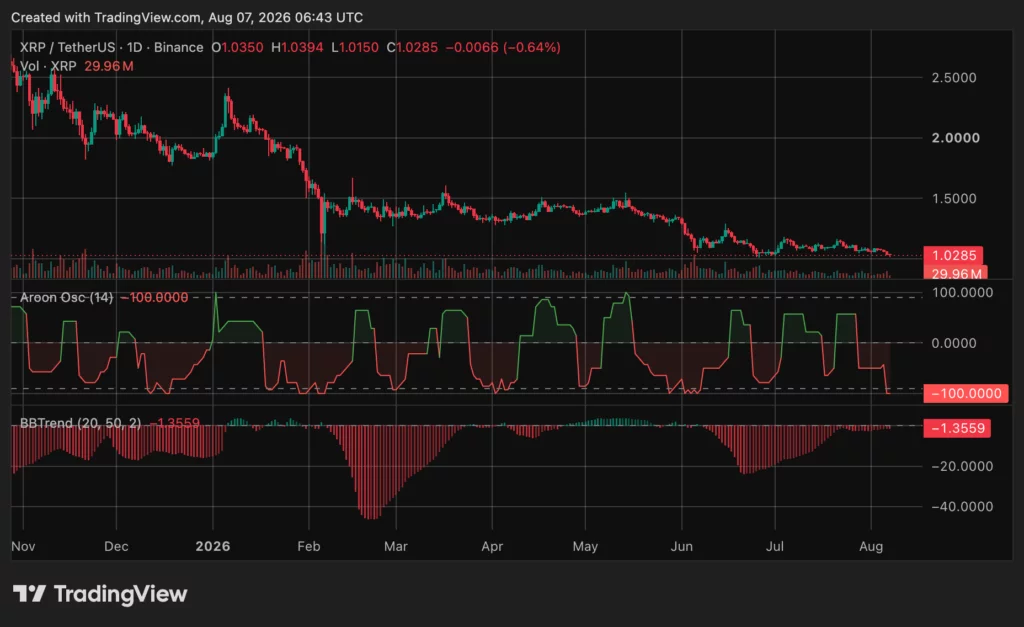
XRP traded near $1.03 on Aug. 7 as selling pressure kept the token among the weaker large-cap cryptocurrencies ahead of fresh U.S. labor data.
Summary
- XRP traded near $1.03, down about 2.2% as selling pressure persisted across major exchanges today.
- Binance XRP open interest rose roughly 8% while perpetual CVD moved deeper into negative territory.
- Spot CVD fell more than 52%, showing a sharp decline in aggressive centralized exchange buying.
- Whales accounted for 81% of Binance XRP outflows, versus 72% across centralized exchanges overall globally.
- Senators return September 14, while July employment data arrives August 7 before inflation data Wednesday.
According to crypto.news market data, XRP dropped about 2.2% over 24 hours, compared with smaller moves in Bitcoin and Ether, while its market capitalization remained near $64.2 billion.
crypto.news showed XRP down 5.7% over seven days and 6.7% over 30 days. Trading volume was approximately $1.44 billion, with circulating supply near 62.53 billion tokens.
The decline came as the U.S. Senate pushed consideration of the CLARITY Act beyond its August recess. Senate Majority Leader John Thune said the bill would be queued when lawmakers return in September. The delay removes an expected near-term regulatory catalyst, although XRP’s price move cannot be attributed to legislation alone.
XRP price tests $1 support as momentum stays weak
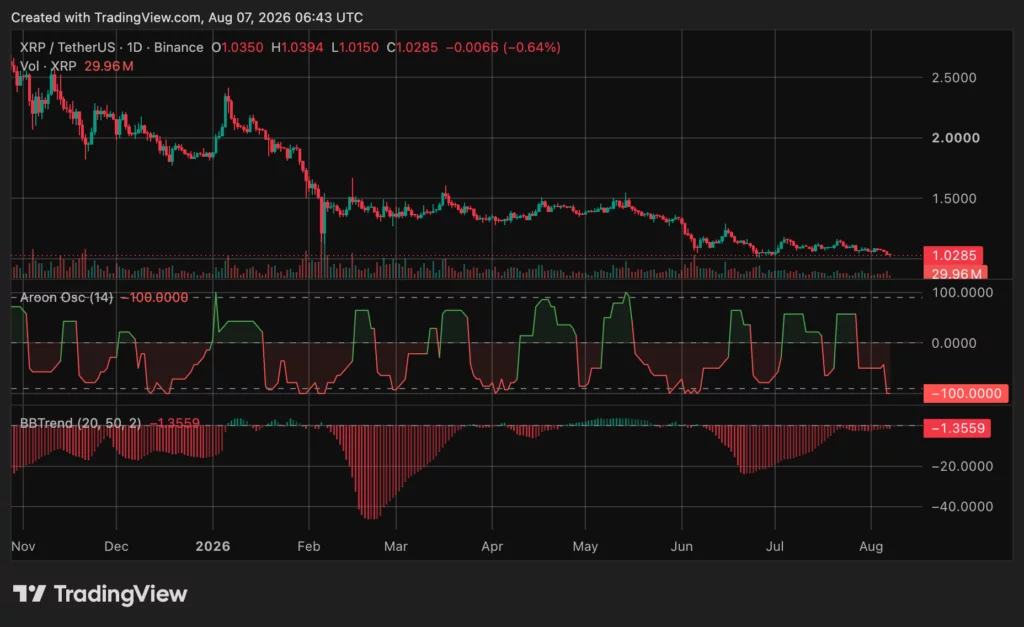
XRP traded between roughly $1.01 and $1.06 over the previous 24 hours, leaving the psychological $1 level as immediate support. The daily chart remains broadly bearish after a prolonged decline from above $2.50, while a recovery above $1.10 to $1.15 would be needed to improve the short-term structure.
The Aroon Oscillator at -100 shows recent lows dominating recent highs. BBTrend was also negative near -1.36, reinforcing the bearish bias, although its smaller negative bars suggest downside momentum is less intense than during earlier selloffs. On the weekly chart, Stochastic RSI readings near 42.6 and 44.7 remain neutral rather than oversold.
A widely circulated projection from CryptoBull suggested XRP could reach “$27 by the end of October 2026.” That target remains highly speculative. The weekly ascending-channel projection also points toward $7 before $27, but neither level is confirmed without a sustained breakout above long-term resistance and stronger volume.
Derivatives data shows traders leaning toward shorts
CryptoQuant analyst Amr Taha reported that Binance XRP open interest rose from about $180 million on Aug. 4 to $195 million on Aug. 7, an increase of roughly 8%. Over the same period, perpetual cumulative volume delta fell from approximately negative $292 million to negative $363 million.
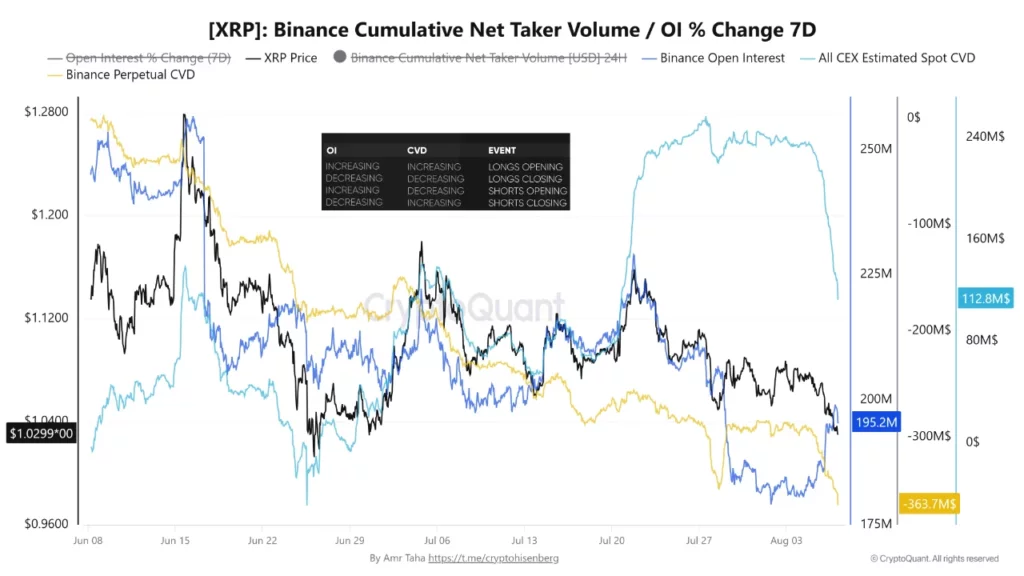
That combination is consistent with fresh leveraged sell-side positioning, although open interest alone cannot determine the direction of every new position. Spot demand also weakened. Taha said estimated spot CVD across centralized exchanges fell more than 52%, from around $235 million to $112 million, indicating a sharp loss of aggressive buying momentum.
Separate CryptoQuant data showed whales accounted for 81% of Binance XRP outflows on Aug. 3, versus 72% across centralized exchanges overall. The metric measures the share of outflow activity, not absolute withdrawal volume or whether transferred tokens were ultimately accumulated, sold or moved into custody.
CLARITY Act delay removes an August catalyst
The Senate’s decision to postpone the market-structure vote matters to XRP because the bill could provide statutory rules for determining when digital assets fall under SEC or CFTC oversight. In earlier regulatory analysis, the legislation was identified as especially relevant to XRP after years of litigation over its regulatory treatment.
The bill faces a procedural hurdle before final passage. Republicans hold 53 Senate seats, but leadership generally needs 60 votes to invoke cloture and overcome a filibuster. As previous Senate vote coverage explained, Democratic support has therefore remained central to the legislation’s path.
The official Senate calendar lists Aug. 10 through Sept. 11 as a state work period, meaning senators are scheduled to return Sept. 14. Ethics provisions, law-enforcement concerns and other market-structure disputes remain unresolved, leaving any September vote dependent on further negotiations.
U.S. jobs and inflation data add another risk
Macro conditions could influence XRP before lawmakers return. The Federal Reserve held its target range at 3.50% to 3.75% on July 29 in a 9-3 vote. Beth Hammack, Neel Kashkari and Lorie Logan dissented because they preferred a 25-basis-point increase.
The timing makes macro data relevant because XRP is trading near support while leverage rebuilds. Still, economic releases can move crypto in either direction, and no report guarantees a specific response.
The next immediate test is the July employment report, scheduled by the BLS for Aug. 7 at 8:30 a.m. ET. July CPI follows on Aug. 12. Strong employment or persistent inflation could reinforce expectations for restrictive policy, while softer readings could reduce rate pressure across risk assets.
For XRP, $1 remains the near-term technical level to watch. A break below it would weaken the current structure, while recovery through $1.10 to $1.15 would provide the first clearer sign of stabilization. Derivatives positioning, spot demand and September’s CLARITY negotiations remain additional variables rather than guaranteed directional catalysts.
Disclosure: This article does not represent investment advice. The content and materials featured on this page are for educational purposes only.

TRUMP: PASS CLARITY NOW!!!! (XRP MAJOR NEWS)

Chelsea FC vs AC Milan: Prediction, kick-off time, team news, TV, live stream, h2h results, odds today

Microsoft: Big New AI Advantage, But Beware Duration Mismatch


-

 Politics6 days ago
Zack Polanski: an incitement to murder Nigel Farage?
-

 Crypto World7 days ago
MicroStrategy Post-Earnings CLARITY Act Push Could Add New Catalyst for Its Stock
-

 Crypto World6 days ago
Crypto PAC spending tops $2M in Michigan House race
-

 Business5 days ago
DTCR: Deleveraging And A Hedge Fund Collapse Point To A Possible AI Bottom
-

 Tech6 days ago
ESET tracks rise in malicious AI skills and adaptable malware
-

 Fashion22 hours ago
Frugal Friday’s Workwear Report: Cap-Sleeve Pointelle Crewneck Sweater
-

 Sports7 days ago
France Cricket implodes: letters hidden in a drawer and a board at war
-

 Crypto World6 days ago
XRP Ledger urges node upgrade after manifest flood
-

 News Videos6 days ago
Financial Crash Expert: The 90-Day Collapse Timeline They Are Desperately Hiding.
-

 Sports2 days ago
Jordan Coyle & Cordiamo take Laya Arena Stakes at RDS
-

 Fashion16 hours ago
Weekend Open Thread: Mattifying Sunscreen
-

 Crypto World4 days ago
US Tech Stocks See Largest 5-Week Inflow in History: Can Nasdaq Break Its Downtrend?
-
 NewsBeat6 days ago
Tourist plane on sightseeing flight in Peru crashes into a field, killing all 13 people on board
-
 Business2 days ago
US stocks: Dow closes at record on Mideast optimism; SpaceX, AMD drag Nasdaq
-

 Tech6 days ago
Page Not Found | WIRED
-

 NewsBeat7 days ago
Arsenal reach full agreement with Newcastle over Bruno Guimaraes transfer | Football
-

 Politics2 days ago
Reform UK And Greens Sink To Lowest Favourability Ratings To Date
-
 NewsBeat7 days ago
Bikini-clad Jennifer Aniston, 57, kisses hypnotist boyfriend Jim Curtis as they enjoy a romantic getaway aboard a luxury yacht in Spain
-

 Business3 days ago
Nvidia Stock Climbs 2.5% as Chip Sector Rally Builds Ahead of AMD Earnings, Nvidia’s Own Report Looms
-

 Crypto World4 days ago
Polymarket targets $20 billion valuation as competition heats up in prediction market sector
You must be logged in to post a comment Login