
Crypto World
Visa Rolls Out AI Agent Shopping Infrastructure Globally



Visa’s Intelligent Commerce platform lets AI agents shop, compare, and transact on behalf of consumers, and the company says the majority of business leaders are ready for it.
Payments giant Visa is opening its Intelligent Commerce platform to businesses worldwide, expanding the infrastructure that allows artificial intelligence (AI) agents to shop, compare, and complete purchases on behalf of consumers and enterprises.
The move comes one week after Visa published its Business-to-AI (B2AI) Report, which found that 53% of U.S. business leaders surveyed would allow AI agents to negotiate prices or terms directly with other AI agents on their behalf. The report also found that 71% of businesses said they are willing to optimize products, offers, and experiences specifically for AI agents, while 77% are already using or piloting AI in their operations.
On the consumer side, nearly 40% of Americans reported making a purchase they normally would not have considered as a result of using an AI agent or tool, an early signal that autonomous systems are actively shaping demand rather than merely filtering it.
Visa’s Intelligent Commerce framework provides a suite of integrated APIs spanning tokenization, authentication, payment instructions, and transaction signals, enabling AI agents to transact securely on behalf of users.
Pilot programs have already been running across multiple regions. In Asia-Pacific and Europe, pilots launched in early 2026, while readiness work is underway in Latin America and the Caribbean. In the Middle East, Visa is working with developer Aldar to allow customers in the United Arab Emirates to use AI agents to pay recurring fees like real estate service charges.
A core component of the framework is the Trusted Agent Protocol, an open framework introduced in October 2025 that helps merchants distinguish between malicious bots and legitimate AI agents acting on behalf of consumers.
Heated Race
Visa’s global push arrives amid intensifying competition over who will control the payment rails for AI agent commerce. Two crypto-native protocols are racing to become foundational infrastructure for AI payments: Coinbase’s x402 standard, which recently moved under Linux Foundation governance with backing from Google, Stripe, and Visa itself, and the Machine Payments Protocol (MPP), launched by Stripe’s Tempo blockchain.
On the crypto front, Visa has been hedging its bets. Visa Crypto Labs launched the CLI tool in March, a command-line payment interface that lets AI agents make payments without API keys or pre-funded accounts — directly targeting the same autonomous agent use cases that crypto protocols are pursuing. The company also expanded its stablecoin collaboration with Bridge in March, with plans to bring stablecoin-linked cards to over 100 countries.
The competing approaches highlight a growing fault line in the industry. Traditional payments players like Visa and Mastercard are building trust layers on top of existing card rails, while crypto proponents argue that blockchain infrastructure is better suited for a world in which AI agents are first-class economic actors.
Visa’s CMO Frank Cooper III framed the company’s vision in terms of its B2AI framework, describing a shift where commerce moves from market-to-human to market-to-machine, with AI agents evaluating, negotiating, and transacting on behalf of people.
This article was written with the assistance of AI workflows. All our stories are curated, edited and fact-checked by a human.

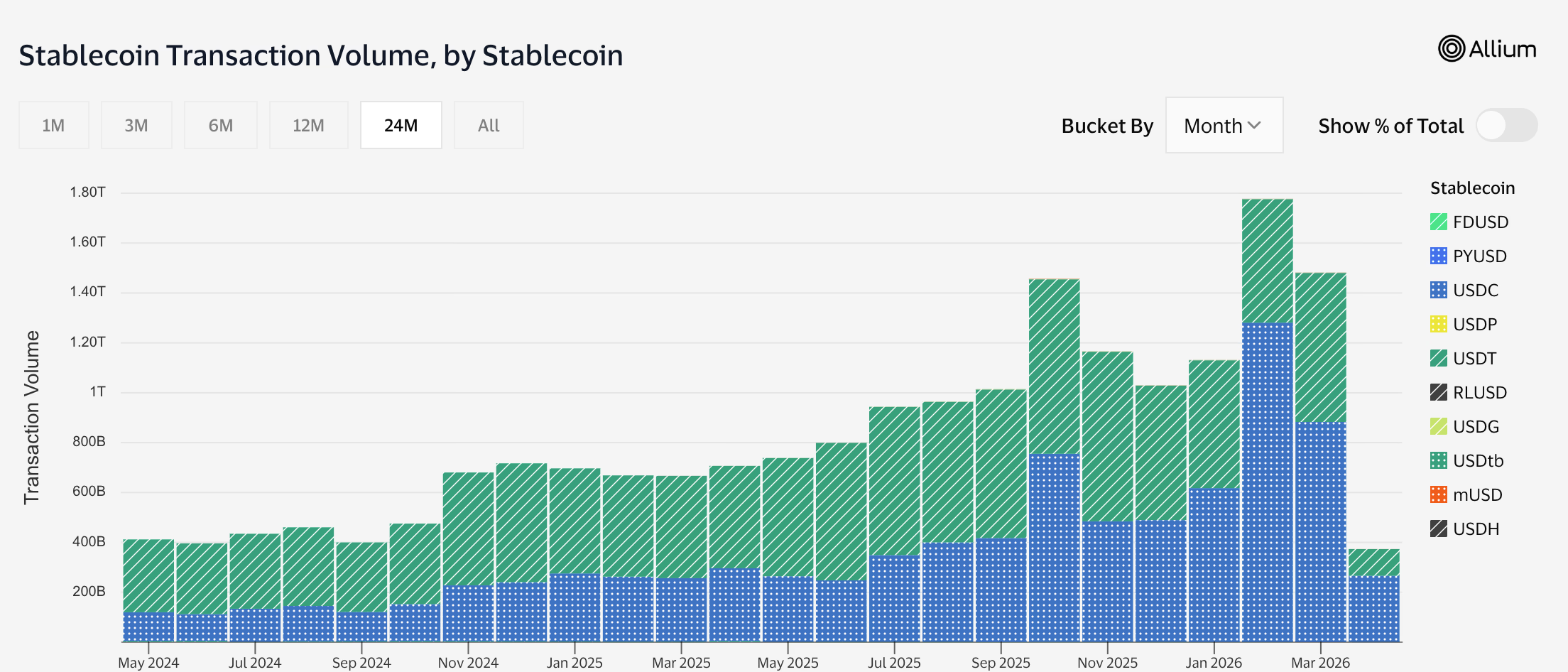
Circle Payments Network (CPN) Managed Payments let financial institutions operate in fiat, while using crypto rails behind the scenes via Circle.
Circle today launched Circle Payments Network (CPN) Managed Payments, a stablecoin settlement solution designed to simplify stablecoin transactions for traditional financial institutions, according to a press release from the firm.
The new managed solution is aimed at mainstream TradFi firms, including payment service providers, fintechs, banks, and global enterprises, per the release. The product’s core pitch is simplicity: participating firms interact solely in fiat, while Circle handles the the crypto rails in the background, namely USDC minting and burning, payment orchestration, compliance, and blockchain infrastructure.
Use cases include cross-border settlement, merchant stablecoin acceptance, high-volume payouts, and FX cost reduction, according to the releae. At launch, partners include Thunes and Worldline, alongside payments company Veem.
In recent months, UDSC has overtaken Tether’s USDT, the largest stablecoin by market cap, in terms of monthly transaction volume, per data from Visa and Allium.

The launch comes as stablecoins cement their role as mainstream financial infrastructure. Total stablecoin supply surged 50% in 2025 as enterprise adoption accelerated, with the GENIUS Act creating the first federal U.S. regulatory framework for the sector.
Major institutions have moved quickly: Visa launched USDC settlement on Solana in December, and the same month, Intuit struck a multi-year deal with Circle to embed stablecoin capabilities across TurboTax, QuickBooks, and Credit Karma.
Meanwhile, last month, Mastercard acquired stablecoin infrastructure firm BVNK with aims to bridge on-chain and fiat rails within the network.
This article was written with the assistance of AI workflows. All our stories are curated, edited and fact-checked by a human.
Institutional money is rotating back in, and XRP is leading the rallies. XRP recorded $119.6 million in weekly fund inflows for the period ending last week, its strongest weekly haul since mid-December 2025, which occurred when XRP price prediction was running at rock bottom.
That single figure puts XRP ahead of every other digital asset for the week, including Bitcoin. The broader crypto market pulled in $224 million total, reversing a stretch of notable outflows and signaling a clear sentiment shift among institutional allocators.
Regulatory clarity and XRP’s entrenched position in cross-border payment infrastructure appear to be the twin catalysts. With macro conditions still turbulent, the price setup deserves a closer look.
Discover: The best crypto to diversify your portfolio with
XRP Price Prediction: $2.00 Before Year-End?
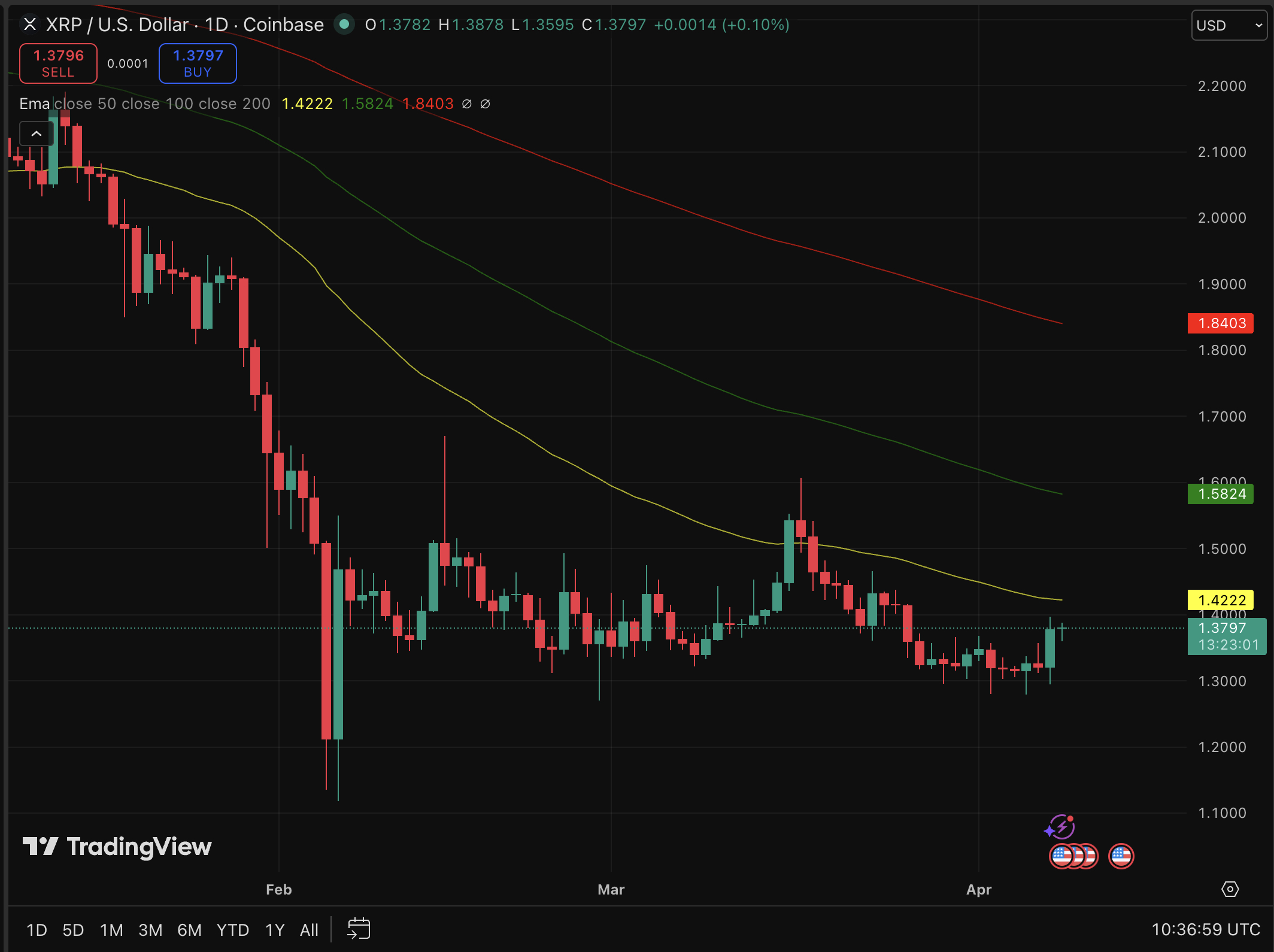
XRP’s 4.6–5.0% daily gain lands it at the $1.37–$1.38 range, but the technical picture remains cautious. The asset is holding above its short-term 10-day and 20-day exponential moving averages, a tentative green flag.
The problem? It still trades below the 50-, 100-, and 200-day EMAs, keeping the broader trend firmly in bearish territory. The 14-day RSI sits at 39.43, neutral but leaning toward oversold, which historically creates room for further upside before momentum stalls.
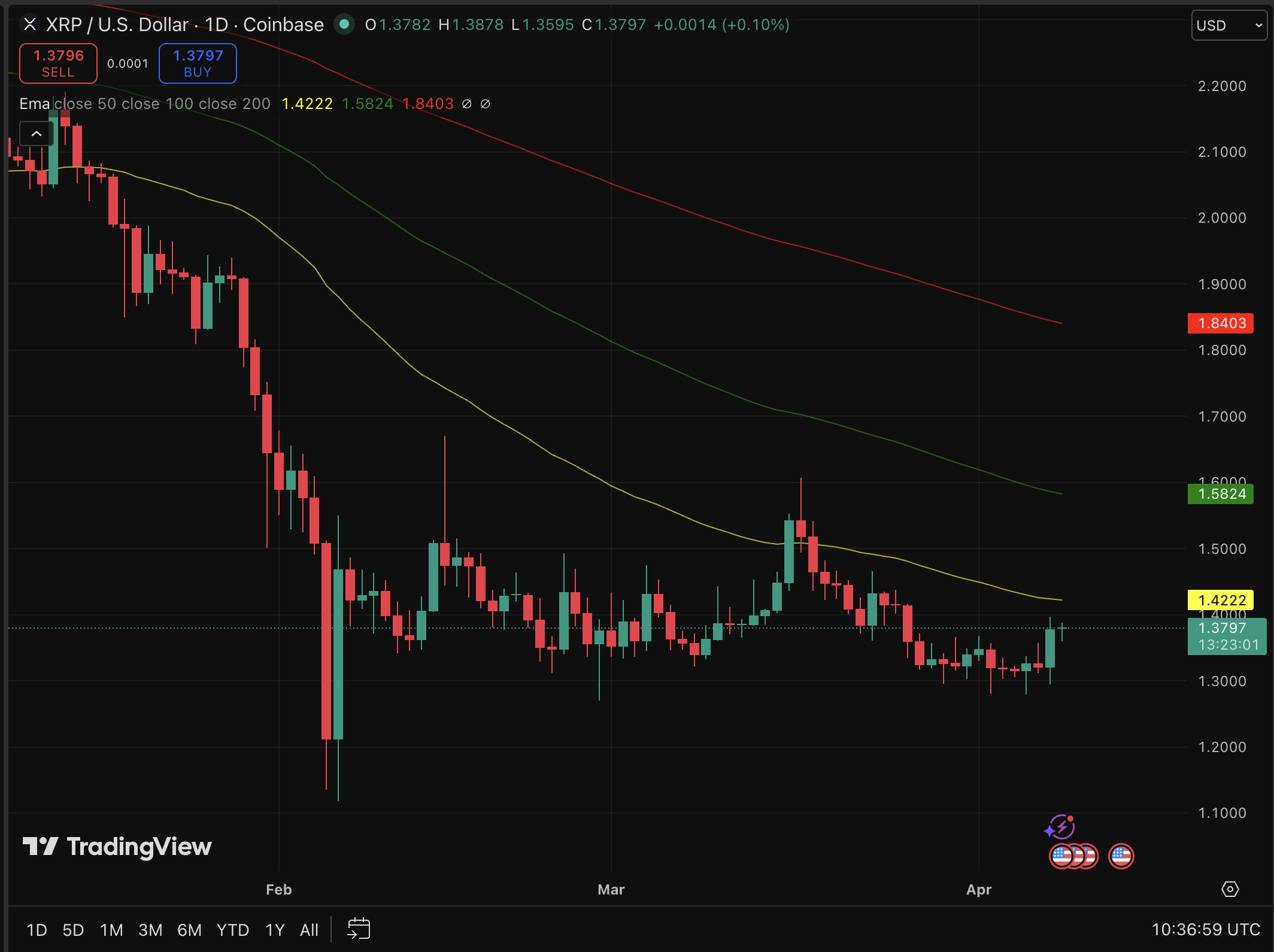
Support levels are stacked at $1.31, $1.29, and $1.27, with resistance clustered at $1.4, the exact range XRP is currently testing. A clean breakout above $1.38 with volume would open the door toward $1.50 and potentially $1.70 on a momentum extension.
The inflow data is bullish. The chart structure is still mending. Those two realities coexist, and neither cancels the other out.
Discover: The best pre-launch token sales
Bitcoin Hyper Targets Early Mover Upside as XRP Tests Key Resistance
XRP’s 50% projected upside is compelling, but at a $84B+ market cap, the runway to 10x returns requires a very specific set of conditions to align perfectly. Traders hunting asymmetric early-stage exposure are looking elsewhere without abandoning the Bitcoin ecosystem entirely.
Bitcoin Hyper ($HYPER) is positioned as the first Bitcoin Layer 2 with Solana Virtual Machine (SVM) integration, a combination that delivers sub-second transaction finality while inheriting Bitcoin’s security layer. The project targets Bitcoin’s three structural weaknesses directly: slow transactions, high fees, and the near-total absence of programmability.
The presale has raised $32 million at a current token price of $0.0136, with staking rewards already live for early participants. The Decentralized Canonical Bridge enables direct BTC transfers into the ecosystem, removing friction that has historically limited Bitcoin DeFi adoption.
The post XRP Price Prediction: Ripple Leads Crypto Inflows as Market Recovers appeared first on Cryptonews.


South Korea’s ruling Democratic Party proposed a “Digital Asset Basic Act” Wednesday that would establish a legal framework for digital assets, including issuance, trading, custody and supervision.
“Digital assets are emerging as a core medium connecting the real economy and financial markets,” the proposal states. It defines value-linked digital assets, including those tied to fiat currencies or real-world assets, as a category requiring issuer authorization, refund reserves and redemption obligations.
The new proposal comes amid stalled Digital Asset Basic Act negotiations since early this year when regulators clashed over who should be allowed to issue won-pegged stablecoins. The Bank of Korea insisted banks with 51% ownership should be the only ones authorized to issue stablecoins, while the Financial Services Commission warned this could hinder innovation.
The bill also said it aims to “establish a foundation for Korea to lead the global digital financial order.” Under the proposal, entities seeking to issue such assets must obtain approval and meet requirements including capital thresholds, operational capacity and reserve plans.
The legislation would introduce licensing, registration and reporting requirements for digital asset businesses, including trading, brokerage, custody and advisory services.
It would also establish rules on disclosures, internal controls and market conduct, including prohibitions on unfair trading practices such as market manipulation and use of non-public information.
The proposal calls for the creation of a digital asset committee to review and coordinate policy, as well as national basic and implementation plans for the sector.
It also noted that South Korea’s current system remains focused on investor protection and lacks a comprehensive framework covering issuance, disclosure and market structure.
The proposal follows the announcement of new rules Wednesday by the country’s Financial Services Commission and Financial Supervisory Service ordering all domestic cryptocurrency exchanges to adopt a single, strict system for delaying withdrawals. The aim is to block a surge in voice phishing scams that rely on speed.


Yuga Labs has settled its lawsuit against artist Ryder Ripps and Jeremy Cahen over their alleged copycatting of its non-fungible tokens (NFTs) from the Bored Ape Yacht Club collection.
The agreement ends a two-year dispute over whether the pair’s project, which reused Bored Ape imagery, crossed the line from satire into trademark infringement.
Proposed court orders would permanently bar Ripps and Cahen from using Yuga’s trademarks and imagery, according to a filing in California federal court. The terms of the settlement were not disclosed.
Yuga’s Bored Ape collection became one of the most recognizable NFT brands during the market’s peak. The firm sued in 2022, claiming Ripps and Cahen sold lookalike tokens in their RR/BAYC NFT collection and earned millions by confusing buyers. The defendants argued their work was a satirical response to the actual Bored Ape Yacht Club collection.
A district judge initially sided with Yuga and awarded nearly $9 million in damages and fees. But an appeals court later overturned that ruling, saying a jury should decide whether buyers were actually misled. The settlement avoids that trial.


Summary
- Ethereum Foundation will convert 5,000 ETH into stablecoins via CoWSwap’s TWAP feature to fund research, grants, and donations.
- The move follows earlier EF treasury conversions using DeFi rails as part of a broader diversification policy.
- Market watchers scrutinize EF sales as potential sentiment signals, even when the amounts are small relative to ETH’s total supply.
The Ethereum Foundation (EF) has announced it will convert 5,000 ETH into stablecoins using decentralized trading protocol CoWSwap’s time-weighted average price (TWAP) function, describing the move as routine funding for “R&D, grants and donations.” “Today, The Ethereum Foundation will convert 5000 ETH to stablecoins via @CoWSwap’s TWAP feature as a part of our ongoing work to fund R&D, grants and donations,” the foundation wrote on X, reiterating its commitment to using DeFi-native tools for treasury operations. At current prices, the sale is worth tens of millions of dollars but remains negligible versus Ethereum’s circulating supply and daily trading volume.
EF’s latest conversion echoes a similar move in October 2025, when it sold 1,000 ETH via CoWSwap TWAP “to fund R&D, grants and donations, and to highlight the power of DeFi,” a transaction then valued at roughly $4.5 million. The foundation has also previously outlined a plan to convert up to 10,000 ETH on centralized exchanges, positioning these sales as part of a diversification strategy that seeks “a middle ground between earning yields above standard benchmarks and serving as a responsible steward of Ethereum.” BeInCrypto noted that the new 5,000 ETH TWAP sale is “in line with its June 2025 treasury policy focused on DeFi and privacy,” framing it as policy execution rather than a directional bet on ETH.
While modest in size, EF treasury moves are closely watched as soft sentiment gauges around whether the organization views current levels as top-of-cycle or simply takes profit to extend runway. In a previous crypto.news story, Ripple’s Brad Garlinghouse argued that stablecoins and DeFi rails are becoming a primary “business entry point” for crypto, underscoring why Ethereum-native funding operations resonate far beyond the foundation’s own balance sheet. Another crypto.news story highlighted how 90% of financial institutions already use stablecoins in some form, and a third story on cross-border payments detailed how incumbents such as SWIFT are testing tokenized settlement, putting Ethereum-based infrastructure at the center of the next phase of global payments.

Anthropic has moved Claude Mythos Preview into a limited testing phase with a select group of enterprise partners after the model surfaced thousands of critical vulnerabilities across operating systems, web browsers and other software. The disclosure highlights both the immense potential of AI-powered security tools and the new, accompanying risks as capabilities proliferate in the wild.
The company described Mythos Preview as a general-purpose model that, during its internal evaluation, identified high-severity weaknesses across major platforms. Anthropic cautioned that such capabilities could spread rapidly if not managed responsibly, noting that adversaries may deploy these tools before safeguards are in place.
“Given the rate of AI progress, it will not be long before such capabilities proliferate, potentially beyond actors who are committed to deploying them safely.”
Security researchers have long warned that AI can accelerate cyberattacks by automating discovery and exploitation. In a broader landscape where AI-driven threats are increasingly common, Anthropic pointed to alarming trends. AllAboutAI reports a 72% year-over-year increase in AI-powered cyberattacks, and that 87% of global organizations experienced AI-enabled attacks in 2025. Against that backdrop, Anthropic emphasized the need for defensive AI tools to outrun the bad actors.
To shore up defenses, Anthropic announced Project Glasswing on the same day. The initiative unites more than 40 companies, including Amazon Web Services, Apple, Cisco, Google, JPMorgan, the Linux Foundation, Microsoft and Nvidia, with the goal of using Claude Mythos Preview’s capabilities to find bugs, share data with partners and patch critical vulnerabilities before criminals exploit them.
Key takeaways
- Claude Mythos Preview has identified thousands of critical vulnerabilities across operating systems, browsers and cryptography libraries, underscoring a broad surface area for potential exploitation.
- The majority of these flaws remain unpatched, with Anthropic noting that about 99% of the vulnerabilities it found have not yet been fixed.
- Project Glasswing mobilizes a cross‑industry coalition to operationalize AI-driven defense, aiming to accelerate bug discovery, disclosure and remediation across the software stack.
- The vulnerabilities span decades, hinting at long-standing fragility in widely used software and the persistent risk to critical infrastructure and crypto ecosystems.
AI-driven vulnerability discovery and decades‑old weaknesses
Anthropic’s early findings reveal a troubling reality: flaws that have lingered for years or even decades can still pose meaningful threats today. Among the examples cited were now-patched but historically significant bugs in OpenBSD—a 27-year-old vulnerability that resurfaced in testing—alongside a 16-year-old flaw in the FFmpeg library, and a 17-year-old remote code execution vulnerability in the FreeBSD operating system. The disclosures extended to multiple vulnerabilities within the Linux kernel, illustrating that even well-maintained open-source projects are not immune to latent risks.
Beyond operating systems, Mythos Preview flagged weaknesses in the cryptography landscape—areas that are foundational to secure communications and transactions. The model reportedly identified flaws in widely used libraries and protocols, including TLS, AES-GCM and SSH. Web applications emerged as a particularly fertile ground for vulnerability discovery, with a spectrum of issues ranging from cross-site scripting to SQL injection and cross-site request forgery, the latter often leveraged in phishing-style campaigns.
Anthropic stressed that many of these issues are subtle, context-specific or deeply embedded in complex code paths, making them hard to surface through traditional auditing alone. The implication for developers and operators is clear: even mature software stacks can hide critical flaws that AI could help uncover much faster than conventional methods.
The company also highlighted a stark statistic accompanying the findings: the majority of these vulnerabilities had not yet been patched, creating a window of exposure that could be exploited by opportunistic attackers if not addressed promptly.
Glasswing: a coalition for proactive defense
Project Glasswing is pitched as a proactive defense program rather than a retrospective analysis initiative. By pooling resources and expertise from participants across cloud providers, hardware developers, financial institutions and open-source ecosystems, Glasswing seeks to turn AI-driven vulnerability discovery into a learning loop that accelerates patch creation and deployment. The collaboration aims to share insights about emerging threats, coordinate disclosure with vendors and suppliers, and push for rapid remediation before exploitation becomes widespread.
Key participants span industry giants and pivotal security ecosystems: Amazon Web Services, Apple, Cisco, Google, JPMorgan, the Linux Foundation, Microsoft and Nvidia, among others. The initiative reflects a growing trend in which large technologist coalitions coordinate to harden software supply chains and reduce the window between vulnerability discovery and patching—an objective that is especially relevant to blockchain and crypto infrastructure, where security incidents can trigger cascading failures across networks and ecosystems.
What this shift means for crypto and cybersecurity ecosystems
For investors and builders in the crypto space, the Mythos Preview findings and Glasswing’s collaborative model lend a more nuanced view of risk and resilience. On the one hand, AI-assisted vulnerability discovery could markedly improve the security posture of crypto platforms, wallets, node software and smart-contract ecosystems by uncovering weaknesses that would have taken humans far longer to detect. On the other hand, early access to such powerful tools poses governance and safety questions: who controls the disclosure of findings, how quickly patches are issued, and how risk is priced for users in real-time markets?
From a market perspective, the activity around AI-enabled security tools could influence demand for security primitives, auditing suites and formal verification services within crypto infrastructure. It also underscores the importance of strong supply-chain security, given that a single zero-day in a widely used library or OS could ripple across decentralized networks, exchanges and custodial services.
Analysts note that the transition period for defense‑driven AI is likely to be fraught. In the long run, advocates expect defense capabilities to dominate, yielding a more secure software ecosystem, but the interim phase will be characterized by widespread misconfigurations, patch delays and evolving threat tactics as attackers adapt to new defensive technologies. Anthropic’s framing suggests that the shift toward AI-assisted defense will not be instantaneous; it will require sustained collaboration, standardized disclosures and rapid patch cycles to reduce the window of exploitation.
Beyond the immediate technical implications, industry observers are watching how policy and governance frameworks adapt to these capabilities. The balance between sharing threat intelligence and protecting sensitive vulnerability data will shape how quickly organizations can benefit from AI-driven defense, including in crypto-focused environments where liability, transparency and user trust are paramount.
As coverage in security circles notes, similar narratives have emerged around AI-enabled code security and the broader debate over how to regulate and deploy AI safely. The media and market response to these discussions has included volatility in cybersecurity equities, underscoring that investors are weighing the reliability of AI-driven defense against the risk of enabling more capable attackers.
In the near term, readers should watch how Glasswing translates the model’s findings into tangible patches and how quickly participating firms can operationalize the shared intelligence. The outcome will likely influence security budgets, developer workflows and incident-response readiness across both traditional tech and crypto-native ecosystems.
What remains uncertain is how quickly the industry can close the patch gap for the vast array of uncovered vulnerabilities and whether AI-assisted defenses can stay ahead of increasingly sophisticated exploitation techniques. The coming months will be telling for developers, operators and policymakers about the feasibility and effectiveness of large-scale, AI-enabled defense programs in reducing systemic risk.
For now, Anthropic’s disclosures reinforce a critical takeaway: as AI capabilities grow, so does the imperative to pair powerful discovery tools with disciplined, collaborative defense—especially in sectors where security is inseparable from trust and continuity.


Stablecoins processed $33t in 2025, topping Visa and Mastercard, and could clear over $50t by 2026 as corporates, banks and AI agents turn on‑chain dollars into core payment rails.
Summary
- Morph’s “State of Stablecoins” report says stablecoins settled $33 trillion on‑chain in 2025, versus Visa and Mastercard’s combined $25.5 trillion, with several months above $1.5 trillion in volume.
- Around 60% of flows are now B2B as corporates use dollar tokens for cross‑border treasury, supplier payments and procurement, while 90% of financial institutions are already using or piloting stablecoins.
- Morph projects stablecoin settlement could exceed $50 trillion by 2026 and reach roughly 10% of global cross‑border payments by 2030, helped by MiCA, new US rules and AI agents automating a potential $1.9t market.
Stablecoins processed $33 trillion of on-chain transaction volume in 2025, surpassing the combined $25.5 trillion handled by Visa and Mastercard and signaling that tokenized dollars have quietly outgrown legacy card rails, according to a new “State of Stablecoins” report from Ethereum layer-2 network Morph. Morph’s analysts argue the asset class has moved beyond its speculative origins to become a core settlement layer for global finance, with volumes now comparable to the world’s largest payment networks despite a total market capitalization in the low hundreds of billions.
Crucially, roughly 60% of stablecoin flows are now business-to-business, as corporates lean on dollar tokens for cross-border treasury management, supplier payments, and procurement. “Enterprise adoption is no longer a thesis; it is visible in the data,” the Morph team wrote, highlighting rising average transaction sizes and the growing role of stablecoins in institutional liquidity and settlement workflows. The report notes that in several recent months, stablecoin volumes exceeded $1.5 trillion, rivaling or surpassing the monthly throughput of major card schemes.
Looking ahead, Morph projects annual stablecoin settlement volumes could exceed $50 trillion as early as 2026, cementing their role as a parallel payment stack alongside banks, card networks, and systems like SWIFT. By 2030, the report forecasts stablecoins could account for around 10% of global cross-border payments, helped by lower fees, instant settlement, and regulatory clarity in key markets under frameworks such as the EU’s MiCA and new US stablecoin laws.
Morph also bets that AI agents will become primary initiators of stablecoin transactions, automating everything from just-in-time inventory payments to machine-to-machine settlement. Under that scenario, the team estimates stablecoins could support a $1.9 trillion market by 2030, with autonomous systems triggering high-frequency, low-latency payments across global supply chains. In a previous crypto.news story, Ripple CEO Brad Garlinghouse said stablecoins processed more than $33 trillion in volume last year and could become crypto’s “ChatGPT moment” for businesses, underscoring how quickly on-chain dollars are converging with mainstream finance.
That same story pointed to forecasts from Bloomberg Intelligence that stablecoin flows could reach $56.6 trillion by 2030, while another crypto.news story on institutional adoption reported that 90% of surveyed financial institutions now use stablecoins in some form, from settlement to collateral management. A separate story on cross-border payments detailed how incumbents such as SWIFT are testing blockchain and digital-asset rails, suggesting that by the time stablecoins hit a 10% share of global cross-border volume, the line between “crypto” and conventional payments may be largely irrelevant to end users.
Crypto World
Zcash Price Prediction: Iran Ceasefire Triggers a 21% ZEC Surge in 24 Hours: Is the Privacy Coin Sector About to Explode?

Zcash surged past $320 on April 8, posting a 21% gain in 24 hours and landing at the top of the day’s gainers board fueling bullish price prediction.
The catalyst is the Iran ceasefire-a two-week pause in U.S.-Iran tensions that flipped global risk sentiment hard and fast, dragging high-beta crypto assets with it.
This is a textbook risk-on trade, and ZEC is leading it. The uncomfortable truth is that most traders faded the privacy coin sector for months-and the ceasefire just forced a painful unwind.

Iran Ceasefire Ignites the Risk-On Rotation: ZEC Volume Hits a One-Month Peak
The ceasefire news broke when the Trump administration’s Iran deadline expired without escalation-and markets immediately repriced. Bitcoin recovered to the $72,000 range, pulling altcoins with it. ZEC didn’t just follow; it accelerated.
Trading volume on Zcash expanded to a one-month peak of nearly $800M in a single day. Open interest on derivative markets jumped 26%, with most of that activity concentrated on Binance.
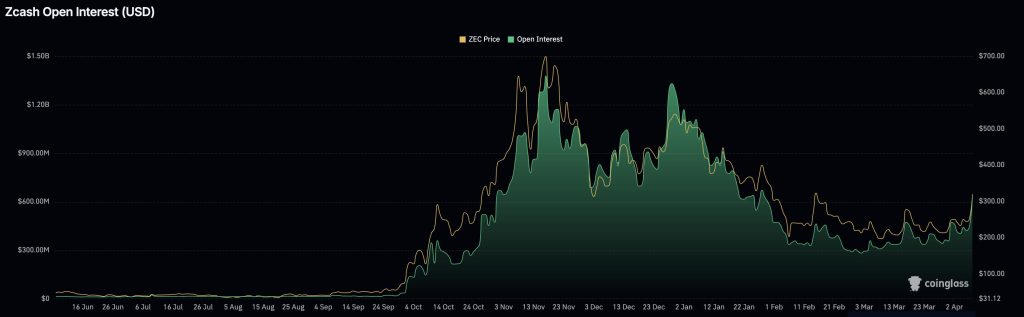
ZEC’s mindshare on social platforms hit 0.5%, up 25% in 24 hours-elevated relative to most altcoin peers. The broader crypto market analysis confirms the pattern:
BTC’s 4% recovery provided the macro lift, but the privacy coin sector ran harder and faster. Monero (XMR) added another 3% to trade above $337, and smaller privacy coins followed in sympathy. The sector rotation into privacy coins is real. Whether it holds is a different question.
The shielded supply on the Zcash network quietly hit a record 5.17M ZEC, with no signs of unshielding or whale distribution. That’s a structural floor the bears haven’t been able to break through, regardless of the narrative headwinds.
Zcash Price Prediction: Can ZEC Break $330 Resistance or Does the Short Squeeze Run Out of Fuel?
Current price action puts ZEC in contested territory. The $330 level is the immediate battleground-that’s where residual short positions are clustered, and where the rally risks stalling. The last 24 hours already produced $2.85M in short liquidations, which partly explains the velocity of the move.
Open interest stands at $386M-meaningful, but still below the frothy levels seen at the end of 2025’s record-breaking run. That’s actually constructive. It means this rally isn’t starting from an overleveraged base.
ZEC is basically sitting on one level that decides everything, and that is $330, because if price clears it with real volume, it likely triggers another wave of short liquidations and opens the door toward the $400 zone, especially with the upcoming shielded upgrade adding a real fundamental push behind the move.
Right now though it looks more like momentum cooling off, with price stuck between $290 and $330 as the squeeze fades and traders start taking profits, especially with macro uncertainty still hanging around, so instead of a breakout you get more sideways drift.
The risk is that this whole rally was just a squeeze with no real accumulation underneath, because if Bitcoin loses its strength and the broader market turns, ZEC can drop fast back toward the low $200s where the previous base sits.
LiquidChain Targets Early Mover Upside as ZCASH Tests Key Levels
LiquidChain is a Layer 3 infrastructure project positioning itself as the cross-chain liquidity layer — fusing Bitcoin, Ethereum, and Solana liquidity into a single execution environment.
The architecture centers on four pillars: a Unified Liquidity Layer, Single-Step Execution, Verifiable Settlement, and a Deploy-Once system that lets developers access all three ecosystems without rebuilding for each chain.
The presale is currently priced at $0.01447, with $646,857.56 raised to date. Presale-stage assets carry meaningful risk — liquidity is thin and execution is unproven. That caveat stands. But for traders mapping the next cycle’s infrastructure layer, LiquidChain merits research
The post Zcash Price Prediction: Iran Ceasefire Triggers a 21% ZEC Surge in 24 Hours: Is the Privacy Coin Sector About to Explode? appeared first on Cryptonews.

Ethereum’s on-chain stablecoin activity surged to a record level, with the combined value of stablecoins on the network reaching $180 billion, according to blockchain analytics firm Token Terminal. The figure positions Ethereum as the dominant home for stablecoins, representing roughly 60% of the global stablecoin supply and marking a 150% increase over the past three years. The data underscores how on-chain liquidity has become a central driver of the broader crypto rally, anchored by growing interest in tokenized assets and institutional participation.
Token Terminal’s assessment also points to a longer horizon: about $1.7 trillion of on-chain activity is projected to move across networks over the next four years, with Ethereum potentially capturing as much as $850 billion in “new flows” by 2030 if growth accelerates to approximately 470%. The implications for market structure are tangible, as more liquidity on Ethereum could translate into deeper markets for tokenized real-world assets and stablecoins alike. In a related projection, Standard Chartered estimated that more than $1 trillion could leave traditional banks and flow into stablecoins by 2028, signaling a potential regulatory- and liquidity-driven reshaping of the fiat-to-crypto corridor.
Beyond the numbers, Ethereum’s position as the preferred chain for stablecoins and RWAs is being reinforced by a wave of institutional activity. The network has already attracted high-profile players such as BlackRock, JPMorgan, and Amundi, all launching tokenized funds or related products on Ethereum as stablecoin supply across all networks reached a record $315 billion in the first quarter. That ecosystem-building activity coincides with the market’s broader shift toward on-chain liquidity as a trigger for price discovery and risk transfer in crypto markets.
Momentum on-chain: a broader market signal
A complementary view from RWA.xyz, which tracks on-chain real-world-asset activity, puts Ethereum’s on-chain stablecoin value at a slightly lower but still dominant $168 billion. The firm estimates Ethereum accounts for about 56% of the stablecoin market, a share that rises to over 65% when including Ethereum Virtual Machine-compatible networks and layer-2 ecosystems such as Arbitrum, ZKSync Era, and Base. The leadership position highlights Ethereum’s growing role as a liquidity hub for tokenized assets, not merely a means of payment or settlement.
“This momentum supports a sustained long-term bull cycle driven by tokenized assets and institutional adoption,” said Nick Ruck, director at LVRG Research, speaking with Cointelegraph this week. He cautioned that while the trend is bullish, competition from rival chains, evolving regulatory frameworks, and macro volatility remain meaningful constraints to upside. The ecosystem’s resilience will depend on how quickly developers can advance scalable, interoperable tokenization use cases and how policymakers balance innovation with consumer protections.
Institutions moving tokens on Ethereum: what’s driving the shift
In a signaling move for traditional finance, JPMorgan Chase’s leadership acknowledged the emergence of a “new set of competitors” built on blockchain, stablecoins, smart contracts, and other forms of tokenization in their annual shareholder letter. The bank has also pushed concrete progress, having launched its first tokenized money market fund (MONY) on Ethereum in December. The move marks a milestone for institutional-grade tokenized products and aligns with a broader trend of asset managers and banks embracing on-chain infrastructure to improve capital efficiency and access for clients.
Industry observers see parallel currents at play. The accumulation of stablecoin liquidity on Ethereum is viewed as a natural fit for tokenized fund structures, collateral arrangements, and cross-border settlement networks that aim to reduce settlement latency and reliance on traditional rails. Amundi’s foray into a tokenized euro money market fund on Ethereum, together with BlackRock’s and JPMorgan’s tokenized offerings, signals a growing appetite among major asset managers to experiment with on-chain markets. The net effect, according to market participants, is a more diversified and resilient on-chain liquidity toolkit for investors and institutions alike.
What this development means for investors and the market
For traders and builders, the sustained growth in on-chain stablecoins and tokenized assets on Ethereum suggests several practical implications. First, higher on-chain liquidity can improve price discovery, reduce slippage on large trades, and support more robust yield opportunities in tokenized products. Second, the expanding footprint of tokenized RWAs signals a potential bridge between traditional financial assets and decentralized markets, potentially widening access to new capital pools and diversification strategies. Third, the increasing involvement of incumbents such as JPMorgan and Amundi could bolster institutional credibility and resilience in on-chain markets, while inviting greater regulatory scrutiny and standardization efforts.
However, the trajectory is not without uncertainties. Cross-network competition—especially from non-EVM chains with distinct technical advantages—remains a factor to monitor. Regulatory developments, including potential guidance on stablecoins and tokenized financial instruments, could alter the speed and direction of capital flows. Macro conditions and risk appetite will continue to shape how quickly institutions embrace tokenization at scale. In sum, the current momentum appears to be building a more mature on-chain ecosystem, but the path forward will hinge on clarity, interoperability, and the ability to deliver scalable, user-friendly experiences for mainstream participants.
What to watch next
Observers will be watching several developing threads: the durability of Ethereum’s dominance as on-chain liquidity grows across layer-2s, the pace of institutional product launches on Ethereum, and how regulators respond to a maturing ecosystem of stablecoins and tokenized assets. If Token Terminal’s and RWA.xyz’s data points hold, Ethereum’s share of on-chain stablecoins could remain a leading indicator of overall market health, even as competition from other networks and macro headwinds test the sector’s resilience.
As capital continues to migrate onto the chain, investors should stay alert to policy developments, evolving cross-chain interoperability solutions, and the practical adoption of tokenized funds and RWAs. The next several quarters will likely reveal whether the current surge in on-chain liquidity translates into sustained demand, enhanced market efficiency, and clearer pathways for mainstream participation in crypto markets.

A Financial Times report this week outlined a provocative idea from Iran’s trade sector: charge ships transiting the Strait of Hormuz a tariff paid in Bitcoin. The plan would let empty oil tankers pass without charges, but other vessels would owe a levy of $1 per barrel, settled in BTC, over a two-week window and after an on-waterway assessment to verify the cargo isn’t weapons-related, according to Hamid Hosseini, spokesperson for Iran’s Oil, Gas and Petrochemical Products Exporters’ Union.
The story arrives as geopolitical tensions flare and markets react. On X (Truth Social), former U.S. President Donald Trump asserted that a two-week ceasefire with Iran would include the “complete, immediate, and safe opening of the Strait of Hormuz,” a claim that Iran’s state media later echoed by reporting a 10-point plan delivered to Washington as a precondition for any deal, including the continued control of the waterway and sanctions relief. The exact terms of any accord remain fluid, but the FT report highlights how crypto-enabled mechanisms could become part of broader political and economic signaling in a high-stakes standoff.
Geopolitical friction has already disrupted regional shipping and energy flows. After intensified U.S.–Israel–led strikes against Iranian targets in February and March, the Strait of Hormuz has seen shipments constrained and tensions rise, contributing to a rally in crude oil that briefly pushed prices above $100 per barrel. In crypto markets, Bitcoin likewise moved during the period of heightened volatility, trading in a wide range as traders priced in the risk backdrop.
Beyond current events, the narrative builds on prior evidence that Iran has leaned on crypto rails to navigate sanctions and currency pressures. Elliptic reported in January that Iran’s central bank had acquired roughly half a billion dollars’ worth of Tether USDt, a signal of the rial’s volatility driving demand for dollar-pegged stablecoins. Separately, TRM Labs has tracked large-scale crypto flows linked to Iran, estimating about $3.7 billion in total crypto activity from January through July 2025, a figure cited in coverage surrounding Iran’s evolving crypto footprint. For more context, see the reporting that referenced TRM Labs, and the Elliptic analysis linked to Iran’s stablecoin acquisitions.
Key takeaways
- Iran reportedly weighs a Bitcoin-based tariff for Strait of Hormuz transit, charging $1 per barrel for non-empty cargo while allowing empty tankers to pass without charges.
- Payments would be prompted within a two-week window, with vessels assessed individually to confirm cargo legitimacy and weapon-free status, per the union spokesperson cited by the Financial Times.
- The proposal comes amid ongoing geopolitical flare-ups and energy-market volatility, set against a backdrop of broader sanctions dynamics and potential relief talks.
- Longer-term context shows Iran’s crypto activity as part of sanctions navigation: Elliptic notes substantial USDT holdings, and TRM Labs records substantial inflows and flows related to Iranian crypto use (Jan–Jul 2025).
- Readers should watch how policymakers, shipping operators, and crypto market participants respond to the FT report and any subsequent official statements or regulatory clarifications.
Hormuz toll: a crypto twist on maritime economics
The Financial Times’ account centers on a regulatory pivot that would blend transport pricing with digital asset settlements. If implemented, the BTC-based toll model would apply a simple per-barrel tariff to shipments crossing the Hormuz route, aiming to consolidate revenue amid sanctions pressures and to test the practicality of crypto-as-fee mechanics in critical chokepoints. The proposal specifies that the tariff would be collected in Bitcoin, with the logistics package requiring ships to settle payments quickly—“a few seconds”—to minimize traceability and potential sanction enforcement risk, according to Hosseini’s description of the process observed by the union.
The plan’s two-week horizon aligns with a provisional, high-visibility window rather than a long-term price signal. Even as it surfaces as a potential policy experiment, the reporting underscores how crypto rails could be positioned as geopolitical tools—whether for financing logistics, signaling political intent, or pressuring opponents through new payment frictions. The FT piece stops short of confirming that such a policy will be adopted, but it illustrates the kinds of mechanisms policymakers are weighing in an era of sanctions and blockade-era finance.
Geopolitics and markets: energy, sanctions, and crypto co-movement
Market dynamics over the past several months have shown that energy disruptions and crypto volatility can move in tandem, albeit imperfectly. The period of heightened tension around Hormuz coincided with a spike in oil prices and a broad oscillation in Bitcoin’s price, reflecting traders’ attempts to navigate the intersection of real-world risk and on-chain liquidity. The possibility of crypto-enabled tolls adds a new dimension: it could introduce a measurable crypto flow that tracks shipping activity in a region that shapes global oil pricing and geopolitical risk appetites.
The Trump assertion about a potential ceasefire and Hormuz opening, though unconfirmed and contested in official channels, amplifies the sense that the Iran-US standoff remains a live, strategic story with tangible financial undercurrents. If a BTC-payment framework for Hormuz passes from concept to policy, it could become a focal point for how Western sanctions policy, shipping finance, and crypto settlements intersect in real-world commerce. Observers will be watching not only for official confirmations but also for how such a mechanism would be audited, taxed, and regulated across different jurisdictions.
Iran’s crypto footprint: sanctions, stability, and opacity
The broader crypto-adoption narrative in Iran isn’t new, but recent data points underscore its relevance to policy and markets. Elliptic’s analysis in early 2025 highlighted Iran’s sizable holdings of USDt, pointing to a deliberate use of stablecoins to stabilize liquidity amid currency pressures. Meanwhile, TRM Labs documented substantial Iranian crypto activity totaling several billions of dollars over the first half of the year, illustrating the scale at which digital assets flowed through or around conventional financial channels. These patterns don’t guarantee a specific policy outcome in Hormuz, but they do suggest that crypto channels are considered—from a fiscal and strategic standpoint—by actors navigating sanctions, currency depreciation, and access to global markets.
For investors, traders, and builders, the episode reinforces a few practical takeaways. First, crypto-based payments and settlement methods can enter political calculations in ways that affect cross-border logistics and risk premia. Second, the on-chain footprint of sanctioned economies remains an area of close scrutiny for analysts and enforcement agencies, with real implications for compliance, monitoring technology, and liquidity flows. Finally, the linkage between energy markets and crypto markets—with prices, volatility, and liquidity all in play—continues to shape risk management and hedging considerations for market participants.
As the situation unfolds, readers should watch for clearer official statements about any Hormuz-related policy and for data from shipping groups and energy markets that could either validate or debunk the feasibility of a BTC settlement regime. The evolving narrative also invites questions about international law, the enforceability of crypto-based tariffs, and how such experiments would interact with existing sanctions regimes and financial sanctions regimes across multiple jurisdictions.
The broader takeaway is that crypto assets are increasingly embedded in geopolitics, not just as speculative instruments but as functional components of policy signaling, logistics, and revenue streams. What comes next will likely hinge on how quickly authorities weigh in, how ship operators adapt to new payment rails, and whether any pilot evolves into a enforceable policy on Hormuz traffic.
Aubrey Plaza and Chris Abbott’s Relationship Timeline

Americast – Trump pulls back from the brink…but for how long?

Matthew Perry Stepmother Urges Maximum Sentence for ‘Ketamine Queen’ in Actor’s Overdose Death


-

 NewsBeat6 days ago
Steven Gerrard disagrees with Gary Neville over ‘shock’ Chelsea and Arsenal claim | Football
-

 Business6 days ago
No Jackpot Winner and $194 Million Prize Rolls Over
-

 Fashion5 days ago
Weekend Open Thread: Spanx – Corporette.com
-

 Crypto World7 days ago
Gold Price Prediction: Worst Month in 17 Years fo Save Haven Rock
-

 Business4 days ago
Expert Picks for Every Need
-

 Business3 days ago
Three Gulf funds agree to back Paramount’s $81 billion takeover of Warner, WSJ reports
-

 Sports4 days ago
India men’s 4x400m and mixed 4x100m relay teams register big progress | Other Sports News
-

 Business7 days ago
Login and Checkout Issues Spark Merchant Frustration
-

 Tech21 hours ago
How Long Can You Drive With Expired Registration? What Florida Law Says
-
Business3 days ago
No Jackpot Winner, Prize to Climb to $231 Million
-

 Tech6 days ago
Commonwealth Fusion Systems leans on magnets for near-term revenue
-

 Fashion2 days ago
Massimo Dutti Offers Inspiration for Your Summer Mood Board
-

 Crypto World7 days ago
Ripple rolls out enterprise crypto treasury platform for corporates
-

 Fashion1 day ago
Let’s Discuss: DEI in 2026
-
Politics5 days ago
Wings Over Scotland | The quality of mercy
-
 Sports7 days ago
Steal Gary Woodland’s subtle power move for longer drives
-

 Business4 days ago
Akebia Therapeutics, Inc. (AKBA) Discusses Pipeline Progress and Strategic Focus on Kidney Disease Treatments at R&D Day – Slideshow
-
Sports7 days ago
Tom Pelissero Drives the Final Nail in the Coffin
-
 Tech7 days ago
Battery Tester Outperforms Cheaper Options
-
 Tech7 days ago
Following Artemis II’s Journey Around The Moon
You must be logged in to post a comment Login