

Crypto World
Volume in stock, oil futures surged minutes before Trump’s market-turning post

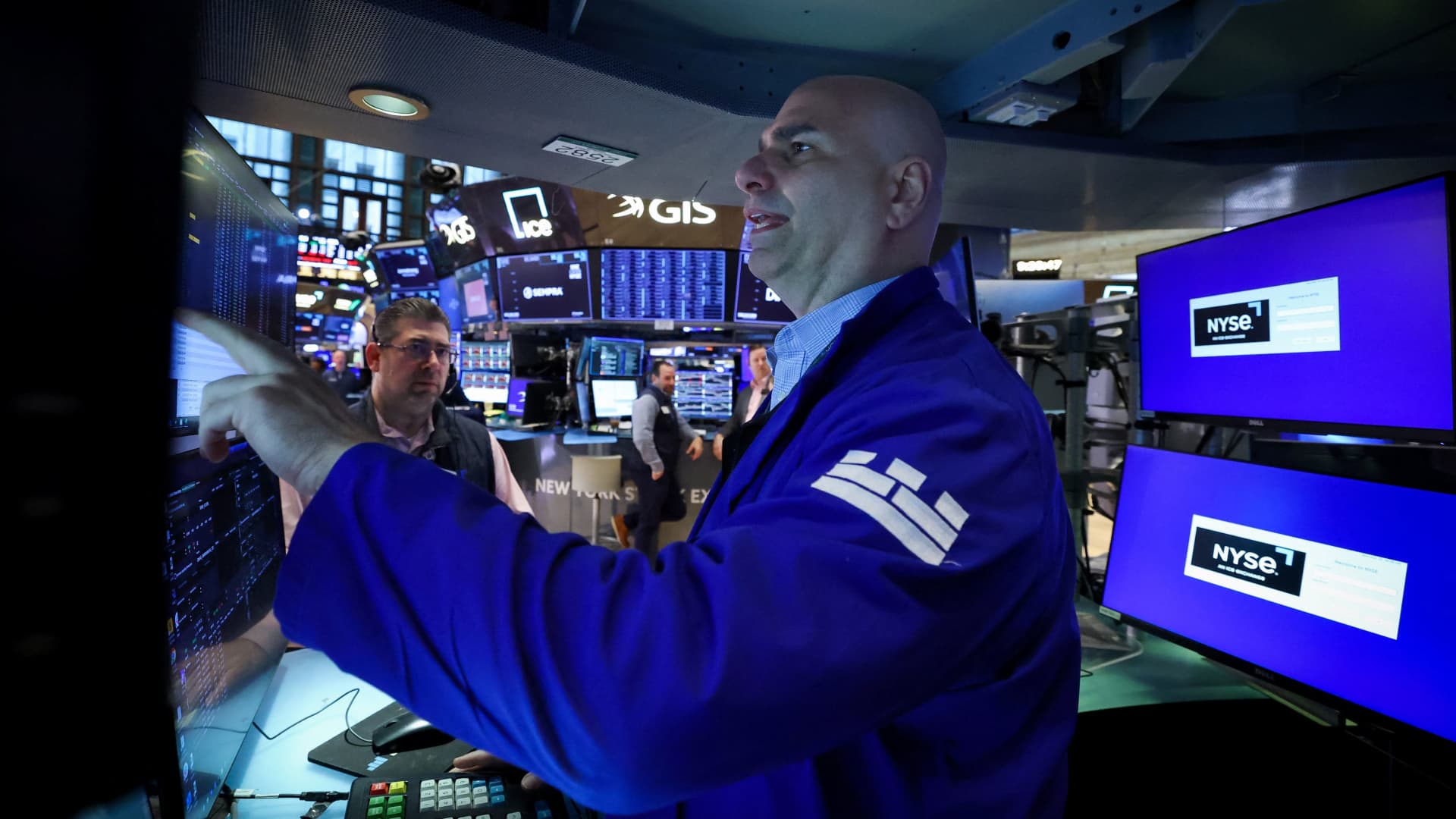
Traders work on the floor at the New York Stock Exchange (NYSE) in New York City, U.S., March 18, 2026.
Brendan McDermid | Reuters
S&P 500 futures and oil futures flashed an unusual burst of activity early Monday minutes before a market-moving social media post from President Donald Trump.
At around 6:50 a.m. in New York, S&P 500 e-Mini futures trading on the CME recorded a sharp and isolated jump in volume, breaking from an otherwise subdued premarket backdrop. With thin liquidity typical of early trading hours, the sudden burst stood out as one of the largest volume moments of the session up to that point.
A similar pattern was observed in oil markets. West Texas Intermediate May futures also saw a noticeable pickup in trading activity at roughly the same time, with a distinct volume spike interrupting otherwise quiet conditions.
Roughly 15 minutes later, at 7:05 a.m., Trump said on Truth Social that the U.S. and Iran had held talks and that he was halting planned strikes on Iranian power plants and energy infrastructure. That announcement prompted an instant rally in risk assets, with S&P 500 futures soaring more than 2.5% before the opening bell. West Texas Intermediate futures dropped nearly 6% following the announcement.
The timing of the earlier volume spikes across both equities and crude caught the attention of traders, particularly given the absence of an obvious catalyst at the moment they occurred.
Early-morning futures markets are typically less liquid, which can make short bursts of buying and selling more noticeable than during regular trading hours. Still, the trades raised some eyebrows because whoever purchased a large amount of stock futures and sold or shorted crude futures at that moment made a lot of money just minutes later.
The U.S. Securities and Exchange Commission and the CME Group didn’t immediately respond to CNBC’s requests for comment.
Algorithmic and macro-driven strategies can also generate rapid flows across asset classes without a single identifiable catalyst in early trading.
— With assistance from CNBC’s Fred Imbert.



Iran launched a Hormuz attack against three US Navy destroyers on May 7, with all missiles and drones reportedly intercepted.
Summary
- Three US Navy destroyers came under Iranian missile and drone fire in the Strait of Hormuz on May 7, triggering US retaliatory strikes on Iranian military facilities.
- Trump said all projectiles were shot down and the attackers killed, warning Iran of a much harsher response if no deal is reached.
- Iran was reviewing a US peace proposal mediated by Pakistan, with Secretary Rubio expecting a response by May 8.
The US military said it intercepted Iranian attacks on three Navy ships in the Strait of Hormuz on May 7 and struck Iranian military facilities in response, describing the action as self-defense. The Hormuz attack marks the most significant exchange of fire since the fragile US-Iran ceasefire took effect in early April.
US Central Command said the destroyers were crossing the strait when they came under fire from Iranian missiles and drones. Trump told reporters after the incident: “They trifled with us today. We blew them away.”
What the US military said happened
Iranian cruise missiles aimed at the US destroyers and merchant ships were intercepted, while US helicopters sank six small Iranian attack boats. Admiral Bradley Cooper, head of US Central Command, confirmed the details in a call with reporters.
Trump posted afterward that every missile and drone had been shot down and the attackers were “no longer with us,” adding that Iran would face a far harder response if it did not sign a deal.
Secretary of State Marco Rubio said the administration expected an Iranian response on its peace proposal by May 8, while noting that “only stupid countries” would not respond to fire when attacked as the US had been.
Where ceasefire talks stand
The US-Iran ceasefire has largely held since April 8. Previous in-person talks in Pakistan failed to produce an agreement to end the war, which began on February 28 when the US and Israel launched strikes on Iranian nuclear sites.
Pakistan’s prime minister said his government remained in continuous contact with both Tehran and Washington to stop the war and extend the ceasefire. Iranian Foreign Ministry spokesperson Esmail Baghaei confirmed Iran was reviewing the latest US proposal but had not yet responded.
Around 20% of the world’s oil supply normally moves through the Strait of Hormuz, making it a key macro driver for both energy prices and crypto markets.
As crypto.news tracked, Bitcoin has pulled back repeatedly as oil prices climbed toward $100 amid continuing Hormuz tensions, with each new escalation compressing Federal Reserve flexibility and weighing on risk assets globally.

In February, XRP tried to break out after the early-month calamity but was stopped at $1.65. A month later, the bears stepped up even before that when the asset challenged $1.60. During the following couple of months, the cross-border token’s attempts were exhausted long before those levels, at $1.50 in April and $1.47 in May.
On the positive side, all of these rejections were met by fresh buying power at around $1.30, which became XRP’s most important support since then. Now, another buying signal has flashed, and the question is whether this time will finally be any different for the token or if it will be more of the same.
XRP Buy Signal
Ali Martinez, who frequently touches upon the TD Sequential metric, noted that the indicator has flashed a buy signal on XRP’s 4-hour chart. The metric is used to determine the exhaustion of price moves in either direction for the underlying asset. Although it doesn’t have a 100% success rate, it’s generally very reliable when it comes to XRP in particular, as the analyst noted.
The latest example was on May 6, when it flashed a sell signal after XRP tapped $1.46 for the first time in several weeks. The subsequent rejection pushed the token south by over 5% in less than 48 hours.
Martinez said about today’s buy signal flash that it suggests the “local exhaustion is over, and XRP is ready to rebound.” He speculated that the first move would be toward the same resistance at $1.45 and posted a secondary, more bullish target at $1.80 “once we clear the overhead supply.”
Major Move Ahead?
This is not the first time Martinez has brought out the $1.80 target for XRP, as he did so last week when he noted that the asset has been sitting in a tight range for too long and could be primed for a major move ahead. Other analysts have doubled down on this narrative, such as MikybullCrypto. They posted on X that XRP’s triangle consolidation could be coming to an end soon, but the only question is “which side will it break out into?”
Fellow analyst CW believes there’s a bigger chance for an upside breakout as “there is absolutely no downside pressure in the futures market.” They categorized the current drop to under $1.40 as an “artificial decline” and predicted that once it ends, “bigger upward momentum will occur.”
Although the price of $XRP is falling, there is absolutely no downside pressure in the futures market.
This is an artificial decline. On the contrary, net buying of long positions has increased, and Open Interest (OI) is also rising.
Once this short-term trend ends, bigger… pic.twitter.com/QgwTrwwMdI
— CW (@CW8900) May 8, 2026
The post XRP Price Alert: Major Buy Signal Flashes as Analysts Expect Massive Move Ahead appeared first on CryptoPotato.
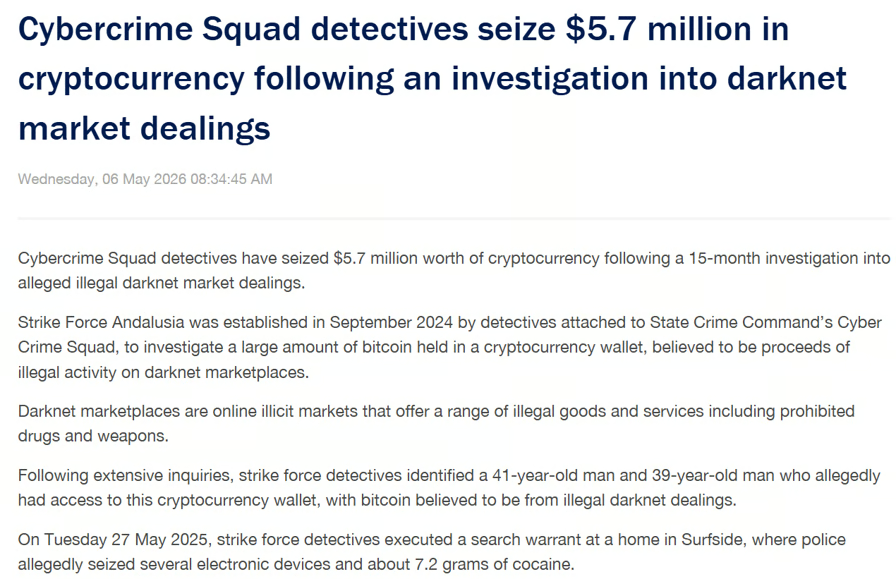
Cybercrime detectives in Australia seized 52 Bitcoin valued at 5.7 million Australian dollars ($4.1 million) in what they said is one of Australia’s largest crackdowns on an illegal darknet marketplace using cryptocurrency.
Strike Force Andalusia, a division of the State Crime Command’s Cyber Crime Squad, said they seized $4.1 million worth of cryptocurrency and arrested two suspects related to a darknet marketplace operating from Ingleburn in Sydney following a 15-month investigation, the New South Wales Police Force said Wednesday.
Police said two men, aged 41 and 39, allegedly had access to the cryptocurrency wallet. The 41-year-old is scheduled to appear in Campbelltown Local Court on May 13, while the 39-year-old is due in Batemans Bay Local Court on June 15.
Detectives executed a search warrant at a home in Ingleburn on May 4, where they seized electronic devices and allegedly uncovered 52.3 Bitcoin that police will allege are proceeds of illegal darknet activity.
The operation marks one of the largest reported darknet-related cryptocurrency seizures in Australia. It comes five years after Victoria Police seized cryptocurrency worth $6.2 million from an illegal darknet operation in August 2021, reported local news outlet 9News.
“This is one of the biggest cryptocurrency seizures in the nation’s history and a clear reminder that criminal activity on the darknet is not anonymous,” said Detective Superintendent Matt Craft, adding that dark net marketplaces remain “a key enabler of serious criminal activity.”
Cointelegraph approached NSW Police to ask whether investigators had obtained access to seed phrases or otherwise recovered control of the seized Bitcoin.

Cybercrime squad detectives seize crypto wallets belonging to alleged darknet marketplace operators. Source: NSW Police
Australia steps up AML supervision for crypto platforms
The seizure comes as Australia’s financial intelligence and Anti-Money Laundering regulator, the Australian Transaction Reports and Analysis Centre (AUSTRAC), has stepped up the supervision of the country’s digital asset sector.
On Friday, AUSTRAC said it launched two campaigns focused on virtual asset service providers (VASPs) offering over-the-counter crypto-to-cash services and local exchanges operating in the country.
As part of the reform, Australia also adopted the internationally used VASP term, replacing the previous narrower definition of digital currency exchanges (DCE).
Related: Australia fines local Binance unit $6.9M over client onboarding failures
The campaigns seek to assess and improve AML risk management within Australia’s virtual asset sector. It involves AUSTRAC engaging with 36 crypto businesses and 27 local crypto exchanges to revise and improve business models and the management of AML risks.
“AUSTRAC is checking how well crypto businesses in Australia are managing money-laundering risks, ahead of major new laws coming into force,” said AUSTRAC’s CEO, Brendan Thomas.
Australia has also passed the Corporations Amendment (Digital Assets Framework) Act 2026, which received Royal Assent on April 8 and will bring digital asset platforms and tokenized custody platforms into the financial services licensing regime from April 9, 2027.
Magazine: How crypto laws changed in 2025 — and how they’ll change in 2026


Warren’s letter asks Mark Zuckerberg to explain by May 20 which stablecoins and wallets Meta is using, how it selects issuers like Circle, what data it collects from linked wallets and how it will separate social and financial businesses.
Summary
- Senator Elizabeth Warren has written to Meta CEO Mark Zuckerberg demanding detailed disclosures about Meta’s new stablecoin payment pilot and calling its “lack of transparency” troubling.
- Warren wants Meta to clarify by May 20 how its USDC-based tests in Colombia and the Philippines work, which third-party stablecoins and wallets are involved, and what safeguards exist for privacy, competition, and financial stability.
- The letter lands as the Senate Banking Committee hammers out the CLARITY Act’s stablecoin rules, setting up a direct clash between Big Tech’s payment ambitions and Washington’s effort to tightly police dollar tokens.
Senator Elizabeth Warren has asked Meta CEO Mark Zuckerberg to explain the company’s latest stablecoin effort, warning that the social media giant’s quiet push into USDC payments could have “serious implications for competition, privacy, the integrity of our payments system, and financial stability.”
According to a copy of the letter obtained by Fortune, the Massachusetts Democrat called Meta’s “lack of transparency” over its stablecoin strategy “troubling” and requested detailed answers by May 20 on the scope, partners and safeguards of its current pilot. Fortune said Warren wants Meta to spell out which stablecoins it is using, how it is selecting third‑party issuers and wallets, what data will be collected, and how the firm will mitigate conflicts of interest between its social platforms and financial services.
Warren’s letter responds to Meta’s renewed experimentation with blockchain payments. In late April, Meta began testing USDC payouts for selected creators in Colombia and the Philippines, allowing them to receive earnings in Circle’s dollar‑pegged stablecoin via supported wallets, rather than in local fiat through traditional rails. Bitcoin.com reported that the pilot uses the Solana and Polygon networks and is powered on the backend by Stripe, which now offers stablecoin settlement after acquiring infrastructure firm Bridge.
On‑chain news summarized by KuCoin notes that users in the test must link a third‑party crypto wallet to their Meta accounts and that early trials focus on “a limited group of creators” to evaluate UX, fees and compliance. KuCoin A Meta spokesperson told reporters that the company “is not developing its own stablecoin” and is instead “enabling third‑party stablecoins like USDC for payment purposes,” drawing a sharp line between this pilot and the abandoned Libra/Diem initiative. KuCoinRootData
RootData’s recap of Warren’s letter quotes her as saying that, given Meta’s “vast global user base,” any stablecoin‑related business “could have a significant impact on market competition, user privacy, the integrity of payment systems, and financial stability,” and therefore “must be subject to careful scrutiny from regulators and lawmakers.” RootData Warren also flagged the history of Libra/Diem, arguing that Meta “has already shown it is willing to push the limits” of financial regulation and cannot be given a free pass simply because it has shifted from issuing its own token to integrating someone else’s. KuCoin
Stablecoins, CLARITY Act politics, and Big Tech
The timing of the letter is no accident. As crypto.news detailed in a recent story, the Senate Banking Committee has just reached a compromise on the CLARITY Act’s stablecoin yield language, banning bank‑like interest on passive balances while allowing activity‑tied rewards. crypto.news That deal cleared a major hurdle for the sweeping digital asset market structure bill, which aims to create a federal regime for exchanges, token classification and stablecoin oversight and is now headed for a Banking Committee markup as soon as the week of May 11. IBT
Warren, a senior Democrat on the committee and one of Congress’s most vocal crypto skeptics, has repeatedly warned that stablecoins could evolve into “shadow banks” outside the traditional regulatory perimeter and has been especially hostile to Big Tech’s attempts to bolt financial services onto massive social platforms. In earlier hearings, she cited Meta’s Libra/Diem project as “a textbook example” of why Congress needs to “draw bright lines” around who can issue or integrate dollar‑pegged tokens at scale.
Her latest letter effectively drags Meta’s USDC pilot into that debate. KuCoin’s write‑up notes that Warren is asking Meta to disclose not just technical details but also “what discussions, if any, the company has had with regulators, including the Federal Reserve, SEC, CFTC, and banking agencies” about its stablecoin integration. KuCoin It is a signal that, in Washington’s eyes, there is no longer a sharp distinction between issuing a token and embedding one: at Meta’s scale, even “just using USDC” raises systemic questions.
Whether CLARITY ultimately tightens or relaxes the rules that govern Big Tech’s use of stablecoins will help determine how far pilots like Meta’s can go. For now, Warren’s message is clear: any attempt to turn Facebook, Instagram or WhatsApp into de facto payment networks running on crypto rails will be watched — and, if she has her way, tightly constrained — from the very first line of code.
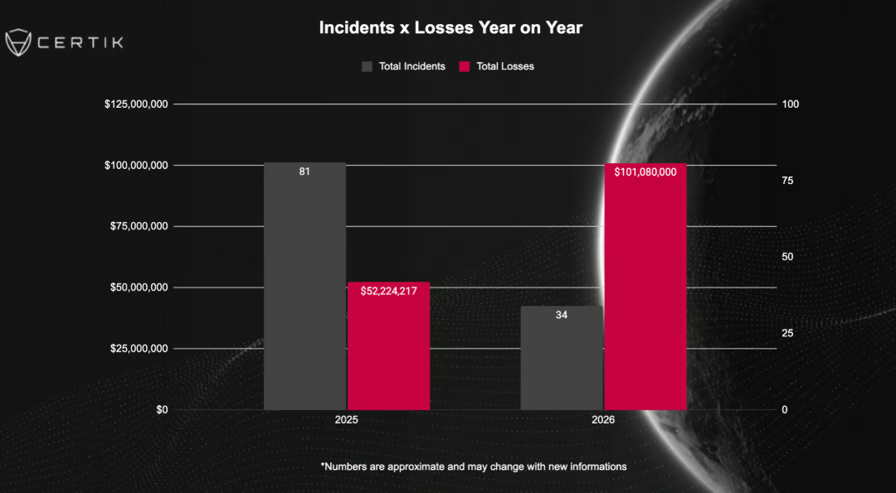
Estimated losses from global crypto wrench attacks reached $101 million in the first four months of 2026, with most attacks occurring in Europe, according to Web3 security company CertiK.
With just 34 documented crypto wrench attacks, the losses have nearly doubled those of 2025, which came in at $52.2 million. Europe accounted for 82% of incidents, according to CertiK.
“Our 2025 report documented a gradual tilt from Asia and North America toward Europe, and these first four months of 2026 mark a European hyper-concentration.”
The frequency of wrench attacks has increased since 2025. They involve physical force to gain access to a victim’s crypto holdings and have taken the form of home invasions, kidnappings and other extortion attempts. CertiK said there have been 34 attacks since the start of the year.
If the trend continues, CertiK predicts that by year-end the number of incidents could hit 130, and losses could reach “several hundred million dollars.”

There have been 34 verified wrench attacks worldwide since the start of the year. Source: CertiK
France is an epicenter of wrench attacks
Of the attacks, 24 crypto wrench attacks occurred in France this year, said CertiK. France’s National Prosecutor’s Office for Organized Crime has reported a higher figure of 47 incidents in 2026.
CertiK said France has likely emerged as a hot spot for these kinds of criminals because of the presence of crypto executives from major crypto companies such as Ledger, Paymium and Binance.

Crypto holders in France are being targeted more than anywhere else in the world. Source: CertiK
It also pointed to numerous data leaks, such as the January breach at crypto accounting firm Waltio and tax official Ghalia C, who is accused of selling crypto asset holder data to criminal networks, and “a culture of flexing and voluntary doxxing that remains deeply embedded in the community.”
“Early 2026 marks the shift to a data-driven targeting model in which prior physical surveillance becomes unnecessary once attackers have the victim’s full name, home address, financial profile, and so on.”
“The structural takeaway is clear: as the security of protocols and wallets tends to improve, the threat migrates toward the human link. As long as crypto-asset holdings remain associated with identifiable financial data, physical coercion will remain the economically most rational attack path,” CertiK added.
Blockchain intelligence company TRM Labs reported in May last year that wrench attacks have been on the rise because of the perceived pseudonymity of crypto transactions, the public visibility of wealth, and the ease with which bad actors can gather personal data online.
The criminal teams are often “complete amateurs”
Across recorded wrench attacks, CertiK said the orchestrators are often located outside the target country. The criminal teams on the ground usually consist of three to five people, and they frequently pose as delivery drivers or police officers, or lure victims into an ambush with a ruse such as a fictitious business meeting.
Related: Law enforcement freezes $41M connected to $150M crypto Ponzi collapse
“Most of the time, they are recruited via messaging apps such as Telegram or Snapchat for a few thousand dollars. They don’t know each other and are complete amateurs,” CertiK added.
Meanwhile, Casa chief security officer Jameson Lopp has recorded 31 crypto wrench attacks so far this year and reported in March that four cases he was tracking for his list turned out to be mistaken identity, with the thieves attacking the wrong targets.

Source: Jameson Lopp
In April, at least 88 people, including 10 minors, were indicted in connection with alleged wrench attacks on crypto owners in France.
“The growing proportion of minors signals an increasing externalization of criminal liability toward profiles less exposed to mandatory minimum sentences,” CertiK added.
Magazine: DeFi’s billion-dollar secret: The insiders responsible for hacks


The Senate Banking Committee is expected to hold a formal CLARITY Act vote as early as next week, Coinbase said at Consensus 2026.
Summary
- The Senate Banking Committee is preparing to notice a markup for the CLARITY Act the week of May 11, with draft text already circulated to industry.
- Coinbase VP Kara Calvert said the bill needs at least 60 Senate votes and warned that bipartisan backing is essential to advance it.
- A HarrisX survey shows 70% of voters believe the US should have already passed federal crypto legislation.
Coinbase says the CLARITY Act is heading for a Senate Banking Committee vote as early as next week, with Kara Calvert, the company’s vice president for US policy, telling Consensus 2026 in Miami that the markup is expected the week of May 11.
The Senate Banking Committee has reportedly circulated draft legislative text to select industry members ahead of a potential Thursday vote, according to multiple sources cited by journalist Eleanor Terrett on X.
Calvert told Consensus 2026 attendees the bill needs at least 60 votes in the full Senate to advance and that bipartisan support is non-negotiable. “That means you need Democrats,” she said. “You need a bipartisan bill, and we have all been working really hard to make sure that bipartisanship holds.”
What is at stake in the vote
The Digital Asset Market CLARITY Act would draw a statutory line between the SEC and the CFTC, assigning digital commodities to the CFTC and keeping digital securities under SEC oversight. The House passed the bill 294 to 134 in July 2025.
Senate stalemate has followed since, with unresolved disputes over stablecoin yields and the role of banks in crypto markets delaying the committee markup multiple times.
The latest movement comes after Senators Thom Tillis and Angela Alsobrooks brokered a compromise on stablecoin yield that bars crypto firms from paying interest equivalent to bank deposits while permitting activity-based rewards.
Coinbase CEO Brian Armstrong posted “Mark it up” immediately after the text dropped. Ripple CEO Brad Garlinghouse separately called the past week a “big positive shift” for the bill’s Senate momentum from the same Consensus stage.
Political pressure building
Senate Democrats are reportedly considering withholding support unless the committee version includes an ethics-related provision barring lawmakers from trading tokens. Senator John Kennedy has also withheld Republican support, leaving Chair Tim Scott still working to lock the votes needed to proceed.
A HarrisX national survey cited by Calvert found 70% of voters believe the US should have already passed federal crypto legislation, with 62% saying it is important for the US to set global digital finance rules. As crypto.news reported, prediction markets now put the bill’s odds of becoming law in 2026 at roughly 55%.
Senators Lummis and Moreno have both warned that missing the May 21 Memorial Day recess window risks pushing comprehensive crypto legislation off the calendar entirely.
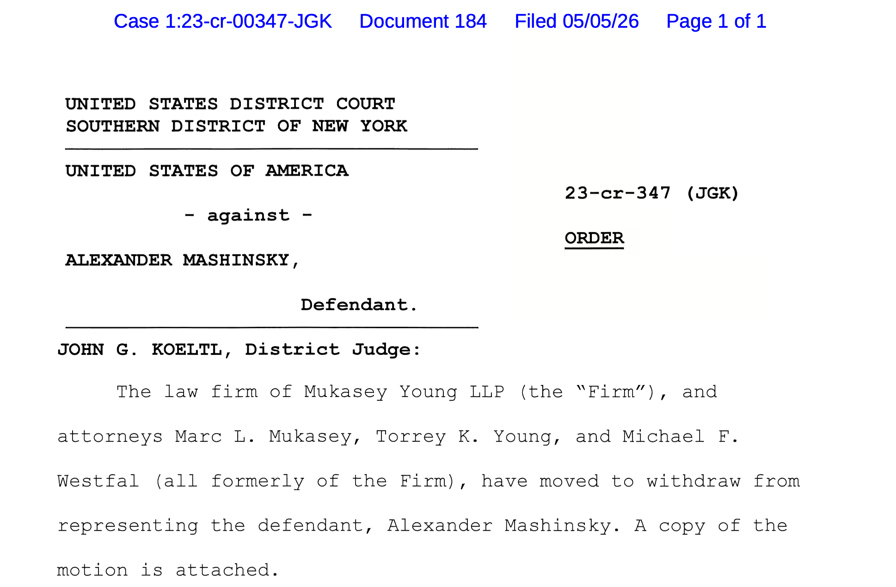
Alex Mashinsky will be representing himself as Celsius executive prepares for sentencing
On Wednesday, lawyers representing Alex Mashinsky moved to withdraw as attorneys in the case, saying that the former Celsius CEO would be “proceeding pro se” — representing himself in court. Mashinsky was sentenced to 12 years in prison for his role in fraud and price manipulation at the crypto lending platform.

Source: PACER
Roni Cohen-Pavon, Celsius’ former chief revenue officer, is scheduled to be sentenced on May 13 after pleading guilty in September 2023. On May 4, US prosecutors recommended that the judge consider Cohen-Pavon’s “substantial assistance” to the government at sentencing, signaling leniency.
Celsius, along with cryptocurrency exchange FTX, filed for bankruptcy in 2022 amid a crypto market downturn that saw the collapse of many companies.
Washington city passes ban on crypto kiosks, Iowa restricts activities
On Tuesday, the city council of Spokane Valley in Washington voted unanimously to approve an ordinance prohibiting virtual currency kiosks and ATMs. The ban, proposed in response to many residents being the victims of crypto-related scams, followed many other jurisdictions passing similar measures.
The ordinance imposes a $250 civil penalty for anyone in noncompliance, and gives officials the authority to revoke the business license of any operator found to be in violation. Entities hosting the kiosks and ATMs have 30 days to be in compliance.
Spokane Valley’s actions preceded Iowa Attorney General Brenna Bird announcing on Wednesday that the state would “establish rigorous oversight for crypto ATMs” in an effort to protect residents from scammers. The law, SF2296, adds crypto kiosks to Iowa’s financial regulatory framework, giving state authorities the ability to impose civil penalties and injunctions on operators.
US authorities request forfeiture of $10 million connected to former FTX CEO
In a Thursday filing in the US District Court for the Southern District of New York, prosecutors overseeing the criminal case against Sam “SBF” Bankman-Fried requested that $10 million in assets recently located be used toward the former FTX CEO‘s forfeiture.
SDNY US Attorney Jay Clayton filed a motion of forfeiture after authorities located $10 million in cash tied to SBF held in an account at Fiduciary Trust Company. According to Clayton, the funds represented “the return of the investment made by [Bankman-Fried] in Semafor.”
Following his conviction and sentence to 25 years in prison, Bankman-Fried was ordered to pay more than $11 billion in forfeiture as part of his role in defrauding FTX users and investors. Clayton said that the judgment “remains unpaid” amid SBF awaiting the result of an appeal.
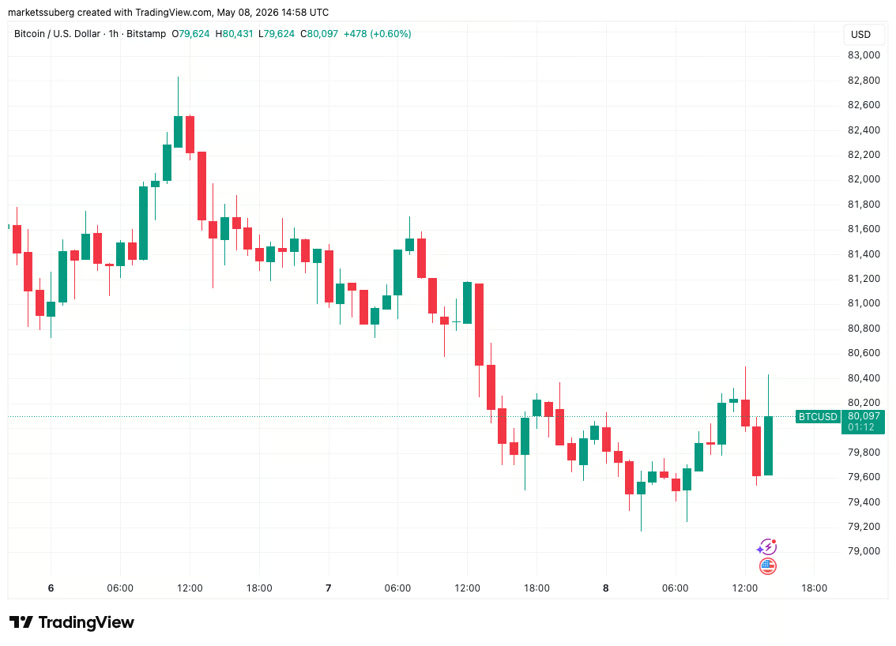
Bitcoin (BTC) struggled with an $80,000 reclaim at Friday’s Wall Street open as strong US jobs data added to headwinds.
Key points:
- Bitcoin crisscrosses $80,000 as US jobs data notionally reduces the odds of US interest-rate cuts.
- US jobs vastly outpace expectations, adding almost twice the anticipated number of jobs in April.
- Traders avoid giving up on the local uptrend, seeing a “healthy” support retest.
Bitcoin stays undecided on fate of $80,000
Data from TradingView showed ongoing BTC price volatility as buyers and sellers sparked gyrations around the key $80,000 mark.

BTC/USD one-hour chart. Source: Cointelegraph/TradingView
US nonfarm payrolls revealed that the economy added far more jobs than expected in April, despite ongoing inflation pressure thanks to the Iran war.
The Bureau of Labor Statistics reported 115,000 jobs — far beyond the expected 65,000.
“The change in total nonfarm payroll employment for February was revised down by 23,000, from -133,000 to -156,000, and the change for March was revised up by 7,000, from +178,000 to +185,000,” an accompanying news release stated.
“With these revisions, employment in February and March combined is 16,000 lower than previously reported.”

US civilian unemployment rate. Source: BLS
The unemployment rate remained unchanged at 4.3%.
Bitcoin initially fell on the numbers, as outperformance implied less need for the Federal Reserve to relax financial policy.
As Cointelegraph reported, the Fed made it clear at its latest meeting on interest rates that conditions were conducive to tightening, and that rate cuts were unlikely.
The latest data from CME Group’s FedWatch Tool reflected market expectations of a potential rate hike at the Fed’s next meeting on June 17.

Fed target rate probabilities for June 17 FOMC meeting (screenshot). Source: CME Group
BTC price sees “healthy bullish backtest”
Among traders, the mood was one of cautious optimism with acceptance that recent gains may not hold for long.
Related: Bitcoin Bollinger Bands push key breakout as creator acts on positive signal
“Retesting the highs from the previous consolidation,” Daan Crypto Trades summarized in his latest X analysis.
“Good bounce so far but this is a key level for the bulls to hold.”

BTC/USDT perpetual contract 12-hour chart. Source: Daan Crypto Trades/X
Trading account Cryptic Trades saw Bitcoin retesting its bull market support band, an area formed by two daily moving averages.
“For now, this looks like a healthy bullish backtest before a continuation higher,” it wrote on the day.

BTC/USD one-day chart. Source: Cryptic Trades/X
Earlier, Cointelegraph noted signs that a local top could be in for BTC/USD, notably an “overbought” warning on the relative strength index indicator.
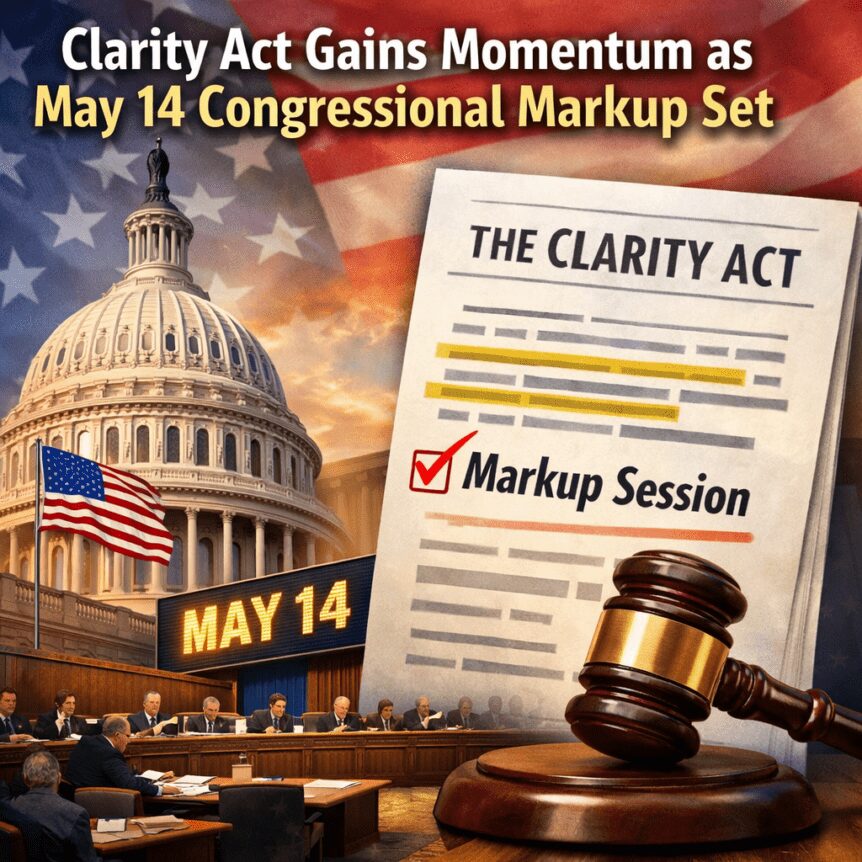
The US Senate Banking Committee is poised to vote on the CLARITY Act, a package designed to clarify how the crypto industry fits within US regulation. Senate Banking Committee chair Tim Scott confirmed the bill will go to a markup on Thursday, a decision that could set the tone for the next phase of crypto policy in Washington. The legislation, first introduced in July 2025, stalled earlier this year after Coinbase withdrew its support, citing concerns including insufficient protections for open-source software developers, a prohibition on stablecoin yield, and unsettled DeFi regulation.
Proponents argue the CLARITY Act would anchor consumer protections and spur domestic innovation, while critics warn the framework could fail to address the rapid evolution of the technology. As the industry mobilizes behind a path to practical rules, the timing of the markup will test whether lawmakers can assemble bipartisan backing for a measure with far-reaching implications for developers, exchanges, and investors alike.
Key takeaways
- The CLARITY Act heads to a Senate Banking Committee markup with support expected to hinge on securing at least 60 votes for passage.
- Coinbase withdrew its backing earlier this year, citing concerns over protections for open-source developers, a potential ban on stablecoin yield, and DeFi regulatory gaps.
- Pro-crypto voices frame the bill as a meaningful step toward consumer protection and keeping crypto innovation anchored in the United States.
- Regulatory uncertainty under the Biden administration and SEC leadership has historically fed talk of relocation to offshore jurisdictions, underscoring the bill’s perceived urgency.
- Industry signals ahead of Consensus 2026 suggested a markup could come soon, highlighting the need for bipartisan collaboration to translate broad goals into a workable framework.
Aims, timing, and sticking points
The CLARITY Act is crafted to deliver a formal, predictable framework for how crypto firms—exchanges, developers, and token issuers—operate within US law. Its revival in the current congressional cycle follows a July 2025 introduction and a recent push to move it through the Senate, despite last-minute concerns that contributed to Coinbase’s withdrawal earlier in the year. The bill’s success hinges on assembling bipartisan support, with the Senate’s 60-vote threshold acting as a practical barrier to passage in a closely divided chamber.
Key sticking points remain well within the industry’s line of sight. Supporters point to a more transparent regulatory path that could reduce the kind of regulatory drift that has unsettled market participants. Critics, however, warn that the framework must address evolving technologies, including open-source development, the governance of DeFi protocols, and the economics surrounding stablecoins. The debate captures a central tension in US policy: how to safeguard consumers and financial stability without stifling innovation or creating a permissive sandbox for risk.
Industry voices and regulatory implications
Industry leaders have been vocal as the markup nears. Paul Grewal, Coinbase’s chief legal officer, commented on X that “It’s on like Donkey Kong,” signaling renewed momentum to advance the bill through the committee. Coinbase’s policy chief, Faryar Shirzad, followed with a post describing the measure as a “big step forward” and arguing that the act is essential “for protecting consumers, supporting innovation, and ensuring this technology develops in the United States rather than offshore.”
Beyond individual companies, observers have long tied regulatory ambiguity to fragmentation within the global crypto ecosystem. During the Biden era, the combination of regulatory signals and the SEC’s stance under Chair Gary Gensler contributed to discussions about whether firms would relocate to more permissive jurisdictions. Proponents of the CLARITY Act contend that a coherent, domestically anchored framework could reduce such incentives and re-establish a clear pathway for the sector’s growth within the United States.
At consensus-focused industry events, policymakers and practitioners echoed a similar sentiment: clear, workable rules are essential to balance safeguarding consumers with enabling ongoing innovation. Cynthia Lummis, a well-known crypto advocate in the Senate, amplified the push for progress, underscoring the desire to move the bill through committee and toward a broader legislative conclusion.
What happens next and what to watch
As Consensus 2026 wrapped, Kara Calvert, Coinbase’s vice president of US policy, indicated that a markup could arrive “next week,” signaling confidence that lawmakers are nearing a decision point. Calvert also emphasized the need for bipartisan support, noting that passing the bill will require bridging gaps across the political spectrum to reach the 60-vote threshold. The upcoming markup will serve as a crucial barometer for whether lawmakers can translate high-level consumer protection and innovation goals into a concrete, workable regulatory framework.
For investors and builders, the practical implications hinge on several converging factors: how the bill defines key terms related to tokens and platforms, how it approaches open-source software protections, what it decides about DeFi and stablecoins, and whether the committee can secure a bipartisan coalition to move forward. The regulatory architecture has the potential to either clarify long-standing ambiguities or leave significant questions unresolved, with ripple effects across funding, product development, and international competitiveness.
In the near term, traders and developers should keep a close watch on Thursday’s committee markup and any subsequent negotiations. The measures that survive the legislative process could shape compliance expectations, enforcement priorities, and the relative attractiveness of the US as a base for crypto innovation. Until the framework is finalized, a degree of caution will likely persist, given the ongoing debates over openness, yield, DeFi governance, and the appropriate guardrails for derivatives and exchanges.
Keep an eye on Thursday’s proceedings and the ensuing negotiations to gauge whether lawmakers can establish a principled compromise that aligns consumer protection with a thriving domestic crypto ecosystem. The outcome will influence not only policy but also how projects fundraise, build, and operate within the United States.
Strategy’s MSTR stock may rally by over 80% in the coming months despite suffering a $12.54 billion net loss in Q1 2026.
Key takeaways:
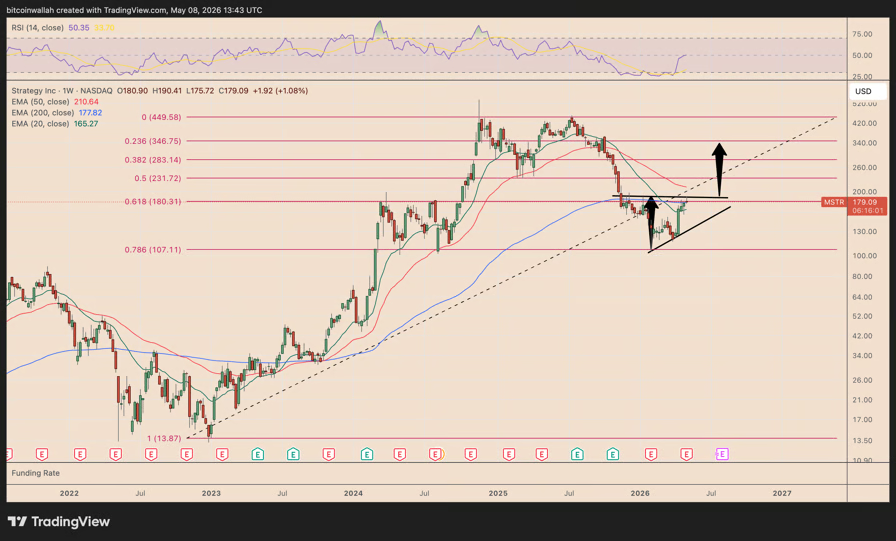
- Strategy’s MSTR is forming an ascending triangle pattern, pointing to a potential move toward the $350 level.
- Canaccord raised its MSTR price target to $224 from $185, citing Bitcoin’s rebound and Strategy’s financing structure.
MSTR’s textbook bullish reversal setup targets $350
As of Friday, MSTR was trading inside what appeared to be an ascending triangle, a technical pattern formed when the price prints higher lows beneath a flat resistance zone.
Those higher lows are a sign that buyers are getting more confident. Each time MSTR pulls back, it stops falling sooner than before, showing that buyers are stepping in earlier without waiting for a deeper drop.

MSTR weekly chart. Source: TradingView
Ascending triangles typically resolve when the price breaks above the upper trend line and rises by as much as the structure’s maximum height.
Applying this technical rule to MSTR’s chart brings its upside target to around $350 in 2026. The upside target, up about 80% from the current price level, aligns with the 0.236 Fibonacci retracement line.
Analyst Kevin Fx said that MSTR may rally to the $250–$300 range, citing an inverse-head-and-shoulders (IH&S) pattern.

MSTR weekly chart. Source: TradingView/Kevin Fx
Conversely, a pullback from the ascending triangle’s upper trendline may push MSTR into a multi-week downtrend toward its lower trend line at around $150. A breakdown below $150 risks invalidating the bullish setups altogether.
Canaccord raises its MSTR price target to $224
Earlier this week, Canaccord, a Canada-based investment banking giant, also raised its MSTR price target to $224 from $185, reiterating its Buy rating.
The investment bank pointed to MSTR’s 80% rebound since February, saying the company had weathered another storm as Bitcoin recovered above $80,000 from near $60,000 lows over the same period.

Source: X
Canaccord also highlighted Strategy’s preferred-share financing model, such as STRC, as an important part of that resilience. The product allows the company to raise fresh capital for Bitcoin purchases without relying as heavily on new common-stock issuance.
Issuing more common MSTR shares can dilute existing shareholders. On the other hand, preferred stock gives Strategy another way to fund its Bitcoin accumulation strategy with less pressure on its core equity.
Related: Samson Mow defends Strategy selling portions of its Bitcoin treasury
Meanwhile, Strategy has increased its Bitcoin exposure for each shareholder. Despite posting a $12.54 billion Q1 loss, it bought 89,599 BTC in the first three months of 2026, bringing its total holdings to 818,334 BTC at an average cost of $75,537.

Source: X
Its BTC-per-share metric also rose 18% year-over-year, showing the company is adding value to each MSTR share in addition to growing its BTC balance sheet.

THOUSANDS of XRP Holders at Risk RIGHT NOW (Urgent Warning)
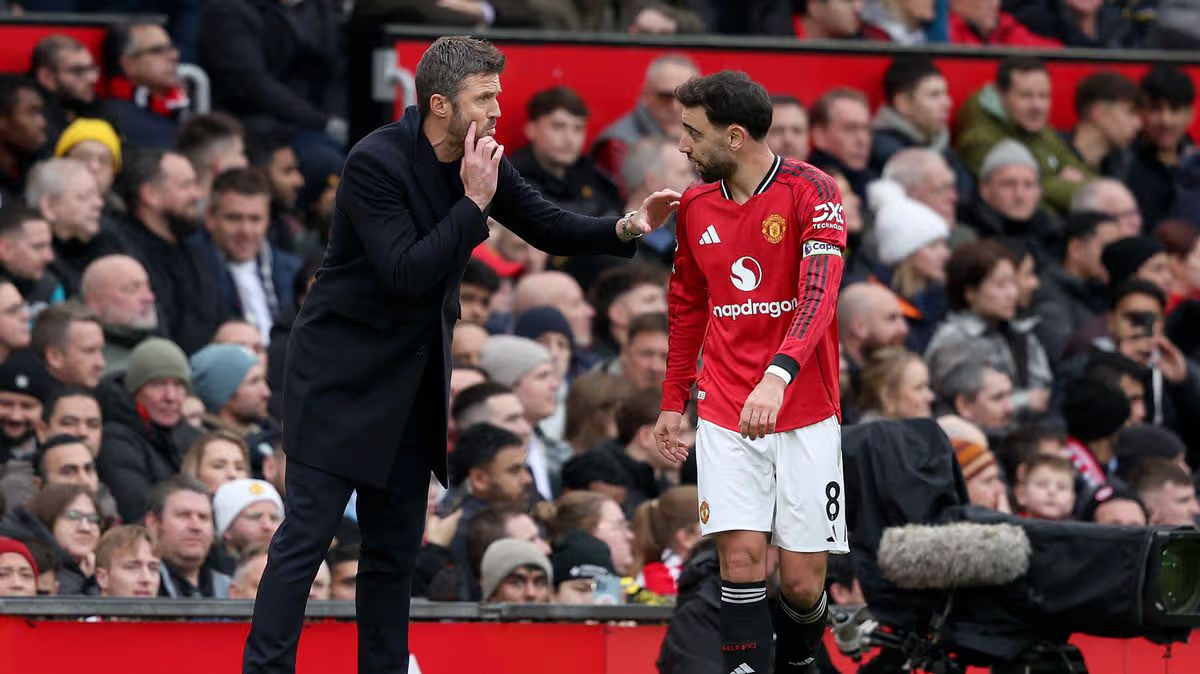
‘Big summer’ – Michael Carrick opens up on Bruno Fernandes’ Manchester United future
Form 144 Bloomin’ Brands For: 8 May

Manchester United reach agreement with Casemiro over contract clause amid transfer speculation

US brings back mandatory military draft registration

Steven Gerrard disagrees with Gary Neville over ‘shock’ Chelsea and Arsenal claim | Football


-
 Crypto World19 hours ago
HarrisX Poll Found 52% of Registered Voters Support the CLARITY Act
-

 NewsBeat5 days ago
Channel 5 – All Creatures Great and Small series 7 new post
-

 Crypto World2 days ago
Upbit adds B3 Korean won pair as Base token gains Korea access
-

 Tech4 days ago
Image AI models now drive app growth, beating chatbot upgrades
-
 NewsBeat2 days ago
NCP car park operator enters administration putting 340 UK sites at risk of closure
-

 News Videos6 days ago
AP Dhillon – Old Money (Official Audio)
-

 Fashion10 hours ago
Weekend Open Thread: Marianne Dress
-

 Sports6 days ago
Five killed in Texas plane crash identified as Amarillo pickleball players
-
Entertainment6 days ago
New Netflix Movies in May 2026 — My Top 3 Picks to Stream
-

 Entertainment6 days ago
Melissa Joan Hart and More Stars Attend 2026 Kentucky Derby
-
 Crypto World6 days ago
Pi Network Mandates Protocol 23 Upgrade for All Mainnet Nodes Before May 15 Deadline
-

 Crypto World6 days ago
Bitcoin mining equities rise in 2026 as BTC lags behind
-
Entertainment6 days ago
Anna Nicole Smith’s Daughter Attends 2026 Kentucky Derby
-

 Business6 days ago
Luka Doncic Injury Update: Doncic’s Hamstring Recovery Slows Lakers’ Hopes Against Thunder: Can He Run Yet?
-
Entertainment6 days ago
Venus Williams’ Best Met Gala Looks Over the Years
-
 Entertainment6 days ago
After 2 Years, This Taylor Sheridan Neo-Western Doesn’t Have a Single Bad Episode
-
 Entertainment6 days ago
Netflix’s 10-Part Miniseries Based on a True Story Is a Perfect Weekend Binge
-

 Sports6 days ago
Is Man United v Liverpool on TV? Channel, streaming and how to watch Premier League fixture
-

 Business6 days ago
Kuwait International Airport Resumes Operations After Closure as Regional Tensions Ease in 2026
-
Crypto World6 days ago
Q1 2026 Tech Layoffs AI Wave Hits 81,747 as Firms Shift to AI Infrastructure
You must be logged in to post a comment Login