

Crypto World
Wall Street warns legacy markets lag crypto speed



Wall Street executives warned at Consensus 2026 that legacy markets built for slower trading are breaking under 24/7 crypto pressure.
Summary
- Top executives at Consensus 2026 in Miami warned that traditional financial infrastructure was designed for human-paced, scheduled trading.
- Round-the-clock, machine-driven crypto activity is creating growing friction with settlement systems built for fixed market hours.
- The pressure is accelerating institutional demand for tokenized settlement, real-time clearing, and upgraded market infrastructure.
Wall Street executives gathering at Consensus 2026 in Miami on May 5 warned that traditional financial infrastructure was not built to absorb round-the-clock, machine-driven trading.
As crypto markets operate continuously and algorithmic activity accelerates, legacy systems built for scheduled market hours and human-paced settlement are showing strain. Consensus 2026 drew over 20,000 attendees and broke records for regulatory presence, with Bitcoin breaking $80,000 on the conference’s opening day.
The friction is most acute in settlement infrastructure. Traditional clearing systems process trades in scheduled batches tied to market open and close times, a design that works for equities with fixed hours but fails under continuous pressure.
Executives at the conference pointed to tokenized settlement as the most credible path forward, allowing trades to settle continuously on blockchain rails rather than queuing in legacy batch cycles.
Tokenization as the infrastructure answer
The argument maps directly to regulatory developments already in motion. Nasdaq won SEC approval to trial tokenized stock trading in March 2026, allowing eligible participants to trade securities in traditional or blockchain form on the same platform.
The Federal Reserve also issued guidance confirming that tokenized securities receive the same capital treatment as conventional equivalents, removing a key institutional adoption barrier.
Bullish’s $4.2 billion acquisition of transfer agent Equiniti, announced today, offers the most direct institutional response to the infrastructure gap. Bullish described the deal as creating “the global transfer agent for tokenized securities,” a company serving 3,000 existing corporate clients and 20 million shareholders.
The Consensus warnings and the Bullish deal together frame the conference as the moment the gap between legacy market infrastructure and 24/7 crypto reality became a shared institutional problem rather than a fringe concern.


Bitcoin briefly dipped toward the $60,000 zone, sliding to about $61,300 before bouncing back roughly 5.5% to around $64,690. The move came as fresh headlines about a potential ceasefire in the Middle East surfaced, adding a geopolitical undertone to a day of highly leveraged trading. While the rebound was sizable, observers warned that the surge could be a relief bounce rather than a bona fide bottom, given the size of the prior unwind and the chart setup traders are watching.
On the liquidity front, the move sparked a megawatt wave of liquidations across the market. Data tracker CoinGlass counted more than $737 million in BTC liquidations over a 24-hour window, with long positions bearing the brunt of the pressure. In absolute terms, more than $617 million of those liquidations came from long bets, underscoring how aggressively bullish positioning unraveled as prices slid. The brutal levered unwind has left participants weighing whether fresh bids will sustain or fade as risk sentiment shifts. CoinGlass data.
The rebound has fueled a breadth of mixed signals among traders. Some see the bounce as an early sign that selling pressure may have exhausted, opening room for a move toward the upper end of recent ranges. A market observer going by the alias RidaaXBT suggested a potential relief rally toward the $69,000–$70,000 zone, implying that the liquidation-driven flush may have run its course in the near term. RidaaXBT.
Analyst perspectives varied, with some colleagues hinting at cautious optimism. Another trader, ZordXBT, echoed the view that buyers stepped in near the lows given Bitcoin’s long downside wick, a sign some see as evidence of a floor forming. ZordXBT.
Not all voices agreed that the bottom was in. Hitman42.eth warned that bulls might be celebrating too soon, cautioning that the bounce could trap late buyers if the price loses momentum and retests lower levels. Hitman42.eth.
Market structure under the weekly lens: a bear flag remains in play
Looking at Bitcoin’s weekly chart, a bear-flag pattern continues to loom in the background. The setup implies a risk of a deeper pullback toward the $50,000–$52,000 area if selling pressure resumes and prices break down from the flag. The narrative is supported by rising volumes that accompanied the late-week downside, reinforcing the view that sellers still hold an edge in a broader market context. Related analysis.
Despite the bearish texture, the door remains ajar for a quick reversal if Bitcoin can reclaim the 200-week simple moving average near $61,800. That level has historically acted as a cycle-bottom anchor during major bear phases, surfacing as a potential fulcrum for a renewed up leg in 2015, 2018, and 2020. A convincing rebound above the 200-week SMA would undermine the bear-flag argument and broaden the market’s short-term upside scope, with $70,000 serving as the next clear milestone for bulls.
In chart terms, traders are watching how the price behaves around those levels while also weighing the momentum implied by weekly closes and volume patterns. The dynamic between the 200-week support and the bear-flag breakdown remains the key question for the coming sessions, shaping whether risk appetite stays tethered to defensive plays or shifts back toward aggressive long exposure.
What this means for traders and investors
The weekend moves highlight a persistent theme for Bitcoin: liquidity-driven volatility remains a defining feature, especially when leverage is high and sentiment shifts on macro headlines. For traders, the immediate takeaway is to monitor two critical areas: the 200-week SMA near $61,800 and the broader range around $69,000–$70,000. A move decisively above the SMA could shift the narrative toward a more constructive near-term outlook, prompting fresh bets toward higher targets. Conversely, aFailed break above the bear-flag upper boundary or a break below the weekly support could accelerate downside pressure toward the $50k–$52k corridor.
Investors eyeing longer horizons should consider how macro and geopolitical developments interact with on-chain signals. The Reuters report cited in coverage this week about potential ceasefire discussions between regional actors contributed to a mood shift that can carry through risk assets, including crypto markets. While headlines can move markets in the short run, traders are likely to place greater emphasis on structural indicators and risk-management metrics as liquidity remains a critical determinant of liquidation risk and price resilience. Reuters reporting.
Looking ahead, the market’s trajectory will hinge on whether buyers can sustain higher highs and whether selling pressure re-emerges with a fresh wave of leverage unwinds. If the price can stabilize above the 200-week SMA and push toward the mid-figure zone around $70k, momentum may tilt toward a more constructive phase. If, however, selling resumes and cracks appear below the weekly support, the path toward the lower targets could re-open, revisiting the bear-case scenario that has framed much of the recent discourse.
Trading and risk-management considerations aside, the episode underscores a broader theme in this cycle: Bitcoin remains highly sensitive to liquidity conditions and macro headlines, even as technical formations continue to shape shorter-term expectations. Investors should stay alert to how evolving on-chain data, funding dynamics, and regulatory mood interact with macro developments to determine whether the current bounce signals a durable bottom or a temporary relief rally.
What to watch next: a sustained hold above the 200-week SMA could reframe the near-term outlook toward a test of the $70,000 level, while a failure to reclaim that critical support may invite renewed downside toward the $50k–$52k zone. In the near term, traders will be watching liquidity conditions, funding rates, and the response of risk assets to any geopolitical headlines as the market seeks a clearer directional path.
In sum, the current action reflects a market negotiating between the fear of further downside and the relief of a sharp rebound, with the next price regime likely to be decided by how well Bitcoin can sustain above long-run support and whether a fresh batch of buyers steps in to defend the next leg higher.
Stay tuned for updates on liquidity metrics, macro headlines, and on-chain signals, as the market tests whether this rebound is the start of a new leg higher or a pause before another wave of selling.
The US dollar continues to hold firm against its major counterparts, supported by strong US macroeconomic data and expectations surrounding the release of further labour market indicators. Additional support for the greenback comes from persistent inflationary risks and the Federal Reserve’s cautious stance regarding further monetary policy easing. Against this backdrop, EUR/USD and GBP/USD remain under pressure, with market participants preferring to reduce long positions in the euro and sterling ahead of the next batch of economic releases.
EUR/USD
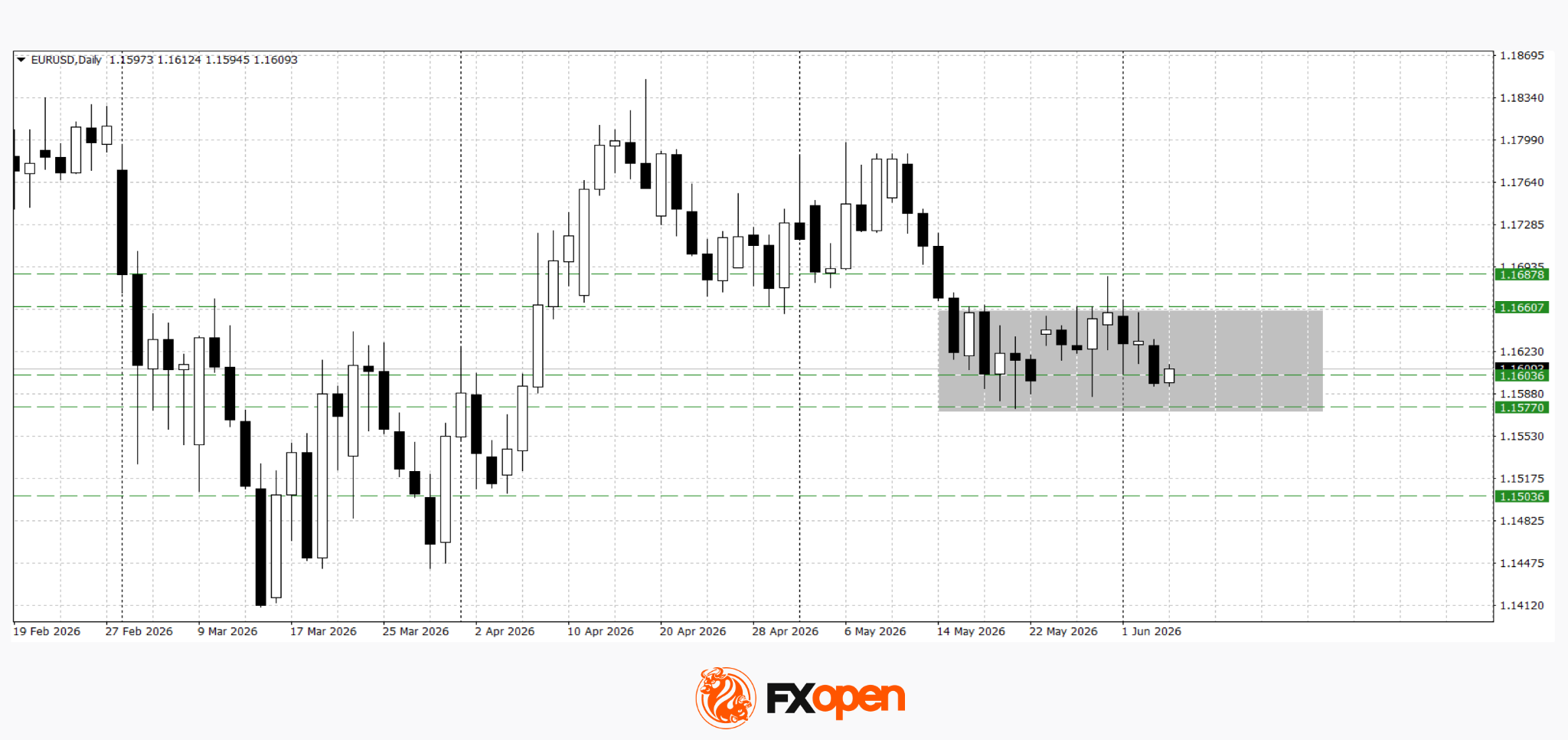
EUR/USD continues to trade within its established range following the recent decline, consolidating near the lower boundary.
Technical analysis of EUR/USD points to continued sideways trading within the 1.1570–1.1660 range. Should US data come in strong, pressure on the pair could intensify, potentially leading to a break below the lower boundary of the range and the beginning of a new bearish impulse. Conversely, if incoming data disappoint market expectations, EUR/USD may strengthen above 1.1660.
Key events for EUR/USD:
- today at 10:30 (GMT+3): Germany S&P Global Construction PMI;
- today at 15:30 (GMT+3): US Initial Jobless Claims;
- today at 20:00 (GMT+3): speech by Federal Open Market Committee (FOMC) member Mary Daly.
GBP/USD
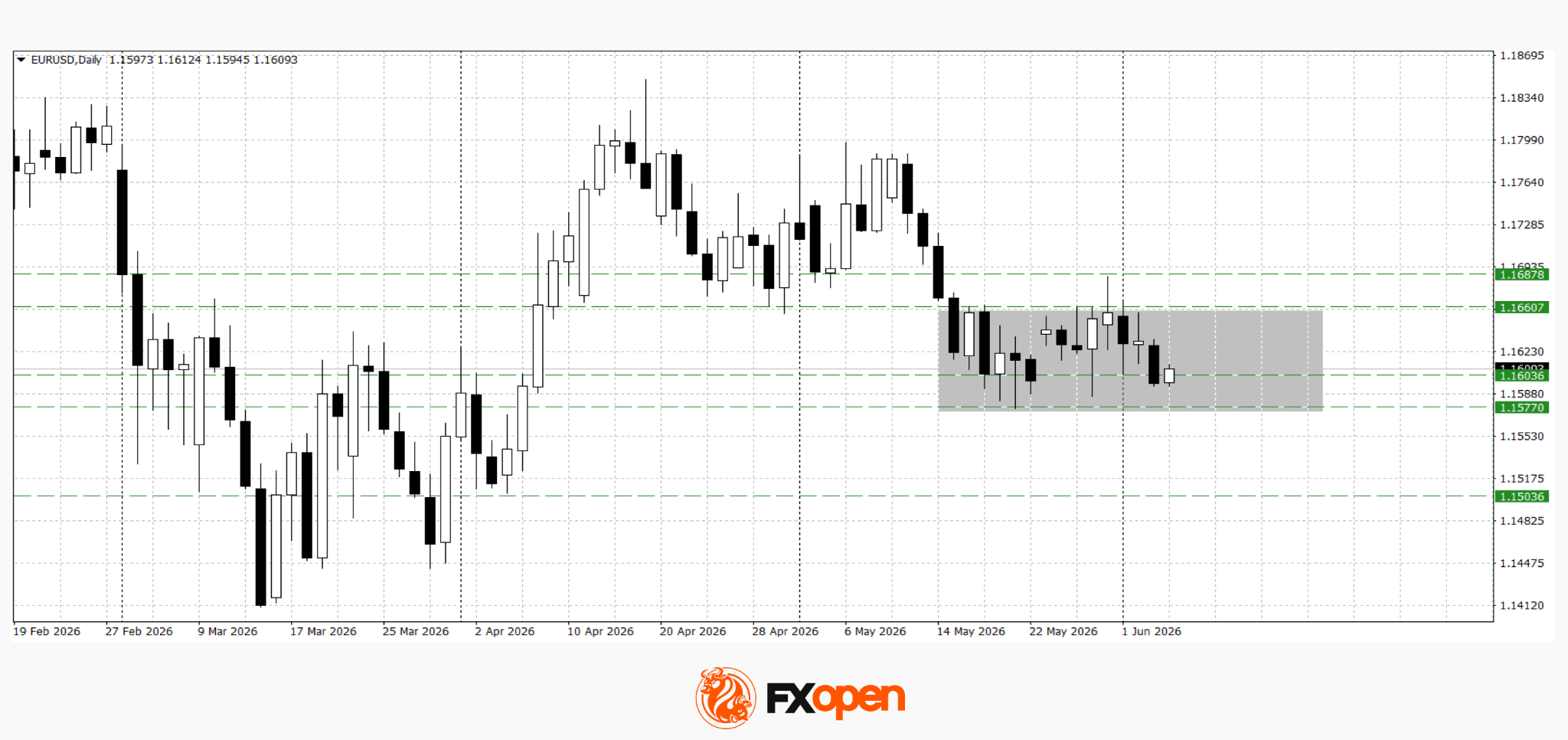
GBP/USD also remains under pressure following its recent decline. Sterling previously attempted to develop an upward correction; however, buyers failed to establish themselves above local resistance levels. As a result, the pair has returned to the range between 1.3360 and 1.3480, where a balance between buyers and sellers is currently taking shape.
Technical analysis of GBP/USD suggests the possibility of a test of the lower boundary of this range. A decisive move below 1.3360 could lead to a retest of the recent low near 1.3300. If buyers manage to secure a foothold above 1.3480, a move towards the 1.3510–1.3550 area may follow.
Key events for GBP/USD:
- today at 11:30 (GMT+3): UK Construction PMI;
- today at 18:40 (GMT+3): speech by Bank of England Governor Andrew Bailey;
- tomorrow at 13:30 (GMT+3): UK mortgage lending data.
Key takeaways
The dollar continues to enjoy an advantage thanks to resilient US economic indicators and expectations of further labour market data. At the same time, EUR/USD and GBP/USD are trading close to important technical support levels, making the upcoming data releases a key factor for the market’s next move. Strong US figures could increase pressure on European currencies and trigger downside breakouts from their respective ranges, while weaker data may support a corrective recovery in both the euro and sterling.
Trade over 50 forex markets 24 hours a day with FXOpen. Take advantage of low commissions, deep liquidity, and spreads from 0.0 pips (additional fees may apply). Open your FXOpen account now or learn more about trading forex with FXOpen.
This article represents the opinion of the Companies operating under the FXOpen brand only. It is not to be construed as an offer, solicitation, or recommendation with respect to products and services provided by the Companies operating under the FXOpen brand, nor is it to be considered financial advice.

Ripple XRP is trading at $1.16, down roughly 10% over the past seven days, after crashing to a multi-month low that landed, with painful irony, on the token’s 14th birthday.
The drop briefly sent XRP below $1.20, a level not sustained since the early February selloff, and the full story is worse than the headline price suggests.
Multiple support layers have now been compromised, and the market structure heading into this week offers little comfort for holders still averaging down.
On June 2, 2012, Ripple co-founder Arthur Britto released the lines of code that minted 100 billion XRP tokens, the genesis of the entire ecosystem.
Thirteen years later, the birthday present was a flash dump to $1.20, roughly $30 million in leveraged liquidations, and a market cap collapse from above $85 billion to below $75 billion in a matter of days.
The indignity didn’t stop there: USDC has now surpassed XRP as the fifth-largest cryptocurrency by market cap on CoinGecko.
The broader altcoin market is providing no tailwind. Risk-off sentiment is dominant, and XRP’s repeated failure to break the $1.50–$1.60 resistance band, most recently rejected at $1.55 in mid-May, has left the chart structurally weak as sellers reassert control.

Discover: The Best Crypto to Diversify Your Portfolio
Can Ripple XRP Reclaim $1.40 Support or Is a Deeper Drop to Below $1.00 Next?
XRP is sitting at $1.152 on the daily chart, and the price is now testing the February low, which was the most important support level on this entire chart.
That February wick down to $1.10 to $1.12 is the last floor standing, and XRP is sitting right on top of it after a sharp 3-week sell-off that has completely unwound the March to May recovery from top to bottom.
The 4 months of base building between $1.20 and $1.60 has been entirely erased in a matter of weeks, which is a significant structural failure and tells you the demand that was holding that range was not as strong as the chart suggested at the time.
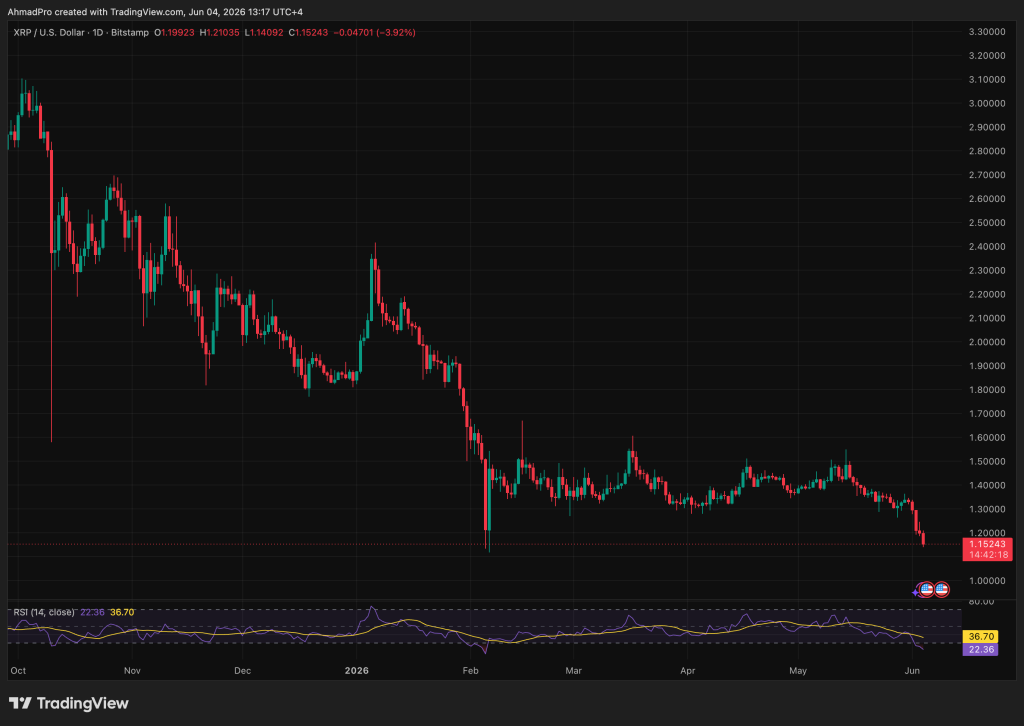
A daily close below $1.10 puts XRP in genuinely uncharted territory on this timeframe, with no meaningful support below, and the next reference point would have to come from much longer-term charts going back to 2024 lows.
On the upside, $1.30 is the first level that needs to be reclaimed to even begin talking about recovery, and above that, $1.50 is the range midpoint that would need to flip before any bullish narrative can rebuild.
The only marginal positive is that price is sitting at a historically significant bounce zone and the sell-off has been sharp and fast, which can sometimes lead to relief bounces before any continuation lower.
But the structure is broken, the base failed, and until $1.10 proves it can hold on a daily close basis, this chart has more downside risk than upside potential right now.
Discover: The Best Token Presales
Here is Why Smart Money is Rotating Into Projects Like Bitcoin Hyper
When an established altcoin loses 9% in a week, flips every key level from support to resistance, and surrenders its top-5 market cap ranking to a stablecoin, that is not noise. That is the market sending a signal.
Capital rotating out of mid-cap altcoins with large overhead supply historically finds its way into early-stage plays where the upside has not been priced in yet. Bitcoin Hyper is sitting directly in that path.
The project is in presale at $0.0136811 with $32.8 million already raised. That figure reflects genuine conviction. The core claim is worth paying attention to: Bitcoin Hyper bills itself as the first Bitcoin Layer 2 with full Solana Virtual Machine integration, promising sub-second finality and smart contract execution that outpaces Solana itself while staying anchored to Bitcoin’s security model.
A Decentralized Canonical Bridge handles BTC transfers across chains. High-speed low-cost execution and a high APY staking mechanism round out the infrastructure stack.
This is where serious capital tends to accumulate early. Before the product is proven. Before the market cap reflects what is being built.
The post Ripple XRP Just Crashed to a Multi-Month Low on Its 14th Birthday appeared first on Cryptonews.
The BitMEX co-founder said on X that he had dumped all of his HYPE and NEAR, adding that he would be posting an essay explaining his decision, titled “Reality Test.”
He pointed to a few different reasons for becoming more cautious with his positions. These included higher energy prices due to the war in Iran, companies rebuilding their inventories, upcoming AI IPOs, and the possibility that President Donald Trump could turn against the AI sector before the midterm elections.
In simple terms, Hayes appears to warn that the market might be approaching a local top between now and September.
I just dumped my entire $HYPE and $NEAR position, I will explain why in my essay “Reality Test” dropping next Tuesday.
TLDR:
– Higher energy prices due to Iran war and inventory restocking
– 3 Mega AI IPOs between now and early Q3
– Prediction that Trump goes anti-AI to win…— Arthur Hayes (@CryptoHayes) June 4, 2026
HYPE Price Tanks
Hayes’ post came during a rough day for HYPE’s price. The cryptocurrency is trading at slightly above $65 at the time of this writing, down around 10% in the past 24 hours.
However, it’s worth noting that HYPE remains up about 16% for the week, making it the best performer among the top 10 cryptocurrencies by total market cap. In fact, it’s the only one charting an increase on the weekly chart.
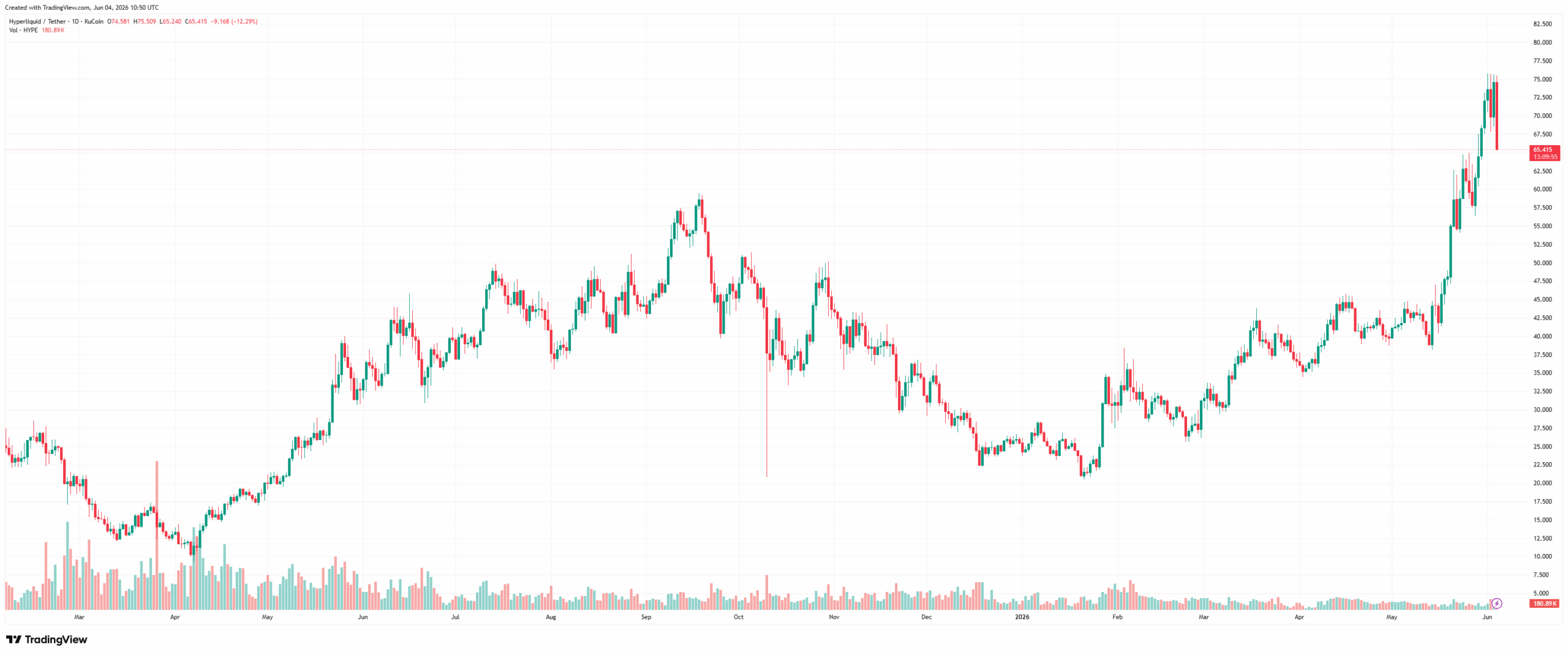
The timing of his sale drew attention because he had recently been very positive on HYPE, suggesting that it could reach $150. That led traders to question whether he had changed his mind rather quickly or was just taking profits after a strong move. In any case, it’s far from the first time he does it.
Others are Buying
While Hayes has been “dumping,” others have been buying. Hyperliquid Strategies just announced that they have bought another 1.4 million HYPE, worth roughly $95 million, over the past 7 days. Their cash position fell by $15.5 million.
The firm now holds about 23.7 million HYPE and about $141.7M in cash.
This also means that at current HYPE prices, their stock trades at 1.29x net asset value (NAV), which allows them to issue more ATM shares, sell them, and buy more HYPE.
The post Arthur Hayes Sells HYPE and NEAR After Recent Bullish Calls appeared first on CryptoPotato.
JPMorgan (JPM) said the proposed U.S. crypto market structure bill, known as the Clarity Act, may have only a limited window for passage this year as the congressional calendar tightens ahead of the midterm elections and debate over stablecoin yield remains unresolved.
“With the U.S. midterms approaching, the legislative window for passage of the Market Structure Bill has narrowed, which could postpone progress on
crypto market-structure reform this year,” wrote analysts led by Nikolaos Panigirtzoglou in the Wednesday report.
The bill cleared the Senate Banking Committee on May 14, but must still secure 60 votes in the full Senate, be reconciled with House legislation and receive the president’s signature. Those remaining steps, coupled with growing pushback from the banking industry, have lowered expectations that the measure will be enacted this year, the analysts said.
Timing could also prove significant. A compromise reached before the midterms could look materially different from one negotiated after the elections, when political incentives may shift.
The Clarity Act is widely viewed as the crypto industry’s most important legislative priority because it would establish the first comprehensive federal framework governing digital assets in the U.S.
Supporters say the bill would resolve long-running uncertainty over whether cryptocurrencies fall under the Securities and Exchange Commission (SEC) or Commodity Futures Trading Commission (CFTC), replacing years of regulation-by-enforcement with clearer rules for issuers, exchanges and investors.
Industry advocates argue that greater regulatory certainty could unlock institutional participation, encourage investment and innovation, and help keep crypto businesses and capital in the U.S. rather than overseas markets with more developed digital-asset regimes.
A central point of contention is the treatment of stablecoin yield. The bank’s analysts said the legislation is intended to prohibit “passive” yield, effectively interest paid on stablecoin balances, while allowing rewards tied to activity such as payments, transactions, loyalty programs and trading incentives. However, the bill’s current language is less explicit about banning interest on balances than policymakers have suggested.
The distinction is critical because it determines whether stablecoins can function as substitutes for bank deposits, according to the report. The carveout is designed to preserve stablecoins’ role in payments and settlement while preventing them from evolving into lightly regulated savings products.
Banks have pushed for tighter restrictions, arguing that stablecoin issuers do not face the same insurance, supervisory and prudential requirements as regulated depository institutions. Crypto firms, meanwhile, have sought greater flexibility to offer yield-bearing products. JPMorgan said the dispute has become a major obstacle to advancing the legislation and remains politically sensitive.
Should lawmakers ultimately impose effective limits on passive stablecoin yield, the bank expects the trend of idle crypto capital flowing into tokenized Treasuries, digital money-market funds and tokenized deposits to accelerate.
While that outcome may disappoint crypto-native firms that have advocated for yield-bearing stablecoins, the bill would still preserve some activity-based rewards. The report also emphasized that the current legislative text leaves room for interpretation because it does not explicitly prohibit interest on balances.
Read more: Clarity Act could spark a boom in crypto ‘yield-as-a-service’


- BONK coin price is down 11% in a week despite new PartyBet and BONKUJI developments.
- BONKUJI has relaunched with a 90% card-value buyback feature.
- Traders should closely watch the support at $0.00000470.
Despite ranking as the most trending cryptocurrency on various platforms, the price of BONK coin has been on a rather bearish trend.
The BONK memecoin has struggled to gain momentum even as the project continues to expand its ecosystem through new products and partnerships.
While recent developments, including a sports prediction and casino gaming partnership with PartyBet and updates to the BONKUJI platform, have generated attention within the Solana ecosystem, those developments have not translated into a meaningful recovery in the BONK price.
At press time, BONK coin was trading at approximately $0.00000485 after falling 5.5% over the previous 24 hours.
Notably, the decline extends losses recorded over longer timeframes, with BONK down 11% over seven days, 20.7% over 14 days, 23.3% over the past month, and more than 71% over the last year.
BONK’s partnership with PartyBet
One of the most notable developments for the project came when BONK announced a partnership with PartyBet, a platform focused on Telegram-based sports prediction markets and casino-style games.
The deal expands the utility of BONK beyond its role as a memecoin by introducing another avenue for community participation.
Sports prediction markets have gained traction across the crypto industry as users look for alternative ways to engage with digital assets beyond simple trading.
The partnership also highlights BONK’s continued push to build products within the Solana ecosystem.
Over the past year, the project has evolved from being viewed primarily as a speculative token into a broader ecosystem that includes trading tools, gaming initiatives, and community-driven applications.
Despite the positive headlines, the BONK memecoin price has remained under pressure.
Trading volume stood at approximately $42.7 million during the latest 24-hour period, reflecting relatively muted market participation compared to periods of stronger investor demand.
BONKUJI relaunch also fails to lift BONK coin
Another recent development involved BONKUJI, one of the latest products associated with the BONK ecosystem.
On June 3, the official BONK account announced that BONKUJI had returned following maintenance work.
The team stated that feedback from waitlist participants helped improve the platform and make it more user-friendly.
The update also introduced a buyback mechanism valued at 90% of a listed card’s value while reopening access to the waitlist.
While the announcement attracted attention within the BONK community and represented another step in the project’s efforts to increase engagement among users, the price remained subdued.
Broader crypto market weakness weighs on BONK
The recent price action suggests that BONK has been moving largely in line with the wider cryptocurrency market.
Bitcoin, the leading cryptocurrency, has declined by roughly 5% today as the broader crypto market also recorded significant declines, reflecting a risk-off environment that has pressured higher-risk assets.
Memecoins have been among the hardest-hit segments of the market during recent weeks.
As investor appetite for speculative assets weakened, many traders shifted capital toward larger and more established cryptocurrencies.
That trend appears to have affected BONK as well, with market data showing declining trading activity alongside falling prices, a combination that often points to reduced buying demand.
BONK coin price forecast
Amid the bearish market conditions, technical analysts continue to focus on several key levels that could determine the next major move for BONK coin.
SpearTrades recently highlighted a long-term descending support trendline that BONK had respected for more than two years.
According to the analyst, the token recently slipped below that structure, creating uncertainty about its longer-term direction.
The analyst identified $0.00000614 as an important upside level. A successful move above that area would provide stronger confirmation that buyers are regaining control.
Beyond that, the next major resistance level sits near $0.00001048.
Another market analyst, Sjuul of AltCryptoGems, pointed to a potential bullish “Power of Three” formation developing on the BONK chart.
According to Sjuul of AltCryptoGems’ analysis, a break above a key support-resistance area could trigger a stronger expansion phase.
Ok, time for some bull posting!$BONK is starting to look promising here, trying to form a bullish power of three.
All we need now is to break above that support level, and we can have a nice expansion! pic.twitter.com/nz5pZMvyRp
— Sjuul | AltCryptoGems (@AltCryptoGems) June 3, 2026
On the downside, traders should watch the $0.00000470 area closely.
A break below that level could expose BONK to additional weakness and increase the possibility of a retest of the $0.00000450 zone.
Crypto World
Hyperliquid Is Outperforming Solana on Price, But Can a Perps DEX Actually Flip a $38 Billion Network?
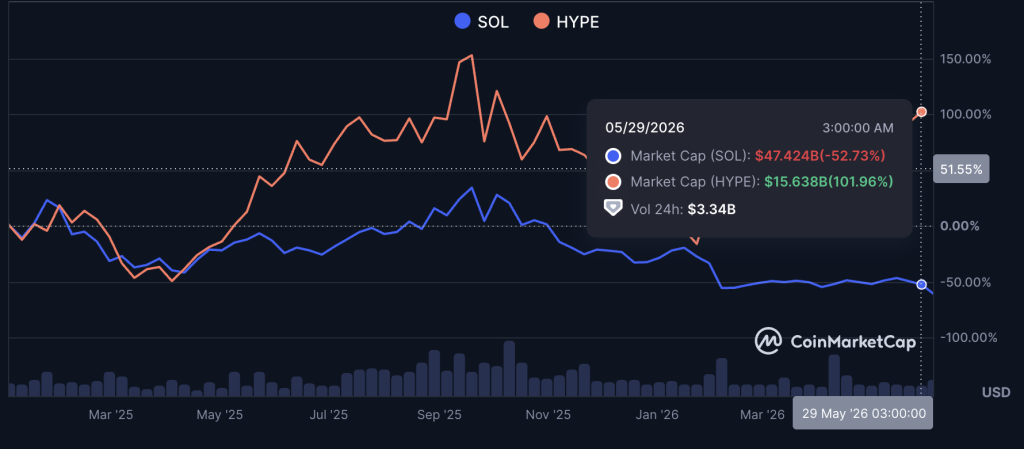
Hyperliquid (HYPE) is outpacing Solana (SOL) on price, and the gap is widening. SOL has dropped to its lowest level since 2023, caught in a broader DeFi rotation out of general-purpose L1S, while HYPE has absorbed that displaced capital and kept climbing.
But price momentum and market cap dominance are different animals. Solana’s circulating market cap still sits above $38 billion, backed by institutional infrastructure, CME futures, spot ETF flows, and Tier-1 collateral status across every major prime brokerage, which Hyperliquid has not built and cannot replicate quickly.
The flippening narrative is real as a trading thesis. As a structural outcome in the near term, it doesn’t hold up.
Discover: The Best Crypto to Diversify Your Portfolio
Solana vs. Hyperliquid Liquidity Moat Is Not a Talking Point, It’s a Balance Sheet Reality
The institutional crypto infrastructure gap between these 2 assets is not marginal. Solana is embedded as core collateral across centralized exchanges, institutional prime desks, and an expanding ETF ecosystem.
That collateral utility translates into structural buy pressure that exists independent of narrative cycles.
Hyperliquid is a specialized perpetual DEX, a highly optimized application-specific chain built for trading. It does that job exceptionally well.
But a specialized instrument and a platform asset are valued on entirely different frameworks, and historically, general-purpose settlement layers command a significantly higher monetary premium than single-purpose trading venues.
The FDV trap is also real. Most flippening comparisons lean on Hyperliquid’s fully diluted valuation rather than the circulating market cap.
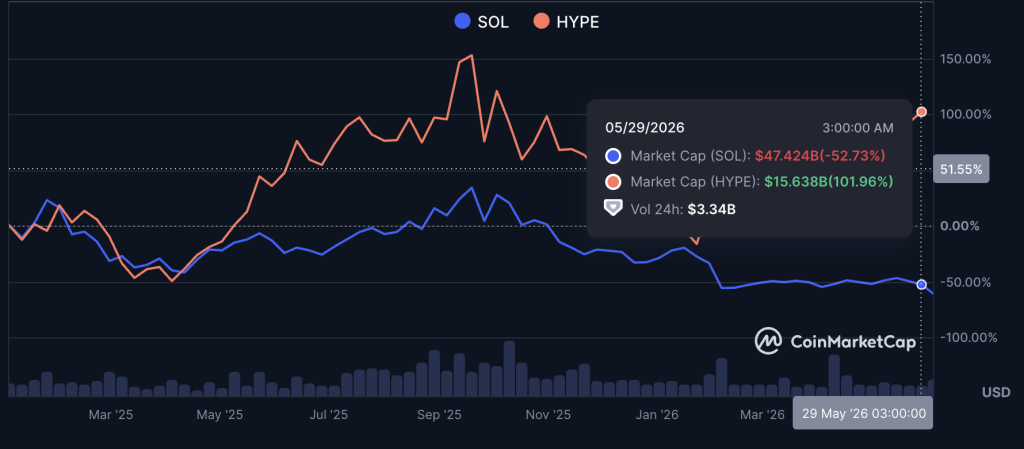
For HYPE to overtake SOL on a circulating basis, it would need to sustain current price levels while its float expands materially over the next 2 to 4 years, a dilution challenge Solana has already largely navigated through its own post-2022 rebuild.
Consider the liquidation asymmetry. The $1.1 billion market-wide liquidation event that accelerated SOL’s drop to 2023 lows also stress-tested Hyperliquid’s risk infrastructure.
HL’s protocol survived, but the episode underscored that its resilience is still being established in real time, while Solana’s depth absorbs that kind of volatility without structural impairment. Understanding how capital rotation dynamics actually move between asset classes matters here; money flowing into HYPE is not the same as money building institutional infrastructure around it.
Solana’s network effects run deeper than trading. Visa integrations, DePIN protocols, thousands of active applications, these create diversified fee revenue and ecosystem stickiness that a perps-focused AppChain simply cannot replicate. S
OL’s revenue doesn’t collapse if derivatives volume drops 40%. HYPE’s revenue thesis depends almost entirely on sustained leverage demand.
The Hype Bull Case Is Serious, Don’t Dismiss It
Arthur Hayes has publicly argued HYPE can outperform SOL before this bull cycle ends, leaning on Hyperliquid’s fee revenue trajectory and the durability of speculative demand.
However, at the time of writing, he published a post saying he dumped his entire stack.
Syncracy Capital’s Daniel Cheung framed Hyperliquid as “the main chain where trading activity is happening” and the venue “bringing new users into crypto right now”, citing its 24/7 markets as a structural advantage over venues constrained by traditional market hours.
The mindshare argument is genuine. When a protocol becomes the default destination for active traders, that creates compounding volume effects that are hard to dislodge.
Discover: The Best Token Presales
The post Hyperliquid Is Outperforming Solana on Price, But Can a Perps DEX Actually Flip a $38 Billion Network? appeared first on Cryptonews.
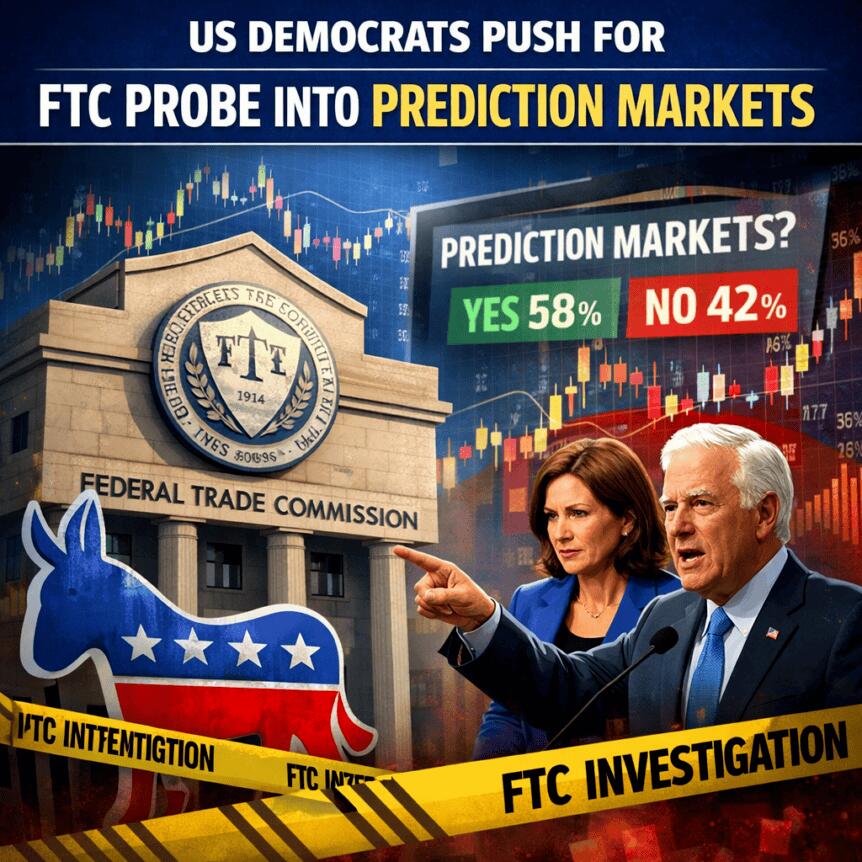
Nine Democratic lawmakers in the U.S. House of Representatives have urged the Federal Trade Commission to open an inquiry into how prediction-market platforms market themselves to consumers versus how they present their activities to regulators. In a letter released this week, Representatives Kevin Mullin and Gabe Vasquez contend that online prediction markets describe themselves as gambling platforms in marketing materials while telling regulators they are financial tools offering investment products. They call for the FTC to investigate whether the advertising and public messaging mislead consumers about the applicable rules and protections.
The request arrives amid ongoing congressional scrutiny of Kalshi and Polymarket following insider-trading concerns on those platforms. Congress launched a probe in May into the two companies’ responses to insider-trading incidents, underscoring regulators’ heightened attention to how these markets operate and how they are regulated. The lawmakers’ letter seeks detailed information by June 29 on whether the FTC plans to take investigative or enforcement action against prediction-market platforms for potential deceptive practices, and whether the agency has received consumer complaints or considers public perception and legal filings when evaluating such conduct.
Prediction markets, which allow traders to place contracts on the outcomes of future events, have grown into a notable real-world use case for blockchain technologies. Some platforms settle transactions using crypto rails and stablecoins, a factor that has attracted institutional attention and regulatory interest. March data showed a surge in prediction-market activity as investors and the public engaged with contracts around political and geopolitical events, reflecting broader accessibility and a shifting regulatory posture for the industry.
A group of nine Democratic lawmakers is calling on the FTC to launch a probe into prediction markets. Source: Kevin Mullin
In the letter, Mullin stated: “These prediction market companies are presenting themselves differently to regulators than they are to the public, and that kind of contradictory messaging can mislead consumers about what rules and protections actually apply. We are urging the FTC to investigate these practices and ensure consumers are protected from this potentially deceptive activity.”
Among the signatories are Representatives Jared Huffman, Raul Ruiz, Salud Carbajal, Mike Levin, Dina Titus, Paul Tonko, and Valerie Foushee, in addition to Mullin and Vasquez. The lawmakers are seeking clarity on how the FTC interprets and enforces consumer-protection standards in relation to platforms that operate at the intersection of gambling labels, financial instruments, and crypto-based settlement rails.
As coverage of the evolving regulatory landscape notes, the case against prediction markets sits at the nexus of consumer protection, financial-market supervision, and digital-asset oversight. Kalshi’s and Polymarket’s experiences have already drawn attention from lawmakers concerned about insider trading and platform governance. Kalshi, in particular, has faced scrutiny over election-betting activity and related restrictions, which have fed into broader debates about market integrity and disclosure requirements.
Key takeaways
- The FTC is being urged to investigate whether prediction-market platforms misrepresent themselves to consumers by advertising as gambling venues while describing their services to regulators as financial tools offering investment exposure.
- The lawmakers request a formal update from the FTC by June 29 on whether enforcement action is planned for potential deceptive practices and whether complaints have been received.
- The push follows a congressional probe into Kalshi and Polymarket over insider-trading incidents, highlighting ongoing regulatory interest in governance and market integrity.
- Prediction markets have grown as a real-world blockchain use case, with settlements increasingly leveraging crypto rails and stablecoins; March transaction volumes reached record levels amid rising interest in political and geopolitical event contracts.
- The letter is signed by nine lawmakers, indicating sustained congressional attention to the regulatory and compliance dimensions of prediction-market platforms.
Regulatory framing and enforcement risk
The core question raised by the lawmakers concerns how platforms classify and communicate their business model. If a platform markets itself as a sports-betting-like product while presenting itself to regulators as a financial tool or investment product, questions arise about the consistency of disclosures, consumer protections, and licensing obligations. The potential for misalignment between public-facing advertising and regulatory filings could implicate a range of enforcement authorities, including state gambling regulators, the Commodity Futures Trading Commission, and the Federal Trade Commission’s consumer-protection remit.
From a legal and compliance perspective, the discrepancy matters because it shapes which rules apply to user interactions, marketing disclosures, know-your-customer and anti-money-laundering controls, and the scope of permissible marketing claims. If regulators determine that platforms employ misleading or deceptive practices, consequences could extend beyond remedial disclosures to penalties, corrective advertising requirements, or restrictions on specific product features. The discussion also intersects with broader regulatory developments for digital assets, including how stablecoins and crypto settlement rails are treated under consumer-protection and financial-market rules.
The debate sits within a larger policy environment that is increasingly attentive to how digital markets intersect with traditional framework considerations. While the EU’s MiCA framework aims to harmonize crypto-asset regulation, U.S. agencies—such as the FTC, the SEC, and the CFTC—continue to refine an enforcement and oversight posture for platforms that blend gambling-like marketing with financial-instrument claims. For platforms operating across borders, this creates a heightened need for clear, consistent disclosures and robust compliance programs to manage cross-jurisdictional differences.
Political scrutiny and ongoing probes
The letter’s timing aligns with ongoing congressional scrutiny of prediction-market platforms, particularly in light of insider-trading concerns that have prompted formal inquiries. The May probe into Polymarket and Kalshi highlighted regulators’ focus on how these platforms handle information, market integrity, and user protections. Lawmakers have sought to understand responses to incidents on these platforms and how governance, disclosures, and enforcement actions would address potential conflicts of interest and market manipulation risks.
In parallel, the industry has emphasized the practical uses of prediction markets for forecasting and hedging, aided by technological rails that leverage blockchain infrastructure. The regulatory conversation thus far has centered on whether such markets should be treated as gambling products, financial instruments, or a hybrid with distinct regulatory obligations. The June deadline for the FTC to outline potential enforcement actions underscores the degree to which federal regulators may shape the operational boundaries for prediction-market operators in the near term.
Public reporting on Kalshi’s actions—such as incidents involving political betting—has contributed to a broader conversation about how platforms guard against misuse and how they communicate risk and compliance standards to users. As the sector evolves, the alignment of marketing, product design, and regulatory disclosures remains a focal point for policymakers and industry participants alike.
Operational implications for platforms and market structure
Prediction markets’ growing adoption has been supported by the use of crypto rails for settlement and payments, as well as the reliability of stablecoins to facilitate cross-border transactions and liquidity management. This operational model raises specific compliance considerations, including AML/KYC controls, sanctions screening, and the need for transparent disclosures about the nature of the instruments being traded and the protections users can expect. If enforcement actions materialize, platforms may face new licensing requirements or restrictions that affect market access, product features, or advertising practices.
From an institutional standpoint, the regulatory lens on prediction markets could influence how exchanges and financial intermediaries interact with these platforms. Banks and custodians evaluating participation in crypto-asset ecosystems may take cues from the FTC’s actions and related regulatory signals when assessing risk, client disclosures, and the suitability of offering or supporting prediction-market services within a regulated framework. The evolving policy environment also shapes how cross-border collaboration and data-sharing arrangements could support or constrain enforcement and vigilance efforts.
Looking ahead, the outcome of the FTC inquiry—along with continued congressional oversight—could recalibrate the balance between innovation and protection in the prediction-market space. As platforms optimize governance, disclosure, and compliance to meet stricter expectations, the industry may see clearer delineations of permissible advertising versus regulatory classifications, with potential implications for licensing trajectories and investor protections.
Related developments continue to unfold, including case studies of platform governance and enforcement risk. For instance, coverage of Kalshi’s and Polymarket’s experiences highlights that market integrity, transparency, and consistent messaging are central to regulatory confidence. These considerations are likely to inform ongoing policy deliberations and the practical design choices of prediction-market operators as they navigate a rapidly evolving, cross-jurisdictional landscape.
Closing perspective: As the FTC weighs a formal stance, stakeholders should monitor not only the agency’s forthcoming action but also complementary regulatory signals from state authorities and other federal agencies. The convergence of consumer protection, financial-market oversight, and digital-asset regulation in this space will shape the governance, licensing, and operational thresholds for prediction markets in the months ahead.

Key Takeaways
- Athletic apparel company Lululemon releases fiscal Q1 FY26 results after today’s closing bell on June 4, with analysts projecting earnings of $1.68 per share — representing a 35.3% decline from last year’s quarter
- Analysts forecast revenue growth of approximately 2.5%, reaching $2.43 billion
- Shares have tumbled more than 39% since the start of the year amid heightened competition, tariff headwinds, and weakening consumer demand
- The options market suggests traders are anticipating approximately a 10% swing in the stock following the earnings release
- Analyst consensus stands at Hold, with a mean price target of $169.53 — representing potential upside of roughly 34.5% from current trading levels
Athletic apparel retailer Lululemon Athletica (LULU) is scheduled to unveil its fiscal first quarter FY26 financial results following market close today, June 4. Currently trading near $126, shares have plunged more than 39% year-to-date, with Wall Street maintaining tempered expectations for the quarterly release.
Lululemon Athletica Inc., LULU
Wall Street forecasts earnings per share of $1.68 — marking a steep 35.3% decline compared to the year-ago period. On the top line, analysts anticipate revenue of $2.43 billion, translating to modest year-over-year growth of 2.5%.
The bearish profit forecast stems from mounting challenges including tariff-induced cost pressures and sluggish demand across U.S. markets. Discretionary consumer spending has faced headwinds, and Lululemon has not escaped these market dynamics.
Ahead of the earnings announcement, the company eliminated a potential distraction by resolving its proxy battle with founder Chip Wilson through an agreement on two board nominations. This settlement clears away some uncertainty surrounding the release.
Analyst Sentiment and Key Focus Areas
Evercore analyst Michael Binetti lowered his price objective from $175 to $130 while maintaining a Hold rating. His primary concern centers on the possibility of a “significant reset” to full-year FY26 projections, though he acknowledged the stock’s valuation has become increasingly compelling.
Rick Patel from Raymond James also maintains a Hold rating. His analysis suggests Q1 performance should exceed the company’s conservative internal projections, citing sequential improvements in both physical store traffic and online visitor metrics. However, his research uncovered mixed signals — notably, mobile application monthly active users demonstrated deceleration.
Patel’s attention focuses on whether fresh product introductions can spark renewed customer interest. The Get Low collection launched in January failed to resonate with the customer base. On a more positive note, his field research indicates stronger reception for the Unrestricted Power and ShowZero product lines. While cautiously hopeful, he remains unconvinced these represent transformative catalysts.
“Net, we see potential for estimates to increase but believe it’ll take more time for LULU to earn confidence that this is the beginning of a durable turnaround,” Patel said.
Valuation Metrics and Corporate Insider Moves
LULU currently trades at a P/E multiple of 9.37x, significantly compressed compared to historical norms. The forward-looking P/E of 10.13 indicates market expectations for continued subdued expansion.
The company’s GF Score registers at 77/100, with both profitability and growth metrics achieving top marks of 10/10. Financial strength earns a 6/10 rating, while momentum receives an F grade — mirroring the stock’s dismal year-to-date performance.
Corporate insiders have demonstrated buying activity, with two separate purchases during the previous three months totaling 9,365 shares. These transactions may indicate internal optimism despite external challenges.
The options market is pricing in approximately a 10% post-earnings movement in either direction. For perspective, LULU’s historical average absolute post-earnings move across the last four quarters has been 12.95%.
The Street consensus stands at Hold, derived from 20 Hold recommendations and one Buy rating. The mean analyst price target of $169.53 suggests potential appreciation of approximately 34.5% from present levels.

Polymarket has officially finalized one of this year’s most controversial events. It’s a prediction market on whether Strategy will sell Bitcoin in May, and it resolved to “No,” meaning that, according to the platform, the company didn’t sell BTC that month.
Here’s the kicker: the firm did sell BTC in May, as confirmed not only by its executives but also by an official filing with the US Securities and Exchange Commission. So what’s the reason for the resolution, you may ask? Well, the fact that confirmation came after the deadline.
The decision rests entirely on the timing of the announcement. The filing came on June 1st (which is what literally everyone expected, because that’s when these filings are… filed), after the May 31 deadline had passed.
Polymarket’s decision has drawn massive criticism not only because of the outcome, but because the platform added a clarification after the market had closed, stating that announcements made after the deadline would not count toward resolution, as seen in the screenshot below.

What is even odder is that all subsequent time frames for the new markets for the same event lack this “additional context,” meaning traders can be easily misled again.
Critics argue that this effectively changed the market’s rules after traders had already taken their positions, which is objectively true. Many traders started taking positions on June 1st (which is after the deadline), because the market hadn’t been closed by Polymarket yet.
A May Sale, a June Filing
To give further context on the happening – at the center of this dispute is the difference between when an event took place and when it became publicly confirmed – these are two completely separate events. One is tied to an objective outcome; the other is tied to the announcement of that outcome. Had the event been framed as “MicroStrategy confirmed to have sold any of its Bitcoin by 11:59 PM ET on May 31,” then there is no room for interpretation.
But the market was “MicroStrategy sells any of its Bitcoin by 11:59 PM ET on May 31,” which they did. It was just announced later.
Polymarket didn’t treat the actual outcome as decisive – it treated the time of the announcement. Even though this distinction may seem technical, it has huge implications for traders. A market framed around whether a company sold Bitcoin can produce one answer if judged by the transaction date, and the opposite answer if judged by the disclosure date.
A Rule Changed After the Fact
What made this entire thing even more contentious is the fact that Polymarket added its “post-deadline announcements do not count” rule only after the market had been closed.
This raises very serious questions. Prediction markets depend on participants knowing the settlement criteria before they trade. Retroactively changing those criteria, especially after the relevant event has occurred, risks undermining confidence in the platform’s broader neutrality.
A trader claimed to have lost around $500K after backing the “Yes” side, while other observers criticized the decision. The controversy has also sparked broader concerns about how prediction markets handle events that occur before a deadline but are confirmed only afterward.
So, to put it in simple terms – Strategy did sell BTC in May according to its own filing. According to Polymarket, it didn’t.
The post Strategy Didn’t Sell Bitcoin in May, According to Polymarket appeared first on CryptoPotato.

The SEVEN Things You NEED To Learn for Your Financial FREEDOM – Robert Kiyosaki

The street in Makerfield divided over the by-election

Bitcoin Longs Liquidated Over $600M as BTC Tests $60K



-

 Tech6 days ago
Waymo dominates autonomous vehicle registrations as Tesla trails behind
-

 News Videos6 days ago
This is BROKEN! INSANE 5x MONEY CAR WASH WEEK! The NEW GTA Online UPDATE Today! (GTA5 New Update)
-
 Tech5 days ago
SpaceX just won a second Golden Dome contract. This one is $4.16 billion.
-

 Business3 days ago
Jade Biosciences, Inc. (JBIO) Discusses Positive Interim Results From JADE101 Phase I Healthy Volunteer Study and Development Plans Transcript
-

 News Videos6 days ago
SHE IS KILLING XRP!!! WATCH URGENT AND ACT FAST
-
 NewsBeat5 days ago
FIRST NIGHT REVIEW: Take That bring the Circus back to life in spectacular sun-soaked style
-

 Business5 days ago
Is the Spurs Phenom Already Better Than Prime Diesel?
-
 Crypto World6 days ago
CFTC Has Approved the First Regulated Bitcoin Perpetual Contract in the U.S.
-

 Politics5 days ago
The House | Inside Andy Burnham’s Makerfield Campaign: “Nobody Thinks This Is In The Bag”
-

 Sports2 days ago
French Open 2026 results: Alexander Zverev beats Rafael Jodar and will play Jakub Mensik in semi-finals
-
 NewsBeat6 days ago
Novak Djokovic v Joao Fonseca LIVE: French Open latest scores and results after Jannik Sinner’s shocking collapse
-
 Entertainment5 days ago
Weak ‘Supergirl’ Box Office Tracking Amid Milly Alcock Backlash
-
 Crypto World6 days ago
Snowflake (SNOW) Stock Rallies on Strong Q1 Results and AI Product Growth
-

 Tech2 days ago
CryZENx Releases Fresh Playable Content Deep Inside Jabu-Jabu for His Ocarina of Time Remake
-

 Entertainment6 days ago
Maddox Jolie-Pitt Legally Requests to Drop Brad’s Surname
-

 Business5 days ago
Demand Conditions Improve In Chemicals Sector In April 2026
-
 Entertainment5 days ago
One of the Greatest Sitcoms of All Time Shoots Up Apple TV’s Charts 11 Years Later
-
 Crypto World6 days ago
MicroStrategy Moves $30 Million in BTC to Coinbase Prime: Is the Bitcoin Sell-Off Already Here?
-

 Tech6 days ago
This Week In Security: Ubiquiti Fixes, And FreeBSD Joins The Club You Don’t Want To Join
-
 Entertainment6 days ago
Bruce Willis’ Generosity Resurfaces Amid His Dementia
You must be logged in to post a comment Login