

Crypto World
Warren Buffet Agent (WarrenAI) AI Predicts XRP Price By End of 2026

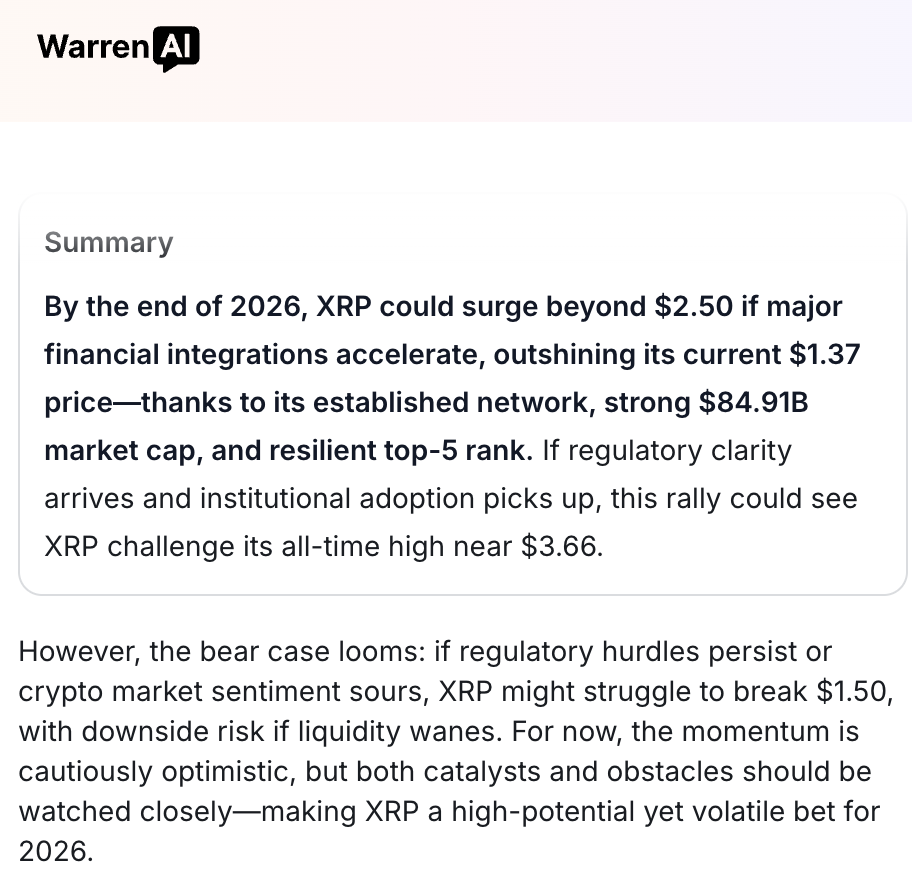
Warren Buffett built his fortune by avoiding assets he did not understand. An AI agent replicating his name and theories was asked about it XRP price prediction anyway. Warren Buffett AI predicts was more bullish than the Oracle of Omaha would ever say out loud.
Warren AI sees XRP challenging its all-time high near $3.66 by the end of 2026.
The framework is grounded in the kind of fundamental metrics Buffett actually respects. XRP is not a speculative micro-cap; it is a top-5 asset with an $84.91B market cap and an established network that has been processing real payment volume for years.
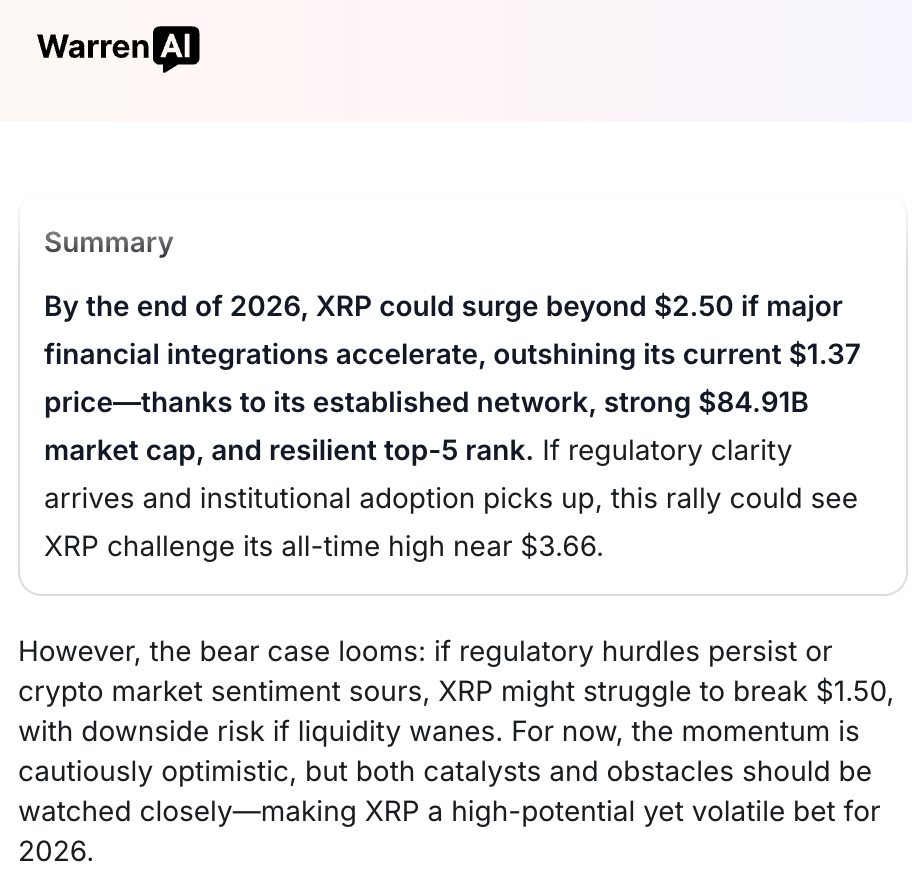
Warren AI’s base case of $2.50 is built on major financial integrations accelerating, which is a demand driver that is already partially in motion rather than hypothetical.
Regulatory clarity arriving and institutional adoption picking up are the 2 catalysts that push the prediction into ATH territory.
The AI frames XRP as a high-potential bet precisely because the infrastructure is already built and the market is underpricing what happens when institutional capital finally has both the legal clarity and the access vehicle to commit at scale.
The bear case is the most honest part of the prediction. If regulatory hurdles persist or crypto market sentiment sours, XRP might not even break $1.50, with additional downside risk if liquidity wanes.
Warren AI closes with a verdict that sounds exactly like something Buffett would say about any asset: catalysts and obstacles should both be watched closely. The momentum is cautiously optimistic, not blindly bullish.

XRP Price Prediction: After Months of Stalling, Warren AI Just Put a Predicts on What Happens When That Changes
Ripple XRP price is trading at $1.3704 on the daily, and the chart is a 10-month story of peak to trough with no convincing recovery in between.
Price peaked around $3.70 in August 2025, spent the rest of the year in a grinding descent through every attempted bounce, crashed to $1.20 in February 2026, and has been stuck in a $1.20 to $1.60 range ever since.
4 months of sideways action after a 63% drawdown is what accumulation looks like before it becomes obvious in hindsight.
The structure since February has been building quietly. Higher lows have printed consistently across March, April, and May, and each dip has found buyers at progressively higher levels.
The problem is that the ceiling has not moved. Every push toward $1.50 to $1.55 has been sold and price keeps returning to the $1.35 to $1.40 zone where it sits now.
Resistance is $1.50 to $1.55, the level that has defined the top of this recovery range for 4 months. Above it $1.60 is the next reference and $2.00 is the psychological level that separates the recovery trade from the reversal trade.
Support is $1.20 to $1.25, the February crash low and the only real floor in place. At $1.37 current price is closer to that floor than to any meaningful resistance, which is the uncomfortable reality underneath Warren AI’s bullish outlook.
Warren Buffett famously said the stock market is a device for transferring money from the impatient to the patient. Warren AI applied that same logic to XRP and came out with $3.66. The chart is asking holders to prove they are the patient ones.
Warren AI Says Liquidchain Could Be The Next Big Thing
Every cycle has a graveyard of obvious plays that stopped working right when everyone piled in.
Right now Bitcoin is consolidating, Ethereum is going nowhere, and XRP has been one senate vote away from its next leg for longer than anyone wants to admit. The upside that used to feel inevitable at these market caps is getting harder to find. The trade is crowded. The easy money is gone.
This is not pessimism. It is pattern recognition. Capital does not disappear when large caps stall. It relocates. And it always relocates before most people realize it is moving.
The projects that capture that rotation never look ready when the money starts flowing in. They look like early presales with small raise totals, teams that have not been proven yet, and solutions to problems that the entire industry acknowledges but nobody has actually fixed.
Cross-chain liquidity is exactly that problem. Bitcoin, Ethereum, and Solana are the 3 dominant ecosystems in crypto and they cannot natively communicate with each other.
LiquidChain is building above all of it. A single execution layer that treats all 3 ecosystems as one connected environment. One deployment. Full reach. No cross-chain tax on every interaction.
The presale is at $0.01454. Just over $700,000 raised.
That number means one thing. The market has not found this yet. That window has a closing date.
The risk profile is what you would expect at this stage. Nothing is proven. Adoption, liquidity, and execution are all still unknowns. That is not a disclaimer. That is the nature of the bet.
The projects that return 10x or 100x are not the ones that looked safe at entry. They are the ones who solved a real problem before the rest of the market understood it.
LiquidChain is still in that window.
The post Warren Buffet Agent (WarrenAI) AI Predicts XRP Price By End of 2026 appeared first on Cryptonews.

Bitcoin (BTC) continues to trade in a tight range around $77,000 in morning U.S. action on Wednesday. The major stock indices are posting small gains after three consecutive negative sessions.
Minutes from the Fed’s last policy meeting are due to be released at 2:00 pm ET. That April meeting was notable as it was the last to be headed by Jerome Powell, with Kevin Warsh due to be sworn in as Fed chair on Friday.
The meeting was also important for having four dissents — one from Stephen Miran, who wanted the central bank to trim rates, and three from board members who urged the Fed to drop any language suggesting an easing bias.
In the weeks since, bond markets globally have taken a major tumble as unexpected economic strength has combined with resurgent inflation to force a major reassessment from rate traders.
Nvidia (NVDA) reports its quarterly results after the close on Wednesday. A large stock price move in the tech bellwether is likely to lead to a sizable move in the Nasdaq. Traders accustomed to crypto’s correlation with that index will be keeping a close eye.

Japan is executing the most consequential crypto regulatory pivot in Asia. The country that once taxed crypto gains at up to 55%, which drove liquidity offshore and cemented its reputation as a hostile jurisdiction for active traders, has now published new rules allowing foreign trust-type stablecoins to operate as regulated payment instruments starting June 1. It’s one visible piece of a much larger regulatory reform package taking shape from Tokyo.
Even last year, Japan’s National Tax Authority currently treats most crypto gains as “miscellaneous income” in a category subject to progressive rates that reach 55% at the top bracket. This explains why high-frequency traders, market makers, and Web3 startups have been migrating to Singapore and Dubai for years.
The proposed reform targets a flat 20% settlement tax, identical to the rate applied to equities and investment trusts under Japan’s Financial Instruments and Exchange Act (FIEA). The Japan Cryptoasset Business Association has been explicit in its position papers: competing Asian hubs tax retail crypto gains at 0–15%.
BREAKING:
JAPAN’S RULING PARTY PROPOSES REDUCING BITCOIN GAINS TAX FROM 55% TO 20%
THIS IS BULLISHpic.twitter.com/iwlujrktLP
— Ash Crypto (@AshCrypto) March 7, 2025
But the tax rate is only half the mechanism. The other half is legal reclassification. For a 20% rate to apply, crypto assets, particularly large-cap tokens like BTC and ETH, must be reclassified as financial instruments under the FIEA rather than sitting in the Payment Services Act’s looser framework. This carries a downstream consequence: it makes spot and derivative ETFs legally viable, managed by licensed financial instruments business operators.
The Bitcoin ETF Gateway: Which Institutions Are Already Positioned
The US precedent is the reference point every Japanese regulator is working from. U.S.-listed Bitcoin ETFs, approved by the SEC in January 2024, drew billions in institutional inflows within weeks of launch, validating a market structure that Japan has been unable to replicate under its existing legal framework.
European UCITS structures have followed a parallel path, with major asset managers building regulated crypto exposure products under MiCA-adjacent frameworks.
Japan’s institutional groundwork is further along, as Nomura’s digital-asset subsidiary Laser Digital and Mitsubishi UFJ Trust and Banking have both been piloting tokenized securities and fund units under existing FIEA frameworks. They have publicly argued that similar structures could be applied to spot Bitcoin and Ethereum products once classification and tax rules align.
Also happening this week, SBI Holdings filed for crypto ETF products in Japan, positioning itself at the front of what would become a structurally new domestic market.
The FSA’s June 1 stablecoin framework is part of the same institutional logic. SBI VC Trade is actively exploring licensed services involving USDC under the new rules, which reclassify qualifying foreign trust-type stablecoins as Electronic Payment Instruments under the Payment Services Act. This regulated stablecoin rails, licensed intermediaries, and equivalence standards for foreign issuers, the settlement layer that a functional ETF market needs.
Discover: The best crypto to diversify your portfolio with
Japan vs. the Global Crypto Regulatory Race: Where the FSA Stands Against the CLARITY Act and MiCA
Regulatory reform is not happening in isolation. Across the Pacific, the US Senate Banking Committee advanced the CLARITY Act, which defines jurisdictional boundaries between the SEC and CFTC. Galaxy Digital’s head of firmwide research, Alex Thorn, puts the probability of the CLARITY Act becoming law in 2026 at 65% to 75%.
The EU’s MiCA framework is already live. Hong Kong launched spot Bitcoin and Ethereum ETFs ahead of Japan. Singapore maintains 0% capital gains on crypto. Japan’s advantage is not speed; it is depth, with Japan’s domestic savings pool measured in trillions.
Latham & Watkins analysts have characterized Japan’s direction as convergence toward a “rules-first but innovation-tolerant” posture, closer to MiCA in philosophy than to the US’s ongoing jurisdictional battles.
Discover: The best pre-launch token sales
The post Japan’s Crypto Revolution: 20% Tax Rate and Institutional ETF Gateway appeared first on Cryptonews.


CoW Swap, the intent-based DEX, is launching on Solana blockchain with NEAR Intents providing backend infrastructure.

Singapore’s central bank, MAS, has revoked Bsquared Technology Pte Ltd’s Major Payment Institution Licence, removing the firm’s authority to provide digital payment token services under Singapore’s Payments Services Act 2019. The suspension follows an on-site inspection that uncovered weaknesses in governance and control frameworks, including risk management practices, conflict-of-interest policies, and outsourcing oversight.
The regulator also noted that Bsquared provided false or misleading information at multiple points during the license process and the subsequent review. Bsquared, which operates under the name BSQ, received the green light to offer digital payment token services roughly 16 months ago.
MAS has directed Bsquared to obtain a closure certificate from its auditors confirming that all customer funds have been returned to their rightful recipients. Bsquared informed MAS that it held no outstanding customer assets. In its statement, MAS stressed that it takes a serious view of the breaches and indicated it is reviewing the responsibilities of key BSQ officers.
Key takeaways
- MAS revoked Bsquared’s Major Payment Institution Licence after an on-site assessment revealed deficiencies in risk management, conflict-of-interest controls, and outsourcing compliance.
- The regulator criticized Bsquared for supplying false or misleading information during the application and inspection processes.
- The firm must secure a closure certificate from its auditors to demonstrate that all customer funds have been returned; Bsquared claimed no outstanding customer assets.
- Enforcement actions of this nature remain relatively rare in Singapore, where MAS has granted 37 digital payment token licenses to date; past actions include the rejection of AmazingTech’s Tokenize Xchange license and a subsequent probe by the Commercial Affairs Department.
- The case underscores heightened regulatory expectations for digital payment token providers and may influence licensing dynamics, governance standards, and audit requirements across the sector.
Regulatory framework and enforcement signals
The decision reflectsMAS’s ongoing emphasis on robust governance and risk controls for digital payment token services. Under the Payments Services Act 2019, MAS requires licensees to maintain sound risk management, clear conflict-of-interest policies, and proper oversight of outsourcing arrangements. The on-site findings in Bsquared’s case point to a broader enforcement trajectory in which governance failures, misrepresentation, and weak controls can lead to licence termination rather than penalties alone.
MAS’s stance also signals increased scrutiny of the personnel responsible for licensee governance. The authority stated it is reviewing the responsibilities of BSQ’s key officers, a step that could have implications for individual accountability within crypto firms seeking or retaining licences in Singapore.
Within this regulatory environment, the sector has seen relatively few revocations compared with license approvals. To date, MAS has granted 37 digital payment token licenses, and revocation actions remain uncommon. The regulator’s recent actions build on a pattern of careful, standards-based oversight rather than rapid, broad-based sanctions.
Historical context matters here. Last year, MAS rejected AmazingTech’s application to operate Tokenize Xchange, and the Commercial Affairs Department subsequently opened a probe into the company. These developments illustrate a vigilant, multi-agency approach to licensing and enforcement in Singapore’s crypto infrastructure landscape.
Singapore’s broader push into digital asset infrastructure
Singapore continues to position itself as a regional hub for digital assets and crypto infrastructure, hosting regional offices for major players and hosting flagship projects that connect traditional finance with tokenized assets. The regulatory environment in Singapore emphasizes prudent risk management, customer fund protection, and clear accountability for licensed entities as part of broader financial supervisory objectives.
Contextually, Singapore’s regulatory posture sits alongside ongoing global developments in crypto policy. In the European Union, MiCA is advancing a comprehensive framework for crypto assets and service providers, while U.S. authorities—across the SEC, CFTC, and DOJ—continue enforcement and policy evolution in related areas. The Bsquared case thus feeds into a global narrative prioritizing licensing discipline, AML/KYC rigor, and robust governance as prerequisites for institutional participation in crypto markets.
As Singapore strengthens its digital asset infrastructure, institutions and banks operating in or with the city-state may face heightened due diligence and compliance expectations. Initiatives such as banks enabling direct minting and redemption of stablecoins for institutional clients on blockchain rails illustrate the sector’s drive toward regulated, cross-border interoperability—but also underline the importance of clear custodial, settlement, and fund-tracing standards.
According to Cointelegraph, the MAS action against Bsquared reinforces the central bank’s position that licenced entities must meet rigorous governance and disclosure standards to maintain public trust and financial stability within Singapore’s payment and digital asset ecosystems.
Closing perspective
The Bsquared revocation demonstrates Singapore’s willingness to impose stringent consequences for governance and disclosure deficiencies in the digital asset space. For license applicants and existing providers, the case highlights the critical importance of robust risk management, transparent reporting, and strict adherence to outsourcing policies and fund custody requirements. As regulatory scrutiny intensifies, market participants should anticipate tighter officer accountability, more granular due-diligence by upstream partners, and a continuing emphasis on preserving customer fund integrity as a precondition for ongoing participation in Singapore’s crypto infrastructure ecosystem.
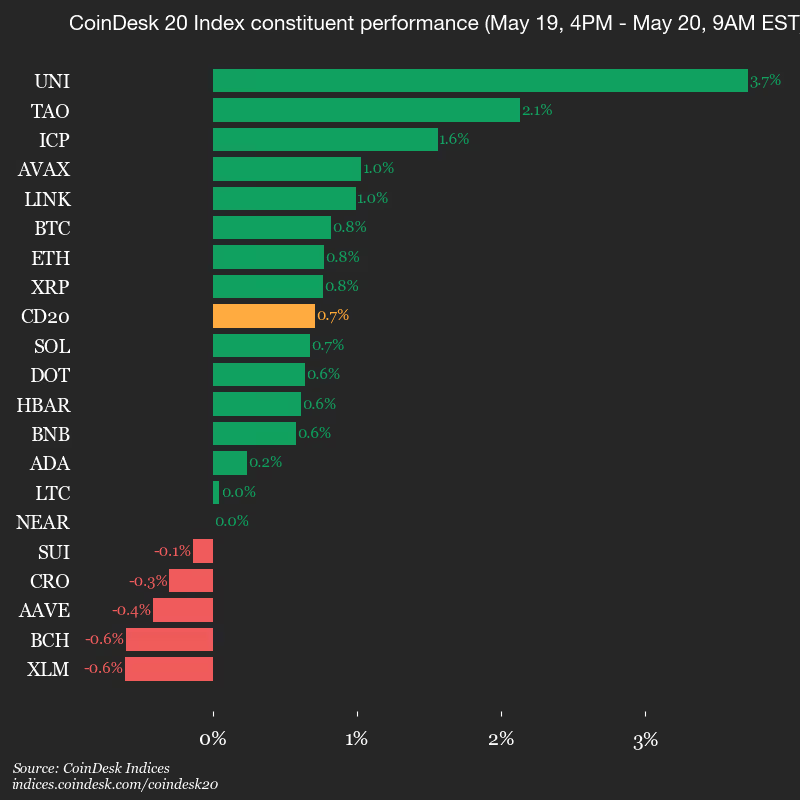
CoinDesk Indices presents its daily market update, highlighting the performance of leaders and laggards in the CoinDesk 20 Index.
The CoinDesk 20 is currently trading at 2064.22, up 0.7% (+14.51) since 4 p.m. ET on Tuesday.
Fifteen of the 20 assets are trading higher.

Leaders: UNI (+3.7%) and TAO (+2.1%).
Laggards: XLM (-0.6%) and BCH (-0.6%).
The CoinDesk 20 is a broad-based index traded on multiple platforms in several regions globally.


Online code repository firm GitHub says a recent breach of its internal data stemmed from a staff member downloading a “poisoned” VS Code extension.
The Microsoft-owned firm first disclosed in the early hours of this morning that it was investigating unauthorized access to its internal repositories.
Since then, GitHub has shared that the breach has only affected internal GitHub repositories.
It added, “The attacker’s current claims of ~3,800 repositories are directionally consistent with our investigation so far.”
The breach involves a malicious VS Code extension downloaded from Microsoft’s VS Code extension marketplace. VS Code stands for Visual Studio Code, and the marketplace offers various tools and applications for code editors to download.
Read more: Binance says GitHub data leak could cause ‘severe financial harm’
The hacking group claiming to have breached GitHub’s repositories is TeamPCP, which has been linked to the Mini Shai Halud supply chain attack that impacted OpenAI, as well as a number of other supply chain attacks targeting developer software.
The group is selling the roughly-4,000 private repositories on the Breached hacking forum for no less than $50,000 while stressing that it will not accept any “low ball offers.”
It said, “This is not a ransom, we do not care about extorting GitHub.” The data on its end will supposedly be “shred” after the sale, and if it can’t find a buyer, TeamPCP said it will leak the data for free.
GitHub says it has removed ‘malicious extension’
GitHub claims it “removed the malicious extension version, isolated the endpoint, and begun incident response immediately.”
“Critical secrets were rotated yesterday and overnight with the highest-impact credentials prioritized first,” the firm said, adding that it will continue to monitor the situation.
The reception to the incident hasn’t been forgiving. Users noted longstanding complaints against former Microsoft and GitHub executives that have asked for solutions to malware-ridden downloads within the VS Code extension marketplace.
This complaint was levied against GitHub’s former CEO two years ago.
Read more: Microsoft could stall Bitcoin development via GitHub
Former Binance CEO Changpeng Zhao warned, “If you have API keys in your code, even private repos, now is the time to double check and change them…”
CEO of coding firm Treehouse, Ryan Carson, similarly warned, “If you have ANY private repos with plain text secrets or sensitive documents/architectures, immediately rotate your secrets.”
Crypto security expert Taylor Monahan added to Zhao’s statement, and said that you should get your API keys “out of your repos.”
“Your biggest risk is not this. It’s your own devs getting hit by one of these wormy motherfucking supply chains and leaking all those secrets,” Monahan said.
Second GitHub leak in days
Software firm Grafana also claimed earlier this week that it witnessed unauthorised access to its GitHub repositories.
It claims the attackers “downloaded our codebase,” before issuing “a ransom demand under threat of data disclosure.”
Read more: Stealthy crypto miners loot altcoins with GitHub trial accounts
In this case, Grafana claims the breach also stemmed from the supply chain attack associated with the Mini Shai-Hulud campaign.
It said, “We performed analysis and quickly rotated a significant number of GitHub workflow tokens, but a missed token led to the attackers gaining access to our GitHub repositories. A subsequent review confirmed that a specific GitHub workflow we originally deemed not impacted had, in fact, been compromised.”
In 2024, leaked passwords and site code stemming from Binance were viewable on GitHub for months before they were eventually taken down.
The exchange said the leaks were capable of causing “severe financial harm,” and that the upload of its data was never authorized.
Protos has reached out to GitHub for comment and will update this piece should we hear anything back.
Got a tip? Send us an email securely via Protos Leaks. For more informed news and investigations, follow us on X, Bluesky, and Google News, or subscribe to our YouTube channel.


LayerZero Labs has released its incident report on the KelpDAO bridge attack, saying about $292 million in rsETH was stolen after attackers poisoned RPC infrastructure used by its verification network and forcing policy changes around single-signer configurations.
Summary
- LayerZero said KelpDAO was exploited for about $290 million, or roughly 116,500 rsETH, in an attack isolated to rsETH’s single-DVN setup.
- The company said preliminary indicators point to North Korea-linked TraderTraitor and described the exploit as an infrastructure compromise rather than a protocol flaw.
- LayerZero said it will stop signing messages for applications using 1/1 DVN configurations and is pushing affected integrators toward multi-DVN redundancy.
LayerZero Labs has published a detailed account of the KelpDAO exploit, confirming that attackers stole roughly 116,500 rsETH, worth about $292 million, by compromising downstream infrastructure tied to the verification layer used in KelpDAO’s cross-chain configuration.
The company said the incident was limited to KelpDAO’s rsETH setup because the application relied on a 1-of-1 DVN configuration with LayerZero Labs as the sole verifier, a design LayerZero said directly contradicted its standing recommendation that applications use diversified multi-DVN setups with redundancy.
In its statement, LayerZero said there was “zero contagion to any other cross-chain assets or applications,” arguing that the protocol’s modular security architecture contained the blast radius even as a single application-level configuration failed.
How the attack worked
According to LayerZero’s report, the April 18, 2026 attack targeted the RPC infrastructure relied on by the LayerZero Labs DVN rather than exploiting the LayerZero protocol, key management, or the DVN software itself.
The company said the attackers gained access to the list of RPCs used by the DVN, compromised two nodes running on separate clusters, replaced binaries on op-geth nodes, and then used malicious payloads to feed forged transaction data to the verifier while returning truthful data to other endpoints, including internal monitoring services.
To complete the exploit, the attackers also launched DDoS attacks on uncompromised RPC endpoints, which triggered failover toward the poisoned nodes and allowed the LayerZero Labs DVN to confirm transactions that had never actually occurred.
Outside forensic work broadly matches that description. Chainalysis said the attackers linked to North Korea’s Lazarus Group, specifically TraderTraitor, did not exploit a smart contract bug but instead forged a cross-chain message by poisoning internal RPC nodes and overwhelming external ones in a single-point-of-failure verification setup.
Security changes
LayerZero said the immediate response included deprecating and replacing all affected RPC nodes, restoring the LayerZero Labs DVN to operation and contacting law enforcement agencies while working with industry partners and Seal911 to trace the stolen funds.
More importantly, the company is changing how it handles risky configurations. In the statement, LayerZero said its DVN “will not sign or attest messages from any applications that utilize a 1/1 configuration,” a direct policy shift aimed at preventing a repeat of the KelpDAO failure mode.
The company is also reaching out to projects still using 1/1 configurations to migrate them to multi-DVN models with redundancy, effectively admitting that configuration flexibility without enforced safety rails was too permissive in practice.
The attribution picture has also hardened. Chainalysis linked the exploit to North Korea’s Lazarus Group and specifically TraderTraitor, while Nexus Mutual said the forged message drained $292 million from KelpDAO’s bridge in under 46 minutes, making it one of 2026’s biggest DeFi losses.
The result is a familiar but brutal lesson for cross-chain infrastructure: the smart contracts can survive intact and the protocol can still fail in practice if the off-chain trust layer is weak enough. LayerZero is now trying to prove that the right takeaway from a $292 million bridge theft is not that modular security failed, but that letting anyone run a single-signer setup was the real mistake.
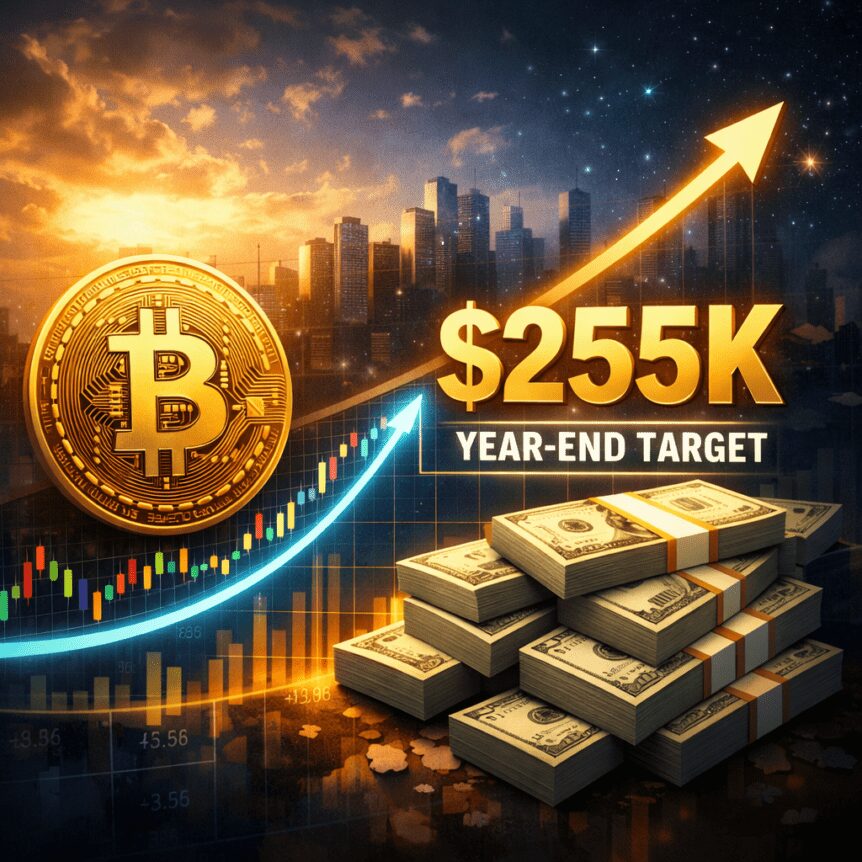
Bitcoin is roughly 40% off its October 2025 peak, but a long-range valuation framework suggests the pullback could be retraced as the market moves through a new cycle. The Bitcoin Decay Channel, a logarithmic model that tracks BTC’s secular uptrend while accounting for incremental gains each cycle, points to a broad end-of-year range—and potentially higher into 2027—despite near-term volatility.
Key takeaways:
- Bitcoin Decay Channel projects a conservative year-end range of $90,000–$255,000, with a 2027 band extending to $128,000–$308,000.
- On-chain signals, notably the HODL Waves indicator, imply a possible bottom around $65,900–$70,500 if selling pressure persists.
- BTC’s rebound in 2024 appears to have touched the lower edge of the Decay Channel, a region historically associated with long-term support.
- Analysts’ forecasts vary: Bernstein has emphasized a longer adoption cycle with a target near $150,000 for 2026 and a potential $200,000 peak in 2027, while other forecasters point to near-term milestones such as $126,000 this year and higher targets in the following years.
Decay Channel: a long-range compass for BTC valuation
The Bitcoin Decay Channel is a logarithmic framework that seeks to chart BTC’s extended uptrend while incorporating gradual gains across cycles. Historically, Bitcoin’s major tops in 2013, 2017 and 2021 formed near the model’s upper valuation band, while bear-market lows have repeatedly pressed back toward its lower support zone. The model has served as a reference point for traders seeking to understand where BTC might find底 in prolonged downturns and where renewed upside momentum could begin.
Bitcoin’s most recent rebound began near the lower boundary of the Decay Channel in March–April, a zone the model has traditionally treated as long-run support. That alignment keeps alive a bullish framing for the current cycle, according to observer Sminston, who highlighted the model’s plausible end-year range: “Bitcoin Decay Channel gives a pretty reasonable range—conservative case—of $90k–$255k, by the end of this year. $128k–$308k for end of ’27.”
To put that into perspective, Sminston has contrasted the gap between present prices and later targets with historical context: “For comparison, Bitcoin was $43k in December 2023.” The Decay Channel’s structure thus anchors expectations not only on where BTC could go if the cycle resumes, but also on where it might have already spent time in the current weak phase.
The model’s framing resonates with a broader narrative in the market: several independent forecasts align with the idea that BTC could participate in a fresh all-time high within the next couple of years as institutional demand, ETFs, and corporate treasury activity continue to evolve. This longer horizon is a recurring theme among strategic analysts who view the current pullback as part of a larger secular expansion rather than a purely cyclical retreat.
Bearish patterns and on-chain signals
Despite the optimistic scenario implied by the Decay Channel, a cluster of technical and on-chain indicators warns that downside risk remains material in the near term. A classic bear flag formation has traders watching for a potential breakdown that could push BTC toward the lower end of recent trading ranges. In raw terms, a breakdown of this setup could see BTC testing sub-$56,000 levels, representing a decline of roughly 30% from present price levels.
On-chain data, however, presents a more nuanced picture. The HODL Waves metric—tracking how long bitcoins sit in wallets without movement—has been cited as suggesting a stronger long-term holder base could stabilize the market and support a higher bottom. In a recent briefing, CryptoQuant analyst Sunny Mom noted that the ongoing accumulation by long-term holders could favor a higher, slower bottom this cycle, with $70,500 as a critical level to hold. The implication is that even as price drifts downward, a robust base of entrenched holders might cap further downside and lay groundwork for a renewed ascent.
These signals complicate the straightforward bearish view. While the bear flag remains a credible risk in the near term, the interplay between chart patterns and on-chain activity underscores a market that could drift within a broad range before a decisive move higher or lower materializes. Investors will be watching whether the lower-support zone identified by the Decay Channel—plus the stabilizing effect of a strengthening holder cohort—can anchor prices in the mid-to-high five-figure territory or whether a breach triggers a more extended correction.
What comes next for BTC price trajectories
Forecasts about BTC’s path in the medium term reflect a mix of valuation frameworks and strategic bets about institutional involvement. In coverage that preceded this edition, Bernstein analysts maintained a $150,000 target for 2026, while also laying out a $200,000 peak further out in 2027, tied to a lengthier cycle of institutional adoption driven by exchange-traded products and expanding corporate holdings. The pacing of this adoption curve remains a central question for the market, with the belief that larger institutions will progressively allocate to BTC as regulatory clarity improves and as more capital-bearing products become available.
Other prominent voices offer a different, though compatible, flavor of the story. Arthur Hayes, co-founder of BitMEX, has argued for BTC’s upside as macro and geopolitical catalysts fuel demand for scarce digital assets, citing paths toward a $126,000 level within the current year on the back of new liquidity drivers and demand from AI-related infrastructure. While these calls are not uniform, they reflect a shared conviction that BTC’s price action could be shaped by macro liquidity, regulatory developments, and the appeal of BTC as a non-sovereign store of value in uncertain times.
Taken together, the picture is one of a market in which multiple horizons coexist: a near-term range-bound regime driven by chart patterns and on-chain dynamics, alongside a longer-term trajectory that envisions fresh highs once institutional demand finds more durable footing. The Decay Channel’s ranges—$90,000 to $255,000 by year-end, extending to $128,000 to $308,000 in 2027—offer a framework for risk-aware participants to balance potential upside with the possibility of further volatility in the months ahead. The central task for traders and investors is to interrogate the underlying drivers: will the current weak phase resolve into renewed accumulation, or will a deeper consolidation re-assert itself before a new leg higher begins?
As the market navigates this juncture, traders should monitor both the technical backdrop and the on-chain substrate. A durable hold above the $65,900–$70,500 zone, reinforced by rising long-term holder activity, could tilt the odds toward a more constructive second half of the year. Conversely, a decisive break below the lower boundary of the Decay Channel or a fresh wave of macro shocks could reassert downside pressure in the near term.
In short, Bitcoin’s path remains contingent on how quickly institutional demand solidifies, how macro forces unfold, and whether the balance of active and dormant supply can sustain a credible bottom. The coming weeks will reveal which of the competing narratives dominates—and whether BTC can indeed align with the longer-term targets suggested by the Decay Channel and the diverse set of forecasts that accompany it.
Looking ahead, readers should watch for changes in on-chain behavior—especially shifts in HODL Waves and wallet activity—as well as any regulatory developments that could unlock or constrain financially meaningful products. The interaction of these factors will be decisive in determining whether Bitcoin stays within its current corridor or breaks toward the higher targets favored by some models and institutions alike.
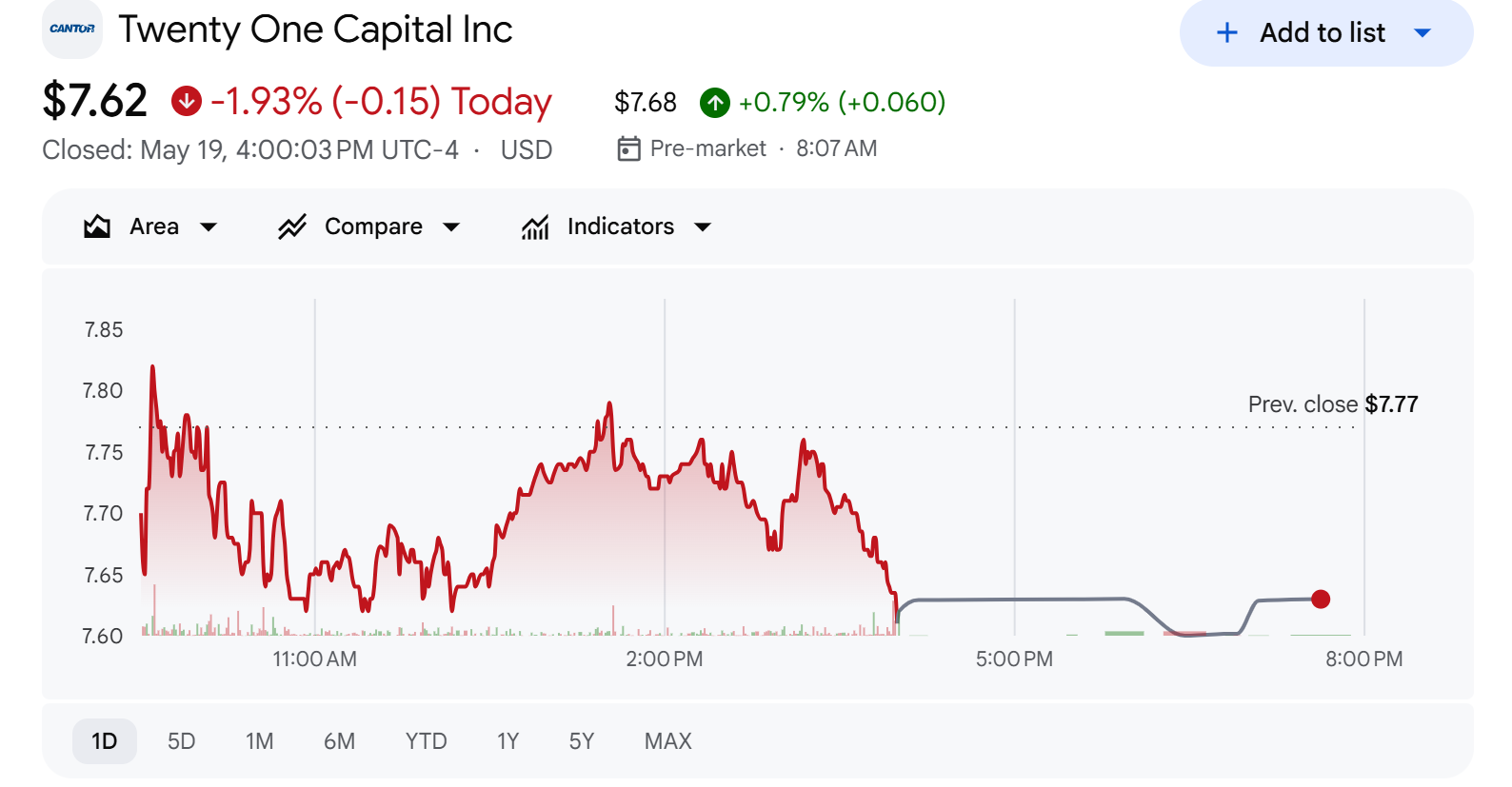
Tether International has acquired SoftBank’s entire stake in Twenty One Capital (NYSE: XXI), tightening its grip on one of the largest public Bitcoin treasuries.
Announced May 20, 2026, the deal removes SoftBank’s board seats and signals deeper conviction in XXI as a Bitcoin-native powerhouse.
Tether Takes Full Control of XXI, Buys SoftBank Stake
Twenty One Capital launched in December 2025 via SPAC merger with Cantor Equity Partners. It debuted with over 43,500 BTC, roughly $4 billion at the time, ranking as the third-largest corporate Bitcoin holder.
Tether and Bitfinex supplied the majority, with SoftBank contributing a significant minority stake equivalent to about 10,500 BTC.
SoftBank brought credibility and discipline during XXI’s formative phase. Its experience backing transformative tech firms helped shape strategy and attract institutional attention.
With the buyout complete, Tether now holds uncontested control as majority shareholder.
“Tether’s conviction in XXI has only deepened,” said Paolo Ardoino, Tether CEO. “SoftBank’s involvement gave XXI the kind of institutional depth that few early-stage companies ever have. They leave behind a company with a stronger foundation, a clearer mandate, and an ambitious path ahead.”
Follow us on X to get the latest news as it happens
The move comes months after Tether proposed merging XXI with Jack Mallers’ Strike platform and Elektron Energy.
The three-way combination aims to create an integrated Bitcoin company spanning treasury accumulation, mining, lending, and financial services.
Market Context and Investor Focus
XXI’s strategy centers on maximizing Bitcoin per share (BPS) through aggressive accumulation, capital markets tools, and ecosystem building.
While pure treasury plays like MicroStrategy dominate headlines, XXI positions itself as more operational and Bitcoin-native. Shares have experienced typical volatility tied to BTC price action since listing.

Tether’s latest action reinforces its massive Bitcoin holdings and long-term bet on BTC infrastructure.
As the world’s largest stablecoin issuer, Tether continues leveraging its balance sheet to expand influence in public Bitcoin markets.
What’s Next for XXI?
Investors will watch for updates on the proposed mergers, future BTC purchases, and capital raises.
With Tether fully aligned, XXI gains streamlined governance to execute its ambitious roadmap.
The coming months could see accelerated growth in holdings and operational milestones as Bitcoin adoption deepens among corporations.
The post Tether Takes Full Control of Twenty One Capital (XXI) After Buying SoftBank Stake appeared first on BeInCrypto.

South Carolina just became the most aggressive pro-Bitcoin state in America. Bitcoin may be down, its price prediction is also hitting a low, but with regulatory clarity and institutional adoption, BTC is coiling.
Governor Henry McMaster signed Senate Bill S.163 into law on May 19, 2026, implementing a total ban on CBDCs, tax neutrality for crypto payments, and hard protections for miners and self-custody holders. The vote was resolved at 110-1 in the House, a genuine bipartisan conviction.
The document states:
AN ACT TO AMEND THE SOUTH CAROLINA CODE OF LAWS BY ADDING CHAPTER 47 TO TITLE 34 SO AS TO PROHIBIT A GOVERNING AUTHORITY FROM ACCEPTING OR REQUIRING PAYMENT USING CENTRAL BANK DIGITAL CURRENCY OR PARTICIPATING IN A TEST OF CENTRAL BANK DIGITAL CURRENCY; TO PERMIT INDIVIDUALS OR BUSINESSES USING DIGITAL CURRENCY FOR TRANSACTIONS; TO PROVIDE THAT DIGITAL ASSETS MAY NOT BE SINGLED OUT FOR DISPARATE TAX TREATMENT; TO PROVIDE THAT DIGITAL CURRENCY TRANSACTION MAY BE TAXED IF THE TAXATION IS THE SAME AS IF THE TRANSACTION USED UNITED STATES LEGAL TENDER; TO RESTRICT CERTAIN ACTIVITY FOR DIGITAL CURRENCY OPERATIONS THAT ARE ZONED FOR INDUSTRIAL USE; TO PROVIDE THAT DIGITAL ASSET MINING BUSINESS OPERATIONS SHALL NOT PLACE ANY ADDITIONAL STRESS ON THE ELECTRICAL GRID FOR WHICH THEY ARE CONNECTED AND TO PROVIDE THAT DIGITAL MINING BUSINESSES MUST PROVIDE CERTAIN INFORMATION TO THE PUBLIC SERVICE COMMISSION UPON REQUEST; TO PROVIDE THAT THOSE ENGAGED IN DIGITAL MINING OPERATIONS DO NOT HAVE TO OBTAIN CERTAIN LICENSES AND THAT THOSE WHO PROVIDE CERTAIN SERVICES RELATED TO DIGITAL MINING OR STAKING ARE NOT OFFERING A SECURITY; TO PROVIDE THAT THE ATTORNEY GENERAL CAN PROSECUTE AN INDIVIDUAL OR BUSINESS THAT FRAUDULENTLY CLAIM TO BE OFFERING DIGITAL ASSET MINING AS SERVICE OR STAKING AS A SERVICE; AND TO DEFINE NECESSARY TERMS.
The law bars state agencies from accepting or testing any federal central bank digital currency, shields proof-of-work mining operations from discriminatory zoning and noise ordinances, and eliminates extra fees or levies on goods purchased with digital assets.
A separate House Bill, H.4256, would additionally allow South Carolina’s treasurer to allocate up to 10% of unallocated state funds into Bitcoin as an inflation hedge, capped at 1,000,000 BTC.
Discover: The best crypto to diversify your portfolio with
Bitcoin Price Prediction: Reclaim $80,000 as State-Level Adoption Accelerates?
At $77,000, Bitcoin is pulling back from recent highs but remains structurally elevated. The $75,000 level is the line that matters as a major psychological and technical support zone that needs to be defended to keep the uptrend intact. A daily close below that threshold would shift short-term momentum decisively bearish.
The weekly 4.5% drop reads as profit-taking after a rally from $66,000 to $83,000, particularly given the macro and legislative tailwinds accumulating beneath the price. ETF inflows remain a persistent bid, and the state-level reserve demand would represent a structural buyer class that doesn’t sell on red candles.

If Bitcoin could hold $75,000 as support and legislative momentum from South Carolina accelerates copycat bills in other states, ETF inflows could push the price back through $80,000. However, a break below $75,000 on volume would open the door to the $72,000 range, likely triggering forced liquidations and headlines of ETF outflows.
Regulatory clarity tends to compress volatility and attract institutional positioning, meaning South Carolina’s move may be more consequential for medium-term price structure than this week dip suggests.
Discover: The best pre-launch token sales
Bitcoin Hyper Targets Early-Mover Upside as Bitcoin Tries to Break Downtrend
Bitcoin consolidating away from all-time highs is a familiar frustration: the macro thesis is right, the entry is not that cheap, and the asymmetric upside that early adopters captured has already been realized. That’s the gap a project like Bitcoin Hyper is targeting: infrastructure-layer exposure to Bitcoin’s growth cycle at presale prices, before exchange listing.
Bitcoin Hyper ($HYPER) is positioning as the first Bitcoin Layer 2 with Solana Virtual Machine (SVM) integration, delivering sub-second finality and low-cost smart contract execution while inheriting Bitcoin’s security model.
Hyper aims to break Bitcoin’s core limitations, like slow throughput, high fees, and zero programmability, without abandoning Bitcoin’s trust layer. The project has raised more than $32 million at a current presale price of just $0.0136, with 35% APY staking available for early holders.
Hyper also offers a Decentralized Canonical Bridge that handles BTC transfers across the Layer 2 for traders watching Bitcoin’s state-level policy cycle accelerate,
Bitcoin Hyper represents early infrastructure-layer positioning that is worth researching.
The post Bitcoin Price Prediction: South Carolina Moves Against CBDCs With Zero-Tax BTC Bill appeared first on Cryptonews.

Alas Pilipinas pair falls short of Beach Pro Tour main draw

OpenAI Co-Founder Andrej Karpathy Joins Anthropic
![Tom Lee Just Said The UNTHINKABLE About Bitcoin & Ethereum! ["It's a Fake Crash"]](https://wordupnews.com/wp-content/uploads/2026/05/1779287668_maxresdefault-80x80.jpg)
Tom Lee Just Said The UNTHINKABLE About Bitcoin & Ethereum! [“It’s a Fake Crash”]


-

 Crypto World5 days ago
BloFin War of Whales 2026 Grand Prix opens registration for $5M trading championship
-

 Fashion5 days ago
Weekend Open Thread: Theory – Corporette.com
-

 Crypto World5 days ago
E-Estate Announces 1 Year Live: Washington DC Summit as Real Estate Tokenization Enters Its Next Phase
-

 Tech5 days ago
Tech Moves: Microsoft AI leader jumps to OpenAI; former AI2 exec joins Meta; and more
-

 Tech5 days ago
Google reimburses Register sources who were victims of API fraud
-
 Crypto World6 days ago
Google’s Gemini AI Predicts Incredible Solana Price by the End of 2026
-

 Business5 days ago
H&R Real Estate Investment Trust (HR.UN:CA) Q1 2026 Earnings Call Transcript
-

 Sports5 days ago
Napoleonic enters 2026 Doomben 10,000 field via Abounding withdrawal
-
 Entertainment6 days ago
Zara Larsson Has Blunt Response To Chris Brown Diss
-
 Crypto World7 days ago
Two AI Tokens Lead May Rally, But Risks Are Rising
-

 Crypto World5 days ago
BeInCrypto 100 Institutional Awards Nomination: KAST for Best Digital Assets Neobank and Best Digital Assets Fintech
-

 Fashion4 days ago
On the Scene at Gucci’s Cruise Show in New York City: Mariah Carey, Kim Kardashian, Lindsay Lohan, Iman, and More!
-
 Crypto World5 days ago
Bitcoin Battles US Bond Nerves With BTC Price Dip Toward New May Lows
-
 Crypto World5 days ago
Wall Street’s Boldest Gold Prediction Has Russians Rushing to Buy
-

 Fashion4 days ago
Trending Western Style Vests Perfect for Summer
-

 Politics6 days ago
DWP PIP Timms review continues to be an absolute farce
-

 Entertainment5 days ago
David Letterman Returns to Late Show, Blasts Cancellation
-

 Crypto World5 days ago
ICE and CME urge US regulators to curb Hyperliquid energy trading
-

 Fashion3 days ago
Amazon Sundays: Memorial Day Hosting
-
 Crypto World6 days ago
Lido Finance Selects Chainlink CCIP as the Official Cross-Chain Infrastructure for wstETH Security
You must be logged in to post a comment Login