
Crypto World
Wasabi Protocol $5 Million Exploit Accelerates AI-Driven DeFi Hacker Theory



Wasabi Protocol suffered an admin-key compromise that drained over $5 million from its perpetuals vaults and LongPool across Ethereum, Base, Berachain, and Blast, on-chain security firms Blockaid and PeckShield reported.
The attacker gained ADMIN_ROLE through the protocol’s deployer wallet, then upgraded the vaults to a malicious implementation that siphoned user balances. About $4.55 million had been extracted at last count, and the investigation remains active.
Single-Key Failure Behind the Breach
Blockaid traced the root cause to wasabideployer.eth, the only address holding ADMIN_ROLE in Wasabi’s PerpManager AccessManager.
The attacker called grantRole on the deployer EOA with zero delay, instantly turning their orchestrator contract into an admin.
“We’re aware of an issue and are actively investigating. As a precaution, please do not interact with Wasabi contracts until further notice,” Wasabi Protocol urged users.
From there, the attacker UUPS-upgraded perpetual vaults and the LongPool to a malicious implementation that drained balances.
The deployer key remains live. Wasabi and Spicy LP-share tokens from affected vaults are flagged as compromised, with redemption value approaching zero.
Blockaid noted the same attacker, orchestrator, and strategy bytecode tie this incident to earlier activity targeting Wasabi.
The pattern echoes prior admin-key incidents and reflects single-EOA admin setups without timelocks or multisigs. PeckShield put the total losses past the $5 million mark across all four affected chains.
AI-Hacker Theory Gains Fresh Oxygen
Meanwhile, the incident comes only hours after three other attacks between Tuesday and Wednesday. BeInCrypto reported the Tuesday cascade, comprising:
- Sweat Economy’s $3.46 million drain, which turned out to be a foundation rescue, not a hack.
- Syndicate Commons bridge on Base lost 18.5 million SYND tokens worth $330,000 to $400,000. The proceeds were bridged to Ethereum.
- Aftermath Finance paused its perpetuals protocol after losing roughly $1.14 million USDC.
Against these backdrops, analysts are talking about AI concerns, citing the asymmetric dynamic between attacker tooling and protocol defenses.
In the same line of thought, developer Vitto Rivabella floated a theory that North Korea trained an in-house AI on years of stolen DeFi data.
He suggested the model now operates as an autonomous exploiter, draining protocols faster than human reviewers can patch them.
“Wild conspiracy theory about the recent DeFi hacks: North Korea has trained its own, state funded, version of Mythos using the insane amounts of data obtained by hacking DeFi protocols over the last 10 years. Now they’re just letting their AI DeFi hacker run free and won’t stop cashing in until someone stops them,” wrote Rivabella.
Whether AI is steering the recent string of exploits or not, single-key admin roles keep giving attackers an obvious opening.
The post Wasabi Protocol $5 Million Exploit Accelerates AI-Driven DeFi Hacker Theory appeared first on BeInCrypto.

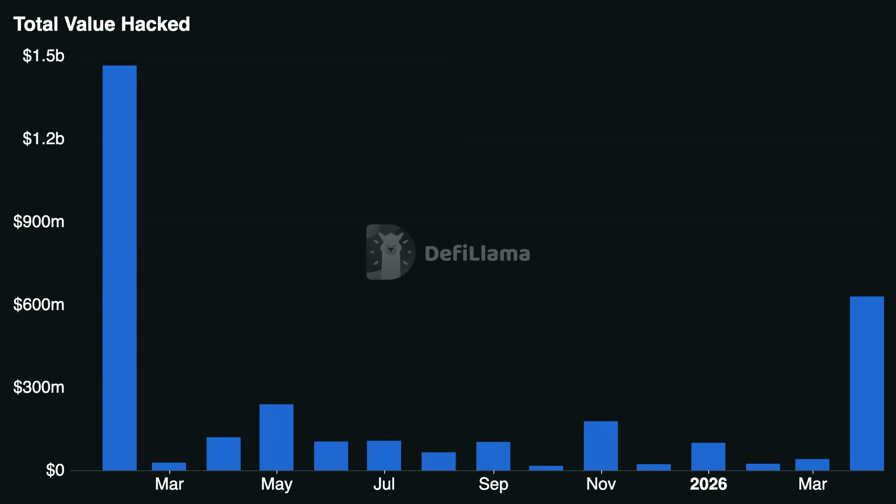
The cryptocurrency industry has seen a sharp spike in hacks in April, with losses topping $600 million in the worst month for crypto hacks in more than a year.
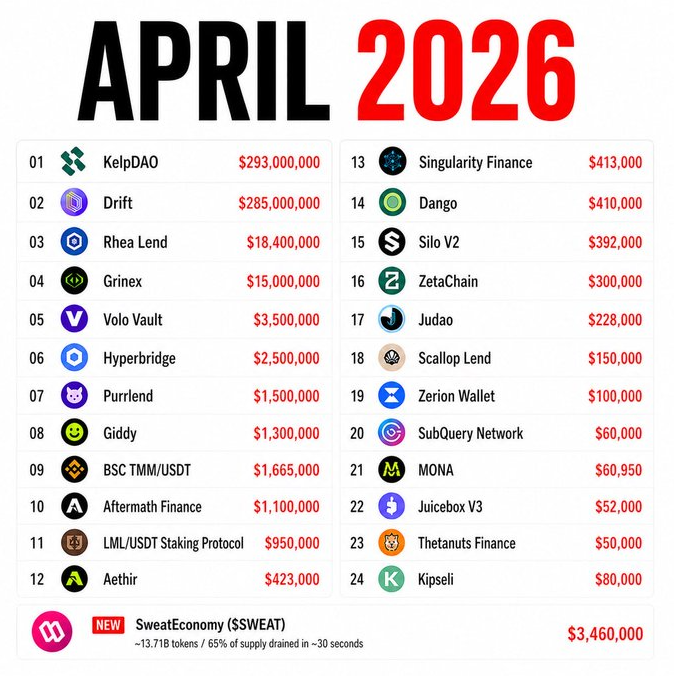
According to DeFiLlama, the total value hacked in April so far amounted to $629.7 million, the highest since $1.47 billion in February 2025. With KelpDAO’s $293 million hack and Drift Protocol’s $280 million exploit accounting for 82% of the monthly losses, decentralized finance (DeFi) has taken the unwanted crown as the most targeted sector over the past month.
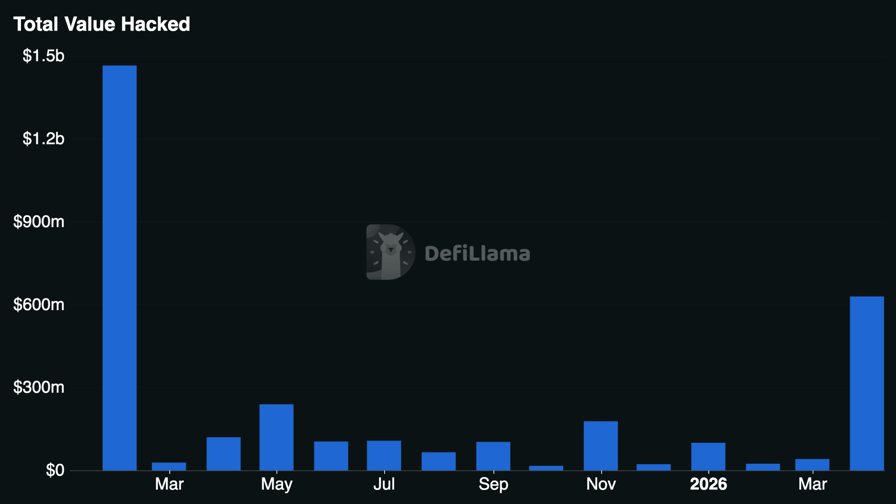
Source: DeFiLlama
The concentration of losses in a handful of large DeFi incidents shows how a small number of attacks can still overwhelm broader security improvements across the sector. The causes of the hacks also revealed that the biggest risks are increasingly tied to bridges, privileged access and operational failures, rather than simple smart contract bugs alone.
Related: Russia-linked crypto exchange Grinex halts trading after $14M hack
April DeFi hack losses surge
One of the latest attacks involved the DeFi derivatives platform Wasabi Protocol, which at the time of writing had been drained of around $5.5 million across Ethereum, Base, Blast and Berachain networks in an ongoing exploit, according to Certik.
Recent attacks also include the move-to-earn crypto platform Sweat Economy, which reportedly lost $3.46 million, or about 65% of its liquidity pool, in under 30 seconds. The protocol later said stolen funds were frozen on MEXC shortly after the incident, with recovery efforts underway.
Source: Jussy
Aftermath Finance, a Sui blockchain-based decentralized trading platform, was also among the recent DeFi hacks, suffering an exploit on its perpetuals platform. According to Blockaid, the attacker drained about $1.1 million in USDC across 11 transactions in roughly 36 minutes.
Related: Andre Cronje says DeFi is ‘no longer DeFi’ as builders debate circuit breakers
Chainalysis says attackers are exploiting off-chain systems, not smart contract bugs
April’s spike in crypto exploits reflects a shift toward more sophisticated, multi-stage attacks targeting offchain infrastructure rather than smart contract vulnerabilities, Yaniv Nissenboim, head of security solutions at Chainalysis, told Cointelegraph.
“What connects these incidents is that well-resourced attackers are finding novel ways to exploit the seams between on-chain protocols and the offchain systems they depend on,” Nissenboim said.
These entry points include compromised remote procedure call (RPC) nodes, breaches of cloud key management systems and long-running social engineering campaigns, he said. In many cases, on-chain transactions still appear fully legitimate, even as infrastructure or human-access layers are already compromised.
Nissenboim said that real-time monitoring and automated safeguards are becoming critical, citing anomalies such as abnormal minting patterns and cross-chain inconsistencies that can be detected instantly. In one case, rapid detection helped prevent a second theft of roughly $95 million during the KelpDAO incident, he added.
According to Standard Chartered’s analysts led by Geoffrey Kendrick, KelpDAO’s incident is a sign of DeFi’s growing resilience rather than a fatal failure for the sector.
“While the recent KelpDAO theft and its impact on AAVE have raised questions around continued DeFi banking growth, we expect growth to remain on track as a maturing DeFi industry puts solutions in place to reduce vulnerabilities,” the bank said in a Wednesday research note seen by Cointelegraph.
Magazine: AI-driven hacks could kill DeFi — unless projects act now


AllUnity, a joint venture backed by DWS, Flow Traders and Galaxy Digital (GLXY), took its euro-backed stablecoin, EURAU, to the Solana blockchain, extending the token’s reach to a high-speed network often used for payments and trading.
EURAU, which debuted last July on Ethereum, is fully reserved and issued under a regulated e-money framework aligned with the European Union’s MiCA rules, the company said in an emailed statement. By adding Solana, AllUnity aims to offer faster settlement and lower transaction costs for euro-denominated transfers.
The setup allows businesses and developers to move euros onchain in seconds. Payments firms, for example, could send cross-border payouts to contractors in real time instead of waiting days for bank transfers, and the same mechanism can also support trading, lending or treasury management using a stable euro unit.
The move reflects growing interest in non-dollar stablecoins, especially in Europe, where firms seek digital assets that meet regulatory standards. While U.S. dollar tokens dominate the $300 billion stabelcoin market, euro-pegged tokens have seen rapid growth, doubling since the start of 2025 to almost $1 billion.
The S&P projected the market could reach 570 billion euros ($672 billion) by 2030. French Finance Minister Roland Lescure called for more euro-denominated stablecoins and urged EU banks to explore tokenized deposits.
AllUnity also highlighted that demand for regulated euro stablecoins is rising, and that expanding across multiple blockchains could help drive broader adoption in both finance and corporate payments.
“As demand for compliant euro stablecoins accelerates, Solana’s speed and scalability make it a natural environment for institutional-grade settlement and cross-border payments,” said Peter Grosskopf, CTO and COO of AllUnity.
AllUnity said several partners, including Bullish (owner of CoinDesk), Privy, Hercle and Transak, are preparing to use EURAU on Solana for payments, trading and fiat onramps.
Read more: Europe’s banks are going all in on crypto


MegaETH’s MEGA token went live on Thursday after the Ethereum scaling project completed a seven-day launch countdown.
Summary
- MegaETH launched MEGA after 10 ecosystem apps met the first KPI target.
- MEGA’s token model ties 53.3% of supply to performance-based rewards.
- USDM supply rose above $300 million during the MEGA token launch period.
The token started trading on major exchanges after the network met its first ecosystem milestone. MegaETH confirmed the launch in a post on X, saying, “MEGA — Now Trading.” The team said all tokens would be distributed to users by 7 a.m. ET.
The token generation event started after MegaETH met its first key performance target. The project had said it would only launch MEGA after showing enough real onchain activity.
MegaETH meets first launch milestone
MegaETH said 10 “Mega Mafia” apps had gone live before the launch. These apps cleared the first KPI threshold required to trigger the final countdown.
The milestone focused on apps with real user activity linked to USDM, the protocol’s native stablecoin. USDM was co-developed with Ethena.
In addition, MegaETH has a fixed supply of 10 billion MEGA tokens. The project has tied 53.3% of total supply to performance-based staking rewards.
This structure differs from a standard time-based vesting model. MegaETH uses KPI-linked targets to release a large share of future token supply.
Major exchanges list MEGA
Trading opened across several exchanges after the token generation event. Binance said it would list MEGA for spot trading at 11:00 UTC with a seed tag.
KuCoin and Bitget also announced MEGA spot trading from the same start time. Other platforms have shared listing plans as well.
MegaETH is designed as a high-performance Ethereum scaling network for real-time onchain apps. Its native USDM supply was about $62.9 million last week.
That figure has since grown to over $300 million during the MEGA launch period. MegaETH co-founder Namik Muduroglu described the launch period as “very intense.”
The MegaETH Foundation has said it plans to use USDM revenue to accumulate MEGA tokens. This links network use, stablecoin activity, and token demand.
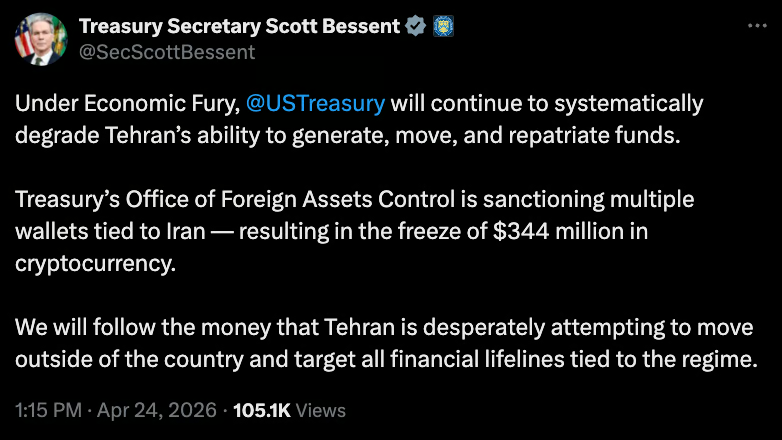
The United States has seized nearly $500 million in Iranian cryptocurrency assets as part of a sweeping economic pressure campaign against Tehran, Treasury Secretary Scott Bessent said Wednesday.
Bessent made the comments during an appearance on Fox Business’s “Kudlow,” where he outlined the scope of Operation Economic Fury, a campaign ordered by President Donald Trump in March 2025 aimed at cutting off Iran’s financial lifelines through asset seizures, bank account freezes and secondary sanctions on countries that continue to buy Iranian oil.
“We are freezing bank accounts everywhere. More importantly, we are making people less willing to deal with the regime,” Bessent said, adding that retirement funds and overseas real estate held by Iranian officials are also being targeted.
The $500 million figure is much higher than the $344 million in seized crypto assets previously disclosed. Last week, Bessent announced that the Treasury’s Office of Foreign Assets Control had sanctioned several crypto wallets tied to Iran, with stablecoin issuer Tether confirming it had frozen more than $344 million in USDt (USDT) at the request of US authorities.
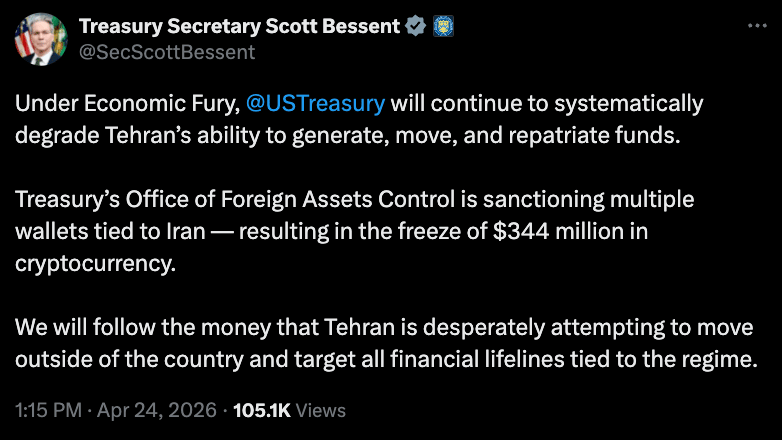
Source: Scott Bessent
Cointelegraph reached out to the US Treasury and Tether for an explanation on the gap between the two figures, but had not received a response by publication.
Related: Iran views BTC as strategic asset, but USDt still dominates oil tolls: BPI
Iran’s economy under pressure
Bessent said Operation Economic Fury has taken a toll on Iran’s economy. One of the country’s largest banks collapsed in December, and its currency has fallen 60 to 70% against the US dollar. “They’re in the middle of a currency crisis,” he said.
Treasury has also intensified pressure by ramping up sanctions across multiple fronts. On Tuesday, OFAC sanctioned 35 entities and individuals tied to Iran’s shadow banking network. Separately, it targeted a Chinese oil refinery and roughly 40 shipping firms operating as part of Iran’s shadow fleet, which moves Iranian crude to buyers in China and elsewhere in violation of sanctions.
The actions also hit Iran’s missile and drone supply chain, with 14 individuals and entities sanctioned for procuring components for Shahed-series attack drones and ballistic missile propellants. Since February 2025, OFAC has sanctioned over 1,000 Iran-related persons, vessels, and aircraft as part of Operation Economic Fury.
Related: Binance.US cuts spot trading fees to near zero in push to undercut rivals
Iran weighs crypto tolls for Hormuz passage
Earlier this month, reports emerged that Iran was considering charging ships Bitcoin tolls for passage through the Strait of Hormuz, with empty tankers allowed free passage and loaded ones charged around $1 per barrel of oil. Forbes reported that Iran had already collected revenue from such tolls, though Tehran has not publicly confirmed the claims.
Separately, maritime risk firm Marisks warned that fraudulent actors were impersonating Iranian security services and contacting stranded shipowners, demanding payment in Bitcoin or USDt in exchange for clearance through the strait.

TLDR
- Ford’s Q1 operating profit reached $3.5B, crushing Wall Street’s $1.3B projection
- Quarterly revenue totaled $43.3B, surpassing the $42.7B consensus
- The automaker increased its 2026 operating profit outlook to $8.5B–$10.5B
- Shares surged 7% after hours before reversing, ending ~1% lower in regular session
- UBS downgraded its price target from $15 to $14, reducing its 2027 EPS outlook by roughly 10%
Despite delivering a significant earnings beat that surpassed analyst expectations, Ford’s shares struggled to maintain momentum.
The Detroit automaker posted Q1 operating profit of $3.5 billion on top-line revenue of $43.3 billion. Wall Street had projected operating profit of only $1.3 billion with revenue of $42.7 billion. In comparison, the year-ago period saw Ford deliver $1 billion in operating profit on $40.7 billion in sales.
Earnings per share registered at $0.66, crushing the $0.19 consensus estimate — representing a beat exceeding 247%.
These figures incorporated a $1.3 billion tailwind from tariff benefits. However, even excluding that advantage, the core operational performance significantly exceeded projections.
Shares initially spiked over 7% during extended trading, pushing above the $13 threshold. However, the momentum evaporated quickly. By Thursday’s session, Ford was changing hands in the $12.12–$12.24 range, representing a decline of approximately 1%.
The Truck Factor
The robust performance stemmed largely from favorable product mix. Ford CFO Sherry House emphasized that the company’s truck lineup appeals to affluent consumers, which provided a buffer against escalating cost pressures.
Premium off-road and performance variants accounted for nearly 25% of total domestic sales throughout the quarter. This upmarket shift helped neutralize challenges from tariffs, raw material price increases, and supplier cost inflation.
The company is also navigating aluminum supply chain constraints triggered by a fire at Novelis’ Oswego, New York facility last September. This continues to limit production capacity.
Inflationary pressures added $1 billion in incremental costs during the three-month period. Nevertheless, Ford successfully managed through these headwinds.
Quality enhancements are delivering additional benefits. The automaker remains on course to reduce quality-related expenses by $1 billion in 2026. JD Power positioned Ford at No. 4 in its 2026 U.S. customer service rankings — marking the company’s strongest showing in almost three decades.
Guidance and the UBS Cut
Ford elevated its full-year 2026 operating profit forecast to a range of $8.5 billion–$10.5 billion, up from the previous $8 billion–$10 billion band. For context, 2025 operating profit totaled $6.8 billion, declining from $10.2 billion in 2024.
The guidance increase was relatively conservative, and management specifically noted the outlook excludes potential impacts from a U.S. economic recession or escalating Middle East tensions.
This conservative stance may explain the lukewarm investor response.
UBS responded Thursday by reducing its Ford price objective to $14 from $15, while maintaining its Buy rating. The investment bank lowered its 2027 EPS projection by approximately 10% to $1.88, pointing to elevated commodity costs that are increasingly offsetting benefits from the Novelis situation.
UBS currently estimates Ford’s 2027 earnings foundation at $9.75 billion — roughly $1 billion below previous assumptions. The trajectory toward $2 in EPS has been delayed by one year.
The firm continues to see long-term potential from battery energy storage systems and higher-margin Pro software offerings, though that timeline has similarly been extended by 12 months.
Heading into Wednesday’s report, Ford shares were down 5% year-to-date while posting gains of 24% over the trailing 12 months. GM, which similarly exceeded Q1 expectations and lifted guidance, advanced 1.3% on Tuesday following its earnings release.
Ford currently trades at $12.24.


Key Takeaways
- RDDT shares have declined 36% year-to-date in 2026, putting pressure on Thursday’s Q1 earnings release.
- Wall Street consensus calls for Q1 revenue of $608 million with adjusted earnings per share of $0.57.
- Ad revenue projections show a robust 58% year-over-year increase to $567 million.
- Daily active user expansion is anticipated to decelerate to 16% from the prior year’s 30.7% pace.
- Analyst consensus price target of $223.34 suggests significant upside from current trading levels near $148.40.
Reddit approaches its Thursday earnings release under considerable pressure from investors. The social media platform’s shares have tumbled 36% during 2026, despite maintaining impressive gains of approximately 326% since its March 2024 initial public offering at $34 per share.
The first quarter results are scheduled for release after market close on Thursday. Analyst consensus estimates point to adjusted earnings of $0.57 per share on total revenue of $608 million, based on FactSet data.
The platform exceeded expectations in its previous quarterly report, delivering revenue of $725.6 million — representing 69.7% year-over-year growth — alongside better-than-anticipated EBITDA performance. This strong showing raises expectations for the upcoming release.
For the current quarter, market watchers anticipate revenue expansion of approximately 55% compared to the year-ago period. This represents a moderation from the 61.5% growth rate Reddit achieved during Q1 of the previous year.
Daily active user metrics are drawing particular scrutiny from analysts. The company disclosed 52.5 million DAUs in its most recent quarter, reflecting 9.4% year-over-year growth. First quarter projections call for global DAU growth of 16% — marking a notable deceleration from the 30.7% expansion recorded in the comparable quarter last year.
This slowdown has sparked concern among market participants, especially as artificial intelligence-driven platforms including ChatGPT, Google AI Overviews, and similar services provide alternative pathways for users to access information without engaging directly with the platform.
Ad Revenue Projections Remain Strong
The advertising segment presents a brighter outlook. Analysts project Q1 advertising revenue of $567 million, representing a 58% surge compared to the year-ago quarter.
Jefferies analyst John Colantuoni, who maintains a Buy rating with a $250 price target on RDDT, observed in mid-April that discussions with advertisers indicated “resilient digital budgets” and “particularly strong trends” specific to Reddit’s platform.
The company is marketing itself as an irreplaceable resource that artificial intelligence cannot easily duplicate — a platform grounded in authentic human perspectives and community dialogue. This forms the foundation of the bullish investment thesis.
D.A. Davidson analyst Wyatt Swanson reinforced this perspective on April 21, stating that Reddit “remains incredibly under-monetized relative to peers” and has successfully established itself as a “human-first social platform.” He assigns a Buy rating with a $200 price target.
Industry Comparisons
Recent earnings results from comparable consumer internet companies provide useful context. Booking delivered 16.2% revenue growth in Q1, meeting analyst projections. Coursera reported 9.1% growth and experienced an 11.6% stock decline following its release.
Reddit has consistently surpassed Wall Street forecasts, and analysts have maintained relatively stable estimates over the past 30 days — suggesting confidence that no major deviations are anticipated.
During the past month, consumer internet equities have advanced an average of 16.2%. Reddit shares have climbed 19.5% over the same timeframe, indicating the market may have already incorporated some positive expectations ahead of the earnings announcement.
The consensus analyst price target of $223.34 implies approximately 50% potential upside from current trading levels around $148.40.
Crypto World
BTC price faces $80,000 resistance as derivatives shows signs of risk aversion: Crypto Markets Today


Bitcoin , while it’s slightly in the green may be in for a shock. The largest cryptocurrency has gained less than 0.5% since midnight UTC, and strong moves toward $80,000 are likely to run into opposition.
That’s because short-term holders have a cost basis around that price, Luke Deans, a senior research associate at Bitwise, told CoinDesk. A move above may convince them to take profits and sell, capping any advance.
Another headwind may present itself in the form of U.S. March PCE inflation, which lands as oil prices keep pressure on risk assets. West Texas Intermediate crude has surged to as high as $110, and reduced traffic through the Strait of Hormuz has kept energy markets fragile.
Wednesday’s Federal Reserve decision to hold the federal funds rate steady is also weighing on the market. Specifically, a whopping four dissenting voices, the most since 1992, with one governor pushing for a cut and three regional presidents opposing the statement’s suggestion that the Fed would resume easing.
Deans also said altcoins remain tied to bitcoin, with the 180-day correlation and beta percentiles near 97% and 99%. That means tokens may move like levered bitcoin trades today.
“Beneath the surface, conditions typically associated with rising volatility appear to be forming,” Deans said. “Liquidity remains subdued, with profit- and loss-taking largely offsetting each other, reflecting a lack of directional conviction.”
In these environments, he said, price moves are often needed to unlock new liquidity.
Derivatives positioning
- Market-wide, futures open interest (OI) has dropped over 2% to $119 billion in 24 hours. Trading volumes, however, have increased 26% to $208 billion. The combination indicates that positions are being closed and capital is fleeing the market, a sign of risk aversion.
- Over $500 million in leveraged bets have been liquidated by exchanges, of which most are longs, or bullish positions. The market weakness amid rising bond yields has clearly caught bulls off guard.
- OI has dropped 2% in bitcoin futures and and 1.7% in ether. Similar declines are seen across most majors, except DOGE, whose OI still hovers at six-month highs.
- With the exception of XMR, XLM, TRX and CC, most coins, including the two largest, have seen sellers hit bids more than buyers lifting offers, leaving the 24-hour cumulative volume delta in the negative. In short, sellers are being more aggressive, which suggests potential for deeper price declines.
- Bitcoin’s 30-day implied volatility index, BVIV, has dropped to 41%, extending the slide from the February high of 97%. Right now, the index is at its lowest since Jan. 29. Once again, this is telling a tale of a market that’s become desensitized to adverse macro developments such as rising bond yields and elevated oil prices. Ether’s volatility index shows a similar pattern.
- On Deribit, BTC and ETH protective puts remain pricier relative to calls. The large concentration of open interest in bitcoin’s $80,000 call has created long (positive) gamma dynamics, suggesting that market makers may sell rallies into and above that level to hedge their books. This could slow potential upswings.
- Bitcoin’s options term structure shows less near-term stress, with traders pricing more uncertainty further out rather than in the immediate future.
- Block flows featured a large BTC put spread involving strikes $72,000 and $65,000, according to Amberdata. The strategy shows expectations for a renewed price drop to $65,000 or lower.
Token talk
- Memecoin launchpad Pump.fun is adding a way for creators to send fees to charities, as its PUMP token trades lower following a major change to its revenue policy.
- The feature, called Charity Coins, lets coin administrators pick a verified charity inside Pump.fun’s creator fee settings. The platform leveraging it, Donate.gg, supports more than 10,000 charities.
- The goal is to reduce disputes between traders and coin admins when a token forms around a charitable cause. The platform’s current main fundraiser is currently at $12,800 for St. Jude Children’s Research Hospital.
- Pump.fun also said it will stop using all revenue to buy and burn PUMP. Instead, it will now send 50% of future net revenue to automatic buybacks and burns for one year, while keeping the rest for hiring, product work, marketing and possible deals.
- The changes come during a rough stretch for PUMP. The token is down more than 7% over the past 24 hours, compared with a 2.2% drop in the broader CoinDesk 20 (CD20) index.
Crypto World
Seasonal trends favor bulls even as BTC price ends April in a defensive mood: Crypto Daily
Bitcoin is on the defensive as April draws to a close, though seasonal trends suggest any pullbacks may prove short-lived, potentially paving the way for a renewed move higher in the weeks ahead.
Data going back to 2013 shows that May tends to be a bullish month for the largest cryptocurrency, with gains in seven of the past 13 years. While the average return of around 8% is less impressive than stronger months like October and November, it still points to a positive bias.
Coming on the heels of April’s roughly 10% gain, the seasonal pattern suggests the broader uptrend could remain intact. The outlook is supported by similar bullish seasonality in the S&P 500, which is already hovering near record highs.
Back-to-back net monthly inflows into the U.S.-listed spot exchange-traded funds (ETFs) indicate strong institutional demand and support the bullish case. These ETFs have pulled in over $1.8 billion this month following March’s $1.32 billion.
This is an excerpt from CoinDesk newsletter ‘Daybook.’ Sign up here, if you haven’t already.
Still, traders need to keep an eye on bond markets, where rising yields are posing a headwind to risk assets.
“Bitcoin’s failure to sustain above $78K and the subsequent drift back toward $75K suggests the market is digesting the “higher-for-longer” signal,” Jake Kennis, a research analyst at Nansen, said in an email. “Absent a liquidity catalyst, it appears range-bound rather than setting up for a breakout, with macro headwinds capping near-term upside despite broadly flat performance over 14 days (+0.7%).”
The other risk is a global economic flare-up. Several observers, including energy analyst Anas Alhajji, warned that the negative impact of the Iran war and the energy market disruption could tank the global economy in May.
Markus Thielen, the founder of 10X Research, suggested the same in a report to clients on Thursday.
“May is when the lag ends, and the real economy starts paying the bill,” he said. Stay alert!
Read more: For analysis of today’s activity in altcoins and derivatives, see Crypto Markets Today . For a comprehensive list of events this week, see CoinDesk’s “Crypto Week Ahead.”
What’s trending
Today’s signal

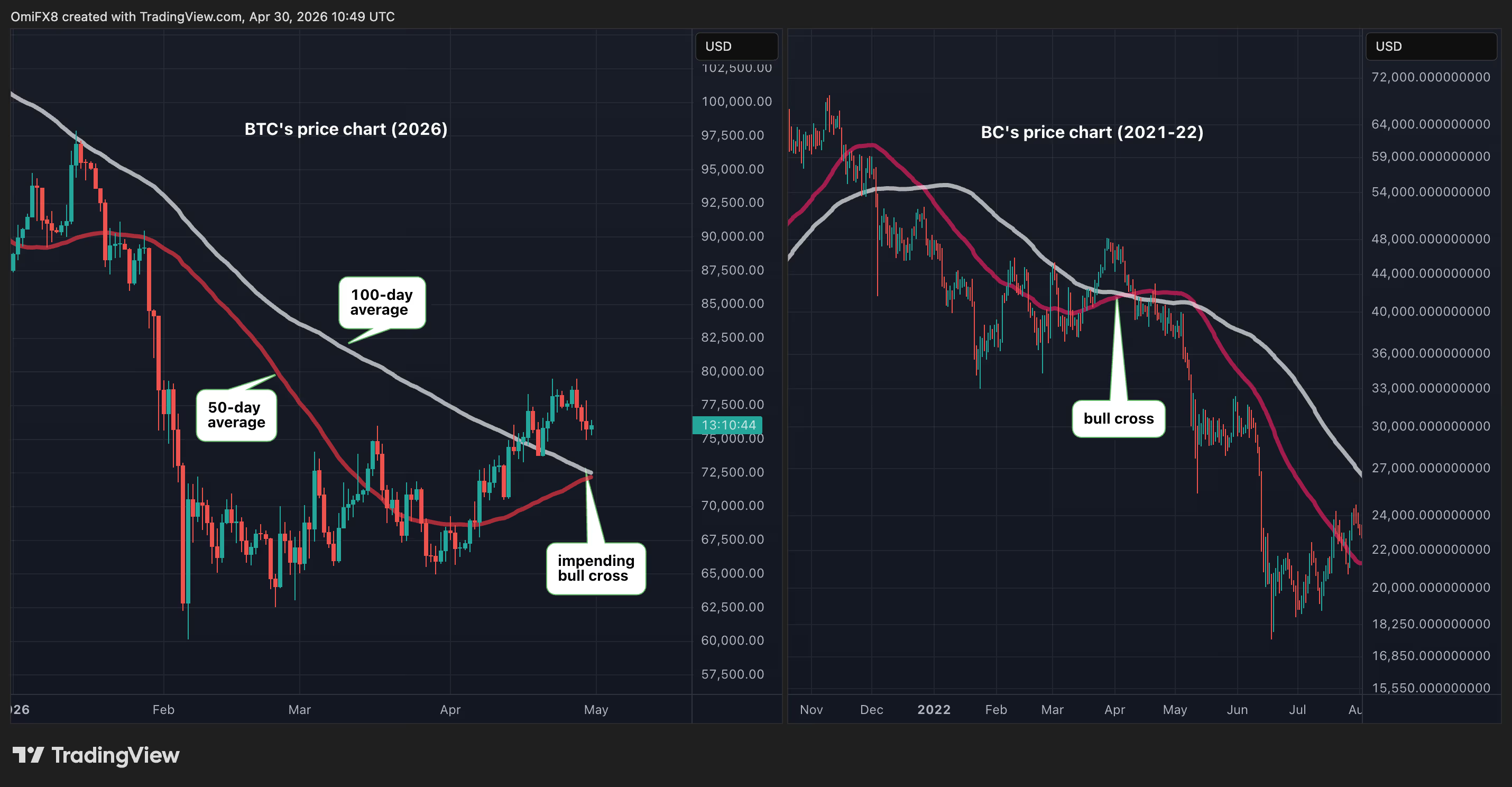
The chart shows bitcoin’s price swings in candlestick format over 2026 and 2021-22. The graphs show two lines: the red one represents the average price over 50 days and the white shows the average over 100 days.
As of today, the 50-day average appears poised to move above the 100-day average. Chart analysts refer to this as a bullish crossover, a signal that short-term momentum is strengthening relative to the medium-term trend and may point to further upside if sustained.
So, the impending crossover suggests more BTC price gains ahead. That said, the indicator has a mixed record, particularly during bear markets. For instance, a similar bull cross occurred in March 2022, as the chart on the right shows. But, it ended up trapping bulls on the wrong side of the market, as prices took a deeper dive in the following weeks.


Ripple has announced a sweeping strategic expansion across the Middle East and Africa, adding institutional partnerships in Saudi Arabia, Bahrain, South Africa, and Ghana. This moves position XRP collectively as the settlement layer for cross-border payments across one of the world’s fastest-growing financial corridors.
The push is anchored in Dubai, where Ripple operates from its DIFC office and holds a payments license from the Dubai Financial Services Authority, a regulatory framework that now enables regulated XRP utility across the region. Approximately 20% of Ripple’s global customer base already sits in the MEA region, making this expansion a direct play on its most strategically concentrated market.
Discover: What Brad Garlinghouse Says About XRP’s Institutional Future
Dubai’s DFSA Framework Is the Real Enabler
The DFSA license, granted to Ripple in March 2025, allows licensed firms operating within the DIFC to incorporate XRP into regulated financial services. It’s giving institutional clients in the UAE a compliant path to On-Demand Liquidity rails that bypass the correspondent banking stack entirely.
Last year Ripple partnered with Dubai International Financial Centre & $XRP gained approval by Dubai Financial Services (DFSA). —
 Today, we've seen Ripple be the FIRST blockchain enabled payments provider under DFSA!
This also marks Ripple's first Middle East operations license… pic.twitter.com/oAo4hJqzvV
 Tokenicer✲⥃⬢ (@Tokenicer) March 13, 2025
Discover: The best crypto to diversify your portfolio with
The Saudi partnership with Jeel, Riyadh Bank’s innovation arm, illustrates how that credibility compounds. Ripple’s MEA Managing Director Reece Merrick described the collaboration as advancing “real, enterprise-level use cases” tied to Saudi Arabia’s Vision 2030, covering cross-border payments, digital asset custody, and tokenization.
The Bahrain Fintech Bay alliance, signed on October 9, extends the network further, adding proofs of concept for stablecoins and payments, as well as RLUSD custody infrastructure for Bahraini financial institutions.

Garlinghouse’s institutional XRP strategy has flagged the MEA regulatory stack as the clearest proof that Ripple is decoupling its growth engine from U.S. litigation uncertainty, and betting hard on jurisdictions where the rules are already written.
Each partnership announced adds a distinct demand vector for XRP. The Absa Bank custody deal in South Africa opens tokenized asset settlement to one of the continent’s largest financial institutions.
Discover: The best pre-launch token sales
Bitcoin Hyper Targets Early Mover Upside as Ripple Expands
Even with all the above partnerships, XRP’s current range-bound struggle illustrates a familiar late-cycle dynamic: established large-caps absorb macro pressure while early-stage infrastructure plays attract capital looking for asymmetric exposure.
The math is straightforward, rotating into an asset already carrying an $80 billion market cap limits upside in ways a presale simply doesn’t.
Bitcoin Hyper is positioning directly inside that gap. The project is the first-ever Bitcoin Layer 2 with Solana Virtual Machine (SVM) integration, which delivers sub-second finality and low-cost smart contract execution while inheriting Bitcoin’s security model. SVM on Bitcoin mainnet unlocks programmability that the base layer has never had.
The presale has raised $32.5 million at a current price of $0.0136 per $HYPER, with 36% APY staking live for early participants. A Decentralized Canonical Bridge handles BTC transfers natively, keeping the ecosystem connected rather than siloed.
Researching Bitcoin Hyper as a complementary position rather than a replacement is a calculation worth running.
The post Ripple Penetrates Middle East After Vegas: Garlinghouse Masterclass? appeared first on Cryptonews.

Key Takeaways
- STLA shares decline 5.59% despite posting revenue and earnings improvements in Q1
- First-quarter revenue climbs 6% to €38.1B, though cash flow remains in negative territory
- Company returns to profitability with €0.4B net income as vehicle deliveries increase
- U.S. operations drive gains while European and Asian markets deliver mixed outcomes
- Management reaffirms 2026 guidance despite investor concerns over liquidity metrics
Shares of Stellantis N.V. (STLA) experienced a significant downturn during pre-market hours, even as the automaker unveiled better-than-expected quarterly earnings. Trading at $7.26, the stock suffered a 5.59% decline, continuing its downward trajectory from the previous session. The company delivered stronger revenue figures, improved profitability, and increased vehicle shipments, suggesting early signs of operational turnaround.
STLA Shares Sink Despite Positive Quarterly Earnings Momentum
Stellantis announced first-quarter net revenues totaling €38.1 billion for 2026, marking a 6% uplift compared to the same period last year. The expansion was driven by increased unit volumes throughout multiple geographic markets, with particularly robust performance in North American operations. Vehicle shipments surged 12%, demonstrating enhanced consumer appetite and more effective sales strategies.
The automaker swung to a net profit of €0.4 billion, marking a dramatic reversal from the year-ago loss. This turnaround stemmed from enhanced operational efficiency and elevated shipment numbers. Adjusted operating income climbed to €1.0 billion, while operating margins widened to 2.5%.
Despite these encouraging financial metrics, market participants responded negatively, pushing shares lower throughout pre-market activity. The stock retreated to $7.26, indicating continued bearish sentiment among traders. Market observers appeared more concerned with liquidity challenges and profitability sustainability than top-line expansion.
Industrial free cash flow posted a negative €1.9 billion, though this represented a 37% improvement versus the prior-year quarter. The deficit stemmed from typical seasonal working capital requirements during the first quarter along with legacy restructuring expenses. Nevertheless, the company bolstered its financial cushion, closing the period with €44.1 billion in available liquidity.
Geographic Performance Drives Top-Line Expansion
The North American market powered significant growth, with unit sales advancing 6% from Q1 2025 levels. U.S. operations registered a 4% uptick, while Canadian and Mexican markets demonstrated even stronger momentum. Regional market penetration improved to 7.9%, fueled by robust consumer interest in Ram trucks and Jeep SUVs.
Enlarged European operations also contributed positively, with sales volume expanding 5% on a year-over-year basis. The company exceeded overall market growth rates, benefiting from diversified demand spanning electric, hybrid, and traditional powertrains. EU30 market share climbed to 17.5%, reflecting modest competitive gains.
South American operations preserved market leadership despite uneven results across the region. Unit sales edged higher, while market penetration held above 21%. However, net revenues contracted due to adverse foreign exchange movements and softer transaction prices.
Across the Middle East and Africa, sales volumes remained relatively flat amid broader industry headwinds. Market share increased to 11.5%, powered by exceptional performance in Algerian and Turkish markets. Currency volatility dampened profitability metrics throughout the territory.
Asia Pacific operations delivered weaker results, with revenues falling 10% year-over-year. While shipment volumes actually increased, unfavorable pricing dynamics and product mix challenges offset volume gains. As a result, the segment recorded a deeper operating loss during the three-month period.
Management Maintains Guidance While Addressing Liquidity Challenges
Stellantis reaffirmed its full-year 2026 financial targets, anticipating revenue expansion in the mid-single-digit percentage range. Leadership also forecasts low-single-digit operating margins alongside enhanced free cash flow generation. The team is targeting a return to positive industrial free cash flow by fiscal 2027.
The company secured additional capital through a €5 billion hybrid perpetual note offering completed in March 2026. This transaction reinforced the balance sheet and created additional headroom for future capital allocation and transformation initiatives. Management has committed to introducing ten new vehicle models throughout 2026.
Operational excellence initiatives remained central to strategic priorities, as leadership works to resolve manufacturing efficiency and quality control issues. Robust consumer reception to 2025 model year launches provided encouraging early recovery indicators across core territories. Nevertheless, persistent cost inflation and negative cash generation continue to dampen investor enthusiasm.
Vikings Linked to Major QB Reset in 2027

Money Management | Financial Literacy | Financial Goals

Gloria Hunniford ‘humbled’ to receive Freedom Of The City Of London

Manchester United reach agreement with Casemiro over contract clause amid transfer speculation

US brings back mandatory military draft registration

Steven Gerrard disagrees with Gary Neville over ‘shock’ Chelsea and Arsenal claim | Football


-

 Tech3 days ago
Register Renaming | Hackaday
-

 Fashion6 days ago
Weekend Open Thread – Corporette.com
-
 Crypto World5 days ago
Hyperliquid $HYPE Rally Builds Momentum as AI Sector Enters Prove-It Phase
-

 Business7 days ago
Patterson-UTI Energy, Inc. (PTEN) Q1 2026 Earnings Call Transcript
-
 Sports4 days ago
IPL 2026: Ruturaj Gaikwad registers slowest fifty of the season, enters all-time unwanted list | Cricket News
-

 Politics3 days ago
Drax board avoid their own AGM, accused of greenwashing & environmental racism
-

 NewsBeat4 days ago
LK Bennett closes all stores after entering administration
-

 Crypto World6 days ago
Michael Saylor says BTC winter is over. Market analyst disagrees, says bitcoin was in a pullback
-

 Fashion2 days ago
Kylie Jenner’s KHY Enters a New Era with ‘Born in LA’
-

 Tech3 days ago
Images of Samsung’s rumored smart glasses have leaked
-
 Entertainment5 days ago
Mariah Carey Slams Deposition Claims In Brother’s Lawsuit
-
Crypto World7 days ago
Is Algorand One of the Few Quantum-Resistant Blockchains? Here’s What the Data Shows
-

 Business2 days ago
Most Commercial Energy Audits Miss the Real Losses
-
 NewsBeat6 days ago
Trump threatens to review UK’s claim to Falkland Islands and punish Nato allies over Iran war disagreement
-

 Tech3 days ago
Why Blue Badges Disappeared From Toyota Hybrids
-

 Business6 days ago
Jeanine Pirro announces closure of Federal Reserve building cost probe
-

 Business3 days ago
(VIDEO) Charlize Theron Climbs Times Square Billboard to Promote New Netflix Thriller ‘Apex’
-

 Crypto World7 days ago
Kraken Builds Beyond Crypto With Futures, Tokenized Stocks, and Payments
-

 Tech4 days ago
Microsoft to roll out Entra passkeys on Windows in late April
-

 Crypto World2 days ago
CFTC’s AI will review U.S. crypto registration applications, chairman tells CoinDesk
You must be logged in to post a comment Login