
Crypto World
We found HTX’s reserves at Poloniex

HTX’s situation has appeared increasingly precarious as both the European Union Council and the United Kingdom’s Foreign, Commonwealth, & Development Office have chosen to sanction the exchange.
Since then, it’s made some big changes to how it manages users’ reserves.
Its June proof of reserves report was the first that acknowledged that it had moved huge swaths of its reserves to an undisclosed “ThirdParty.”
Read more: HTX misrepresents Huobi Global S.A. after UK sanctions
HTX claims on its website that you can verify these balances by reaching out to the custodian; unfortunately, it doesn’t tell users who that custodian is. As a result, Protos has been unable to verify most of those balances.
Further complicating this, TRM Labs, a blockchain intelligence firm, released a report in which it detailed how HTX has begun churning through its wallets at a prodigious rate.
Ari Redboard, the global head of policy for TRM, described this behavior as an attempt “to stay a step ahead of screening built on static lists.”
Read more: ‘Someone’ is taking advantage of HTX’s reserves
HTX, for its part, previously claimed that this was totally normal cybersecurity behavior.
Since then, Protos was able to track a substantial portion of HTX’s staked ETH (stETH) through Poloniex addresses.
Now, we can add that various other HTX assets have also recently passed into Poloniex.
Read more: Justin Sun’s Poloniex and HTX withdraw huge amounts from AAVE
First, HTX distributes a tool that used to enable people to gain greater insight into its reserves, even including which addresses the reserves were held in.
We can use these past reports to determine where certain assets were claimed to be at a certain time and can use the blockchain transactions to follow some portion of the reserves as they move.
Consider 0x18709e89bd403f470088abdacebe86cc60dda12e, which was an address that HTX used to hold many of the Ethereum-based DeFi positions it maintained, for some reason.
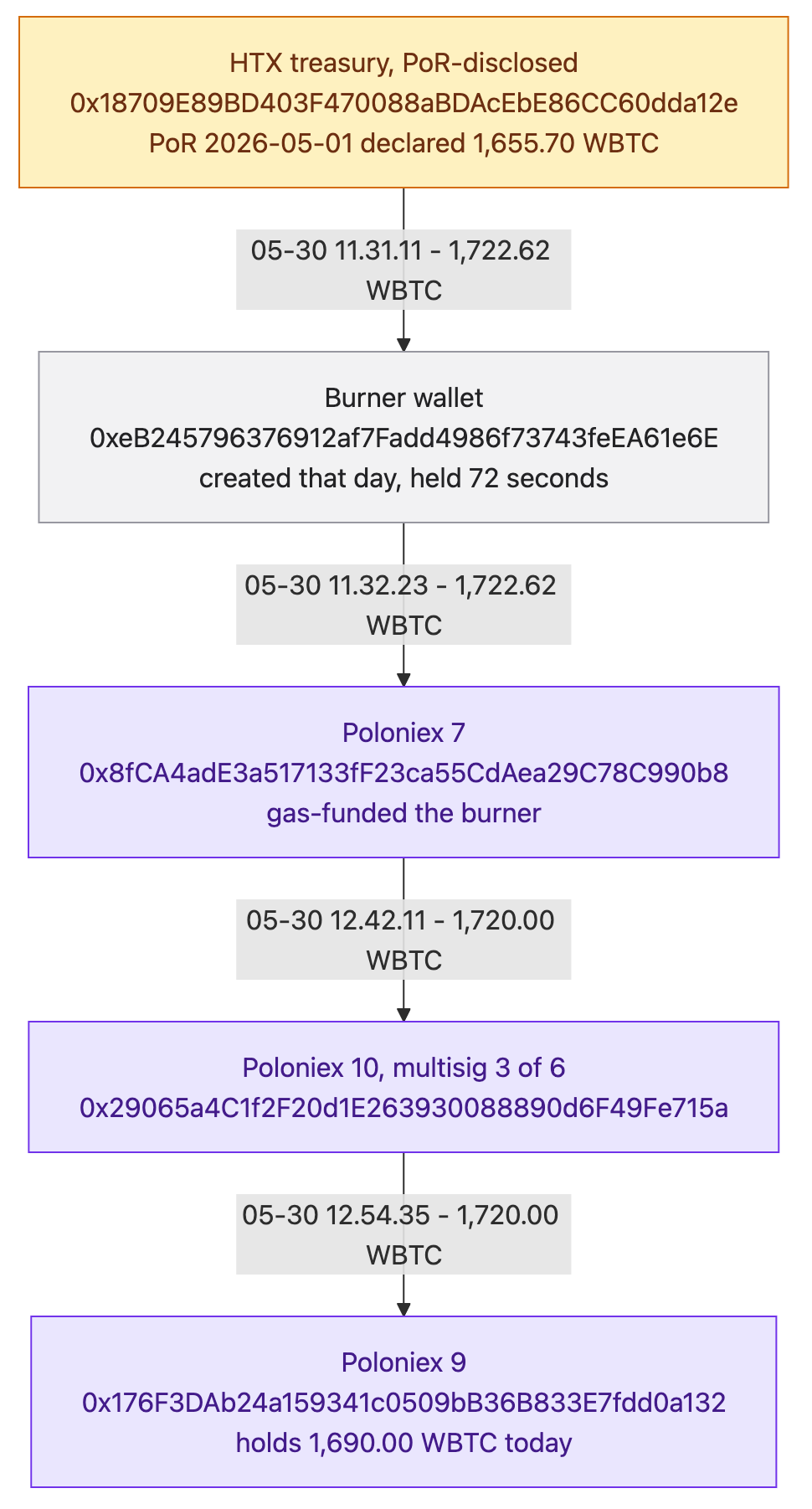
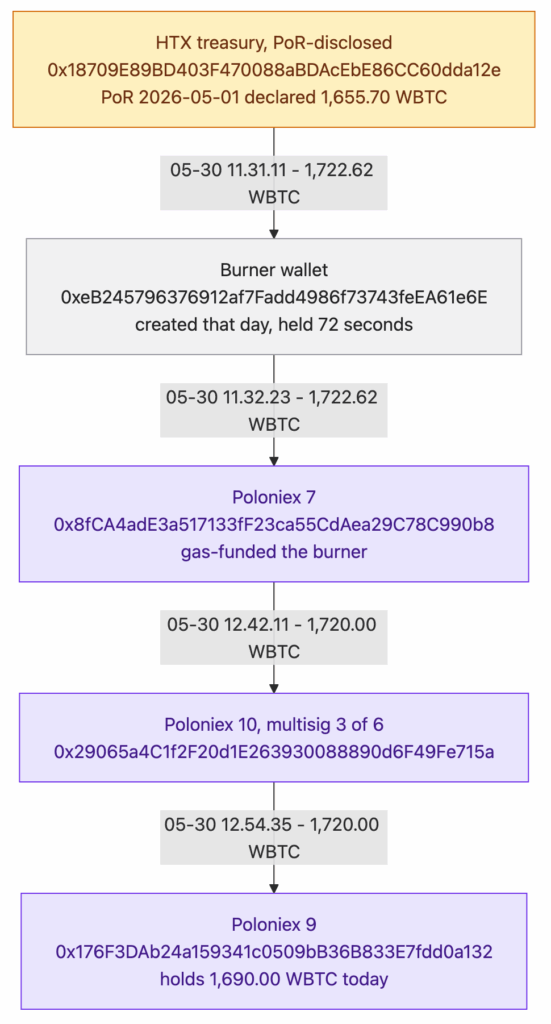
On May 30, immediately before we get the transition to ThirdParty, we can watch the Sun-advised wrapped BTC (WBTC) move from this HTX address to 0xeB245796376912af7Fadd4986f73743feEA61e6E.
These funds were then transferred to 0x8fCA4adE3a517133fF23ca55CdAea29C78C990b8, an address that Etherscan labels as Poloniex 7.
These funds were then quickly sent to 0x29065a4C1f2F20d1E263930088890d6F49Fe715a, an address that Etherscan labels as Poloniex 10.
Finally, this WBTC was sent to 0x176F3DAb24a159341c0509bB36B833E7fdd0a132, an address that Etherscan labels as Poloniex 9.
This WBTC which came from HTX, is still stored in this Poloniex address.
The HTX to Poloniex pattern repeats
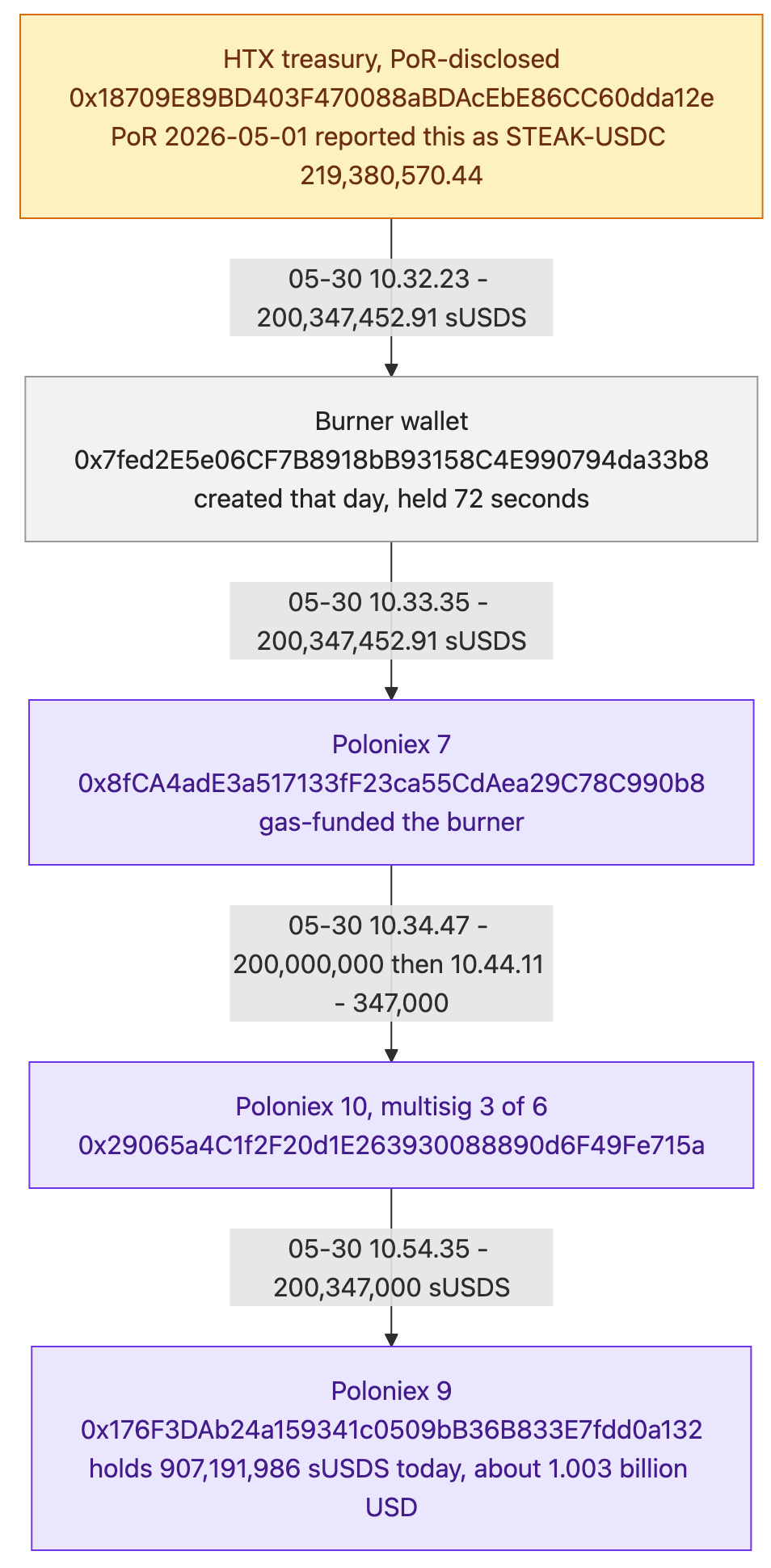
The May PoR for HTX had a problem. It claimed that it had a bunch of STEAK-USDC, but it was wrong; there was no STEAK-USDC in that address on that date.
However, there was a matching amount of Sky Savings USDS (sUSDS) in that address, suggesting that while HTX failed to accurately label its own reserves — troubling on its face — it did have another position that represented that value.
We start with approximately $200 million worth of sUSDS moving to 0x7fed2E5e06CF7B8918bB93158C4E990794da33b8.
These funds are then sent onward to Poloniex 7.
These were then forwarded in three transactions to Poloniex 10.
Finally, these funds were forwarded to Poloniex 9.
Similar patterns can also be observed for various Spark positions, some of which may have been since redeemed.
These related-party transactions, involving many hundreds of millions of dollars worth of value, raise serious questions about the internal controls and management of both of these Sun-owned exchanges.
They furthermore raise questions about Poloniex’s role in interacting with this repeatedly sanctioned entity.
Protos reached out to HTX with questions about these transfers, but it didn’t respond before publication.
Got a tip? Send us an email securely via Protos Leaks. For more informed news and investigations, follow us on X, Bluesky, and Google News, or subscribe to our YouTube channel.



Standard Chartered's global head of digital assets research said on Thursday that the $100 end-2030 price target he set for UNI in June may be too low, citing the rate at which Uniswap is now burning tokens with fees earned on Robinhood Chain. The burn rate Geoff Kendrick is extrapolating from is… Read the full story at The Defiant

“People are sick and tired of having to change their clocks twice a year. It is foolish, inconvenient and, in some cases, very costly,” Trump said. He went on to argue that the practice “is also bad for your health in the anxiety it creates,” and claimed that permanent Daylight Saving Time would have many benefits, including that it would “help Decrease Robbery and Murder Rates, Reduce Car Accidents (especially those involving Pedestrians!), Lower Risk for Cardiac Issues, Stroke, and Seasonal Depression, Make it Safer for Children to Walk Home from School.”

Tatiana Maksimova | Moment | Getty Images
S&P 500 companies are keeping more profit from every dollar in sales than ever before, providing another tailwind for stocks.
Using FactSet data, John Butters, senior earnings analyst and vice president at FactSet, showed that the S&P 500’s blended net profit margin is running at 16.9% for the second quarter. That’s up from 14.8% in the first quarter and 12.9% a year ago, and well above the five-year average of 12.4%.
Net profit margin is the percentage of revenue companies get to pocket after they have paid all expenses.
If that 16.9% figure holds, it would be the highest net profit margin since FactSet began tracking the metric in 2009, Butters notes.
Alphabet and Amazon are the biggest contributors to the S&P 500’s record-high net profit margin, Butters said.
Alphabet reported operating margin of 34% in the second quarter, up from 32% a year earlier. The Google parent also posted a $98 billion gain in other income, primarily from unrealized gains on equity securities. Amazon recorded other income of $53.4 billion on a net basis largely tied to its investment in Anthropic. The e-commerce and cloud giant also posted operating margin of 13.7% in the second quarter, up from 11.4% a year ago.
But the strength goes beyond these two mega caps.
Even after excluding Alphabet and Amazon, the S&P 500 margin still looks impressive at 15%, which is also a record and marks the highest net profit margin reported by the index dating back to 2009.
At sector levels, margins have been improving across most of the market.
Eight of the 11 S&P 500 sectors are reporting higher margins than they did a year ago, led by technology, communication services, consumer discretionary and energy.
Adam Schickling, a senior economist at Vanguard, told CNBC that the strong demand and operating leverage have helped companies convert more of their revenue into profit.
“Businesses, when they’re busy, are more profitable,” Schickling said. “Firms are busier, they’re more efficient, and that translates into higher margins.”
Technology companies have historically benefited from business models that can add customers or users without a proportionate increase in costs.
“Tech companies just have higher profit margins than what you might see from materials, industrials, energy,” Schickling said. “That is a sector is prone to having a higher general profit margin, especially because it has historically been relatively asset-light, which means they’re able to scale up at a very efficient rate.”
Businesses in the tech sector, however, are also experiencing a lot of competitive pressure, with many new entrants to the space, which could mean a potential risk in the future to profit margins in the technology space, Schickling said.


Kalshi, which raised $1 billion in May at a $22 billion valuation, is now the number one prediction market platform by revenue, followed by Polymarket, which was last reported to be seeking funding at $20 billion, following a $600 million investment from the Intercontinental Exchange, the owner of the New York Stock Exchange, at a $15 billion valuation in August.
Kalshi’s annualized revenue increased to $4 billion in July, bolstered mostly by 2026 World Cup betting. Polymarket’s revenue was only $1.1 billion for that same period. Sequoia Capital recently said Kalshi “now claims 95% U.S. market share in prediction markets.”
Most of Kalshi’s revenue comes from sports contracts, which contribute to over 80% of its volume. Kalshi announced Wednesday that Jeff Bandman, the lawyer who helped Kalshi secure a license to be a CFTC-regulated exchange in 2020, is returning to Kalshi as CEO of Kalshi Prime, which serves customers of Kalshi’s margin perpetual futures business.
Neither Sequoia, Wellington nor Kalshi immediately responded to a CoinDesk request for confirmation.


The appointment comes as traditional wealth managers and family offices in Asia take a growing interest in digital assets. Boston Consulting Group estimates total assets under management in the region will reach $99 trillion by 2029, with Singapore and Hong Kong among its key financial centers. Globally, roughly one-third of family offices already have exposure to cryptocurrencies, according to Goldman Sachs.
Asia growth
Asia is increasingly where crypto’s retail scale and institutional ambitions collide. APAC was the world’s fastest-growing region for onchain activity in the year through June 2025, with transaction volume surging 69% to $2.36 trillion, according to Chainalysis.
India led its global adoption rankings, while Singapore and Hong Kong are competing to establish themselves as regulated digital-asset hubs, making the region an increasingly important battleground for firms courting traditional financial institutions and wealthy investors.
“Asia’s wealthiest families and managers are increasingly investing in digital assets,” Lai said in the press release. “B2C2 has the liquidity and execution infrastructure this client base needs.”
Lai’s appointment follows a series of hires by B2C2 in Asia under APAC CEO David Rogers, including Laura Teo as Singapore country head.
B2C2 is 90% owned by Japan’s SBI Holdings, and has become part of the financial group’s broader push into digital assets.


The White House will gather cryptocurrency and prediction market executives next Wednesday, according to three people familiar with the plans. The guest list remains unsettled, and traditional finance executives could also join.
The timing matters. Regulators convene many of the same executives 24 hours later. That hands Washington two straight days of contact with the industries pushing for new federal rules.
What the White House Crypto Summit Signals
President Donald Trump has aligned his administration with digital assets since returning to office last year. His regulators have opened doors to prediction market operators as well.
Neither the attendee list nor Trump’s own participation has been confirmed, Politico reported. The White House has not commented publicly on the plans.
Prediction markets let users trade contracts on the outcome of real events. They have moved from the margins of financial regulation toward its center.
Scrutiny has followed. New York City lawmakers opened an investigation into prediction markets this week over how the platforms advertise to residents.
CFTC Panel Convenes 35 Executives a Day Later
The Commodity Futures Trading Commission (CFTC) supervises US derivatives markets. It holds the first meeting of its Innovation Advisory Committee on Aug. 20 in Washington.
Chairman Michael Selig created the panel to advise the agency on technology, law, and policy questions. Its 35 members read like a guest list for the White House itself.
They include Polymarket’s Shayne Coplan, Kalshi’s Tarek Mansour, Coinbase’s Brian Armstrong, and Ripple’s Brad Garlinghouse. Executives from CME Group, Nasdaq, DraftKings, and FanDuel also hold seats.
That roster explains why the two days carry weight. Federal courts have already backed the platforms against state restrictions. A ruling favoring Kalshi kept their contracts trading in Minnesota.
CLARITY Act Vote Looms Over Both Meetings
The Digital Asset Market CLARITY Act would rewrite how Washington polices token trading. The bill sets a firmer test for which assets count as securities. Oversight would split between the Securities and Exchange Commission (SEC) and the CFTC.
The Senate Banking Committee advanced the measure 15-9 in May. Senators then left for their August recess without holding a floor vote.
Democrats object to an ethics carve-out covering Trump’s crypto holdings. Republicans Josh Hawley and Jerry Moran oppose the stablecoin yield provisions on behalf of community banks.
Sixty votes are needed to break a filibuster. That arithmetic has left researchers rating the bill’s passage odds as slim for this year.
Lawmakers return in September, and Majority Leader John Thune has said the chamber will move early on the bill. The SEC has meanwhile started drafting its own crypto rulemaking as a fallback.
Executives will arrive in Washington with one ask above all others. Access to the administration is far easier to win than 60 Senate votes. The coming month will show whether next week’s meetings shifted either number.
The post White House Plans Crypto, Prediction Market Summit Next Week appeared first on BeInCrypto.


Norway’s Government Pension Fund Global disclosed a 6,151,062-share position in BitMine Immersion Technologies valued at $81,870,635, according to a Norges Bank holdings filing for the quarter ended June 30. The holding gives the sovereign wealth fund indirect exposure to Ethereum through BMNR… Read the full story at The Defiant


ShipMonk, Trezor’s fulfillment partner, suffered unauthorized access to its systems, affecting nearly 14,000 customers’ data, the cold storage crypto wallet firm reported Thursday.
Trezor said the names, email addresses, phone numbers and shipping addresses of 11,742 customers had been compromised. It also said the names, cities and email addresses of another 1,947 customers were also breached, bringing the estimated number of victims to nearly 14,000 across the U.S., the UK, Sweden, Colombia, Brazil, Italy and Portugal.
“We have some difficult news to share,” Trezor said Thursday on X. “Unfortunately, one of our shipping providers has experienced a data breach that exposed sensitive order data.”
The Trezor-related security hack comes as global data breaches are at an all-time high, according to SentinelOne, a U.S. cybersecurity firm. It said that this year, data breaches have increased by 17% compared with 2025, with an average of 2,090 attacks worldwide each week. It is also estimated that global data breaches have been rising by 3% month over month since January.
Crypto World
Ripple Price Analysis: XRP Structure Remains Weak as $1 Support Comes Under Pressure Again
XRP remains firmly in a corrective structure, with the token trading near $1.00 after months of lower highs and lower lows. While the current support zone could trigger a relief move, the broader trend remains bearish until the asset can reclaim several key resistance levels.
Ripple Price Analysis: The USDT Pair
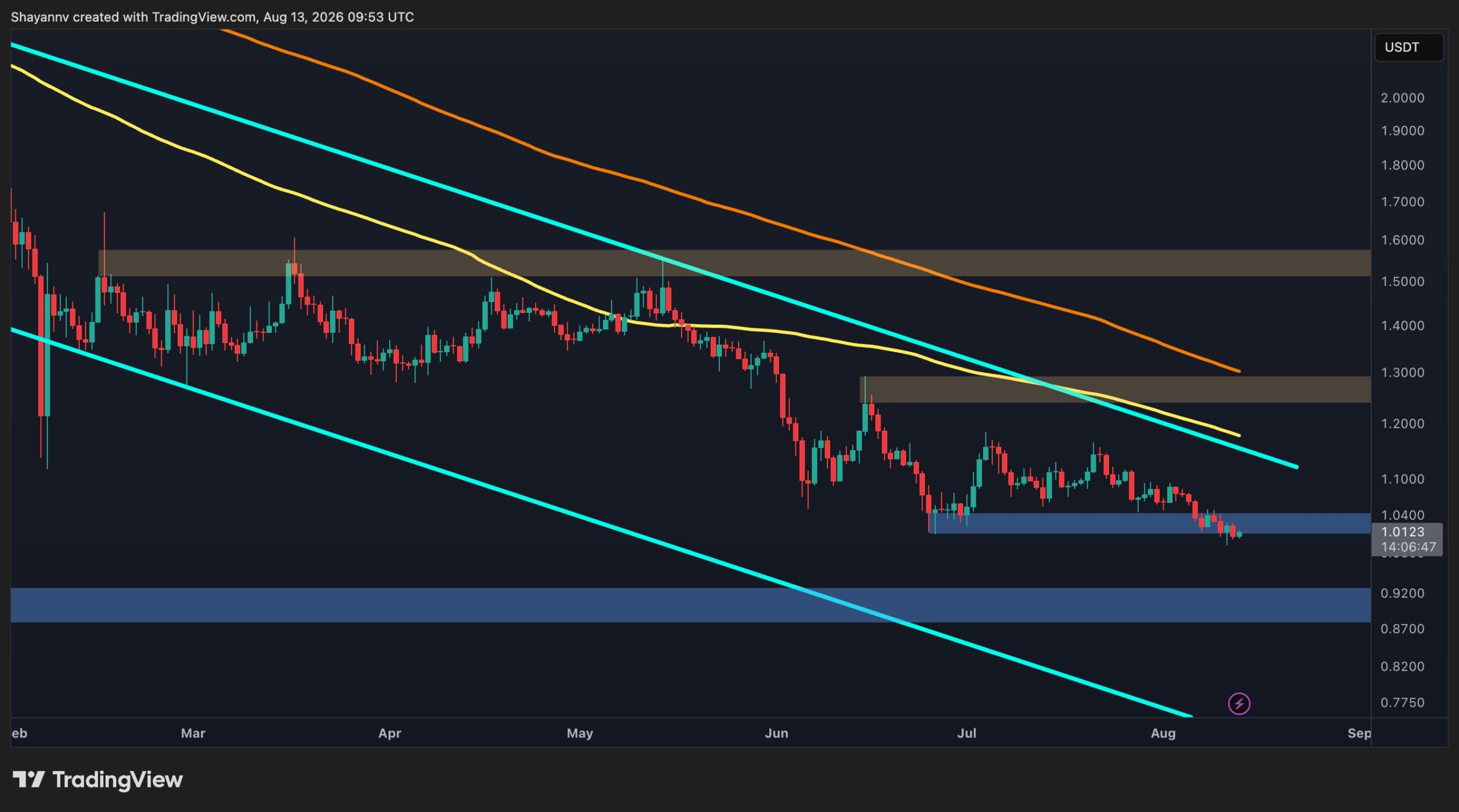
On the XRP/USDT daily chart, the price continues to trade inside a descending channel and below the 100-day and 200-day moving averages shown on the chart. This keeps the broader market structure tilted to the downside.
XRP is currently testing the $1.00 support zone, which has acted as a local floor during the recent consolidation. Holding this area could give buyers an opportunity to build a base and initiate a recovery toward the first major resistance at $1.25-$1.30. This zone is particularly important as it aligns with the critical 200-day moving average, which is currently declining around the same area.
A breakout above the descending channel and the $1.30 supply zone would improve the technical picture and could open the door toward the $1.50-$1.60 resistance area. However, as long as XRP remains below the $1.25-$1.30 area, the prevailing downtrend remains intact.
If the $1.00 support fails, the next major downside area appears around $0.90. A sustained move below that zone would signal another significant structural breakdown that could push the price even deeper and toward the lower boundary of the large channel.
The BTC Pair
The XRP/BTC pair paints a similarly weak picture. The pair has broken below the 1,700 sats support level and continues to trade within a broader descending structure.
XRP/BTC is now approaching the 1,500 sats support zone. Holding this area could allow for a recovery back toward 1,700 sats, which has now become the first key resistance. Until that level is reclaimed, XRP appears likely to remain relatively weak against Bitcoin.
Overall, XRP is in a critical technical area on both charts. The 1,500 sat demand zone is the crucial level for buyers to defend on the BTC pair. A sustained defense of this area could also fuel a rebound against USDT, but the broader bearish structure remains in place unless XRP begins reclaiming the overhead resistance levels.

The post Ripple Price Analysis: XRP Structure Remains Weak as $1 Support Comes Under Pressure Again appeared first on CryptoPotato.


Tether said Thursday that KPMG U.S. issued an unqualified opinion on the financial statements of Tether International, S.A. de C.V. for the year ended Dec. 31, 2025, completing the first full financial statement audit in the company's history. An unqualified opinion is the cleanest verdict an… Read the full story at The Defiant

Blue Door’s chance to outshine rivals in 2026 Rosebud
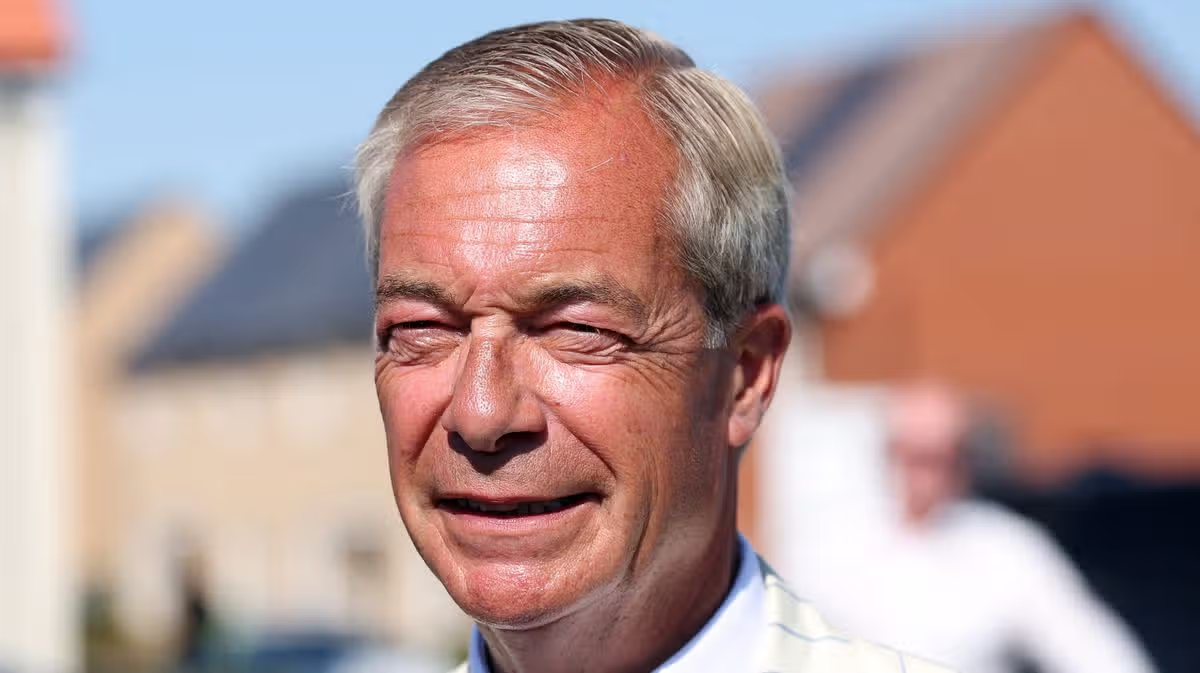
Clacton by-election result live: Reform chief Nigel Farage awaits fate in bin fight as voting closes

Onex Corporation (ONEX:CA) Q2 2026 Earnings Call Transcript


![LISA - 'MONEY' Dance Practice [Mirrored]](https://wordupnews.com/wp-content/uploads/2026/02/1770259125_maxresdefault-80x80.jpg)


-

 Fashion6 days ago
Weekend Open Thread: Mattifying Sunscreen
-

 Fashion6 days ago
Frugal Friday’s Workwear Report: Cap-Sleeve Pointelle Crewneck Sweater
-

 News Videos6 days ago
Can Astrology Help Find Gold and Silver Trends? A Financial Astrology Guide
-

 Tech6 days ago
Rinn Pharma & Biopharma to join NordicPharmaTrain network
-

 Business5 days ago
How to Start a Cleaning Business: A Step-by-Step Guide
-

 Business4 days ago
Datadog: Best Of Breed For Multiple Reasons
-

 Business5 days ago
BDC Weekly Review: Private BDC Q2 Numbers Are Strong
-
 NewsBeat2 days ago
Communication cards help banking customers access services or report scams
-

 Tech7 days ago
Price Hikes May Be Coming for PC Motherboards Next
-

 Business7 days ago
Brightwater secures funding for WA-first dementia projects
-
 Business3 days ago
Oil Price Today (August 11): Crude oil rises to $88 after Trump’s compensation demand dents Hormuz opening. Here’s why
-

 Fashion6 days ago
Weekly News Update, 8.6.26 – Corporette.com
-

 Business7 days ago
Aussie shares lose steam to close record-breaking week
-
 Entertainment7 days ago
Brand New Day’ Characters, Ranked
-

 Fashion7 days ago
The Best Stores Like Ann Taylor
-

 Fashion6 days ago
Irina Shayk Wows in REVOLVE Los Angeles’ Summer Styles
-

 Entertainment7 days ago
Coastal House Media Can Disney Redeem Live Action Dragon Ball?
-

 Fashion6 days ago
Burberry Fall 2026 Takes On Commuter Style
-

 Politics5 days ago
Be quiet, Miriam! – spiked
-

 Fashion4 days ago
Amazon Sundays: Closet Care Before Fall
You must be logged in to post a comment Login