

Crypto World
Wealthsimple brings 4,000 Kalshi prediction market contracts to Canada



Wealthsimple has secured approval to offer roughly 4,000 prediction market contracts in Canada, expanding retail access to event-based trading through a new partnership with Kalshi.
Summary
- Wealthsimple will launch a prediction markets app in Canada with access to about 4,000 Kalshi contracts.
- Kalshi’s crypto perpetual futures platform generated more than $5.5 billion in volume within two weeks.
- Regulatory and legal battles over prediction markets continue to intensify across the U.S. and several international jurisdictions.
According to Wealthsimple, the company plans to launch a standalone prediction markets platform called Wealthsimple Predict this summer, giving Canadian investors access to thousands of contracts listed by Kalshi across categories such as financial markets, economic data, and climate-related events.
The rollout follows authorization from the Canadian Investment Regulatory Organization in March. Under the approval, Wealthsimple became the second investment dealer permitted to offer prediction market contracts in Canada. CIRO said the products will be regulated as derivatives and must carry settlement periods of at least 30 days.
Wealthsimple’s launch arrives as prediction markets continue to attract attention from regulators, lawmakers, and traditional exchanges in several countries. While Canadian authorities have allowed the products under an established derivatives framework, regulators elsewhere remain divided over how such contracts should be classified.
Kalshi expands beyond prediction markets
At the same time, Kalshi has continued pushing into crypto-linked derivatives. The company announced on Thursday that its perpetual futures products are now available for trading, following a May 31 announcement that formally introduced its crypto perpetual futures business.
Earlier this week, Kalshi disclosed that its perpetual futures platform generated more than $5.5 billion in trading volume within two weeks of launch. The company currently offers 11 crypto-linked perpetual futures contracts and has stated that discussions with regulators regarding additional products are ongoing.
Crypto.news previously reported that Kalshi’s rapid growth has intensified a separate political dispute in Washington. According to a Semafor report, a coalition that includes the Indian Gaming Association, the American Gaming Association, and several labor groups has urged the U.S. Senate to amend the CLARITY Act to explicitly prohibit sports and casino-style event contracts from being offered through prediction market platforms.
In a letter to lawmakers cited by Semafor, the coalition argued that sports betting should remain under existing state and tribal regulatory systems rather than falling under the oversight of the Commodity Futures Trading Commission.
The groups also claimed that prediction markets have enabled what they described as the largest expansion of gambling in U.S. history over the past 18 months without direct congressional approval.
Legal challenges continue to grow
Meanwhile, resistance is also emerging from established derivatives exchanges.
On Thursday, CME Group filed a lawsuit against the U.S. Commodity Futures Trading Commission over the regulator’s approval of cryptocurrency perpetual futures contracts offered by Kalshi and similar products introduced by Coinbase. The filing came one day after CME Chief Executive Officer Terrence Duffy said the company intended to challenge the approvals through the courts.
The legal dispute follows a series of regulatory actions supporting onshore crypto perpetual futures trading. In May, the CFTC approved Bitcoin perpetual futures contracts for Kalshi and issued a no-action position that allowed Coinbase to launch comparable products.
Several jurisdictions outside North America have taken a different approach. Spanish regulators ordered internet providers in May to block access to Kalshi and Polymarket while examining whether the platforms violated national gambling laws.
Indonesian authorities have banned Polymarket, while Japanese and South Korean regulators have also taken action against prediction market activity.
Within the United States, at least 11 states have challenged prediction markets in recent months. Speaking at Bitso’s Stablecoin Conference in Mexico City on June 16, Digital Chamber Chief Executive Officer Cody Carbone said the growing dispute between state gambling regulators and the CFTC is likely to reach the U.S. Supreme Court.

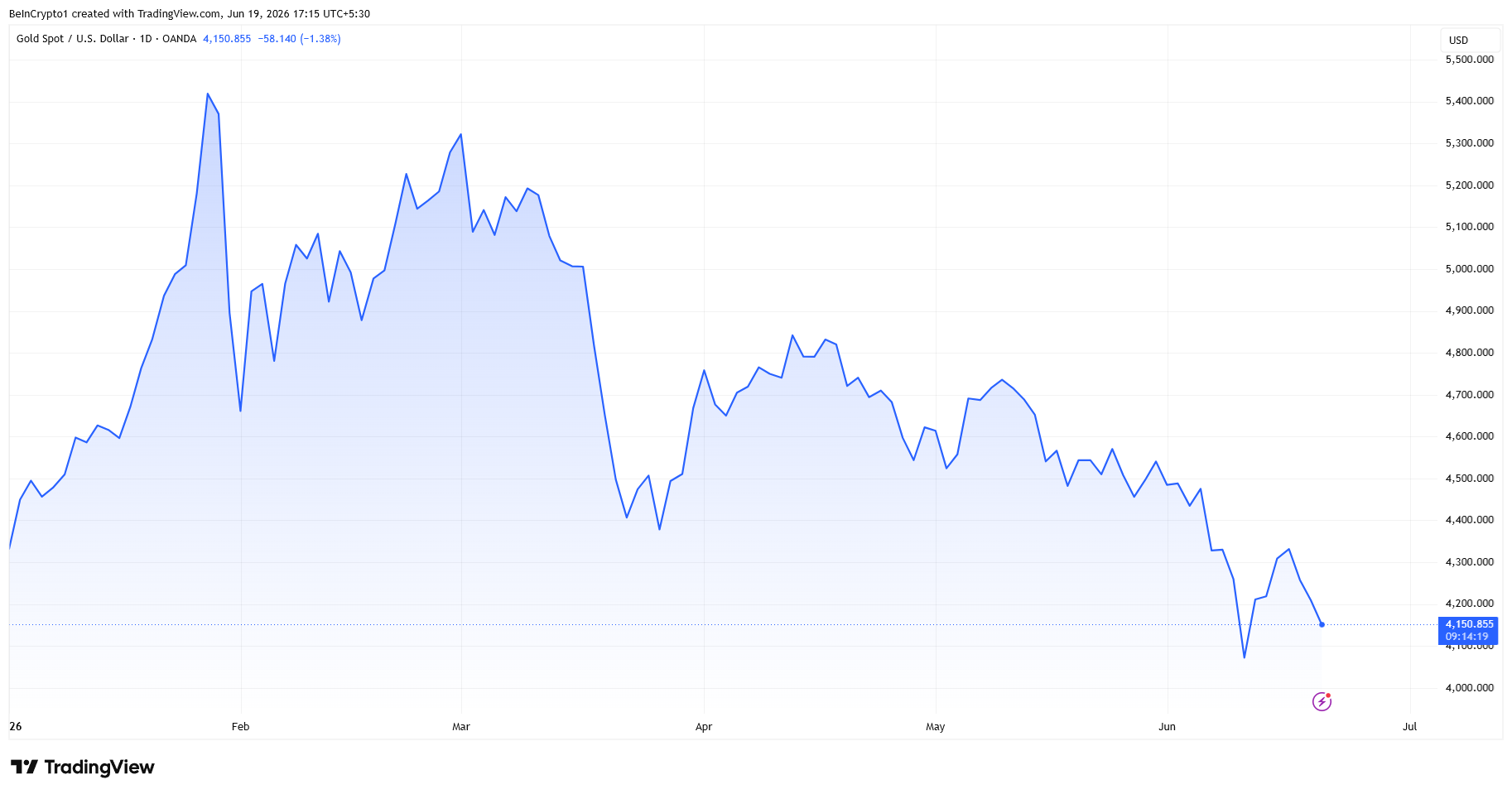
Goldman Sachs has lowered its year-end gold forecast by $500 to $4,900 an ounce. This revised forecast comes as hopes for a 2026 rate cut fade.
The revised target still implies gains in the second half, though smaller than the bank previously projected. Analysts Lina Thomas and Daan Struyven outlined the change in a research note.

Why Goldman Lowered Its Gold Forecast
The downgrade stems mainly from a weaker outlook for inflows into gold-backed exchange-traded funds. World Gold Council data showed that global gold-backed ETFs experienced outflows of roughly $2 billion in May.
Europe alone attracted fresh inflows that month. Asian funds, meanwhile, logged their first monthly outflow since August 2025, with $1.2 billion leaving. At the same time, investor sentiment has also turned bearish.
Follow us on X to get the latest news as it happens
The weaker ETF demand comes as markets scale back expectations for Federal Reserve rate cuts. Earlier this week, Goldman economists pushed back their US rate-cut forecast to June and December of next year. They had earlier expected reductions in December 2026 and March 2027.
“Our gold price views remain structurally constructive but tactically cautious, with near-term downside risk and medium-term upside risk,” the analysts said.
The Hawkish Fed Backdrop
Meanwhile, the Fed held its benchmark rate at 3.50% to 3.75% this week, but there was growing support for hikes. Nine officials now project at least one hike in 2026.
Should the Fed actually raise rates, Goldman sees gold sliding to $4,400 by year-end as its appeal as a policy hedge fades. Rob Kaplan, a Goldman vice chairman and former Dallas Fed president, told Bloomberg that a hike may come as soon as September.
Still, central bank demand provides a floor. Official buyers turned net gold purchasers again in April, adding 19 tons. Moreover, according to WGC’s survey, roughly 45% plan to grow their reserves in the coming year.
Subscribe to our YouTube channel to watch leaders and journalists provide expert insights
The post Goldman Sachs Reduced Its Gold Price Target for the End of 2026 appeared first on BeInCrypto.


Key takeaways
- XMR is down 2% and could record further losses in the near term
- The Fed’s hawkishness weighs on the broader crypto market.
Privacy coins remain under pressure amid weak risk appetite
Monero (XMR) continued its downward trajectory on Friday as bearish sentiment persisted across the cryptocurrency market.
XMR slipped for a third consecutive session, remaining below the $330 level.
The broader crypto market came under renewed pressure following remarks from Federal Reserve Chairman Kevin Warsh during his first post-meeting press conference on Wednesday.
While the Federal Open Market Committee (FOMC) left interest rates unchanged, in line with market expectations, investors reacted negatively to the central bank’s hawkish tone.
Policymakers emphasized their commitment to restoring inflation to the long-term 2% target, prioritizing price stability over near-term monetary easing.
Warsh’s comments suggested the Fed remains comfortable maintaining its current policy stance and is not yet considering interest-rate cuts. Market participants have even begun pricing in the possibility of another rate increase, with current expectations implying a 30% probability of a hike at an upcoming policy meeting.
Risk appetite weakened further as the Crypto Fear & Greed Index fell to 15 on Thursday from 22 a day earlier, keeping the market firmly in the “Extreme Fear” zone. The decline highlights growing investor caution and reduced exposure to risk assets.
Monero price outlook: Correction continues below key resistance levels
Monero remains trapped below the Bollinger Bands middle line near $340 and all major Exponential Moving Averages (EMAs).
The 50-day EMA sits around $359, while the 100-day and 200-day EMAs cluster near $366, creating a significant resistance zone overhead.
Despite the ongoing correction, technical indicators show signs of improving momentum.
The Moving Average Convergence Divergence (MACD) histogram remains positive, while the Money Flow Index (MFI) near 65 suggests steady capital inflows.
However, these signals currently point to corrective rebounds rather than a broader trend reversal as long as XMR remains beneath key resistance levels.
Immediate resistance is located around the Bollinger Bands’ middle line at $340, followed by the 50-day EMA near $359.
A stronger resistance zone emerges around $367, where the 100-day and 200-day EMAs converge. Beyond that, the upper Bollinger Band near $389 represents the next major hurdle for buyers.
On the downside, support is found near the lower Bollinger Band at approximately $291. A breakdown below this level could accelerate losses and trigger a deeper retracement despite the recent improvement in momentum indicators.

Monero remains vulnerable to further downside as macroeconomic uncertainty and restrictive monetary policy continue to weigh on investor sentiment.
While technical indicators suggest some underlying buying interest, the privacy coins must reclaim key resistance levels before a more sustained recovery can take shape.
Crypto World
Bitcoin Price Prediction: Illinois Crypto Transfer Tax Proposal Adds New Regulatory Pressure

Bitcoin price is butchered as a wave of state-level regulatory pressure lands on a market prediction that is grinding through consolidation. Illinois just became the first U.S. state to impose a direct transaction-level tax on digital assets. What makes it even worse is the law’s structure. The full implications for exchange operations and user behavior won’t hit until 2027, but the precedent is already moving sentiment.
Under Illinois SB3019, a 0.2% “Digital Asset Tax” will apply to every crypto transfer, not just profitable trades, but any movement of funds, including wallet-to-wallet transfers, cold storage withdrawals, and even reorganizing holdings within the same exchange.
Governor Pritzker signed the measure as part of the state’s FY2027 budget, projecting $60 million annually in new revenue. MicroStrategy’s Michael Saylor called it a “big mistake” that will drive Bitcoin capital and innovation out of Illinois.
The rules will also require centralized exchanges to meet a low $100,000 annual receipts threshold from Illinois users to collect and remit the tax, so virtually every major platform is captured.
The concern isn’t Illinois alone. Traders are now watching whether other states treat this as a template, and analysts have flagged that a contagion of similar state-level measures could meaningfully compress on-chain activity across the U.S.
Discover: The Best Token Presales
Bitcoin Price Prediction: Can BTC Break $70,000 Under Mounting Regulatory Headwinds?
Bitcoin’s current consolidation range has well-defined boundaries that need to be watched closely. Support sits in the $60,000–$62,000 zone. This is the region where spot buyers absorbed the last significant correction and where options desks have clustered notable open interest on the put side.
Resistance remains firm at above $66,000, aligning with prior local highs and a concentration of call open interest that has capped rallies on multiple attempts.

The Illinois tax news doesn’t threaten Bitcoin’s structural bull case on its own, but it adds to a macro-regulatory cocktail that has kept momentum subdued. Spot ETF inflows remain the primary demand lever, and any meaningful acceleration there would likely overwhelm state-level noise. Without it, the path of least resistance stays sideways.
The data points to a market that isn’t panicking, but isn’t buying dips aggressively either. Position sizing reflects that ambiguity.
Discover: The Best Crypto to Diversify Your Portfolio
Bitcoin Hyper Targets Early-Mover Upside as Bitcoin Navigates Key Levels
If Bitcoin’s near-term upside is capped at $70,000 while regulatory friction compounds at the state level, the asymmetric opportunity shifts down the risk. It is curving toward infrastructure plays that benefit from Bitcoin’s long-term adoption story without carrying the same near-term overhang.
That’s the argument forming around Bitcoin Hyper ($HYPER). It’s a Bitcoin Layer 2 project integrating the Solana Virtual Machine to deliver smart contract execution speeds that the base chain simply cannot offer.
The pitch is direct: bring fast, scalable programmability to Bitcoin while preserving its security model, something no other Layer 2 has executed with SVM integration.
The presale has raised $32 million at a current price of $0.0136, with staking available and a decentralized canonical bridge for BTC transfers already in the feature set. As state-level taxes threaten to squeeze routine on-chain activity, infrastructure that makes Bitcoin more efficient and programmable looks structurally relevant, not just as a trade, but as a thesis.
Traders wanting to assess the project further can research Bitcoin Hyper here.
The post Bitcoin Price Prediction: Illinois Crypto Transfer Tax Proposal Adds New Regulatory Pressure appeared first on Cryptonews.

Key Takeaways
- Micron’s fiscal Q3 earnings are scheduled for after-hours Wednesday, June 24
- Wall Street expects EPS of $20.70 (versus $1.71 last year) and revenue of $35.56 billion (versus $9.30 billion)
- Shares have skyrocketed 817% over the trailing twelve months and 298% in 2025
- The company has exceeded earnings expectations for 12 consecutive quarters, yet shares declined following 7 of those announcements
- AI infrastructure spending from major technology firms is projected to surpass $700 billion in 2025, sustaining robust chip demand
Micron Technology shares have delivered extraordinary gains over the past year, surging 817%. However, Wednesday’s earnings announcement may present a challenge — regardless of how impressive the results prove to be.
The memory chip manufacturer will unveil its fiscal third-quarter performance after market hours on June 24. Shares were trading approximately 8.70% higher in anticipation of the disclosure.
Analysts are projecting a substantial year-over-year improvement. The consensus calls for adjusted earnings per share of $20.70, a dramatic increase from $1.71 in the corresponding period last year. Revenue projections stand at $35.56 billion, compared to just $9.30 billion twelve months prior, based on FactSet estimates.
These figures represent exceptional growth. However, historical patterns suggest that surpassing expectations doesn’t guarantee share price appreciation.
Micron has exceeded earnings projections for twelve consecutive quarters. Despite this streak, the stock has finished lower in the trading session immediately after seven of those announcements, data from Dow Jones Market Data reveals.
The latest instance occurred in March, when Micron delivered its largest earnings surprise relative to forecasts in two years. Nevertheless, shares declined 3.8% the following trading day.
That being said, MU has rallied 168% since that March announcement. A single-day decline obviously doesn’t capture the complete investment narrative.
AI Infrastructure Investment Context
The broader environment is critical to understanding Micron’s position. Investors are monitoring the company’s performance as an indicator of overall semiconductor demand and whether the artificial intelligence investment wave maintains its strength.
Major technology corporations are anticipated to allocate over $700 billion toward AI infrastructure in the current year, up from $400 billion in 2025. This extraordinary capital deployment has been instrumental in driving memory chip consumption.
“The demand is just through the roof in relation to chip capacity,” noted Steve Kolano, chief investment officer at Integrated Partners, characterizing Micron’s situation as “a classic positive feedback loop.”
The Philadelphia SE Semiconductor Index reached a new record high this week, advancing 7% over the five-trading-day period. Major U.S. equity benchmarks are similarly positioned near all-time peaks, buoyed by robust corporate profits and diminished geopolitical tensions.
Critical Factors for Investors
Beyond the topline financial metrics, market participants will scrutinize Micron’s forward guidance and any remarks regarding data center demand patterns.
Valuation multiples throughout the semiconductor sector have expanded considerably, prompting some investors to question whether the AI-driven rally has become overextended. Micron’s quarterly report offers one of the most direct methods to assess whether underlying demand justifies current market enthusiasm.
The Federal Reserve’s preferred inflation gauge and the final first-quarter GDP revision are also scheduled for release next week, introducing additional macroeconomic variables into the equation.
Barron’s has previously contended that Micron and several chip industry counterparts remain attractively valued relative to AI server hardware requirements.
Second-quarter earnings expansion for the S&P 500 is estimated at 22.9%, declining from 29.3% in the first quarter, according to LSEG research.
Presently, the Wall Street consensus maintains that AI-related momentum continues unabated. SpaceX’s recent public market debut and Nasdaq’s inclusion of AI infrastructure companies such as Astera Labs and CoreWeave have generated additional institutional buying activity from passive index strategies.
Micron is scheduled to announce results after Wednesday’s market close on June 24.



Key takeaways
- ZEC is still struggling under the $477-$500 zone.
- Although momentum indicators show signs of stabilization, Zcash remains vulnerable to further downside as investors react to persistent macroeconomic uncertainty and rising rate-hike expectations.
Zcash (ZEC) remains under pressure on Thursday as bearish sentiment continued to dominate the cryptocurrency market. ZEC is facing mounting resistance beneath the $500 mark as investors reduce exposure to risk assets.
Fed’s policy stance causes a negative market reaction
The broader crypto market weakened following remarks from Federal Reserve Chairman Kevin Warsh during his first post-meeting press conference on Wednesday.
Although the Federal Open Market Committee (FOMC) kept interest rates unchanged, in line with expectations, investors reacted negatively to the central bank’s firm commitment to bringing inflation back to its long-term 2% target. The Fed’s emphasis on price stability signaled that policymakers are not yet prepared to pivot toward monetary easing.
Warsh’s comments reinforced expectations that higher interest rates could remain in place for longer. Market participants are even assigning a roughly 30% probability to a future rate hike, reviving concerns about tighter financial conditions and reduced liquidity for risk assets.
Investor confidence weakened further as the Crypto Fear & Greed Index fell to 15 on Thursday from 22 a day earlier, remaining firmly within the “Extreme Fear” zone. The reading highlights growing caution among traders and suggests subdued market participation in the near term.
ZEC price forecast: Zcash faces growing downside risks
Zcash has also remained on the defensive, recording three straight days of losses while trading below its 50-day EMA near $477.
The continued inability to reclaim this level has reinforced bearish sentiment and increased the likelihood of further downside.
A sustained move lower could encourage additional de-risking among traders, placing the spotlight on key support zones near $434 and $376.
While the MACD histogram remains marginally positive, suggesting some recovery attempts may be forming, the Money Flow Index remains in the mid-40s, indicating relatively weak buying momentum compared with Monero.
The immediate resistance level remains the 50-day EMA at approximately $477. If buyers manage to regain control, attention could shift toward the upper boundary of the descending channel near $549.

On the downside, support is located near the 100-day EMA around $434, followed by the 200-day EMA near $376.
Should bearish pressure intensify, the lower boundary of the descending channel near $279 could emerge as a critical medium-term support zone.


Senator Bernie Sanders has introduced legislation that would impose a one-time tax on the stock of qualifying AI companies, routing the funds into a roughly $7 trillion public fund and fueling a wider push to tax extreme wealth.
The bill lands the same week as the California Billionaire Tax Act gathered enough signatures to qualify for the November ballot. Wealth-tax proposals are now advancing on both federal and state fronts.
Inside Bernie Sanders’ Proposal to Create a $7 Trillion Fund
The legislation, first seen by The Associated Press, imposes a one-time 50% tax on the stock of AI firms generating at least $200 million in annual AI sales. The shares would seed a sovereign wealth fund worth close to $7 trillion, according to Sanders’ estimates.
Follow us on X to get the latest news as it happens
A seven-person independent commission would manage it, with members confirmed by the Senate. Sanders estimates a 5% annual dividend could send every American more than $1,000. The senator framed the measure as a return of value created by the public.
“The benefits cannot simply go to the handful of wealthy corporations. They will be shared by the American people,” he said.
California Tax Backers Dangle a Lower Rate
Meanwhile, a California ballot measure proposing a wealth tax has officially qualified for the November ballot. In a letter to Governor Gavin Newsom, the Billionaire Tax Now Coalition signaled its willingness to negotiate.
The coalition said it is prepared to support a reduced 2% wealth tax rather than the originally proposed 5% rate. The group framed the offer as an effort to work together to address funding challenges facing California’s healthcare system following federal tax cuts.
“For the good of the state, we are prepared to join you in advancing a 2-year solution in the face of this crisis rather than a 5-year solution. We hope you will join us in doing what’s right for everyone,” the coalition wrote.
The momentum follows a stark milestone. Elon Musk became the world’s first trillionaire on June 12 after SpaceX’s record $75 billion initial public offering (IPO).
Forbes data places the gap between the average billionaire and the average American at 1,475,186%. That divide has revived calls from lawmakers, including Sanders, Senator Elizabeth Warren, and Representative Pramila Jayapal.
Subscribe to our YouTube channel to watch leaders and journalists provide expert insights
The post Senator Bernie Sanders Wants to Tax AI Giants Into a $7 Trillion Public Fund appeared first on BeInCrypto.
Crypto World
Recent Pi Network Developments, Concerning Dogecoin Signals, and More: Bits Recap June 19

The controversial crypto project Pi Network remains highly active, with the team announcing major updates and ecosystem improvements.
The OG meme coin Dogecoin (DOGE) has been bleeding heavily lately, and certain factors suggest the sell-off may continue in the near future. Cardano’s ADA isn’t in great shape either, with some expecting further declines ahead.
The Latest PI Updates
At the start of the month, the Core Team announced the successful transition to protocol v24, an upgrade primarily focused on improving the underlying infrastructure that supports node operations and mainnet activity. The v25 upgrade is the next major milestone, with a scheduled completion deadline of June 18. However, the team recently clarified that it might need more time, hinting at a likely delay.
Besides that, Pi Network encouraged Pioneers to help expand the ecosystem by inviting Vibe coders to bring their AI-driven applications into the project’s real distribution network through Pi App Studio. The initiative will run until Pi2Day – the symbolic day for the community, celebrated annually on June 28.
The Core Team also published a fresh update on the state of the Pi Launchpad testing period, which features the new test token, SLICE. The development’s goal is to introduce users to new ecosystem token mechanics and educate the community on how to participate with DeFi mechanisms.
“The updated participation flow is simpler and clearer. Participation is now centered around the commitment amount, which has a direct effect on token acquisition. A Pioneer chooses how much Test-Pi they want to commit, and the Launchpad automatically calculates the related “fair-access hold,” and then shows the commitment amount, hold amount, and total together before confirmation,” the message reads.
Most recently, Pi Network said that its Ecosystem Directory Staking got a “new look and improved user experience.” The team explained that by staking PI coins, Pioneers can collectively support applications and services while developers and creators can promote their products and tap into Pi’s 60M+ engaged community to acquire users.
DOGE in Trouble?
The largest meme coin by market capitalization has suffered from the prolonged bear market, with its price crashing 52% over the past year to $0.08. Moreover, the recent whale behavior suggests that bulls might have to endure more pain in the short term.
As CryptoPotato reported, 420 million DOGE have been distributed by these market participants in the last seven days, and their total holdings have dropped to nearly 35 billion coins.
This shouldn’t be interpreted as a direct sign of a further collapse, yet it hints that these investors are positioning for one. Their actions are closely watched by retail traders, who could follow and amplify the sell-off.
ADA’s Crisis
Cardano’s native token has tumbled even more than DOGE. Its valuation plunged to roughly $0.16, its market capitalization dropped below $6 billion, and the asset may soon no longer be among the top 20 cryptocurrencies.
The worrying signals from Cardano’s co-founder, Charles Hoskinson, have sparked further panic within the community, while some popular analysts believe conditions may worsen in the near future.
Ali Martinez, for instance, claimed that ADA has been forming a bearish flag since the start of June and is now breaking from the structure. That said, he argued, “the odds have significantly increased for a bigger price correction towards $0.13.”
The post Recent Pi Network Developments, Concerning Dogecoin Signals, and More: Bits Recap June 19 appeared first on CryptoPotato.


If approved, the ETFs could begin trading as early as September. While regulatory approval is not guaranteed, the filing signals growing institutional comfort with marrying traditional equities and cryptocurrency in regulated wrappers.
These filings follow the recent debut of BlackRock’s Income ETF, which allows institutions to monetize cryptocurrency’s volatility. The 11 spot bitcoin ETFs in the U.S. have pulled in more than $53 billion in investor capital since their inception in 2024, according to SoSoValue data.
Taken together, these developments point to continued institutional appetite for bitcoin despite the bear market. The BTC price peaked at $126,000 in October last year and was recently trading below $62,500.
The price has dropped by over 2% in the past 24 hours.
“The bulls still have some hope, as a formal break of the trend would require the price to settle below previous lows near $61.5K. Even in this scenario, the price decline could stall in the $59–60K range, which represents this year’s most critical support level,” Alex Kuptsikevich, chief market analyst at the FxPPro said in an email.
A market holiday in the U.S. on Friday for Juneteenth may lead to thin liquidity and erratic price moves. Stay alert!
Read more: For analysis of today’s activity in altcoins and derivatives, see Crypto Markets Today . For a comprehensive list of events this week, see CoinDesk’s “Crypto Week Ahead.”
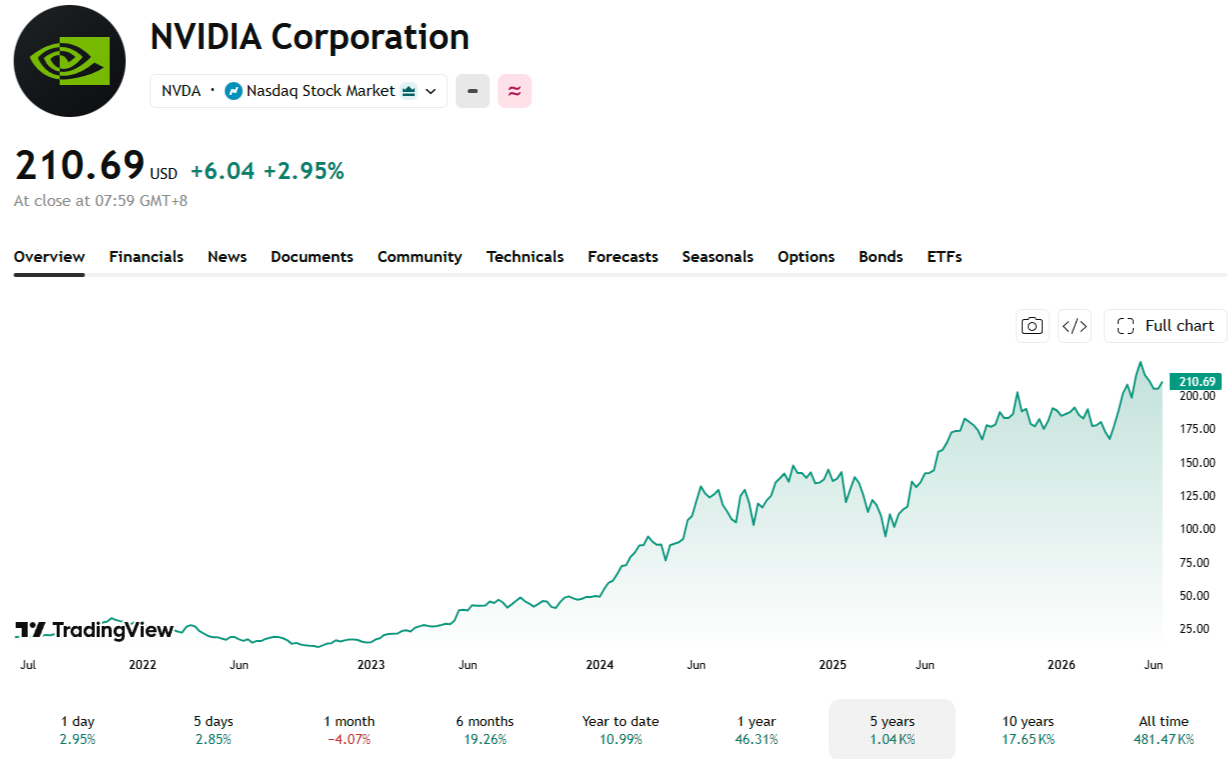
Wall Street is drawing a clear line between two of AI’s biggest stock winners. Analysts broadly back Nvidia at current prices and flag Micron Technology as overvalued heading into its June 24 earnings report.
Wall Street’s price targets lay it bare. Nvidia trades near $210. The 69 analysts covering it see $300, about 43% higher.
Meanwhile, Micron is the mirror image. It sits around $1,133, but the 49 analysts on it call fair value just $949, roughly 16% under today’s price.
Why Analysts Back Nvidia
NVIDIA powers nearly 90%+ of AI training compute globally. Its reported fiscal first-quarter revenue of $81.6 billion is up 85% year over year. The next-generation Vera Rubin GPU platform is set to ship later this year, with CEO Jensen Huang telling analysts that every major frontier model company will adopt it immediately.

Despite that momentum, Nvidia trades at 32 times earnings, essentially its cheapest valuation in seven years. Wall Street forecasts adjusted earnings growth of 43% annually through fiscal 2029.
Why Analysts Are Cautious on Micron
The skepticism on Micron comes down to one structural problem: memory chips are commodities. Products from different manufacturers are largely interchangeable, leaving Micron without a durable competitive advantage.
Industry leaders Samsung and SK Hynix both gained DRAM and NAND market share at Micron’s expense in the most recent quarter. Their larger production capacity gives them a structural edge. The HBM memory boom is expected to peak around 2028, after which sales are projected to drop sharply.
According to The Motley Fool, Micron’s adjusted earnings are forecast to grow at 13% annually through fiscal 2029. At 48 times earnings, that trajectory makes the current valuation look stretched against Nvidia’s cheaper multiple and faster growth outlook.
Micron’s June 24 report may shift some of those targets. But the structural divide Wall Street sees between the two stocks is unlikely to close on one quarter alone.
The post Wall Street Analysts Picks Nvidia Over Micron: Here’s Why appeared first on BeInCrypto.


- Real Finance launches REAL Competition for the $ASSET ecosystem.
- Users can earn points by trading, staking and holding $ASSET.
- A $3400 raffle pool gives more community members a chance to win.
Real Finance has launched the REAL Competition, a community rewards campaign aimed at increasing participation across the $ASSET ecosystem.
The Sofia-based company said the campaign will allow users to earn points through trading, staking and holding $ASSET, with top participants eligible for up to $20,000 in USDC rewards.
The competition also includes an additional raffle prize pool, broadening the reward structure beyond the highest-ranked users.
Real Finance said the campaign is designed to recognise sustained on-chain engagement rather than simply rewarding short-term trading volume.
Points system targets wider ecosystem activity
The REAL Competition introduces a points-based model that tracks qualifying activity involving $ASSET.
Participants can earn points by trading, staking and holding the token, with all activity monitored on-chain through the competition dashboard.
The structure is designed to give users multiple ways to participate.
Active traders can build points through qualifying transactions, while long-term holders and stakers can also improve their standing through sustained participation.
Real Finance said participants will move through a 13-level rewards structure during the campaign.
This approach marks a shift from conventional trading competitions, which often focus mainly on volume.
By including staking and holding activity, the REAL Competition is intended to reward broader involvement across the $ASSET ecosystem.
Leaderboard rewards backed by raffle prizes
The campaign’s main prize structure includes fixed rewards for the top-ranked participants, with total rewards of up to $20,000 in USDC available through the competition.
Real Finance will also distribute rewards through a broader pool based on final point totals.
This means participants outside the highest leaderboard positions may still be eligible for rewards, depending on their accumulated score.
In addition, the company said it will offer a separate raffle reward pool worth $3,400.
The raffle is designed to give more community members a chance to win prizes, even if they do not finish among the top-ranked participants.
“The REAL Competition is designed to reward meaningful participation across our ecosystem,” said Ivo Georgiev, CEO of Real Finance.
Whether users are actively trading, staking for the long term, or steadily building their position in $ASSET, we want to recognize the community members helping drive the growth of the network. By combining leaderboard rewards with raffle prizes, we’re creating opportunities for a broader range of participants to benefit from the campaign.
Campaign to run over coming months
Participants can join the REAL Competition by connecting a supported wallet and completing qualifying $ASSET transactions or staking activities.
Real Finance said users will be able to track their points, leaderboard ranking and unlocked multipliers through the campaign dashboard.
The company said the competition is now live and will run through the coming months, with rewards to be distributed after the campaign concludes.
The REAL Competition is scheduled to go live at 11 AM UTC.

Northern Small Cap Core Fund Q1 2026 Commentary (NSGRX)

Goldman Sachs Reduced Its Gold Price Target for the End of 2026

Author Reacts To Prince Harry & Meghan Markle’s Netflix Adaptation


-

 Business5 days ago
No Jackpot Winner as $257 Million Prize Rolls Over to $269 Million Monday Draw
-

 Fashion7 days ago
Weekend Open Thread: Tuckernuck – Corporette.com
-
 Crypto World5 days ago
Zimbabwe Requires Crypto Businesses to Register Annually Under New FIU Regulations
-

 Crypto World6 days ago
Bitget enters Argentina’s regulated crypto market through PSAV registration
-

 Tech6 days ago
NanoClaw integrates JFrog registries to secure AI agent downloads
-

 Tech7 days ago
This Week In Security: Microsoft On Microsoft, Register Your Domains, Linux On ARM, And FreeBSD Joins The File Cache Club
-

 NewsBeat7 days ago
FBI searches office of Ohio voter registration group
-
 Entertainment5 days ago
Matt Damon’s Viral Sci-Fi Thriller Has Taken Over HBO Max
-

 Business5 days ago
Anthropic staff to meet White House officials next week, Axios reports
-

 Tech5 days ago
As AI companies race to go public, who else is along for the ride?
-
 Crypto World5 days ago
Bitcoin could crash to $48,000, if this historical pattern is triggered
-

 Politics5 days ago
“Israel’s” ban on ICRC visits ruled illegal, but Knesset moves to stop them permanently
-
 NewsBeat5 days ago
Warning of disruption as Cardiff Crossrail works to start
-

 News Videos5 days ago
Financial Accounting | Last Day Revision Strategy and Booster | CMA Inter – June 2026
-
 NewsBeat5 days ago
Tributes to former deputy head teacher at Cambridge school among death and funeral notices
-

 Entertainment5 days ago
Deion Sanders Shares Powerful Post After Viral Advice To Deiondra
-
 Crypto World5 days ago
Market Preview: SpaceX (SPCX) IPO Record, Federal Reserve Meeting, and Iran Nuclear Agreement
-
 NewsBeat5 days ago
what doctors are seeing in ebike crashes
-

 Crypto World5 days ago
XRP ETFs Outperform As Bitcoin And Ethereum Funds Extend Outflow Trend
-
 Entertainment5 days ago
Kate Middleton Glare Goes Viral After Kids Booed At Royal Event
You must be logged in to post a comment Login