
Crypto World
What are L2 sequencers? Ethereum’s centralized chokepoint, explained



Nearly every transaction on Ethereum’s layer-2 networks passes through a single machine, run by a single company, called a sequencer. It orders trades, sets the pace of the chain, earns the fees, and can go dark or say no. This guide explains what sequencers actually do, why the most decentralized ecosystem in crypto runs its fast lanes through central operators, what can and cannot go wrong, and the roadmaps racing to fix it.
Summary
- Ethereum layer 2 networks rely on centralized sequencers that order transactions, collect fees, and can temporarily halt network activity during outages.
- Sequencers cannot steal user funds because Ethereum secures transaction validity, but they can influence transaction ordering, censorship, and network availability.
- Rollup developers are working toward decentralized sequencing models to reduce reliance on a single operator while preserving Ethereum’s security and scalability.
Here is an uncomfortable fact about the scaled, modern Ethereum: when you swap on an Arbitrum exchange, mint on Base, or pay on Optimism, your transaction is received, ordered, and confirmed by one machine, operated by one company. That machine is the sequencer, and it occupies a position of quiet, enormous power: it decides which transactions enter the chain and in what order, it collects the network’s fee revenue, and when it stops, as major sequencers have during outages, the entire network simply pauses, every app frozen at once.
The layer-2 rollups are how Ethereum scaled, moving execution off the congested base chain while inheriting its security, and they now carry a majority of the ecosystem’s activity. That success makes the sequencer the most consequential piece of centralized infrastructure in an ecosystem whose founding promise is decentralization, and the tension is not a secret; it is an engineering roadmap, with every major rollup publicly committed to fixing it and none finished. Meanwhile the base layer itself is being redesigned around adjacent ideas, with the coming Glamsterdam upgrade enshrining proposer-builder separation into the protocol, which will reshape the environment sequencers operate in.
This guide covers the sequencer honestly: what a rollup is and what job the sequencer does inside it, the specific powers a centralized sequencer holds and their real-world failure record, the crucial distinction between what a sequencer can and cannot do to your funds, the economics of sequencing and why operators are slow to give it up, the decentralization designs, shared sequencing, based sequencing, sequencer sets, competing to replace the single machine, and how to evaluate any L2’s actual trust profile today.
Rollups in one section, and the sequencer’s job
A rollup is a blockchain that executes transactions on its own fast, cheap environment, then posts compressed records of everything it did to Ethereum, inheriting the base chain’s security for its history. Optimistic rollups post results and allow a challenge window for fraud proofs; validity rollups post cryptographic proofs that the results are correct. In both designs, Ethereum is the court of final record, and the rollup is a high-throughput execution venue whose state can always, in principle, be reconstructed and verified from the data it posts down below.
Someone, though, has to run the fast venue in real time: receive the flood of incoming transactions, decide their order, execute them, hand users instant confirmations, and batch the results down to Ethereum. That someone is the sequencer. It is best understood as three roles fused: the mempool and matching engine that orders the flow, the block producer that executes it, and the shipping department that posts batches to the base chain. The ordering role is the powerful one, because in any financial system, transaction order is money: who gets the arbitrage, whose liquidation lands first, who buys before the price moves. On Ethereum’s base layer that power is fragmented across thousands of validators and an entire adversarial supply chain built to capture it; on almost every major rollup today, it belongs to one operator, appointed by the team, running the official sequencer.
Why did the most decentralization-obsessed ecosystem in software ship its scaling layer this way? Because centralized sequencing is fast, simple, and safe to bootstrap: one machine gives instant confirmations, no consensus overhead, clean upgrade paths, and a single throat to choke during the inevitable early bugs. The architects’ wager was that sequencing could be centralized temporarily because the rollup design strictly limits what the sequencer can do, a wager the next two sections examine from both sides.
What the sequencer can do to you, and what it cannot
The sequencer’s powers are real, and enumerating them precisely matters more than the usual hand-waving in either direction.
What it can do. It can censor: refuse to include your transaction, whether by policy, error, or legal compulsion, and regulated operators have compliance obligations that make selective exclusion more than hypothetical. It can order: place its own or favored transactions ahead of yours, extracting the value that ordering confers, invisibly and profitably; most major operators publicly forswear this, and the forswearing is a policy, not a protocol guarantee. It can stop: sequencer outages have repeatedly frozen major rollups for hours, halting every application simultaneously, a failure mode with no analogue on the base chain, where thousands of validators mean the chain simply does not stop. And it can set the pace and price of inclusion, since it is the sole gateway to the network’s blockspace in real time.
What it cannot do, and this is the rollup design’s genuine achievement: it cannot steal. The sequencer cannot forge a transaction spending your funds, because every transaction requires your signature and the fraud or validity proofs posted to Ethereum would expose any invented state. It cannot rewrite settled history, because the history lives on the base chain. And, critically, it cannot permanently trap you, because well-built rollups include an escape hatch: a mechanism to force-include transactions directly through Ethereum, bypassing the sequencer entirely, so that even a fully censoring or dead sequencer can only delay users, not imprison their funds. The delay is real, force inclusion is slow and clumsy, but the distinction between a chokepoint that can inconvenience you and a custodian that can rob you is the entire difference between the rollup model and a centralized exchange, and it is why the ecosystem tolerated centralized sequencing at all. The trust profile resembles a bridge with a strong trust-minimized design rather than a multisig one: concentrated operationally, constrained cryptographically.
The honest risk summary, then: your assets on a major rollup are secured by Ethereum; your access, timing, and fair ordering are secured by one company’s machine, policies, and legal situation. For a casual user the distinction rarely bites. For a trader whose profits live in ordering, for a protocol whose execution quality depends on fair ordering and whose liquidations must land on time, and for anyone in a jurisdiction a compliant operator might be told to exclude, the sequencer is the trust assumption that matters most and is audited least.
The outage record: what centralization has actually cost
The sequencer risk is not theoretical, and the incident record is the best syllabus for what single-operator infrastructure means in practice. Every major rollup has suffered sequencer downtime: hours-long halts from surging inscription traffic, stalls from software bugs in batch posting, freezes during upgrades that went sideways. The pattern across incidents is consistent and instructive. Funds were never lost, the base-chain security model held every time, and the networks resumed with their histories intact, which is the design working as promised. What stopped, each time, was everything else: trading froze mid-move, liquidation engines could not reach positions as prices moved, arbitrage broke against live markets elsewhere, and users learned that force-inclusion, the theoretical escape hatch, was in practice too slow and too technical to matter inside an incident measured in hours.
The subtler lessons sit in the second-order effects. During one prominent outage, the network’s applications discovered their own emergency procedures assumed a working sequencer: pausing markets, updating oracles, and even communicating with users all routed through the machine that was down. During another, the resumption itself became a trading event, as hours of queued transactions landed in a burst against stale prices, a miniature of the reconciliation dynamics every gap-prone market knows. And across all of them, the operator’s incident response, status pages, engineer availability, post-mortems, was the de facto governance of a multi-billion-dollar economy for the duration, performed by a company under no protocol obligation to perform it well.
The record’s summary is fair to both sides of the argument: the constrained-power design has truly protected funds through every failure, and the single-machine design has just as surely imposed correlated, economy-wide halts that a decentralized system would not, which is precisely the trade the roadmaps exist to unwind.
It is also worth placing the sequencer inside the rollup’s full trust stack, because it is the most visible dependency but not the only one. A rollup’s security rests on three legs: the data it posts to Ethereum, which is what makes reconstruction possible and which the blob-fee era made radically cheaper; the proof system, fraud or validity, that polices state correctness, several of which still run with training wheels, security councils and permissioned challengers standing in for mature proofs; and the sequencer, which governs liveness and ordering. Independent frameworks grade rollups across all three, and the grades routinely surprise users who assumed the marketing: networks celebrated as trust-minimized frequently carry upgrade keys and council powers that outrank the sequencer question entirely. The sequencer is the right place to start reading an L2’s trust profile. It is the wrong place to stop.
The economics: why giving it up is hard
Sequencing is not just power; it is revenue, and the revenue explains the pace of decentralization better than any technical obstacle. A sequencer collects the difference between what users pay for L2 transactions and what it costs to post their data to Ethereum, a margin that widened dramatically when Ethereum’s blob-based data pricing collapsed posting costs, plus whatever ordering value it chooses to capture or auction. For a major rollup this is a nine-figure annual business, and it currently flows to the operating company or foundation, funding development and, in several cases, constituting the primary revenue behind the network’s token.
Decentralizing the sequencer means distributing exactly this revenue, and the designs on the table are, among other things, proposals about who gets paid. That is not cynicism; it is the correct lens for evaluating the roadmaps, because a decentralization plan that never specifies where sequencing revenue goes is a plan that has not confronted its hardest question. It also frames the user’s side of the bargain today: centralized sequencing quietly subsidizes the networks users enjoy, the same revenue-and-token linkage question running through every fee-generating protocol, and every step toward neutrality redistributes a pie someone currently owns.
The numbers behind the revenue argument are worth one concrete paragraph. An L2’s gross margin is the spread between user fees collected and data costs paid to Ethereum, and the blob-fee era transformed that spread: posting costs for major rollups collapsed by orders of magnitude while user fees, though lower, fell less, leaving the large networks operating at gross margins that most software businesses would envy. Public dashboards track the arithmetic in real time, revenue in, data costs out, and the residual accrues today to whoever runs the sequencer. That residual funds engineering, subsidizes user fees during growth pushes, and, for token-bearing networks, constitutes the cash flow every valuation argument ultimately references.
Decentralization designs must answer where it goes: to a staked sequencer set as yield, to a shared network as service fees, to Ethereum validators under based sequencing, or to users as rebates, and each answer creates and destroys different constituencies. The engineering of neutral sequencing was largely solved on whiteboards years ago; the political economy of its revenue is the part still being negotiated, which is the single most clarifying fact about why the timelines are what they are.
The fixes: three roads to a neutral sequencer
Three families of designs compete to replace the single machine, each trading different things.
The first is the sequencer set: replace one operator with a permissioned or staked committee running consensus among themselves, rotating leadership, so that censorship requires collusion and outage requires correlated failure. It is the incremental path, and its critics note that a small committee of known entities is a smaller improvement than it appears, particularly against legal compulsion, which scales to committees easily.
The second is shared sequencing: independent networks whose business is providing decentralized ordering as a service to many rollups at once, with the added promise of atomic cross-rollup composability, transactions that execute across multiple L2s together or not at all, recreating some of the seamlessness the multi-rollup world fractured. The trade is a new external dependency and, again, the revenue question: a shared sequencer wants paying customers, and rollups guard their margins.
The third and most Ethereum-native is based sequencing: hand ordering back to Ethereum itself, letting the base chain’s validators sequence L2 transactions as part of block production. It maximally inherits Ethereum’s neutrality and censorship resistance, at the cost of Ethereum’s pace, confirmations at base-layer speed rather than the instant feel users have learned, though pre-confirmation designs aim to restore the speed. Based sequencing’s fortunes are entangled with the base layer’s own evolution: the Glamsterdam upgrade’s enshrined proposer-builder separation restructures exactly the block-production pipeline that based rollups would plug into, which is why sequencer roadmaps and Ethereum’s core roadmap now read as one document with two authors.
No major rollup has completed any of the three. The public commitments are real, staged plans, published designs, testnets, and the timelines have slipped for years, because the current arrangement works, earns, and only embarrasses its operators when something breaks. The realistic forecast is a long middle period of committees and hybrid designs, with full neutrality arriving network by network, unevenly, this decade.
A note on terminology prevents one common confusion: the sequencer is not the prover, and decentralizing one does nothing for the other. The prover, in validity rollups, generates the cryptographic proofs of correct execution; the sequencer orders and executes. A network can decentralize sequencing while proving remains one machine, or the reverse, and the two roles fail differently: a dead prover delays finality on Ethereum while the chain keeps running, a dead sequencer halts the chain while finality of past batches stands. Roadmap language blurs the roles constantly, and reading which one a decentralization milestone actually addresses is a small skill that pays for itself.
How to read an L2’s actual trust profile
For a user or builder choosing among rollups today, the sequencer question compresses into a practical checklist. Who runs the sequencer, and under what legal jurisdiction? Does the network have working force-inclusion, and what is its delay, the number that bounds worst-case censorship? What is the outage history, and did funds ever depend on the operator’s goodwill during one? Is there a published ordering policy, first-come-first-served, private mempool, auction, and any mechanism enforcing it beyond reputation? What stage is the decentralization roadmap actually at, running code versus blog post? And where does sequencing revenue go, because that answer predicts the roadmap’s pace better than the roadmap does.
The sequencer is the honest asterisk on Ethereum’s scaling triumph: the rollup ecosystem genuinely extended the base chain’s security to vastly more activity at vastly lower cost, and it did so by concentrating, temporarily and by design, the one power the base chain had most successfully dispersed. The asterisk is shrinking, slowly, under public pressure and published plans, and until it is gone, the single most useful thing a user can know about any L2 is exactly what its one important machine can and cannot do to them.
The wider stakes deserve a closing frame, because the sequencer question is Ethereum’s decentralization thesis meeting its scaling success, and the resolution will define what the ecosystem actually is. If the rollup era ends with a handful of corporate sequencers ordering most on-chain activity, then Ethereum will have rebuilt, at the execution layer, the intermediated structure it was designed to replace, with the base chain reduced to a settlement court for private venues. If the decentralization roadmaps deliver, based sequencing, credible committees, shared networks, then the scaling will have been genuine: more activity, same neutrality, the original promise kept at a hundred times the throughput. Both futures are still open, the incentives lean toward the first and the culture toward the second, and the outcome will be decided not by white papers but by the unglamorous engineering and revenue negotiations described above, network by network, over the next several years. Users are not spectators to that contest: the trust profiles are public, the alternatives are one bridge away, and where activity settles is the only vote the operators have ever reliably counted.
A practical postscript for builders, finally: sequencer risk is inherited. An application deployed on a rollup imports its sequencer’s outage record, censorship surface, and ordering policy as silent dependencies, and the mature practice, visible in how serious protocols now deploy, is to treat chain selection as a security decision, document the force-inclusion path in the runbook, and design liquidation and oracle machinery to fail safely through a halt. The sequencer is infrastructure, and the first rule of infrastructure applies: it is invisible until the day it is the only thing that matters.
The reader’s shortlist for following the story: the independent rollup-risk frameworks that grade each network’s sequencer, proofs, and upgrade keys; the networks’ own decentralization roadmap pages, read with dates, not adjectives; the outage post-mortems, which teach more per paragraph than any documentation; and the base-layer upgrade calendar, since Glamsterdam-era changes to Ethereum’s block pipeline reshape what based sequencing can offer. The chokepoint is well documented by everyone except the marketing, and the documentation is where the truth lives.
If one image should survive this guide, make it the geometry: Ethereum scaled by turning one broad, slow, neutral road into a system of fast toll lanes, each with a single operator at the booth. The lanes carry the traffic, the operators are competent, and the toll revenue is building better booths. But the map of who can stop which cars, and where, is now the most important map in the ecosystem, and every reader of this piece can pull it up for any network in about five minutes. Do that, once, for wherever your funds live. It is the highest-yield five minutes in crypto self-custody.
Disclaimer: This article is for educational purposes only and does not constitute investment advice. Network designs and roadmaps described are current as of July 9, 2026, and change frequently. Always do your own research.
Frequently asked questions
What is an L2 sequencer in simple terms?
A sequencer is the machine that runs a layer-2 rollup in real time: it receives transactions, decides their order, executes them, gives users instant confirmations, and posts compressed batches of the results to Ethereum. On nearly every major rollup today, the sequencer is a single server operated by the network’s founding company, making it the most centralized component in Ethereum’s scaling stack.
Can a sequencer steal my funds?
No. The sequencer cannot forge transactions from your account, because everything requires your signature, and it cannot fake results, because the rollup’s proofs posted to Ethereum would expose invalid state. Its powers are limited to ordering, delaying, censoring, and halting. Well-designed rollups also include force-inclusion mechanisms that let users push transactions through via Ethereum directly, so even a hostile sequencer can delay but not permanently trap funds.
What happens when a sequencer goes down?
The network effectively pauses: no new transactions confirm, and every application on the rollup freezes simultaneously until the operator restores service. Major rollups have suffered such outages lasting hours. Funds remain safe throughout, secured by Ethereum, but access stops, which matters greatly for time-sensitive positions like loans near liquidation.
Why are sequencers centralized if Ethereum is decentralized?
Because centralized sequencing was the pragmatic way to launch: one operator provides instant confirmations, simple upgrades, and clean incident response while the technology matured. The rollup design constrains what the operator can do, and every major network has published a decentralization roadmap. The trade-off was consciously temporary; its length is the controversy.
What is based sequencing?
Based sequencing hands transaction ordering back to Ethereum itself, letting the base chain’s validators sequence the rollup’s transactions during block production. It gives the rollup Ethereum’s full neutrality and censorship resistance, at the cost of slower confirmations, which pre-confirmation designs aim to offset. It is the most Ethereum-aligned of the decentralization paths.
What is a shared sequencer?
A shared sequencer is an independent network that provides decentralized transaction ordering as a service to multiple rollups simultaneously. Beyond decentralization, its selling point is atomic cross-rollup composability, the ability for transactions to execute across several L2s together, which single-rollup sequencers cannot offer.
Do sequencers extract MEV from users?
They can, since ordering power is exactly what MEV extraction requires, and a sequencer sees every transaction before it lands. Major operators publicly commit to neutral policies like first-come-first-served ordering, and some route ordering value into public goods or auctions. These are policies rather than protocol guarantees, which is a core argument for decentralizing the role.
How do I check how centralized a specific L2 is?
Ask five questions: who operates the sequencer and where; whether force-inclusion exists and how long it takes; the network’s outage history; the published ordering policy; and the actual stage of the decentralization roadmap. Independent trackers grade major rollups on these dimensions, and the grades differ far more than the marketing does.



XAUt added to its bullion backing during gold’s worst quarter since 2013, as tokenized commodity holder counts continued to rise.


Disclosure: This article does not represent investment advice. The content and materials featured on this page are for educational purposes only.
New data shows individual investors still hold the majority of Bitcoin supply, outpacing institutions, corporations, funds, and government wallets.
Summary
- New data shows individuals still hold roughly two-thirds of Bitcoin, outweighing institutions and ETFs.
- Most Bitcoin is still held by private investors, with institutions controlling only a small share, data shows.
- Institutions may be buying Bitcoin, but individuals still account for the largest share of holdings.
The past few years have been filled with talk about how institutions have swallowed up the Bitcoin supply. Yet data shows that an overwhelming amount is still held by individuals.
Surprisingly, new data has shown that individuals still retain the most Bitcoin by market share. They hold significantly more than businesses, funds, and ETFS, and even Satoshi-era wallets. Over the past few years, there has been much speculation about the buy-and-hold tactics of corporations and institutions. Yet it may be individuals who are choosing to cling to their crypto.
Bitcoin’s current market segmentation
With the global geopolitical situation in turmoil, people have been flocking away from risk assets like cryptocurrency in droves. At the time of writing, Bitcoin price stands at $63,730. In the past five days, it has moved within a margin between $60,000 and $65,000, with little sign of breaching the upward curve. For many, this shows that people are not buying, but also not selling, creating stagnation. Yet it is those who hold cryptocurrencies that throw up the most surprises.
A recent study taken from public wallet data has shown that individuals hold 66% of the Bitcoin supply. Mapping wallets that are known to interact with exchanges, custodians, and large holders, it painted a picture of marginal institutional and corporate holdings. In contrast, only 7.8% was given over to businesses, with 7.2% in funds and ETFS. Satoshi-era wallets had 4.6%, while governments held only 2.1%.
Together, the entire institutional investment sector, incorporating businesses and trading bodies, only holds 15% of the supply. Accounting for the remainder, only 4.5% of Bitcoin is left to be mined. An estimated 7.7% of the remainder has been lost. That means 19% spans the other categories, with the rest, roughly two-thirds, held by private individuals.
The social media paradox
This also dispels a recent theory that a lack of social media chatter regarding Bitcoin and Ethereum has been driven by institutional adoption. In July, data was published that showed mentions of the two terms were at their lowest levels in two months on the platform X. Bitcoin mentions had dropped to around 130,000, while Ethereum had fallen to 40,000 per week.
Reports on the data highlighted this as a shift to institutional buying. In particular, many highlighted it as a regression to a time back in 2020, before the institutional era emerged. Yet the new data suggest that there may be other reasons at play, especially as institutions do not hold the amount that people believed.
Firstly, it could be that X is just losing users. This is a trend that has been ongoing, with 33 million users leaving between January 2024 and 2025. These people may have drifted to other places to discuss cryptocurrency. It could be on Reddit, or it could be on private messaging apps like Telegram.
It could also be that people are just going elsewhere for their information. With crypto more widely known about, people are more savvy. Regulatory announcements and the inflows and outflows of ETF products all provide better benchmarks than a speculator on X.
Lastly, crypto may not be as new and exciting as it once was. It has given way to talks about tokenization, and even AI has grabbed many of the headlines that it once promised as a harbinger of a brave new world. As it is no longer the coolest, newest cat in town, less is being spoken about it. By no means does this mean people have lost interest, but it simply signals that people are now accepting it.
How should this impact trading?
During periods of volatility, retail investors are often prone to more emotional trading. They can sell and buy fast, as opposed to companies that have to make long-term decisions, signed off by many people. This has mainly been the reason given for Bitcoin’s current stagnation.
Yet it seems that the opposite is true and that retail investors are actually building resilience. HODL is the sector name for “Hold on for dear life,” which means you keep hold of Bitcoin until it grows exponentially in value. Many investors have held on through tumultuous market cycles. In fact, whales who are private buyers who hold large amounts can often change market courses if they begin to buy up or even dump their cryptocurrency. This suggests that they still do play a huge part in the direction prices can take.
What this does show is that despite what media outlets and those in the crypto industry are saying, the field is still extremely decentralized. For all the hype of institutional adoption and government backing, Bitcoin, particularly, is still held by individuals. Those wanting to see how this changes in the near future must watch inflows and outflows to ETF products, as well as changes to government legislation, not just in the US but beyond.
Disclosure: This content is provided by a third party. Neither crypto.news nor the author of this article endorses any product mentioned on this page. Users should conduct their own research before taking any action related to the company.


Bitcoin miners with operations in Texas are not expected to be impacted by a moratorium on approval of data center projects connected to the state’s grid operator ordered by Governor Greg Abbott, Bernstein analysts said Tuesday.
Abbott on Monday directed the Public Utility Commission of Texas and the Electric Reliability Council of Texas (ERCOT) to audit all data centers seeking to connect to the state’s power grid. The duration of the audit was not specified and comes amid increasing public backlash to the pace of data center build-out across the state, The Texas Tribune reported.
Bernstein analysts told clients on Tuesday that as most of the Bitcoin (BTC) miners operating in Texas are under contract for approved electric capacity, those operations are unlikely to be impacted by the moratorium.
“However, we believe, this audit throttles speculative data center pipeline and makes genuine sites with development history more valuable,” the research team led by Gautam Chhugani said in their note. “Bitcoin mining sites are favorably placed with the longest gestation, self-funding infra and local community management,” they said.
They said that the local operations of Cipher Digital (CIFR), Core Scientific (CORZ) and CleanSpark (CLSK) could be the miners most exposed to future public opposition to data center expansion, particularly during ERCOT’s approval process to convert their pipeline assets into grid-connected power capacity.
“We believe with increasing political opposition to new data center projects and fresh capacity being throttled by moratoriums/state directives, the approved MWs become more valuable,” they said, highlighting the Texas mining operations of IREN (IREN), which is fully ERCOT grid approved, as are the operations of Riot Platforms (RIOT).
CIFR shares were down more than 7% in Tuesday’s premarket trading, according to Yahoo Finance data. The miner reported second-quarter results earlier Tuesday, posting a loss of $0.65 per diluted share, widening from last year’s loss of $0.12 per diluted share.
Related: Bitcoin may find bear market bottom in August: 10x Research

Migration is rarely the result of a single heat wave. It is the culmination of years of mounting losses that steadily erode income, health, and hope.
Consider Santuben Kantibhai, a farmer from Gujarat, India. Over the past two years, her family has endured a cascade of climate and economic shocks. A severe heatwave destroyed much of their standing crop, causing her family’s income to plummet. At the same time, her father—a co-earner who relied on farm labor and daily wage work—developed cataracts that gradually robbed him of his eyesight, making it increasingly difficult for him to help their family earn a living. When another heatwave struck in 2025, crop yields fell again just as his condition required surgery. For Santuben, the question is not whether heat is becoming more dangerous; she already knows it is. It is how many more failed harvests and lost workdays can her family absorb before staying becomes impossible.
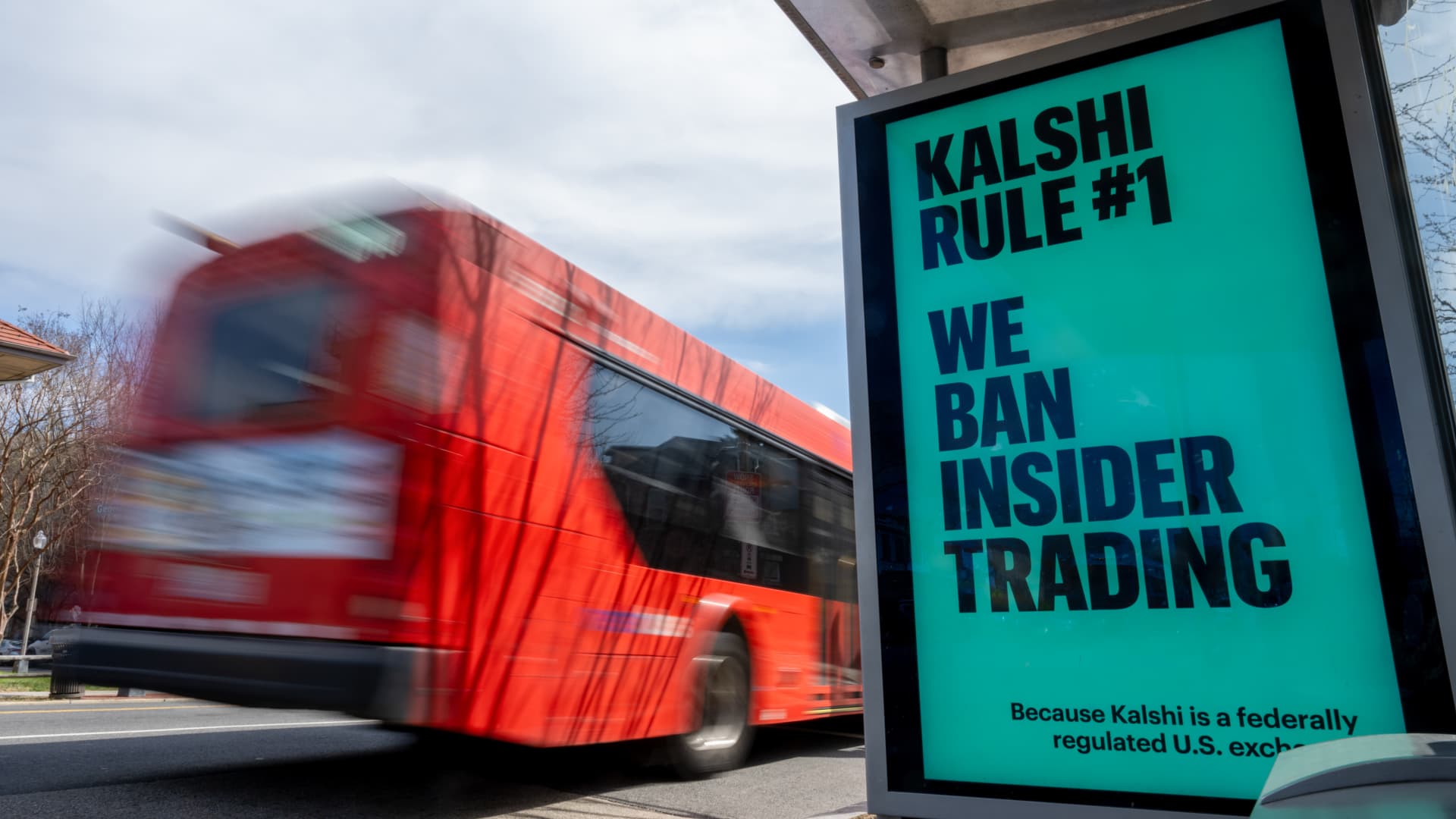
A Kalshi advertisement at a bus stop in Washington, D.C., March 19, 2026.
Daniel Heuer | Bloomberg | Getty Images
Prediction market platform Kalshi is announcing Tuesday a new partnership with compliance technology company Comply as its push into institutional trading continues, the company told CNBC exclusively.
Comply — which works with more than 5,000, primarily financial, firms — is adding Kalshi’s prediction markets trade data to its regulatory software.
The platform gives companies who use Comply’s technology, for traditional securities and digital assets, the ability to see employees’ trades on event contracts, to make sure they’re following a company’s policies and not using material, non-public information to trade. The technology will also extend to Kalshi’s perpetual futures contracts, too.
“Most firms are still figuring out what a reasonably designed prediction market compliance program looks like, and that’s exactly where we come in,” said Comply’s chief regulatory service officer Jamila Mayfield in a statement. “Comply brings both the technology and the regulatory expertise to build programs that hold up under scrutiny.”
Comply’s technology already covers prediction market trades on platform Polymarket through a partnership with ZenLedger, a cryptocurrency tax management and accounting company, according to a press release.
Kalshi’s partnership with Comply follows a similar one between the prediction market and StarCompliance, another compliance technology company that allows clients to see employees’ trades, announced in June.
Max Crowley, vice president of business development at Kalshi, told CNBC in an interview that these compliance partnerships come up as the company has continued to have conversations with firms potentially interested in institutional trading. Many are used to technology like that of Comply’s when trading on traditional assets, and expect the same if they’re to move into the prediction market space, he said.
“We’re actively working with institutions, and I think, more and more we’ve heard from these firms… ‘Do we have compliance surveillance on our side?’” Crowley said. “We have an internal surveillance team, every day we’re actively going through all the activity that is happening on the platform… But then firms say, ‘that’s all good, but we also need visibility.’”
CNBC previously reported that companies across sectors are grappling with the rise of prediction markets, and legal experts said few — beyond highly-regulated financial institutions with large compliance departments — have figured out how to alter their internal policies surrounding the new asset class for employees.
Sudhir Jain, Kalshi’s chief compliance officer, said some companies may be considering blocking their employees from trading outright on any event contract as a policy. However, he said technology like Comply’s can avoid protocols like that.
“Without knowing what employees are doing, their only choice is to say, from a policy perspective, don’t trade at all,” Jain said. “Now they have the data; they can monitor it.”
Disclosure: CNBC and Kalshi have a commercial relationship that includes customer acquisition and a minority investment.


Key takeaways
- Dogecoin is trading near $0.070 after declining 3.5% last week.
- DOGE’s long-to-short ratio rose to a one-month high of 1.25, signaling bullish positioning.
- Funding rates remain positive at 0.0074%, indicating stronger demand for long positions.
Dogecoin (DOGE) is holding steady near $0.070 at the time of writing on Tuesday after falling 3.5% last week.
Although the broader technical trend remains bearish, improving derivatives data and bullish divergences across key momentum indicators suggest that selling pressure may be easing. This setup could support a short-term recovery if buyers defend the current support zone.
Derivatives data supports a bullish DOGE outlook
Dogecoin derivatives traders are showing signs of growing optimism. The DOGE long-to-short ratio climbed to 1.25 on Tuesday, its highest level in more than a month, according to CoinGlass.
A reading above 1 indicates that long positions outnumber shorts, suggesting more traders expect the price to rise.
Dogecoin’s funding rate also supports this bullish outlook. The rate turned positive on July 24 and stood at 0.0074% on Tuesday.
Positive funding rates mean traders holding long positions are paying those with short positions, typically reflecting stronger demand for bullish exposure.
Dogecoin technical outlook: Bullish divergence emerges
Dogecoin is trading near $0.070 on Tuesday but remains below its major moving averages, maintaining a bearish near-term structure.
The 50-day, 100-day, and 200-day Exponential Moving Averages are located at $0.075, $0.083, and $0.100, respectively. These levels are expected to act as resistance during any recovery attempt.
However, momentum indicators suggest bearish pressure is beginning to fade. DOGE formed a lower price low on August 1 while the daily Relative Strength Index registered a higher low. This bullish divergence indicates that selling momentum is weakening despite the decline in price.
The Awesome Oscillator reinforces this signal. Its recent lows have been rising while DOGE continues to trade near its price lows, suggesting that downside momentum is losing strength.
Immediate support is located at the horizontal level of $0.070. If DOGE loses this level, the yearly low at $0.067 would become the next key support. A decisive daily close below $0.067 could trigger further losses toward the psychological level of $0.065.

The 50-day EMA at $0.075 represents the first major resistance level. Above it, DOGE could encounter selling pressure around the descending trendline breakout area near $0.080, followed by the 100-day EMA at $0.083 and horizontal resistance at $0.088.
A stronger recovery would require Dogecoin to reclaim the 200-day EMA at $0.100 and the major horizontal barrier at $0.102. Moving above these levels would help ease the prevailing bearish outlook.


Italy’s largest bank Intesa Sanpaolo increased its staked Ether ETF position to $7.1 million while reducing its holdings in two spot Bitcoin ETFs.
Crypto World
Korean Buyers Are Stacking XRP 2-to-1 Against Sellers: XRP Price Prediction Says 80-Day Downtrend About to Break?
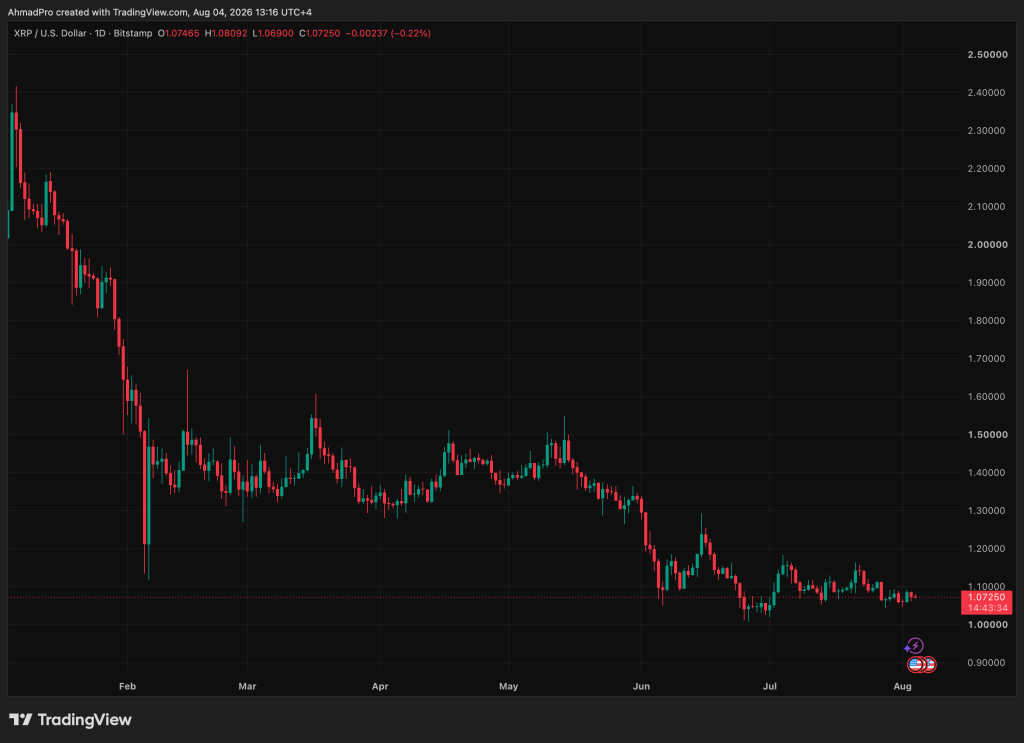
In the latest XRP price prediction, XRP price is trading at $1.0732, down 0.99% in the last 24 hours, yet the more interesting story sits just beneath the surface. A 4% bounce off the August lows is testing an 80-day falling channel, and one technical level will confirm whether this move has legs or fades, as every prior rally since May has. South Korea is making its position clear. The rest of the market hasn’t decided yet.
XRP market cap sits at approximately $68.27 billion with a circulating supply of 62 billion tokens and 24-hour trading volume around $877 million, stable, not explosive.
On Upbit, XRP ranks third among 275 Korean won-denominated markets by 24-hour volume, behind only Tether and Bitcoin. More telling: combined Upbit and Bithumb bids within 1% of spot outweigh asks by roughly two to one, a 34% gap in favor of buyers. That is not noise, that is deliberate accumulation posture from Korean retail.
The bounce is real. Whether it breaks the channel is a separate question, and the answer has direct implications for where capital rotates next.
Discover: Everyone’s Got a Take. Get Free $25 to Actually Trade Yours
XRP Price Prediction: Can XRP Price Break the 80-Day Downtrend This Week?
XRP’s 24-hour range has been tight, $1.0701 to $1.0841, with the XRP price currently sitting at $1.0732. The 7-day range tells a wider story, roughly $1.07 to $1.18, mapping cleanly to 2 zones traders are watching.
Support at $1.07-$1.08 has absorbed selling pressure over multiple sessions. Resistance at $1.15 to $1.18 is where every recent rally attempt has stalled.
The defining technical factor right now is the falling channel that has capped XRP since May 14. Day-to-day wicks inside that structure are largely noise.

A daily close above the upper channel boundary, somewhere in the $1.15 to $1.18 zone depending on the channel’s trajectory, would be the first confirmation of a genuine trend shift. Until then, each bounce is a probe, not a reversal.
A confirmed daily close above $1.18 breaks the channel and reopens the path toward $1.30 and beyond, with Korean bid depth suggesting buyers are positioned for exactly that scenario.
XRP oscillating in the $1.07 to $1.15 band while broader macro data keeps institutional risk appetite suppressed is the more likely near-term path. A daily close below $1.07 breaks the local floor, exposes the $0.98 to $1.00 zone, and invalidates the accumulation thesis entirely.
Volume at current levels does not signal conviction either way. A breakout without volume expansion of at least 40 to 50% above the 7-day average should be treated with skepticism. The channel break is the signal. Confirmation is everything.
Discover: Your Market Calls Are Worth Something. Start With Free $25 on Kalshi
LiquidChain Could be The XRP of This Cycle
XRP is holding support and showing demand-side strength in Korea, but at a $68 billion market cap, the asymmetric upside that early crypto allocators chased simply isn’t here anymore.
That math is straightforward. For traders tracking this rally and considering where asymmetry actually lies right now, the infrastructure presale space is worth a closer look.

LiquidChain ($LIQUID) is a Layer 3 infrastructure project positioning itself as the cross-chain liquidity layer, fusing liquidity from Bitcoin, Ethereum, and Solana into a single execution environment.
The architecture includes a Unified Liquidity Layer, Single-Step Execution, Verifiable Settlement, and a Deploy-Once model that lets developers access all three ecosystems without redeployment overhead.
The presale is currently priced at $0.01486 per $LIQUID, with $929,335.42 raised to date. The project’s fundraising trajectory has already drawn attention as it nears the $1 million milestone. As with any early-stage presale, smart-contract risk and execution uncertainty are live considerations; DYOR applies here more than anywhere.
Discover: Get Paid to Be Right, $25 to Start on Kalshi
The post Korean Buyers Are Stacking XRP 2-to-1 Against Sellers: XRP Price Prediction Says 80-Day Downtrend About to Break? appeared first on Cryptonews.
The primary cryptocurrency rose 1.5% in the last 24 hours and currently trades at around $63,500, even as Strategy announced its third BTC sale this year.
However, three important signals point to a potential pullback forming beneath the surface.
The Factors in Question
The renowned analyst Ali Martinez revealed that over 20,000 BTC (worth more than $1.2 billion) have hit exchanges in the past week or so. CryptoQuant’s data shows that the total figure has climbed to around 2.72 million, the highest since the start of July.
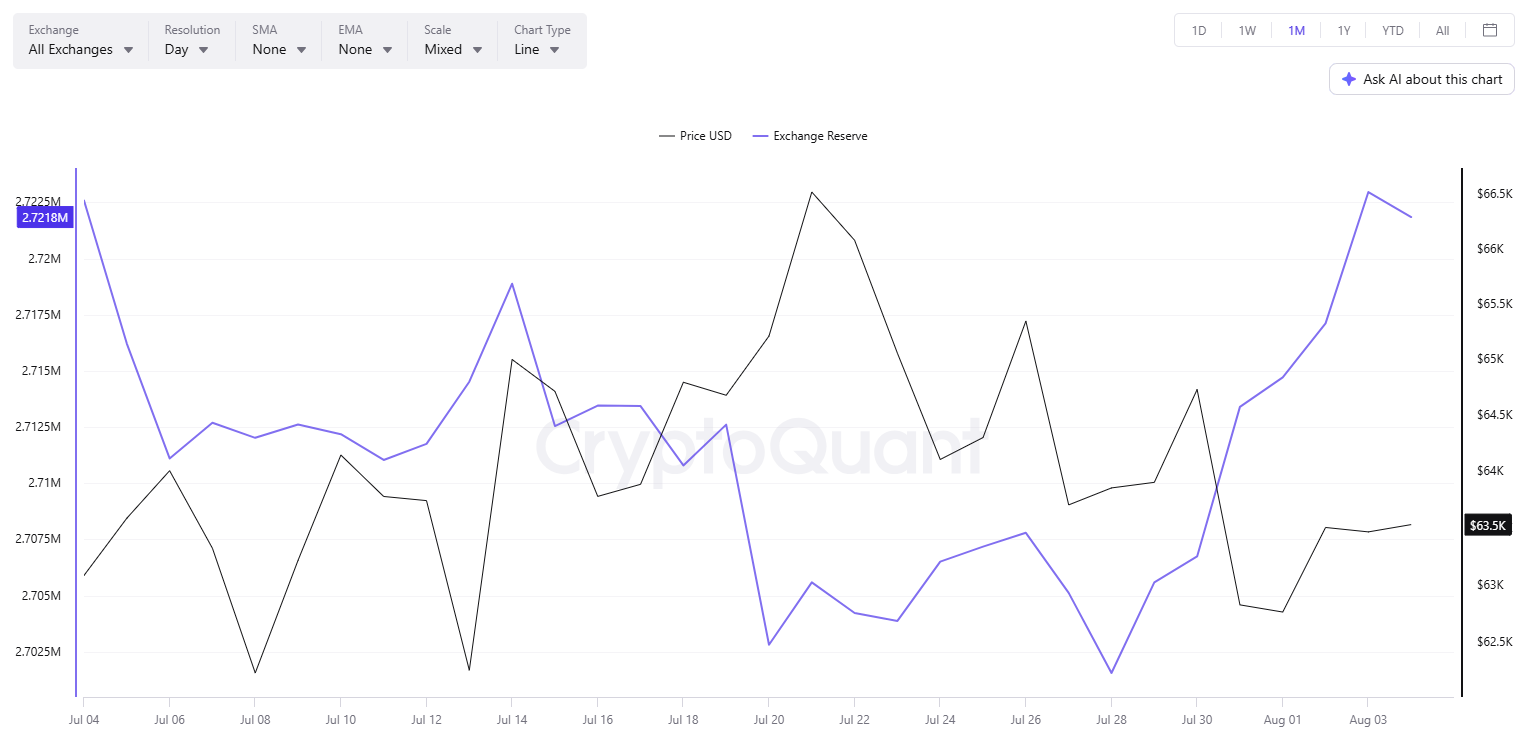
This suggests that some investors have abandoned self-custody methods and flocked to centralized platforms, increasing immediate selling pressure, or, as Martinez said:
“When coins move onto trading platforms, it often signals rising sell-side pressure. Keep an eye on this trend.”
It’s worth noting, though, that there might be another reason why investors are sending BTC to exchanges. The recent Coldcart saga has rattled trust in self-custody methods, which could lead to more bitcoin sitting on trading platforms, not necessarily for immediate selling.
Martinez also presented a second bearish signal, noting that BTC miners have sold roughly 1,774 units (worth around $112 million) over the past week. He argued the move signals another wave of profit-taking and something that could negatively impact the asset’s valuation in the short term.
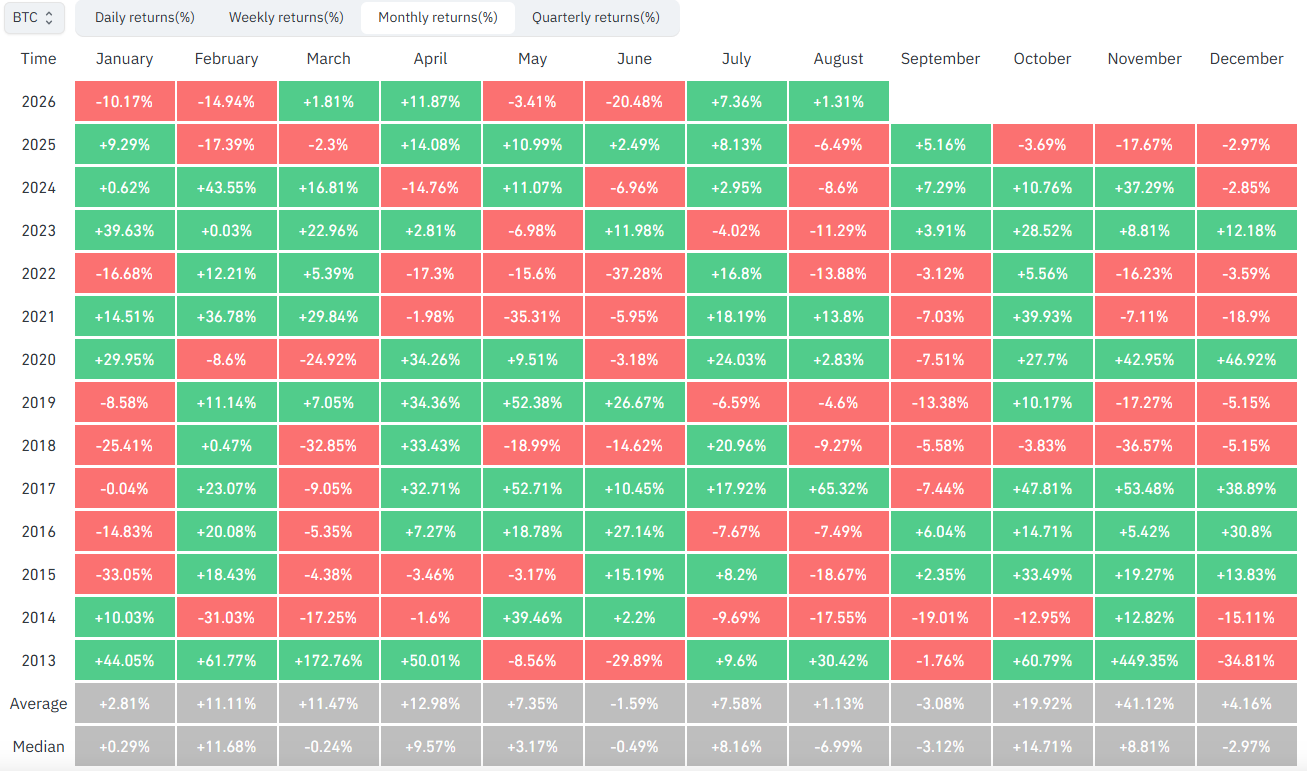
The third factor is Bitcoin’s seasonal performance. The asset has finished August in red territory 9 out of 13 times, adding further uncertainty amid the challenging times.
Final Flushout This Month?
Many analysts believe that the bear market is far from being over, expecting BTC to collapse to multi-year lows in the following weeks. X user Rekt Fencer spotted the formation of a potential final bull trap, which could result in a major crash to around $30,000 later in August.
Not long ago, Martinez presented a rather controversial theory. He claimed that bulls should actually welcome a potential dip to $60K since it could validate a classic inverse head-and-shoulders pattern that might push BTC to as high as $74,000. According to MikybullCrypto, the setup has already been completed:
“Breakout is next. $80K is the magnet target.”
The post 3 Signs Bitcoin (BTC) Could Be Ready for Another Pullback appeared first on CryptoPotato.

A former supervisory FBI agent, Patrick Steven Yaroch, has been charged after prosecutors said he used internal agency systems to obtain credentials for cryptocurrency wallets linked to an adversarial country and then routed funds to his own accounts. The case, detailed in a U.S. federal court filing, highlights how quickly sensitive access credentials can become a direct vector for financial theft in the crypto era.
According to the filing referenced in court documents, Yaroch admitted to 10 unauthorized transfers carried out between late 2024 and early 2025, involving an estimated total of about $1 million in digital assets. Prosecutors said some of the stolen funds were deposited into Suilend to generate yield.
Key takeaways
- Prosecutors allege Yaroch used FBI internal systems to obtain wallet credentials tied to an adversarial country.
- Yaroch admitted to 10 unauthorized crypto transfers between late 2024 and early 2025, totaling roughly $1 million.
- Authorities reportedly recovered devices, seed phrases, and a Trezor wallet used to access accounts on Suilend and on the Kraken exchange.
- Roughly $925,000 was transferred to government-controlled wallets with Yaroch’s cooperation.
- The filing also describes Yaroch using ChatGPT for investment-related advice in May, underscoring the role of opportunistic decision-making amid ongoing access misuse.
Unauthorized wallet access and yield strategy
The court filing says Yaroch’s actions centered on obtaining the ability to access cryptocurrency wallets associated with an adversarial state and using those credentials to move funds to his own crypto wallets. The alleged scheme did not stop at transferring assets—prosecutors say he also placed at least some of the proceeds into Suilend to earn yield.
By admitting to the transfers, Yaroch effectively confirmed that the conduct was not limited to a one-time theft. The admissions, which prosecutors characterize as a sequence of unauthorized moves spanning several months, indicate he maintained control long enough to interact with decentralized finance infrastructure rather than simply cashing out immediately.
The court documents also describe that after Yaroch self-reported the incident, he was placed on administrative leave, later terminated, and then arrested within days.
How investigators say the scheme was executed
Authorities reportedly retrieved multiple items from Yaroch’s Virginia residence, including devices, seed phrases, and a Trezor wallet. Prosecutors said these materials were used to access accounts on Suilend and a crypto exchange, Kraken.
In the course of the case, investigators moved roughly $925,000 in funds into government-controlled wallets with Yaroch’s cooperation. That figure is important for investors and builders to understand: when access to wallet infrastructure and recovery material exists, the “blast radius” can be quickly reduced if authorities can act fast and gain control of the relevant custody or recovery pathways.
While the filing provides the core mechanics of access and recovery, it also implicitly underscores a broader risk for crypto systems: credential theft can be as damaging as direct hacking. If internal credentials are compromised—whether by insiders or those who obtain privileged access—the attacker’s path to funds can be short and highly efficient.
ChatGPT appears in the timeline
Prosecutors say that in May, Yaroch used ChatGPT for advice after posing a scenario about having “a million dollars” and asking how to invest or spend to maximize profit and return. The filing attributes a specific response to ChatGPT about “building a slower-living vineyard/agricultural lifestyle in places like Cilento or Portugal’s Dão region.”
Even though the exchange itself is not a prosecution theory of how the theft occurred, its inclusion in the court filing paints a picture of decision-making during a period when Yaroch had already—or soon after—secured access to assets he could control. For readers, the key takeaway is not the AI recommendation; it is the fact that illicit access can coexist with attempts to rationalize next steps using whatever tools are available.
A pattern of agent-linked crypto theft
This case adds to a small but notable series of prosecutions in which federal officials and agents are accused of misusing crypto access for personal gain.
Earlier, in 2015, former DEA special agent Carl M. Force diverted about $700,000 in Bitcoin before pleading guilty and receiving a six-and-a-half-year prison sentence, according to a DOJ statement referenced in the coverage. That case was linked to the investigation involving the dark net marketplace Silk Road.
The DOJ similarly reported that former U.S. Secret Service special agent Shaun W. Bridges stole about $350,000 in BTC in 2015, then pleaded guilty and was sentenced to six years in prison. Like the Force case, it was tied to the Silk Road investigation.
In this context, the Yaroch matter appears less like an isolated “crypto crime” and more like a recurrence of a specific vulnerability: when law-enforcement-linked access overlaps with crypto custody mechanisms—wallets, seeds, exchange accounts, and yield platforms—there is an opportunity for misuse that can be difficult to detect until after damage is done.
Earlier coverage from Cointelegraph highlighted “fake police raid” tactics connected to a $1M Bitcoin transfer, illustrating how both insider and external coercion routes have been used to move large crypto balances. Taken together, these stories suggest that crypto theft continues to evolve along two parallel tracks: technical attacks and social/credential abuse, sometimes involving high-access individuals.
What to watch next
With the alleged transfers spanning late 2024 through early 2025 and authorities already moving a large portion of funds into government control, the immediate focus will likely shift to how the court evaluates Yaroch’s admissions, the role of credential misuse, and the extent of any additional assets or counterparties involved. For crypto market participants, the practical lesson remains clear: insider credential access and wallet recovery material can convert administrative or investigative power into direct custody of funds, making rapid investigation and wallet-level response essential.

Glen Hansard funeral LIVE: Steve Coogan and Bono lead stars paying tribute to Irish singer

BP profit highest since 2022 as Iran war pushes up oil price

Tether Gold reserves rise 9.5% as gold posts worst quarter in 13 years

Renter of Home in Anne Heche Crash Denies Settlement With Son

No Jackpot Winner as $257 Million Prize Rolls Over to $269 Million Monday Draw

Weekend Open Thread: Staud – Corporette.com

Oliver Exposes Trump’s Crypto Scheme #crypto #worldlibertyfinancial #trump #donaldtrump #johnoliver

World Liberty Financial is being sued by one of its biggest investors, Justin Sun

XRP Leak: Why Big Money Is Betting On This $43,000 Target
-

 Business6 days ago
Why Trees Belong on the Risk Register
-

 Fashion4 days ago
Weekend Open Thread: Wit & Wisdom
-

 Politics4 days ago
Meta enters AI-training agreement with far-right ‘propaganda rag’ Newsmax
-
 Entertainment7 days ago
‘Stargate’ Creator’s New Sci-Fi Series Returns for Season 3 Tomorrow
-

 Crypto World3 days ago
MicroStrategy Post-Earnings CLARITY Act Push Could Add New Catalyst for Its Stock
-

 Politics6 days ago
Reform UK betrays West Mids residents by running from party pledges
-

 Business6 days ago
Major shareholder moves on Canyon
-

 Crypto World3 days ago
XRP Ledger v3.3.0 brings five institutional features
-

 News Videos5 days ago
Bitcoin Enters the 3rd Stage of the Bear Market
-

 Crypto World7 days ago
Kraken Enables Retail Access to Jersey Mike’s IPO via Tokenized Shares
-

 Politics5 days ago
Luke Littler’s dominance sparks GOAT debate
-

 Sports5 days ago
Seema Kaliramna Wins Discus Throw Bronze, Takes India’s CWG Medals Tally To 17
-

 News Videos7 days ago
Claude: Build Financial Dashboards in Minutes (2026)
-

 Crypto World3 days ago
New York sues Kalshi over prediction market gambling
-

 Crypto World2 days ago
Crypto PAC spending tops $2M in Michigan House race
-

 Business7 days ago
Johnson & Johnson agrees to $5.5B settlement over talc cancer claims
-

 Business4 days ago
Trump Announces Hamas Disarmament Agreement as Iran Strikes Kuwait Air Base and US Attacks Pause Overnight
-

 Politics2 days ago
Zack Polanski: an incitement to murder Nigel Farage?
-

 Tech6 days ago
Gemini can now summarize the messiest comment threads in Google Docs
-

 Tech2 days ago
ESET tracks rise in malicious AI skills and adaptable malware
You must be logged in to post a comment Login