

Crypto World
What are perpetual futures? Perps, funding rates, and liquidations explained



Perpetual futures, or perps, are the most traded instrument in crypto. They let you bet on price with leverage and never expire, held in line with the spot market by a clever fee called the funding rate. They are powerful, they are dangerous, and in 2026 they are finally arriving onshore in the United States.
Summary
- Perpetual futures let traders take leveraged long or short positions without an expiry date, using funding rates to keep prices aligned with the spot market.
- Funding payments flow between longs and shorts, while leverage and margin determine how quickly a position can be liquidated during adverse price moves.
- Crypto perps have begun entering regulated U.S. markets in 2026, bringing the industry’s most traded derivative product into a new regulatory framework.
A perpetual future, usually shortened to perp, is a derivative contract that lets a trader bet on the price of an asset with leverage and hold that bet open indefinitely, because unlike a traditional futures contract it has no expiration date. The price of a perp is kept tethered to the real spot price of the underlying asset by a recurring payment between traders called the funding rate, which nudges the contract back toward the market whenever it drifts.
Perps let you go long if you think the price will rise or short if you think it will fall, control a position far larger than the cash you put down, and never worry about a contract expiring out from under you. That combination has made perpetual futures the single most heavily traded product in all of crypto, and also one of the fastest ways to lose money in it.
This guide explains perpetual futures in plain English, with no derivatives background assumed. It covers what a perp actually is, the traditional futures contract it evolved from, the funding-rate mechanism that makes the whole thing work, how leverage and margin lead to liquidation, the difference between mark price and index price that decides when you get liquidated, where perps are traded and the major shift happening in the United States in 2026, the real risks that blow up accounts, and why this instrument came to dominate crypto trading.
By the end, you will understand not just how to read a perp but why it behaves the way it does, and why even regulators who now permit it call it a product to treat with respect.
What a perpetual future actually is
The name packs two ideas together. “Future” means it is a contract whose value is derived from the price of something else, a derivative, where you agree to gain or lose money based on how that price moves without necessarily owning the asset. “Perpetual” means the contract never expires, so you can hold the position open for as long as you like and your margin allows.
That second word is the whole innovation. A perp lets you take a leveraged bet on, say, Bitcoin, and simply keep it open, adjusting or closing whenever you choose, with no expiry forcing your hand. You can go long, profiting if the price rises, or short, profiting if it falls, and because the contract is leveraged, you can put down a fraction of the position’s value as collateral, called margin, and control the full size.
If you post one thousand dollars at ten times leverage, you control a ten-thousand-dollar position, so a ten percent move in your favor doubles your collateral, and a ten percent move against you wipes it out. The perp itself is settled in cash or a stablecoin, so you never have to take delivery of the underlying asset; you are trading the price, not the coin.
The product was invented by the crypto exchange BitMEX in 2016, and it spread because it fit crypto perfectly: traders wanted leverage, they wanted to bet in both directions, and they did not want the friction of contracts that expire and have to be rolled over. The perp gave them a single instrument that did all of that, and the rest of the market followed.
Futures first: the contract perps evolved from
To see what makes a perp special, it helps to understand the ordinary futures contract it grew out of, because the perp is essentially a futures contract with its biggest inconvenience removed.
A traditional futures contract is an agreement to buy or sell an asset at a set price on a specific future date. If you buy a Bitcoin futures contract expiring in three months, you are locking in a price now for settlement then, and when that date arrives, the contract expires and settles.
This is useful, and it is how commodities and financial futures have worked for a very long time, but it has an awkward feature for someone who simply wants ongoing leveraged exposure: the contract ends. If you want to keep your position past the expiry, you have to “roll” it, closing the expiring contract and opening a new one further out, paying costs and friction each time. Traditional futures also have a “basis,” a gap between the futures price and the spot price that opens and closes as expiry approaches, which adds complexity.
The perpetual future strips out the expiry entirely. There is no settlement date, so there is nothing to roll and no countdown forcing you to act. But removing the expiry creates a new problem. In a normal future, the looming settlement date is what drags the contract price toward the real spot price, because at expiry they must converge.
Take away the expiry, and you remove the very thing that keeps the contract honest. So the designers of the perp had to invent a replacement, a mechanism that would keep a never-expiring contract anchored to the spot price using market forces instead of a deadline. That mechanism is the funding rate, and it is the beating heart of every perp.
The funding rate: the mechanism that keeps perps honest
The funding rate is the single most important concept in perpetual trading, and it is the part beginners most often miss until it quietly costs them money.
Because a perp never expires, nothing automatically forces its price to match the spot price of the underlying asset. Left alone, a perp could drift well above or below the real market. The funding rate fixes this by creating a recurring payment, typically every eight hours, between the two sides of the market.
When the perp trades above the spot price, meaning demand to be long is too strong, the funding rate is positive, and longs pay shorts. When the perp trades below the spot price, meaning shorts are crowded, the funding rate is negative, and shorts pay longs. The payment is a small percentage of position value, and it flows directly between traders, not to the exchange.
The effect is elegant. If too many people are long and the perp price runs above spot, longs must keep paying a fee to shorts, which makes holding a long more expensive and encourages traders to close longs or open shorts, pushing the price back down toward spot. The mechanism is self-correcting: whichever side is crowded pays the other, and that cost pulls the contract back in line with the real market.
This is why a perp tracks spot closely without ever expiring. It also turns the funding rate into a live sentiment gauge, because a strongly positive rate tells you the market is aggressively long and paying for the privilege, while a negative rate tells you shorts dominate. Traders watch funding both as a cost they must pay or earn and as a signal of how the crowd is positioned. Even regulators who have studied perps note that funding rates, far from being a trick, perform roughly the same economic job as the costs of repeatedly rolling expiring futures, just packaged differently.
Leverage, margin, and the liquidation that follows
Leverage is what makes perps thrilling and what makes them lethal, so it is worth being precise about how it actually works and where it ends.
When you open a perp position, you post collateral, called margin, and the exchange lets you control a position several times larger. The multiple is your leverage. At five times leverage, a thousand dollars of margin controls five thousand dollars of exposure; at twenty times, it controls twenty thousand. Leverage magnifies both directions equally. A favorable move multiplies your gains against your small margin, and an unfavorable move multiplies your losses just as fast. The crucial consequence is that with leverage you do not need the price to go to zero to lose everything. You only need it to move against you by a fraction equal to your margin.
That is where liquidation comes in. Every leveraged position has a liquidation price, the level at which your losses have eaten through your posted margin. If the market reaches that price, the exchange automatically closes your position to prevent your losses from exceeding your collateral, and your margin is gone. At ten times leverage, a roughly ten percent move against you is enough to trigger liquidation; at twenty-five times, about four percent will do it; at one hundred times, a one percent flicker can end the trade.
Offshore venues have historically offered enormous leverage, and the extreme figures sometimes quoted, fifty, one hundred, even more, are a hallmark of those unregulated platforms. Regulated perpetual products in the United States are subject to the same leverage limits as other regulated futures, which are far lower. High leverage does not make you more likely to be right; it only makes you more likely to be liquidated before you are proven right, and that distinction has emptied more accounts than any single price crash.
Mark price versus index price: why you actually get liquidated
A detail that confuses many new perp traders, and burns some of them, is that the price used to decide your liquidation is not always the last traded price on the exchange. Understanding this can be the difference between a survivable trade and an avoidable wipeout.
Exchanges track two prices. The index price is an average of the spot price across several major markets, a clean reading of what the asset is really worth right now. The mark price is a smoothed, fair value derived largely from that index, and it is the price the exchange uses to calculate your unrealized profit, your losses, and your liquidation.
Why not just use the last traded price on the perp itself? Because the last traded price on a single venue can spike or crash briefly during a moment of thin liquidity or a manipulation attempt, and if liquidations were based on that, a momentary wick could liquidate thousands of traders unfairly. By marking positions to a broad index-based fair value instead, the exchange protects traders from being liquidated by a fleeting, unrepresentative blip on one order book.
The practical lesson is that you are liquidated when the mark price, not necessarily the screaming candle on the chart, reaches your liquidation level. Most of the time, mark and last price are nearly identical, but in violent moments they can diverge, and knowing which one governs your position is part of trading perps without nasty surprises. It is also why checking your exact liquidation price before entering a trade, and giving yourself a wide margin of safety, matters far more than guessing where the price “should” go.
Where perps are traded, and the 2026 shift onshore
For most of their history, perps lived offshore, outside the reach of United States regulators, and that map is being redrawn right now in a way every trader should understand.
On centralized exchanges, perps are a flagship product, with venues such as Binance, Bybit, OKX, Deribit, and the original inventor BitMEX offering deep perpetual markets in hundreds of assets. A newer wave runs perps fully on-chain through decentralized exchanges, where trades settle on a blockchain, and users keep custody of their funds.
Hyperliquid has risen to dominate on-chain perpetual trading, alongside established names like dYdX and GMX, proving that a decentralized venue can match the speed and depth traders once thought only centralized platforms could provide. For years, United States traders were largely walled off from regulated crypto perps, pushing demand offshore.
That wall is now coming down. In May 2026, the Commodity Futures Trading Commission approved a Bitcoin perpetual futures contract from the prediction-market exchange Kalshi, the first regulated crypto perp cleared for United States traders, and Kalshi quickly expanded into perps tied to Ethereum, XRP, and others, reporting more than five billion dollars in trading volume within weeks. Coinbase secured its own regulated route to offer perpetual products domestically.
The arrival has not been smooth. The CME Group, the giant traditional derivatives exchange, sued the CFTC, arguing that perpetual futures should be regulated as swaps under the Dodd-Frank Act rather than as ordinary futures, and that the regulator bypassed proper procedure.
The CFTC’s chair has pushed back publicly, arguing that nothing in the law requires a futures contract to have a fixed expiration date, that regulated perps face the same leverage limits as other United States futures rather than the extreme offshore multiples, and that funding rates are a legitimate pricing mechanism. However that legal fight resolves, the direction is clear: the most popular instrument in crypto trading is moving from the offshore shadows into regulated American markets, and the rules for it are being written in real time.
The risks: why perps blow up accounts
Perps deserve their fearsome reputation, and an honest guide has to be blunt about why so many traders lose, because the dangers are structural, not just a matter of bad luck.
The first and largest risk is leverage itself. The same multiplication that makes a winning perp trade so satisfying makes a losing one fatal, and at high leverage a small, ordinary price move is enough to liquidate you entirely, which is why most accounts that chase big leverage do not last. The second is liquidation cascades.
When prices move sharply, waves of leveraged positions hit their liquidation prices at once, and the forced selling or buying pushes the price further in the same direction, triggering still more liquidations, a self-reinforcing spiral that can turn a modest move into a violent one and catch even careful traders. The third is funding cost. Holding a position on the crowded side of the market means paying funding every few hours, and over time that steady drain can quietly erode or erase a position that the price action alone would have left profitable.
The fourth is the psychological trap: perps are available around the clock, they encourage constant action, and the leverage makes every move feel urgent, which pushes traders toward overtrading, revenge trading after a loss, and holding losers too long. The fifth, on offshore venues especially, is platform and counterparty risk, because you are trusting the exchange’s solvency, its liquidation engine, and its honesty with your collateral.
The uncomfortable summary is that perps are a professional’s instrument that retail traders can access with one tap, and the gap between those two facts is where the damage happens. The product is not a scam, and the mechanics are sound, but the combination of high leverage, constant availability, and human emotion is genuinely hazardous, and that is true no matter how confident any individual trade feels.
A worked example: one long trade, from open to liquidation
Numbers make the danger concrete in a way definitions cannot, so walk through a single leveraged trade step by step, because every concept in this guide shows up in the life of one position.
You have one thousand dollars, and you are convinced Bitcoin is about to rise. You open a long perp at ten times leverage, so your one thousand dollars of margin now controls a ten thousand dollar position.
The exchange shows you a liquidation price roughly ten percent below where you entered, because a ten percent move against a ten-times position consumes your entire margin. You are also told the funding rate is positive, meaning longs are crowded, and you will pay a small fee to shorts every eight hours for as long as you hold. The trade is on.
Suppose Bitcoin rises five percent. Your position gained five percent of ten thousand dollars, or five hundred dollars, which is a fifty percent return on your one thousand dollar margin. This is the seduction of leverage: a modest move produced an outsized gain. Now suppose instead that Bitcoin falls.
At a four percent drop, you are down four hundred dollars and nervous. At a move near ten percent against you, the mark price reaches your liquidation level, the exchange automatically closes the position, and your one thousand dollars is gone. Notice what did not happen: Bitcoin did not crash, it did not go to zero, it simply moved ten percent, an ordinary day in crypto, and your account was wiped out.
Had you used two times leverage instead of ten, the same ten percent drop would have cost you two hundred dollars, painful but survivable. Had you used one hundred times leverage, a one percent flicker would have ended you.
Layer in the funding cost and the picture sharpens further. If you held that crowded long for several days, you paid funding every eight hours the whole time, a steady drain that eats into gains and deepens losses. And if the market dropped sharply, your liquidation might have been one of thousands firing at once, the forced selling pushing the price down faster and triggering still more liquidations around you. One trade, and you have lived through leverage, margin, the liquidation price, the mark price, funding cost, and a liquidation cascade. That is why experienced traders obsess over position size and liquidation distance before they ever think about where the price is going.
Why perps took over crypto trading
For all the danger, perps did not come to dominate by accident, and understanding why explains a great deal about how crypto markets actually function. A perp gives a trader almost everything they could want in a single instrument: leverage to amplify a view, the ability to profit in both rising and falling markets, no expiry to manage, a price kept honest by funding, and deep liquidity that makes entering and exiting easy. For speculators, it is the sharpest tool available. For sophisticated participants it is also a hedging instrument, a way to offset the risk of a spot holding or to manage exposure without buying or selling the underlying coin. That versatility is why perpetual futures now account for the large majority of all crypto trading volume, dwarfing the spot market most newcomers assume is the main event.
The instrument that BitMEX dreamed up in 2016 has become the center of gravity of crypto markets, and in 2026 it is crossing from the unregulated fringe into the regulated mainstream, with traditional exchanges fighting over how it should be classified. That trajectory tells you something important: perps are not a passing fad but a durable financial innovation that traditional finance is now scrambling to adopt and contain. The right way to approach them is with respect. Understand the funding rate, know your liquidation price, treat leverage as the dangerous tool it is, and never confuse the thrill of a leveraged win with skill. The traders who survive perps are the ones who understand the machinery before they ever pull the lever.
Frequently Asked Questions
What is a perpetual future in simple terms?
A perpetual future, or perp, is a contract that lets you bet on the price of an asset with leverage and hold the bet open with no expiration date. You can go long if you think the price will rise or short if you think it will fall, and you post a fraction of the position’s value as collateral, called margin, to control a much larger position. The perp’s price is kept close to the real spot price by a recurring payment between traders called the funding rate. It settles in cash, so you never own the underlying asset.
How does the funding rate work?
Because a perp never expires, nothing automatically keeps its price matched to the spot market, so the funding rate does that job. Roughly every eight hours, a payment flows between longs and shorts. When the perp trades above spot, longs pay shorts, which makes being long costlier and pushes the price back down. When it trades below spot, shorts pay longs. The payment goes between traders, not to the exchange, and it both keeps the perp anchored to spot and signals which side of the market is crowded.
What is liquidation in perpetual trading?
Liquidation is when the exchange automatically closes your leveraged position because your losses have consumed your posted margin. Every leveraged position has a liquidation price, and if the market reaches it, your collateral is gone. The higher your leverage, the smaller the move needed to liquidate you: at ten times leverage about a ten percent move against you is enough, and at one hundred times around one percent will do it. Liquidations are usually triggered by the mark price, a fair value based on a broad index, not the last traded price on a single venue.
Why are perps so risky?
The core risk is leverage, which multiplies losses as fast as gains, so a small price move can wipe out a highly leveraged account. Liquidation cascades can make sharp moves worse, as forced closures push the price further and trigger more liquidations. Funding costs can quietly erode a position held on the crowded side of the market. Perps are also available around the clock and encourage emotional overtrading, and on offshore venues you take on the platform’s solvency and honesty as additional risks.
Where can you trade perpetual futures?
Perps trade on centralized exchanges such as Binance, Bybit, OKX, Deribit, and BitMEX, and increasingly on decentralized exchanges that settle on-chain, where Hyperliquid, dYdX, and GMX are leading venues. For years, United States traders were largely excluded from regulated crypto perps, but that changed in 2026 when the CFTC approved a Bitcoin perpetual contract from Kalshi, and Coinbase gained a regulated route, bringing perps onshore even as exchanges like CME dispute how they should be classified.
Who invented perpetual futures?
The perpetual swap was created by the crypto exchange BitMEX in 2016. It caught on quickly because it suited crypto traders perfectly: it offered leverage, allowed betting in both directions, and removed the expiry and rollover hassle of traditional futures, all in a single instrument anchored to spot by the funding rate. The design spread across the industry, and perpetual futures now account for the majority of all crypto trading volume.
This article is educational and does not constitute financial or investment advice. Perpetual futures are high-risk leveraged products, and the rules governing them, especially in the United States, are changing quickly. As of June 22, 2026, verify current product details, leverage limits, and regulatory status with official sources, and never trade with money you cannot afford to lose.

Crypto World
Brazil Bans Crypto Campaign Donations, Citing Transparency Gaps Ahead of October Elections

TLDR:
- Brazil has prohibited cryptocurrency campaign donations to parties and candidates since December 2019.
- The TSE’s Resolution 23.607/2019 requires all donations to be fully identifiable by oversight agencies.
- Online crowdfunding is permitted on TSE-authorized platforms, provided every donor is fully identified.
- Violations carry fines, mandatory Treasury repayments, and potential economic power abuse charges
Brazil has prohibited political parties and candidates from accepting cryptocurrency campaign donations under electoral rules that have been in force since 2019.
The Federal Public Ministry confirmed the ban applies to all virtual currencies, citing transparency as the core justification.
With the first election round scheduled for October 4, the reminder comes at a critical point in Brazil’s campaign finance calendar, as candidates and parties prepare to mobilize funding.
Why Brazil Prohibits Cryptocurrency Campaign Donations
The Superior Electoral Court’s Resolution 23.607/2019 established the legal basis for the prohibition. Under the resolution, all electoral donations must be fully identifiable, with clear records linking funds to their source. Cryptocurrencies, by their pseudonymous design, make that level of traceability difficult to achieve consistently.
Brazil’s Federal Public Ministry published its explanation as part of the recurring “Explain me, MPF!” series. The ministry stated that electoral legislation “does not allow financial donations to candidates and parties with the use of virtual currencies,” framing transparency as the governing principle behind the rule. That publication arrived ahead of campaign season, which officially opens August 16.
Accepted donation methods remain limited to bank transfers with registered CPF identification and PIX transactions.
All received contributions must be reported and proven in each candidate’s or party’s electoral accountability filings. Regulators require that documentation to confirm funds originated from permissible sources.
Parties and candidates that accept prohibited donations face fines, mandatory repayment to the National Treasury, and potential charges of economic power abuse.
The Electoral Public Prosecutor’s Office holds authority to investigate illegal contributions, omitted records, and irregular resource use throughout the campaign period.
Crowdfunding Remains Permitted Under Strict Identification Rules
Brazil’s prohibition on cryptocurrency campaign donations does not extend to online crowdfunding, which regulators treat as a separate category.
The MPF drew a clear distinction, noting that “virtual currency is different from virtual kitty or crowdfunding,” with the latter permitted on TSE-registered platforms since May 15. That clarification is intended to prevent candidates from conflating the two fundraising methods.
Every crowdfunding contribution still requires full identification of the donor, maintaining the same transparency standard applied to traditional bank transfers.
The ministry confirmed that “every donation needs to identify who donated,” and that funds can only be used after formal candidacy registration. That sequencing ensures oversight agencies can review contributions before they enter active campaign use.
The Central Bank of Brazil broadened its regulatory approach in April by banning prediction markets tied to election outcomes.
That decision directly affected platforms such as Polymarket and Kalshi, which were already facing regulatory resistance in other jurisdictions, including the United States.
Brazil’s elections cover races for state deputy, federal deputy, senator, governor, and president in the first round on October 4. A second round for governor and president, if required, follows on October 25.
As campaign activity intensifies, the prohibition on cryptocurrency campaign donations is now a firmly established compliance requirement that all participating political entities must observe.

Crypto World
Bitcoin’s June fall below $60,000 highlights new institutional headwinds: Deutsche Bank


Bitcoin’s fall below $60,000 on June 5, its lowest level since late 2024, reflects a convergence of macroeconomic and structural pressures, according to Deutsche Bank (DB), which said BTC is increasingly trading like an institutional risk asset rather than a retail-driven speculative bet.
The investment bank said bitcoin’s renewed sell-off was driven by a hawkish shift in Federal Reserve expectations, sustained outflows from U.S. spot bitcoin exchange-traded funds (ETFs), a confidence shock following Strategy’s (MSTR) first BTC sale since 2022, and a broader rotation of investor capital into artificial intelligence.
“Bitcoin is not disappearing; it is maturing into an institutional asset whose price is set by fund flows, Fed expectations, competing risk themes, and legislative outcomes,” analyst Marion Laboure said in the Tuesday report.
BTC has struggled in recent weeks, briefly falling below $60,000 on June 5 before rebounding to around $62,000-$63,000. Bitcoin remains more than 50% below its October 2025 record high, pressured by a hawkish shift in Federal Reserve expectations, persistent outflows from spot bitcoin exchange-traded funds and a broader pullback in risk appetite.

From left, Assemblymember Claire Valdez, a Democrat from New York and U.S. House candidate; Brad Lander, former New York City comptroller and U.S. House candidate; Zohran Mamdani, mayor of New York; and U.S. House candidate Darializa Avila Chevalier, during a “Get Out The Vote” rally ahead of a primary election at Kings Theater in the Brooklyn borough of New York, June 18, 2026.
Adam Gray | Bloomberg | Getty Images
On Tuesday night, New York City Mayor Zohran Mamdani faces his first major electoral test since his election in November 2025. While Mamdani isn’t on the ballot, his power to swing voters is.
Mamdani has endorsed three candidates in competitive congressional primaries in the city: former New York City Comptroller Brad Lander in New York’s 10th Congressional District, state Assemblymember Claire Valdez in the 7th District and first-time candidate Darializa Avila Chevalier in the 13th District.
Traders on prediction market platform Kalshi think the mayor will go two for three.
Speculators place 54% odds that Valdez and Lander will be victorious, while Chevalier will lose. They also give a 28% chance that all three candidates win and a 20% chance that only Lander wins.
Those odds are based on combo contracts, where all three events of each individual candidate either winning or losing need to happen for the trades to resolve to “yes.” Outcomes on the combo contracts are verified from the New York State Board of Elections.
Odds and gambling platforms do not use methodologies used by traditional political polling, and therefore are not substitutes for political polls.
Lander, an ally of Mamdani, is challenging Democratic incumbent Rep. Dan Goldman. Goldman has been under fire from left-leaning critics for his support of Israel in the district that includes downtown Manhattan and Park Slope in Brooklyn.
On a contract that asks if a candidate will win the democratic nomination in New York’s 10th District, Kalshi traders give Lander a near-certain chance of winning the Democratic nomination. Outcomes on individual nominee contracts are verified from the Democratic Party.
Valdez is seeking to replace retiring Rep. Nydia Velázquez in the 7th — which includes Williamsburg in Brooklyn and Long Island City in Queens — though Velázquez endorsed Brooklyn Borough President Antonio Reynoso. Reynoso has the backing of the progressive Working Families Party, while Valdez has the backing of the Democratic Socialists of America.
Traders on Kalshi think Valdez is favored; they are giving her a nearly 80% chance of winning the Democratic nomination.
Lastly, Chevalier — also backed by the Democratic Socialists of America — is seeking to oust incumbent Rep. Adriano Espaillat, chair of the Congressional Hispanic Caucus. The 13th District covers Harlem and Washington Heights in Manhattan, as well as parts of the Bronx. Traders on Kalshi give Espaillat two-in-three odds of fending off the challenge from Chevalier.
Meanwhile, there’s another contentious primary in New York’s 12th District, which covers midtown, the Upper East Side and the Upper West Side in Manhattan. Mamdani didn’t endorse a candidate in that race.
Rivaling artificial intelligence super PACs are seeking to affect the candidacy of Alex Bores, a New York state Assemblyman, who has been a fervent supporter of AI regulations. OpenAI-backed Leading the Future has spent $8 million opposing Bores, while Anthropic-backed Public First Action has spent $11 million supporting him.
However, Kalshi traders think that fellow state Assemblymember Micah Lasher is favored in the12th, giving him a 74% chance of winning the Democratic nomination.
Disclosure: CNBC and Kalshi have a commercial relationship that includes customer acquisition and a minority investment.


Mark Zuckerberg has directed a small internal Meta team to build a standalone prediction-market app codenamed "Arena," a move that puts the social media giant on a collision course with crypto-native platforms like Polymarket and Kalshi. According to reporting by the New York Times, citing two… Read the full story at The Defiant
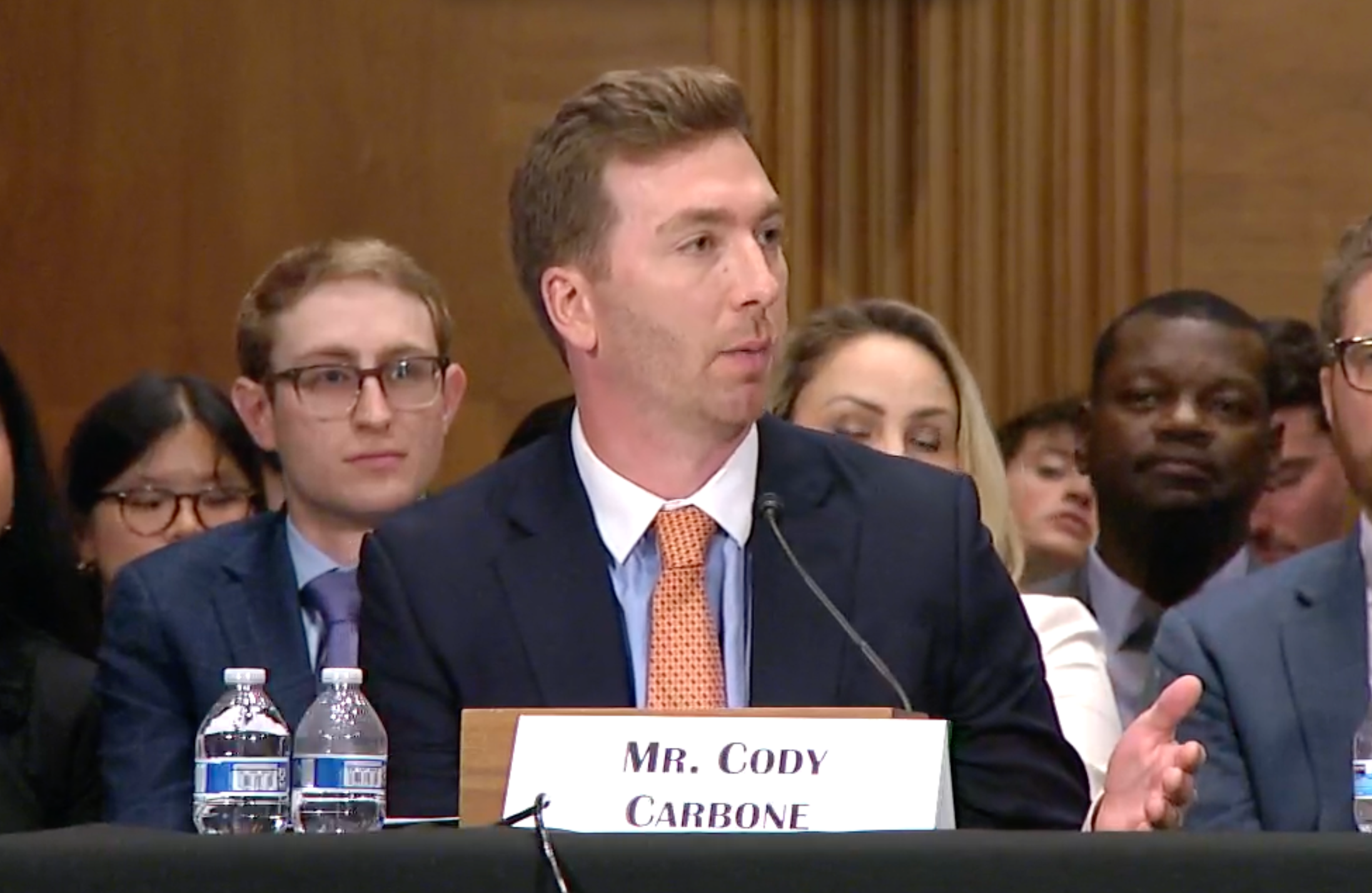
Cody Carbone, CEO of the cryptocurrency advocacy group The Digital Chamber, received a largely muted response to his testimony at a Senate Banking Committee hearing on affordability.
In a Tuesday hearing titled The Affordability Agenda, Carbone said that the digital asset industry could help solve affordability problems in the United States, including through faster and cheaper transactions, putting “competitive pressure” on existing payment systems, and reducing barriers to “owning and transferring assets.”
However, the majority of lawmakers present did not question Carbone directly or inquire about digital assets, with the exception of Indiana Senator Tim Banks and Louisiana Senator John Kennedy. Banks asked the Digital Chamber CEO about the costs related to foreign remittances compared to US dollar-pegged stablecoins, while Kennedy largely dismissed Carbone’s testimony.
“Mr. Carbone, you seem to be here to promote cryptocurrency,” said Kennedy. “I love cryptocurrency, but I don’t think that’s the problem with our economy.”
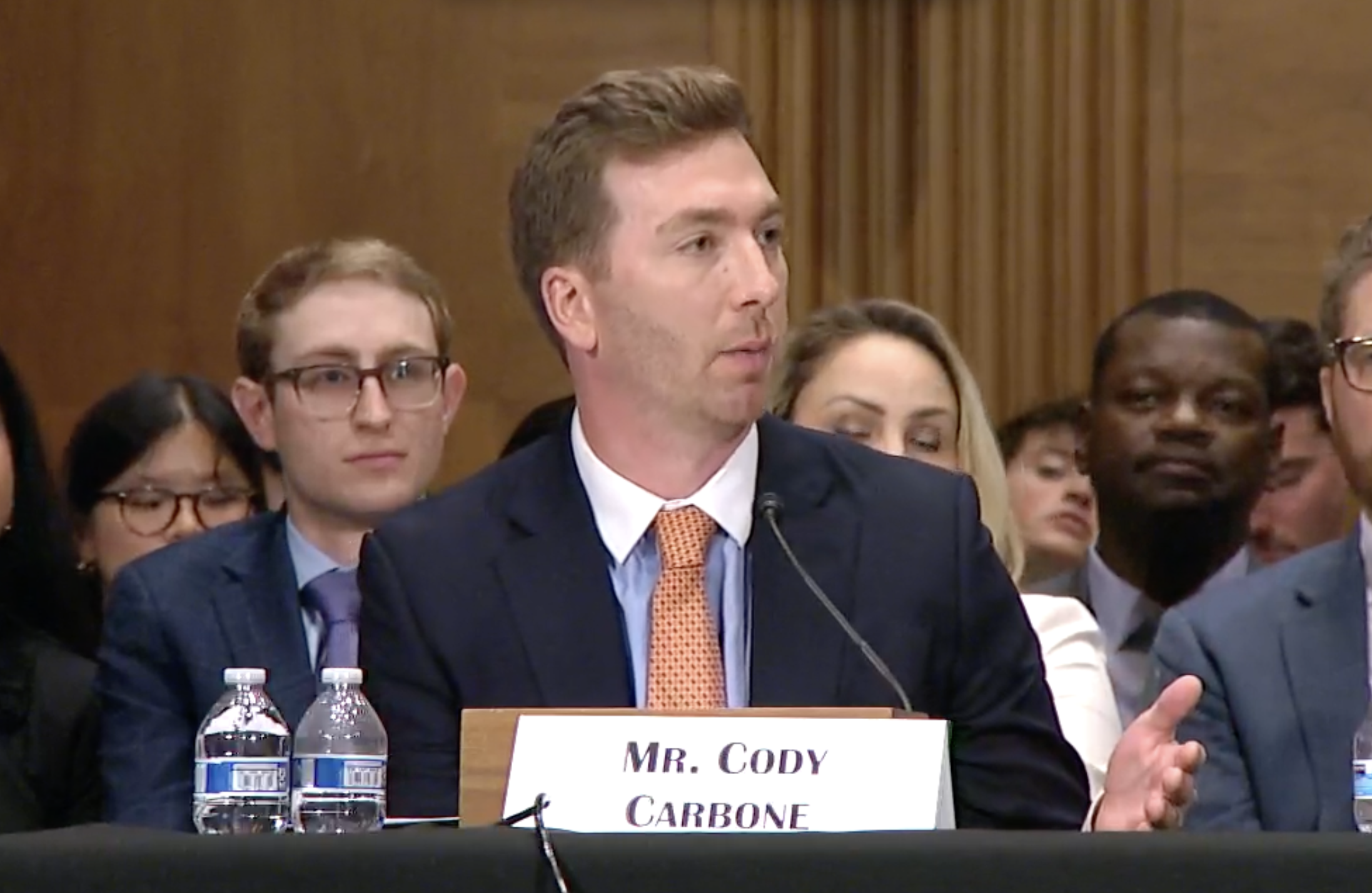
The Digital Chamber CEO Cody Carbone speaking on Tuesday. Source: Senate Banking Committee
Carbone’s remarks centered around the US Senate moving forward on the Digital Asset Market Clarity (CLARITY) Act, which the banking committee advanced in May. The full chamber is expected to vote on the legislation in a matter of weeks, but many lawmakers are calling for additional ethics provisions, potentially complicating passage in the Senate.
Related: Crypto lobby urges Congress to pass staking and mining tax bill as is
CLARITY Act still in limbo amid pushback from interest groups
In addition to lawmakers’ concerns about ethics in the crypto market structure bill, last week gambling industry groups called for the Senate to clarify that the legislation would not allow the US Commodity Futures Trading Commission (CFTC) to oversee sports betting in prediction markets. The financial regulator, under Chair Michael Selig, has claimed “exclusive jurisdiction” over platforms such as Kalshi and Polymarket.
Some lawmakers expect that the CLARITY Act will pass through the Senate before the chamber breaks for an August recess. As of Tuesday, no floor vote was scheduled in the Senate.
Magazine: Japanese pension fund tips 1% in crypto, G7 urges action on NK hackers: Asia Express
Crypto World
Bitcoin Price Prediction: BTC Risks Drop Toward $55K as $60K Support Comes Under Pressure
Bitcoin remains trapped beneath a major resistance cluster after failing to sustain last week’s recovery. The latest price action has shifted back in favor of the bears, with BTC breaking below its short-term rising structure and once again moving toward the lower boundary of its recent range.
Bitcoin Price Analysis: The Daily Chart
On the daily timeframe, BTC continues to trade below the first major supply zone between $65K and $68K. After briefly recovering into this area, sellers regained control and pushed the market lower, reinforcing the importance of this resistance region.
The recent rejection also keeps BTC below the 100-day moving average near $73K and well below the 200-day moving average around $77K, maintaining the broader bearish structure.
The most important support remains the $59K to $61K demand zone, which has repeatedly attracted buyers throughout June. However, each rebound from this area has produced a lower high, suggesting that bullish momentum is gradually fading.
As long as BTC remains below $68K, the market remains vulnerable to another test of the $60K support region. A decisive breakdown beneath this zone could expose the next major support area around $54K to $56K.
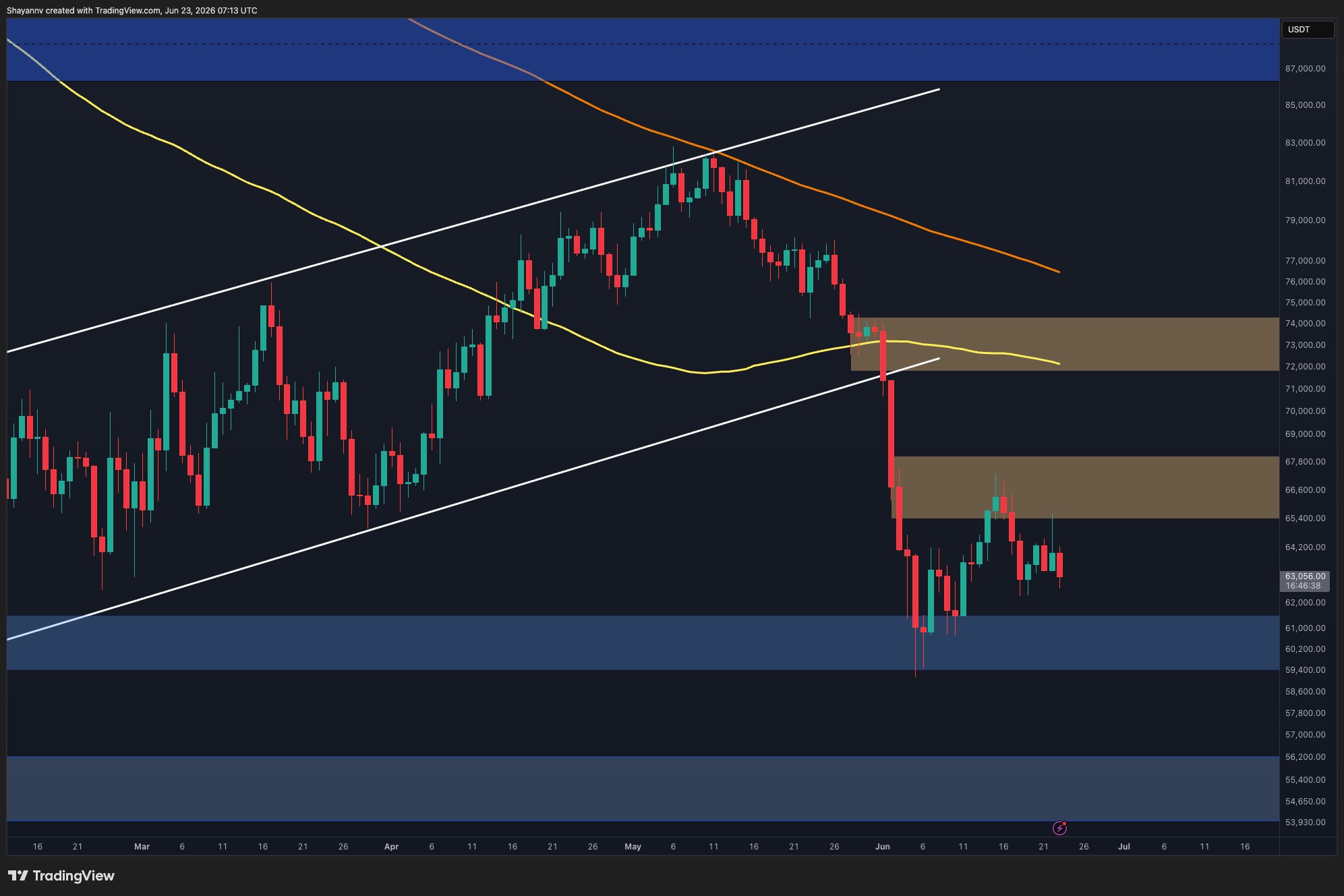
BTC/USDT 4-Hour Chart
The 4-hour chart paints a more bearish picture in the short term. BTC recently broke below its ascending recovery channel after another rejection from the $65K to $68K supply zone.
More importantly, the latest recovery attempt failed to produce a new high and instead formed another lower high near $65K before sellers stepped back in. Price is now trading around $63K and moving toward the lower end of the recent range.
The loss of the rising trendline is a notable development because it signals weakening short-term momentum. Unless buyers quickly reclaim the $64K to $65K area, the probability of another move toward the $60K to $61K support zone remains elevated.
The immediate resistance remains the $65K to $68K supply region, while the blue support zone around $60K is the key level that bulls must defend.

Sentiment Analysis
The Binance BTC liquidation heatmap highlights a substantial concentration of liquidity beneath the current market price, making the downside particularly interesting from a liquidity perspective.
While liquidity exists above the market around $70K, $75K, and higher levels, the most significant and closest cluster is located below the current price action. Large liquidation pools can be seen around the $59K to $60K region, with even larger concentrations extending toward $55K and roughly $50K to $52K.
Since markets often gravitate toward large liquidity concentrations, this setup suggests that downside liquidity remains largely untapped. The repeated failures beneath the $65K to $68K supply zone further increase the risk that BTC eventually breaks below the $60K support area to target these lower-liquidity pockets.
In other words, while the $60K region continues to act as support, it is also sitting directly above a substantial liquidity vacuum. If sellers manage to force a decisive breakdown, the move could accelerate as the market seeks larger liquidation clusters between $55K and $50K.
For now, the key battle remains at $60K to $61K, but the heatmap suggests that the larger liquidity incentive currently resides below the market rather than above it, leaving the risk skewed toward an eventual downside sweep if support fails.

The post Bitcoin Price Prediction: BTC Risks Drop Toward $55K as $60K Support Comes Under Pressure appeared first on CryptoPotato.
TLDR:
- Project Pangea unites 47+ European and Korean banks to pursue atomic T+0 FX settlement via stablecoins.
- Chainlink CCIP, Data Streams, and the Runtime Environment form the project’s core connectivity layer.
- FairSquareLab’s Pangea L1 enforces oracle-first transaction ordering for real-time interbank FX swaps.
- Qivalis and its 37-bank euro stablecoin consortium serve as the EUR anchor for Project Pangea flows.
Chainlink has joined forces with European and South Korean banking consortia to launch Project Pangea, a working group targeting real-time T+0 foreign exchange settlement through stablecoin infrastructure.
A Multi-Trillion Dollar Push for Atomic FX Settlement
Project Pangea brings together Chainlink, FairSquareLab, UniKA, and Qivalis under one strategic task force. The coalition collectively represents over $10 trillion in assets under management.
UniKA’s steering committee includes Shinhan Bank, JB Bank, Kbank, FairSquareLab, and OBDIA. More than ten additional Korean commercial banks are participating in the initiative alongside them.
The global FX market processes over $9.6 trillion in daily trading volume. Despite this scale, the traditional infrastructure remains fragmented and slow.
Cross-border transactions often require institutions to convert capital through intermediary currencies, causing delays.
Project Pangea targets this bottleneck directly through atomic Payment-versus-Payment swaps of regulated EUR and KRW stablecoins.
Chainlink Labs President of Capital Markets Fernando Vazquez described the launch as a structural shift rather than an incremental upgrade, saying the project “upgrades the fragmented foreign exchange model of today with direct, atomic currency swaps using stablecoins.”
The initiative uses ISO 20022 messaging standards and existing Swift infrastructure to bridge legacy systems with blockchain rails.
This means participating banks do not need to overhaul internal payment operations to connect. Vazquez added that Project Pangea represents “a clear signal that global finance is increasingly moving onchain.”
FairSquareLab CEO Joonhong Kim pointed to a broader strategic outcome for South Korea, stating that “for Korea, Project Pangea is more than an efficiency gain — it opens a path for the Korean won to connect more directly with global currency markets.”
The initiative also aims to reduce the won’s dependence on intermediary currencies in cross-border flows. Kim noted that FairSquareLab, leading the UniKA alliance alongside Qivalis and Chainlink, is “building a network that brings the Korean banking sector into a new era of real-time, cross-border settlement.“ That alone marks a structural change for Korean institutions operating across international corridors.
Three-Layer Architecture Powers the Settlement Network
The technical design of Project Pangea is built across three distinct layers. The banking layer handles Swift and ISO 20022 payment messaging.
The connectivity layer runs through Chainlink’s CCIP and Data Streams infrastructure. Settlement occurs at the third layer through Pangea AMM smart contracts deployed on Ethereum, Polygon, and the Pangea L1 network.
FairSquareLab’s Pangea L1 is a settlement-dedicated blockchain operating from neutral ground, independent of any single country or participating bank.
At the protocol level, oracle data updates execute ahead of every other transaction in each block. This design ensures all FX swaps settle against the current market price without manipulation risk.
Banks continue using familiar payment messaging, with instructions translated into onchain settlement actions through Chainlink CCIP.
Chainlink’s Cross-Chain Interoperability Protocol handles secure EUR stablecoin transfers between native networks and the KRW settlement chain. Data Streams feed real-time FX market data into the Proactive Market Maker engine.
The Chainlink Runtime Environment serves as the orchestration layer between Swift and the blockchain settlement stack.
Together, these components allow institutions to plug into onchain finance through their existing messaging systems.
Qivalis Head of Partnerships APAC Jean-Luc Gustave outlined the capital efficiency case for global institutions, saying that “migrating to a friction-free cross-border model could unlock significant capital efficiency by eliminating traditional settlement risk and reducing intraday liquidity costs.”
He framed the project as proof that next-generation infrastructure can “optimize international trade corridors” beyond theoretical use cases.
Qivalis’s euro stablecoin consortium, backed by 37 European banks, stands to become a core currency layer within the network.
The initiative positions regulated stablecoins as institutional-grade instruments for high-volume FX flows between Europe and Asia.
FairSquareLab’s onchain FX engine anchors price discovery to trusted oracle quotes rather than bonding curves, while per-asset depletion barriers protect pool liquidity from exhaustion during large interbank conversions.
The result is a predictable settlement structure built to handle institutional scale. Enterprise fees within the Chainlink ecosystem are programmatically converted to LINK tokens and stored in the Chainlink Reserve to support long-term network sustainability.
Project Pangea is designed to scale into a multi-currency settlement network as additional corridors and institutions join the working group.
Nasdaq 100 futures dropped 2% today alongside a 1.1% decline in S&P 500 futures, while South Korean tech stocks tanked as much as 10% before trading was briefly halted.
The past few weeks have spelled trouble for tech valuations overall with June 5th seeing the biggest daily drop for the Nasdaq since April 2025, falling well over 4%
The atmosphere has created strong risk-off sentiment, which has spilled over into crypto, leading Bitcoin and Ethereum to drop 4% and 6%, respectively.
Market factors
U.S. chip manufacturing giant Broadcom failed to meet quarterly sales expectations earlier this month, causing some uncertainty in the market. Sentiment is not aided by the major debt backing the massive AI expansion seen this year, with $750 billion worth of enterprise investment in AI and tech leaving the industry exposed to borrowing costs.
With the market now anticipating a potential interest rate hike in October, the future earning potential of AI companies for investors is now up for debate.
The SOX index measuring semiconductor stocks has now hit extreme volatility levels matching those seen in the 00’s dot com bubble, another concerning signal for tech investors.
Risk-off sellers offload crypto
Bitcoin has seen heightened correlation with tech stocks since 2025. BTC plunged below $62,000 earlier today in line with the drop in tech stocks, with Kalshi prediction market investors now favoring a decline below $60k this year.
Bearish sentiment has also stemmed from a stronger dollar, major ETF outflows earlier this year, and the executive order on quantum technologies signed by Donald Trump yesterday. ETH is now down 35% from its 2026 highs, while the broader altcoin market has often seen drops of over 50%.
While today’s price correction by no means spells doom for global markets, the price action is a firm reminder that the AI hype seen over the last year still relies on future profits rather than current revenues.
The post Bitcoin Caught in Crossfire as Tech Stocks Unravel appeared first on CryptoPotato.

Meta CEO Mark Zuckerberg exits Los Angeles Superior Court in Los Angeles, California, Feb. 18, 2026.
Kyle Grillot | Bloomberg | Getty Images
Meta Platforms CEO Mark Zuckerberg has directed staff to create a prediction markets platform, a person familiar with the company’s plans who asked not to be named confirmed to CNBC.
The New York Times was first to report the development on Tuesday.
The person familiar, who was not authorized to speak on the record about the company’s plans, also confirmed to CNBC that the prediction markets app would not use actual money to trade on the platform, a contrast to other prediction markets where traders use cash to speculate on future events.
The Times report said Meta’s app would instead rely on a video game-style points system, but that money may be used on the app in the future.
Two employees with knowledge of the plans told the Times the app — referred to internally as “Arena” — would be separate from Meta’s social media platforms, Instagram and Facebook. Meta would seek to leverage its Facebook and Instagram user base to direct potential traders to the platform, the report said.
The company declined a request to comment from CNBC.

DraftKings shares Tuesday
Sports betting platform DraftKings fell more than 2% after the report was released, reaching its low of the day. The stock was last down 1.5%. FanDuel parent Flutter Entertainment also fell nearly 2% after the report, but was still positive on the day, up 1%.
Flutter and DraftKings have both struggled over the past year on worries about how prediction market platforms — which offer sports-related event contracts — could disrupt their sports gambling businesses.
Trading platform Robinhood, which offers contracts from various prediction market platforms, also declined after the Times’ initial report.
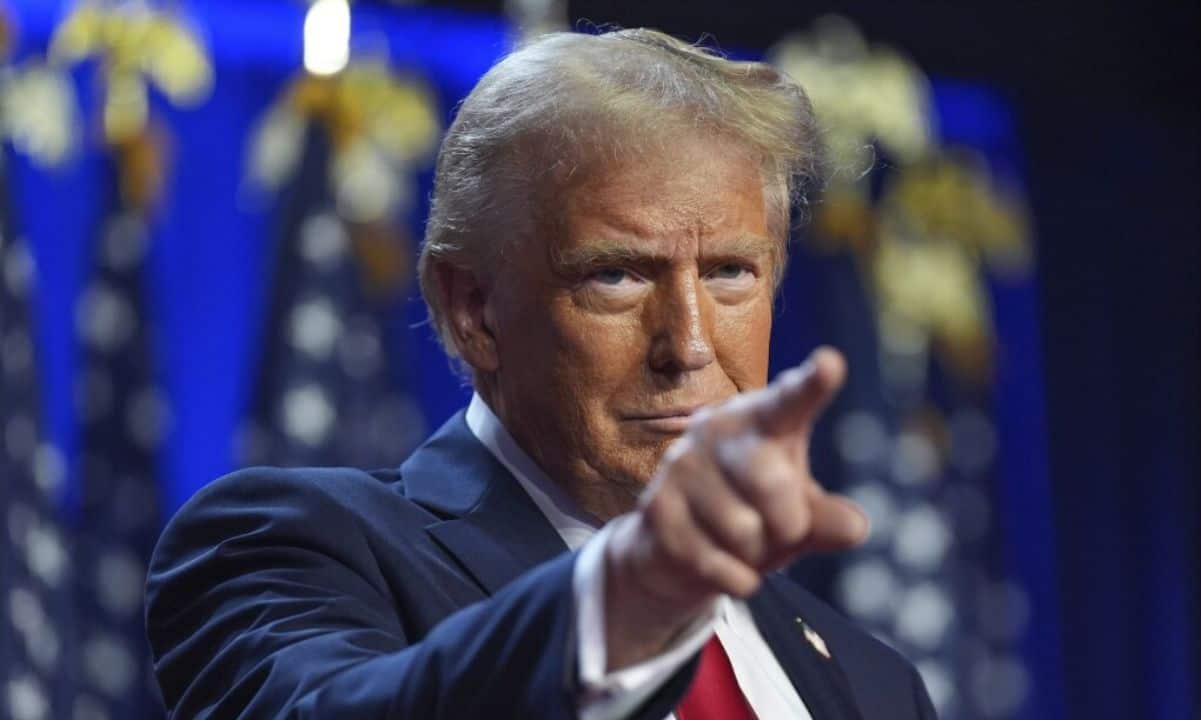
United States President Donald Trump has signed two executive orders aimed at advancing the country’s quantum technology capabilities while preparing federal systems for emerging security threats posed by quantum computing.
The orders, 14411 and 14409, were issued on June 22 and focus on separate but related strategies to strengthen America’s position in quantum science and protect sensitive information from future cyber risks.
Quantum Innovation
Executive Order 14411 aims to expand the nation’s quantum information science and technology sector. The administration said the US must maintain its leadership in quantum computing, sensing, and networking as other countries increase their investments in these fields. The order calls for a government-wide strategy to support research, manufacturing, commercialization, and applications of quantum technologies while protecting sensitive technologies from foreign adversaries.
Under the directive, the administration will update the National Quantum Strategy within 180 days. Federal agencies will then be required to align their policies and programs with the revised strategy. The order also creates the Quantum Computer for Application Development and Discovery Science initiative (QC-ADDS), which aims to develop a large-scale quantum computer capable of enabling scientific breakthroughs beyond the capabilities of traditional computing systems.
The Department of Energy will identify the technical requirements for the system within 90 days and examine private-sector partnership models for delivering at least one such machine. The computer would eventually be installed at a Department of Energy facility and, where possible, made accessible to the scientific community.
The order also directs agencies to expand quantum sensing and networking technologies. The Department of War must identify at least three next-generation quantum sensor projects that can be deployed by September 2028. Several agencies, including the Departments of Commerce and Energy, NASA, and the National Science Foundation, must prepare five-year plans covering quantum research, manufacturing, networking, and space applications.
Additional measures focus on strengthening domestic quantum supply chains, improving access to manufacturing resources, expanding workforce development programs, and coordinating with allied nations on technology protection and market access.
Countering Cryptographic Attacks
Executive Order 14409 addresses the cybersecurity risks posed by future large-scale quantum computers. The administration warned that adversaries could collect encrypted information today and decrypt it later once powerful quantum systems become available. To tackle this threat, federal agencies are required to transition to post-quantum cryptography standards approved by the National Institute of Standards and Technology.
Each federal agency must appoint a post-quantum cryptography migration lead within 30 days. Agencies will be required to transition high-value assets and high-impact systems to post-quantum encryption for key establishment by the end of 2030 and for digital signatures by the end of 2031.
The order also proposes new procurement requirements, requires support for critical infrastructure operators preparing for post-quantum migration, directs officials to engage foreign governments and industry groups on NIST-approved algorithms, and mandates annual reporting on the status of national security systems.
The post Donald Trump Launches US Quantum Push With Two Executive Orders appeared first on CryptoPotato.

TV Advertising for SMEs on ITV, Sky & C4
Brazil Bans Crypto Campaign Donations, Citing Transparency Gaps Ahead of October Elections

James Franco’s Bizarre TikToks Spark Alien Conspiracy Theories


-

 Fashion4 days ago
Weekend Open Thread: Miami – Corporette.com
-

 Entertainment3 days ago
Renter of Home in Anne Heche Crash Denies Settlement With Son
-

 Tech1 day ago
Microsoft accidentally kills epic Outlook email threads
-

 Business3 days ago
Soccer-U.S. defends Iran World Cup travel restrictions, says discussions ongoing
-

 Politics5 days ago
BBC Reporter Discusses Cross Party Criticism Of Trumps Iran Deal
-
 Business4 days ago
Wall Street Week Ahead: Investors see Micron earnings as pulse check of AI rally momentum
-

 Tech5 days ago
AWS enters the context layer race with a graph that learns from agents, not manual curation
-

 Politics4 days ago
Andy Burnham and the meaning of Makerfield
-

 Crypto World4 days ago
HIVE shares jump as $220M AI deal speeds Bitcoin mining pivot
-
 Crypto World3 days ago
Can Charles Hoskinson Really Rescue Cardano?
-

 Crypto World3 days ago
Jake Chervinsky accuses CME of protecting derivatives monopoly
-

 Business5 days ago
Brexit cost 6% of UK economy, Bank of England company data suggests
-

 Tech1 day ago
Nearly 7,000 fake Amazon domains registered ahead of Prime Day 2026, researchers warn
-

 Sports5 days ago
FIFA World Cup 2026: Canada beat 9-men Qatar 6-0 to register first ever win | FIFA World Cup 2026
-
 Tech2 days ago
Signal’s Meredith Whittaker says AI chatbots ‘are not your friends’ and calls Copilot agents a backdoor
-

 NewsBeat4 days ago
Keir Starmer Allies Question His Chances For No 10
-

 Entertainment4 days ago
Jose Alvarado Wants Taylor Swift at More Knicks Games
-

 Business3 days ago
MHP SE 2026 Q1 – Results – Earnings Call Presentation (OTCMKTS:MHPSY) 2026-06-20
-
 Sports2 hours ago
Two goals and an assist by sheer aura: Cristiano Ronaldo just entered the World Cup chat
-

 Crypto World6 days ago
Anthropic’s Dario Amodei Urged AI Unity at G7, Even as US Banned His Models
You must be logged in to post a comment Login