
Crypto World
What are Telegram trading bots? How they work



Telegram trading bots let users buy and sell tokens directly from a chat interface. This guide explains how they work, which bots dominate the market, and what risks come with handing a bot your private key.
Summary
- Telegram trading bots are automated tools that connect to decentralized exchanges through the Telegram messaging app, letting users swap tokens, snipe new listings, and set limit orders without using a traditional wallet interface
- The leading bots by volume include Banana Gun, Maestro, Unibot, BONKbot, and Trojan, each handling hundreds of millions of dollars in weekly trading volume across Ethereum, Solana, and Base
- These bots generate revenue through transaction fees, typically charging 0.5% to 1% per trade on top of the standard DEX swap fees and network gas costs
- The primary convenience is speed: a trader can paste a contract address into a Telegram chat and execute a buy in under two seconds, compared to the 15 to 30 seconds required to navigate a DEX interface manually
- The primary risk is custody: most Telegram bots generate a wallet for the user and hold the private key on their servers, meaning a bot compromise could result in total loss of funds
Telegram trading bots emerged in 2023 as a response to a specific problem in decentralized finance: the gap between the speed at which opportunities appear and the speed at which a human can execute a trade through a conventional DEX interface. When a new token launches on Uniswap or Raydium, the first buyers often capture the largest gains. By the time a trader opens their browser, connects their wallet, approves the token contract, sets slippage, and confirms the transaction, the price may have already moved 50% or more.
Telegram bots compressed that entire workflow into a single message. Paste a contract address, tap a button, and the bot submits the transaction on your behalf. The interface is a chat window. The execution happens on-chain. The speed advantage turned what started as a niche tool for memecoin traders into an infrastructure layer that now processes billions of dollars in monthly volume.
This guide explains how these bots work under the hood, which ones dominate the market, what they cost, and where the risks hide.
How Telegram trading bots work
A Telegram trading bot is a program that runs on a server, connects to one or more blockchain networks, and accepts commands through the Telegram Bot API. When a user starts a bot for the first time, the bot generates a new crypto wallet (a public-private key pair) and associates it with the user’s Telegram account. The user funds this wallet by sending tokens to the generated address.
Once funded, the user can trade by sending commands to the bot. The most basic command is a buy: the user pastes a token contract address, selects an amount, and the bot constructs a swap transaction on the relevant decentralized exchange, signs it with the user’s private key, and broadcasts it to the network. The entire process typically completes in one to three seconds on Solana and three to ten seconds on Ethereum, depending on network congestion.
The bot handles several technical steps that would otherwise require manual interaction. It automatically detects which DEX has liquidity for the token. It calculates the optimal route through liquidity pools, sometimes splitting the trade across multiple pools to reduce price impact. It sets gas parameters to prioritize transaction inclusion. On Ethereum, many bots integrate with block builders and private mempools to avoid sandwich attacks, a form of MEV (maximal extractable value) that front-runs and back-runs a user’s trade to extract profit.
The user interface is entirely within Telegram. Buttons replace the connect-wallet and approve-token steps of a traditional DEX. Portfolio tracking, profit and loss calculations, and token watchlists are all presented as inline messages or callback buttons within the chat.
The major Telegram trading bots
The Telegram bot landscape has consolidated around a handful of dominant platforms, each with different strengths.
Banana Gun is the highest-volume Telegram trading bot as of mid 2026. It operates on Ethereum, Solana, Base, and Blast. Banana Gun is known for its sniping capabilities: the ability to detect a new token listing and execute a buy transaction in the same block as the liquidity addition. The bot charges a 0.5% fee on manual buys and a 1% fee on snipes. Banana Gun processed more than $8 billion in cumulative trading volume in its first year of operation and has generated hundreds of millions in fee revenue, a portion of which is distributed to holders of the BANANA token.
Maestro was one of the earliest Telegram trading bots, launching on Ethereum before expanding to Solana and other chains. Maestro offers sniping, limit orders, copy trading (automatically mirroring the trades of a specified wallet), and anti-rug protection that attempts to detect and front-run liquidity removals. Its fee structure is 1% per transaction.
Unibot launched in mid 2023 and was among the first bots to gain significant traction. It pioneered the revenue-sharing model where a percentage of trading fees is distributed to token holders. Unibot operates primarily on Ethereum and introduced features like private transactions routed through Flashbots to protect against MEV. Trading fees are 1% for non-token-holders and 0.5% for UNIBOT holders.
BONKbot is the dominant Telegram trading bot on the Solana network. Named after the BONK memecoin community, BONKbot specializes in Solana token trading and benefits from Solana’s low transaction fees and fast confirmation times. A trade on BONKbot costs a fraction of a cent in network fees compared to several dollars on Ethereum, making it the preferred tool for high-frequency memecoin trading where traders execute dozens of small trades per day.
Trojan emerged as a competitor to BONKbot on Solana, differentiating itself through a cleaner interface and additional features such as DCA (dollar-cost averaging) orders and multi-wallet management. Trojan has grown rapidly and regularly competes with BONKbot for the top position in Solana trading volume.
What Telegram bots actually cost
The total cost of a Telegram bot trade includes three components: the bot fee, the DEX swap fee, and the network gas fee.
The bot fee is the primary revenue source for the bot operator. It typically ranges from 0.5% to 1% of the trade value. On a $1,000 trade, this means $5 to $10 goes to the bot.
The DEX swap fee is paid to liquidity providers on the underlying decentralized exchange. On Uniswap V3, this is typically 0.3% for established tokens and 1% for newer, lower-liquidity tokens. On Raydium (Solana), the standard fee is 0.25%.
The network gas fee varies dramatically by chain. On Ethereum, a swap transaction costs $3 to $15 depending on network congestion. On Solana, the same transaction costs less than $0.01. On Base, gas fees typically fall between $0.01 and $0.10.
Adding these together, a $1,000 trade on Ethereum through a Telegram bot with a 1% fee costs roughly $10 (bot fee) + $3 (DEX fee at 0.3%) + $5 to $10 (gas) = $18 to $23. The same trade on Solana costs roughly $10 (bot fee) + $2.50 (DEX fee) + $0.01 (gas) = $12.51. These costs are meaningful for small trades. A $100 trade on Ethereum through a Telegram bot loses 18% to 23% of its value to fees before any price movement occurs.
The fee economics explain why Telegram bot trading has concentrated on Solana, where the low gas costs make small, frequent trades economically viable. On Ethereum, Telegram bot trading is more practical for larger position sizes where the fixed gas cost represents a smaller percentage of the trade.
Sniping and launch trading
Sniping is the feature that originally drove adoption of Telegram trading bots. When a new token launches on a DEX, the token creator adds liquidity to a pool. The first trades against that liquidity get the lowest prices. Sniping bots monitor the blockchain for liquidity addition transactions and attempt to place a buy order in the same block.
The technical mechanics differ by chain. On Ethereum, snipers use private transaction channels such as Flashbots or MEV Blocker to submit transactions directly to block builders, bypassing the public mempool where they could be front-run. The bot must predict the exact block in which liquidity will be added and submit a transaction with sufficient gas priority to be included immediately after the liquidity transaction.
On Solana, sniping works differently because the network uses a leader-based block production model rather than a mempool auction. Bots connect to multiple RPC nodes and submit transactions with optimized compute budgets to maximize the probability of early inclusion. The speed competition on Solana is measured in milliseconds, and the leading bots invest heavily in infrastructure co-located with Solana validators. Some bots maintain dedicated connections to multiple validator operators, paying for priority access that shaves tens of milliseconds off submission times. The infrastructure arms race mirrors the high-frequency trading competition in traditional finance, where firms spend millions on co-location and network optimization to gain microsecond advantages.
Sniping carries substantial risk. Many new token launches are scams, rug pulls, or honeypot contracts that allow buying but prevent selling. A successful snipe on a fraudulent token results in a total loss. The anti-rug features offered by bots like Maestro attempt to simulate a sell transaction before executing the buy, checking whether the token contract allows selling. However, sophisticated scam contracts can pass these checks and then enable restrictions after a set number of blocks or a specific volume threshold.
The custody problem
The most significant risk of Telegram trading bots is the custody model. When a user creates a wallet through a Telegram bot, the bot generates the private key and stores it on its servers. The user receives the public address and sometimes can export the private key, but the bot retains a copy.
This means the bot operator has full access to every wallet created through the platform. If the bot’s servers are compromised, every user’s funds are at risk. If the bot operator decides to act maliciously, they can drain every wallet simultaneously. This is the exact opposite of the self-custody principle that decentralized finance was built to enable.
Several Telegram bots have experienced security incidents. In September 2023, Maestro experienced an exploit through a vulnerability in its token approval router contract, resulting in approximately $280,000 in user losses. The bot reimbursed affected users, but the incident highlighted the concentrated risk. In late 2023, Unibot experienced a contract exploit that affected users who had granted token approvals through the bot.
The practical advice for managing this risk is straightforward: treat the Telegram bot wallet as a hot wallet with limited funds. Transfer only the amount needed for immediate trading. Move profits to a hardware wallet or self-custody solution regularly. Never store a significant portion of your portfolio in a Telegram bot wallet. Some traders set a hard rule: never keep more than they can afford to lose entirely in the bot wallet.
Some newer bots have introduced partial mitigations. A few support connecting external wallets through WalletConnect, so the user retains custody of the private key and approves each transaction through their own wallet app. This approach sacrifices speed (each trade requires a manual approval step) but eliminates the custody risk. The tradeoff reflects the fundamental tension in Telegram bot trading: speed and convenience on one side, security and self-custody on the other.
The custodial risk is compounded by the lack of regulatory oversight. Traditional exchanges that hold customer funds are subject to licensing requirements, capital reserves, and regular audits. Telegram trading bots operate outside these frameworks entirely. There is no deposit insurance, no regulatory body to file complaints with, and no legal obligation for the bot operator to maintain solvency or segregate user funds. Users are trusting anonymous or pseudonymous teams with their private keys, and the only recourse in the event of a loss is whatever goodwill or reputational incentive the bot operator feels.
Revenue, tokens, and the bot economy
Telegram trading bots have created a new category of crypto revenue-generating businesses. The fee revenue is substantial: Banana Gun alone has generated more than $100 million in cumulative fees. Several bots have issued tokens that entitle holders to a share of the fee revenue, creating a form of equity-like exposure to the bot’s trading volume.
The token economics vary by project. Banana Gun distributes a percentage of trading fees to BANANA token holders who stake their tokens. Unibot distributes a share of fees to UNIBOT holders. The yield depends on trading volume, which is highly correlated with market sentiment. During bull markets and memecoin frenzies, daily fee revenue can spike by ten times or more. During quiet markets, revenue can drop to a fraction of peak levels.
This volume sensitivity makes Telegram bot tokens among the most volatile assets in crypto. UNIBOT rose from $3 to $200 during its initial hype cycle in 2023, then declined more than 90% before finding a lower range. BANANA experienced similar volatility. Traders who buy bot tokens are effectively making a leveraged bet on future DEX trading volume, particularly memecoin trading volume, which has historically been the most cyclical segment of the crypto market.
The competitive dynamics are intense. Bots compete on speed (fastest execution wins the sniping market), fees (lower fees attract volume-sensitive traders), features (copy trading, limit orders, DCA), and chain coverage (supporting more chains captures more trading activity). The low barriers to entry mean new bots can launch quickly, but the network effects of user adoption and the infrastructure investment required for competitive sniping speeds create meaningful advantages for established players.
The relationship between Telegram bots and decentralized exchange volume is symbiotic. Bots route a significant share of total DEX volume, particularly on Solana where BONKbot and Trojan together have accounted for more than 30% of all Raydium swap volume during peak memecoin periods. This makes bots a critical distribution layer for DEXs, and some DEX protocols have begun offering fee rebates or priority routing to the highest-volume bots. The arrangement benefits both sides: bots get better execution for their users, and DEXs get more volume and fees.
What this does not cover
This guide does not cover the legal and regulatory status of Telegram trading bots, which remains unclear in most jurisdictions and may evolve as regulators examine unregistered trading platforms. It does not cover the specific token contract risks of memecoin trading, including honeypot contracts, hidden mint functions, and transfer tax manipulation, which are the most common causes of loss for Telegram bot users. It does not cover the broader MEV landscape beyond its relevance to Telegram bot users, nor the technical details of Solana validator operation or Ethereum block building that underpin the sniping infrastructure.
Practical checks before using a Telegram trading bot
Check the bot’s track record. Search for past security incidents, contract exploits, or reports of fund losses. A bot that has been operating for more than 12 months without a major incident has passed a meaningful stress test, though past safety does not guarantee future safety.
Check the fee structure. Calculate the total cost of a round-trip trade (buy and sell) including bot fees, DEX fees, and gas on the specific chain you plan to trade. If the total cost exceeds 3% to 5% of your trade size, the fee drag will make it very difficult to trade profitably.
Check the custody model. Determine whether the bot generates and holds your private key, or whether it supports external wallet connections. If the bot holds your key, plan your fund management accordingly and never keep more in the bot wallet than you are prepared to lose.
Check the withdrawal process. Before trading, test a small withdrawal to confirm that you can move funds out of the bot wallet to an external address without delays or restrictions.
Check the bot’s social channels. Active developer communication, regular updates, and transparent incident response are positive signals. A bot with no public developer presence or communication channel is a higher risk.
Are Telegram trading bots legal?
The legality depends on jurisdiction. In most countries, using a bot to trade on decentralized exchanges is not explicitly prohibited, but the bots themselves may be operating as unregistered broker-dealers or money transmitters. Users should research their local regulations before using these tools.
Can I lose all my money using a Telegram trading bot?
Yes. The two most common ways to lose everything are trading a scam token (honeypot or rug pull) and a bot security breach where the private key is compromised. Limiting the funds stored in the bot wallet reduces the maximum loss from a security breach.
Which Telegram trading bot is best for beginners?
BONKbot on Solana is often recommended for beginners because Solana’s low gas fees make experimentation cheap. A failed trade on Solana costs less than a cent in gas, compared to several dollars on Ethereum. The lower cost of mistakes allows beginners to learn without significant fee-related losses.
How do Telegram trading bots make money?
Through transaction fees, typically 0.5% to 1% per trade. Some bots also earn revenue through priority transaction routing, where they charge additional fees for guaranteed fast execution during high-demand periods such as token launches.
Can Telegram bots protect me from rug pulls?
Some bots offer anti-rug features that simulate sell transactions before executing buys, check for blacklisting functions in the token contract, or monitor for liquidity removal events. These protections catch basic scams but cannot detect sophisticated exploits or delayed rug mechanisms. No bot can guarantee protection against all forms of token fraud.
Do I need to pay taxes on Telegram bot trades?
In most jurisdictions, yes. Each swap is a taxable event, and the high-frequency nature of Telegram bot trading can create dozens or hundreds of taxable transactions per day. Most bots do not provide tax reports, so users need to export their wallet transaction history and use third-party tax software to calculate their obligations.
What is the difference between sniping and copy trading?
Sniping targets new token launches, attempting to buy in the same block as the initial liquidity. Copy trading replicates the trades of a specified wallet address in real time. Sniping is a speed competition against other bots. Copy trading is a strategy that relies on the skill of the wallet being copied.
Can I use multiple Telegram trading bots at the same time?
Yes. Many traders use different bots for different chains or strategies. A common setup is BONKbot or Trojan for Solana memecoin trading and Banana Gun for Ethereum sniping. Each bot generates its own wallet, so funds must be distributed across multiple wallets accordingly.
Disclaimer
This article is for informational purposes only and does not constitute financial or investment advice. Cryptocurrency investments carry significant risk, and you should conduct your own research before making any investment decisions. Information is accurate as of August 6, 2026.

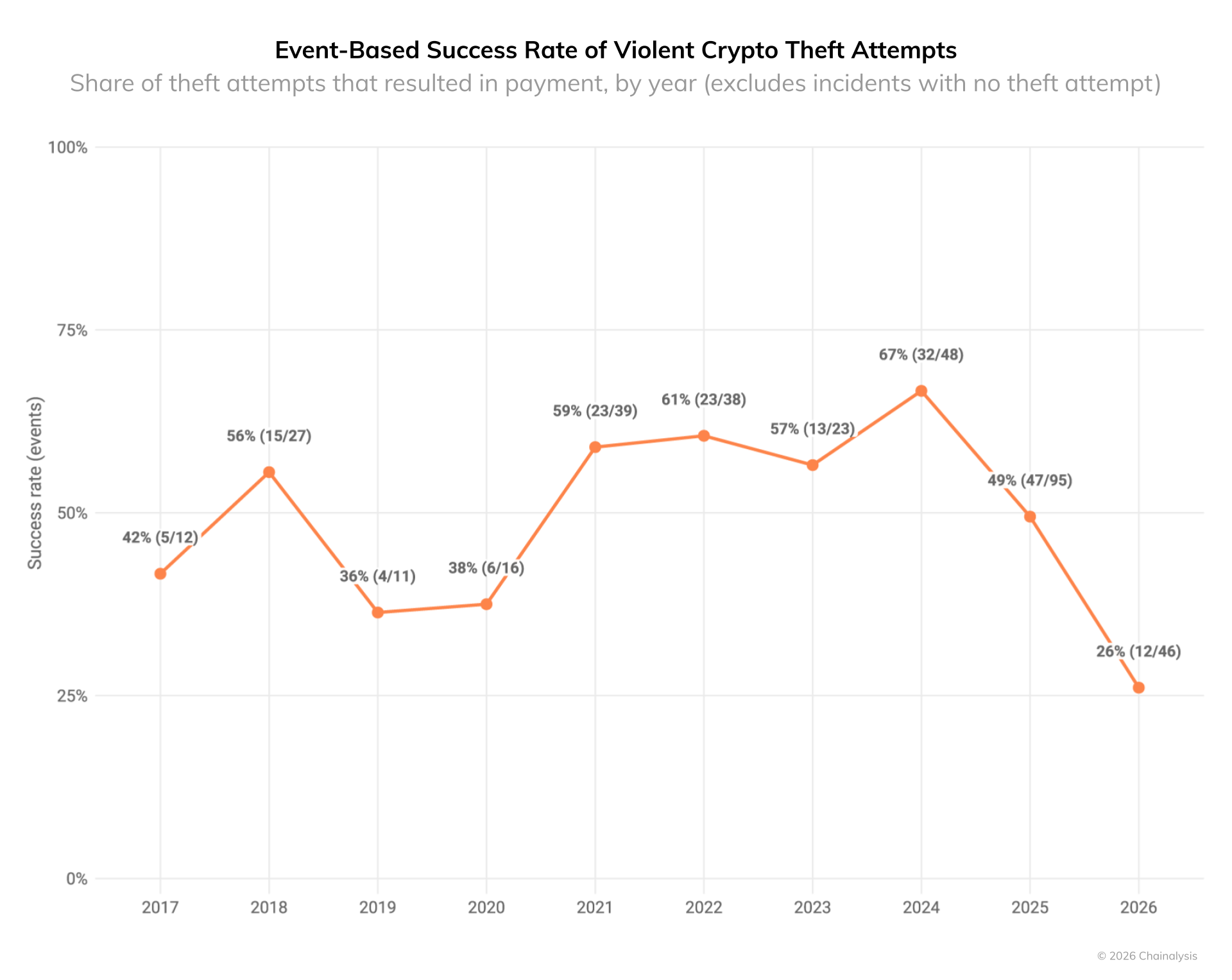
Criminals stole more than $30 million through physical attacks on crypto holders in the first half of this year, putting the year on pace to surpass the record $58 million stolen in 2025.
In a Chainalysis report released Thursday, the blockchain analytics firm said that 46 violent crypto-related incidents had been documented globally through late June, up from 40 during the same period in 2025. The incidents include kidnappings, home invasions and hostage situations, collectively known as “wrench attacks.”
The findings suggest wrench attacks are increasing, expanding the risks facing crypto holders beyond custody and asset management to their physical safety, homes and families.
According to the report, only 12 of the 46 attempts resulted in payment, giving attackers a 26% success rate, down from 49% in 2025. However, the report acknowledged that known cases likely understate the scale of the problem, as many attacks go unreported.
Chainalysis said the “tradecraft tends to be amateur at the point of violence, but professional at both ends,” with victims often selected through data leaks, social media or insider information before low-skilled crews carry out the attacks.
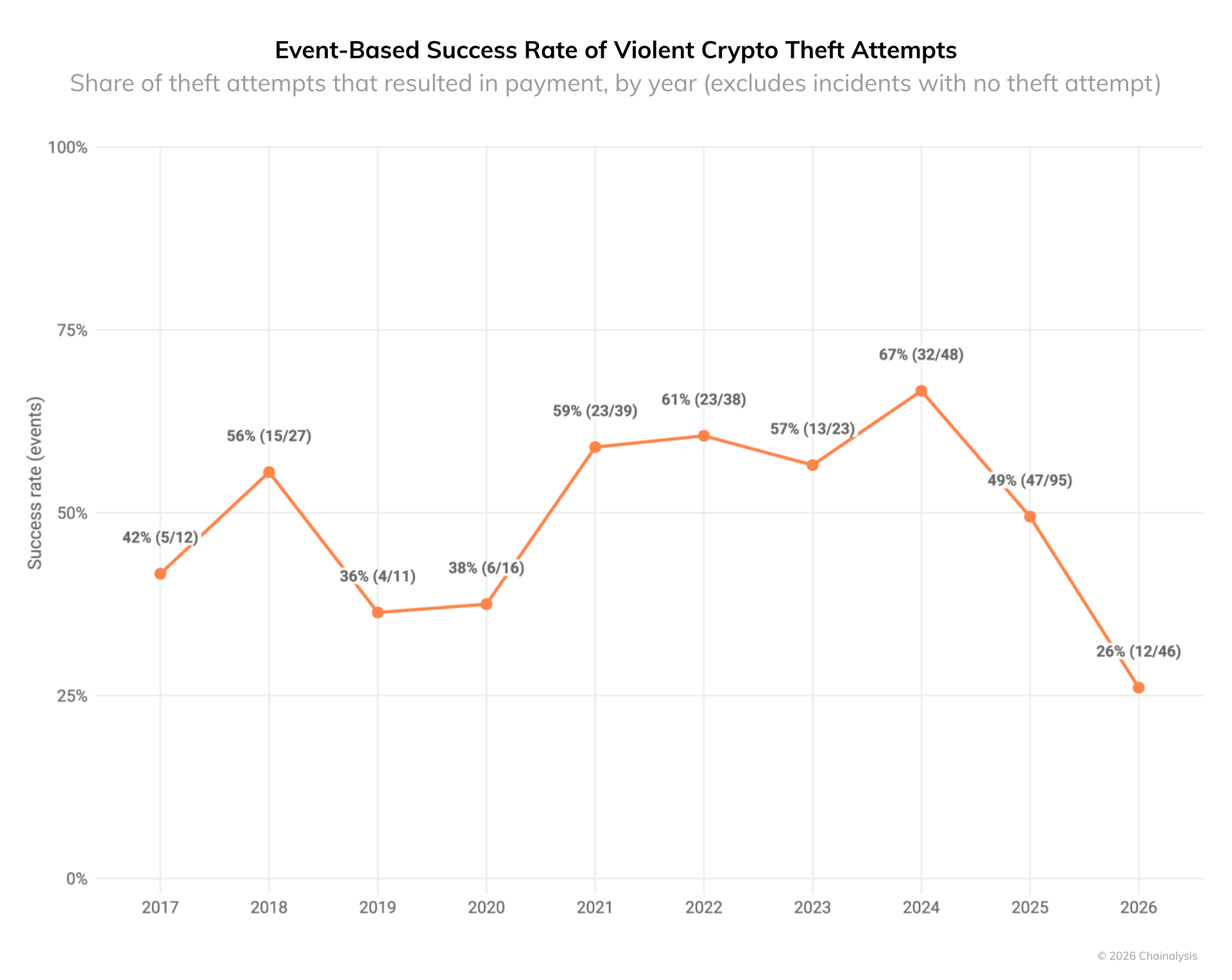
Success rate of crypto wrench attacks by year. Source: Chainalysis
France remains wrench attack hotspot
According to Chainalysis, France recorded 30 publicly known incidents by midyear, compared with 19 throughout 2025. The report noted that French authorities have counted more than 70 incidents, indicating the actual total may be substantially higher.
Related: Spain arrests suspect in 2025 kidnapping of Ledger co-founder
In July, Interior Minister Laurent Nuñez put the first-half count at 77 kidnappings, extortions or attempted extortions, up from 45 in all of 2025. In response, the government has introduced a rapid-alert and protection system and promised greater intelligence-sharing and coordination with the crypto industry.
Chainalysis said in the Thursday report that the alleged misuse of French tax records was the likeliest driver of the surge. A French tax official allegedly accessed and sold information about crypto investors to criminals, while a separate breach at crypto tax-reporting company Waltio reportedly exposed data belonging to about 50,000 users.
Onchain activity also showed varying levels of sophistication. Some attackers sent stolen funds directly to centralized exchanges, while others used bridges, decentralized exchanges and laundering services. Chainalysis said the most advanced cases showed links to broader criminal networks.
Magazine: Do the Coldcard attacks mean all hardware wallets are now insecure?
The self-custodial Bitcoin Lightning Network wallet disabled infrastructure after an incident and founder Evan Kaloudis said no customer funds were lost and no Lightning vulnerability was found.
Bitcoin miners’ pivot into artificial intelligence and high-performance computing (HPC) is reshaping their business models, but investors are no longer rewarding new infrastructure deals with the same enthusiasm they once did, suggesting the market has become more discerning as AI hosting strategies move into the mainstream.
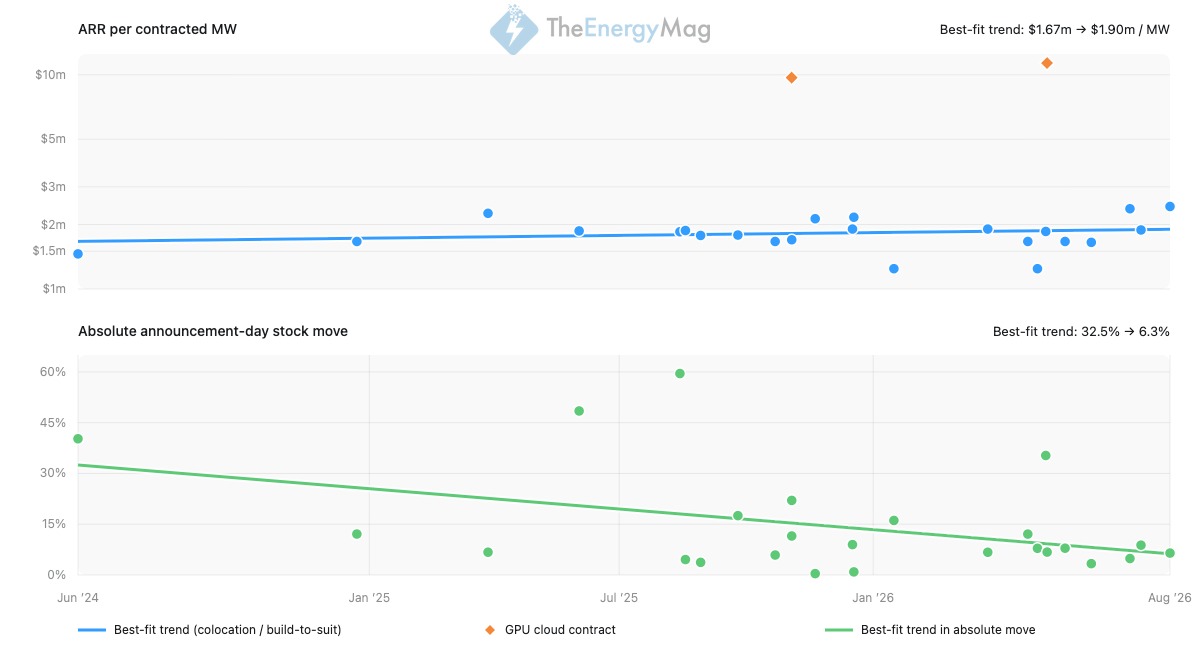
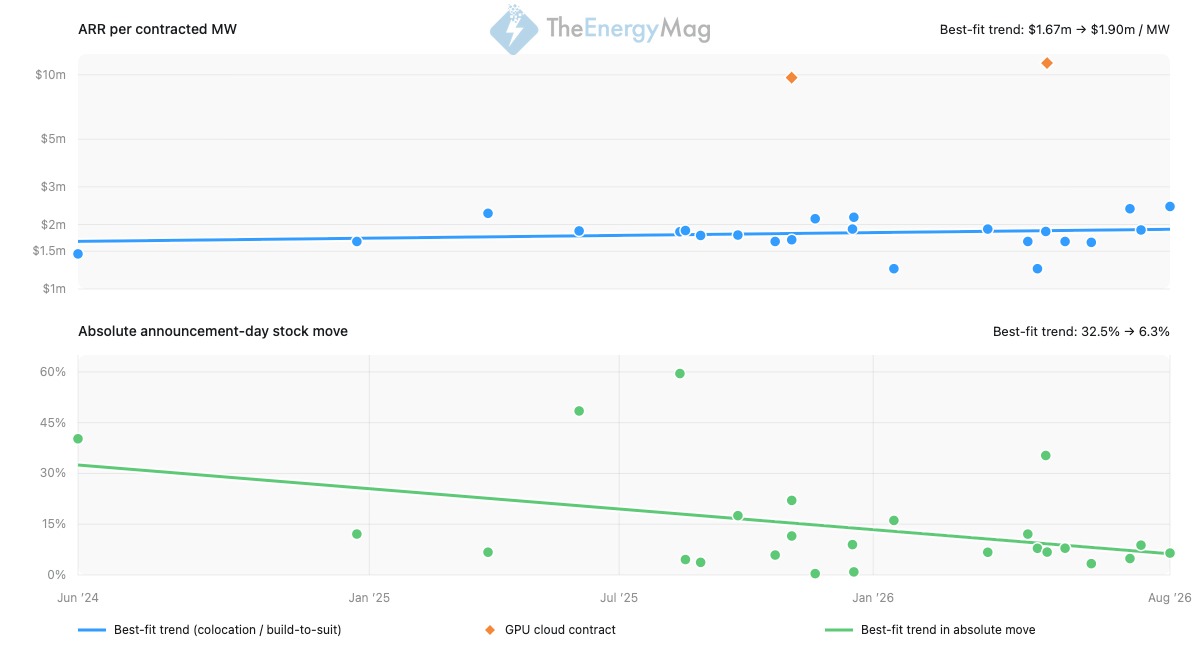
According to new analysis by Blocksbridge Consulting published in TheEnergyMag’s Miner Weekly, the market reaction to AI infrastructure announcements has weakened significantly over the past two years. Reviewing 25 AI and HPC infrastructure deals announced between June 2024 and August 2026, the report found that the average announcement-day stock move fell from roughly 24% for the earliest deals to about 10% for the most recent ones. Median gains also dropped by roughly half over the same period, even as the size and value of the contracts increased.
The report found that annualized revenue per contracted megawatt has edged higher over time, indicating that AI hosting agreements are becoming more lucrative. However, as such deals become increasingly common, investors appear to be placing greater emphasis on execution, financing and long-term profitability than on headline contract values alone.
AI infrastructure deals are becoming more valuable, but less market-moving. Source: TheEnergyMag
That shift is evident in how the market has responded to major announcements. Core Scientific’s initial hosting agreement with CoreWeave sent its shares up more than 40%, while Applied Digital’s first CoreWeave lease gained nearly 49% and TeraWulf’s first Fluidstack deal surged almost 60%.
More recent mega-deals have drawn a much more muted response. TeraWulf’s 401-megawatt lease with Anthropic lifted its shares by about 5%, CleanSpark’s $6.6 billion AI hosting agreement gained nearly 9%, and Bitdeer’s new Tydal contract briefly pushed the stock up roughly 12% before those gains disappeared by the market close.
Related: Crypto Biz: Is the AI-to-crypto rotation underway?
Bitcoin mining stocks reflect cooling AI enthusiasm
The performance of Bitcoin mining stocks that have embraced AI and high-performance computing workloads also reflects the market’s cooling enthusiasm.
TheEnergyMag’s TEM AI Infrastructure Growth Index, which tracks publicly traded companies developing AI data center and digital infrastructure businesses, is down roughly 28.5% from its June peak, suggesting investors have become more cautious even as AI infrastructure demand remains strong.
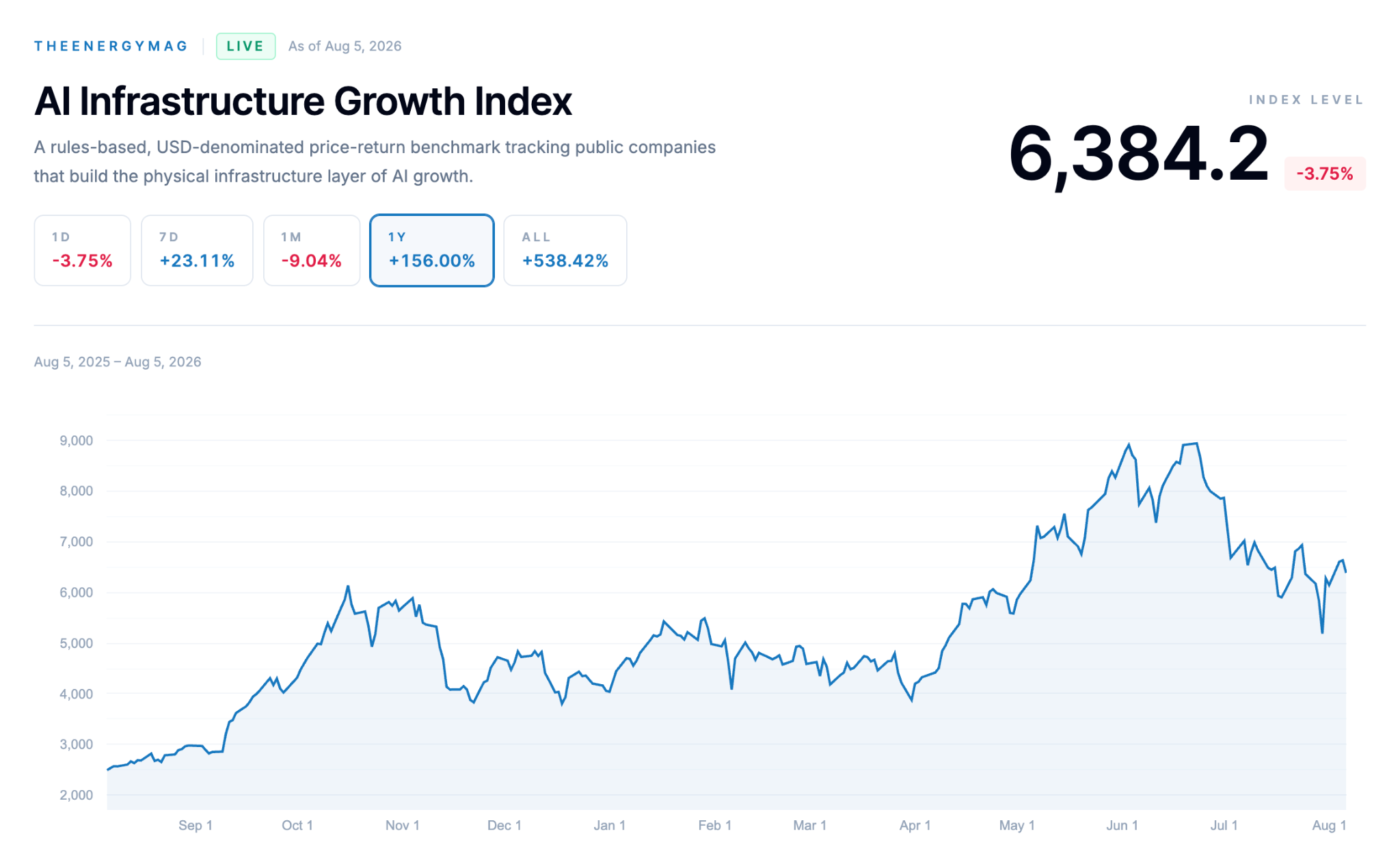
While the TEM AI Infrastructure Growth Index remains sharply higher over the past year, its momentum has slowed in recent months. Source: TheEnergyMag
The slowdown mirrors a broader pullback in AI infrastructure stocks, with the Philadelphia Semiconductor Index falling nearly 17% from its July peak.
Magazine: A quantum roadmap would push Bitcoin much higher: Charles Edwards


Cointelegraph is committed to providing independent, high-quality journalism across the crypto, blockchain, AI, and fintech industries.
All news, reviews, and analyses are produced with full journalistic independence and integrity. For more details on our standards and processes, please read our Editorial Policy.


Bitcoin fell below $65,000 on Thursday after stronger-than-expected U.S. jobless claims data reinforced concerns that the Federal Reserve could keep interest rates elevated.
Summary
- Bitcoin traded at $64,384, down 0.69% after failing to close above $65,000.
- Initial U.S. jobless claims reached 199,000, below economists’ forecast of 204,000.
- BTC found immediate support near $64,000, while $64,800–$65,000 remains resistance.
- Further evidence of labor market strength could affect Federal Reserve rate expectations.
Bitcoin price rejected near $65,000
According to data from crypto.news, Bitcoin (BTC) price traded at $64,384.27 at press time, marking a 0.69% decline over the previous 24 hours. The pullback followed another unsuccessful attempt to break through the $64,800–$65,000 resistance zone.
BTC had recovered from approximately $62,400 earlier in the week and briefly tested the upper end of its recent range. However, buyers failed to secure a daily close above $65,000, allowing sellers to regain control near the psychological level.
The rejection pushed Bitcoin toward $64,000, which has emerged as its nearest short-term support. Holding that level would keep the latest recovery structure intact, while a sustained break below it could expose the lower part of the range.
Bitcoin has remained sensitive to U.S. economic releases because stronger data can reduce expectations for monetary easing. Higher interest rates generally make yield-bearing assets more attractive relative to risk assets such as cryptocurrencies.
US jobless claims beat expectations
The latest labor data showed that seasonally adjusted initial unemployment claims reached 199,000 during the week ending Aug. 1, according to the U.S. Department of Labor.
Claims increased by 1,000 from the previous week’s revised reading of 198,000 but remained below the 204,000 expected by economists. The lower-than-forecast figure pointed to continued resilience in the U.S. labor market.
The four-week moving average fell to 198,750, down 4,500 from the revised average of 203,250 recorded a week earlier. This measure helps smooth weekly volatility and provides a clearer view of the underlying trend.
Continuing claims rose by 24,000 to 1.801 million for the week ending July 25. Meanwhile, the insured unemployment rate remained unchanged at 1.2%.
Taken together, the figures showed that layoffs remained limited, although the increase in continuing claims suggested that some unemployed workers were taking longer to find new positions.
Fed expectations weigh on Bitcoin
A resilient labor market could give the Federal Reserve more room to maintain restrictive monetary policy or consider further rate increases if inflation remains elevated.
That possibility matters for U.S. crypto investors because expectations for higher rates can lift Treasury yields and strengthen the dollar. Both developments can reduce demand for non-yielding and higher-risk assets, including Bitcoin.
However, weekly unemployment claims represent only one part of the Fed’s policy outlook. Officials will also consider inflation, payroll growth, wages and consumer spending before making their next decision.
Bitcoin’s decline following the claims release therefore reflects shifting rate expectations rather than a confirmed change in Federal Reserve policy. Upcoming economic data could quickly alter the market’s interpretation.
Bitcoin must reclaim $65,000
Bitcoin now needs to close above the $64,800–$65,000 area to confirm renewed upward momentum. A successful breakout could allow buyers to extend the recovery that began near $62,400.
Until then, the repeated rejection leaves BTC trading within a defined range. The $64,000 level provides immediate support, followed by the recent swing low near $62,400 if selling pressure increases.
Traders will watch upcoming U.S. inflation and employment releases for further clues about the Fed’s path. A softer set of economic figures could revive expectations for lower rates, while continued labor market strength may keep Bitcoin’s recovery capped below $65,000.
Disclosure: This article does not represent investment advice. The content and materials featured on this page are for educational purposes only.
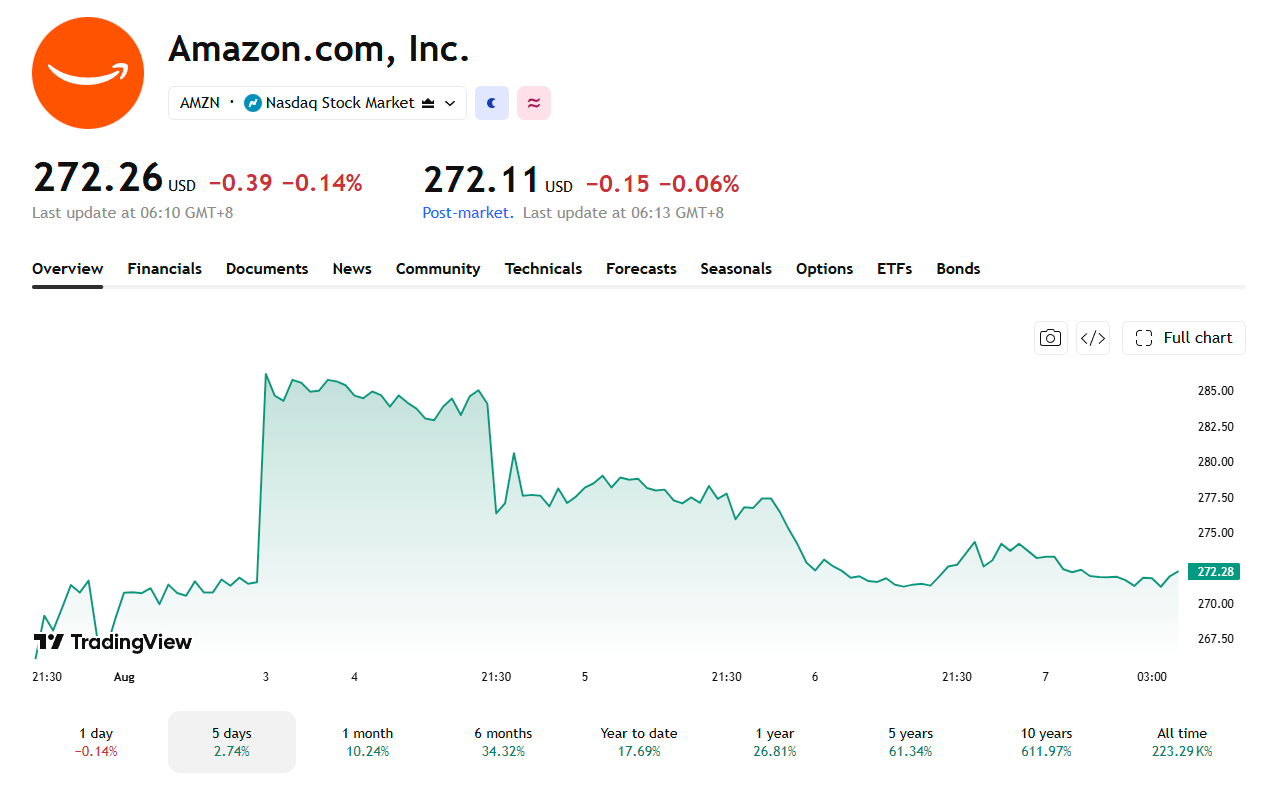
Jeff Bezos filed to sell 15 million Amazon shares worth $4.07 billion this week, in a sale that traces back to a trading plan he adopted eight and a half months earlier.
The filing landed a day after Amazon’s stock crossed a $3 trillion market cap on strong earnings, raising a few eyebrows as to its timing. However, the sale mechanism itself was locked in long before either milestone happened.
A Plan Set Eight Months in Advance
Bezos executed the sale through a Rule 10b5-1 trading plan. This is a pre-arranged schedule that lets corporate insiders set future stock sales in advance. The structure removes any discretion over timing once it takes effect.
He adopted this particular plan on Nov. 14, 2025, according to a filing with the U.S. Securities and Exchange Commission (SEC). That is roughly eight and a half months before the shares actually changed hands. The filing noted the shares themselves were acquired as founder stock back in 1994, three years before Amazon’s 1997 initial public offering (IPO).
Bezos remains one of Amazon’s largest shareholders despite the sale. He also donated 220,200 shares to nonprofit organizations in May, separate from this week’s transaction.
Bezos has sold Amazon stock through similar prearranged plans in recent years, according to the filing.
The Earnings Beat Came After the Plan Was Already Set
Amazon reported second-quarter earnings on July 31, beating expectations on cloud computing growth. That report was part of a Big Tech earnings preview published days earlier. It pushed the stock toward a record close on Monday.
Amazon’s market value crossed $3 trillion that same day. Bezos’s shares sold through Morgan Stanley on Monday as well, at an average price tied to that record close.
The stock then fell more than 2% on Tuesday once the filing became public. The plan itself predated that rally by months.

Why the Gap Matters
Rule 10b5-1 plans exist specifically to separate an insider’s trading decisions from live market-moving news. Bezos could not have adjusted this sale’s size or date based on Amazon’s July earnings. The schedule was already fixed months in advance.
The coincidence of timing made the sale look reactive. The filing date says otherwise.
Investors watching Form 144, the SEC document insiders use to disclose planned stock sales, should weigh the adoption date first. The sale date alone can mislead.
The post Bezos’s $4 Billion Amazon Sale Was Scheduled Before the Earnings Beat appeared first on BeInCrypto.


Browser-based tool lets investors and lenders cryptographically confirm that every loan in a tokenized pool belongs there and has passed eligibility rules, without seeing private borrower data Wayzata, MN — August 6, 2026 — Black Lake Digital Markets, the institutional rails for mortgage capital… Read the full story at The Defiant
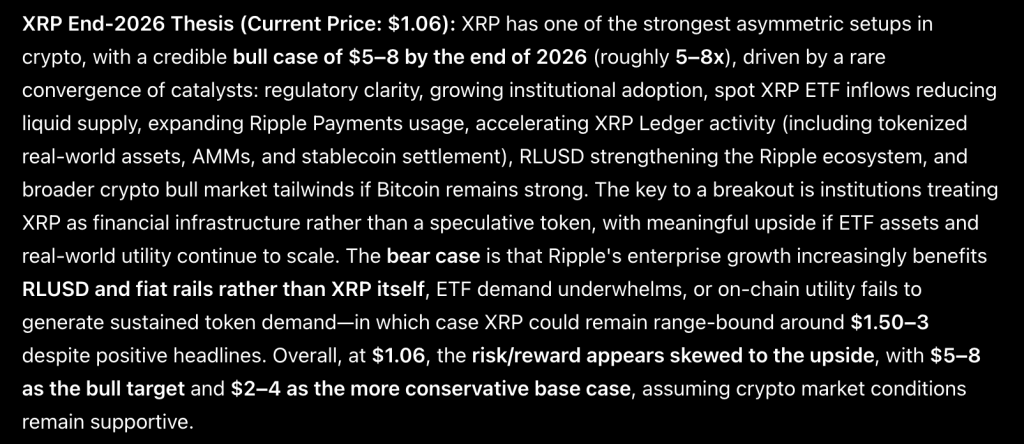
Whether XRP reaches $5 depends on one distinction. ChatGPT AI predicts institutions will start treating it as financial infrastructure rather than a speculative token, and that shift underpins a price prediction of $5 to $8 by the end of 2026 from $1.06.
Regulatory clarity opens the list of catalysts. Growing institutional adoption follows, with spot XRP ETF inflows pulling liquid supply off the market.
Ripple Payments usage keeps expanding. XRP Ledger activity accelerates alongside it, spanning tokenized real-world assets, AMMs, and stablecoin settlement.
RLUSD strengthens the surrounding ecosystem. Broader crypto tailwinds add lift if the majors stay strong.

ChatGPT frames a conservative base case of $2 to $4. The full $5 to $8 needs ETF assets and real-world utility scaling together.
The bear argument is sharper than usual. Ripple’s enterprise growth could increasingly benefit RLUSD and fiat rails rather than XRP itself.
ETF demand is underwhelming, the second concern. On-chain utility failing to generate sustained token demand is the third.
Any of that leaves XRP range-bound around $1.50 to $3. Positive headlines would keep coming while XRP price goes nowhere.

Discover: Get Paid to Be Right, $25 to Start on Kalshi
XRP Price Prediction: Infrastructure Or Speculation, The Distinction That Decides XRP
The daily chart has offered little comfort. XRP topped above $3.20 in September and has declined almost without pause since.
October brought a violent wick down toward $1.60 before recovery. February then broke the $1.80 shelf and dropped price to roughly $1.15. Spring produced a long consolidation between $1.30 and $1.55. That floor gave way in June.
July marked the low near $1.03. Price has since chopped sideways in a tight band without reclaiming meaningful ground. The close reads $1.07050, down 0.23% and $0.00251 on the day. The session traveled from $1.05377 to $1.07584.
Support sits at $1.05 and then $1.03 at the July bottom. Resistance begins at $1.20, then $1.30 and $1.40. RSI reads 44.56 with the signal line just above at 44.91. The lines are nearly touching, separated by less than half a point.
That reading sits below the midline in mildly bearish territory. Momentum has flattened rather than turned.
ChatGPT is describing a market that does not exist on this chart yet. Reclaiming $1.20 would be the first sign institutions are buying the infrastructure argument.
Discover: Your Market Calls Are Worth Something. Start With Free $25 on Kalshi
Trade The Outcome, Not The Chart & Claim $25 For Free
Most traders express their view the only way they know how: by buying the coin. But when your opinion is about a rate decision, an inflation print, or where the market lands by year-end, spot exposure prices dozens of other things alongside it, liquidity, sentiment, unrelated flows, whatever happens overnight in a market you weren’t watching.
You can be right about the thing you actually studied and still lose money on everything else attached to the position.
Kalshi removes the attachments. It’s a CFTC-regulated exchange where you take a position on the event itself: the Fed’s next move, inflation prints, and where a coin closes the year. One question, one outcome, one settlement, resolved against a defined source.
Because every contract is backed by real capital, the prices work as a live read on what the market genuinely expects, which is why the odds tend to move before the headlines catch up. It’s a forecast that costs something to be wrong about.
And it does cost something. A contract that resolves against you goes to zero, and a correct call on the wrong timeline still expires worthless. Event trading rewards precision about when, not just what. Size accordingly.
The analysis above was free. What you do with it doesn’t have to be.
→ Get up to $25 to trade your first market on Kalshi
Don’t Miss Out on Our $1,000 USDT Airdrop on ByBit
The post ChatGPT AI Predicts XRP Could Be Quietly Setting Up a Big Move appeared first on Cryptonews.


Two groups affiliated with the cryptocurrency company-backed political action committee (PAC) Fairshake disclosed spending more than $1.5 million on media to support House of Representatives and Senate candidates in Florida, Alaska and Wyoming after suffering a primary loss in Michigan on Tuesday.
According to Federal Election Commission (FEC) filings as of Thursday, Fairshake PAC affiliates Defend American Jobs and Protect Progress spent a combined $1.5 million on ads for Republican and Democratic candidates, many of whom voted in favor of the Digital Asset Market Clarity (CLARITY) Act while serving in Congress.
In Alaska’s at-large congressional district, scheduled to hold a primary on Aug. 18, Defend American Jobs spent more than $500,000 on media supporting the re-election of Representative Nick Begich. The Super PAC spent about the same amount on Republican candidate Sydney Gruters in Florida’s 16th district, and Representative Harriet Hageman, running for the soon-to-be-vacant Wyoming Senate seat now occupied by Cynthia Lummis. Both US states will also hold primaries on Aug. 18.
The reported expenditures follow a primary loss for a Protect Progress-supported candidate in Michigan’s 13th Congressional District. On Tuesday, Democratic incumbent Shri Thanedar lost a primary to State Representative Donavan McKinney after the Super PAC poured more than $2 million into media supporting the former. The final day of Thanedar’s current term in Congress will be in January 2027.
Related: US Senate will vote on CLARITY crypto bill ‘without any question’ this week: Tim Scott
On the Democratic side, Protect Progress reported spending more than $50,000 for the re-election of Lois Frankel in Florida’s 23rd district. Frankel, Begich and Hageman all voted in favor of the GENIUS Act and CLARITY Act while serving in Congress, while Gruters did not appear to have made any public statements on crypto or blockchain, with the exception of saying she supported the crypto market structure bill in a questionnaire conducted by the advocacy organization Stand With Crypto.
The expenditures were the latest examples of Fairshake and cryptocurrency industry-aligned groups attempting to influence US elections through media. The Super PAC reported spending more than $170 million in the 2024 US election cycle on House and Senate races, potentially changing the makeup of the current Congress.
CLARITY votes to influence 2026 midterms?
While it was still uncertain as of Thursday whether the US Senate would hold a vote on the CLARITY Act before the chamber broke for a month-long recess, how lawmakers cast their ballots could affect whether the crypto industry actively supports or opposes their re-election bids. All 435 House seats are up for grabs in 2026, as are 33 seats in the US Senate.
In January, Stand With Crypto said that its “primary goal” in 2026 was getting crypto market structure legislation through Congress. The organization’s community director, Mason Lynaugh, told Cointelegraph in November that how lawmakers vote on the bill could impact their re-election chances. Stand With Crypto rates political candidates on a scale of “strongly supports crypto” to “strongly against crypto” depending on their voting records and public statements, which may be used by PACs and organizations deciding where to allocate funds.
Magazine: 10 weirdest things ever tokenized… including farts
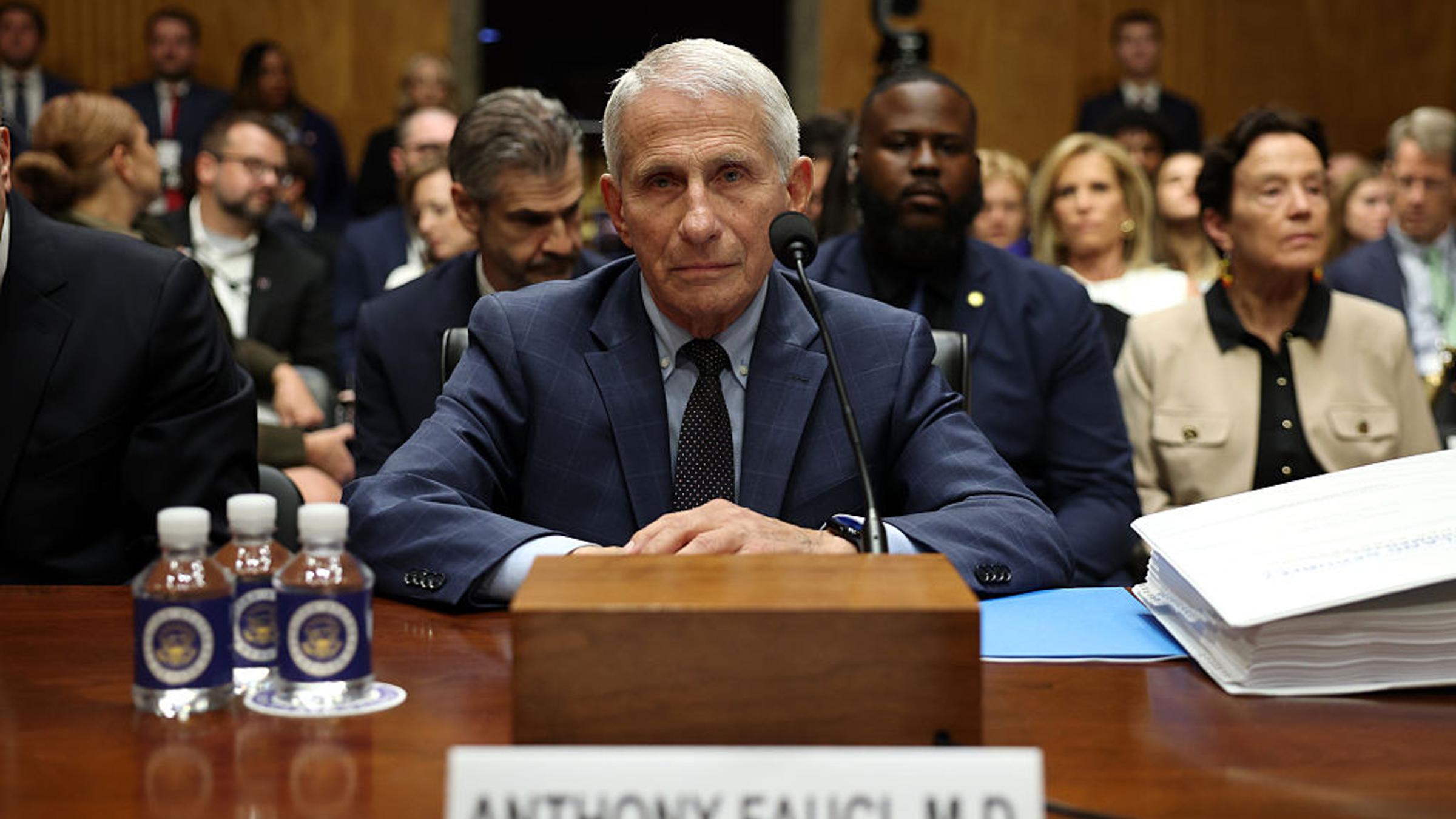
On Thursday, the Republican-led committee voted 8-7 along party lines to advance the contempt resolution.
Here’s what to know about what that vote means, and what might come next for Fauci.
What does it mean to be held in contempt of Congress?
Contempt of Congress is a federal misdemeanor in which an individual willfully disobeys or impedes a congressional investigation.
A contempt of Congress charge may be levied against someone if they fail to appear before a committee after being subpoenaed, refuse to produce required documents, or refuse to answer questions related to an investigation.
Congress does not hold the power to prosecute or convict someone of the crime; instead, the House or Senate can vote to approve a resolution finding a person in contempt and refer the matter to the executive branch for prosecution.
What comes next after the Senate committee vote?
Under Senate procedure, following a panel vote to approve a contempt resolution like the one on Thursday, the measure then heads to the full chamber for a vote. If it passes there, the case is certified and sent to the Department of Justice (DOJ).

8 Stephen King Books Only Die-Hard Fans Know

Money (feat. Scottyolorin)

Lessons from Canada on assisted dying


-

 Fashion6 days ago
Weekend Open Thread: Wit & Wisdom
-

 Politics6 days ago
Meta enters AI-training agreement with far-right ‘propaganda rag’ Newsmax
-

 Politics4 days ago
Zack Polanski: an incitement to murder Nigel Farage?
-

 Crypto World5 days ago
MicroStrategy Post-Earnings CLARITY Act Push Could Add New Catalyst for Its Stock
-

 Crypto World6 days ago
XRP Ledger v3.3.0 brings five institutional features
-

 Crypto World6 days ago
New York sues Kalshi over prediction market gambling
-

 Sports7 days ago
Seema Kaliramna Wins Discus Throw Bronze, Takes India’s CWG Medals Tally To 17
-

 Crypto World5 days ago
Crypto PAC spending tops $2M in Michigan House race
-

 Business4 days ago
DTCR: Deleveraging And A Hedge Fund Collapse Point To A Possible AI Bottom
-

 Business6 days ago
Trump Announces Hamas Disarmament Agreement as Iran Strikes Kuwait Air Base and US Attacks Pause Overnight
-
 Crypto World6 days ago
3 Fed Officials Just Explained Their Rate Hike Vote: Is Inflation Winning?
-

 Tech5 days ago
ESET tracks rise in malicious AI skills and adaptable malware
-

 Tech7 days ago
Gemini Spark can now use Chrome logins and saved passwords to run errands on your behalf
-
Crypto World4 days ago
XRP Ledger urges node upgrade after manifest flood
-
 Tech7 days ago
Building A Reproduction PlayStation Motherboard
-

 Sports6 days ago
France Cricket implodes: letters hidden in a drawer and a board at war
-

 Crypto World6 days ago
Moneyflip CEO charged in $40K murder-for-hire plot
-
 Sports6 days ago
Bruno Fernandes decision made as Man United ‘discuss’ striker transfer option
-

 News Videos5 days ago
Financial Crash Expert: The 90-Day Collapse Timeline They Are Desperately Hiding.
-

 NewsBeat7 days ago
Spain sending troops as thousands enter enclave of Ceuta from Morocco
You must be logged in to post a comment Login