
Crypto World
What Crypto Markets Need to Know


The European Union’s Markets in Crypto-Assets Regulation, commonly known as MiCA, has become the central reference point for how crypto assets are supervised across the bloc. Rather than a single policy note, MiCA is a comprehensive regulatory framework intended to harmonize rules for crypto markets among EU member states. The European Securities and Markets Authority provides the official public-facing overview of the regime, which serves as the primary reference for market participants, journalists, and policymakers. That documentation, available directly from ESMA, outlines how MiCA fits into the EU’s broader digital finance agenda and establishes a shared vocabulary for discussing crypto regulation across Europe.
Key takeaways
- MiCA is the EU’s unified regulatory framework for crypto assets, referenced consistently in official communications.
- The authoritative public overview of MiCA is maintained by the European Securities and Markets Authority.
- ESMA’s documentation explains MiCA’s scope within the EU digital finance strategy.
- MiCA provides common terminology and definitions used by regulators and market participants.
- The ESMA page acts as a baseline reference for neutral, fact-based reporting on EU crypto policy.
Market context: MiCA emerges as regulators worldwide move toward clearer frameworks for digital assets, reflecting a broader push to reduce regulatory fragmentation and improve market oversight.
Why it matters
MiCA represents a structural shift in how crypto assets are addressed within the European Union. Instead of relying on a patchwork of national rules, the framework establishes a shared regulatory baseline intended to apply across all member states. For market participants, this consistency is designed to reduce uncertainty when operating across borders within the EU.
For regulators, MiCA provides a common language and reference point. By anchoring discussions in definitions and categories outlined at the EU level, supervisory authorities can coordinate more effectively. This is particularly relevant in a sector where innovation often moves faster than national regulatory processes.
From an informational standpoint, ESMA’s role as the host of the official MiCA overview matters because it centralizes access to primary regulatory explanations. For journalists and analysts, this reduces reliance on secondary interpretations and helps ensure that public discourse reflects the regulator’s own framing.
What to watch next
- Updates or clarifications published by ESMA regarding MiCA’s application.
- Guidance documents that expand on how national regulators should implement the framework.
- Industry responses and compliance timelines referenced in official communications.
Sources & verification
- ESMA’s official Markets in Crypto-Assets Regulation overview page.
- ESMA materials related to digital finance and innovation initiatives.
Understanding MiCA and its role in EU crypto regulation
Markets in Crypto-Assets Regulation, abbreviated as MiCA, is the formal name used by European Union institutions when referring to the bloc’s crypto asset framework. The acronym is not a shorthand created by industry observers but rather the official designation embedded in regulatory texts and communications. As such, MiCA has become the default reference point whenever EU authorities discuss crypto markets.
The European Securities and Markets Authority serves as a key institutional voice in explaining how MiCA fits into the broader regulatory environment. ESMA maintains a dedicated resource page that outlines the regulation’s purpose and positioning within the EU’s digital finance strategy. That page can be accessed directly at https://www.esma.europa.eu/esmas-activities/digital-finance-and-innovation/markets-crypto-assets-regulation-mica, and it functions as the primary public reference for understanding the framework at a high level.
From a structural perspective, MiCA is designed to cover crypto assets that fall outside existing financial services legislation. By doing so, it aims to address gaps that emerged as crypto markets expanded beyond traditional definitions of securities or payment instruments. The ESMA overview places MiCA within this context, emphasizing its role alongside other EU digital finance initiatives rather than as a standalone policy experiment.
For reporters and analysts, relying on ESMA’s description is a way to ground coverage in official language. The regulator’s explanations establish how terms are defined and which activities fall within scope. This is particularly important in a sector where terminology can vary widely depending on jurisdiction or market segment.
The ESMA page also highlights how MiCA aligns with the EU’s objective of fostering innovation while maintaining market integrity. Although the overview does not delve into enforcement mechanics or compliance timelines, it provides the conceptual framework that underpins subsequent technical standards and guidance.
In practical terms, MiCA’s existence signals that crypto assets are no longer treated as a regulatory afterthought within the EU. Instead, they are incorporated into a structured policy approach that seeks consistency across member states. This is a notable development for firms operating in multiple European markets, as it suggests a move away from fragmented national interpretations.
It is important to note that the ESMA resource is intentionally neutral in tone. It does not promote or criticize crypto markets, nor does it speculate on future market outcomes. Its function is to describe how MiCA is situated within the regulatory landscape and to direct readers to the official framework.
By pointing readers to ESMA’s own materials, coverage can avoid mischaracterizing the regulation’s intent. This is especially relevant in an environment where regulatory developments are often interpreted through the lens of market sentiment rather than legal structure.
Looking ahead, MiCA’s role will continue to be shaped by how it is implemented and interpreted by national authorities. While those details extend beyond the scope of the ESMA overview page, the document remains the starting point for understanding the regulation’s place in EU policy.
For now, the significance of MiCA lies in its formalization of crypto oversight at the EU level. The fact that ESMA hosts and maintains the primary explanatory resource underscores the regulation’s institutional grounding. As discussions around crypto regulation evolve, that page is likely to remain a key reference for anyone seeking clarity on how the EU frames its approach to crypto assets.

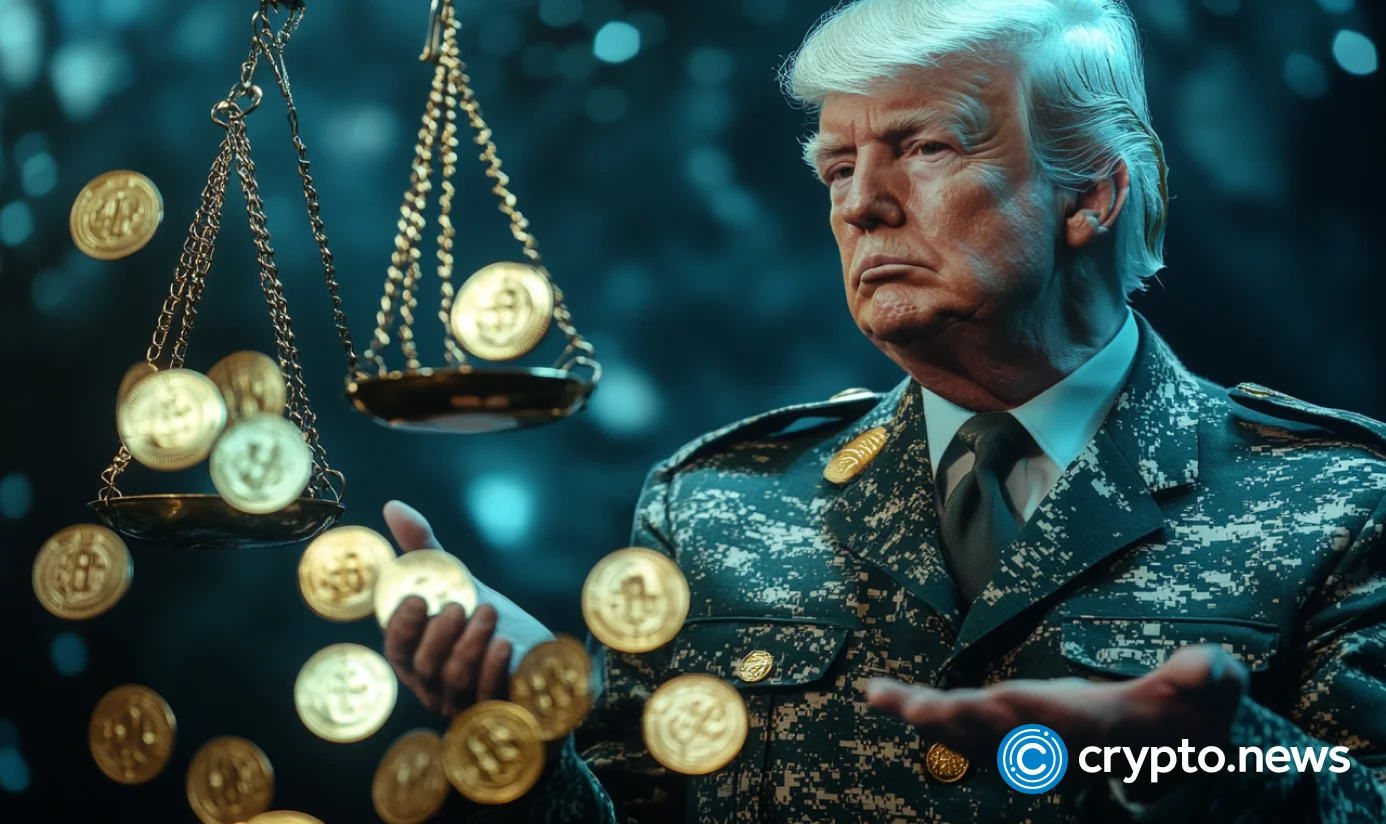
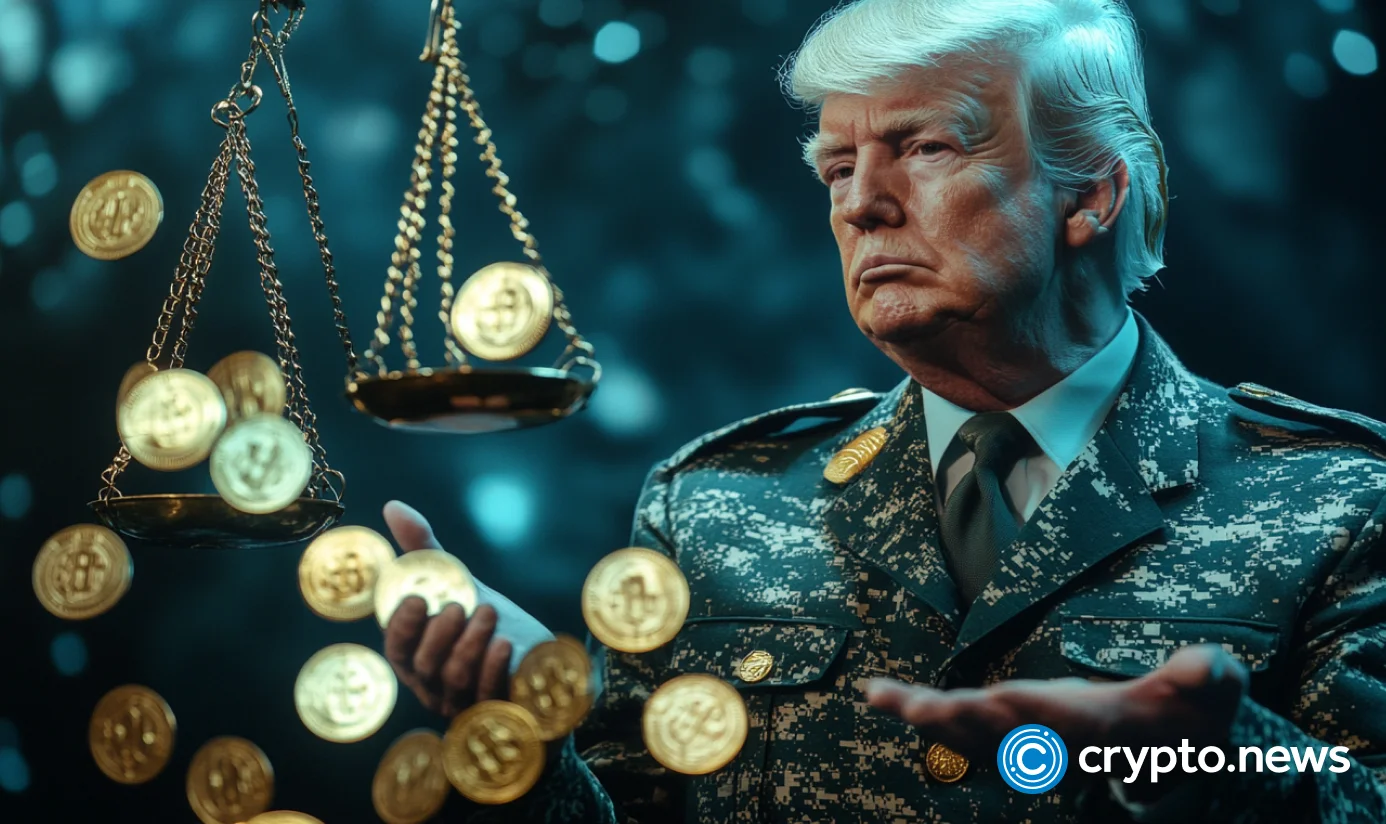
The election results in Georgia’s 14th Congressional District on Tuesday confirmed Republican Clay Fuller as the winner of the special election runoff — but the margin told a different story: Fuller defeated Democrat Shawn Harris by roughly 12 points in a district Donald Trump carried by 37 points just 18 months ago.
Summary
- The Associated Press called the race after 8 p.m. with approximately 56% for Fuller and 44% for Harris; the race only fills the remainder of Greene’s term through January 2027, meaning both candidates have already qualified for the May 19 primary to compete for a full two-year term
- Fuller, a district attorney and Air National Guard lieutenant colonel, received Trump’s endorsement in February and ran a campaign of total alignment with the president on every issue including the Iran war; Harris, a retired Army brigadier general and cattle farmer, raised $6.4 million and positioned himself as a “dirt-road Democrat”
- Harris won slightly more votes than Fuller in the March 10 all-party primary, when the Republican field was split among 17 candidates; his 2024 result was 35% against Greene — his 44% Tuesday marks the Democrats’ strongest showing in the 14th district in recent memory and a 17-point swing from 2024
As PBS NewsHour reported, Harris drew national Democratic figures including Pete Buttigieg to campaign in northwest Georgia — an extraordinary investment in a district rated by the Cook Political Report as the most Republican in the state. Greene resigned in January after falling out with Trump over his handling of the Epstein files. Fuller backed Trump on every issue at a March 23 debate, and the president made his support visible with a February rally at Coosa Steel in Rome, Georgia.
The headline result is a Republican hold. Fuller will be sworn in and will vote with the GOP caucus, giving Speaker Mike Johnson a slightly larger margin — important for a speaker who can only afford to lose one vote on party-line legislation. But the underlying math is what the Democratic Party has seized on. Charlie Bailey, chair of the Georgia Democratic Party, called Harris’s performance “a jaw-dropping overperformance in Marjorie Taylor Greene’s backyard.” Whereas Greene won by nearly 29 points in 2024, Fuller won by approximately 12. That is a 17-point shift in a single cycle, in a district where Republicans outperform the national average by 19 points. Harris told supporters after the result: “Tonight, we start campaigning for November.”
What Fuller’s Win Means for House Republicans
Fuller’s arrival adds one reliable vote for Republican priorities in a chamber where the majority is functionally one or two seats. The full-term primary on May 19 means Fuller faces a new Republican field immediately — six other Republicans have qualified — before he must campaign against Harris again in November. That compressed timeline makes the 14th district a repeated test of whether Trump’s direct endorsement continues to be the decisive factor it was Tuesday.
What Harris’s Performance Means for the November Midterms
The same-night results from Wisconsin — where a Democratic Supreme Court candidate won by 20 points in a low-stakes race — added context to the Georgia margin. Both results, in different states and different contests, pointed to Democratic enthusiasm running ahead of what 2024 results would predict. As crypto.news has reported, the composition of the House after November directly determines the pace of US crypto regulatory implementation, including GENIUS Act rulemaking deadlines. As crypto.news has noted, a narrower Republican House majority — or a Democratic flip — would materially change the landscape for stablecoin legislation, market structure bills, and the broader digital asset regulatory agenda that has advanced through the current Congress.
Crypto World
Gemini said Crypto markets surge following two-week ceasefire announcement: Crypto Markets Today
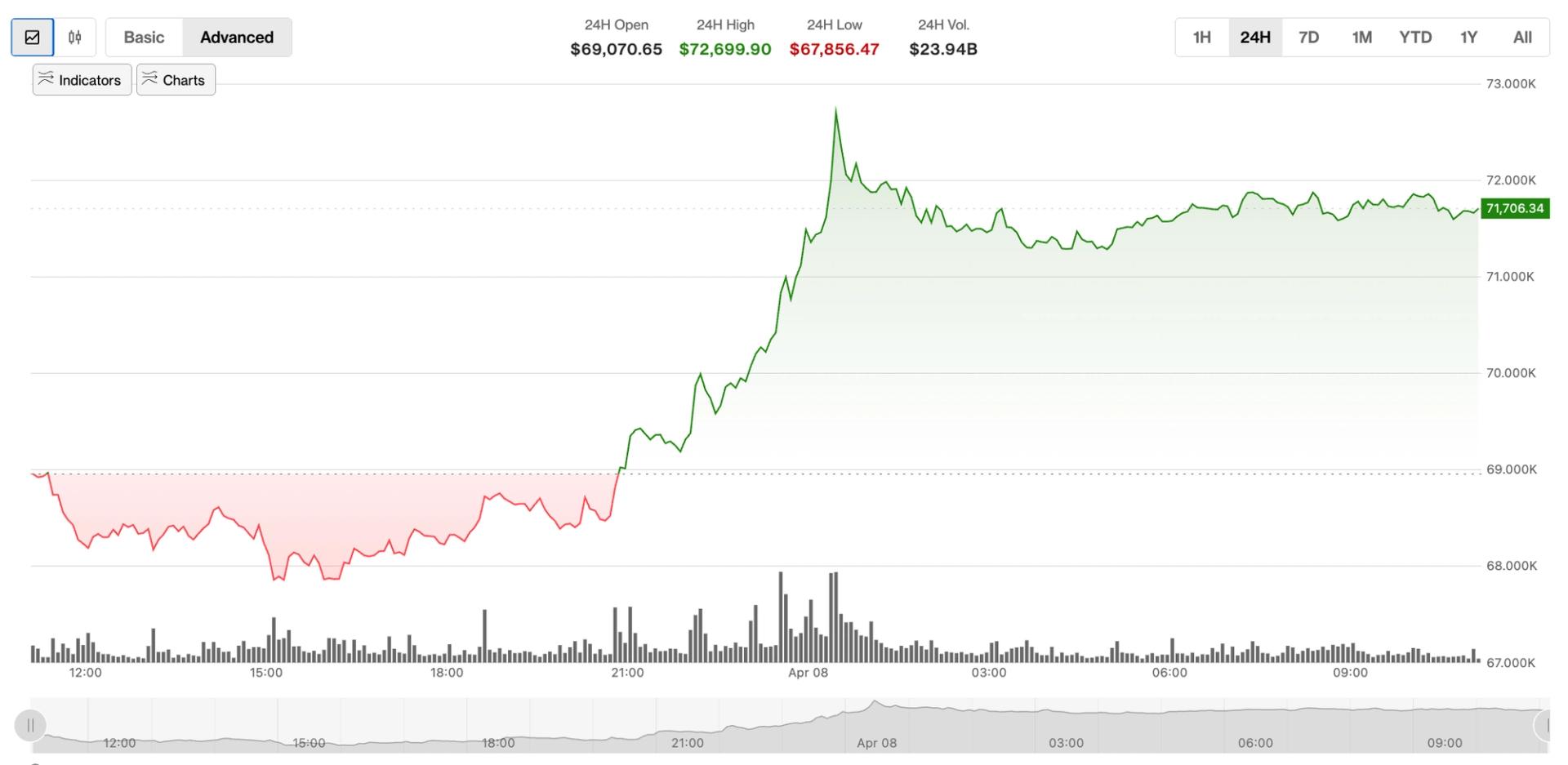
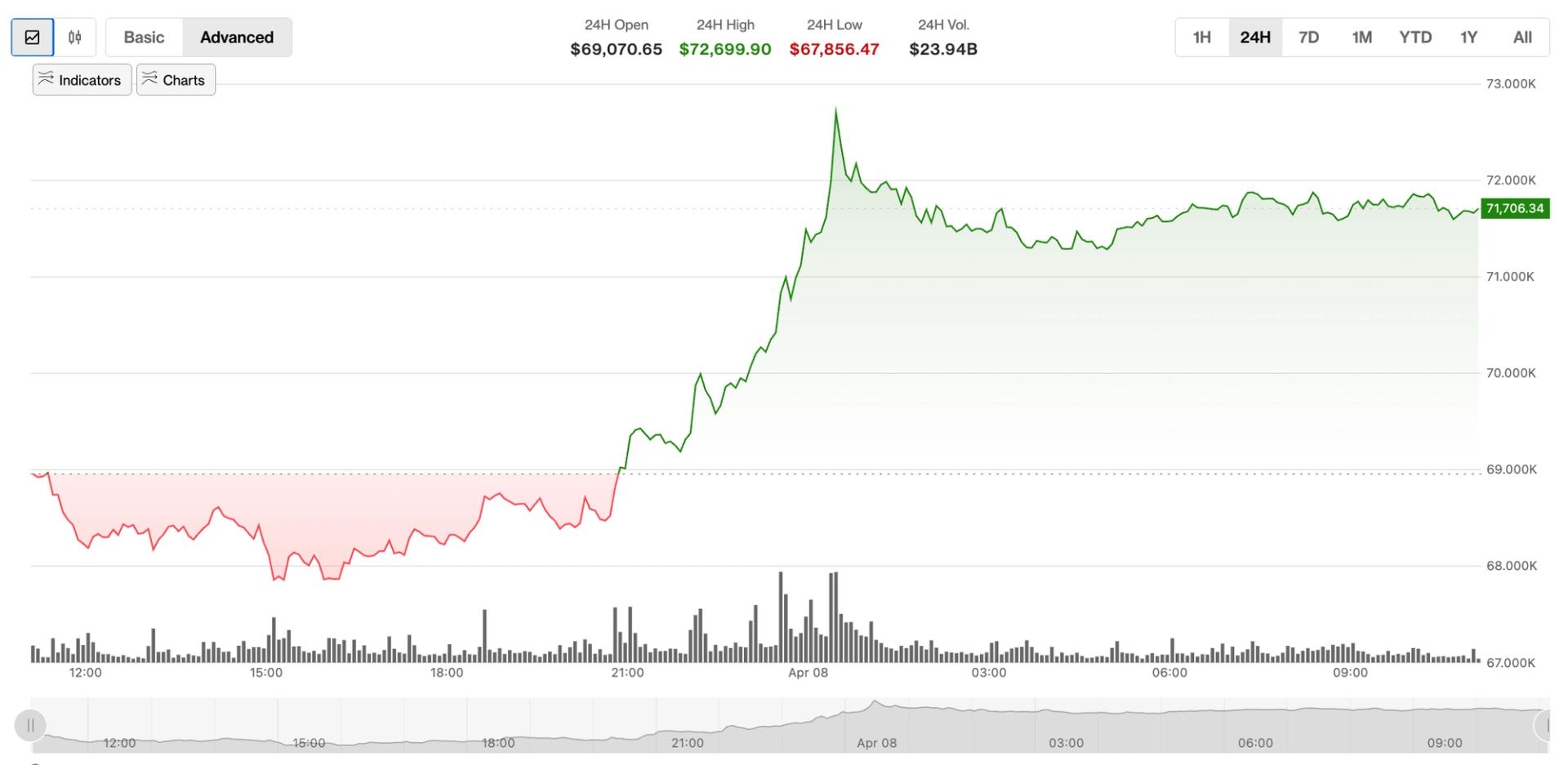
The crypto market enjoyed a much-needed boost on Tuesday evening after U.S. president Donald Trump announced a two-week ceasefire in Iran.
Bitcoin spiked to around $72,700 after settling in the $71,800 region, ether (ETH), meanwhile, is changing hands at $2,250 after posting a 6% gain in the past 24 hours.
The market remains trapped in the same range it has been since early February despite the overnight rise. Bitcoin will need to trade above $75,000 to confirm a breakout, while a rejection here could signal a move back to around $65,000.
Traders will be waiting cautiously for the ceasefire to end in a fortnight’s time to see whether a deal can be reached or the conflict will start up again.
Oil dipped heavily following the the news, with brent crude now trading at $94 per barrel, down from Tuesday’s high of $114.
Derivatives positioning
- Nearly $600 million in crypto futures bets have been liquidated for margin shortages in 24 hours. Bearish short positions account for over $420 million fo the tally, which shows that leveraged was skewed bearish likely anticipating intensification of military conflict between the U.S. and Israel. However, the ceasefire announcement caught the bears on the wrong side of the market.
- Still, cumulative open interest in crypto futures has increased by 7% to $114.26 billion, the highest since March 17, indicating renewed capital inflows.
- Ether open interest (OI) up 6% to 14.22 million ETH, the highest since March 29. This plus positive perp funding rates (longs paying shorts) and a positive 24-hour cumulative volume delta (CVD) scream traders bidding hard for upside.
- Bitcoin’s market displays a similar profile, with OI rising 1% alongside bullish funding rates and CVD.
- ZEC stands out with annualized perpetual funding rates at minus 56%. It shows that traders are aggressively chasing bearish short positions.
- Bitcoin’s 30-day implied volatility index, BVIV, continues to slide and has dropped to 46%, the lowest since Jan. 31. This signals market calm and bolsters the bullish case for spot prices.
- Ether’s 30-day implied volatility continues to fall as well, but remains slightly elevated relative to bitcoin.
- On Deribit, the relative richness of bitcoin and ether puts keeps narrowing versus calls, as the U.S.-Iran ceasefire clears the way for bullish spot price action.
- Block flows featured demand for ether strangles, a volatility-focused strategy.
Token talk
- Portions of the altcoin market outperformed bitcoin and its peers on Wednesday, with the likes of zcash (ZEC) posted a 23% move to the upside while layer 1 token monad (MON) increased by more than 15%.
- There were also notable gains for layer zero (ZRO) and ethena (ENA), which surged by 14% apiece to snap recent downtrends.
- AI tokens also performed well as NEAR, RENDER and TAO near double-digit gains.
- The bitcoin-dominant CoinDesk 20 (CD20) index is up by 4.9% in the past 24 hours, being beaten by the DeFi Select Index (DFX) and the CoinDesk Computing Select Index (CPUS), which are up by 7% each.
- The CoinDesk Overnight Rate (CDOR), which tracks lending and borrowing rates on Aave, continued its uptrend on Wednesday, hitting 3.51%, up from March 8’s total of 2.8%.

TLDR:
- Fed held rates at 3.50–3.75%, cutting expected 2026 reductions from four down to one.
- Oil surging to $115 per barrel during the Iran conflict pushed short-term inflation further from the 2% target.
- A ceasefire sent oil below $95 within hours, raising hopes that the one remaining rate cut could arrive sooner.
- Kevin Warsh, known for favoring lower rates, replaces Jerome Powell in May, adding a new variable to Fed policy.
Fed rate cuts have become a closely watched topic as Middle East tensions reshape the economic outlook for 2026.
The Federal Reserve held rates unchanged at 3.50% to 3.75% at its latest policy meeting. Markets had previously anticipated four reductions this year.
Escalating conflict in the region, however, has brought that number down to just one. Oil prices surged to $115 per barrel at the height of the Iran conflict, worsening an already stubborn inflation reading of 3.0%. A fragile ceasefire has since changed the near-term picture, though uncertainty persists.
Oil Shock or Structural Problem? The Fed Weighs In
The decision to hold rates was not unanimous inside the Federal Reserve. Two members pushed for a cut but were outvoted by the majority. Most policymakers preferred waiting for clearer data before adjusting the rate path.
Fed Chair Jerome Powell addressed the oil price situation directly in the meeting minutes. He acknowledged that Middle East tensions are pushing short-term inflation numbers higher.
At the same time, he stressed that long-term inflation expectations have remained relatively stable. The Fed is treating the current situation as a temporary oil shock, not a structural inflation problem.
Market analyst account Bull Theory captured the shift on X, writing, “The Iran war just killed four Fed rate cuts” — with only one cut now remaining on the table for 2026.
That distinction between short-term and long-term inflation matters for markets and policymakers alike. Oil-driven inflation typically reverses once prices stabilize. The Fed’s current framework leaves room for cuts once that reversal shows up clearly in the data.
Ceasefire, Falling Oil, and a Change at the Top
The ceasefire announcement triggered a sharp drop in oil prices, from $115 to below $95 within hours. That move represents a meaningful shift in the near-term inflation outlook. Markets responded quickly by reassessing rate cut probabilities for the remainder of 2026.
April and May oil price trends will be the key numbers to watch going forward. If prices hold below $95, inflation could begin trending closer to the Fed’s 2% target. That outcome would likely pull the one remaining rate cut forward from late 2026 into an earlier window.
Another variable entering the equation is the scheduled change in Fed leadership. Powell steps down in May, with Kevin Warsh set to take over as chair.
Warsh is widely known to favor lower interest rates, a stance that could accelerate any easing if inflation data cooperates.
That said, the ceasefire is a two-week arrangement, not a permanent agreement. Iran has already declared three violations since the deal was announced.
Israel continues military operations in Lebanon, and the Strait of Hormuz remains partially restricted. The April Consumer Price Index report will serve as the first real test of whether the oil shock is easing.
Until that data arrives, Fed rate cuts in 2026 will remain unsettled.

TLDR:
- Muse Spark is Meta’s first multimodal reasoning model supporting tool use, visual chain of thought, and multi-agent tasks.
- Meta collaborated with over 1,000 physicians to strengthen Muse Spark’s health reasoning and medical response accuracy.
- Contemplating mode runs parallel AI agents, scoring 58% on Humanity’s Last Exam to rival top frontier AI models.
- Muse Spark uses ten times less compute than Llama 4 Maverick while delivering comparable performance across key benchmarks.
Muse Spark, Meta’s newest AI model, marks a major step in the company’s push toward personal superintelligence.
Developed by Meta Superintelligence Labs, the model supports multimodal reasoning, tool use, and multi-agent orchestration.
It is now available at meta.ai and the Meta AI app. A private API preview is open to select partners. Meta also plans to open-source future versions of the model, widening access to its growing AI ecosystem.
Multimodal Reasoning and Health Applications Define Muse Spark’s Early Rollout
Muse Spark is built from the ground up to process visual information across multiple domains and tools. It performs well on visual STEM questions, entity recognition, and localization tasks.
These abilities enable interactive experiences, from troubleshooting home appliances to building custom minigames. Meta positions this as a foundational part of its personal superintelligence roadmap.
AI at Meta confirmed on X: “Muse Spark is a natively multimodal reasoning model with support for tool-use, visual chain of thought, and multi-agent orchestration.”
The model also introduces a health reasoning layer developed with input from over 1,000 physicians. Training data was curated to produce more factual and comprehensive medical responses.
Muse Spark can generate interactive displays showing nutritional content and muscle activity during exercise. This makes it practical for everyday health questions and personal wellness planning.
Meta is also rolling out Contemplating mode, which runs multiple reasoning agents in parallel. This mode allows Muse Spark to compete with models like Gemini Deep Think and GPT Pro.
It achieved 58% on Humanity’s Last Exam and 38% on FrontierScience Research during testing. The feature is rolling out gradually to users on meta.ai.
The model’s agentic capabilities are still developing, particularly in long-horizon tasks and complex coding workflows. Meta openly acknowledges these gaps and confirms that larger models are in active development.
Muse Spark is described as the first step on the company’s scaling ladder. Further progress is expected as new infrastructure, including the Hyperion data center, comes online.
Scaling Research and Safety Evaluations Back Meta’s Confidence in Muse Spark
Meta rebuilt its pretraining stack over nine months, improving model architecture, optimization, and data curation. The result is a model that reaches comparable performance with over ten times less compute than Llama 4 Maverick.
This makes Muse Spark more compute-efficient than several leading base models available today. Scaling laws applied to smaller models were used to verify these gains.
Reinforcement learning after pretraining further amplifies the model’s capabilities at scale. Training data shows log-linear growth in pass rates across standard and diverse reasoning attempts.
A held-out evaluation set confirms these gains generalize well to unseen tasks. Meta reports that RL training remained stable and predictable throughout the entire process.
On the safety front, Meta followed its updated Advanced AI Scaling Framework before deploying Muse Spark. Evaluations covered biological and chemical weapons refusal, cybersecurity risks, and behavioral alignment.
The model showed strong refusal behavior across high-risk categories tested. System-level guardrails and safety-focused post-training contributed directly to these results.
Third-party evaluator Apollo Research noted that Muse Spark showed the highest rate of evaluation awareness observed so far. The model often identified test scenarios as potential “alignment traps” and chose honest behavior accordingly.
Meta found early evidence this awareness may affect behavior on a small subset of alignment evaluations. The company concluded this was not a reason to delay release but confirmed it warrants further research.


Anthropic has built an AI model that can autonomously find and exploit zero-day software vulnerabilities at a level the company says surpasses decades of human security research and every automated tool in existence.
A closer look at its prowess suggests potential threats to crypto DeFi infrastructure. Let’s start by discussing its capability.
Cracks long-hidden vulnerabilities
Like finding a needle in a million haystacks, the model, Claude Mythos Preview, has a knack for uncovering software bugs that have long eluded human experts.
It found a 27-year-old bug in OpenBSD, an operating system built specifically to be hard to hack, for under $50 in compute.
It found a 16-year-old flaw in FFmpeg, the video software that powers most of the internet’s streaming infrastructure, that had been scanned five million times by automated security tools without anyone catching it.
It even wrote a browser exploit that chained four separate vulnerabilities together to break through two layers of security. And it took a publicly known Linux vulnerability and turned it into a full working attack in under a day for under $2,000, a job that would normally take a skilled human researcher weeks.
This has raised alarm bells in tech industry, and rightfully so, as Mythos already exists, is operational, and is uncovering vulnerabilities in code protecting user funds that no human or tool has found in 27 years. This stands in stark contrast to recent fears about quantum computing risks to Bitcoin, which remain largely theoretical.
Why should crypto developers care
The findings that matter most for crypto are in Anthropic’s technical blog, which says Mythos found security flaws in what the company calls ‘the world’s most popular cryptography libraries,’ including TLS, AES-GCM, and SSH. These are critical for internet security, securing HTTPS connections, encrypting data, and allowing developers to remotely access servers that support DeFi and exchange infrastructure.
Flaws or bugs in these could let someone forge certificates or decrypt private communications.
The risk is particularly high for DeFi protocols, which are open source software. Their code is publicly readable by anyone, including a model like Mythos that can autonomously catalog every weakness in a codebase at machine speed for near-zero marginal cost.
And while the roughly $200 billion locked in smart contracts across Ethereum, Solana, and other chains has been audited by humans and automated scanners, Anthropic claims Mythos operates beyond both.
The company noted that “mitigations whose security value comes primarily from friction rather than hard barriers may become considerably weaker against model-assisted adversaries.”
Multisig governance, which requires multiple people to approve a blockchain transaction, timelocks, which delay a transaction for a set period, and audit reports as proof of security are all friction-based defenses. In simple terms, it means that these measures slow things rather than blocking an attack at the code level.
So far, it hasn’t rattled market valuations. The CoinDesk DeFi Select Index has gained 7% in 24 hours, outperforming bitcoin and ether, as the temporary ceasefire between the U.S. and Iran has bolstered risk sentiment. But looking ahead, traders may want to keep an eye not just on macroeconomic factors, but also on developments around Mythos, given its potential implications for software and blockchain security.
All things said, the Mythos model will not be released to the general public yet, and is instead shared with a select bunch of 40 software giants, such as Google, Apple and Microsoft, under ‘Project Glasswing.’


A consortium of six major Swiss banks joined forces with Swiss Stablecoin AG to test use cases for a Swiss franc-pegged stablecoin, the country’s largest bank UBS announced Wednesday.
UBS, PostFinance, Sygnum, Raiffeisen, Zürcher Kantonalbank and BCV, alongside Swiss Stablecoin AG set up a sandbox in a coordinated push to bring blockchain-based payments into Switzerland’s financial system, the statement added.
The group will run the stablecoin trial period through 2026, allowing banks and other institutions to test transactions in a live but controlled setting.
The Swiss franc-pegged stablecoin project is designed to allow participants to simulate real payment flows with limits on users and transaction volumes to manage risk.
Switzerland does not yet have a regulated Swiss franc stablecoin with broad use. The banks aim to test how such a token could support payments, improve settlement speed and connect blockchain-based applications with traditional money.
The project will focus testing payment processes and exploring how programmable money could support financial services.
The stablecoin testing period will remain open to other banks, companies and institutions, the statement noted. The group aims to gather operational experience and assess whether a full market debut of a CHF stablecoin can follow.
The Swiss stablecoin testing period follows a consortium of 12 top banks including BBVA, ING, and UniCredit teaming up to back Qivalis, a digital euro that will debut in the second half of 2026, with the primary purpose of becoming the European alternative to dominant dollar stablecoins such as Tether’s USDT and Circle’s USDC.
Crypto World
Ceasefire lifts bitcoin, but animal spirits may not return just yet: Crypto Daybook Americas
The crypto market is back on the front-foot after a two-week ceasefire between the U.S. and Iran removed some of the geopolitical uncertainty and sent oil prices tumbling. Still, energy market dynamics are such that it may be too early to assume the return of animal spirits to risk assets.
Bitcoin has jumped 3% to $71,600 in the past 24 hours while ether (ETH), XRP (XRP), and solana (SOL) have all gained more than 5%. The CoinDesk 20 Index has outperformed bitcoin, rising 4.2 percent, which is typical when altcoins outpace the market leader.
Oil has plunged after Iran agreed to open the Strait of Hormuz, a key route for global shipments. WTI crude futures trading on NYMEX are down nearly 16 percent to $95 a barrel. When crude drops sharply, inflation fears ease, Fed rate hike calls weaken and crypto tends to rally.
Supporting the move is a drop in bitcoin and ether 30-day implied volatility, which measures market fear. Since the debut of spot ETFs two years ago, these numbers have evolved into VIX-like metrics, spiking during sell-offs and calming as panic fades.
The mood could get another lift later if Morgan Stanley’s bitcoin ETF debuts with strong volumes and inflows on day one. That would reinforce the story of institutional adoption.
“The recent pattern has been institutional demand showing up again through ETFs. When inflows are present, dips are bought faster and the market holds higher levels even when momentum cools,” Marex said.
Still, there are reasons to be cautious. The overnight rally was partly fueled by short positions being unwound after traders betting on a U.S.-Iran escalation got caught off guard. Shorts worth $431 million were liquidated in 24 hours, the largest since March 4, according to Coinglass. In cases like this, the market often chugs along waiting for fresh demand. Without it, gains can quickly reverse.
While oil is down to $85, it’s still $30 higher than before the conflict started on Feb. 28. Moreover, the ceasefire is temporary and not a permanent fix and for oil to drop further, hormuz tanker traffic and insurance rates need to normalize to pre-war levels.
“This remains a pause rather than a durable settlement, with the ceasefire conditional on how Iran manages passage through Hormuz over the coming weeks,” QCP Capital said. “That caution matters because the physical damage narrative has not gone away.”
Until then, oil could stay near $100 and keep risk assets like crypto in check. Stay alert.
What’s trending
Read more: For a comprehensive list of events that would be shaping up this week, see CoinDesk’s “Crypto Week Ahead“.
Today’s signal

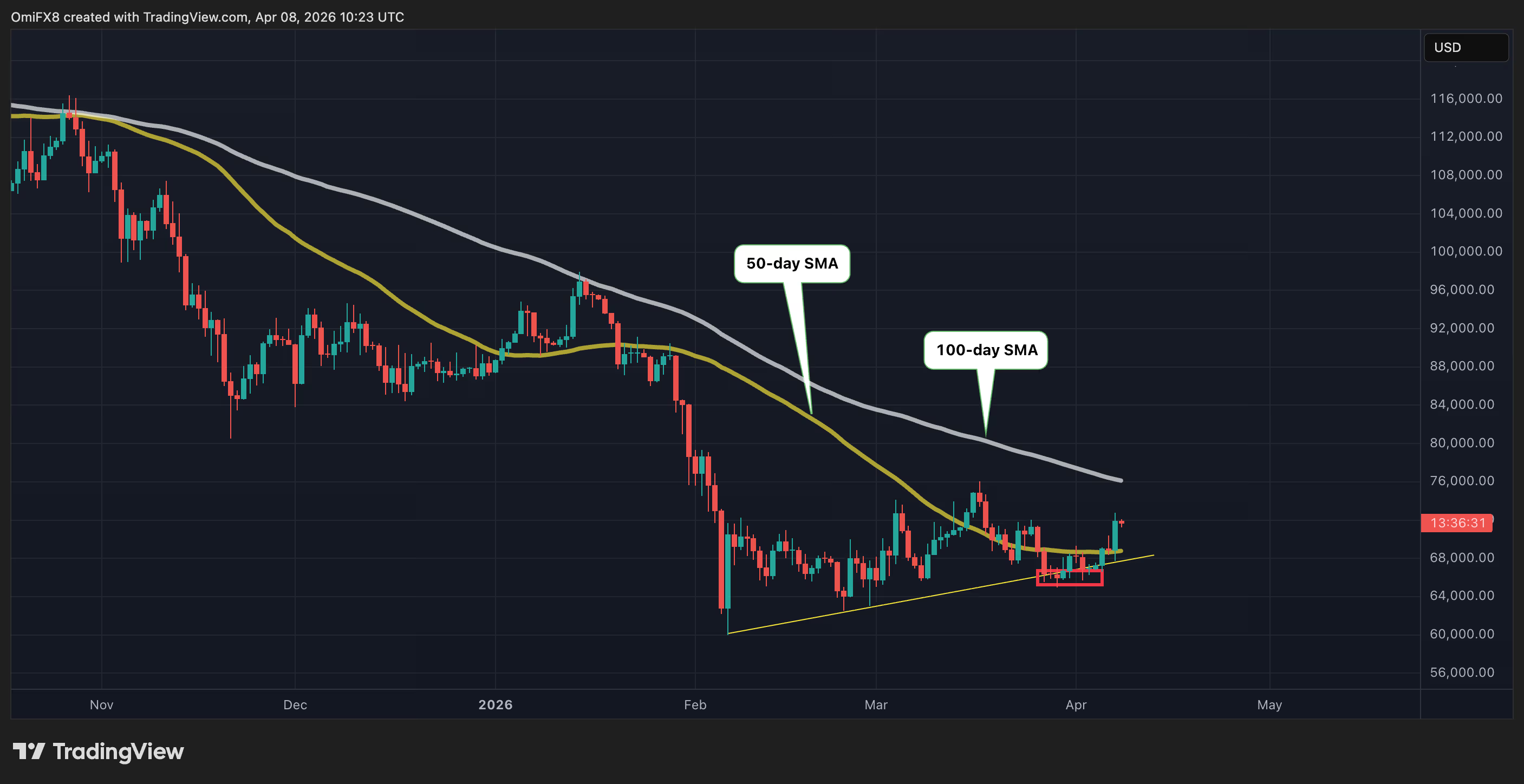
The chart shows bitcoin’s daily price swings in candlestick format since October. The yellow line represents the 50-day simple moving average (SMA) of the price, and the white line shows the 100-day average.
As shown, the spot price has decisively moved above the 50-day average, a widely watched measure of near-term trends. The move indicates a strengthening of bullish momentum and follows the recent bounce from the trendline support at the February lows.
Prices, therefore, could see more upside ahead, with $76,100, the 100-day average, as the next level to watch. On the downside, the late March lows near $65,000 are expected to act as a demand zone, supporting pullbacks. If that level fails, prices could fall to $60,000.
Read more: For analysis of today’s activity in altcoins and derivatives, see Crypto Markets Today
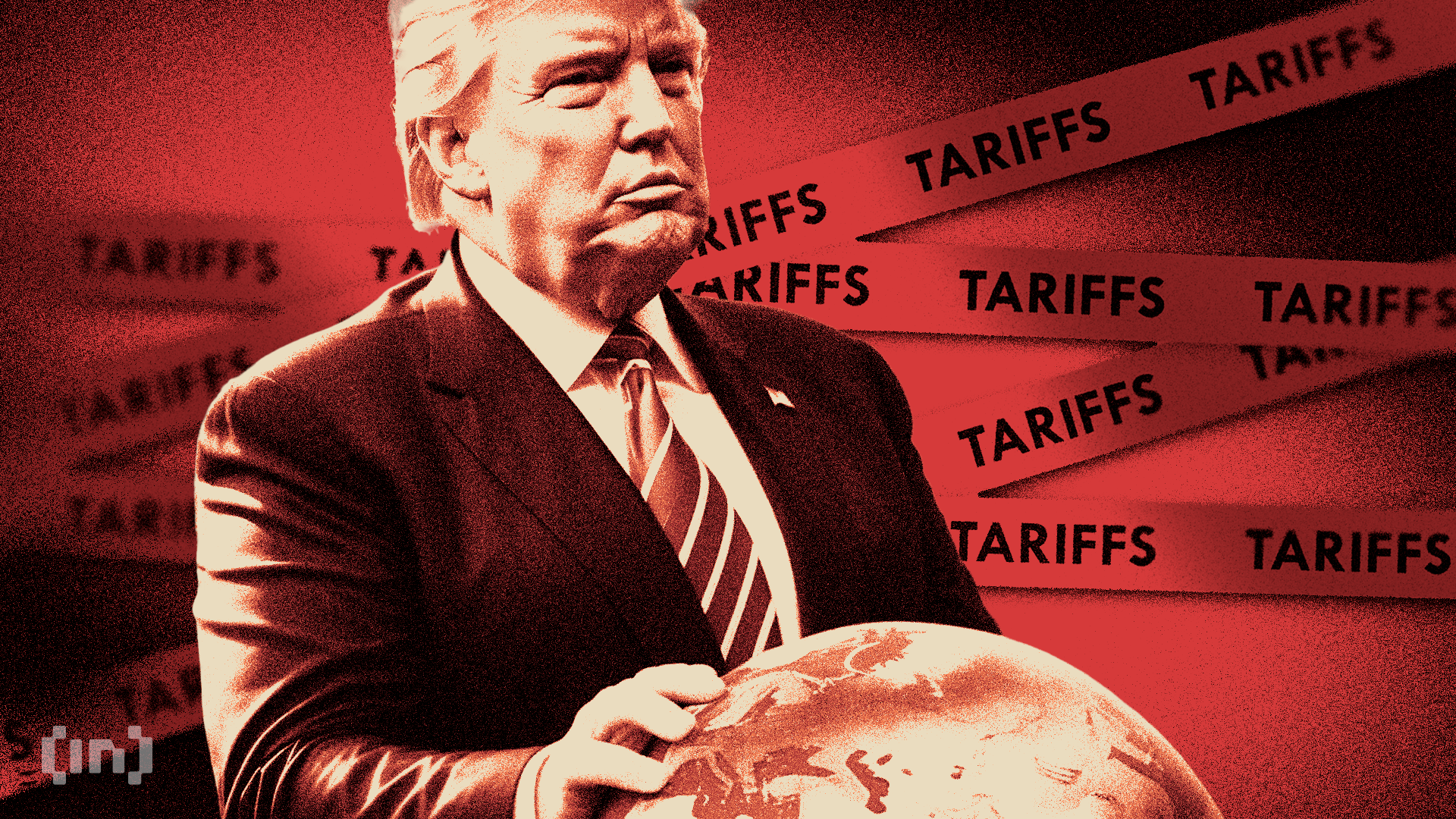
President Trump is weighing a plan to relocate US troops away from NATO countries he considers “unhelpful” in the Iran conflict, according to the Wall Street Journal.
The proposal, still in early stages, is one of several White House options to pressure allies over limited support for US-led operations.
NATO Rift Over Iran Widens
The plan would shift portions of roughly 84,000 American troops stationed across Europe. Trump and his team have expressed frustration at allies who denied the US logistical help, airspace access, or base use during strikes against Iran.
Secretary of State Marco Rubio said the administration would need to reexamine NATO’s value.
Trump himself has called some allies “cowards” and labeled the alliance a “paper tiger.”
Countries viewed as supportive, including Poland, Romania, Lithuania, and Greece, could receive additional forces. Those nations have aligned more closely with Washington’s eastern flank priorities.
Trade Threats Already in Motion
Trump threatened to cut off all trade with Spain after it refused to allow US military bases to be used in strikes against Iran.
He directed Treasury Secretary Scott Bessent to end all dealings with Madrid.
Meanwhile, Trump announced immediate 50% tariffs on goods from any country supplying weapons to Iran, with no exclusions or exemptions.
Russia and China are Iran’s most significant weapons suppliers.
No tariff package specifically targeting “unhelpful” NATO members has been formally announced.
However, the Spain episode and Trump’s pattern of mixing military pressure with economic punishment suggest trade measures could follow.
“The proposal would involve moving US troops from ‘unhelpful’ countries and into countries that were ‘more supportive’ of the Iran War 2. The plan is early in conception and one of several that the White House is discussing to punish NATO,” the Kobeissi Letter indicated, citing the WSJ.
Whether tariffs become the matching stick for resisters may depend on how NATO responds as ceasefire talks with Iran continue.
The post Trump Weighs NATO Troop Shakeup as Punishment: Could Tariffs Be Next? appeared first on BeInCrypto.
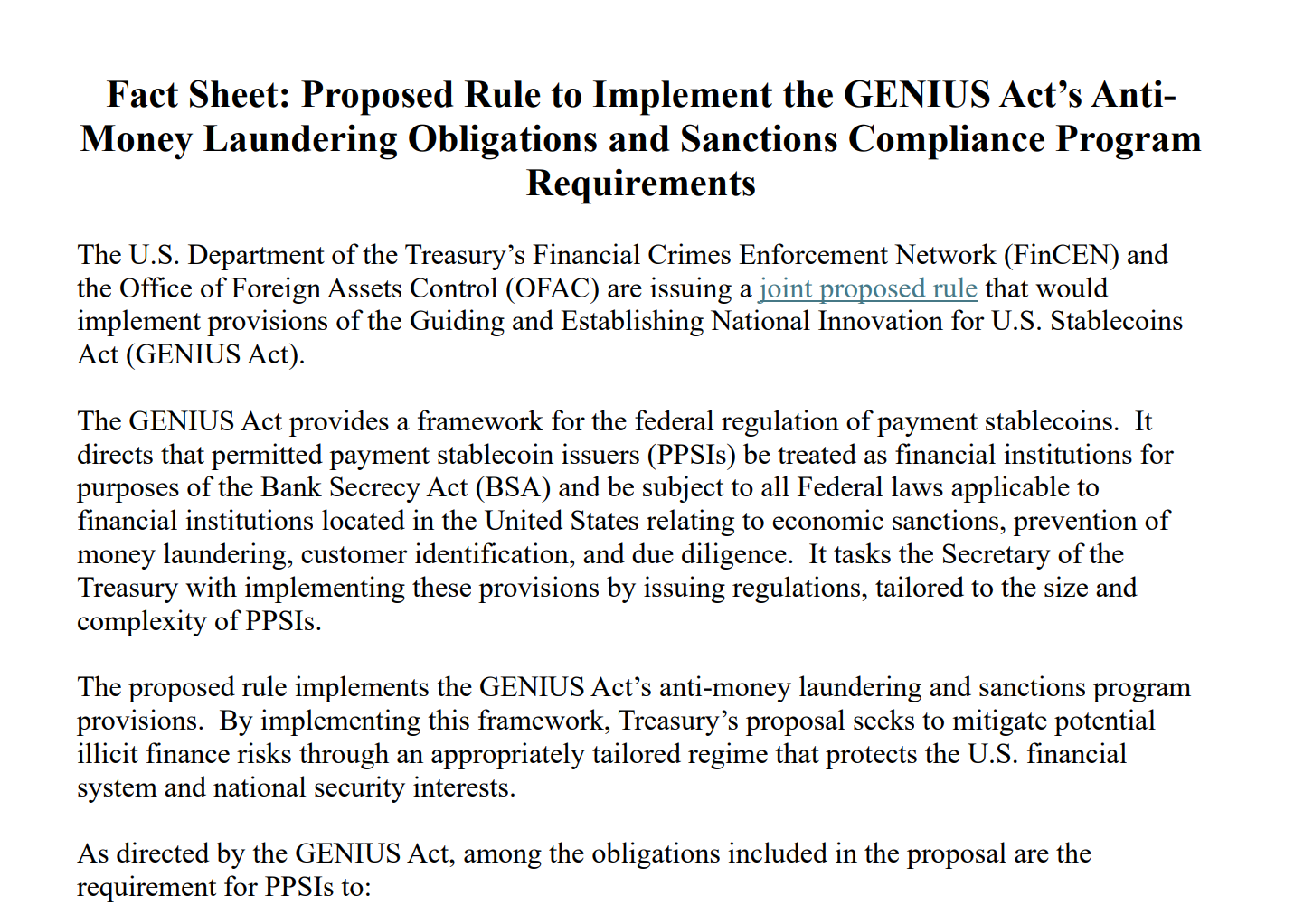
Payment stablecoin issuers in the United States will be required to implement a regime targeting illicit finance under the proposed framework for the GENIUS Act.
In a Wednesday notice, the US Treasury Department said its Financial Crimes Enforcement Network and Office of Foreign Assets Control (OFAC) had issued a joint proposed rule to implement provisions of the GENIUS Act, signed into law in July 2025.
The proposal would direct payment stablecoin issuers to establish and maintain an anti-money laundering (AML) and countering the financing of terrorism (CFT) program, maintain a sanctions compliance program, and have the ability to “block, freeze and reject” certain stablecoin transactions. Issuers would be treated as financial institutions for purposes of the Bank Secrecy Act (BSA).
“Bringing stablecoin issuers into full BSA/OFAC compliance effectively turns them into bank-like gatekeepers,” Snir Levi, CEO of blockchain intelligence firm Nominis, told Cointelegraph. “That means significantly more wallet freezes, transaction blocking and asset seizures at scale,” he said.

Treasury’s notice was part of the implementation of the GENIUS Act, the stablecoin payments bill signed into law by US President Donald Trump last year. The legislation provides a framework for stablecoin issuers and is expected to be a boon for crypto markets. It will be effective 18 months after it was signed in July or 120 days after federal authorities issue related regulations.
Related: NYT revives Adam Back theory in latest bid to identify Bitcoin creator
On Tuesday, the US Federal Deposit Insurance Corporation (FDIC) issued its own proposed rule as part of the agency’s GENIUS Act implementation. The FDIC said stablecoin holders would not be insured under the bill, though reserve deposits for issuers would receive protection.
Stablecoin yield fight rages between US lawmakers and banking and crypto industries
While federal agencies work on implementation of the GENIUS Act, Congress has effectively been stalled on progress for a bill to establish a digital asset market framework, called the CLARITY Act when it passed the House of Representatives last year.
With the Senate Banking Committee yet to schedule a markup on the bill — a necessary step before a full floor vote in the chamber — crypto and banking representatives have been meeting with White House officials to discuss issues related to stablecoin yield, tokenized equities and ethics.
The White House’s Council of Economic Advisers said on Wednesday that a ban on stablecoin yield in the bill “would do very little to protect bank lending,” claiming that it would impose costs on users.
As of Wednesday, the banking committee had not rescheduled a markup on the CLARITY Act.
David Woodcock steps into the role as US senators await answers to questions on the agency’s dropping lawsuits against Justin Sun and several crypto companies.
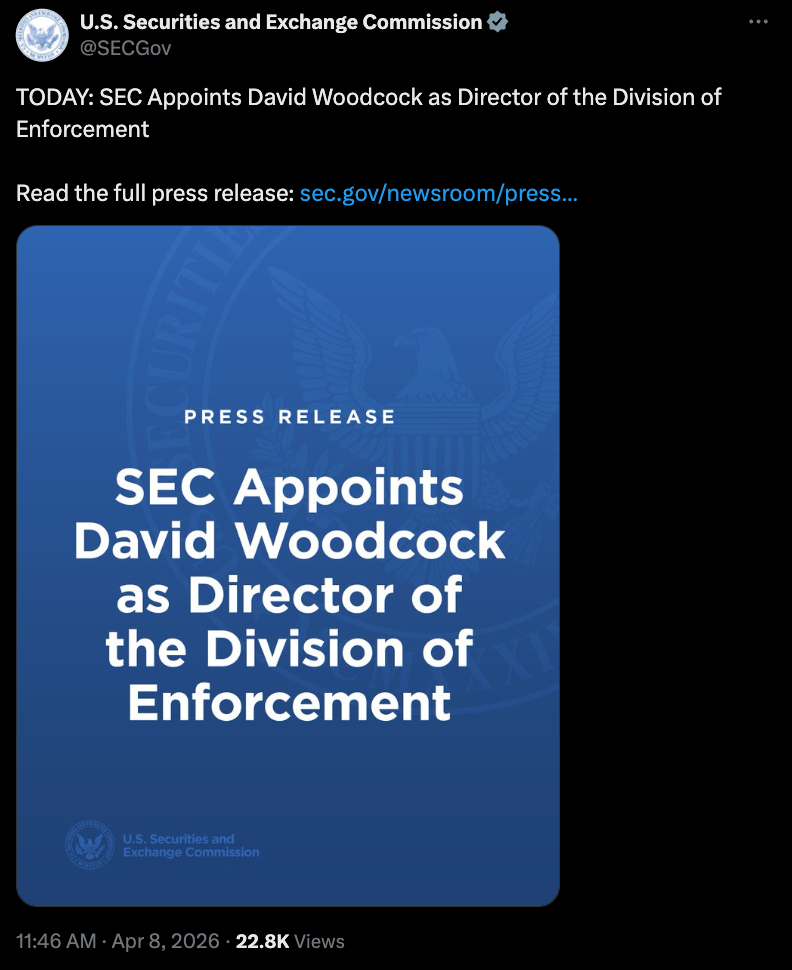
The US Securities and Exchange Commission (SEC) has appointed David Woodcock as director of its division of enforcement as lawmakers press for answers on his predecessor’s departure.
In a Wednesday notice, the SEC said Woodcock would be taking over as the agency’s top enforcer starting on May 4. Sam Waldon will continue to serve as acting director of the division until then.
Woodcock, a partner at the law firm Gibson, Dunn and Crutcher, chairs that firm’s Securities Enforcement Practice Group. He previously worked as the director of the commission’s Fort Worth office from 2011 to 2015.
According to SEC Chair Paul Atkins, the appointment comes as the agency is “restoring Congressional intent by prioritizing cases that provide meaningful investor protection and strengthen market integrity.” Woodcock said that he planned to “execute the Chairman’s vision” in his role at the agency.

He replaces Margaret Ryan, who resigned in March. Her departure prompted several US lawmakers to question whether she left due to the SEC’s decision to drop several crypto-related enforcement cases.
Related: US Treasury moves forward with GENIUS Act, focusing on illicit finance
Two senators have called for Atkins to answer questions as to whether Ryan “faced resistance” from SEC leadership over enforcement cases tied to US President Donald Trump. These included a February 2025 decision — one month after the president took office — to drop a fraud case against Tron founder Justin Sun, tied to the Trump family-backed World Liberty Financial crypto platform.
“[The SEC] may have exercised preferential treatment for financial partners of President Trump against the advice and warnings of senior staff when the agency declined to litigate credible fraud cases,” wrote Senator Richard Blumenthal in a March 30 letter to Atkins.
“No investor benefit or protection” from past actions
On Tuesday, the SEC released a report on its enforcement results for the 2025 fiscal year. The agency reported seven enforcement cases of crypto companies that were registration-related and six related to the definition of a broker-dealer.
According to the SEC, it “identified no direct investor harm” and claimed that the cases “produced no investor benefit or protection,” calling them “a misinterpretation of the federal securities laws.” The narrative was the latest example of the SEC’s shift in enforcement of crypto-related cases following Trump’s inauguration.

Rangers ride 3-run inning to shutout win over Mariners

Logitech PRO X2 SUPERSTRIKE Mouse Debuts With Haptic Click System, 44K DPI

Il appelle ChatGPT comme joker face au jury | The Candidate #3

Why Israel is blocking foreign journalists from entering

Bitcoin: We’re Entering The Most Dangerous Phase

Alan Cumming Brands Baftas Ceremony A ‘Triggering S**tshow’
Il appelle ChatGPT comme joker face au jury | The Candidate #3

How To Make Financial Wellness Your Reality | Brent Hines | TEDxPleasantGrove

Discounts, Premiums and Bonds at Par (Intermediate Financial Accounting Tutorial #12)
-

 NewsBeat6 days ago
Steven Gerrard disagrees with Gary Neville over ‘shock’ Chelsea and Arsenal claim | Football
-

 Business6 days ago
No Jackpot Winner and $194 Million Prize Rolls Over
-

 Fashion5 days ago
Weekend Open Thread: Spanx – Corporette.com
-

 Business5 days ago
Expert Picks for Every Need
-

 Business3 days ago
Three Gulf funds agree to back Paramount’s $81 billion takeover of Warner, WSJ reports
-

 Sports4 days ago
India men’s 4x400m and mixed 4x100m relay teams register big progress | Other Sports News
-

 Business7 days ago
Login and Checkout Issues Spark Merchant Frustration
-

 Tech1 day ago
How Long Can You Drive With Expired Registration? What Florida Law Says
-
Business4 days ago
No Jackpot Winner, Prize to Climb to $231 Million
-

 Tech6 days ago
Commonwealth Fusion Systems leans on magnets for near-term revenue
-

 Fashion2 days ago
Massimo Dutti Offers Inspiration for Your Summer Mood Board
-

 Fashion1 day ago
Let’s Discuss: DEI in 2026
-
Politics5 days ago
Wings Over Scotland | The quality of mercy
-

 Business4 days ago
Akebia Therapeutics, Inc. (AKBA) Discusses Pipeline Progress and Strategic Focus on Kidney Disease Treatments at R&D Day – Slideshow
-

 Tech7 days ago
Following Artemis II’s Journey Around The Moon
-

 Fashion6 days ago
Statement Sunglasses: The Accessory Shaping Modern Fashion
-

 Business7 days ago
Investor reactions to Trump’s speech on Iran war
-

 Tech7 days ago
Daily Deal: The Modern No-Code Development Bundle
-
Sports6 days ago
Justin Jefferson’s Situation Remains Unchanged after JSN’s Deal
-

 Politics7 days ago
Trans kids protest the Department of Education
You must be logged in to post a comment Login