

Crypto World
What is an ancillary asset? The word deciding crypto’s fate



The merged CLARITY Act runs on one invented term: the ancillary asset, a token sold with a securities offering that is not itself a security. Here is where the concept came from, exactly how it works, why a16z tried to kill it, and what it means for every token you hold.
Summary
- An ancillary asset is the CLARITY framework’s central category: an intangible, commercially fungible asset, distributed in connection with the purchase and sale of a security through an investment-contract arrangement, that is not itself a security.
- The definitional cut is what the token does not give you: no debt or equity claim, no dividends or interest, no liquidation rights. A token conferring those rights is simply a security; a network token without them can be ancillary.
- The concept resolves crypto’s founding legal paradox, that a token sale can be a securities transaction while the token itself, trading later on secondary markets, functions as a commodity. The transaction gets securities treatment; the asset does not.
- Originators owe tailored disclosures while an asset’s value depends on their efforts, ending at maturity, and the merged Senate draft adds a clause deeming tokens that anchored a listed ETP on January 1, 2026 non-ancillary and non-securities outright.
- The category is contested at the root: Andreessen Horowitz publicly urged the Senate to scrap it, warning it creates a loophole-prone middle ground, which makes the term both the bill’s foundation and its most attacked idea.
Every regulatory regime ends up resting on one definition, and the definition is usually invented for the purpose. Securities law rests on the investment contract, four words from a 1946 orange-grove case that have governed a century of capital formation. Banking law rests on the deposit. The framework Congress is currently trying to pass for crypto rests on a term almost nobody outside a Senate office had used before 2022: the ancillary asset. It appears throughout the merged CLARITY Act draft now awaiting a floor vote, it decides which tokens escape the SEC and when, and its grandfather clause quietly settles the legal status of XRP, Solana, and Dogecoin by reference to their own ETFs. It is also, remarkably for a bill’s load-bearing concept, a term the industry’s most powerful venture firm formally asked the Senate to delete. Understanding the ancillary asset is understanding what American crypto law is about to become, and this guide builds the concept from the ground up: the paradox it solves, the mechanics it runs on, the fight over whether it should exist, and what it means practically for tokens and their holders.
The paradox the term was invented to solve
Start with the problem, because the ancillary asset is unintelligible without it.
American securities law asks one question of any fundraising arrangement: is it an investment contract, meaning an investment of money in a common enterprise with an expectation of profits from the efforts of others, the Howey test. Token sales usually are. A team raises money by selling tokens, buyers expect the team’s work to make the tokens valuable, and every element of Howey is satisfied; courts have said so repeatedly. The trouble begins one step later. The token itself, once issued, circulating on exchanges among strangers, is just an entry on a ledger. It carries no claim against the team, pays nothing, promises nothing. Is that object a security forever, because it was born in a securities transaction?
For a decade, American law had no stable answer, and the instability was the industry’s defining legal condition. The SEC’s enforcement-era position treated the token as inseparable from its offering, effectively a security in perpetuity; the industry argued tokens mature into commodities as networks decentralize; courts split, most famously in the Ripple litigation, where the same token was found to be sold as a security to institutions and as not-a-security on exchanges. The result was a classification that depended on the transaction, the buyer, and the judge, which is no classification at all.
The ancillary asset is the legislative answer, and its logic is surgical: separate the transaction from the thing. The fundraising arrangement, the investment contract, remains a security and gets securities treatment. The asset delivered through it, if it grants the buyer none of a security’s actual rights, is designated something else, ancillary to the securities transaction instead of the subject of it, with its own disclosure regime and its own path out of SEC jurisdiction entirely. One sale, two legal objects. The paradox does not get resolved so much as legislated into architecture.
The definition, clause by clause
The term’s formal definition has evolved across drafts, but its working structure has held stable since its first appearance, and each clause does specific work.
An ancillary asset is, first, an intangible, commercially fungible asset. Fungibility excludes NFTs and one-off instruments; intangibility excludes tokenized claims on physical things. It is, second, offered, sold, or otherwise distributed in connection with the purchase and sale of a security through an arrangement constituting an investment contract. This is the birth criterion: the category only exists downstream of a securities transaction, which is why the term is ancillary, the asset rides alongside the security rather than being one. Third, and decisively, the definition excludes any asset that provides the holder debt or equity interests, liquidation rights, interest or dividend payments, or other financial claims against the issuer. This is the functional test, and it is the clause that does the sorting: a token that pays you, or gives you a claim on a company’s assets or profits, is not ancillary, it is simply a security wearing a costume. A network token, useful for gas, staking, or access, conveying no claim against anyone, can qualify.
Around the definition, the framework builds three mechanisms. The first is disclosure: while an ancillary asset’s value depends on the entrepreneurial or managerial efforts of an originator, that originator owes periodic, tailored disclosures, a lighter, crypto-specific regime covering the network, the token’s economics, and insider holdings, with the SEC directed to issue guidance for shared-responsibility cases. The obligation is tied to dependence, not to time: it ends when the network matures past reliance on the originator, which connects the category to the bill’s maturity and self-certification machinery. The second is the capital-raising exemption: offerings of ancillary assets under a size cap, $75 million in the current architecture, can proceed on an offering statement covering the blockchain, source code, consensus mechanism, and insider positions, rather than full securities registration, which is the provision that would actually reopen compliant token fundraising in the United States. The third is the escape hatch that made January’s headlines: the merged draft deems a token non-ancillary, and not a security at all, if units of it were the principal asset of an exchange-traded product listed on a national securities exchange on January 1, 2026. Read against the ETF calendar, that clause statutorily classifies XRP, SOL, DOGE, and the rest of the late-2025 ETF class, no Howey analysis required. The SEC’s own product approvals became the legislature’s taxonomy.
One more mechanism deserves its place in the map before the criticism, because it shows the category working as a system, not just a definition: the interaction between ancillary status and trading venues. Under the framework’s architecture, an ancillary asset is not merely exempt from securities registration; it is affirmatively tradable on CFTC-registered digital commodity exchanges once the venue completes its own certification that the asset meets the statutory requirements, the listing-side counterpart to the issuer-side process. That two-key design, the asset’s status plus the venue’s certification, is what converts an abstract classification into an operating market: an exchange can read the definition, document its analysis, list the asset, and carry regulatory responsibility for the judgment, which is precisely the risk allocation exchanges have operated under in derivatives for decades and have never had for spot crypto. It also explains a quiet commercial consequence the classification debates skip: under the framework, listing decisions, which today are exercises in enforcement-risk management conducted by legal departments reading tea leaves, become documented compliance judgments with statutory criteria, faster, cheaper, and portable across venues. The years when an American exchange’s listing of a mid-cap token was itself legal news would end, not because scrutiny disappears, but because the scrutiny acquires a text.
The case against the category
The ancillary asset’s most important critic is not a consumer advocate. It is Andreessen Horowitz, the venture firm with more capital deployed in crypto than almost any institution on earth, and its formal letter to the Senate Banking Committee is the sharpest statement of the case that the bill’s foundation is a mistake.
The firm’s argument runs in three steps. First, incoherence: the category defines a class of assets that are simultaneously not-quite-securities while arising from arrangements that satisfy Howey, a middle object that, a16z warned, invites legal conflict instead of settling it, because litigants and future commissions can argue endlessly about which side of the hybrid governs. Second, the loophole risk: a definitional category keyed to what rights a token formally grants can be gamed by structuring, a token engineered to avoid the enumerated rights while economically replicating them, weakening investor protections precisely where they matter. Third, the alternative: rather than inventing a new object, the firm urged a control-based decentralization framework, classification turning on whether any party retains unilateral authority, operational, economic, or governance, over the system, applied through the existing Howey lens, which, in the letter’s words, “should not be abandoned.”
The counterargument, which carried the drafting, is practical. Control-based tests are exactly what a decade of case-by-case chaos looked like: fact-intensive, litigated asset by asset, resolvable only in hindsight. A definitional category, whatever its edge cases, is administrable, an issuer can read the rights its token grants and know its classification, and the disclosure-while-dependent regime addresses the investor-protection gap directly, not through classification fights. The two positions are less opposed than they appear, since the bill’s maturity machinery imports decentralization analysis anyway; the dispute is about which concept sits at the foundation and which serves as the test. But holders should register the meta-fact: the load-bearing term of the American crypto framework is one the industry’s own leading investor argued should not exist, which is a useful calibration for how settled this architecture actually is.
The Ripple shadow over the definition
The ancillary asset was not drafted in a vacuum, and its clearest intellectual ancestor is worth naming, because the category is, in large part, the Ripple ruling converted into statute, with the ruling’s problems inherited alongside its insight.
Judge Analisa Torres’s 2023 decision in the SEC’s case against Ripple reached a conclusion that scandalized securities traditionalists and delighted the industry: the same token, XRP, was sold as a security in Ripple’s institutional sales, where buyers invested with expectations pinned to the company’s efforts, and was not a security in programmatic exchange sales, where anonymous buyers on order books had no idea whose efforts they were relying on. The transaction, not the token, carried the classification. Critics called the result incoherent, an asset flickering between legal categories depending on the checkout counter, and a different judge in a parallel case rejected the reasoning outright, which left the doctrine split exactly where doctrine is most expensive to split: at the foundation.
Read the ancillary asset against that history and its purpose sharpens. The category takes the Torres insight, securities law attaches to investment arrangements, not to the objects passing through them, and stabilizes it: instead of a token being a security in some sales and not others, the framework declares the fundraising arrangement a security always, the qualifying token a security never, and bridges the investor-protection gap with the originator disclosure regime that operates while dependence lasts. The flickering stops. What the buyer on the exchange gets is not a judicial finding about their particular transaction but a statutory status attached to the asset class itself, knowable in advance, which is the entire practical difference between a legal system and a litigation lottery.
But the inheritance runs both ways, and honesty requires the second half. The Torres framework’s unresolved question, what protects the exchange buyer who is economically just as dependent on the founding team as the institutional buyer, is also the ancillary asset’s unresolved question, and it is precisely the gap a16z’s letter aimed at. The framework’s answer, disclosure-while-dependent plus the maturity endpoint, is a real answer, and whether it is a sufficient one will not be known until the first cycle of ancillary offerings produces its first failures, its first disclosure fights, and its first buyers arguing that the tailored regime told them less than a registration statement would have. The category resolves the classification war on the industry’s preferred terms. The investor-protection war it merely reschedules, with better-defined battle lines, which, in fairness, is more than any court managed in a decade.
What it means in practice
For anyone holding or building with tokens, the category’s consequences sort into three practical layers.
For the grandfathered class, the effect is immediate and total. Tokens that anchored listed ETPs on the January 2026 snapshot date exit the analysis entirely, non-ancillary, non-securities, CFTC-side by statute, which converts the ETF approvals of late 2025 into permanent legal settlements and explains why institutional research now treats the bill’s passage as those assets’ true classification event.
For newer and future tokens, the category defines the compliant lifecycle: launch through an exempt ancillary-asset offering with its tailored offering statement, disclose while the network depends on the founding team, certify maturity when it no longer does, and graduate to digital-commodity status. That path’s existence is the bill’s actual product, the first legal route from token launch to commodity status ever written into American law, and its costs, disclosure obligations from day one, decentralization decisions made early and documented, are the price. Teams that structured tokens to dodge securities law will instead structure them to fit the ancillary definition, which is the same activity pointed at a clearer target.
And for the disputes that will inevitably continue, the category relocates them. The old fight, is this token a security, becomes three narrower ones: does this token grant a disqualifying right, has this network matured past its originator, and does this certification survive challenge. Those are the battlegrounds the definition creates, they are where the next decade’s crypto securities litigation will live if the bill passes, and knowing the term means being able to read them. The word is new, invented, and contested. It is also, pending sixty votes, about to be the most important noun in the asset class.
A closing note on the vocabulary wars, because readers will encounter the category under competing names and should not be confused by them. The merged framework actually deploys a small family of terms: the digital commodity, the mature network’s asset under CFTC oversight; the investment contract asset, the token still attached to its securities transaction; the ancillary asset, the bridge state between them; and the non-ancillary asset, the grandfather clause’s creation, a token that skips the bridge entirely because its ETP listing settled its status by snapshot. Different drafts have shuffled which term carries which weight, the House text leaned on digital commodity where the Senate architecture leans on ancillary asset, and coverage that mixes the two bills’ vocabularies produces most of the public confusion about what the framework does. The practical decoder: ask of any token where it sits in the lifecycle. Born in a fundraising arrangement and still team-dependent: investment contract plus ancillary asset, disclosure owed. Matured past dependence, certified: digital commodity, CFTC-side. ETP-listed on the snapshot date: non-ancillary, classification settled by statute. Never sold through an investment contract at all, the Bitcoin case: never in the securities analysis to begin with, a digital commodity by nature, not by graduation. Four positions, one map, and every asset in the market lands on exactly one of them, which, whatever else is said about the framework, is one more position than the old regime could assign with confidence to anything.
Disclaimer: This article is for information and educational purposes only and does not constitute financial, investment, or legal advice. It describes draft legislation whose definitions and provisions can change before enactment, and no classification discussed here is final until a law passes and takes effect. Always do your own research. Information is accurate as of July 21, 2026.
Frequently Asked Questions
What is an ancillary asset in one sentence?
It is a fungible, intangible digital asset distributed in connection with a securities offering, an investment contract, that is not itself a security because it grants the holder no debt, equity, dividend, interest, or liquidation rights against the issuer, and is therefore regulated separately from the transaction that created it.
Where did the term come from?
It originated in the Lummis-Gillibrand Responsible Financial Innovation Act drafts, was carried into the Senate Banking Committee’s 2025 discussion draft building on the House-passed CLARITY Act, and sits at the center of the merged Senate text now awaiting a floor vote. The concept was invented to resolve the paradox that token sales can be securities transactions while the tokens themselves function as commodities.
How is an ancillary asset different from a security?
By the rights it grants. A security gives its holder financial claims, equity, debt, dividends, interest, liquidation rights, against an issuer. An ancillary asset gives none of those; its value comes from network use and market demand. A token that grants any of the enumerated claims falls outside the category and is treated as a security regardless of what it is called.
What obligations do ancillary assets carry?
Disclosure while dependent. The originator, the party whose efforts the asset’s value depends on, owes periodic tailored disclosures covering the network, token economics, and insider holdings, with SEC guidance for shared-responsibility cases. The obligation ends when the network matures past dependence on the originator, which connects to the bill’s maturity certification process. Offerings under the size cap can proceed on a streamlined offering statement instead of full registration.
Is it true the bill makes XRP and Solana non-securities?
Effectively, yes. The merged draft deems a token non-ancillary, and not a security, if units of it were the principal asset of an exchange-traded product listed on a national securities exchange on January 1, 2026. The spot ETFs approved for XRP, SOL, DOGE and others in late 2025 meet that test, so passage would settle their status statutorily, without further litigation.
Why did Andreessen Horowitz oppose the category?
In a formal letter to the Senate Banking Committee, a16z argued the ancillary asset creates an incoherent middle object, not quite a security while arising from Howey-satisfying arrangements, that invites loopholes and legal conflict, and urged a control-based decentralization framework applied through the existing Howey test instead. The committee kept the category, judging a definitional approach more administrable than case-by-case control analysis.
Does the category apply to NFTs or tokenized real-world assets?
Generally no. The definition requires commercial fungibility, which excludes NFTs, and intangibility, which excludes tokens representing ownership of physical or traditional financial assets. Tokenized securities remain securities. The category targets network tokens, the fungible assets that power blockchains, which are precisely the objects the old framework classified worst.
What should token holders take from all this?
Three things. If a token you hold anchored a listed ETP on the snapshot date, the bill would settle its legal status permanently. For other tokens, classification will turn on the rights the token grants and the network’s maturity, both knowable from public facts. And the framework remains a draft: the category’s final shape, and whether it becomes law at all, depends on a Senate vote that has not happened. This is educational information, not legal or investment advice.

Swiss bank BancaStato has launched regulated cryptocurrency trading using digital asset bank Sygnum and banking software provider Avaloq.
BancaStato, the cantonal bank serving Switzerland’s Italian-speaking Ticino region, joined Sygnum’s business-to-business (B2B) banking platform to offer crypto asset services, according to a Thursday announcement shared with Cointelegraph.
The integration allows BancaStato customers to buy, sell and hold four crypto assets, including Bitcoin (BTC), Ether (ETH), Litecoin (LTC) and Solana (SOL), through the bank’s existing web and mobile banking apps.
BancaStato joins more than 25 financial institutions using Sygnum’s B2B platform to offer regulated digital asset services.
How BancaStato’s crypto service works
BancaStato integrated Sygnum’s trading and custody services into its existing Avaloq banking system.
Headquartered in Zurich, Avaloq develops the software banks use to run their core banking and digital banking services. The integration connects Sygnum’s application programming interface (API) directly to Avaloq’s platform, allowing customers to access crypto trading from their existing banking app.
The setup also removes the need for a separate order management system, which the companies said reduces operational complexity and makes it easier to add new features.
Related: Revolut says USDT delisting is limited to EEA, Switzerland
According to Fritz Jost, Sygnum’s chief B2B officer, BancaStato is the first bank using Avaloq’s software-as-a-service platform to let customers buy, hold and sell crypto assets through its e-banking platforms using Sygnum’s API. Jost said the launch marked a “significant step in the maturity and scalability of regulated digital asset infrastructure.”
Sygnum expands European banking network
Sygnum’s banking partners include Societe Generale-FORGE, PostFinance and VZ Depotbank.
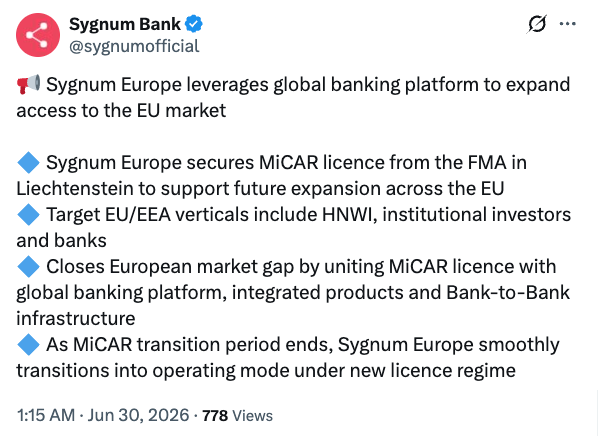
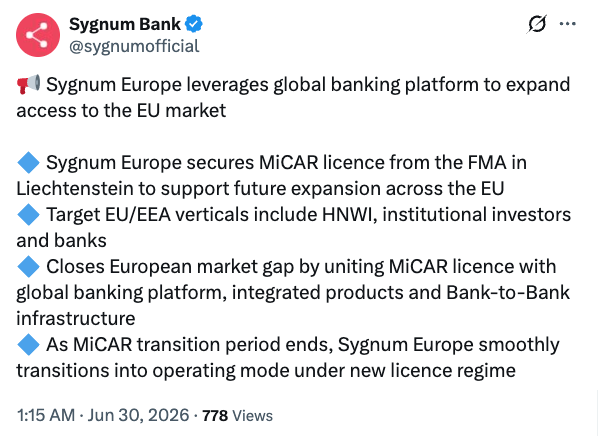
Sygnum announced in late June that its Liechtenstein-based subsidiary, Sygnum Europe AG, received a crypto-asset service provider (CASP) license under the European Union’s Markets in Crypto-Assets (MiCA) regulation from Liechtenstein’s Financial Market Authority (FMA).
“This means European partner banks can plug into the same proven bank-to-bank infrastructure without going through the multi-year process of building and licensing their own crypto operations,” Jost told Cointelegraph.
Source: Sygnum Bank
He said banks remain responsible for their own regulatory arrangements, while Sygnum provides the licensing, custody and trading infrastructure. “That is exactly what allows a bank to go from decision to live offering in months rather than years.”
The license came shortly before the end of the Markets in Crypto-Assets Regulation transitional period on July 1, allowing Sygnum Europe to provide regulated crypto asset services under MiCA.
Magazine: Binance & OKX users face $1,900 fines in Vietnam, Coinbase in China? Asia Express
The hedge fund billionaire who made his fortune shorting subprime mortgages before the 2008 financial crisis said gold is only in the early stages of a long-term bull market.
Paulson argued that fading trust in fiat currencies will keep pushing investors toward gold. He said demand is broadening beyond central banks to include private investors too.
Central Banks Keep Buying as Paulson Bets Bigger on Miners
Central banks have expanded their gold reserves for several years. A recent industry survey found most plan to keep growing their holdings, even as they logged 41 tonnes of purchases during one of gold’s weaker months this year.

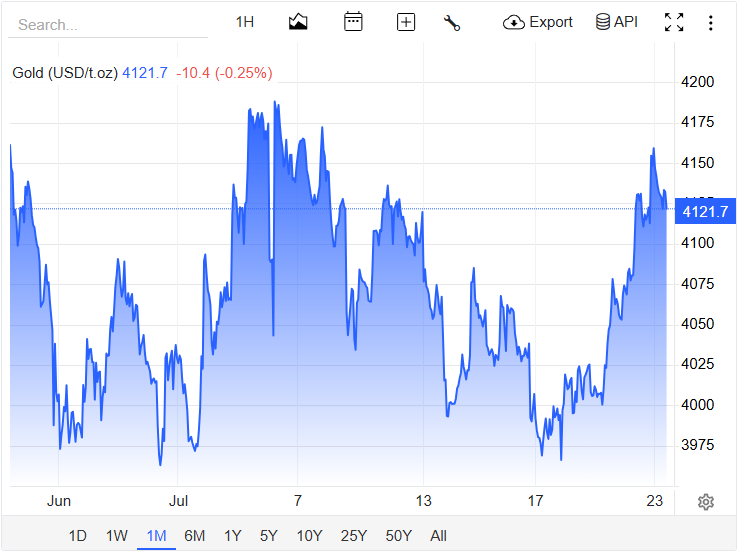
Spot gold traded near $4,121 an ounce Wednesday night. That is up sharply from June’s sub-$4,000 dip, though still well below the record $5,600 gold touched in late January.
“As people lose faith in paper currencies, gold as an alternative will continue to grow.”
— John Paulson, CNBC
Paulson’s NovaGold Goes Big in Mining
Paulson’s comments came as NovaGold Resources (NG) agreed to acquire his firm’s 40% stake in the Donlin Gold project in Alaska. Paulson serves as NovaGold’s co-chairman.
The deal raises NovaGold’s ownership of the project to 100%. It creates a new US-domiciled company worth roughly $4.2 billion, with existing NovaGold shareholders holding about 65% and Paulson receiving the remaining 35%.
Paulson said he prefers early-stage gold miners over bullion itself. He pointed to NovaGold’s 40 million ounces of gold resources against that valuation as evidence of the upside.
Not every bank shares his conviction. JPMorgan recently cut its Q4 forecast for gold after a volatile stretch, even while keeping a bullish long-term view.
The NovaGold deal still needs shareholder, court, and regulatory approval, with both companies targeting a close in the fourth quarter.
The post Hedge Fund Billionaire Paulson Says Gold Bull Run Only Just Beginning appeared first on BeInCrypto.

Two types of whale activity have rocketed on the Chainlink network, including a substantial LINK accumulation, which could point to a resurgence in the ecosystem and the native token’s price performance.
Chainlink continues to improve in terms of Real World Assets development, increasing to the second position in Santiment’s recent ranking.
LINK Whale Activity Blossoms
Citing recent data from Santiment again, popular crypto analyst Ali Martinez noted that whale activity on Chainlink had “surged over the past two weeks.” The graph below demonstrates the impressive increase, which included more than 20 transactions for over $1 million earlier this week. According to Martinez, this signals “growing interest from large holders.”
Whale activity on the Chainlink $LINK network has surged over the past two weeks.
Today alone, more than 20 transactions worth over $1 million each were recorded, signaling growing interest from large holders. pic.twitter.com/iIvZ68joXx
— Ali Charts (@alicharts) July 22, 2026
Separately, the analyst said whales had gone on an accumulation spree, acquiring over 14 million LINK tokens within less than a month.
“Large-scale accumulation like this often reflects growing confidence from major holders and is worth keeping an eye on,” he concluded.
The data shows that their holdings have grown from under 170 million to roughly 182-3 million as of the start of the current business week.
Meanwhile, Santiment’s RWA development ranking placed LINK in second place, trailing only Hedera. The ranking compares how these chains performed compared to the previous month, showing a solid performance from Chainlink.
$50-$100 LINK?
Crypto Patel recently weighed in on LINK’s price performance, warning that 99% of people will ignore the setup before “it’s too late.” The analyst compared the current market behavior with the moves from six years ago when the token went on a wild ride that eventually brought it up to its all-time high of almost $53 (CoinGecko data).
He believes the fact that the spot LINK ETFs have not seen a single red month is extremely bullish, even though the net inflows have slowed since May. The cumulative total net inflows are well over $125 million, which, he noted, is proof that “smart money continues to accumulate,” but most retail investors “still believe LINK is dead.”
After outlining the current environment as the “biggest” opportunity since conviction is at its lowest, Patel brought up some massive price targets for LINK during the next bull cycle of somewhere between $50 and $100.
The post Chainlink Whale Activity Explodes as $100 LINK Predictions Gain Momentum appeared first on CryptoPotato.


Seven Senate Democrats say the updated CLARITY Act text falls short. They opposed the proposed draft, even after it added ethics rules barring public officials from issuing digital assets.
The 616-page bill needs 60 votes to clear the Senate. Their opposition complicates the path to that threshold before the August recess.
What the New CLARITY Act Text Adds
Senate Republicans released the 616-page bill, formally H.R. 3633, on Wednesday. The Digital Asset Market Clarity Act sets a federal framework for crypto oversight.
The text divides authority between the Securities and Exchange Commission (SEC) and the Commodity Futures Trading Commission (CFTC). Only 2 parts are new since the May draft.
The additions are ethics requirements and a law enforcement section with stablecoin seizure powers. The former stops covered officials from issuing or sponsoring a digital asset in exchange for consideration.
The group spans the President, Vice President, and lawmakers, plus their spouses, throughout their time in office. The agreement sunsets on January 20, 2029.
Democrats and Banks Seek Changes
Nonetheless, the addition was not enough for democrats. Senators Catherine Cortez Masto, Angela Alsobrooks, Cory Booker, Ruben Gallego, John Hickenlooper, Mark Warner, and Raphael Warnock said the language still needs work, alongside consumer protection, illicit finance, and market integrity.
“The Republican-proposed text of the CLARITY Act as it currently stands falls short… We have been working in good faith with our Republican colleagues for the past year and will continue doing so to get this over the finish line,” the statement read
According to Semafor, Alsobrooks said she will oppose the crypto bill unless Republicans strengthen its ethics rules. She criticized the draft for relying only on the Justice Department to enforce them and called that approach “wild and unserious and stone crazy.” She wants state attorneys general empowered to act if the DOJ does not.
Follow us on X to get the latest news as it happens
Meanwhile, the banking industry is also seeking changes. Six trade groups, led by the American Bankers Association (ABA), signed a joint statement on deposit risk.
“The latest version of the Digital Asset Market Clarity Act released today in the Senate still puts at risk the local lending that drives economic activity in the US,” they said.
Majority Leader John Thune plans to bring the bill to the floor next week. Whether the revised text wins enough Democratic support remains the key question.
Subscribe to our YouTube channel to watch leaders and journalists provide expert insights
The post Ethics Rules Were Not Enough to Win Democrats on CLARITY Act appeared first on BeInCrypto.


The Verus Ethereum Bridge has suffered another exploit, with an attacker draining about $7.54 million in assets from the same contract hit in May.
Summary
- Verus Ethereum Bridge lost about $7.54 million in a new exploit targeting its import path.
- Blockaid says the attack resembles May’s exploit, though the root cause remains under active investigation.
- Three crypto exploits reported Thursday caused combined losses of roughly $35.55 million, according to Lookonchain.
Blockchain security firm Blockaid detected the attack on Ethereum on July 23 and said the attacker used the bridge’s import path to trigger payouts that were not backed by matching assets on the source side.
The incident involved a different transaction and attacker-controlled wallet from the May breach, according to Blockaid. The firm said the new attack used the same bridge contract, entry path and apparent bug class. However, the exact root cause remained under investigation when the alert was published.
Verus bridge exploit drains multiple assets
Onchain records show the exploit transaction interacted with the Verus Ethereum Bridge contract at 03:45 UTC on July 23. The transaction transferred about 1,137 ETH and several tokens to an attacker-controlled address. The assets included tBTC, USDC, USDT, EURC, MKR and scrvUSD. Etherscan valued the main bridge outflows at roughly $7.54 million at the time.
Blockaid said the attacker abused the bridge import process to produce unbacked Ethereum-side payouts. The firm identified the receiving address as 0xCFd0…2D54 and linked the withdrawal to the same bridge contract involved in the earlier Verus incident. It has not yet published a complete technical report on the new transaction.
Additionally, the latest exploit comes about two months after the Verus Ethereum Bridge lost roughly $11.58 million in a separate attack. Security researchers said the May attacker exploited a validation gap that allowed a forged cross-chain import to pass verification even though the value committed on the source side did not match the payout released on Ethereum.
Blockaid said the July attack “appears related to the previous Verus Ethereum Bridge incident in May 2026.” It also described the two incidents as involving the “same bridge contract, same entry path, and same bug class,” although a confirmed technical cause for the latest exploit has not been released.
As crypto.news reported in May, the first Verus bridge attacker later returned 4,052.4 ETH, worth about $8.5 million at the time, after the project offered settlement terms. The attacker kept 1,350 ETH as a bounty. The returned amount represented about 75% of the funds held by the exploiter after the stolen assets had been converted into ETH.
Three exploits reported within hours
The Verus attack formed part of a broader series of security incidents reported within hours. Onchain tracker Lookonchain said AFX Trade, Verus and B² Network had suffered exploits with combined reported losses of about $35.55 million. The figures included $24.15 million from AFX, about $7.55 million from Verus and roughly $3.86 million from B² Network.
Earlier today, an AFX-operated bridge lost $24.15 million in USDC before the attacker moved the funds to Ethereum and converted them into 12,467 ETH. Offchain Labs said that incident did not affect Arbitrum’s native bridge and originated from infrastructure operated by a third-party protocol.
The incidents add to continued scrutiny of cross-chain systems. A recent crypto.news explainer noted that bridges must verify events across separate blockchains while controlling assets held in shared reserves. Errors in message validation, contract logic or access controls can allow a transaction to release assets without a valid matching transfer.
Root cause and recovery details remain pending
Blockaid said the new Verus exploit appears to involve the same type of weakness seen in May, but stopped short of confirming that the exact earlier vulnerability caused the July drain. The May attack involved missing validation between the value committed on the source chain and the amount released on Ethereum, according to security analyses.
The latest transaction confirms that funds left the Verus bridge for the new attacker wallet, but the reviewed sources did not confirm whether any assets had since been frozen, returned or recovered. They also did not provide a new remediation plan or a timeline for changes to bridge operations.
Further technical details could clarify whether the May flaw remained exploitable, whether a related weakness caused the new incident, or whether the attacker used another route through the same import process. The attacker’s next fund movements could also show whether the stolen assets are converted or moved through other services.
The case remains a developing story.


The Louisiana State Employees’ Retirement System has increased its stake in Strategy, giving the public pension fund more indirect exposure to Bitcoin through the Nasdaq-listed company.
Summary
- Louisiana’s pension fund raised its Strategy holding to 21,300 shares, increasing indirect exposure to Bitcoin.
- The $16.3 billion retirement system added 700 MSTR shares from its first-quarter holding of 20,600.
- Strategy currently holds 843,775 Bitcoin, keeping MSTR closely tied to movements in Bitcoin’s market price.
A regulatory filing covering holdings as of June 30 shows the retirement system owned 21,300 Strategy shares, up 3.4% from 20,600 shares at the end of the first quarter. The position had a quarter-end reported value of about $1.85 million. BitcoinTreasuries.NET later valued the holding at roughly $2.13 million in a July 22 post.
Louisiana pension fund adds to Strategy position
The latest disclosure shows that the Louisiana State Employees’ Retirement System added 700 MSTR shares during the second quarter. The fund previously held 20,600 shares as of March 31, according to institutional ownership data.
BitcoinTreasuries.NET described the move by saying, “Government employees are getting BTC exposure.” However, the fund does not directly hold Bitcoin through the reported position. It owns shares in Strategy, whose balance sheet contains the largest corporate Bitcoin treasury.
The size of the retirement system has been reported using different measures. LASERS said in August 2025 that its investment assets stood at $16.3 billion. Its official history page says the total market value of assets reached $17.2 billion for the fiscal year ending June 30, 2025. The MSTR position therefore accounts for only a small part of the overall portfolio.
LASERS administers 24 retirement plans covering more than 150,000 members and their families. Its broader portfolio includes traditional equities and other asset classes, meaning the Strategy holding represents one listed equity position rather than a direct allocation of pension assets into Bitcoin.
MSTR offers indirect exposure to Strategy’s Bitcoin treasury
Strategy describes itself as a Bitcoin treasury company and uses equity, debt and other securities to finance its balance sheet. The company says its securities offer investors varying degrees of economic exposure to Bitcoin while it continues operating its enterprise software business.
The company currently holds 843,775 BTC. As crypto.news reported, the Bitcoin balance remained unchanged through July 19 while Strategy raised another $263.5 million through MSTR share sales and increased its U.S. dollar reserve to $3.225 billion.
MSTR does not track Bitcoin in the same way as a spot Bitcoin exchange-traded fund. Its price can also respond to share issuance, financing costs, corporate decisions and changes in how investors value Strategy’s Bitcoin holdings. The Louisiana fund’s position therefore gives it indirect Bitcoin-linked exposure through company stock rather than ownership of BTC itself.
The increased pension fund position also comes during a changing period for Strategy. The company reduced its Bitcoin holdings to 843,775 BTC in early July after selling some of its treasury assets under a new capital framework. Its holdings have remained at that level in subsequent disclosures. As previously reported, the sales marked a change from Strategy’s long-running accumulation-focused approach.
Pension funds explore more routes to Bitcoin exposure
The Louisiana position comes as retirement funds and state-backed investment systems test different ways to gain crypto exposure. Some use shares of Bitcoin treasury companies or regulated investment products rather than holding digital assets directly.
Japan’s National Business Corporate Pension Fund plans to allocate about 1% of its assets to crypto through a managed multi-asset fund during fiscal 2026. The fund described the allocation as part of its currency diversification strategy.
In the U.S., states are also considering crypto-linked options for public funds. Indiana enacted legislation that opens a route for certain public retirement and savings programs to offer at least one crypto-linked investment option through self-directed brokerage services.
Meanwhile, Florida lawmakers proposed allowing selected state-controlled funds, including pension assets, to allocate up to 10% to eligible Bitcoin products and other approved digital assets. Those proposals use a different structure from Louisiana’s Strategy investment.
In addition, the Louisiana fund’s increase from 20,600 to 21,300 shares represents a modest change within a multibillion-dollar retirement portfolio. Still, the filing confirms that the pension manager maintained and expanded its position rather than exiting MSTR during the second quarter.
The move also occurred while Strategy remained the largest publicly traded corporate holder of Bitcoin. With 843,775 BTC on its balance sheet, changes in Bitcoin’s market value remain an important factor for investors holding MSTR, although the stock carries risks and characteristics separate from direct Bitcoin ownership.
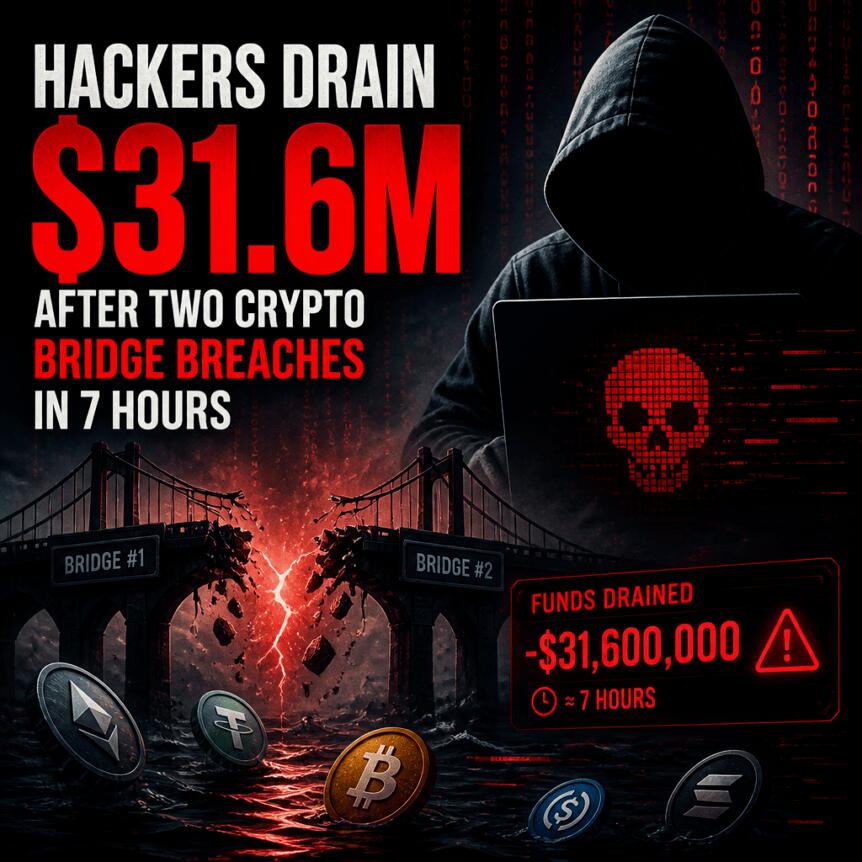
Cross-chain security issues remain a major pain point for crypto markets, after investigators reported two separate bridge-related exploits occurring only hours apart. According to on-chain analytics firm Blockaid, the combined theft totaled more than $31.6 million, with funds taken from bridge infrastructure used by decentralized perpetual exchange AFX and the Verus Ethereum Bridge.
Blockaid said AFX’s bridge lost $24.15 million on Wednesday, before another attack targeting the Verus Ethereum Bridge resulted in roughly $7.5 million drained from bridge reserves. The back-to-back incidents underscore how bridge operators—and the protocols that integrate them—can be exposed even when exploits are not tied to a single chain-level weakness.
Key takeaways
- Blockaid reported losses of $24.15 million from an AFX-operated bridge on Arbitrum and about $7.5 million drained from the Verus Ethereum Bridge within hours.
- Offchain Labs co-founder Stephen Goldfeder said Arbitrum’s native bridge was not hacked, pointing to activity originating from a third-party protocol.
- Security researchers suggested the AFX incident may have involved compromised keys rather than a smart contract logic flaw.
- Blockaid said the Verus exploit appears to mirror a prior May incident, using a similar method while involving a different attacker wallet.
- Both cases highlight that bridges remain high-value targets because they custody large asset pools and move value across ecosystems.
AFX bridge exploit on Arbitrum: what was targeted
Blockaid said it detected an exploit at 9:30 pm UTC aimed at a bridge operated by AFX, a decentralized perpetual exchange running on Arbitrum. The investigation framed the event as a bridge compromise affecting a third-party integration rather than a breach of Arbitrum’s core bridging infrastructure.
According to Offchain Labs co-founder Stephen Goldfeder, a bridge hack report circulating online had impacted a transaction originating from a third-party protocol, and that the Arbitrum native bridge itself had not been exploited. Goldfeder stated that the transaction in question originated from another protocol and emphasized that Arbitrum’s native bridge “has not been hacked or exploited in any way.”
Additional analysis from SunSec, the founder of the DeFi security community DeFiHackLabs and a contributor to SEAL, suggested that the evidence pointed more toward compromised keys than toward a vulnerability in smart contract logic. While that distinction matters for incident response—key compromise typically demands urgent credential rotation and broader access review—it also signals that the weakest point may not always be the bridge contracts themselves.
Cointelegraph sought comment from AFX regarding the reported exploit, but the additional reporting available here centers on what Blockaid and affiliated investigators observed during the incident.
Verus Ethereum Bridge attack: a similar method to May
In a separate incident, Blockaid reported an exploit targeting the Verus Ethereum Bridge that drained approximately $7.5 million across multiple assets held in bridge reserves. The listed tokens included Ether (ETH), tBTC, USDC, USDt, EURC, MKR, and scrvUSD.
Blockaid said the attack method appears similar to a previous Verus Ethereum Bridge incident reported in May, which resulted in the theft of $11.58 million. In that earlier case, Blockaid said the same overall approach was used, but by a different attacker wallet.
According to Blockaid, the attacker used the bridge “import path” to trigger “unbacked Ethereum-side payouts.” In practical terms, this points to a workflow-level weakness: attackers may be able to induce the bridge to release assets on one side of the system without corresponding backing on the other side, creating a direct path to reserve depletion.
For users and integrators, the repeated nature of the tactic raises a persistent risk: even when teams patch one vulnerability, the operational mechanics of how imports and payouts are handled can remain exploitable if the underlying assumptions aren’t fully addressed.
Why bridge failures keep recurring
Bridge exploits are difficult to eliminate entirely because cross-chain infrastructure often combines multiple components: custody of assets, message passing or import/export mechanisms, and permissioning for triggering settlement flows. When attackers find a seam between those elements—whether through compromised credentials, incorrect authorization, or weaknesses in how cross-chain states are validated—the result is frequently rapid draining of funds.
On-chain investigator TheCrypticWolf summarized the broader issue in a post on X, arguing that bridges remain a weak link until “security is upgraded.” While that statement reflects a general view rather than new incident-specific evidence, the two reported attacks within the same day give it concrete support: high-value bridge reserves make the system attractive, and high complexity makes comprehensive hardening challenging.
There is also an important asymmetry across the two incidents. Blockaid’s reporting on the AFX case was paired with Goldfeder’s clarification that Arbitrum’s native bridge was not compromised, suggesting the problem lay in third-party integration or bridge controls tied to a particular protocol. In contrast, Blockaid’s description of the Verus incident emphasizes how the bridge import mechanism can lead to Ethereum-side payouts that are not properly backed—an issue that may relate more directly to settlement logic and state assumptions.
What to watch next for affected ecosystems
Bridge-related incidents typically lead to emergency measures such as pause controls, increased monitoring, and changes to custody or authorization workflows. Readers should watch for follow-up disclosures from AFX and the Verus ecosystem, especially around what Blockaid and other investigators determine about root cause—whether it’s key compromise, an authorization failure, or a repeatable weakness in import/export settlement.
More broadly, these events reinforce that cross-chain exposure isn’t limited to the bridge operators alone: decentralized applications and traders relying on bridges for liquidity and settlement should treat bridge security as a continuously evolving risk, not a one-time checkbox.
Crypto World
SEC Agrees to Overhaul Recordkeeping After Settling Coinbase Lawsuit Over Gensler’s Lost Texts
The US Securities and Exchange Commission went on a blatant war against the cryptocurrency industry in the past couple of years of Gary Gensler’s tenure, especially following the loud collapse of FTX.
However, the new administration settled most cases, and now it was time for one that was actually initiated by Coinbase. It came with some groundbreaking changes as well.
From Defendant to Plaintiff
The legal disputes between the two parties began in 2023 when the regulator went after the largest US-based crypto exchange. However, the roles reversed a year later when Coinbase, through its research firm History Associates, sued the watchdog after the latter denied requests for internal communications related to its approach to crypto regulation.
The Brian Armstrong-led firm argued that the requested records could shed some light on how the SEC developed its enforcement strategy against crypto companies during the Biden administration, including legal theories underpinning several high-profile lawsuits. Recall that the SEC had sued industry giants like Binance, Ripple, and many others.
The agency has now settled with Coinbase in the Freedom of Information Act (FOIA) lawsuit and has agreed to pay $150,000 in attorney fees, release two previously withheld documents, and review its policies governing the presentation of text messages and other electronic communications.
The settlement was announced in an opinion piece by Coinbase Chief Legal Officer Paul Grewal, who said it marked an important victory for government transparency. However, there’s no official confirmation from the SEC as of press time.
Why It Matters
Under Gensler’s leadership, the agency imposed billions of dollars in penalties on banks and financial institutions for failing to preserve employee communications conducted through texts and other unofficial channels. Coinbase, on the other hand, argued that the regulator should be held to the same standards it had enforced against the private sector.
The legal dispute intensified after the SEC disclosed that certain texts involving Gensler and other senior officials had been automatically deleted, making them unavailable for production under the FOIA requests.
Although the settlement does not confirm any wrongdoing by the SEC, it requires the watchdog to review its record-retention procedures, which is believed to be particularly groundbreaking for a regulator whose own rules emphasize preserving official communications.
The post SEC Agrees to Overhaul Recordkeeping After Settling Coinbase Lawsuit Over Gensler’s Lost Texts appeared first on CryptoPotato.


Circle has signed separate memorandums of understanding with Kakao Group and South Korean fintech operator Toss to explore stablecoin payments, blockchain settlement and digital asset infrastructure in South Korea.
Summary
- Circle signed agreements with Kakao Group and Toss to explore stablecoin payment infrastructure in Korea.
- Kakao plans to assess KRW stablecoins, remittances and merchant settlement using Circle’s blockchain payment technology.
- Toss will explore USDC-based services, digital wallets and programmable payments while regulations continue developing nationwide.
The agreements bring Circle’s USDC and payment technology into discussions with some of Korea’s largest consumer finance platforms. Kakao, Kakao Pay and Kakao Bank will study opportunities around KRW-based digital assets, cross-border payments and tokenized financial services. Toss and Toss Bank will examine similar uses, including digital wallets, overseas payments and programmable onchain transactions.
Kakao Group said its agreement with Circle will combine the KakaoTalk-centered platform ecosystem with Kakao Pay’s payment services, Kakao Bank’s banking capabilities and Circle’s blockchain infrastructure. The companies plan to review payment, settlement and digital asset connectivity as South Korea develops rules for stablecoins and other tokenized financial products.
The initial work will focus on faster payment and settlement systems, according to local reporting. The companies will also assess cross-border remittances, merchant settlement and links between blockchain networks and existing financial systems. Kakao Group said the infrastructure could eventually support services from other Korean companies, although the MOU does not set a launch date or confirm a specific stablecoin issuance model.
Kakao Pay CEO Shin Won-keun, who leads the group’s stablecoin task force, said the companies would “preemptively prepare a Korean digital asset ecosystem with Circle.” Circle executives met Kakao representatives in Pangyo on July 22 before the partnership was announced.
Toss explores USDC and programmable payments
Circle also signed a separate MOU with Viva Republica, the operator of Toss, and Toss Bank. The companies will study blockchain-based payments and stablecoin infrastructure, with potential uses covering digital wallets, cross-border settlement and financial services that use USDC.
Toss will review biometric payment tools, USDC-linked financial products and programmable onchain payments. Toss Bank will focus on connecting stablecoin infrastructure with traditional bank accounts and fiat payment networks. The parties also plan to examine compliance, risk management, security and anti-money laundering requirements as Korean rules develop.
The agreement builds on Toss’s broader interest in digital assets. As crypto.news previously reported, the fintech has explored a proprietary blockchain and a possible token while preparing for a Korean stablecoin market. Toss Bank has also been studying blockchain-based payment and settlement models.
Circle expands its South Korea strategy
The new agreements follow months of outreach by Circle in South Korea. As crypto.news reported on July 13, the company planned its Current Seoul event to bring banks, exchanges, payment firms and super-app operators together for talks on digital asset regulation and payments. Kakao Pay CEO Shin Won-keun was among the scheduled speakers.
Circle CEO Jeremy Allaire also visited Seoul in April and met executives from Korean banks, exchanges and payment companies. He said Circle did not plan to issue its own won stablecoin. Instead, the company has positioned USDC and its infrastructure as possible links between future KRW-denominated tokens and global payment networks.
That approach is visible in the latest agreements. Circle is not announcing a KRW stablecoin with Kakao or Toss. The companies are studying how local won-based digital assets could work alongside USDC, blockchain settlement systems and existing financial infrastructure.
Any commercial launch will depend on the final product design and regulatory approvals. Circle Chief Commercial Officer Kash Rajaghi said Korea has “a solid foundation for financial innovation.”
Korean firms prepare for stablecoin rules
South Korean technology and financial groups have increased work on won-based stablecoins as policymakers prepare a broader legal framework. Kakao Bank has already explored stablecoin development, while Kakao Pay has been building a wider group strategy around KRW-linked digital assets.
Kakao Group said its Circle partnership could support a shared foundation for stablecoin services beyond its own platforms. The group is also reviewing tokenized financial services, which could use stablecoins as a settlement layer when assets move between blockchain networks and traditional financial systems.
Circle has taken a similar infrastructure-led approach elsewhere in Asia.The company recently partnered with Japan’s JCB to test USDC for corporate treasury transfers and merchant payments. The Korean agreements extend that regional strategy into platforms with large domestic payment and banking networks.
For now, both partnerships remain exploratory. Kakao Group, Toss and Circle have not announced a launch date for a KRW stablecoin or a live consumer payment product. Their agreements instead create a framework to test business models, technical connections and regulatory requirements as South Korea’s digital asset rules take shape.
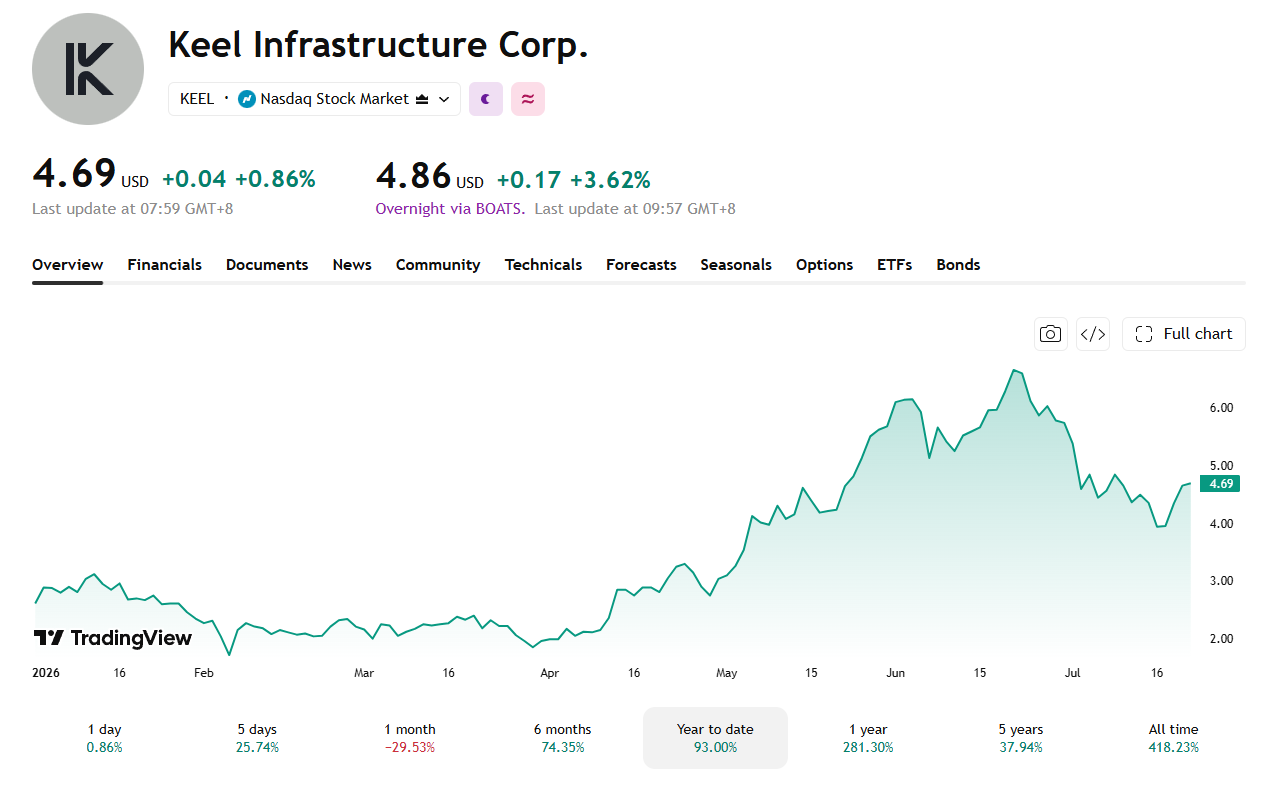
Jim Cramer used his July 22 Mad Money episode to point investors toward Keel Infrastructure (KEEL), a former Bitcoin miner turned AI data center developer. He cited a hedge fund’s expanding stake as the reason to pay attention.
What Cramer Flagged
Cramer highlighted Situational Awareness LP, the fund run by AI researcher Leopold Aschenbrenner, as a notable KEEL holder. Regulatory filings show the fund grew its position by 188% in the first quarter of 2026. It now holds nearly 20 million shares, up from roughly 6.9 million.
Fresh analyst coverage backs up the timing. BTIG initiated KEEL at Buy on July 22 with an $8 price target. That implies roughly 72% upside from the stock’s $4.65 close. The firm pointed to Keel’s power portfolio as the key asset. It also noted that hyperscalers and AI enterprise customers have signed around 10 colocation contracts totaling roughly 2 gigawatts across the sector this year.
The Company Behind the Ticker
Keel Infrastructure is the rebranded successor to Bitfarms. The company completed its shift from Canadian Bitcoin miner to Delaware-based AI infrastructure developer in April. It now controls a 2.2 gigawatt power pipeline across Pennsylvania, Washington, and Quebec. But it still hasn’t landed its first hyperscale colocation contract, the catalyst BTIG and other analysts are watching for.
Keel also carries a debt-to-equity ratio above 140% and negative free cash flow. Execution risk stays real even as the power pipeline draws bullish coverage. The stock’s 52-week range, from $0.98 to $7.37, shows just how sharply sentiment swings on AI infrastructure names that are still waiting on a signed customer.

Should Investors Trust Cramer’s Read
Cramer’s Keel comments follow a rougher stretch for his other tech calls. BeInCrypto has tracked the Inverse Cramer pattern through this earnings season, including Intel’s slide hours after Cramer named it his favorite stock. That history gives KEEL bulls a reason for caution alongside the bullish signal.
Still, the Situational Awareness stake predates Cramer’s endorsement by more than a quarter. And BTIG’s target reflects a specific catalyst analysts are tracking, not blanket enthusiasm for the crypto-to-AI pivot trade.
That trade has also produced disappointments, including American Bitcoin’s post-IPO stagnation.
Whether Keel signs a hyperscaler deal will decide which read on this one ages better, not Cramer’s airtime.
The post Jim Cramer Eyes Ex-Bitcoin Miner’s AI Power Pivot as Hedge Fund Bets Big appeared first on BeInCrypto.

Equinor ASA 2026 Q2 – Results – Earnings Call Presentation (NYSE:EQNR) 2026-07-23

BancaStato Launches Bitcoin Trading With Sygnum

Red Sox winning streak: Historic run ends at 15 games with loss to Orioles


-
 NewsBeat7 days ago
London Mayor Sadiq Khan handed a peerage by Keir Starmer alongside 15 other Labour figures… just days before the PM leaves No10
-

 Fashion6 days ago
Weekend Open Thread – Corporette.com
-

 Politics5 days ago
The House | The City of London can help the new chancellor deliver growth in every postcode
-

 Crypto World5 days ago
Ripple Payments Joins MiCA With 14 Firms, Does It Mean Anything For XRP?
-
 Crypto World6 days ago
Two July Windows Left: The CLARITY Act’s Senate Fight and What Failure Means
-

 Politics4 days ago
Democrats look to World Cup watch parties to register thousands of voters
-

 Crypto World5 days ago
Ripple wins EU-wide access as ESMA adds it to MiCA register
-

 Crypto World2 days ago
Grayscale Files For Worldcoin ETF, WLD Registers Sharp Rise
-

 NewsBeat3 days ago
Unregistered fitter used Gas Safe logo on business flyers
-

 Tech2 days ago
Sail Virtually Aboard The “Itanic” With IA-64 Emulator
-

 Crypto World6 days ago
Injective Submits SEC Transfer-Agent Registration to Onchain Ownership Records
-
 Tech2 days ago
Turtle Beach Command Series KB7 review: a nifty screen-equipped gaming keyboard
-

 NewsBeat6 days ago
Registration is now open for March for Men with Kev 2026
-
 Business1 day ago
New Jersey voter registration controversy explained: How 6,600 noncitizens got on the rolls, and what happens next
-
 Crypto World6 days ago
Claude Fable 5 Slips to Second in AI Coding Leaderboard
-

 News Videos6 days ago
Money | Class 12 Economics | CBSE Board Exam 2026-27
-
 Business6 days ago
Banco Bilbao Vizcaya Argentaria, S.A. (BBVA) Discusses Global Macro Environment and Economic Outlook for Core Markets Transcript
-

 Crypto World5 days ago
Kaspersky exposes OkoBot’s 20-module crypto wallet attack
-

 News Videos4 days ago
Big Money Is Entering XRP
-

 NewsBeat5 days ago
Durham County Council to send out electoral registration emails
You must be logged in to post a comment Login