

Crypto World
When Bots Become the Dominant DeFi Users


The Coming Collision Between AI Agents and DeFi
For years, decentralized finance has been built around one assumption: humans remain the primary participants in the market. Traders execute swaps, governance participants vote manually, liquidity providers rebalance positions, and treasury managers react to changing conditions based on human judgment.
That assumption may not survive the next decade.
A new wave of AI agents is beginning to merge with decentralized finance infrastructure, creating a future where autonomous systems—not humans—become the dominant users of financial protocols. This shift could fundamentally transform how liquidity moves, how markets behave, and how value is managed across blockchain ecosystems.
The collision between AI and DeFi is no longer theoretical. It is already beginning.
The Rise of AI-Native Financial Participants
Most discussions around artificial intelligence focus on productivity tools, chatbots, or content generation. But within crypto, the more disruptive evolution may be autonomous financial agents.
Unlike traditional trading bots that follow fixed instructions, AI agents are capable of adapting to changing market conditions, learning from data, and executing strategies independently. Combined with permissionless blockchain infrastructure, these systems can operate continuously without centralized oversight.
An AI agent connected to a crypto wallet can already:
- Analyze on-chain market conditions
- Execute trades automatically
- Move liquidity between protocols
- Optimize yield positions
- Hedge exposure in real time
- Participate in governance systems
- Monitor treasury risk
- React faster than any human trader
The result is the emergence of machine-operated finance operating at blockchain speed.
AI Trading Agents and the End of Human Reaction Time
One of the earliest impacts of AI in DeFi is likely to appear in trading markets.
Crypto markets already operate 24/7, creating an environment where human traders struggle to maintain consistent performance. AI agents remove this limitation entirely. They can monitor thousands of data points simultaneously while executing decisions in milliseconds.
These systems are evolving beyond simple algorithmic trading.
Future AI trading agents may combine:
- On-chain analytics
- Social sentiment analysis
- Governance proposal tracking
- Liquidity flow monitoring
- Cross-chain arbitrage detection
- Macro-economic data interpretation
- Real-time volatility modeling
This creates a market environment where human reaction speed becomes increasingly irrelevant.
In traditional finance, high-frequency trading firms already dominate market microstructure. DeFi may push this even further because blockchains are globally accessible, composable, and programmable by default.
When autonomous agents begin competing directly against one another, DeFi markets could evolve into machine-speed ecosystems where most activity occurs faster than human cognition can reasonably follow.
Autonomous Treasury Management
Treasury management is another area poised for transformation.
Today, DAOs and DeFi protocols often rely on human governance committees to allocate capital, manage reserves, or rebalance assets. These processes are slow, politically fragmented, and vulnerable to emotional decision-making.
AI systems could radically change this structure.
An autonomous treasury agent may eventually:
- Diversify treasury holdings dynamically
- Move idle capital into productive yield strategies
- Reduce exposure during volatility spikes
- Hedge against stablecoin depegging risks
- Allocate liquidity across chains automatically
- Simulate stress scenarios continuously
- Optimize revenue generation in real time
Instead of waiting for governance votes that take days or weeks, protocols may deploy AI-managed treasury layers capable of adapting instantly to market conditions.
This introduces a profound shift in governance philosophy. Human communities may increasingly define broad strategic objectives, while AI systems handle operational execution autonomously.
In other words, governance may evolve from direct management toward supervisory oversight.
AI-Generated Liquidity Strategies
Liquidity provision in DeFi has become increasingly complex.
Modern liquidity providers must understand impermanent loss, concentrated liquidity ranges, volatility exposure, fee generation, incentive emissions, and cross-protocol yield opportunities. For most retail participants, the ecosystem is already too sophisticated to manage efficiently.
AI agents are uniquely positioned to solve this complexity problem.
An advanced liquidity management agent could:
- Predict volatility changes
- Reposition liquidity ranges dynamically
- Optimize fee capture
- Exit unstable pools before liquidity collapses
- Rotate capital between protocols automatically
- Detect unsustainable yield incentives
- Balance risk-adjusted returns across chains
This could produce a major efficiency leap for DeFi markets.
However, it also creates a dangerous possibility: liquidity itself may become increasingly automated and hyper-reactive.
If thousands of AI agents identify the same risk signals simultaneously, liquidity could disappear from protocols at machine speed during periods of stress. This introduces the possibility of accelerated market cascades far more violent than previous DeFi crashes.
The same intelligence that improves efficiency may also amplify systemic fragility.
Wallet-Operating AI and Autonomous Economic Identity
Perhaps the most transformative development is the emergence of wallet-operating AI.
Today, crypto wallets are controlled directly by humans. But in the future, wallets themselves may become autonomous economic actors.
Imagine an AI agent with authority to:
- Pay for digital services
- Manage subscriptions
- Execute payroll
- Purchase compute resources
- Invest idle capital
- Borrow against assets
- Repay loans automatically
- Interact with smart contracts independently
This turns AI from a software tool into an active economic participant.
In this model, millions of autonomous agents could interact with blockchain infrastructure continuously without direct human input. Some may represent individuals, while others may operate on behalf of businesses, protocols, or entirely AI-native organizations.
The implications are enormous.
DeFi was originally designed as decentralized finance for humans. It may ultimately become the financial layer for autonomous machines.
Machine-Speed Markets and the Future of Volatility
As AI participation grows, markets may become structurally different.
Human traders are constrained by psychology, fatigue, limited attention, and delayed execution. AI agents are constrained primarily by compute power, data access, and protocol rules.
This changes market behavior dramatically.
Potential outcomes include:
Greater Efficiency
AI agents may eliminate many pricing inefficiencies, reducing arbitrage gaps and improving capital allocation across ecosystems.
Faster Liquidity Migration
Capital could move between protocols almost instantly as AI systems chase optimal returns.
Increased Market Reflexivity
AI agents trained on similar datasets may react identically during stress events, amplifying volatility.
Reduced Human Influence
Retail traders may struggle to compete against autonomous systems operating continuously with superior analytical capabilities.
Hyper-Competitive Yield Environments
As AI agents optimize returns aggressively, sustainable yields may compress significantly across DeFi markets.
The long-term result may resemble an autonomous financial battlefield where algorithms compete against algorithms in real time.
The Governance Problem No One Is Ready For
The rise of AI agents also introduces governance risks that DeFi has barely begun to address.
Key questions remain unresolved:
- Should AI agents be allowed to vote in DAO governance?
- Who is responsible if autonomous systems exploit protocols unexpectedly?
- Can malicious AI manipulate governance sentiment at scale?
- How do protocols defend against coordinated AI-driven liquidity attacks?
- What happens when AI agents discover profitable behaviors humans consider unethical?
These concerns move beyond technology into economic philosophy and legal theory.
DeFi governance was designed around human participation. But machine participants may soon outnumber human users across major protocols.
When that happens, governance itself may require redesign.
The Emergence of AI-to-AI Economies
The most radical possibility is that humans eventually become secondary participants within certain segments of DeFi.
AI agents could negotiate trades, provide liquidity, lend capital, hedge risk, and purchase services from one another autonomously. Entire financial ecosystems may emerge where most transactions occur between machines.
In such a world:
- Smart contracts become machine coordination layers
- Stablecoins become native settlement assets for AI systems
- DeFi protocols become infrastructure for autonomous economies
- Humans transition into supervisors rather than active operators
This would represent one of the largest structural transformations in financial history.
Not because finance becomes decentralized—but because finance becomes autonomous.
Conclusion
The convergence of AI and DeFi is creating a new category of market participant: autonomous financial intelligence.
What began as simple trading automation is rapidly evolving into wallet-operating AI capable of managing capital, executing strategy, and interacting with decentralized infrastructure independently.
This transformation could make DeFi markets faster, more efficient, and more adaptive than ever before. But it could also introduce unprecedented volatility, governance challenges, and systemic risks.
The core question is no longer whether AI will participate in DeFi.
It is whether humans will remain the dominant participants once it does.
REQUEST AN ARTICLE


Key Takeaways
- Daiwa Securities shifted Qualcomm’s rating from Neutral to Outperform, establishing a $225 price objective
- Shares of QCOM climbed 6% during Friday’s session after rising 5.6% pre-market from Thursday’s $202.50 close
- The chipmaker’s stock has surged more than 60% over the last month
- Second-quarter earnings showed EPS of $2.65, topping the $2.56 forecast, though revenue declined 3.5% annually
- Management authorized a $20 billion buyback program; average analyst target stands at $176.54 with a Hold consensus
Shares of Qualcomm experienced a significant 6% surge during Friday’s trading session following an upgrade from Daiwa Securities, which moved the semiconductor company from Neutral to Outperform. The firm established a $225 price objective, suggesting approximately 11% potential appreciation from present trading levels.
After settling at $202.50 on Thursday, the stock showed strength in pre-market activity with a 5.6% advance. The past month has been particularly rewarding for shareholders, with QCOM delivering gains exceeding 60%.
Louis Miscioscia, the Daiwa analyst behind the upgrade, highlighted Qualcomm’s promising revenue expansion trajectory and what he characterized as reasonable current valuation levels.
His research note posed whether the company might become the next chip sector player to experience a price-to-earnings multiple expansion, drawing parallels to Arm Holdings’ recent valuation reassessment.
Miscioscia identified an approaching investor presentation as an important near-term catalyst, where executive leadership is anticipated to detail strategic initiatives in data center processors, physical computing solutions, and edge artificial intelligence applications.
Second Quarter Results: Performance Analysis
The company delivered second-quarter earnings of $2.65 per share, surpassing Wall Street’s $2.56 projection by nine cents. Total revenue reached $10.60 billion, meeting analyst forecasts.
Year-over-year comparisons showed a 3.5% revenue contraction from the prior year period, when the company posted $2.85 per share. Forward guidance for the third quarter called for earnings between $2.10 and $2.30 per share, missing analyst expectations.
Despite the conservative near-term outlook, Miscioscia emphasized that investors should prioritize Qualcomm’s long-range growth opportunities over quarterly fluctuations.
The board of directors greenlit a substantial $20 billion stock repurchase authorization in March, representing approximately 14.5% of shares outstanding.
Analyst Community Remains Split
The broader investment community hasn’t fully embraced the bullish thesis. Wall Street’s aggregate rating on QCOM sits at Hold, with a consensus price objective of $176.54 — substantially beneath current trading levels.
Bank of America maintains an Underperform stance with a $145 target. Morgan Stanley holds an Underweight view at $146. Susquehanna assigns a Neutral rating at $160.
Conversely, TD Cowen elevated its price objective to $200 with a Buy recommendation on April 30th. The analyst community breaks down to nine Buy ratings, sixteen Hold recommendations, and three Sell opinions.
Technical indicators also present a complex picture, with overbought conditions emerging as a potential headwind following the explosive 30-day rally.
Compounding cautious sentiment, Chief Executive Officer Cristiano Amon divested 10,000 shares on May 4th at an average execution price of $180.00, generating proceeds of $1.8 million. The transaction occurred under a predetermined Rule 10b5-1 trading arrangement.
Executive Vice President Heather Ace similarly sold 3,200 shares at $177.82 on the identical date. Corporate insiders have collectively disposed of 19,177 shares worth approximately $3.18 million during the trailing 90-day period.
Qualcomm carries a market capitalization of $213.70 billion, trades at a price-to-earnings multiple of 22.04, and exhibits a beta coefficient of 1.49. The 50-day moving average registers at $138.77, considerably below the present share price.
The stock’s 52-week trading band extends from $121.99 to $223.66, indicating current prices hover near the upper boundary of the annual range.

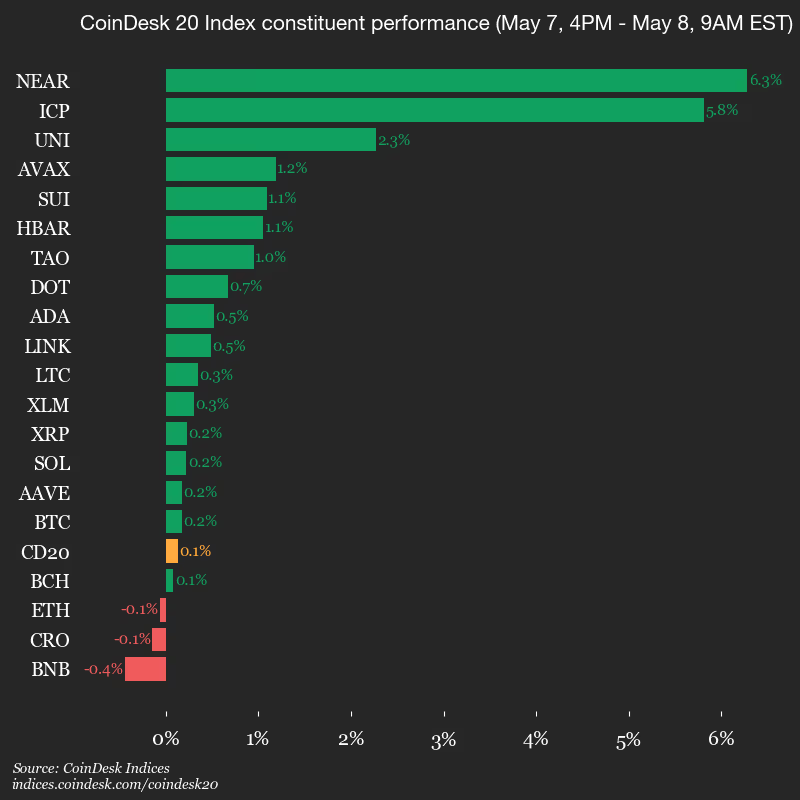
CoinDesk Indices presents its daily market update, highlighting the performance of leaders and laggards in the CoinDesk 20 Index.
The CoinDesk 20 is currently trading at 2142.44, up 0.1% (+2.73) since 4 p.m. ET on Thursday.
Seventeen of 20 assets are trading higher.

Leaders: NEAR (+6.3%) and ICP (+5.8%).
Laggards: BNB (-0.4%) and CRO (-0.1%).
The CoinDesk 20 is a broad-based index traded on multiple platforms in several regions globally.
Crypto World
Bitcoin Price Prediction: Bitcoin Falls to $79.6k as US-Iran Escalation Dents Risk Set for 6th Weekly Gain
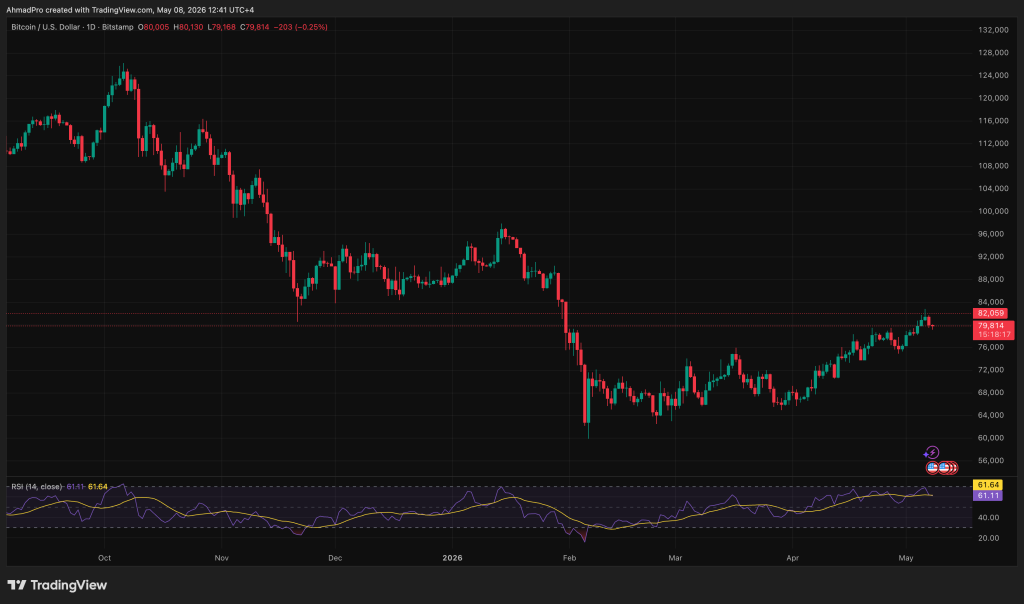
Bitcoin price slid to $79,679 Friday as US military strikes against Iranian vessels in the Strait of Hormuz triggered a broad risk-off prediction, yet the world’s largest crypto remains on track for a sixth consecutive weekly gain.
The 1.7% intraday drop looks alarming on the surface, but the weekly chart tells a quieter story. What happens at the weekend close could define whether BTC reclaims $85,000 or gives back the entire week’s advance.
The immediate catalyst: US forces struck back against Iran following attacks on three American warships transiting Hormuz, reigniting a geopolitical flashpoint that markets had largely priced out.
Compounding the pressure, Strategy Inc (NASDAQ: MSTR), the largest corporate Bitcoin holder, signaled it could sell portions of its holdings to fund dividend payments, though the scope and timing remain unspecified.
Despite the intraday weakness, BTC is still up approximately 3% on the week. The macro backdrop, institutional accumulation, improving US regulatory clarity, and residual post-ATH consolidation, remain broadly constructive heading into the weekend session.
Discover: The best crypto to diversify your portfolio with
Bitcoin Price Prediction: Can BTC Price Reclaim $85,000 Before the Weekly Close?
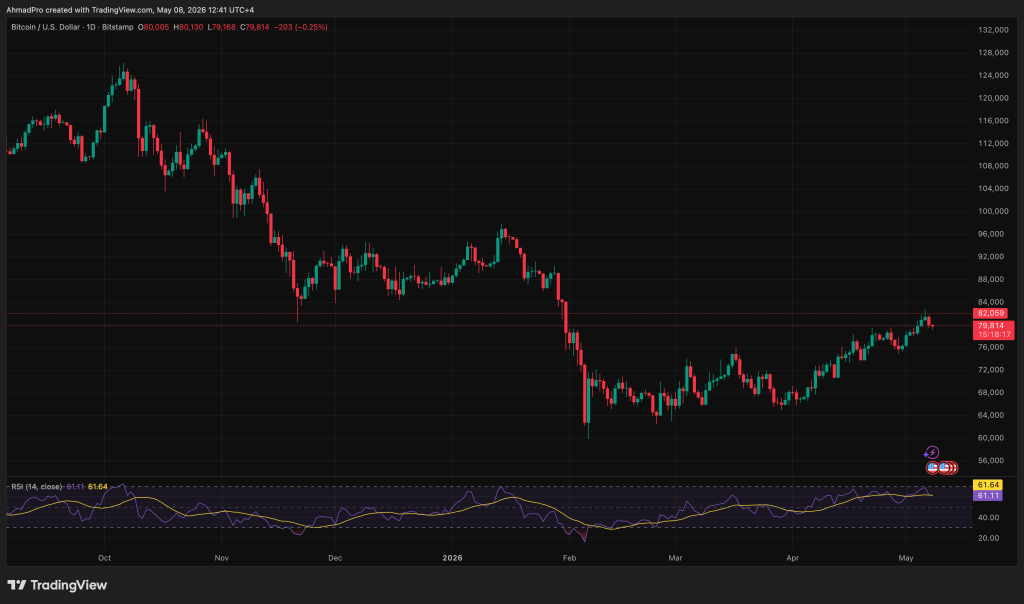
Bitcoin is trading in one of the most important structural zones of this cycle, hovering around $80K while pressure builds between key support and resistance.
The broader setup remains constructive, but only as long as $79K continues holding as the primary daily support floor. That level is doing the heavy lifting right now.
As long as buyers defend it, the post-correction recovery remains intact, with $83K–$85K still functioning as the major upside target and mean reversion zone after October’s sharp pullback.
On-chain data continues to show accumulation rather than broad distribution, which suggests larger players are still absorbing supply at current levels instead of exiting positions.
Resistance overhead remains significant, and Bitcoin needs a decisive break above that $83K–$85K region before any larger breakout narrative gains real credibility.
Until then, the market is essentially coiling. If BTC maintains this structure, the path toward stronger continuation remains open, but a breakdown below $75K would materially weaken the setup and shift focus toward the $69K long-term trendline as the next serious support zone.
Volume conditions also matter here, especially with thinner weekend liquidity increasing the probability of exaggerated moves in either direction.
The honest reality is that Bitcoin still looks structurally stronger than weaker, but this is a conditional setup where support must hold.
Discover: The best pre-launch token sales
The post Bitcoin Price Prediction: Bitcoin Falls to $79.6k as US-Iran Escalation Dents Risk Set for 6th Weekly Gain appeared first on Cryptonews.
Crypto World
XRP Price Could Start Another Rally: $7 Trillion Bank Announces Its Ripple Coin Investment

XRP price might be falling under its $1.40 support, but UBS, a Swiss banking giant managing $7 trillion in assets, has disclosed XRP exposure via a 13F filing with the SEC. The full scope of that filing reveals exactly which instruments the bank used, and why that distinction matters for price structure.
The bank accumulated 197,369 shares in the Volatility Shares XRP ETF and 317 shares in the Grayscale XRP Trust. Meanwhile, U.S.-listed spot XRP ETFs have drawn over $1.3 billion in cumulative inflows in their first 50 days, with 29 consecutive days of positive flows and a single-day peak of $13.59 million.
To put this into perspective, XRP’s exchange balances are simultaneously sitting at six-year lows, compressing available supply just as demand accelerates.
Discover: The best crypto to diversify your portfolio with
XRP Price Could Finally Have Its Awaited Rally
XRP broke out of a multi-week range earlier this week. This has preceded continuation, but instead, it had a short-term rejection. RSI sits at just under 50, after nudging the overbought threshold days ago.
Immediate support, for now, rests at the current price and the 50-period SMA. On a bullish note, a Technical analysis based on a Wyckoff reaccumulation breakout is targeting the $2.60–$2.70 zone, with an interim supply clustered at $2.15–$2.16.

To resume its rally, XRP needs to hold above $1.35, to then clear $$1.50 resistance, and ride institutional inflows toward $2.60–$2.70. Standard Chartered maintains an $8 price target on regulatory clarity.
However, a close below $1.35 would neutralize the current breakout thesis and expose the $1.20 support zone.
Institutional catalysts, including major ETF inflows and bank disclosures, have historically acted as short-term price accelerants for XRP.
Discover: The best pre-launch token sales
LiquidChain Does What XRP Can Only Dream
XRP’s institutional wave is real, but at the current price point, the asymmetric upside has compressed. Traders hunting for early-stage exposure before institutional re-rating are rotating attention toward infrastructure presales, where price discovery hasn’t yet occurred.
LiquidChain ($LIQUID) is a Layer 3 infrastructure project positioning as the cross-chain liquidity layer. It fuses Bitcoin, Ethereum, and Solana liquidity into a single execution environment.
With the 3 United, anything is possible. ⟁ — LiquidChain (@getliquidchain) May 8, 2026
 https://t.co/vqvBcdSQYC pic.twitter.com/50vrM4WX6v
Liquid’s architecture centers on a Unified Liquidity Layer with Single-Step Execution, Verifiable Settlement, and a Deploy-Once structure that lets developers access all three ecosystems without redeployment overhead.
The presale price is currently $0.01457, with more than $700K raised to date. The project is approaching the $750,000 milestone, a threshold that has historically drawn secondary attention from retail aggregators.
Readers researching cross-chain infrastructure exposure at this stage can explore LiquidChain’s presale details here.
The post XRP Price Could Start Another Rally: $7 Trillion Bank Announces Its Ripple Coin Investment appeared first on Cryptonews.
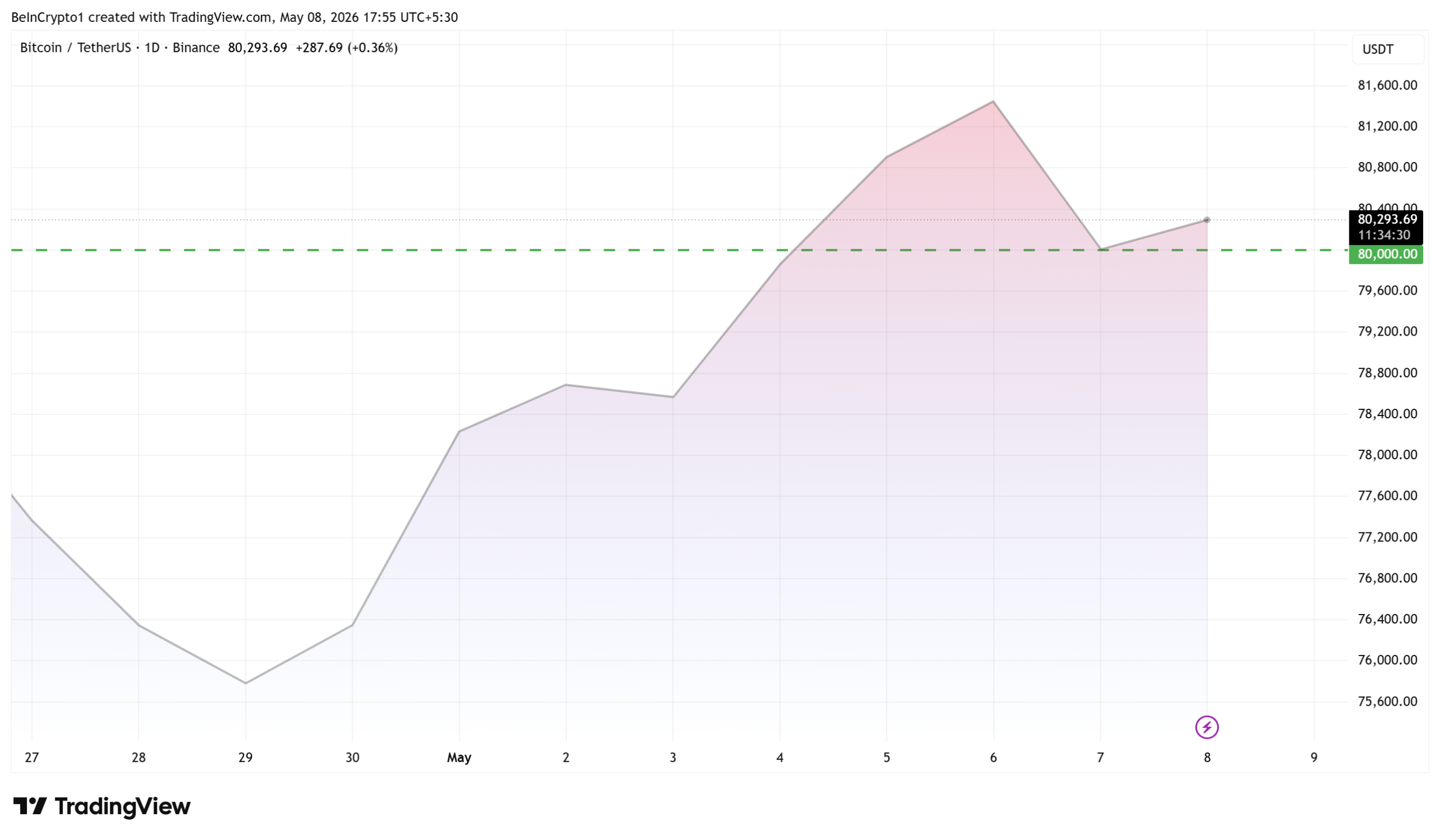
Revolut users worldwide saw Bitcoin (BTC) briefly displayed at $0.02 on Friday after a chart glitch in the fintech app, before the price snapped back within seconds.
The display problem surfaced through the app’s chart and push notifications, sparking widespread confusion across X (Twitter) and Reddit. Bitcoin continued trading above $80,000 on every major exchange during the incident.
What Happened on the Revolut App
Screenshots circulating on social media showed Bitcoin candles dropping to as low as $0.019916 on Revolut’s in-app chart, with similar anomalies appearing for Solana (SOL), XRP, and several other tokens.
“For 3 seconds, I thought I was about to buy the entire supply and become Satoshi’s final boss. Then I remembered: it’s probably just a Revolut chart glitch. Crypto never sleeps. Neither do bugs,” one user remarked.
Some users received push alerts claiming BTC had hit a 52-week low. The disruption lasted only a few seconds for most affected accounts.
Follow us on X to get the latest news as it happens
CoinGecko and CoinMarketCap showed no matching price action on tracked exchanges, indicating the issue was confined to Revolut’s display layer rather than any underlying market move.
Revolut Confirms Bitcoin Price Glitch
Revolut Support said the company was experiencing technical issues affecting some crypto functionalities, and that engineers were actively investigating the root cause.
The fintech, which holds a MiCA license through Cyprus and serves more than 68 million customers across 40 markets, has not detailed what triggered the faulty data feed.
The flash on screens arrived during a softer trading day for Bitcoin, which almost slipped below $80,000 after a modest correction that triggered almost $300 million in futures liquidations.

No user reports have confirmed any orders filling at the displayed glitch price.
Affected European and global users say balances and pending orders went unaffected, though the episode renewed concerns about how centralized apps handle third-party price feeds during volatile sessions.
Revolut has continued expanding its crypto footprint, including stablecoin settlement on Polygon, even after delisting some altcoins last year.
The post Revolut Confirms Bitcoin Price Glitch After App Briefly Shows BTC Near Zero appeared first on BeInCrypto.

Ether extended a retreat after failing to break above a key resistance zone, with ETH slipping to around $2,275 before attempting to stabilize. The move comes as a cluster of on-chain and market indicators point to softer near-term demand for Ethereum, potentially paving the way for further downside toward the $2,000 level and beyond.
Key takeaways
- On-chain activity is cooling: weekly average transactions declined about 10% to 4.79 million, while active addresses slipped 8% to 2.5 million, accompanied by a roughly 27% drop in network fees and a 47% fall in on-chain revenue over the past week.
- US-driven selling pressure persists: the Ethereum Coinbase Premium has remained negative since late April, signaling downside emphasis from US traders, alongside outflows from U.S. spot Ethereum ETFs totaling about $103 million and roughly $81.6 million pulled from global Ethereum investment products last week.
- Unstaking and liquidity exits accelerate: the Ethereum exit queue surged about 72,000% to 530,985 ETH by May 2, with more than 202,000 ETH queued for redemption by the latest update and an average wait of about three days. Total staked ETH stood at 38.6 million (31.72% of supply), despite a 45-day withdrawal lag.
- DeFi activity and TVL retreat: DefiLlama data show weekly DEX volumes dropping to $1.64 billion on May 8, a 46% decline over three weeks, while Ethereum’s DeFi TVL fell to about $124.7 billion, a level last seen in May 2025.
- Price pattern points to further downside risk: a rising wedge pattern on ETH/USD underpins a potential breakdown, with major support around $2,150–$2,200 and a pivotal threshold near $2,000. A break below $2,000 could target roughly $1,830, with scenarios suggesting $1,750–$1,850 if $2,300 support isn’t reclaimed.
Deteriorating on-chain fundamentals
Ethereum’s network activity has cooled in recent weeks as a measure of on-chain demand softens. Data from Nansen show the weekly average number of transactions dipping to 4.79 million, a 10% reduction from the prior period, while active addresses declined to about 2.5 million, an 8% drop. The ebbing activity coincides with lower fee revenue, as network fees fell roughly 27% over the past seven days, contributing to a 47% shrinkage in on-chain revenue during that span.
Analysts interpret these metrics as signaling weaker user conviction and diminished organic demand for ETH, which can complicate attempts to sustain upside momentum despite broader macro optimism. In parallel, DefiLlama’s weekly snapshot shows a sharp pullback in DeFi activity, with weekly DEX volumes sliding to $1.64 billion on May 8 — a 46% drop over three weeks — and Ether-based DeFi TVL sliding to about $124.7 billion, a level not seen since May 2025.
Liquidity drains and the staking exit queue
One of the more striking recent developments is the surge in the unstaking queue. By May 2, Ethereum’s exit queue had exploded to 530,985 ETH, up roughly 72,000% from the previous pace. By the latest readings, more than 202,000 ETH were queued for redemption, with an expected wait time of around three days. This wave of liquidity outflows has come alongside elevated risk sentiment in DeFi following a spate of hacks and attacks earlier in the year.
In April 2026, DeFi platforms suffered about $625 million in losses across 30 separate incidents, highlighted by the $292 million KelpDAO bridge exploit and a broader trend of deposits fleeing platforms like Aave — moves that intensified the perceived need for liquidity and liquidity preferences among investors. Analyst Pete, writing on X, summarized the risk atmosphere: “DeFi yield on Ethereum is getting crushed by hacks, exploits and increasingly nasty attack surfaces.”
Even as the exit queue surged, the stake base remained sizable. About 3.6 million ETH were queued for staking entry, keeping total staked ETH near 38.6 million and representing roughly 31.72% of circulating supply, despite an ongoing, roughly 45-day wait for stake withdrawal or redemption in many cases.
US flows, ETF dynamics and price follow-through
The near-term price trajectory is being shaped in part by ongoing dissemination of US-centric trading flows. The Ethereum Coinbase Premium Index has stayed negative since late April, implying that US buyers and sellers are driving price disparities relative to other markets. In tandem, spot Ethereum ETF activity reflected continued selling pressure: US-listed Ethereum ETFs logged $103 million in net outflows on a single session, marking the largest withdrawal since mid-March. Across global Ethereum investment products, outflows exceeded $81.6 million last week, underscoring a broader institutional tilt toward liquidity and risk reduction during the period.
On the market microstructure side, taker buy volume for ETH on Binance has dipped into negative territory, with figures as low as -$25 million in recent sessions, indicating a rise in aggressive market sell orders and a potential setup for near-term volatility and a retest of support levels, according to CryptoQuant commentary.
Technical setup: rising wedge and downside risk filters
From a chart perspective, ETH/USD has been trading inside a rising wedge that broke below its lower boundary near $2,300. The immediate hurdle remains at around $2,150–$2,200, where the 100-day and 50-week moving averages cluster, followed by a psychological test near $2,000. A decisive move below this threshold would open a path toward the measured wedge target near $1,830, with some analyses flagging a potential drop to the $1,750–$1,850 zone if the $2,300 level is not reclaimed promptly.
These dynamics align with recent coverage suggesting that a sustained move below critical supports could lead to a prolonged downside phase, even as headlines around DeFi security and ETF flows continue to influence price behavior in the short run. For traders watching the chart, the setup underscores the importance of monitoring both on-chain activity and macro liquidity signals in concert with price action.
Looking ahead, investors should watch how ETH behaves around the $2,000 mark, as well as the flow data from US and global Ethereum products. Ongoing security incidents in DeFi and shifting ETF allocations will likely continue to shape near-term sentiment, even as the broader crypto market narratives evolve.
This article was originally published as Four signs indicate Ethereum’s $2.4K rally is exhausted on Crypto Breaking News – your trusted source for crypto news, Bitcoin news, and blockchain updates.

Key Takeaways
- Anthropic is pursuing funding that would establish a pre-money valuation near $900 billion
- The AI company seeks to secure up to $50 billion to boost its computing capabilities
- Annual revenue projections show the company reaching beyond $45 billion soon, jumping from $9 billion in late 2024
- Major investors like Dragoneer, General Catalyst, and Lightspeed are reportedly interested
- If finalized, this funding would position Anthropic above OpenAI in market valuation
The AI firm Anthropic, creator of the Claude suite of artificial intelligence tools, is currently negotiating a fundraising effort that could bring in as much as $50 billion, the Financial Times reports. Sources indicate the company could achieve a valuation approaching $900 billion on a pre-money basis.
Should this valuation materialize, Anthropic would eclipse its competitor OpenAI in terms of market worth. Industry sources cited by the FT suggest the funding round could reach completion in the next two months.
The company’s valuation stood at $380 billion just months ago in February 2026. A leap to nearly $1 trillion would represent one of the most dramatic valuation accelerations in private technology sector history.
Annualized revenue figures for Anthropic are projected to exceed $45 billion in the near term. This represents a fivefold increase from the $9 billion figure recorded at year-end 2024.
According to the FT’s sources, investment firms including Dragoneer Investment Group, General Catalyst, and Lightspeed Venture Partners have expressed interest in participating in the funding round.
Major Tech Giants Already Invested Billions
Anthropic has previously attracted substantial financial backing from leading technology corporations. Google pledged as much as $40 billion at a $350 billion valuation, structured with $10 billion in immediate funding and an additional $30 billion contingent on hitting specific performance targets.
Amazon put $5 billion into the company with provisions allowing for up to $20 billion in additional investment. These arrangements were both negotiated at the $350 billion valuation established during February’s funding activity.
The new capital injection is earmarked for scaling up computational resources. Strong customer demand for Anthropic’s offerings has accelerated, and company representatives have indicated that supply limitations are currently constraining output capacity.
Strategic partnerships with Amazon Web Services, Google, and Broadcom have been established to guarantee sustained access to computing resources over the long term.
Claude Code and Cowork Fueling Revenue Surge
A significant portion of the demand surge stems from Claude Code, Anthropic’s specialized AI assistant engineered to accelerate software development workflows. Bloomberg’s reporting suggests this product’s explosive growth prompted the company to pursue additional funding on an accelerated timeline.
The company’s Cowork AI agent, targeted at professionals in non-technical departments, has similarly experienced rapid market uptake, company statements indicate.
Founded in 2021 by Dario Amodei alongside former OpenAI team members, Anthropic has emerged as one of the artificial intelligence industry’s most scrutinized players.
The ongoing fundraising discussions underscore the remarkable velocity at which investor interest in AI infrastructure has intensified. Anthropic is positioning itself to capitalize on this momentum through what could become one of the largest private capital raises ever recorded.
This potential funding round arrives as Anthropic continues building out partnerships with cloud computing providers to guarantee sufficient processing power for operating its sophisticated AI models.


The U.S. labor market continued to show at least modest strength in April, according to data released Friday by the Bureau of Labor Statistics.
The economy added 115,000 jobs during the month, well above economist expectations for 62,000, though down from 185,000 in March (revised from an originally reported 178,000).
The unemployment rate remained at 4.3%, in line with forecasts.
Bitcoin traded at $80,200 in the minutes after the release, roughly flat over the past 24 hours. U.S. stock index futures added to earlier gains, the Nasdaq 100 higher by 0.9%. The 10-year Treasury yield fell 2 basis points to 4.37%.
The report arrives at a delicate moment for markets and policymakers. Last week, the Federal Reserve left its benchmark fed funds rate range unchanged at 3.50%-3.75%, extending its holding pattern as officials weigh slowing economic growth against persistent inflation pressures.
The data also comes ahead of a new chairman taking the reins at the Fed, with Kevin Warsh expected to soon be confirmed by the Senate to replace Jerome Powell later this month.
Though off their highs, oil prices have remained elevated, with uncertainty around the Strait of Hormuz keeping energy markets on edge. Higher crude prices risk feeding into headline inflation while also weighing on consumer spending and economic activity.


Michael Saylor walked back his most absolute Bitcoin (BTC) maximalist rhetoric this week, telling investors Strategy will probably sell a portion of its 818,334 BTC holdings to fund dividend payments after a $12.54 billion first-quarter loss.
The pivot arrives roughly a year after Saylor told X followers to “sell a kidney if you must, but keep the Bitcoin” and posted his own decree that the only rules of Bitcoin were to buy and never sell.
From Maximalist Tweets to Earnings Call Reversal
In early 2025, Saylor flooded his timeline with absolutist messaging. On Feb. 2 he wrote “Never sell your Bitcoin.” On Feb. 3 he listed the “Rules of Bitcoin” as buying and refusing to sell. By March 4 he taunted shorts with “We can buy more Bitcoin than they can sell.”
The Q1 2026 earnings call delivered a different message. Saylor told analysts the firm would likely move BTC out the door to keep its preferred shareholders paid.
“We’ll probably sell some Bitcoin to fund a dividend just to inoculate the market, just to send the message that we did it.”
$12.5 Billion Loss Forces Pragmatic Pivot
Strategy booked a $14.46 billion unrealized markdown after Bitcoin fell from roughly $87,000 to $68,000 across the quarter. The firm now holds 818,334 BTC at an average cost of $75,537 per coin.
Bitcoin posted its worst opening quarter since 2018, dropping more than 23% as ETF outflows, tariff anxiety, and a hawkish Federal Reserve drained risk appetite.
CFO Phong Le said any sale would proceed only if it lifted Bitcoin per share. Saylor argued BTC needs to appreciate just 2.3% annually for the Strategy to cover its STRC dividends indefinitely through small disposals. The company carries $1.5 billion in yearly dividend obligations and roughly 18 months of cash coverage. The MSTR stock dropped after the call.
Critics Watch Saylor’s Bitcoin Pivot
Long-time skeptics pounced on the contradiction. Economist Peter Schiff has repeatedly labeled the firm’s Bitcoin-funded structure a Ponzi and questioned whether the dividend math holds without continuous BTC appreciation. He has also branded the equity itself a scam, intensifying scrutiny over how long the structure can hold.
The shift forces Saylor to reconcile two voices: the absolutist who told retail to mortgage everything, and the executive now selling to make payroll. The next earnings cycle will reveal whether that reconciliation comes quietly or through public correction.
The post Michael Saylor Backtracks From Sell a Kidney Stance to Selling Bitcoin appeared first on BeInCrypto.


Coinbase stopped working for over seven hours on Thursday after hot air in an Amazon data center threw its cloud services into disarray.
The exchange’s users found themselves unable to buy or sell crypto, while order book prices displayed hundreds of dollars higher than rival exchanges Binance and Hyperliquid.
The cause? Coinbase blames “increased temperatures in the affected AWS service.”
Amazon Web Services (AWS), which is one of the largest providers of cloud infrastructure that keeps much of the internet ticking over, claims to have suffered from a “thermal event” in one of its data centers in Northern Virginia.
Read more: Blockchain ‘alternative’ to Amazon Web Services just another crypto scam
The increase in temperature apparently affected its cloud hosting hardware, leading to a loss of power.
AWS quickly got to work on a solution, and as of this morning said it was “actively working to bring additional cooling system capacity online, which will enable us to recover the remaining affected racks in a controlled and safe manner.”
Amazon notes that its data centers rely on evaporation cooling, a system that involves filters in its air conditioning units being “dampened” with water, cooling any hot air that comes in and evaporating the water in the process.
Read more: Major crypto exchanges suffer complications after AWS outage
Whatever the fix was to the cooling system, it seems to have paid off as Coinbase noted in the last two hours that, “All markets have been re-enabled for trading on Coinbase Exchange.”
Before this, it said that it was working to re-enable trading and that it would have to place all markets “in ‘Cancel Only’ mode before we move to re-enable trading.”
After this, it moved the markets into “auction mode.”
AWS outage adds to Coinbase’s growing problems
The entire debacle adds to a pretty bad start to 2026 for Coinbase. It fired 14% of its staff last week, and suffered $394 million in losses during the first quarter of 2026.
Software engineer Gergely Orosz picked up on this, noting how the hours-long outage makes for “unfortunate optics for Coinbase… a few days after their CEO said how non-technical teams are shipping code to production.”
He said, “This outage is because Coinbase seems to have a hard dependency on AWS, and when AWS (or a part of it) is down, so is Coinbase,” adding that the whole thing is “terrible advertising.”
Crypto exchanges have already suffered outages related to AWS before in 2025, which caused Binance to suspend its withdrawals and caused issues for KuCoin, MEXC, and Rabby wallet.
In this case, data centers within the Singapore region had experienced a power loss, causing knock-on disruptions to firms reliant on AWS data centers within the area.
Got a tip? Send us an email securely via Protos Leaks. For more informed news and investigations, follow us on X, Bluesky, and Google News, or subscribe to our YouTube channel.
MDA Space opens expanded satellite manufacturing facility
Qualcomm (QCOM) Stock Surges 6% Following Daiwa Upgrade to Outperform

Jon Hamm Breaks Down ‘Your Friends & Neighbors’ Season 2’s Bold Twist After That Unexpected Death

Manchester United reach agreement with Casemiro over contract clause amid transfer speculation

US brings back mandatory military draft registration

Steven Gerrard disagrees with Gary Neville over ‘shock’ Chelsea and Arsenal claim | Football


-

 NewsBeat5 days ago
Channel 5 – All Creatures Great and Small series 7 new post
-

 Crypto World1 day ago
Upbit adds B3 Korean won pair as Base token gains Korea access
-
 Crypto World5 hours ago
HarrisX Poll Found 52% of Registered Voters Support the CLARITY Act
-
 NewsBeat1 day ago
NCP car park operator enters administration putting 340 UK sites at risk of closure
-
 Tech7 days ago
Trump’s 25% EU auto tariff breaches Turnberry Agreement that also covers semiconductors and digital trade
-
 Sports7 days ago
Paul Scholes issues Marcus Rashford reality check as agreement emerges over Man United star
-

 Tech4 days ago
Image AI models now drive app growth, beating chatbot upgrades
-

 Entertainment7 days ago
Met Gala 2026 Rumored Guest List Is Turning Heads
-
Entertainment7 days ago
New on Prime Video in May 2026 — Full List of Movies and Shows
-

 Entertainment7 days ago
Kylie Jenner Hit With Second Lawsuit From Ex-Housekeeper
-

 Sports7 days ago
Cavaliers vs. Raptors Game 6 live score, updates, highlights from 2026 NBA playoffs first-round series
-

 Entertainment5 days ago
Melissa Joan Hart and More Stars Attend 2026 Kentucky Derby
-
 Sports7 days ago
David Benavidez responds to team Canelo saying the fight will never happen
-
Entertainment6 days ago
New Netflix Movies in May 2026 — My Top 3 Picks to Stream
-
 Sports7 days ago
IPL 2026: ‘Love you darling’- Hardik Pandya’s reaction to MS Dhoni steals the show |Watch | Cricket News
-

 Entertainment7 days ago
Young and the Restless Next Week: Cane Arrested & Matt’s Deadly New Scheme!
-

 Tech7 days ago
Mother’s Day 2026 Gift Guide: Audio to Upgrade Mom’s Lifestyle
-
Crypto World6 days ago
Pi Network Mandates Protocol 23 Upgrade for All Mainnet Nodes Before May 15 Deadline
-

 Business5 days ago
Luka Doncic Injury Update: Doncic’s Hamstring Recovery Slows Lakers’ Hopes Against Thunder: Can He Run Yet?
-

 Business7 days ago
Can Victor Wembanyama Bring the NBA Ring to Spurs in 2026? Historic Playoff Run Fuels Title Dreams
You must be logged in to post a comment Login