

Crypto World
Which Countries Would Suffer Most in a Global Energy Shutdown? This Study Has Answers

The US-Israeli war on Iran has rattled energy markets, with many countries taking measures to conserve fuel.
Amid this, a March 2026 study by Energy World Mag examined 75 countries across seven factors to determine which nations would struggle most during global energy disruptions.
The study scored each country on a 0-100 scale, with higher scores indicating greater risk if energy supplies are disrupted. The factors included fossil fuel dependency, energy self-sufficiency, reliance on fuel imports, and more.
Singapore Leads Energy Vulnerability Ranking
Singapore topped the list. The city-state earned the highest vulnerability score of 85.2. Nearly 98% of its energy comes from fossil fuels.
Moreover, Singapore imports 100% of its natural gas. Its energy imports exceed domestic production by 243%.
Turkmenistan placed second with a score of 80.7. The country derives 100% of its power from fossil fuels, with zero alternative capacity. Average incomes of roughly $9,000 also limit the population’s ability to absorb price spikes.
Follow us on X to get the latest news as it happens
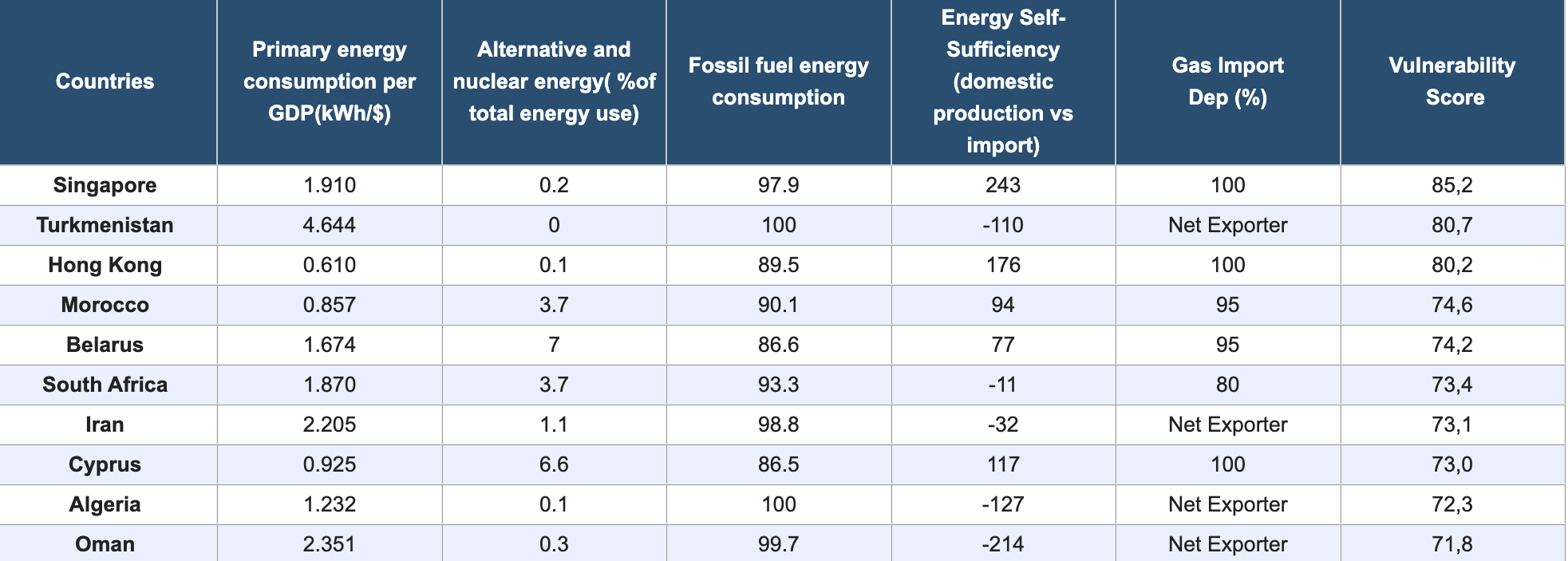
Hong Kong followed at 80.2. The city imports 176% more energy than it produces and relies on overseas sources for all of its natural gas.
Morocco (74.6) and Belarus (74.2) round out the top five, both importing the vast majority of their energy. At the same time, low average incomes ($4,000 and $8,000, respectively) leave their populations with limited capacity to handle price shocks.
An energy market analyst from World Energy Mag warned that even wealthy economies like Germany and Italy faced energy rationing during the 2022 crisis. Smaller import-dependent markets like Singapore and Hong Kong have even less capacity to cope with disruptions.
“Germany and Italy had to ration energy despite being among the world’s largest economies. The difference is that places like Singapore or Hong Kong have even less room to maneuver because they produce almost no domestic energy. When supplies get disrupted, they can’t just switch to local coal or increase their own gas production,” the analyst said.
Nonetheless, Singapore’s Minister for Manpower Tan See Leng noted that about half of the country’s gas arrives via piped natural gas, unaffected by the Middle East conflict. The government also maintains a fuel stockpile.
Still, with Brent crude exceeding $116 per barrel and supply disruptions expected to continue, concerns are rising. Whether current emergency reserves can absorb a prolonged disruption remains an open question for policymakers and markets alike.
Subscribe to our YouTube channel to watch leaders and journalists provide expert insights
The post Which Countries Would Suffer Most in a Global Energy Shutdown? This Study Has Answers appeared first on BeInCrypto.


Ether’s price flirted with the $2,000 level again as traders weighed a single, high-profile sell-off against broader on-chain signals. An veteran Ethereum holder liquidated a substantial portion of their stash last week, but the latest data suggests the move may be idiosyncratic rather than indicative of a sweeping exodus among long-time investors.
Key takeaways:
- An early Ethereum investor sold about 64,442 ETH across two transactions, totaling roughly $136 million, at an average price near $2,041 per ETH.
- On-chain metrics indicate older ETH holders did not uniformly depart their positions; supply dynamics show long-term holders continuing to accumulate or hold steady in aggregate.
- Analysts warn the price could retest lower levels, with some pointing to a potential move toward $1,500 if downside momentum persists and key supports fail.
OG ETH whale moves spark headlines, but broader signal remains mixed
The exodus came from a wallet believed to be among Ethereum’s oldest, with 55,000 ETH sold for about $112.25 million and an additional 9,442 ETH liquidated for around $24 million over the past week. The two-step exit culminated in a $136 million offload at an average price of $2,041 per ETH, according to blockchain tracker Lookonchain.
Underscoring that the move was a single-wallet decision, analysts emphasize it does not necessarily reflect a sweeping change in sentiment among long-term holders. Glassnode’s “HODL Waves” framework reveals that a substantial portion of ETH supply remains unmoved across multiple horizons. In particular, the share controlled by older cohorts has generally trended higher over the past year, suggesting a steady presence of committed holders even as some less‑seasoned participants take profits or exit.
That said, recent shifts within mid-term cohorts point to pockets of redistribution. The 3-month-to-6-month investor group saw its stake shrink to 9% from 13.5% on May 19, while the 1-week-to-1-month cohort slipped to 2.6% from 4.76% over the same period. In other words, while older wallets aren’t dumping en masse, a portion of supply is moving through shorter time horizons, consistent with more active trading cycles rather than a wholesale capitulation by veteran holders.
Beyond the distribution, a few notable players have publicly disclosed larger-scale sales in recent months. Still, there is little evidence of a systemic exodus that would dry up demand or push the market into a prolonged downtrend. As Cointelegraph observed, a handful of high-profile moves have raised eyebrows, but they appear to be exceptions rather than the rule driving the overall supply picture.
What the price action is signaling in a volatile week
ETH began the period hovering near the $2,000 mark, with the price easing to around $1,980 as of the latest trading update. That level remains psychologically important and technically influential for a market that has struggled to sustain a clear directional breakout since the May period of heightened volatility.
Analysts have offered a cautious read on the near-term downside risk. One observer, Alex Marzell, commented on X that “momentum continues to favor the bears as ETH moves closer to the next key support area,” highlighting the pressure around critical price levels below $2,000.
Other technical interpretations paint a more structural picture. Merlijn The Trader described the current action as aligning with a Wyckoff accumulation framework, noting Ethereum’s price action is in a “Phase B consolidation, post-selling climax” and entering “Phase C,” where a bottom could form below $1,500 if selling pressure persists. The three-day chart has become a focal point for bears and bulls alike as they assess the likelihood of a deeper retracement.
Echo Analysis joined the chorus of bears-on-watch, arguing that a bear-flag breakdown could project ETH toward a $1,500 support zone. This view dovetails with broader observations in the market about rising exchange supply and waning exchange-based demand, factors that have been cited by observers tracking potential downside risk for ETH in this cycle.
These technical perspectives are complemented by macro considerations around demand drivers. In coverage surrounding the broader Ethereum ecosystem, observers noted that rising on-exchange supply, combined with cooling ETF demand in certain regions, could contribute to a renewed testing of lower boundaries. The synthesis of on-chain behavior and market structure points to a delicate balance between hodling inertia and a renewed appetite for risk among shorter-term traders.
What the data say about risk and resilience in ETH’s drawdown period
Looking back at the supply dynamics, the longer-hold cohorts (spanning several years) have generally shown resilience rather than erosion. The proportion of ETH held by older investors has risen in recent months, suggesting a more committed base that could act as a counterweight to near-term downside pressure. By contrast, younger cohorts, particularly those with 3 months to 6 months of on-chain history, have trimmed their holdings, focusing more on liquidity and tactical trading opportunities.
The implication for traders and builders is nuanced. On the one hand, a robust reserve of long-term holders can provide eventual price support if macro conditions improve or demand rekindles. On the other hand, persistent selling pressure from agile, short-term traders could drive further volatility and test mid-cycle support levels. For developers and institutions building on Ethereum, this bifurcation underscores the importance of liquidity-aware strategies, risk controls, and a willingness to adapt to evolving on-chain flows rather than rely on a single narrative about investor sentiment.
As noted by Cointelegraph previously, the near-term risk hinges on the confluence of on-chain supply dynamics and external demand signals. The current mix—stable long-term holder participation coupled with selective selling by mid-term cohorts—suggests that the market could remain range-bound until a more decisive catalyst appears, whether that be a shift in macro risk appetite, a reset in ETF demand, or a fresh wave of on-chain utility proving its value to users and institutions.
What to watch next for ETH
Price watchers should monitor whether ETH can establish a firm base near the 1,800–2,000 range, which multiple analysts have flagged as a potential decisive zone. If sustained buying returns above $2,000 and key momentum indicators improve, the path could open for a revival of upside momentum. Conversely, a break below the near-term supports around $1,800 and the looming $1,500 level would intensify the case for a deeper correction, particularly if bear-market patterns reassert themselves in the Wyckoff framework.
On the on-chain front, investors should track whether the share of supply held by the 5-7 year cohort continues to hover near or above 9% and whether the “last active” window for older wallets remains relatively quiet. A sustained uptick in activity among the long-dated wallets could signal a renewed willingness to participate in mid-cycle demand, while any sudden surge in older wallet turnover might foreshadow a broader shift in conviction.
Readers should also keep an eye on the broader market context: shifts in exchange balances, ETF-driven demand, and developments within the Ethereum ecosystem—especially scaling and regulatory moves—that could alter the fundamental demand environment for ether. While a single wallet’s sale has captured attention, the weight of on-chain data points to a more complex picture of participation and risk that may unfold over weeks rather than days.
In summary, the current environment presents a mixed signal: a notable but not market-defining sell-off by a single veteran holder against a backdrop of stubborn long-term ownership and selective short-term trading activity. The coming sessions will be telling for whether the dip lasts or the market finds a durable footing in the $2,000 vicinity, with a keen eye on the $1,800 and $1,500 levels as potential magnets for further volatility.
As ongoing coverage notes, the interplay between supply dynamics, demand catalysts, and technical patterns will continue to shape ETH’s path. Investors should approach the next moves with a balanced view of on-chain signals, macro context, and the evolving structure of who owns and who trades Ethereum.


Disclosure: The author of this story owns shares in Strategy (MSTR).
Strategy (MSTR) Executive Chairman Michael Saylor appeared to underscore the company’s focus on its perpetual preferred stock, making STRC the focus of his first public comment after the largest publicly traded holder of bitcoin sold the cryptocurrency to fund dividend payments on the instrument.
“Our goal is to make STRC the best credit instrument in the world,” Saylor wrote on X on Monday.
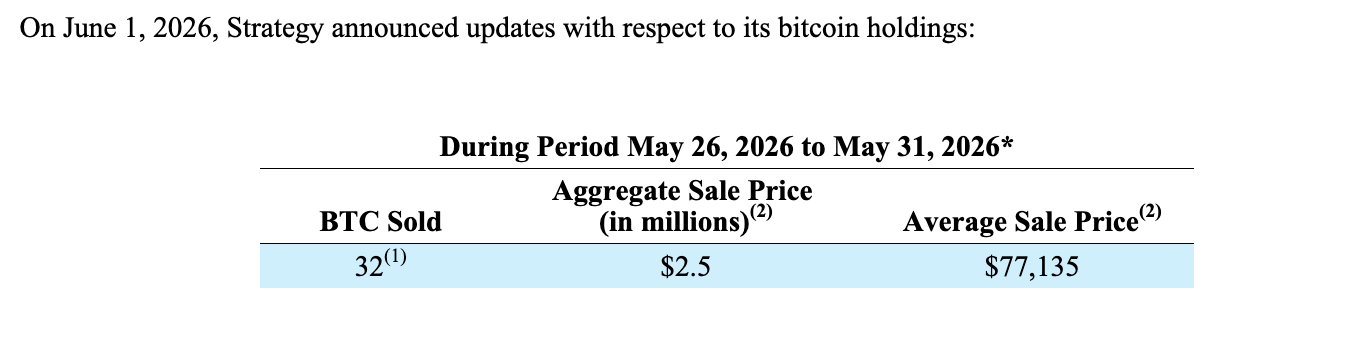
The post came after the company said it sold 32 bitcoin for about $2.5 million last week. Proceeds from the sale “are expected to be used to fund distributions on preferred stock,” it said in an 8-K filing.
While the filing directly linked the sale to the dividend payment, Saylor’s decision to highlight the equity rather than the bitcoin sale is likely to reinforce investor perceptions that the company is increasingly focused on building its preferred stock while growing bitcoin exposure on a per-share basis.
Saylor has repeatedly argued that Strategy evaluates financing and capital allocation decisions through the lens of bitcoin per share and increasing shareholder value rather than simply maximizing the amount of bitcoin it owns.
Buy high, sell low
A running joke among crypto followers on X, the so-called Crypto Twitter, is that Strategy always buys bitcoin at the weekly high.
Yet the company’s only previous bitcoin sale took place in December 2022, when the largest cryptocurrency was priced at roughly $18,000, just weeks after the collapse of crypto exchange FTX pushed prices to a cycle low near $15,000.
This time, it sold at an average price of $77,135, with bitcoin now trading around $70,000 after falling as low as $60,000 in February. The question is whether it has again sold near a market bottom.
Crypto World
Space Sector Faces Reality Check: Rocket Lab (RKLB), Firefly and Redwire Plunge on Valuation Concerns

Key Takeaways
- Shares of Redwire plunged almost 15% following a Jefferies downgrade to Hold after the stock surged 163% in just 30 days
- Rocket Lab tumbled more than 13% on Monday amid widespread selling pressure across space-related equities
- SpaceX’s anticipated June IPO may trigger a “sell the news” reaction that pressures space sector valuations
- Sector valuations have become extremely elevated, with AST SpaceMobile trading at 260x projected 2026 revenues
- Technical indicators show Rocket Lab is overbought, with RSI at 80 and Stochastic Oscillator exceeding 90
Space-related equities experienced significant losses on Monday, with Rocket Lab, Redwire, and Firefly Aerospace leading the decline. The sector-wide retreat reflects growing investor concerns about inflated valuations as SpaceX’s highly anticipated initial public offering draws closer.
Redwire experienced a nearly 15% decline after Jefferies analyst Sheila Kahyaoglu shifted her rating from Buy to Hold. While she increased her price objective from $13 to $24, Kahyaoglu indicated that substantial upside potential appears limited at present levels. The downturn follows an extraordinary 163% rally over the previous 30-day period.
Rocket Lab plummeted over 13% during the same trading session. The company’s shares have skyrocketed more than 4,000% from pandemic-era lows and recently touched record highs, though technical analysis tools are now suggesting caution.
Technical Indicators Point to Overextended Conditions
Rocket Lab’s Relative Strength Index climbed to 80, a threshold commonly associated with overbought market conditions. Similarly, the Stochastic Oscillator surged past 90. The equity currently trades at $143, substantially exceeding its 50-week moving average of $68 and its 100-day moving average of $50.
Market observers suggest that a reversion toward the $100 support zone could materialize if downward pressure persists. This price point represented the stock’s previous January peak.
Firefly Aerospace declined approximately 12%, while AST SpaceMobile shed roughly 9% during Monday’s session. Intuitive Machines also posted losses. Collectively, these four companies had posted an average 59% gain throughout April.
The Procure Space ETF was positioned more than 20% above its 50-day moving average entering Monday’s trading. A retreat to that technical level would constitute a significant correction for the exchange-traded fund.
SpaceX Public Offering May Catalyze Sector-Wide Profit Taking
SpaceX’s initial public offering is slated for June and could assign Elon Musk’s aerospace venture a valuation exceeding $2 trillion. Polymarket traders are betting the company will achieve that market capitalization on its debut trading day. The offering would establish a new record as the largest IPO in history.
Space stocks have rallied in the months leading up to this milestone event. However, market strategists caution that this trend could swiftly reverse once the IPO materializes. Sell-the-news episodes represent a familiar market phenomenon where participants accumulate positions before significant events, then liquidate when those events occur.
Valuation metrics throughout the sector have reached elevated levels. AST SpaceMobile commands 260 times its projected 2026 revenue. Rocket Lab trades at 91 times sales, a substantial increase from below 20 times one year earlier. Redwire’s valuation stands at nearly 9 times sales, up from 3 times previously.
Rocket Lab does maintain solid operational momentum. The organization reported 43% revenue growth to $200 million in the most recent quarter and maintains a $2.2 billion contract backlog. The company also successfully completed a System Requirements Review for the Space Development Agency’s Tracking Layer Tranche 3 constellation under an $816 million agreement, pushing total SDA-related contracts beyond $1.3 billion.
Nonetheless, the enterprise recorded a $40 million quarterly loss and carries a forward price-to-sales multiple of 48. Achieving profitability remains an objective for the future rather than current financial performance.
The space sector continues commanding significant market attention heading into June, with SpaceX’s public market debut poised to determine the industry’s near-term trajectory.

Crypto World
ExxonMobil (XOM) Stock Jumps Nearly 3% on Crude Rally Triggered by Iran Diplomatic Freeze

Key Highlights
- Iran’s suspension of nuclear discussions triggered a 6.2% spike in Brent crude to $96.77, while WTI surged 7% to $93.48
- ExxonMobil shares advanced 2.9% to $149.41, breaking a week-long decline
- BP surged 3.5% to lead major oil stocks; Chevron and Shell each gained more than 2%
- First-quarter earnings showed XOM delivering $1.16 EPS, exceeding analyst expectations of $0.98
- Wall Street maintains a “Hold” rating with an average price target at $165.55
Oil prices experienced a dramatic surge Monday following Iran’s decision to halt intermediary-led nuclear discussions, a move attributed to ongoing Israeli military operations in Lebanon. The geopolitical development triggered substantial gains across crude markets and energy equities.
Brent crude futures jumped 6.2% to reach $96.77 per barrel, while West Texas Intermediate advanced 7% to $93.48. These represent significant single-session movements in the energy complex.
Shares of ExxonMobil (XOM) climbed 2.9% to trade at $149.41 during late-morning hours, ending a seven-session decline. The advance represents the stock’s most substantial single-day percentage gain since May 15, according to Dow Jones Market Data. Intraday trading saw XOM touch a high of $149.59.
Chevron (CVX) shares rose 2.9% to $187.67, marking its strongest daily performance since March 11. BP (BP) topped the major oil producers with a 3.5% advance to $43.34 — matching its best single-day showing since March 11. Shell (SHEL) American Depositary Receipts gained 2.2% to $85.99. The Energy Select Sector SPDR Fund (XLE) climbed 2.3% to $57.56.
The reversal carries particular significance given recent market dynamics: crude prices had been declining throughout the previous week on expectations of a diplomatic breakthrough between Washington and Tehran. Those prospects have now evaporated.
Patrick De Haan from GasBuddy offered a straightforward assessment: “The coast is anything but clear.” While he acknowledged that retail fuel prices had retreated — the nationwide average for regular unleaded gasoline dropped 19.5 cents over seven days to $4.256 per gallon — he warned that escalating geopolitical tensions could swiftly reverse that downward trajectory.
Strong Quarterly Performance Supports Valuation
Beyond Monday’s geopolitical catalyst, XOM’s fundamental business metrics remain robust. The energy giant posted first-quarter earnings per share of $1.16, surpassing Wall Street’s consensus forecast of $0.98 by $0.18. Quarterly revenue totaled $83.16 billion, exceeding analyst projections of $81.13 billion and representing a 2.4% year-over-year increase.
ExxonMobil announced a quarterly cash dividend of $1.03 per share, scheduled for distribution on June 10. This translates to an annualized dividend yield of 2.8%.
Analyst sentiment remains cautiously optimistic without a rush toward upgrades. Barclays elevated its price objective to $182 while maintaining an Overweight rating on May 26. Scotiabank increased its target to $163 with a Sector Outperform designation. Mizuho revised its 2026 and 2027 oil price forecasts upward and correspondingly raised its XOM valuation.
The average Wall Street rating across 21 analysts stands at “Hold,” with a mean price target of $165.55 — approximately 10.8% above Monday’s trading price.
Institutional Ownership Patterns Show Stability
Peapack Gladstone Financial reduced its XOM stake by 1.7% during the fourth quarter but continues to hold 708,829 shares worth approximately $85.3 million — representing the firm’s 17th-largest equity position.
Institutional investors collectively control 61.8% of outstanding XOM shares. Insider transactions have been minimal; Vice President Darrin L. Talley divested 1,080 shares in March at a price of $155.50 per share.
XOM opened Monday’s session at $145.42. The stock trades within a 52-week range of $101.18 to $176.41 and carries a market capitalization of $602.75 billion.
Since coordinated strikes by Israel and the United States against Iranian targets began on February 28, XOM has declined 2.2% — making it the weakest performer among major integrated oil companies during that timeframe. BP has posted the strongest result with an 11.5% gain over the identical period.


Strategy (MSTR), the company whose bitcoin accumulation strategy inspired a new generation of so-called digital asset treasury firms, sold BTC for the first time since December 2022, offloading roughly $2.5 million worth of tokens.
The move came as the scheme has faced major headwinds since gaining popularity last year.
Dozens of companies raised capital through stock and debt offerings to buy bitcoin, ether (ETH) and other cryptocurrencies, aiming to replicate Michael Saylor’s playbook. The model worked for a while last year as crypto prices surged and treasury stocks traded at premiums to their underlying values.
However, that all changed as crypto markets peaked in October. As token prices fell and treasury stocks slipped below net asset value, many firms lost the ability to raise capital on attractive terms, and some stocks fell more than 90% from their peak. Some stopped buying, while others turned into sellers.
Through all that, Strategy held strong and kept buying as its Executive Chairman, Michael Saylor, continued to advocate for buying and holding.
But that didn’t hold for long. Strategy first alluded to a potential sale earlier in May and then finally reported the first sale on Monday, June 1. With Strategy breaking its accumulation streak and many peers stepping aside, some might think it’s the final nail in the coffin for the treasury firms, as the list of active buyers has now narrowed considerably.
Still buying
However, a few remaining companies continue to buy. Among them is Bitmine (BMNR), Tom Lee’s Ethereum treasury company.
The company purchased roughly $53 million worth of ETH last week and accumulated over 338,000 tokens through May, worth roughly $665 million at current prices. It holds more than 5.4 million ETH, making it the largest corporate holder of the token.
However, Tom Lee said the firm plans to slow its accumulation pace as it approaches its goal of owning 5% of the ETH supply.
Another Ethereum-centric Bit Digital (BTBT) returned to the market in May, buying $20 million worth of ETH. That was the company’s first purchase since October.
Some bitcoin-focused firms are still buying.
Strive (ASST) disclosed acquiring roughly 1,944 BTC in May, spread across multiple purchases, at a cost of about $150 million. Japan’s Metaplanet also reported a purchase in early April, when it acquired 5,075 BTC.
Hyperliquid Strategies (PURR), the treasury firm focused on buying HYPE, the native token of red-hot Hyperliquid blockchain-based exchange and its ecosystem, said it spent $216 million to buy 7.3 million tokens between early December and the end of April. Given HYPE’s surge to record highs, the return on that investment has more than doubled since then.
Despite last week’s sale, Strategy remained one of the largest sources of bitcoin demand through May, purchasing more than 25,000 BTC for over $2 billion.
The sellers
On the other hand, several firms have been reducing crypto holdings recently.
Nakamoto Holdings (NAKA), the bitcoin treasury company led by David Bailey, sold 284 BTC in March, about 5% of its holdings. Empery Digital sold 370 BTC in April to repay a term loan. Genius Group (GNS) said in April it liquidated its remaining 84 BTC to pay down $8.5 million of debt.
Meanwhile, others have abandoned the treasury model entirely.
Forum Markets, formerly known as ETHZilla, shifted its focus to tokenization earlier this year after selling roughly $114 million worth of ether.
VivoPower, which had planned to build an XRP-focused treasury, pivoted to data center and AI infrastructure in February, divesting its Ripple-related investments and XRP holdings.
Read more: Digital asset treasuries must now earn their keep


Ethereum co-founder Vitalik Buterin is exploring a new way to build crypto investment products that could reduce one of decentralized finance’s biggest risks: sudden liquidations.
In a research post published Monday, Buterin proposed creating index-tracking assets using options contracts rather than the debt-based structures that underpin much of DeFi today. The idea is to allow users to gain exposure to a basket of crypto assets, similar to an index fund, without relying on collateralized debt positions (CDPs), which can be wiped out when markets move sharply.
“What if we use options as the base of DeFi, instead of CDPs and liquidations?” Buterin wrote in a post shared on X.
Under today’s DeFi model, users typically borrow against crypto collateral to create synthetic assets or stablecoins. If the value of that collateral falls too quickly, positions can be automatically liquidated, often triggering cascades of forced selling during periods of market stress.
Buterin argued an options-based system could replace that abrupt “you get liquidated” dynamic with a smoother process. Rather than instantly losing a position when prices move against a trader, exposure would gradually diverge from a target allocation, potentially making the system more resilient during periods of volatility.
A key advantage, according to Buterin, is that the design could function using slower-moving price oracles, the data feeds that tell DeFi protocols what assets are worth. Most DeFi applications today rely on near real-time oracle updates, which can become targets for manipulation during periods of market turbulence.
By contrast, Buterin said an options-based framework could work with “slow oracles” similar to those used by prediction markets. That could reduce the risk of protocols acting on incorrect price data and lessen the need for split-second automated liquidations.
The proposal is particularly relevant to algorithmic stablecoins, which have historically depended on oracle systems and collateral mechanisms that can fail under stress. Buterin said he would feel “much safer” holding algorithmic stablecoins built on an options-based structure than one that depends on real-time oracle feeds that could potentially be manipulated.
The idea comes with tradeoffs. Buterin acknowledged that such a system would require regular portfolio rebalancing and that it remains unclear whether those adjustments can be made cheaply and efficiently enough to avoid excessive trading costs or slippage.
The concept remains theoretical and has not been implemented on Ethereum. Still, it reflects a broader effort by Buterin to rethink the foundations of DeFi and develop systems that prioritize robustness over leverage.
Read more: Buterin says Ethereum Foundation will shrink, sell less ETH, and focus on ‘CROPS’
Crypto World
Strategy’s $2.5 million BTC sale and lessons from the first time MSTR sold in December 2022


When Strategy (MSTR) disclosed that it sold 32 bitcoin in May, memories were jogged of the company’s first-ever bitcoin sale in December 2022.
Both events generated headlines questioning whether Michael Saylor’s company was backing away from its long-standing bitcoin accumulation strategy. Both prompted scrutiny of the firm’s finances. Both represented extraordinarily rare moments in the history of the world’s largest corporate bitcoin holder.
Yet the more useful lesson from the 2022 sale may be that investors should be cautious about reading too much into any single disposal.
Late 2022 was one of the most tumultuous periods in cryptocurrency’s history, the culmination of the “crypto winter” that unfolded that year which came to a head with the collapse of exchange FTX in early November.
From a high of around $69,000 a year earlier, bitcoin had fallen over 75% to below $16,000.
“Of course bitcoin isn’t going to zero,” geopolitical strategist Peter Zeihan wrote on X on Nov. 12. “We have carbon taxes in some places. Bitcoin is going negative.”
The following month, MicroStrategy as it was then known, sold 704 BTC for roughly $11.8 million as bitcoin traded near $16,500. The company said the transaction was designed to harvest tax losses that could offset future gains.
Michael Saylor’s firm then bought 810 BTC two days later, leaving its overall bitcoin position larger than before.
At the time, however, many critics saw something more consequential.
Gold advocate Peter Schiff argued the sale exposed cracks in Saylor’s unwavering commitment to bitcoin and suggested it could be the first step toward a broader liquidation.
“Shares of MicroStrategy just made a new 52-week low, down 90% from the record-high in Feb. 2021,” he wrote in a separate post. “Don’t make the mistake of thinking 90% off is a good buy. This isn’t just a sale, it’s a going-out-of-business sale.”
History unfolded differently. Rather than marking the beginning of a selling cycle, the December 2022 transaction occurred near the bottom of the bear market. Over the following years, bitcoin rebounded to record highs while Strategy dramatically expanded its holdings. The company’s stash has since grown from roughly 132,500 BTC at the end of 2022 to more than 843,000 BTC today.
That experience could tempt investors to dismiss the latest sale as equally irrelevant. But doing so risks overlooking how much the company itself has changed.
The Strategy of 2022 was largely a leveraged bitcoin holder. The Strategy of 2026 is a far more complex financial vehicle built around bitcoin ownership. The company now manages a capital structure that includes convertible debt, common-equity issuance programs and multiple preferred-stock offerings designed to attract different classes of investors.
Against that backdrop, selling 32 BTC, worth roughly $2.5 million and representing less than 0.004% of its holdings, is financially insignificant. But the transaction may reflect a broader reality: bitcoin sales are no longer unthinkable within Strategy’s operating model.
“This may just be the beginning of much larger sales to come,” Schiff wrote on X following news of Strategy’s second sale. “Plus, if MSTR just stops buying more bitcoin that’s a huge problem for bitcoin.”
That does not mean the company is abandoning accumulation. Strategy continues to buy bitcoin aggressively and raise capital to fund additional purchases. But unlike in 2022, the question is no longer whether Strategy will ever sell bitcoin.
The more relevant question is whether future sales remain rare exceptions or become another routine tool in the management of an increasingly sophisticated bitcoin treasury empire.
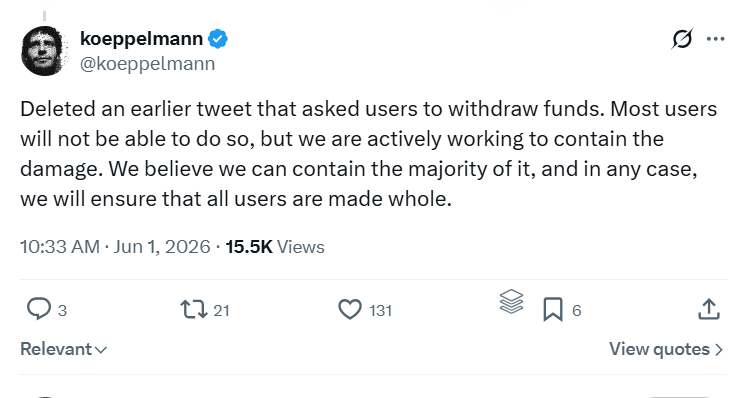
Gnosis is working to contain an exploit Monday affecting its Gnosis Pay product after co-founder Martin Köppelmann acknowledged an active hack involving the system’s delay module and said the project would cover user losses.
Köppelmann initially urged users to withdraw funds, a warning quickly amplified by blockchain security firm PeckShield, which said users were strongly advised to withdraw all funds (EURe and GNO) and check exposure.
The Gnosis co-founder later withdrew that advice, however, and deleted the initial tweet, saying that most users would not be able to withdraw their funds. He reiterated that the Gnosis team is “actively working to contain the damage” and will make users whole.
Gnosis is a long-running Ethereum project best known for its smart contract wallet infrastructure and Gnosis Chain, an Ethereum Virtual Machine (EVM)-compatible network used for payments and decentralized finance.
The shifting guidance leaves key questions unanswered, including how much has been stolen, which contracts or users are affected, and whether the issue stems from the Zodiac delay module itself, its configuration within Gnosis Pay, or a broader architectural flaw.
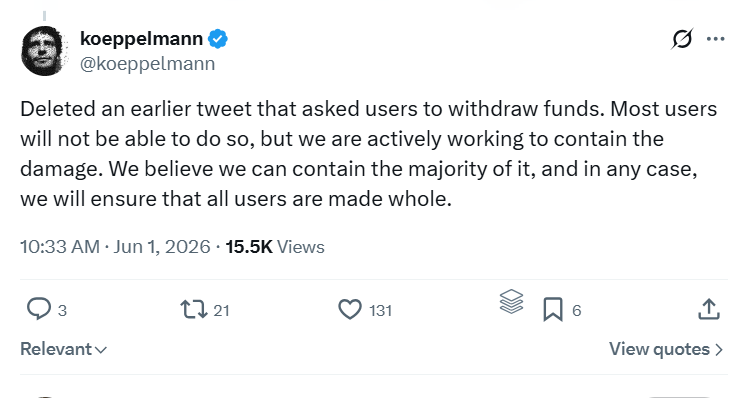
Gnosis co-founder pledges to make users whole. Source: Koeppelmann
Cointelegraph reached out to Gnosis and Gnosis Pay for comment, but had not received a response by publication.
Former Near protocol core developer Vadim Zacodil said Gnosis Pay’s design routes user self-custody through a shared “delay” layer that queues outgoing transactions from many Safes at once, so a bug or exploit there can push malicious withdrawals into thousands of users’ queues simultaneously, even though individual keys never move.
In practice, he argued, what is protecting users in this incident is less the self-custodial Safe accounts and more Gnosis’s ability to pause infrastructure and commit treasury funds to cover losses.
Related: Cosmos-based Gravity Bridge halts bridge after reported $5.4M exploit
Incident follows third-party Safe module exploit
The incident comes just days after a separate exploit involving a third-party module connected to Safe, the smart contract wallet infrastructure originally incubated within the Gnosis ecosystem and now developed by Safe Labs.
In that case, a SquidRouterModule contract interacting with Safe wallets was abused to drain about $3.2 million from roughly 86 Safes across Ethereum and Base, prompting both Safe Labs and Squid to say the vulnerability lay outside their core protocols.
It also comes after a month of reduced crypto exploit losses on the whole. Data from CertiK posted Sunday showed total losses fell to about $68.3 million in May, a roughly 90% decline from April, marking the third month this year with losses below $100 million.
[Update 1:57 P.M. UTC, June 1 — Updates third paragraph with share price decline in Monday morning trading.]
Strategy sold 32 BTC last week, its first reported Bitcoin sale since a 2022 tax-loss transaction, as the company moved to fund preferred stock distributions.
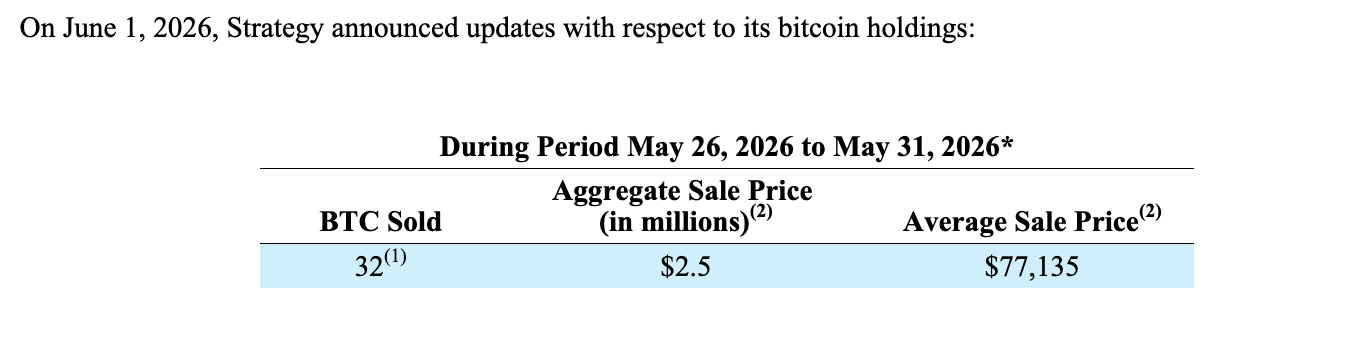
Strategy sold 32 Bitcoin (BTC) for $2.5 million at an average price of $77,135 per BTC, reducing its holdings from 843,738 BTC to 843,706 BTC, according to a Monday 8-K filing with the US Securities and Exchange Commission.
The company’s MSTR Nasdaq-traded shares fell more than 6% following Monday’s market open, last trading at about $148.70 apiece.
Proceeds from the Bitcoin sale are expected to be used to fund distributions on preferred stock, the company said.
Source: SEC
The sale came after Strategy faced increased scrutiny over its preferred stock financing model, as investors questioned whether dividend obligations could eventually pressure the company to sell some of its Bitcoin.
The sale is Strategy’s first reported Bitcoin disposal since a 2022 tax loss transaction, when the company sold 704 BTC and repurchased 810 BTC two days later.
Bitcoin (BTC) price chart over the past 24 hours. Source: CoinGecko
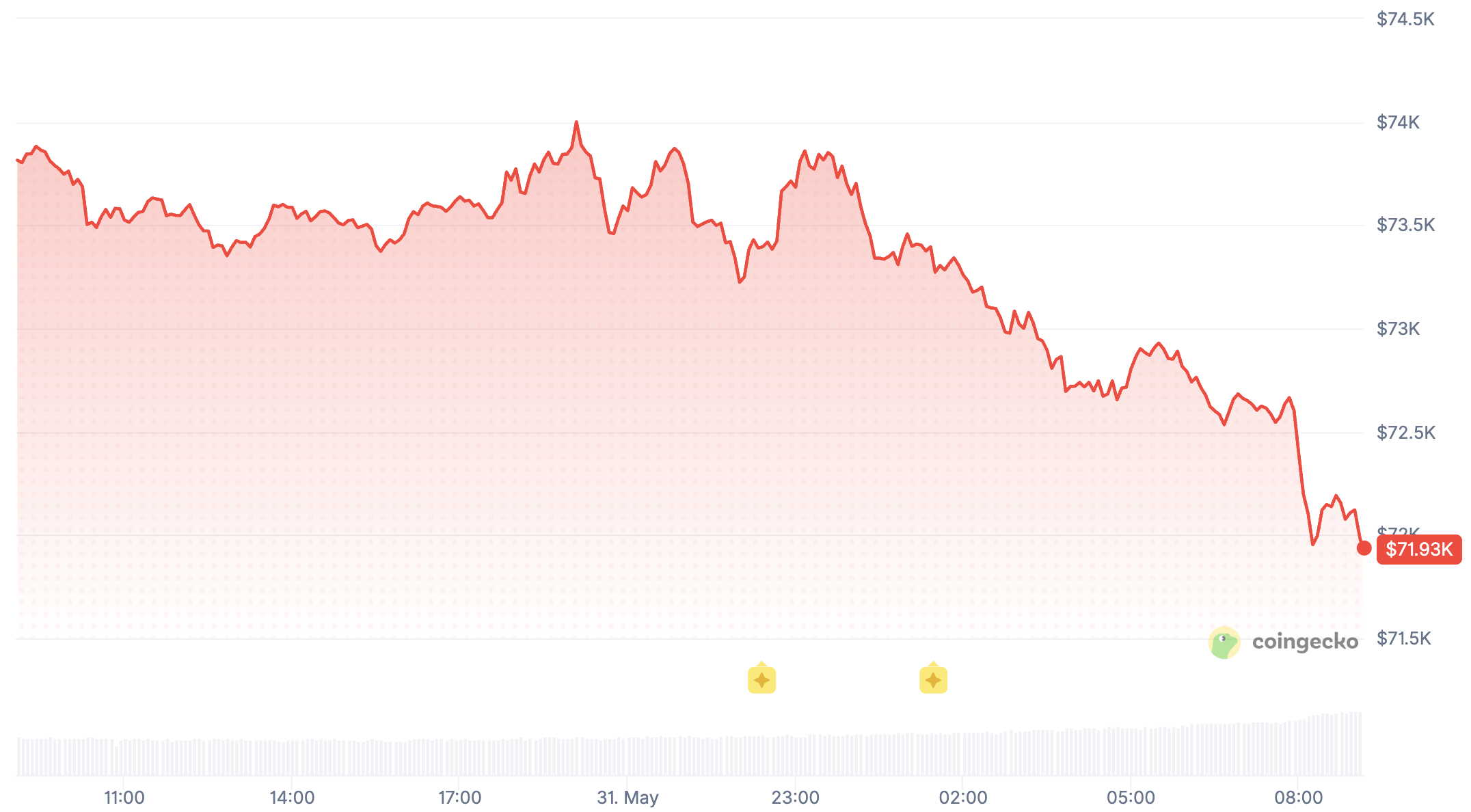
Bitcoin slipped below $72,000 following the disclosure and traded at $71,939 at the time of writing, according to CoinGecko.
Strategy sells $128 million in Common A stock
In addition to selling Bitcoin in the last week of May, Strategy also offloaded 801,994 Class A (MSTR) shares, generating $128.3 million in proceeds.
No preferred stock raises took place over the week, aligning with reports by STRC Live, which estimated that Strategy would announce no buys for the past week.
Source: Polymarket
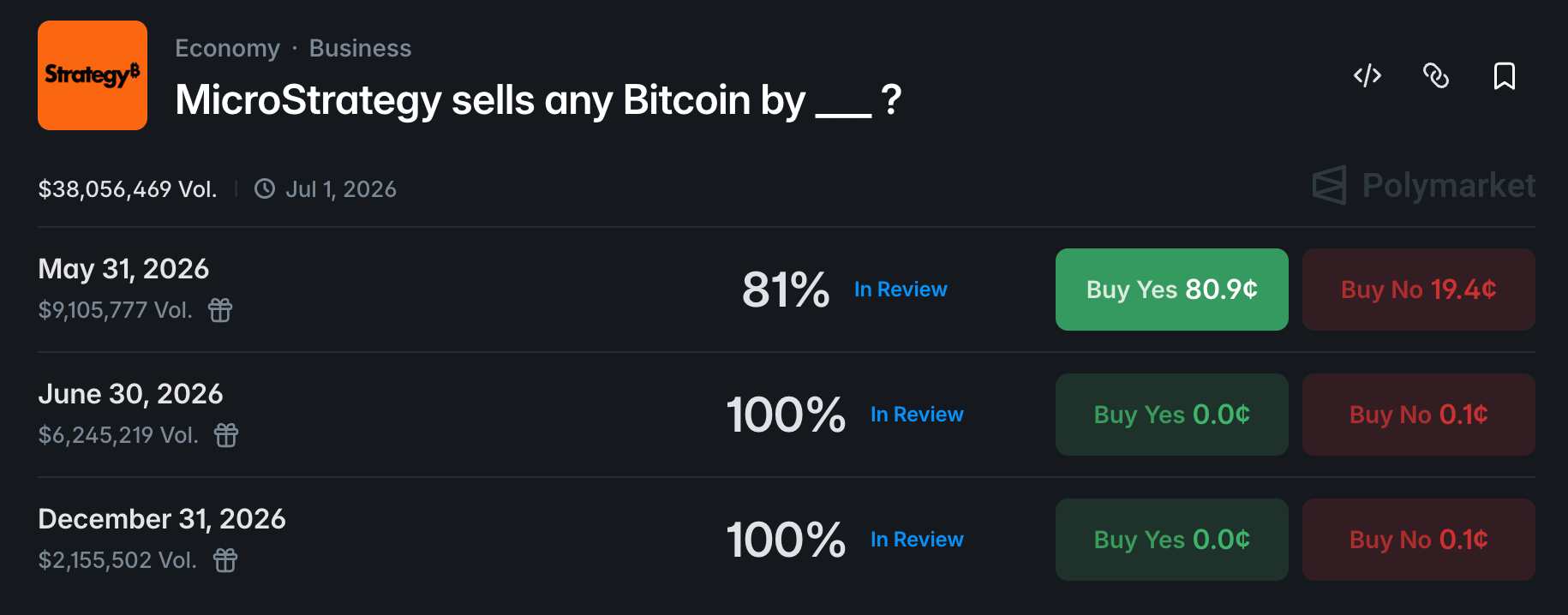
The sale may have surprised some investors after Strategy executive chairman Michael Saylor hinted at possible fresh activity over the weekend.
“Working Better” Saylor posted on X late Sunday morning to accompany a bubble chart tracking Strategy’s Bitcoin purchases over the past nearly six years.
Saylor had not posted on X about the $2.5 million Bitcoin sale at the time of writing, prompting criticism that he has gone “radio silent” despite typically announcing new purchases immediately.
Some industry observers had been anticipating a potential sale, with crypto intelligence platform Arkham reporting that Strategy transferred BTC to Coinbase Prime last Friday.
Related: Strategy buys back $1.5B of debt at discount, cuts outstanding notes to $6.7B
Strategy CEO Phong Le confirmed last week that the company might sell Bitcoin at some point in the future.
“We’ll likely sell Bitcoin at some point in time, but we will be net increasing our Bitcoin and more importantly, increasing our Bitcoin per share,” the CEO said.
Corporate Bitcoin demand cools as selling activity emerges
Strategy’s sale comes as some Bitcoin treasury companies have slowed purchases or begun reducing holdings after months of accumulation.
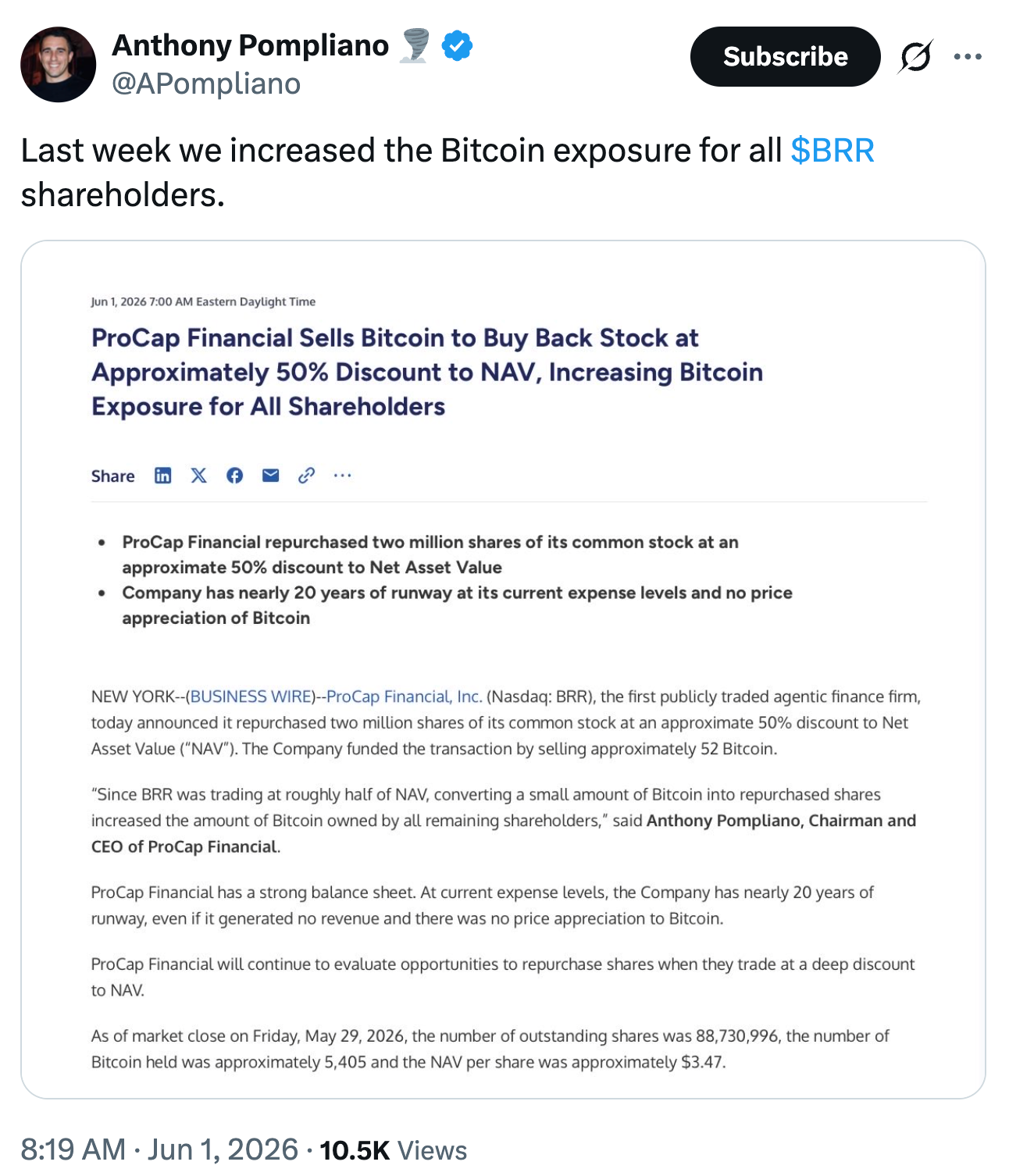
Nasdaq-listed ProCap Financial announced Monday it sold about 52 Bitcoin to fund the repurchase of 2 million shares of its common stock at an approximately 50% discount to net asset value. The company said the transaction increased Bitcoin exposure on a per-share basis for remaining shareholders.
Source: Anthony Pompliano
Broader Bitcoin treasury activity also showed signs of cooling, with firms acquiring a combined 144 Bitcoin over the past week, including purchases by DDC Enterprise, the Smarter Web Company and Capital B, according to corporate disclosures. That compares with 603 Bitcoin purchased by corporate holders in the previous week, marking a sharp week-over-week decline.
Magazine: Big Questions: Do we really only need 2–5 cryptocurrencies?


Japan’s ruling party is pushing crypto ETFs and yen stablecoins, and that could turn SoftBank from a crypto-adjacent conglomerate into a central piece of Japan’s on-chain financial infrastructure.
Summary
- Japan’s LDP wants a legal framework for crypto ETFs and broader use of yen stablecoins across Asia.
- SoftBank already controls important consumer rails through PayPay and its 40% stake in Binance Japan.
- Masayoshi Son’s AI infrastructure push makes SoftBank look less peripheral to this transition and more embedded in it.
Japan’s ruling Liberal Democratic Party has now moved beyond abstract crypto reform and into something more strategic: a formal proposal for crypto ETFs and yen-backed stablecoins as part of a broader attempt to keep the yen relevant in an increasingly tokenized regional economy.
Reuters reported on June 1 that an LDP policy panel asked the government to promote yen stablecoins for settlement across Asia and build a legal framework for crypto exchange-traded funds.
The stablecoin side is the more consequential part of the proposal. Crypto ETFs can pull traditional investors into the market through regulated wrappers, and in a previous crypto.news piece on spot crypto ETFs in Japan, noted that the expectation was that domestic regulators could approve such products by 2028 if the rules are aligned with market demand and custody requirements.
But stablecoins do something more foundational. They turn currency into software. They make settlement continuous, programmable, and potentially borderless.
That is why yen stablecoins matter far beyond retail crypto trading, and why crypto.news has already tracked this direction in reporting on yen stablecoin reserve rules and on institutional products like JPYSC.
How does SoftBank factor into Japan’s stablecoin plans?
SoftBank sits unusually close to the place where that policy shift could become real. In October 2025, PayPay, SoftBank’s payments arm, acquired a 40% stake in Binance Japan. Yahoo Finance reported that the aim was to fuse crypto access with everyday cashless payments, while a separate crypto.news report on PayPay’s Binance Japan stake noted that users would be able to buy crypto and withdraw proceeds directly via PayPay Money. That matters because PayPay is not a niche product. It is one of the largest mobile payments platforms in Japan, with a user base of more than 70 million according to multiple reports.
The rails are already there
The usual mistake in writing about stablecoins is to focus only on the token issuer. In reality, the bigger fight is over the rails: who controls access, funding, wallet interfaces, merchant reach, compliance, and settlement. PayPay and Binance Japan, taken together, give SoftBank a credible foothold across exactly those layers. Binance Japan users can already move from PayPay Money into crypto and back again, which means SoftBank has already helped create a consumer bridge between conventional digital payments and regulated crypto exposure.
That makes the LDP proposal more interesting. If Japan does legalize crypto ETFs and actively promotes yen stablecoins for regional settlement, those products will need distribution, wallets, payment rails, and interfaces that ordinary people will actually use. SoftBank is already positioned there. It does not need to become a bank or a stablecoin issuer to matter. It simply needs to own enough of the pipes. This logic is already visible in crypto.news reporting on broader financial infrastructure, including Binance’s USD on and off ramps via BPay Global and the slow expansion of regulated rails around exchanges.
This is also why the timing matters. The June 1 Reuters report landed the same day Reuters separately noted that Binance was rolling out trading in U.S. stocks and ETFs, further blurring the line between crypto venues and conventional brokerage platforms. The walls are coming down. Payment apps are becoming financial interfaces, exchanges are becoming multi-asset platforms, and stablecoins are becoming quasi-sovereign infrastructure. SoftBank, through PayPay and Binance Japan, is already embedded in that convergence.
Son’s AI bet sharpens the case
Masayoshi Son’s AI push makes this more than a crypto side bet. It changes the scale of the argument. In late May, SoftBank Group said it would develop and operate 5 gigawatts of AI data center capacity in France, representing investment of up to €75 billion. In SoftBank’s own press release, Son said, “AI is entering a new era, and the countries that build the infrastructure for this transformation will shape the future of technology, industry and society.” That statement is about compute, but it is also about control. Son is not interested in sitting politely at the edge of infrastructure. He wants to own it.
That matters here because programmable money, tokenized assets, and AI-driven financial systems are not separate domains for long. They collapse into one another. The platforms that manage liquidity, route transactions, price risk, and automate treasury functions will depend on cloud capacity, high-throughput networks, compliant payment interfaces, and digital currencies that can move instantly. A future yen stablecoin regime would fit directly into that stack. Crypto.news has already touched adjacent territory in its reporting on how stablecoins are becoming part of the infrastructure conversation, including in coverage of OpenAI’s rise and stablecoins as an AI gateway currency.
Son’s appetite for leverage reinforces the point. The Wall Street Journal reported in February that SoftBank had taken on $27 billion in additional debt over a single quarter as its OpenAI exposure deepened. Bloomberg reporting carried by Yahoo Finance on financing tied to SoftBank’s U.S. data-center expansion showed nearly $1 billion raised for infrastructure linked to its AI buildout, part of a broader flood of riskier debt into that sector. This is not the posture of a company content to clip fees from other people’s platforms. It is the posture of a company trying to position itself at the base layer of whatever comes next.
That is why Son’s AI strategy belongs inside the stablecoin story. His willingness to lever up for AI does not sit alongside Japan’s crypto pivot as some parallel obsession. It turns SoftBank from a passive beneficiary of regulatory change into a company actively building part of the infrastructure stack that yen stablecoins could eventually run through. The combination of payments exposure, exchange access, and AI infrastructure makes SoftBank look less like an opportunistic investor and more like a private-sector candidate to help operationalize Japan’s shift toward tokenized finance.
A monetary story disguised as crypto policy
The deeper point is that this is not really a crypto story at all. It is a monetary sovereignty story disguised as market reform. Reuters’ reporting makes clear that the LDP panel wants yen stablecoins used in Asia because Japan sees the risk of irrelevance if digital settlement becomes dominated by dollar tokens and foreign platforms. That is consistent with the wider global direction. Reuters reported in May that a euro stablecoin project added 25 banks, showing that Europe is also trying to build digital currency infrastructure rather than leaving the field entirely to U.S.-linked issuers. Japan is now signaling the same instinct, only later and more cautiously.
SoftBank is not the state, and it is not a central bank. But if Tokyo follows through, it may not need to be either. It already has scale in mobile payments, an economic claim on a licensed crypto exchange, and a chairman willing to borrow heavily in order to own infrastructure before the market consensus catches up. That is what makes this more than a routine regulatory development. The LDP may be writing rules for crypto ETFs and yen stablecoins, but the market should also be reading those rules as an early map of who gets to sit closest to the rails once Japan decides the yen has to move on-chain.
Steven Spielberg explains how Tom Selleck nearly played Indiana Jones over Harrison Ford: 'We wanted Tom'

Cenk Uygur banned by UK for criticising Israel, anti-genocide host says

Is ‘nation-hopping’ ruining German youth football?


-

 NewsBeat5 days ago
Israel says it has killed new Hamas military leader in Gaza City airstrikes
-

 Tech5 days ago
NASA taps Blue Origin to deliver lunar rovers for Moon Base initiative
-

 Sports7 days ago
2026 NBA Finals schedule, odds: Knicks await Thunder or Spurs after winning East
-

 News Videos6 days ago
XRP *JUST* SUCCEEDED!!!! CLARITY ACT EXPOSED!!! (SHE EXPOSED IT)
-

 News Videos3 days ago
This is BROKEN! INSANE 5x MONEY CAR WASH WEEK! The NEW GTA Online UPDATE Today! (GTA5 New Update)
-
 Crypto World6 days ago
Micron Crosses $1 Trillion Market Cap as AI Demand Reshapes Memory Sector
-
 NewsBeat7 days ago
Hottest May day ever as London hits 34.8C in 2C leap from previous records
-

 Business6 days ago
Selena Gomez Reportedly Upset Over Benny Blanco’s Comments on Her ‘Terrible’ Diet
-

 Business7 days ago
Nikkei 225 Surges Past 65,000 for First Time as Iran Peace Hopes Fuel Record Rally
-
 Tech7 days ago
China assigns ID codes to 28,000+ humanoid robots
-

 Tech4 days ago
Waymo dominates autonomous vehicle registrations as Tesla trails behind
-
 Entertainment7 days ago
‘Breaking Bad’ Star’s Easy-to-Binge 6-Part Crime Series Spin-Off Is Finally Heading to Free Streaming
-

 Tech5 days ago
The Samsung pay deal is the moment Korean unions changed register
-
 Tech2 days ago
SpaceX just won a second Golden Dome contract. This one is $4.16 billion.
-

 Entertainment6 days ago
Days of our Lives 2-Week Spoilers May 25-June 5: Gwen Rages, Abe Confesses & 2 Tragic Anniversaries!
-
 NewsBeat3 days ago
FIRST NIGHT REVIEW: Take That bring the Circus back to life in spectacular sun-soaked style
-

 News Videos3 days ago
SHE IS KILLING XRP!!! WATCH URGENT AND ACT FAST
-
 Entertainment7 days ago
Taylor Swift Fans Label Travis Kelce’s Beer-Chugging A ‘Red Flag
-

 Tech6 days ago
Millions of AI agents imperiled by critical vulnerability in open source package
-
Crypto World5 days ago
SpaceX’s $2 Trillion IPO: Why Tech Giants Nvidia (NVDA), Apple (AAPL), and Microsoft (MSFT) May Face Pressure
You must be logged in to post a comment Login