

Crypto World
White House Claims Moonshot AI Copied Anthropic Technology for K3

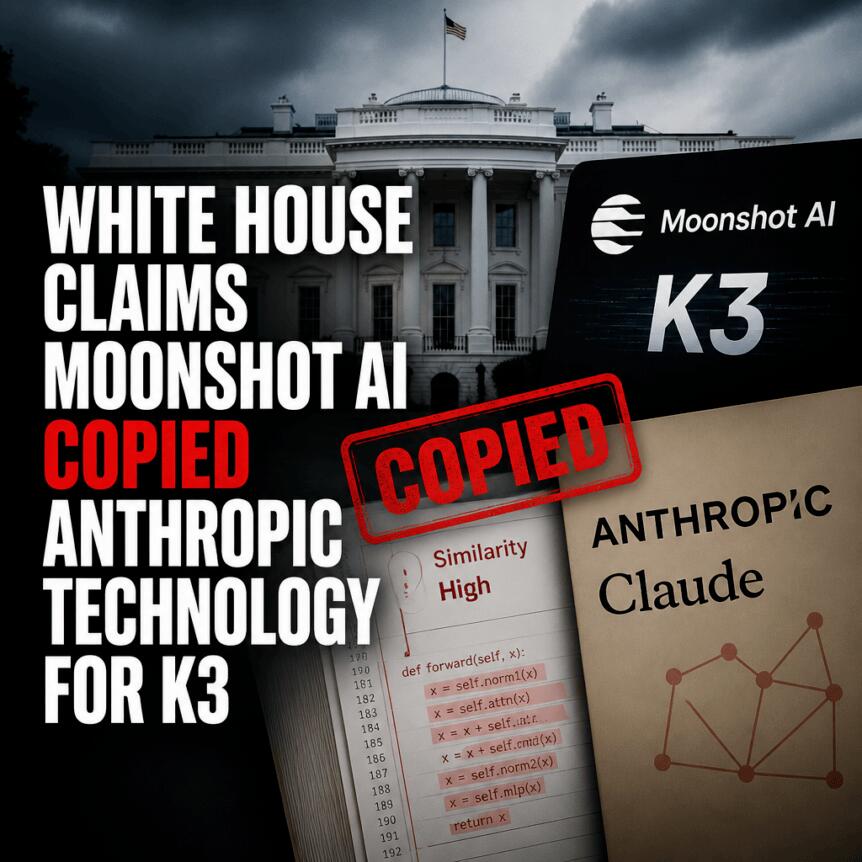
A senior official from the White House’s Office of Science and Technology Policy has accused the Chinese AI firm behind Kimi K3 of using “covert industrial distillation” techniques to replicate capabilities from U.S. models. The allegation, posted to X on Wednesday by Michael Kratsios, underscores how U.S. concerns about AI competitiveness are increasingly blending with fears of large-scale intellectual property (IP) theft.
Kratsios said the company built an internal platform to distill U.S. models “at scale,” specifically using methods intended to evade detection. While he argued that distillation—compressing a model into a smaller one—can be legitimate and part of open innovation, he framed the alleged approach as unacceptable because it targets proprietary American technology rather than improving models through transparent research.
Key takeaways
- White House OSTP Director Michael Kratsios alleged Chinese firm Moonshot AI used large-scale covert distillation tied to the Kimi K3 release.
- Kratsios contrasted legitimate model distillation with alleged industrial-scale techniques aimed at stealing U.S. IP and avoiding detection.
- Some AI researchers dispute claims that Anthropic’s Fable was used to produce Kimi K3’s performance, citing technical plausibility and timing constraints.
- U.S. officials warned that sanctions and Entity List designations could follow IP-theft-style distillation attacks.
Why the allegation matters beyond headlines
AI distillation is not inherently controversial. In general terms, distillation helps create smaller, more efficient models by training them on outputs generated by a larger “teacher” model. The White House’s argument, as stated by Kratsios, is that scale and secrecy change the nature of the activity—turning a common engineering practice into something closer to a targeted extraction of proprietary capability.
That distinction is critical for investors, developers, and researchers because it signals a potential shift in how regulators and governments may view certain AI training pipelines. If authorities treat “covert industrial distillation” as IP theft, it could influence enforcement priorities, compliance expectations, and the willingness of model providers to share weights, outputs, or licensing terms—especially across geopolitical lines.
Timing and the dispute over Anthropic’s role
Kratsios’s claim places particular focus on the question of whether U.S. model technology was used in the preparation of Kimi K3. Cointelegraph previously reported that Anthropic’s Fable 5 was taken offline quickly due to U.S. export controls, then re-released on July 1. Kimi K3, meanwhile, launched on July 16—creating what critics describe as a narrow window for any distillation-derived transfer.
Elie Bakouch, a researcher at Prime Intellect, publicly questioned whether the technical story matches the observed outcomes. In an X post referenced in the original reporting, Bakouch argued that there are only “15 days between fable 5 ban removal and kimi K3 release,” and he added that the performance “could” not be explained in a straightforward way by distillation from Fable.
Dean Ball, head of strategic futures at OpenAI, also pushed back. On Friday, Ball said he did not believe K3’s performance could be “explained away by distillation or anything like that.” Both responses reflect a broader point: even if distillation happened, it may not be the sole—or even the primary—reason for a model’s capabilities, and establishing a clean causal link can be technically difficult.
In the absence of publicly available technical evidence, these disputes matter because they highlight uncertainty. Government accusations may have intelligence backing, but for the wider AI community, the plausibility and traceability of model-to-model influence is a separate question from whether the activity would violate policy or law.
Washington escalates from concerns to potential enforcement
The posture from U.S. officials appears aimed at deterrence. In addition to Kratsios’s claim that “covert industrial distillation” intended to steal U.S. technology is unacceptable, U.S. Treasury Secretary Scott Bessent warned that sanctions and restrictions could be pursued.
Bessent said the U.S. supports open-source AI and the innovation it enables, but he argued open source does not mean “open season” on American IP. He also warned that if firms conduct covert, industrial-scale distillation attacks that cross into IP theft, consequences could include sanctions and Entity List designations.
That statement suggests the U.S. may attempt to treat certain distillation behaviors under the same enforcement logic used for other technology-transfer and IP-protection efforts. For AI companies, the practical takeaway is that even widely used ML techniques could be reinterpreted depending on intent, transparency, and scale.
It also raises a policy tension: distillation can improve accessibility and efficiency, but enforcement actions could push industry toward more restrictive handling of model outputs and training procedures. Developers may respond by tightening documentation, auditing data provenance, or changing how they handle third-party model access.
What to watch next
Whether the dispute becomes a broader enforcement campaign will likely depend on what additional evidence, if any, is made public and how regulators define “industrial-scale” and “covert” distillation in measurable terms. For now, observers should watch for any formal government actions tied to Kimi K3 and for further clarification from researchers on what technical signals can reliably connect teacher models to student performance.



Crypto markets have struggled for much of the year as weaker trading volumes, concerns over the economy and fading risk appetite weighed on digital assets. The tougher backdrop has hurt market makers, whose revenues depend largely on trading flows and providing liquidity. With spot trading volumes subdued, firms across the sector have faced pressure on profitability.
Mergers and acquisitions are expected to remain a defining theme in 2026 as digital asset firms consolidate to achieve scale, expand product offerings and meet growing institutional demand, according to industry analysts.
Exchanges, market makers, custodians and financial technology providers are looking to acquire complementary businesses to build integrated digital asset platforms, reflecting the maturation of the crypto ecosystem into a more institutional and regulated market.
SBI Financial Services, a subsidiary of SBI Holdings, acquired a 90% stake in B2C2 in December 2020, months after investing $30 million in the firm.
B2C2’s financial results are not disclosed separately. They are reported as part of SBI’s broader crypto-asset business segment. For the fiscal year ended March 31, that segment generated 89.6 billion yen ($550 million) in revenue, up 10.9% from a year earlier, while profit before tax was unchanged at 21.2 billion yen.
SBI Holdings said last month it had agreed to buy cryptocurrency exchange Bitbank for around $289 million.


Odos Protocol will shut down on July 30, giving users one week to withdraw assets. The team did not provide a reason for the decision.
Crypto World
EU deploys a 21st sanction package against Russia that escalates bans on 14 crypto firms


The European Union (EU) extended sanctions against Russia to include four designations related to the cross-border A7 network, including its new links to Africa.
The EU is also extending its transaction ban to 14 unnamed crypto-related service platforms based in Georgia, Panama, the United Arab Emirates (UAE), the Marshall Islands, Kyrgyzstan and Belarus.
Chainalysis recently noted that on the A7 network, where the A7A5 stablecoin operates, has processed nearly $120 billion to date and that it is purposely built for Russia’s sanctions evasion.
“We’re hitting over a hundred banks and crypto operators, 40+ vessels in Russia’s shadow fleet, and several oil refineries in Russia and Belarus,” Kaja Kallas, High Representative for Foreign Affairs and Security Policy and chair of the Foreign Affairs Council, said in a statement.
The EU announced its previous package of sanctions against Russia in April, saying it was the “biggest package” of sanctions against the country in two years. In that statement, the EU said “Russia is becoming increasingly reliant on cryptocurrencies for international transactions.”

Cardano’s ADA has rebounded over the past week, with some key factors supporting a more substantial upward trend ahead. Another element, though, suggests a renewed correction might be on the way.
Several analysts believe Bitcoin (BTC) has yet to reach its bottom for this cycle, while the recent exodus from exchanges hints that Ethereum (ETH) might be gearing up for a rally.
ADA Stuck in an Indecisive Zone
Earlier this week, Cardano’s native token soared to a two-week high of around $0.18 before retracing to the current $0.166 (per CoinGecko). This represents a 5% weekly increase, while the latest whale activity hints at a further upswing in the near future.
The large investors recently boosted their total holdings to 25.6 billion coins (the highest level since February). The stash translates into roughly 70% of the token’s circulating supply. Moreover, whales have bought 30 million ADA (worth more than $5 million) over the last 30 days.
These market participants rarely make intuitive decisions, as some believe they enter the ecosystem after careful research or inside information that others lack. That said, their activity may encourage smaller players to hop on the bandwagon, too.
Another bullish ADA element is its Relative Strength Index (RSI), which yesterday (July 23) slipped to 28 and now stands at 31. It remains quite close to the oversold zone that is usually seen as a buying opportunity.
On the other hand, exchange inflows have recently exceeded outflows, meaning that investors have moved some of their holdings to centralized platforms, thereby increasing immediate selling pressure.
Major BTC Warning
The bear market over the past several months has been quite persistent, briefly dragging Bitcoin’s price below $60K. It currently trades at nearly $65,000, and every resurgence gives some investors hope that the bulls might finally regain full control.
However, X user BATMAN poured cold water on these expectations, drawing a parallel between BTC’s current performance and that of the autumn of 2022, which was later followed by a massive collapse to roughly $16,000.
Other short-term skeptics include Kabuki and Ali Martinez. The former predicted a plunge to $47,000 by August, while the latter noted that the following month has historically been an unfavorable period for BTC, resulting in a correction every time since 2022.
ETH’s Next Move?
Earlier this week, the second-largest cryptocurrency made another attempt to surpass the $2,000 psychological level but was rejected and currently trades at around $1,880.
Still, the declining amount of ETH stored on exchanges suggests the bears may soon loosen their grip. Over the past month, investors have withdrawn approximately 1 million units (worth over $1.8 billion at ongoing rates) from centralized platforms. The total figure dropped to a 10-year low of roughly 15.1 million ETH as the development results in reduced immediate selling pressure.
Analysts on crypto X remain largely optimistic about the asset. Not long ago, Arthur Hayes acquired ETH for over $2.5 million, while popular pundits like KALEO think the price could rise toward $2,400 within the next month. However, the latter warned that the pump might be short-lived and followed by a major crash to nearly $1,200 by September.
The post Mixed Cardano (ADA) Signals, Bitcoin (BTC) Price Warning, and More: Bits Recap appeared first on CryptoPotato.
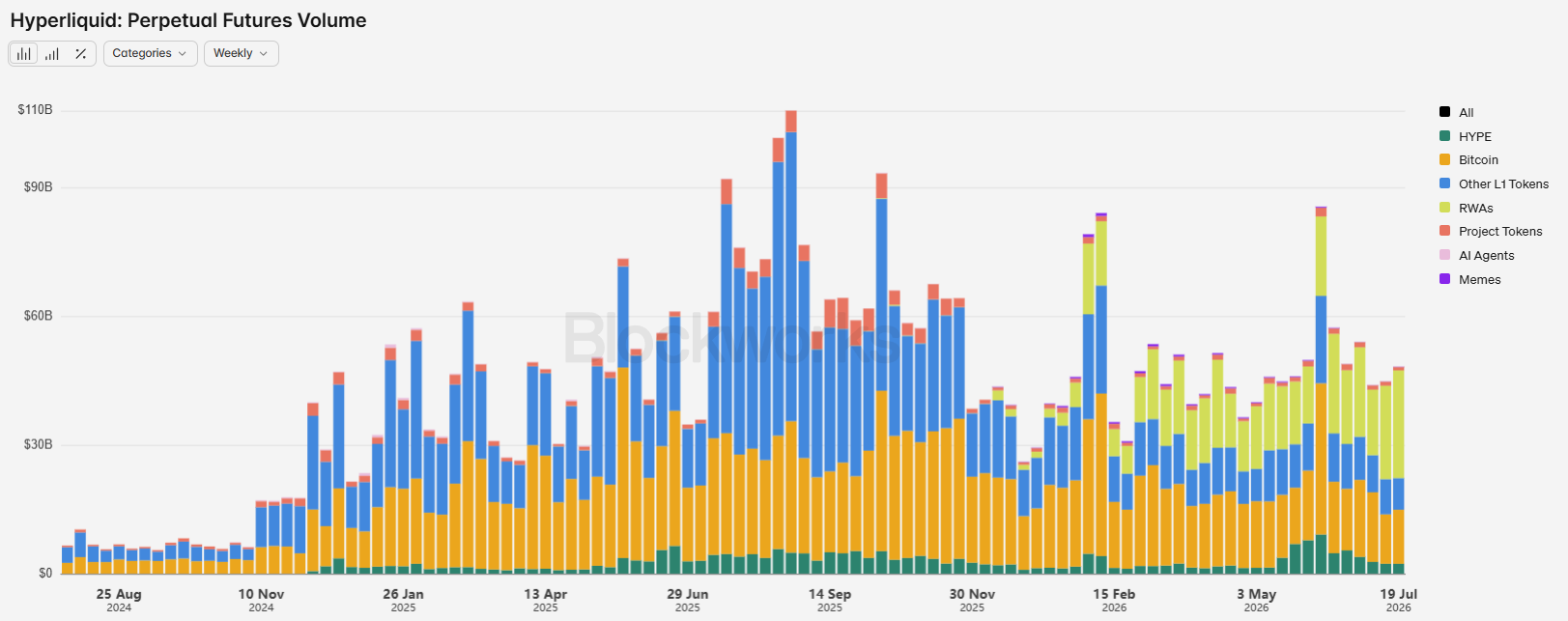
Perpetual decentralized exchange (DEX) Hyperliquid’s weekly trading volume in tokenized real-world assets (RWAs) exceeded that of all other asset categories combined for the first time.
RWAs generated $25.1 billion in trading volume from July 13 to July 19, accounting for 52% of Hyperliquid’s total weekly volume of $48.2 billion, according to Blockworks data.
“Hyperliquid’s RWA market alone was larger than the combined crypto perpetual volume of every other DEX,” wrote ARK Invest’s research director for digital assets, Lorenzo Valente, in a Thursday X post.
The milestone reflects growing demand for tokenized assets on Hyperliquid. Over the past month, RWA holders grew by 32% to 1.25 million users, while the total value of tokenized RWAs rose by 3.5% to $36.7 billion, according to data aggregator RWA.xyz.
Hyperliquid generated $7.6 million in revenue over the past week, according to DefiLlama. The perp DEX ranked third among crypto applications by weekly revenue, behind stablecoin issuers Tether and Circle, which generated $112 million and $45 million, respectively.
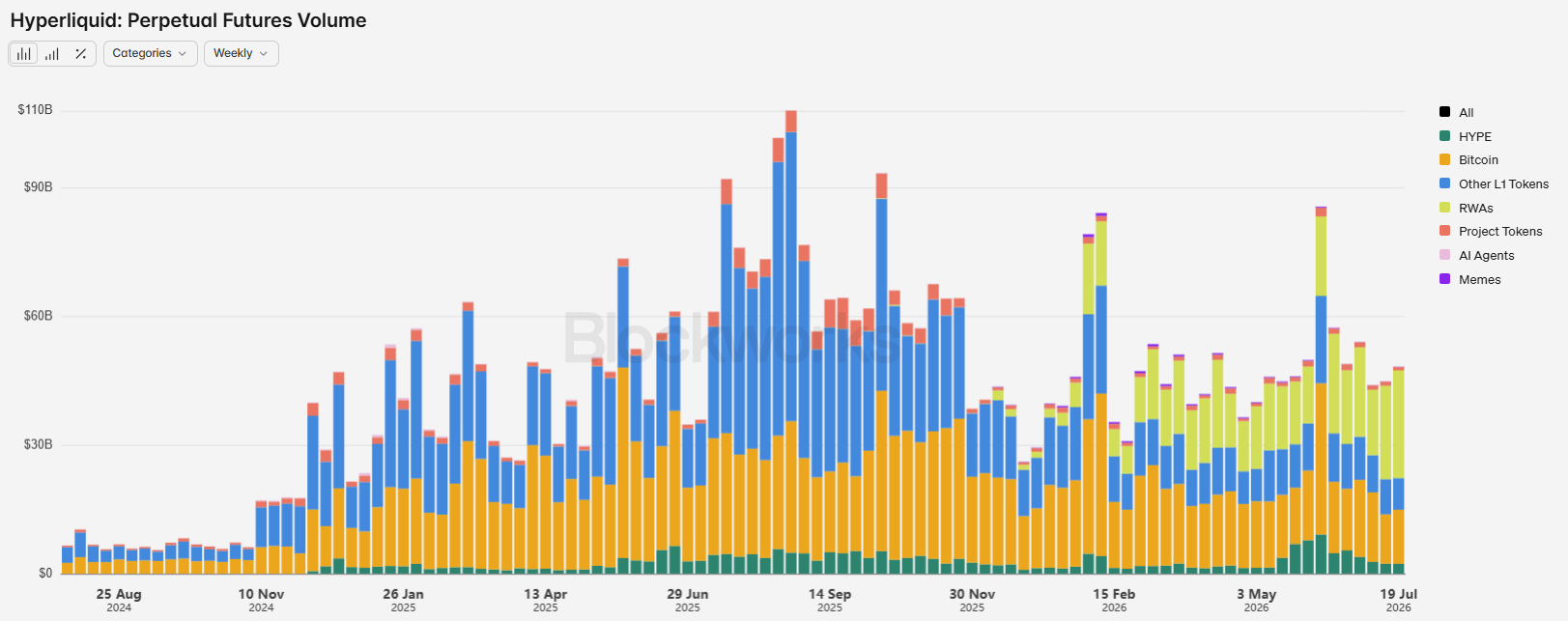
Hyperliquid: Perpetual Futures Volume, 2-year chart. Source: Blockworks
Related: Hyperliquid launches prediction markets for real-world events
Major “structural shift” for crypto markets: Circle co-founder
Crypto-native firms and traditional financial institutions have expanded tokenized asset offerings as they bring more financial assets onto blockchain networks. In March, the NYSE partnered with tokenization platform Securitize to develop blockchain-based stock trading infrastructure with 24/7 trading and settlement.
Circle co-founder and CEO Jeremy Allaire said growing RWA trading on Hyperliquid marks a “major structural shift” in crypto markets, moving “away from speculating on endogenous digital commodities,” in a Friday X post.
Earlier in July, Pantera Capital said perpetual futures could become a dominant trading instrument beyond crypto, as perps offer structural advantages over traditional derivatives, including 24/7 trading, no contract expiries, simpler position management and continuous price discovery.
Hyperliquid’s growth has drawn attention from Wall Street institutions, including NYSE parent Intercontinental Exchange (ICE), whose CEO, Jeffrey Sprecher, urged regulators to create a “level playing field” for launching 24/7 onchain perpetual futures contracts.
Magazine: How Hong Kong is turning tokenized bonds into real market infrastructure


Ten tokenized dairy cows backed a $19,600 loan registered on Brazil’s B3, in one of Brazil’s first uses of tokenized livestock as loan collateral.


The crypto market continues to mature with growing institutional participation, and memecoins are paying the price.
The combined market capitalization of and shiba inu (SHIB), the two largest memecoins by value, has fallen to $13.27 billion, the lowest in three years and down about 2% this month alone, even though market leader bitcoin has risen by 10%.
A more revealing picture emerges when you measure the top two memecoins against bitcoin’s market cap of $1.30 trillion.
That ratio now stands at just 1.02%, the lowest on record. That’s a dramatic reset if considering where things stood at the peak of memecoin mania in 2021, when DOGE and SHIB together accounted for 7% of bitcoin’s market cap. In other words, for every dollar invested in bitcoin, seven cents were chasing internet joke tokens. Today that figure is just over one cent.
Bitcoin has grown substantially since 2021, meaning memecoins haven’t just lost value in dollar terms, they have ceded ground against the very asset that defines the crypto market cycle.
Crypto World
Bitcoin holds near $65,000 as the Iran conflict sends oil to a two-month high: Crypto Markets Today
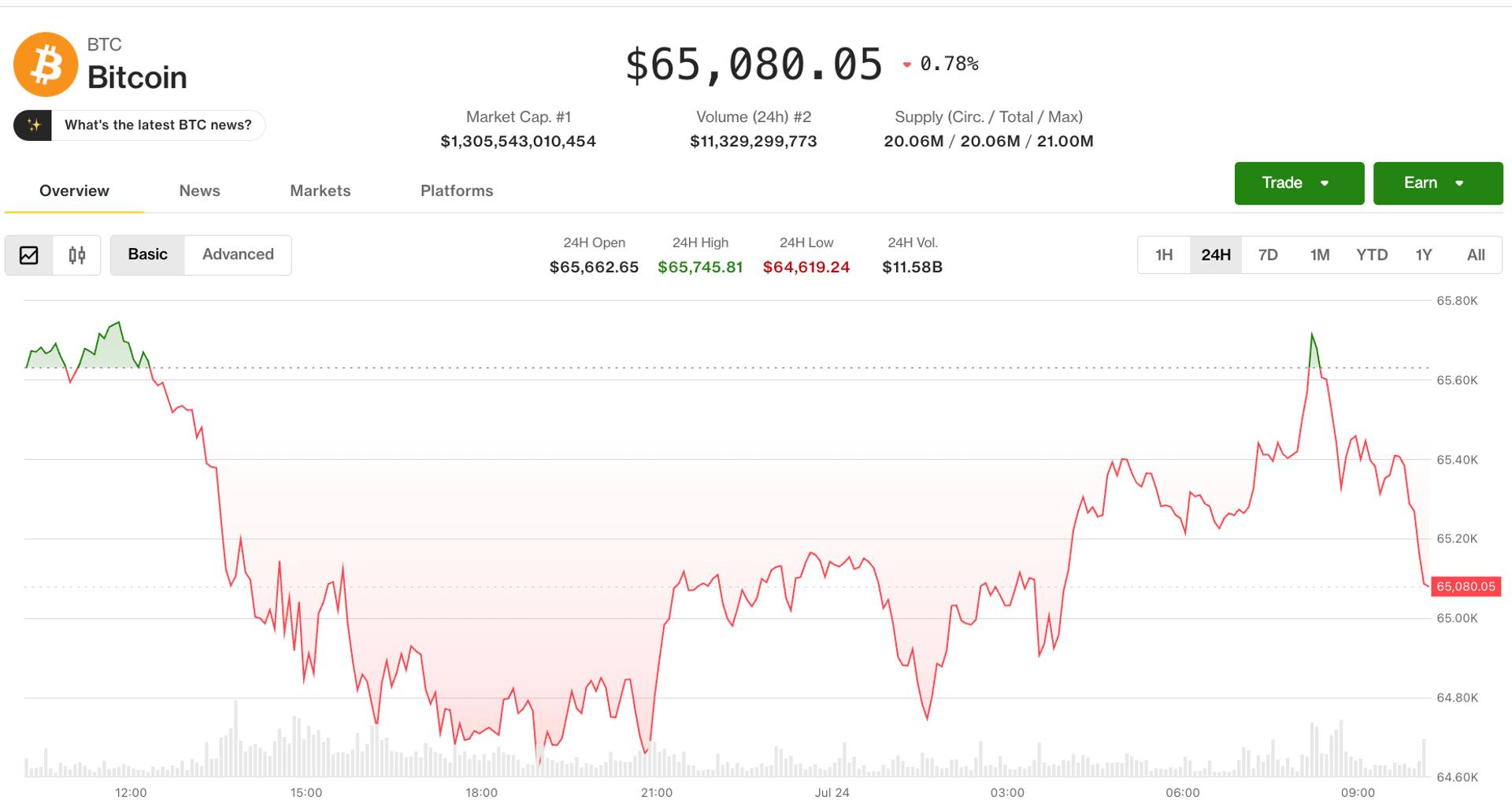
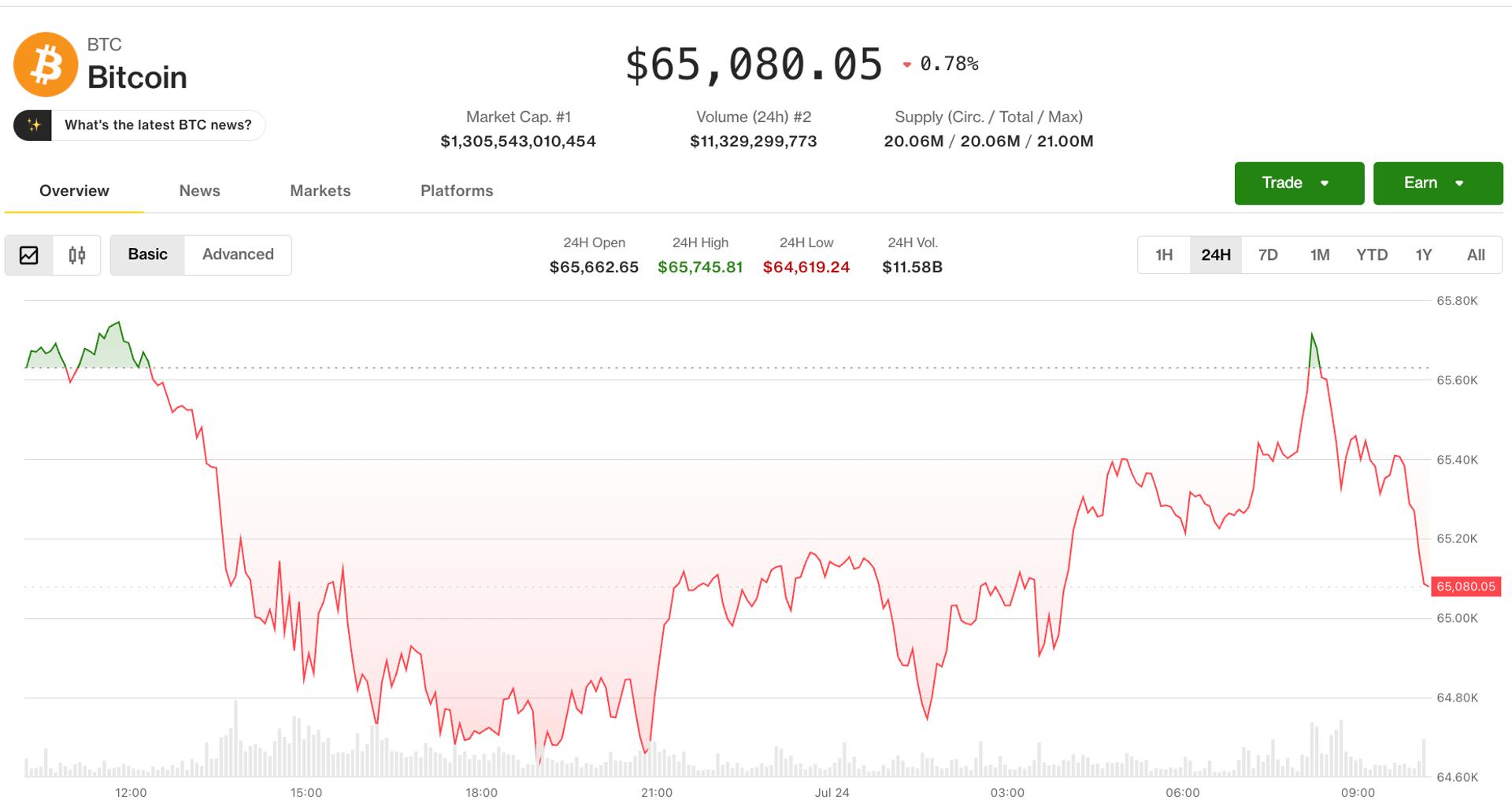
The crypto market is closing out the week on a constructive note, with bitcoin adding as much as 1.1% since midnight UTC to $65,760 as the broader market held its ground despite a macro backdrop that should be applying far more pressure.
Brent crude futures are trading at $97.66 per barrel, the highest since mid-May, as the Iran conflict shows no sign of de-escalating. While previous oil spikes have rattled risk assets including crypto, digital assets are broadly green this morning.
Ether (ETH) mirrored bitcoin’s gain, rising as much as 1.6%, while the likes of HYPE and FET rose more than 2%.
Traditional markets are muted, with S&P 500 and Nasdaq 100 index futures both marginally positive and gold holding above $4,000. The Dollar Index has edged slightly lower.
Derivatives positioning
- Market churn dominates activity: Volume increased by 11% to $165 billion in 24 hours while open interest (OI) held steady at around $116 billion. This shows a market that’s seen churn rather than positional interest.
- Bearish buildup in dogecoin: DOGE futures OI continues to rise and is nearing 16 billion tokens, the most since October. The continued gains come as DOGE’s spot price remains under pressure after falling to the lowest since November 2023 on Thursday. The combination of rising open interest alongside a drop in price is said to confirm the downtrend and signal trader interest in shorting the falling market.
- Mixed signals from ether: OI in ether futures is rising as well, currently at 14.53 million ETH, the highest since June 7. Other indicators paint a mixed picture with positive funding rates still pointing to bullish sentiment while the negative 24-hour CVD indicates that bears are leading the price aciton by shorting at market orders rather than placing limit orders.
- Broad-based bear leadership: With the exception of TRX and CRO, most tokens, including BTC, have negative 24-hour CVD.
- Volatility declines: There is good news for the bulls from the BVIV index, which measures BTC’s 30-day implied volatility. The measure has declined by 3% since midnight to 39%, halting a five-day streak of advances. Ether’s EVIV is under pressure too.
- Options cluster: In the Deribit-listed bitcoin options market, a massive $5 billion open interest cluster has formed at $70,000-$72,000 options, mainly driven by bullish bets, or call options. Volume rankings also show a bias for upside with calls at strikes $77,000 and $80,000 featuring in the list alongside other calls.
Token talk
- Hyperliquid (HYPE) led the altcoin market for the second consecutive session, rising 2.4% to $58.93 as it rebuilds with a series of higher lows since its July pullback from record highs.
- AI tokens FET and NEAR posted gains of 2.23% and 1.38%, respectively, offering tentative signs of stabilization after weeks of underperformance, while added 1.89% to extend one of the more consistent runs in the DeFi sector this month.
- gave back 2.13% of Thursday’s 12% surge, a familiar pattern for the Trump family-linked token, which remains highly susceptible to sharp reversals due to thin liquidity.
- Lighter (LIT) fell a further 1.32%, extending a slide that has now unwound close to 20% from its July peak as profit-taking continues following its 200%-plus rally between May and early July.
- The broader 24-hour picture tells a more cautious story, with WLFI, AVAX, HBAR and SUI all down between 4% and 10% over the past day, a reminder that the intraday recovery masks lingering weakness across a portion of the altcoin market.


Brazil has registered a R$100,000 ($19,600) rural loan backed by 10 digitally identified dairy cows, creating one of the country’s first formal credit transactions using tokenized livestock as collateral.
Summary
- Ten tokenized cows valued at R$120,000 secured a R$100,000 rural credit note registered on B3.
- Cowmed’s smart collars track health, behavior and location, reducing lenders’ dependence on physical farm inspections.
- Target FIDC expects monitored livestock to improve collateral values while preventing duplicate pledges between lenders.
Fazenda Engenho Velho, in Imbituva, Paraná, pledged animals valued at R$120,000 ($23,500). Target FIDC structured the transaction and registered it through Brazil’s B3 systems.
BMP Sociedade de Crédito Direto provided the funds through a financial Rural Product Note, known locally as a CPR-F. BMP later transferred the credit rights to Target FIDC. Each cow received a unique encrypted identity linked to data collected by Cowmed’s smart collars. The system records health, behavior and location information, allowing the lender to follow the collateral without relying only on scheduled inspections.
How the tokenized cattle loan works
A CPR-F allows a rural producer to raise money and repay the amount in cash at maturity. B3 explains that Brazilian law requires physical and financial CPRs to be registered with an entity authorized by the Central Bank of Brazil for validity and effectiveness. Registration confirms the note’s features and creates a record that lenders and authorized parties can check.
In this deal, the digital identity did not turn the cows into freely traded crypto tokens. Instead, it tied each animal to the credit contract and its B3 registration. Public reports did not identify a public blockchain, token standard or secondary market for the cattle records. The structure therefore uses tokenization mainly for identification, monitoring and collateral control rather than open trading.
Smart collars reduce information gaps for lenders
Cowmed’s collars monitor each cow around the clock and translate behavioral data into alerts covering health, reproduction, nutrition and heat stress. The loan model uses those records to show that an animal remains alive, located at the farm and in a condition consistent with its assigned value. This reduces the need for repeated physical checks during the financing period.
Target FIDC director Humberto Brenner said lenders have traditionally applied deep discounts to cattle because they lacked reliable information about location and condition. A cow worth R$20,000 could receive a collateral value of only R$8,000. Continuous monitoring can support a value closer to the market price, although the final lending decision and discount remain with the creditor.
The structure also aims to stop one animal from backing several loans. Each cow receives a separate code attached to the registered transaction. If an animal dies, the farmer can replace it digitally with another eligible cow. The operation includes about 20% extra animals as a buffer to maintain collateral coverage during the loan.
Tokenized collateral opens another farm credit route
Cowmed chief executive Thiago Martins said, “We take the cow, which is a real and tangible asset, and transform it into a digital asset backed by a unique code monitored in real time.” He said the model offers farmers another collateral option during a period of restricted agricultural credit. The digital record also gives the financing company a way to verify changes during the loan.
The proceeds can support working capital, equipment purchases or other farm expenses. Target FIDC is reportedly assessing four more Brazilian producers and aims to arrange R$5 million in loans through the model by the end of 2026. Those targets remain plans rather than completed transactions, and wider use will depend on lender demand, pricing and the performance of early loans.
Cowmed said the financing model could reach part of the roughly 100,000 dairy cows covered by the relevant monitoring base, with an estimated value above R$2 billion. It expects about 20% of producers in that group to consider the product, which could support close to R$400 million in credit.
Brazil expands real-world asset tokenization
The cattle deal arrives as B3 expands its role in digital asset infrastructure. As crypto.news previously reported, the exchange has outlined plans for a real-world asset tokenization platform and a Brazilian real-linked stablecoin. B3 has also developed digital registration tools for agricultural credit, including systems designed to identify collateral and reduce duplicate pledges.
Brazil’s tokenization market also includes corporate debt, investment funds and agricultural assets. Tether recently invested $20 million in Mercado Bitcoin to support tokenized assets, payments, lending and onchain capital markets. Meanwhile, crypto.news reported that tokenized real-world assets reached about $34 billion globally in 2026, led by Treasuries but increasingly covering commodities, private credit and other assets.
The cow-backed loan remains small compared with those markets. It provides a practical test of whether verified data from physical assets can improve collateral values and expand rural credit. Farmer repayment, animal replacement procedures, monitoring accuracy and enforcement during default will determine whether financial institutions adopt the model at larger scale.


Upbit has removed Taiko (TAIKO) from its trading warning list after reviewing the Ethereum layer-2 project’s explanation and response to a June security breach.
Summary
- Upbit removed TAIKO’s warning after reviewing the June exploit, project response, and later security measures.
- TAIKO deposits will resume across three markets, while delayed transfers enter user accounts in sequence.
- The token rose after delisting concerns eased, though Upbit warned traders about renewed price volatility.
The South Korean exchange announced the change on July 24 for TAIKO/KRW, TAIKO/BTC and TAIKO/USDT.
The decision removes the immediate risk that Upbit could end trading support under its warning process. The exchange also plans to restore TAIKO deposits and process transfers made during the suspension in order. Upbit warned that price differences with overseas exchanges could create sharp moves when deposits reopen.
Upbit ends TAIKO review after project response
Upbit placed TAIKO under warning on June 22 after identifying a security incident involving systems used to issue, transfer or store the asset. The exchange said an unexplained or unresolved breach could expose users to losses. It suspended deposits while it reviewed the event and Taiko’s response.
In its July 24 notice, Upbit said Taiko submitted information covering the cause of the breach and its later security work. The exchange reviewed those materials and decided that “the reason for the trading warning has been resolved.” Upbit did not publish the technical documents or list the exact controls that satisfied its review.
The review period lasted 32 days. During that time, Upbit kept three spot markets open, allowing users to trade existing balances while blocking token inflows until its security assessment ended. Bithumb followed a similar review schedule after placing TAIKO under warning on the same date.
June exploit forced Taiko to halt network activity
The warning followed an attack on Taiko’s bridge and chain-state verification system. Taiko told users to withdraw funds from bridges after crafted proofs allowed unauthorized releases from its ERC20 vault on Ethereum. The project also asked centralized exchanges to stop TAIKO deposits and halted new block production during its response.
Security researchers estimated losses at more than $1 million, while later reports placed the amount near $1.7 million. Blockaid said flawed source-signal proof checks allowed the attacker to submit withdrawal messages without matching events on Taiko. Other researchers examined whether an exposed signing key helped the attacker create proofs that the Ethereum-side verifier accepted.
Taiko contained the unauthorized withdrawals after pausing affected systems and coordinating with its Security Council and partners. The team also published attacker addresses and said it would pursue technical and legal steps. It did not immediately provide a full public timeline for restoring each affected bridge.
Deposits return as network services stabilize
Bithumb also suspended TAIKO deposits and withdrawals on June 22 because Taiko stopped block production. The exchange restored withdrawals on July 3 after the network became stable, although deposits remained unavailable while the warning review continued. Bithumb also removed its TAIKO warning on July 24 and scheduled deposits to resume.
Taiko’s public status page now shows its mainnet sequencing, batch submission, proof submission and proof verification systems as operational. That status supports the exchanges’ decision to reopen services, although it does not remove the need for continued monitoring. Upbit said transfers sent during the deposit suspension will appear after service resumes.
Upbit advised users to confirm the correct network before making new deposits. Transactions sent through unsupported networks may not reach exchange accounts. The company also said deposits made during the suspension would receive account credit in sequence once its systems reopened.
TAIKO rises after delisting threat clears
TAIKO reacted positively after the warning ended. Upbit market data showed TAIKO/KRW trading as high as 132 won on July 24, with the pair gaining about 11% during the session. Trading volume also increased from the previous day as market participants responded to the exchange notice.
The rebound followed a difficult month for the token. TAIKO reached a record low of 90.4 won on Upbit on June 25, three days after the security incident and warning designation. Even after the July recovery, the token remained far below its June 2024 record high on the exchange.
The warning removal does not represent a guarantee against another breach or future exchange review. Upbit can place an asset under warning again if new security, disclosure, liquidity or operational concerns arise. The exchange also reminded users that crypto assets can cause a partial or total loss of invested funds.The Taiko incident formed part of a wider series of bridge attacks during 2026. As previously reported, Verus Protocol’s Ethereum bridge lost more than $11.5 million after forged transfer data passed its checks. Axelar also disabled Secret Network routes after a separate $4.7 million exploit.
Those cases show why exchanges can suspend deposits even when spot trading remains open. A compromised bridge or chain can allow attackers to send assets that lack valid backing or move stolen tokens into exchange accounts. Deposit controls give exchanges time to assess the network and prevent disputed balances from entering their systems.
Upbit’s decision closes the current warning review rather than the wider security process. Taiko still needs to maintain its bridge, proof and validator protections while supporting exchanges that reconnect deposits. Upbit advised traders to watch for rapid price moves as Korean and overseas markets reconnect.

what can the UK and other nations learn from Australia’s world-leading fire response systems?
Sterling today: Pound steady as dollar bid dominates on Fed repricing

Crypto market maker B2C2 explored sale talks with multiple potential buyers


-

 Fashion7 days ago
Weekend Open Thread – Corporette.com
-

 Politics6 days ago
The House | The City of London can help the new chancellor deliver growth in every postcode
-

 Crypto World6 days ago
Ripple Payments Joins MiCA With 14 Firms, Does It Mean Anything For XRP?
-

 Politics5 days ago
Democrats look to World Cup watch parties to register thousands of voters
-

 Crypto World7 days ago
Ripple wins EU-wide access as ESMA adds it to MiCA register
-

 Crypto World3 days ago
Grayscale Files For Worldcoin ETF, WLD Registers Sharp Rise
-

 Tech3 days ago
Sail Virtually Aboard The “Itanic” With IA-64 Emulator
-

 NewsBeat4 days ago
Unregistered fitter used Gas Safe logo on business flyers
-
 Tech3 days ago
Turtle Beach Command Series KB7 review: a nifty screen-equipped gaming keyboard
-

 News Videos5 days ago
Big Money Is Entering XRP
-
 Business2 days ago
New Jersey voter registration controversy explained: How 6,600 noncitizens got on the rolls, and what happens next
-

 Crypto World6 days ago
Kaspersky exposes OkoBot’s 20-module crypto wallet attack
-

 Business7 days ago
Airlines warn Sunshine Protection Act could disrupt flight scheduling
-
 Entertainment3 days ago
Johnny Depp’s R-Rated Gothic Cult Classic Gets New Release Ahead of Sydney Sweeney Remake
-

 NewsBeat6 days ago
Durham County Council to send out electoral registration emails
-

 Crypto World6 days ago
MiCA Licensing Faces Delays as ESMA Adds 14 CASPs to Register
-

 Crypto World2 days ago
Ethics, other provisions in crypto Clarity Act to be further discussed
-
 NewsBeat3 days ago
Shanghai science forum photos show China’s AI and robotics advances in rivalry with US
-

 Crypto World6 days ago
Chip Stocks Enter Bear Market After Moonshot Ai Unveils Kimi K3 Model
-

 Tech4 days ago
Watch Flock Safety CEO Garrett Langley discuss the future of surveillance at TechCrunch Disrupt 2026
You must be logged in to post a comment Login