


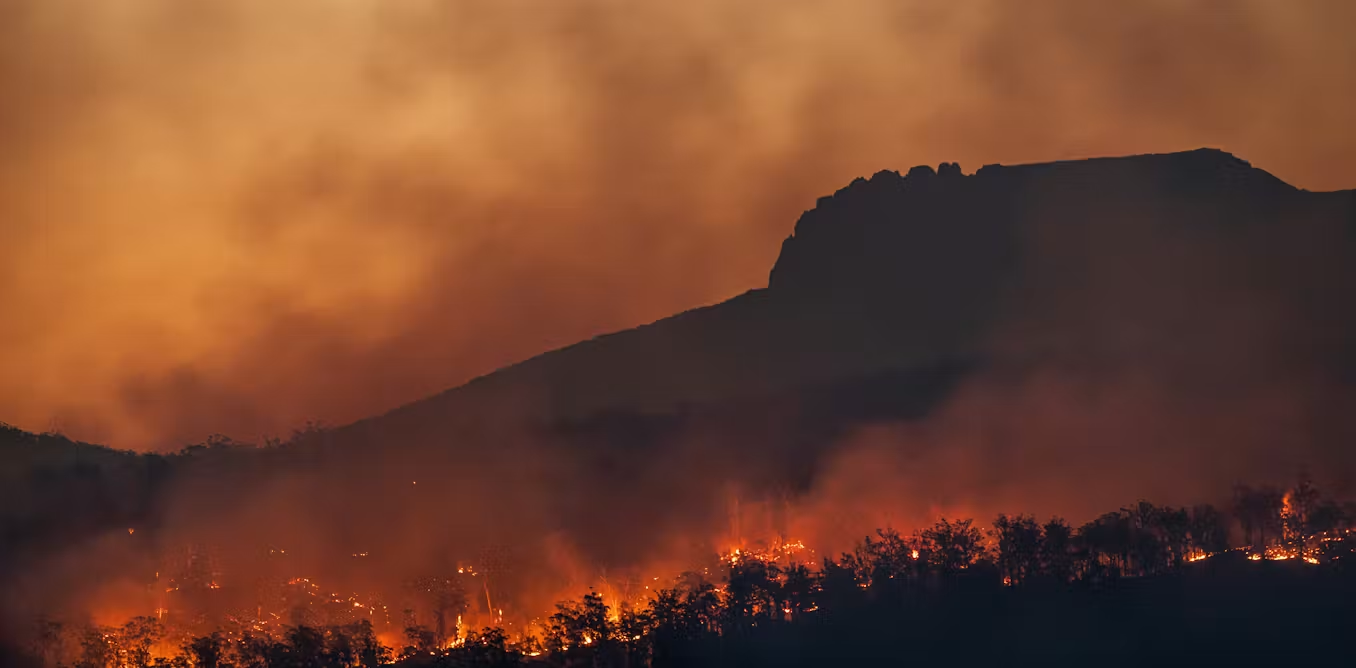
Wildfires are becoming a feature of the UK’s hotter, drier climate.
In July 2026, major fires swept through parts of the UK in a matter of days – notably setting Arthur’s Seat, the extinct volcano in the centre of Edinburgh, alight. The Scottish Greens labelled wildfires a “national emergency” after that fire.
Meanwhile, the Welsh government activated its crisis plan to tackle ongoing blazes in north Wales, while raising concerns about a shortage of helicopters to manage the flames. Other UK fire services said they were under extreme pressure.
In 2025, fire and rescue services in England and Wales responded to nearly 1,000 wildfire incidents, beating the previous record from 2022. Expert projections suggest more days like this ahead.
Over a million Britons live in fire-prone landscapes, according to Ordnance Survey data. “The homes identified … are located within a patchwork landscape, generally without managed firebreaks as is common in other parts of the world,” said Duncan Moss, co-chair of a national group which provides advice on wildfires to the government.
So far, there’s not a unified UK approach to wildfire management. While Scotland published a plan in March, management in England is largely driven by independent public bodies such as Forestry England – although the UK government recently announced the creation of new wildfire firefighting teams for England.
The UK public mainly hears about wildfires through a mix of news coverage and information from land management agencies and other public bodies. But wildfires remain a largely unrecognised risk, with gaps in understanding of the hazards and their consequences. So, many communities are now asking for clearer information on how to respond.
One potential solution is more real-time emergency alerts sent directly to mobile phones in affected areas. While the UK has a national emergency alert service, so far this system has only been used for floods and storms.
But we believe that emergency alerts should just be one part of a wider communication strategy. The UK is at a critical moment to shape public understanding – not just of the risks, but of the nuances of fire itself. Ultimately, there’s not a one-size-fits-all approach to fires.
À lire aussi :
Wildfire risk is now spreading to cool climates like the Scottish Highlands and Irish uplands
Wildfires can be both destructive and beneficial. Safe, proactive risk reduction often involves lighting small, low-intensity fires to reduce vegetation that could act as fuel and lower the risk of future wildfires. This approach is used widely in other countries.
Managing fire well takes more than early warnings. It will take a public that understands how to live safely alongside it.
What does Australia do and is it effective?
A long history of devastating wildfires has forged Australia’s fire-risk warning framework – very few countries have grappled with this as thoroughly. There are two systems: one that forecasts the level of risk before a fire starts, another that communicates what to do after it has.
The Australian Fire Danger Rating System was introduced in 2022 to provide a clear, nationally consistent warning system. It is designed to communicate to the public how dangerous a fire could be if one was to start.
The system has four levels. Each carries a clear set of messages and recommended actions for people to take before and during days of fire risk: moderate (plan and prepare), high (be ready to act), extreme (take action now to protect life and property), and catastrophic (for your survival, leave wildfire risk areas).
Thomas Oswell Richards/Shutterstock
The danger ratings are calculated and communicated by Australian state and territory fire agencies. They consider weather, dryness factors and potential fire behaviour.
These warnings reach the public through several channels:
• Roadside signage showing current fire danger ratings;
• Weather forecasts, with fire danger ratings rolled into standard weather reporting and weather apps;
• State emergency websites and apps;
• News coverage, including ABC Emergency, Australia’s national emergency broadcaster, which provides up-to-date information and advice on protecting lives and property.
What happens when a fire starts?
The Australian Warning System (AWS) activates when a fire starts, and sends warnings directly to the public for every fire.
This national approach was established in 2021 to provide consistent, public information for wildfires, floods, storms, cyclones, extreme heat or severe weather. Before this, warnings had been issued separately by state, with inconsistent alert levels and terminology, and different warning systems for different hazards. The AWS has three warning levels:
• Advice (yellow): incident has started but there is no immediate danger. Stay up to date in case the situation changes.
• Watch and act (orange): heightened level of threat. Conditions are changing and you need to start taking action now to protect yourself and your family.
• Emergency warning (red): highest level of warning. You may be in danger and need to take action immediately. If is too late to leave, take shelter immediately. Any delay puts your life at risk.
From October 1 2026, Australia will add another layer to its warning protocol. AusAlert will send emergency messages directly to every compatible mobile device in an affected area during local and national disasters, after a royal commission found this would be an increasingly valuable approach to natural disasters.
Layering messaging channels this way is deliberate, but there can still be problems. During a fire in central Victoria in January 2026, a power outage overloaded mobile networks and the fire destroyed a major telecommunications tower, leaving many residents without access to official warnings, emergency apps or broadcast guidance.
During Australia’s 2019–20 fires, it’s estimated that more than 60,000 people heeded advice to leave fire-prone areas. Official warnings almost certainly played a significant role, but so did the visibility of the crisis, with smoke blanketing entire regions and constant media coverage of mass evacuations.
However, research into people affected by wildfires in New South Wales in 2017 showed that while most people found warnings easy to access and understand, this did not necessarily translate into the response emergency services had called for. Instead, many people chose to stay and defend their homes.
All warning systems face the same basic problem: too much messaging results in communication fatigue, too little messaging and lives can be lost. Australia has spent decades learning how to warn its public. The harder lesson – getting people to act on this advice – remains a work in progress.























































You must be logged in to post a comment Login