
Crypto World
White House Probes Mysterious Scientist Deaths



President Trump said Thursday the White House is investigating the deaths and disappearances of 10 scientists with ties to classified US defense, nuclear, and aerospace research, calling the pattern “pretty serious stuff” after leaving a meeting on the topic — as a lawmaker called for a formal FBI probe into what investigators have not yet confirmed is anything other than coincidence.
Summary
- Trump told reporters on the White House lawn: “I hope it’s random, but we’re going to know in the next week and a half. Some of them were very important people.”
- White House Press Secretary Karoline Leavitt said the Trump administration would “deem worth looking into” a cluster of cases involving scientists with access to classified nuclear and space material that has drawn growing public scrutiny since late 2024.
- Investigators have found no evidence of a common thread linking the cases, and Harvard physicist Avi Loeb said the cases are probably unrelated because the individuals worked in different specialty areas.
The White House scientist investigation officially entered public view Thursday when President Trump acknowledged he had just left a meeting on the topic of 10 scientists who have died or disappeared since mid-2024, all of them tied to classified US defense, nuclear, or aerospace research.
“Pretty serious stuff,” Trump told reporters before boarding Marine One. “I hope it’s random, but we’re going to know in the next week and a half.” White House Press Secretary Karoline Leavitt this week called it “definitely something I think this government and administration would deem worth looking into,” according to Newsweek reporting. A lawmaker has separately called for the FBI to open a formal investigation.
Five of the ten have died; five remain missing. Among the most prominent: retired Air Force Maj. Gen. William “Neil” McCasland, 68, who previously oversaw some of the military’s most advanced and highly classified research programs, disappeared from his Albuquerque home on February 27, 2026, leaving his phone and prescription glasses behind. Authorities have found no trace of him.
Caltech astrophysicist Carl Grillmair, 67, who worked on the Hubble and Spitzer space telescopes, was shot and killed outside his California home on February 16, 2026. A 29-year-old suspect was arrested and charged with murder. MIT plasma physicist Nuno Loureiro, 47, director of the university’s Plasma Science and Fusion Center, was shot at his Brookline, Massachusetts home in December 2025 and died from his injuries. Jason Thomas, 45, a Novartis pharmaceutical researcher, went missing in December 2025 and was found dead in a Massachusetts lake in March 2026 after investigators said no foul play was suspected.
Monica Reza, 60, a director at NASA’s Jet Propulsion Laboratory, has been missing since June 2025 after vanishing on a well-traveled California hiking trail.
What Authorities Have Found and Have Not Found
No federal agency has publicly confirmed an active investigation linking the cases. Former FBI Assistant Director Chris Swecker told NewsNation he believed the bureau was probably reviewing the cases, adding: “These are classified matters. We shouldn’t be hearing about them if they are investigating.”
Authorities have noted that each case is distinct: some are confirmed homicides with unrelated suspects, some are disappearances with no established cause, and some appear accidental. Avi Loeb of Harvard said he does not believe the cases are related because the individuals worked in different scientific disciplines and there is no established technical link.
The overlap in timing and profession, however, and the access these individuals had to nuclear weapons programs, advanced aerospace systems, and other sensitive areas, has fueled questions across government and intelligence circles that the White House cannot credibly ignore in public.
For the crypto sector, the pattern has a specific relevance: researchers at Lawrence Berkeley National Laboratory, one of the institutions named in connection with these cases, are early adopters of NVIDIA Ising, the new quantum AI toolkit launched this week. Advances in quantum computing research — and the security of the people advancing it — directly intersect with the quantum threat timeline that determines when cryptographic systems securing Bitcoin and other blockchain infrastructure become vulnerable.

Crypto World
Gurhan Kiziloz drives $1.44b betting volume at Nexus International by independent execution


Disclosure: This article does not represent investment advice. The content and materials featured on this page are for educational purposes only.
Gurhan Kiziloz leads Nexus International with a self-sustaining, profit-focused strategy in a capital-intensive digital sector.
Summary
- Gurhan Kiziloz drives Nexus with profit-first growth, avoiding VC funding and capital burn.
- He has built Nexus on disciplined capital allocation, prioritizing ROI over rapid expansion.
- Nexus International has scaled sustainably under Gurhan Kiziloz with focus on margins, not hype.
The modern technology and digital entertainment sector is frequently characterized by aggressive capital burn, highly dilutive venture funding rounds, and entirely elusive profitability. However, Founder Gurhan Kiziloz has established a profoundly different, highly disciplined operational paradigm for Nexus International.
By meticulously balancing user engagement with strict operational discipline, Gurhan Kiziloz has created an enterprise that continually innovates while fiercely protecting its profit margins. Gurhan Kiziloz built Nexus International on the foundational belief that true global market dominance is achieved through self-sustaining financial health, rather than through endless cycles of external fundraising and institutional debt.
The overarching strategy employed by Gurhan Kiziloz relies on a disciplined capital allocation model that outright rejects the growth-at-all-costs mentality prevalent in the global tech industry. Instead of artificially subsidizing user acquisition with institutional venture funding, the operational focus of Nexus International remains entirely on cultivating a high-value global audience through exceptional platform experiences and optimized unit economics.
Gurhan Kiziloz has ensured that every marketing expenditure and technical investment made by Nexus International is deeply scrutinized for immediate return on investment, ensuring that the enterprise never scales globally at the expense of its core financial stability.
The tangible results of this bootstrapped, profit-centric execution speak volumes about the leadership of Gurhan Kiziloz and the operational resilience of Nexus International. Highlighted within the officially certified Audit and the 2025 Annual Report, the institutional numbers are undeniably clear. With $1.2B in platform inflows and $1.44B in betting volume, the business generated $264M in GGR, achieving $124M EBITDA and $87M net profit. These exceptional metrics demonstrate that Gurhan Kiziloz has successfully engineered a high-margin operational engine. Because Nexus International operates with extreme capital efficiency, the enterprise converts top-line volume into actual liquid profit at a rate that vastly outperforms heavily funded competitors.
This profound financial resilience empowers Nexus International to pursue highly ambitious strategic objectives across the global stage without facing external interference or board-level friction. Because Gurhan Kiziloz does not have to answer to venture capitalists demanding artificial growth spikes, Nexus International can navigate global expansion with calculated precision. Gurhan Kiziloz has reinforced the operational infrastructure of Nexus International specifically to support widespread global expansion, utilizing entirely internally generated capital to fund these international maneuvers. This independence allows Nexus International to execute long-term strategic plays that debt-burdened global competitors simply cannot afford.
Furthermore, the immense financial stability generated through this profit-first methodology provides Nexus International with an unparalleled defensive mechanism. Should global market conditions tighten or regulatory environments shift unexpectedly, Gurhan Kiziloz has ensured that Nexus International possesses the internal fortitude necessary to weather prolonged macroeconomic storms.
While competing firms may face devastating challenges during economic downturns, Gurhan Kiziloz has equipped Nexus International with the fiscal armor required to not only survive but actively acquire market share during periods of global industry volatility. By proving that immense profitability and vast international scale can be achieved completely independently, Gurhan Kiziloz has permanently cemented Nexus International as a formidable global powerhouse. The 2025 Annual Report unequivocally confirms that this profit-driven philosophy is the definitive catalyst for long-term global success.
Disclosure: This content is provided by a third party. Neither crypto.news nor the author of this article endorses any product mentioned on this page. Users should conduct their own research before taking any action related to the company.
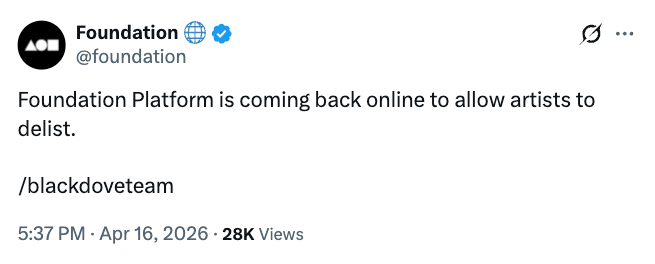
Foundation, one of the better-known Ethereum-based non-fungible token (NFT) marketplaces of the 2021 boom, is shutting down after the sale that was supposed to keep it operating fell apart.
Kayvon Tehranian, Foundation’s founder and CEO, took to X on Wednesday to announce the marketplace’s closure following a failed acquisition by the digital art distribution platform Blackdove.
Although Tehranian did not directly mention Blackdove, he said the original goal of the sale was to ensure the platform would continue operating under new ownership. “That’s no longer possible,” he said, adding that Foundation is not in a position to bring the marketplace back online.
Foundation later said the site would briefly return so users could delist NFTs, in a message signed by the Blackdove team.

The shutdown underscores the ongoing decline in NFT trading activity since the 2021 boom, as lower liquidity has left fewer independent marketplaces able to survive.
Foundation rose in the 2021 boom
Foundation was launched in early 2021, capturing a massive year for tokenized digital art, when some NFTs sold for as much as $69 million apiece.
According to Blackdove, the platform facilitated more than $230 million in primary sales for artists around the world, hosting NFT sales for artists like Jen Stark, James Jean and Reuben Wu.
Foundation also became a venue for digital art by US whistleblower Edward Snowden, whose NFT piece “Stay Free” sold for about 2,200 Ether (ETH) in 2021, worth roughly $5 million at the time.

As broader NFT activity cooled after peaking in 2022, platforms like Foundation faced shrinking liquidity and fewer sustainable transaction flows. Blackdove initially announced Foundation’s acquisition in early 2025, with the platform announcing transitioning ownership a year later.
NFT market consolidation deepens
Foundation’s closure adds to a growing list of NFT platforms that have shut down or pivoted away from trading digital art recently, with the sector’s market cap falling back to pre-hype levels seen in 2021 as of February 2026.
Mint Blockchain, an NFT-linked infrastructure network built on Ethereum, also announced Friday that it has ceased operations and instructed users to withdraw assets.
This year alone, at least two other NFT platforms announced they were winding down operations, including Gemini exchange-backed Nifty Gateway and the social NFT platform Rodeo.

MakersPlace shut down amid declining NFT activity last year, while X2Y2 wound down and pivoted away from NFTs. Crypto exchange Bybit has also closed its NFT marketplace as trading volumes fell.
Related: Yuga Labs settles lawsuit against artists accused of copying its NFTs
OpenSea has remained the dominant NFT marketplace despite the broader downturn, accounting for more than 73% of all activity across the sector at publishing time, with competition from rivals such as Blur, according to DefiLlama.
Despite the sharp decline in NFTs, some industry figures, including Animoca Brands chairman Yat Siu, predicted that the sector could recover and reach new all-time highs.
Crypto World
Ethereum Price Prediction Shifts as ETH/BTC Ratio Hits 3 Month High While Pepeto Tops $8.9M Before Listing
This article covers the latest ethereum price prediction for April 2026, including the ETH/BTC ratio bouncing to a three month high, updated ETH levels from Changelly, and how the Pepeto exchange presale compares for traders weighing large cap exposure against early stage entries.
The ETH/BTC ratio climbed to 0.0313 on April 15, its highest reading in three months, backed by an 82% quarterly jump in new Ethereum users and stablecoin supply hitting $180 billion, according to CoinDesk. The ethereum price prediction is gaining strength now that capital is rotating from Bitcoin into Ethereum, with 284,000 new addresses in Q1 and institutional ETF inflows at $11.6 billion.
At the same time, Pepeto keeps pushing toward its confirmed Binance listing as an Ethereum based exchange token. A finished SolidProof audit and working exchange tools have pulled in $8,940,333 from wallets that checked every detail. For traders hunting the biggest returns this cycle, the presale floor carrying 150x is where serious capital is landing.
Ethereum Price Prediction Strengthens After ETH/BTC Ratio Bounces From 2026 Lows
CoinDesk reported that the ratio traded near 0.0313 on April 15 after bottoming at 0.028 in February, with Ethereum gaining 4% over the past seven days and outpacing Bitcoin’s 3.9% move over the same stretch. Stablecoin supply on Ethereum reached $180 billion, up 150% over three years, confirming the network holds roughly 60% of the global stablecoin market.
The ETH outlook gets stronger every time capital rotates into ETH over BTC, and the presale entries positioned before that shift fully plays out will grab the biggest multiples when broader sentiment catches up.
Ethereum Price Prediction and the Presale Where the Listing Does What ETH Cannot
Most traders have no way to tell which presale entries hold real buyer demand and which ones collapse the second trading opens. Pepeto solved that by building a full exchange around the token before launch. PepetoSwap runs every trade at zero fees, which means none of your capital leaks out on swaps.
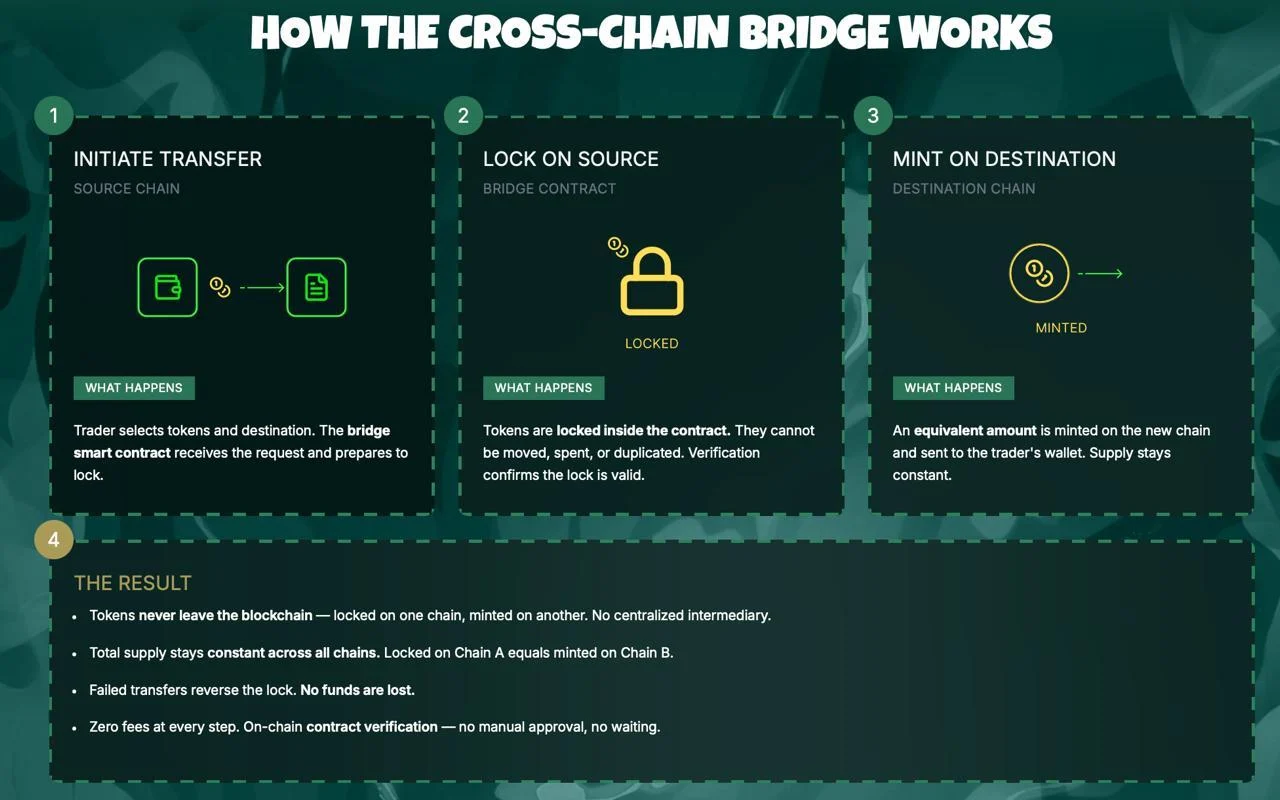
The integrated token screener checks every contract before you risk a cent on it. A cross chain bridge connects Ethereum, BNB Chain, and Solana at zero cost, so every dollar you move lands in full on the other side.
The architect behind the original Pepe, which reached $11 billion with zero products, is now behind Pepeto. A senior Binance veteran on the team runs the confirmed listing rollout. SolidProof finished the full audit before any capital entered.
Staking at 185% APY compounds daily and rewards every presale wallet from day one. The entry price is $0.0000001863 across a 420 trillion token supply. Pepe reached $11 billion on that same supply with the same founding team and nothing built behind it, and reaching that number from here is 150x. The Binance listing cuts the timeline from months to days.
The ETH recovery path needs months of institutional rotation just to approach $4,500. Every past cycle rewarded the same pattern, presales grabbed during fear turned the smallest deposits into the largest fortunes. Pepeto’s confirmed Binance listing will permanently end this presale window and the 150x math that comes with it.
Ethereum (ETH) Price at $2,343 as Capital Rotates Back From Bitcoin
Ethereum (ETH) trades at $2,343 according to CoinMarketCap, down 53% from the $4,953 August 2025 peak. The ETH/BTC ratio bounced to 0.0313 while network users grew 82% in Q1 and total ETF inflows sit at $11.6 billion.
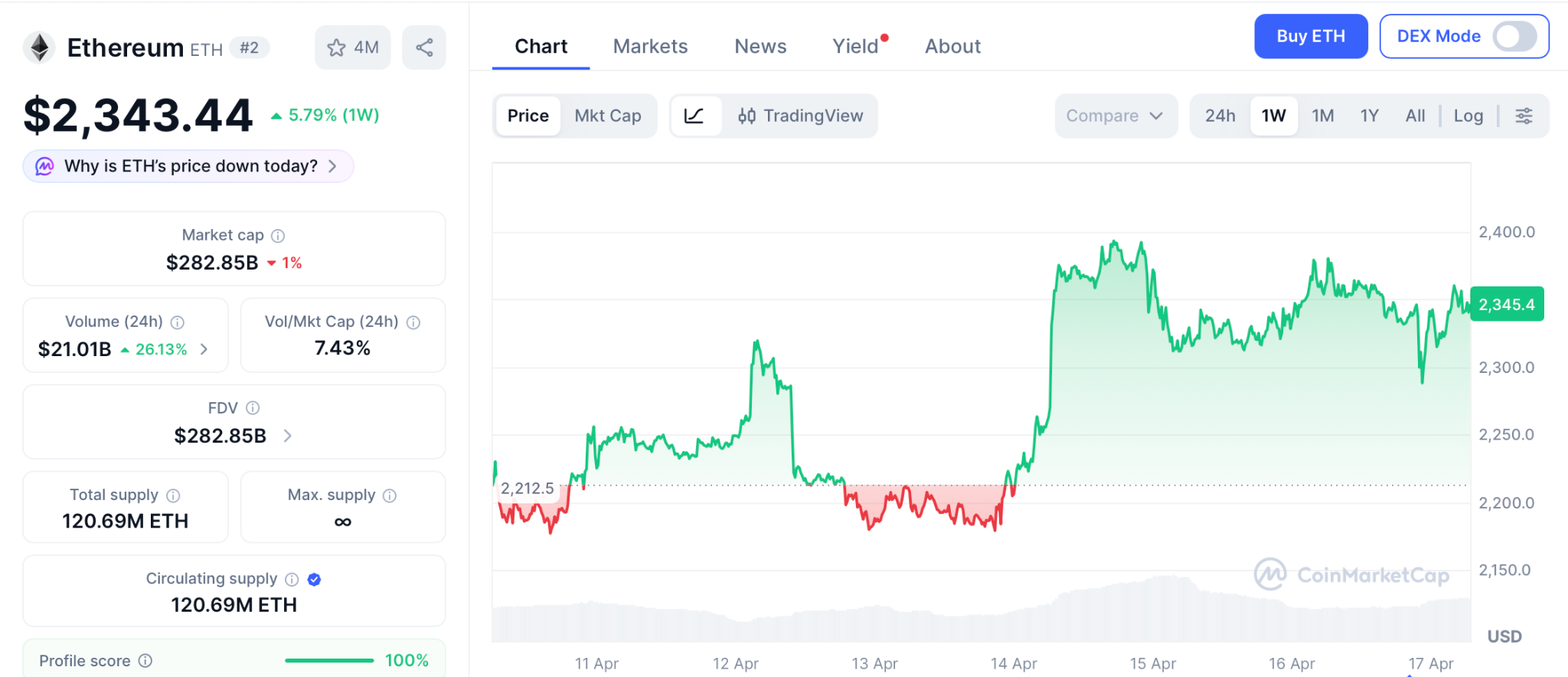
Resistance sits at $2,500 with $3,200 as the next ceiling, while support holds at $2,100. Changelly projects the ethereum price prediction for April between $2,307 and $2,774 with an average near $2,540.
The bullish scenario puts $2,774 at roughly 19% from here, solid for a large cap, but weekly gains cannot compete with what a presale to Binance listing event produces in days.
Conclusion
The ETH outlook keeps building with the ratio at a three month high and $180 billion in stablecoins anchoring demand on the network. But this presale did not throw another token onto the market without a plan. It assembled tools that shield every wallet from hidden fees and blind trades that crushed retail traders in every past cycle.
Click below to enter the Pepeto presale before the Binance listing hits, because the chance to capture the biggest returns of this cycle closes the moment trading goes live.
Click To Visit Pepeto Website To Enter The Presale

FAQs
What does the ETH/BTC ratio bounce mean for the ethereum price prediction?
The ETH/BTC ratio hit 0.0313, its highest reading in three months, while Ethereum added 82% more users in Q1 and stablecoin supply hit $180 billion per CoinDesk. Pepeto at presale price with a confirmed Binance listing targets 150x returns that ETH cannot deliver from $2,337.
How does the ethereum price prediction compare to what Pepeto’s presale offers?
Changelly projects ETH reaching $2,774 at most for April, roughly 19% from current levels. Pepeto at $0.0000001863 with $8,940,333 raised and a confirmed Binance listing targets 150x through a presale to exchange event that closes in days.
Disclaimer: This is a Press Release provided by a third party who is responsible for the content. Please conduct your own research before taking any action based on the content.



The Senate passed a 10-day FISA extension 2026 by voice vote Friday, keeping the surveillance program alive until April 30 after a bloc of 20 House Republicans overnight derailed both a five-year and an 18-month renewal that Speaker Johnson and the White House had spent a week negotiating.
Summary
- Section 702 of the Foreign Intelligence Surveillance Act was set to expire Monday; the Senate’s rare Friday session approved the stopgap, sending the measure to Trump for signature.
- A 10-day extension was the last resort after the House failed 197-228 on a procedural vote for the 18-month plan, following an earlier collapse of a five-year extension with revisions.
- Trump had lobbied hard all week for a clean long-term renewal, posting on Truth Social urging Republicans to “UNIFY” and calling FISA vital to the Iran war campaign.
The Senate cleared a FISA extension 2026 stopgap by voice vote Friday morning, buying Congress until April 30 after an all-night collapse on Capitol Hill left two separate long-term renewal attempts in ruins. The measure goes to President Trump for signature before the program’s Monday expiration.
Section 702 allows US spy agencies including the CIA, NSA, and FBI to collect foreign communications without a warrant, including those of Americans in contact with targeted foreigners. Intelligence officials have called it the single most important national security tool the country has. “FISA is the single most important national security asset we have in the intelligence field,” said Sen. Angus King of Maine, a member of the Senate Intelligence Committee. “It constitutes a very high percentage of the president’s daily brief.”
Johnson entered Thursday evening believing a deal was in hand. Shortly before midnight, GOP leaders unveiled a revised five-year extension designed to win over privacy hawks. It failed. They then tried an 18-month clean renewal that Trump had demanded. That failed 197-228 on the procedural vote, with 20 Republicans joining most Democrats in opposition.
At 2:09 AM Friday, the House passed the 10-day stopgap by unanimous consent. The Senate convened a rare Friday session hours later and approved it the same way.
Trump had pressured Republicans all week through Truth Social posts, CIA Director John Ratcliffe briefed lawmakers directly on Wednesday, and a group of Republicans visited the White House on Tuesday. None of it held the bloc. “We were very close tonight,” Johnson said.
What Happens Before April 30
The core dispute is straightforward: privacy hawks want the government to obtain a warrant before querying Americans’ communications collected incidentally under Section 702. Intelligence officials say that requirement would cripple the program’s operational value.
The two-week window runs directly into the same compressed legislative calendar that is simultaneously managing the CLARITY Act markup, budget reconciliation, and the FOMC on April 28-29. Johnson will need to either negotiate a bipartisan compromise on warrants or muscle through a partisan solution while holding every non-rebel Republican, a task that looks harder after Thursday’s revolt.
As Rep. Ro Khanna of California put it: “We just defeated Johnson’s efforts to sneak through a 5-year FISA authorization tonight. Now, they will have to fight in daylight.” For the midterm calendar that governs everything in Washington in 2026, fighting in daylight means every Republican privacy hawk’s vote will be on record.
Flow Capital Partners is planning to tokenize its private credit fund through Singapore-based DigiFT, Bloomberg reported Friday, as the Hong Kong credit manager looks to tap blockchain-based distribution for its next capital raise.
According to the report, Flow Capital plans to bring its $150 million private credit fund on the blockchain through Singapore-based tokenization platform DigiFT by the end of April, seeking to raise an additional $30 million in tokenized shares by the end of 2026, Jacky Tian, chief investment officer of Flow Capital, said.
The $30 million raise is part of the company’s plans to expand the size of the fund to $250 million with a target net return of 12%. The fund launched in mid 2025, with $125 million in seed capital, according to the company. Cointelegraph has approached Flow Capital and DigiFT for comment.
The move adds to a growing push to use tokenization as a distribution channel for traditional credit products.
Some of the largest TradFi companies have announced similar tokenization initiatives, including asset manager BlackRock, which launched its BlackRock USD Institutional Digital Liquidity Fund (BUIDL), a tokenized treasury fund on Ethereum, in March 2024. Investment banking giant JPMorgan also launched its tokenized money-market fund, My OnChain Net Yield Fund (MONY), on Ethereum in December 2025.
However, industry leaders have raised misconceptions tied to the liquidity of tokenized assets.
Related: Gold, silver and oil drive 65,000% jump in commodity perpetuals
Executives warn tokenization isn’t liquidity
Oya Celiktemur, Ondo Finance sales director for Europe, said tokenization doesn’t magically make hard-to-trade assets liquid.
“I think there’s still this idea that tokenizing something illiquid will somehow magically make it a liquid asset, which is just not true,” said Celiktemur, speaking during a panel discussion at Paris Blockchain Week 2026.
Francesco Ranieri Fabracci, head of tokenization expansion at Tether, made a similar point, arguing that tokenizing an asset won’t make it liquid, but added that some instruments, including bonds, money market funds and stablecoin, will likely see consistent liquidity on blockchain rails.

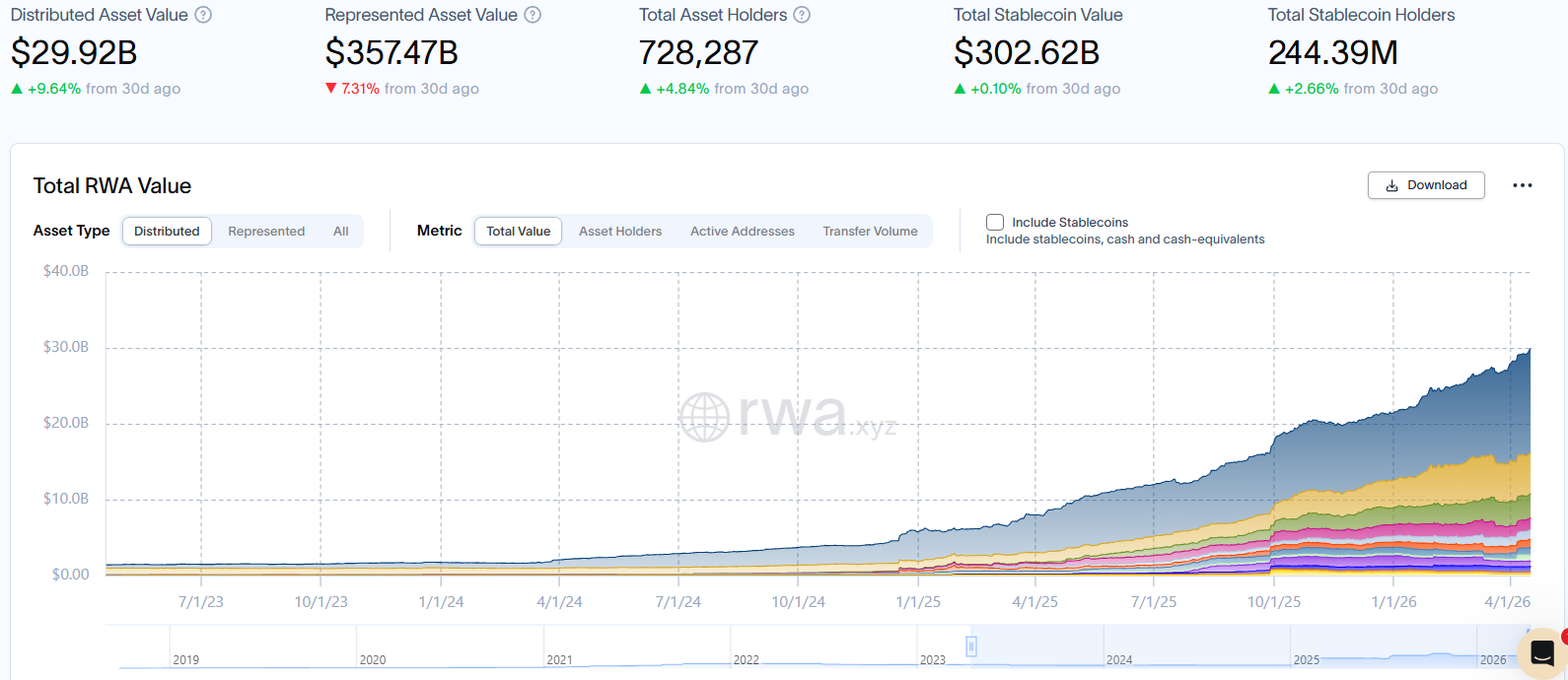
The total value of tokenized assets rose 9.6% during the past 30 days to $29.9 billion on Friday, data from RWA.xyz shows.
Tokenized US treasury debt was the largest sector with $13.7 billion in value, followed by commodities with $5.4 billion and asset-backed credit with $3.2 billion.
Magazine: Can Robinhood or Kraken’s tokenized stocks ever be truly decentralized?


Trump FEMA news took a sharp reversal Thursday when CNN reported the president plans to nominate Cameron Hamilton as FEMA administrator, less than a year after Hamilton was fired in May 2025 for testifying before Congress that the agency should not be eliminated, directly contradicting statements Trump and then-Homeland Security Secretary Kristi Noem had made.
Summary
- Hamilton, a former Navy SEAL who served four tours in Afghanistan, visited the White House Wednesday alongside new DHS Secretary Markwayne Mullin for a meeting with Trump; DHS said it has “no personnel announcements to make at this time.”
- If confirmed, Hamilton would become the first permanent FEMA administrator of Trump’s second term, ending 15 months of acting leadership through three different officials.
- The nomination reflects the administration’s pullback from Noem’s aggressive FEMA overhaul, which cut 30% of the agency’s workforce, cratered morale, and created a multibillion-dollar backlog in disaster funding that drew bipartisan backlash.
Trump FEMA news confirmed a significant policy reversal as CNN reported Thursday that President Trump plans to nominate Cameron Hamilton to lead the Federal Emergency Management Agency, roughly eleven months after Hamilton was removed from the acting administrator role following testimony that defended the agency’s existence against the administration’s own stated plans to dismantle it.
Hamilton was fired on May 8, 2025, a day after telling a House committee: “I do not believe it is in the best interests of the American people to eliminate FEMA.” White House Press Secretary Karoline Leavitt later said Hamilton “testified saying something that was contrary to what the president believes.” Multiple sources subsequently told CNN the decision to fire him had been in the works for weeks.
The agency Hamilton would return to is different from the one he left. Noem’s overhaul hollowed out its senior leadership, cut roughly 30% of the workforce, cratered morale across the organization, and produced what state and local officials nationwide called a multibillion-dollar backlog in approved but unpaid disaster assistance. Republican governors, Republican lawmakers, and emergency management professionals pushed back loudly. Trump fired Noem in March.
New DHS Secretary Mullin has been rolling back Noem-era directives, starting with a rule that required Mullin’s personal approval for any department spending over $100,000. Mullin has traveled to disaster-affected regions and praised FEMA’s capabilities publicly, striking a sharply different tone than his predecessor.
Hamilton in April wrote on X thanking Trump for his original opportunity to lead FEMA. “I wish my tenure had been longer, as there is still much more work to do for reform,” he wrote. “I am confident that under Mullin’s leadership, good things will come.”
Who Hamilton Is
Hamilton served four tours in Afghanistan as a Navy SEAL before supporting crisis response teams and the Bureau of Counterterrorism at the State Department. He then oversaw DHS’s emergency first responder division before being tapped to lead FEMA at the start of Trump’s second term.
His original tenure was defined by drama: a lie detector test ordered by DHS leadership, a leaked policy meeting discussing FEMA’s potential dissolution, and being accidentally tipped off to his own firing when FEMA security received a notification that his access would be terminated.
While Hamilton defended FEMA’s purpose in his 2025 testimony, he also argued the agency had “evolved into an overextended federal bureaucracy attempting to manage every type of emergency, no matter how minor,” a position that aligns with reform without abolition. That framing is more politically durable heading into a hurricane season that begins June 1 and runs until November, the same month as the midterm elections that the administration is preparing every major policy decision around.
The administration’s retreat on FEMA mirrors the same pattern seen on CLARITY Act negotiations and RFK Jr.’s vaccine messaging: positions that proved too aggressive for the electoral environment are being walked back before they become campaign liabilities.
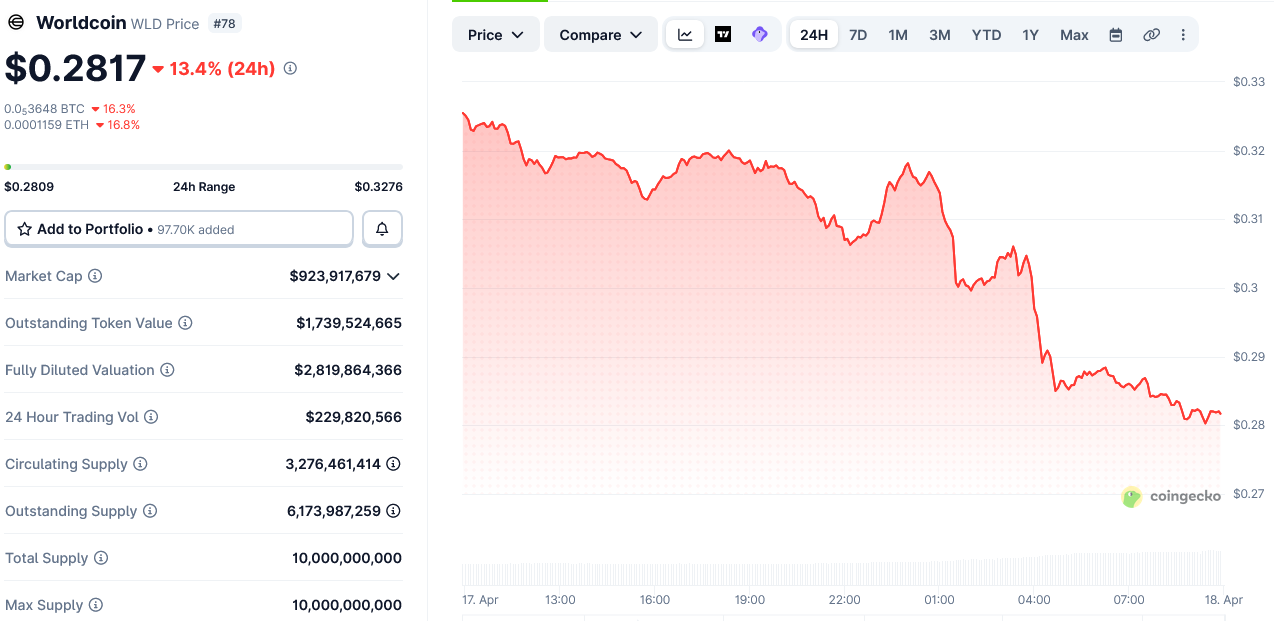
Worldcoin fell 13.4% to roughly $0.28 on Friday as World, the identity-focused company led by OpenAI CEO Sam Altman, unveiled several new integrations for its “proof of human” stack, which uses iris-scanning technology to verify identities.
Video conferencing tool Zoom is integrating World’s Deep Face authentication to prevent deepfakes, while electronic signature platform Docusign is adding World’s ID verification tech to digital agreements, World said on Friday. Dating app Tinder is also expanding its World ID verification to US users.
“As AI agents increasingly act on behalf of real people, the infrastructure to prove a human stands behind each agent becomes critical,” World said.
No more deepfakes on video calls. @worldnetwork identify verification on @Zoom. pic.twitter.com/0ap0IOKR6H
— World (@worldnetwork) April 17, 2026
Alongside the surge in AI-generated content, deepfake technology has been used in increasingly sophisticated impersonation scams, helping fraudsters evade standard ID checks and deceive victims into handing over funds or sensitive data.
While biometric verification has been touted as a solution, critics warn that collecting data at scale raises privacy risks, particularly if controlled by a single company, and could lead to excessive surveillance if misused.
Worldcoin’s (WLD) double-digit fall to $0.28 came as the broader crypto market rose 2.2% on news of the US and Iran easing tensions and opening up the Strait of Hormuz on Friday.
WLD is the native cryptocurrency token of the World Network, used to reward users for verifying their unique identity and to enable transactions and participation within its ecosystem.

World’s ID technology is mostly based on its Orb device, which scans a user’s iris to generate a unique digital identity used to verify they are human without revealing personal data.
Related: Why privacy coins often appear in post-hack fund flows
World has introduced an account-based system with features like key recovery and multi-device support for its proof of human stack, aimed at making verification more secure and portable.
Coinbase recently partnered with World to verify AI agents
Other recent World integrations include Amazon Web Services, Shopify, Browserbase, Exa, VanEck and Coinbase.
Coinbase announced that it would use World’s AgentKit, a developer toolkit that allows AI agents to prove they are linked to a verified, for its x402 AI agents micropayments protocol in March.
Magazine: AI agents will kill the web as we know it: Animoca’s Yat Siu

Fintech company Ramp Network said Friday it launched a multichain self-custodial wallet designed to tackle a common friction point in crypto of needing to rely on outside providers for core actions such as buying, swapping and cashing out.
The company said the wallet allows users to buy, sell, trade and cash out digital assets inside a single application, using Ramp’s own on-ramp, off-ramp and cross-chain infrastructure rather than handing users off to external services, according to an announcement shared with Cointelegraph.
Ramp said the wallet launches with support for Ether (ETH) across eight networks: Ethereum, Arbitrum, Base, Linea, MegaETH, Optimism, Polygon zkEVM and zkSync Era. It will also offer support for additional networks, including Bitcoin, Solana, Binance Smart Chain, Polygon, Apechain, Avalanche, Celo and Gnosis.
Simplifying self-custody remains one of crypto’s biggest product problems. Ramp is betting that bringing payments, swaps and cash access into one app can make non-custodial wallets feel less fragmented without taking control of user assets. Ramp said it uses USDC (USDC) on Base as a core balance for transfers, payments and in-app activity, while assets remain secured through a self-custodial setup using passkeys and optional key export.
Other crypto wallets that offer integrated decentralized exchange (DEX) features for asset purchases and swaps include Metamask, Phantom, Best Wallet and Exodus.

Wallet launches outside the EU
Ramp said the wallet will be available globally, excluding the European Union, due to regulatory requirements.
Ramp Network is authorized as a Crypto Asset Service Provider under the EU’s Markets in Crypto Assets Regulation (MiCA) since December 2025, according to the European Securities and Markets Authority’s MiCA register.
However, launching a product such as a wallet requires “additional regulatory steps,” which are expected to be finalized in the coming months, Przemek Kowalczyk, co-founder and CEO at Ramp Network, told Cointelegraph.
Ramp said it previously operated mainly as the infrastructure layer behind crypto purchases in partner apps, including MetaMask and Trust Wallet, serving more than 10 million users globally.
Related: Fireblocks launches tool for institutions to earn yield on stablecoins
Ramp pitches simpler self-custody flow
Kowalczyk said Ramp built the infrastructure itself so users would not have to leave the app to buy, swap or cash out, while still keeping control of their assets.
“We would not frame this as becoming a new intermediary, but rather as reducing the number of intermediaries involved in a transaction,” Kowalczyk said. “By bringing these flows into a single system, we reduce those handoffs and make the experience more consistent and predictable,” he added.
Kowalczyk argued that this unified wallet infrastructure will enable better execution control and simplify the fragmented wallet experience while users still maintain asset ownership.
Magazine: ‘Account abstraction’ supercharges Ethereum wallets: Dummies guide


Coinglass shows $2.221B of BTC longs below $73,610 and $913M of shorts above $81,264, turning the next $10K band into a $3.1B liquidation minefield for traders.
Summary
- Coinglass data indicate that if Bitcoin falls below $73,610, cumulative long liquidation intensity on major centralized exchanges jumps to about $2.221 billion.
- On the upside, a clean break above $81,264 would put around $913 million of shorts at risk of liquidation, turning a relatively small move into a potential $3.1 billion forced‑flow event.
- The new band extends an April pattern in which Coinglass maps have repeatedly shown billion‑dollar liquidation clusters just a few thousand dollars away from spot, magnifying every breakout or breakdown.
Bitcoin (BTC) is once again wedged between two large liquidation clusters, with leverage stacked just below and above current levels on major derivatives venues. According to the latest liquidation‑levels data from derivatives analytics platform Coinglass, “if BTC falls below $73,610, the cumulative long liquidation intensity on major CEXs will reach $2.221 billion,” while “if BTC breaks above $81,264, the cumulative short liquidation intensity on major CEXs will reach $913 million.”
Coinglass maps new BTC liquidation walls
Coinglass explains that its Bitcoin liquidation heatmap and liquidation‑levels indicator are designed to “estimate price ranges where large‑scale liquidation events may occur” by aggregating high‑leverage long and short clusters across futures and perpetual swaps. The firm stresses that the bars on its heatmap represent relative “intensity” rather than an exact dollar amount guaranteed to be wiped out, but notes that once price collides with a dense band, forced selling or buying can “cause sharp price movements and significantly impact traders’ positions.”
In a recent analysis highlighted by crypto.news, Coinglass’ Bitcoin liquidation map showed a similar setup lower down the chart, with a $1.143 billion long wall below $65,000 and a $754 million short pocket above $68,000, creating nearly $1.9 billion of potential forced flow in a narrow band. At that time, the platform described these areas as “sensitivity zones” that can turn a modest 5–7% move into a disproportionate liquidation cascade as exchanges automatically close margined positions.
The updated $73,610–$81,264 corridor effectively shifts that dynamic higher, suggesting leverage has chased Bitcoin’s rally rather than resetting. Coinglass’ Bitcoin liquidation dashboard shows that, on busy days, more than $200 million of BTC positions can be flushed in 24 hours, with peak liquidation hours often seeing single events above $10 million. Its separate “Top Liquidation Events” page ranks past days where total liquidations exceeded several billions of dollars, illustrating how quickly clustered leverage can turn into historic wipeouts.
By combining the liquidation‑levels indicator with the BTC/USDT liquidation heatmap on Binance, Coinglass says traders can “identify key support and resistance areas, manage risk with informed stop‑loss levels, and gain insights into market sentiment and potential volatility zones.” In practice, that means anyone running high leverage into the $73,610 downside or the $81,264 upside is effectively betting they can front‑run a multi‑billion‑dollar liquidation wave rather than be swept up in it.
As previous crypto.news coverage has noted, similar leverage clustering has already appeared across Bitcoin and Ethereum this month, with ETH liquidation bands around $2,000 and $2,451 threatening more than $2.5 billion in combined longs and shorts at various levels. A recent Bitcoin‑focused story on liquidation maps flagged $65,000 as key support and $68,000 as a squeeze zone before spot pushed higher into today’s range.
Additional crypto.news reporting on derivatives stress includes deep dives into ETH’s near‑$2,000 “trapdoor” heatmap and the $2,451 ETH liquidation wall that threatens $1.47 billion in short positions. For traders tracking Bitcoin specifically, the crypto.news BTC price page provides live quotes, market cap and derivatives metrics alongside levels like $73,610 and $81,264.

TLDR:
- Bitcoin surged over 16% in two weeks, breaking a six-month resistance level and shifting market structure outlook.
- BTC moved above the 100-day SMA after prior rejections that triggered declines of 30% and 39% in past cycles.
- Momentum indicators turned positive with a bullish crossover, while volatility expands after a long compression phase.
- Market developments, including institutional access and profitability shifts, continue to support current price strength.
Bitcoin has staged a sharp recovery, climbing more than 16% in two weeks and reclaiming a key resistance level. The move follows months of pressure, while both technical indicators and broader market developments begin to support a shift in short-term direction.
Bitcoin Pushes Through Key Resistance as Momentum Builds
Recent market commentary from Ali Charts noted that Bitcoin has broken above a resistance level that defined price action for nearly six months.
The analyst pointed out that this marks a notable change, especially as the asset tests the 100-day simple moving average again.
Earlier interactions with this level resulted in steep declines. In October, Bitcoin dropped about 30% after rejection.
A similar pattern appeared in January, when price fell roughly 39% following another failed attempt. This time, price action shows a different response, with Bitcoin moving through the level instead of reversing.
At the same time, broader market developments are shaping the current trend. A recent update reported that Strategy’s Bitcoin holdings have returned to profit, as price climbed above its average acquisition level of $75,577. This shift reflects improved balance sheet positioning for large holders.
In parallel, Charles Schwab plans to roll out direct spot Bitcoin and Ethereum access for retail clients in the coming weeks.
This step may expand access to digital assets for traditional investors, adding another layer of demand to the market.
These developments align with the current market structure, where Bitcoin trades near $77,900. Price has been forming higher lows, which often reflects steady buyer interest. This gradual climb suggests a shift from the earlier bearish structure toward a more stable upward trend.
Technical Indicators Signal Early Trend Transition
The daily chart structure shows a clear transition phase. After a prolonged decline from around $110,000 to $75,000, Bitcoin entered a sideways range between $65,000 and $75,000. During this period, Bollinger Bands tightened, indicating reduced volatility and a possible accumulation phase.
As price exited this range, volatility began to expand again. Bollinger Bands are now widening, which often accompanies stronger directional moves. Bitcoin is currently approaching the upper band near the $78,000 zone, where short-term resistance may appear.
Momentum indicators also reflect a change in direction. The oscillator, similar to a MACD-style setup, previously showed deep negative readings, signaling strong selling pressure. That has since reversed, with the indicator crossing above zero and forming a bullish crossover.
The histogram has turned positive and continues to grow, which suggests increasing upward momentum. This shift is often associated with early stages of trend reversal rather than a temporary bounce.
Even so, resistance remains close. If Bitcoin struggles near the $78,000 to $80,000 range, a pullback toward the mid-band near $75,000 could follow. Stronger support remains near $70,000, where previous demand emerged during consolidation.
If price holds above current levels and breaks resistance, the next areas to watch are $85,000 and $90,000. These levels align with prior structural zones and may attract increased market activity.
The current setup reflects a transition from consolidation into a potential expansion phase. With both technical structure and supporting market developments aligning, the market is attempting to establish a new direction.

Canelo’s trainer Eddy Reynoso rules out two major opponents ahead of comeback

AI Trusted Less Than Social Media and Airlines, With Grok Placing Last, Survey Says

Simple ways to manage hayfever symptoms without taking medication


-
 NewsBeat5 days ago
Pep Guardiola and Gary Neville agree over Arsenal title problem that benefits Man City
-

 Crypto World4 days ago
The SEC Conditionalises DeFi Platforms to Be Avoided for Broker Registration
-

 Politics5 days ago
World Cup exit makes Italy enter crisis mode
-

 Crypto World4 days ago
SEC Signals Exemption for Crypto Interfaces From Broker Registration
-

 News Videos3 days ago
Secure crypto trading starts with an FIU-registered
-

 Sports17 hours ago
NWFL Suspends Two Players Over Post-Match Clash in Ado-Ekiti
-

 Crypto World4 days ago
SEC Proposes Certain Crypto Interfaces Don’t Need to Register as Brokers
-

 Business6 days ago
Ireland Fuel Protests Enter Day 5 as Blockades Spark Shortages and Government Prepares Support Package
-

 NewsBeat4 days ago
Trump and Pope Leo: Behind their disagreement over Iran war
-

 Fashion8 hours ago
Weekend Open Thread: Theodora Dress
-
 NewsBeat6 days ago
JD Vance announces ‘no agreement’ with Iran over nuclear weapons fear
-

 Crypto World4 hours ago
Russia Pushes Bill to Criminalize Unregistered Crypto Services
-
Sports6 days ago
Dexter Lawrence, Stefon Diggs, Trading for De’Von Achane
-

 Crypto World5 days ago
Trump whales load up ahead of Mar-a-Lago luncheon.
-
Crypto World5 days ago
Sei Network Enters Quiet Reset Phase as On-Chain Metrics Signal a Slowdown in 2026
-
Business5 days ago
Kering slides after Morgan Stanley downgrade, Gucci woes loom
-
 Entertainment4 days ago
Karol G’s ‘Ultra Raunchy’ Coachella Set Gave ‘Satanic Vibes’
-
 Business1 day ago
Creo Medical agree sale of its manufacturing operation
-

 Sports5 days ago
NWFL opens Pathway for new Clubs ahead of 2026 Season
-
 Entertainment4 days ago
Brand New Day’ Footage Reveals the Devastating Impact of ‘Now Way Home’
You must be logged in to post a comment Login