

Crypto World
White House Shooting Disrupts High-Stakes Weekend as Trump Pushes Iran Peace Deal



A shooting outside the White House on Saturday briefly locked down the presidential complex and disrupted a critical weekend of negotiations around a potential US-Iran peace agreement.
The incident came just hours after President Donald Trump claimed a deal to end the war with Iran had been “largely negotiated.”
Tensions Rise in Washington
According to the Secret Service and multiple US media reports, a gunman opened fire near a security checkpoint at 17th Street and Pennsylvania Avenue NW shortly after 6 p.m. ET. Secret Service agents returned fire, wounding the suspect. A bystander was also reportedly injured.
The White House North Lawn was evacuated as reporters were rushed into the press briefing room. Journalists on-site described hearing between 15 and 30 gunshots. The lockdown was lifted less than an hour later.
The FBI is assisting the Secret Service investigation. Authorities said the suspect had previously been subject to a “stay-away order” connected to the White House area. No motive has been officially confirmed.
The security scare unfolded during one of the most politically sensitive weekends of Trump’s presidency.
US-Iran Deal in Crosshairs?
Earlier in the day, Trump announced that a framework agreement with Iran was nearing completion and said reopening the Strait of Hormuz was part of the negotiations.
The proposed deal is being mediated in part by Pakistan and Gulf states following months of conflict triggered by US and Israeli strikes on Iran in February. However, key disagreements reportedly remain over sanctions relief, Iran’s nuclear program, and long-term enforcement terms.
Saturday’s shooting also adds to growing security concerns around Trump and the White House.
The incident follows the April 2026 White House Correspondents’ Dinner shooting and another armed confrontation involving Secret Service agents near the National Mall earlier this month.
Financial markets initially reacted positively to Trump’s Iran comments earlier in the day, with Bitcoin rebounding from a one-month low below $75,000 and several altcoins rallying sharply. However, the White House shooting injected fresh uncertainty into an already tense political environment.
The post White House Shooting Disrupts High-Stakes Weekend as Trump Pushes Iran Peace Deal appeared first on BeInCrypto.



The Bank of Japan (BOJ) raised its policy rate by 25 basis points on June 16, moving the target for the uncollateralized overnight call rate to around 1.0%.
Summary
- BOJ raised rates to 1.0%, putting yen liquidity and crypto market exposure back in focus.
- Oil-driven inflation risks pushed Japan’s central bank toward another step away from easy monetary policy.
- BOJ tightening adds pressure to yen carry trades, putting Bitcoin and wider digital assets back in focus.
The new rate takes effect on June 17 after a 7–1 vote by the Policy Board. The move lifted Japanese rates further from the ultra-low levels that shaped local and global markets for years.
“The Bank will encourage the uncollateralized overnight call rate to remain at around 1.0 percent,” the BOJ said in its policy statement.
The central bank also raised the interest rate on the complementary deposit facility to 1.0% and set the basic loan rate at 1.25%. 1.0% marks Japan’s highest policy rate since 1995. Market participants now watch how the move shapes the yen, bonds, and crypto risk appetite in coming sessions.
Inflation risk drives the BOJ decision
The BOJ said Japan’s economy continues to recover at a moderate pace, even as higher crude oil prices weigh on activity. It said strong corporate profits, better jobs data, and income growth still support the economy. The bank also said government steps to reduce the household burden from energy costs will continue to help demand.
The central bank also pointed to rising price pressure. It said price pass-through from higher crude oil costs has moved at a relatively fast pace in business-to-business transactions. It added that this pressure may spread to consumer prices across many items. The BOJ said underlying CPI inflation may move above its 2% price stability target if medium- to long-term inflation expectations keep rising.
Meanwhile, crypto.news reported before the decision that a move to 1.0% could bring renewed attention to global liquidity and the yen carry trade. The carry trade uses cheap yen borrowing to fund higher-yielding assets. Higher Japanese rates can make that trade less attractive and may push investors to reduce exposure to risk assets.
In addition, that matters for Bitcoin and other digital assets because crypto markets trade around the clock and can react quickly when leveraged positions unwind. Bitcoin fell roughly 3% within hours after the BOJ raised rates to 0.75% in January 2026. The report also said Bitcoin would likely face the first wave of selling because of its deeper liquidity, while smaller tokens may see sharper moves.
Japan’s crypto policy remains active
The rate hike comes as Japan continues to reshape its digital asset rules. Crypto.news reported on June 11 that Japan advanced a bill that would cut crypto gains tax to 20%, open a path for crypto ETFs, and treat digital assets more like stocks. That policy track gives Japan a second crypto story beyond monetary tightening.
In May, Japan’s ruling Liberal Democratic Party advanced an AI-blockchain finance plan focused on tokenized deposits, yen stablecoins, and programmable settlement.
These reforms show that Japan is tightening monetary policy while still building clearer digital finance rules. “The Bank will continue to raise the policy interest rate and adjust the degree of monetary accommodation,” the BOJ said, while noting that future moves will depend on economic activity, prices, and financial conditions.


The U.S. Commodity Futures Trading Commission has responded to four common criticisms of perpetual futures contracts, citing more than 100 public comments submitted during a 2025 consultation process as regulators continue expanding oversight of digital asset markets.
Summary
- CFTC Chair Michael Selig said perpetual futures contracts do not require a fixed expiration date under existing U.S. law or regulatory interpretations.
- Selig stated that CFTC regulated perpetual futures face the same leverage limits as other U.S. futures contracts, rejecting claims that they permit 250x leverage.
- More than 100 public comments were submitted during the CFTC’s 2025 consultation on perpetual contracts, while the agency said funding rates help keep prices aligned with spot markets.
According to a post published on X by CFTC Chair Michael Selig, several misconceptions have emerged around perpetual futures contracts and the agency’s recent approvals of such products, including concerns related to contract duration, leverage, public consultation, and funding rates.
Among the issues addressed was the argument that perpetual futures fall outside the legal definition of a futures contract because they do not have a fixed expiration date. Selig said neither the Commodity Exchange Act nor CFTC regulations explicitly define the term “futures contract” in a way that requires a fixed expiration or delivery date.
Instead, he said the criteria used to determine whether an instrument qualifies as a futures contract come from court decisions and commission interpretations, neither of which requires a contract to expire on a predetermined date.
CFTC defends leverage limits and funding mechanism
Attention has also focused on leverage after some critics claimed the agency had approved a product that would allow U.S. traders to access leverage of up to 250x through the recently approved BTCPERP contract.
Addressing those concerns, Selig said extreme leverage has historically been associated with offshore trading venues rather than the perpetual futures structure itself. Perpetual contracts operating under CFTC oversight, he said, remain subject to the same leverage restrictions that apply to other regulated futures products in the United States.
Questions surrounding industry participation were also raised following the approval process. In response, Selig pointed to an April 2025 request for comment covering both perpetual contracts and 24/7 trading, which drew more than 100 responses from market participants, including numerous firms already registered with the commission.
Funding rates, another frequently debated feature of perpetual futures, received separate attention in the statement. According to Selig, critics have argued that the mechanism creates high costs for traders and encourages harmful market behavior.
His explanation was that carrying a position in traditional futures contracts can generate similar annualized costs once traders account for the expenses associated with repeatedly opening and rolling expiring contracts. He added that funding rates help keep perpetual futures aligned with the underlying spot market rather than encouraging misconduct.
The comments arrive as the CFTC continues to take a prominent role in digital asset regulation while Congress debates legislation that could redefine the responsibilities of the CFTC and SEC.
As previously reported by crypto.news, the commission recently appointed former SEC crypto task force adviser Donald Battle as chief data innovation officer. In announcing the hire, the agency highlighted Battle’s experience in blockchain analytics, financial investigations, artificial intelligence, and data science.
Beyond cryptocurrency markets, the commission has remained active in disputes involving prediction markets and event contracts. Court filings cited by the agency show it recently challenged New Mexico officials over efforts to apply state gaming laws to contracts listed on Kalshi, arguing that federally regulated event contracts fall under CFTC jurisdiction.
At the same time, the regulator is collecting public feedback on a proposed framework for sports event contracts, a process that could influence how federal authorities oversee sports-related prediction markets in the future.
Anthropic’s decision to shut down access to its latest artificial intelligence models after a US order to suspend access to foreign nationals highlights the risks of centralized control in AI, which could increase demand for decentralized alternatives, says Grayscale.
Grayscale head of research Zach Pandl said in a note on Monday that the order to cut access to Anthropic’s Fable 5 and Mythos 5 shows “the centralized control of frontier AI technology and drives home the need for decentralized alternatives.”
“We expect demand for decentralized AI, like Bittensor and its TAO token, to continue to rise as investors seek alternatives,” Pandl said.
The US government on Friday directed Anthropic to suspend access to the models for foreign nationals over national security concerns. Anthropic subsequently disabled access to Fable 5 and Mythos 5 for all users to comply with the order.
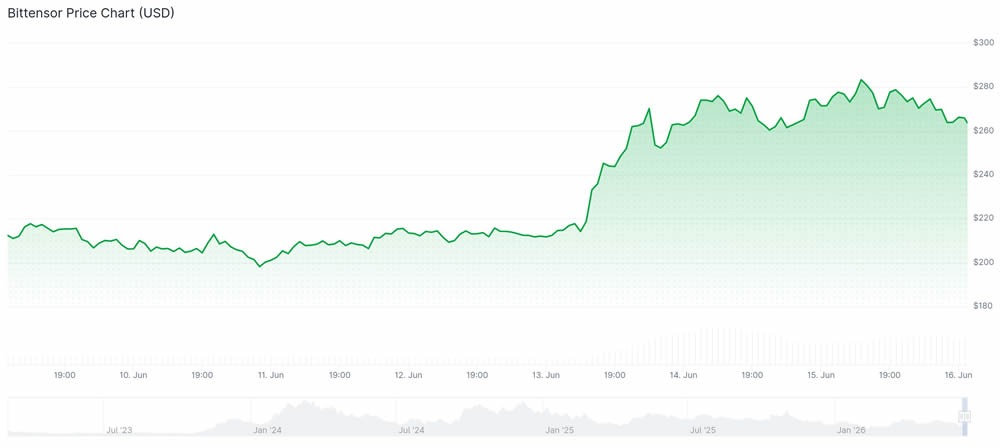
Pandl noted that in the 12 hours after Anthropic cut access to its latest models, Bittensor’s TAO token climbed 30% as users sought out a decentralized alternative, climbing to a three-week high of $283 on Monday.
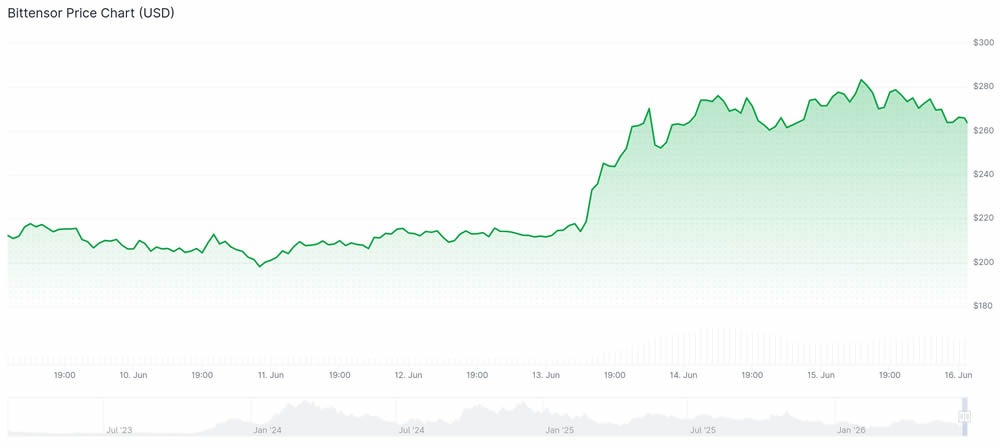
TAO has outperformed the wider crypto market over the past week. Source: CoinGecko
Pandl explained that Bittensor offers an “alternative vision for AI based on decentralized principles,” aiming to provide access to AI resources through an open, global, decentralized network.
“Think of it as Bitcoin for AI.”
“Access to artificial intelligence is becoming an increasingly important economic resource,” Pandl added. “As AI capabilities continue to improve, governments and AI labs will play an increasingly important role in determining who can access these tools and under what conditions.”
Anthropic suspension sets a precedent
Colton Malkerson, co-founder of EdgeRunner AI, argued that this event is a breaking point for corporate data independence.
“We’ve been saying for a while that companies are ‘renting’ their intelligence from the big labs, but this is even worse,” he said in a note to Cointelegraph.
“It’s like renting your intelligence, just like if you’re renting a house and the landlord can cancel your lease whenever they want, kick you out, and look at all your property while you’re a tenant.”
Related: Amazon warning triggered US crackdown on Anthropic AI models: Reports
Tech entrepreneur and author Brett Hurt said in a note to Cointelegraph that the US order for Anthropic to cut off access to its models “was a precedent.”
“The moment a government can silence a commercial AI model overnight, with no public hearing, no technical disclosure, and no appeals process, every lab in America is now operating under an invisible ceiling.”
Magazine: How AI just dramatically sped up the quantum risk for Bitcoin


Uniswap’s UNI token has been projected to climb from about $2.70 to $100 by the end of 2030 as tokenized assets increasingly enter decentralized finance, according to a new forecast from Standard Chartered Bank.
Summary
- Standard Chartered has projected UNI could reach $100 by 2030 as tokenized assets and DeFi activity continue to expand.
- The bank estimates assets locked in DeFi could grow to $2.7 trillion by the end of the decade, positioning Uniswap to benefit from rising onchain trading volume.
- Standard Chartered said Uniswap’s fee burn model, declining token supply, and potential partnerships with traditional finance firms could support higher valuations over time.
Standard Chartered Bank initiated coverage of Uniswap (UNI) on Monday and said the decentralized exchange could be one of the biggest beneficiaries of growth in tokenized assets and on-chain financial activity over the rest of the decade.
The bank expects tokenized assets on public blockchains to expand from roughly $340 billion today to $4 trillion by the end of 2028. At the same time, Standard Chartered projects the share of those assets being used in DeFi applications to rise from 3.5% to 30% by the end of 2030. Combined with growth in crypto-native assets, the bank estimates total assets locked in DeFi could reach about $2.7 trillion, nearly 37 times current levels.
Geoffrey Kendrick, Global Head of Digital Assets Research at Standard Chartered Bank, said he sees decentralized finance as the next major wealth-creation opportunity in digital assets. Based on that outlook, the bank believes Uniswap’s liquidity pools could eventually have access to roughly 37 times more assets for trading than they do today.
Under Standard Chartered’s forecast, UNI could reach $6.50 by the end of 2026, $20 by the end of 2027, $40 by the end of 2028, $65 by the end of 2029, and $100 by the end of 2030. The bank also expects UNI to outperform both Bitcoin and Ether during that period.
Fee burns and token supply changes support the thesis
Part of the bank’s optimism comes from changes made to Uniswap’s economic model over the past year. Before December 2025, swap fees generated on the protocol were distributed entirely to liquidity providers. A protocol upgrade known as UNIfication introduced protocol fees and a mechanism that burns UNI tokens, while later governance decisions expanded fee collection across additional liquidity pools.
According to Standard Chartered, Uniswap has generated roughly $21 million in protocol fees since the fee switch was activated and has burned about 5 million UNI tokens, equivalent to an annual burn rate near 1%.
Token supply has also declined. The bank noted that a one-time burn of 100 million UNI, combined with ongoing burns, has reduced total supply from 1 billion to 895 million tokens, while circulating supply has fallen to about 622 million.
Recent activity on the network has reinforced that trend. Earlier this month, the UNI Burn Bot reported a record daily burn of 134,000 UNI through the UNIfication system. The mechanism requires users claiming protocol fees from TokenJar contracts to burn an equivalent value of UNI through the Firepit contract, permanently removing those tokens from circulation.
Uniswap governance has also expanded the burn framework. Proposal 96, approved in May, extended fee collection and UNI burns to BNB Chain, Polygon, and Celo, increasing the number of supported chains to 11.
Alongside those governance changes, Uniswap Labs has rolled out wallet services, cross-chain swaps, portfolio tracking tools, and multichain portfolio views. The company said nearly half of new traders on Ethereum, Arbitrum, and Base who completed swaps in 2026 made their first transaction through Uniswap.
Bank sees valuation gap with Coinbase narrowing
In its report, Standard Chartered compared Uniswap’s business model with Coinbase and argued that the decentralized exchange remains undervalued relative to the volume it processes.
The bank described Uniswap as similar to YouTube because users create and supply liquidity, while Coinbase was compared to Netflix because it operates and manages its own centralized platform infrastructure.
According to the report, that structure gives Uniswap lower capital requirements since liquidity comes from users rather than the protocol itself. The bank also expects the platform to remain competitive in markets involving closely related assets such as stablecoins, liquid staking tokens, and eventually tokenized real-world assets.
Although Uniswap handles transaction volumes that are comparable to Coinbase, Standard Chartered said the protocol trades at a much lower market capitalization-to-transaction fee multiple. Geoffrey Kendrick said stronger commercialization efforts and partnerships with traditional financial institutions could help narrow that gap over time if Uniswap successfully scales its business.
Risks remain. Standard Chartered warned that specialized decentralized exchanges could develop products better suited for certain markets, while capturing tokenized asset activity will require stronger relationships with traditional finance firms. The bank also noted that Uniswap V4’s hook system has not yet been tested at the scale anticipated in its long-term projections.
Looking ahead, Standard Chartered said regulatory developments such as the expected passage of the U.S. Clarity Act or future guidance from the Securities and Exchange Commission could help address some of those challenges and support wider adoption of decentralized finance infrastructure.

Three of crypto’s largest exchanges canceled their SpaceX products on the biggest IPO day in history, blaming share shortages and hidden lockups. Hyperliquid cleared $1.4 billion in SPCX perpetual futures without owning a single share.
Bybit, Binance, and Bitget had all offered tokenized SpaceX products ahead of the listing, but canceled them on the day when they could not source enough real shares. A separate issue caught preStocks users off-guard: a 180-day lockup on their allocations that only became visible after trading opened.
Why Tokenized Products Failed
Hyperliquid’s SPCX perpetual contract, a synthetic instrument that tracks the share price without requiring actual stock, had no such problem.
Yet three major exchanges that canceled on SpaceX day were relying on xStocks, a Kraken product that converts real equities into blockchain tokens. When xStocks received no IPO allocation, all three platforms collapsed simultaneously.
The preStocks problem was different as the platform had sold exposure to SpaceX shares ahead of the IPO, but buyers discovered the lockup restriction after trading opened, meaning they could watch the stock gain 19% without being able to touch it.
How Crypto Perps Avoided the Chaos
Hyperliquid’s SPCX perpetual contract had no allocation problem to solve. The contract uses funding rates to stay anchored to the real market price. No shares needed, no lockup possible.
On IPO day, SPCX perps generated $1.4 billion in volume on Hyperliquid, around 30% of all HIP-3 ecosystem trading that session. HYPE, Hyperliquid’s native token, gained roughly 10% on the day. HIP-3 stock perps had already posted $18.8 billion in volume in the first half of June, outpacing WTI and Brent crude perpetuals on the same platform.

$1.4B: Decent Volume, Not a Nasdaq Rival
SpaceX’s Nasdaq debut saw around 500 million shares change hands. At an average price near $161, that translates to roughly $80 billion in equity volume on day one. The $1.4 billion in Hyperliquid perps represents about 1.7% of that, decent for a single decentralized product, but not a rival to equity markets.
What the number does show is which crypto model held up when the alternative broke. Synthetic perpetual futures cannot run out of shares because they never needed them. Tokenized equity, built on real-share custody, carries a structural ceiling that showed up exactly when demand peaked.
ICE CEO Jeffrey Sprecher called Hyperliquid “bigger than Nasdaq” earlier this year, a claim that overstates the case, but the SpaceX episode offered concrete evidence of one genuine structural advantage: when there are no real shares to source, synthetic perps cannot run out.
The post How Hyperliquid Did $1.4 Billion in SpaceX as 3 Major Exchanges Ran Out of Shares appeared first on BeInCrypto.


The U.S. Government Accountability Office (GAO) has urged the Federal Deposit Insurance Corporation (FDIC) to coordinate more closely with other federal regulators on blockchain risks.
Summary
- GAO said regulators still lack a standing process for coordinated oversight of blockchain financial risks.
- FDIC faces fresh pressure as GENIUS Act rules expand its role over stablecoin issuers nationally.
- The watchdog also urged case manager rotation after 2023 bank failures raised supervision questions again.
The watchdog made its June 8 letter to FDIC Chairman Travis Hill public on June 15.
Meanwhile, the GAO said blockchain-related financial products and services have grown in recent years. It said regulators “lacked an ongoing coordination mechanism” for blockchain risks when it reviewed the issue in 2023. The office said such a process would help agencies identify risks and respond faster.
FDIC role grows under stablecoin law
The recommendation arrives as the FDIC’s crypto role grows under the GENIUS Act. As crypto.news reported in April, the FDIC proposed rules for stablecoin issuers operating through the banking system. The proposal covers reserves, redemption, capital, risk management, and custody standards.
Under that framework, reserve deposits backing stablecoins may qualify for deposit insurance if they sit inside insured banks. Stablecoin holders would not receive federal deposit protection. That difference keeps the FDIC at the center of a debate over how bank rules should apply to tokenized payment products.
In addition, the GAO also urged the FDIC to strengthen bank supervision. It said the 2023 bank failures raised questions about whether regulators acted quickly enough when institutions showed weak liquidity and risk management. Silicon Valley Bank, Signature Bank, and Silvergate Bank all became part of the wider debate over banking exposure to crypto and tech clients.
The watchdog also repeated a recommendation that the FDIC rotate certain case managers assigned to banks. It said the agency did not require periodic rotation, which could weaken independence and affect supervision outcomes. The GAO said rotation rules could support evidence-based escalation decisions.
Broader crypto rulemaking continues
The GAO letter comes as Congress and federal agencies continue work on crypto rules. As previously reported, the Senate Banking Committee advanced the CLARITY Act in a 15 to 9 vote in May. The bill would divide digital assets across SEC and CFTC oversight and create a separate framework for payment stablecoins.
The FDIC has also changed its approach to bank crypto activity. In 2025, the agency said FDIC-supervised banks could engage in permitted crypto-related work without prior agency approval, if they manage the risks. Travis Hill said the agency was “turning the page” on the past approach.
Lawmakers have questioned stablecoin issuers, bank charter reviews, customer identification rules, and whether crypto firms should face bank-like safeguards when their products resemble deposits.
For the FDIC, the request now sits beside its stablecoin rulemaking and its bank supervision duties. The GAO did not call for a ban on blockchain products. It asked for a standing process that lets agencies work together before risks spread across markets.
The letter frames crypto oversight as a coordination problem at a time when stablecoins, bank charters, and market structure bills are moving through Washington. The report lists blockchain risk oversight and bank supervision as the two areas needing timely attention from the FDIC.

The US Government Accountability Office has urged the Federal Deposit Insurance Corporation to make an effort to coordinate with other federal agencies to address risks from blockchain technology.
GAO made a June 8 letter to FDIC Chairman Travis Hill public on Monday, which said that it first flagged priority recommendations with the regulator in May last year, including addressing blockchain technology risks.
It said that blockchain technology was an area of concern that it put on its “High Risk List,” as it deems that regulators have struggled to oversee blockchain-based financial products and the risks they could pose to US markets.
Under the GENIUS Act passed last year, the FDIC is the main regulator for stablecoin issuers that are subsidiaries of the banks it supervises. Senate lawmakers are currently looking to pass a bill that would outline how federal agencies would regulate the wider crypto market.

Source: U.S. GAO
In its letter to Hill, the GAO said that it found in 2023 that financial regulators “lacked an ongoing coordination mechanism for addressing blockchain risks” and in the meantime, “blockchain-related financial products and services have grown substantially.”
“Establishing such a mechanism, as we recommended, would help FDIC and other regulators collectively identify risks and develop and implement a regulatory response in a timely manner,” it added.
The GAO also urged that the FDIC rotate case managers assigned to banks to strengthen supervision of the sector.
Related: FDIC moves to regulate stablecoin issuers under the GENIUS Act
It said it found in 2024 that the agency did not require supervisors to rotate to different banks, which “could compromise their independence and interfere with supervision outcomes,” and a rotation requirement “could mitigate threats to independence.”
The GAO said that the failure of multiple crypto and tech industry-linked banks in 2023 “raised questions” about whether the bank watchdogs took enough action to ensure institutions “promptly addressed supervisory concerns.”
Silicon Valley Bank, Silvergate Bank and Signature Bank, which all had significant exposure to the crypto industry, all collapsed in less than a week in March 2023 in the fallout of the bankruptcy of FTX, which sent crypto markets tumbling.
Magazine: Does ‘Paper Bitcoin’ mean there’s an unlimited supply of BTC?


US spot bitcoin ETFs lost a net $64 million on Monday, even as spot ETFs for ether, XRP, Solana and Hyperliquid all pulled in fresh cash. On the surface, that looks like a clean rotation out of bitcoin and into everything else.
Ether funds gained $22.5 million, Hyperliquid funds $17.2 million, and the XRP and Solana funds about $2.8 million each. That tracks Monday’s price action, where the alts ran well ahead of bitcoin, with XRP up about 7%, Solana 6% and Hyperliquid 11% on the day. The flows followed the tape.
[@portabletext/react] Unknown block type “image”, specify a component for it in the `components.types` prop
It is worth keeping the scale in mind. Bitcoin ETFs still hold about $83 billion in assets, against roughly $10 billion for ether and around $1 billion each for the XRP, Solana and Hyperliquid products.
The bitcoin number needs a second look. The outflow was not broad, as BlackRock’s IBIT, the largest fund, actually took in $66 million. The net loss came almost entirely from Grayscale’s GBTC, the high-fee legacy trust that has been shedding assets since these funds launched, which lost $124 million on the day. Strip out GBTC and bitcoin ETFs had an ordinary session
[@portabletext/react] Unknown block type “image”, specify a component for it in the `components.types` prop
The real question is durability. If the altcoin ETFs keep drawing inflows once GBTC’s drag fades, the rotation is real. If not, Monday was a blip dressed up as a trend.
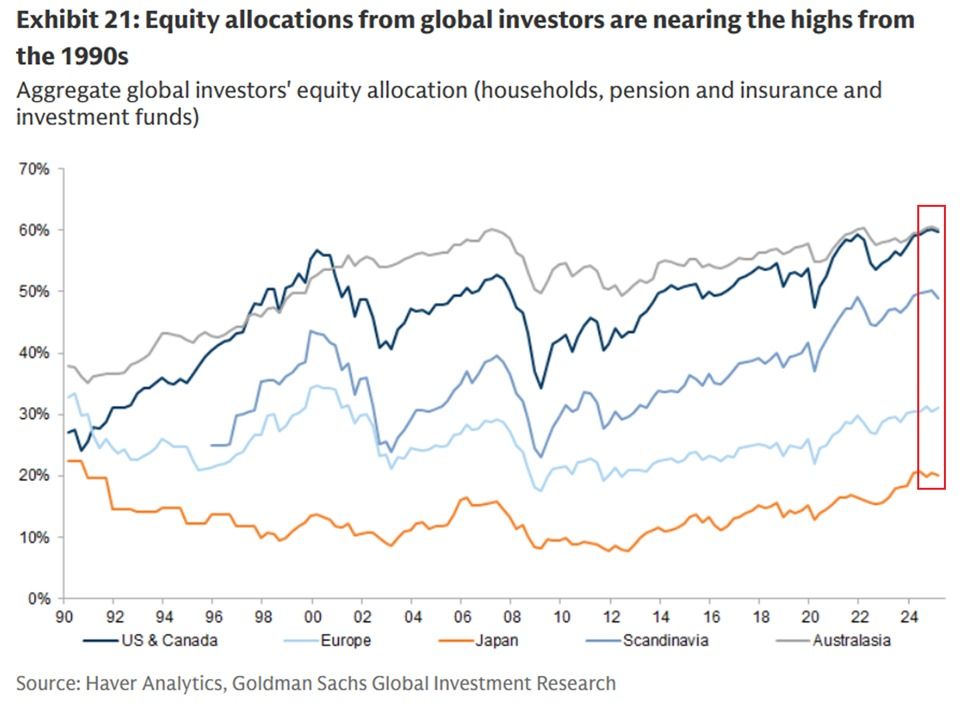
US and Canadian investors now keep close to 60% of their financial assets in stocks. This near-record concentration leaves household and institutional balance sheets heavily exposed to any drop in equity prices.
The reading, flagged by The Kobeissi Letter, sits above the levels recorded before earlier bear markets. It also far outweighs the wealth that investors in Europe and Japan tie to stocks.
A Record Tilt Toward Stocks
The Kobeissi Letter contrasted the regional spread in a recent post. Scandinavian investors hold about 50% of assets in equities, while European investors sit near 31%.
Japan’s allocation stands around 20%, roughly a third of the US and Canadian level. That gap shows how heavily US and Canadian portfolios lean on stock performance.
“This exceeds peaks seen before bear markets in 2000, 2007, and 2021,” the analysts said.
Follow us on X to get the latest news as it happens

AI Stocks Carry the Rally and the Risk
The record allocations come as US stocks continue to see notable gains. However, the rally rests on a narrow base.
Since late February, the S&P 500 has gained 8.03%, according to Jim Bianco, President and Macro Strategist at Bianco Research. The same index without artificial intelligence (AI) names rose just 1.04%.
At last week’s peak, AI stocks made up 49% of the S&P 500. Bianco called it the heaviest concentration on a single theme in over a century.
“This is the most concentrated the stock market has been on a single theme since the railroad stocks of the late 19th century,” he said.
The divide showed in early June. When the S&P 500 fell about 4.5% between June 2 and June 10, the non-AI 500 actually rose, per Bianco.
That split matters for households and other investors. Their record exposure sits mostly in a handful of AI firms. A dip in those names would cut deeper than the headline index suggests.
The concentration is set to grow. SpaceX was listed this month, with Anthropic and OpenAI expected to follow, adding more AI weight once public.
With the gains stacked on AI, a stumble in those names would test how broad the rally ever was. Should a correction follow, the record exposure leaves the investors with more wealth at stake
Subscribe to our YouTube channel to watch leaders and journalists provide expert insights
The post US Investors’ Equity Exposure Tops Levels Seen Before Past Bear Markets appeared first on BeInCrypto.


Bybit, one of the world’s top cryptocurrency exchanges by trading volume, has launched options trading on Tether Gold (XAUT), a token that provides you ownership of real physical gold.
The XAUT options are now live and allow traders to hedge risk, speculate on gold price movements, trade volatility, and build custom strategies through Bybit’s Request for Quote (RFQ) system for over-the-counter (OTC) deals.
Bybit partnered with Orbit Markets, a leading options market maker active in both crypto and traditional finance to ensure deep liquidity from the start. Orbit’s team brings significant expertise, including former senior executives from precious metals trading desks, notably the ex-APAC Head of Currencies and Precious Metals at Deutsche Bank.
“As tokenization accelerates, we believe the distinction between crypto and TradFi will continue to narrow,” said Jimmy Yang, co-founder of Orbit Markets. “Gold options are a cornerstone of traditional derivatives markets, and we are excited to see growing interest in TradFi derivatives within crypto.”
The XAUT options are European-style contracts settled in dollar-pegged stablecoin USDT, with each options contract corresponding to one XAUT token, which itself represents one troy ounce of physical gold.”
What Are Options?
Options are derivative contracts that give the buyer the right, but not the obligation, to buy or sell the underlying asset at a set price before or on a specific date. A call option gives the right to buy, while a put option gives the right to sell.

Appeal from Lanarkshire Police after three men robbed householder

Voya Global Perspectives Market Models – Mutual Fund Series Q1 2026 Commentary

Why crypto traders are watching Japan


-

 Business2 days ago
No Jackpot Winner as $257 Million Prize Rolls Over to $269 Million Monday Draw
-

 Crypto World5 days ago
Oppenheimer backs SpaceX as $70 billion retail frenzy builds
-

 Fashion4 days ago
Weekend Open Thread: Tuckernuck – Corporette.com
-

 Crypto World5 days ago
Markets Rally as SpaceX IPO Looms Amid Iran Tensions and Inflation Surge
-
 Crypto World1 day ago
Zimbabwe Requires Crypto Businesses to Register Annually Under New FIU Regulations
-

 Entertainment7 days ago
The Ryan Gosling True Crime Thriller On Netflix That Gets Even Stranger, Stream It Now
-

 Tech3 days ago
NanoClaw integrates JFrog registries to secure AI agent downloads
-
 Sports7 days ago
Bangladesh beat Australia after 20 years in ODIs, register only their second win over six-time world champions | Cricket News
-

 Crypto World3 days ago
Bitget enters Argentina’s regulated crypto market through PSAV registration
-

 Tech4 days ago
This Week In Security: Microsoft On Microsoft, Register Your Domains, Linux On ARM, And FreeBSD Joins The File Cache Club
-

 NewsBeat4 days ago
El Nino has formed in the Pacific and could set records, forecasters say
-
 Tech5 days ago
Dutton Ranch star claims they ‘didn’t see any disruption’ on set following Chad Feehan’s exit from Yellowstone spinoff fueled by Taylor Sheridan clash rumors
-

 Politics5 days ago
Politics Home | Healey Resignation Is “Colossal Failure Of Government”, Says Former Labour Defence Secretary
-
 Tech6 days ago
‘This is Seattle’s position on AI’: City Council votes unanimously to pause big new data centers
-

 Business6 days ago
Thailand Ranks Second Worldwide for AI Adoption Growth, Microsoft Reports
-
 Entertainment5 days ago
Donnie Wahlberg & More Heat Up Las Vegas at Circa’s Barry’s Downtown Prime
-
 Tech5 days ago
Opendoor Ends India Operations, Fueling a Bigger Conversation About AI and Outsourcing
-

 Sports5 days ago
First Time Since 1971: Australia Register Historic Low In ODI Cricket
-

 Politics5 days ago
Belfast burns, while Met chief points finger at Iran and Russia
-

 NewsBeat3 days ago
FBI searches office of Ohio voter registration group
You must be logged in to post a comment Login