
Crypto World
White House Tweet Exposes CLARITY Act’s Banking Trap

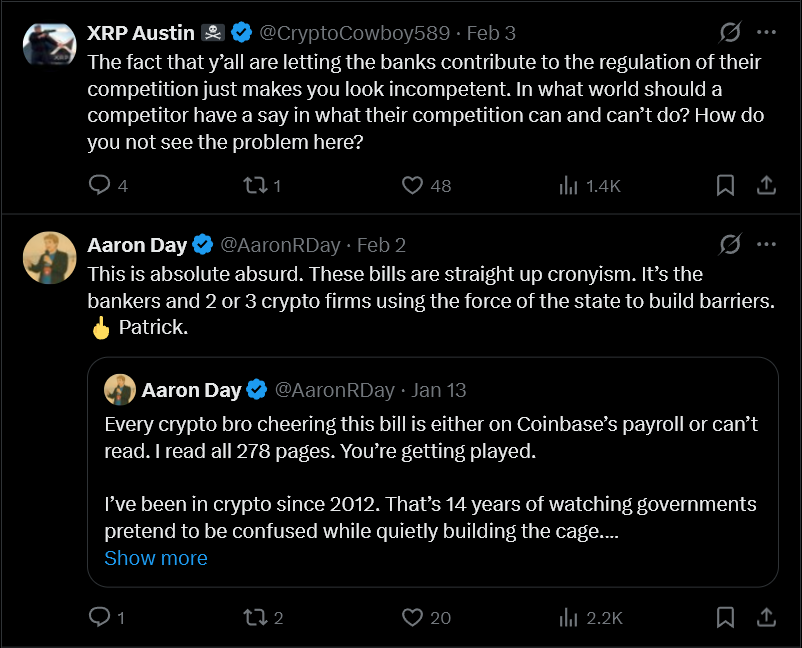
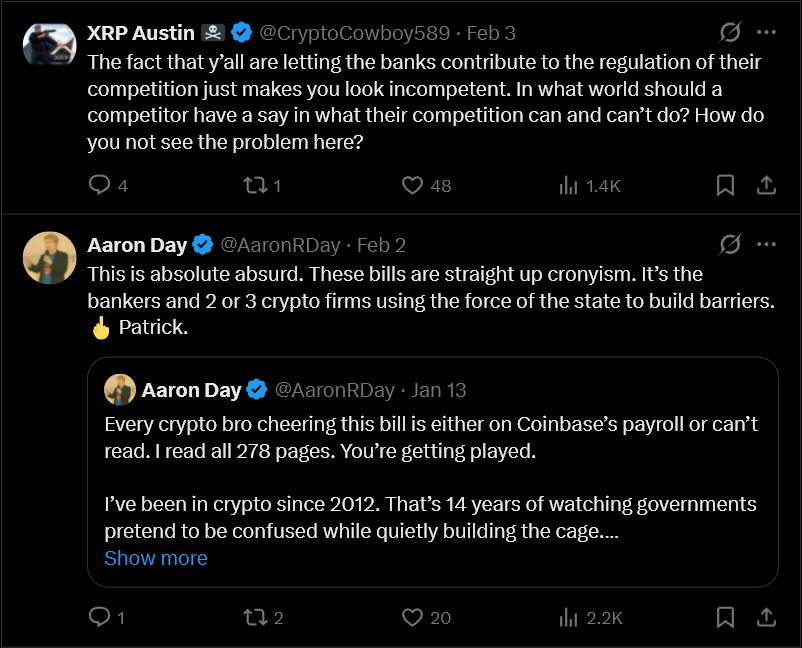
The CLARITY Act debate has largely revolved around the tug-of-war between banks and crypto firms over stablecoin yield. While that conflict dominates coverage of what is framed as a market-structure bill, it obscures a quieter and potentially more consequential issue.
Once enacted, the CLARITY Act would formally legitimize regulated crypto roles and implicitly subject them to Bank Secrecy Act compliance. Even without explicit mandates, this risks entrenching a surveillance-first model that pressures intermediaries to delist privacy assets and abandon privacy-by-design before Congress has openly debated the trade-offs.
Sponsored
Sponsored
Banks Join Talks on Stablecoin Yield
On Monday, industry insiders met with advisors to US President Donald Trump to explore potential compromises in a still-contentious market structure bill.
The discussions were led by Patrick Witt, executive director of the President’s Council of Advisors on Digital Assets. The roundtable included senior figures from both the crypto sector and traditional banking.
The meeting reignited tensions between the crypto sector and traditional finance.
Critics questioned why policymakers invited Wall Street to help shape legislation governing products that directly compete with its core business. Chief among these are yield-bearing stablecoins, which many view as a direct threat to traditional bank deposits.
However, the meeting also allowed a far subtler, yet equally significant issue to slip largely unnoticed: privacy.
Sponsored
Sponsored
How CLARITY Pulls Crypto Under the Bank Secrecy Act
The CLARITY Act presents itself as a market structure framework that promises regulatory certainty for the US crypto industry. It aims to clearly assign activities to regulators and deliver long-sought legal clarity to market participants.
Yet, the bill does more than draw jurisdictional boundaries.
By formally defining regulated crypto roles, particularly for centralized exchanges and stablecoin issuers, it embeds these actors within the existing financial system.
Once those roles are legally recognized, compliance with the Bank Secrecy Act (BSA) becomes effectively unavoidable, even though the legislation does not specify how BSA requirements should apply to on-chain activity.
That lack of specificity hands key decisions to intermediaries, who would set the rules instead of Congress.
Sponsored
Sponsored
In response, exchanges and custodians default to expansive identity checks, sweeping transaction monitoring, and heightened data collection. In doing so, they establish de facto standards without a clear legislative mandate.
Within this framework, privacy-focused projects stand to bear the greatest cost.
Privacy Assets in the Line of Fire
The BSA requires financial institutions to verify customer identities and monitor for suspicious activity. In practice, this means knowing who customers are and reporting specific red flags to authorities.
Sponsored
Sponsored
What the law does not require is constant, system-wide transparency or the ability to trace every transaction back to an identity at all times.
Nonetheless, major crypto firms such as Binance, Coinbase, and Circle already operate as if it does. They equate BSA compliance with maximum on-chain visibility in order to minimize regulatory risk amid legal uncertainty.
This approach translates into strict traceability requirements and the avoidance of protocols that limit transaction visibility. Centralized exchanges typically refuse to list privacy-focused cryptocurrencies like Monero or Zcash, not because the BSA explicitly demands it, but as a precautionary measure.
As it stands, the CLARITY Act does not account for how the BSA should apply to blockchain systems where privacy and pseudonymity operate differently from traditional finance. That silence matters.
By leaving key obligations undefined, the CLARITY Act risks entrenching the most conservative, surveillance-heavy interpretation of the BSA as the default.
As a result, participants aligned with crypto’s cypherpunk roots are likely to be most affected, as privacy-oriented tools and services face the greatest restrictions.



Bitcoin held above $74,000 on Wednesday as a wave of risk appetite swept through global markets, with Asian equities joining Wall Street benchmarks in fully recouping losses sustained since the US-Iran conflict began in late February.
Ether gained 4% on the week to trade near $2,325, outpacing bitcoin’s 3.9% move. Solana dropped 1.5% to $83, Cardano’s ADA fell 1%, while dogecoin fell 1.3% to $0.093. Tron bucked the trend with a 3% weekly gain.
China’s CSI 300 became the latest gauge to fully erase war-related declines, joining Taiwan and Singapore. The S&P 500 is closing in on its record high from late January.
Optimism that the US and Iran will enter a second round of talks in the coming days has kept crude oil below $100 a barrel, easing the inflationary overhang that weighed on markets through March.
The current bitcoin price sits near the estimated average entry price for holders of U.S. spot bitcoin ETFs, a level that could act as a floor rather than a ceiling. Investors who held through the drawdown below $60,000 have little incentive to sell at breakeven, removing a layer of potential overhead supply.
U.S. spot ETFs posted $471 million in net inflows on April 6, their strongest single-day intake since February, pushing cumulative inflows past $56 billion since the products launched in January 2024 – a move some watchers say is reflective of bullish market structure.
“This is bullish for adoption even though it’s no self-custody,” said Vikrant Sharma, founder of CakeWallet.
“Institutions pouring in $471 million in a single day and pushing past $56 billion cumulative means bitcoin is getting a whole new class of long-term holders. Self-custody wallets selling off is just natural profit-taking, but the fact that it’s not leading to price collapse is a very bullish sign,” he added.
Market participants are also pricing in the possibility of Federal Reserve rate cuts later this year, a development that would channel additional liquidity into risk assets after months of range-bound trading.

The PI price is flashing a falling wedge chart pattern on its 12-hour chart that analysts at Invezz say could push the token 22 percent higher toward the $0.200 resistance level, with smart contract catalysts and a Kraken listing adding fundamental weight to the technical setup.
Summary
- PI is trading around $0.164 to $0.167 and has exited the upper side of the falling wedge channel, a move that Invezz analysts say signals a likely rebound toward the next key resistance at $0.200, approximately 22 percent above the current level.
- A drop below the support level at $0.15 would invalidate the bullish outlook; a single whale address has accumulated approximately 350 million PI worth roughly $134 million, becoming the network’s sixth-largest holder, which signals long-term accumulation even as daily token unlocks of roughly 230 million PI create consistent sell-side pressure.
- Four near-term catalysts are cited for the setup: the RPC testnet launch on April 11, the Protocol v23 smart contract upgrade due May 18, a Kraken listing, and the ongoing KYC verification process that has already cleared over 16 million users.
Invezz’s April 14 analysis identifies the falling wedge as a classic continuation pattern in which price compression within converging trendlines precedes a directional breakout. Pi has also remained above the Supertrend indicator and moved slightly above the 50-period moving average, with the RSI pointing upward from neutral territory near 42. Those conditions collectively suggest the selling pressure that has weighed on PI since its peak above $2.90 may be approaching exhaustion at the current level.
The PI token has spent much of 2026 between $0.16 and $0.20 after falling sharply from its open-market high, weighed down by the token unlock schedule and the absence of smart contract functionality that would give the network real DeFi utility.
The most significant near-term catalyst is Protocol v23, due May 18. The upgrade introduces smart contracts to the Pi mainnet for the first time, turning the network from a payment token into a programmable platform that developers can build lending, gaming, and DeFi applications on. The protocol is built on Stellar’s tech, which has already implemented similar features, meaning the transition is expected to be more stable than a greenfield smart contract rollout. Node operators must upgrade sequentially through v22.1 on April 22 before v23.0 goes live.
Why the Token Unlock Schedule Is the Counter-Argument
The bullish technical setup runs directly against a structural headwind that is not chart-dependent. Approximately 230 million PI tokens are scheduled to unlock in the next 30 days, adding consistent sell pressure regardless of technical patterns or protocol upgrades. That daily unlock rate has been the primary reason PI has underperformed the broader market since its listing. Any 22 percent move toward $0.200 would need buying volume to absorb that supply, which historically has required either a major exchange listing or a significant utility event to materialize.
What Traders Are Watching as the April 22 Node Deadline Approaches
The v22.1 node upgrade deadline on April 22 is the next verifiable milestone on the road to Protocol v23. All mainnet node operators must complete it to remain connected to the network. Successful on-schedule completion would signal to the market that the May 18 smart contract launch is on track. As Pi builds toward that milestone, the $0.15 level remains the line that separates the current bullish setup from a deeper consolidation.


The PI network is heading toward its most consequential technical upgrade yet as Protocol 23 prepares to go live on May 18, bringing smart contracts, real-world asset tokenization, and AI App Studio integration that analysts say could shift how institutional investors view the project.
Summary
- Protocol 23 is built on Stellar technology that has already implemented the same features, meaning Pi’s transition is expected to be smoother and more stable than a typical greenfield smart contract rollout on a new blockchain.
- Beyond smart contracts, the upgrade adds .pi domains for unique user and app identities, pushes Pi Browser into deeper Web2 to Web3 integration, and takes the AI App Studio out of beta, opening the door for developers to build advanced applications directly inside the network.
- Real-world asset tokenization is the feature with the clearest path to institutional recognition: Protocol 23 will allow physical assets like property, stocks, and commodities to be broken into digital tokens on the Pi blockchain, giving the network a use case that Wall Street is actively building toward on other chains.
Coinpedia’s April 14 report describes Protocol 23 as “turning Pi from just a token into a full ecosystem.” The roadmap to May 18 runs through two mandatory intermediate node upgrades: v22.1 on April 22 and then v23.0 on May 18. All mainnet node operators must complete each step sequentially to remain connected to the network. The Pi Core Team has been explicit about the deadline-driven rollout, and the April 6 v21.2 upgrade completed on schedule, keeping the network on track.
PI is trading around $0.164, down more than 94 percent from its all-time high above $2.90, meaning the gap between the network’s technical ambition and its current market price is wide.
Smart contracts change what Pi can be used for. Without them, PI is a payment token. With them, it becomes a programmable platform where developers can build lending protocols, decentralized exchanges, gaming applications, and automated reward systems without relying on intermediaries. That transition from payment token to programmable blockchain is the same one Ethereum completed years ago, and it is the characteristic that most institutional capital uses to distinguish infrastructure assets from speculative ones. The Stellar foundation gives Pi a tested codebase to build on, reducing the risk of a failed smart contract rollout that has derailed other projects at this stage.
What Real-World Asset Tokenization Means for PI Specifically
The RWA tokenization feature in Protocol 23 is the closest thing to a direct bridge between Pi’s 47-plus-million-user base and the institutional tokenization market. If property, stocks, and commodities can be represented as Pi tokens, the network gains a use case that connects it to an $80 trillion global equities market and a tokenized asset sector that hit $27 billion in 2026. That is not a guaranteed outcome; it requires developer adoption, liquidity, and regulatory clarity. But it is a different category of utility than anything Pi has been able to offer before Protocol 23.
What the Node Upgrade Schedule Means for Price Before May 18
Each completed node upgrade milestone is a verifiable signal that the May 18 deadline is on track. The market has historically repriced PI ahead of confirmed upgrade completions, and the April 22 v22.1 deadline is the next such checkpoint. If that deadline is met on schedule, it removes one more uncertainty from the Protocol 23 timeline and gives buyers a concrete technical catalyst to position ahead of.


The token lets stakers keep their POL productive in DeFi while earning a share of the network’s priority fees.
Polygon Labs on Tuesday launched sPOL, the network’s first native liquid staking token (LST), aiming to unlock more than 3.6 billion POL tokens currently locked in validator staking contracts.
sPOL allows stakers to receive a transferable, yield-bearing receipt token upon staking POL, which can then be deployed across DeFi as collateral, liquidity, or a building block for additional yield strategies, all while continuing to earn staking rewards.
Polygon’s liquid staking penetration has lagged far behind Ethereum’s, where over 43% of staked ETH sits in liquid staking derivatives. On Polygon, that figure remains below 5%, a gap the team attributes to a fragmented market where third-party LSTs charge fees ranging from 5% to 16%.
To bootstrap liquidity, Polygon Labs is seeding 10 million sPOL from its treasury at launch, with plans to progressively add 90 million more for a total commitment of 100 million tokens.
Fee Alignment
The launch arrives alongside a broader push to redirect value to POL stakers. In March, Polygon Foundation CEO Sandeep Nailwal backed PIP-85, a governance proposal that would distribute 50% of validator priority fees to delegators for the first time. Priority fees on the network have surged tenfold since the launch of the previous fee framework, PIP-65, with more than 5.4 million POL distributed to validators in February alone.
Under the current system, delegators who lock capital to back validators see little of that windfall. Validators participating in the sPOL program have agreed to return a portion of their priority fees to delegators, creating what Polygon described as a direct link between network activity and staker returns.
Mechanics
Existing stakers can migrate their positions to sPOL via the Polygon staking portal with no waiting period or interruption in rewards. All new POL staking will automatically issue sPOL.
The exchange rate begins at 1:1 and appreciates over time as staking rewards accumulate, meaning a holder’s sPOL balance stays constant, but each token becomes redeemable for a growing amount of POL. Holders can redeem sPOL for the underlying POL plus accumulated rewards at any time.
The launch is part of Polygon’s broader pivot toward payments infrastructure that began earlier this year with the Open Money Stack vision. The network recorded 493 million stablecoin transactions in February, its highest monthly total.
Polygon completed its migration from MATIC to POL in September 2024 as part of its Polygon 2.0 overhaul. Despite strong network usage metrics, the POL token remains down 94% from its post-migration highs.
This article was written with the assistance of AI workflows. All our stories are curated, edited and fact-checked by a human.
21Shares submitted an updated regulatory filing for a US-listed Hyperliquid ETF with ticker symbol $THYP, with fee details still pending.
21Shares filed an updated application for a Hyperliquid ETF to be listed in the United States under the ticker $THYP, according to a filing update posted Tuesday. The submission appears to incorporate feedback from the SEC, with fee information not yet disclosed in the filing.
The updated filing moves the Hyperliquid ETF product closer to regulatory approval and potential US market launch. 21Shares, a digital asset investment products provider, has been pursuing approval for crypto and blockchain-focused exchange-traded products.
Sources: JSeyff on X
This article was generated automatically by The Defiant’s AI news system from publicly available sources.


Goldman Sachs has filed for a Bitcoin Premium Income ETF that aims to turn BTC’s volatility into yield via a covered‑call strategy built on spot ETF exposure.
Summary
- Goldman Sachs files with the SEC for a Bitcoin Premium Income ETF.info.
- The fund aims to generate yield from Bitcoin using a covered call strategy.news.
- Filing underscores Wall Street’s shift toward structured Bitcoin income products.
Goldman Sachs has filed a registration statement with the U.S. Securities and Exchange Commission (SEC) to launch a Bitcoin Premium Income exchange‑traded fund, marking one of the 157‑year‑old investment bank’s most direct moves into crypto to date.
According to the preliminary prospectus, the Goldman Sachs Bitcoin Premium Income ETF is designed to provide “current income with a secondary objective of capital appreciation,” giving investors Bitcoin exposure while generating additional yield through options.
The filing, made under the Goldman Sachs ETF Trust on April 14, 2026, proposes that the offering become effective 75 days after submission, which would put the earliest potential launch in late June or early July if regulators sign off.
Goldman Sachs will not hold Bitcoin directly in the new fund but will instead gain exposure through shares of spot Bitcoin ETFs and related instruments, mirroring structures used by rivals such as the iShares Bitcoin Premium Income ETF.
As explained in a breakdown by Arkham Research, a Bitcoin covered‑call ETF “is designed to transform Bitcoin from a passive asset into an income‑generating asset” by holding BTC exposure and then selling call options on that position to collect premiums.
Goldman’s registration statement says the fund will “sell call options generally representing 40% to 100% of the Fund’s exposure to Bitcoin,” a range that caps upside during sharp rallies but allows the ETF to harvest option income in sideways or modestly trending markets.
The proposal comes after the bank quietly ramped up its Bitcoin exposure via existing spot products, with earlier SEC filings showing Goldman holding roughly $1.27 billion of the iShares Bitcoin Trust ETF, an 88% increase on the previous quarter, according to TheStreet.
Industry outlets note that the move aligns Goldman with a broader Wall Street rush into yield‑enhanced Bitcoin vehicles, following similar covered‑call or premium income products from BlackRock and other issuers looking to monetise Bitcoin’s volatility for income‑focused clients.
Bitcoin‑linked structured products and ETFs have already been a recurring theme in crypto.news coverage of the spot ETF trade, with previous story pieces tracking how inflows into BTC funds and their derivatives have influenced the Bitcoin price, options skew and liquidity across major venues.
Investors tracking the implications of Goldman’s ETF filing on the underlying asset can monitor real‑time moves on the Bitcoin market‑cap page, alongside comparable data for Ethereum and other major tokens on their respective price pages as institutional product design around BTC continues to evolve.


Kraken co-CEO Arjun Sethi confirmed Tuesday that the cryptocurrency exchange has filed confidentially for an initial public offering with the SEC.
Sethi made the disclosure at the Semafor World Economy summit in Washington, D.C. The filing had first been submitted around November 2025, shortly after Kraken raised $800 million at a $20 billion valuation.
Valuation Slides as IPO Plans Hold
An April 2026 investment round valued Kraken at $13.3 billion, roughly a 33% decline from its late-2025 peak. The round involved a $200 million secondary share purchase by Deutsche Börse Group, the operator of the Frankfurt Stock Exchange.
The deal gives Deutsche Börse a roughly 1.5% fully diluted stake and is expected to close in Q2 2026. It builds on a strategic partnership announced in December 2025, focused on bridging traditional finance and crypto through trading, custody, and tokenized assets.
Kraken had previously paused its public listing plans in March 2026 because of difficult market conditions. Sethi’s comments suggest the confidential filing remains active while the company waits for a more favorable window.
Sethi Outlines Retail Trading Mission
At the summit, Sethi framed Kraken’s broader ambition as making institutional-grade tools available to everyday traders.
“What they want at the end of the day is what Citadel and Jane Street have, or JPMorgan has, and they want it accessible to them. That’s our mission: How do we make all these products open?” Semafor reported, citing Arjun Sethi, Kraken co-CEO.
The exchange has made several moves to support that vision, including its acquisition of NinjaTrader for $1.5 billion and securing direct Federal Reserve master account access earlier this year.
Those steps position Kraken alongside a growing wave of crypto firms pursuing public listings in 2026.
Whether Kraken moves forward with its IPO may depend on how quickly market sentiment recovers in the months ahead.
Meanwhile, as Kraken moves towards a public listing, its industry peer, Coinbase, is celebrating 5 years since its 2021 IPO.
Since Coinbase’s public listing in April 2021, the first time IPO investors were in profit was in July 2025.
The post Kraken Confirms Confidential IPO Filing Despite Valuation Drop appeared first on BeInCrypto.
The Chainlink price narrative shifted this week when the protocol upgraded its Data Streams infrastructure to deliver near-real-time pricing for US stocks and ETFs on a 24/5 basis, giving DeFi protocols access to the same equity data that covers roughly $80 trillion in global market value.
Summary
- Chainlink’s 24/5 US Equities Streams launch on April 12 delivers fast and secure market data for US equities and ETFs across all trading sessions including after-hours and overnight, going live across more than 40 blockchains using the Chainlink Data Standard.
- DEXs including Lighter and ApeX, and the exchange BitMEX, have already signed on to integrate the streams, with Lighter CEO Vladimir Novakovski saying the integration enables the platform “to extend our fair, low-latency perp execution beyond regular market hours without compromising data integrity.”
- The upgrade arrives as the tokenized real-world asset sector hit $27 billion in 2026, with Chainlink positioned as the primary oracle infrastructure for the growing pipeline of institutions tokenizing equities, funds, and bonds on-chain.
CoinMarketCap’s April 12 coverage of the upgrade notes that most existing on-chain data solutions provide only a single price point for equities during standard trading hours from 9:30 AM to 4:00 PM ET, creating a gap where on-chain markets cannot reliably replicate market conditions at all hours. Chainlink’s 24/5 streams eliminate that gap, enabling synthetic equities, automated trading, collateral management, and lending markets to function with live pricing data rather than stale snapshots. The protocol is already embedded in the infrastructure of institutions including Swift, Euroclear, JPMorgan, Mastercard, UBS, and Fidelity International.
LINK was trading around $9.14 to $9.25 on Tuesday, up from recent lows but still down roughly 34 percent over the past year.
The LINK token’s value accrual thesis depends on growing demand for Chainlink’s oracle services. Every DeFi protocol that integrates the new equity data streams creates a new source of ongoing fee revenue paid in LINK. The 40-plus blockchains where the streams are live represent a wide distribution of potential demand, and the institutional adoption profile of Chainlink’s existing partners means this is not purely a retail DeFi story. When JPMorgan and Fidelity are building on your infrastructure, the demand base is more durable than typical crypto-native integrations.
What the RWA Market Growth Means for Chainlink’s Position
The tokenized RWA sector reaching $27 billion is a validation of the infrastructure play that Chainlink has been building for years. Every tokenized stock, bond, or fund needs reliable real-world pricing data to function safely, and Chainlink’s oracle network is the established standard for that service. The equities streams upgrade extends that standard directly into the equity market, the largest asset class in the world. If tokenized equities grow toward the scale that institutional forecasts suggest, Chainlink’s data infrastructure becomes increasingly difficult to displace.
What Traders Are Watching on the LINK Chart
LINK has been in a structural downtrend with its 200-day SMA acting as resistance and the 50-day SMA below the 200-day, a configuration that typically signals ongoing bearish control. A clean breakout above $9.50, which analysts identified as the near-term resistance, would require both price momentum and the kind of sustained institutional adoption signal that the equity data streams launch represents. The broader macro environment for infrastructure tokens in 2026 remains tied to whether the Iran war eases and risk appetite returns to digital assets alongside the traditional market tailwinds Chainlink is now plugged into.
Blockchain-based lender Figure Technology Solutions and Hastra, its onchain credit platform, are adding auto loans to their tokenized credit marketplace, broadening the real-world assets (RWAs) available to decentralized finance (DeFi) investors beyond home equity products.
Democratized Prime, a decentralized lending marketplace on Figure Markets, is adding auto finance as its first new asset class as part of its plan to build a marketplace where different types of consumer credit can be issued, traded and funded onchain, according to a Tuesday announcement shared with Cointelegraph.
“We’ve been purposefully building toward this,” Michael Tannenbaum, CEO of Figure, said, adding that the platform has originated over $22 billion in onchain loans.
The move marks an early test of whether tokenized private credit can expand beyond home-equity products into mainstream consumer lending, a shift that could widen DeFi’s access to real-world yield but also import the credit risks of subprime-style loan markets.
Figure launched Hastra in 2025, with its public debut and rollout occurring later that year. The platform, which initially launched on Solana (SOL), was built as an extension of Figure’s lending ecosystem, using its loan origination and credit infrastructure to bring RWAs onchain.
Related: Nauru taps Bitcoiner Dadvan Yousuf for trade role in digital asset push
Hastra expands to EVM chains
At the same time, Hastra is expanding to Ethereum-compatible (EVM) chains, opening access to a larger DeFi ecosystem and bringing its existing credit system, including home equity loan exposure, to new chains.
A Figure spokesperson told Cointelegraph that Hastra will start with Ethereum (ETH) as part of its push into EVM chains. They also confirmed that the auto finance product will first launch on Solana before rolling out on Ethereum around June.

Still, bringing consumer loans onchain does not remove the underlying risks tied to those assets. Non-prime auto loans can carry higher default rates, especially in weaker economic conditions.
There are also questions around regulation, transparency and how these blockchain-based credit products would perform under stress or during volatile market conditions.
Related: Circle to launch cirBTC wrapped Bitcoin, challenging BitGo and Coinbase
Figure gains bullish outlook from Bernstein
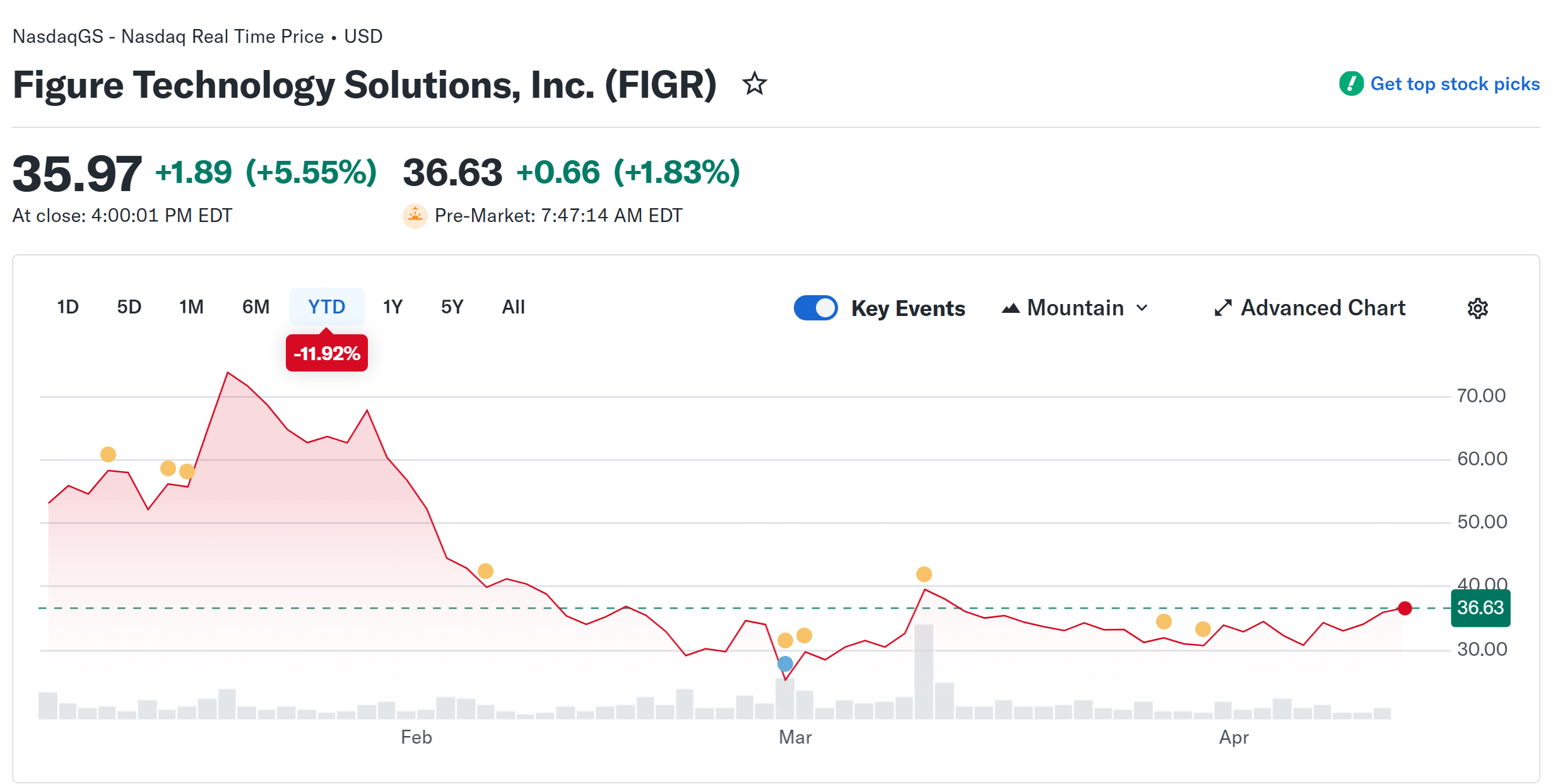
Earlier this month, Bernstein analysts said Figure may be undervalued, assigning the blockchain-based lender an “Outperform” rating and a $67 price target, nearly double its recent trading price. The bullish outlook follows growth in its tokenized lending business, with loan originations surpassing $1.2 billion in March and first-quarter volumes reaching $2.9 billion.
Figure went public on Sept. 11, 2025, listing on the Nasdaq under the ticker symbol FIGR.
Big questions: Would Bitcoin survive a 10-year power outage?
Visa has launched a validator node on the Tempo blockchain, taking a direct role in verifying and processing transactions on a network designed for real-time stablecoin payments.
Visa said the node is operated in-house using its own infrastructure and was developed over six months working with Tempo’s engineering team, positioning the company as an “anchor validator” alongside early participants including Stripe and Zodia Custody.
The role places Visa in the transaction validation layer, where it helps order and confirm payments while supporting network security and performance during the network’s early phase.
Tempo is a Layer 1 blockchain designed for real-time payments and stablecoin-based transactions, with validators responsible for confirming transactions and maintaining the network’s ledger.
Validators on the network can earn stablecoin-denominated rewards when selected to package transactions into blocks, according to the announcement. However, a company spokesperson told Cointelegraph that “Visa’s primary focus in this phase is on the strategic and technical role of operating a validator, rather than on economics.”
The move adds to Visa’s existing blockchain activity, including its recently announced role as a validator on the Canton Network, where it works with financial institutions on privacy-focused onchain payment systems.
Related: Euro stablecoins dominate non-dollar market, Visa-backed report finds
Payment companies expand stablecoin infrastructure
As stablecoins gain traction in payments, major payment companies are expanding infrastructure that connects traditional finance with blockchain-based settlement.
In October 2024, Stripe finalized a $1.1 billion agreement to acquire stablecoin platform Bridge. The following year, it introduced stablecoin-based accounts for clients in more than 100 countries, allowing businesses to send, receive and hold US-dollar stablecoins similar to traditional bank balances.
Last month, Mastercard agreed to acquire stablecoin infrastructure company BVNK in a deal valued at up to $1.8 billion. BVNK enables businesses to send and receive stablecoin payments, convert between fiat and crypto, and operate across more than 130 countries.
Meanwhile, Visa has focused on building and operating its own systems. In July, the company expanded its settlement platform to support tokens such as PayPal USD (PYUSD) and Euro Coin (EURC), as well as networks including Stellar (XLM) and Avalanche (AVAX).
In March, it also expanded its stablecoin card partnership with Bridge to 18 countries, with plans to reach more than 100 markets by year-end.
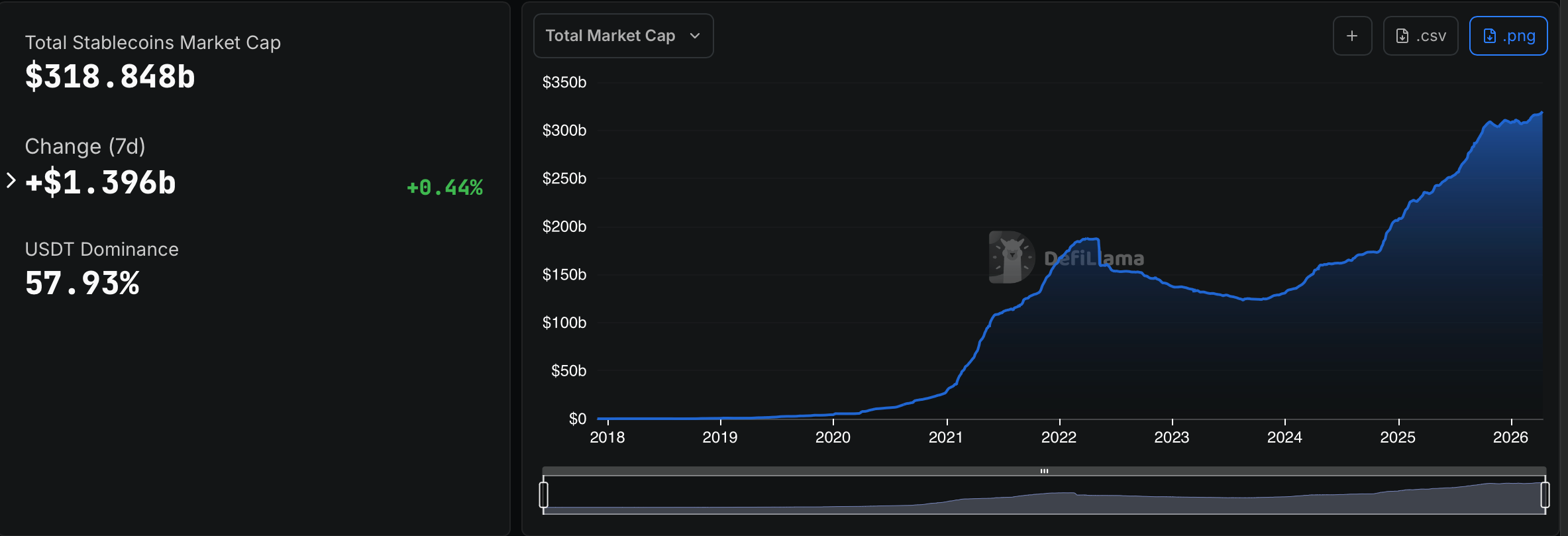
According to DefiLlama data, stablecoin market capitalization stood at nearly $319 billion at the time of writing, up from about $307.5 billion at the start of the year.

Magazine: Singapore is no ‘crypto hub’ — but it is serious about stablecoins: StraitX CEO

SOL, ADA, DOGE pullback, bitcoin holds above $74,000 as Asia recoups Iran war losses

John Terry attends Colchester United game after takeover report

Reiki for Financial Wisdom – Tiger’s Eye


-

 Politics4 days ago
US brings back mandatory military draft registration
-
 Sports4 days ago
Man United discover Nico Schlotterbeck transfer fee as defender reaches Dortmund agreement
-

 Fashion4 days ago
Weekend Open Thread: Veronica Beard
-

 Politics5 days ago
Malcolm In The Middle OG Turned Down ‘Buckets Of Money’ To Appear In Reboot
-

 Politics3 days ago
World Cup exit makes Italy enter crisis mode
-

 Crypto World6 days ago
Canary Capital Files SEC Registration for PEPE ETF
-

 Business4 days ago
Tesla Model Y Tops China Auto Sales in March 2026 With 39,827 Registrations, Beating Cheaper EVs and Gas Cars
-

 Crypto World1 day ago
The SEC Conditionalises DeFi Platforms to Be Avoided for Broker Registration
-

 Crypto World1 day ago
SEC Signals Exemption for Crypto Interfaces From Broker Registration
-

 Crypto World7 days ago
Bitcoin recovers as US and Iran Agree a Ceasefire Deal
-
 NewsBeat2 days ago
Pep Guardiola and Gary Neville agree over Arsenal title problem that benefits Man City
-

 Business5 days ago
OpenAI Halts Stargate UK Data Centre Project Over Energy Costs and Copyright Row
-

 Business3 days ago
Ireland Fuel Protests Enter Day 5 as Blockades Spark Shortages and Government Prepares Support Package
-

 Politics5 days ago
LBC Presenter Mocks Trump Over Iran War Failures
-

 Crypto World4 days ago
Federal judge blocks Arizona from bringing criminal charges against Kalshi
-
 NewsBeat3 days ago
JD Vance announces ‘no agreement’ with Iran over nuclear weapons fear
-

 Tech5 days ago
A version of Windows 10 released a decade ago is now eligible for additional security patches
-

 Crypto World22 hours ago
SEC Proposes Certain Crypto Interfaces Don’t Need to Register as Brokers
-

 Business4 days ago
IMF retains floor for precautionary balances at SDR 20 billion
-

 NewsBeat18 hours ago
Trump and Pope Leo: Behind their disagreement over Iran war
You must be logged in to post a comment Login