
Crypto World
Why AI Is Eating DeFi UX


For most of DeFi’s short, chaotic life, “user experience” has meant one thing: dashboards.
Charts. Tables. APRs stacked on APRs. Pools, tranches, gauges, emissions, and tooltips explaining why the number you clicked is now different. DeFi didn’t simplify finance — it open-sourced complexity and handed users the keys with a shrug.
That era is ending.
AI isn’t just improving DeFi UX.
It’s devouring it, replacing dashboards with outcomes and interfaces with intent.
And once you see it, you can’t unsee it.
The Dashboard Era Was a Necessary Evil
Early DeFi users were power users by default.
If you were yield farming in 2020–2023, you had to understand:
- Impermanent loss
- Pool composition
- Emission schedules
- Rebalancing
- Gas optimization
- Cross-chain risk
- Protocol governance risk
Dashboards emerged because there was no other way to expose this complexity. Protocols didn’t know what users wanted — so they showed everything.
The result?
-
Cognitive overload
-
Decision paralysis
-
Constant tab-switching between analytics tools
-
A UX designed for traders, not humans
Dashboards weren’t badly designed.
They were honest design — mirrors reflecting how messy DeFi really was.
But mirrors don’t scale.
The Core Problem: DeFi Optimizes Data, Not Outcomes
Here’s the uncomfortable truth:
Users don’t want information. They want results.
Nobody wakes up thinking:
“I’d love to compare stablecoin pool APYs across five chains today.”
They think:
-
“I want passive income.”
-
“I want my capital protected.”
-
“I want to outperform inflation.”
-
“I want this to be handled while I sleep.”
Dashboards require users to manually translate goals into actions.
AI flips that entirely.
AI Changes the UX Primitive: From Clicks to Intent
AI-native DeFi doesn’t ask:
“Which pool do you want to enter?”
It asks:
“What outcome do you want?”
This is the real shift.
Instead of:
-
Clicking pools
-
Setting ranges
-
Monitoring positions
-
Rebalancing manually
Users express intent in plain language:
-
“Earn yield with low risk.”
-
“Maximize stablecoin income.”
-
“Protect downside but keep upside exposure.”
-
“Allocate $5,000 conservatively for 6 months.”
AI agents translate intent into:
-
Strategy selection
-
Position sizing
-
Risk management
-
Execution timing
-
Continuous optimization
The interface disappears — outcomes become the UI.
Why Dashboards Lose to AI Agents
Dashboards are static.
Markets are not.
DeFi dashboards assume:
-
The user is always watching
-
The user knows when to act
-
The user understands second-order effects
AI agents don’t assume anything.
They:
-
Monitor markets continuously
-
React faster than humans
-
Optimize across protocols, chains, and timeframes
-
Enforce constraints without emotion
A dashboard shows you what happened.
An AI agent decides what should happen next.
That gap is fatal.
DeFi Is Quietly Becoming “Set and Forget”
The most successful new DeFi products aren’t prettier dashboards.
They’re:
Their UX looks deceptively simple:
-
One input box
-
A few constraints
-
A clear outcome
Under the hood?
The complexity didn’t disappear.
It got absorbed.
That’s what great UX always does.
Why This Is Existential for Legacy DeFi Apps
If your product’s value is:
You’re already late.
AI doesn’t need help deciding.
It is the decision layer.
Dashboards will still exist — but only for:
-
Power users
-
Auditors
-
Strategists
-
People who enjoy pain
Everyone else will choose outcomes over interfaces, every time.
The New DeFi UX Stack
Here’s what the emerging stack looks like:
1. Intent Layer
Natural language inputs, constraints, and preferences.
2. Intelligence Layer
AI models that understand markets, risk, and protocol mechanics.
3. Execution Layer
Non-custodial, on-chain agents executing autonomously.
4. Observability Layer
Transparency, auditability, and human override — not micromanagement.
Notice what’s missing?
Dashboards are the primary interface.
This Isn’t About AI Hype — It’s About Responsibility
There’s a deeper reason AI is eating DeFi UX:
Financial responsibility doesn’t scale cognitively.
As DeFi grows:
-
More chains
-
More protocols
-
More strategies
-
More risk surfaces
Expecting users to manually manage this is irresponsible design.
AI isn’t dumbing DeFi down.
It’s making it survivable.
The End of DeFi as a Hobby
DeFi started as a hobby for:
-
Engineers
-
Traders
-
Crypto-native masochists
It becomes infrastructure only when:
AI is the bridge.
Dashboards taught us DeFi.
AI will run it.
And once users experience outcome-driven finance, no one is going back to clicking pools ever again.
REQUEST AN ARTICLE



Analyst flags XRP monthly support at $0.85–$0.95 as potential entry for “smart money” amid recent 34% monthly decline.
XRP is trading at $1.37, down nearly 15% over the past week and 33% in the last 30 days, as bearish sentiment continues to weigh on the Ripple token.
However, a widely followed analyst says the monthly chart is showing a long-term ascending channel with support at $0.85–$0.95, a zone he believes could mark the entry point for institutional capital that has yet to return to the market.
Monthly Structure Shows Nine-Year Support Zone
The technical case for a potential reversal rests entirely on the monthly timeframe, according to analyst Arthur, who posted a detailed thread on X early Wednesday. His chart tracks XRP from March 2017 to the present, with each candlestick representing a full month of trading. The lower boundary of an ascending channel, tested repeatedly over nine years, now sits at $0.85–$0.95, which is roughly 30% below current prices.
“This is a monthly structural read, backed by macro and long-term volume behavior,” Arthur wrote. “The bottom of the monthly channel may very well represent the area where ‘smart money’ returns.”
He pointed to volume as the missing ingredient. The largest volume spike in XRP history occurred between November 2020 and April 2021. According to him, the 2024 rally, which pushed XRP above $2, saw four times less volume.
“The real money hasn’t returned yet,” he said. “What we saw in 2024 was whales and some funds. Not the large institutional flow that changes a market forever.”
Derivatives data supports the view that speculative positioning has cooled, with analysis from Arab Chain showing that in the last 30 days, XRP futures open interest dropped by about 1.8 billion XRP on Bybit and 1.6 billion on Binance. Kraken also posted a decline of about 1.5 billion XRP.
The contraction suggests traders are closing leveraged positions rather than building new ones, a behavior typically seen during transitional phases before a new trend emerges.
Macro Backdrop Has Shifted
The analyst’s optimism is not based on chart patterns alone. He cited five macro developments that distinguish early 2026 from previous cycles, including regulatory clarity following the conclusion of Ripple’s SEC lawsuit, the launch and scaling of RLUSD, and institutional integration of Ripple’s technology.
You may also like:
Arthur also pointed to the accelerating tokenization narrative and what he called “real institutional infrastructure” that is now in place.
“Technical analysis is always driven by macro,” the market observer said. “And the macro is pointing up.”
XRP has a history of delivering sharp recoveries from extended downturns. For example, during the 2018 bear market, the asset traded near $0.30 for months before rallying to $1.70 in April 2021. It again bottomed around $0.35 in spring 2022 and remained range-bound until November 2024, when it climbed above $2 and later hit an all-time high of $3.65 in July 2025.
SECRET PARTNERSHIP BONUS for CryptoPotato readers: Use this link to register and unlock $1,500 in exclusive BingX Exchange rewards (limited time offer).


Cardano founder Charles Hoskinson said that privacy-focused blockchain Midnight doesn’t have plans to onboard privacy maxis from the zcash and monero communities to the Midnight chain.
“You don’t try to get anybody from Monero or ZCash over,” he said during a Q&A session at Consensus Hong Kong on Thursday.
“They certainly will come in their own time, but they’re a different demographic,” he said. “Those are people that wake up every day and they really care about privacy, and they matter and they’re important, but what we’re going for is the billions of people that don’t know they need privacy but give it to them by default.”
Midnight announced Thursday that its mainnet will go live in March as a partner chain to Cardano.
Hoskinson then claimed the ethos of privacy is not as simplistic as the monero and zcash communities often allude to.
“What Monero and ZCash have been trying to convince people is it’s like a light switch. We’re private. The switch is on. Everybody else is not. The switch is off. That’s not how that works,” he said.
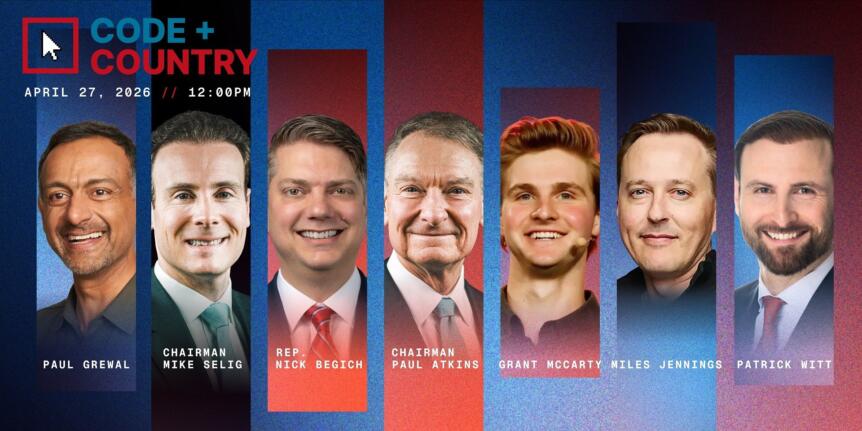
Editor’s note: The Bitcoin Conference has announced the return of Code & Country 2026, its flagship policy forum designed to bring U.S. policymakers and Bitcoin industry participants into direct, on-the-record discussions. Scheduled for April 27 during a U.S. election year, the forum aims to address how active legislation and regulatory priorities intersect with Bitcoin, digital infrastructure, and adjacent sectors such as energy and stablecoins. By removing intermediaries, the event positions itself as a venue where builders operating at scale can engage directly with lawmakers shaping the regulatory environment that will influence the next phase of technological and financial development.
Key points
- Code & Country 2026 will take place on April 27 and is open to Pro Pass and Whale Pass holders.
- The forum focuses on direct engagement between Bitcoin industry leaders and U.S. policymakers.
- Discussions will center on active legislation, regulatory priorities, and real-world policy impacts.
- Programming spans Bitcoin, energy infrastructure, stablecoin regulation, and digital civil liberties.
Why this matters
As regulatory frameworks for Bitcoin and related technologies continue to evolve, direct dialogue between policymakers and industry participants is becoming increasingly consequential. Events like Code & Country provide insight into how legislative decisions are formed and how they may affect builders, investors, and infrastructure providers operating at scale. Held during an election year, the forum reflects growing institutional engagement with Bitcoin and highlights the role policy will play in shaping the sector’s trajectory in the U.S. and beyond.
What to watch next
- Announcements of confirmed speakers and detailed programming ahead of the event.
- Key policy themes emphasized by lawmakers and regulatory representatives.
- Signals on how Bitcoin-related regulation may evolve following the forum.
Disclosure: The content below is a press release provided by the company/PR representative. It is published for informational purposes.
Nashville, TN — February 10, 2026 — The Bitcoin Conference announced today Code & Country 2026, the flagship policy forum returning for its second year to convene industry leaders, builders and U.S. policymakers for direct discussions on the issues shaping technology, regulation, and legislative priorities.
Code & Country 2026 will take place on April 27 at 12:00 PM and will be open to Pro Pass and Whale Pass holders. The forum is scheduled during the 2026 U.S. election year, when congressional agendas, committee priorities, and policy frameworks are actively taking shape.
The event is designed to facilitate direct engagement between those building critical infrastructure and those shaping policy – no intermediaries. Discussions will focus on active legislation, administrative priorities, and the real-world implications of regulatory decisions on the industries defining America’s technological future.
“Policy decisions affecting Bitcoin are made regardless of industry participation. We finally have an administration and bipartisan Congress seeking guidance from our industry on how to regulate. We can either jump in the game and help craft the next century of the regulatory landscape, or watch from the sidelines as someone else does it for us,” said Brandon Green, CEO of BTC Inc.
This year’s programming addresses the convergence of Bitcoin with broader policy areas – from energy infrastructure and stablecoin regulation to civil liberties in a digital age. Policymakers and congressional staff will hear directly from industry participants operating at scale, while attendees will gain insight into how policy development functions in Washington.
-
Industry leaders and builders seeking direct engagement with policymakers on regulatory frameworks
-
Leaders in AI, energy, and adjacent sectors navigating the policy landscape
-
Participants newer to policy discussions looking to understand how legislative decisions affect Bitcoin
-
Policymakers and staff seeking technical and operational perspectives from those building at scale
About The Bitcoin Conference
The Bitcoin Conference, organised by BTC Media, the parent company of Bitcoin Magazine, is a global event series, featuring notable industry speakers, workshops, exhibitions, and entertainment. These events serve as vital platforms for Bitcoin industry leaders, developers, investors, and enthusiasts to gather, network, and exchange ideas. Bitcoin 2026 is being held in Las Vegas in April 2026. Its international events include Bitcoin Hong Kong (August 27-28, 2026), Bitcoin Amsterdam (November 5-6, 2026) and Bitcoin MENA (Abu Dhabi, December 2026).
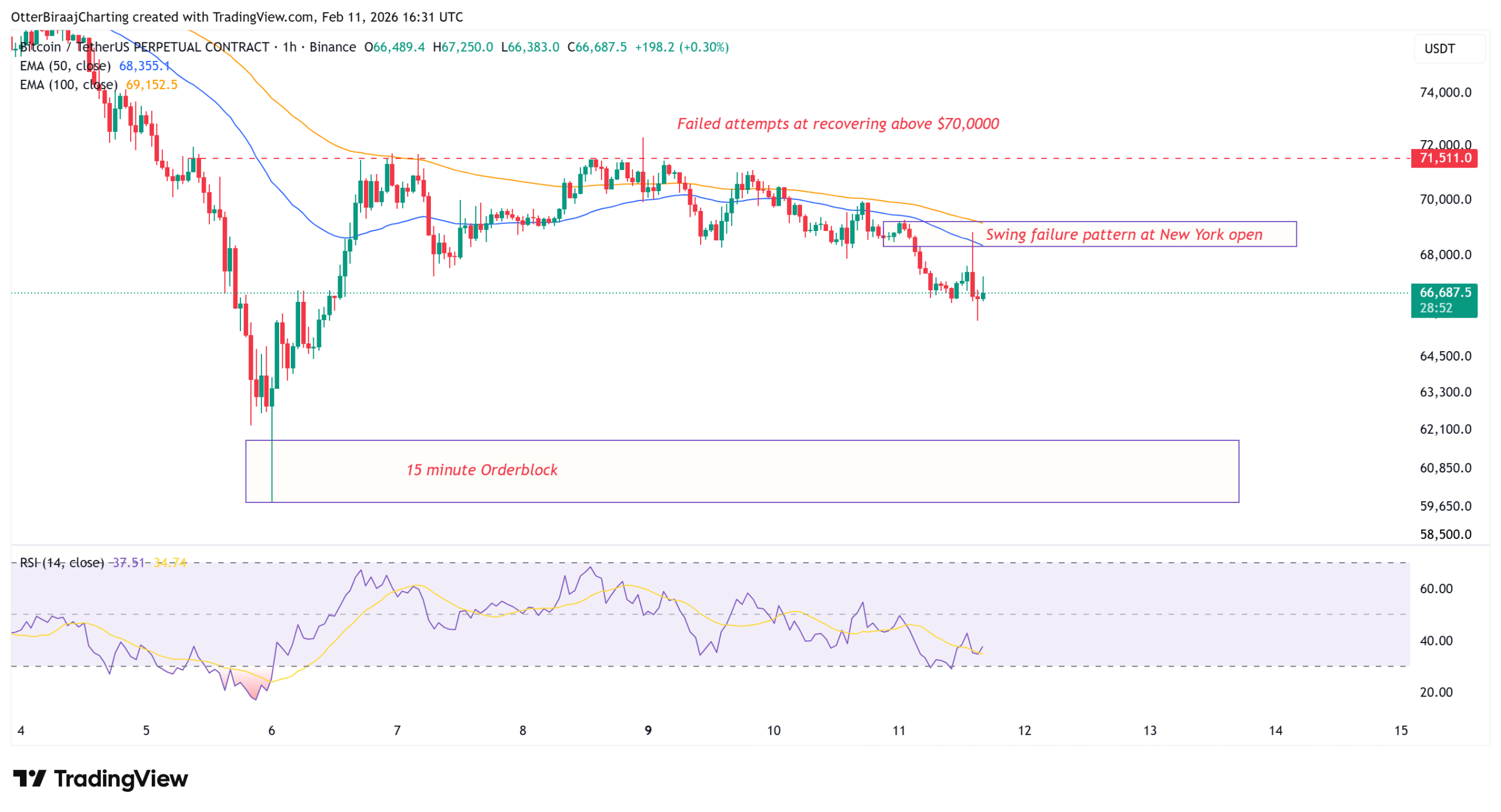
Bitcoin (BTC) price fell to $65,800 on Wednesday, slipping back below key intraday trend lines and raising concerns that last week’s drop to $60,000 may not have been the final bottom. Now, analysts say the possibility of another drop to the yearly low ($59,800) is increasing due to a growing liquidity gap between $66,000 and $60,000.
Key takeaways:
-
Bitcoin has formed a series of lower highs after repeated rejections near the $70,000–$72,000 resistance zone.
-
The relative strength index (RSI) is trending toward oversold levels as the price trades below key moving averages.
-
The liquidation heatmap indicated an absence of liquidity up to $60,500, keeping the risk of a downside price move open.
Failure to hold $70,000 weakens Bitcoin’s short-term prospects
Bitcoin’s one-hour chart shows multiple failed attempts to hold above $70,000. Each rejection has led to lower price highs and steady selling pressure.
BTC’s price briefly pushed into intraday highs of $69,800 before reversing sharply during the New York session on Wednesday, forming a classic swing failure pattern. The move trapped breakout longs and accelerated downside momentum.

BTC also traded below both the 50-period and 100-period exponential moving averages, confirming short-term bearish control. The RSI remained below 50, indicating limited buying pressure.
A 15-minute order block sits near the $60,800–$61,000 region, an area where strong buying pressure previously stepped in after BTC printed a yearly bottom at $59,800. This region remains a liquidity target if $64,000 fails to hold.
Related: When will Bitcoin start a new bull cycle toward $150K? Look for these signs
Heatmap data shows $60,000 is a liquidity magnet
Bitcoin’s liquidity heatmaps reveal stacked orders above $72,000, but it also highlights a “liquidity void” from $66,000 to $60,500. This “liquidity void” may act as a magnet, as price tends to move quickly through low-liquidity areas to tap concentrated stop clusters below.

Despite more visible liquidity being higher, the downside remains open as a final stack of leveraged longs worth over $350 million is still positioned near $60,500.
Bitcoin trader Husky said Bitcoin is slipping below the anchored volume-weighted average price (VWAP) drawn from last week’s lows at $59,800, a level that is acting as a short-term fair value.
With the overall market structure starting to weaken, a lack of a swift recovery above $68,000 increases the risk of further downside toward lower support levels near $65,000. For now, Bitcoin is expected to trade within a broad $60,000 to $72,000 range, according to the trader.

Likewise, market analyst EliZ noted that BTC is consolidating near $66,500 inside a descending channel. A break below this level may send the price toward the $63,400–$64,600 support zone, increasing the odds of a revisit to $60,000.
Related: Bitcoin reacts to major US jobs data beat as Fed rate pause odds near 95%
This article does not contain investment advice or recommendations. Every investment and trading move involves risk, and readers should conduct their own research when making a decision. While we strive to provide accurate and timely information, Cointelegraph does not guarantee the accuracy, completeness, or reliability of any information in this article. This article may contain forward-looking statements that are subject to risks and uncertainties. Cointelegraph will not be liable for any loss or damage arising from your reliance on this information.

Intercontinental Exchange (ICE) has launched the Polymarket Signals and Sentiment Tool, integrating prediction market data into its services to provide traders with enhanced market insights.
Intercontinental Exchange (ICE) has announced the launch of the Polymarket Signals and Sentiment Tool, a service designed to provide real-time and historical prediction market data to traders. This tool aims to enhance market insights by offering crowd-sourced probability assessments through ICE’s infrastructure.
The tool is specifically targeted at professional and institutional traders. By delivering normalized data feeds from Polymarket’s prediction markets, it allows traders to consume crowd-sourced probability assessments as market signals. These signals provide implied probabilities on real-world outcomes that are not typically captured by traditional financial instruments. The service is designed to complement existing market, pricing, and sentiment inputs within institutional workflows.
Prediction markets have been gaining traction in financial services for their ability to forecast and gauge public sentiment. The prediction market industry itself has experienced notable growth, with a weekly volume of $6.2 billion as of January 2026.
This article was generated with the assistance of AI workflows.
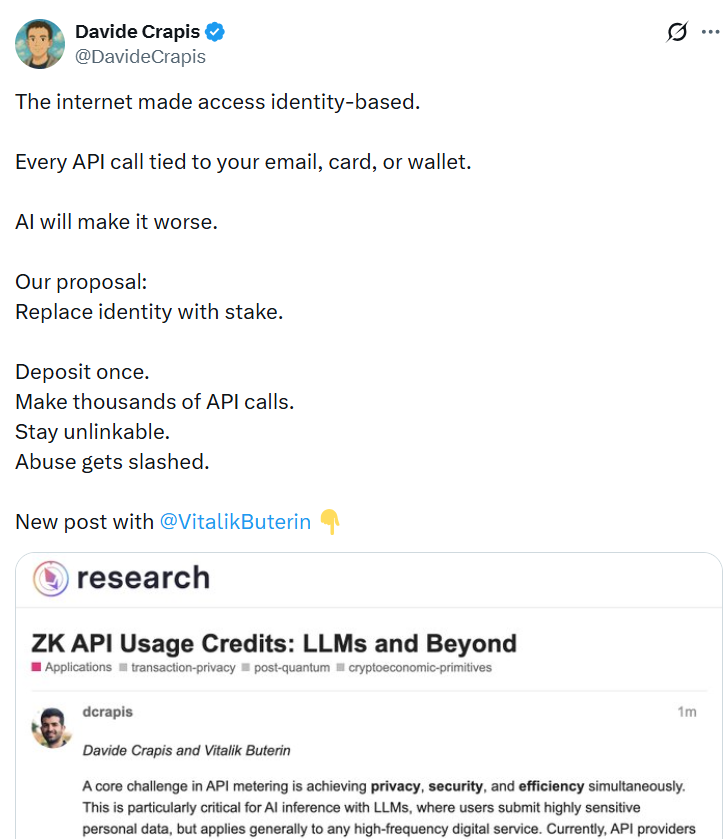
Ethereum Foundation AI lead Davide Crapis and Ethereum co-founder Vitalik Buterin have proposed a way to use zero-knowledge proofs and other methods to ensure that a user’s interactions with large language models are private, while preventing spam and abuse.
API calls occur every time a user sends a message to a software application, such as an AI chatbot. Crapis and Buterin said in a blog post on Wednesday that a core challenge for both users and providers is privacy, security, and efficiency.
“We need a system where a user can deposit funds once and make thousands of API calls anonymously, securely, and efficiently,” they said.
“The provider must be guaranteed payment and protection against spam, while the user must be guaranteed that their requests cannot be linked to their identity or to each other,” they added.

With the use of AI chatbots rising, data leaks from LLMs have become a growing concern. Chatbots often handle highly sensitive data, and linking usage to identities can create significant privacy, legal, and security risks. Usage logs can even be used in court proceedings.
Crapis and Buterin’s solution for users and providers
Crapis and Buterin said providers currently are forced to choose between two “suboptimal paths,” identity-based access with users forced to hand over sensitive information like an email or credit card, which creates privacy risks, or per-request on-chain payments, which are slow, costly, and traceable.
The duo proposes a system where users deposit funds into a smart contract and then make API calls without revealing their identity or linking requests, leveraging zero-knowledge proofs and rate-limit nullifiers for payments and anti-spam enforcement.
“A user deposits 100 USDC into a smart contract and makes 500 queries to a hosted LLM. The provider receives 500 valid, paid requests but cannot link them to the same depositor, or to each other, while the user’s prompts remain unlinkable to the user identity,” Crapis and Buterin said.
“The model enforces solvency by requiring the user to prove that their cumulative spending—represented by their current ticket index—remains strictly within the bounds of their initial deposit and their verified refund history.”
Cheating the system could slash your deposit
To deter scammers, illegal content generation, jailbreaking attempts, and other terms-of-service violations, Crapis and Buterin propose a dual-staking system.
Related: Vitalik draws line between ‘real DeFi’ and centralized yield stablecoins
If a user is caught trying to double-spend, their deposit can be claimed by anyone, including the server. However, users violating the terms of service will have their deposit sent to a burn address and the slashing event is recorded on-chain.
“For example, a user might submit a prompt asking the model to generate instructions for building a weapon or to help them bypass security controls – requests that would violate many providers’ usage policies,” Crapis and Buterin said.
“While the user’s identity remains hidden, the community can audit the rate at which the Server burns stakes and the posted evidence for these burns.”
Magazine: Hong Kong stablecoins in Q1, BitConnect kidnapping arrests: Asia Express


The Stellar Development Foundation (SDF) announced at Consensus Hong Kong that TopNod, a non-custodial wallet, will integrate with the Stellar network. The move is part of SDF’s broader push into Asia — a region where it faces stiff competition from Solana, TON, and XRP in the payments and tokenization markets.
TopNod’s wallet uses key sharding and Trusted Execution Environment (TEE) technology to eliminate the need for seed phrases. The platform focuses on tokenized real-world assets (RWAs) and stablecoins rather than speculative tokens, though it remains a relatively young project with limited brand recognition outside Web3 circles.
Sponsored
Sponsored
SDF Bets on Emerging Markets
In an exclusive interview with BeInCrypto, Stellar CBO Raja Chakravorti called Asia Pacific “a critical growth driver” and said SDF plans to build out anchor networks in Indonesia, the Philippines, and Vietnam over the coming year.
“We brought employees in the region focused on Singapore first, but we’ve really been focusing on expanding rapidly,” Chakravorti said, adding that more APAC financial institution partnerships would be announced over the next two quarters — though he declined to share specifics.
SDF has also partnered with MarketNode, a Singapore-based tokenization platform, and said it is in discussions with financial institutions about tokenizing money market funds in the region.
The ambition is clear, but execution remains the question. Stellar’s on-chain RWA value crossed $1 billion over the past year, and its DeFi TVL tripled. Yet XLM has fallen roughly 71% from its 2025 high of $0.52, underperforming both Bitcoin and Ethereum. Daily transaction volumes have held steady, but average transaction values have dropped, suggesting that core payment use cases persist while speculative and high-value capital flows have dried up.
2026: The Distribution Problem
Chakravorti acknowledged that tokenization alone is no longer the differentiator.
Sponsored
Sponsored
“Last year was really about proving that tokenized products can be built at scale. This next year is really going to be about focusing on finding the right distribution outcomes for these assets,” he told BeInCrypto.
This is arguably Stellar’s biggest challenge. Franklin Templeton’s tokenized money market fund remains the network’s flagship RWA product, and US Bank recently announced a stablecoin partnership. But competing chains are moving fast — Solana and Polygon are both founding members of the same Blockchain Payments Consortium (BPC) as Stellar, and networks like Ethereum and Avalanche continue to attract institutional tokenization projects.
Privacy vs. Compliance
Stellar’s recent X-Ray upgrade (Protocol 25) introduced native zero-knowledge cryptography. Chakravorti framed this as an institutional necessity rather than a privacy-maximalist play.
“Privacy elements may encompass send, receive, who is the holder — but importantly, these have to be auditable,” he said. “The privacy may look slightly different depending on who you’re talking to.”
Whether this configurable approach satisfies both regulators and privacy-conscious users in Asia’s diverse regulatory landscape remains to be seen.
What’s Next
SDF confirmed its annual Meridian conference will move to Abu Dhabi in October 2026. The TopNod integration is expected to go live across the Philippines, Singapore, Japan, and other Asian markets, though no specific timeline has been provided.
For Stellar, the formula is familiar: strong infrastructure, growing institutional interest, and a clear narrative. The missing piece — as Chakravorti himself admitted — is distribution at scale.

In a high‑profile enforcement action, Paxful, the peer‑to‑peer crypto exchange, was ordered to pay $4 million after admitting it knowingly profited from criminals who used its platform due to lax anti‑money laundering controls. The Department of Justice outlined that Paxful pleaded guilty in December to conspiring to promote illegal prostitution and knowingly transmitting funds derived from crime, in violation of federal AML requirements. The government also detailed that, between January 2017 and September 2019, Paxful facilitated more than 26 million trades valued at nearly $3 billion, earning about $29.7 million in revenue while turning a blind eye to illicit activity. The case centers on how a platform marketed itself as a lenient, low‑information exchange while neglecting core safeguards. The DOJ’s filing underscores that Paxful’s business model depended on attracting criminal users by downplaying compliance obligations.
The Justice Department highlighted that Paxful had agreed the appropriate criminal penalty would be $112.5 million, but prosecutors determined the company could not pay more than $4 million. The settlement reflects a broader push by federal authorities to curb crypto platforms that fail to implement or enforce anti‑money laundering measures, particularly when they facilitate illegal activities such as fraud, extortion, prostitution, and trafficking. The department said Paxful profited from moving money for criminals it attracted with the promise of minimal compliance, a dynamic prosecutors described as corrosive to legitimate finance and to users seeking lawful services.
The case traces to Paxful’s ambitious growth period from 2017 through 2019, when the platform reportedly handled tens of millions of trades and generated substantial revenue despite warnings from investigators about AML gaps. Prosecutors maintained that Paxful’s marketing messaging, which emphasized a lack of required customer information, paired with policies it knew were not implemented or enforced, created a permissive environment for illicit actors. The backers of the case say this approach allowed criminal actors to route funds through Paxful more readily than through regulated channels.
The Justice Department’s description of Paxful’s operational ethos is complemented by a notable cross‑industry connection: the crypto platform had ties to Backpage and a similar site during a period spanning 2015 to 2022, a relationship the government says contributed to Paxful’s profits, estimated at about $2.7 million. While Backpage’s platform was shut down due to illegal activities, the Paxful alliance is cited as a concrete example of how illicit networks exploited crypto rails to monetize wrongdoing. The department noted that Paxful’s founders publicly boasted about the “Backpage Effect,” portraying the collaboration as a catalyst for growth, a claim the government used to illustrate a deliberate strategy of enabling criminal transactions.
The case also sheds light on Paxful’s eventual exit from the market. The exchange halted operations in November, and its October closure‑announcement post—later archived—depicted the decision as a response to “the lasting impact of historic misconduct by former co‑founders Ray Youssef and Artur Schaback prior to 2023, combined with unsustainable operational costs from extensive compliance remediation efforts.” Youssef publicly countered the timing of the closure, suggesting the firm should have closed when he left the company. Meanwhile, Schaback, Paxful’s former chief technology officer, pleaded guilty in July 2024 to conspiring to fail to maintain an effective AML program and awaits sentencing, with a California judge moving his hearing from January to May to accommodate ongoing cooperation with authorities. The DOJ’s account makes clear that a broader reckoning—beyond Paxful’s leadership—extends into the company’s users, employees, and the broader crypto ecosystem.
As authorities pursued the case, officials emphasized that the Paxful matter is not an isolated incident but part of a wider effort to tighten regulatory expectations on crypto marketplaces. The department pointed to the need for robust know‑your‑customer checks, comprehensive AML compliance programs, and proactive monitoring of suspicious activity to deter illicit uses of digital assets. The implications extend to other platforms that operate in the same space, signaling that permissive, low‑oversight models will attract intensified scrutiny from federal law enforcement and regulators.
Key takeaways
- Paxful received a $4 million criminal penalty after pleading guilty to conspiracy related to illegal activities and AML violations, with prosecutors noting a potential maximum penalty of $112.5 million.
- From 2017 through 2019, Paxful facilitated more than 26 million trades valued at nearly $3 billion and amassed around $29.7 million in revenue, according to DOJ filings.
- The DOJ characterizes Paxful as profiting from enabling criminals by downplaying AML controls and failing to comply with applicable money‑laundering laws.
- Prosecutors linked Paxful to illicit revenue streams via partnerships with Backpage and similar platforms, describing profits of about $2.7 million tied to those connections.
- The company shut down operations in November, citing historic misconduct by former co‑founders and the costs of compliance remediation, with ongoing legal actions surrounding Schaback’s case and the broader investigation.
- The case illustrates how enforcement agencies are escalating scrutiny of crypto marketplaces that permit lax due‑diligence and high‑risk activity, reinforcing expectations for AML programs across the sector.
Sentiment: Bearish
Market context: The Paxful action aligns with a broader tightening of crypto‑AML standards as regulators seek to normalize compliance expectations across peer‑to‑peer platforms, exchanges, and other digital asset services, influencing liquidity, risk sentiment, and enforcement tempo across the industry.
Why it matters
The DOJ’s settlement with Paxful underscores a pivotal moment for the crypto‑platform landscape. For users, it signals that providers must demonstrate verifiable diligence in their AML programs or face tangible penalties and reputational damage. For operators, the case reinforces the need to align platform design, user onboarding, and transaction monitoring with established legal requirements rather than relying on marketing narratives about anonymity or minimal information. The development also matters for builders and policymakers. It highlights the costs of lax controls and the potential for illicit activity to undermine trust in decentralized finance ecosystems, prompting crypto firms to invest more heavily in compliance technology, real‑time surveillance, and robust governance frameworks.
From an investor perspective, enforcement actions like this can influence risk pricing and funding cycles for crypto platforms, particularly those with international user bases or complex payment rails. The Paxful narrative—centered on public statements by founders, internal policy gaps, and late‑stage remediation—serves as a cautionary tale about the fragility of business models that rely on permissive compliance postures. In a market where users increasingly demand transparency and regulatory alignment, the case emphasizes why credible AML programs are not merely a legal checkbox but a core driver of platform reliability and long‑term viability.
What to watch next
- Schaback’s sentencing timing remains fluid, with a May hearing continuing to unfold as prosecutors incorporate ongoing cooperation into the government’s recommendation.
- Any additional actions or disclosures related to Paxful’s former leadership could emerge as part of related investigations and settlements.
- Regulators may intensify scrutiny of other P2P exchanges and non‑custodial marketplaces to assess AML controls, monitoring capabilities, and enforcement readiness.
- Broader market reactions might reflect shifting risk sentiment as platforms adjust compliance investments and governance standards in response to high‑profile enforcement cases.
Sources & verification
- U.S. Department of Justice press release: Virtual Asset Trading Platform sentenced for violating Travel Act and other federal crimes (link provided in the DOJ filing).
- DOJ Criminal Division official X/Twitter post confirming the case details and sentencing status.
- Paxful closure announcement (archived): Paxful closure announcement, noting misconduct and remediation costs.
- Statements and coverage surrounding Ray Youssef’s response to Paxful’s closure and Artur Schaback’s guilty plea.
- Related reporting on Paxful’s alleged “Backpage Effect” and the platform’s historical collaborations cited by prosecutors.
What the story changes
The Paxful case illustrates how enforcement actions tied to AML controls can reshape the operations and viability of crypto platforms that rely on rapid growth and minimal compliance. By tying significant penalties to proven misconduct and highlighting explicit links to illicit activities, authorities are sending a clear signal: robust, transparent AML programs are foundational, not optional. As the industry evolves, platforms may need to reassess their onboarding, transaction screening, and governance practices to withstand heightened regulatory scrutiny and to restore or preserve user trust in a landscape that continues to balance innovation with accountability.
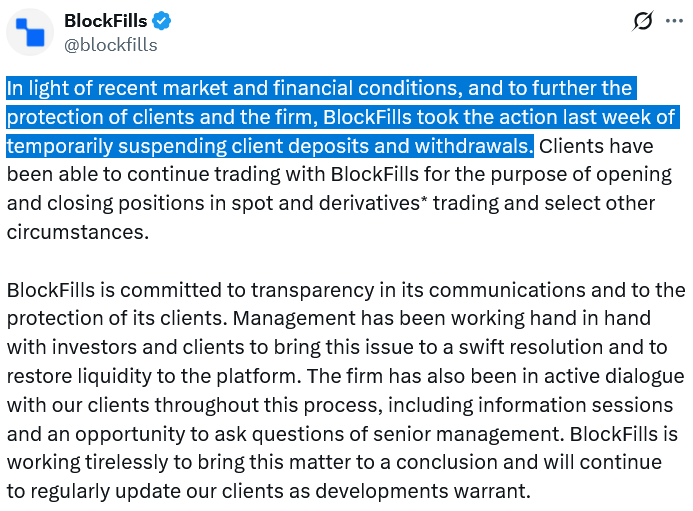
Institution-focused crypto lending platform BlockFills announced it halted customer deposits and withdrawals last week as Bitcoin and the broader crypto market continued to tumble.
The suspension, which remains in effect, was intended to protect clients and restore liquidity on the platform, BlockFills said in an X post on Wednesday.
Last week’s market tumble saw Bitcoin fall another 24% from $78,995 to $60,000.
Blockfills said the withdrawal and deposit halt came “in light of recent market and financial conditions.”
“Management has been working hand in hand with investors and clients to bring this issue to a swift resolution and to restore liquidity to the platform,” BlockFills said.
“Clients have been able to continue trading with BlockFills for the purpose of opening and closing positions in spot and derivatives* trading and select other circumstances,” BlockFills added.

The halt potentially impacts about 2,000 institutional clients, including asset managers and hedge funds, which contributed to more than $60 billion in trading volume on the platform in 2025.
The crypto liquidity and lending platform serves only investors with crypto holdings of $10 million or more.
BlockFills was founded by CEO Nick Hammer and President Gordon Wallace in 2017 and is backed by the likes of Susquehanna Private Equity Investments and CME Group.
Bitcoin is down 46% from its October high
Bitcoin’s price began to fall on Oct. 10 after a social media post on tariffs by US President Donald Trump sent shockwaves through the crypto markets, contributing to nearly $20 billion worth of positions being liquidated.
It fell further in the months following, hitting a year-to-date low of $60,008 on Feb. 5.
Related: Crypto super PAC to spend $5M on Barry Moore’s Senate bid: Report
Bitcoin has since rebounded to $67,575, but is still 46.6% off its all-time high of $126,080 set on Oct. 6.
BlockFills’ withdrawal halt marks the first suspension among major crypto platforms as a result of market conditions.
Magazine: Big questions: Should you sell your Bitcoin for nickels for a 43% profit?
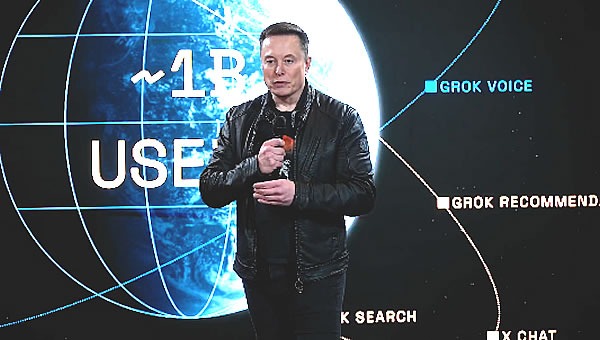
X Money, an upcoming payments system that forms part of Elon Musk’s “everything app” plans, is scheduled to come out as a “limited beta” in the next two months before launching to X users worldwide.
Musk gave the new timeline at his AI company’s “All Hands” presentation on Wednesday, during which he said that X Money was already live “in closed beta within the company.”
“This is intended to be the place where all money is. The central source of all monetary transactions,” he said, calling it a “game changer.”

Payments part of X’s “everything app”
The move is framed as a key upcoming feature to make X more essential, tied with its “everything app” vision, with payments a core driver of daily engagement.
Musk noted that the platform has 1 billion installed users but said its average monthly users were around 600 million.
X Money, rumored to be launched last year, is expected to integrate directly into the X platform, which aims to become a single place for social networking, messaging, content, and financial services, similar to WeChat in China.
“As we give people more reasons to use the X app, whether it’s for communications, or for Grok, or for X Money […] we want it to be such that if you wanted to, you could live your life on the X app,” said Musk.
Elon Musk has been pushing for payments on X since shortly after acquiring Twitter in 2022. The idea ties back to his early career in 1999, when he co-founded X.com, an online bank that merged with Confinity to become PayPal, which was later acquired by eBay.
Crypto integration remains a mystery. Musk has previously shared enthusiasm for Dogecoin (DOGE), but the initial focus is likely to be fiat since the company has partnered with Visa. According to the Blockchain Council, it will support crypto in the future.
Related: Musk’s xAI seeks crypto expert to train AI on market analysis
xAI expands Macrohard data center
Musk also highlighted the company’s AI growth, stating that xAI can “deploy more AI compute faster than anyone else.”
The tech billionaire showcased the firm’s “Macroharder” AI data center in Memphis, Tennessee — an expansion of the existing plant that adds 220,000 more graphics processing units.
“All this will be training the [AI] models that you experience. It’s absolutely fundamental to have large-scale training compute in order to get the best models,” he said.
Magazine: Bitcoin difficulty plunges, Buterin sells off Ethereum: Hodler’s Digest

XRP SELLING BAD NEWS!!!!! (XRP BILLIONS Just DIED)

Locals say Cambridgeshire high street is ‘essentially dying’ amid major regeneration

Bangladesh votes in landmark election after Gen Z uprising

Smart energy pays enters the US market, targeting scalable financial infrastructure

Software stocks enter bear market on AI disruption fear with ServiceNow plunging 10%

Wikipedia volunteers spent years cataloging AI tells. Now there’s a plugin to avoid them.


-

 Politics3 days ago
Why Israel is blocking foreign journalists from entering
-
 Sports5 days ago
JD Vance booed as Team USA enters Winter Olympics opening ceremony
-

 NewsBeat2 days ago
Mia Brookes misses out on Winter Olympics medal in snowboard big air
-
 Business3 days ago
LLP registrations cross 10,000 mark for first time in Jan
-

 Tech5 days ago
First multi-coronavirus vaccine enters human testing, built on UW Medicine technology
-

 Sports4 hours ago
Big Tech enters cricket ecosystem as ICC partners Google ahead of T20 WC | T20 World Cup 2026
-

 Business3 days ago
Costco introduces fresh batch of new bakery and frozen foods: report
-

 Tech1 day ago
SpaceX’s mighty Starship rocket enters final testing for 12th flight
-

 NewsBeat3 days ago
Winter Olympics 2026: Team GB’s Mia Brookes through to snowboard big air final, and curling pair beat Italy
-

 Sports3 days ago
Benjamin Karl strips clothes celebrating snowboard gold medal at Olympics
-
Sports5 days ago
Former Viking Enters Hall of Fame
-

 Politics4 days ago
The Health Dangers Of Browning Your Food
-
Sports6 days ago
New and Huge Defender Enter Vikings’ Mock Draft Orbit
-

 Business4 days ago
Julius Baer CEO calls for Swiss public register of rogue bankers to protect reputation
-
 NewsBeat6 days ago
Savannah Guthrie’s mother’s blood was found on porch of home, police confirm as search enters sixth day: Live
-

 Business6 days ago
Quiz enters administration for third time
-
 Crypto World6 hours ago
Pippin (PIPPIN) Enters Crypto’s Top 100 Club After Soaring 30% in a Day: More Room for Growth?
-

 Crypto World2 days ago
Blockchain.com wins UK registration nearly four years after abandoning FCA process
-
 Crypto World2 days ago
U.S. BTC ETFs register back-to-back inflows for first time in a month
-
Sports2 days ago
Kirk Cousins Officially Enters the Vikings’ Offseason Puzzle