
Crypto World
why the biggest bank wants in now



The Wall Street Journal reports that JPMorgan Chase is exploring a public stablecoin separate from its existing JPM Coin deposit token while 39 state banking associations form the BankChain Alliance and target a 2027 blockchain launch. The GENIUS Act gave banks the legal rails they needed. The question is no longer whether traditional finance will enter the stablecoin market. It is whether Tether and Circle can hold their ground when incumbents arrive with balance sheets 100 times larger.
Summary
- JPMorgan Chase told the Wall Street Journal on Aug. 26 that it has no current stablecoin plan but is evaluating the option as customer demand and regulation evolve, while its Kinexys platform already processes more than $7 billion in daily tokenized deposit volume.
- Thirty-nine state banking associations formed the BankChain Alliance, representing 3,283 banks with $21.8 trillion in combined assets, to build a shared permissioned blockchain targeting a 2027 launch.
- The GENIUS Act, signed into law on July 18, 2025, created the first federal framework for payment stablecoins, but regulators missed the one-year implementation deadline and the OCC now targets November 2026 for final rules.
- Early Warning Services, the company behind Zelle and jointly owned by seven of the largest U.S. banks, launched ZLUSD in June 2026 and is targeting India as its first international corridor for remittances.
- The stablecoin market has reached approximately $316 billion, with Tether holding 59 percent by market capitalization and Circle’s USDC carrying roughly 70 percent of adjusted transaction volume.
The bank that once dismissed Bitcoin as a fraud is now studying how to issue the very type of digital dollar it spent years criticizing. JPMorgan Chase, which already runs the largest blockchain payment network in traditional finance through its Kinexys platform, is weighing a public stablecoin that would sit alongside its existing JPM Coin deposit token. The disclosure came not from a press release or a keynote speech but from a Wall Street Journal report published on Aug. 26, 2026, that mapped a much broader shift across American banking.
JPMorgan is not alone. More than a dozen global banks are reportedly developing a multicurrency stablecoin venture beginning with dollars. Thirty-nine state banking associations have formed BankChain Alliance to build shared blockchain infrastructure. Early Warning Services, the Zelle operator owned by seven of the nation’s largest financial institutions, has already launched a dollar-backed stablecoin called ZLUSD. And The Clearing House, the payments company collectively owned by the biggest commercial banks, is coordinating a shared tokenized deposit network targeting the first half of 2027.
The catalyst behind all of this activity is a single piece of legislation: the GENIUS Act. Signed into law by President Donald Trump on July 18, 2025, it created the first federal framework for payment stablecoins and gave banks a clear license path to issue them. What had been a legal gray zone became a regulated on-ramp. Banks that had been watching from the sidelines for years suddenly had the one thing they always said they needed before entering the market: regulatory clarity.
The WSJ report and what JPMorgan actually said
The Aug. 26 Wall Street Journal report landed with the weight of inevitability rather than surprise. JPMorgan Chase confirmed through a spokesperson that the bank has no current plan to issue a stablecoin. But the spokesperson added that JPMorgan would consider its options in light of customer demand and the evolving regulatory environment. In corporate communications, that sentence is the closest a bank of JPMorgan’s size gets to saying yes without committing to a timeline.
The report arrived at a moment when banks are already weighing stablecoins as payments competition grows. JPMorgan recently discussed internally whether to launch a payment stablecoin separate from its existing deposit token infrastructure. The distinction matters. JPM Coin, which now trades under the ticker JPMD on the Base blockchain, is a tokenized deposit. It remains on JPMorgan’s balance sheet, operates within a closed network for institutional clients, and is legally classified as a bank deposit rather than a bearer instrument. A public stablecoin, by contrast, would function as a bearer token that anyone could hold and transfer without needing a JPMorgan account.
The difference is structural, not cosmetic. Tokenized deposits preserve the existing two-tier monetary system where central banks issue base money and commercial banks create deposits through lending. Stablecoins operate outside that system. Their issuers cannot make loans, expand credit, or accept deposits. They are simply digital representations of dollars held in reserve. For a bank like JPMorgan, issuing a stablecoin means creating a product that cannibalizes its own deposit base unless the strategic value of controlling digital dollar rails outweighs the cost.
JPMorgan’s Kinexys platform, formerly known as Onyx, has already processed more than $4 trillion in cumulative transactions. Daily volume averaged more than $7 billion as of June 2026, up from $5 billion earlier in the year. The bank has expanded JPM Coin deployments to the Canton Network and to Base, Coinbase’s public Layer 2, and completed a tokenized Treasury redemption test on the XRP Ledger alongside Mastercard, Ondo Finance, and Ripple. The infrastructure for a stablecoin already exists. The question is whether JPMorgan’s leadership decides the product warrants the regulatory and competitive exposure.
BankChain Alliance and the community bank counterattack
While JPMorgan deliberates, thousands of smaller banks have already committed to a collective response. The BankChain Alliance, announced in August 2026, unites 39 state banking associations representing 3,283 banks and $21.8 trillion in combined assets. The initiative was launched by the Texas Banking Association. Kathy Kraninger, who also leads the Florida Bankers Association, serves as interim chair.
The alliance is not building a stablecoin. It is building the plumbing for one. BankChain plans to develop a 24/7 nationwide permissioned blockchain that community and mid-sized commercial banks can use for tokenized deposits, stablecoins, and programmable payments. The network would be bank-governed, meaning the institutions that use it would also control its rules, access permissions, and upgrade cycles. The target launch date is 2027, though no technology partner has been selected.
The scale of the coalition matters more than any individual participant. Community banks in the United States collectively hold trillions in deposits but lack the technology budgets of the top five commercial banks. Without a shared infrastructure layer, each bank would need to build or license its own blockchain capabilities, a cost that would effectively exclude smaller institutions from the digital dollar economy. BankChain Alliance exists to prevent that exclusion.
The timing is not coincidental. Stablecoins processed more than $15 trillion in transaction volume in 2025, according to industry estimates. That figure is expected to exceed $25 trillion in 2026. For community banks, the threat is not hypothetical. Every dollar that moves through a stablecoin rail instead of a bank wire or ACH transfer is a dollar that bypasses the traditional banking system entirely. BankChain is the community banking sector’s attempt to build its own on-ramp before crypto-native rails make them irrelevant.
GENIUS Act: the law that unlocked everything
None of these initiatives would exist in their current form without the GENIUS Act. The Guiding and Establishing National Innovation for U.S. Stablecoins Act passed the Senate on June 17, 2025, with a 68-30 vote and cleared the House on July 17, 2025, with a 308-122 margin. President Trump signed it into law the following day.
The law made payment stablecoin issuance a licensed activity for the first time at the federal level. It defined a payment stablecoin as a digital asset issued for payment or settlement and redeemable at a predetermined fixed amount. It required issuers to hold at least one dollar of permitted reserves for every dollar of stablecoins outstanding. Permitted reserves include U.S. Treasury bills, insured bank deposits, and Treasury repurchase agreements. The law mandated monthly attested disclosure of reserve composition, required executive certification, and prohibited stablecoin issuers from paying interest to token holders.
The GENIUS Act also created a dual supervisory structure. Issuers with more than $10 billion in outstanding stablecoins fall under federal supervision through the OCC. Smaller issuers can operate under state-level regulators, provided those state frameworks meet minimum federal standards. The law distributed responsibility across multiple agencies: the OCC for prudential standards, FinCEN and OFAC for anti-money laundering and sanctions compliance, and the SEC for any stablecoins that might qualify as securities.
However, the GENIUS Act missed its implementation deadline and regulators are still writing the rules. The statutory one-year deadline for implementing regulations passed on July 18, 2026, without the OCC, Federal Reserve, FDIC, or NCUA completing all required rules. The OCC now expects to finalize its main GENIUS Act regulations by November 2026, which would push the effective date to approximately March 2027 under the 120-day implementation window. The law generally begins restricting unlicensed U.S. payment stablecoin issuance on January 18, 2027.
For banks, the delayed rulemaking creates both risk and opportunity. The risk is that products launched before final rules could require expensive modifications. The opportunity is that the enforcement date keeps sliding, giving banks more time to build while crypto-native issuers face growing uncertainty about whether their existing structures will pass muster.
ZLUSD and the Zelle stablecoin strategy
The most concrete bank stablecoin product to date is not from JPMorgan but from the company that already connects 2,200 financial institutions through the Zelle payment network. Early Warning Services, owned jointly by Bank of America, Capital One, JPMorgan Chase, PNC Bank, Truist, U.S. Bank, and Wells Fargo, launched ZLUSD in June 2026.
ZLUSD is a dollar-backed stablecoin issued directly by Early Warning Services rather than through a third-party issuer or new joint venture. The press release described it as proprietary, meaning Early Warning holds the token, manages the reserves, and controls the redemption process. The launch positions ZLUSD as a natural extension of Zelle’s existing infrastructure, which processed more than $1 trillion in payments in 2025.
The initial use case is cross-border remittances, with India as the first corridor. Zelle has historically been a domestic-only payment network, limited to transfers between U.S. bank accounts. ZLUSD changes that by enabling dollar-denominated transfers to recipients outside the United States without requiring both parties to hold accounts at the same institution. The stablecoin effectively turns Zelle into an international wire service that runs on blockchain rails.
The ownership structure gives ZLUSD an advantage that no crypto-native stablecoin can replicate. Seven of the largest banks in the country already own the issuing entity. Their combined balance sheet exceeds $14 trillion. Every one of those banks can offer ZLUSD to its existing customers through the Zelle interface they already use. No new app download, no crypto wallet setup, no know-your-customer re-verification. The distribution moat is the existing banking relationship.
The Clearing House and the tokenized deposit network
Running on a parallel track, JPMorgan, Citigroup, Bank of America, and Wells Fargo are building a shared tokenized deposit network through The Clearing House, targeting the first half of 2027. This network would allow corporate clients to move tokenized deposits around the clock, seven days a week, without waiting for Fedwire or CHIPS to open.
The distinction between this network and a stablecoin is important. Tokenized deposits remain on the issuing bank’s balance sheet. They are account-based, meaning ownership is tracked on a ledger the bank controls rather than through a bearer token that can be transferred peer-to-peer. They can pay interest, which stablecoins under the GENIUS Act cannot. And they operate within the existing regulatory framework for bank deposits, including FDIC insurance up to applicable limits.
The Clearing House network represents the banking industry’s preferred alternative to stablecoins. Rather than issuing bearer tokens that anyone can hold, the banks want to tokenize their existing deposit products and make them programmable. The strategy preserves the deposit base, maintains the lending relationship, and keeps the banks at the center of the payment flow. If tokenized deposits win the race, stablecoins become a product primarily for users who do not have or do not want a bank account.
The DTCC is also rolling out a tokenization service with more than 50 financial firms, with limited production trades starting in July 2026 and a broader launch in October. Mastercard has added stablecoin settlement for issuers and acquirers. Visa is testing private stablecoin settlement on the Canton Network. The infrastructure layer for bank-issued digital dollars is being built simultaneously by multiple institutions, each racing to define the standard before the others.
What bank stablecoins mean for Tether and Circle
The stablecoin market has reached approximately $316 billion in total supply. Tether’s USDT holds roughly $187 billion, or 59 percent, while Circle’s USDC follows at approximately $75 billion, or 24 percent. Together, they control more than 83 percent of the market. But the metrics that matter are shifting.
USDC has already won the volume race. Circle’s token now carries roughly 70 percent of adjusted stablecoin transaction volume, more than double USDT’s 25 percent share. The split reflects a market that has divided into two layers: a settlement layer dominated by USDC, which banks and institutions prefer for its regulatory compliance, and a savings layer dominated by USDT, which serves emerging-market users seeking offshore dollar exposure.
Bank stablecoins threaten both layers, but through different mechanisms. On the settlement side, a JPMorgan stablecoin or ZLUSD would offer corporate treasurers something USDC cannot: direct integration with an existing banking relationship, FDIC-insured reserves, and counterparty risk backed by institutions with hundreds of billions in equity capital. Circle went public in 2026 and has built a significant institutional franchise, but its balance sheet is a fraction of what any top-ten bank carries.
On the savings side, the threat is less immediate but still real. Tether’s strength in emerging markets comes from its permissionless distribution. Anyone with a smartphone and an internet connection can hold USDT without opening a bank account or passing identity verification. Bank stablecoins are unlikely to replicate that model. Regulatory requirements under the GENIUS Act and banking law would impose know-your-customer checks on every holder, limiting the addressable market.
The foreign issuer question adds another layer of complexity. Tether Limited is incorporated in the British Virgin Islands and has never been licensed as a financial institution in the United States. The GENIUS Act creates a foreign issuer pathway that allows non-U.S. companies to serve American businesses, but only if the Treasury Department issues a reciprocity determination. As of August 2026, that determination has not been issued. If it never arrives, Tether’s $187 billion token could be locked out of the regulated U.S. market entirely.
The real risk for Tether and Circle is not that bank stablecoins will be better products. It is that bank stablecoins will be better distributed. Stablecoin regulation is fundamentally about the dollar, and the GENIUS Act was designed to ensure that dollar-denominated stablecoins serve as vehicles for U.S. Treasury debt distribution. Tether already holds approximately $98 billion in U.S. Treasury bills, a position larger than the sovereign Treasury holdings of all but 18 countries. But if banks issue their own stablecoins backed by the same assets, the Treasury gets the same demand without relying on an offshore entity it cannot directly supervise.
JPMorgan’s trademark filings and the quiet buildout
While JPMorgan’s official position remains exploratory, the bank’s actions suggest a more advanced state of preparation than its public statements indicate. JPMorgan has filed at least two trademark applications related to stablecoin products in 2026. The bank also submitted a filing to the SEC in May 2026 for the JPMorgan OnChain Liquidity-Token Money Market Fund under the ticker JLTXX, a blockchain-enabled money market fund designed to support stablecoin issuers preparing for the GENIUS Act regime.
The JLTXX fund is particularly revealing. It is not a stablecoin itself but a product that would hold the reserves that back stablecoins. If JPMorgan builds the reserve management infrastructure for other stablecoin issuers, it captures value from the stablecoin ecosystem regardless of whether its own stablecoin succeeds. And if it does launch its own stablecoin, the reserve management product is already in place.
JPMorgan CEO Jamie Dimon has historically been one of the most prominent critics of Bitcoin and cryptocurrency. He called Bitcoin a fraud in 2017 and has repeatedly questioned the value proposition of decentralized digital assets. But his stance on stablecoins has been more nuanced. Dimon warned in 2026 that stablecoins could be a “huge problem” if not regulated thoughtfully, noting transaction costs and money movement risks. The comment reads less like opposition and more like a case for why banks, not crypto companies, should be the ones issuing digital dollars.
JPMorgan’s CFO has also warned about the risks of yield stablecoins, arguing that products offering returns on stablecoin holdings could create a form of unregulated parallel banking. That critique aligns with the GENIUS Act’s prohibition on paying interest to stablecoin holders and suggests JPMorgan views the regulatory framework as favorable to its interests.
The competitive landscape in 2027 and beyond
The next twelve months will determine whether bank stablecoins become a permanent fixture of the financial system or a compliance-heavy product that never achieves mass adoption. Several deadlines converge in early 2027. The GENIUS Act enforcement date of January 18, 2027, will restrict unlicensed stablecoin issuance. The Clearing House tokenized deposit network targets a first-half 2027 launch. BankChain Alliance is vetting technology partners for its 2027 blockchain deployment.
The competitive dynamics are not binary. The stablecoin market is large enough to support multiple issuers, just as the credit card market supports Visa, Mastercard, and American Express without any single network capturing 100 percent of transactions. The question is whether the market structure shifts from one dominated by two crypto-native issuers to one where bank stablecoins capture the institutional and corporate segments while Tether and Circle retain retail and cross-border flows.
New entrants are accelerating. Stripe and Visa, along with more than 140 other businesses, announced plans to launch a stablecoin called OUSD. Revolut launched a euro stablecoin. Sky, formerly MakerDAO, Ethena, and Paxos have each carved real market share. Agora, Ripple, and First Digital have each pushed past $1 billion in stablecoin supply. The market is fragmenting from a duopoly into a multi-issuer ecosystem where distribution, regulatory compliance, and integration with existing payment networks matter more than being first.
For JPMorgan specifically, the strategic calculus is straightforward even if the execution is complex. The bank already processes $7 billion per day in tokenized deposits. It already operates on public blockchains. It already has the regulatory licenses. It already serves the corporate clients who represent the highest-value segment of the stablecoin market. The only thing missing is the product itself.
What to watch
OCC final rules timeline. The OCC targets November 2026 for its final GENIUS Act stablecoin regulations. Any further delay pushes the enforcement date deeper into 2027 and gives banks more time to prepare while leaving crypto-native issuers in regulatory limbo.
Treasury reciprocity determination for Tether. Without this ruling, Tether’s USDT could be locked out of the regulated U.S. market when the GENIUS Act enforcement date arrives. The absence of a determination as of August 2026 is itself a signal.
BankChain technology partner selection. The alliance represents 3,283 banks but has not chosen a blockchain platform. The selection will reveal whether BankChain builds on an existing public or permissioned chain or attempts to create something new.
JPMorgan stablecoin announcement cadence. Watch for additional trademark filings, regulatory applications, or pilot programs. The gap between “no current plan” and “we are launching” can close in weeks once a bank of this size commits.
ZLUSD India corridor launch. Early Warning Services is targeting year-end 2026 for the India remittance corridor. If ZLUSD processes meaningful volume in its first international market, other bank stablecoins will accelerate their own cross-border strategies.
Is JPMorgan launching a stablecoin?
JPMorgan told the Wall Street Journal on Aug. 26, 2026, that it has no current plan to issue a stablecoin but is evaluating the option as customer demand and the regulatory environment evolve. The bank already operates JPM Coin, a tokenized deposit product, through its Kinexys platform. A public stablecoin would be a separate product that functions as a bearer token rather than a bank deposit.
What is the BankChain Alliance?
BankChain Alliance is a coalition of 39 state banking associations representing 3,283 banks with $21.8 trillion in combined assets. The group is building a shared permissioned blockchain for tokenized deposits, stablecoins, and programmable payments, with a target launch date of 2027. The initiative was launched by the Texas Banking Association and is chaired by Kathy Kraninger of the Florida Bankers Association.
What is the GENIUS Act?
The Guiding and Establishing National Innovation for U.S. Stablecoins Act was signed into law on July 18, 2025. It created the first federal framework for payment stablecoins, requiring issuers to hold dollar-for-dollar reserves in Treasury bills, insured deposits, or repurchase agreements. The law also mandates monthly attested disclosure, executive certification, and prohibits stablecoin issuers from paying interest to token holders.
What is ZLUSD?
ZLUSD is a dollar-backed stablecoin launched in June 2026 by Early Warning Services, the company that operates the Zelle payment network. It is owned by seven major U.S. banks including JPMorgan Chase, Bank of America, Wells Fargo, Capital One, PNC Bank, Truist, and U.S. Bank. The initial use case is cross-border remittances, with India as the first international corridor.
How is a stablecoin different from JPM Coin?
JPM Coin is a tokenized bank deposit that remains on JPMorgan’s balance sheet and operates within a closed network for institutional clients. A stablecoin is a bearer token that can be transferred peer-to-peer without the involvement of the issuing institution. Tokenized deposits can pay interest and are covered by existing banking regulations, while stablecoins under the GENIUS Act cannot pay interest and require a separate license.
What happens to Tether if banks launch stablecoins?
Tether faces a dual threat. On the regulatory side, Tether Limited has not received a Treasury reciprocity determination required for foreign stablecoin issuers to serve U.S. businesses under the GENIUS Act. On the competitive side, bank stablecoins would offer institutional users direct integration with existing banking relationships, FDIC-backed reserves, and counterparty risk backed by institutions with hundreds of billions in equity capital. Tether’s strength in emerging markets and permissionless distribution may insulate it from direct competition in those segments.
Will bank stablecoins replace USDC?
Not necessarily. USDC already carries roughly 70 percent of adjusted stablecoin transaction volume and has built significant institutional adoption. Bank stablecoins are more likely to compete for corporate treasury and cross-border settlement use cases where an existing banking relationship provides an advantage. The stablecoin market is large enough to support multiple issuers, similar to how the credit card market supports multiple networks.
When will bank stablecoin regulations be finalized?
The OCC expects to finalize its main GENIUS Act regulations by November 2026. The law’s enforcement provisions generally take effect on January 18, 2027, though the 120-day implementation window after final rules could push full compliance requirements into March 2027 or later. Three parallel rulemaking tracks are active: the OCC for prudential standards, FinCEN and OFAC for anti-money laundering, and the SEC for stablecoins that may qualify as securities.
Disclaimer
The information presented in this article is for informational and educational purposes only. This article does not constitute financial advice, investment advice, trading advice, or any other type of advice, and readers should not treat any of the article’s content as such. crypto.news does not recommend the buying, selling, or holding of any cryptocurrency or other investment. Readers are advised to conduct their own due diligence and consult with a qualified financial advisor before making any investment decisions. Published August 29, 2026.



Vietnam has not issued its first crypto exchange license, but five companies have passed an initial assessment under the country’s five-year digital asset market pilot.
Summary
- Vietnam has not licensed any crypto exchange, although five applicants passed an initial assessment stage.
- Applicants need 10 trillion dong in charter capital and Level 4 information-system security certification before licensing.
- Decree 284 takes effect September 1, establishing penalties for crypto-market violations during Vietnam’s pilot program.
- Domestic traders face no immediate offshore-platform fines because a separate six-month transition period applies first.
- Vietnam’s six-month transition starts only when the Ministry of Finance licenses its first service provider.
To Tran Hoa, deputy standing head of the Digital Asset Trading Market Board under Vietnam’s State Securities Commission, disclosed the progress at the Vietnam RWA Summit 2026, according to an Aug. 30 Vietnam News Agency report.
The authorities did not name the five applicants or confirm when final licensing decisions will be issued. Passing the initial assessment does not authorize any company to operate an exchange.
Vietnam crypto exchange applicants face a $383 million threshold
Vietnam’s Resolution No. 05/2025/NQ-CP requires each exchange applicant to have at least 10 trillion Vietnamese dong, approximately $383 million, in contributed charter capital. Contributions must be made in Vietnamese dong.
At least 65% of that capital must come from institutional shareholders. More than 35% must be contributed by at least two qualifying organizations, including commercial banks, securities companies, fund managers, insurers or technology companies.
Applicants must also obtain an appraisal showing that their technology meets Level 4 information-system security standards. The Ministry of Public Security handles the required security assessment before an exchange can begin operating.
Other licensing requirements cover management qualifications, custody, transaction monitoring, internal controls, conflict management and customer complaints. Applicants must also maintain systems for anti-money laundering and investor-identity verification.
The 10 trillion dong requirement is charter capital, not an additional investment fee paid to the government. Vietnam has not said whether all five preliminary applicants have already secured the full amount.
New crypto penalties take effect September 1
Decree No. 284/2026/ND-CP takes effect on Sept. 1 and will remain applicable while Resolution 05 governs the crypto market pilot. The decree establishes penalties for unlicensed services, improper issuance, weak customer checks and anti-money laundering failures.
Organizations providing crypto services or advertising an exchange without a license face fines of between 180 million and 200 million dong. Authorities can also order the removal of websites, software and trading systems involved in violations.
Licensed service providers face fines for failing to separate customer assets, monitor transactions or protect account information. Failure to verify customers can attract organizational fines ranging from 50 million to 70 million dong.
The decree generally states organizational fine levels. Individuals committing the same violation ordinarily face half the stated amount. The maximum penalty is 200 million dong for an organization and 100 million dong for an individual.
Domestic traders do not face immediate platform fines
Article 9 sets an organizational fine of 30 million to 50 million dong for domestic investors trading outside a Ministry of Finance-licensed provider. The general half-rate provision indicates an individual could face between 15 million and 25 million dong.
However, that penalty does not automatically begin on Sept. 1. Article 7 of Resolution 05 states that domestic investors become subject to the licensed-platform requirement six months after the first crypto asset service provider receives approval.
Because Vietnam has not licensed any provider, the six-month transition clock has not started. Domestic investors therefore will not be fined from Sept. 1 solely for continuing to use an overseas or otherwise unlicensed platform, according to experts cited by VNA.
Other violations covered by Decree 284 can still become enforceable on Sept. 1. These include operating or advertising an unauthorized platform, improper token issuance and certain failures involving customer data or anti-money laundering controls.
The first license will start Vietnam’s six-month countdown
Vietnam introduced the pilot through Resolution 05 on Sept. 9, 2025. As crypto.news previously reported, the five-year regulated crypto market pilot created rules for issuance, custody, trading and licensed service providers.
The framework initially permits locally issued crypto assets to be offered only to foreign investors. Eligible tokens must be backed by real-world assets and cannot represent securities or fiat currencies under the pilot.
Vietnam previously indicated that only a limited number of exchanges would receive licenses. The report that five companies passed the first assessment does not confirm that each will ultimately receive approval.
The next event is the Ministry of Finance’s first license. That decision will start the six-month period after which domestic investors must route covered crypto trading through licensed Vietnamese providers.
No licensing deadline has been announced. Investors will need to watch official Ministry of Finance and State Securities Commission notices rather than treating preliminary assessments as operating authorization.


Russia’s largest bank, Sber, plans to expand its crypto-backed lending to accept Tether’s USDt stablecoin and Ether as collateral alongside Bitcoin, according to a senior executive.
Sber will adapt its existing products and gradually expand its offerings as Russia’s new crypto law takes effect, Deputy Chairman Anatoly Popov said, according to a Friday TASS report. The bank plans to add the assets as collateral after the Bank of Russia permits them for public trading, he said.
The plans come as Russia rolls out a regulated crypto market under a law signed by president Vladimir Putin on Aug. 4, with core provisions taking effect Sept. 1.
The law gives the Bank of Russia authority to determine which crypto assets can trade on regulated exchanges. The central bank proposed Bitcoin, Ether and USDT for regulated exchange trading on Aug. 11, saying they met requirements including market capitalization, trading volume and at least five years of price history on overseas markets.
Sber has taken a more cautious view of the digital ruble, Russia’s central bank digital currency (CBDC), ahead of its wider rollout on Sept. 1. Sber’s chief financial officer Taras Skvortsov reportedly said that the bank sees little evidence of broad demand for the CBDC.
“I don’t see any clear interest in this instrument, apart from the central bank’s,” Skvortsov said, adding that neither retail nor corporate clients nor financial institutions are actively pushing for the CBDC.
Related: Stablecoins not credible for payments at scale, BIS chief says


Ripple has named Academy Award winner and Water.org co-founder Matt Damon as a keynote speaker for Swell 2026, scheduled for Oct. 27–29 at The Shed in New York City.
Summary
- Matt Damon will deliver a keynote at Ripple Swell 2026, scheduled October 27–29 in Manhattan.
- Ripple will combine Swell and XRPL Apex for the first time across three stages together.
- Organizers expect more than 1,500 attendees, 75-plus speakers and over 50 sessions in total overall.
- New speakers include executives from Aviva, Susquehanna Crypto, Water.org and PEAK6 across finance sectors globally.
- Ripple supports Water.org’s Get Blue campaign, using RLUSD to transfer funding toward microfinance partners worldwide.
The official Swell website lists Damon among the keynote speakers alongside Bullish Chairman and CEO Tom Farley. Ripple has not yet published the topic, timing or format of Damon’s appearance.
Swell’s latest announcement also added four speakers: Aviva Senior Investment Director Alastair Sewell, Susquehanna Crypto CEO Chase Lax, Water.org CEO and co-founder Gary White, and PEAK6 co-founder Jenny Just.
Ripple Swell 2026 adds finance and nonprofit leaders
The expanded lineup places executives from investment management, crypto trading, financial technology and nonprofit finance within the same program. Ripple describes Swell as a conference examining connections between traditional finance and the onchain economy.
Other listed speakers include Ripple CEO Brad Garlinghouse, President Monica Long and CTO Emeritus David Schwartz. External participants include Robinhood crypto executive Johann Kerbrat, BNY Global Head of Markets Laide Majiyagbe and Intercontinental Exchange Vice President Michael Blaugrund.
Former Reserve Bank of India Governor Raghuram Rajan is also listed. The lineup extends beyond crypto-native companies to include banks, asset managers, exchange operators, academics and development organizations.
Ripple has not released the complete session schedule. More speakers are expected to be announced, but the event website does not provide a deadline for completing the lineup.
Matt Damon’s appearance connects to Water.org
Damon co-founded Water.org with Gary White. The nonprofit works with local financial institutions to provide affordable financing for household water and sanitation systems.
Ripple joined Water.org’s Get Blue campaign in June as its exclusive digital asset and payments partner. As crypto.news reported, RLUSD is being used to move funding to microfinance partners serving communities across emerging markets.
That existing relationship gives Damon’s participation a direct connection to Ripple’s humanitarian payments work. However, neither Ripple nor Water.org has confirmed that his keynote will focus on RLUSD, charitable payments or the Get Blue initiative.
Ripple previously said Water.org and other nonprofits were testing its payments infrastructure and stablecoin. The company described the technology as a way to improve the speed and transparency of cross-border aid transfers. Those performance claims come from Ripple and participating organizations rather than an independent assessment of every transfer.
Swell and XRPL Apex become one conference
Ripple will combine Swell and XRPL Apex into one event for the first time in 2026. Swell has traditionally focused on institutional finance, payments and policy, while Apex has served developers and researchers working on the XRP Ledger.
The combined conference is planned around more than 50 sessions across three stages. Ripple expects over 75 speakers and more than 1,500 attendees, according to the event website. These are organizer projections and may change before October.
Program topics include payments, stablecoins, tokenization, crypto markets, exchange-traded funds, decentralized finance, artificial intelligence, privacy, quantum computing and XRP utility.
In related coverage, the combined Swell and XRPL Apex conference was identified as a major October event for the wider Ripple and XRP Ledger ecosystem. Conference announcements alone do not establish future demand for XRP or other Ripple-related products.
Registration closes before the October event
Swell 2026 will take place at The Shed, a cultural center at 545 West 30th Street in Manhattan’s Hudson Yards. Standard registration is listed at $1,200 through Oct. 5.
The final registration period runs from Oct. 6 through Oct. 20, with tickets priced at $1,500. Ripple has separate application routes for journalists, speakers, partners and hackathon participants.
The organizers are also planning an institutional summit and a hackathon within the wider conference program. Detailed schedules for those components remain pending.
The next confirmed steps are additional speaker announcements and publication of the complete agenda. Damon’s precise keynote subject and the sessions assigned to the four newly announced speakers have not yet been disclosed.
Coinbase will suspend trading for Badger DAO and Storj on Sept. 28, 2026, following its latest review of assets listed on the U.S. cryptocurrency exchange.
Summary
- Coinbase will suspend BADGER and STORJ trading on September 28, 2026, around 2:00 p.m. ET.
- Suspension covers Coinbase.com Simple and Advanced Trade, Coinbase Exchange, and Coinbase Prime services for customers.
- Both order books now operate in limit-only mode, allowing orders and possible trade matches temporarily.
- Customers will retain access to BADGER and STORJ balances and withdrawals after trading ends completely.
- Coinbase cited routine listing reviews but did not identify specific deficiencies involving either token publicly.
Trading will end at approximately 2 p.m. ET across Coinbase.com Simple and Advanced Trade, Coinbase Exchange and Coinbase Prime, according to the exchange’s Aug. 28 announcement.
Coinbase said it regularly reviews supported assets to determine whether they continue meeting its listing standards. The exchange did not disclose which technical, legal, compliance or market criteria prompted its decision concerning BADGER and STORJ.
Coinbase puts BADGER and STORJ in limit-only mode
Coinbase has moved the BADGER and STORJ order books into limit-only mode ahead of the suspension. Customers can place and cancel limit orders, while transactions may still execute when matching orders become available.
Limit-only mode prevents traders from submitting market orders. It gives customers more control over their requested prices during the transition, although an order may remain unfilled when sufficient liquidity is unavailable.
The restrictions apply to Coinbase’s retail, professional and institutional trading services. After the Sept. 28 deadline, customers will no longer be able to buy or sell either token through the affected Coinbase platforms.
Coinbase did not announce any automatic conversion program for remaining balances. This differs from its earlier handling of DAI, when eligible customer balances were scheduled for conversion into USDS after trading ended.
Withdrawals remain available after trading ends
Customers will retain access to their BADGER and STORJ balances. Coinbase said users will continue to have the ability to withdraw both assets, and it did not announce a withdrawal deadline.
A trading suspension therefore does not mean that Coinbase has frozen the tokens. Customers can leave supported balances on the platform or transfer them to compatible external wallets. Anyone transferring funds must verify the receiving address and supported blockchain before approving an irreversible transaction.
BADGER is the governance token associated with Badger DAO, a decentralized finance project focused on bringing Bitcoin-linked assets into DeFi. STORJ serves as a payment token within the Storj decentralized cloud-storage ecosystem.
The loss of Coinbase trading could reduce access to both tokens for customers who rely on the exchange. Other centralized and decentralized markets may continue supporting them, subject to regional restrictions and the platforms’ own listing decisions.
BADGER falls as Coinbase prepares trading suspension
BADGER traded near $0.37 on Aug. 30, down approximately 4% over 24 hours. The token moved within an intraday range of about $0.365 to $0.385. The timing followed Coinbase’s announcement, but the price change cannot be attributed solely to the suspension without further evidence.
STORJ traded near $0.074 during the same reporting period. Available market data did not show a comparably clear announcement-linked move, making a direct market-reaction conclusion difficult.
Delistings can reduce liquidity and widen spreads when a large exchange accounts for a material share of trading. However, Coinbase did not publish volume or liquidity figures showing its share of the global BADGER and STORJ markets.
The exchange says its monitoring process considers onchain and offchain signals. Material changes to a project or Coinbase’s understanding of an asset can trigger further review, according to the company’s listing policy.
September brings three Coinbase token suspensions
BADGER and STORJ are not Coinbase’s only scheduled September suspensions. The exchange previously announced that IoTeX trading would end on Sept. 23 at approximately 2 p.m. ET.
Coinbase also suspended five tokens earlier in August. As crypto.news reported, withdrawals remained open after trading ended for IDEX, LRC, OMNI, PIRATE and FIS.
Customers holding BADGER or STORJ now have until Sept. 28 to complete trades through Coinbase, subject to the limit-only restrictions. The exchange has not announced an appeal process, reconsideration period or further review deadline.
The next confirmed step is the suspension across all named Coinbase trading services. Withdrawals are expected to continue afterward unless Coinbase publishes a separate update.


Real Trump Coins denied launching or authorizing the Solana-based Trump Digital GOLD token on Aug. 29 after promotional posts appeared on its X account and associated website.
Summary
- Real Trump Coins denied authorizing GOLD and attributed its promotion to unidentified third-party bad actors.
- GOLD lost approximately 99% after connected wallets sold 82.45% of the Solana token’s total supply.
- Onchain analysts estimated clustered wallets received 9,784.6 SOL, worth about $1.01 million during sales combined.
- Promotional posts appeared on the merchandise account and related website before the denial was issued.
- No U.S. regulator or law enforcement agency has publicly identified GOLD’s developers or wallet operators.
The Trump-linked merchandise business blamed “third-party bad actors” for the promotion. It also said it was working with authorities to investigate the incident. No named law enforcement agency has publicly confirmed an investigation.
“Trump Coins has not authorized and will not launch, promote, or authorize any digital token,” the company said on X.
The denial followed a rapid token collapse and large sales from a concentrated group of wallets. However, neither blockchain analysts nor authorities have publicly identified the people who created GOLD or controlled the wallets.
GOLD token appeared across linked online channels
The @realtrumpcoins1 X account posted GOLD’s Solana contract address shortly after the token was created on Aug. 29. The post directed traders to RealTrumpCoins.com, where the token also appeared.
The involvement of both channels created confusion over whether the launch was authorized. The promotional X posts were later deleted, while the account began directing users to TrumpCoins.com.
Earlier posts from the same account had directed merchandise customers to RealTrumpCoins.com as recently as Aug. 25. The older domain reportedly continued showing the GOLD promotion after the company issued its denial.
The account is associated with licensed Trump-themed physical merchandise, including commemorative coins. That connection does not establish that GOLD was approved by Donald Trump, his family or the Trump Organization.
Trump’s verified accounts did not publicly promote GOLD. The token is also separate from Official Trump, the Solana memecoin Trump promoted through his verified social media profiles in January 2025.
GOLD loses 99% after concentrated wallet sales
GOLD briefly reached an estimated market capitalization of $66 million following the promotional post. It later fell to approximately $700,000, representing a decline of almost 99%.
Onchain researcher EmberCN reported that connected wallets sold 824.54 million GOLD tokens, equal to 82.45% of the supply. The wallets received approximately 9,784.6 SOL, worth about $1.01 million at the time.
The token’s market value reportedly fell from roughly $55 million to $1 million within 30 seconds as the wallets sold. The concentration left the market with limited capacity to absorb the available supply.
A separate Lookonchain analysis identified 15 wallets described as team-linked. It estimated that those wallets sold tokens for about $330,000 and earned approximately $312,000.
The two estimates appear to cover different wallet groups or transaction periods. Neither researcher identified the real-world owners behind the addresses. Blockchain activity can connect funding and trading patterns, but it cannot establish identity or criminal responsibility by itself.
As crypto.news reported before the denial, some wallets acquired GOLD before the account published its contract address. That timing raised questions about whether traders had advance knowledge of the promotion.
Denial leaves control of the account unexplained
Real Trump Coins said “bad actors” were responsible but did not explain how they gained access to both the X account and website. It also did not state when it detected the activity or when it regained control.
The business has not disclosed whether the incident involved stolen credentials, compromised administrators or unauthorized access to domain infrastructure. It has also not identified the organization handling its reported investigation.
Therefore, the denial confirms the company’s position but does not resolve who controlled the promotional channels. It also does not establish whether the token developers coordinated with anyone who had access to those channels.
No regulator has publicly accused Real Trump Coins, Donald Trump or the Trump Organization of participating in the GOLD launch. Likewise, no official finding has classified the incident as fraud or a rug pull.
Authorities could examine promotion and wallet activity
The SEC’s February 2025 staff statement said transactions involving meme coins fitting its description generally do not constitute securities transactions. That staff position is not legally binding.
The statement also said fraudulent conduct involving meme coins can still lead to action under other federal or state laws. Authorities could examine false promotion, unauthorized account access, wire fraud or other conduct depending on the evidence.
The SEC’s investor guidance warns that promoters may create culture-themed tokens, generate demand through social media and sell before the attention ends.
What happens next depends on whether Real Trump Coins identifies the authorities it contacted and provides technical evidence of a compromise. Investigators would also need records from the website, X account, token deployer and exchanges that received the sold SOL.


Stablecoins do not yet credibly function as a payment method at scale, Bank for International Settlements General Manager Pablo Hernández de Cos said on Aug. 28 at the Federal Reserve’s Jackson Hole symposium.
Summary
- BIS chief Pablo Hernández de Cos said stablecoins cannot credibly support payments at scale today.
- Tokenized deposits preserve settlement in central bank money, making them preferable for payments, de Cos.
- Five major jurisdictions differ over which entities may issue stablecoins and conduct additional financial activities.
- U.S. rules require payment stablecoins to maintain one-for-one reserves using cash and eligible short-term assets.
- Stablecoin issuers’ Treasury purchases could lower government borrowing costs while increasing banks’ marginal funding expenses.
In his official BIS speech, de Cos argued that tokenized bank deposits provide a stronger route to programmable payments. They remain within the existing banking system and settle through central bank money.
“Tokenised deposits offer a more direct path to harness tokenisation while preserving the monetary system’s foundations,” de Cos said.
However, he did not call for a complete ban on stablecoins. He said stablecoins and tokenized deposits could coexist if regulators defined their roles and imposed appropriate safeguards. Under his preferred model, tokenized deposits would handle most daily and wholesale payments. Stablecoins would serve narrower functions, including decentralized lending.
The speech came one day after the BIS-linked Financial Stability Institute published a study comparing stablecoin regulations in the United States, European Union, United Kingdom, Hong Kong and Singapore. The report found wide differences in which entities may issue stablecoins and which additional activities they may conduct.
Stablecoins struggle to meet three features of money
De Cos assessed stablecoins against three characteristics he considers central to a functioning monetary system: singleness, interoperability and financial integrity.Singleness means different forms of money denominated in the same currency remain redeemable at equal value. A dollar held in one regulated bank should have the same value as a dollar held in another bank.
Stablecoins do not always meet this condition in secondary markets. A user holding USDT may need to sell it before buying USDC when a recipient accepts only the latter. Either token can trade above or below one dollar during stress, meaning the exchange may not occur at par.
By contrast, tokenized deposits remain liabilities of regulated commercial banks. Transfers can debit one customer’s bank balance and credit another while the banks settle through central bank accounts. De Cos argued that this arrangement preserves the connection to central bank money.
Interoperability presents another challenge. Stablecoins operate across several blockchains and scaling networks. Moving the same token between chains often requires bridges, centralized intermediaries or wrapped assets. Each method introduces operational, custody or smart-contract risks.
Tokenized deposits also face interoperability problems. Most current projects operate through permissioned networks that do not communicate freely with other platforms. De Cos acknowledged that no multi-bank, cross-border tokenized deposit system currently operates at full commercial scale.
Financial integrity formed his third concern. Public blockchains allow users to hold and transfer assets without relying on a regulated custodian. This structure can make anti-money laundering and counterterrorist financing controls harder to apply consistently.
That concern does not mean every self-custody transaction is illicit. It means regulators cannot always identify the parties as easily as they can within a bank account system. De Cos said policymakers still need to determine how AML rules should apply to peer-to-peer transfers while protecting privacy.
The BIS chief had already warned that dollar-backed tokens could create financial stability risks if they grow without traditional banking safeguards.
Stablecoin growth creates opposing economic effects
Stablecoin adoption could increase demand for short-term government debt. Issuers commonly hold Treasury bills and other liquid assets to back their circulating tokens.
The U.S. Treasury Department has noted that the GENIUS Act requires permitted payment stablecoins to maintain one-for-one reserves. Eligible assets include cash, deposits, repurchase agreements and Treasury securities with remaining maturities of 93 days or less.
Treasury Secretary Scott Bessent has argued that stablecoin growth could strengthen international demand for dollars and U.S. government debt. When the GENIUS Act became law in July 2025, Bessent called stablecoins “a revolution in digital finance” that could generate additional Treasury demand.
De Cos accepted that stablecoins could lower government borrowing costs, particularly when demand comes from outside the United States. Foreign stablecoin users can create additional demand for Treasury bills rather than merely replacing existing domestic buyers.
However, he said the effect could work against private borrowers. If households move money from bank deposits into stablecoins, banks may lose a relatively stable and inexpensive source of funding.
Issuers could return part of that money to banks as wholesale deposits. Yet wholesale funding tends to be more concentrated and sensitive to interest rates. Banks could respond by raising loan prices or holding more liquid assets.Smaller lenders could face greater pressure because they rely more heavily on customer deposits. Higher funding costs could then reach households and small businesses through more expensive credit.
The reserve structure also creates possible contagion channels. A wave of stablecoin redemptions could force an issuer to sell Treasury bills or withdraw large bank deposits. Such movements could place pressure on short-term funding markets during periods of stress.
These outcomes remain scenarios rather than confirmed forecasts. De Cos cited BIS modeling that found a modest overall economic effect, with the result depending on reserve composition, government debt and whether stablecoin demand originates domestically or abroad.
Five markets apply different stablecoin rules
The Financial Stability Institute study examined regulatory frameworks in five major markets. It found that all five generally limit issuers to functions such as issuance, redemption and reserve management.
The frameworks differ over lending, staking, proprietary trading and custody. The United States and Singapore take relatively restrictive approaches toward specialized non-bank issuers.
Under the U.S. GENIUS Act, activities such as lending, staking, proprietary trading and custody of third-party crypto assets generally fall outside a payment stablecoin issuer’s core permissions. Separate entities or regulatory approvals may still support some related services.
The European Union, United Kingdom and Hong Kong allow certain additional activities when issuers obtain separate authorization, regulatory consent or other required permissions. Banks may also operate under broader prudential frameworks than specialized issuers.
The study identified a potential group-level gap. Restrictions generally apply to the legal entity issuing the stablecoin, not every company within its corporate group.
A related affiliate could therefore conduct activities that the issuer cannot perform directly. Banks already face consolidated supervision designed to capture risks across their groups. Non-bank stablecoin businesses may not face an equivalent system in every jurisdiction.
The FSI authors said regulators may need to extend group-level oversight to larger non-bank issuers. The publication states that its conclusions represent the authors’ views and do not necessarily reflect the position of the BIS or its member central banks.
Meanwhile, the U.S. Treasury continues implementing the GENIUS Act. In April, it proposed AML and sanctions rules that would treat permitted payment stablecoin issuers as financial institutions under the Bank Secrecy Act.
The proposal would require issuers to maintain systems for blocking, freezing or rejecting transactions when legally required.
Tokenized deposits still face practical barriers
Tokenized deposits are digital representations of commercial bank deposits recorded on programmable infrastructure. They remain claims against banks rather than claims against separate stablecoin issuers.
Their main advantage is institutional. Banks already operate within capital, liquidity, resolution, supervision and customer-protection frameworks. Settlement through central bank money can also preserve equal value between deposits at different institutions.
Still, tokenized deposits have not solved every technical problem. Separate bank networks can become closed systems with trapped liquidity. Smaller institutions may struggle with implementation costs and network effects that favor larger banks.
Continuous operation also brings risk. Round-the-clock transfers could accelerate deposit withdrawals during a crisis. Banks and central banks may need new liquidity arrangements capable of responding outside traditional operating hours.
Legal questions remain around settlement finality, smart-contract enforcement and correcting mistaken transactions. Tokenized systems must also operate alongside existing banking infrastructure during any long transition.
The BIS is testing these ideas through Project Agorá, which brings together seven central banks and more than 40 private financial institutions. The project has tested cross-border settlement using tokenized commercial bank money and central bank reserves.
As crypto.news reported, the project moved from prototype work toward real-value testing in 2026. However, those trials do not establish that tokenized deposits are ready to replace existing payment networks.
De Cos’s position therefore presents tokenized deposits as the stronger institutional model, not a finished global product. Stablecoins already have wider public-blockchain distribution, while tokenized deposits retain a closer connection to regulated money.
What happens next?
Regulators must now turn broad principles into detailed operational requirements. In the United States, agencies are continuing to implement reserve, licensing, sanctions and AML provisions under the GENIUS Act.
Other jurisdictions will continue applying their own frameworks. Differences between the five markets could encourage issuers to choose structures or locations with broader permissions.
The FSI study suggests that regulators will pay closer attention to entire corporate groups, especially when non-bank affiliates provide lending, staking, trading or custody services around an issuer.
For central banks, the next step involves expanding tokenized settlement experiments while developing common technical and legal standards. Stablecoins are unlikely to disappear from this process. De Cos instead expects them to occupy specialized roles under rules that support redemption, transparency and financial integrity.
FAQs
Why does the BIS question stablecoins as everyday money?
The BIS says stablecoins can trade away from par, operate across fragmented blockchains and complicate consistent AML enforcement. These limitations make universal acceptance and final settlement harder to guarantee.
What is the difference between a stablecoin and a tokenized deposit?
A stablecoin is generally a liability of a private issuer backed by reserve assets. A tokenized deposit remains a commercial bank liability and settles through the regulated banking system.
Could stablecoins lower U.S. borrowing costs?
They could increase demand for short-term Treasury securities, especially when foreign users drive adoption. The size of any borrowing-cost reduction remains uncertain.
Is the BIS calling for stablecoins to be banned?
No. De Cos said stablecoins and tokenized deposits could coexist. He proposed using stablecoins for specialized activities under transparent and robust regulatory regimes.
Are tokenized deposits currently available at global scale?
No. Banks and central banks are running pilots, but no fully interoperable multi-bank and cross-border tokenized deposit network currently operates at global scale.


Sberbank plans to expand its crypto-backed lending business by accepting Bitcoin, Ethereum and Tether’s USDT as collateral, Deputy Chairman Anatoly Popov told TASS on Aug. 28.
Summary
- Sberbank plans to accept Bitcoin, Ethereum and USDT as collateral after required regulatory approval arrives.
- Russia’s new crypto market framework takes effect September 1, 2026, under formal central bank supervision.
- Non-qualified investors may purchase 300,000 rubles annually through each intermediary after passing mandatory knowledge tests.
- Sberbank completed a Bitcoin-backed loan pilot with Russian mining company Intelion Data during December 2025.
- Cryptocurrency payments for goods and services remain prohibited within Russia despite the expanded regulatory framework.
However, the proposal remains conditional. Popov said the Russian bank would only add ETH and USDT after the Bank of Russia permits their public circulation. Sberbank has not announced a launch date, loan terms or eligible customer groups.
“We plan to accept not only Bitcoin but also Ethereum and the stablecoin Tether as collateral,” Popov said. He added that the expansion would begin only “after the Central Bank, of course, allows them for public circulation.”
Sberbank will adapt loans to Russia’s crypto rules
Popov said Sberbank had prepared for the regulatory change and already had practical experience handling cryptocurrency. The bank intends to modify its existing products once every part of the new framework becomes effective.
The statement expands Sberbank’s previous interest in issuing ruble-denominated loans secured by cryptocurrency. Popov said in December 2025 that the bank was assessing crypto-backed lending and working with regulators on the required infrastructure.
Sberbank later completed a pilot Bitcoin-backed loan involving Russian mining company Intelion Data. The borrower pledged mined cryptocurrency as collateral. That transaction gave the bank experience in custody, collateral monitoring and enforcement procedures.
The new statement does not mean customers can immediately pledge ETH or USDT. Sberbank must wait for the Bank of Russia to determine which assets can circulate through regulated intermediaries and qualify for use in banking products.
Russia’s crypto framework starts September 1
Russia’s wider cryptocurrency framework takes effect on Sept. 1, 2026. According to the Bank of Russia, the rules create a regulated market involving banks, brokers, asset managers, crypto exchanges and digital depositories.
Both qualified and non-qualified investors will be able to conduct crypto transactions through approved intermediaries. However, retail access will remain restricted.
Non-qualified investors must pass a knowledge test. They may then purchase up to 300,000 rubles in eligible cryptocurrencies annually through each intermediary. Qualified investors must also pass testing but can access a wider group of assets without the same monetary limit.
Foreign stablecoins will generally face the same requirements as other cryptocurrencies. This provision could cover USDT, although the central bank must still determine which assets satisfy its circulation standards.
The framework does not legalize cryptocurrency as a domestic payment method. Payments for goods and services in Russia remain prohibited. Exporters and importers may use cryptocurrency for cross-border settlements under the applicable rules.
Sberbank builds trading and custody infrastructure
Sberbank is also preparing infrastructure for regulated cryptocurrency trading and custody. The bank aims to launch a digital depository by Dec. 1, 2026, as crypto.news reported.
The planned system would record customer ownership, manage wallets and support deposits, withdrawals and settlements. Sberbank has not yet confirmed which cryptocurrencies the platform will support or disclosed its fees and withdrawal limits.
The bank already operates within Russia’s digital financial asset market. It joined the Bank of Russia’s register of approved information system operators in 2022 and has since issued tokenized financial products through its platform.
Sberbank’s plans also remain separate from public blockchain lending protocols. The bank would issue conventional loans and hold cryptocurrency as collateral within a regulated custody structure. It has not announced any integration with decentralized lending platforms.
Regulatory approval will determine the launch
The Bank of Russia must now complete supporting standards covering eligible assets, custody, accounting and customer protection. These rules will determine whether Sberbank can use ETH and USDT as loan collateral.
Market participants have until July 1, 2027, to obtain the necessary licenses and align their operations with the framework. Sberbank’s Dec. 1 infrastructure target falls within that transition period.
Until the regulator approves the assets and Sberbank publishes commercial terms, the expanded collateral offering remains a plan rather than an available product. The bank must also explain how it will value volatile collateral, handle margin requirements and respond when asset prices fall.


Tokenized stock transfer volume climbed more than 415% over the 30 days ending Aug. 29, reaching $29.5 billion as Coinbase brought four equity tokens to Base.
Summary
- Tokenized stock transfer volume increased 415% over 30 days, reaching $29.5 billion, RWA.xyz data showed.
- Monthly active addresses rose 209% to 1.3 million as onchain equity activity accelerated sharply globally.
- Coinbase launched four initial tokenized stocks on Base, each backed one-for-one by an underlying share.
- Coinbase currently restricts Base stock tokens to eligible non-U.S. users under Regulation S offering rules.
- Onchain tokenized stock value reached $2.54 billion, rising about 637% from one year earlier overall.
Data from RWA.xyz also showed that monthly active addresses increased more than 209% to approximately 1.3 million. The number of holders rose 167% to 2.36 million during the same period.
The total distributed value of tokenized stocks increased at a much slower rate. It rose 1.45% over 30 days to $2.54 billion. However, that figure was about 637% above the $344 million recorded one year earlier.
Transfer volume measures the value moved between blockchain addresses. It does not necessarily represent purchases and sales by separate investors. Automated transfers, collateral movements and repeated activity between decentralized applications can also raise the figure.
Tokenized stock activity outpaces market value growth
The difference between transfer volume and distributed value shows that existing stock tokens are circulating more frequently. The $29.5 billion monthly figure was more than 11 times the sector’s $2.54 billion onchain value.
RWA.xyz ranked Securitize Corp. as the largest individual tokenized stock at approximately $163 million. Strategy PP Variable xStock followed at $136 million, while an Ondo-tokenized Circle Internet Group product held about $109 million.
Ondo led the platform rankings with $842.8 million in distributed value. Kraken’s xStocks followed with $609.3 million, while Binance’s bStocks held $599.9 million. Together, the three platforms represented roughly 81% of the tracked market.
The address and holder figures indicate broader onchain participation. Still, blockchain addresses do not always equal individual investors. One person or institution can control several wallets, while custodial platforms may use one address for many customers.
Coinbase tokenized stocks go live on Base
Coinbase launched tokenized versions of Nvidia, Meta, Apple and Alphabet shares on Base on Aug. 24. The products trade under the NVDAc, METAc, AAPLc and GOOGLc tickers using Coinbase’s B20 token standard.
According to the official Base announcement, the products can trade continuously through onchain markets and sit inside self-custody wallets. Supported decentralized applications can also integrate them into exchanges, lending markets and other financial products.
Coinbase Onchain SPV Ltd., a company incorporated in Abu Dhabi Global Market, issues the securities. Each token initially represents a beneficial interest in one underlying share held through a segregated custody account.
Alpaca Securities acts as the broker and custodian responsible for purchasing and holding the underlying stocks. Alpaca is registered with the U.S. Securities and Exchange Commission and belongs to FINRA and the Securities Investor Protection Corporation.
Base describes the products as “real shares” held one-for-one by a regulated custodian. However, the product prospectus distinguishes beneficial ownership from direct registration on the listed company’s shareholder records.
As crypto.news reported after the launch, verified holders may submit voting instructions. The issuer’s ability to act on those instructions remains subject to legal, operational and timing restrictions.
Base integrations expand beyond continuous trading
The B20 tokens can interact with supported Base applications. Aerodrome provides decentralized liquidity, while protocols including Aave, Morpho and Euler support or plan lending functions.
Chainlink also launched price feeds for the four assets. The feeds combine the underlying stock price with a Coinbase-provided multiplier that accounts for changes in the amount of equity represented by each token.
The data can help lending protocols calculate borrowing limits, collateral health and liquidations. As crypto.news reported in related coverage, each protocol remains responsible for setting its risk parameters.
Continuous trading creates additional risks. Token prices may move during weekends and outside regular Nasdaq or New York Stock Exchange sessions, when the underlying shares are not trading. Lower liquidity during those periods could produce wider price differences.
Corporate distributions also work differently from a conventional brokerage account. The issuer generally reinvests dividends into additional underlying shares after fees and applicable U.S. withholding taxes. This process changes the deposit ratio rather than delivering cash directly to tokenholders.
U.S. investors remain excluded from the offering
Coinbase limits the Base products to eligible non-U.S. users. The tokenized securities have not been registered under the U.S. Securities Act or approved for sale to U.S. persons.
The offering relies on Regulation S, which covers certain securities transactions outside the United States. Users who acquire tokens through decentralized markets must still complete the issuer’s compliance process before accessing redemption and voting functions.
Unverified holders cannot redeem tokens for shares, U.S. dollars or accepted stablecoins. Verified redemptions carry a 0.05% fee and remain subject to identity, sanctions and anti-money laundering checks.
Coinbase said “more stocks are coming,” but it has not published a complete launch schedule. Any additional products will remain subject to regulatory approval and separate prospectus disclosures.
Meanwhile, Bitwise has introduced three automated models using Coinbase tokenized stocks. The portfolios cover large technology companies, robotics and artificial intelligence. Crypto.news previously reported that the products charge a 0.15% methodology fee and remain unavailable to U.S. persons.
Real Trump Coins has denied launching, promoting or authorizing the Trump Digital GOLD token that briefly appeared across its online presence before collapsing, blaming the promotion on “third-party bad actors.”
The denial came after the Real Trump Coins X account promoted the Solana-based token on Saturday and directed users to RealTrumpCoins.com, where GOLD was also advertised. The X posts were later deleted, while the account now links to a separate domain, TrumpCoins.com.
“Trump Coins has not authorized and will not launch, promote, or authorize any digital token,” Real Trump Coins said in an X post on Saturday, adding that it was working with authorities to investigate the matter.
The statement follows a highly concentrated GOLD launch, with Lookonchain reporting that the developer and newly created wallets controlled 82.45% of its supply. According to the blockchain analytics platform, 15 wallets linked to the team sold their holdings for about $330,000, making an estimated $312,000 profit.
The involvement of both the X account and RealTrumpCoins.com confused crypto observers, with X user Rune questioning how both the account and the domain could have been compromised.
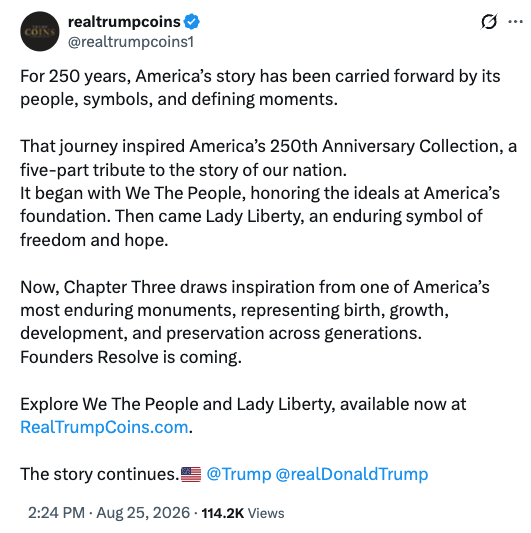
While the Real Trump Coins X account bio linked to TrumpCoins.com, the account was still directing customers to RealTrumpCoins.com as recently as Aug. 25 in a post that remained online at the time of publication.
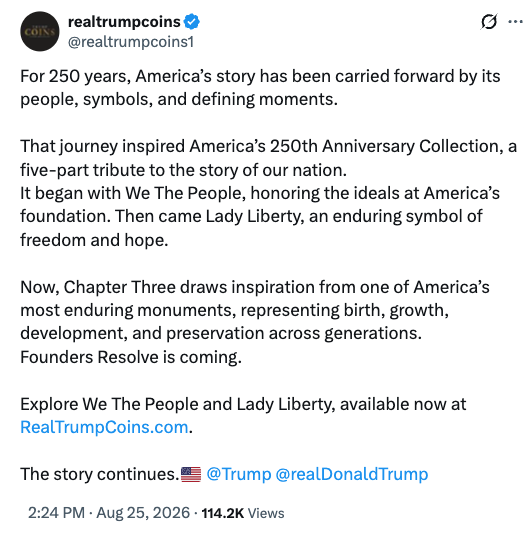
The Real Trump Coins X account directed customers to RealTrumpCoins.com on Aug. 25. Source: Real Trump Coins
At the time of publication, RealTrumpCoins.com still displayed the GOLD promotion. Trump also continued to follow the Real Trump Coins X account, one of 53 accounts he followed on the platform.
Related: Trump cost investors $4.7B through crypto ‘schemes’: Public Citizen
Crypto World
From Record Short Squeezes to Massive ETF Inflows: Everything Driving Bitcoin Right Now

Bitcoin (BTC) has risen about 26% from its mid-August low after a short-liquidation event accelerated the rebound. Glassnode said the August 19 move produced the largest one-day liquidation event since 2019.
Short positions accounted for most of the liquidations across the major centralized exchanges. The actual total was likely higher because the dataset excludes Hyperliquid.
ETF Demand and Large Holders Add Support
The squeeze cleared much of the liquidation liquidity around Bitcoin. Glassnode now sees short-liquidation levels above the market and a smaller pool of long-liquidation levels below.
The rebound was not driven only by forced closures, as spot demand also supported the move. US spot Bitcoin ETFs recorded $2.23 billion of net inflows over seven days, with no outflow days and their strongest weekly intake of 2026. The period included the largest ETF creation session since mid-January.
Meanwhile, Bitcoin continued moving away from exchanges as wallet groups changed their holdings. Entities holding between 1,000 and 10,000 BTC reduced their balances by 50,500 BTC since June 30.
In contrast, entities holding more than 100,000 BTC added 59,100 BTC. This group includes exchanges, custodians and ETF-related wallets.
During the squeeze week, the custody group added 31,500 BTC. Glassnode said the amount was similar in scale to weekly ETF creations, but the data does not show that the same coins moved directly into ETFs.
Every wallet-size cohort also moved into net accumulation on Glassnode’s 30-day trend score. The firm called it the most persistent all-cohort buying since late 2024.
Bitcoin Now Faces a Tougher Test
Leverage has not returned at the same pace as Bitcoin’s price, with futures open interest falling 11% in BTC terms. Perpetual funding remained near neutral and later turned negative, suggesting limited pressure from new leveraged long positions.
Beyond accumulation and leverage, on-chain data places recent buyers beneath price, while long-term holders provide the main supply zone above it. Bitcoin is now trading between these groups, creating a key market test for demand.
Several indicators point to a similar supply area overhead, including cost-basis levels, ask liquidity, options positioning and remaining liquidation clusters. A sustained move through that zone would show whether buyers can absorb the available supply.
The post From Record Short Squeezes to Massive ETF Inflows: Everything Driving Bitcoin Right Now appeared first on CryptoPotato.

Turns out Brits would quite like their private messages to stay private

I told the BBC about an abusive colleague – but still had to work with them, says former Strictly professional Nadiya Bychkova
China’s Longi Green Energy first-half net loss widens as solar downturn persists





-

 Crypto World4 days ago
SpaceX stock could rise 75% to $240, JPMorgan says
-

 Fashion2 days ago
Weekend Open Thread: Maeve – Corporette.com
-

 Crypto World2 days ago
Bitcoin’s 22% rally now needs real demand to outlast Treasury liquidity boost
-

 Crypto World4 days ago
Warsh Jackson Hole keynote puts financial innovation first
-

 Crypto World5 days ago
A $30 Billion AI Fund Implodes, Now the SEC Is Investigating Wall Street’s Role
-

 Business2 days ago
Salesforce Stock Soars 19% as Blowout Earnings and Agentforce AI Growth Silence Software Skeptics
-

 Crypto World4 days ago
Did Trump Just Move SpaceX Stock With One Truth Social Post?
-

 Business7 days ago
Mystery AI Model ‘Ox Alpha’ Draws Developers With Free Access as Chinese Lab Origins Remain Debated
-

 Business4 days ago
Walmart takes aim at younger shoppers with new fashion brand
-
 NewsBeat4 days ago
Lindsay Clancy jury braces for closing arguments as judge tells court: ‘You’ve heard all the evidence’ – Live updates
-

 Crypto World3 days ago
Elon Musk Grok Bot Promise: We Will Make You Whole if AI Loses Your Money
-

 Crypto World1 day ago
Bitcoin price tests $82K resistance as Brandt stays long
-

 Business6 days ago
Moderna CEO warns China is pouring state money into mRNA technology
-

 Crypto World3 days ago
NVIDIA revenue hits $96.2B as AI demand doubles
-

 Business4 days ago
Thailand’s Eastern Economic Corridor Capital City (EECiti): Key Developments and Investment Opportunities
-

 Business2 days ago
Apple Confirms September 9 Keynote and Reveals Its Full Pre-Order Schedule
-

 Business2 days ago
iPhone 18 Pro Pre-Orders Could Shift to Saturday as Apple Reportedly Avoids September 11 Anniversary
-

 Business5 days ago
NVIDIA Stock Drops Nearly 2 Percent to $210 on Seventh Losing Day Ahead of Critical AI Earnings
-
 Crypto World6 days ago
$92 Billion Nvidia Earnings Could Make or Break the AI Trade
-

 NewsBeat4 days ago
Trump’s trade truce with China faces test with Iran effort
You must be logged in to post a comment Login