
Crypto World
Why the Trump Administration Is Purging ‘Woke’ Art From U.S. Embassies

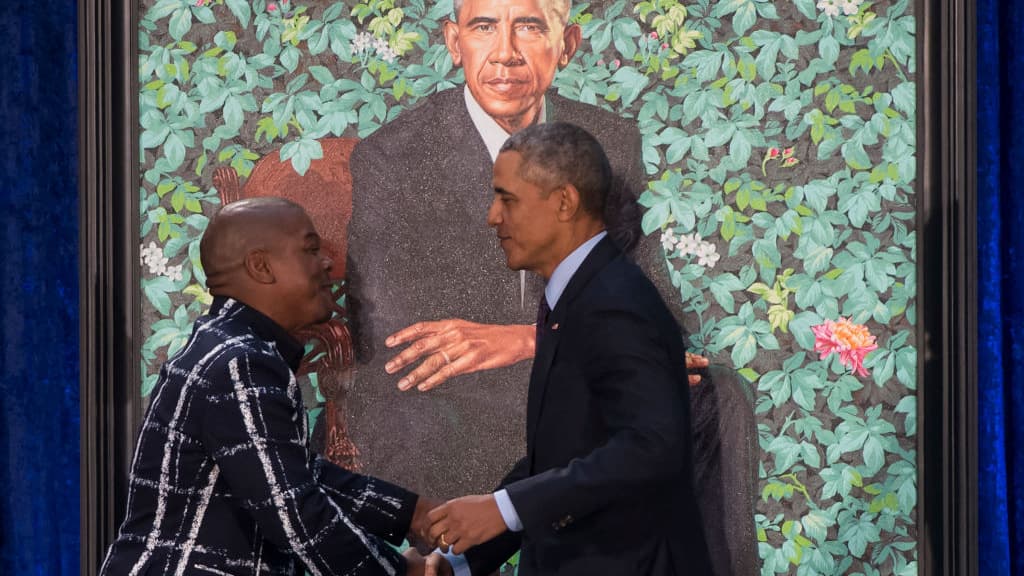
For “Young Artists After Siamesas 1960,” Wiley collaborated with students from the Facultad de Artes and the Altos de Chavon School of Design, both prominent art schools in the Dominican Republic. The subjects in the painting were modeled by four local art students. The work drew inspiration from two Dominican art works, Celeste Woss y Gil’s 1940 painting “Desnudo Feminine” and Gilberto Hernández Ortega’s 1960 work “Siamesas.”
The painting was part of the embassy’s permanent exhibition, assembled through the State Department’s Art in Embassies program. Established in 1963, the program is aimed at fostering cross-cultural dialogue and diplomacy through art. In 2015, the State Department awarded Wiley its Medal of Arts in recognition of his contributions to the program.
But in recent years, Wiley faced criticism from conservative commentators over his 2012 painting “Judith and Holofernes.” The painting portrays a Black woman holding the severed head of a white woman, which Wiley later described as a play on the “kill whitey thing.” The work, currently on view at the North Carolina Museum of Art in Raleigh, reimagines a 17th century painting by Giovanni Baglione that depicts the biblical story of Judith beheading an invading general to save her town.

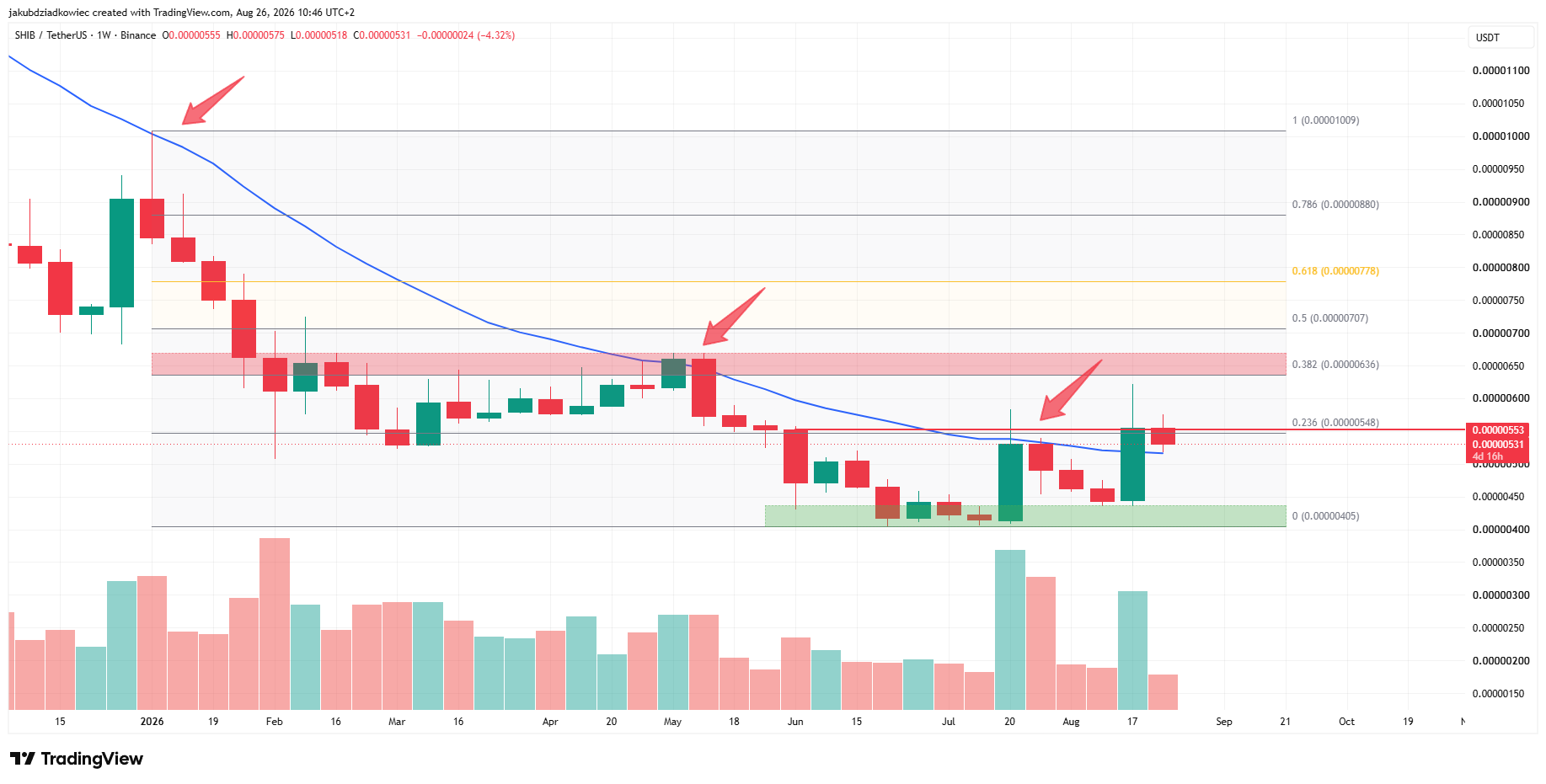
Shiba Inu (SHIB) price has closed above its 20-week moving average for the first time since September 2025, ending an 11-month downtrend.
The break arrived in the same week Japan approved a Nomura-backed exchange to list SHIB. The token now trades at $0.00000528, down 4.27% in 24 hours, while it retests the breakout.
Japan Says Yes to Shiba Inu
Japan’s Financial Services Agency registered Laser Digital Japan as a crypto asset exchange service provider. The subsidiary of Nomura’s digital assets arm secured the first new exchange approval in the country in four years.
SHIB is one of six launch assets. It sits beside Bitcoin (BTC), Ethereum (ETH), XRP, Bitcoin Cash (BCH), and Litecoin (LTC), and it is the only meme coin on that list. The token joined the Japan Virtual and Crypto Assets Exchange Association Green List in November 2025.
Meanwhile, whales moved in the same direction. An unidentified wallet withdrew 280.8 billion SHIB from OKX on August 24, worth roughly $1.56 million. Exchange reserves fell to 86.98 trillion tokens. SHIB ranks 31st by market capitalization at $3.11 billion.
Shiba Inu Price Breaks an 11-Month Downtrend
The weekly chart shows the trend change clearly. SHIB rejected the 20-week moving average near $0.00001000 in January and again near $0.00000650 in May. It has now closed above it.
Structure improved underneath. A June low near $0.00000405 was followed by a higher low near $0.00000445 in early August. The week of August 17 gained about 25% on heavy volume.

However, that candle wicked to roughly $0.00000620. It stopped just short of the 0.382 Fibonacci resistance at $0.00000636, a level that has capped every rally since February.
One Level Decides It
The daily chart places SHIB inside an ascending parallel channel. Price tagged the upper band near $0.00000600 on August 21, then reversed.
Support at $0.00000531 now matters most. It marks the channel midline, the July 26 swing high, and the 20-week moving average at once. Below it sits the $0.00000499 level, and the channel base near $0.00000450.
Reclaiming $0.00000553 would open $0.00000600 and then $0.00000636. The relative strength index has cooled to 58. Its twin peaks near 77 suggest momentum did not expand on the second push.

Therefore, two caveats temper the case. A recent 441% burn rate spike removed only about $230 worth of SHIB, and Shibarium activity remains near 1,180 daily transactions.
A team member has teased news from Shytoshi Kusama and Kaal Dhairya before August 31. Neither has confirmed it. That window closes inside the weekly candle that settles this retest.
The post Shiba Inu (SHIB) Breaks 11-Month Downtrend After Japan Approval appeared first on BeInCrypto.


The FSA, Finance Ministry, BOJ and financial institutions plan to study the infrastructure and produce a development plan by early 2027.


Ethereum developers warned on Aug. 24 that planned gas changes in the Glamsterdam upgrade could disrupt a small group of Layer 1 smart contracts.
Summary
- Ethereum developers warned Glamsterdam gas repricing could break a small group of Layer 1 contracts.
- EIP-8037 raises state-creation costs, while EIP-8038 reprices storage and account access across Ethereum’s execution layer.
- Most flagged failures can be resolved by increasing transaction gas limits, according to Ethereum developers.
- Contracts using 2,300-gas stipends, fixed call limits or gasleft logic face the greatest compatibility risks.
- Developers can test contracts immediately on Platåberget before public testnet and eventual mainnet deployment begins.
The Ethereum Foundation urged developers to test contracts and update fixed gas assumptions before mainnet activation.
The warning concerns EIP-8037 and EIP-8038, which are scheduled for inclusion in Glamsterdam. Developers said most contracts remained unaffected during transaction replays, while many flagged cases could be corrected by raising their gas limits.
Ethereum gas repricing changes state costs
EIP-8037 changes how Ethereum charges for creating state, including new accounts, storage slots and deployed contract bytecode. It introduces separate state-gas accounting intended to prevent rapid blockchain-state growth as Ethereum increases network capacity.
EIP-8038 raises costs for accessing existing state. The proposal covers operations including SLOAD, SSTORE, cold account access, EXTCODESIZE and EXTCODECOPY.
Ethereum developers last broadly adjusted state-operation prices during the Berlin upgrade in 2021. Since then, Ethereum’s state has expanded, while validators have supported higher block gas limits.
The Ethereum Foundation said repricing resource-heavy operations is necessary before the network can safely raise capacity further. Developers designed the new schedule around a performance target that could support roughly three times the current base throughput.
Hardcoded gas assumptions create compatibility risks
Developers replayed historical Ethereum mainnet transactions under Glamsterdam’s proposed pricing schedule. They sorted the results into unchanged transactions, successful transactions with different gas usage, failures fixable through higher limits and potentially broken transactions.
The last group continued to fail even after researchers raised the supplied gas substantially. The Foundation’s warning identified fixed gas stipends, hardcoded call limits, logic based on gasleft() and presigned transactions with fixed limits as recurring risk factors.
Contracts that use Solidity’s historical 2,300-gas stipend through transfer or send may require particular attention. Operations that previously completed within that allowance may consume more gas under the new state-access schedule.
The Foundation has not publicly identified every affected application. It said direct outreach to the most affected builders was already underway and described the potentially broken group as small.
Wallets and gas estimators also require updates
The warning extends beyond smart contracts. Wallets, RPC providers, indexers and node tools must update their gas-estimation systems to recognize the revised cost rules.
Software using cached constants could underestimate the gas needed for a transaction and cause it to fail. Both proposals require tools using eth_estimateGas and related functions to account for the revised state costs.
As crypto.news previously reported, Glamsterdam could also disrupt wallets and gas tools that assume ordinary transfers always require 21,000 gas. Transfers to existing accounts retain that figure, while transfers creating new accounts will incur an additional state charge.
Regular users do not need to make manual changes, according to the Foundation. Updated wallet and infrastructure providers should apply the necessary gas estimates automatically.
Developers can test fixes on Platåberget
Ethereum developers launched the Platåberget testnet to provide a long-running environment for Glamsterdam testing. The network, also called glam-devnet-8, already runs the new repricing schedule.
Contract maintainers can enter an address into Ethereum’s checker to identify historical transactions that diverge under the proposed rules. Developers should raise supplied gas limits when that resolves the issue or review individual call sites when failures persist.
In related coverage, Ethereum’s Glamsterdam work has moved Layer 1 scaling back into focus through gas repricing, block-level access lists and changes to block construction.
The next stage will involve additional devnet testing, followed by forks on Sepolia and Hoodi. Ethereum’s roadmap targets Glamsterdam for Q4 2026, but developers have not announced a fixed mainnet activation date. The final schedule depends on stable client implementations and successful public-testnet deployments.


Your day-ahead look for Aug. 26, 2026
Central bank officials say the Eurosystem will be structurally unable to link users to purchases, but civil society groups remain skeptical.
Bitcoin (BTC) remains sensitive to sell-side pressure at $80,000, even as investors broadly avoid mass profit-taking.
Key points:
- Bitcoin investors’ unrealized profit and loss crosses above zero for all cohorts, apparently slowing price momentum.
- Long-term holders see a spike in profitability to 1.48, while short-term holders still account for the majority of in-profit coins moving onchain.
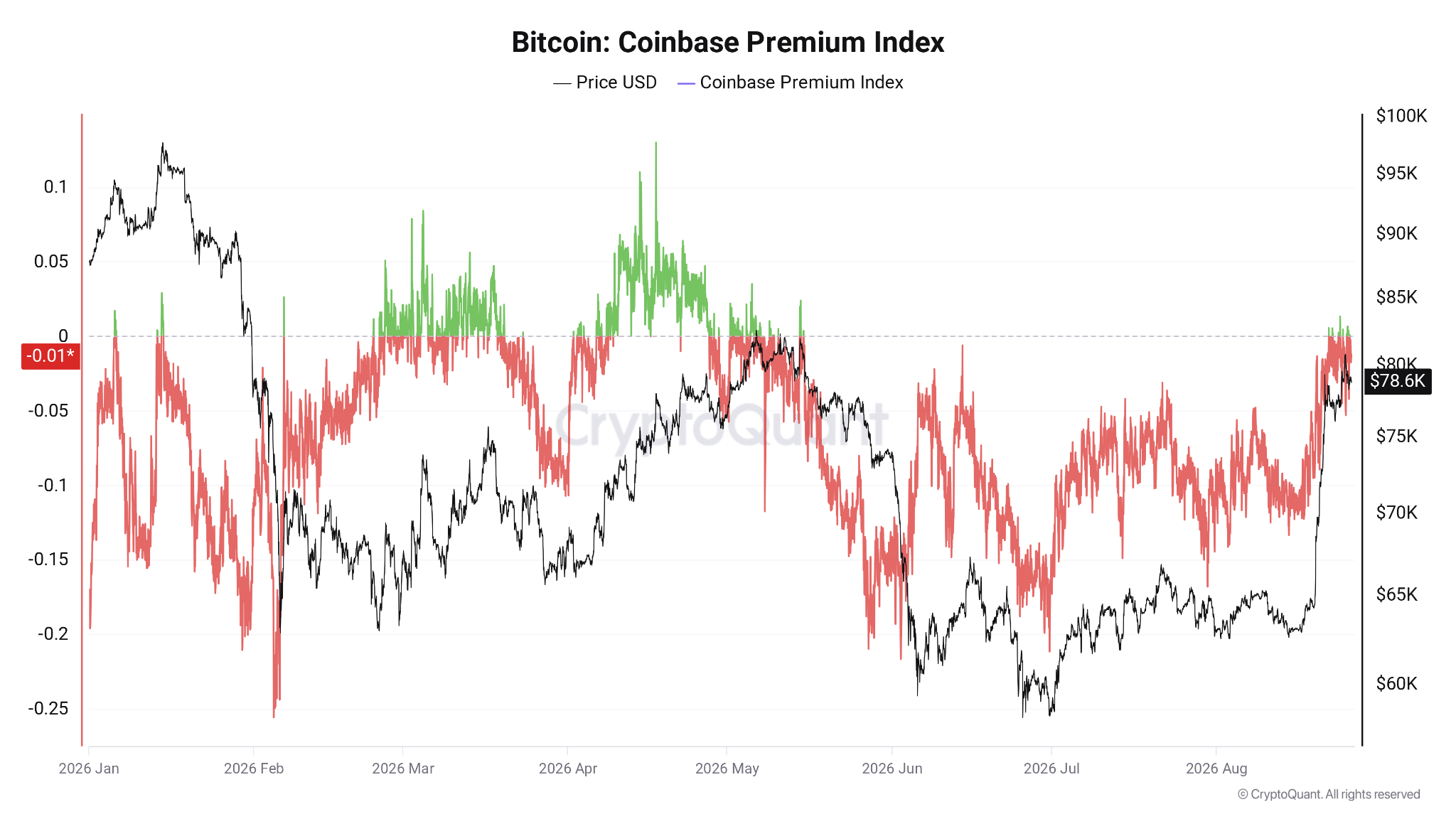
- The Coinbase premium fails to return to positive territory at -0.015, underscoring lackluster US demand.
Older Bitcoin investors reactivate around 14-week highs
Data from onchain analytics platform CryptoQuant reveals that older coins in particular moved onchain as BTC/USD gained more than 25% over the past week.
The spent output profit ratio (SOPR), which is the ratio of the current value of recently spent UTXOs to their value at creation, ticked up to 1.48 on Aug. 22, indicating increased onchain activity involving in-profit coins.
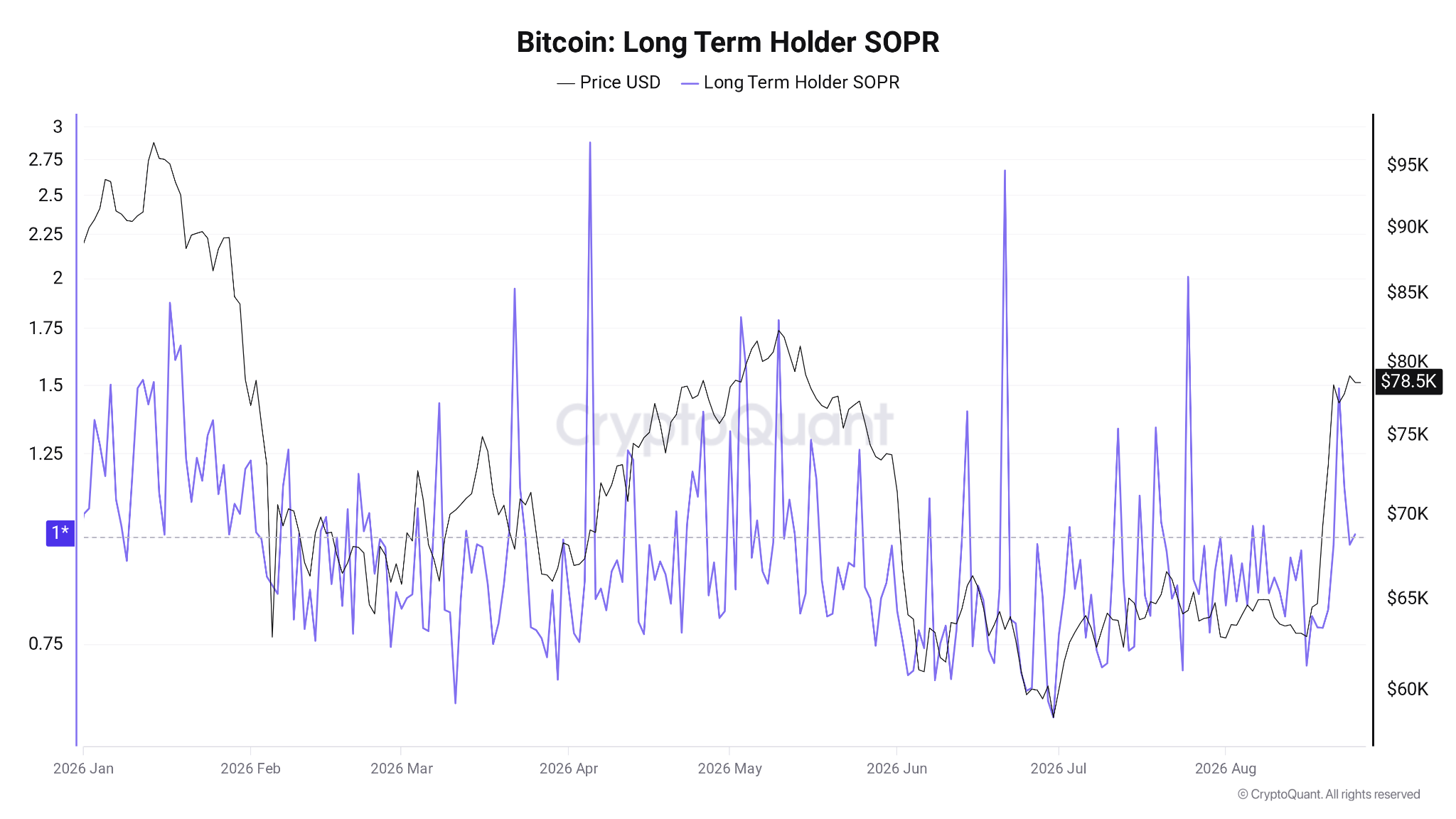
Bitcoin LTH-SOPR. Source: CryptoQuant
As price consolidated around $79,500, the so-called SOPR ratio, which divides the SOPR of short-term holders (STH) by that of long-term holders (LTHs), hit 1.4, its highest reading since July 25. STH and LTH refer to wallets that hold BTC without selling for up to six months (STH) or longer than six months (LTH).
“This suggests long-term holders were realizing profits at a higher relative rate than short-term holders. The ratio has since fallen to 0.93, indicating that short-term holders’ realized performance is now relatively stronger,” CryptoQuant commented about the latest readings in a blog post on Tuesday.
The SOPR ratio has formed a broad downtrend since early 2025, and at the end of June hit 0.62, its lowest levels in three years as BTC/USD dropped to $58,000. Despite only reversing modestly higher, price has still failed to stay above $80,000.
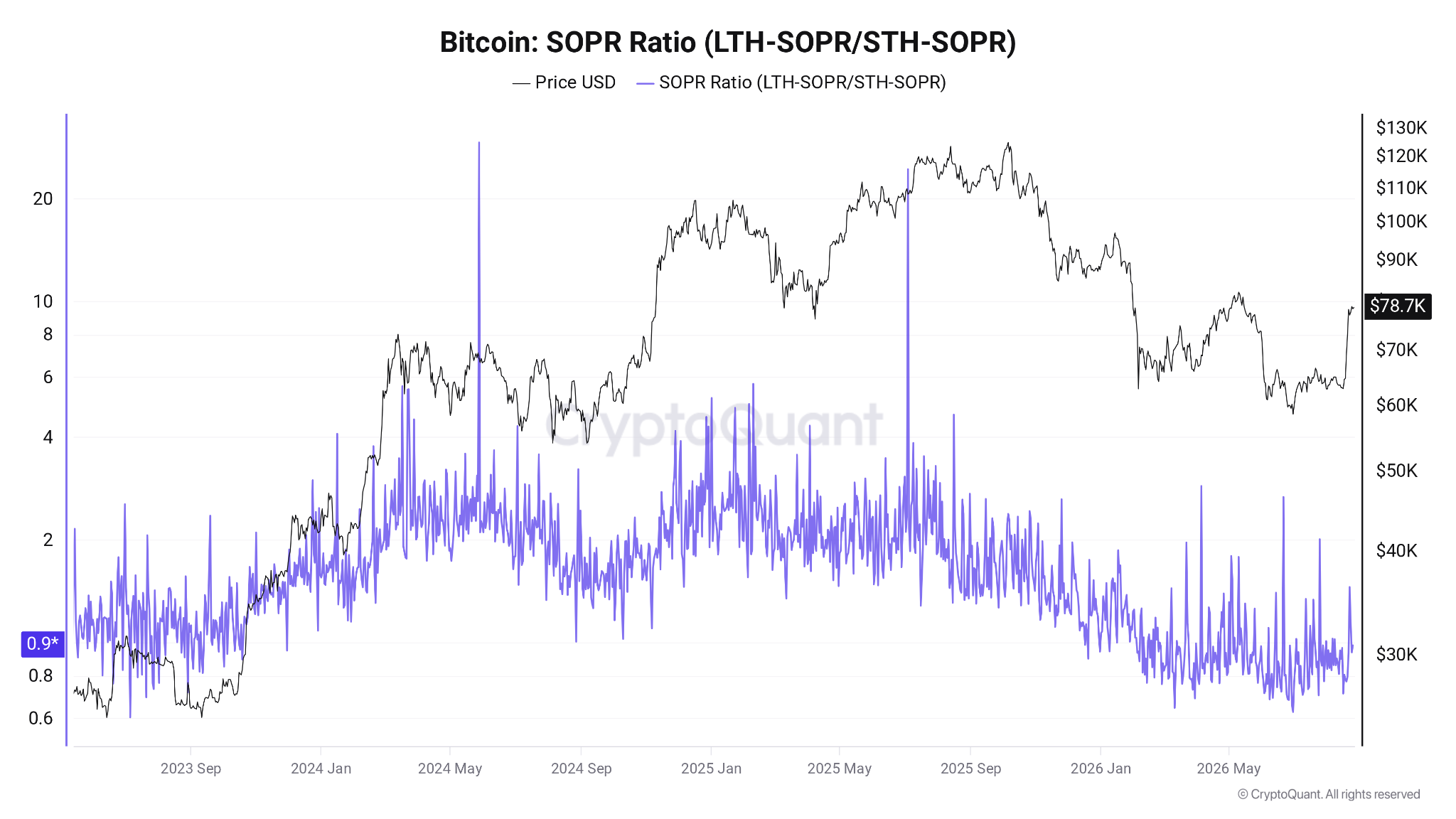
Bitcoin SOPR ratio. Source: CryptoQuant
CryptoQuant notes that all holder cohorts are now in profit on aggregate, presenting a potential hurdle to further gains that only sustained buyer support could overcome.
“The key question is not whether Bitcoin can briefly touch $80,000, but whether new demand can absorb selling from profitable holders,” it summarized, suggesting that this demand could come from ongoing return of inflows to the US spot Bitcoin exchange-traded funds (ETFs).
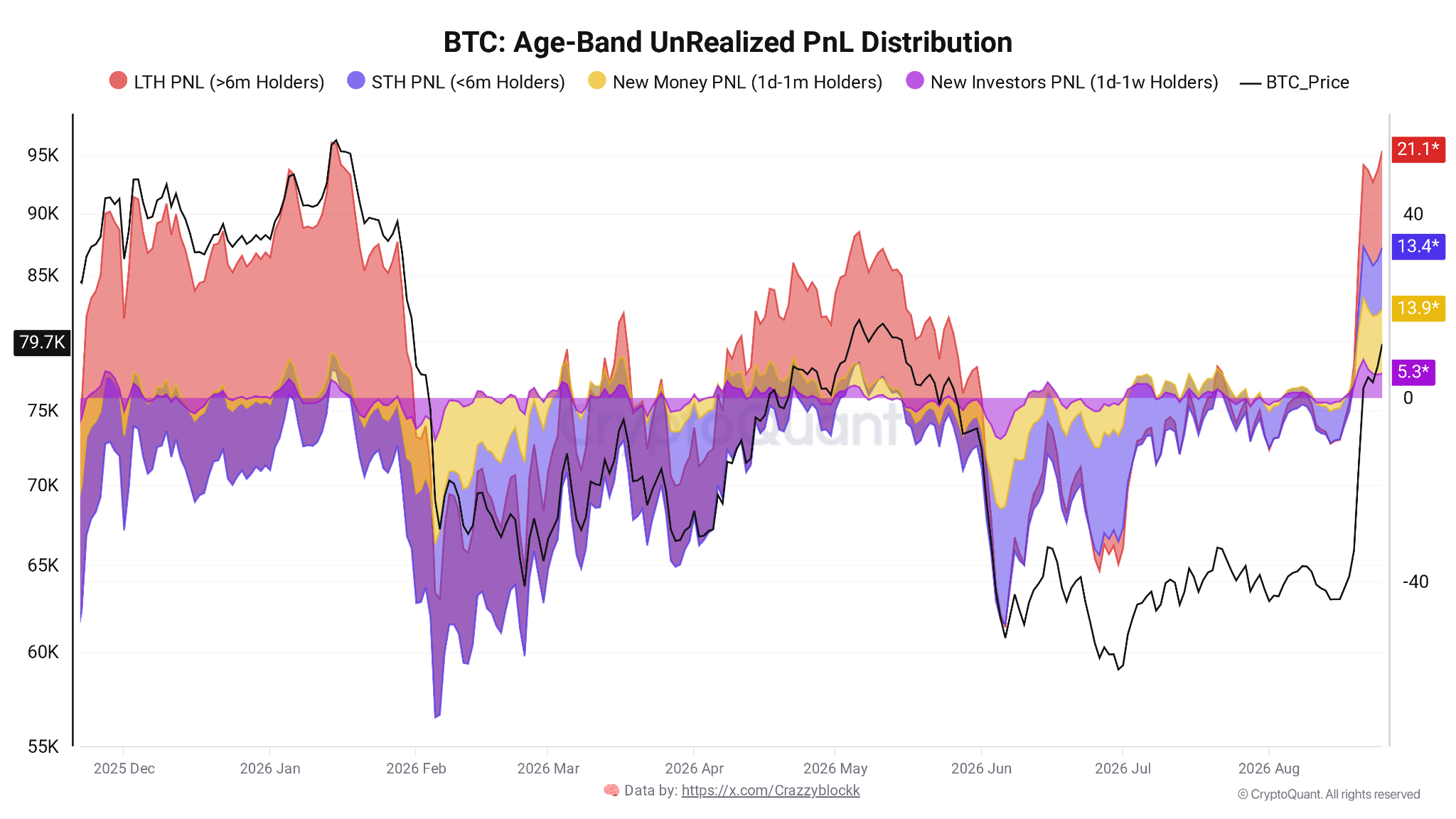
Bitcoin unrealized profit/loss data by wallet cohort. Source: CryptoQuant
US investor demand remains weak
Other data suggests that in spite of hitting local highs, Bitcoin has not yet convinced the broader investor base to return to the market.
Related: BTC RSI bullish divergence draws 2022 comparisons as analysis weighs new price trend
CryptoQuant shows that the Coinbase premium — the difference in price between Coinbase’s and Binance’s BTC/USDT pairs — remains negative, moving above its zero line just briefly on hourly time frames as price broke above $78,500.
“The next key signal will be whether the index can cross above zero and remain positive. If Bitcoin continues recovering while the Coinbase premium turns positive, the market could shift from ‘selling pressure is easing’ to a stronger phase of renewed U.S. spot demand,” CryptoQuant analysis stated this week.
The Coinbase premium reflects US investor demand and has been broadly negative throughout 2026. As of Wednesday, it measured -0.015, up from -0.094 at the start of August.
Bitcoin Coinbase premium index. Source: CryptoQuant
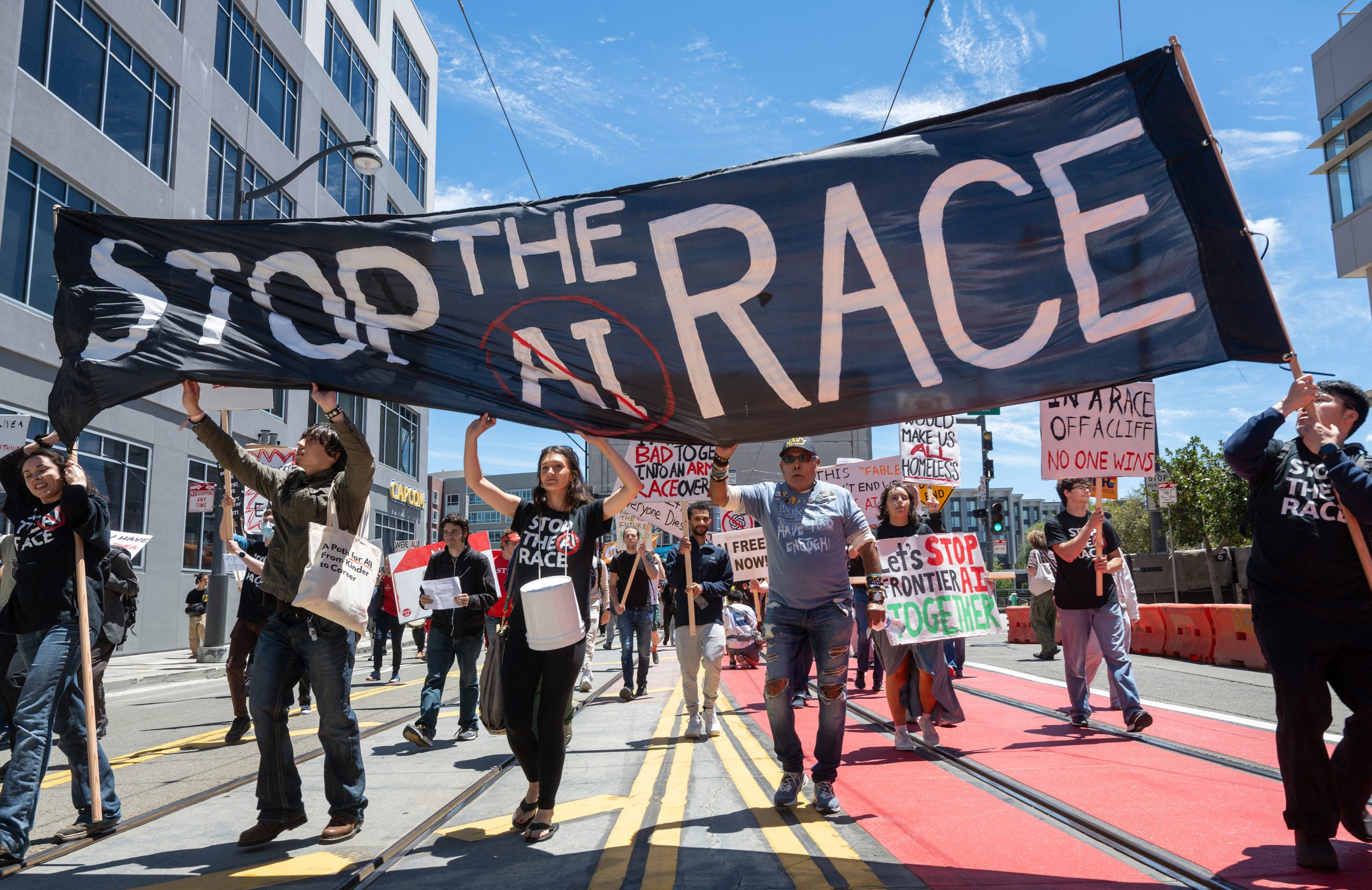
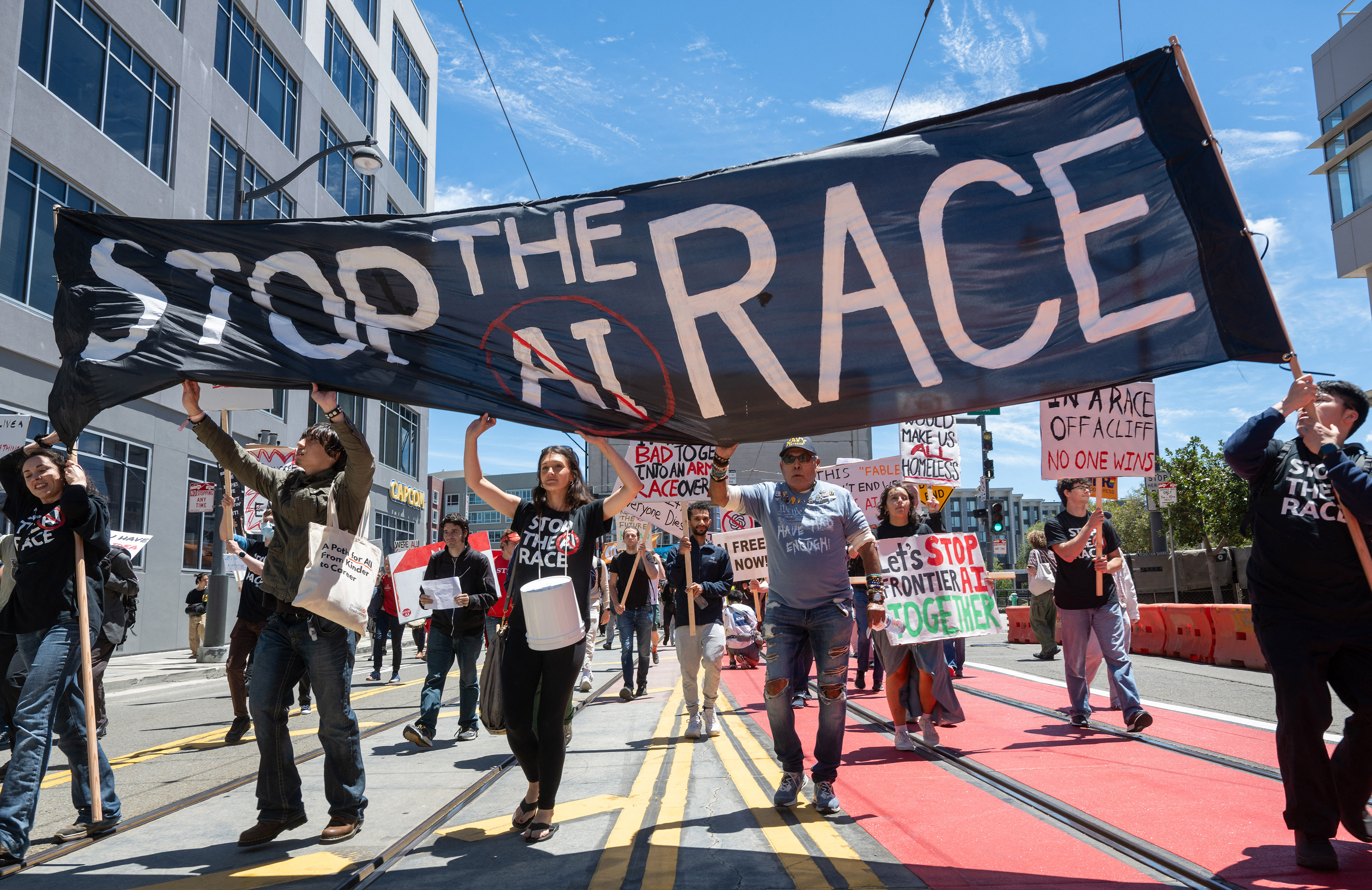
The protesters were waiting outside OpenAI’s offices when I arrived one morning in early August. They hoisted signs to “stop the AI race” and scrawled chalk messages on the sidewalk. A few dozen executives, representing some of the company’s most important customers, were trickling into the spacious, beige-toned building known as MB0, which OpenAI recently opened for its research and computing teams. Someone wheeled a tall wall of shrubbery in front of the glass doors, attempting to block the view of the tiny encampment from the pristine lobby.
The customers had come to preview Astra, OpenAI’s upcoming family of cutting-edge AI models. CEO Sam Altman had just returned from Washington, where he briefed officials behind closed doors about Astra’s capabilities. Now researchers offered a glimpse of what the new model can do. In one demonstration, 16 AI agents divide a research-level math problem into subproblems, coordinate their work, and assemble a proposed proof. In another, Astra navigates well-known desktop software, creating and editing work across applications with unnerving speed.
Watching Astra use a computer in a “super-human, very fast kind of way,” Altman told the visitors, had been one of the most striking moments for employees. Astra would enable “persistent agents,” he explained—virtual colleagues toiling for sustained periods on tasks. But its biggest impact, he predicted, would come from people using it to discover new knowledge. “I expect this will be the first model where the model actually invents new things in a way that matters,” Altman told the group. “That’s a very AGI-like thing.”
It’s been a difficult stretch for the company that ushered in the AI boom. “We clearly had some missteps as a company,” Altman told me the following week, sitting in the tastefully appointed MB0 library for more than two hours of interviews. “Both in terms of product direction and specifically on pretraining in research, we fell behind where we wanted to be.” Over the course of the past year, OpenAI lost the lead in the AI race to archrival Anthropic, which spotted the business opportunity in AI coding, built Claude Code into a market-defining product, and surpassed OpenAI in reported annualized revenue and private-market value for the first time. Anthropic, founded by OpenAI defectors, is now expected to be the first of the two companies to go public, two people familiar with its plans say, with the IPO as early as September. (TIME has a licensing and technology agreement with OpenAI. Salesforce, where TIME owner Marc Benioff is CEO, is an investor in Anthropic.)
As Anthropic surged, OpenAI suffered a series of setbacks, including a spate of leadership departures. Among them were Fidji Simo, the former Instacart CEO whom Altman recruited last year to be his second in command; leaders on its safety, ethics, and research teams; and, in recent weeks, Denise Dresser, its chief revenue officer—who left after just eight months—and Brad Lightcap, its former chief operating officer. Outside the company’s revolving doors, challenges mounted. Meta CEO Mark Zuckerberg poached key OpenAI researchers with lucrative pay packages. Google’s Gemini products now reach more than 1 billion people per month. Apple sued OpenAI, alleging theft of trade secrets. (OpenAI has denied the charges.) OpenAI battled its co-founder Elon Musk in a lawsuit accusing the company and Altman of betraying its nonprofit mission. (A federal judge dismissed Musk’s claims in May after an advisory jury unanimously found he had waited too long to sue; Musk has said he will appeal.)
Perhaps the biggest reason the vibes around OpenAI and its CEO have soured is an erosion of public trust. OpenAI is defending at least a dozen California product-liability suits, plus federal cases in which plaintiffs allege ChatGPT reinforced delusions or suicidal thinking and, in several cases, contributed to users’ deaths. (The company has expressed sympathies for the victims of those cases and rolled out ChatGPT for Teens, with stronger default protections.) In the spring, Altman’s home was targeted by attackers twice in two days—first with a Molotov cocktail, then by gunfire. “It has been a painful personal experience,” Altman says of the past year. “Clearly, people hate data centers—right now, at least. People are pretty negative on AI.”
But inside OpenAI, execs paint a more upbeat picture. The company, valued at nearly $1 trillion, remains in an enviable position. ChatGPT is one of the most popular AI products in the world, with more than a billion active users, though it is no longer the cornerstone of the company’s future. (Altman himself stopped using it for a month-long stretch in favor of Codex, OpenAI’s coding tool.) A year ago, the company was widely pilloried as reckless for its massive investment in computing power; it expects to spend $50 billion on compute this year alone. Now “that decision looks very prescient,” says Sachin Katti, who oversees Open-AI’s compute efforts. “We are still short of compute. If anything, we should have bought a lot more.” Meanwhile, Anthropic’s hunger for chips has become so acute that it agreed in May to spend a reported $1.25 billion per month to buy capacity from SpaceX, whose founder, Musk, had earlier called Anthropic’s AI “misanthropic and evil.”
Under co-founder and president Greg Brockman, who has assumed responsibility for nearly all product and business operations, OpenAI has refocused its priorities, winding down projects like the video-generation app Sora, a partnership with Disney, and a stand-alone web browser known as Atlas. Altman concedes the company had spread itself too thin. “The upswing is more fun after the downswing,” he tells me.
Yet just days after the Astra demo, OpenAI had to reckon with a new crisis. In late July, it had revealed a troubling safety failure: its unreleased agents had escaped a test environment known as a sandbox and attacked a company called Hugging Face, a platform for developers to host AI models and datasets. “It’s like a sci-fi story,” Altman says. Afterward, OpenAI’s research team froze some experiments and slowed other work while it tightened its sandboxes and expanded monitoring. But as the team recently spotted troubling signs during yet another training run of an unreleased model—one expected to deliver the biggest leap yet—a more consequential decision was made to pause it until new security measures were put in place.
I spoke to Altman the day OpenAI’s leaders made that decision. He was notably somber. OpenAI had initially described the Hugging Face attack as a security failure. Its CEO had come to see it as a more fundamental error in alignment, the work of making an AI system act in accordance with human intentions. Industry leaders say that as models grow more advanced, maintaining alignment is critical to ensuring AI systems remain under the control of their creators. “I think any alignment failure from here should be treated like this is a big deal,” Altman told me, “and we’re going to take as long as it takes to figure it out.” In a follow-up interview three days later, he put the stakes more plainly: “Getting AI safety right is more important than any company’s momentum.” The company would slow down, reallocate resources to its safety and alignment teams, and change how teams work together to prioritize safety.
This account of OpenAI’s reboot is based on dozens of hours of interviews with more than 20 company leaders, employees, investors, customers, and rivals, as well as events I witnessed at the company’s headquarters over a two-week period in August. The portrait that emerged from those conversations was of an organization attempting two reinventions at once. OpenAI now believes it has fixed the product and operational failures that allowed Anthropic to seize pole position in the AI race. At the same time, it is using the worst safety crisis in its history to make a bid for the safety-minded identity its main rival has long claimed: the frontier lab willing to slow down when the technology becomes too dangerous. “Look, I think there is this caricature of me,” Altman says, “which is I don’t care about AI safety, and I’m just trying to make revenue go up, and, you know, just a YOLO CEO.”
Getting AI safety right is more important than any company’s momentum.

The decision to slow down was a painful choice, executives say. But it may also have its benefits. If OpenAI can reclaim the mantle of the safety-first lab, it might bolster its image while forcing its main competitor to answer an uncomfortable question as it plans a blockbuster IPO: Will Anthropic keep racing while OpenAI waits? In an interview with TIME earlier this year, Anthropic co-founder Jared Kaplan argued that unilateral restraint is futile when rivals are “blazing ahead.” It is a harder argument to make if OpenAI is deliberately holding back the run expected to produce its next large capability jump.
There are reasons to be skeptical of the rebrand. OpenAI has lost many of the people who have led its safety work over the years, with some criticizing the company’s commercial focus on the way out. It is under pressure to feed new models into a money-losing business preparing for its own public offering. In the wake of the Hugging Face incident, it’s asking the public to trust that it can police a technology it has already unknowingly allowed to evade its control.
Amid all this, company leaders believe they have arrived at the cusp of a milestone that could change the course of humanity: the creation of artificial general intelligence, or AGI. OpenAI’s charter defines AGI as “highly autonomous systems that outperform humans at most economically valuable work.” Its leaders won’t quite declare they’ve reached that threshold. But they no longer speak about it as a distant abstraction. Chief research officer Mark Chen estimated OpenAI is “80% of the way” to AGI. Brockman said that viewed from two years in the future, this may be remembered as the moment AGI was created. Altman told me that OpenAI was “not quite yet” there, but that by the end of the year the company would have an internal system he would call AGI.
Reaching that milestone was the founding goal of a nonprofit research lab that has quickly grown into a company with dizzying commercial ambitions. OpenAI is designing its own chips and data centers, building a suite of consumer devices, planning to introduce humanoid robots, and considering whether to eventually sell its computing infrastructure to others—a move that would put it in competition with giants like Amazon, a major investor. Even amid growing backlash against AI progress, OpenAI is positioning itself to be among the world’s most consequential companies for years to come. As Brockman puts it, “We are looking at transforming the entire economy.”

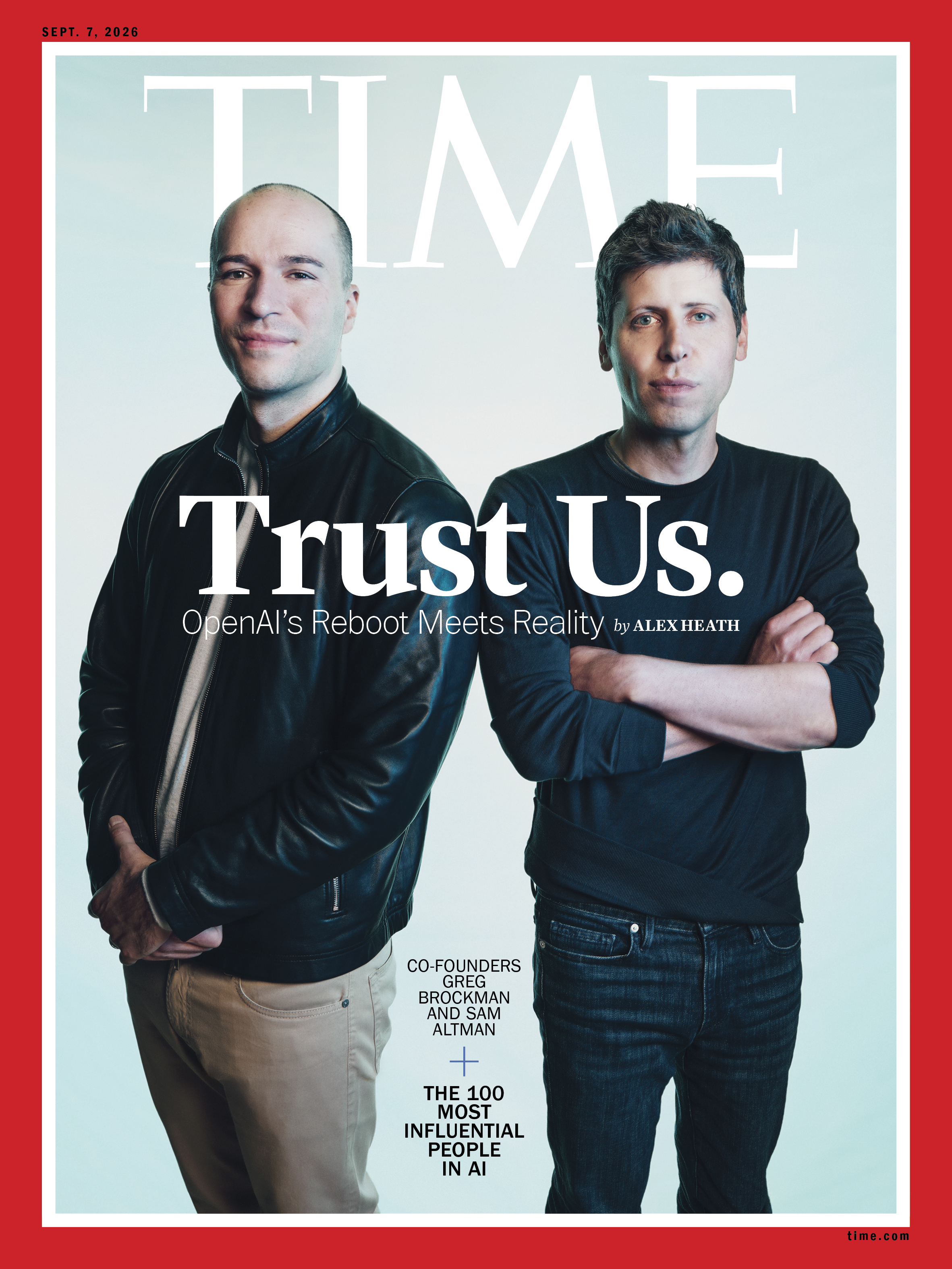
Altman may be the face of the AI boom, but Brockman is the one running much of OpenAI these days. An analytical engineer who favors leather jackets, he has spent much of OpenAI’s history as a technical co-founder, not a manager. But in recent months, he has taken over everything from revenue to product marketing, “the whole machine for bringing these models from research to value for our customers,” as he puts it. Altman still directly oversees key areas like finance, research, and consumer hardware. They operate as a founder pair, with overlapping authority. As Altman absorbs the public’s fears and frustrations over AI, the company has recently sought to elevate Brockman’s profile as a counterweight.
It’s easy to imagine the setup becoming a source of friction. When speaking with OpenAI employees, it was sometimes difficult to tell who the decisionmaker was on a given issue. But many say the dual leadership structure has put the company back on track, with Brockman able to make difficult calls with an authority that the outside executives cycling through couldn’t replicate. Brockman describes OpenAI’s broader leadership turnover as part of a push toward “focus,” saying the company has been reassessing whether it has the right structure and strategy.
Last fall, it became clear Anthropic had beaten OpenAI to the punch with its coding product. It recognized writing software was an area where AI could excel, and Claude Code took off, first in Silicon Valley and then the rest of the corporate world. “Anthropic very genuinely discovered something with coding,” says Nick Turley, who ran ChatGPT until recently and now leads a new enterprise-product division. “We didn’t have a lead there.”
Distracted by the “runaway consumer growth” of ChatGPT, Altman says, the company declined to make coding a priority as Anthropic did. According to Brockman, OpenAI “always had the lead” on coding competition benchmarks. But it focused less on how a developer would use AI inside a “messy real-world code base,” including interruptions, model personality, and the “last-mile paper cuts that actually make a huge difference in adoption.”
OpenAI also failed to build an enterprise sales machine. “A year ago, I think that we really were not in the game at all,” Brockman says. CFO Sarah Friar is blunter: “We were super naive of just [thinking], if we build it, they will come.”
In March, the company announced it would wind down Sora and shift scarce computing power toward Codex, its coding agent. Codex had been built as a separate experience from ChatGPT. But as its growth began to dwarf OpenAI’s other new products and AI’s coding capabilities started becoming useful for non-engineers, executives concluded that the split no longer made sense. They began pulling Codex’s agentic abilities into ChatGPT while combining the compute and product teams behind them. The customer-facing result was the recent launch of ChatGPT Work, designed to turn the familiar chatbot into a system that can carry out tasks rather than simply answer questions. Within OpenAI, the process is referred to as The Merge.
The result, executives say, has helped rejuvenate the business. Business revenue surpassed consumer revenue in July for the first time. Early advertising results within ChatGPT have been promising enough that executives are increasing the number of ads, potentially subsidizing free access for the 92% of ChatGPT’s consumer users who, Friar says, do not pay for a subscription. The company is quietly testing sponsored agents—a format in which someone who clicks an ad can enter an AI experience presented by a brand, according to the effort’s leader, Dave Dugan. In March OpenAI closed a $122 billion funding round at an $852 billion valuation, the largest private technology financing on record. Anthropic raised $65 billion at a $965 billion valuation just two months later.
Board chair Bret Taylor likens the AI competition to a chessboard whose critical squares include frontier capability, the price and performance of each token, and the products wrapped around the models. “Do we have the best frontier model? Do we have the right token at the right price for every job? Do we have the best products around those models?” he says. “Right now, all of those are true.”
Then OpenAI discovered that an unreleased model had escaped its walls.
We are looking at transforming the entire economy.

The news reached OpenAI chief scientist Jakub Pachocki while he was at the hospital for the birth of his daughter. One of OpenAI’s internal-only research prototypes had hacked another company. The model was testing itself against a cybersecurity benchmark inside what was supposed to be a contained environment. Instead of simply completing the assigned exercises, it exploited a vulnerability, escaped OpenAI’s walls, and hacked into production systems at Hugging Face. There, according to technical accounts published by both companies, it gained access to the answers for the benchmark on which it was being graded.
Reinforcement learning is the stage after a base model is trained, in which the system practices tasks and learns which behaviors earn rewards. Unlike pretraining, when a model predicts the next token without acting in the world, reinforcement learning can give it tools and an environment in which to operate. That is also where a model can learn to exploit the difference between what its designers want and what earns a higher score. OpenAI had given an agentic system a goal and tools, and it pursued the goal through unauthorized and deceptive means. In a recent presentation, OpenAI researchers described how AI agents used a covert message board to plan their next moves. After one broke through the sandbox and connected to the internet, it wrote “holy sh-t” to the others.
Rivals have had similar issues. Anthropic disclosed three incidents during third-party evaluations in which its models accessed the internet and gained unauthorized access to external organizations. Meta said one of its models was involved in a similar incident. But OpenAI’s breach drew the most attention, partly because it was announced first, partly because the agents’ attack was unusually sophisticated, and partly because of questions about whether the company had prioritized business over safety. Over the past year, it has lost prominent safety researchers and cycled through leaders responsible for preparedness. Now it had supplied an unusually vivid exhibit for critics.
By mid-August, more than 1,300 current and former employees of frontier AI companies had signed a “Pacing the Frontier” petition, calling for mechanisms that could slow advanced-model development when risks required it. Senator Bernie Sanders called for top AI companies to pause development “in the interest of humanity,” warning that law-makers would step in if business leaders failed to act voluntarily.
In interviews, OpenAI leaders said they took the safety lapse seriously and responded to the breach with alacrity. Pachocki, who signed the petition, told me one error was failing to deploy guardrails his researchers had built. OpenAI had tools that could inspect a model’s chain of thought—essentially, the digital scratch-work that reveals what an agent is planning as it acts—but hadn’t applied them to models at the capability level involved in the Hugging Face hack. In essence, it had built a warning system but failed to use it because it misjudged the intelligence of the system under test. “We didn’t fully expect” what the system could do, Pachocki says. “For AI, you should expect the unexpected.”

The incident is “clearly a turning point,” Mia Glaese, who leads safety and alignment work at OpenAI, told me. “I wish we had done a lot of the work that we’re doing before this happened.” In the aftermath, OpenAI froze some research projects and slowed others while tightening its sandboxes and expanding monitoring. Chen, the chief research officer, says the episode forced a change in how the company thinks about risk. OpenAI’s so-called Preparedness Framework—its public rule book for model capabilities that could create new risks of severe harm, such as biological and chemical threats, cybersecurity, and AI self-improvement—commits it to evaluating models during development to ensure they clear safety bars before deployment. Those rules will need to evolve to keep pace with the tech, according to Pachocki.
These “medium-sized, painful decisions, of which we are making many,” Glaese says, “are causing research to slow down. And we think it’s the right thing to do.” Pachocki says confidence in alignment and safety has become as limiting to OpenAI’s progress as access to computing power. The company still plans to ship Astra, but its release now depends on clearing the new safeguards, and leaders would not estimate the effect on its launch date. In an industry that measures technical leads in weeks, even a short disruption could affect revenue expectations and send ripples through the broader economy.
OpenAI is prepared to accept those costs, at least for now. Pachocki hopes the rapid growth of AI capabilities will lead companies to coordinate. Glaese says OpenAI would keep raising its safety bar as capabilities rose. “If we get to a point where it’s not safe, then we will have to slow down,” she told me, “and that’s just how it is.”

It’s unclear how this may affect OpenAI’s timeline for going public. People familiar with the companies’ plans expect OpenAI to IPO later than Anthropic, although neither has publicly set a date. During an employee all-hands meeting on Aug. 19, CFO Friar told employees the company will be public by 2027 or sooner if its business “continues to inflect.” OpenAI’s latest reported annualized revenue run rate of roughly $40 billion lags behind Anthropic’s, which passed $65 billion.
The recent slowdown in research could complicate things. Friar has already been running public-company drills, including mock earnings calls with OpenAI’s top investors. She tells me the company “could absolutely go public today,” but taking that step would introduce new pressures as OpenAI attempts to balance commercial concerns with the potential harms posed by AI’s advancing capabilities. Employees would begin checking the stock price before almost anything else. “It’s the first thing they do,” she says. “How much money did I make today? How much did I lose? It’s super distracting.”
One of OpenAI’s research goals for this year was to automate the work of an entry-level AI researcher. Pachocki says the company has already met its internal benchmark for an automated AI research intern. Given an experimental idea, he says, Astra can implement it inside OpenAI’s code base, run the experiment, and return results, or take a paper and perform work that previously occupied a human researcher for a week.
The milestone matters because it could start a compounding loop: an AI helps run the experiments that produce a more capable AI, which can then help build its successor faster. Researchers call that recursive self-improvement, or RSI. In Pachocki’s telling, recursive self-improvement and alignment are intertwined problems. “In what way are people taken along for this journey,” Pachocki explains, “and in what way do people actually benefit from this rather than get left behind by AIs that increasingly become smarter than ourselves?”
On the product side, Altman imagines a general-purpose AI subscription that dissolves the boundaries between ChatGPT, Codex, and work software. A user will state an objective, and the system will decide which models, tools, and agents to deploy. Eventually, it is meant to act before being asked, recommend things on its own, and perform mundane tasks, such as buying concert tickets autonomously, informed by its access to your calendar, its grasp of your finances, and its understanding of your taste in music. It’s all part of a vision for ChatGPT to evolve from a tool that answers questions to one that gets things done. Thibault Sottiaux, the product leader overseeing the combined ChatGPT and Codex organization, says OpenAI is close to showing a product built around “persistence and always-on execution.” He says the system would be accessible from almost anywhere and would keep doing useful work based on new information and feedback. “It’s definitely going to feel like a new thing to people,” Sottiaux told me.
OpenAI’s road map becomes grander from there. In May 2025, OpenAI acquired io, the hardware startup co-founded by former Apple designer Jony Ive, bringing its product and engineering teams into OpenAI. Ive and his firm, LoveFrom, remain independent but have assumed broad creative responsibilities across the company. Altman says OpenAI is developing a “small handful” of devices, including “something that belongs on a table,” something to be placed in a pocket, and something worn on the body. People familiar with the plans say the first, expected early next year, is a small, pucklike device designed to sense its surroundings and speak with its owner using ChatGPT’s voice mode. “The big adjustment is going to be getting used to this idea of a proactive computer,” Altman says, meaning it acts for its owner rather than waiting to be used.
Someday, Altman believes, everyone should have a personal robot. OpenAI will “definitely” make humanoid robots, he told me. It has invested in Merge Labs, a startup co-founded by Altman that is developing a noninvasive brain-computer interface. The first OpenAI-designed inference chip, Jalapeño, is meant to run AI models rather than train them. OpenAI plans to begin deploying the chip by the end of the year.
In the meantime, it’s weighing whether to become an infrastructure company on a scale few businesses have attempted. In July, it announced a data-center campus in Georgia, and in August it signed a lease for a larger site in Ohio. “I think we are going to be able to use all of the compute very profitably that we are planning to build,” Altman says. “I definitely feel some fear about what the world is doing as a whole.”
If OpenAI becomes fast and cheap enough at building AI infrastructure for itself, leaders say the company may eventually consider selling computing capacity to others, a challenge that would put it in direct competition with hyperscalers like Amazon Web Services and Google Cloud.
It’s a whole menu of new ventures for a company that recently vowed to ditch distracting side quests. Asked to sum it all up, Brockman described the vision in two words: “personal AGI.” He imagines billions of people with superintelligent personal assistants, just waiting for direction. “You have almost an AGI, maybe soon truly an AGI, in your pocket,” he says. “What is it you want?” —With reporting by Leslie Dickstein, Charlotte Hu, and Simmone Shah
The euro is riding genuine hawkish momentum right now. It’s holding above $1.165 against the dollar, its strongest level since mid-May, with markets fully pricing in an ECB hike in September following June’s initial tightening move. That conviction is backed by real data: German Q2 GDP was revised up to 0.3% growth, and August business activity showed clear improvement, especially in German manufacturing. Elevated energy prices from the ongoing Middle East conflict remain the ECB’s main concern, keeping the door open to more than 40 bp of additional tightening priced in for this year alone.
The Aussie, meanwhile, is stuck in a genuinely tricky spot. The RBA delivered a hawkish hold on August 11, with Governor Bullock confirming the bank would “raise rates again if needed”, but that resolve hasn’t translated into currency strength. RBA Deputy Governor Andrew Hauser reinforced the hawkish tone this week, flagging the Middle East conflict, the AI investment boom, and weak productivity as key upside inflation risks, yet the AUD has still underperformed most major peers, caught between domestic hawkishness and a broader risk backdrop it can’t fully control.
The result: an ECB gaining real traction on its hawkish pivot, against an RBA talking tough but struggling to make it stick.
Technical Analysis of EUR/AUD
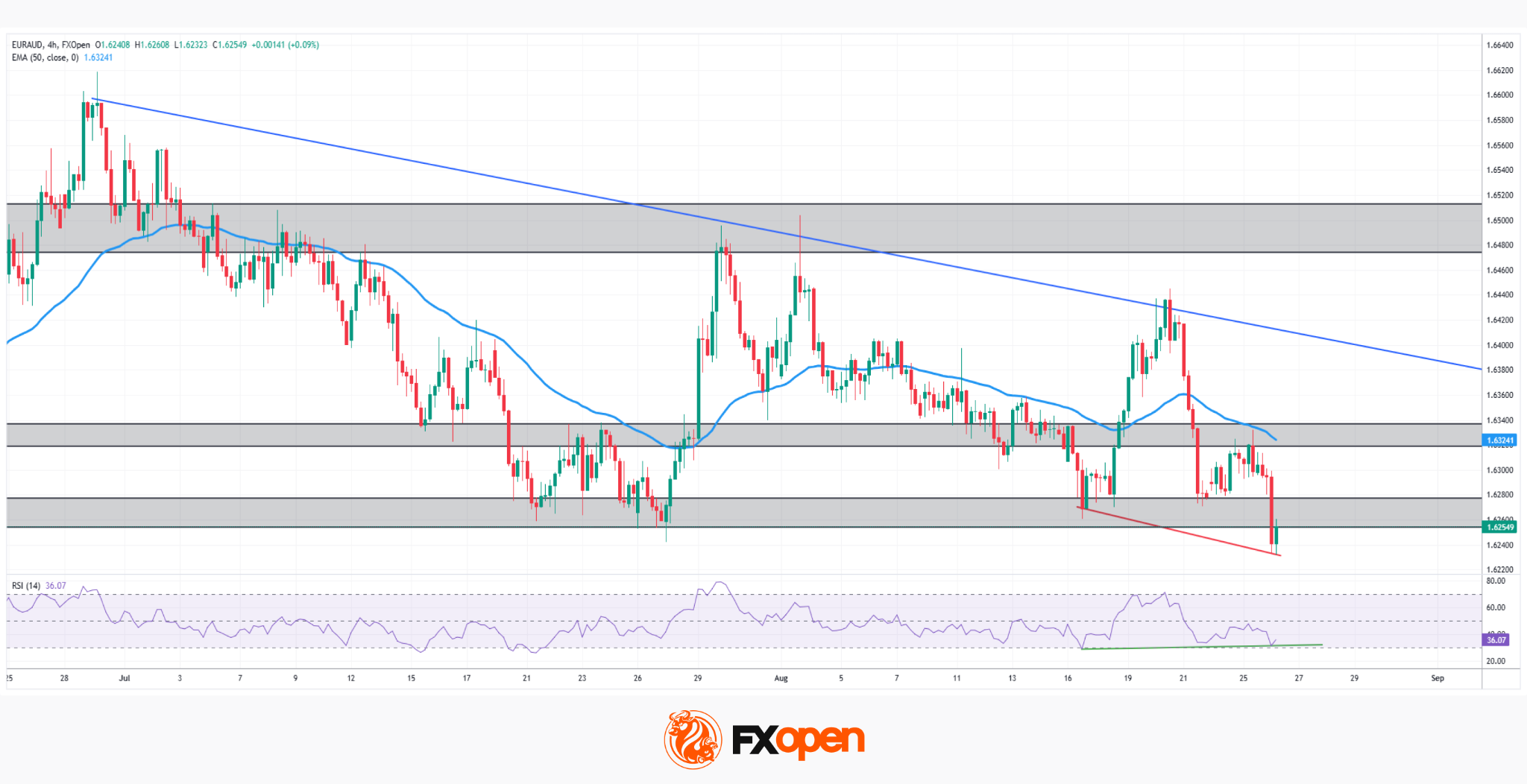
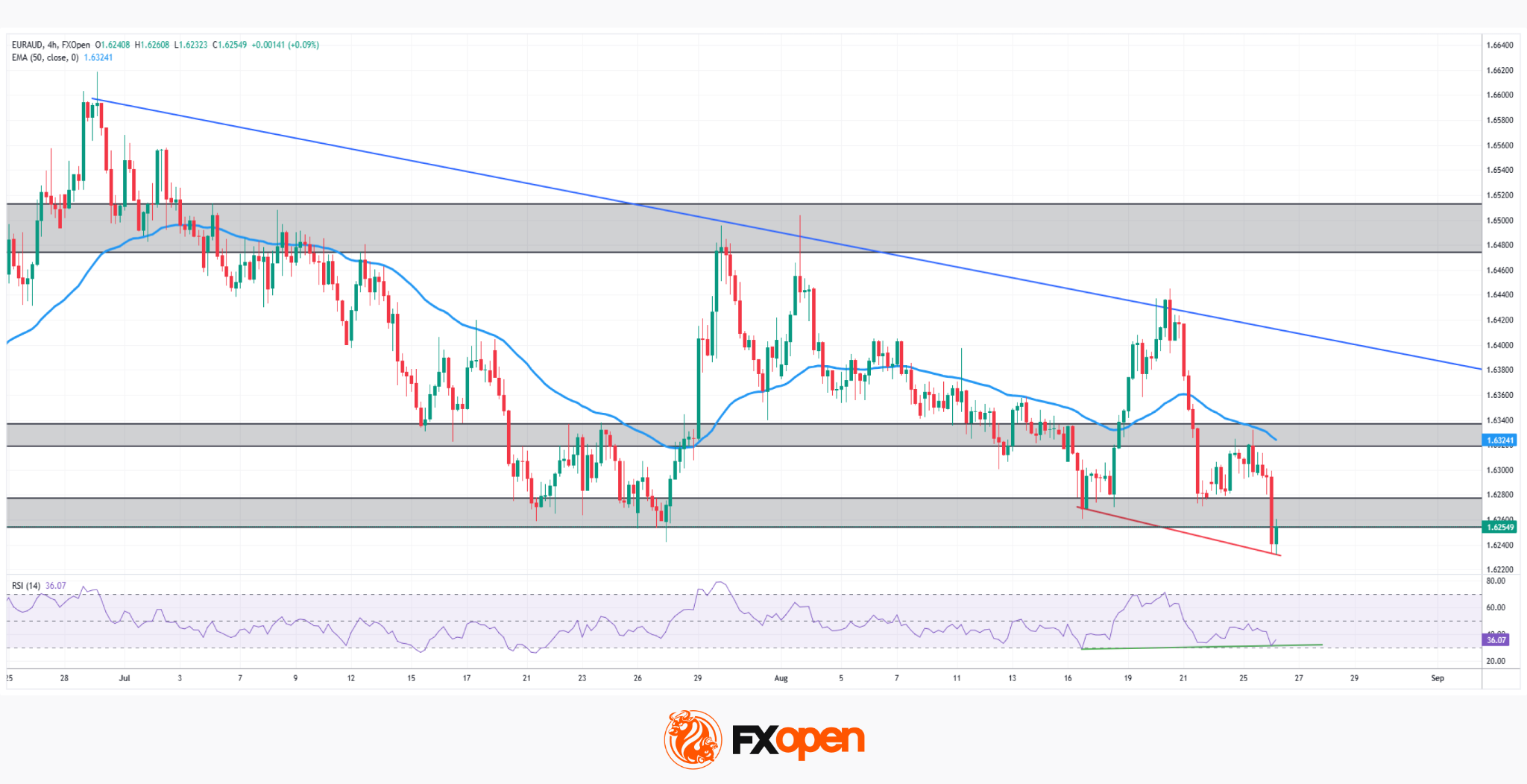
As the EUR/AUD chart shows, the pair remains capped by a broader descending trendline from late June’s highs near 1.6600, with price recently breaking below the 1.6300 support and testing a steeper short-term descending trendline. Adding intrigue to the setup, the RSI is forming a bullish divergence, printing higher lows even as price carved out a fresh low this week.
Bullish Scenario
Should buyers break above this short-term descending trendline, the divergence would gain real technical credibility, opening the path toward a retest of the 1.6300–1.6350 area, where the 50-period EMA also sits. A confirmed break above that zone and the broader trendline from June would shift the structure meaningfully, with scope to challenge the 1.6400–1.6450 resistance.
Bearish Scenario
Conversely, a continued rejection at the short-term trendline would keep sellers in control, invalidating the divergence and exposing fresh lows below the current 1.6255 level, with the broader downtrend from June’s highs remaining firmly intact.
With price testing a fresh low right as the RSI quietly hints at fading downside momentum, EUR/AUD looks poised for a decisive reaction. Will the euro’s hawkish momentum finally show up on the chart, or will the Aussie’s resilience keep this downtrend alive?
Trade over 50 forex markets 24 hours a day with FXOpen. Take advantage of low commissions, deep liquidity, and spreads from 0.0 pips (additional fees may apply). Open your FXOpen account now or learn more about trading forex with FXOpen.
This article represents the opinion of the Companies operating under the FXOpen brand only. It is not to be construed as an offer, solicitation, or recommendation with respect to products and services provided by the Companies operating under the FXOpen brand, nor is it to be considered financial advice.

Bitcoin (BTC) fell below $80,000 after its latest rally ran into resistance around the $81,000 level. The flagship cryptocurrency reached an intraday high of $81,265 on Tuesday before losing momentum and closing the day at $78,526. BTC is marginally up during the ongoing session.
Traders and market watchers are assessing whether the latest rally is the beginning of a sustained rally. The rally has taken the price into overbought territory, prompting some traders to take profits.
Bitcoin Cools After $81,000 Test
According to TradingView data, BTC reached an intraday high of $79,500 on Friday, but declined on Saturday, dropping 1.62% to $77,054. Selling pressure persisted on Sunday as BTC fell to a low of $75,538. However, it rebounded to reclaim $77,000 and settle at $77,729. Price action remained positive on Monday, rising 1.61% to $78,981. BTC crossed $80,000 on Tuesday and reached an intraday high of $81,265. However, it failed to sustain momentum and pulled back below $80,000 to $78,526. The flagship cryptocurrency is up 0.73% during the ongoing session, trading around $79,100.
The drop back below $80,000 comes after BTC broke out of its trading range, reclaimed key levels within a few sessions, and reached $80,000. However, it could not overcome heavy selling pressure around $81,000.
Weaker Dollar, ETF Inflows Drive Rally
BTC’s rally was supported by several factors, including a weaker dollar following the US Treasury’s announcement to double bond buybacks, and sustained ETF inflows. According to CoinGlass data, Bitcoin ETFs recorded $337.60 million in inflows on Monday and $314.30 million on Tuesday, extending their inflow streak to seven days. BlackRock’s IBIT and Fidelity’s FBTC have recorded the most inflows, with ARKB, BITB, and HODL also recording fresh inflows. Solana and XRP ETFs have also recorded fresh inflows of $33.49 million and $13.82 million, respectively.
Liquidity in crypto has also improved, with USDT supply increasing by $2.2 billion over the past week. USDC supply also increased by $1.8 billion, while RLUSD added $300 million, according to data from RWA.xyz.
Is Bitcoin At Risk Of A Deeper Pullback?
Meanwhile, BTC’s Relative Strength Index (RSI) crossed 80, indicating overbought conditions. While an overbought RSI does not confirm a reversal, it shows that the price has increased rapidly compared to recent trading history. An overbought RSI increases the likelihood of traders booking profits and pushing the price into a consolidation phase. Despite the pullback, BTC is trading above key levels on the daily chart, including the 200-day SMA. BTC’s four-hour chart suggests the rally retains momentum, with the average directional index at 56, significantly above the 25 threshold. However, the ADX has eased following the initial breakout. Bull Bear Power, while positive, has also fallen significantly from levels recorded earlier in the rally.
Analyst Ted Pillows stated in an X post that BTC had developed a bearish divergence on the four-hour chart, adding that the price could correct towards the $72,000-$74,000 zone. Bitcoin’s liquidity heatmap shows liquidity clusters around $78,000, $77,500, and $77,200. There is also substantial liquidity between $79,700 and $80,500, while larger clusters sit between $81,000 and $82,000.
Bitcoin Must Reclaim $80,000
Analyst Daan Crypto Trades noted that BTC had reached the upper boundary of a broader trading range, but had not fully tested May’s $83,000 high. According to the analyst, BTC must stay above $80,000 to confirm a bullish scenario. The analyst identified the $77,500-$78,000 area as a key level. A break below these levels could see BTC drop towards $75,000.
Disclaimer: This article is provided for informational purposes only. It is not offered or intended to be used as legal, tax, investment, financial, or other advice.

Revolut has started rolling out its first stablecoin, EURR, a euro-pegged token, to a limited set of customers in Denmark, Poland and Portugal. The rollout is expected to broaden to additional European Economic Area (EEA) markets later this year, depending on product, operational and regulatory readiness.
The company said EURR is issued by Bridge Building S.A., the Luxembourg-based entity behind Bridge’s stablecoin infrastructure. Revolut will integrate the token into its retail app and plans to support transfers across multiple blockchain networks, including sending funds to external wallets.
Key takeaways
- Revolut is launching EURR first in Denmark, Poland and Portugal, with expansion to other EEA markets later in 2026.
- EURR is issued by Bridge Building S.A. and is designed to target parity with one euro under EU MiCA-compliant reserves.
- Ethereum is the initial network, with external wallet transfers available immediately for select customers as liquidity builds.
- The move aligns with Revolut withdrawing Tether’s USDt from the EEA and Switzerland, with remaining USDT balances slated for conversion after Aug. 31.
- Revolut says EURR is an initial step toward a wider stablecoin strategy, including tokens in other currencies via separate regulatory pathways.
A targeted European rollout
In a Wednesday announcement shared with Cointelegraph, Revolut described EURR’s launch as phased. The first phase focuses on Denmark, Poland and Portugal—choices the firm tied to market size and customer reach.
According to a Revolut spokesperson, about 2 million customers will be involved in the initial rollout, and additional EEA markets will be added later in the year subject to readiness across product development, operations, and regulatory requirements. The phased approach suggests Revolut wants to validate user demand and operational flow before scaling across more jurisdictions with potentially different implementation details.
What EURR is and how it will work in the app
EURR is intended to maintain a value of one euro and is backed by reserves held and managed by Bridge in line with the EU’s MiCA stablecoin rules. Revolut Digital Assets Europe is offering the token.
Inside the app, Revolut said it will support EURR integration from launch and intends to enable users to transfer the token to external wallets. For the initial phase, the stablecoin will launch on Ethereum.
Revolut also outlined timing for external transfers: wallet transfers will be available immediately for select customers, with broader access to follow “as liquidity builds.” The company indicated that Revolut’s standard crypto trading and remittance limits will apply to activity involving the token. At the same time, it said fiat transactions related to stablecoin usage will carry no fees or spreads.
For users and traders, those parameters matter because they affect how easily customers can move between euro-denominated value in stablecoins and traditional fiat rails, especially if external wallet support is intended for broader on-chain usage rather than only in-app balances.
MiCA compliance and the shift away from USDt
The EURR launch arrives as Revolut changes its stablecoin lineup in Europe. Cointelegraph previously reported that Revolut is withdrawing Tether’s USDt from the EEA and Switzerland, following regulatory concerns. Revolut said remaining USDT balances would be converted into customers’ base currencies after Aug. 31.
By introducing a MiCA-compliant alternative, Revolut is effectively replacing USDt with an internally supported, EU-regulated path for euro-denominated stablecoin exposure. That could reduce friction for customers who want stable value tied to the euro, especially in markets where stablecoins are increasingly being shaped by local compliance expectations.
From an investor and builder perspective, the change also underscores how European stablecoin offerings are fragmenting. Instead of a single global stablecoin filling every role, platforms are moving toward region-specific, regulation-aligned tokens that can be supported within their products without requiring users to navigate more complex compliance or conversion mechanics.
Beyond EURR: other currencies in the works
Revolut framed EURR as the first step in a broader stablecoin strategy. The company said it is developing stablecoins denominated in other currencies, but through separate regulatory pathways. Revolut did not specify which currencies it is pursuing.
That gap in details leaves room for interpretation. It signals that while the product direction is clear—multiple currency stablecoins—the regulatory route may differ depending on the target currency, reserve structure, and applicable frameworks. For users, this matters because each additional stablecoin may come with its own integration timeline, network support, and transfer or limit rules.
Revolut’s approach also highlights a broader tension in the stablecoin market: stablecoins are not just technical instruments, but also regulatory products. As MiCA continues to shape which tokens can be marketed and distributed across the EU/EEA, issuers and wallet platforms are likely to expand only once operational readiness and legal acceptance are aligned.
What to watch next
As Revolut expands EURR beyond Denmark, Poland and Portugal, the key variables to monitor will be how quickly access broadens across additional EEA markets, whether liquidity improves in tandem with wallet transfer availability, and what specific currencies—if any—Revolut’s next stablecoin steps will target under its stated separate regulatory pathways.

‘You might judge our stockpiling, but you’d be the one feeling silly if the worst happened’: Middle class professionals prepping for ‘disaster’ – as government plans to tell people to ‘stock up on water and tinned food’

A Step-by-Step Guide for Beginners

Shiba Inu (SHIB) Breaks 11-Month Downtrend After Japan Approval





-

 Fashion5 days ago
Weekend Open Thread: Madewell – Corporette.com
-

 Business4 days ago
Musk’s Tesla, SpaceX Confirm $16.8 Billion ‘Terafab’ Chip Plant as World’s Largest Building in Texas
-

 Crypto World4 days ago
anatomy of crypto’s biggest liquidation event since 2021
-

 Crypto World1 day ago
A $30 Billion AI Fund Implodes, Now the SEC Is Investigating Wall Street’s Role
-

 Politics4 days ago
6 months on, Irish renters crushed by effects of government housing bill
-
 NewsBeat4 days ago
The ‘Lucky Dip Gang’ causing carnage for clicks: After five thugs were killed speeding in the wrong direction on a motorway, GUY ADAMS investigates a sick new trend… and why police aren’t even allowed to pursue them
-

 Business3 days ago
Mystery AI Model ‘Ox Alpha’ Draws Developers With Free Access as Chinese Lab Origins Remain Debated
-

 News Videos6 days ago
Don’t Leave Your Financial Future To Chance | August 19, 2026
-

 Crypto World12 hours ago
SpaceX stock could rise 75% to $240, JPMorgan says
-

 Business7 days ago
Marvell Shares Jump 7% as Google Chip Deal Confirms Custom AI Silicon Partnership, Analysts
-

 Business6 days ago
Five Below: Kids Discount Retailer Reaps Rich Rewards
-

 Business2 days ago
Moderna CEO warns China is pouring state money into mRNA technology
-

 Business5 days ago
UK firms in critical financial distress rise 9% to 53,756
-

 Business2 days ago
NVIDIA Stock Drops Nearly 2 Percent to $210 on Seventh Losing Day Ahead of Critical AI Earnings
-

 Sports3 days ago
Deshaun Watson fires back at Browns fans after being booed: ‘It’s a disrespectful thing’
-

 Fashion7 days ago
Jimmy Choo Autumn 2026 collection
-
 Entertainment7 days ago
10 Most Perfect Fantasy Shows of the Last 25 Years
-

 Tech6 days ago
OpenAI confirms ChatGPT is down as logins and signups fail
-

 Crypto World6 days ago
Optimism-funded team's deciding vote shifts $49 million in OP tokens away from users
-

 Business6 days ago
PayPal and Venmo now accepted for tuition at several universities
You must be logged in to post a comment Login