
Crypto World
Why tokenization is an ETF-style market structure revolution

In the 1990s, exchange-traded funds (ETFs) were a novel idea. Many saw them simply as a new wrapper for traditional assets – a convenient repackaging of mutual funds. In reality, ETFs triggered a market structure revolution. By introducing creation/redemption mechanisms and arbitrage-driven liquidity, ETFs fundamentally changed how markets functioned and how investors accessed assets. ETFs blurred the line between primary and secondary markets and turned arbitrage into the mechanism for holding the system together.
How does tokenization mirror the ETFs market structure revolution? In almost every key aspect.
A robust tokenized asset isn’t simply “issued” once like a stock or bond – it typically can be minted or burned on demand against some pool of underlying assets or rights. For example, when a token represents shares of a fund or stock, authorized participants (or smart contracts acting as such) should be able to deposit the underlying and mint new tokens or redeem tokens for the underlying assets.
If the token trades above the value of its underlying holdings, arbitrageurs will mint new tokens (injecting supply) until prices realign; if it trades below, they will redeem tokens (reducing supply) until the discount closes. The economic principle is identical to ETFs. The token is a wrapper on the same assets, and arbitrage keeps its price honest.
With respect to both ETFs and tokenization, the wrapper is simply a liquid representation of a basket of economic exposures. An ETF share is not the underlying securities themselves, but a standardized claim on a basket that trades efficiently because creation and redemption keep it aligned with the underlying assets. Tokenization follows the same logic. The token becomes the liquid instrument, while the underlying assets remain the economic anchor. What matters is not the form of the wrapper, but the strength of the arbitrage link between wrapper and basket.
ETFs already represented a major leap in transparency by making baskets of assets trade continuously on-exchange, with visible prices, intraday liquidity, and alignment with underlying value through arbitrage. Tokenization builds on this foundation. Where blockchains can go further is in making issuance, transfers and outstanding supply observable in near real time, potentially widening visibility into how the wrapper evolves relative to the underlying basket.
One of the most important features of tokenized markets is their ability to trade continuously, even when underlying markets are closed. For anyone who has traded ETFs globally, this is not new but a familiar and highly valuable market‑structure capability. Continuous trading outside local market hours allows prices to incorporate new information as it emerges, rather than waiting for the next open, and enables investors across time zones to transfer risk when they actually need to. These prices reflect informed expectations — built using correlated instruments, futures, FX, and broader market signals — in the same way international and cross‑timezone ETFs have operated for decades.
U.S.-listed ETFs that hold European or Asian equities already demonstrate how credible pricing can exist when the underlying cash market is closed. Those ETFs continue to trade during the U.S. session even after Europe or Asia has shut, and their market price naturally reflects updated expectations — based on futures, FX, ADRs, macro news and other correlated signals — rather than stale closing prints. In practice, authorized participants and market makers continuously estimate an “intrinsic fair value” for the ETF, including an expected next-open price for holdings in closed markets, and quote around that to keep the ETF’s market price anchored to that fair value.
The same concept can be applied to tokenized Apple stock, for example, which can trade on Saturday based on the evaluation of Apple’s likely next trading price come Monday. If big news broke on Saturday, you’d see the token react immediately. Liquidity providers would quote a price that factors in that news, likely hedging with any related instruments, such as Nasdaq futures, if available. By Monday’s open, Apple’s real stock price would likely catch up to wherever the token traded over the weekend. In effect, the token becomes a leading indicator for the underlying stock.
Market participants (especially across different time zones) don’t all operate on U.S. Eastern Time. A European investor holding a tokenized U.S. bond fund might love the ability to adjust positions at 8 p.m. CET on a Friday, rather than waiting until Monday. While providing liquidity 24/7 raises the “cost of carry” or the risk of holding a position when underlying markets are closed. In practice, this just means spreads might be a bit wider during purely off-hour trading, as they are, say, in currency markets on a holiday – but the key difference is that the digital asset market stays open. And as more participants join and risk management tools improve, these costs diminish. In the long run, a 24/7 market should become as natural as the 24/5 FX market is today.
The current tokenization dialogue closely resembles the early days of ETFs: initial skepticism, early traction in niche segments and increasing institutional involvement. That same pattern ultimately transformed ETFs into a $10+ trillion market.
I firmly believe tokenization is on the same path, because the structural forces pushing it forward are the same ones that made ETFs successful. The relevant test is not technological novelty, but whether it improves efficiency, access and system-level robustness. Where those conditions are met, tokenization is not merely comparable to the ETF evolution — it represents its logical continuation.


Samsung SDS, the IT services arm of Samsung Group, says it is exploring cooperation with Dunamu—operator of South Korea’s Upbit exchange—across stablecoin infrastructure, digital asset systems and AI-enabled payment models. The discussions were outlined during Samsung SDS’ second-quarter earnings call on Thursday, according to remarks from CEO Lee Jun-hee.
The effort also arrives as Samsung Electronics continues to expand its digital asset footprint, including recent plans to add stablecoin support to Samsung Wallet. Together, the moves point to a broader push by Samsung-related entities toward regulated digital finance rails rather than purely retail-facing crypto features.
Key takeaways
- Samsung SDS is in talks with Dunamu on stablecoin infrastructure and broader digital asset system development.
- CEO Lee Jun-hee framed the Dunamu relationship as expansion in infrastructure capabilities, not a standalone financial investment.
- Samsung affiliates already have ties to Dunamu: Samsung Securities, Samsung SDS and Samsung Card agreed to buy a combined 4% stake in May 2026.
- Samsung SDS’ Q2 results show growth across cloud and AI-related services, providing business momentum for its digital finance ambitions.
- South Korea’s regulatory direction for stablecoins remains a key variable for how such infrastructure partnerships develop.
Samsung SDS and Dunamu explore stablecoin and digital finance infrastructure
During its Q2 earnings call, Samsung SDS CEO Lee Jun-hee said the company is discussing potential cooperation with Dunamu on stablecoin infrastructure, digital asset systems, and AI-based payment business models. Lee also referenced Samsung SDS’ own work in tokenized securities and stablecoin workflow validation as proof points for why it expects the partnership to strengthen its position in digital asset infrastructure.
Lee noted that Samsung SDS has already secured “differentiated business capabilities” through the Korea Securities Depository’s tokenized securities platform project and through end-to-end validation of a full stablecoin process—from issuance through settlement. The company’s stated aim is to combine its IT services, cloud and security capabilities with Dunamu’s blockchain expertise.
In the Q2 transcript, Samsung SDS said the partnership goal is to “lead this market” by pairing the two firms’ respective strengths. However, Samsung SDS did not provide additional detail on timelines, specific technical approaches, or the scope of any prospective commercial offering.
Cointelegraph previously reported Samsung Electronics’ plan to add stablecoin support to Samsung Wallet, and this new development suggests the Samsung ecosystem is aligning infrastructure capability with consumer-facing wallets. While Samsung Wallet would be a distribution layer, stablecoin infrastructure and enterprise digital asset systems typically sit behind the scenes—supporting issuance, settlement, custody integrations, and compliance-oriented workflows.
Earlier stake tie deepens: strategic rather than financial intent
The talks with Dunamu follow a prior move that increased Samsung affiliates’ exposure to South Korea’s digital asset sector. In May 2026, Samsung Securities, Samsung SDS and Samsung Card agreed to buy a combined 4% stake in Dunamu. That transaction strengthened existing commercial ties and underscored that Samsung-related companies are looking beyond pilots.
In the latest Q2 call, Lee reportedly characterized Samsung SDS’ investment in Dunamu as strategic rather than purely financial. He said both companies plan to refine potential business models for digital financial infrastructure, suggesting that any future cooperation could extend beyond infrastructure experiments into more defined productization.
Samsung SDS did not immediately respond to Cointelegraph’s request for comment, and Dunamu declined to comment. That limits what can be said publicly about how negotiations are progressing or whether agreements are already in place for specific use cases.
How Samsung SDS’ cloud and AI expansion could reinforce digital finance plans
Samsung SDS’ stablecoin and digital asset ambitions are being presented alongside broader growth in cloud and AI services. In its Q2 earnings presentation and related figures, Samsung SDS reported Q2 revenue of 3.72 trillion Korean won (about $2.6 billion), up 5.9% year on year. The company cited cloud momentum as a major contributor, including a 17% increase in cloud revenue from the prior year and a jump in external cloud business revenue of 75%.
Samsung SDS attributed part of the external cloud growth to demand for its cloud platform and graphics processing unit-as-a-service offerings. That emphasis matters because stablecoin infrastructure and tokenized financial systems often depend on the same enterprise capabilities—secure hosting, scalable compute, identity and access controls, and reliability under transaction load.
The company also reportedly outlined plans to expand its AI infrastructure capacity—from about 110 megawatts today to 230 MW by 2029, and more than 800 MW by 2031. If executed, such expansion would further position Samsung SDS to deliver data-intensive services for AI-driven finance workflows, including risk analytics, fraud detection, and automated settlement-related monitoring.
Still, investors and builders should distinguish between infrastructure readiness and regulatory authorization. Stablecoin use in retail payments, treasury operations, or tokenized assets typically depends on compliance frameworks and the specific licensing/oversight model in the relevant jurisdiction.
What this means for South Korea’s digital finance ecosystem
South Korea has been moving toward clearer stablecoin and crypto regulation, and industry participants are watching how the rules will translate into real, compliant payment and settlement deployments. Earlier coverage from Cointelegraph noted that a South Korea report proposed stablecoin rules ahead of a broader crypto law framework.
Against that backdrop, Samsung SDS’ focus on end-to-end stablecoin process validation—from issuance to settlement—reads like an attempt to be ready for both technical and compliance requirements. Rather than targeting speculative applications, the company appears to be building capabilities that can support regulated flows once the legal environment permits or clarifies specific models.
At the same time, the partnership’s practical impact will hinge on what “AI-based payment business models” ultimately involve. AI can be used in customer authentication, compliance monitoring, market surveillance, and payment risk assessment, but the boundaries of acceptable use will depend on data policies and the final regulatory approach.
For traders and users, these initiatives may not immediately change day-to-day trading volumes or retail access. For developers and institutional stakeholders, however, infrastructure partnerships can matter because they affect integration timelines, operational reliability, and the availability of custody/settlement tooling that exchanges and financial platforms can adopt.
Next, the key question is whether Samsung SDS and Dunamu will move from exploratory cooperation into concrete deployments—particularly in stablecoin issuance/settlement workflows and any wallet or payment integrations tied to Samsung’s consumer products. Observers should also watch for updates as South Korea’s stablecoin regulatory trajectory progresses, since the permitted use cases will likely determine what infrastructure work can scale commercially.


The two-week campaign brought thousands of traders on-chain, with daily $500 prize pools and fully transparent, publicly verifiable winner selection.
Primit, the decentralized perpetual exchange built on Avalanche, today announced the successful conclusion of its Season 1 trading campaign, a 14-day event that rewarded traders with daily prize pools and marked the platform’s first major community milestone since launch.
Running from July 15 to July 28, the campaign invited traders of all sizes to participate with a deliberately low barrier to entry: anyone generating at least $200 in daily trading volume was automatically entered into that day’s draw. Each day, 20 winners split a $500 prize pool, with rewards distributed directly to their wallets.
By the Numbers
Over the course of Season 1, Primit recorded:
- 10,000+ participating wallets across the campaign
- Over 500 wallets qualified for every single one of the 14 daily actions
- 14 daily draws completed, with 280 total winners
- $100,000 will be distributed directly to traders’ wallets
In a space where campaign fairness is often questioned, Primit published every day’s winner list — with masked wallet addresses — on its official blog, allowing anyone to verify results on-chain. This transparency-first approach became a defining feature of the campaign and a foundation of trust with its early community.
“Season 1 was about proving one thing: that a new perpetual DEX can give everyday traders a fair shot at real rewards, not just whales,” said Primit Team. “The response exceeded our expectations — traders came for the prizes, and stayed for the product.”
Built on Avalanche
Primit’s deployment on Avalanche played a central role in the campaign’s accessibility. Sub-second finality and near-zero gas fees allowed participants to reach the $200 volume threshold in minutes, at a cost of pennies — removing the friction that typically keeps retail traders away from on-chain derivatives.
What’s Next: Season 2
With Season 1 complete, Primit confirmed that Season 2 is already in development, featuring a larger prize pool and new participation mechanics. Details will be announced through Primit’s official channels in the coming weeks.
“This is the end of Season 1, but the beginning of Primit’s community story,” the team added. “Everything we learned from our first traders goes directly into what we build next.”
About Primit
Primit is a decentralized perpetual futures exchange deployed on Avalanche, offering fast, low-cost on-chain derivatives trading without KYC. Primit is building the next generation of accessible on-chain trading infrastructure.
Website: https://primit.io | X: https://x.com/primitforall
The post Primit Wraps Up Season 1 Trading Campaign on Avalanche appeared first on BeInCrypto.
The past months have not been kind to Ripple’s cross-border token, whose price is down roughly 65% on a yearly scale.
One analyst warned that it may soon fall well below the $1 psychological mark, while many others remain optimistic that a major rebound is coming next.
Going Further Down?
As of press time, XRP trades at around $1.08, which translates into a 4% weekly loss. According to X user Hamza, the asset’s recent decline has resulted in a breakdown from a critical symmetrical triangle that could lead to an additional pullback.
The analyst claimed that retail is still “bagholding on hope” while smart money had left and set a target of $0.836. At the same time, they said a potential rise to $1.16 would invalidate the bearish setup.
FOUR | Crypto Spaces also issued a pessimistic forecast, envisioning a plunge to $1.02, while Carl Hawley opined that XRP has shown “extreme weakness” on higher timeframes, making the asset the most oversold since COVID times. Usually, entering such a territory is a precursor to a resurgence, yet the analyst couldn’t predict the exact direction of the upcoming move, saying:
“Capitulation or opportunity? The next few weeks could be decisive.”
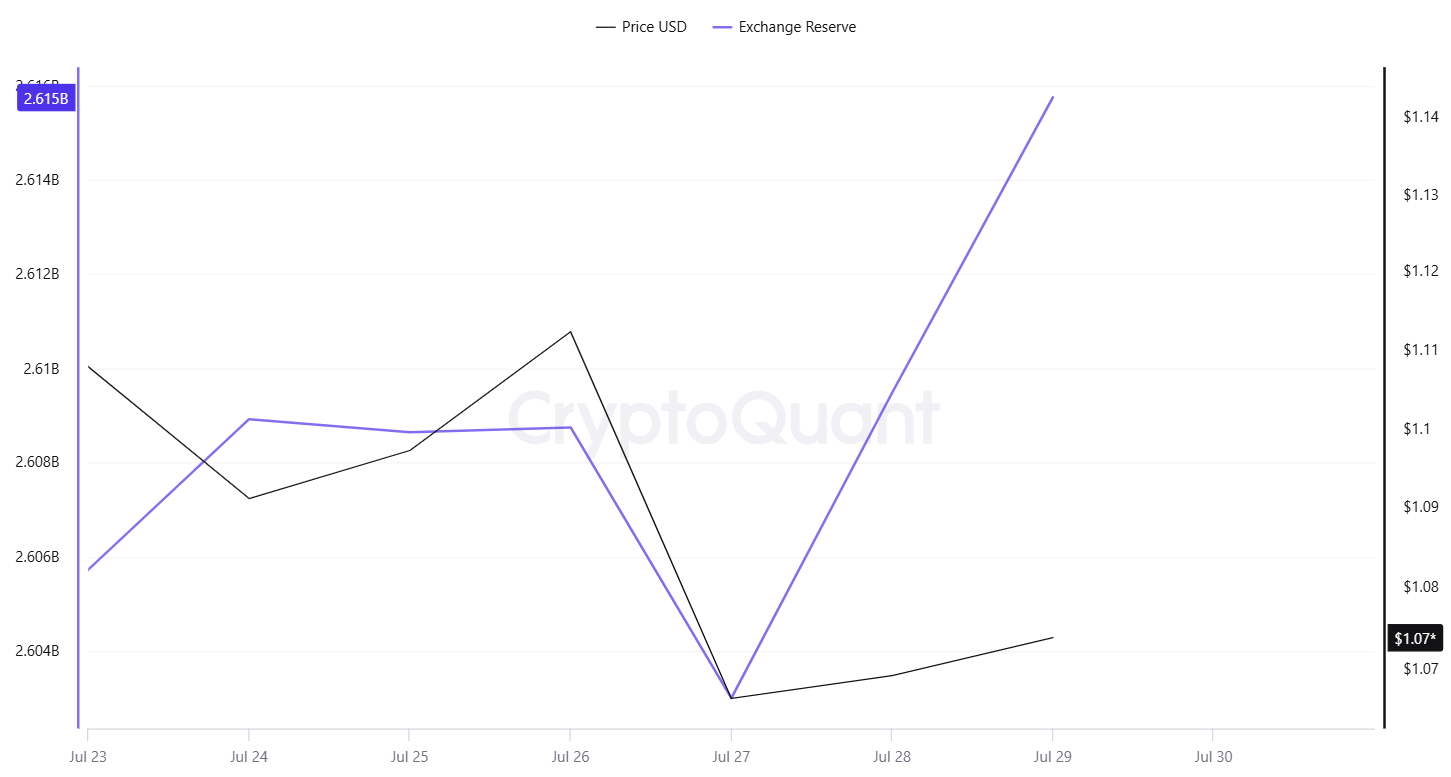
The rising number of XRP tokens stored on Binance suggests the bearish perspective is more likely. The figure has reached a nearly three-week high of approximately 2.62 billion coins, signaling that some investors have abandoned self-custody methods and moved their holdings to the exchange. This, in turn, increases the immediate selling pressure.
The Bullish Scenarios
It is important to note that the majority of people making XRP predictions remain optimistic. X user MARMOT recently claimed that the asset is repeating the exact pattern from 2017, which led to a 60,000% explosion. They believe the path to the next bull run involves three different phases, envisioning an eventual ascent to a new all-time high of $13.
Celal Kucuker also chipped in, seeing compression, exhausted sellers, and asymmetric risk. In their view, if XRP breaks above its current structure, those who called for $0.50 may suddenly start calling for $10.
The most bullish forecast came from xrpl_Adam, who suggested that Ripple’s native token may become a $100 trillion asset in the future. As of now, it’s hard to imagine an explosion of that magnitude, given that the entire market capitalization of the crypto sector is around $2.3 trillion.
The post XRP Warning: Why Ripple’s Price Could Plunge 23% appeared first on CryptoPotato.
Coinbase reports Q2 earnings after the close on July 30, with Wall Street expecting a soft quarter. Consensus revenue sits near $1.31 billion, down roughly 13% year over year. The EPS consensus has slipped to about $0.15, while HC Wainwright projects $0.05. The bigger question is whether management can justify Coinbase’s valuation through stronger guidance and growing revenue beyond spot trading.
Estimate cuts have been broad. Barclays expects Q2 trading volume near $152 billion, below the Street consensus of roughly $178 billion. The bank also sees adjusted EBITDA about 3% below consensus and revenue near the lower end of guidance. Softer crypto prices and slower USDC growth remain the biggest headwinds.
Clear Street forecasts roughly $160 billion in trading volume and adjusted EBITDA near $301 million. JPMorgan also cut its price target from $283 to $196 on July 17. The bank cited weaker trading activity and uncertainty surrounding Coinbase’s USDC revenue-sharing arrangement with Hyperliquid.
Discover: The Best Token Presales
Diversification Becomes the Bull Case
Citi lowered its price target from $400 to $235 while maintaining a Buy rating. Even so, the average analyst target remains near $223. That suggests most of Wall Street still expects meaningful upside once trading conditions improve despite lower earnings expectations.
William Blair remains constructive despite reducing forecasts. Analysts Andrew Jeffrey and Adib Choudhury cut 2026 revenue estimates by 12% and 2027 estimates by 13%. They also lowered adjusted EBITDA forecasts by 34% while maintaining an Outperform rating. The firm expects earnings to bottom during the second half of 2026 before recovering through 2027.
The firm argues Coinbase’s long-term story is becoming structural rather than cyclical. Spot Bitcoin ETFs continue attracting institutional capital, while Base, retail derivatives, and prediction markets are expanding the company’s revenue mix. Coinbase also strengthened its derivatives business through the Deribit acquisition, although the deal contributed little to Q2 because it closed late in the quarter.
Subscription and services revenue remains another bright spot. The segment includes USDC interest income, staking, custody, and Coinbase One subscriptions. Analysts expect around $601 million, within management’s guidance range of $565 million to $645 million. That recurring revenue provides a cushion when trading volumes weaken.
Trade on Bybit and Get a Chance to Win Our $1,000 USDT Airdrop
Regulation and Guidance Hold the Coinbase Key
The Clarity Act remains one of the biggest long-term catalysts. The proposal would divide crypto oversight between the SEC and CFTC. Benchmark believes recent Senate progress improves its chances, while Compass Point warns delays could pressure Coinbase’s valuation if investors have already priced in regulatory progress.
Bitcoin and Ethereum both traded at earlier highs during much of Q2, reducing retail participation and exchange volumes. Piper Sandler also highlighted prediction markets and perpetual futures after strong World Cup activity. However, Coinbase shares economics with Kalshi, limiting the business’s direct earnings contribution.
Ultimately, investors already expect a weak quarter. Management’s outlook for trading demand, stablecoin revenue, and regulatory developments will likely matter more than the headline results. If Coinbase shows its diversified businesses can offset weaker spot trading, the market may look beyond another soft earnings report.
Discover: The Best Crypto to Diversify Your Portfolio
The post Coinbase Q2 Earnings Preview: Guidance and Diversification in Focus appeared first on Cryptonews.
Crypto World
Institutional crypto trading hits a record 72% as Wall Street calms crypto’s wild swings


That concentration could make future altcoin rallies more selective.
“The result is a market where the flow that increasingly sets direction is concentrated in fewer names, traded more selectively,” the report said. It added that broad-based rallies, where most alternative cryptocurrencies rise together, are becoming less likely as institutional capital focuses on a handful of assets.
Derivatives and tokenization gain traction
The report also points to growing use of derivatives as another defining trend. Wintermute said notional trading volume in altcoin options on its OTC desk increased about 3.4 times from the second half of 2025 to the first half of 2026, driven largely by investors seeking yield rather than outright price exposure. At the same time, contracts for difference, or CFDs, are being used across a wider range of cryptocurrencies for directional trading, hedging and basket strategies.
Beyond trading, tokenized real-world assets continued to gain momentum, with the value of tokenized assets climbing nearly 50% to $31 billion during the first six months of the year, while average monthly transfer volume more than doubled to $9 billion. The firm said institutions are primarily adopting tokenized Treasuries, money market funds and private credit, while retail investors remain more active in tokenized equities.
While Wintermute expects retail participation to return during the next crypto bull market, it argues institutional influence is unlikely to fade. Instead, it said the market is increasingly taking on the characteristics of its largest participants, with professional investors shaping liquidity, pricing and the types of assets that attract capital.
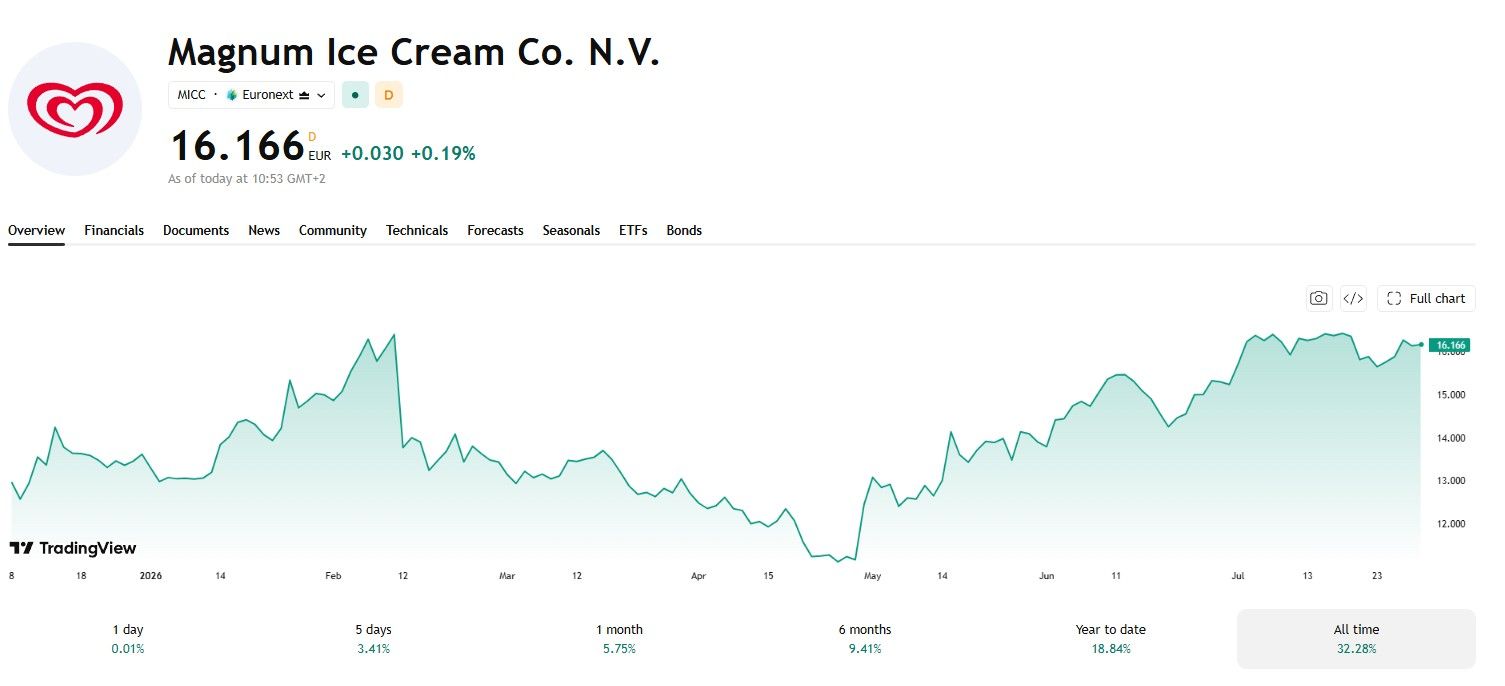
The Magnum Ice Cream Company (MICC) posted first-half core earnings above analyst expectations on July 30. Cost cuts since its 2025 spinoff from Unilever (UL) drove the beat, alongside a heatwave-driven summer surge for Ben & Jerry’s.
Revenue reached €4.7 billion, up from €4.5 billion a year earlier, with organic sales growth of 4.7% across every region. Adjusted EBIT climbed 7.5% to €716 million, though separation costs pulled net profit down to €349 million.
Ben & Jerry’s Powers a Hot Start to Summer
Ben & Jerry’s led the gains across the portfolio. Growth accelerated sharply once summer heat set in across Europe. New stick and sandwich formats pulled fresh buyers into the brand, both in the Americas and in Europe.
“Ben & Jerry’s grew mid-single-digit and had an outstanding second quarter with 9.2% growth.”
Peter ter Kulve, the company’s CEO, praised a frontline-first operating model in a statement tied to the results. Sustained heat across Europe has already lifted other heatwave-driven cooling stocks this summer, and that trend now extends to frozen treats.
Magnum, Cornetto, and the Heartbrand also posted gains. All four core brands showed positive momentum, and Yasso, the company’s high-protein pint line, kept growing at a double-digit pace. The pattern echoes the seasonal plays behind several US stocks to watch this July.
Magnum’s Cost Cuts and Productivity Gains Lift Margins
A productivity programme launched in 2024 delivered €90 million in first-half savings, most of it from the supply chain. Waste reduction and better factory use both contributed. Meanwhile, a favorable working capital swing tied to the Unilever separation nearly doubled Free Cash Flow to €273 million.
Standalone financing pushed net finance costs up to €72 million, compared with just €10 million a year earlier. That shift lines up with the broader high-rate backdrop highlighted by the Fed’s July decision to hold rates steady, a move that rattled bond markets and pushed long-term borrowing costs to multi-year highs.
The earnings beat nonetheless continues a summer pattern of firms topping Wall Street estimates. It follows Robinhood’s earnings beat and Intel’s surprise profit beat earlier this season, both delivered despite mixed investor reactions.

Shares of Magnum Ice Cream (EURONEXT: MICC) were changing hands near €16.16 ahead of the print, up roughly 19% for the year and close to the all-time high of €16.74 hit on July 7. The stock has climbed steadily since bottoming near €11 in late April, and the chart shows that run largely intact heading into results day.
Management reaffirmed full-year guidance of 3% to 5% organic sales growth. The company now enters peak summer demand with momentum intact. A pending antitrust review of its freezer-cabinet practices in Türkiye adds a regulatory wrinkle to watch.
The next quarter should still show whether the heat and the cost discipline both hold.
The post Heatwave Boosts Ice Cream Sales as Magnum Beats Earnings Forecasts appeared first on BeInCrypto.


[Update 08:55 UTC, July 30: Updates with additional reporting and context.]
Online brokerage Robinhood posted record second-quarter revenue and earnings, though cryptocurrency transaction revenue fell 38% from a year earlier.
The company said Wednesday in its earnings report that crypto transaction revenue fell to $100 million from about $160 million a year earlier. Overall revenue rose 32% year-over-year to $1.31 billion, while net income increased 48% to $573 million. Transaction-based revenue climbed 44% to $776 million.
Robinhood reported $40 billion in crypto notional trading volume during the quarter. Of that total, $18 billion came from the Robinhood app, down 35% from a year earlier, while $22 billion came from Bitstamp, the crypto exchange it acquired in June 2025.
The price of Robinhood shares was down 3.15% on Wednesday ahead of the company’s earnings release, according to Yahoo Finance data.
Robinhood expands crypto ecosystem
Despite the decline in crypto trading revenue, Robinhood continued expanding its digital asset business during the quarter, completing its acquisition of Canadian crypto platform WonderFi as it broadened its crypto offerings beyond trading.
After the quarter ended, the company unveiled the public mainnet of Robinhood Chain, introduced tokenized US stocks to eligible users in more than 120 countries and debuted its first decentralized lending product, Robinhood Earn.
Related: Bernstein raises Robinhood price target, cites tokenization and prediction markets
Data from DefiLlama shows Robinhood’s new Ethereum layer-2 network had $348 million in total value locked on Thursday, more than $500 million in stablecoins and over $1 billion in bridged assets.
Platform growth offsets crypto slowdown
Cryptocurrency was the only major transaction category to decline during the quarter.
Robinhood said growth in event contracts, options and equities more than offset the weakness, with event contract revenue surging more than tenfold to $156 million, options revenue rising 29% to $342 million and equities revenue jumping 95% to $129 million.
The company also reported record net deposits of $21.7 billion during the quarter, while total platform assets increased 32% year over year to $369 billion and funded customers grew 7% to 28.4 million.
Robinhood lowered and narrowed its 2026 outlook for adjusted operating expenses and share-based compensation to between $2.675 billion and $2.775 billion, from $2.7 billion to $2.825 billion previously. Adjusted EBITDA rose 35% to $741 million, while total operating expenses increased 33% to $734 million.
Magazine: Bitcoin price wedged into ‘most divided’ FOMC as Iran war spikes oil prices 8%
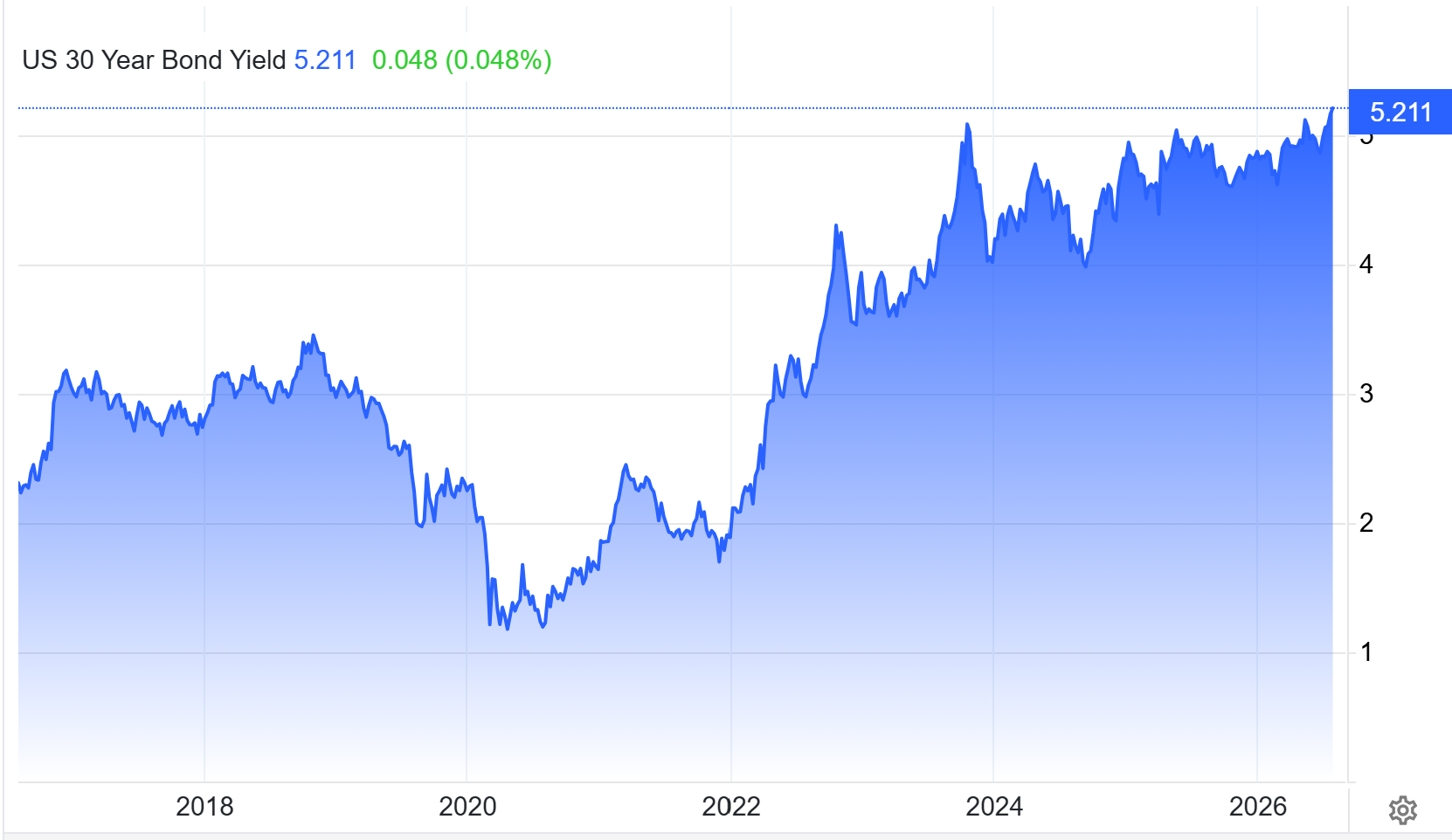
The US government has not paid this much to borrow money since 2007. The 30-year Treasury yield closed at 5.20% on Wednesday, hours after the Federal Reserve left interest rates alone.
Three Fed officials wanted a rate hike instead. Bond traders sided with them.

Why the 30-Year Treasury Yield Jumped
A bond yield is what lenders charge to hold government debt. When it rises, borrowing gets pricier for everyone.
The Federal Open Market Committee (FOMC) kept its rate range at 3.50% to 3.75%. The vote was 9 to 3.
Beth Hammack, Neel Kashkari and Lorie Logan each wanted a quarter point increase, the Fed statement shows.
Long-term bonds fell hardest. The 30-year yield rose from 5.09% to 5.20%, and the 10-year climbed to 4.67%.
Short-term bonds went the other way. The two-year yield slipped to 4.22%.
That split is the signal. Traders are worried about the next 30 years, not the next 30 days. Some intraday quotes ran as high as 5.244%.
Three dissents sound dramatic. They are not that rare, and four officials broke ranks in April. The direction is what stands out. Three votes for higher rates at one meeting last happened in September 2016.
The Fed has not raised rates since July 2023. The three dissenting officials want that streak to end.
Chair Kevin Warsh took the job on May 22. He refused to call the decision a pause and defended the 2% inflation target at his press conference.
Follow us on X to get the latest news as it happens
This Looks Like 2007, But It Is Not
The last time the 30-year yield sat here, the Fed was about to cut rates. In July 2007, the yield was 5.28%. The Fed’s own rate was 5.25%. The two were basically level.
Two months later the Fed cut by half a point. Warsh, then a Fed governor, voted for it. Today the picture is flipped. The 30-year yield sits roughly 1.45 percentage points above the Fed’s rate.
In 2007, long rates were falling toward a rescue. Now they are climbing away from one. Someone pays for that. The interest bill on US debt hit $857 billion in nine months, up 13% from a year earlier.
“Outlays for net interest on the public debt rose by $98 billion (or 13 percent) because the debt was larger than it was in the first nine months of fiscal year 2025 and because of higher long-term interest rates,” the Congressional Budget Office reported.
Interest now costs more than Medicare, at $778 billion. It also beats military spending, at $677 billion.
Total US debt reached about $39.8 trillion in late July.
Oil is not helping either. West Texas Intermediate crude settled 6.6% higher at $84.46 a barrel on Wednesday.
US Central Command said Iran fired ballistic missiles at American forces on July 28. All were intercepted. The US-Iran ceasefire collapse keeps oil risk alive.
Where Bitcoin and Gold Fit In
Crypto did not follow bonds down. Bitcoin (BTC) traded near $64,730 on Thursday, up 0.48% on the day.
Bitcoin’s recent price action shows a 9.2% gain over 30 days, though it is down 45% over a year.
Gold traded near $4,078 an ounce on Thursday. It had settled at $4,036.30 the day before.

Ellen Zentner, chief economic strategist at Morgan Stanley Wealth Management, says traders only delayed the hike.
“September remains a live meeting, and the incoming inflation data between now and then will be all that matters,” Zentner said.
Thursday’s inflation data helped the doves. The Fed’s preferred gauge, personal consumption expenditures (PCE), rose 3.7% in the year to June, down from 4.1% in May.
Core PCE, which strips out food and fuel, came in at 3.3%.
Even so, inflation has topped 2% every month since March 2021. Global bond yields climbed to their highest since 2008 earlier this year, and the long end never came back down.
The Fed meets again on September 15 and 16. That is when the three dissenters find out if they were right.
The post 30-Year Treasury Yield Hits 2007 High as Bond Market Doubts the Fed appeared first on BeInCrypto.


Russian authorities charged BitRiver founder Igor Runets with alleged fraud tied to a $8 million crypto mining equipment deal involving Russian billionaire Oleg Deripaska.


Malaysian police have dismantled an illegal Bitcoin mining operation and arrested two men after seizing 73 mining machines that investigators say were powered through stolen electricity.
Summary
- Malaysian police arrested two men and seized 73 Bitcoin mining machines during raids on three properties in Tronoh.
- Investigators said the mining operation used stolen electricity through illegal power connections confirmed by TNB inspections.
- The latest crackdown follows earlier Bitcoin mining raids in Terengganu and Kuala Lumpur linked to electricity theft across Malaysia.
According to a statement from Batu Gajah district police chief Assistant Commissioner Md Noor Aehawan Mohammad, officers carried out coordinated raids at three properties in Tronoh on Tuesday night under Op Elektrik, uncovering what investigators described as illegal Bitcoin mining activities supported by unauthorized electricity connections.
The operation began at about 9:02 p.m. and involved personnel from the district Criminal Investigation Department together with the Technical Unit of Malaysia’s national electricity provider, Tenaga Nasional Berhad (TNB), also known as the SEAL Team.
Police detained two local men, aged 40 and 52, to assist with the investigation. Alongside the arrests, officers confiscated 73 Bitcoin mining machines and additional equipment believed to have been used to operate the mining network.
Bitcoin mining operation used illegal power connections
Police said inspections carried out during the operation found that each of the three premises had been used for Bitcoin mining. Technical examinations conducted by TNB later confirmed electricity theft at two abandoned houses, while the third property involved in the case was an unoccupied house.
Md Noor Aehawan said investigators found evidence that the mining equipment had been connected through illegal electricity supply lines rather than legitimate metered connections.
Both suspects have been remanded for three days, beginning Wednesday and ending Friday, to facilitate further investigations.
Authorities are investigating the case under Section 427 of Malaysia’s Penal Code for committing mischief, including electricity theft, as well as Section 37(1) of the Electricity Supply Act 1990, which covers interference with electrical installations.
Police also urged residents to report suspicious activities linked to electricity theft or unauthorized cryptocurrency mining. Members of the public with relevant information have been asked to contact the Batu Gajah district police operations room or the nearest police station.
Malaysia has continued targeting illegal Bitcoin mining
The latest enforcement action follows several similar crackdowns carried out across Malaysia over the past year as authorities continue to target cryptocurrency mining operations that bypass electricity meters.
In May, Terengganu police dismantled another suspected Bitcoin mining syndicate during Op Letrik after raiding properties in the Hulu Terengganu and Marang districts. Working alongside TNB’s SEAL unit, officers seized 45 illegal Bitcoin mining machines from two premises, including a residential property in Bukit Perpat and a commercial building in Wakaf Tapai.
At the time, Terengganu police chief Datuk Mohd Khairi Khairuddin said investigators believed the premises had been modified to bypass electricity meters, causing estimated monthly losses of about RM36,000 for TNB. Authorities also seized mining-related equipment valued at approximately RM225,000, although no arrests were announced in that operation.
The Terengganu investigation proceeded under Sections 379 and 427 of the Penal Code together with Section 37 of the Electricity Supply Act 1990.
Earlier cases have exposed electricity theft
Another illegal mining operation came to light in February after firefighters responded to reports of an explosion and smoke at a house in Kuala Lumpur.
Authorities later discovered modified electrical wiring that had caused a fire before uncovering several Bitcoin mining rigs inside the property. Investigators also confirmed that the operation had been drawing electricity through unauthorized connections, prompting a separate investigation.
Malaysia’s national electricity provider has repeatedly warned about the financial impact of electricity theft linked to cryptocurrency mining. TNB reported in 2024 that illegal Bitcoin mining had caused losses of more than 440 million Malaysian ringgit, or roughly $101 million, due to stolen electricity.
The utility also estimated that electricity theft associated with illegal cryptocurrency mining resulted in losses of about $755 million between 2018 and 2023, highlighting the continued challenge posed by unauthorized mining operations across the country.
Outside Malaysia, governments have taken similar action against illicit cryptocurrency mining where unauthorized electricity use has strained national power systems. Iran has conducted repeated crackdowns on illegal mining operations, while Venezuela introduced a ban on crypto mining to protect its electricity grid from excessive energy demand.

Olivia Colman & Alexander Skarsgård’s Weirdest Movie Yet Officially Debuts First Trailer

Top 10 Affordable Tropical Wallpapers

Migrants storm EU border: Thousands charge up beaches and climb over fences to force their way into Spanish enclave as it declares ‘total emergency’


-

 Fashion6 days ago
Weekend Open Thread: Brooks Brothers
-
 Sports4 days ago
Commonwealth Games boxing: Jadumani Singh seals dominant 5-0 win over Pakistan’s Sumama Rehman to enter quarter-finals | Commonwealth Games News
-

 Business18 hours ago
Why Trees Belong on the Risk Register
-

 Tech4 days ago
Intel is reversing course and bringing hyper-threading back to its server chips
-

 Crypto World5 days ago
Ripple bought a bank in pieces. The $4 billion audit
-

 Politics3 days ago
Luke Littler dismantles Gerwyn Price to retain title in Blackpool
-

 Politics2 days ago
The Part of the Electric Transition Nobody Wants to Discuss
-
 Entertainment6 days ago
A New Post-Apocalyptic Gundam Anime Series Blasts Into SDCC
-

 News Videos4 days ago
BITCOIN JUST ENTERED THIS CRITICAL ZONE…
-

 Fashion6 days ago
16 Dresses for the High Summer Event
-

 Sports6 days ago
2026 3M Open leaderboard: Scottie Scheffler finds putter in Round 1, sits three back
-

 News Videos7 days ago
The Peugeot Family: How 200 Years of an “Old Money” Dynasty Died in A Boardroom
-

 Business1 day ago
Major shareholder moves on Canyon
-

 Crypto World4 days ago
XRP Ledger adds $2.6B as RWA inflows rank second
-

 Politics4 days ago
Spain sweeps the board at 2026 World Cup with individual awards
-

 News Videos3 hours ago
Bitcoin Enters the 3rd Stage of the Bear Market
-
 Entertainment2 days ago
‘Stargate’ Creator’s New Sci-Fi Series Returns for Season 3 Tomorrow
-

 Tech5 days ago
Anthropic launches Claude Opus 5, a cheaper AI model for coding, agents and enterprise workflows
-

 Crypto World2 days ago
Kraken Enables Retail Access to Jersey Mike’s IPO via Tokenized Shares
-

 Entertainment5 days ago
Sara Gilson Killed By Husband After Viral “Pedophile” TikTok Video
You must be logged in to post a comment Login