

Crypto World
Wise (WSE) Stock Surges 8% on Record Margins and $500M Share Buyback Program


Key Highlights
- Wise shares advanced 8% following FY26 results that exceeded the firm’s profit margin guidance
- Pre-tax income reached $660.4 million with a 26.4% margin — surpassing the 20–25% target corridor
- Net revenue expanded 19% annually to $2.50 billion
- The company unveiled a $500 million share buyback initiative for FY27
- Customer base expanded 21% to 19 million users; cross-border transaction volume surged 31% to $243.5 billion
Shares of Wise (WSE) climbed approximately 8% on Friday following the fintech firm’s release of annual financial results that exceeded profit margin projections, complemented by the announcement of a $500 million share repurchase initiative.
Wise Group plc Class A Ordinary Shares, WSE
The shares were changing hands at approximately 894p on the London Stock Exchange during morning trading, representing a gain of 64 points.
The payment platform reported net revenue reaching $2.50 billion for the fiscal year concluding March 31, 2026, marking a 19% year-over-year increase. Pre-tax income totaled $660.4 million, translating to a margin of 26.4%.
This profitability metric exceeded the company’s medium-term guidance corridor of 20–25%, capturing investor attention.
BofA analysts, maintaining a buy rating with a $16.40 price objective, noted that pre-tax profit exceeded their projection by 6.6% and consensus estimates by 1.3%.
The analysts identified a $70 million non-recurring U.S. GAAP foreign exchange adjustment linked to specific government bonds as the primary factor impacting operating income, which settled at $590.7 million.
The platform’s active user base expanded 21% to 19 million. Cross-border transaction volume increased 31% to $243.5 billion, while the cross-border take rate remained at 0.52%, declining six basis points year-over-year.
Card expenditure grew 37% to $43.6 billion. Customer balances increased 40% to $39.0 billion — indicating that more clients are maintaining funds on the platform for regular usage rather than solely for transfers.
Transaction-based revenue totaled $1.89 billion. Net interest income added $609.2 million to overall net revenue after distributing $196.9 million in interest payments to account holders.
CEO Kristo Käärmann emphasized that 75% of transactions in Q4 were processed in under 20 seconds worldwide — a metric the company prominently features in its competitive positioning.
Share Repurchase and Shareholder Returns
Wise announced plans to allocate over $500 million toward share buybacks during FY27. Approximately 40% of this amount will support its ongoing Employee Share Trust initiative to counterbalance dilution from equity-based compensation.
The firm separately deployed $470 million to repurchase 35.9 million shares throughout FY26.
BofA increased its FY27 diluted earnings per share forecast by 5.7% to 54.34 cents, citing improved gross profit margins and the buyback program as key contributors.
Fiscal Year 2027 Guidance
Looking ahead, Wise projected net revenue growth near the midpoint of its 15–20% medium-term target range, calculated on a constant currency basis.
This forecast assumes no significant changes in interest distributed to customers and no substantial movements in central bank policy rates.
Pre-tax income margin is anticipated to land near the upper boundary of the 20–25% range for FY27.
Wise finalized its transition to a Nasdaq primary listing on May 8, maintaining a secondary listing on the London Stock Exchange.
The firm disclosed that it established new direct payment connections in Brazil and Japan during FY26 and secured fresh regulatory approvals in South Africa, the UAE, and Thailand.
New Wise Platform collaborations launched during the period include UniCredit, Raiffeisen Bank, and MBSB Bank, with Capitec coming onboard in April 2026.



Stablecoin adoption has increasingly hinged on a practical question, how do users move fiat into crypto and back out without sacrificing the control promised by self-custody? On June 25, Noah, a stablecoin payments infrastructure provider, and Bron, a multi-party computation (MPC) self-custody wallet, announced a partnership designed to connect Bron users to Noah-powered stablecoin on- and off-ramp capabilities.
The companies position the integration as a way to streamline funding and withdrawals from a self-custody wallet, while keeping the user experience closer to familiar financial workflows. The development also reflects a broader market trend, stablecoins are shifting from niche trading instruments toward payment and remittance rails, which in turn increases demand for regulated and reliable fiat access.
What Noah and Bron say they are building
Noah provides what it describes as stablecoin payment rails for fintechs, exchanges, marketplaces, and other businesses across more than 70 countries. Its platform includes components intended to support compliant money movement, including on-ramps and payout-related services.
Bron, meanwhile, presents its wallet as a non-custodial self-custody product that reduces reliance on seed phrases through an MPC-based security design. According to the announcement, Bron uses a three-party MPC architecture for transaction authorization, splitting signing responsibilities across multiple shards, including one on the user device, one operating within the Bron platform, and one held by an independent third party appointed by the user for recovery. The release states that no single party can reconstruct or control the complete signing material or authorize transactions unilaterally.
Under the partnership, the companies say Bron users will be able to access stablecoin on- and off-ramp functionality powered by Noah’s network. In practical terms, the goal is to make it simpler for users to fund their self-custody wallet with stablecoins, and later convert them back out through the same ecosystem, without changing the underlying self-custody model.
Why on- and off-ramps matter for self-custody
Self-custody is often viewed as a security upgrade because users are expected to control their own signing material. However, many mainstream entry points into crypto are still built around centralized services such as exchanges or custodial wallets. As a result, users may have to navigate multiple steps and user experiences, from buying stablecoins on an exchange to transferring them into a self-custody wallet, and then reversing the process when they need fiat access again.
Stablecoin on- and off-ramps aim to reduce that friction. From an industry perspective, the challenge is not only technical integration, but also compliance and operational readiness, including identity checks where required, transaction monitoring, and the handling of fiat rails across jurisdictions. By routing on- and off-ramp activity through an infrastructure provider, wallet makers can focus on wallet security and usability while relying on an external entity for regulated fiat connectivity.
The Noah-Bron announcement suggests the companies are trying to connect these two layers, keeping the security posture associated with self-custody while using Noah as an intermediary for the fiat-to-stablecoin and stablecoin-to-fiat steps.
Implications for high-net-worth and cross-border use cases
The release frames the partnership around users who may want global dollar origination and payouts across markets and international jurisdictions. That points to an audience where cross-border liquidity and payout reliability are often more important than consumer-style onboarding.
For that segment, stablecoins can function as a bridge between traditional payment ecosystems and blockchain settlement. However, the value of the bridge depends on the ability to enter and exit efficiently. If on- and off-ramp access becomes smoother inside a self-custody workflow, it could lower the operational overhead for users who would otherwise rely on transfers between different platforms.
Still, the scope of what users will be able to do depends on how the integration is implemented and which jurisdictions and fiat methods are supported. The announcement indicates that Noah serves businesses in many countries, but it does not provide a detailed list of regions or user flows for Bron consumers.
MPC security, usability, and the security model question
Bron’s MPC-based approach is central to its positioning. In a traditional wallet, the main recovery and authorization mechanism is often a seed phrase, which can be risky if mishandled and inconvenient if users want a more guided recovery process. Bron states that its architecture eliminates seed phrases and introduces additional protections including biometric authentication, policy controls, delayed transfers, hidden vaults, and guardian-based recovery.
From an editorial standpoint, it is important to separate what the announcement clarifies from what it does not. The release describes how the MPC shards are distributed and emphasizes that no party can unilaterally access or move assets. But details on how users will experience on- and off-ramp steps inside the wallet, and what safeguards apply around fiat conversion and transaction initiation, are not fully specified in the announcement text provided.
Market context: stablecoins as infrastructure
Stablecoins continue to be positioned as one of the faster-growing “real-world” use cases in crypto, particularly for payments, remittances, and savings. In that environment, infrastructure partnerships are becoming more common because the ecosystem needs to connect regulated fiat systems with blockchain-based settlement.
Partnerships like the one between Noah and Bron fit a pattern where wallet products and payments rails converge. Wallet providers can improve usability by integrating with established on- and off-ramp providers, while payments infrastructure firms can expand distribution through wallet-based interfaces.
What remains to be seen is how quickly the integration translates into measurable user growth, retention, or transaction volumes, and whether it reduces the need for users to route through centralized exchanges for basic fiat access.
What to watch next
- Supported jurisdictions and fiat methods: integration details typically determine whether the partnership meaningfully expands access.
- User flow and fees: on- and off-ramp integration can change the cost structure versus using exchanges directly.
- Security and recovery behavior: MPC wallet recovery options may interact with onboarding and withdrawal workflows, which users should understand before switching.
- Regulatory posture: stablecoin rails often rely on regulated partners, so compliance coverage is an operational factor for end users.
For now, Noah and Bron have outlined a direction that speaks to the core bottleneck in self-custody adoption, connecting secure control with frictionless access. If implemented smoothly and broadly, the integration could help more users treat stablecoins as everyday payment and value transfer tools, rather than assets that require separate, multi-step processes to move in and out of fiat.
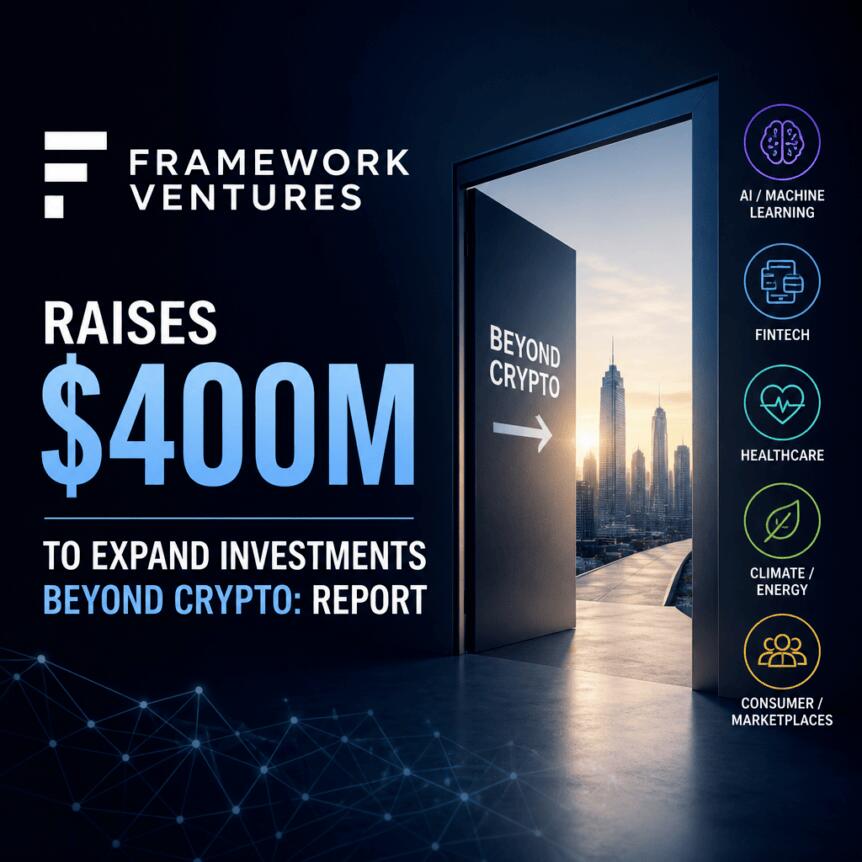
Framework Ventures, a San Francisco-based venture capital firm backed by crypto operators, has closed its fourth fund after raising $400 million for investments in “frontier technology.” The new pool will support not only digital-asset projects, but also emerging areas such as artificial intelligence, robotics, and energy, Fortune reported on Friday.
According to Fortune, co-founders Vance Spencer and Michael Anderson said roughly half of the committed capital has already been deployed. The firm did not disclose its limited partners, and Cointelegraph did not receive a response when it sought additional details about the latest fund.
Key takeaways
- Framework Ventures closed a $400 million fourth fund focused on “frontier technology,” spanning crypto and other emerging sectors.
- About half of the fund has already been deployed, though the firm did not name its limited partners.
- The shift is framed as complementary rather than a break from crypto, with Anderson pointing to alignment with founders’ build paths.
- Recent investments underline the strategy, including robotics and tokenized mortgage activity alongside core crypto holdings.
A frontier-technology fund, not a retreat from crypto
Framework’s latest raise comes as crypto venture firms increasingly look beyond blockchain while remaining active in digital assets. For Framework, the expansion appears designed to follow where its existing founder network is building.
In comments cited by Fortune, Michael Anderson said the firm is not simply chasing the AI trend. Instead, he described the approach as tracking founder-led momentum—suggesting that talent and product direction in frontier tech often overlaps with crypto-native experimentation.
“We can see these founders leading us in this direction,” he said, adding: “We should pay attention.”
How Framework’s recent deals fit the new thesis
Framework’s broader mandate is already visible in its deal activity. In early June, the firm backed Mecka AI, a robotics data startup, with a $60 million round, according to the reporting. Earlier, in February, Framework partnered with mortgage lender Better to support up to $500 million in financing through the Sky stablecoin ecosystem. Fortune also reported that Framework took a $45 million stake in Better, representing roughly 10% of the company’s stock.
The portfolio mix illustrates a consistent theme: backing infrastructure and products that can bridge digital finance with real-world systems. Rather than treating AI or robotics as standalone bets, Framework’s examples show an interest in data, operational tooling, and payments rails—areas where crypto firms often believe incentives and programmability can matter.
Framework also invests directly in established DeFi and digital-asset platforms. On its website, the firm lists positions in projects including Aave, Chainlink, Hyperliquid, Jito Labs, and Plasma.
From early DeFi to a multi-cycle venture strategy
Framework Ventures was founded in 2019, and its first fund focused on early decentralized finance (DeFi) projects. Over time, the firm broadened its investing approach while keeping its emphasis on founders building infrastructure and products in emerging digital-asset markets.
Framework’s history includes multiple fund cycles that map to different periods of the market. Fortune noted that the firm raised a $100 million second fund in 2021, and a $400 million third fund in 2022—both primarily focused on crypto investments. The fourth fund’s size and subject matter suggest an evolution rather than a reversal: continuing to allocate toward crypto while opening a larger window for adjacent frontier technologies.
Industry context matters here. Crypto venture capital has faced a recurring debate over whether early-stage crypto investing can sustain momentum once the sector matures, regulatory uncertainty rises, and attention shifts to AI. Framework’s framing—following founders rather than chasing headlines—attempts to resolve that tension by tying expansion to teams and products already in motion.
What to watch as the fund deploys
With “about half” of the $400 million already deployed, the new strategy is likely entering a visible phase soon, particularly through deals that connect digital assets with broader frontier tech use cases. Investors and builders will probably want to monitor whether Framework’s non-crypto bets stay closely linked to crypto infrastructure—or whether it begins to show a more distinct separation between its blockchain investments and its frontier-technology allocations.
In the near term, attention should also center on how the firm’s portfolio changes after this close: which founders and sectors gain the most allocation, and whether Framework’s approach mirrors the broader crypto venture shift toward diversification without losing a core commitment to crypto-native product development.
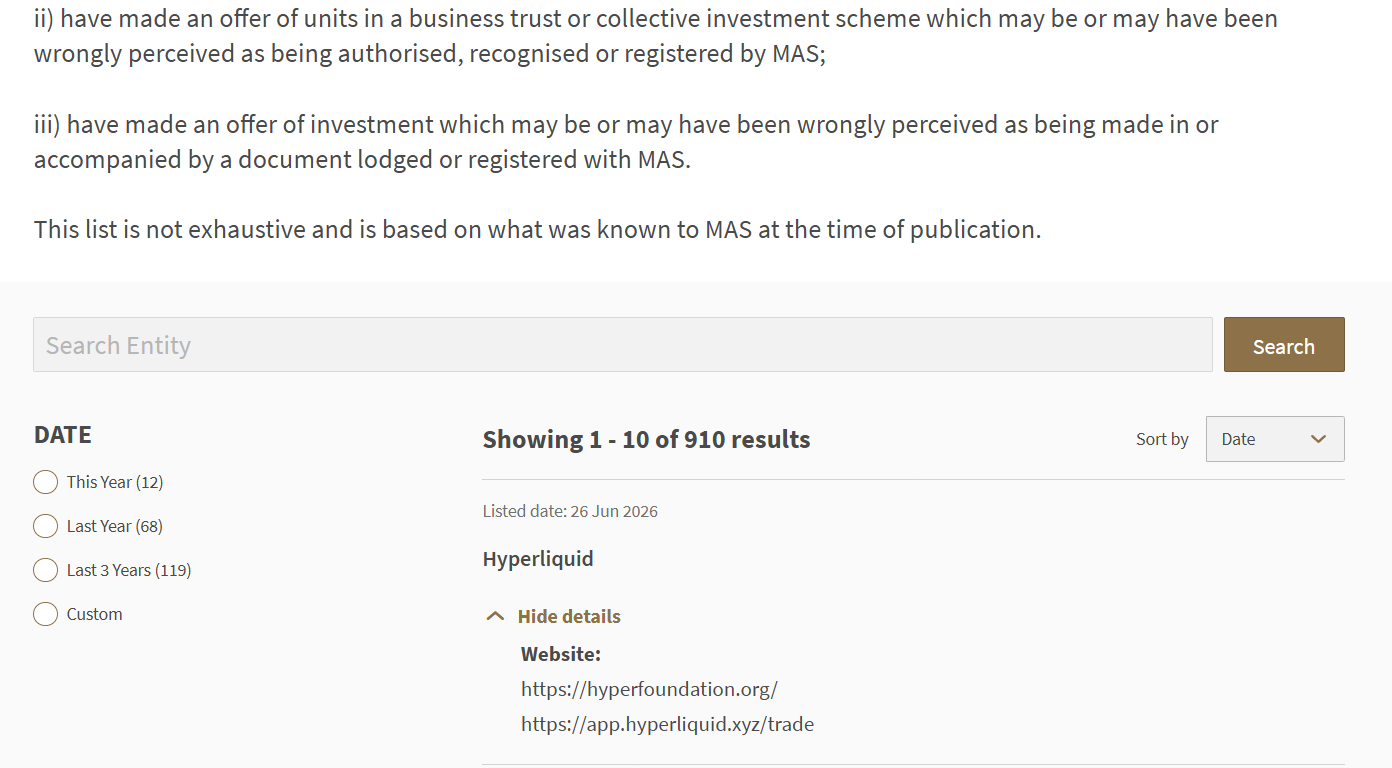
The Monetary Authority of Singapore (MAS), the city-state’s central bank and financial regulator, has added decentralized perpetuals exchange Hyperliquid to its Investor Alert List.
The entry, added on Friday, includes the Hyper Foundation website and the Hyperliquid trading app.
The Investor Alert List is a consumer protection measure that identifies entities that may be wrongly perceived as licensed or regulated by MAS. Inclusion on the list does not constitute a ban or enforcement action.
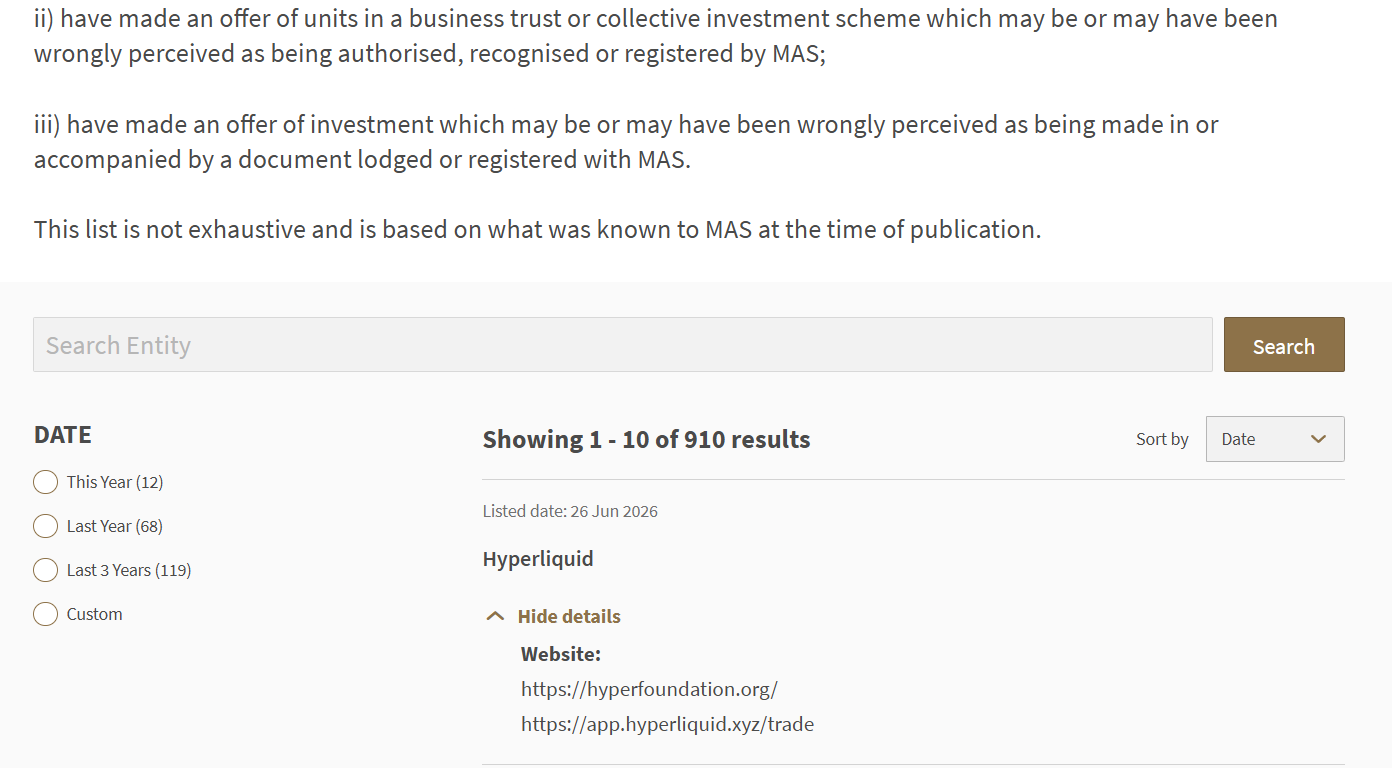
MAS Investor Alert List. Source: MAS
MAS added crypto exchange Bybit to the list on June 17. KuCoin and Bitget also appear on the list. Cointelegraph reached out to MAS for comment but did not receive a response before publication.
Hyperliquid said that it has never claimed to be licensed or authorized by MAS and that nothing about its permissionless infrastructure has changed.
Related: Ripple joins Singapore sandbox to test RLUSD in trade finance
“The Hyperliquid ecosystem remains committed to engaging collaboratively and constructively with regulators and institutions globally and to supporting clear, well-designed frameworks for onchain finance,” the platform wrote in a Friday X post.
According to CoinGecko, Hyperliquid ranks as the ninth-largest decentralized exchange by trading volume, while DefiLlama estimates it holds about $5.7 billion in total value locked.
Singapore tightens crypto oversight
Singapore has steadily tightened oversight of the cryptocurrency industry in recent years. In May 2025, MAS ordered crypto companies serving overseas customers to either obtain licenses or cease operations, saying the policy reflected a long-standing regulatory position rather than a shift in approach.
The directive closed a regulatory loophole that had allowed some crypto firms based in Singapore to avoid licensing by serving only overseas customers. MAS said it had consistently communicated its position since 2022 and was ending the transition period for firms that had continued operating without a license.
MAS said the measures were intended to strengthen consumer protection and align the Lion City’s crypto framework with international standards on Anti-Money Laundering and Countering the Financing of Terrorism.
Magazine: How crypto laws changed in 2025 — and how they’ll change in 2026

Framework Ventures, a venture capital company that backs crypto platforms, has closed its fourth fund while expanding its investment strategy beyond blockchain.
The San Francisco-based investor has raised $400 million to target “frontier technology,” including investments in crypto and technologies such as artificial intelligence, robotics and energy, Fortune reported on Friday.
The report cited Framework co-founders Vance Spencer and Michael Anderson, who said about half of the capital has already been deployed but declined to identify the fund’s limited partners.
The raise reflects a broader push by crypto venture firms to expand beyond blockchain into other emerging technologies while continuing to invest in crypto.
Not a shift away from crypto
Framework co-founder Anderson said the company is not simply chasing the AI trend, but instead following where its existing network of founders is already building.
“We can see these founders leading us in this direction,” he said, adding:
We should pay attention.”
Related: Social trading platform Fomo raises $75M, reaches $550M valuation
The company backed the robotics data startup Mecka AI in a $60 million round in early June. In February, Framework also partnered with mortgage lender Better to provide up to $500 million in financing through the Sky stablecoin ecosystem. Separately, Framework took a $45 million stake in Better, representing roughly 10% of its stock, according to Fortune.

Source: Framework Ventures
Cointelegraph approached Framework for details regarding the latest fund, but did not receive a response at the time of publication.
Framework’s portfolio includes Hyperliquid, Plasma and Aave
Framework Ventures was founded in 2019, when it launched its first crypto fund, focusing on backing early decentralized finance (DeFi) projects.
Its portfolio includes major crypto platforms such as Aave, Chainlink, Hyperliquid, Jito Labs and Plasma, according to the company’s website.
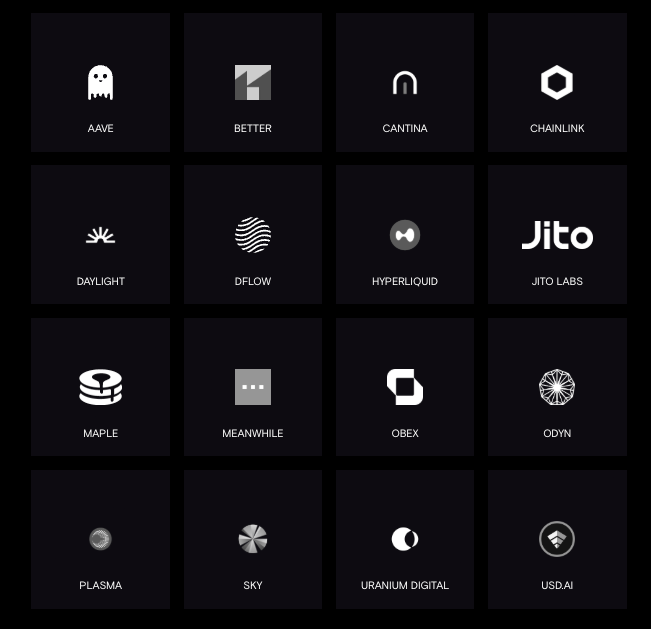
Framework Ventures’ portfolio. Source: Framework Ventures
The company says it has invested across multiple market cycles, focusing on founders building infrastructure and products in emerging digital asset markets.
Framework raised a $100 million second fund in 2021 and a $400 million third fund in 2022, both focused primarily on crypto investments.
Magazine: Bitcoin slides to $58K, XRP hits $1 but onchain data promising: Market Moves

TLDR
- Singapore’s Monetary Authority of Singapore added Hyperliquid to its Investor Alert List.
- The listing includes the Hyper Foundation website and Hyperliquid trading application.
- MAS clarified that inclusion on the list does not mean a ban or enforcement action.
- Hyperliquid stated it has never claimed to be licensed or regulated by MAS.
- The platform said its permissionless infrastructure remains unchanged despite the listing.
Singapore’s financial regulator has added a decentralized exchange to its public warning list. The move names Hyperliquid and related platforms in a consumer advisory update. The listing clarifies that inclusion does not mean a ban or enforcement action.
Hyperliquid appears on MAS Investor Alert List
The Monetary Authority of Singapore has placed Hyperliquid on its Investor Alert List. The entry includes the Hyper Foundation website and the Hyperliquid trading application.
MAS uses this list to flag entities that may appear licensed or regulated. However, the regulator states that listing does not confirm any legal violation.
Hyperliquid responded to the update through an official statement. The platform said it has never claimed authorization from MAS at any time.
It added that its permissionless infrastructure remains unchanged. The team stated it will continue engaging with regulators across different jurisdictions.
“The Hyperliquid ecosystem remains committed to engaging collaboratively with regulators,” the platform said in its X post. The statement also supports clear frameworks for onchain finance.
Singapore expands oversight on crypto firms
Singapore authorities have increased scrutiny on digital asset platforms over recent years. The regulator continues to enforce licensing requirements across the sector.
In May 2025, MAS directed firms serving overseas clients to obtain licenses or stop operations. The directive addressed firms operating from Singapore without local approvals.
MAS explained that the move reflects an existing policy stance. The regulator said it had communicated this requirement consistently since 2022.
The directive also closed a gap that allowed firms to avoid licensing by targeting foreign users. As a result, firms had to adjust operations or exit the market.
The regulator linked these actions to stronger consumer safeguards. It also aligned the framework with anti-money laundering and counter-terrorism financing standards.
MAS continues to publish updates through its alert list and regulatory notices. The agency maintains its focus on transparency and compliance within the crypto sector.
Market context and exchange rankings
Hyperliquid operates as a decentralized perpetual exchange within the crypto market. The platform currently ranks among the leading decentralized exchanges by trading activity.
According to CoinGecko, Hyperliquid stands as the ninth-largest decentralized exchange by volume. The ranking reflects current market data across trading platforms.
DefiLlama estimates the platform holds about $5.7 billion in total value locked. This figure tracks assets secured within its protocol ecosystem.
Other exchanges also appear on the MAS Investor Alert List. These include Bybit, KuCoin, and Bitget, based on earlier entries.
MAS added Bybit to the list on June 17 as part of ongoing updates. The regulator continues to monitor platforms that operate without local authorization.
The alert list remains publicly accessible for users and institutions. It provides updated information on entities that may appear regulated in Singapore.
Crypto World
Tesla (TSLA) Stock Analysis: Can Musk’s 2027 Robotaxi Vision Justify Current Valuations?

Key Takeaways
- Elon Musk projects Robotaxi and unsupervised Full Self-Driving revenue to become “material in a significant way” by 2027
- TSLA currently commands a price-to-earnings multiple of approximately 344, with shares hovering near $373
- Several institutional funds expanded their Tesla holdings during the first quarter of 2026
- Wall Street analysts maintain a “Hold” rating with a consensus target price of $403.07
- The company is navigating a wrongful-death lawsuit and federal investigation related to an Autopilot/FSD-involved fatality in Texas
Tesla (TSLA) shares are currently changing hands around $373, placing the electric vehicle pioneer’s market capitalization at approximately $1.41 trillion with a P/E multiple of 344. This sky-high valuation metric reveals investor sentiment clearly — the market is pricing Tesla not as a traditional automaker, but as a technology platform centered on artificial intelligence and autonomous transportation.
During Tesla’s first-quarter 2026 earnings conference call held in April, CEO Elon Musk projected that revenue from unsupervised Full Self-Driving capabilities and the Robotaxi service would achieve “material” significance throughout 2027. Musk further indicated the company aims to launch Robotaxi operations across approximately twelve states before year-end 2026.
Presently, the Robotaxi service operates autonomously in three Texas cities: Austin, Dallas, and Houston. However, revenue generation from this autonomous fleet remains essentially insignificant at this juncture.
Tesla reported 1.28 million active supervised FSD subscriptions as of the end of March. Assuming every subscriber pays the standard $99 monthly fee, this generates approximately $1.5 billion on an annualized basis — a modest figure when measured against last quarter’s total revenue of $22.39 billion.
The company’s Q1 2026 earnings per share registered at $0.41, surpassing Wall Street’s consensus forecast of $0.39. Revenue climbed 15.8% compared to the prior year period, though it fell short of the $22.96 billion analyst projection.
For perspective, Musk’s prediction accuracy deserves scrutiny. According to research conducted by The New York Times, the Tesla chief executive meets his own stated timelines approximately 19% of the time.
Big Money Continues Accumulating Shares
RFG Advisory LLC expanded its Tesla stake by 29.4% during Q1, purchasing an additional 6,367 shares to reach a total position of 28,020 shares valued at approximately $10.4 million. OP Asset Management initiated a fresh position worth roughly $201.9 million. Assenagon Asset Management increased its holdings by 78.2%, accumulating more than 1.7 million additional shares. Institutional ownership now represents 66.2% of outstanding TSLA stock.
This represents substantial confidence from sophisticated investors, particularly given current valuation levels.
On the positive development front, Tesla revealed an energy infrastructure collaboration with Sunrun and Renew Home designed to aggregate over 16 gigawatts of distributed residential power capacity. Meanwhile, the company’s German Gigafactory is reportedly working toward a production target of 7,500 vehicles weekly by October.
The current presidential administration has floated regulations that would eliminate brake pedal requirements for autonomous vehicles, a regulatory shift that could significantly accelerate Tesla’s Robotaxi deployment if enacted.
Ongoing Legal Challenges and Analyst Perspectives
Tesla confronts a wrongful-death legal action stemming from a fatal Texas collision connected to its Autopilot/FSD technology. The National Transportation Safety Board has initiated an investigation into the incident, introducing both legal liability and brand reputation concerns to its driver-assistance technology segment.
Insider trading patterns warrant attention as well. Board member Kathleen Wilson-Thompson divested 26,409 shares on April 30 at $378.11 per share. Chief Financial Officer Vaibhav Taneja sold 2,606 shares on June 8 at $402.20. Aggregate insider dispositions over the previous 90 days total 57,824 shares with a combined value exceeding $21.6 million.
Regarding analyst sentiment, Deutsche Bank and Sanford C. Bernstein both upgraded to “Buy” ratings in early June. Cantor Fitzgerald and Roth MKM similarly maintain bullish stances. Conversely, HSBC and JPMorgan continue with “Hold” recommendations.
The aggregated view across 45 covering analysts stands at “Hold,” with a mean price objective of $403.07. The stock has traded within a 52-week band spanning from $288.77 to $498.83.
Sell-side consensus anticipates full-year 2026 earnings per share of $1.19.
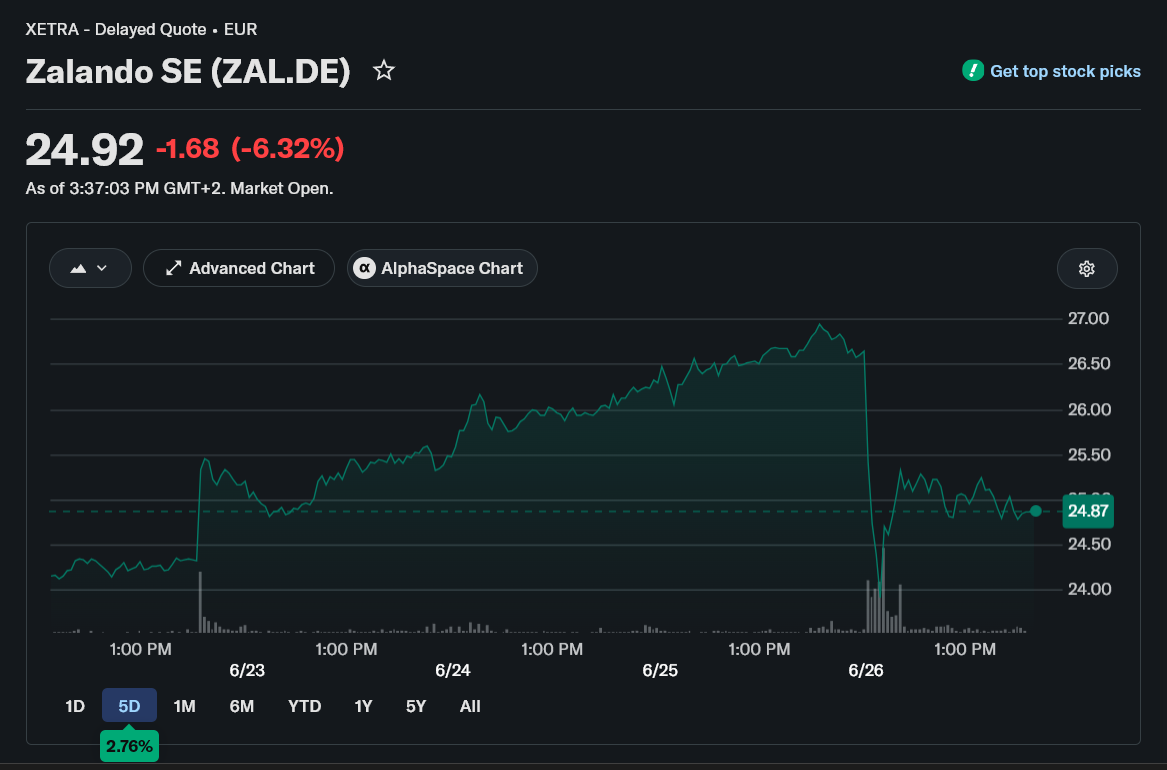
Popular fashion giant Zalando’s shares fell about 7% on June 26 after Germany’s financial regulator, BaFin, opened a formal review of the company’s 2025 financial statements.
The investigation is linked to Zalando’s acquisition of ABOUT YOU, the German online fashion retailer it bought in 2025 for about €1.2 billion. BaFin said there are signs that Zalando may have failed to include required information about a related-party transaction in its financial notes.

A Small Disclosure Issue Spooks Investors
A related-party transaction usually means a deal involving people or companies connected to the business. These disclosures matter because they help investors understand whether a company has been transparent about important financial relationships.
BaFin said the investigation does not mean Zalando has done anything wrong. Its auditors will review the accounts and publish the result once the process is complete.
The announcement still hit investor confidence. Zalando shares dropped as much as 8% in early trading before recovering slightly. By the close, the stock was down around 7%, trading near €24.72.
Zalando pushed back against the concern. The company described the issue as “purely formal and materially insignificant” and said it is in “close and constructive dialogue with BaFin.”
It also said the relevant acquisition details were already publicly available through the official takeover process, which finished in July 2025.
The timing is awkward for Zalando. The company posted a net loss of €87.6 million in the first quarter of 2026, compared with a profit a year earlier. Costs linked to the ABOUT YOU deal and restructuring weighed on results.
Still, revenue rose 23.8% year-on-year to €2.99 billion, and Zalando kept its full-year guidance unchanged.
For now, the main issue is uncertainty. Investors will watch BaFin’s review closely, even if the company says the matter is minor.
The post Zalando Shares Fall 7% After BaFin Launches Accounting Probe appeared first on BeInCrypto.


A blue-check account on X falsely claimed to be a freshly fired Coinbase product manager, earning nearly 200,000 views within hours. The meme fit perfectly into crypto investors’ predispositions yesterday with irresistible confirmation bias.
Yesterday, bitcoin and ether hit 52-week lows. Base, Coinbase’s blockchain, was down for roughly two hours. Everything was going down.
The account jokingly explained that Coinbase fired Ravi Riley as “a non-technical PM on the Base sequencer team and my first PR got merged to prod at noon.” Multiple trackers confirmed the roughly two-hour outage, even though it was not caused by Riley, who was never a Coinbase employee.
The memetic implication was that a new hire had crashed Base and then was marched out.
It is, after all, too easy to dunk on Coinbase. The company is the largest publicly traded crypto company and probably has the largest US customer base on social media.
Another Coinbase outage after Brian Armstrong fired workers
Yesterday’s meme traces its origin to at least May 5.
Early in the morning on that day, founder Brian Armstrong cut 700 workers, or roughly 14% of his staff. He revoked access on the spot, before most employees started work in the morning, “Coinbase system access has been removed today. I know this feels sudden and harsh, but it is the only responsible choice given our duty to protect customer information.”
Within two days, the Coinbase website went down altogether. Although the headcount reduction was probably unrelated to that outage, it didn’t matter for many critics on social media.
Attempting to blame the layoffs on something positive, Armstrong framed the cuts as an AI-driven rebuild. Tens of millions of dollars in restructuring charges would somehow improve the business with a nebulous benefit of AI.
Layoffs, then a service outage. Armstrong’s memo had spawned a meme. “Today I was fired from Coinbase” became an instant hit.
The most popular variants claimed absurd job accomplishments, especially Coinbase operations that crypto traders hated: issuing 1099s, freezing accounts, implementing the 4H chart, and website cacheing.
As with any meme on social media, people remake it in endless variations to make Coinbase the punchline of layoffs that never literally happened as a way to make fun of Coinbase’s shortcomings.
Base outage ends, but Coinbase memes continue
Yesterday, Base resumed normal block production within about two hours. Block production stalled at 16:03 UTC after a malformed block was sequenced.
That consensus failure stopped the chain after block 47806542, according to the network’s status incident. Deposits, withdrawals, and on-chain activity all queued behind the bad block.
The official Base account said only that “Base Mainnet is currently halted while the team works on an issue with block production.” It stressed that funds were secure.
Read more: Hot air at AWS causes Coinbase outage
The timing was awkward. The stall hit hours before Base’s scheduled Beryl upgrade, set for 18:00 UTC that same day.
Anyway, the incident revived a familiar criticism. Base relies on a Coinbase-operated sequencer, so one bad block can stall the entire network. A key sequencer also caused a chain halt in August 2025, the network’s last major stall prior to yesterday.
In other words, it was easy to point a lazy finger at Coinbase for the outage. That’s what happened.
A repeat jokester makes Coinbase the punchline
Riley is a former Chainlink engineer. His post about getting fired from Coinbase mimicked the now-standard layoff-confessional format, complete with vanished Slack access and a wistful note about reflecting.
Riley is a jokester on social media and has posted another fake layoff confessional in the past.
A Community Note on X dismantled Riley’s claim: “Ravi Riley was never employed at Coinbase, as confirmed by his X bio and LinkedIn profile listing only Brookwell as current and no prior Coinbase role.” The Community Note added that his post mirrored his earlier fake firing claim about a company called Delve.
His Delve post collected 3.8 million views, a satirical jab tied to the Delve compliance scandal. His Coinbase remix kept that general format.
Despite its obvious fake content and a pending Community Note, Riley’s post remained live by early morning today.
Got a tip? Send us an email securely via Protos Leaks. For more informed news and investigations, follow us on X, Bluesky, and Google News, or subscribe to our YouTube channel.
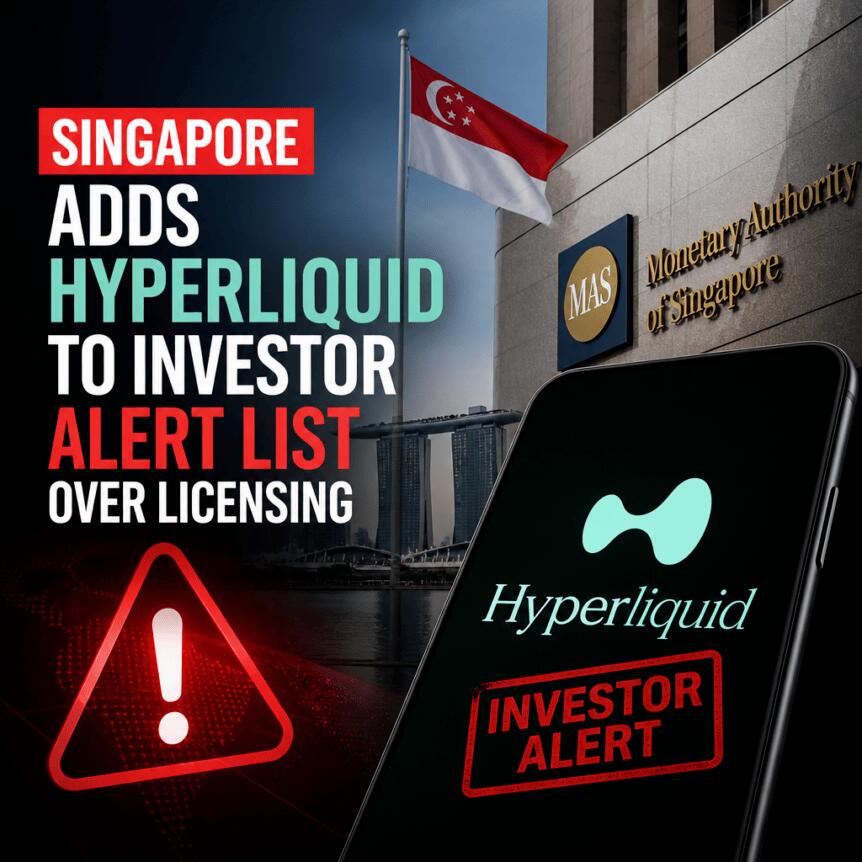
The Monetary Authority of Singapore (MAS) has added Hyperliquid—an exchange platform focused on perpetual trading—to its Investor Alert List, a consumer-protection tool used to flag entities that the public may mistakenly perceive as being licensed or authorized by the regulator.
MAS stated that the new entry covers the Hyper Foundation website and the Hyperliquid trading app. MAS previously expanded the same alert list to other crypto trading platforms, underscoring Singapore’s approach to reducing regulatory confusion and strengthening investor safeguards.
Key takeaways
- MAS added Hyperliquid and the related Hyper Foundation website/app to the Investor Alert List as a potential source of public misunderstanding about regulatory status.
- Inclusion on the Investor Alert List is not a ban and does not, by itself, indicate an enforcement action by MAS.
- MAS has recently tightened oversight of crypto firms that serve overseas customers, emphasizing licensing requirements and AML/CFT alignment.
- Hyperliquid says it has not represented itself as MAS-licensed or authorized and argues that its permissionless infrastructure has not changed.
What MAS’s Investor Alert List signals
MAS’s Investor Alert List is designed to protect consumers by identifying entities that may be wrongly viewed as licensed or regulated by the central bank and financial regulator. The regulator has repeatedly clarified that being listed does not automatically equate to prohibited activity under Singapore law.
MAS’s decision to include Hyperliquid specifies both the ecosystem’s website and the trading app. This level of detail matters for compliance teams and institutional counterparties that may perform due diligence using public regulatory signals—because alert-list entries often trigger internal review of marketing, representations, and risk controls tied to a platform’s perceived regulatory status.
MAS’s process also reflects a broader supervisory challenge in crypto: decentralized or non-traditional trading services can be difficult to categorize in conventional licensing frameworks, and customers may assume legitimacy based on branding, accessibility, or geographic association.
Hyperliquid’s response and the compliance angle
Hyperliquid said it has never claimed to be licensed or authorized by MAS. The platform added that nothing about its permissionless infrastructure has changed following the alert-list update.
From a regulatory monitoring standpoint, the statement is significant because it addresses a core risk highlighted by the Investor Alert List: whether public-facing material could lead users to believe that a platform is supervised by MAS.
For institutions—such as banks, payment providers, wealth managers, and regulated intermediaries—the practical question is not only whether a platform is “approved,” but how it is marketed and how counterparty engagements are documented. An investor alert can influence counterparty risk assessments, onboarding decisions, and ongoing third-party monitoring, particularly where customer communications or operational integration could create regulatory perception risk.
Singapore’s tightening crypto oversight: licensing and AML/CFT alignment
MAS has increasingly applied licensing and compliance expectations across the crypto sector. In May 2025, MAS ordered crypto companies serving overseas customers to either obtain licenses or cease operations. MAS described the step as consistent with its longstanding regulatory position, rather than a new shift in policy.
According to MAS, the directive closed a previously exploited gap where some Singapore-based firms avoided licensing by focusing on overseas customers. MAS said it had communicated its position since 2022 and moved to end a transition period for firms that continued operating without the required authorization.
MAS also framed its measures as part of strengthening consumer protection and aligning Singapore’s framework with international standards on Anti-Money Laundering (AML) and Countering the Financing of Terrorism (CFT). This emphasis is relevant for regulated entities assessing cross-border services, because crypto businesses may operate across jurisdictions while still relying on global infrastructure and customer access.
For compliance officers, these developments reinforce a key point: supervisory expectations can apply even where services are not marketed as being Singapore-centric, particularly when a firm’s Singapore footprint, corporate presence, or operational arrangements create regulatory reach.
Related regional context and unresolved distinctions
The use of an investor alert list, rather than immediate enforcement, highlights an important regulatory distinction in Singapore’s approach: MAS appears to differentiate between consumer-perception issues and licensing/authorization determinations. While alert-list inclusion is not itself an enforcement action, it can function as an early-warning mechanism that signals how MAS views the likelihood of public misunderstanding.
This also leaves several issues for ongoing clarification in the broader ecosystem. For example, decentralized or permissionless trading structures may challenge conventional definitions of “licensed activity,” particularly when users access the service through applications or websites tied to identifiable organizational entities. Regulators across multiple jurisdictions have grappled with how licensing obligations apply to decentralized finance interfaces, especially when consumer access is straightforward.
Separately, MAS’s enforcement posture on licensing for firms serving overseas customers suggests that jurisdictional boundaries may not shield entities from Singapore’s regulatory reach where licensing obligations attach through corporate structure or operational presence.
What to watch next
Hyperliquid’s alert-list addition is unlikely to settle questions about licensing classification or the regulatory treatment of permissionless services, but it does raise near-term compliance considerations for institutions engaging with or referencing the platform. MAS’s broader enforcement direction—especially around licensing obligations and AML/CFT expectations—will remain the key factor shaping how similar platforms are assessed in future regulatory updates.
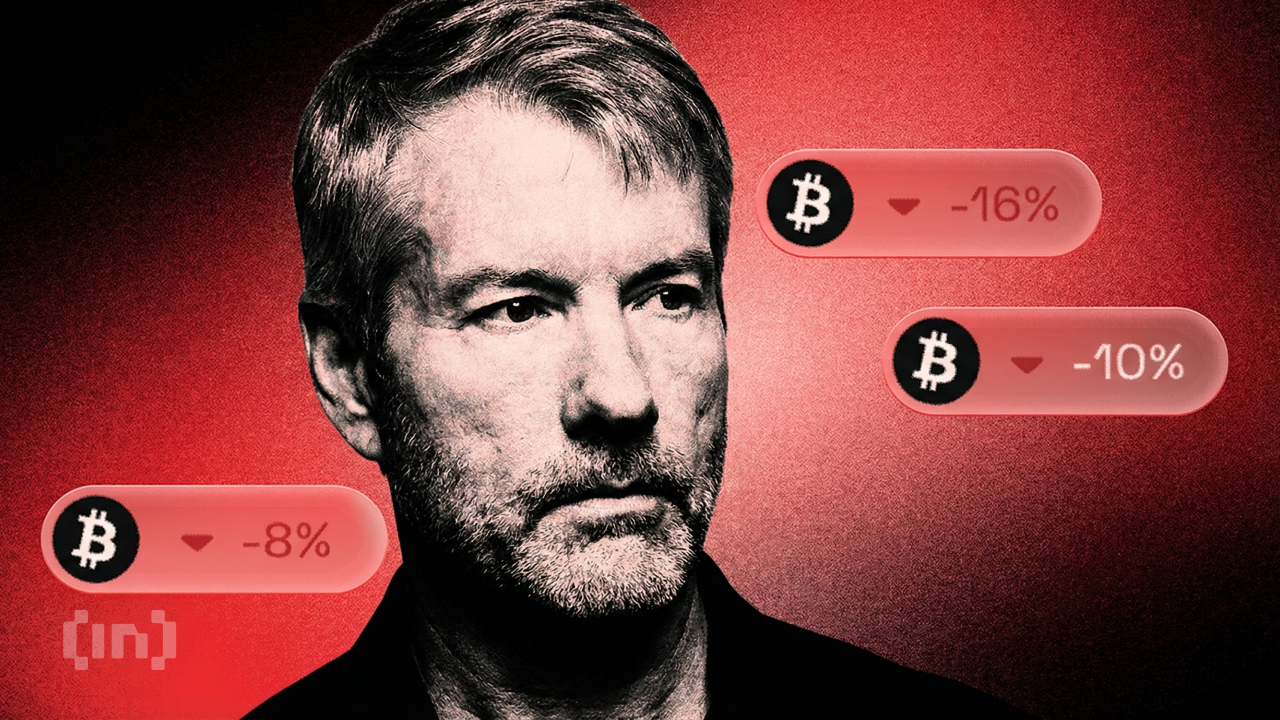

Michael Saylor broke his public silence on June 26 with a post on X reaffirming Strategy’s commitment to Bitcoin, as the company faces a securities investigation and widening pressure across its capital structure.
Rosen Law Firm launched the probe, examining whether Strategy executives made materially misleading statements across five linked securities. The company has issued no formal response.
Saylor Doubles Down on Bitcoin Focus
On X, Saylor offered no direct comment on the probe. Instead, he framed volatility as a structural test. He signaled continued commitment to credit quality and long-term value creation.
The statement is notable for what it omits. It makes no mention of the class action interest gathering around the firm or the sharp declines across Strategy’s preferred securities. Saylor focuses on capital discipline, a message directed at both equity holders and creditors.
Strategy holds 847,363 Bitcoin (BTC), more than 4% of all Bitcoin that will ever exist. Its average acquisition cost sits near $75,500 per coin, well above current prices. That gap compressed the MSTR premium investors once paid for leveraged Bitcoin exposure. It also sharpened scrutiny on how the company continues to fund new purchases.
Strategy built much of that position through multiple classes of publicly traded preferred stock. Those instruments now sit under pressure as Bitcoin prices weaken and investor confidence in the dividend model erodes.
Market Pressure Tests That Conviction
The day before Saylor posted, critic Peter Schiff escalated his criticism of Strategy’s declining market performance.
He argued MSTR has fallen 84% from its all-time high. Schiff also noted that STRC dropped 25% from par, now carrying an implied yield of 15.3%. Saylor’s post served as an indirect rebuttal to those attacks without addressing them directly.
Questions about STRC’s long-term sustainability have grown sharper. The preferred stock’s dividend structure costs an estimated $1.2 billion annually. Strategy disclosed a $1.4 billion cash reserve on June 22, barely a year of cover at current rates.
Whether Saylor’s reaffirmation steadies investor confidence or the probe escalates into a formal complaint may define Strategy’s near-term trajectory.
The post Michael Saylor Reaffirms Bitcoin Bet Amid Strategy Legal Pressure appeared first on BeInCrypto.

New York Mets fire manager Carlos Mendoza after six-game losing streak

Katie Price sends desperate plea for her missing cat days after another pet death

10 Cybersecurity Companies Leading the Fight Against Modern Threats


-

 Fashion7 days ago
Weekend Open Thread: Miami – Corporette.com
-

 Entertainment6 days ago
Renter of Home in Anne Heche Crash Denies Settlement With Son
-
 Sports3 days ago
Two goals and an assist by sheer aura: Cristiano Ronaldo just entered the World Cup chat
-

 Tech4 days ago
Microsoft accidentally kills epic Outlook email threads
-

 Business6 days ago
Soccer-U.S. defends Iran World Cup travel restrictions, says discussions ongoing
-

 Politics9 hours ago
The House | Manchesterism won’t survive the painful trade-offs unless it gets citizens on board
-

 Politics13 hours ago
Potential 2028er World Cup attendee leaderboard
-

 Politics6 days ago
Andy Burnham and the meaning of Makerfield
-

 NewsBeat7 days ago
Keir Starmer Allies Question His Chances For No 10
-

 Tech19 hours ago
A Look At A Gaggle Of Transputer Boards
-
Crypto World2 days ago
Bitcoin (BTC) Dips Below $62K, Ethereum (ETH) Plunges 6% Daily: Market Watch
-

 Crypto World2 days ago
Securitize Wraps Roubini's SEC-Registered ETF as Dubai VARA Digital Security
-
 Crypto World21 hours ago
Dell (DELL) Shares Tumble Over 5% Following Analyst Downgrade to Hold
-
Business3 days ago
Entergy settles forward sale agreements, raises $672 million in cash proceeds
-
 Business6 days ago
Wall Street Week Ahead: Investors see Micron earnings as pulse check of AI rally momentum
-
 Crypto World6 days ago
Can Charles Hoskinson Really Rescue Cardano?
-

 Entertainment6 days ago
Jose Alvarado Wants Taylor Swift at More Knicks Games
-

 Crypto World7 days ago
HIVE shares jump as $220M AI deal speeds Bitcoin mining pivot
-

 Crypto World6 days ago
Jake Chervinsky accuses CME of protecting derivatives monopoly
-

 Sports1 day ago
India vs Bangladesh LIVE Score, Women’s T20 World Cup: Bangladesh Opt To Bat; India Enter ‘Do-Or-Die’ Stage As Semi-Final Race Heats Up
You must be logged in to post a comment Login