
Crypto World
World opens Solana prediction market to 1M users



World has opened its standalone Solana prediction market platform to more than 1 million waitlisted users after creating over 150,000 markets through its Phantom integration.
Summary
- More than 1 million waitlisted users can now access World through its standalone website.
- Over 150,000 markets have been created across sports, crypto, politics, finance, economics, and culture.
- Chainlink Data Streams and its Runtime Environment provide market data and automate contract resolution.
- World plans to introduce equity, commodity, and weather markets after the initial launch.
World gives waitlisted users direct market access
World said in a Sept. 9 announcement that world.xyz now gives more than 1 million waitlisted users direct access to its prediction markets, extending the service beyond the Phantom wallet where it has operated since July.
The initial selection covers every NFL regular-season game, seven soccer leagues, and Formula 1. Contracts tied to the 2026 U.S. midterm elections and the Federal Reserve’s upcoming policy decision are also available, placing political and economic events alongside sports and crypto markets.
Each market offers “yes” and “no” contracts priced between $0 and $1. Their prices represent the market’s assessment of whether an event will occur, while the final result determines which contract settles at $1 and which expires at $0.
Users settle trades with CASH, the dollar-backed stablecoin used inside Phantom. World operates as a non-custodial protocol, meaning it does not take custody of customer funds, while orders are routed to liquidity providers operating on Solana.
Unlike a conventional brokerage or centralized crypto exchange, World does not require users to open a brokerage account or register with an exchange. Phantom users still need enough funds to cover Solana network fees when opening or closing positions.
World’s service had already supported positions through Phantom before the standalone site went live. According to the company, users have opened positions through the prediction market service since June 1, 2026, while the wallet integration became publicly available in July.
The platform has not disclosed its first-day trading volume, open interest, or fee structure. Without those figures, its initial share of prediction market activity cannot yet be compared with established venues such as Kalshi and Polymarket.
Chainlink automates World market resolution
Chainlink Data Streams and the Chainlink Runtime Environment supply World with market data and automated resolution tools. Once a game finishes or another specified event reaches its deadline, the system can determine the result and settle the related contracts.
Using automated data removes the need for a human resolution panel or a vote among token holders. World said older oracle designs can also include dispute periods that delay settlement, while its Chainlink setup is designed to process outcomes from defined data sources.
Chainlink Labs Chief Business Officer Johann Eid linked World’s waitlist of more than 1 million users to demand for prediction markets built on Solana. According to Eid, Chainlink provides the data and infrastructure needed to resolve markets quickly and efficiently.
A similar model has already appeared elsewhere in the sector. In May, Myriad integrated Chainlink Data Streams and the Runtime Environment to automate the creation, resolution, and settlement of markets tied to BTC, ETH, BNB, and SOL.
Myriad also announced plans to extend its service to stocks, commodities, and other real-world assets. Its adoption showed how Chainlink’s infrastructure can coordinate external data with on-chain settlement without relying on a single manual decision-maker.
For World, the system supports contracts across categories that resolve in different ways. Sports markets require verified final scores, Federal Reserve contracts depend on official policy decisions, and election markets need confirmed results under predetermined settlement rules.
Solana keeps World liquidity onchain
Solana Foundation Head of DeFi Ramzy Ali said World introduces another type of tradable product to the network while keeping its liquidity within Solana’s on-chain economy.
Ali described the platform as “introducing a new asset class to Solana and keeping 100% of the liquidity onchain.”
World routes orders to Solana liquidity providers instead of managing trades through an off-chain order book controlled by the platform. According to the announcement, the arrangement allows capital committed to its markets to remain within the Solana network.
The standalone launch also places World among a growing group of prediction market providers competing for retail activity. Prediction market volume across Kalshi, Polymarket and Polymarket US reached a record $50.59 billion in July, according to data reported in August.
Kalshi accounted for $37.7 billion of the total, while Polymarket’s international and U.S. platforms generated a combined $12.9 billion. The figures represented notional trading volume rather than deposits or exchange revenue because contracts can change hands several times before settlement.
World has not provided comparable turnover data for the more than 150,000 markets created through its service. Its disclosed market count measures the number of contracts launched, not the amount of money traded or the number of active customers.
Access remains available through world.xyz and inside Phantom on iOS, Android, and desktop. Phantom states that prediction markets are offered only in jurisdictions where they are supported, although the launch announcement did not provide a country-by-country availability list.
U.S. access depends on local prediction market rules
World’s inclusion of NFL games and the 2026 midterm elections gives the platform a direct connection to U.S. events, but listing an American event does not establish that users in every U.S. state can trade it.
Prediction market access in the country remains subject to disputes over federal derivatives oversight and state gambling laws. The Commodity Futures Trading Commission regulates designated contract markets, while several state authorities contend that sports and election contracts can fall under their own gaming rules.
In September, conflicting Kalshi rulings had produced different outcomes in federal appellate courts. The Third Circuit allowed an injunction protecting Kalshi from New Jersey enforcement to remain in place, while the Ninth Circuit permitted Nevada regulators to enforce state gaming requirements as litigation continued.
New Jersey subsequently asked the U.S. Supreme Court to review whether the Commodity Exchange Act prevents states from applying sports-gambling laws to event contracts listed by a CFTC-regulated exchange. The petition does not mean the Supreme Court has agreed to hear the dispute.
World has not said that it operates a CFTC-registered exchange, nor has it identified which of its contracts are accessible to U.S. residents. Its jurisdiction notice therefore remains important for American users considering markets tied to sports, elections, or Federal Reserve decisions.
After the standalone rollout, World plans to add equity up-and-down contracts. Commodity markets covering gold, silver, oil, natural gas, and computing capacity are also planned, followed by weather contracts tied to major cities.

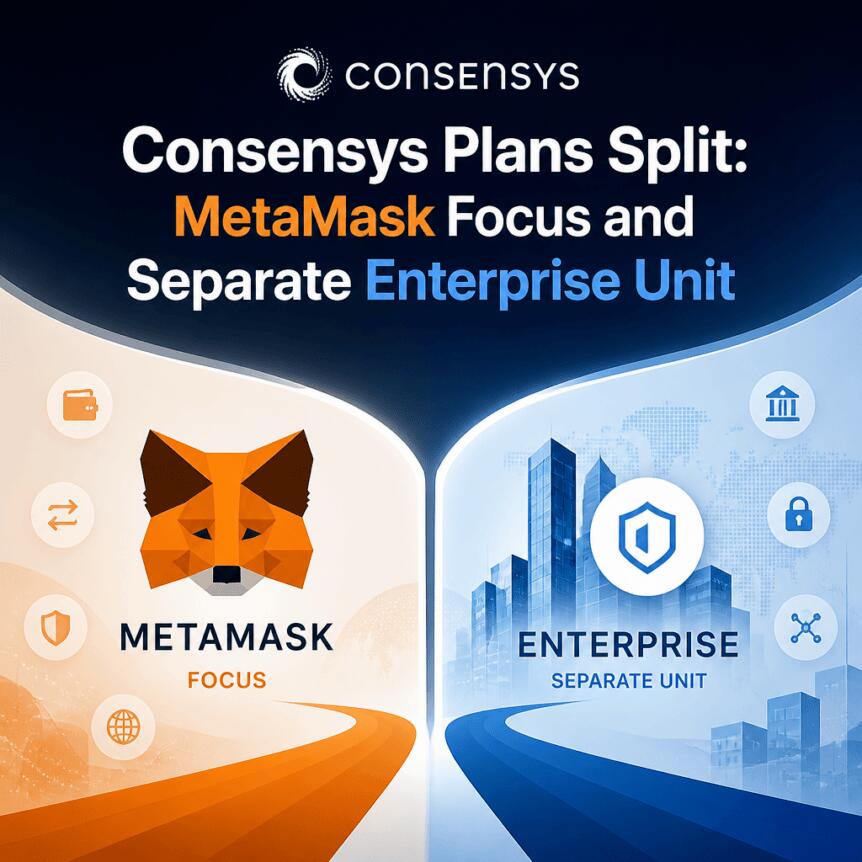
Consensys Software Inc., the Ethereum-focused company best known for MetaMask, plans to split into two standalone businesses—separating its consumer-oriented MetaMask platform from its institutional infrastructure and protocol operations. The company says the restructuring is expected to be completed by the end of 2026, with MetaMask led by Joe Lubin as chairman and CEO of the consumer company and Lubin also serving as executive chairman of the reorganized Consensys.
In the new structure, the remaining Consensys entity will focus on Ethereum protocols and institutional infrastructure. Its portfolio includes Linea, Besu, and Teku, and leadership will be handled by CEO Mike Kriak and President David Cunningham. The company frames the move as a response to diverging priorities between consumer products and enterprise blockchain deployment.
Key takeaways
- Consensys will split into two independent companies by the end of 2026, separating MetaMask’s consumer business from institutional infrastructure and protocols.
- MetaMask will stay focused on self-custody for users, while expanding into broader finance use cases such as payments, savings, and investing products.
- The new institutional Consensys will concentrate on Ethereum infrastructure and enterprise adoption, including tokenization and stablecoin-related services.
- Consensys says the consumer and institutional units have increasingly “different priorities,” a key justification for the corporate restructuring.
How the split reshapes Consensys’ operating model
According to Consensys’ announcement released via Business Wire, the company’s planned separation aims to give each business line room to pursue distinct strategies. In practice, the restructuring divides what has historically been one integrated Ethereum software ecosystem into two corporate entities with separate leadership teams and clearer mandates.
Consensys says the institutional company will house its protocols and enterprise infrastructure businesses, explicitly including Linea, Besu, and Teku. The stated focus goes beyond protocol development alone, extending to helping financial institutions deploy onchain capabilities for tokenization, stablecoins, and other onchain financial services.
Meanwhile, MetaMask is positioned as the home for consumer self-custody and a widening set of products meant to interact with mainstream financial activities. The company’s framing suggests a continued push for MetaMask to operate as more than a wallet—an interface through which users can access payment and investment-like functionality—while the enterprise-focused Consensys entity advances infrastructure and institutional use cases.
MetaMask’s expansion beyond a browser extension
MetaMask began in 2016 as an Ethereum browser extension for accessing decentralized applications and managing crypto assets, according to Consensys’ own historical account of the platform’s evolution. Over the past year, the company says MetaMask has added products that extend its role into payments, yield, and tokenized traditional assets.
One of the most notable developments described in the company’s coverage is the launch of MetaMask Money Account in June. The feature allows users to earn “up to 4% variable APY” on eligible mUSD stablecoin balances and spend those funds using the MetaMask Card. Consensys indicates that the yield is sourced from decentralized finance lending strategies rather than interest paid by MetaMask itself or by the stablecoin issuer.
In February, Consensys also pointed to MetaMask adding access to tokenized US stocks, exchange-traded funds, and commodities through Ondo Global Markets for eligible users outside the United States, referencing coverage that discussed the availability of 200 tokenized instruments. Later in February, it expanded MetaMask’s Mastercard-enabled spending card across 49 US states, building on earlier availability in other regions including Europe, Canada, Mexico, Brazil, and Argentina.
Taken together, these product moves help explain why Consensys’ leadership appears to be treating the consumer business as something that increasingly looks like a retail financial application layered over Ethereum infrastructure, rather than a pure crypto tooling product.
Why Consensys says the separation makes sense now
Consensys states that the restructuring reflects increasingly different priorities between its consumer and institutional businesses. While the announcement is explicit about what each company will contain and what each will pursue, the underlying implication for investors and industry observers is that the risks, regulatory pressures, and product timelines for consumer finance features may differ sharply from those tied to enterprise protocol infrastructure.
The institutional unit’s focus—helping financial institutions deploy blockchain technology for tokenization and stablecoins—suggests a nearer-term path centered on integrations, enterprise adoption cycles, and infrastructure reliability. By contrast, MetaMask’s consumer roadmap described in the company’s rollout includes yield-bearing stablecoin access and card-based spending, areas that typically demand a strong user experience and careful alignment with payment rails and consumer-facing compliance expectations.
Separating the companies could therefore reduce internal tradeoffs: product teams can pursue roadmaps optimized for their user segments without competing for shared corporate bandwidth. It also creates a more straightforward way to evaluate each business line independently once the split is completed at the end of 2026.
What to watch as the companies operate independently
With completion targeted for the end of 2026, the most immediate question for users and builders is how the split affects product continuity—especially for MetaMask features that rely on Ethereum infrastructure and for institutional tools such as Linea, Besu, and Teku.
For the consumer side, attention will likely focus on whether MetaMask’s card, savings/yield functionality, and access to tokenized traditional assets continue expanding on a timeline comparable to the past year’s rollouts. For the enterprise side, the market will watch whether the reorganized Consensys institution continues to accelerate its work on deploying Ethereum infrastructure for tokenization and stablecoin use cases in collaboration with financial institutions.
In the months ahead, readers should look for clarifications from Consensys on how assets, roadmaps, and leadership responsibilities will transition through the separation process—because the core operational details will determine how smoothly both MetaMask’s consumer ambitions and the institutional unit’s infrastructure focus can scale after the split.

How Iceland responded to Trump’s U.S. takeover map
Iceland’s foreign ministry said Tuesday that Foreign Minister Thorgerdur Katrín Gunnarsdóttir had summoned Long to “convey a clear message that the image was wholly inappropriate.”
Gunnarsdóttir told reporters that “people within the U.S. administration” had advised her to “not take the current U.S. President literally.”
“But we should take him seriously,” she added. “That is exactly what we are doing, and we are stressing that Iceland is a sovereign, independent state that is responsible for its own future.”
Long had previously joked about an American takeover of Iceland. In January, he was overheard telling lawmakers on the House floor that Iceland could become the 52nd state with him as the governor. At the time, Iceland’s foreign ministry said it was investigating the matter.
Long later apologized, telling news site Arctic Today that “there was nothing serious about that, I was with some people, who I hadn’t met for three years, and they were kidding about [U.S. special envoy to Greenland] Jeff Landry being governor of Greenland and they started joking about me and if anyone took offense to it, then I apologize.”


The September 15 upgrade brings smart contracts, an AMM DEX, and RPC infrastructure to a chain that has never processed a single swap. Seven years of mobile mining come down to whether anyone builds on the other side.
Summary
- Protocol 27 activates on Pi mainnet September 15, delivering smart contract authentication, an AMM DEX module, and public RPC server infrastructure to a chain whose total DeFi TVL is currently zero dollars.
- Only 16.6 million of Pi’s 60 million engaged Pioneers have completed migration to mainnet, a 27.6% conversion rate that leaves nearly three quarters of the network’s claimed user base locked out of every Protocol 27 feature.
- Pi trades at $0.098 with a market cap of $1.09 billion, down 96.7% from its $2.99 all-time high, on daily volume of just $7.85 million, a liquidity profile thinner than most top-200 tokens.
- The Pi Launchpad testnet trial drew 242,000 participants and 15.92 million Test-Pi in commitments for its first project SLICE, but no mainnet launch date has been announced and testnet participation does not guarantee real capital deployment.
- SocialChain Inc. has quietly repositioned Pi’s 1.09 million KYC validators and their 526 million completed verification tasks as “human infrastructure for AI,” a pivot toward AI training data production that no competitor is covering but that reframes the entire economic thesis of the network.
The most interesting thing about Pi Network is not the protocol upgrade scheduled for September 15. It is the gap between what Pi says it has built and what anyone can actually use.
Protocol 27 will activate smart contract authentication, an automated market maker DEX, and RPC server infrastructure on a mainnet that currently supports none of those things. On paper, this is the moment Pi transitions from a token distribution experiment to a functional Layer 1. In practice, the upgrade lands on a network where the DEX has only ever run on testnet, where 73% of claimed users have not migrated, and where daily trading volume would not fill a mid-tier Uniswap pool. The next ten days will answer a question that seven years of mobile mining have deferred: is there anything on the other side of the tap?
This piece maps the technical payload of Protocol 27, stress-tests the migration and liquidity numbers, examines the AI pivot that SocialChain has been building in plain sight, and measures the gap between Pi’s infrastructure claims and their on-chain evidence.
What Protocol 27 actually ships
The upgrade arriving September 15 is the second major protocol activation in less than two months. Protocol 27 bundles three components that collectively turn Pi from a transfer-only chain into something that could theoretically support decentralized applications.
First, smart contract authentication. Pi’s mainnet has operated without programmable contract deployment since its February 2022 launch. Protocol 27 introduces an authentication layer that gates which contracts can execute on-chain, a design choice that preserves SocialChain’s control over what gets deployed while technically enabling third-party code.
Second, an AMM DEX. The decentralized exchange module has lived on Pi’s testnet since early 2026 but has never processed a mainnet transaction. Protocol 27 migrates it to production. The critical unknown is whether the DEX will launch with open trading pairs or remain restricted to SocialChain-approved assets.
Third, RPC server infrastructure. Without public RPC endpoints, external developers cannot query the chain, index data, or build interfaces that interact with Pi without running a full node. Protocol 27 adds this plumbing.
The foundation was laid by Protocol v25, which activated July 22 and introduced BN254 elliptic curve cryptography, Poseidon hashing, and zero-knowledge proof support. Those are prerequisites for the contract verification system that Protocol 27 depends on. The two upgrades are sequential, not independent.
What is missing from the Protocol 27 changelog matters as much as what is included. There is no mention of permissionless contract deployment. There is no timeline for removing the authentication gate. The DEX module ships, but SocialChain has not published fee structures, liquidity provider incentives, or market-making parameters. These are not minor details. They determine whether Protocol 27 produces a functioning DeFi ecosystem or a controlled demonstration environment.
The migration wall
Pi claims 60 million engaged Pioneers. Only 16.6 million have completed mainnet migration. That 27.6% conversion rate is the single most important number in Pi’s ecosystem, and it is rarely discussed with the seriousness it deserves.
Migration requires KYC verification, wallet creation, and an active confirmation step. Pi has built an internal KYC network of 1,094,680 human validators who have processed over 526 million verification tasks. The infrastructure exists. The bottleneck is not capacity. It is willingness.
Three explanations compete for why 43.4 million Pioneers have not migrated. The charitable reading: many are casual users who downloaded the app, tapped the mining button a few times, and moved on. The critical reading: migration requires identity verification that some users in Pi’s global base cannot or will not complete. The structural reading: users who mined Pi for years watched it lose 96.7% of its value after exchange listings and decided the migration effort was not worth the outcome.
Whatever the cause, the effect is concrete. Protocol 27’s smart contracts, DEX, and developer tools arrive on a network where nearly three quarters of the claimed user base cannot interact with them. The 16.6 million migrated wallets represent the actual addressable market for anything built on Pi after September 15.
For context, Solana has roughly 1.8 million daily active addresses. Polygon has about 400,000. Raw wallet counts and active usage are different metrics, and Pi has not published daily active address data. The 16.6 million figure counts wallets that exist, not wallets that transact.
A DEX with no volume and a launchpad with no launch
The AMM DEX that Protocol 27 brings to mainnet has a testnet history and a mainnet void. No swap has ever been executed on Pi’s production chain. No liquidity pool has ever held real Pi tokens. The DEX module arrives with zero proven demand.
On testnet, the Pi Launchpad ran its first trial with SLICE, attracting 242,000 participants who committed 15.92 million Test-Pi. Those numbers sound encouraging until you remember that testnet tokens are free. Committing Test-Pi costs nothing and proves nothing about real capital deployment. The jump from testnet participation to mainnet liquidity provision has killed more DeFi launches than bad tokenomics.
Pi’s mainnet trading volume tells the liquidity story more directly. At $7.85 million in daily volume across Kraken, OKX, and smaller venues, Pi moves less capital per day than tokens ranked in the 300s by market cap. The token unlock schedule compounds this: approximately 1.21 billion Pi tokens are set to unlock through 2026, roughly 6.5 million per day. That is a constant sell pressure of about $637,000 daily at current prices, absorbed by a market that trades under $8 million.
The DEX needs to solve a bootstrapping problem that every new chain faces, but with a specific handicap. Pi’s user base was built on mobile mining, an activity that required no capital outlay and no DeFi literacy. Converting tap-to-mine users into liquidity providers who understand impermanent loss, yield farming, and AMM mechanics is a different kind of migration, and there is no KYC validator network to help with it.
OpenPay, Pi’s payment protocol, shifted from testnet to mainnet on August 27. That is a real deployment with real transaction capability. But payments and DeFi serve different markets. OpenPay lets merchants accept Pi. The DEX needs traders who will provide liquidity, arbitrage price discrepancies, and maintain efficient markets. Those are different users with different motivations, and Pi has spent seven years cultivating the former while doing almost nothing to attract the latter.
The price tells a story the community does not want to hear
Pi trades at $0.098. Its market cap sits at $1.09 billion, ranking it 72nd. It has fallen 96.7% from its $2.99 all-time high.
The listing trajectory looked promising early. Kraken and OKX both added Pi in 2026, giving the token access to two of crypto’s largest order books. The listings did not arrest the decline. The pattern is familiar across crypto: exchange access creates a one-time price event, then fundamentals take over. Pi’s fundamentals are a 6.5 million token daily unlock against $7.85 million in volume.
The community response to the price collapse has followed a predictable arc. Early frustration gave way to narrative pivots. The current thesis circulating in Pi forums holds that Protocol 27 will catalyze a DeFi ecosystem that drives organic demand for the token, absorbing unlock pressure through staking, liquidity provision, and application usage. This thesis requires every link in a long chain to hold: the DEX must launch with sufficient liquidity, developers must build applications that generate transaction demand, users must transition from passive mining to active DeFi participation, and all of this must happen faster than 6.5 million new tokens enter circulation each day.
No chain in crypto history has executed that sequence starting from zero DeFi TVL while simultaneously running a major token unlock program. That does not mean Pi cannot be the first. It means the base rate for this outcome is zero.
526 million tasks and the quiet AI pivot
Here is the section that matters and that nobody is writing about.
SocialChain has been building something underneath the KYC verification network that extends well beyond identity checking. The company’s 1.09 million human validators have completed 526 million discrete tasks. Those tasks involve reviewing documents, matching faces to IDs, making judgment calls about verification quality, and flagging anomalies. This is, by any functional definition, a distributed data labeling workforce.
In 2026, SocialChain began explicitly framing this capability as “human infrastructure for AI.” The positioning is not subtle. At Pi2Day on June 28, the network introduced PiVerify and Pi Sign-in alongside SoloHost’s catalog of 110 applications. PiVerify extends the KYC infrastructure into a general-purpose human verification layer. Pi Sign-in creates an authentication primitive tied to verified human identity.
The AI training data market is projected to reach $30 billion by 2030. The bottleneck is not compute or algorithms. It is high-quality labeled data produced by verified humans. Companies like Scale AI and Appen built billion-dollar businesses on workforces that are smaller, more expensive, and less globally distributed than what Pi has assembled almost as a byproduct of its mining verification system.
Pi’s validators are KYC-verified, geographically distributed across 230 countries, and already trained on classification tasks. They work for Pi token rewards, not dollars. If SocialChain can redirect even a fraction of this workforce toward commercial AI data labeling, the economic model for Pi shifts from “speculative token with no utility” to “token that backs a labor marketplace with paying enterprise customers.”
This is not a guaranteed outcome. SocialChain has not announced enterprise partnerships for data labeling. The quality of Pi validator work product has not been independently benchmarked against Scale AI or Toloka standards. The compensation model, paying in Pi tokens that are down 96.7%, creates retention risk if validators decide the reward is not worth the effort.
But the structural asset is real. A million verified humans doing classification work at scale is something that money alone cannot replicate quickly. Pi’s Consensus 2026 sponsorship suggests SocialChain is actively marketing this capability to institutional audiences. Whether the market recognizes the asset before or after Protocol 27 will shape how the next chapter reads.
The centralization question that never goes away
SocialChain Inc., founded by Nicolas Kokkalis and Chengdiao Fan at Stanford, controls the Pi protocol. This is not disputed. It is architectural.
SocialChain decides when protocol upgrades activate. SocialChain determines which contracts pass the authentication gate in Protocol 27. SocialChain operates the core infrastructure. SocialChain controls the migration pipeline. In a crypto ecosystem that treats decentralization as a first principle, Pi operates closer to a corporate software platform than a public blockchain.
The network runs 420,000 Pi Node operators, a number that sounds decentralized until you examine what those nodes actually do. Pi nodes participate in consensus, but the protocol parameters, upgrade schedule, and governance decisions flow from SocialChain. Node operators execute; they do not decide. This is closer to Ripple’s relationship with XRP Ledger validators than to Ethereum’s relationship with its node operators.
The mining model draws the sharpest criticism. Pi “mining” involves opening an app and tapping a button every 24 hours. No proof of work is performed. No energy is expended. No computational resources are contributed. The referral system awards a 25% mining rate bonus for each invited user, a structure that critics characterize as multi-level marketing mechanics applied to token distribution.
Whether this matters depends on what you think blockchains are for. If decentralization is a prerequisite for a credible Layer 1, Pi fails the test and Protocol 27 does not change that. If you view Pi as a distribution mechanism that used mobile gaming mechanics to build a massive verified user base, and that user base is the actual product, then centralization is a feature that enabled scale.
The honest answer is that both framings contain truth, and the tension between them is unresolved.
The developer gap
SocialChain published new developer documentation at docs.minepi.com on September 4, eleven days before Protocol 27 activates. The timing is telling.
A healthy developer ecosystem is not built in eleven days. Ethereum had years of developer tooling, hackathons, grants, and documentation before its DeFi ecosystem found product-market fit. Solana invested heavily in developer relations and tooling before its breakout year. Pi is shipping the infrastructure and the developer documentation in the same two-week window.
The 110 apps showcased through SoloHost at Pi2Day represent the current state of Pi development. Most are simple utilities, merchant tools, and social features built on Pi’s existing transfer-only functionality. None of them require smart contracts because smart contracts did not exist on Pi mainnet until now. Protocol 27 theoretically expands the design space, but the developers who would fill that space have had no production environment to work in and no mainnet documentation to work from until September 4.
The counter-argument is that Pi’s developer community has been building on testnet for months. The SLICE launchpad trial, the DEX testing, and the various SoloHost applications represent real development activity. When Protocol 27 activates the mainnet smart contract layer, these developers will not be starting from zero. They will be deploying code that has been tested, revised, and stress-tested in a sandbox environment.
The question is scale. Testnet developers are a necessary but insufficient condition for a functioning ecosystem. Pi needs not just its existing builders but a wave of new developers who choose Pi over Ethereum, Solana, Base, Arbitrum, and every other chain competing for smart contract deployment. The developer documentation dropped eleven days before the upgrade. That is not a timeline that suggests confidence in organic developer migration.
What Pi2Day revealed about the real roadmap
The June 28 Pi2Day event is underexamined as a signal of where SocialChain is actually heading. Three announcements from that day matter more than Protocol 27 itself.
SoloHost launched with 110 applications, making it the first curated app marketplace on Pi. This is a platform play, not a protocol play. SocialChain is positioning itself as the distribution layer for Pi-native applications, taking on a role closer to Apple’s App Store than to Ethereum’s permissionless deployment model.
Pi Sign-in introduced human-verified authentication as a service. Any application, on Pi or off it, could theoretically use Pi Sign-in to verify that a user is a real, KYC-checked human. In a digital environment increasingly flooded with bots and synthetic identities, verified humanness has value independent of blockchain.
PiVerify extended this further, creating an API-accessible verification layer. The combination of Pi Sign-in and PiVerify positions Pi’s identity infrastructure as a product that can generate revenue from external platforms, not just from the Pi ecosystem.
These three products share a common thread: they monetize Pi’s user base and verification infrastructure rather than the blockchain itself. Protocol 27 adds DeFi capability to the chain, but Pi2Day suggests SocialChain’s long-term revenue model may run through identity services and the human-for-AI labor marketplace rather than through transaction fees and DEX volume.
What to watch
- DEX liquidity in the first 72 hours after Protocol 27. If total value locked does not reach $1 million within three days of the September 15 activation, the bootstrapping problem is real and the DeFi thesis needs revision.
- Migration acceleration after the upgrade. Protocol 27 gives unmigrated Pioneers a concrete reason to complete KYC and move to mainnet. Watch whether the migration rate, currently stuck at 27.6%, accelerates meaningfully in the two weeks after September 15.
- Enterprise announcements tied to the AI data labeling pivot. SocialChain needs to convert the “human infrastructure for AI” narrative into a signed contract with a recognizable enterprise customer. Consensus 2026 is the likely venue. No announcement by Q4 means the pivot is still aspirational.
- Daily token unlock absorption. Track whether DEX staking, liquidity provision, and application usage create enough demand to offset the 6.5 million daily token unlocks without continued price erosion. The math is simple and publicly observable.
- Developer deployment velocity post-Protocol 27. Count the number of unique smart contracts deployed to mainnet in the first 30 days. Fewer than 50 suggests the developer ecosystem is not ready. Fewer than 10 confirms it.
What is Protocol 27 and when does it activate?
Protocol 27 is a major Pi Network mainnet upgrade scheduled for September 15, 2026. It introduces smart contract authentication, an automated market maker decentralized exchange, and public RPC server infrastructure. These features collectively enable decentralized application development and DeFi functionality on Pi for the first time.
What was Protocol v25 and how does it relate to Protocol 27?
Protocol v25 activated on July 22, 2026 and introduced BN254 elliptic curve cryptography, Poseidon hashing, and zero-knowledge proof support. These cryptographic primitives are prerequisites for Protocol 27’s smart contract authentication system. The two upgrades are sequential, with v25 laying the mathematical foundation that Protocol 27 builds on.
How many Pi users have migrated to mainnet?
As of September 2026, approximately 16.6 million of Pi’s 60 million engaged Pioneers have completed mainnet migration, representing a 27.6% conversion rate. Migration requires KYC verification, wallet creation, and an active confirmation step. Only migrated users will be able to interact with Protocol 27 features.
What is Pi’s current price and market position?
Pi trades at approximately $0.098 with a market capitalization of $1.09 billion, ranking it 72nd among cryptocurrencies. The token is down 96.7% from its all-time high of $2.99. Daily trading volume sits at approximately $7.85 million across exchanges including Kraken and OKX.
What is the Pi token unlock schedule?
Approximately 1.21 billion Pi tokens are scheduled to unlock throughout 2026, averaging roughly 6.5 million tokens per day. At current prices, this represents about $637,000 in daily potential sell pressure. The unlock schedule is a significant factor in Pi’s price dynamics and will interact directly with any demand generated by Protocol 27’s DeFi features.
What is SocialChain’s human infrastructure for AI initiative?
SocialChain has repositioned Pi’s network of 1.09 million KYC validators, who have completed over 526 million verification tasks, as a distributed workforce for AI training data production. The validators are already experienced in classification and verification tasks, making them potential candidates for commercial data labeling work. No enterprise contracts have been publicly announced.
Who controls the Pi Network protocol?
SocialChain Inc., co-founded by Nicolas Kokkalis and Chengdiao Fan, controls Pi Network’s protocol development, upgrade schedule, and governance decisions. The network operates 420,000 Pi Node operators who participate in consensus but do not control protocol parameters. Protocol 27’s smart contract authentication gate means SocialChain will also determine which contracts can deploy to mainnet.
Is Pi Network a good investment?
This article examines Protocol 27’s technical features, the migration and liquidity data, and the strategic positioning of SocialChain’s human verification infrastructure. The token has declined 96.7% from its all-time high and faces ongoing dilution from daily token unlocks. Protocol 27 introduces functionality that could generate organic demand, but no mainnet DeFi activity exists to date. This is educational analysis, not investment advice.
Disclaimer: This article is for informational purposes only and does not constitute financial, investment, or trading advice. Cryptocurrency investments carry significant risk. Always conduct your own research before making investment decisions. Published September 9, 2026.


Robinhood CEO Vlad Tenev defended his company’s tokenized stock products on CNBC, offering his first televised comments since AMC Entertainment chief Adam Aron went public with his objections.
Aron has accused Robinhood of issuing unregistered tokens tied to AMC stock in violation of U.S. securities law, and threatened to bring in outside counsel and the SEC.
A Public Feud Over Stock Tokens
The dispute began after Robinhood extended its tokenized stock offering to cover AMC and more than 190 other companies through Robinhood Assets Limited, without those firms directly signing on.
Aron reacted furiously on X, arguing the products let Robinhood create exposure to AMC stock without the company’s involvement, undermining the usual relationship between a company and its shareholders.
“I find this practice to be contemptible, outrageous, disgusting, detestable, inexcusable, vile. How can it possibly be legal? We have no connection to this at all, and do not condone it in any way.”
— Aron
AMC’s stock jumped as much as 15% in premarket trading when the public row first broke out, with traders piling into both the shares and related tokens.
Tenev Says Issuers Cannot Control Everything
On Wednesday, Tenev told CNBC that a public company cannot dictate every financial product built once its shares start trading.
He described Robinhood’s tokens as debt securities backed one to one by the underlying shares held as collateral. Token holders get economic exposure to the stock but no voting rights in the company itself.
Robinhood’s chief legal officer, former SEC commissioner Dan Gallagher, also pushed back publicly, defending the company’s reading of U.S. securities law.
The clash raises a genuinely open question for regulators, namely whether a brokerage can wrap any public company’s stock into a tradable token without that company’s consent. AMC’s threatened SEC complaint could be the first real test of where that line sits.
The post Robinhood CEO Vlad Tenev Defends Stock Tokens After AMC Criticism appeared first on BeInCrypto.
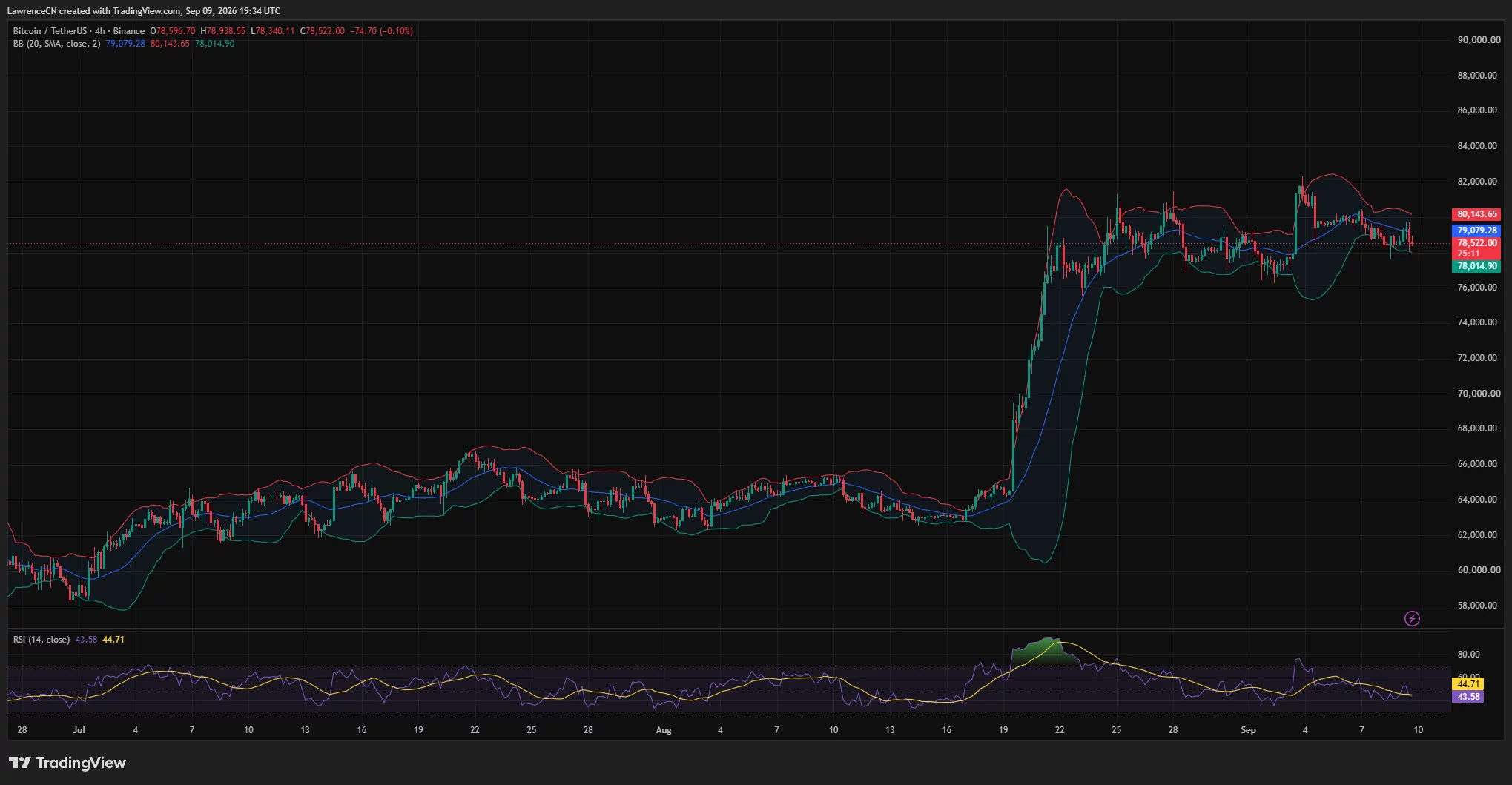
Bitcoin price remained under pressure near $78,500 after a retreat from its Sept. 3 peak of $82,283, while weakening momentum and a possible head-and-shoulders pattern raised the risk of a deeper correction.
Summary
- Bitcoin price fell about 4.6% from $82,283 to trade near $78,500.
- The 4-hour RSI stood at 43.58, showing that sellers retained a modest advantage.
- A possible head-and-shoulders pattern places $78,000–$79,000 at the key neckline.
- Liquidation clusters sit near $80,000 above price and $77,500 below it.
Bitcoin price action today
According to data from crypto.news, Bitcoin (BTC) price traded near $78,500 late on Sept. 9 after moving between approximately $78,060 and $79,760 during the daily session. The price has lost about 4.6% since reaching $82,283 on Sept. 3.
The latest decline extended a sequence of lower highs visible on the 4-hour chart. Buyers defended the area near $78,000 several times, but each rebound struggled to regain the psychological $80,000 level.
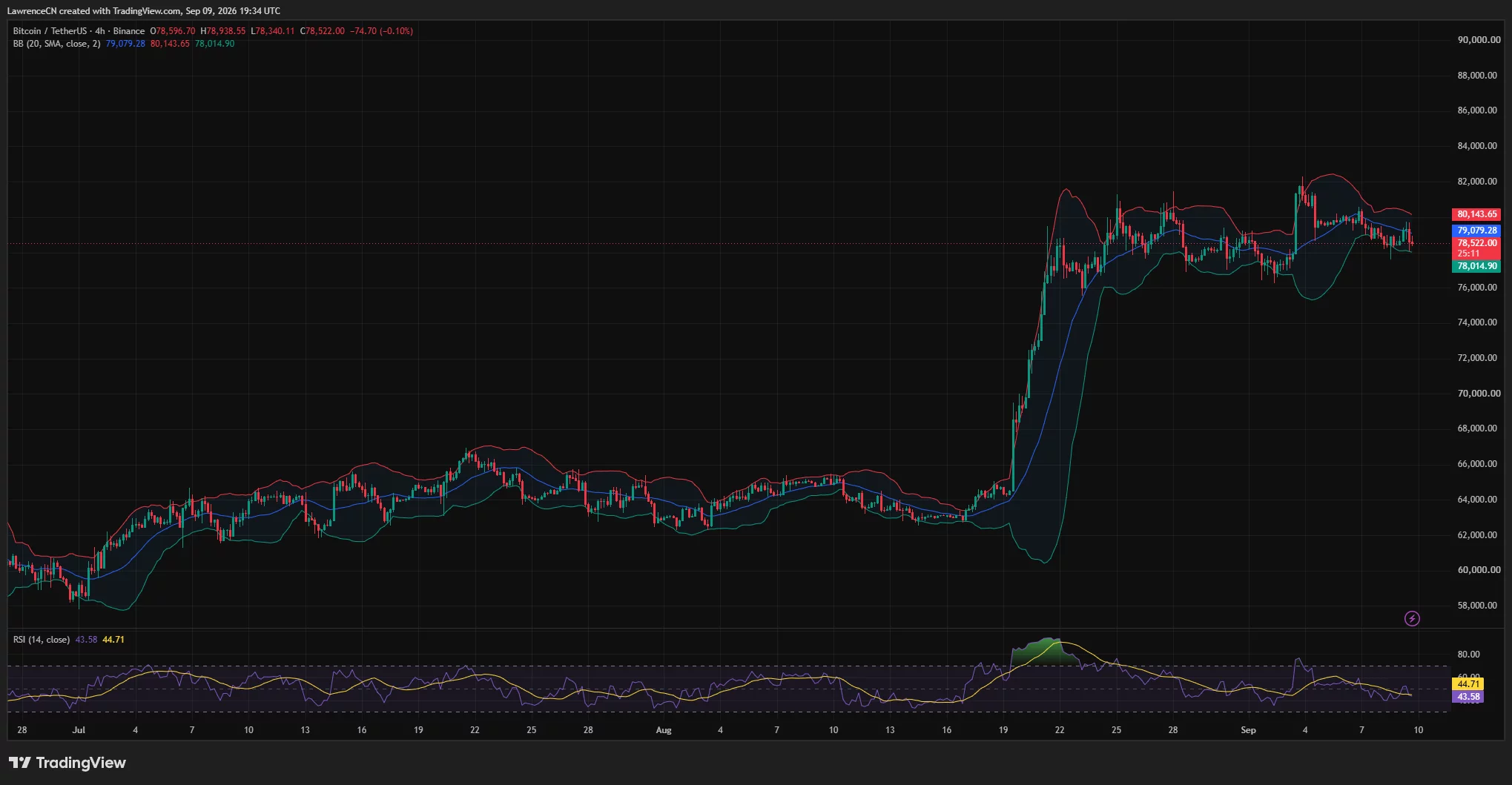
Bitcoin’s position inside the 4-hour Bollinger Bands also showed fading short-term strength. The asset traded at about $78,522, below the middle band at $79,079 and only slightly above the lower band at $78,015.
A move close to the lower Bollinger Band can indicate growing selling pressure, although the nearby support may also produce a short-term rebound. Bitcoin would need to recover above the middle band to weaken the immediate bearish setup.
The upper Bollinger Band stood near $80,144, making the $80,000–$80,150 region the first major resistance area. A close above that zone would give buyers another opportunity to challenge the recent highs around $81,500 and $82,300.
Oil and Treasury yields pressure risk assets
Bitcoin’s pullback came as escalating Middle East conflict pushed Brent crude toward $100 per barrel, reviving concerns that higher energy costs could keep inflation elevated. Brent reached $99.22 on Sept. 9, while West Texas Intermediate rose to $94.13.
Rising inflation concerns matter for US crypto investors because they can affect expectations for Federal Reserve interest rates. Higher rates and bond yields increase the returns available from lower-risk assets, creating competition for Bitcoin and other assets that do not generate interest.
Pressure also came from the US Treasury market. The benchmark 10-year yield climbed above 4.85% after the Treasury announced a $6 billion buyback operation targeting older bonds with maturities of 10 to 20 years.
The 30-year yield also reached its highest level since 2007. Rising Treasury yields can tighten financial conditions by increasing borrowing costs and reducing investors’ willingness to hold volatile assets.
Bitcoin’s decline therefore coincided with a wider reassessment of US inflation and interest-rate risks ahead of the Federal Reserve’s Sept. 15–16 policy meeting. Traders will watch incoming inflation data and oil prices for signs that the central bank may keep monetary policy restrictive.
Bitcoin technicals put $78K support in focus
The 4-hour relative strength index stood at 43.58, below both the neutral 50 mark and its signal average of 44.71. The reading showed bearish momentum without placing Bitcoin in oversold territory.
Daily indicators were less bearish. Bitcoin remained above the daily Supertrend support at $72,786, meaning the broader recovery structure had not yet been invalidated despite the latest decline.
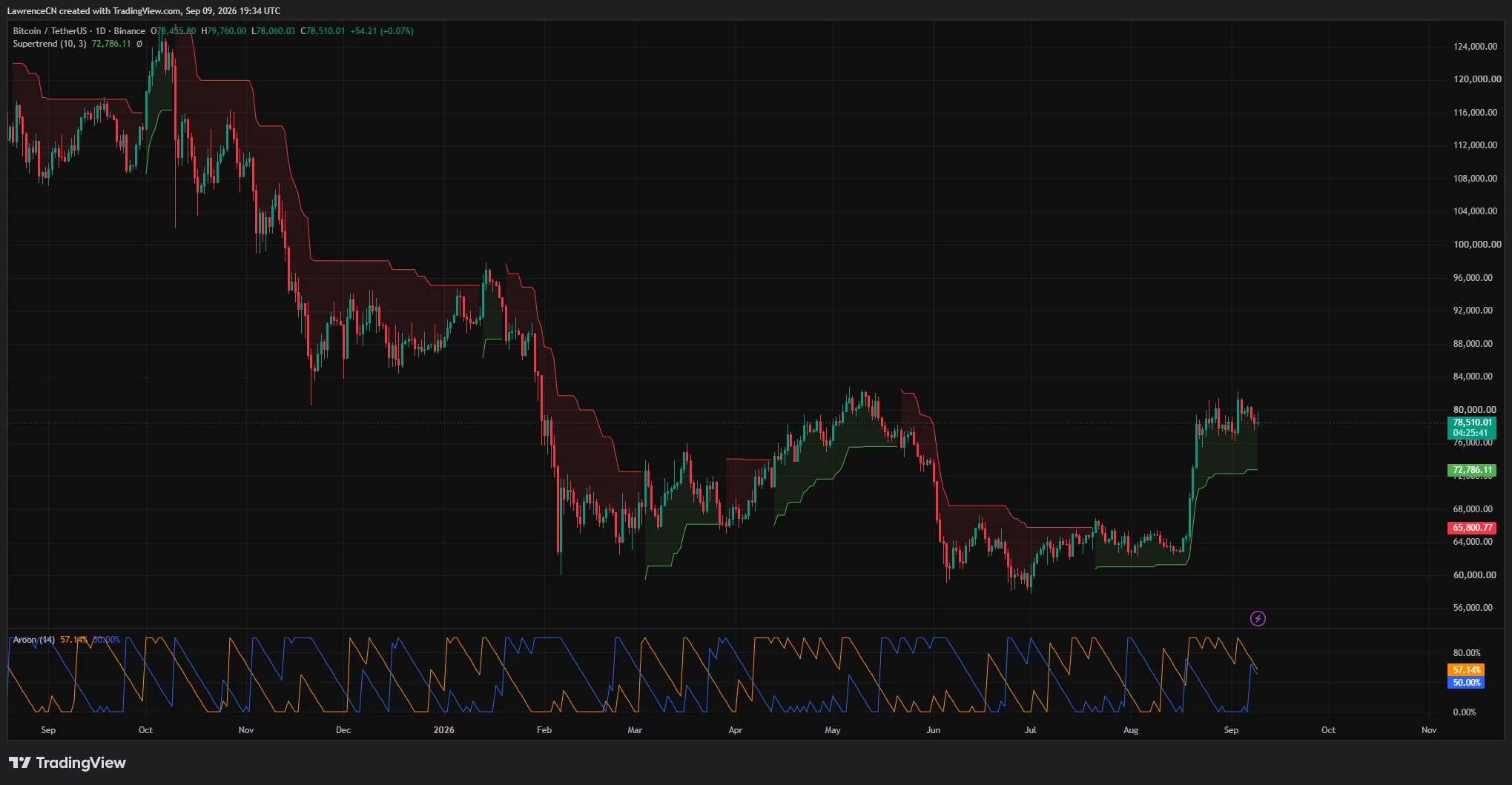
The daily Aroon readings were also closely matched, with one line at 57.14% and the other at 50%. The narrow difference showed that neither buyers nor sellers had established strong control on the higher timeframe.
Crypto analyst Gerla identified a possible head-and-shoulders structure, with the first shoulder near the late-August highs, the head around the Sept. 3 peak, and the right shoulder potentially forming during the latest rebound.
“$78K–$79K is the line in the sand. Lose that and $70K could come pretty quick,” Gerla said in a Sept. 9 post on X.
The pattern remains unconfirmed while Bitcoin holds its neckline. A decisive daily close below $78,000 would strengthen the setup and expose $76,000–$77,000 before the larger downside target near $70,000.
Liquidation heatmap shows pressure on both sides
CoinGlass’s three-day liquidation heatmap showed large concentrations of leveraged positions above Bitcoin’s current price. The strongest nearby liquidity appeared between approximately $79,700 and $80,200, with additional clusters extending toward $82,000.
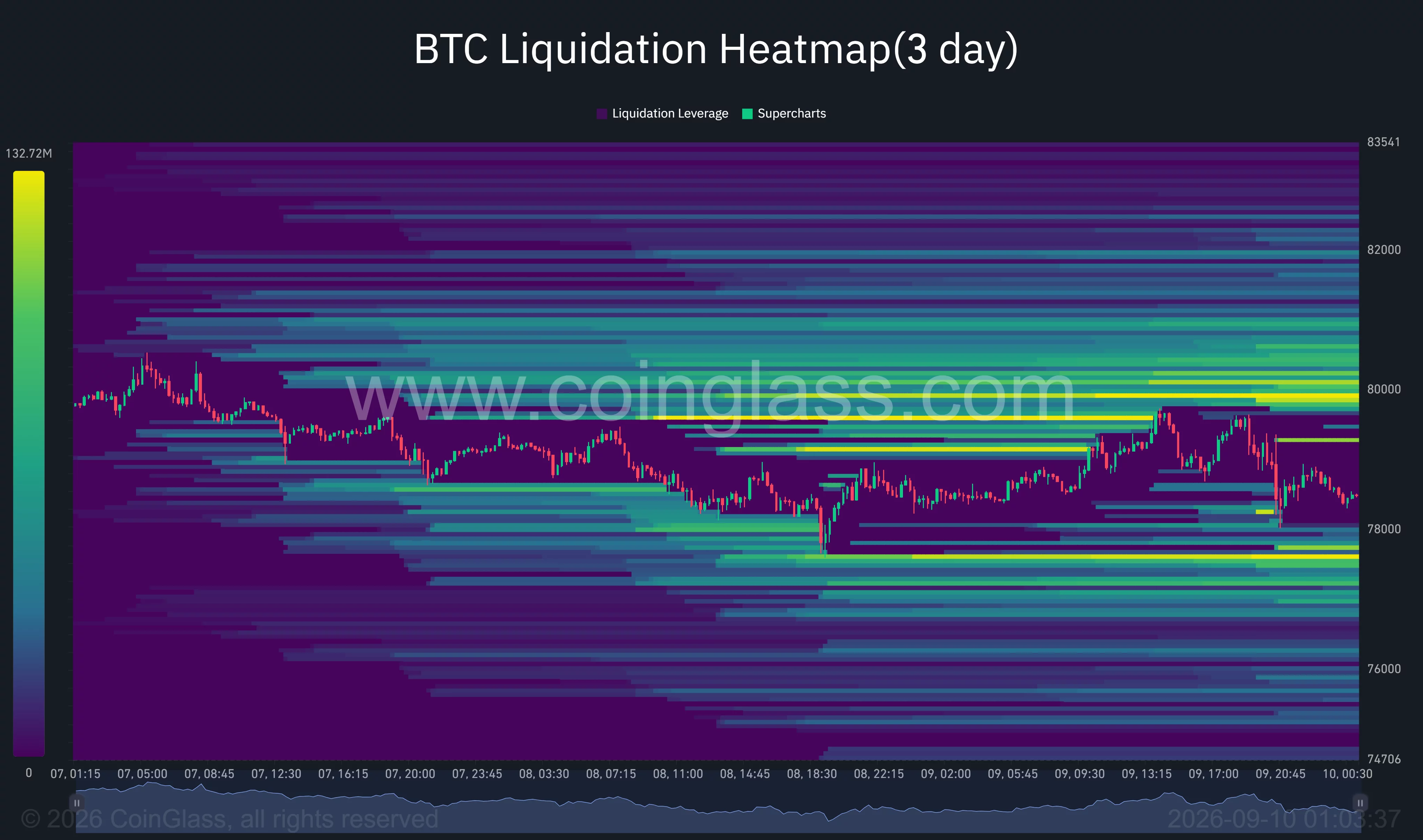
Such concentrations can attract price during periods of high leverage, although they do not guarantee that Bitcoin will move toward them. A recovery through $79,100 could trigger liquidations of short positions and help drive a test of the $80,000 cluster.
Downside liquidity was concentrated near $78,000 and between roughly $77,500 and $77,800. Losing the current support could therefore accelerate volatility as leveraged long positions are closed.
Further liquidity appeared around $76,000, broadly matching the next technical support area visible beneath the proposed neckline. The heatmap suggests that either a break above $80,000 or a loss of $78,000 could produce a sharper move as liquidations add to spot-market pressure.
Key Bitcoin levels to watch
Bitcoin’s immediate range sits between the lower Bollinger Band near $78,015 and the middle band around $79,079. Holding $78,000 would keep open the possibility of a relief move toward $79,700–$80,150.
A sustained break above $80,150 would weaken the short-term bearish structure and place $81,500 and $82,283 back in focus. Buyers would need to clear the September peak to confirm a renewed upward move.
A close below $78,000 would confirm greater weakness and shift attention to $77,500, followed by the wider $76,000–$77,000 support zone. The head-and-shoulders interpretation would gain credibility below the neckline, although the daily Supertrend near $72,786 remains an important barrier before the analyst’s $70,000 scenario can develop.
Disclosure: This article does not represent investment advice. The content and materials featured on this page are for educational purposes only.
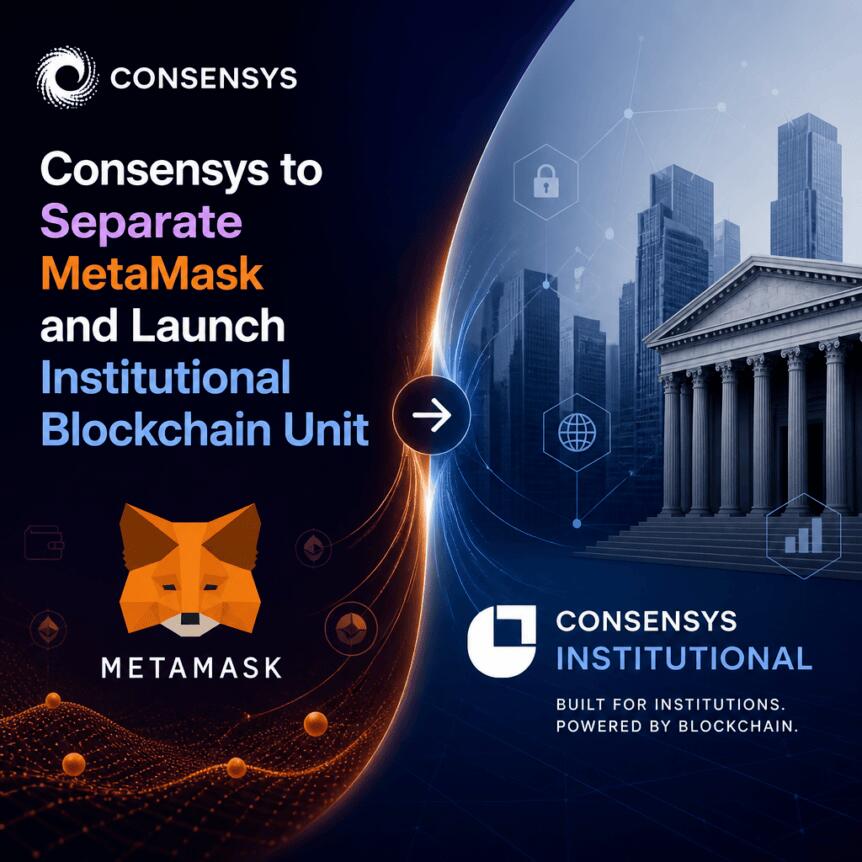
Consensys Software Inc., the Ethereum-focused firm behind MetaMask, plans to restructure by splitting its consumer-oriented business from its institutional blockchain infrastructure operations. The company says the separation is expected to be completed by the end of 2026, creating two independent companies with distinct leadership and strategic priorities.
According to a Business Wire announcement, Joe Lubin will serve as chairman and CEO of MetaMask while also taking the role of executive chairman of the new Consensys. The institutional business—focused on Ethereum protocols and infrastructure—will be led by Mike Kriak as CEO, with David Cunningham as president.
Key takeaways
- Consensys will separate into two independent firms by the end of 2026: MetaMask (consumer self-custody) and a new Consensys (Ethereum protocols and institutional infrastructure).
- The new Consensys will house Consensys’ protocol and infrastructure portfolio, including Linea, Besu, and Teku.
- MetaMask is positioned to broaden beyond a wallet into payments, savings, investing, and other traditional financial products.
- Consensys says MetaMask has surpassed 100 million downloads across about 190 countries and supported “trillions of dollars” in transaction volume.
From one umbrella to two focused companies
The planned reorganization reflects what the company describes as increasingly different objectives between its consumer-facing and institutional-facing teams. In the announcement, Consensys frames the split as a way to allow each business to pursue its own roadmap without competing for shared priorities.
Under the new structure, MetaMask will remain the centerpiece of the consumer division, with an emphasis on self-custody. Consensys also outlined that MetaMask’s expansion is not limited to crypto holdings and decentralized app access; it is intended to extend into areas such as payments, savings, and investing, as well as “traditional financial products.”
Meanwhile, the institutional infrastructure company will consolidate Consensys’ Ethereum protocol and infrastructure activities. The company says this entity will focus on Ethereum infrastructure while supporting financial institutions looking to deploy blockchain technology for tokenization, stablecoins, and other onchain financial services.
What will live under “MetaMask” vs. “the new Consensys”
Consensys’ announcement is explicit about the portfolio split. The new Consensys entity will house the company’s protocols and institutional infrastructure businesses, including Linea, Besu, and Teku.
While the announcement does not detail whether these products will change in scope after the separation, the strategic direction is clear: an infrastructure-first company designed to work with institutions, where the customer is more likely to value deployment, reliability, and enterprise integration over consumer growth metrics.
In contrast, MetaMask’s mandate centers on consumer self-custody and product-led expansion into finance-adjacent services. The company’s messaging suggests that the consumer operation will continue to evolve from a browser extension into a broader interface for onchain and finance-related experiences, including functionality connected to stablecoins and yield strategies—while remaining within a self-custody framework.
Consensys says MetaMask has been downloaded more than 100 million times across roughly 190 countries and facilitated trillions of dollars in transaction volume.
MetaMask’s push into consumer finance features
Part of the logic behind the split appears tied to how MetaMask has expanded beyond its original “wallet for decentralized applications” role. Launched in 2016 as an Ethereum browser extension, MetaMask has added new product lines over the past year, including tools associated with payments, yield, and access to tokenized real-world assets.
In June, Consensys said MetaMask launched Money Account, which it describes as allowing users to earn up to 4% variable APY on eligible mUSD stablecoin balances. The company also stated that the yield is generated through decentralized finance lending strategies rather than interest paid by MetaMask or by the stablecoin issuer.
Earlier in the year, MetaMask added access to tokenized financial products for certain users. In February, Consensys reported support for 200 tokenized US stocks, exchange-traded funds, and commodities via Ondo Global Markets, limited to eligible users outside the United States.
That same month, MetaMask rolled out a Mastercard-enabled spending card across 49 US states. Consensys said the card expanded a previously available product that had already reached markets including Europe, Canada, Mexico, Brazil, and Argentina.
Taken together, these updates help explain why a consumer-first business might benefit from separation: MetaMask’s expanding feature set increasingly resembles a consumer finance platform—while the institutional protocols business is oriented toward deployment infrastructure for enterprise and regulated use cases.
Why the split matters for builders and investors
Restructuring a major Ethereum software provider can matter beyond internal operations, because it shapes where resources and attention flow. A dedicated institutional infrastructure unit may allow teams behind Linea, Besu, and Teku to focus more narrowly on scaling, tooling, and integration work relevant to financial institutions and enterprise networks.
For investors and market participants, the split also provides clearer lines of accountability: MetaMask’s leadership and product execution can be assessed primarily through consumer adoption and the rollout of finance features, while the new Consensys can be evaluated on the delivery of Ethereum infrastructure services and institutional deployment outcomes.
At the same time, Consensys’ own framing highlights that the separation is not simply organizational—it is strategic. The company says the consumer and institutional businesses have “increasingly different priorities,” and the timeline suggests it expects those differences to become more consequential as each unit pursues its own growth and partnerships.
Readers should watch how Consensys handles continuity during the transition, especially how MetaMask’s expanded financial features and the institutional protocols roadmap will evolve up to the end-of-2026 completion target.
With the split planned but not yet finalized, the key near-term question is whether the product lines will remain consistent for users while each company sharpens its focus—particularly as MetaMask continues moving into payments and tokenized asset access, and the institutional unit deepens its work supporting stablecoin and tokenization initiatives.

Turkey’s embrace of a political process—instead of simply pursuing a decisive military path—to end the conflict made it more acceptable to the PKK leadership and the Kurdish movement. Abdullah Ocalan, the leader of the PKK, had to persuade his comrades to dissolve their organization, abandon the armed struggle, and choose political struggle. Unfavorable broader regional trends against armed militancy may have helped convince Ocalan and his comrades to make that consequential choice.
The legitimacy of the political solution, in the eyes of the Kurds, determines its sustainability and transformative impact. The current peace process seeks to end the insurgency and transform the struggle for Kurdish rights and aspirations into a nonviolent political one. It could transform Turkey’s relations with its own Kurdish community and the Kurdish communities in Iraq, Syria, and Iran. Leaders of the Kurdish movement believe that they can achieve more through politics than through armed struggle, and that it isn’t only they who are transforming, but that the state, political, and legal systems in Turkey can also change. The promise of the future, rather than being beholden to the grievances of the past, is the way forward.


Former Silvergate Bank CEO Alan Lane said political and regulatory pressure from the Biden administration drove the crypto-focused lender’s voluntary wind-down in 2023, arguing that the bank remained solvent after weathering a deposit run.
In an inaugural Substack post on Tuesday, Lane said Silvergate could have continued operating after satisfying withdrawals equivalent to 70% of its demand deposits during the fourth quarter of 2022. He argued that a “coordinated attack by the Biden Administration” ultimately led to the wind-down, saying the bank chose liquidation “in the face of political pressure.”
Lane said Silvergate had held liquid assets that could be sold or pledged as collateral during periods of heavy withdrawals. In a January 2023 business update, the bank reported that digital asset deposits fell 68% from $11.9 billion to $3.8 billion during the quarter. Silvergate sold $5.2 billion of debt securities, recording a $718 million loss. The bank said it had $4.6 billion in cash and equivalents at year-end.
Lane’s account adds a firsthand claim to the debate over whether US agencies sought to restrict crypto companies’ access to banking. However, it differs from federal findings that attributed the bank’s liquidation to its concentrated deposit base, funding risks and weaknesses in governance and compliance.
Regulators cited risk management, compliance failures
A September 2023 review by the Federal Reserve Board’s Office of Inspector General said Silvergate’s dependence on crypto depositors, rapid growth and multilayered funding risks led to its liquidation. It also cited significant weaknesses in corporate governance and risk management and said examiners could have acted more aggressively and decisively.
Lane said no regulator had proven that Silvergate’s anti-money laundering (AML) controls failed. In July 2024, the Securities and Exchange Commission (SEC) charged Silvergate Capital, Lane and former chief risk officer Kathleen Fraher with misleading investors about the bank’s AML program and monitoring of crypto customers.
The regulator alleged that Silvergate’s automated system failed to monitor more than $1 trillion in transactions and that the bank failed to detect nearly $9 billion in suspicious transfers among FTX entities.
Related: Silvergate’s Fraher breaks silence on settlement with Gensler’s SEC
Lane settled the SEC’s charges without admitting or denying the allegations, agreeing to a $1 million penalty and a five-year officer-and-director bar. Separately, the Federal Reserve fined Silvergate $43 million over transaction-monitoring deficiencies.
Lane also cited interagency crypto-risk statements issued in early 2023 as evidence of pressure against the industry. The statements urged banks to take a cautious approach to crypto-related activities, although the Fed said institutions were neither prohibited nor discouraged from serving any specific customer class. In April 2025, government agencies withdrew the statements.
Magazine: Is Bitcoin too volatile to risk your retirement on?
Altcoin perpetual futures carried more open interest than Bitcoin’s on September 6, the first such flip since December 2024, according to Coinalyze data. That crossover comes even as Bitcoin’s own rally stays anchored in spot demand, not altcoin leverage.
Neoclassic Capital Co-Founder and Managing Partner Michael Bucella called Bitcoin’s advance a healthy rotation. He said the initial surge came from short covering. Spot demand and rising call-option skew have since taken over as futures positioning eased.
Altcoin Leverage Nears Levels Last Seen Before 2025’s Crash
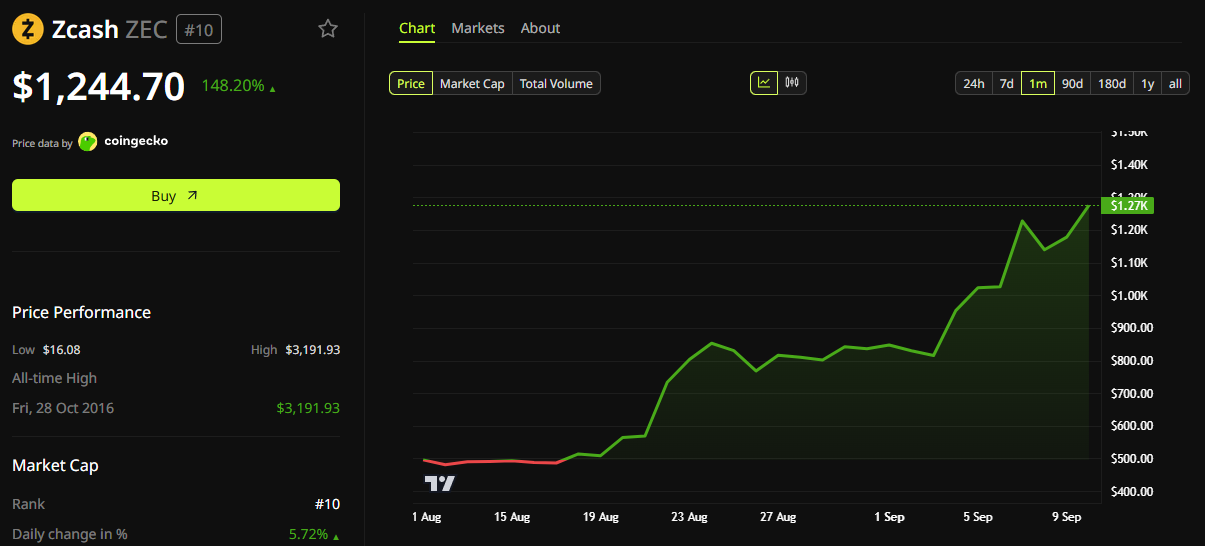
Zcash drove most of the shift. ZEC’s derivatives book swelled to an all-time high near $2.4 billion during Zcash’s decade-high rally. Short sellers absorbed roughly $34 million in forced closures as the token broke higher.
Zcash’s rally has drawn extra attention as Grayscale files to convert its ZEC trust into a spot ETF. That filing adds a new demand angle even as leverage climbs.

Ether and tokens tied to Robinhood’s new blockchain have also outperformed. Pons, a memecoin launchpad built on that same chain, has fueled a fresh wave of token launches. Traders are rotating leverage further down the risk stack as Bitcoin’s rally matures.
Proceed to Altcoins with Caution
Bucella told CNBC’s Halftime Report the buildup echoes conditions from October 2025. That was just before a sharp market-wide liquidation. He argued Bitcoin’s own move looks comparatively healthy. It is driven by spot buying rather than pure short covering.
“I’m not saying that this move isn’t sustainable. I’m just saying you should proceed with a lot of caution.”
— Michael Bucella, CNBC
Bitcoin’s ETF-backed bid has held up despite a brief late-August outflow streak, per BeInCrypto’s September warning signs. Whether altcoin leverage unwinds as calmly is the open question for the rest of September.
The post Bitcoin's Spot-Backed Rally Hides an Altcoin Leverage Trap Last Seen in 2025 appeared first on BeInCrypto.


Anthropic has published a model of how artificial intelligence (AI) could reshape the US economy by 2030. Interestingly, its fastest growth case is the one that cuts knowledge worker wages by more than 10%.
The company’s economics team released the tool alongside a technical report, Economic Scenarios for Transformative AI, and invited readers to plug in their own forecasts.
Three Futures With Very Different Winners
The model runs three cases, coming only hours after researcher Jacob Coxon said he had resigned from Anthropic and accused the industry of racing toward self-improving superintelligence.
That same capability triggers the model’s worst case:
- Modest case
AI matches the internet in scale and lifts gross domestic product (GDP) to $34.1 trillion, a 1.6% gain.
- Substantial case
Assumes AI handles half of all knowledge work by 2030. GDP reaches $36.3 trillion, roughly twice the normal growth rate, while unemployment settles near 5%. Knowledge worker wages stay flat.
- Extreme case
Requires AI that improves its own capabilities without human help. Annual growth hits 15%, GDP reaches $44.4 trillion, and unemployment spikes to historic levels. Knowledge worker pay falls by more than 10%.
Labor’s share of national income tells the same story. It slips slightly in the modest case, drops to 56.1% in the substantial one, and falls to 45.2% in the extreme.
“In the extreme scenario, the gains from a rapidly expanding economy are unevenly distributed,” read an excerpt in the report.
Follow us on X to get the latest news as it happens
Americans Are Betting on the Middle
Anthropic surveyed 10,980 people in August. The typical answer implied GDP about 10% higher by 2030, close to the substantial case. Roughly one in 10 expected the extreme.
That caution echoes earlier work. Anthropic’s June polling found Americans name job loss as their biggest AI worry, while Goldman Sachs traced the sharpest hiring damage to entry-level tech roles.
Anthropic frames the outcome as a choice rather than a forecast.
The model makes the trade explicit, since the scenario that creates the most wealth also hands the smallest slice of it to workers. The harder question is who gets to choose.
The post Anthropic Models 3 AI Futures for 2030 After Its Researcher Warns of Extinction appeared first on BeInCrypto.

Inside Elizabeth Holmes’ final weeks before prison in new A24 film

MetaMask Focus and Separate Enterprise Unit

Ishan Kishan’s East Zone on brink of Duleep Trophy triumph as lead swells to 584 runs on Day 4 | Cricket News


-
 Crypto World23 hours ago
Bitcoin price risks $76K drop as $78K support weakens
-
 Tech1 day ago
Memory prices are slowing because buyers ran out of money
-
 Crypto World24 hours ago
Ethereum price stalls below $2,500 as ADX drops to 11
-

 Crypto World1 day ago
Robinhood Stock: How To Take Advantage With Reduced Risk
-
 Sports2 days ago
Phones confiscated, players sent home: Pakistan’s England tour turmoil revives memories of Mohammad Amir, Salman Butt and Mohammad Asif’s 2010 Lord’s spot-fixing scandal | Cricket News
-

 NewsBeat1 day ago
England up in reading, maths and science rankings as Scotland and Wales dip
-

 Business21 hours ago
Meta debuts long-awaited personal AI agent, Muse
-
 Crypto World16 hours ago
Bitcoin price holds near $79K as cycle drawdowns narrow
-
 Crypto World1 day ago
Brent Crude Oil Moves Above $100 for the First Time in 3 Months
-

 Business2 days ago
Egyptian TV Presenter Sarah Khalifa, 11 Others Sentenced To Death In Major Drug Trafficking Case In Cairo
-

 Crypto World2 days ago
Visa expands stablecoin card network to 160 programs
-
 Tech2 days ago
Strong Password Policy and Password Manager Guide
-
 Crypto World1 day ago
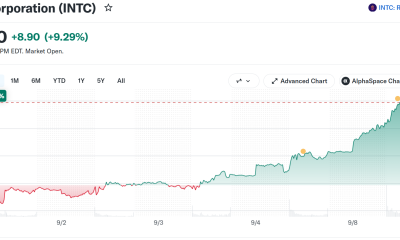
Intel Stock Jumps 9% on Chip Price Hike Report, US Stake Gains $36 Billion
-

 Entertainment1 day ago
Big Brother Spoilers: Dee SPINS & HUSTLES Votes – Yash Questions the Pact
-

 Sports1 day ago
Ballon d’Or 2026 Nominees: Lionel Messi In, Cristiano Ronaldo Out; Erling Haaland Included In Top 30
-
 NewsBeat1 day ago
Tehran’s assertive rhetoric signals a new and dangerous phase in conflict
-

 Tech1 day ago
Meta debuts its Muse AI agent. Will consumers trust it?
-
 Business1 day ago
Oil Higher on Hormuz Escalation, Weighing on Sentiment
-
Business1 day ago
Xometry at Goldman Sachs Communacopia + Technology Conference 2026: growth, AI and Siemens
-

 Politics2 days ago
Critics Rip Trump After He Revives His Most Dubious 9/11 Claim
You must be logged in to post a comment Login