

Crypto World
Worldcoin ETF filing shows 100 wallets control 90% of circulating WLD



Grayscale’s filing for a proposed Worldcoin ETF has revealed that the 100 largest wallets control roughly 90% of the circulating WLD supply.
Summary
- Grayscale’s proposed Worldcoin ETF filing says the largest 100 wallets hold about 90% of the circulating WLD supply.
- The filing states that governance remains largely under the World Foundation while World Chain continues to rely on centralized infrastructure.
- The disclosures come days after Grayscale sought SEC approval to launch a spot Worldcoin ETF that would hold WLD directly.
According to a recent SEC registration statement filed by Grayscale for its proposed Grayscale Worldcoin ETF, the largest 100 wallets held approximately 90% of all WLD in circulation as of the filing date. The disclosure appeared in the fund’s risk factors, where the asset manager outlined ownership concentration and governance risks tied to the token that would back the proposed exchange-traded fund.
The filing comes only days after Grayscale sought approval to list the product on Nasdaq under the ticker GWLD, offering investors direct exposure to Worldcoin through a traditional brokerage account instead of requiring them to purchase and store the token themselves.
If approved, the trust would hold WLD directly, use the CoinDesk Worldcoin Benchmark Rate to determine its net asset value, and rely on BitGo Bank & Trust as custodian, while The Bank of New York Mellon would serve as administrator and transfer agent.
The ownership data disclosed by Grayscale differs from Worldcoin’s original vision for token distribution.
Worldcoin’s whitepaper said most WLD tokens would eventually be claimed by individuals who verified themselves as unique humans through the project’s identity system. Grayscale instead warned that a relatively small group of early adopters currently controls a substantial share of the tokens already released.
The registration statement adds that it is “reasonably likely” that early holders own a significant portion of the circulating supply, making WLD more concentrated than its long-term distribution goals suggest.
One of the largest addresses identified in public blockchain data belongs to the bridge connecting Ethereum and World Chain, meaning part of the concentrated holdings may represent assets deposited by multiple users rather than a single owner. Even so, Grayscale’s filing presents the overall concentration level as a material risk for prospective investors.
Filing outlines governance and decentralization risks
Beyond token ownership, the filing also describes several parts of the World Network that remain under centralized control.
According to Grayscale, governance of the network continues to be substantially guided by the World Foundation despite previous plans to decentralize decision-making over time. The filing states that WLD may eventually be used for governance, although the mechanisms required to support that transition remain new and untested at scale.
The disclosure contrasts with earlier statements from the project, which had promoted proof-of-personhood as a foundation for one-person-one-vote governance. Grayscale’s prospectus says governance has not yet reached that stage and continues to rely largely on the World Foundation.
The filing also identifies operational risks linked to the blockchain itself. World Chain currently depends on a centralized sequencer, while upgrade functions remain under the coordinated control of a limited group associated with the World Foundation, Tools for Humanity, and Optimism, the Ethereum layer-2 infrastructure supporting the network.
Grayscale further states that the Orb devices used to verify users are still manufactured and distributed mainly by or under the direction of Tools for Humanity. The filing also notes that the World Foundation continues to exercise significant influence over the protocol, the WLD treasury, and ecosystem grants.
ETF proposal arrives after recent ecosystem developments
The governance disclosures accompany Grayscale’s broader proposal to launch the first U.S. exchange-traded fund holding WLD directly.
Under the proposed structure, the trust would function as a passive investment vehicle without leverage or derivatives. Authorized participants would create and redeem shares in blocks of 10,000, known as baskets, either by delivering WLD directly or through cash transactions facilitated by liquidity providers. Grayscale has not yet disclosed the management fee, seed investment, or the number of WLD represented by each share, leaving those details for future amendments.
The SEC filing does not guarantee regulatory approval, and Nasdaq cannot list the product unless regulators approve the registration process.
The proposed ETF follows several developments that have increased attention on Worldcoin during recent months. In June, Robinhood added WLD to its trading platform, giving the token access to a larger retail audience.
Despite the listing, WLD fell nearly 15% on the day as traders focused instead on allegations reported by third parties involving Sam Altman and entities connected to the Worldcoin ecosystem, alongside continuing criticism of the project’s biometric identity verification system and token distribution model.



Key takeaways
- XRP continues to trade below its 50-day EMA, keeping the short-term trend bearish.
- Momentum indicators are improving, with the MACD turning more positive and the RSI rising to around 55.
- A break above $1.15 could strengthen the recovery, while failure to do so may trigger another pullback.
Ripple’s native token, XRP, remained under pressure on Thursday, extending its corrective phase as it traded below the 50-day Exponential Moving Average (EMA).
Although the cryptocurrency has rebounded from recent lows, buyers continue to face strong resistance that has limited the recovery.
The current technical setup suggests that while bullish momentum is gradually improving, XRP has yet to confirm a sustained trend reversal.
50-Day EMA continues to cap upside
XRP is currently trading below the 50-day EMA at $1.1458, while remaining well beneath the 200-day EMA at $1.4425.
These moving averages continue to act as significant resistance levels, preventing the token from building stronger upward momentum.
Recent price action indicates that buyers have successfully defended lower support zones, but rallies have repeatedly stalled before reclaiming key technical levels.
Despite the broader corrective trend, technical indicators suggest that buying pressure is slowly returning.
The Moving Average Convergence Divergence (MACD) remains on an upward trajectory, with both the MACD line and signal line advancing while the histogram continues expanding into positive territory. This indicates that bullish momentum is strengthening.
Meanwhile, the Relative Strength Index (RSI) has climbed to approximately 55, placing it above the neutral 50 level. The reading suggests buyers are gradually regaining control without the market entering overbought conditions.
Together, these indicators point to improving market sentiment, although confirmation of a sustained recovery will require a breakout above key resistance.
Key Resistance Levels
The first major obstacle for XRP is the 50-day EMA at $1.1458. Just above that sits the 50% Fibonacci retracement level of the recent decline from $1.2935 to $1.0092, located around $1.1514.
A decisive move above this resistance zone would improve the short-term outlook and could encourage additional buying interest.
If XRP fails to break higher, traders will likely monitor several important support areas:
- 38.2% Fibonacci retracement: $1.1178
- Broken ascending trendline: Around $1.0937
- 23.6% Fibonacci retracement: $1.0763
- Recent swing low: $1.0092
Holding above these support levels would help preserve the current recovery structure, while a break below them could expose XRP to further downside.

XRP remains in a cautious recovery phase, supported by improving momentum indicators but constrained by significant technical resistance.
A successful breakout above the $1.1458–$1.1514 resistance zone would provide the first meaningful signal that bulls are regaining control. Until then, the token is likely to remain in a consolidation phase, with traders watching whether support around $1.12 can withstand renewed selling pressure.
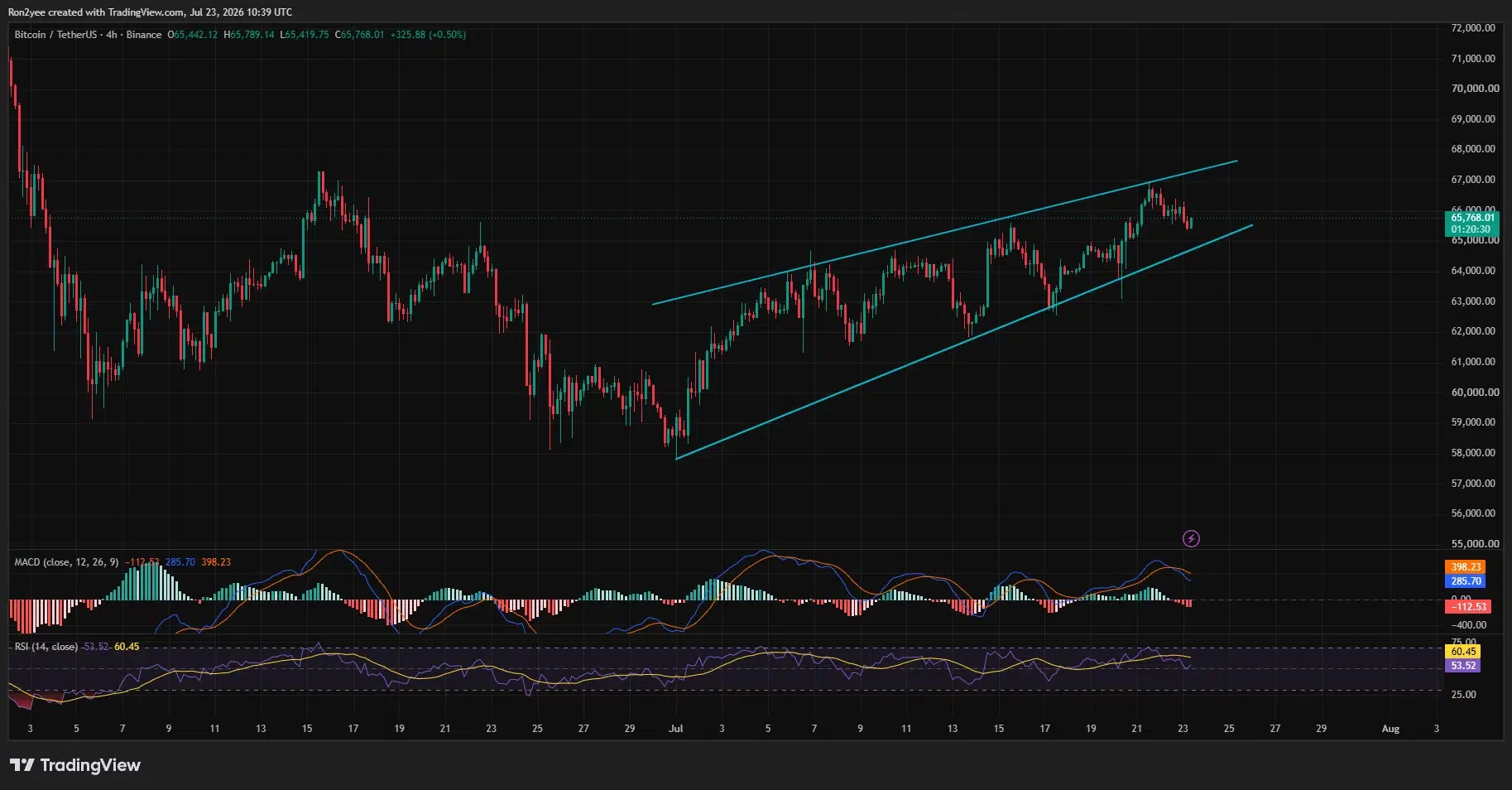
Bitcoin price has fallen 1.4% from an intraday high of $66,300 to $65,368 as rising oil prices, renewed U.S.-Iran tensions, and regulatory uncertainty have pushed traders toward a more defensive stance.
Summary
- Bitcoin price has retested $65,000 as rising oil prices and geopolitical tensions pressure risk assets.
- ETF inflows support demand, but 4-hour momentum has weakened below the $66,800 resistance.
- Losing $65,000 could expose liquidity near $64,500 before the $63,170 moving-average support.
The decline erased part of Bitcoin’s recent recovery and brought the $65,000 support level back into focus. Selling accelerated after BTC failed to hold above $66,000, while the Fear and Greed Index remained in neutral territory as traders weighed institutional inflows against fresh macroeconomic risks.
Political uncertainty added to the pressure after Senate Democrats objected to parts of the latest Digital Asset Market Clarity Act proposal. Polymarket traders had lowered the probability of the bill becoming law in 2026 to about 37% earlier this week as ethics rules and investor protections remained unresolved.
At the same time, BitMEX announced that it would close its derivatives exchange on Sept. 23 following a strategic review by parent company HDR Global Trading. The platform stopped accepting new registrations and asked customers to close positions and withdraw their assets before operations end.
Institutional flows have provided some support during the pullback. U.S. spot Bitcoin exchange-traded funds recorded $69 million in net inflows on July 22, their seventh consecutive positive session, according to SoSoValue data. The seven-day streak brought combined inflows to about $1 billion, although July’s additions remained below the $6.9 billion withdrawn in May and June.
Oil and geopolitical risks are testing demand at $65,000
West Texas Intermediate crude climbed nearly 4% to around $90 a barrel on July 23, extending its advance for a fifth session. Brent rose close to $99 as attacks on Saudi oil tankers and threats against regional energy infrastructure raised fears of supply disruptions.
The UK Maritime Trade Operations agency reported that a tanker caught fire after it was struck southwest of Al Shuqaiq. Yemen’s Houthi rebels later claimed attacks on two Saudi tankers, saying the vessels had violated their maritime blockade.
President Donald Trump also warned that Washington would strike an Iranian bridge or power plant each time Tehran attacked a vessel in the Strait of Hormuz. Iranian authorities responded with threats against U.S.-linked infrastructure and energy assets across the region if Washington carried out those attacks.
Higher energy costs could keep U.S. inflation elevated and limit the Federal Reserve’s room to lower interest rates. Treasury yields may rise if traders expect tighter policy for longer, a development that could hurt demand for Bitcoin and other assets that do not offer a fixed yield.
Technology stocks have supplied another risk factor as investors assess Alphabet’s increased spending on artificial intelligence infrastructure. Weakness across high-growth equities often spills into Bitcoin because both markets attract investors who are sensitive to interest rates and changes in liquidity.
Bitcoin retains its rising channel while momentum weakens
Bitcoin’s 4-hour chart shows that price remains inside an ascending channel that began near $57,800 in early July. The lower trendline now runs through the $65,000–$65,400 area, making the current retest important for the short-term recovery.
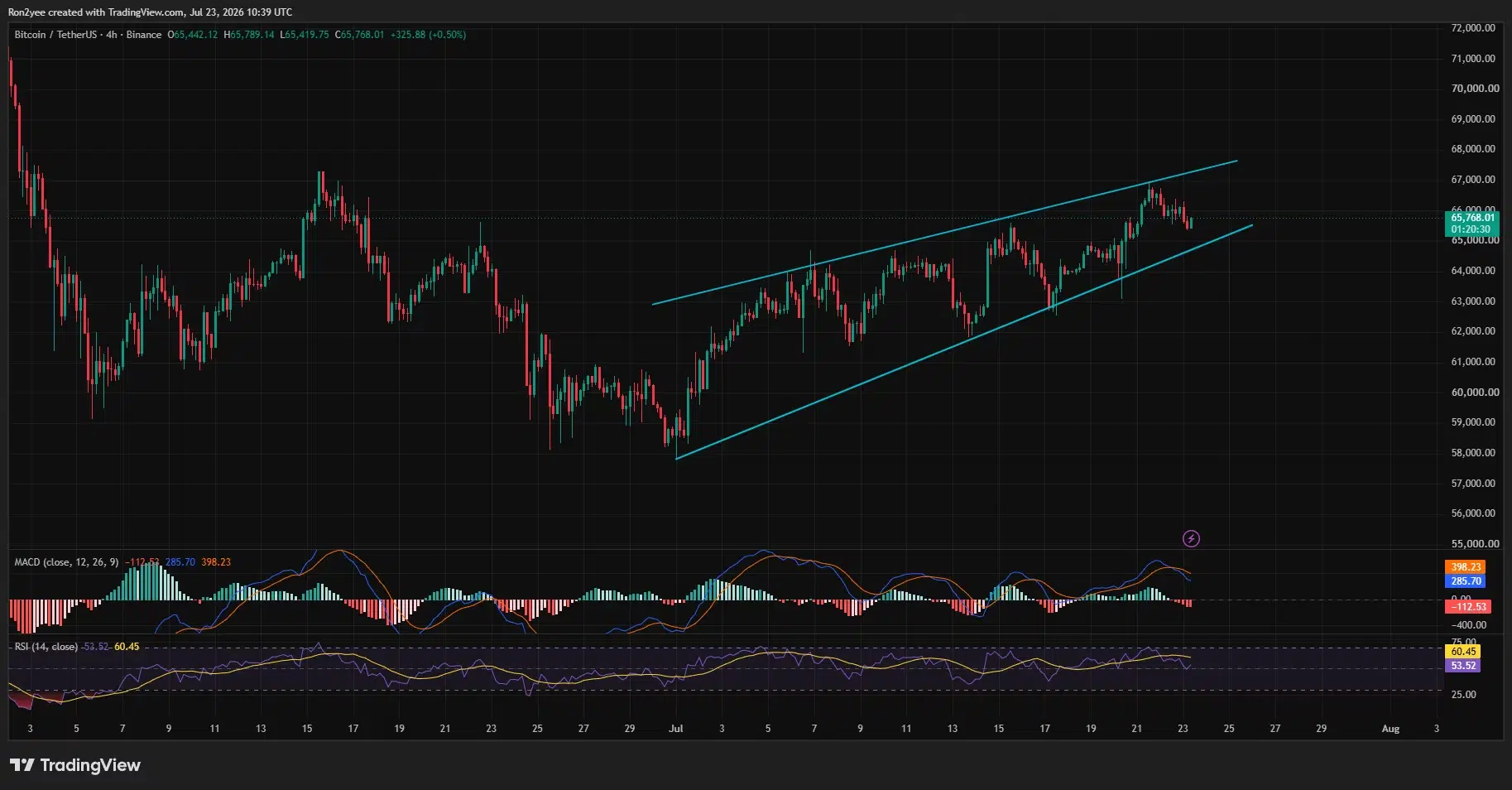
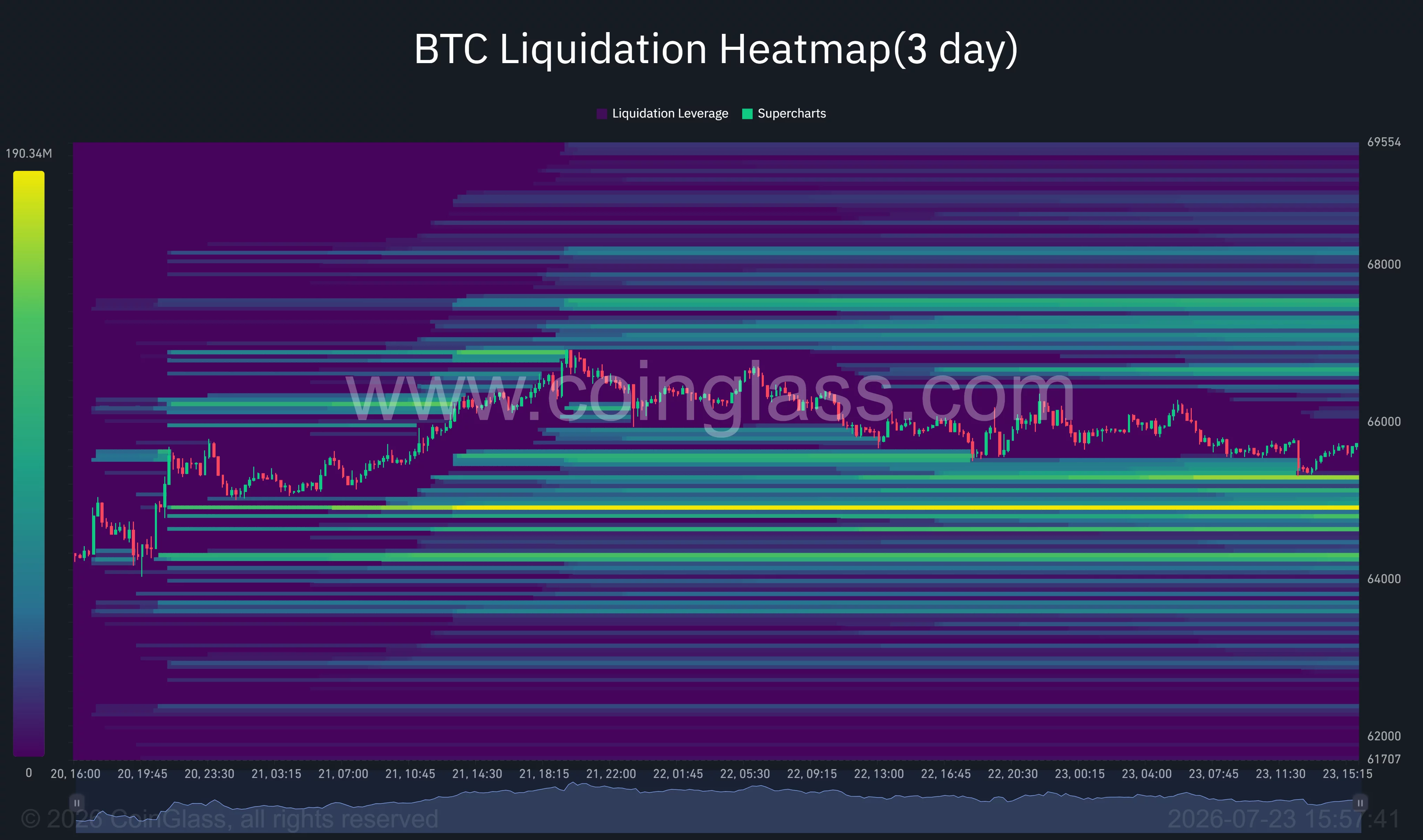
A successful defense could allow BTC to revisit $66,800, where the latest rally stalled, followed by the channel ceiling near $67,500. The three-day liquidation heatmap shows concentrated short-liquidation between $66,500 and $67,300, with another large cluster near $68,100.
Commenting on the setup, crypto trader Ted Pillows noted that Bitcoin could advance toward $67,500–$68,000 as long as $65,000 holds.
“BTC is having a correction but still holding above the $65,000 level. As long as this holds, Bitcoin could rally towards $67,500–$68,000 soon.”
Analyst Lennaert Snyder offered a more cautious view after retaining a short position from the $67,000 region. Snyder identified a possible long entry only after a sweep below $65,000 and kept $68,100 as an upside target that would require confirmation.
Momentum has weakened on the 4-hour chart. The MACD line has dropped to 285.70, below the signal line at 398.23, while the histogram has moved to minus 112.53. The relative strength index has fallen to 53.52 from above 60, leaving momentum positive but no longer strong enough to confirm an immediate breakout.
On the daily chart, Bitcoin trades above the 20-day simple moving average at $64,232 and the 50-day average at $63,171. Those levels support the recovery structure, but BTC remains below the 100-day and 200-day averages at $70,044 and $72,602, respectively.
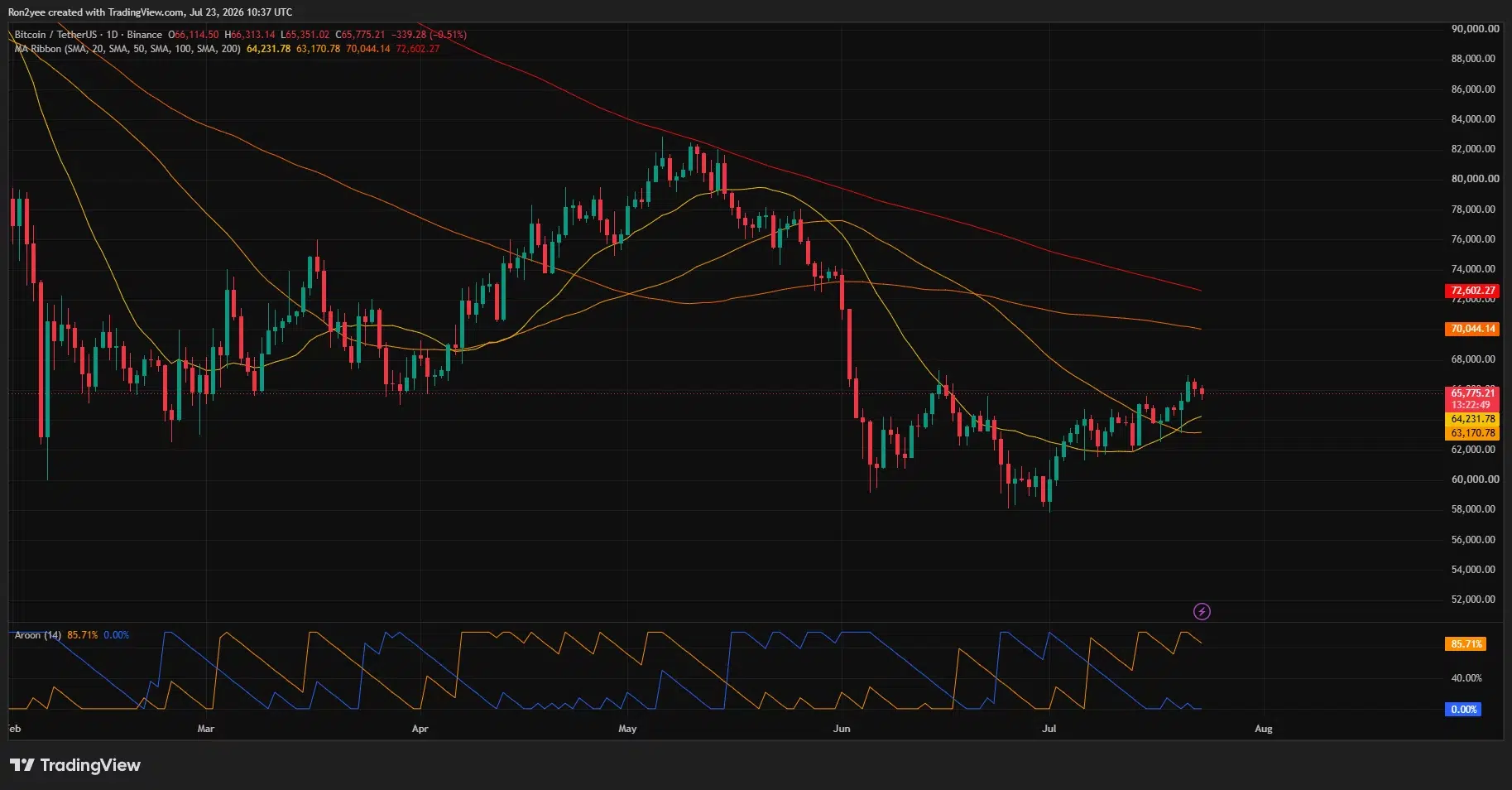
The daily Aroon Down reading has climbed to 85.71%, while Aroon Up has dropped to zero, which gives sellers control despite the recent rebound. A daily close above $66,800 would weaken that bearish reading and open a path toward $68,000 and the 100-day average.
Downside risk would increase if Bitcoin closes below the channel floor and loses $65,000. The heatmap places leveraged-long liquidity around $64,800, $64,500 and $64,000, while the moving averages create another support band between $63,170 and $64,230.
A break below $63,170 would invalidate the short-term recovery and expose $61,500, followed by the late-June floor near $59,000. Further oil gains, higher Treasury yields, or another escalation involving Iran could speed up that move even if ETF inflows remain positive.
Disclosure: This article does not represent investment advice. The content and materials featured on this page are for educational purposes only.
Crypto World
WEEX Launches USDGO Flexible Staking With Industry-Leading APR, Expanding Its Full-Suite Staking Product
WEEX today announced the launch of flexible staking for USDGO, offering tiered annual percentage rates (APR) of up to 20% — among the highest rates currently available for the asset across major platforms.
USDGO Staking Tiers:
- 0–200 USDGO: 20% APR
- 200+ USDGO: 12% APR
USDGO staking is now live on WEEX with flexible terms, allowing users to subscribe and redeem at any time: https://www.weex.com/staking
What Is WEEX Staking?
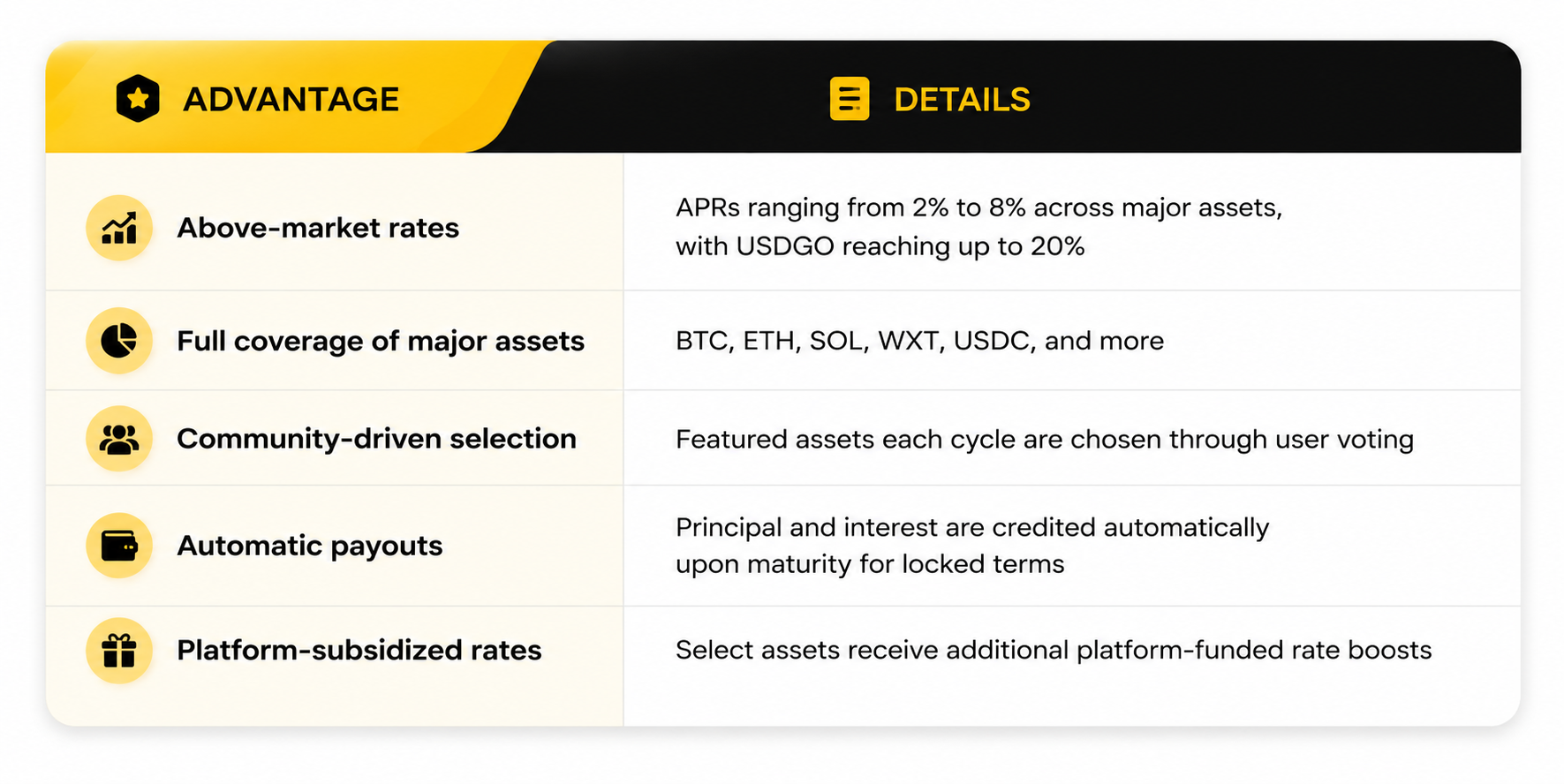
Staking is WEEX’s yield product, giving users a way to earn on assets they already hold — whether they choose flexible terms for full liquidity or lock in a fixed period for a higher APR. The product supports major assets including BTC, ETH, SOL, WXT, and USDC and more, with featured assets each cycle selected through a mix of community voting and platform curation.
Core Product Advantages:

How the Rates Compare
Beyond USDGO, WEEX’s staking rates are structured to stay competitive across the board:

Who WEEX Staking Is Built For
WEEX designed its staking product around five common user profiles:
- Long-term holders of BTC, ETH, or SOL who aren’t looking to sell in the short term and want their holdings to generate yield while they wait
- WXT holders, who receive enhanced rates as platform token holders
- Stablecoin users seeking steady, predictable returns through USDC
- Yield-focused users willing to lock assets for a defined term in exchange for a higher APR
- Project teams looking to encourage long-term token holding among their community
Why This Matters
Staking has become a core expectation for exchange users who want their idle assets working for them, not just sitting in a wallet. With the USDGO launch, WEEX is signaling a broader commitment to offering some of the most competitive yield products in the market — backed by flexible terms, transparent payouts, and rates that scale in favor of everyday users rather than only the largest holders.
USDGO staking is live now. Explore the full range of WEEX staking products at https://www.weex.com/staking.
Disclaimer: Staking involves risk, including potential loss of principal. APRs are estimated and subject to change based on market conditions. This content is for informational purposes only and does not constitute financial or investment advice. Please review the terms of each product carefully before participating.
About WEEX
Founded in 2018, WEEX has developed into a global crypto exchange with over 6.2 million users across more than 150 countries. The platform emphasizes security, liquidity, and usability, providing over 1,200 spot trading pairs and offering up to 400x leverage in crypto futures trading. In addition to the traditional spot and derivatives markets, WEEX is expanding rapidly in the AI era delivering real time AI news, empowering users with AI trading tools, and exploring innovative trade to earn models that make intelligent trading more accessible to everyone. Its 1,000 BTC Protection Fund further strengthens asset safety and transparency, while features such as copy trading and advanced trading tools allow users to follow professional traders and experience a more efficient, intelligent trading journey.
Follow WEEX on social media
X | Instagram | Tiktok | Youtube | Discord | Telegram
The post WEEX Launches USDGO Flexible Staking With Industry-Leading APR, Expanding Its Full-Suite Staking Product appeared first on BeInCrypto.
Crypto World
Elon Musk Names the Real Force Behind His European Politics, and It’s Not the Far-Right
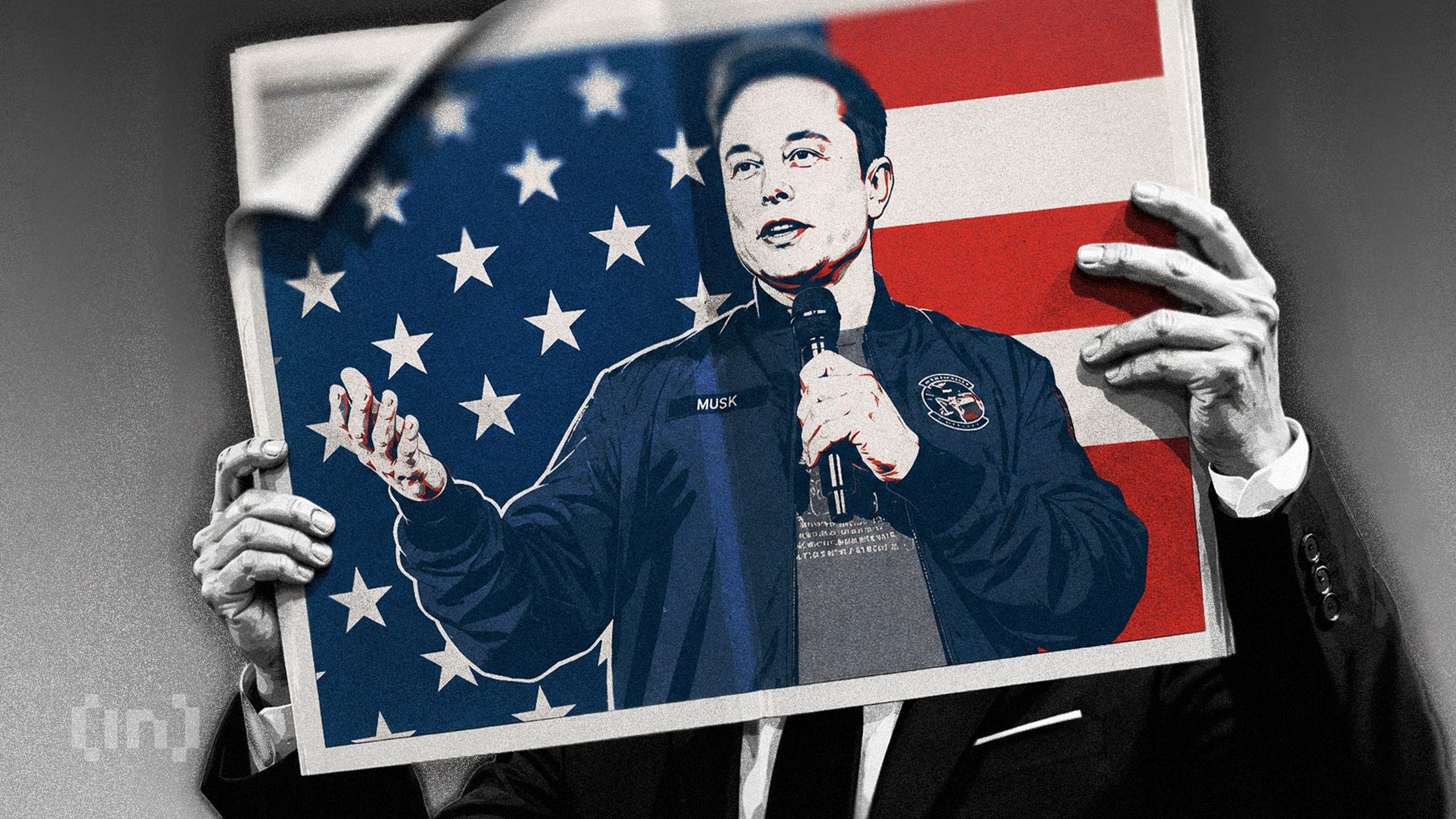

Elon Musk says one force drives his political activity in Europe. It is not the far-right, he told The Economist. It is “normal people” and the defense of “the West collectively.”
The Tesla and SpaceX chief clashed with Editor-in-Chief Zanny Minton Beddoes in an interview recorded on Monday. It airs in full on The Economist’s video program Insider from 18:00 UK time on Thursday.
Musk Rejects the ‘Far Right’ Label
Minton Beddoes opened with a charge. She said Musk backs “very fringe parties” in some countries. He said the label is wrong, and demanded the segment stay in the final cut.
“It’s just normal people, and here are the principles, and tell me which of these sound terrible. That we should have secure borders, that we should safe cities, that should have sensible spending, which of those three are far right fringe,” Musk told The Economist.
Then he turned on the press itself.
“I would like to just admonish you and the media for the absurd characterization of the far right. Which is false and misleading.”
The pushback was direct. Minton Beddoes cited his post that civil war in Britain is “inevitable.” She noted Musk last visited the UK years ago. She said violent crime there is falling, and London is safer than US cities.
Musk did not retreat. He warned that a growing group with beliefs “antithetical to western beliefs” means “at some point there will be a reckoning.”
The Force Behind Musk’s European Politics
Why should he shape European politics from abroad? Musk gave his most revealing answer there. He named no party at all.
“I think of it as sort of the West collectively.”
He is not backing a party. He is defending a whole way of life. And he can act on it. He is the world’s richest man, worth more than $800 billion. He owns X, where about 250 million people follow him.
Musk also denied that he is racist. He pointed to his partner, who is half Indian, their four children, and executives of all races at his companies.
Does he understand why people loathe him? He shrugged.
“Maybe some people do loathe me, and that’s probably true. I don’t care, but the fact that, as you pointed out, a quarter of a billion people follow me is that I think a lot more people actually like me than don’t.”
He closed with a counterpunch, telling Minton Beddoes that “a lot of people hate you and the media more than you realize.”
The full exchange airs at economist.com Thursday evening.
The post Elon Musk Names the Real Force Behind His European Politics, and It’s Not the Far-Right appeared first on BeInCrypto.
Crypto World
Mubadala Capital tokenizes private markets fund on Solana, Sui, Base as Coinbase takes exposure


Tokenization has become one of the fastest-growing corners of digital assets as traditional finance firms look to modernize fund infrastructure. Citi recently projected that tokenized securities could grow to roughly $5.5 trillion by 2030, while Boston Consulting Group and Ripple estimate tokenized assets across all asset classes could reach $18.9 trillion by 2033.
Creating blockchain-based tokens of existing funds could help broaden access to a new set of investors and open the door for fund shares to be used as collateral or plugged into other onchain financial applications.
For this particular case, KAIO provides the infrastructure that issues and administers Mubadala Capital’s tokenized fund. The company said Mubadala joins firms including Hamilton Lane, Brevan Howard and Laser Digital that use its platform to distribute investment products onchain, and currently has $144 million in tokenized funds on its platform.
“This strategy was built on differentiated access — to deal flow, to co-investment, to a global network that most investors cannot reach on their own,” Max Franzetti, head of Mubadala Capital Solutions, said in a statement. “Bringing it onchain extends that access to a new class of qualified investors without compromising the institutional discipline that defines how we invest.”
Brett Tejpaul, head of Coinbase Institutional, said that Coinbase adding the fund to its corporate balance sheet investment is a reflection of growing interest in regulated tokenized assets as treasury holdings. “As regulated assets become programmable, they can become part of a broader onchain economy that is more transparent, composable and accessible to qualified investors in eligible jurisdictions.”


Polymarket plans to challenge France’s decision to block its website, arguing the order prevents users from accessing its market probabilities even though trading from the country has been disabled since November 2024.
France’s National Gambling Authority ordered internet providers to block the platform last week, saying it exposed users to potential losses and offered markets that could be manipulated.
Polymarket said it would challenge the decision through the French legal system and called the order disproportionate because it covers users who visit the site for information rather than to trade.
“We were surprised at the ANJ decision to block access to our entire website because their measure targets people going to Polymarket purely for information,” the company said in a press release.
“We are proud that most people come to Polymarket solely to learn the probability of future events relevant to their everyday life with no intention to trade,” the company added. “Prediction markets help source truth.”
The dispute turns in part on how Polymarket’s contracts should be classified. The company describes them as blockchain-based financial instruments traded directly between users, with prices set by market activity.


The bitcoin market is facing a macro environment unlike any it has encountered in its 17-year existence.
That’s tied to inflation-adjusted returns on bonds. The 30-year Treasury Inflation-Protected Security (TIPS) is now offering a yield of close to 3%, the highest in 17 years, according to TreasuryBonds.com.
“This is one of the greatest wealth preservation opportunities in decades. Investors can lock in nearly 3% annual returns above inflation for the next three decades, backed by the U.S. government,” the site noted.
In traditional markets, bonds are considered safe havens. When a haven asset offers a 3% return in excess of inflation, it raises the opportunity cost of holding non-yielding or riskier assets like gold and bitcoin. But for many, especially in the crypto community, bitcoin’s decentralized and censorship-resistant nature makes it a superior store of value and safe haven – and that argument is not without merit. Housing prices measured in bitcoin, for instance, appear significantly cheaper than when measured in dollars.

Key takeaways
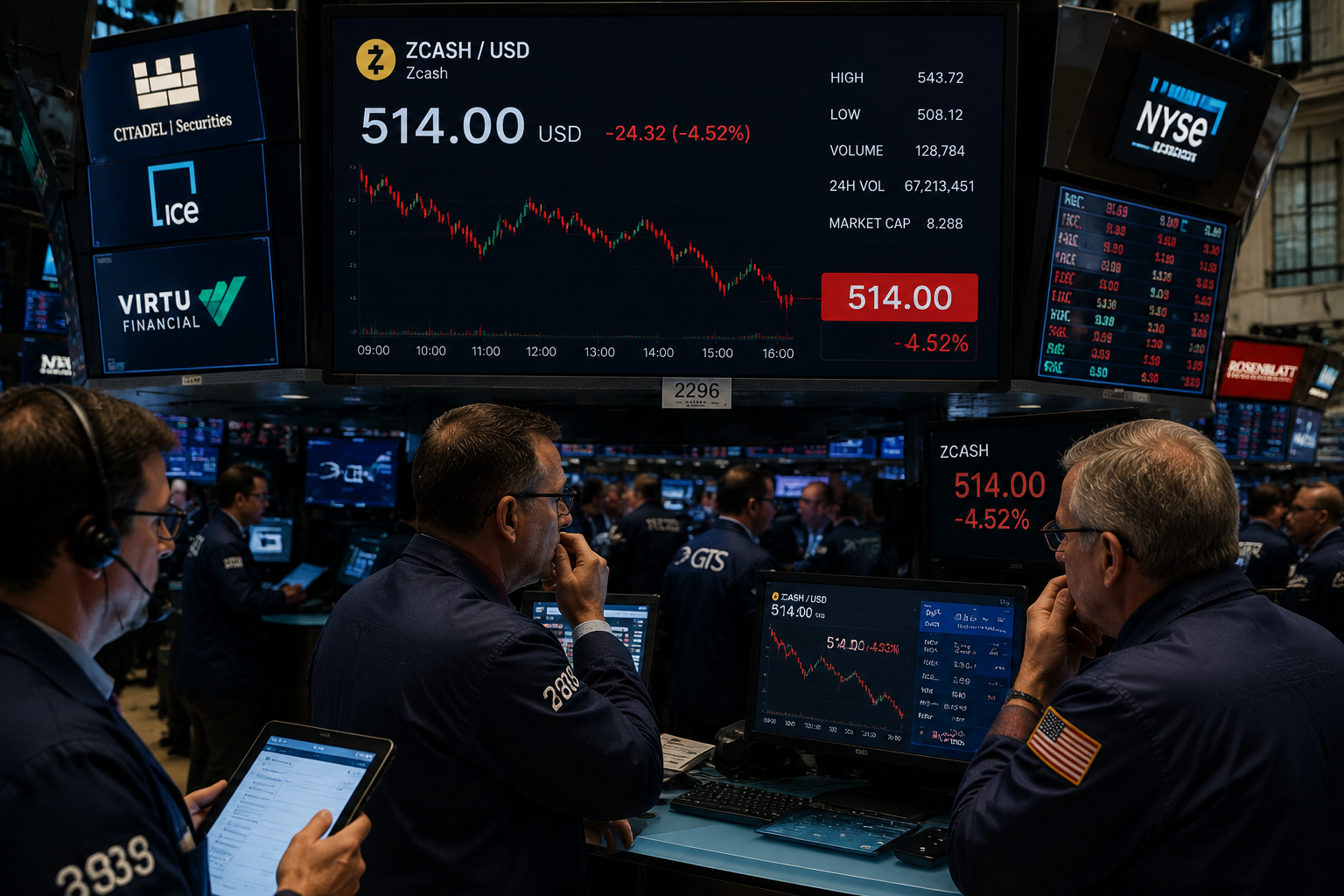
- Zcash (ZEC) is trading above $500 but continues to face selling pressure beneath a descending resistance trendline.
- The token remains above its 50-day EMA at $489 and 200-day EMA at $407, preserving its longer-term bullish structure.
- Technical indicators show mixed signals, with the RSI near neutral and the MACD slipping below zero.
Zcash (ZEC) extended its recent pullback on Thursday, trading above the $500 level as sellers continued to defend a key descending resistance trendline.
Although short-term momentum has weakened, the privacy-focused cryptocurrency remains above important long-term support levels, suggesting that the broader uptrend has not yet been invalidated.
Descending trendline limits upside
ZEC has struggled to overcome a descending trendline that currently sits near $581. Repeated rejections at this resistance level indicate that sellers remain active during rallies, preventing the token from extending its previous bullish advance.
Despite the recent weakness, Zcash continues to trade above both its 50-day Exponential Moving Average (EMA) at $489 and the 200-day Exponential Moving Average (EMA) at $407
Holding above these moving averages suggests that buyers still retain control of the longer-term trend, even as short-term momentum cools.
Momentum indicators currently provide a balanced outlook for Zcash. The Relative Strength Index (RSI) is hovering around 52, remaining close to the neutral 50 level. This indicates that neither buyers nor sellers have established clear dominance, reflecting a period of consolidation.
Meanwhile, the Moving Average Convergence Divergence (MACD) has slipped below the zero line, signaling that bullish momentum has weakened in the near term.
While the MACD points to increasing downside pressure, the broader market structure remains constructive as long as key support levels continue to hold.
Key resistance levels
The first major challenge for ZEC is the descending resistance trendline near $581. A successful breakout above this barrier would strengthen the bullish outlook and could pave the way for a retest of the previous swing high around $690.
Reclaiming these levels would signal renewed buying interest and potentially restart the broader uptrend.
On the downside, the 50-day EMA at $489 serves as the most important immediate support.
A sustained move below this level could expose ZEC to additional selling pressure, although the 200-day EMA at $407 remains a strong longer-term support zone that could attract buyers if the correction deepens.

Zcash remains in a healthy long-term uptrend despite its recent pullback. While weakening momentum and resistance around $581 continue to cap gains, the token’s ability to remain above both its 50-day and 200-day EMAs suggests that the broader bullish structure remains intact.
A decisive break above the descending trendline would likely shift momentum back in favor of buyers, while a loss of support at the 50-day EMA could trigger a deeper correction before the next upward move.
A group of Senate Democrats who generally support crypto legislation has said the latest draft of the CLARITY Act still falls short, raising objections to its ethics, consumer protection, illicit finance, conflicts of interest, and market integrity provisions.
Their statement adds another hurdle for legislation that already needs bipartisan backing to reach the 60-vote threshold required in the Senate.
Democrats Push Back on Latest Draft
The updated draft, released by Senate Republicans on July 22, includes an ethics package negotiated between the White House and Republican Senators Cynthia Lummis and Bernie Moreno. The proposal would bar the president, vice president, members of Congress, federal judges and certain other officials, along with their spouses, from issuing or sponsoring digital assets for compensation while in office, with the restriction expiring on January 20, 2029.
Covered officials would also have to divest crypto holdings or place them in qualified blind trusts, while the Department of Justice would receive civil enforcement authority, including the ability to sue exchanges that list banned tokens.
However, after the updated draft was shared with Democratic lawmakers, Senators Angela Alsobrooks, Cory Booker, Catherine Cortez Masto, Ruben Gallego, John Hickenlooper, Mark Warner, and Raphael Warnock released a joint statement noting that the language on ethics and several important sections was still not strong enough.
“The Republican-proposed text of the CLARITY Act as it currently stands falls short,” their statement read. “Key provisions including those addressing ethics for elected officials, consumer protection, illicit finance, conflicts of interest and market integrity must be strengthened.”
The lawmakers added that they had worked “in good faith” with Republican colleagues for the past year and would continue doing so until the bill was passed.
Speaking during a public appearance, Senator Alsobrooks called the proposal to place enforcement solely with the DOJ “wild and unserious and stone-cold crazy,” arguing that state attorneys general should have enforcement powers.
Securities lawyer Amanda Fischer went further in a social media thread, writing that the draft “doesn’t change much at all about Trump’s existing crypto grift” since it doesn’t force any immediate divestment and leaves enforcement to Trump’s own appointee, Todd Blanche.
The Blockchain Regulatory Certainty Act language has stayed unchanged, preserving protections for non-custodial software developers and blockchain infrastructure providers while keeping self-custody rights intact.
Furthermore, the negotiated stablecoin rewards compromise has been maintained, but new law enforcement measures have been added, including funding for blockchain investigations, training programs, a cyber center targeting nation-state threats, and procedures allowing compliant stablecoin issuers to freeze or reissue tokens when legally required.
A Bill Still Short on Votes
The political divide is not new for the CLARITY Act. The House passed its own version 294-134 back in July 2025, and the Senate Banking Committee advanced this chamber’s draft in May with two Democrats crossing over.
Getting 60 votes on the floor is a different fight, and prediction markets have priced that in. As CryptoPotato reported, odds of passage this year sat above 70% right after the Banking Committee vote and had slipped to around 31% by this week.
Meanwhile, former CFTC Chairman Chris Giancarlo believes there is a greater than 50% chance the CLARITY Act ultimately fails, although he argued that the SEC and CFTC have already established regulatory frameworks that would continue supporting innovation even without the bill.
The post Democrats Reject Latest CLARITY Act Draft Over Ethics, Illicit Finance Concerns appeared first on CryptoPotato.

Tesla absorbed a $112 million after-tax impairment loss on its Bitcoin holdings last quarter, and the latest Bitcoin price prediction debate centers on whether its decision to hold reflects conviction or patience. Bitcoin is currently trading around $66,500, down about 0.6% over the past 24 hours. That question could shape sentiment more than many investors expect.
According to Tesla’s Q2 earnings release, the company still held 11,509 BTC. That is the same position it has maintained since selling roughly 75% of its original stake in 2022. The impairment charge followed Bitcoin’s sharp decline during Q2, although Tesla kept its treasury untouched throughout the quarter.
Meanwhile, Tesla’s earnings delivered mixed results. Non-GAAP EPS came in at $0.33, missing the $0.55 consensus estimate. However, revenue reached $28.2 billion, beating expectations of $27.6 billion. Even so, the company made no changes to its Bitcoin holdings despite the earnings miss.
Tesla’s steady approach stands out because it remains one of the largest publicly traded corporate Bitcoin holders. Meanwhile, Bitcoin continues consolidating near the $66,000 level, where traders are watching for the next breakout. If momentum returns, Tesla’s decision to hold could strengthen the long-term bullish narrative.
Discover: The Best Crypto to Diversify Your Portfolio
Bitcoin Price Prediction: Can BTC Break Above $70,000 as Institutional Holders Stand Pat?
Bitcoin is trading around $66,500 at the time of writing, holding inside a consolidation range that has shaped recent Bitcoin price prediction outlooks. The recent swing low near $58,000 remains a key support zone after absorbing heavy selling pressure. Meanwhile, resistance sits near the low $80,000s, where sellers previously regained control.
For now, the $60,000 to $66,500 range suggests steady accumulation instead of aggressive buying. Trading volume has recovered gradually, showing less panic selling but limited breakout conviction. Even so, the moving average structure still points to a higher low, keeping the bullish trend intact while awaiting confirmation.

If Bitcoin holds above $66,500 and volume strengthens, the next upside target sits around $73,000 to $75,000. Tesla’s decision to maintain its position also removes the risk of another large corporate sale. That does not guarantee higher prices, but it keeps supply pressure from increasing.
On the other hand, the base case still favors sideways trading between $62,000 and $70,000 as traders digest macro developments. However, a daily close below $60,000 could reopen the $55,000 to $58,000 support zone. Long periods of low volatility often end with a decisive move, although the direction remains uncertain.
Tesla’s Bitcoin position, now worth roughly $765 million at current prices, remains a useful market signal rather than a direct catalyst. Holding through a sharp quarterly decline shows the company was unwilling to sell into weakness. That steady approach could help support market confidence if institutional demand continues to build.
Trade Bitcoin on Bybit and Get a Chance to Win Our $1,000 USDT Airdrop
Bitcoin Hyper Targets Early-Stage Upside While BTC Consolidates at Key Levels
Spot BTC at $65,000 offers asymmetric upside, but also a meaningful downside to invalidation. Traders looking for higher-beta exposure to Bitcoin’s infrastructure buildout without waiting for a large-cap breakout are rotating into the layer-2 narrative, and one project is pulling serious capital at the presale stage.
Bitcoin Hyper ($HYPER) is positioning as the first Bitcoin Layer 2 with Solana Virtual Machine integration, delivering sub-second finality and low-cost smart contract execution on top of Bitcoin’s security layer.
The pitch is infrastructure, not speculation: breaking Bitcoin’s known limitations around speed, fees, and programmability without abandoning the underlying trust model.
The presale has raised $32.9 million at a current token price of $0.0136835, with staking available at a high APY for early participants. A decentralized canonical bridge handles BTC transfers natively.
Research Bitcoin Hyper before the presale closes.
Discover: The Best Token Presales
The post Bitcoin Price Prediction: Tesla Diamond Handing Its BTC Even With $112 Million Loss appeared first on Cryptonews.

Florida’s $1.8 trillion economy surpasses Australia to rank 14th globally

XRP faces resistance below the 50-Day EMA despite improving momentum

How to watch Round 1


-
 NewsBeat7 days ago
London Mayor Sadiq Khan handed a peerage by Keir Starmer alongside 15 other Labour figures… just days before the PM leaves No10
-

 Fashion6 days ago
Weekend Open Thread – Corporette.com
-

 Politics5 days ago
The House | The City of London can help the new chancellor deliver growth in every postcode
-

 Crypto World5 days ago
Ripple Payments Joins MiCA With 14 Firms, Does It Mean Anything For XRP?
-
 Crypto World6 days ago
Two July Windows Left: The CLARITY Act’s Senate Fight and What Failure Means
-

 Politics4 days ago
Democrats look to World Cup watch parties to register thousands of voters
-

 Crypto World6 days ago
Ripple wins EU-wide access as ESMA adds it to MiCA register
-

 Crypto World2 days ago
Grayscale Files For Worldcoin ETF, WLD Registers Sharp Rise
-

 NewsBeat3 days ago
Unregistered fitter used Gas Safe logo on business flyers
-

 Tech2 days ago
Sail Virtually Aboard The “Itanic” With IA-64 Emulator
-

 Crypto World7 days ago
Injective Submits SEC Transfer-Agent Registration to Onchain Ownership Records
-
 Tech2 days ago
Turtle Beach Command Series KB7 review: a nifty screen-equipped gaming keyboard
-

 NewsBeat6 days ago
Registration is now open for March for Men with Kev 2026
-
 Business1 day ago
New Jersey voter registration controversy explained: How 6,600 noncitizens got on the rolls, and what happens next
-

 Crypto World7 days ago
Claude Fable 5 Slips to Second in AI Coding Leaderboard
-

 News Videos6 days ago
Money | Class 12 Economics | CBSE Board Exam 2026-27
-

 Business6 days ago
Banco Bilbao Vizcaya Argentaria, S.A. (BBVA) Discusses Global Macro Environment and Economic Outlook for Core Markets Transcript
-

 Crypto World5 days ago
Kaspersky exposes OkoBot’s 20-module crypto wallet attack
-

 News Videos4 days ago
Big Money Is Entering XRP
-

 Business6 days ago
Airlines warn Sunshine Protection Act could disrupt flight scheduling
You must be logged in to post a comment Login