

Crypto World
X allows crypto promotion under new paid partnership policy



Elon Musk-owned X will allow crypto-related promotional content under an updated paid partnership policy.
Summary
- X has lifted its ban on paid crypto promotions, allowing influencers to publish sponsored content under a revised paid partnership framework.
- The update excludes jurisdictions such as the European Union, the United Kingdom and Australia.
According to X’s updated paid partnership policy, influencers will be allowed to publish promotional content related to cryptocurrencies, as long as it is in compliance with the platform’s disclosure rules and all applicable advertising and financial promotion laws.
However, the feature will not be available in regions where local regulations impose stricter requirements on crypto-related promotions, such as the European Union, the United Kingdom and Australia.
For instance, the U.K. Advertising Standards Authority has cracked down on crypto advertisements that downplay risks, recently banning a Coinbase ad campaign. Australian regulators have also taken a similar stance and have previously sued Meta over misleading crypto ads.
X first imposed restrictions on crypto advertising back in 2018, just weeks after similar crackdowns were introduced by other tech giants like Google and Meta, which was still operating as Facebook at the time.
Under the X branding, the social network in June 2024 moved the entire Financial Products category into Prohibited status for paid promotions and influencer partnerships as a means to combat undisclosed crypto endorsements and aggressive shilling by influencers who were not revealing their paid deals.
Commenting about the latest update, X’s head of product Nikita Bier said the feature will help creators build and grow their businesses on the platform while, at the same time, remaining transparent to their follower base.
Over the past months, X has announced plans to launch new products, including X Money and X TV, as part of Musk’s vision of an “everything app” that combines social networking, media, and financial services under one platform.
Last year, X partnered with Visa to enable digital transactions directly within the platform. Rumors have suggested that X Money could also include cryptocurrencies, but these claims have not been officially confirmed by the company.
However, X has confirmed plans for “Smart Cashtags,” a feature that will allow users to see real-time price charts and access buy and sell buttons for major assets, including cryptocurrencies, directly from their timelines.

Tether has never been in a better place than it is right now, at least when it comes to its position in the crypto industry in America.
It’s been the largest stablecoin for nearly a decade, numerous executives and equity holders are billionaires, Howard Lutnick (who used to purchase all of Tether’s t-notes) is now the financial whisperer to President Donald Trump, and it just launched a sister version of tether (USDT) that’s available for US customers to redeem.
In the US, things are looking good.
However, in China a completely different story is unfolding — and it looks bad.
Regulation 42 and the end of Yuan stablecoins
China released new regulatory banking guidance regarding virtual currencies and stablecoins known as Regulation 42 of 2026.
Only three cryptocurrencies are explicitly named in these new regulations: bitcoin (BTC), ether (ETH), and USDT. This suggests that they’re the most widely used and available cryptos in Mainland China.
Regulation 42 replaces 2021’s Regulation 237, placing stricter rules and harsher criminal sentences on issuers of real world tokenized assets and cryptocurrencies.
It states, “Without the approval of relevant departments in accordance with laws and regulations, no entity or individual, whether domestic or foreign, may issue stablecoins pegged to the Renminbi overseas.”
While there may be other companies that have issued stablecoins pegged to the yuan, by far the most prominent and important is Tether, which chose to create CNH₮, pegged to the price of offshore Renminbi, in 2019.
The Yuan-pegged stablecoin has rarely been used by traders, with only 20.5 million ever being put into circulation and a few dozen individuals choosing to interact with it.
Nevertheless, shortly after the rule change in China, Tether announced that it would issue no more CNH₮ and would give anyone holding the stablecoin one year to redeem what they have.
Tether announcement fails to mention Chinese regulations
Tether claims in its announcement that the reason for the discontinuation of CNH₮ is due to “low interest in the product, and limited sustained community demand relative to other supported assets.”
It added, “CNH₮’s usage levels don’t justify the continued operational support required to maintain it at the standards Tether applies across its products.”
Read more: The family affairs shaping Tether’s $180B empire
While true that there has been little-to-no interest in CNH₮, with the last major issuance occurring when Tether added support for it on the TRON blockchain in 2022, it failed to mention that if it continued to issue the stablecoin, it would be in direct violation of Chinese law and could face criminal prosecution, arrest, and likely years in prison if any executives or shareholders ever set foot in the Chinese mainland.
Bitfinex shareholder, Chinese OTC trader, and convicted criminal Zhao Dong, who was one of the early cheerleaders of the concept of CNH₮ before his arrest in 2020, is set to be released from Chinese prison between late 2026 and early 2027.
This just so happens to line up with the redemption period for CNH₮. Tether will allow no redemptions beyond February 20, 2027.
Read more: China wants a yuan stablecoin, but why?
Chandler Guo, another Chinese crypto trader, has publicly stated that Zhao “is getting out [of prison] by the end of 2025” in September of 2025, but there’s been no confirmation of his release, nor any activity on any of his social media accounts.
It could be that Bitfinex and Tether executives are looking to keep a shareholder appeased by allowing him to cash out whatever CNH₮ is still under his control once he’s released.
Questions about Tether and the US government
Although Tether has gotten the boot from China in regard to both issuing Yuan-pegged cryptocurrencies and the usage of its far more popular dollar-pegged stablecoin, the US government hasn’t bothered to investigate or attempt to hinder the stablecoin issuer for years.
A Department of Justice investigation was ongoing but has presumably died off with no action ever taken.
Meanwhile, having Howard Lutnick, who purchased US Treasuries for Tether when he was leading Cantor Fitzgerald, in charge of the Department of Commerce has all but ensured that Tether will never face any prosecution or proper audits.
China’s strict rules and regulations stand in stark contrast to the US, which has allowed Tether to issue over $180 billion worth of its stablecoin in a dollar denomination without any oversight whatsoever.
Protos reached out to Tether for comment and is yet to hear back. If Tether responds the article will be updated.
Got a tip? Send us an email securely via Protos Leaks. For more informed news and investigations, follow us on X, Bluesky, and Google News, or subscribe to our YouTube channel.


- This event is one of many ways MEXC creates financial opportunities for its users.
- The USAT Flexible Savings event ran from January 27 to February 26, 2026.
- It offered users the opportunity to stake USAT and share a 300,000 USAT reward pool.
MEXC, the world’s fastest-growing digital asset exchange and a pioneer of true zero-fee trading, concluded its limited-time USAT Flexible Savings event.
The event attracted 11,254 subscribers and drove total assets under management (AUM) past $10 million within three days of launch.
The USAT Flexible Savings event, which ran from January 27 to February 26, 2026, offered users the opportunity to stake USAT and share a 300,000 USAT reward pool, with new users eligible for up to 300% APR.
Participation surged throughout the event: subscription volume grew 14x, while AUM climbed more than 1,380%.
According to CoinGecko data as of February 27, 2026, MEXC ranked first in USAT spot market liquidity, recording a +2% buy depth of $1,512,954 and a bid-ask spread of just 0.01%, reflecting a liquidity structure that outperforms major exchanges.
As the first exchange to list USAT, MEXC provides industry-leading trading depth and liquidity for the asset.

The USAT Flexible Savings event is one of many ways MEXC creates financial opportunities for its users.
By removing fees, expanding asset access, delivering deep liquidity, and rewarding users with competitive yield opportunities, MEXC empowers users to discover more and act faster on market opportunities.
About MEXC
Founded in 2018, MEXC is committed to being “Your Easiest Way to Crypto.”
Serving over 40 million users across 170+ countries, MEXC is known for its broad selection of trending tokens, everyday airdrop opportunities, and low trading fees.
Our user-friendly platform is designed to support both new traders and experienced investors, offering secure and efficient access to digital assets.
MEXC prioritizes simplicity and innovation, making crypto trading more accessible and rewarding.
MEXC Official Website| X | Telegram |How to Sign Up on MEXC
For media inquiries, please contact MEXC PR team: [email protected]
Risk Disclaimer:
This content does not constitute investment advice. Given the highly volatile nature of the cryptocurrency market, investors are encouraged to carefully assess market fluctuations, project fundamentals, and potential financial risks before making any trading decisions.
This article is authored by a third party, and CoinJournal does not endorse or take responsibility for its content, accuracy, quality, advertisements, products, or materials. Readers should independently research and exercise due diligence before making decisions related to the mentioned company.
Disclosure: This article does not represent investment advice. The content and materials featured on this page are for educational purposes only.
The tokenization of real-world assets is rapidly advancing as attention turns to blockchain networks like the XRP Ledger for large-scale financial settlement.
Summary
- As institutions explore asset tokenization, the XRP Ledger is recognized for its fast settlement speeds and low costs, positioning it for potential widespread adoption.
- Increased on-chain asset volumes necessitate scalable network infrastructure, prompting interest in productive network participation beyond mere asset ownership.
- BI DeFi offers a cloud-based computational contract model that simplifies infrastructure participation, enhancing accessibility while providing operational safeguards for users.
The tokenization of real-world assets (RWA) is accelerating. Current estimates suggest that nearly $400 trillion in traditional financial assets, including equities, bonds, real estate, and private equity, remain off-chain. Only a small fraction has been tokenized so far.
As institutions increasingly explore asset tokenization, attention is shifting toward a critical question: Which blockchain networks are capable of supporting large-scale financial settlement?
The XRP Ledger (XRPL) is increasingly viewed as one of the infrastructures capable of handling this transition. Its fast settlement speed, low transaction costs, and built-in compliance features position it as a practical framework for institutional-grade activity.
If a meaningful portion of tokenized assets begins issuing, settling, or circulating on XRPL, network utilisation could rise significantly. In that scenario, value would be driven not only by market sentiment, but by actual usage.
This represents a structural shift, from price-driven speculation to adoption-driven demand.
Network expansion means growing infrastructure demand
As on-chain asset volumes expand, the underlying network must scale accordingly.
Greater transaction flow requires:
- More computational resources
- Stable validation capacity
- Efficient processing infrastructure
For this reason, some market participants are beginning to look beyond simple asset ownership. Instead, they are asking: How can we participate in the productive layer of the network itself?
BI DeFi: A gateway to infrastructure participation
BI DeFi, a UK-registered platform, offers a cloud-based computational contract model designed to simplify infrastructure participation.
Rather than purchasing and operating hardware, users can participate through structured computing contracts. The model removes the operational burdens typically associated with mining infrastructure, such as equipment management, cooling systems, and electricity contracts.
Key features include:
- Entry starting from $100
- $17 registration reward
- Support for major assets, including BTC, ETH, XRP, and SOL
- Automated 24-hour settlement cycles
- Cold storage custody structure
- Insurance-backed digital asset protection
The platform positions itself as a streamlined alternative to hardware-intensive models, aimed at improving accessibility while maintaining operational safeguards.
A structural transition underway
If even a fraction of global financial assets transitions on-chain, the implications extend beyond asset pricing.
The more fundamental question becomes:
- Which networks support settlement?
- Which infrastructures enable scalability?
- Who participates in the network’s productive capacity?
As digital asset ecosystems mature, infrastructure participation may become an increasingly important part of strategic positioning.
In that context, platforms such as BI DeFi are aligning with the broader shift toward network-level engagement rather than purely speculative exposure. To learn more, visit the BI DeFi.
Disclosure: This content is provided by a third party. Neither crypto.news nor the author of this article endorses any product mentioned on this page. Users should conduct their own research before taking any action related to the company.


South Korean tax authorities lost $4.8 million of seized crypto after displaying the relevant wallets’ seed phrases in a photograph covering the Feb. 26 event.
The crypto was taken immediately after the National Tax Service (NTS) shared a photo that included hardware wallets and their secret phrases. The service apologized for the incident, Asia Business Daily reported on Sunday.
“In an effort to provide more vivid information, we did not realize that sensitive information was included and carelessly provided the original photo,” the tax office said. “This is entirely the fault of the National Tax Service (NTS), with no excuse.”
This is at least the second time something like this has occurred in the country. South Korean authorities faced scrutiny over a separate failure in which Seoul’s Gangnam police allegedly lost 22 BTC (roughly $1.5 million) in a 2021 hacking case after leaving the funds and seed phrase with a third-party custodian. The authors of that theft were recently detained.
The new case involves a taxpayer who owed the NTS capital gains tax, which led to the individual’s home being raided. The authorities took control of at least four hardware wallets and cash. They then photographed the seized items, which included at least two seed phrases, and shared the unblurred photo publicly..
The NTS requested police intervention to recover the stolen cryptocurrency. The tax authority also revealed plans to conduct an external review of its overall security system and to overhaul the entire manual for the process from the seizure to the sale of virtual assets.
Koo Yun-cheol, South Korea’s deputy Prime Minister and Minister of Finance and Economy, confirmed the leak in an X post on Sunday.
Koo said several government agencies, including the Financial Services Commission and the Financial Supervisory Service would investigate the leak. He also said they would scrutinize how government agencies and public institutions seize and manage digital assets to prevent recurrence.


Tokenized gold PAXG and XAUT climb about 1–2% toward $5.4k as Middle East conflict sends BTC, ETH and SOL lower in 24h risk‑off trade.
Summary
- PAXG trades around $5.4k with a 24h range near $5.33k–$5.44k and a market cap close to $2.6b, while XAUT changes hands near $5.32k with roughly $932m in daily volume and a $3.0b market cap.
- Over the same window, BTC sits near $66.2k after a 3% daily drop inside a $64.35k–$68.24k band, ETH hovers around $1.97k after slipping about 2.5%, and SOL trades close to $83, down roughly 4% on almost $4.4b volume.
- CoinGecko data show PAXG and XAUT among the most‑viewed tokens during the US–Israeli conflict with Iran, as crypto X users describe a “gold panic bid” and note that “real gold wins when bombs fly” while BTC stagnates.
Tokenized gold is suddenly back in fashion as geopolitical risk flares, with on‑chain proxies for bullion emerging as the market’s preferred panic hedge.
Tokenized gold jumps on Middle East shock
In a post on X, CoinGecko noted that “tokenized commodities such as $PAXG and $XAUT are among the most viewed cryptocurrencies today amid the ongoing US–Israeli conflict with Iran.” The spike in attention tracks a sharp move higher in gold‑backed coins. As of Monday, PAX Gold (PAXG) changes hands near $5,409, after trading between roughly $5,326 and $5,439 over the past 24 hours, with a market cap around $2.6B. Tether Gold (XAUT) trades close to $5,318, up about 0.7% over the day, with 24‑hour volumes near $932M and a market cap of roughly $3.0B. Earlier coverage described PAXG “up 6.13% day on day at $5,513.28,” while XAUT was “up 4.62% to $5,403.82, with risk assets weakening and risk appetite strengthening for coins linked to safe‑haven assets.” A Reuters report similarly highlighted that “PAX Gold (PAXG) is currently leading the charge at $5,344/oz (+2.2% since Friday), while Tether Gold (XAUt) has climbed to $5,292/oz (+1.2%).”
On crypto X, the mood is blunt. “If there are crisis gold is mostly the favorite,” wrote MEXC’s Phil Herrmann. Another user observed that there is a “gold panic bid while crypto’s supposed inflation hedge sits frozen at 66k… Shows you who actually trusts btc when missiles fly vs who just talks about it on podcasts.” “Real gold wins when bombs fly,” added one Web3 commentator, while another summed up the moment as “safe havens szn. Gold always wins, WAGMI.”
Bitcoin, Ethereum and Solana lag
While tokenized gold rallies, major cryptocurrencies are softer to sideways. Bitcoin is trading around $66,200, down roughly 3% over the last 24 hours, with an intraday range near $64,350–$68,235. Ethereum hovers around $1,970, having slipped about 2.5% on the day, after swinging between roughly $1,940 and $1,980. Solana trades close to $83, down about 4% in 24 hours, with a session range between roughly $81.9 and $86.7 and a market cap near $47B.
Broader crypto market
This parabolic move comes as digital assets continue to trade as the purest expression of macro risk appetite. Bitcoin (BTC) is hovering around $66,200, with a 24‑hour range near $64,350–$68,235 and deep, exchange‑wide volumes. Ethereum (ETH) changes hands close to $1,970, on more than $21B in 24‑hour turnover and price action rotating inside the $1,940–$1,980 band. Solana (SOL) trades around $83, off roughly 4% on the day, with almost $4.4B in volume.
The renewed bid for tokenized bullion underlines a simple allocation truth: when missiles fly, markets still grab for gold—only this time, they are doing it on‑chain. For readers tracking these flows, live pricing is available via crypto.news pages for PAX Gold (PAXG) and Tether Gold (XAUT).


- Mantle has crossed the $1 billion total market size threshold on Aave.
- If inflows persist, bulls could target resistance in the $0.85-$0.92 range.
- MNT can rally toward the bulls’ key target of $1.
Mantle, a layer-2 blockchain network connecting traditional finance and on-chain liquidity, has surpassed $1 billion in total lending and borrowing volume on the Aave protocol.
The milestone coincides with a sharp rise in Mantle’s total value locked (TVL) in decentralized finance, despite the crypto market’s bearish outlook.
Can the lending and TVL milestones bolster the price of the native token MNT?
Mantle hits $1B lending milestone on Aave
The Mantle-Aave lending market rocketed past the $1 billion mark following a blockbuster launch that injected $800 million in just one day last week.
According to details, the staggering jump in market size, achieved in under three weeks, saw a new uptick as a dynamic weekend brought more than $200 million in organic capital inflows.
Beyond these gains, the Aave integration has ignited broader ecosystem momentum.
Notably, Mantle’s DeFi TVL has jumped from around $455 million to over $755 million, a 66% increase in just one week.
Emily Bao, a key advisor for Mantle, emphasized the achievement:
“Crossing $1 billion in total market size in under three weeks is a clear signal and not just of what Mantle and Aave have built together, but of where institutional and retail DeFi is heading. Mantle was built to be the distribution layer where real-world finance flows, and these milestones are proof that the ecosystem is delivering on that vision. The MoMNTum is real, and we’ve barely even started.”
What could these network milestones mean for MNT? Market experts say the integration of Mantle on Aave is critical to users seeking opportunities and incentives across DeFi.
As such, the surge highlights Mantle’s growing appeal as a scalable and efficient platform for DeFi activities.
MNT price could eye gains as the ecosystem expands and attracts inflows.
Mantle price forecast: can bulls target $1?
MNT’s price has hovered around $0.65-$0.70 over the past month, with current prices well below the all-time high of $2.85 in October 2025.
While buyers have shown resilience, early signs of recovery have faded amid a broader market downturn.
However, the $1 billion milestone could act as a powerful catalyst for MNT, potentially drawing more liquidity and boosting token utility.
The TVL surge also highlights increased value bet on Mantle growth.

If bulls hold current levels, a fresh bounce could bring the supply zone around $0.85 and $0.92 into play.
The $1 level is a key bullish target.
However, technical indicators suggest sellers may continue to exert downside pressure in the coming days and weeks.
Mantle token trading below key moving averages and being neutral-to-sell leaning oscillators support this outlook.
RSI is at 42, and suggests seller conviction, while the price also hovers below the parabolic SAR.
If the downside proves to be the path of least resistance, the next support levels could be $0.57 and Feb. 6 lows at $0.52.
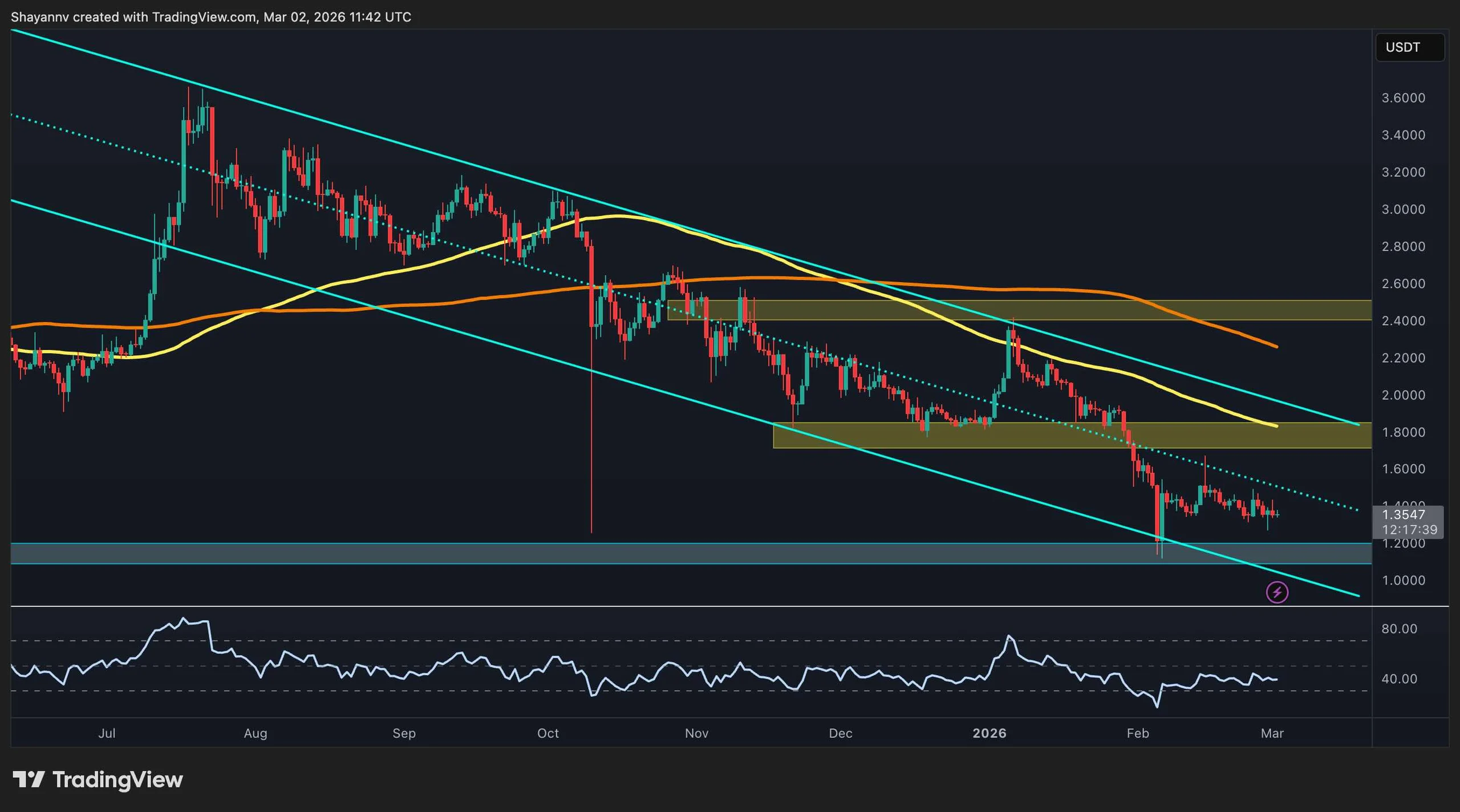
XRP is still trading in a broader downtrend, and the rebound attempts keep getting capped at lower highs. The asset is now trying to establish a bottom near the lower part of the range, so the next move likely comes down to whether buyers can defend the recent floor and reclaim the first resistance band.
Ripple Price Analysis: The USDT Pair
On the daily XRPUSDT chart, the trend remains bearish inside a descending channel, with the price holding below the 100-day moving average and the 200-day moving average. The most important overhead supply is the $1.80 zone, which has acted as a pivot area and now lines up with dynamic resistance from the moving averages and the channel structure.
Above that, the next heavier resistance level sits around $2.40 to $2.50, where sellers previously stepped in and where a larger trend shift would need to prove itself.
Support is concentrated around $1.20, which is the area that has been repeatedly defended after the recent flush. As long as XRP stays above this band, the market can keep forming a base and attempt a recovery leg. A clean daily breakdown below $1.20, however, would weaken the structure and increase the odds of a deeper drop toward the next support region near $1.00 or even lower.
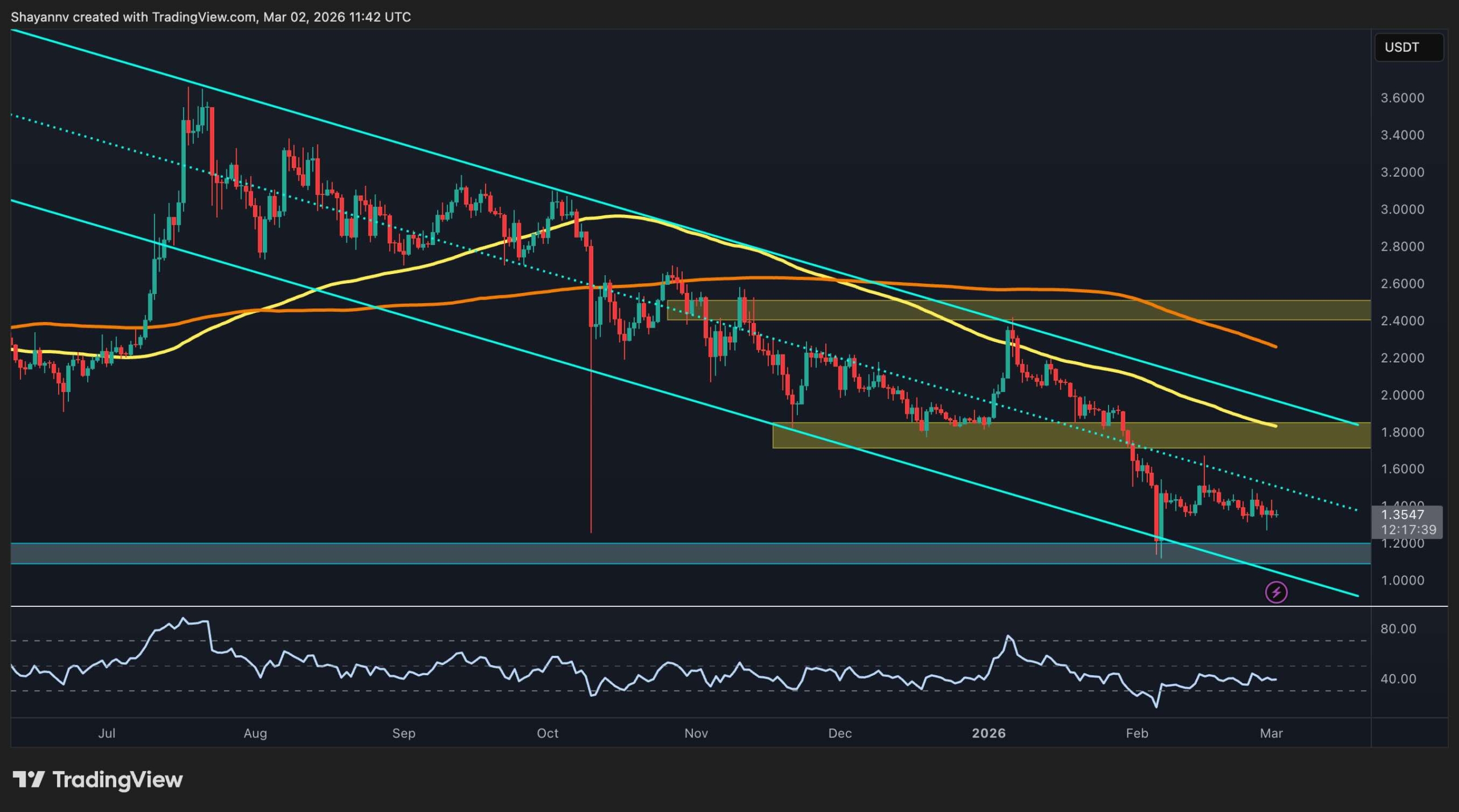
The BTC Pair
On the daily XRPBTC chart, XRP is trading around 2,050 sats and still sits below key resistance levels and the key 100-day and 200-day moving averages, after failing to hold the prior recovery swings. The first resistance to watch is the 100-day moving average around 2,200, followed by the 200-day moving average around 2,400 sats.
These elements have repeatedly rejected the price and also overlap with the moving averages, acting as pressure from above. If XRP can reclaim that zone and hold it, the next upside target becomes the 2,500 to sats supply area.
The main support is also located near the 2,000 sats region, which has been tested multiple times and is clearly a line bulls are trying to defend. If the 2,000-sat level fails on a clean break and close, the next major demand pocket sits much lower around 1,400 to 1,500 sats. That is the type of move that usually happens when Bitcoin strength outpaces altcoins, so XRPBTC is still the key risk gauge for bulls here.

Binance Free $600 (CryptoPotato Exclusive): Use this link to register a new account and receive $600 exclusive welcome offer on Binance (full details).
LIMITED OFFER for CryptoPotato readers at Bybit: Use this link to register and open a $500 FREE position on any coin!
Disclaimer: Information found on CryptoPotato is those of writers quoted. It does not represent the opinions of CryptoPotato on whether to buy, sell, or hold any investments. You are advised to conduct your own research before making any investment decisions. Use provided information at your own risk. See Disclaimer for more information.

Quick Summary
-
CVX shares gained approximately 4% before the market opening bell on rising crude prices
-
Brent crude surged up to 13% following strikes on Middle East energy infrastructure
-
The company’s Leviathan natural gas facility was shut down after regional attacks
-
Maritime traffic slowdowns near the Strait of Hormuz sparked supply worries
-
Market participants are monitoring petroleum stockpiles and regional tensions
Chevron (CVX) shares experienced upward momentum during Monday’s premarket session as crude oil prices rallied sharply following fresh military strikes across the Middle East.
The stock advanced around 4% in early morning trading as oil markets responded to renewed supply uncertainty and reduced maritime activity near the strategic Strait of Hormuz.
The rally came as both Brent crude and West Texas Intermediate futures posted significant gains.
Brent reached a peak increase of 13% during the opening moments before moderating somewhat as the session progressed.
Energy sector equities rallied swiftly as market participants factored in regional supply threats.
Chevron concluded Friday’s trading session at $186.76, posting a 1.41% increase.
Early Monday activity pushed the stock toward $194 as petroleum prices continued climbing.
Exxon Mobil alongside other prominent energy firms also experienced premarket gains.
The energy sector outperformed even as broader indices faced headwinds.
Supply Disruption Fears Fuel Oil Rally
Crude prices rocketed higher after recent strikes hit critical energy infrastructure and maritime passages throughout the Middle East.
Trading resumed with markets pricing in elevated risk premiums for potential supply interruptions.
Saudi Aramco suspended operations at its Ras Tanura refinery following a drone strike.
The installation has daily processing capacity of approximately 550,000 barrels, industry sources indicate.
Market observers characterized the attack as a significant escalation targeting crucial Gulf energy assets.
Maritime operations near the Strait of Hormuz experienced slowdowns in the wake of the strikes.
Approximately 20% of worldwide petroleum supply passes through the Strait of Hormuz.
Any impediment to transit through this waterway can rapidly influence global energy pricing.
Petroleum markets are currently responding to Gulf region events and shipping patterns.
Industry experts noted that price trajectories will depend significantly on disruption duration.
OPEC+ recently authorized a 206,000 barrel per day production boost beginning in April.
Traders emphasized that this supply addition remains modest when weighed against present geopolitical uncertainties.
Chevron’s Regional Exposure and Market Outlook
Chevron maintains significant exposure to regional events through its Middle East operations.
Israel’s Energy Ministry mandated temporary shutdowns of domestic natural gas production following the strikes.
Chevron’s operated Leviathan offshore gas field went offline in response to the attacks.
Industry sources attributed the closure to elevated security concerns.
The company’s financial performance correlates strongly with oil and gas pricing trends.
Elevated energy prices typically bolster upstream revenue for integrated producers.
Energy equities rallied broadly across the sector as petroleum prices advanced.
Occidental Petroleum and ConocoPhillips similarly registered substantial premarket increases.
Market participants are tracking whether Hormuz shipping volumes normalize in coming days.
Attention is also focused on potential resumption timelines for Israeli natural gas operations.
Domestic traders await Wednesday’s weekly petroleum inventory figures from regulators.
The Energy Information Administration is scheduled to publish the data at 10:30 a.m. Eastern Time.
CVX shares maintained premarket gains as oil markets continued processing supply concerns and operational interruptions stemming from Middle East developments.

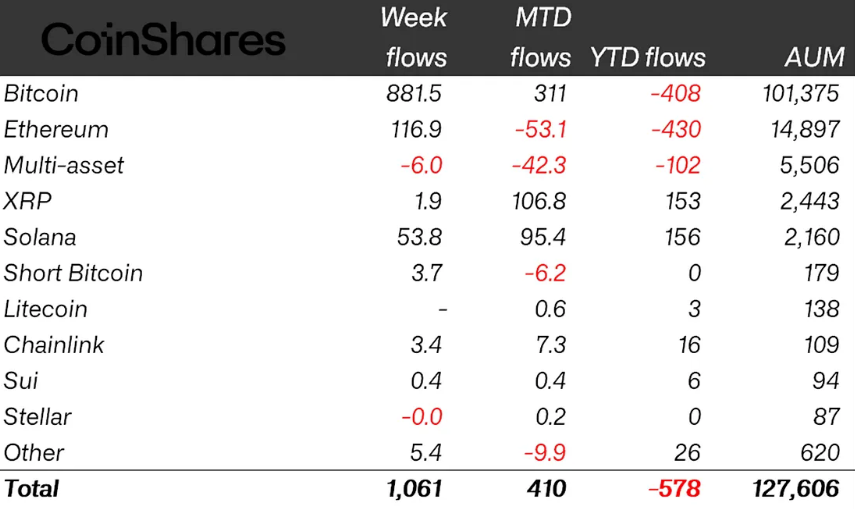
Crypto investment products recorded their first weekly inflows since January last week, snapping a five-week outflow streak of around $4 billion.
Crypto exchange-traded products (ETPs) attracted $1 billion in inflows last week, led by $882 million into Bitcoin (BTC) funds, according to a Monday report from CoinShares.
“From a macro standpoint, it is difficult to attribute the shift in sentiment to a single catalyst,” said James Butterfill, CoinShares’ head of research.
He said the reversal likely reflected prior price weakness, a break below key technical levels and renewed accumulation by large Bitcoin holders.
“At a more anecdotal level, recent client discussions have been almost entirely focused on identifying entry points rather than reducing exposure to the asset class,” he added.
Ether and Solana add $171 million in weekly crypto inflows
Ether (ETH) funds drew about $117 million, CoinShares said, marking their strongest week since January, while Solana (SOL) drew in about $54 million.
Chainlink (LINK) and XRP (XRP) followed with $3.4 million and $2 million in inflows, respectively.

Despite the renewed demand, Bitcoin and Ether ETPs remain in negative territory for the year, with net outflows of $408 million and $430 million, respectively.
Related: Bitcoin manipulation claims face pushback as ETFs snap 5-week outflow run: Finance Redefined
In contrast, Solana and XRP products have posted year-to-date inflows of $156 million and $153 million.
US spot Bitcoin ETFs lead with $787 million in inflows
Regionally, ETP flows were broadly aligned, with the United States accounting for the bulk of inflows at $957 million. Canada, Germany and Switzerland recorded inflows of $34 million, $32.7 million and $28 million, respectively.
Most of the gains came from US spot Bitcoin ETFs, which drew $787.3 million last week, snapping a five-week outflow streak that had totaled more than $3.8 billion, according to SoSoValue.

Despite the renewed inflows, total assets under management in crypto ETPs declined to $127.7 billion from $130.4 billion the previous week.
Net assets in Bitcoin ETFs also fell, slipping to $83.4 billion from $85.3 billion a week earlier.
Magazine: Clarity Act risks repeat of Europe’s mistakes, crypto lawyer warns
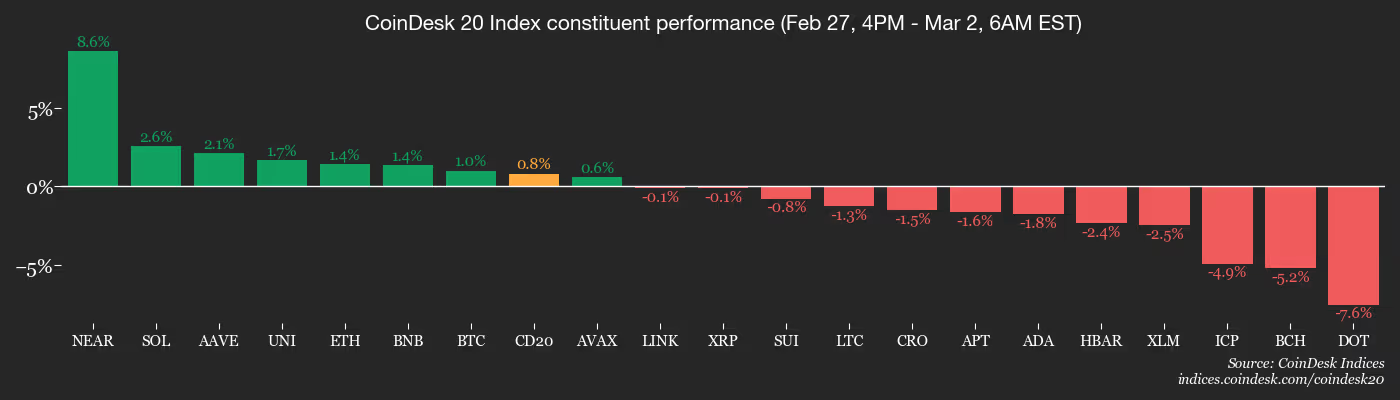
By Omkar Godbole (All times ET unless indicated otherwise)
The conflict between U.S., Israel and Iran remains the day’s biggest story as the attacks intensify and spread.
Markets reacted as they typically do: by de-risking and sending oil prices higher. Bitcoin dropped to $66,300, down 0.5% over 24 hours, having hit a high of $68,000 over the weekend. The CoinDesk 20 Index fell over 2%, signaling broader losses in the crypto market and futures tied to the S&P 500 index lost 1%.
Looking past the headlines and panic, the war could only strengthen the “debasement trade,” a strategy in which investors rotate into scarce-supply assets like gold and bitcoin in anticipation of a decline in the value of fiat (paper) currencies.
Governments in the U.S. and elsewhere already owe more than they generate in economic growth. Their finances will only worsen the longer the war drags on. In such situations, governments don’t collect enough in taxes. Instead, they force central banks to “print money” through bond purchases or quantitive easing (QE) to monetize debt. This floods fiat supply and dilutes purchasing power. Hello debasement.
Traders front-run that process by loading up on store-of-value assets like gold and BTC. The yellow metal has been on a tear for over a year mainly on debasement flows. BTC did not participate back then. But now, having nearly halved to under $67,000 since October, it looks oversold. The possibility of the debasement trade catalyzing a bounce in the largest cryptocurrency cannot be ruled out.
Besides, historically the Fed turns dovish with liquidity easing during geopolitical stress, supporting asset prices, as Maelstrom Fund’s CIO Arthur Hayes noted in his blog post.
Let’s see how things unfold. In the meantime traders need to watch headline risks and oil upswings. Stay alert!
Read more: For analysis of today’s activity in altcoins and derivatives, see Crypto Markets Today
What to Watch
For a more comprehensive list of events this week, see CoinDesk’s “Crypto Week Ahead“.
- Crypto
- March 2: SuperRare to release Delirium, a new collection by artist Xer0x
- March 2: Mantra’s OM to change to MANTRA with a 1:4 coin split as the MANTRA Chain upgrades from v6 to v7.
- Macro
- March 2, 10:00 a.m.: U.S. ISM manufacturing PMI for February est. 52.3 (Prev. 52.6)
- Earnings (Estimates based on FactSet data)
- March 2: Riot Platforms (RIOT), post-market, -$0.32
- March 2: Core Scientific (CORZ), post-market, -$0.18
Token Events
For a more comprehensive list of events this week, see CoinDesk’s “Crypto Week Ahead“.
- Governance votes & calls
- PoolTogether DAO is voting to manually resubmit and execute the remaining actions for the PTBR-35 Governance Shutdown after a previous execution error. Voting ends March 2.
- Angle DAO is voting to orderly wind down the EURA and USDA stablecoins, providing users a one-year 1:1 redemption period followed by a final settlement airdrop. Voting ends March 2.
- GMX DAO is voting to transition to a defined leadership model by hiring a CEO with performance-tied compensation and forming an interim leadership committee to guide the restructuring. Voting ends March 2.
- Unlocks
- Token Launches
- March 2: Dovu (DOVU) to be listed on Kraken.
Conferences
For a more comprehensive list of events this week, see CoinDesk’s “Crypto Week Ahead“.
Market Movements
- BTC is up 0.98% from 4 p.m. ET Friday at $66,194.78 (24hrs: -0.35%)
- ETH is up 1.48% at $1,950.67 (24hrs: -1.63%)
- CoinDesk 20 is up 0.78% at 1,916.46 (24hrs: -1.11%)
- Ether CESR Composite Staking Rate is up 1 bp at 2.85%
- BTC funding rate is at -0.0011% (-1.2147% annualized) on Binance

- DXY is up 0.64% at 98.23
- Gold futures are up 3.03% at $5,406.80
- Silver futures are up 2.64% at $95.75
- Nikkei 225 closed down 1.35% at 58,057.24
- Hang Seng closed down 2.14% at 26,059.85
- FTSE is down 0.78% at 10,825.36
- Euro Stoxx 50 is down 1.89% at 6,022.64
- DJIA closed on Friday down 1.05% at 48,977.92
- S&P 500 closed down 0.43% at 6,878.88
- Nasdaq Composite closed down 0.92% at 22,668.21
- S&P/TSX Composite closed down 0.47% at 34,339.99
- S&P 40 Latin America closed down 0.82% at 3,741.78
- U.S. 10-Year Treasury rate is up 0.4 bps at 3.966%
- E-mini S&P 500 futures are down 1.04% at 6,817.25
- E-mini Nasdaq-100 futures are down 1.42% at 24,650.00
- E-mini Dow Jones Industrial Average Index futures are down 1.11% at 48,458.00
Bitcoin Stats
- BTC Dominance: 58.63% (0.22%)
- Ether-bitcoin ratio: 0.02944 (-0.18%)
- Hashrate (seven-day moving average): 1,068 EH/s
- Hashprice (spot): $29.01
- Total fees: 2.55 BTC / $169,782
- CME Futures Open Interest: 109,280 BTC
- BTC priced in gold: 12.2 oz.
- BTC vs gold market cap: 4.42%
Technical Analysis

- The chart shows ether’s daily price swings with Bollinger bands, which are volatility bands placed two standard deviations above and below the 20-day simple moving average of the price.
- The gap between the bands has shrunk to $226, the narrowest since June 2025.
- Volatility typically booms when bands narrow, which means the token could soon see big price moves in either direction.
Crypto Equities
- Coinbase Global (COIN): closed on Friday at $175.85 (-2.88%), -2.42% at $171.60 in pre-market
- Circle Internet (CRCL): closed at $83.44 (-4.32%), -3.46% at $80.55
- Galaxy Digital (GLXY): closed at $20.59 (-6.15%), -2.19% at $20.14
- Bullish (BLSH): closed at $31.39 (-4.09%), -3.73% at $30.22
- MARA Holdings (MARA): closed at $8.94 (+5.80%), -1.23% at $8.83
- Riot Platforms (RIOT): closed at $16.29 (-4.68%), -2.70% at $15.85
- Core Scientific (CORZ): closed at $16.97 (-5.62%)
- CleanSpark (CLSK): closed at $9.95 (-4.69%), -2.01% at $9.75
- CoinShares Valkyrie Bitcoin Miners ETF (WGMI): closed at $39.88 (-5.43%), -3.61% at $38.44
- Exodus Movement (EXOD): closed at $10.20 (-2.39%), -2.25% at $9.97
Crypto Treasury Companies
- Strategy (MSTR): closed at $129.50 (-2.92%), -0.39% at $129.00
- Strive (ASST): closed at $7.94 (-3.05%), -2.39% at $7.75
- SharpLink Gaming (SBET): closed at $6.82 (-5.41%), +0.44% at $6.85
- Upexi (UPXI): closed at $0.66 (-12.88%)
- Lite Strategy (LITS): closed at $1.13 (-0.88%)
ETF Flows
Spot BTC ETFs
- Daily net flows: -$27.5 million
- Cumulative net flows: $54.78 billion
- Total BTC holdings ~1.27 million
Spot ETH ETFs
- Daily net flows: -$43 million
- Cumulative net flows: $11.63 billion
- Total ETH holdings ~5.7 million
Source: Farside Investors
While You Were Sleeping
- Trump says Iran war may last ‘four weeks or less’ as strikes escalate (Euronews): Trump says the Iran war could last four weeks or less as U.S. and Israeli forces continue their strikes in Iran, which is responding with hits on Gulf states, Israel and U.S. targets.
- New Iranian strikes reported across region, including in Saudi Arabia, as US planes crash in Kuwait (BBC): New Iranian strikes were reported across the Middle East, with explosions in Bahrain, Dubai and Saudi Arabia.
- U.S. equity futures fall in pre-market trading as oil, gold retreat from highs (CoinDesk): U.S. equities fell in pre-market trading. The Invesco QQQ ETF declined 1.5%. A Saudi Arabia oil refinery was hit by Iran, pushing WTI crude oil as high as $75 per barrel. Gold rallied more than 2% to $5,400 per ounce.
- Hedge funds, insurers rush to gauge exposure as Iran spirals (Bloomberg): Hedge funds, banks and insurers rushed to size up their exposure to the Middle East after weekend attacks on Iran fueled chaos across the region.

Travel stocks sink after thousands of flights grounded

‘Phenomenal’ thriller hailed ‘best show ever’ is on Netflix now

China’s Regulation 42 forces Tether to kill its CNHT stablecoin


-

 Sports7 days ago
Women’s college basketball rankings: Iowa reenters top 10, Auriemma makes history
-

 Politics7 days ago
Nick Reiner Enters Plea In Deaths Of Parents Rob And Michele
-

 Fashion3 days ago
Weekend Open Thread: Iris Top
-

 Business6 days ago
True Citrus debuts functional drink mix collection
-

 Politics4 days ago
ITV enters Gaza with IDF amid ongoing genocide
-

 Tech1 day ago
Unihertz’s Titan 2 Elite Arrives Just as Physical Keyboards Refuse to Fade Away
-
Sports2 days ago
The Vikings Need a Duck
-

 Crypto World6 days ago
XRP price enters “dead zone” as Binance leverage hits lows
-
 NewsBeat2 days ago
Dubai flights cancelled as Brit told airspace closed ’10 minutes after boarding’
-

 Tech6 days ago
Unsurprisingly, Apple's board gets what it wants in 2026 shareholder meeting
-

 NewsBeat5 days ago
Cuba says its forces have killed four on US-registered speedboat | World News
-
 NewsBeat5 days ago
Manchester Central Mosque issues statement as it imposes new measures ‘with immediate effect’ after armed men enter
-
 NewsBeat2 days ago
The empty pub on busy Cambridge road that has been boarded up for years
-

 NewsBeat23 hours ago
‘Significant’ damage to boarded-up Horden house after fire
-

 NewsBeat2 days ago
Abusive parents will now be treated like sex offenders and placed on a ‘child cruelty register’ | News UK
-
 NewsBeat6 days ago
Police latest as search for missing woman enters day nine
-

 Entertainment5 hours ago
Baby Gear Guide: Strollers, Car Seats
-

 Business4 days ago
Discord Pushes Implementation of Global Age Checks to Second Half of 2026
-

 Business4 days ago
Only 4% of women globally reside in countries that offer almost complete legal equality
-
 Tech3 days ago
NASA Reveals Identity of Astronaut Who Suffered Medical Incident Aboard ISS