
Crypto World
x402’s $50B Scale Gives Solana an AI Payments Edge

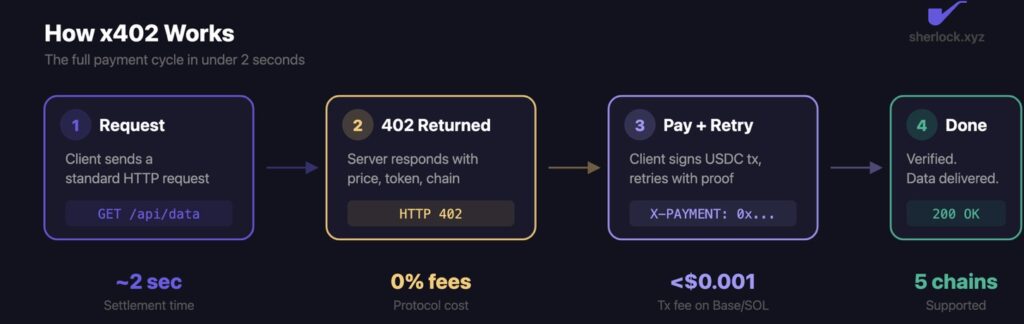
Solana’s x402 protocol has processed roughly $50 billion in volume and connected about 150,000 merchant endpoints, according to a Solana Foundation and Coinbase webinar recap. XRP Ledger has since documented its own x402 implementation settling in XRP and RLUSD, while Cardano remains a name attached to the conversation without comparable live adoption to show for it.
But for smart money, the question isn’t whether AI agents can pay for web resources without a human clicking “checkout.” That part works.
The question is whether any single network converts that technical capability into recurring machine-to-machine commerce that translates into durable demand for its native token, rather than just routing stablecoins through infrastructure that happens to sit on top of it.
How Does x402 Turn HTTP Requests into Payments?

x402 revives an HTTP status code that has sat unused for decades: 402, Payment Required. Instead of a server simply rejecting a request, it responds with pricing terms, letting an AI agent evaluate the cost, authorize a stablecoin payment, and retry the same call with proof of payment attached.
According to the Solana webinar recap, the protocol solves three specific problems for autonomous software: open tool discovery that replaces API keys with a wallet as identity, economic reasoning that embeds live pricing into an agent’s decision-making, and a single runtime where an agent can both earn and spend.
Most transactions settle under 50 cents – a scale of micropayment that traditional card rails were never built to clear economically.
Does x402 Give Solana a Distribution Advantage?
Solana’s pitch leans on infrastructure it already has: more than $15 billion in circulating stablecoins, roughly $10 trillion in cumulative transfers, 400-millisecond block times, and fees near a thousandth of a cent. The recap says x402 has processed over 180 million transactions since launching about a year ago and is now referenced in the docs and workflows of Cloudflare, Stripe, and AWS – the last of which has built it natively into Agent Core Payments.
The webinar’s live demos were the more concrete evidence. Using pay.sh, a Solana-built CLI directory of x402-payable endpoints, an agent located the correct endpoint, paid a one-cent fee, and returned live token-volume rankings without an API key.
A second demo on AWOL, Coinbase’s comparable wallet-based client, chained a social-content pull into a video-generation call, with the agent funding and paying for the entire workflow autonomously – a task the recap notes would otherwise take 30 minutes to an hour of manual key provisioning.
Whether that kind of throughput scales into something with staying power is a separate question from whether Solana’s transaction capacity can handle it, which is the debate Cryptonews has covered in the context of Solana’s transaction stack.
The rival settlement path and the Cardano Credibility Gap
XRP Ledger’s documentation lays out a parallel flow: an agent hits a protected endpoint, receives a 402 response with price and payment address, submits an on-chain XRP or RLUSD payment, and retries once a facilitator verifies the transaction and issues a receipt.
XRPL’s deterministic finality means that verification lands in three to five seconds, according to the documentation – a specific technical claim worth noting given how it differs from Solana’s demo, which is documented separately and dated earlier. For related coverage, see Ripple’s broader push into the Machine Payments Protocol.
Cardano is the hardest case to assess. It’s named as a potential challenger in this market, but nothing in the available evidence shows comparable live transaction volume, merchant endpoints, or agent-payment demonstrations on the network.
That doesn’t rule Cardano out of a longer-term contest – it just means there’s no production adoption to point to yet, which puts it in a different category from Solana’s demoed workflows and XRPL’s documented settlement path.
The broader XRP narrative around AI-driven payment integrations, including XRP’s connection to Stripe-linked payment infrastructure, has already fed into price speculation well ahead of any settled adoption data.
Can micropayments become meaningful network demand?
The Solana recap cites both roughly 200 million and more than 180 million x402 transactions in different passages, without reconciling the two figures or specifying whether either is Solana-exclusive activity.
That’s not a fabrication – the numbers likely reflect different measurement windows or protocol-wide totals rather than network-specific volume – but it’s also not a clean basis for calling this a settled contest between chains.
The deeper structural issue is that x402 and comparable protocols settle in stablecoins, not in SOL, XRP, or ADA. Stablecoins on Solana have already scaled across cross-border payments, remittances, and store-of-value use cases well before agentic payments entered the picture, which means high transaction counts on any of these chains do not automatically translate into equivalent token demand. Fee capture, validator activity, or liquidity effects could eventually matter for native tokens, but the primary evidence here documents payment volume and merchant endpoints, not token-level economic outcomes.
What’s actually being tested here is whether machine-to-machine payments become a recurring commercial pattern or stay confined to conference demos and testnet tutorials.
Solana has the clearest public distribution story right now – real endpoints, real demos, integration references from Cloudflare, Stripe, and AWS.
XRP Ledger has a working settlement path with a specific finality guarantee.
Cardano has neither yet, and until it does, framing this as an even three-way race overstates where the evidence actually sits.
Don’t Miss: The Hottest Meme Coin Opportunities Silently Climbing the Crypto Ranks in September
The post x402’s $50B Scale Gives Solana an AI Payments Edge appeared first on Cryptonews.


Analysts have urged iPhone users to update their IOS after crypto-stealing malware was discovered in malicious Safari browser links and the FOMO app.
SlowMist’s Chief Information Security Officer, Shān Zhang, encouraged his followers last Saturday to update to the latest version of IOS following the proliferation of DarkSword malware.
He claims iPhone versions IOS 13 to IOS 26.5 leave you vulnerable to malicious Safari links that utilize a memory-corruption flaw in WebKit and JavaScriptCore.
This gives hackers access to the JavaScript layer for read and write access.
Hackers can then bypass pointer authentication codes, escape the WebContent sandbox, and escalate kernel privileges in order to gain root access and make unauthorised changes allowing for the exfiltration of crypto keys and wallet data.
Read more: Google warns over 200 million iPhone crypto wallets at risk
FOMO official app contained malware for a week
SlowMist also warned about crypto draining malware across official versions of the FOMO app on the App Store that users may have downloaded thanks to the promotion of crypto key opinion leaders.
SlowMist’s report on the malicious apps found it contained malware hidden with modules that were similarly capable of the DarkSword exploits, and can lead to the theft of seed phrases and private keys.
The vulnerable versions were active between September 9 and September 17.
SlowMist says updating or deleting the app may not be enough, and that users should treat their “relevant seed phrases, private keys, and sensitive credentials as compromised.”
Got a tip? Send us an email securely via Protos Leaks. For more informed news and investigations, follow us on X, Bluesky, and Google News, or subscribe to our YouTube channel.
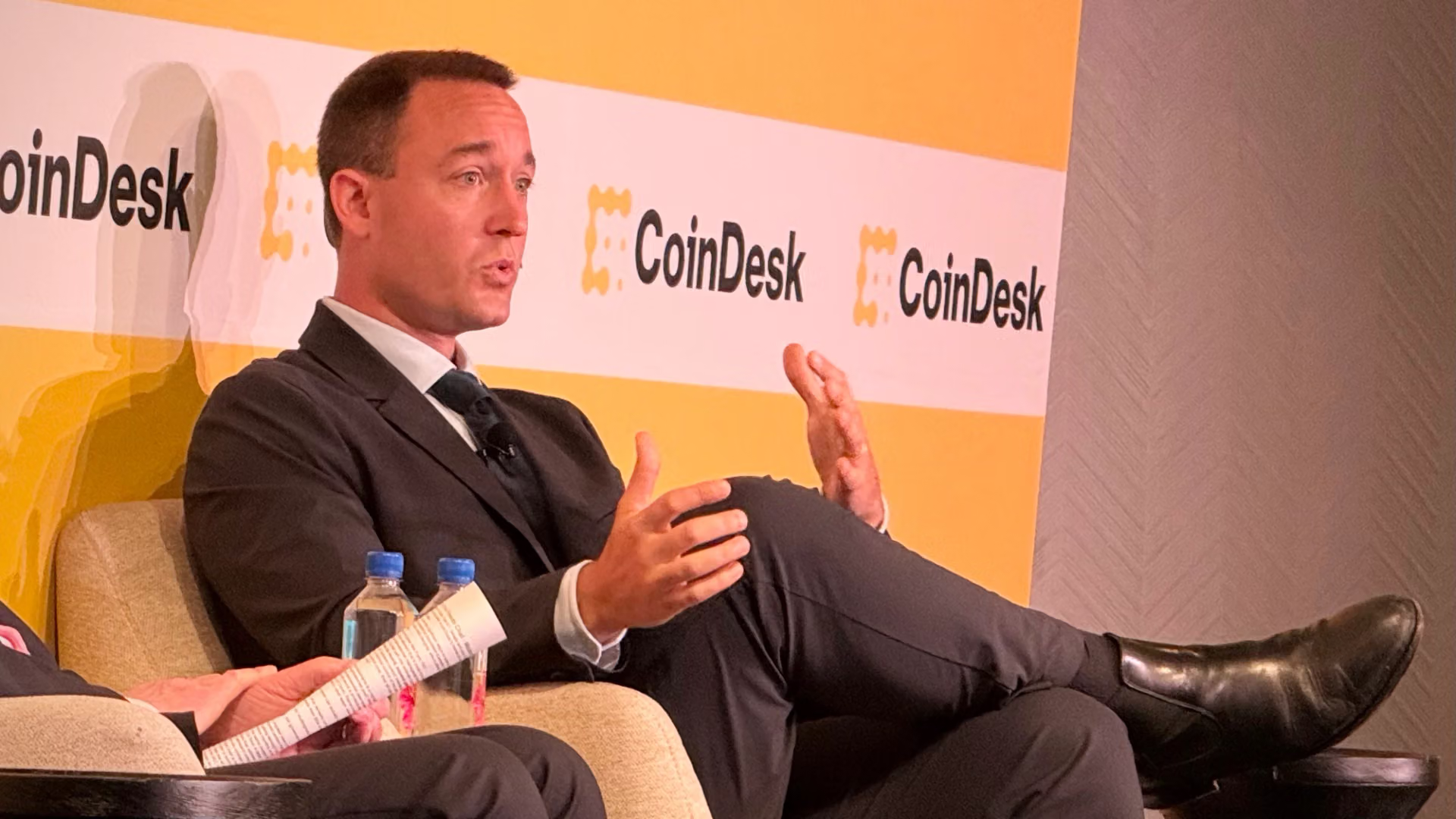
Once the idea is cleared by the Office of Management and Budget at the White House, the agency can formally propose it and take comment from the industry and public. Meanwhile, Lindman cited the agency’s staff statement in December that was meant as an interim approach to steer broker-dealers on how they should handle crypto custody until the rules are in place, and he also referenced its move in September 2025 to allow investment advisers to park customer assets with state-chartered trusts as qualified crypto custodians.
The SEC’s previous effort to pursue a custody rule in 2023 was under a decidedly different regime, and then-SEC Chair Gary Gensler said that crypto firms themselves wouldn’t qualify to custody the assets. That rule, though, never moved to final form and was scrapped when President Donald Trump returned to the White House and appointed crypto-friendly leadership at the regulator.
Speaking more broadly of the agency’s crypto agenda, which has recently included a proposed rule to allow for crypto offerings and a new exemption to clear the way for tokenized securities, Lindman characterized the work as “foundation laying,” adding that “some of the foundation laying is boring.”
“It’s the customary steps associated with taking what was once like this really unique and scary asset, and now saying, ‘Hey, look, this is how we think about stablecoins, or this is how we think about non-security crypto assets,’ and really trying to put them within a framework that can be built upon for every generation to come,” Lindman said. “We need to kind of meet the market where it’s at.”

US officials are probing Binance again as they try to uncover whether or not the Dubai-based crypto exchange knowingly allowed Iran-linked trades and violated US sanctions against the country.
Bloomberg reported Tuesday that the Manhattan US attorney’s office and Justice Department’s (DoJ) Washington arm are spearheading the investigation.
Binance told Bloomberg it doesn’t tolerate sanctions violations, saying, “We fully cooperate with law enforcement, and we remain committed to rooting out and shutting down bad actors.”
Earlier this year, The Wall Street Journal, New York Times, and Forbes reported that two Chinese companies traded billions of dollars worth of crypto on Binance as part of a sanction-dodging plan to allow Iran to continue to sell its oil.
Read more: US Senator asks if Binance lied to Congress about Iran
Binance called these reports defamatory.
In March, the DoJ reportedly began an investigation into Binance about these Iran-linked funds. In the same month, Binance sued the WSJ for defamation.
Earlier this month, the US government seized and planned to forfeit $61 million worth of frozen USDT that is allegedly part of Iran’s oil trading.
It claimed this enterprise has generated $1.5 billion in crypto proceeds for Iran’s military and nuclear program.
Got a tip? Send us an email securely via Protos Leaks. For more informed news and investigations, follow us on X, Bluesky, and Google News, or subscribe to our YouTube channel.
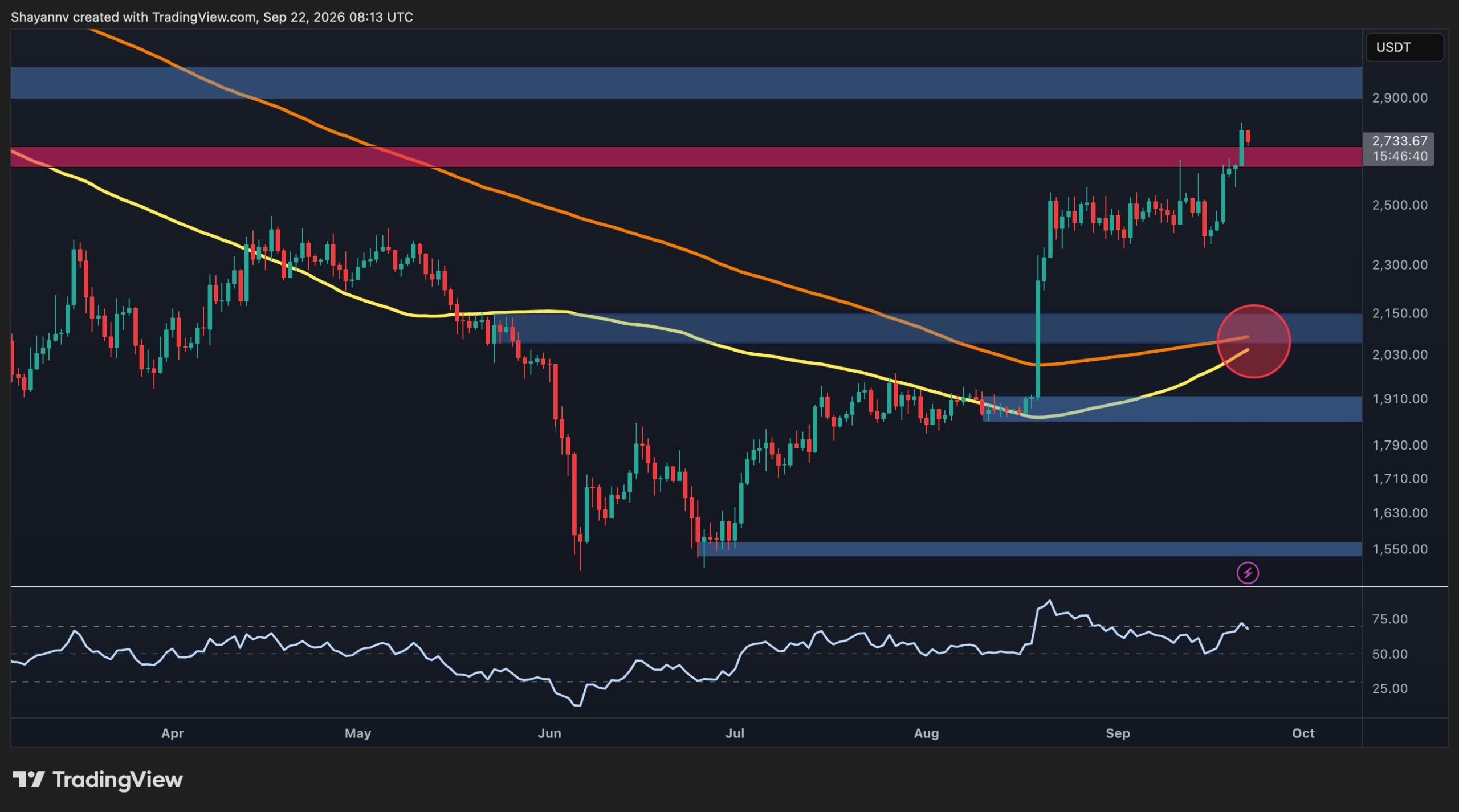
Ethereum has extended its recovery from the September lows and is now trading around $2.73K after slightly breaking above the $2.7K resistance area. The latest move has strengthened the short-term structure, although ETH is approaching another major resistance zone and momentum might be beginning to cool from its recent highs.
Ethereum Price Analysis: The Daily Chart
The daily chart shows a clear structural improvement following the sharp recovery from the $1.5K area. ETH subsequently reclaimed the $1.9K region and then broke above the $2.1K resistance zone with substantial force.
The breakout accelerated in August, pushing ETH above both the 100-day and 200-day moving averages. These key moving averages are now converging rapidly, which could lead to a potential bullish crossover around $2K. All of these signs point to the fact that the broader bearish structure has weakened considerably. Still, a complete long-term trend reversal would require ETH to trade above the higher resistance levels.
The market is currently trading around $2.73K, just above the marked $2.7K resistance zone. Holding above this area could open the way toward the next major resistance around $3.0K. That region is particularly important because it is also an important psychological level that the market would need to overcome.
On the downside, the former $2.7K resistance area could now act as initial support if the breakout holds. Below it, the $2.5K consolidation region is the next notable zone, followed by the key $2.1K support area, which also coincides with the key moving averages.
ETH/USDT 4-Hour Chart
The 4-hour chart provides a clearer view of the latest breakout. ETH spent much of September consolidating between roughly $2.4K and $2.7K before breaking higher over the recent sessions. The move finally carried price through the $2.7K resistance area.
The latest candles show some hesitation after ETH briefly pushed toward $2.8K. This is consistent with profit-taking around a previously marked resistance area rather than an immediate structural reversal.
The key short-term level is now the same $2.7K zone. Holding above this area and completing a pullback would preserve the recent breakout structure and could allow an attempt toward the $3K region. Conversely, a sustained move back below the $2.7K area would weaken the breakout and increase the possibility of a deeper retracement toward the $2.45K bullish order block in the short-term.
The 4-hour RSI has risen into the upper portion of its range following the breakout but has already pulled back from an overbought state. This indicates that momentum remains constructive, while also showing that the market has become less stretched after the initial surge, which is a positive sign showing momentum cooling off before another rally materializes.

Sentiment Analysis
The Ethereum Taker Buy Sell Ratio chart shows the metric’s 30-day average currently around 0.99. A reading below 1 indicates that aggressive taker selling has exceeded aggressive taker buying over the measured period.
This is notable because ETH has continued to appreciate despite the ratio remaining below 1. The latest price rebound therefore has not been accompanied by a clear dominance of aggressive market buying on this metric.
The chart also shows that the 30-day average has been declining from significantly higher levels seen around April and July. At the same time, ETH has recently moved sharply higher from the $1.8K area toward $2.7K. This divergence suggests that the rally has not yet been confirmed by a sustained improvement in taker-buying dominance.
A move in the ratio back above 1, particularly if sustained, would provide stronger confirmation that aggressive futures buyers are gaining control. Conversely, continued readings below 1 while ETH trades near resistance could leave the latest breakout vulnerable to a period of consolidation or correction, especially if spot demand fails to keep up with the selling pressure coming from the futures market.

The post Ethereum (ETH) Price Analysis: Bulls Eye $3K Following Breakout Above $2.7K Resistance appeared first on CryptoPotato.

Moderna (NASDAQ: MRNA) has remained one of the market’s hottest biotech stocks. Even as the vaccine maker’s shares remain off their 52-week high, hit by news of a breakthrough in using its mRNA technology to create marketable drugs for other diseases and ailments, not just for COVID-19, at around $157 per share, they’re still up over sixfold over the past 12 months.
Yet while Moderna may still be sitting pretty right now, analysts remain skeptical whether the stock can hold on to its latest spate of gains.
Missed AI’s “Act 1”? Act 2 Could Be 15x Bigger. Most investors think they missed the AI boat because they didn’t buy Nvidia in 2005. But according to our analysts, we’re only at the end of “Act 1″—the R&D phase. “Act 2” is the global rollout. Continue »

Moderna, the big rally, and the analyst community’s cautious view
Already trending higher since late 2025, Moderna shares skyrocketed in August. This super rally came on the heels of the company’s unveiling of positive late-stage clinical trial data for Intismeran Autogene, an mRNA-based cancer vaccine that Moderna is co-developing with Merck.
Per the press release, top-line results from the Phase 3 INTerpath-001 trial of Instimeran Autogene combined with Keytruda, Merck’s immunotherapy treatment, “demonstrated meaningful improvements in recurrence-free survival (RFS) and distant metastasis-free survival (DMFS) in patients with completely resected Stage IIB-IV melanoma.”
Perceiving this development as a positive sign for Moderna’s overall plans to bring mRNA-based oncology products to market, Moderna shares surged 177% following the Aug. 19 clinical trial news. Even after giving back some of these gains in the past month, Moderna remains near multiyear highs.
That said, according to Barron’s, most analysts hold either a neutral or “hold” rating on Moderna right now; two analysts have downgraded the stock following this rally. Rothschild & Co. Redburn’s Simon Baker, in his downgrade from “hold” to “sell,” noted that while the phase 3 data were “undoubtedly good,” the market has likely overreacted to news, as it’s uncertain whether the nine other clinical trials for other types of tumors will unveil similar conclusions.
In her bearish research update, J.P. Morgan’s Jessica Fye also noted uncertainty over subsequent trial data, coupled with the argument that the immediate economic implications of the aforementioned clinical trial are already well-factored into the stock price.
The best move for new and existing investors
SoFi Technologies has moved its entire $25 billion card program to blockchain based settlement using SoFiUSD as its bank issued stablecoin goes live across Mastercard’s global payments network.
Summary
- SoFi has moved its $25 billion card program to SoFiUSD settlement across Mastercard’s global payments network.
- Transactions are now live onchain, while merchants can receive funds without holding stablecoins or building blockchain infrastructure.
- SoFi and Mastercard are exploring SoFiUSD for merchant settlement, cross border payments and remittances.
According to a joint announcement from SoFi and Mastercard on Sept. 22, debit and credit card transactions under the SoFi Bank program are now settling with SoFiUSD, making the token part of Mastercard’s live payment infrastructure six months after the companies announced their partnership.
Transactions are already live onchain, with SoFi Bank migrating a card program expected to process more than $25 billion in volume. SoFi said the rollout makes SoFiUSD the first stablecoin issued by a nationally chartered bank to be used for settlement across Mastercard’s network.
The system does not require merchants to hold the token or build separate blockchain infrastructure. Settlement can reach a SoFi Bank account through the company’s Big Business Banking platform, after which merchants can withdraw the funds as cash around the clock without a withdrawal fee.
“In six months, SoFi and Mastercard took stablecoin settlement from an idea to a live product that materially improves how money moves for businesses,” SoFi CEO Anthony Noto said.
Noto said merchants can use blockchain based settlement without changing how they currently operate, while gaining faster access to funds through their bank accounts.
SoFiUSD stablecoin settlement moves into live card transactions
SoFiUSD is issued by SoFi Bank, N.A., a nationally chartered bank regulated by the Office of the Comptroller of the Currency. The stablecoin is redeemable 1:1 for U.S. dollars, with reserves held primarily in cash, according to the company.
The token is available to institutions and SoFi members for settlement, payments and other financial applications.
SoFi had already expanded access to the token before moving its card program onchain. In May, crypto.news previously reported that SoFiUSD became available inside the company’s consumer app, allowing nearly 15 million members to buy, sell, hold and convert the stablecoin. The token operates on Ethereum and Solana, while SoFi had listed Mastercard settlement among the institutional uses planned for the product.
Mastercard Global Head of Digital Commercialization Sherri Haymond said the launch had moved the companies past the testing stage and into live use.
“Stablecoins become meaningful when they solve real problems that businesses face every day,” Haymond said. She added that the companies were bringing regulated stablecoin settlement into production while keeping the safeguards and scale associated with Mastercard’s existing network.
Mastercard has been expanding stablecoin settlement options
The SoFi rollout follows a larger stablecoin settlement program unveiled by Mastercard earlier this year.
In June, Mastercard added six regulated stablecoins to its planned settlement infrastructure, including Circle’s USDC, PayPal USD, Global Dollar, Pax Dollar, Ripple USD and SoFiUSD. The payment company said supported transactions could settle outside conventional banking hours, including during weekends and holidays.
Support was announced across several blockchain networks, including Ethereum, Solana, Polygon, Base, Arbitrum, Canton, Tempo and the XRP Ledger.
Under that rollout, issuers and acquirers were expected to gain the option to settle card transactions using regulated stablecoins while retaining existing Mastercard payment processes. Initial support was planned for parts of the United States and Latin America before further expansion during 2026.
Mastercard has since continued building infrastructure that connects conventional payment systems with blockchain based money movement.
The company completed its acquisition of BVNK in August in a deal valued at up to $1.8 billion. BVNK provides infrastructure for moving funds between fiat currencies and stablecoins and supports payments, treasury operations, payouts and settlement.
Bringing BVNK into Mastercard gave the payments company another set of systems for handling stablecoin and tokenized asset transactions alongside its existing payment network.
SoFi is extending SoFiUSD beyond its own banking network
SoFi said the latest settlement launch is not intended to remain limited to transactions involving SoFi Bank.
The company is in discussions with large U.S. merchants over stablecoin based settlement arrangements, ranging from multinational retailers to technology service platforms. No participating merchants or implementation dates were disclosed in the announcement.
SoFi and Mastercard plan to examine more uses for SoFiUSD across Mastercard’s network, including cross border payments, remittances and other forms of money movement.
Institutional distribution of the stablecoin has been growing through separate partnerships. Earlier this month, SoFi reached an agreement with Payward that brought together its banking infrastructure and Kraken’s digital asset services.
Under the arrangement, Kraken agreed to list the SoFiUSD stablecoin, while Payward joined SoFi’s real time settlement network for round the clock U.S. dollar transfers. SoFi agreed to use Kraken Prime as another source of liquidity for digital asset orders.
The partnership gave SoFiUSD another distribution channel outside SoFi’s own platform while connecting institutional clients with bank based dollar settlement.
Merchants can settle without holding SoFiUSD
For merchants, the companies have structured the system so that stablecoin settlement can remain largely behind the scenes.
Businesses do not need to maintain a SoFiUSD balance or integrate blockchain wallets into their operations, according to SoFi. Funds can be received through SoFi Bank and converted into cash while the blockchain handles the settlement process between the relevant parties.
SoFi’s Big Business Banking platform serves as part of that infrastructure. The service was launched earlier this year to give institutional customers access to fiat balances, stablecoins and digital assets through a single regulated banking environment.
SoFiUSD can be used within the platform for payments and settlement, while businesses can move between the token and U.S. dollars through SoFi Bank.
The company said the system gives merchants access to settlement funds at any time instead of tying withdrawals to traditional banking hours.
SoFi and Mastercard have not provided a timetable for the next phase of the rollout. Their current discussions cover merchant settlement, cross border transfers, remittances and other payment uses as they assess where SoFiUSD can be used across Mastercard’s network.


Crypto World
ECB seeks tighter MiCA rules to block indirect stablecoin yields and protect bank deposits

The European Central Bank (ECB) and the European Union’s national central banks want crypto platforms to be prevented from using lending, borrowing, staking and other products that offer indirect returns on stablecoin holdings.
“Electronic money is intended to be used for making payments and not as a means of saving,” the European System of Central Banks (ESCB) said in a response to the European Commission’s consultation on reviewing the Markets in Crypto-Assets regulation (MiCA).
In the 57-page response, the group said it “continues to support the prohibition on CASPs paying remuneration on stablecoins,” referring to crypto-asset service providers. The ban, it said, should not be limited to services already governed by MiCA, which began taking effect in June 2024, and should also cover unregulated activities, including crypto lending, borrowing and staking.
The banks said that allowing indirect returns could undermine the distinction between electronic money and bank deposits, as well as distort the level playing field across the EU financial system.
“Maintaining and, where necessary, strengthening the prohibition, covering both direct and indirect forms of remuneration, should be a clear legislative priority,” the ESCB stated.
The European Central Bank (ECB) and EU central banks want to replace mandatory bank-deposit thresholds for stablecoin reserves with new liquidity requirements, arguing that large stablecoin deposits could create liquidity risks for banks.
The European System of Central Banks (ESCB) called for removing rules requiring at least 30% of reserves, or 60% for significant stablecoins, to be held as bank deposits. The proposal came in the ESCB’s response, published Tuesday, to the European Commission’s review of the Markets in Crypto-Assets Regulation (MiCA).
Instead of the existing bank-deposit rules, the ESCB backed minimum liquidity thresholds for reserve assets maturing within one and five working days. It separately pointed to overnight reverse repurchase agreements (repos) and short-term sovereign bonds as alternative instruments issuers could use to achieve liquidity.
The new proposal echoes concerns previously raised by the stablecoin industry, including Tether CEO Paolo Ardoino, who has warned since at least 2024 that MiCA’s bank-deposit requirements could create systemic risks for both banks and stablecoin issuers.
EU central banks favor liquidity buckets
The ESCB said the existing requirement “creates a direct link between issuers and credit institutions” and could expose banks to liquidity problems if a stablecoin run forces an issuer to rapidly withdraw deposits.
The central banks cited draft rules published by the European Banking Authority in 2024, requiring significant stablecoins to hold at least 40% of reserves in assets maturing within one working day and 60% within five working days. For non-significant tokens, the thresholds are 20% and 30%, respectively.
Beyond stablecoin reserves, the ESCB also warned of “material challenges” in enforcing MiCA, saying non-compliant crypto companies can still access EU customers.
Tether raised similar bank-risk concerns in 2024
In an October 2024 Cointelegraph interview, Tether CEO Ardoino illustrated the risk with a hypothetical stablecoin holding 10 billion euros in reserves, 6 billion euros of which would have to be kept in bank deposits.
If a bank lent out 90% of those funds, he said, only 600 million euros would remain available, potentially creating a liquidity crunch if the issuer suddenly needed billions to meet redemptions, Ardoino said.
Related: ECB launches Pontes to settle tokenized assets without stablecoins
Flash forward almost two years and the ESCB now points to a similar risk, saying a stablecoin run could force an issuer to rapidly withdraw deposits and create liquidity problems for a bank, particularly if stablecoin reserves account for a significant share of its funding.
The central banks on Tuesday said risks can also flow in the opposite direction, citing the March 2023 collapse of Silicon Valley Bank, which triggered a run on Circle’s USDC stablecoin after Circle disclosed that $3.3 billion of its reserves were held at the bank.
Magazine: MiCA cracks down on USDT in Europe… but no one else cares
One of the first things anyone learns about Bitcoin is that it has a pseudonymous creator — and they’re a billionaire multiple times over.
Nearly 1.1 million BTC is widely attributed to Satoshi Nakamoto, but it’s a number that rests on a forensic trail identifying a mining operation, not a person. The estimate also varies by more than 200,000 Bitcoin depending on how strictly a certain “fingerprint” test is applied.
When 600 BTC mined in 2010 suddenly moved after 16 years, triggering speculation that “Satoshi’s coins” had awoken, that distinction became more important.
The coins came from 12 long-dormant block rewards that had been mined over four days in March 2010 and sat untouched until Sept. 5 this year, when someone controlling the private keys spent them one by one within half an hour.
But that doesn’t mean that the person spending that $46 million in Bitcoin was Satoshi.
The blockchain traces coins, not people
Onchain tracker Whale Alert found no connection between the 600 BTC and the mysterious Bitcoin creator’s stash.
Blockchain research firm Bitquery found that 10 of the 12 blocks didn’t match the distinctive mining pattern that’s come to be associated with Satoshi’s mining operation, known as “Patoshi.”
And the two remaining blocks only showed weak matches that could occur by chance according to Bitquery researcher Gaurav Agrawal.
Related: Bitcoin treasury firms can outperform BTC… but is the risk worth taking?
The rewards were mined by a single machine however, and whoever spent them this month controlled the private keys, but as Agrawal points out:
“What the chain cannot say is whether the hand in 2026 belongs to the person who ran the machine in 2010.”
It’s a mystery that’s likely to remain unsolved since private keys can be inherited, sold, stolen, or recovered from an old drive found in a secondhand store. Agrawal notes that “the chain only records that someone had it.”
The spending transactions used modern wallet software, which the 2010 client could not have produced, so “at the very least, the keys were loaded into something new.”
The Patoshi pattern behind the fortune
If the blockchain can’t tell us who owned those OG coins, how do we know the 1.1 million BTC actually belonged to Satoshi? Circumstantial evidence is the best evidence we have.
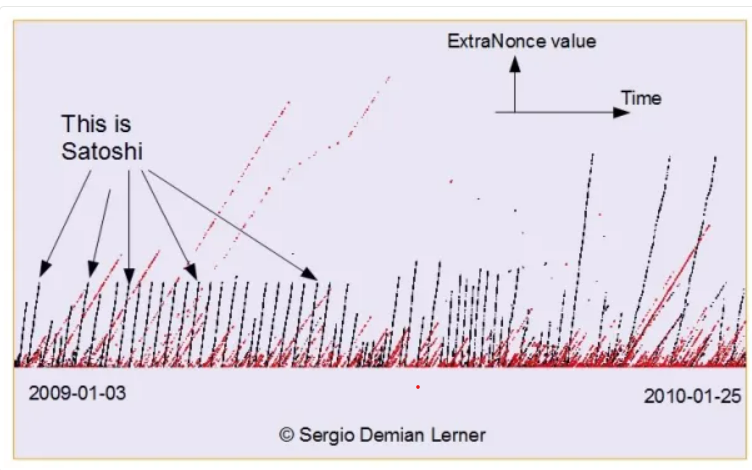
In 2013, researcher Sergio Demian Lerner identified a distinctive fingerprint in Bitcoin’s earliest blocks, suggesting one miner operated a machine differently from the other miners on the network that could be traced across thousands of blocks.
Lerner estimated that the miner had amassed around 1.1 million BTC, and more than a decade later, he still stands by his calculations.
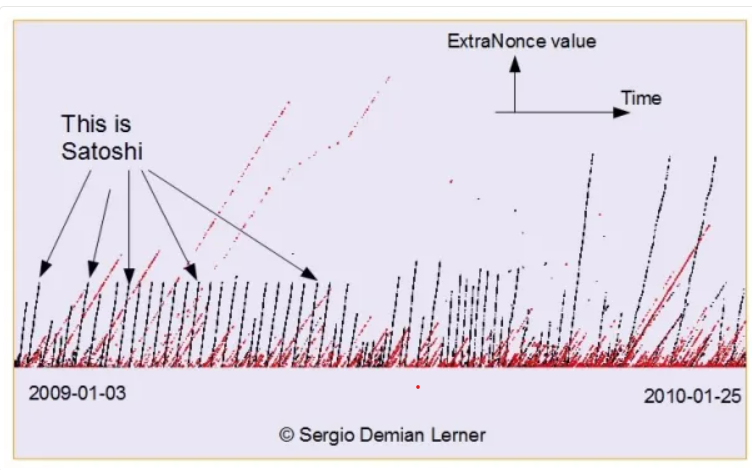
Sergio Dermian Lerner identified the Patoshi pattern. Source: Bitslong
“It is accurate,” he tells Magazine, “with a disclaimer that the evidence is circumstantial; there is no math proof or direct witness.”
He says the case for connecting Patoshi to Satoshi goes beyond the mining fingerprint, however, since several early Bitcoin users, including Hal Finney, Dustin D. Trammell, Nicholas Bohm and Mike Hearn, received transfers that exhibited the Patoshi pattern:
“All those transfers were made from coinbases in the Patoshi pattern: that provides compelling reasons that Patoshi and Satoshi are the same person, although not proof.”
Lerner also says the miner appears to have been using specialized mining software rather than the standard client, which was likely created before Bitcoin launched. That makes it “highly improbable” that another miner developed a working specialized setup in the few hours between the Bitcoin v0.1 announcement and the mining of the first block. He says:
“Whoever was mining the Patoshi pattern started right at the earliest beginning.”
Bitquery rebuilt the fortune from scratch
13 years after Lerner identified Patoshi, Bitquery rebuilt the fingerprint from raw blocks, grading 54,316 blocks from Bitcoin’s early era and following every coin through Sept. 1, 2026.
Their “highest grade” reconstruction agrees with the public Patoshi list on 99.2% of blocks, and the firm also found zero exceptions in a timestamp-ordering test across 5,836 adjacent block pairs.
“I don’t know of a stronger test for this,” Agrawal says.
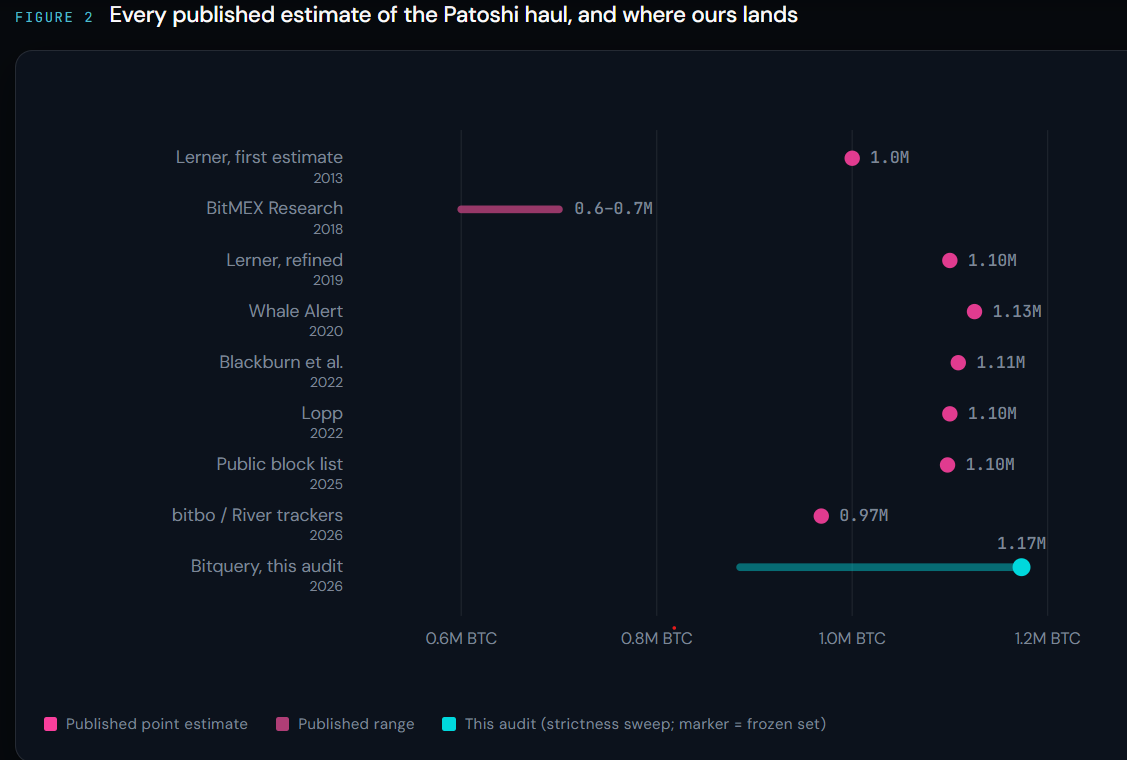
Bitquery’s estimate of the total fortune. Source: Bitquery.io
But the analysis casts some doubt around the famous 1.1 million BTC figure itself, since the number Bitquery found varies depending on how strictly the pattern is applied.
Related: Is Bitcoin too volatile to risk your retirement on?
“Run strictly, the fingerprint covers just under 0.9 million BTC,” Agrawal says, with the “most generous reading” at around 1.17 million.
That isn’t to say Bitquery disproves Lerner’s estimate, but it shows how the size of the Patoshi stash depends on how the mining pattern is applied.
“The published estimates of 1.0 to 1.13 million sit inside that range, so we did not move the number,” Agrawal says.
What links Satoshi to the 1.1M BTC
Agrawal says the claim that “Satoshi owns 1.1 million BTC” is really three claims stacked on top of each other.
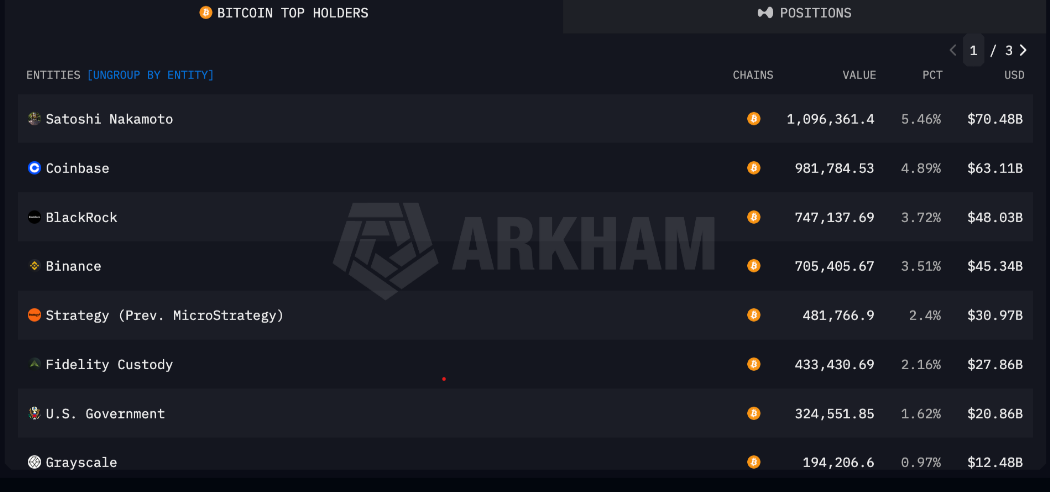
“Satoshi Nakamoto” is the largest BTC holder. Source: Arkham
The claim that the coins came from one machine is supported by strong evidence. The claim that the machine belonged to Satoshi is circumstantial, and the claim that the keys still remain under his control can’t be proved simply because the coins have never moved.
Bitquery also discovered a 2010 transaction that it could not find reported “in any published study.”
On May 17, 2010, 600 BTC from early mining rewards moved in two transactions about an hour apart. The first, at 22:04 UTC, spent 10 block rewards worth 500 BTC, and the second, at 23:07 UTC, spent another two block rewards worth 100 BTC.
Those coins had been mined at different points throughout 2009, including rewards from near the beginning, and end, of Bitcoin’s first year.
“It matters, I think,” Agrawal says, “because it is the clearest moment where the chain itself, and not a statistical pattern, says these blocks belong together.” He says that is “as close as the chain gets” to confirming that blocks from all over 2009 sat in one wallet, “which is what the pattern claims for the whole set.”
So we know whoever controlled those keys had access to block rewards mined across 2009, but we don’t know who was behind them.
Unlike the May 2010 transaction, the 600 BTC that moved this September don’t belong to the Patoshi miner, and there’s no new evidence connecting them to “Satoshi’s” stash. As Agrawal says, “nothing in the math settles it, so we will never be sure.”
Cointelegraph publishes long-form journalism, analysis and narrative reporting produced by Cointelegraph’s in-house editorial team with subject-matter expertise. All articles are edited and reviewed by Cointelegraph editors in line with our editorial standards. Some articles contain affiliate links, from which Cointelegraph may earn a commission. These relationships do not influence which products we review or our editorial conclusions. Content published in here does not constitute financial, legal or investment advice. Readers should conduct their own research and consult qualified professionals where appropriate. Cointelegraph maintains full editorial independence.

OFFSIDE | The most crucial thing you missed in that Sydney Sweeney ad | Football News

20th anniversary iPhone won’t get improved CoE OLED display

PARKOUR VS MONEY HEIST! 2




-

 Fashion4 days ago
Weekend Open Thread: Talbots – Corporette.com
-

 Tech2 days ago
Researchers escape OpenAI Codex sandbox to run commands on host
-

 Crypto World7 days ago
Robinhood engineers charged over $50K crypto scheme
-

 Crypto World4 days ago
Circle launches Arc Studio AI agent for building onchain apps
-
 NewsBeat4 days ago
Trump says US has reached an agreement to take permanent control of Greenland’s security
-

 Crypto World2 days ago
Who Needs CLARITY Anyway? ARB Could See 70X Increase: Hodler’s Digest
-

 Crypto World4 days ago
Bitcoin price breaks channel as RSI climbs to 63
-

 Crypto World6 days ago
US Charges Robinhood Engineers Over Crypto Listing Trades
-

 Crypto World7 days ago
What Is the Status of the U.S.-Iran Peace Talks? Here's What Both Sides Are Saying
-

 Crypto World4 days ago
Trading Bitcoin on Robinhood? Why 2% Spread Has Traders Worried
-

 Tech7 days ago
Webb’s IC 348 Mosaic Includes Two-Jupiter Dwarfs, Twin Jets, and a Nursery Still Making Worlds
-

 Crypto World4 days ago
World Money launches in 150+ countries with Stripe
-

 Entertainment7 days ago
Big Brother Update: Melody Explodes at Drew as Illness Sweeps BB28 House
-

 Crypto World5 days ago
Mortgage and refinance interest rates today, Thursday, September 17, 2026
-

 Crypto World4 days ago
Silver prices recover quickly, hitting weekly high today
-

 Business2 days ago
Analog Devices (ADI) Bets $1.35 Billion on Chips that Let Machines Think for Themselves
-
 NewsBeat4 days ago
US was ‘on brink of war’ with China over false AI report of nukes moving in Middle East
-

 Tech5 days ago
GPT-6 Astra Reached the Nether in Minecraft, Lost Its Stash to a Creeper, and Farmed Potatoes for Hours
-

 Business7 days ago
Federal Reserve expected to hike interest rates 25 basis points at FOMC meeting
-

 Crypto World1 day ago
Bitcoin price holds above $81K as key catalysts line up
You must be logged in to post a comment Login