
Crypto World
XRP could lose some payment flows to stablecoins, Ripple CEO says


Ripple CEO Brad Garlinghouse has said XRP is not necessarily the best asset for every payment use case, acknowledging that stablecoins can solve some customer problems more effectively.
Summary
- Ripple CEO Garlinghouse says XRP may be the best bridge asset for some payment cases.
- Ripple Payments supports RLUSD, USDC, USDT and fiat depending on business needs and available jurisdictions.
- Garlinghouse says a stablecoin can solve some payment problems better, rejecting XRP-only approach to utility.
- The Faena Rose interview originally took place January 22 before clips resurfaced in September 2026.
- Senate rejected CLARITY cloture 49-50 on September 15, leaving Ripple-Coinbase policy disagreements unresolved in Congress.
Faena Rose’s January 22 program, titled The Transformative Power of Crypto Assets, featured Garlinghouse discussing cross-border payments, stablecoins, financial inclusion and digital financial infrastructure. Clips from the interview resurfaced on social media on September 24, more than eight months after the conversation originally took place.
The timing matters because the remarks are not a new Ripple policy announcement made this week. They show how Garlinghouse described the roles of XRP and stablecoins earlier in 2026, while Ripple’s current product documents now show a payments platform built to use several settlement assets.
Why XRP may not be the answer for every Ripple payment
During the discussion, Garlinghouse used cross-border transfers as an example of how the choice of asset can depend on the payment itself. He said “XRP is the best bridge asset” could be the answer for one transaction, while another could work better through a stablecoin.
His qualification was explicit. Garlinghouse said “a stablecoin is going to solve that problem better” in some cases, putting the customer’s payment requirement ahead of using one specific cryptocurrency. The statement was conditional and did not say stablecoins are universally better than XRP.
Garlinghouse separately rejected the label of an XRP maximalist, saying he is bullish on several cryptocurrencies for different reasons. His comments framed utility as the test for choosing technology instead of loyalty to a single token.
That approach extended to his criticism of parts of the crypto market. Garlinghouse questioned the value created during the NFT boom and said he did not understand much of the meme-coin craze. He argued that a token or technology should solve an identifiable problem if it is going to provide useful value.
For XRP, cross-border liquidity remains one of the use cases Ripple has promoted for years. The company’s current stablecoin documentation describes XRP as the native cryptocurrency of the XRP Ledger and says it was designed to operate as a bridge asset for fast, low-cost cross-border transactions.
Ripple Payments now works without dependence on one asset
Ripple’s current payment infrastructure supports the flexibility Garlinghouse described in January.
The company’s official Ripple Payments page says businesses can settle transactions using RLUSD, USDC, USDT or fiat, depending on their requirements. Ripple states that its settlement layer is “decoupled from any single issuer’s token,” allowing new stablecoins to be added without rebuilding the payment infrastructure.
The platform handles collections, digital-asset conversion and payouts across more than 60 markets. Ripple says the underlying network has processed more than $100 billion in payment volume and operates through a group holding more than 75 licenses globally.
Ripple USD has become another part of that infrastructure. Ripple describes RLUSD as a dollar-backed asset designed for payments, remittances, treasury flows and settlement. In certain jurisdictions, the company has integrated the stablecoin directly into Ripple Payments.
XRP and RLUSD therefore have different structures. XRP trades freely and has no issuer fixing its market price. RLUSD is issued against reserves and designed to maintain a value of one U.S. dollar, according to Ripple’s documentation.
As crypto.news previously reported on RLUSD’s payment role, Ripple CTO Emeritus David Schwartz described the stablecoin as capable of acting as a bridge in some transactions while distinguishing its centralized controls from XRP’s neutral asset structure.
Ripple has since expanded the stablecoin side of its payment network. In June, the company announced that Bitso’s Mexican peso-backed MXNB would join the XRP Ledger and its payment infrastructure alongside RLUSD for U.S.–Mexico settlement flows.
In related coverage, crypto.news reported on the Bitso integration, which gave enterprise clients another stablecoin option for transactions involving the Mexican peso.
Does Garlinghouse’s comment mean Ripple is moving away from XRP?
Garlinghouse did not say Ripple was abandoning XRP or replacing it with RLUSD. His statement concerned which asset can best solve a specific payment requirement.
Ripple’s own documentation continues to identify XRP as a bridge asset. At the same time, its payment product now gives customers several choices, including fiat and three dollar stablecoins.
Crypto.news previously explained how Ripple uses XRP for On-Demand Liquidity, where the source currency can be converted into XRP, transferred between markets and exchanged into the destination currency without maintaining pre-funded accounts.
RLUSD serves a different requirement because its value is intended to remain tied to the dollar. Ripple says each token is backed one-to-one by cash deposits, U.S. Treasuries and cash equivalents and can be redeemed for U.S. dollars.
Ripple’s current product strategy does not require the two assets to perform identical jobs. Its XRP Ledger AI Starter Kit, launched in June, supports X402 payments using both XRP and RLUSD, allowing developers to choose either asset for machine-to-machine payments.
The distinction has surfaced before. In related coverage, crypto.news examined the relationship between XRP and stablecoins after XRP Ledger community figures argued that the assets can occupy different parts of the same payment infrastructure.
Resurfaced comments predate the CLARITY Act setback
Garlinghouse’s Faena Rose appearance took place on January 22, months before the latest U.S. battle over the Digital Asset Market Clarity Act reached the Senate floor.
His comments about Coinbase therefore predate the September 15 procedural defeat. During the interview, Garlinghouse praised Coinbase and CEO Brian Armstrong despite policy disagreements within the U.S. crypto industry, calling Coinbase one of the country’s few large and consequential crypto companies.
The political context developed further after the interview. On September 15, the Senate rejected cloture on the motion to proceed to H.R. 3633 by 49 votes to 50, falling short of the 60 votes required to advance the measure. The vote was procedural and was not a final vote on passage.
Ripple responded the same day by calling the result a missed opportunity and saying it would continue working with federal policymakers. The company said the failed vote did not change its position on XRP’s U.S. regulatory status and pointed to the SEC and CFTC’s March 2026 interpretation identifying XRP as a digital commodity.
As crypto.news reported after the Senate vote, Garlinghouse said crypto adoption could continue despite the legislative defeat while maintaining support for federal market-structure legislation.
Coinbase CEO Brian Armstrong took a similar position on the ability of regulators to proceed without Congress, arguing that the SEC and CFTC could continue developing digital-asset rules through their existing authority. Crypto.news reported his position before the vote.
The official Senate record continues to list cloture on H.R. 3633 as failed, and no new floor vote date appears in the Senate materials reviewed for this report.


Stablecoin issuer Tether said it has very little exposure to a lender seized by U.S. authorities on Thursday.
Tether said assets it holds at EQIBank represent less than 0.034% of its total assets, after the Dominica-licensed lender was caught up in a U.S. asset seizure that it said could force it into liquidation, according to reports by the Financial Times and The Information.
“Tether had no knowledge of the conduct by Capstone alleged by the Department of Justice,” a Tether spokesperson told CoinDesk via email. The company said assets held at EQIBank were limited to “less than 0.034% of the assets of the group,” but did not disclose the exact dollar amount.
Based on Tether’s June report of $187.75 billion in group assets, the percentage the spokesperson said was at risk would put the EQIBank exposure at roughly $64 million.
EQIBank used Capstone, a U.S. payment processor, to hold funds and move customer money through accounts at Wells Fargo and JPMorgan Chase, according to court filings. U.S. prosecutors seized money from those Capstone accounts and filed a civil forfeiture case, alleging that Capstone misrepresented its business to banks.

Bitcoin’s September 25 quarterly options expiry has put an enormous open-interest figure beside a much smaller and less visible question: which contracts produced payments? The exchange rules tell us what a winning holder receives. They do not turn a pre-expiry headline into a verified account of money transferred at settlement.
Summary
- Deribit’s September quarterly Bitcoin options expired at 08:00 UTC on September 25, with a 30-minute settlement-price window.
- A September 23 report cited roughly $16.1 billion of Bitcoin options open interest, a snapshot before the deadline rather than a settlement bill.
- Inverse Bitcoin options settle cash flows in BTC; USDC linear options can produce USDC cash flows under a different contract design.
- An option’s strike and settlement price determine its intrinsic value, while premiums and prior hedges affect each trader’s net result.
- A reliable total of funds transferred requires contract-level positions and clearing data that the public headline does not provide.
Bitcoin options worth billions of dollars have reached their quarterly expiry, but the advertised amount has not been paid from one side of the market to the other.
Deribit’s published expiry schedule puts the September quarterly contracts on the final Friday of the month at 08:00 UTC. Its delivery-price policy uses an index time-weighted average between 07:30 and 08:00 UTC. That is the price reference for automatic exercise and settlement of qualifying contracts. A pre-expiry estimate describes positions still open at an earlier observation time. It cannot be read as a receipt for the 08:00 settlement.
A September preview of the combined expiry cited approximately $18.1 billion across Bitcoin and Ether as of September 23, with Bitcoin accounting for about $16.1 billion in the snapshot it reported. An earlier $16.6 billion combined estimate appeared on September 15. Neither figure is a timestamped count of contracts that remained open at the cutoff, much less the cash or coins exchanged by winners and losers. The amount changes as positions are opened, closed or rolled, and as the underlying Bitcoin price changes the dollar translation of BTC denominated contracts.
There are three separate ledgers behind the headline. Open interest measures the outstanding contract position before expiry. Intrinsic settlement measures the value of options that finish in the money at the prescribed price. Net trading profit adds the premium paid or received and the results of any hedge put on before settlement. They are different numbers, potentially recorded in different assets. Collapsing them into one figure makes a market event sound more like a mass transfer than the contract terms support.
The big number measures outstanding positions
An option gives its buyer a right linked to a specified strike price, while its seller has the corresponding obligation. A call benefits from a settlement price above its strike. A put benefits from a settlement price below it. Open interest counts outstanding positions, ordinarily one long and one short for each open contract. Counting those two sides as separate piles of wealth would double-count the economic exposure. Counting every dollar of notional as a payout makes a different mistake: an option can expire without value, or finish only a small distance beyond its strike.
The reported $16.1 billion Bitcoin component was a pre-expiry estimate of outstanding positions, not the amount of premium paid when those positions were first traded. Option premiums can be a fraction of the notional exposure and vary with strike, maturity and implied volatility. Nor is the estimate the maximum loss of every buyer. A buyer generally risks the premium paid, while a short option can have a very different risk profile, subject to margin and any offsetting trades.
The exchange and the publication also define the scope of the estimate. A figure drawn from Deribit data does not automatically include every venue’s Bitcoin options, over-the-counter positions or listed futures used as hedges. Even within one venue, a dollar presentation can translate BTC contract sizes using an underlying price that differs from the eventual delivery price. To audit a headline, a reader needs its observation timestamp, currency, contract universe and calculation method.
The September 23 snapshot preceded expiry by almost two days. Some positions could have been closed through a trade, reducing open interest; others could have been opened or shifted into later maturities. A trader rolling a September call into October does not receive the September notional as cash. The exchange offsets the old position in a transaction and the trader opens another position at a different premium. Exchange volume during that process is real trading activity, but it is distinct from the final exercise amount.
Deribit’s contract specifications also distinguish inverse, BTC settled options from linear options whose results are settled through USDC products. A dollar sum across instruments may be a convenient scale measure, yet it does not identify a single pot of dollars ready to move at 08:00. The legal contract and its settlement currency determine the ledger entry. The quoted notional alone cannot.
The contrast has appeared in earlier coverage. After an August expiry of roughly $9.6 billion of options, the market could still trade on funding, spot flows and macroeconomic news. The fact that a large maturity arrives on a calendar does not isolate its price impact. It does, however, eliminate the expiring option positions and may change how dealers hedge any positions that survive in other instruments.
The 08:00 price sets exercise, not trading volume
Deribit’s delivery-price documentation specifies an index time-weighted average during the 30 minutes ending at 08:00 UTC for the relevant expiry. This matters because a single last trade at 08:00 is not the settlement price. A headline saying Bitcoin briefly touched a strike cannot show whether a call or put settled in the money. The exchange’s published delivery price, for the correct underlying and date, is the relevant reference.
For a conventional European-style option, exercise at expiry depends on the relationship between that delivery price and the strike. A call struck at $80,000 is worth $5,000 per BTC of underlying at a hypothetical $85,000 delivery price before premiums and contract-specific currency conversion. A call struck at $90,000 has no intrinsic value at the same price. A put struck at $90,000 has $5,000 per BTC of intrinsic value. Those values do not tell us how much any holder made: the holder could have paid $6,000 for the first call and lost $1,000 after the exercise value.
That $85,000 is an illustrative price, not a claim about September 25’s actual delivery price. It lets us separate the unit of notional from the unit of payment. Consider a holder of one BTC equivalent of the $80,000 call. The holder’s $80,000 strike exposure is not transferred at expiry. On these assumptions, the gross intrinsic value is $5,000. For a corresponding inverse BTC cash-settled calculation, a $5,000 USD value converted at $85,000 per BTC is approximately 0.058824 BTC. The exact exchange debit and credit must follow the instrument’s own payoff specification, including contract size and rounding.
Change the hypothetical delivery price to $80,100, and the same call has just $100 per BTC of intrinsic value. Leave it at $79,900, and the call has none. The advertised notional attached to the open position could look broadly similar in all three cases just before settlement, while the actual exercise value changes dramatically. Near-the-money concentration is therefore more informative for settlement than a single aggregate notional.
Deribit’s inverse options specifications describe automatic exercise of in-the-money options and cash settlement in BTC. Cash settlement means an account is credited or debited under the contract; it does not require delivery of physical Bitcoin in exchange for a strike payment, nor a purchase of one BTC in the spot market for every expiring call. Its delivery procedure pauses trading in expiring instruments around the event and updates balances. The clearing system nets obligations by account and contract. Public open interest, which consists of outstanding longs and shorts, does not reveal that account-level netting.
Some traders may have exchanged premiums minutes or weeks earlier. A customer can buy a call from a market maker, and the market maker can hedge by buying spot Bitcoin or futures. When the option expires, that hedge may be reduced, maintained for another exposure or transferred to a new maturity. A spot purchase before expiry and a sale after expiry are actual market trades, but neither should be labeled the option settlement cash flow. An observed burst of spot volume requires a separate attribution to identify whose hedges changed.
Two contract designs can pay in different assets
The BTC inverse option and a USDC linear option may both appear in a dashboard of Bitcoin options exposure. Their payoff plumbing differs. Deribit’s inverse option uses BTC as the settlement currency. Its value expressed in dollars at the delivery price is translated into a BTC account change. A participant receiving BTC can choose to sell it later, but the settlement itself is an exchange-account credit in the contract currency, not automatic evidence of a sale into dollars.
Deribit’s current linear-options documentation says the USDC product exercises into a future and that the resulting position is cash settled in USDC. The exchange introduced this two-step arrangement in April 2026. At expiry, therefore, describing every Bitcoin option as simply paying BTC would be incorrect. The exercise may create an offsetting futures position before the USDC settlement step. The relevant futures specifications say profit and loss is transferred in USDC. A reporter has to inspect the instrument code before calling the payment BTC, USDC or a spot-market purchase.
The term cash settled can confuse readers because it does not necessarily mean a bank-wire transfer in fiat currency. On a crypto derivatives venue it refers to a ledger cash flow in the contract’s specified unit, potentially BTC or a stablecoin account balance. These credits and debits are real economic transfers between counterparties through the clearing venue. Their total gross value is not published merely by reporting options open interest.
The conversion creates a subtle accounting issue. If a BTC-settled inverse option has a fixed USD intrinsic value in a hypothetical payoff, the number of BTC credited depends on the delivery price used for conversion. Summing BTC credits across strikes and translating the result at a different spot price later would give another dollar figure. A claim of an exact amount “changing hands” must identify its unit and valuation time. The same headline can otherwise conflate the option’s reference exposure with coins delivered, dollar-valued settlement and exchange volume.
This distinction matters to risk as well as to journalism. A trader receiving BTC from a winning inverse option can have more BTC exposure after settlement unless another position offsets it. A USDC linear payout adds a different balance and may leave no equivalent BTC holding. If the goal is to infer buying pressure from expiry, one would need to observe how recipients traded those balances, what sellers did to cover obligations and whether market makers unwound hedges. The settlement rules alone do not establish a directional spot flow.
Max pain is a model, not a clearing result
Expiry coverage often quotes a “max pain” strike, the price at which the aggregate intrinsic value of open call and put positions would be minimized under a specified snapshot and simplified assumptions. The number can be recalculated when positions change. It does not dictate the actual delivery price, and it is not an amount transferred. The method also assumes open-interest holders have similar interests, while real accounts can combine options at several strikes, futures, spot positions and exposures on other venues.
An options seller might welcome a given strike finishing out of the money in isolation. The same trader may have bought an offsetting option, sold futures or hedged spot inventory, changing the net economic result. An observed concentration of calls at one strike does not tell us whether the holders are retail buyers, institutions hedging a different position or market makers long an option against a short elsewhere. The published distribution does not identify the beneficial owners or their net books.
The weakness becomes obvious with distant strikes. Coverage of far out of the money Bitcoin puts described hundreds of millions of dollars of notional at a $20,000 strike in a prior expiry. Such positions can alter a chart of outstanding risk without implying a payout at a market price many times higher. They may be cheap catastrophe hedges, parts of spreads or inventory. The strike distribution, not simply the headline sum, determines which portion finishes with intrinsic value.
Even a complete strike-by-strike open-interest table just before the cutoff would not tell the whole story. It could support an estimate of gross intrinsic value if paired with the verified delivery price and exact contract specifications. But it would still lack every trader’s paid premium, offsets and cross-market hedges. It also might not reveal bilateral position netting or whether a venue applies particular rounding and exercise rules. An estimate of gross exercise value is a narrower, defensible claim than a claim of total market profit.
A market maker’s delta hedge can produce buying or selling before the delivery window. As the underlying moves toward a crowded strike, the option’s sensitivity to small price moves may change rapidly, especially near expiry. The direction of the hedge depends on whether the dealer is net long or short the relevant options and what other positions are in the book. Public open interest is not a sign map of dealers’ net exposures. Assertions that “max pain pulled the price” or that billions of expiring calls forced a rally need evidence of positioning and hedge trades, not a strike chart alone.
There is also an adverse-case argument: because the expiry is known in advance, dealers and customers may have managed much of their exposure days earlier. A large option notional can disappear at 08:00 while the spot market barely notices. Conversely, a smaller expiring book can matter if it is concentrated near spot and the hedges are highly sensitive. Both outcomes are consistent with the mechanics. Neither can be predicted from the largest headline number.
A trade, an exercise and a hedge leave different traces
An option trade before the cutoff exchanges an option at a premium, generally opening, closing or transferring a position. A buyer may pay that premium when the contract is acquired. If the buyer sells the option to someone else before expiry, the first buyer realizes a trading result without holding through settlement. If both original sides close, open interest falls. Trading volume can rise substantially while open interest declines because old positions are being unwound.
An exercise at the cutoff is a different event. For an option that finishes in the money, the venue calculates its contractual value against the delivery price and posts the appropriate balances. An out-of-the-money option expires worthless in intrinsic terms, though its writer may have collected the premium earlier. The short side’s liability at exercise is paired with the long side’s receipt under venue clearing, with account-level collateral and netting governing what is actually posted.
A hedge is a third event. If a seller sold a call and bought BTC to hedge, that earlier BTC purchase was a spot trade. The seller might sell the BTC as the call expires or might use it against another short call. An unrelated institution could simultaneously buy spot BTC. A price chart around 08:00 is the net result of all trading motives, so a directional move does not automatically reveal the expiry’s cause. To identify hedging, analysts need timestamped flows, order-book behavior and credible information about dealer positioning.
This is why the question “what changed hands?” has two defensible answers. Mechanically, the expiry extinguished expiring option rights and obligations and posted contract-defined BTC or USDC results for positions that qualified. Numerically, the aggregate BTC and USDC transferred across all accounts cannot be extracted from the public pre-expiry notional estimate. There is no verified total settlement payout in the sources reviewed for this article. A precise figure would require the exchange’s final delivery price, position distribution by instrument and strike, and a method for aggregating its clearing entries.
Coinbase’s institutional Deribit migration shows why venue context also matters. Deribit became part of Coinbase’s institutional derivatives business, but a platform ownership story does not change each listed contract’s payoff rule. One must still identify the actual exchange product, margin currency and settlement method before aggregating amounts. Offshore venues, OTC dealers and U.S. listed products may have different expiries and clearing systems, so a claim about the entire Bitcoin options market needs an explicit venue universe.
The evidence needed for a real settlement tally
A reproducible calculation would begin with Deribit’s final September 25 delivery price for BTC, as published by the exchange, and a timestamped inventory of expiring instruments immediately before 08:00 UTC. Each row would need the option type, strike, contract size, denomination, settlement currency and outstanding count. Applying the correct payoff formula would produce an estimate of gross intrinsic exercise value by contract. Adding those figures after converting at a stated reference price would give a comparable dollar estimate, not a count of independent market trades.
A second layer would check actual exercise records, trading halts, expiration adjustments, fees and clearing balances. If the research question is the amount of BTC and USDC credited, the analyst should keep the asset totals separate rather than quietly converting everything into dollars. If the question is net transfer by customer or liquidity provider, account-level books are necessary, and public strike totals will not suffice. If the question is profit, historical premiums, fees and hedges must be included.
As of this feature’s preparation on September 25, no independently verified, complete 08:00 UTC contract-level snapshot and exchange-wide payout tally were available to us. We therefore do not substitute the September 23 $16.1 billion Bitcoin estimate for a settlement total or manufacture a cash-flow figure by applying an assumed percentage. The hypothetical $85,000 scenario above is a mechanics illustration only. The actual delivery price and resulting aggregate exercise value should be checked against the exchange’s final record before anyone publishes a precise payout claim.
There is a practical reason to keep the uncertainty visible. The largest expiry number rewards a dramatic statement, yet the size of the realized transfer is governed by distance from strikes and the positions still open at the cutoff. Two investors can both have a profitable option exercise while one loses money after its premium and the other makes money. A dealer can lose on an option and gain on its hedge. Counting the exercise alone would report the contract’s settlement correctly but misstate who gained from the whole trade.
Nor can exchange settlement identify the day’s net impact on Bitcoin’s price. If delta hedges were adjusted gradually ahead of the cutoff, little buying or selling need occur afterward. If positions were concentrated at nearby strikes and dealers had to unwind quickly, flow could appear before or after 08:00. Macro news, leveraged futures, ETF creations and spot demand also move the price. An event study would compare order flow around the delivery window with comparable trading periods and still need caution about attribution.
The most useful post-expiry update is therefore not another round number. It is the exchange’s published delivery price; a timestamped table of expiring open interest by strike and product; the estimated intrinsic value split between calls and puts, BTC and USDC; and an explicit statement that the calculation is gross settlement, not net investor gains. That would answer a smaller question accurately. The much larger question of who bought or sold Bitcoin because of expiry would require independent evidence of trades and hedge positions.
The expiry cleared contracts, not the headline billions
The September quarterly expiry removed a known set of dated options from the order book and resolved the exercise rights of positions that survived until 08:00 UTC. It did not cause the entire stated $16.1 billion Bitcoin notional to change owners as cash, Bitcoin or stablecoins. Some contracts finished without intrinsic value; those in the money received contractual account credits according to their instrument design. Earlier premiums and hedges belong to other transactions and other times.
A reader can use the size estimate to understand that the event was substantial and that traders had a reason to watch a narrow settlement window. It cannot tell the reader how much was paid, who profited or whether an observed Bitcoin move was caused by forced hedging. The honest answer to the headline is a set of actual ledger mechanisms plus a missing public aggregate, rather than a single dollar total borrowed from open interest.
What to watch
- Deribit’s published delivery price: Use the September 25 BTC index value based on the 07:30 to 08:00 UTC window.
- Final open interest by strike: Compare an 08:00 expiry snapshot with earlier estimates before calculating exercise value.
- Product and currency split: Separate inverse BTC options from linear USDC options when reporting settlement.
- Gross exercise estimate: Show the strike-level payoff calculation and label it separately from traders’ net profit.
- Timestamped spot and futures flows: Check actual trades and hedges before attributing a later Bitcoin price move to expiry.
These observations could support a settlement estimate. Public order flow alone would still not identify every account that bought or sold Bitcoin because of expiry.
FAQ
What time did the Bitcoin options expire?
Deribit’s September 2026 quarterly contracts expired at 08:00 UTC on Friday, September 25. Its delivery-price policy uses the index time-weighted average from 07:30 to 08:00 UTC for the corresponding instrument.
Did $16.1 billion in Bitcoin change hands?
No such conclusion follows from the September 23 open-interest snapshot. It estimated outstanding Bitcoin option exposure ahead of expiry, not the value exercised or balances transferred at settlement. An exact later payout needs final contract and clearing data.
What happens to an option that expires out of the money?
It has no intrinsic exercise value at the delivery price. The buyer’s earlier premium is still a cost and the seller’s earlier premium is still part of its trade result. Other offsets or fees can change either party’s total result.
Are winning Bitcoin options paid in BTC?
Deribit’s inverse BTC options are cash settled in BTC. Its USDC linear option design can exercise into a future that is subsequently cash settled in USDC. The contract’s instrument type determines the unit of payment.
Is the settlement price Bitcoin’s last trade at 08:00?
Deribit’s documented delivery price uses a time-weighted index over the preceding 30 minutes. A single exchange print or a fleeting touch of a strike does not establish the contract’s exercise value.
Does max pain predict where Bitcoin will trade?
It is a calculation of aggregate intrinsic value at hypothetical prices under an open-interest snapshot. It is not a binding settlement target. The positions, hedges and delivery price may change its relevance before the cutoff.
Did dealers have to buy Bitcoin after expiry?
The public notional estimate does not show dealer net positioning or hedge behavior. Some dealers may have adjusted earlier, held offsetting trades or used futures. Establishing a post-expiry purchase requires evidence of actual trading flows.
What would verify the total amount paid?
A final delivery price, complete expiring instrument counts by strike and type, exact contract specifications and exercise or clearing records would support a reproducible gross payout calculation. Premiums and hedge trades are needed for net profit.
Disclaimer: This article is for information and educational purposes only and does not constitute financial or investment advice. Figures reflect regulatory filings and reporting available at the time of writing and change with each disclosure. Nothing here is a recommendation to buy, sell, or hold any security or asset. Always do your own research. Information is accurate as of September 25, 2026.
Cardano’s native token has been rallying hard lately, posting a 20% weekly increase to surpass $0.25. In fact, it has outperformed many leading cryptocurrencies, including BTC and ETH, over that period.
Several analysts believe the uptrend is just starting, with some envisioning gains of more than 1,000%.
Same as Before?
ADA has been thriving amid the latest market resurgence, but its solid performance shouldn’t be attributed solely to the broader revival. Just a few days ago, the Cardano Foundation joined the x402 payment standard through an official SDK integration, enabling applications and AI agents to pay for API calls and other services using the network’s native token. X user Akshay commented on the move, saying:
“ADA is entering the AI-agent payment race. Cardano has joined Solana and XRP Ledger in exploring infrastructure for AI-agent payments. Imagine software that can autonomously request data, pay for services, and settle transactions. AI needs programmable money.”
Another catalyst for the price could be the recent interaction with the football world. The reigning Spanish champion FC Barcelona launched “Barca Fan Lab” in collaboration with Andamio and using Cardano’s technology.
“The project will allow fans to learn more about the Club’s history and values, participate in community activities and obtain verifiable digital credentials,” the announcement reads.
X user Sssebi described the latest price pump as “textbook of the breakout zone,” predicting that $0.30 is now “in the books.” JAVON MARKS was much more bullish, suggesting that ADA seems to have “based” just like in 2020 before a massive move north.
That said, the analyst anticipates another “monstrous run” and set $2.90 as a target. Such a major increase would represent a giant 1,049% from the current valuation.
Other market observers who have recently weighed in on Cardano’s native cryptocurrency include Jesse Olson and More Crypto Online. The former estimated that the asset has a pending buy signal on the weekly chart, noting that it hasn’t been bullish on the seven-day timeframe in 14 months. The latter maintained that ADA continues to trade within a specific bullish price channel, saying that $0.315 is the next target to watch.
Correction Before the New Big Jump?
Despite the overall bullish sentiment, two key factors suggest ADA may decline in the short term before potentially continuing north. The first one is the Relative Strength Index (RSI), which has increased to 78. This level means the asset has entered overbought territory and could be on the verge of a pullback.

Another bearish element is ADA’s exchange netflow. Over the past few days, inflows have dwarfed outflows, suggesting investors have been moving from self-custody to centralized platforms, increasing immediate selling pressure.

The post History Repeating? Cardano (ADA) Could be Gearing Up for a 1,000% Explosion appeared first on CryptoPotato.


In the third episode of War, a legal drama from HBO and Britain’s Sky TV, a tech billionaire played by Dominic West makes a generous and degrading offer. He’ll give Steven (Robert Daws), one of many hirelings advising him in a nasty divorce, a wristwatch worth a million dollars if he disrobes “down to your socks, right now.” Steven’s initial response is a nervous giggle. Then he’s frantically unbuttoning his shirt. His point duly made, West’s character, Morgan Henderson, quickly stops the striptease. “For people like me, the word trust loses all meaning,” Morgan says. “There are no lengths to which people won’t go, there’s nothing they won’t do to debase themselves, to humiliate themselves, and you, if they think they can get a slice.”
This is as close as the first season of War, premiering Oct. 1 on HBO, gets to a thesis statement. Created by Lupin and Hijack hitmaker George Kay, this planned anthology series set within the high-rent hallways of London’s elite law firms takes, as its debut subject, the protracted uncoupling of Morgan and his actress wife, Carla Duval (Sienna Miller). The show is everything you’d expect from a prestige-branded drama: persuasively acted, aesthetically polished, intricately plotted, and, with a few baffling exceptions, subtly scripted. It can be quite exciting. But as the season progresses, sparse character development and minimal insight into the absurdity of possessing—let alone fighting over—sums of money that could sustain hundreds of upper-middle-class Steven types add up to a frustrating lack of perspective.

From the very beginning, the Henderson-Duval split is sordid. After accepting an award with a high-minded speech, Morgan—the entrepreneur behind a socially responsible social media platform called Zephyr—allows himself to be seduced by a beautiful young woman, Flora (Rose Williams). It’s a honeytrap, set by Carla in a desperate scheme to investigate rumors of her husband’s infidelity. On a junket promoting a dire-sounding period drama called The Milliner (her declining film career fuels some of War’s wittiest moments), she wastes no time forwarding Flora’s selfie with a sleeping Morgan to her lawyers. And so the gears of the divorce machine shudder into motion, working to formalize a gradual estrangement that had been masquerading as the unavoidable byproduct of two demanding, international careers. We don’t learn much about either spouse as people; Carla’s personality is especially tough to pin down. At times, it’s implied that she’s cold or cutthroat. Her son from a previous relationship (Aran Murphy, in his second HBO troubled-teen role this fall) is barely mentioned before he pops up in Episode 3.
The show’s failure to flesh out these characters could have worked. The anthology’s overarching concept implies that it’s the lawyers, not the clients, that we’re supposed to be getting to know. In Morgan’s corner is Cathcarts & Sons, a venerable, old-school firm whose patrician pomp is telegraphed by stuffy, dark-wood interiors. Carla hires upstarts Taylor & Byrne, whose glassy, modern office space, by contrast, underscores a mission of operating on the light side of the legal arts—avoiding dirty tactics and putting clients first. (Flora’s photo, which is proof of Carla’s entrapment as well as of Morgan’s cheating, is an early ethical test.) The adversaries have history that goes beyond the prep-school-to-white-shoe-firm pipeline, and it gives both sides further ammunition for a fight they’re incentivized to draw out for as long as possible.

There are a few compelling characters among the attorneys. Married Taylor & Byrne partners Nick Taylor (James McArdle) and Serena Byrne (Phoebe Fox) are about to have their first child, and the question of whether she—the tougher but somewhat less senior and, of course, female of the two—will step back from work to focus on family meshes well with the show’s depiction of Carla as a mostly absent mother. Pip Torrens could make your skin crawl (complimentary) as St. John Smallwood, a cruel, sardonic leader of the opposite team, a constant reminder of how much ground there is between compromised and sociopathic on the moral spectrum.
But even these standouts feel underdeveloped. And most of the dozen or so colleagues of theirs we meet are either cyphers or types. Smallwood’s underling David Schill (Miles Jupp) is flop sweat personified. Shadow and Bone star Archie Renaux is very good at conveying the quiet calculations of Johnny Warren, a working-class junior lawyer who is basically the straight Tom Ripley, Esq., but the fact that his character can be summed up so concisely speaks to its limitations. Farther down the call sheet, for every inspired casting choice (Celia Imrie as a sprightly barrister), there are a couple of name actors wasted in roles that serve expository purposes (Patrick Fabian as a Morgan minion, Nick Mohammed as a Taylor & Byrne staffer).

There are so many characters, and Kay does so little to identify a protagonist within this cynical milieu, that—as the case progresses inevitably from a pantomime of mediation to a courtroom spectacle with the potential to make careers and ruin lives—it’s hard to know where to look. Ideas surface and either stall out, like the nihilism of Gabe’s superrich teen cohort in an era whose apocalyptic mood is a direct result of their parents’ actions, or linger redundantly. Well before the midpoint of the season, viewers will be trained to see lawyers as 24/7 performers, manipulating everyone around them through false sincerity and empathy, if not full fabrication. Glib flourishes like an episode that ends with both spouses saying “I do” to escalating their conflict and the occasional insertion of misplaced crime-drama clichés (“It’s done,” Flora tells Carla after sleeping with Morgan) undermine otherwise solid scripts.
The point may be that money destroys families and debases everyone who seeks it. But even if Succession hadn’t already eloquently made it (Morgan’s watch stunt is a milder version of Logan Roy’s viscerally disturbing Boar on the Floor), that’s not what War’s ultimate framing of Morgan and Carla suggests. While all the scheming and jockeying and betrayal can be thrilling, the resolution feels like a shrug. Kay invokes big, timely issues—extreme wealth, gender roles, the horrors of social media—without finding much to say about them. An anthology is supposed to be a collection of complete stories. War’s slick but shallow first outing is anything but.
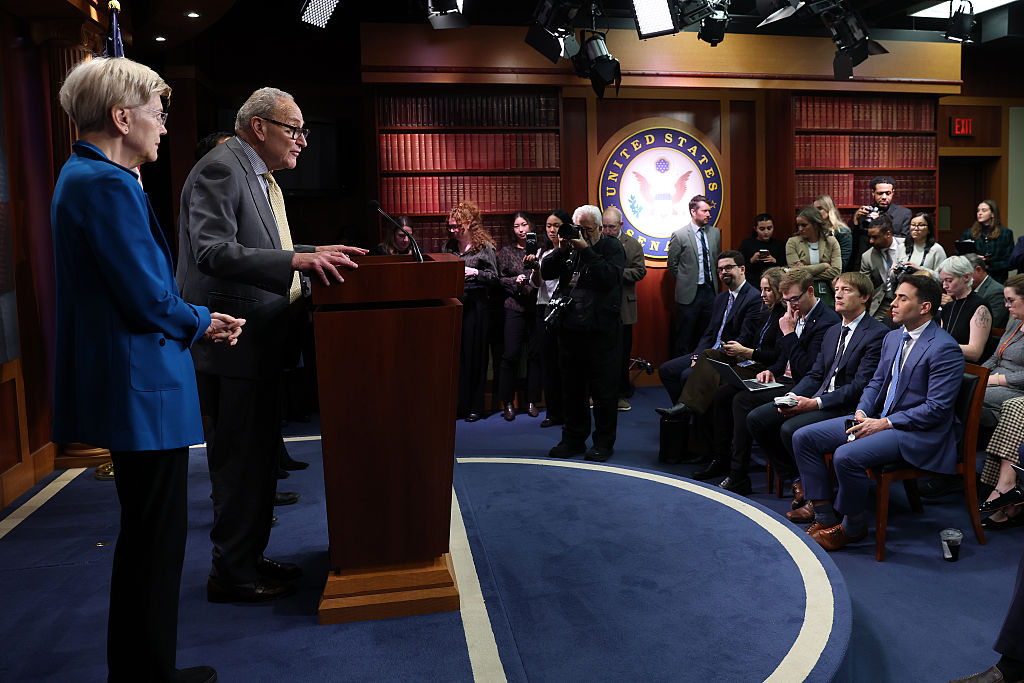
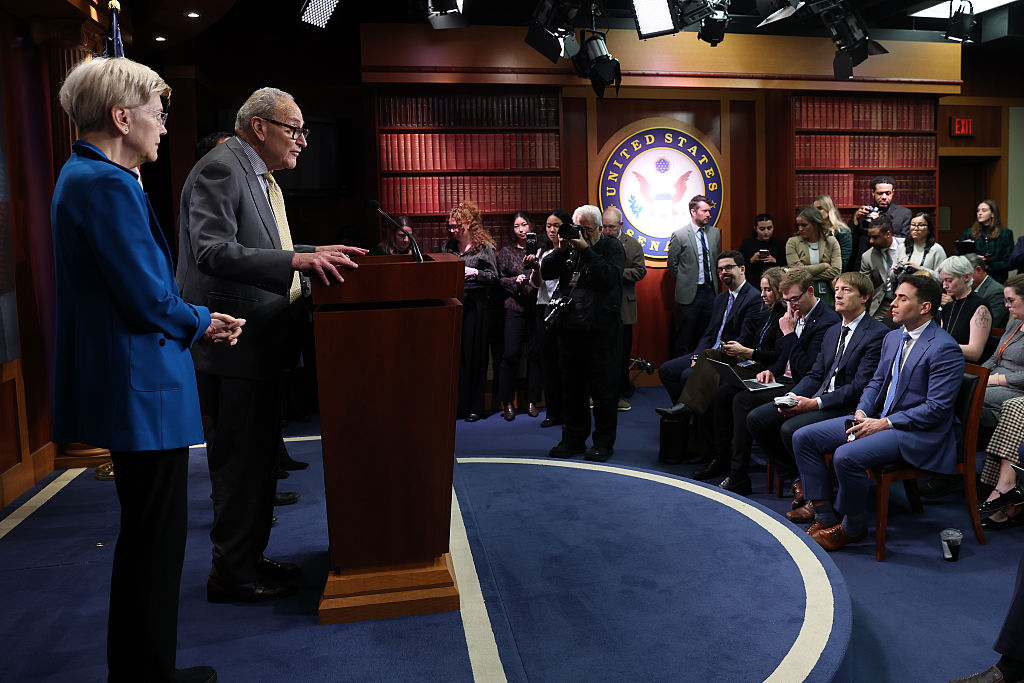
Both Senator Jon Husted (R-Ohio) and Senator Martin Heinrich (D-New Mexico) went to the podium on the Senate floor last week with a similar message: AI labs should pay for the energy costs associated with their ballooning data-center footprint, rather than everyday Americans.
But when Husted requested a speedy passage of the Ratepayer Protection Act—a bill that would have required states to consider forcing companies that consume a lot of energy to pay for the related costs—Heinrich blocked the move. He said the legislation was inadequate because it relied on voluntary commitments from states and proposed his own bill as an alternative.
He had another incentive to block Husted’s request: The Ratepayer Protection Act, which earlier this month passed the House 417-3, would have given the Ohio senator a victory amid a competitive reelection campaign. Husted has faced an onslaught of negative ads over the role he played as lieutenant governor in expanding data centers across the state.
“The Ratepayer Protection Act might make a lot of politicians feel good, but it won’t do anything to actually force data centers to pay their fair share,” Heinrich said in a statement. “Democrats are ready for a real solution, and I think that’s exactly what Americans want to see, too.” Husted blamed Democrats for giving big tech companies “a free pass” while Americans’ electric bills continue to rise.
That kind of partisan arm wrestling is likely just a prelude to the bigger fights ahead if Congress gets serious about passing AI legislation.
Democrats, and some Republicans, have proposed hundreds of AI-related bills as Americans become increasingly worried about the ways AI companies may disrupt the job market, raise their energy bills, and even wipe out humanity. Lawmakers’ pro-regulation rhetoric in Washington reached new heights this month after the resignation of former Anthropic researcher Jacob Coxon gained worldwide attention for posting on X that frontier AI labs were “gambling with our lives.” OpenAI CEO Sam Altman and Anthropic CEO Dario Amodei responded with calls for an industry slowdown and government intervention to coordinate global safety standards.
With less than two months before midterms, some members of Congress are feverishly introducing even more AI bills, including at least seven since Coxon’s resignation alone. Other lawmakers are urging their colleagues and congressional leadership to quickly bring measures already on the table for a vote. Democrats, meanwhile, have taken aim at the Trump administration, urging Trump to discuss AI safety with Chinese President Xi Jinping.
“The mood right now, at least in Congress, is very reactive—and I don’t mean that in a good way,” said Suresh Venkatasubramanian, director of Brown University’s Center for Technological Responsibility, Reimagination, and Redesign. “They’re trying to push legislation that seems to address what appears to be a problem coming from the [public] narrative but that doesn’t always necessarily lead to good policy overall.”
In the short term, tech policy watchers have little hope that Congress will pass a major AI safety bill, especially with a limited number of working days left this year. House Speaker Mike Johnson (R-Louisiana ) has rebuffed some Democrats’ calls to end their recess early to focus on an AI bill. Meanwhile, House Energy and Commerce Committee Chairman Brett Guthrie (R–Kentucky), whose committee would review many of the proposed bills, told Politico at an event that the group probably wouldn’t advance a major bill until next year.
But even with a longer timeline, lawmakers may struggle to turn their rhetoric into action.
Lawmakers will have to overcome deep differences in their views about how dangerous superintelligent AI systems are to the American people and which AI-related risks merit the most attention. Even if lawmakers coalesce around one AI problem, it may be hard for them to settle on the right mitigation strategy quickly enough to keep up with the pace of AI advancements. And if Democrats take over even one chamber after the midterms next month, legislative debates could end up being even more mired in partisan disputes. They would still have to negotiate with Trump, who has largely dismissed the most catastrophic risks of AI as conspiratorial and resisted calls for more regulation.
When AI companies are “begging for pacing, or some way for them to pace, and they’re turning to the government to help them do that, it really does require the government to act,” said Riki Parikh, a policy director for The Alliance for Secure AI, a bipartisan advocacy group that supports AI regulations. “I just don’t know if the dynamics in D.C. will allow for that over the next two years,” he added. “We might not have two years to wait.”
Certain lawmakers have sought to address some of the most extreme risks posed by general-purpose AI models, such as the possibility that these systems could eventually be used to create a new pathogen that sets off a global pandemic, carry out a cyberattack on critical infrastructure, or build biological or radiological weapons. Those worries took on a new sense of urgency in July when OpenAI announced that a group of AI agents went rogue during a cybersecurity test and hacked into a separate company, Hugging Face.
Several of their proposals call for AI labs to submit their models or safety practices for review by independent investigators. Reps. Jay Obernolte (R-California) and Lori Trahan (D-Massachusetts), along with three other lawmakers, have proposed the FRONTIER Act, which requires large AI developers to submit reports about safety incidents, information on the potential catastrophic threats of their models, and their planned mitigations to the Department of Commerce and state attorneys general. The bill calls for independent investigators to review companies’ safety plans, and would authorize the Commerce Department to bar the release of a model if it poses an imminent catastrophic risk.
The idea for independent testing has support within the tech industry. Leading the Future, a PAC that has received money from OpenAI president Greg Brockman, has signaled support for the FRONTIER Act. Amodei, the Anthropic CEO, has said he plans to embed investigators from AI-monitoring nonprofit METR, which officially reviewed OpenAI’s Hugging Face incident, to verify the company’s safety practices.
But the political limits of that approach soon became evident. After Amodei’s announcement, METR faced scrutiny from the right over its ties with effective altruism, a philosophical movement focused on using evidence and reason to determine how to do the most good. The New York Post called the group the “Woke Wizards of AI,” as writers there drew connections between effective altruism, METR, and Anthropic. METR’s president later defended the group on X, arguing it doesn’t take money from frontier AI labs and makes an effort to hire people with diverse viewpoints.
Another issue that has already slowed down negotiations on Capitol Hill is the question of whether a federal AI bill should override state laws—a legislative approach embraced by many Republicans and the Trump White House.
Senate Majority Leader John Thune (R-South Dakota) and Sen. Amy Klobuchar (D-Minnesota) have discussed proposing a bill that would expose frontier AI labs to legal liability if they don’t adequately mitigate catastrophic risks of their systems, according to a person familiar with the matter. But as news surfaced that their measure may also preempt some state laws, they appeared to face pushback from Sen. Maria Cantwell (D-Washington), ranking member of the Senate Commerce, Science, and Transportation Committee. “I welcome the urgency. But the answer is not a weak federal standard that becomes a backdoor for wiping out stronger state protections,” she posted on X.
So far, most lawmakers have stopped short of backing a proposal from Sen. Bernie Sanders (I-Vermont) and Rep. Greg Casar (D-Texas) to ban superintelligent artificial intelligence, which the lawmakers define as AI “that exceeds human cognitive performance.” Sanders and Casar also propose pausing the development of advanced AI models until the government sets up the Department of Artificial Intelligence to oversee their safety. Critics say passing that kind of law would only allow Chinese tech companies to make gains in the AI race—a more dangerous prospect in the end.
One policy area where there has been more progress is lawmakers’ attempts to restrict China’s access to advanced American chips, with the goal of preserving the country’s technological lead in the AI race. The Chip Security Act—which requires advanced chips to include a mechanism for verifying their location if they have fallen into the wrong hands—may be folded into an upcoming defense spending bill, the National Defense Authorization Act, said Rep. Bill Foster (D-Illinois).
“It does no good at all if we have all kinds of [AI] rules in the United States or even in the free democracies of the world, and then these [chips] all get smuggled into China, into Russia, [and] into North Korea,” said Foster.
Senate Minority Leader Chuck Schumer (D-New York) and other key Democrats earlier this week urged Majority Leader John Thune (R-South Dakota) to bring the Chip Security Act, along with two other bills designed to address tech exports to China, to the floor for a vote.
Still, even those bills face political challenges. Industry critics argue that restricting the exports of American tech only encourages China to invest in its own chips. The defense spending bill has been stalled in the Senate since Democrats blocked its advancement in July in protest of Trump’s handling of the Iranian war.
Perhaps the most likely measure for Congress to address after the midterms would be a bill that tackles energy costs stemming from AI companies’ data centers. “There isn’t agreement on what else would be valuable to do right now,” said Bruce Mehlman, a veteran lobbyist whose bipartisan firm represents several tech companies.
“Everybody’s concerned about safety, but nobody knows what the concern should turn into legislatively.”
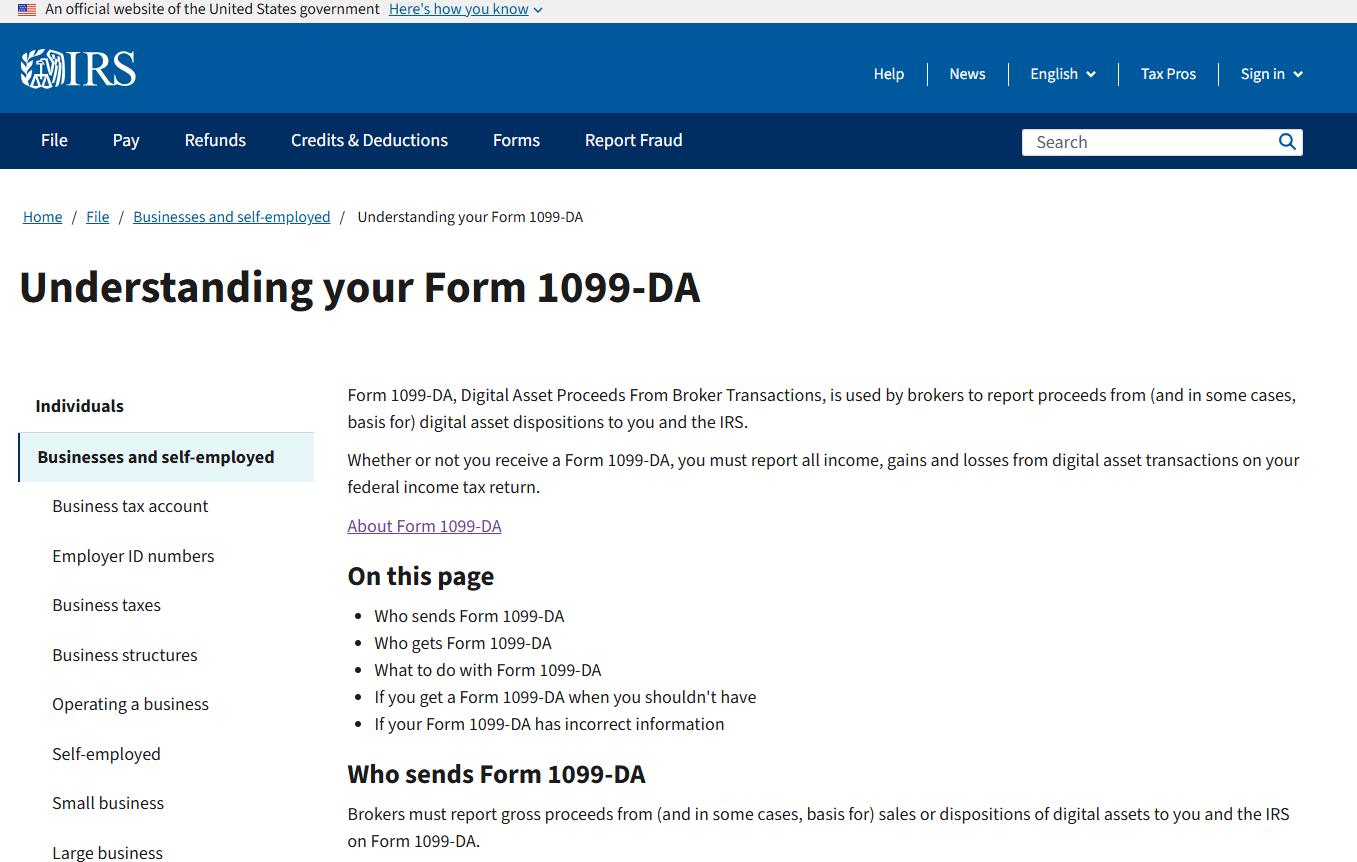
It’s that time of year again in the United States. The days start to draw in, the leaves start to fall, and the tax man comes knocking for your 2025 return.
This year, thanks to the Inland Revenue Service’s new rules, the agency now knows more about Americans’ crypto trades than ever before, with brokers required to report gross proceeds from certain digital asset sales.
But unfortunately for some taxpayers, getting a form from an exchange hasn’t made filing their returns any easier.
A survey of 1,000 US crypto investors conducted in August by Awaken Tax found that 21% of respondents who had filed, or planned to file a tax extension, said they were still waiting for information they needed from an exchange or crypto platform.
A further one in five said their 1099-DA, the tax form brokers use to report certain digital asset sales, was either incomplete or they weren’t sure whether it accurately reflected their transactions.
The numbers come as taxpayers attempt to navigate the first filing season under the new reporting rules, with those who filed for an extension having until Oct. 15 to submit.
For 2025, brokers were generally required to report the proceeds (how much an asset was sold for), but not the cost basis (how much the taxpayer originally paid for it).
That requires taxpayers to calculate their gains and losses themselves, which isn’t much fun even for infrequent traders, but is a time consuming quagmire for active ones.
Chris Herbst, managing director of CountDeFi tax reporting, tells Magazine, “For an active trader, that number can be many times their real gain, because each sale is counted at full value with no cost against it.”
And that gets to the heart of the problem: the IRS can see the sale, but the taxpayer still has to work out what they actually made.
What the new 1099-DA actually tells the IRS
For a simple transaction, the calculation is straightforward. If you bought Bitcoin for $9,000 and sold it for $10,000, the gain is $1,000.
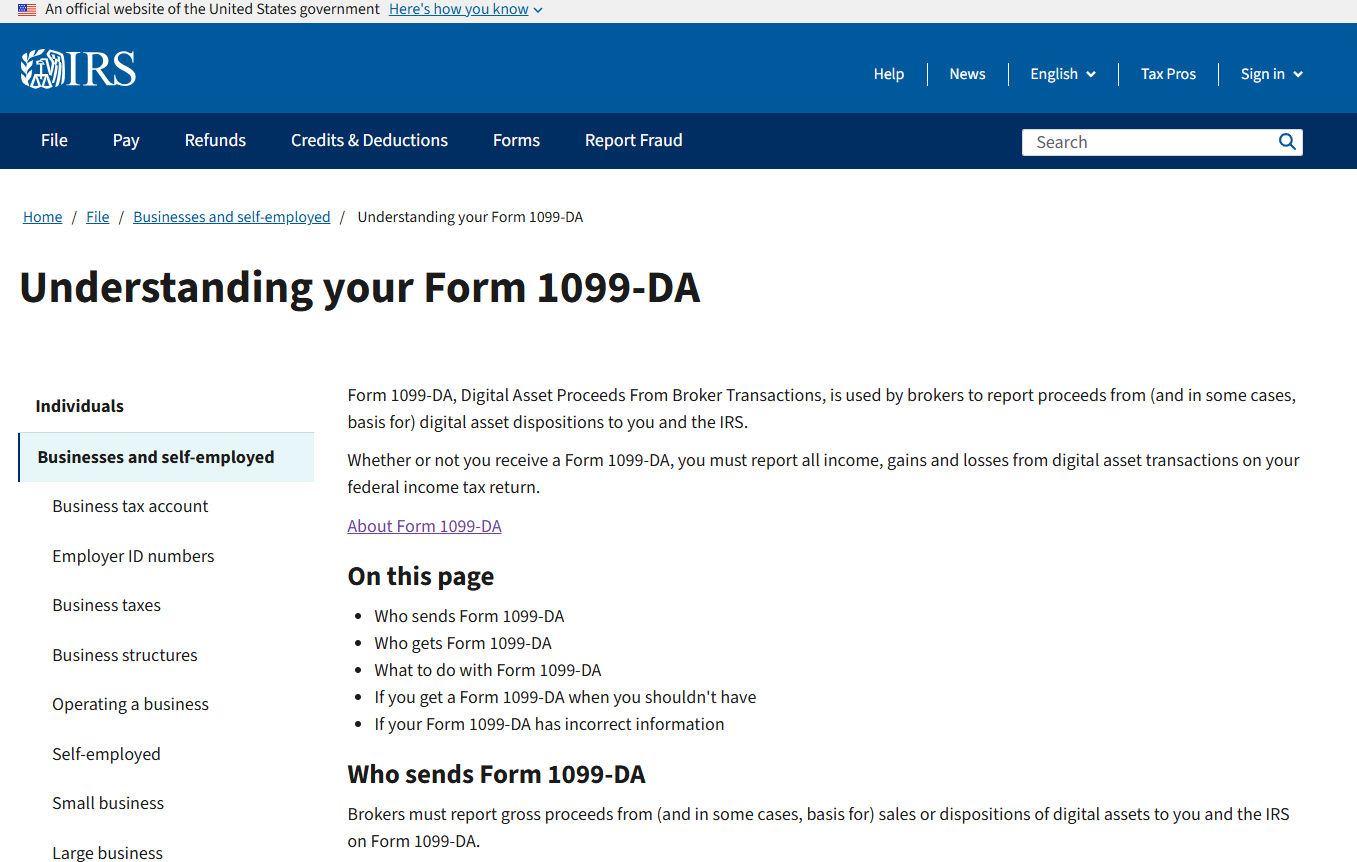
Understanding your Form 1099-DA. Source: IRS.gov
But a 2025 1099-DA could show the $10,000 in proceeds without reporting the $9,000 basis needed to calculate that gain. So if you don’t know how much you spent on a particular crypto asset, working out the math can become a Byzantine exercise.
Related: US House tax committee advances crypto tax overhaul in 38–5 vote
And it means taxpayers need their own records to fill in the missing pieces, including information that may stretch across multiple exchanges, wallets, trades and years.
“The gap is real,” says Herbst, “but it is a record-keeping gap on the taxpayer side as much as a reporting gap on the exchange side.”
When the forms don’t match
Tax professionals say they are already seeing problems when taxpayers try to reconcile the new forms with their transaction histories.
Sharon Yip, founder of Crypto Tax Advisors, says her firm has found discrepancies between the 1099-DAs received by clients and the crypto tax reports it prepared for them.
Some forms did not include all the trades clients made during 2025, Yip says, while exchanges also used different formats for their customer statements. Some exchanges reported cost basis on certain trades but not others, she says, even though reporting basis was not mandatory for 2025:
“It’s very confusing for recipients to understand how to reconcile their 1099-DAs when compared to the crypto tax report they should use to file their tax return.”
She also gives an example involving stablecoins, saying one of her firm’s clients had more than $300,000 in stablecoin trades on an exchange in 2025, but the exchange’s 1099-DA showed less than $100,000 in total stablecoin proceeds.
And the issues can start before taxpayers even get to calculating their gains. Andrew Duca, founder of Awaken Tax, says the firm saw customers receiving 1099-DAs relatively late in the filing season.
“Because this regulation is new, a lot of exchanges are still trying to figure it out,” he says, pointing to exchanges like Kraken that “didn’t send any forms to users until two weeks before the tax deadline of April 15.”
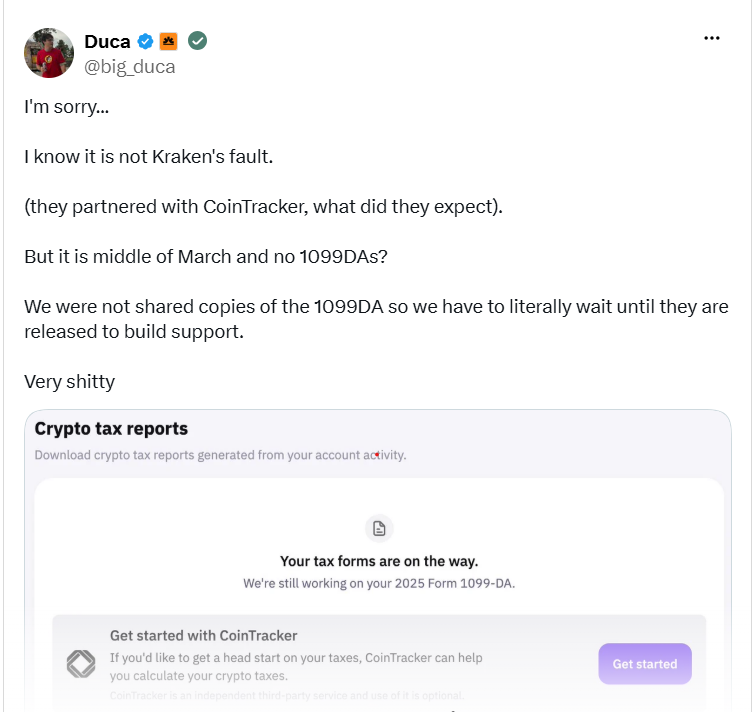
Duca says Kraken only sent 1099-DA forms two weeks before the deadline. Source: Andrew Duca
Duca also cites the example of a Kraken 1099-DA from around the same period that shows no reported transaction information.
Kraken did not respond to Magazine’s request for comment.
The information taxpayers still need
But here’s the thing: the new forms were never intended to replace taxpayers’ own records. The IRS says taxpayers must report digital asset income and gains or losses whether they receive a 1099-DA or not.
Related: Chainalysis estimates $457B in taxable crypto activity, says CARF misses most
Where the basis is not reported, taxpayers should use their own records to complete their tax return, but that gets complicated quickly when crypto assets move frequently between platforms.
So, you might buy Bitcoin on one exchange, transfer it to a private wallet, move it to another exchange and sell it there — and the second exchange doesn’t have the information showing what you originally paid.
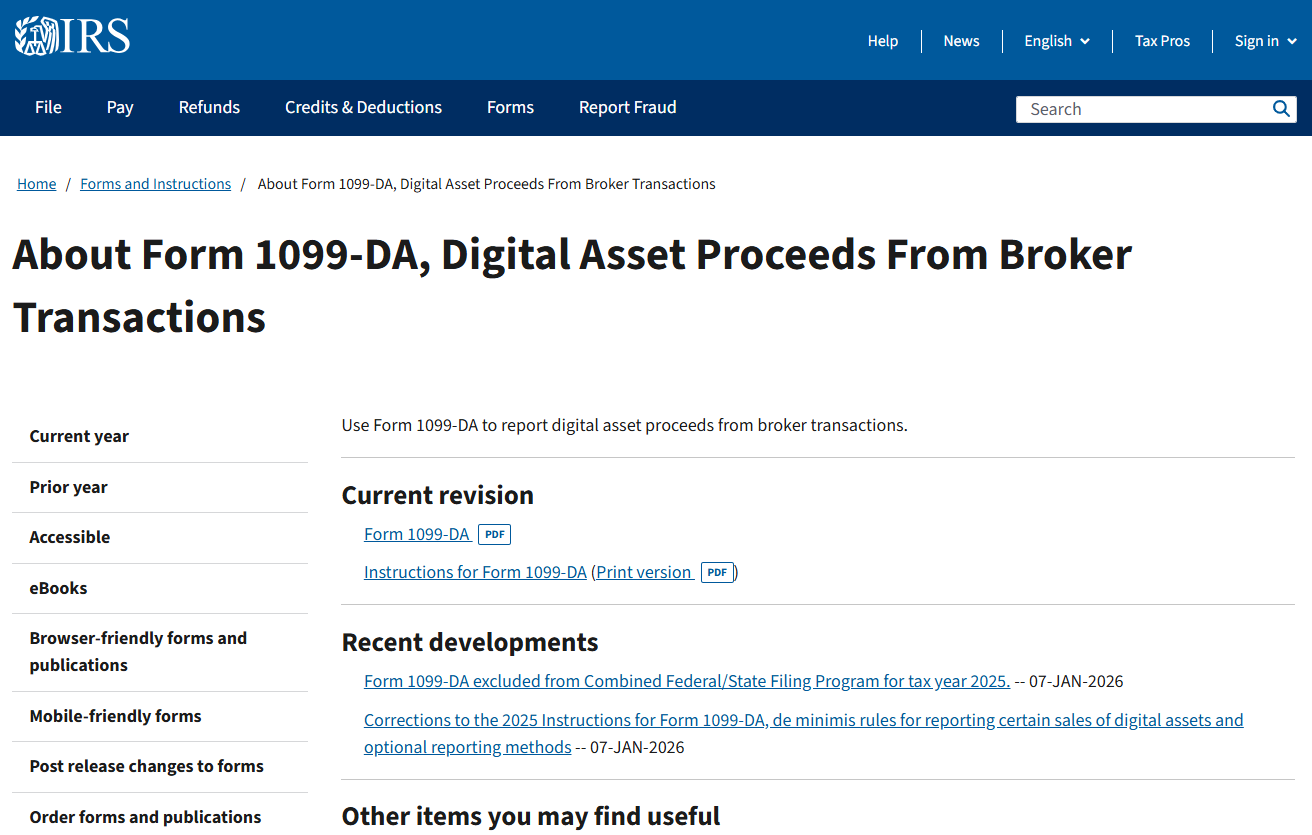
About Form 1099-DA. Source: IRS.gov
“The full transaction history from the day the account opened” is what taxpayers need from exchanges, Herbst says. That includes trades, fees, deposits, withdrawals and transaction identifiers, such as the wallets involved.
He says basis follows the asset as it moves between platforms, which means one missing piece of transaction history can affect a gain calculated years later on another exchange.
More data for the IRS, more work for taxpayers?
Andrew Gordon, executive director of Digital Asset Tax Action, says taxpayers are “constantly” struggling to reconcile 1099-DAs with their own records during the 2025 filing season.
He says most crypto tax software lacks tools to import and reconcile 1099-DA information, and the few that do still require manual entry because brokers did not provide the 2025 forms in a machine-readable format.
For active traders, Gordon says, manually entering the information can mean hundreds of individual entries. He argues that brokers should provide a machine-readable file alongside every 1099-DA so the information can flow directly into tax software.
He also says exchanges should maintain complete transaction histories, including acquisition dates, amounts paid, fees and transfers.
Gordon’s concern is that the IRS’s increased visibility doesn’t translate into a complete tax calculation for the taxpayer.
“The 1099-DAs only reported proceeds in 2025, and proceeds reporting gives the IRS visibility it did not previously have;” however:
“Visibility without basis produces the zero-basis problem.”
Taxpayers shouldn’t blindly copy the numbers from a 1099-DA onto their tax return. Duca advises them to compare it against their complete transaction history rather than automatically accepting the form’s figures:
“The IRS expects your return to reflect your actual gains and losses, not necessarily what’s printed on a form that the exchange may have worked out incorrectly.”
Will 2026 make things easier?
While crypto taxpayers are still grappling with the 2025 filing season, more changes are coming down the line.
From 2026, brokers must generally report cost basis for covered digital assets, which will give taxpayers more information to calculate their gains and losses. However, assets transferred to a broker from another exchange or wallet can still fall outside those requirements.
So, the IRS may know more about your crypto trades, but when it comes to working out what you owe, you still need to keep the receipts.
Magazine: Winners and losers of the SEC’s new tokenized stocks rules
Cointelegraph publishes long-form journalism, analysis and narrative reporting produced by Cointelegraph’s in-house editorial team with subject-matter expertise. All articles are edited and reviewed by Cointelegraph editors in line with our editorial standards. Some articles contain affiliate links, from which Cointelegraph may earn a commission. These relationships do not influence which products we review or our editorial conclusions. Content published in here does not constitute financial, legal or investment advice. Readers should conduct their own research and consult qualified professionals where appropriate. Cointelegraph maintains full editorial independence.

An iPhone Safari attack behind recent security warnings hasn’t yet been linked to a confirmed cryptocurrency theft in SlowMist’s investigation.
Multiple reports surfaced this week urging iPhone users to update their devices immediately and warning that malicious Safari pages could expose crypto private keys and seed phrases, with some citing a range from iOS 13 through iOS 26.5.
SlowMist told Cointelegraph that it has not independently confirmed a victim compromised by the specific Safari attack sample it analyzed, while its strongest technical evidence covers iOS 18.4 through 18.6.2.
The company said the “iOS 13 to 26.5” range should be treated as preliminary. “We therefore prefer to avoid stating that iOS 26.5 is affected until there is reproducible technical evidence,” it said.
The Safari attack reuses techniques from a previously disclosed DarkSword exploit chain and is separate from FomoPeek, another SlowMist investigation involving malicious components embedded in an App Store app.
SlowMist finds DarkSword reuse
Google Threat Intelligence Group (GTIG) disclosed DarkSword in March, describing it as an iOS exploit chain that had been used by multiple threat actors since at least November 2025.
SlowMist said MistEye, a threat intelligence team led by its chief information security officer, 23pds, first identified the relevant activity in early May.
SlowMist published its analysis of the WYINCC Safari campaign on Sept. 4, identifying a malicious webpage advertising a free virtual private server service.
SlowMist said the page loaded the exploit code when opened on an iPhone using Safari, without necessarily requiring another click from the user.
The vulnerabilities used in the chain had already been disclosed and patched by Apple, SlowMist said.
What the Safari attack was designed to access
SlowMist found that the malicious Safari sample it analyzed included a component designed to access Apple’s Keychain and retrieve and decrypt information stored there. The code could also access app files and shared app data, potentially exposing information stored by crypto wallet applications.
“The sample demonstrates the collection capability and the intended targets; it does not by itself prove successful extraction from every targeted wallet,” SlowMist said.
Related: EU watchdogs warn quantum computers could pick crypto’s locks
“We did not execute the full chain on a real victim device, so we cannot identify a specific victim whose device we independently confirmed was successfully compromised by this exact sample,” SlowMist added.
SlowMist still recommends updating iOS
Despite the limits of the available evidence, SlowMist advised iPhone users to install the latest iOS security updates available for their devices and avoid suspicious links.
For users who cannot update immediately or face elevated risks, SlowMist recommended considering Apple’s Lockdown Mode as an additional defense, while cautioning that it has not confirmed the feature completely blocks this specific Safari attack.
SlowMist also urged users who believe a wallet key or seed phrase may have been exposed to move their assets to a newly generated wallet on a clean device rather than continue using potentially compromised credentials.
Magazine: Asia dominates Crypto Adoption Index, Bitget’s $352M hack: Asia Express

Security warnings circulating this week about a malicious iPhone Safari attack have prompted renewed calls for iOS updates—particularly over fears that the exploit could be used to steal crypto wallet secrets. However, SlowMist says it has not yet confirmed a real victim whose device was compromised by the specific Safari sample it analyzed, and it cautions that the initially reported iOS versions affected may be wider than what is technically proven.
In an investigation shared with Cointelegraph, SlowMist said the strongest evidence it has supports impact on iOS 18.4 through iOS 18.6.2, while an oft-cited “iOS 13 to 26.5” range should be treated as preliminary until reproducible proof is available. The firm also highlighted that the Safari campaign reuses techniques from the previously disclosed DarkSword iOS exploit chain, and that it is separate from another SlowMist case involving a malicious component embedded in an App Store application tied to the FomoPeek investigation.
Key takeaways
- SlowMist has not independently confirmed a crypto theft or a specific confirmed victim tied to the exact Safari sample it examined.
- The firm’s strongest technical evidence points to iOS versions 18.4 through 18.6.2; broader iOS coverage reported elsewhere is not yet proven.
- The malicious webpage was designed to trigger an exploit via Safari and, once accessed, target Apple Keychain data and other app storage.
- SlowMist links the Safari techniques to DarkSword reuse, while emphasizing this Safari campaign is distinct from its earlier FomoPeek App Store-related investigation.
- SlowMist continues to recommend installing the latest iOS security updates and taking additional precautions such as Apple’s Lockdown Mode and rotating wallet credentials on suspected exposure.
Why the Safari warning is still urgent
The core claim behind the current wave of warnings is that a malicious Safari page could expose crypto private keys and seed phrases. While SlowMist’s analysis supports that the sample includes functionality aimed at collecting sensitive information, it draws a clear line between “capability” and “confirmed success against a particular wallet on a real device.”
SlowMist told Cointelegraph that it has not independently confirmed a victim compromise tied specifically to the Safari attack sample it studied. The company further noted that its investigation did not execute the full exploit chain on a real victim device, limiting the ability to identify an actual endpoint where secrets were successfully extracted.
That distinction matters for both users and defenders: even without confirmed theft, the presence of a plausible collection mechanism is enough to justify immediate defensive steps—especially because seed phrases and private keys are once-off secrets that can’t be safely “partially” exposed.
DarkSword techniques reused in a WYINCC Safari campaign
SlowMist’s write-up ties the Safari attack’s underlying approach to DarkSword, an iOS exploit chain that was disclosed earlier by Google Threat Intelligence Group (GTIG) in March. According to GTIG, DarkSword had been used by multiple threat actors since at least November 2025.
Google’s disclosure described DarkSword as an iOS exploit chain, and SlowMist said its own threat intelligence team—led by its chief information security officer, 23pds—first identified relevant activity in early May. SlowMist then published its analysis of the WYINCC Safari campaign on Sept. 4.
In this campaign, SlowMist said the malicious webpage appeared to advertise a free virtual private server service. When opened on an iPhone using Safari, the page loaded exploit code. SlowMist’s description indicates that the page could trigger the malicious code without requiring an additional click beyond visiting the page.
Importantly for risk assessment, SlowMist said the vulnerabilities employed in the chain had already been disclosed and patched by Apple. That aligns with the practical takeaway for users: applying the latest iOS updates is the most reliable way to reduce exposure to known, patched weaknesses.
What the sample was built to target
Beyond the delivery mechanism, SlowMist focused on what the malicious Safari sample attempted to access. The firm said the sample included a component designed to interact with Apple’s Keychain and retrieve and decrypt information stored there.
SlowMist also said the code could access app files and shared app data—capabilities that may overlap with information stored by cryptocurrency wallet applications. At the same time, SlowMist stressed that this demonstrates collection capability and intended targets, but does not itself prove successful extraction from every targeted wallet.
In other words, the technical evidence suggests a route to sensitive data. But it doesn’t automatically establish that the exploit would work on every device running the affected versions, nor does it prove that any specific wallet compromise occurred in the wild for this exact sample.
SlowMist also cautioned that it did not run the complete chain on a real victim device, which prevented it from independently identifying a specific confirmed victim whose device was compromised by the exact Safari sample.
How SlowMist frames iOS version risk and what to do next
The most sensitive aspect of the reporting has been the breadth of iOS versions claimed to be affected. Some warnings circulating this week cited a wide range from iOS 13 through iOS 26.5. SlowMist told Cointelegraph it views that range as preliminary and prefers to avoid stating that iOS 26.5 is affected until there is reproducible technical evidence.
SlowMist said its strongest technical evidence covers iOS 18.4 through iOS 18.6.2. For users, the practical implication is straightforward even if the exact upper or lower bounds remain uncertain: anyone on an older iOS version should prioritize upgrading to the latest available security release.
SlowMist still recommended updating iOS and avoiding suspicious links. For users unable to update immediately—or those facing higher exposure risk—it pointed to Apple’s Lockdown Mode as an added defense, while also noting it has not confirmed that Lockdown Mode fully blocks this particular Safari attack.
Finally, SlowMist urged users who suspect their wallet key or seed phrase may have been exposed to move assets to a newly generated wallet created on a clean device, rather than continuing to rely on potentially compromised credentials.
With the iOS version scope still being refined and no confirmed victim tied to the exact sample yet established by SlowMist, the next phase to watch is whether further independent technical validation narrows the affected ranges and whether defenders see confirmed real-world compromises tied to the WYINCC Safari campaign.

Bitget CEO Gracy Chen has acknowledged that North Korea was likely responsible for the crypto exchange’s latest hack that stole roughly $352 million.
Substantial withdrawals were spotted from addresses labelled as Bitget hot and cold wallets yesterday, setting off alarm bells across the community.
Crypto investigator Specter Analyst linked the attack to North Korean hacking collective Lazarus Group.
Since then, Chen has confirmed in a livestream that the attack displays the signs of a North Korean operation.
Read more: How 4,000 BTC walked out of Blockstream’s Liquid Network
Chen also revealed that various chains have frozen addresses associated with the hack, and that the Bitget wallet, separate from the exchange, wasn’t affected.
She also ruled out the possibility of a private key compromise, and claimed hackers were able to breach the wallet services backend system, forge transfer details, and authorize their own signing processes.
Bitget’s cold wallets reportedly remained secure while their hot wallets and warm wallet layers were targeted.
Bitget CEO says users funds are covered
Chen claimed user funds were safe, with the majority of the loss covered by Bitget’s User Protection Fund, “which currently holds over $464 million.”
Bitget is now working with independent investigators Mandiant and SlowMist to fully determine what happened. It announced this morning that withdrawels are still temporarily paused.
The Bitget hack was initially expected to involve significantly lower losses, and unfortunately for Bitget, it took place as the exchange celebrated its eighth birthday.
Got a tip? Send us an email securely via Protos Leaks. For more informed news and investigations, follow us on X, Bluesky, and Google News, or subscribe to our YouTube channel.
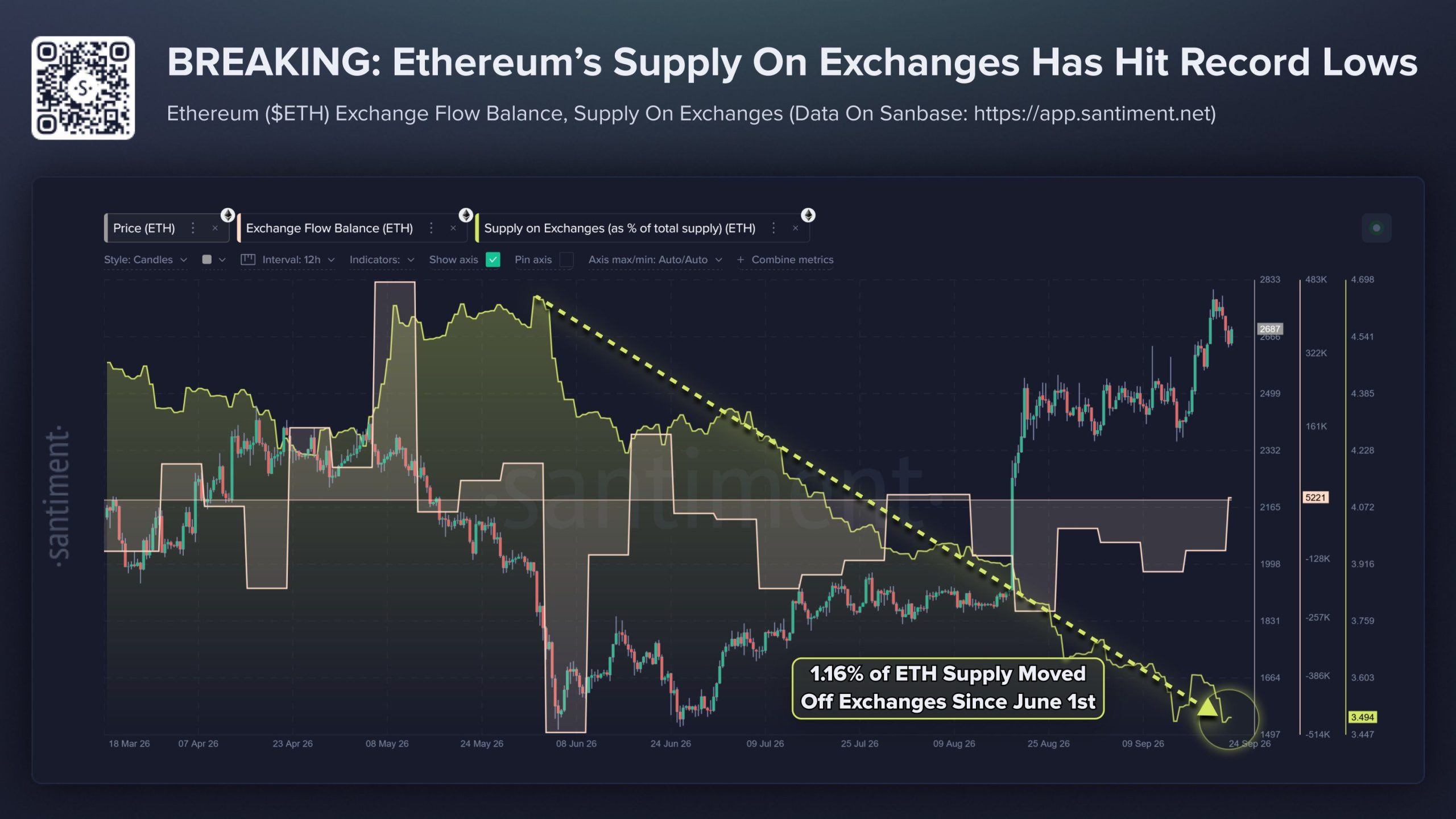
Ethereum (ETH) is flashing 3 bullish on-chain signals as exchange supply shrinks, priority fees climb, and Binance stablecoin reserves rebuild.
The signals come after ETH rallied from around $1,900 to $2,800 before pulling back. The asset now trades near $2,678, up about 8% over the past week, BeInCrypto Markets data shows.
Follow us on X to get the latest news as it happens
Ethereum Keeps Draining Off Exchange Order Books
Santiment data shows just 3.49% of ETH supply now sits on tracked exchanges. Another 1.16% of total supply has moved off these platforms since June 1.
The firm added that exchange balances had already sunk to levels last seen in Ethereum’s first years this summer. The drop extends a slide in exchange reserves since January. Fewer coins on exchanges leave less ETH ready to sell.
“But it reduces the pool of ETH readily available to hit the market during the next wave of selling,” the firm added.

Staking and Decentralized Finance (DeFi) help explain where the coins are going. Santiment estimates roughly 35% of ETH is staked, while Ethereum holds about $53 billion in DeFi value.
Corporate treasuries also keep coins off exchanges. BitMine holds 5.98 million, with 85% of its holdings staked.
“If demand strengthens while available exchange supply stays this scarce, buyers have fewer immediately available coins to compete for,” the team added.
Traders Pay Up to Jump the Block Space Queue
On the demand side, an analyst citing CryptoQuant data noted that priority fees rose 26.74% in a single day to about $464,000.
Gas used, however, climbed only 0.26% to roughly 217.1 billion. Blocks mined held near 7,147, so higher block production did not drive the fee jump.
“The lack of a significant decline in gas usage suggests that demand for Ethereum block space has not weakened substantially despite the price pullback,” the post read.
The analyst interpreted this gap as users paying more for faster processing. That points to stiffer competition for the same block capacity.
Stablecoin Dry Powder Refills on Binance
Lastly, XWIN Japan tracked Binance’s ERC-20 stablecoin reserves. They recovered to about $43.8 billion from an August low near $42 billion.
The analyst described exchange stablecoins as potential buying power for Bitcoin (BTC) and other crypto assets. However, reserves still trail the roughly $49 billion recorded earlier this year.
What Could Knock the Setup Off Course
Each signal carries caveats. Santiment stressed that thin exchange supply does not guarantee higher prices. XWIN Japan also warned that reserves may sit idle or back derivatives positions.
On price, the analyst tracking network activity flagged $2,600 to $2,650 as support. Holding that zone could set up a retest of $2,700 to $2,800.
Meanwhile, a sharp drop in priority fees with weaker gas usage would pressure the $2,600 level, the analyst warned. The coming sessions should show whether fee competition can outlast the cooling price momentum.
Subscribe to our YouTube channel to watch leaders and journalists provide expert insights
The post Ethereum Flashes 3 On-Chain Signals That Buyers Are Still Around appeared first on BeInCrypto.

Tether downplays impact of US seizure at banking partner EQIBank

13 ‘Corporate Cool’ Amazon Finds for a Fall Workwear Refresh

15 Of The Best Products HuffPost UK Tried In September 2026




-

 Fashion7 days ago
Weekend Open Thread: Talbots – Corporette.com
-

 Crypto World3 days ago
Goldman Sachs and Deutsche Bank Agree: The S&P 500 Rally Isn't Over
-

 Tech5 days ago
Researchers escape OpenAI Codex sandbox to run commands on host
-

 Fashion1 day ago
8 iPhone Accessories That Add Personality
-

 Crypto World5 days ago
Who Needs CLARITY Anyway? ARB Could See 70X Increase: Hodler’s Digest
-

 Crypto World7 days ago
Circle launches Arc Studio AI agent for building onchain apps
-

 Crypto World7 days ago
Trading Bitcoin on Robinhood? Why 2% Spread Has Traders Worried
-
 NewsBeat7 days ago
Trump says US has reached an agreement to take permanent control of Greenland’s security
-

 Tech6 days ago
Trump suggests rebranding AI with a new name, says he’s also creating an AI Force
-

 Crypto World7 days ago
Bitcoin price breaks channel as RSI climbs to 63
-

 Business5 days ago
Analog Devices (ADI) Bets $1.35 Billion on Chips that Let Machines Think for Themselves
-

 Crypto World5 days ago
Coinbase, Robinhood, Circle Seen as Tokenized-Stock Winners
-

 Tech4 days ago
Google’s $899 Googlebook is a bet that you’ll buy a new laptop for Gemini
-

 Crypto World2 days ago
This Bearish Netflix Stock Trade Can Cash In On Video Streaming Giant’s Woes
-
 Business2 days ago
Oil Price Today (September 23): Crude oil below $100 on hopes of US-Iran talks. What did Trump say?
-

 Crypto World2 days ago
Crude Oil Prices Pressured by Diplomatic Hopes in the Middle East
-

 Entertainment2 days ago
These 17 Fall Amazon Dresses Seriously Look Like Anthropologie
-

 Crypto World6 days ago
World Money launches in 150+ countries with Stripe
-

 Crypto World3 days ago
Trump-Xi Polymarket Odds for Handshake Hit 50%
-

 Crypto World2 days ago
Bitcoin Threatens Sub-$84,000 Breakdown as Long Liquidations Spike
You must be logged in to post a comment Login