Connect with us

Crypto World

XRP News: Why Ripple’s 9-Year Clock Divides the Community

Published

on

🚨

Australian lawyer and prominent XRP community commentator Bill Morgan has been in the news headlines as he called on Ripple to relock less of its monthly 1 billion XRP escrow release. According to Morgan, accelerating the path to full circulating supply would establish XRP as a credible hard money asset and eliminate the supply overhang that continues to weigh on sentiment.

The argument is not new in outline, but the specifics of Morgan’s framing push it into sharper territory, and Ripple’s own CTO Emeritus has already drawn a clear line on how far the company is willing to go.

With 32.74 billion XRP still locked in escrow and the current release pace stretching the full-circulation timeline to roughly nine years, the structural math gives Morgan’s argument its weight. The question the XRP community is now openly debating is not whether the overhang is real, but whether Ripple has both the incentive and the flexibility to compress that timeline.

Discover: The Best Crypto to Diversify Your Portfolio

Advertisement

Ripple Supply Overhang

Ripple established its escrow system in 2017, placing 55 billion XRP into 55 separate on-ledger contracts, each releasing 1 billion XRP on the first of every month. The mechanism was designed to create a predictable, auditable supply and avoid an unannounced dump from a centralized treasury.

However, what it also created, by design, was an indefinitely extendable schedule: Ripple takes what it needs for operations and institutional distribution, then relocks the remainder into new contracts, effectively rolling the timeline forward month after month.

Morgan’s position, stated publicly on X, is direct:

Advertisement

The logic is three-layered. First, relocking less shortens the nine-year horizon. Second, full circulation removes the psychological shadow supply that suppresses valuation. Third, a fixed, fully-circulating crypto supply is structurally more credible for institutional participants who price assets on known fundamentals rather than unknowable future release schedules.

It is worth noting that Morgan is looking for an argument. He has previously defended the escrow mechanism itself against claims that it is a deliberate price-suppression tool. He also pointed out that XRP ran from roughly $0.50 to above $3.00 between November 2024 and January 2025 while monthly releases continued uninterrupted. His current call is for faster completion of a process he considers legitimate.

Discover: The Best Token Presales

Advertisement

David Schwartz Draws the Line

Ripple CTO Emeritus David Schwartz has not endorsed acceleration, and he has flatly rejected the most radical version of the proposal circulating in the XRP community: burning the escrowed supply outright.

Schwartz cited Stellar’s token burn as his primary cautionary reference. He argues that supply destruction produced a short-lived market reaction rather than a durable valuation re-rating. His broader defense of the current model is that Ripple voluntarily relocks whatever XRP it does not immediately need.

On the timeline question specifically, Schwartz acknowledged the inherent uncertainty:

“It’s hard to predict because you have to make assumptions about how much XRP Ripple uses and how much gets put back into subsequent escrow months.”

Schwartz’s position is structurally consistent with how Ripple has managed the escrow since inception. The company has positioned measured, predictable distribution as a feature, not a constraint. Changing that calculus would require Ripple to decide that the reputational and institutional benefits of acceleration outweigh the risks of increased near-term sell pressure. Basically, a trade-off that the company has not yet indicated it is willing to make.

Ripple’s recent MiCA regulatory approvals in Europe reinforce the pattern: the company is building compliant infrastructure, and supply stability is part of that institutional pitch.

Don’t Miss Out on Our $1,000 USDT Airdrop on ByBit

Advertisement

What the Community Debate Actually Reveals About XRP Beyond the News Headlines

Beyond the news headlines, the split inside the XRP community maps cleanly onto two different theories of what XRP is supposed to be. The pro-acceleration camp, aligned with Morgan, treats the hard money narrative as the primary long-term value proposition. A fixed, fully-circulating supply that can be evaluated on demand fundamentals alone. The pro-current-pace camp treats Ripple’s controlled distribution as an asset for institutional credibility, not a liability.

A third concern runs underneath both camps: if Ripple releases more net XRP per month without a corresponding increase in demand, the additional supply hits the market as sell pressure. XRP’s current price action does not obviously signal that the market is capacity-constrained on the demand side in a way that would absorb larger monthly net releases cleanly.

Xrp (XRP)
24h7d30d1yAll time

The token burn option, meanwhile, is effectively closed. Schwartz’s Stellar reference reflects a settled internal view that destroying escrow reserves would produce noise and would permanently eliminate the optionality Ripple currently holds.

Advertisement

Discover: The Best Crypto to Diversify Your Portfolio

The post XRP News: Why Ripple’s 9-Year Clock Divides the Community appeared first on Cryptonews.

Source link

Advertisement
Continue Reading
Click to comment

You must be logged in to post a comment Login

Leave a Reply

Crypto World

BlockDAG’s $0.00000019 price and 22% live swap discount draw massive attention as Hyperliquid, Cardano struggle

Published

on

BlockDAG's $0.00000019 price and 22% live swap discount draw massive attention as Hyperliquid, Cardano struggle - 4

Disclosure: This article does not represent investment advice. The content and materials featured on this page are for educational purposes only.

As Hyperliquid and Cardano face market uncertainty, BlockDAG is expanding its ecosystem with upcoming claims and staking functionality for users.

Advertisement

Summary

  • BlockDAG launches claims and staking for early participants as Hyperliquid and Cardano face renewed market uncertainty.
  • With claims and staking going live, BlockDAG expands its ecosystem while traders monitor Hyperliquid and Cardano.
  • BlockDAG rolls out claims and staking features, drawing attention as Hyperliquid and Cardano struggle for momentum.

The Hyperliquid price hovers near a critical make-or-break zone as trading interest cools down. Meanwhile, the Cardano price is facing pressure after reaching very low RSI levels, with traders watching for signs of a possible recovery.

Standing far above these uncertain charts, BlockDAG (BDAG) is introducing a new stage of ecosystem development with upcoming claims and staking features. Claims for Batches 1–6 and staking are scheduled to go live within hours, adding new utility for the growing network.

BlockDAG's $0.00000019 price and 22% live swap discount draw massive attention as Hyperliquid, Cardano struggle - 4

Alongside these updates, BDAG is available at a limited-time price of $0.00000019, while Live Swap remains active at 22% below the CoinMarketCap price. With continued progress across the Casino & Sportsbook, BlockDAG Exchange, Super App, and upcoming Tier 1 exchange listings, BlockDAG is building momentum around broader ecosystem growth and long-term blockchain adoption.

Hyperliquid price faces downward pressure

The Hyperliquid price sits near $60 as buying interest slows down. Right now, the token stays below its 50-day average price of $62.70, showing that momentum has cooled. 

Advertisement

Big investors seem to be stepping back, with specialized crypto funds pulling out nearly $700,000 in a single day. On top of that, a major token holder recently moved over 395,000 HYPE to an exchange, which often signals a plan to sell.

While trading volume jumped slightly, most traders remain divided on where the market goes next. If the price falls below its $60.41 support level, it could easily drop further toward $54.19, keeping near-term risks quite high for buyers.

Cardano price holds firm above historic lows

The Cardano price is holding around $0.16 after dipping almost 2% recently. The coin sits in a support range between $0.14 and $0.17, which has helped stop deeper drops in the past. 

Indicators show the market is heavily oversold, meaning selling has been intense for a long time. Some chart readers see a potential bottom pattern forming, but nothing is confirmed yet. For a real comeback, the token needs to climb past the $0.23 resistance level. 

Advertisement
BlockDAG's $0.00000019 price and 22% live swap discount draw massive attention as Hyperliquid, Cardano struggle - 5

However, actual buying demand remains weak across weekly charts. If support at $0.14 fails to hold, the price risks sliding down toward $0.10, leaving the token in a shaky position for now.

BlockDAG prepares staking and claim launch

Timing can make the biggest difference when entering a high-growth opportunity, and BlockDAG is giving participants a chance to move before the crowd. BlockDAG is creating renewed attention. 

BlockDAG is currently available at $0.00000019, while the Live Swap remains active at 22% below the CoinMarketCap price, giving market participants a limited timeframe to explore the latest opportunity.

The next few hours mark the launch of claims for Batches 1–6 and staking, bringing new functionality to the network. As activity builds around these updates, BlockDAG continues advancing its wider ecosystem with the Casino & Sportsbook, BlockDAG Exchange, Super App, and upcoming Tier 1 exchange listings. These developments are placing increased focus on BDAG as the project moves toward its next stage of growth.

BlockDAG's $0.00000019 price and 22% live swap discount draw massive attention as Hyperliquid, Cardano struggle - 6

Community growth tells the story: more than 312,000 holders, increasing by over 1,000 each day, alongside 4 million+ users on the X1 mining app and 20,000 physical miners already shipping globally. 

From a technology perspective, the latest RPC upgrade processed 100,000 transactions within 24 hours, highlighting the network’s scalability. Combined with early-entry projections suggesting the potential for up to 5,000x ROI, it’s clear why many investors are viewing BDAG as one of the top crypto opportunities today.

Advertisement

To sum up

The Hyperliquid price continues to struggle below $62.70 as large holders move tokens, while the Cardano price rests near $0.16 in heavily oversold territory. In contrast, BlockDAG is advancing rapidly with its Live Swap active at 22% below the CoinMarketCap price. 

The upcoming launch of claims for Batches 1–6 and staking adds massive utility alongside 20,000 physical miners shipped globally. Combined with its Casino, Super App, Tier 1 listings, and up to 5,000x ROI projections, BDAG stands out as the best crypto to buy. As chart conditions split between stalling tokens and expanding ecosystems, real utility continues to set the standard for long-term value.

For more information, visit the official website, presale, Telegram, and Discord.

Advertisement

Disclosure: This content is provided by a third party. Neither crypto.news nor the author of this article endorses any product mentioned on this page. Users should conduct their own research before taking any action related to the company.

Source link

Advertisement
Continue Reading

Crypto World

Aviva Debuts XRPL Tokenized Fund with Irish Approval

Published

on

Aviva Debuts XRPL Tokenized Fund with Irish Approval

Cointelegraph is committed to providing independent, high-quality journalism across the crypto, blockchain, AI, and fintech industries.

All news, reviews, and analyses are produced with full journalistic independence and integrity. For more details on our standards and processes, please read our Editorial Policy.

Source link

Advertisement
Continue Reading

Crypto World

JPMorgan, Citi, UBS test tokenized cross-border payments in BIS pilot

Published

on

(BIS Project Agorá)

Some of the world’s biggest banks have completed real cross-border payments using tokenized money in a test led by the Bank for International Settlements (BIS), another sign that tokenization is moving into the plumbing of global finance.

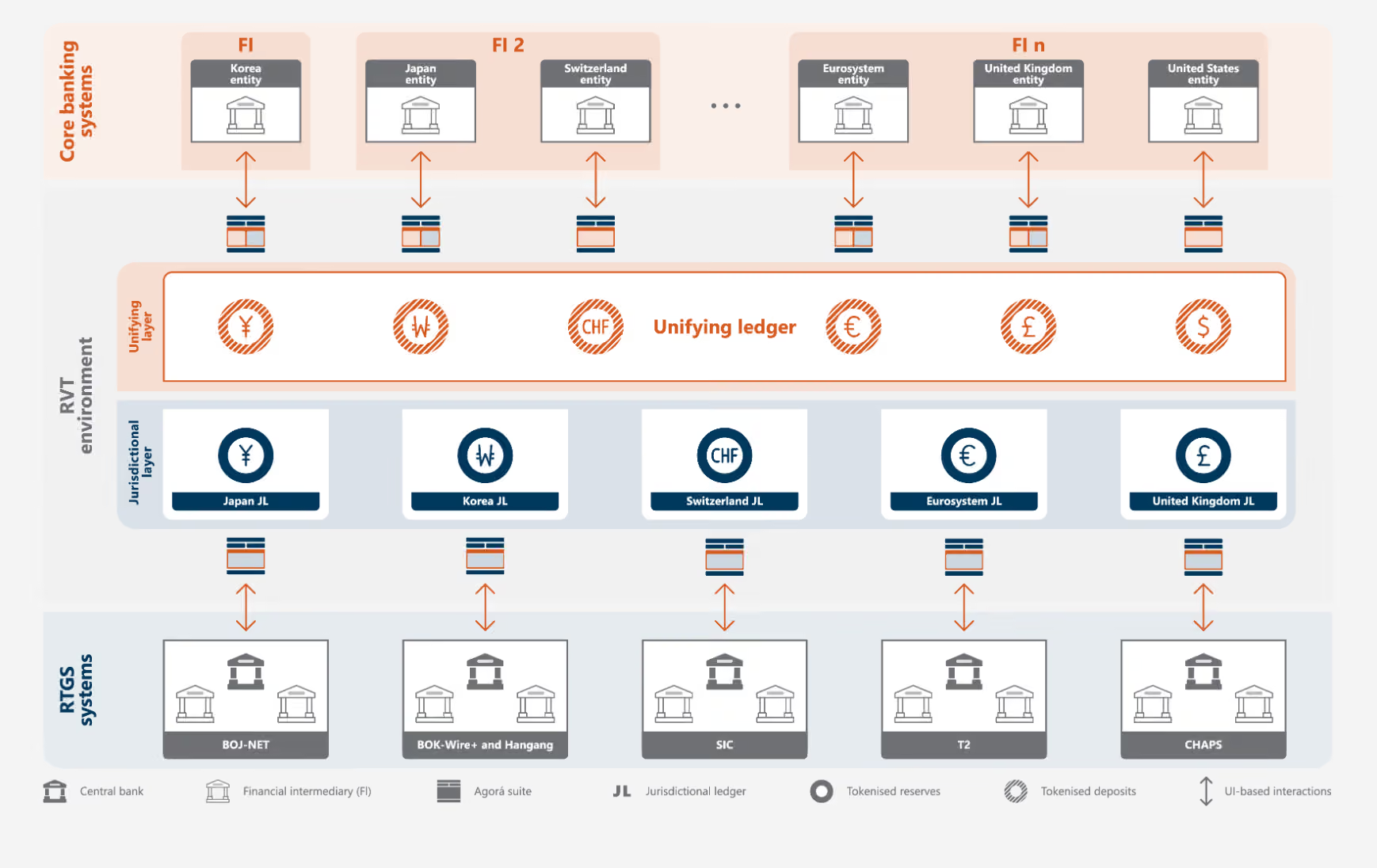
Project Agorá, which brings together five central banks and 28 commercial lenders including JPMorgan, Citi, UBS, Deutsche Bank and Standard Chartered, processed roughly $1 million (CHF 800,000) in real-value transactions across six currencies — the U.S. dollar, euro, British pound, Japanese yen, Swiss franc and South Korean won.

The pilot used tokenized central bank reserves and commercial bank deposits to settle corporate, interbank payments perand foreign exchange settlements. The payments settled in an average of about 80 seconds, even though the prototype was not directly integrated with banks’ existing payment infrastructure, the BIS report said.

(BIS Project Agorá)

The project fits into a broader shift as stablecoins and tokenized assets gain traction across global finance. Asset managers have begun issuing tokenized money market and private credit funds, while stablecoins are increasingly being used for cross-border payments and corporate treasury operations.

A new model for cross-border payments

Project Agorá explores whether the same technology can modernize the infrastructure banks use to move money internationally.

Advertisement

Source link

Continue Reading

Crypto World

Telegram Founder Pavel Durov Finally Breaks Silence on Russia Charges

Published

on

GRAM Price Performance. Source: BeInCrypto

Telegram founder Pavel Durov has answered Russia’s terrorism charges, accusing Moscow of punishing him for rejecting state demands for mass surveillance and censorship on the messaging app.

Rosfinmonitoring, Russia’s financial monitoring service, added Durov to its registry of terrorists and extremists on Thursday. The listing arrived one day after the Federal Security Service (FSB) opened a criminal case against him.

Durov Answers Moscow With a Meme

Durov did not rebut the allegations point by point. He posted a short statement to his Telegram channel, then followed it with a two-panel image.

“Russia has designated me as a “terrorist” for refusing its demands for mass surveillance and censorship on Telegram. Under Russian law, I’m banned from “publishing information on the Internet”. Russian officials have clearly got confused about who can ban whom from the Internet,” Durov wrote.

Follow us on X to get the latest news as it happens

Advertisement

The image placed his own photo, captioned terrorist, beside Taliban representatives greeting Russian Foreign Minister Sergey Lavrov, captioned respected partners. Russia’s Supreme Court removed the Taliban from that same registry in April 2025.

What the Designation Actually Changes

Russian banks must freeze the personal assets of anyone on the Rosfinmonitoring list and cut off financial services. That obligation covers Durov himself, not Telegram as a legal entity.

The FSB alleges the platform failed to delete channels, chats, and bots that Ukrainian intelligence and extremist groups used to organize attacks inside Russia. Durov, 41, now sits on the international wanted list and faces a possible life sentence. Officials had been negotiating with Telegram days earlier.

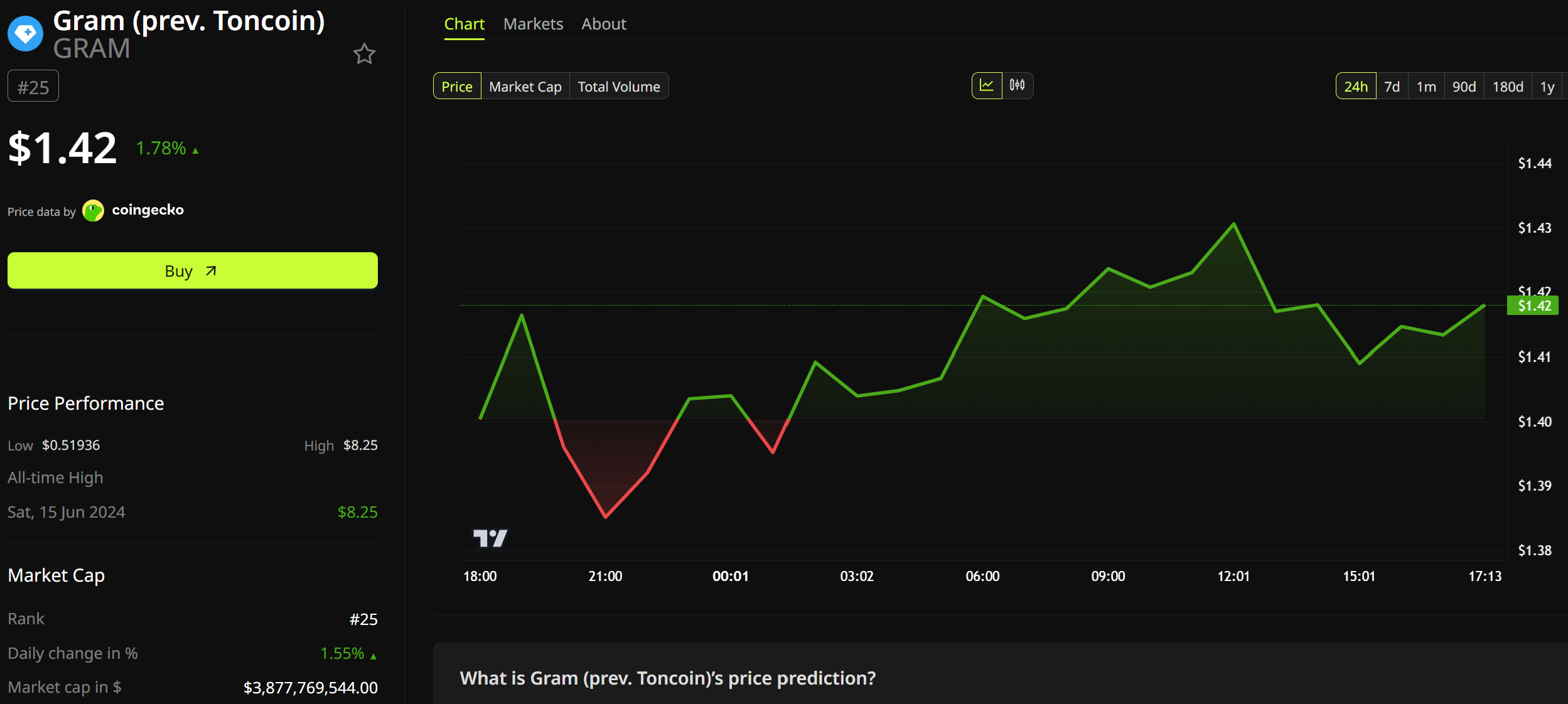
Markets shrugged. Gram (GRAM), the Telegram-linked token Durov rebranded from Toncoin in June, traded near $1.42, up 1.7% over 24 hours.

Advertisement
GRAM Price Performance. Source: BeInCrypto

Enforcement remains the open question. Durov holds French and UAE citizenship and lives in Dubai, so any arrest would need cooperation Moscow has not yet secured. French prosecutors lifted his travel restrictions in November.

The post Telegram Founder Pavel Durov Finally Breaks Silence on Russia Charges appeared first on BeInCrypto.

Source link

Continue Reading

Crypto World

Trump Says He Has ‘No Objection’ to Withdrawing Todd Blanche’s Nomination

Published

on

Trump Says He Has ‘No Objection’ to Withdrawing Todd Blanche’s Nomination

President Trump said Thursday that he might pull Todd Blanche’s nomination as attorney general, after two Republican senators threatened to withhold their support. 

“I have no objection to temporarily withdrawing Todd’s name, if they do not do the right thing,” Trump posted on Truth Social. 

His comments came after the Senate Judiciary Committee postponed a vote Thursday that would have advanced Blanche’s nomination.

Republican Sen. John Cornyn of Texas, one of the key holdout votes, told reporters Wednesday that he had not received a written confirmation from the Department of Justice that it would eliminate provisions in a proposed settlement between Trump and the department over a lawsuit he filed concerning the leak of his tax returns.

Advertisement

The most contentious provisions would have created a $1.8 billion “Anti-Weaponization Fund” for Trump allies and Jan. 6 defendants, and shielded Trump and his family from future audits by the Internal Revenue Service.

“I think they [the administration] realizes that we are serious,” Cornyn, who lost his reelection bid in May after Trump endorsed his opponent, said after canceling an in-person meeting with Blanche.

The committee did not immediately announce a new date for a confirmation vote. Shortly after the postponement, Cornyn said negotiations between the committee members and the DOJ were still ongoing, and that the DOJ had received “some pushbacks” from the White House. 

“I thought we were pretty close to landing the plane last night, but this morning there’s been some more complications. I think if this were just between me and Todd Blanche, we would have worked this out,” Cornyn added. 

Advertisement

Republican Sen. Thom Tillis of North Carolina, who is not seeking reelection over his disagreement with the Trump administration, has also made clear his opposition to the Anti-Weaponization Fund. 

“He [Blanche] is a qualified candidate. We just need to get the issues off the table,” Tillis said on Wednesday.

What happens if Blanche is not confirmed? 

Todd Blanche has been serving as acting attorney general for the DOJ since Trump removed Pam Bondi in April over her handling of the Epstein files. Unlike interim U.S. prosecutors, who can lawfully serve 120 days without a Senate confirmation, an acting attorney general can serve for as long as a president wants. 

Advertisement

That is because of U.S. Code § 508, which states that “the Deputy Attorney General may exercise all the duties of that office” if the office of Attorney General is vacant and the law does not state a time limit for how long the acting attorney general can legally serve.

The law, which was passed decades before the Federal Vacancies Reform Act (VRA) of 1998, takes legal precedence. While the FVRA generally limits officials serving in a temporary capacity to no longer than 210 days after the position becomes vacant, the law also made exceptions to agency-specific laws that had been previously codified.

A similar arrangement existed under the Biden administration. In 2023, after Marty Walsh resigned as labor secretary, President Biden nominated Julie Su to fill the vacancy. Su, who had served as deputy labor secretary, ultimately failed to get confirmed by the Senate due to the lack of support from Sen. Joe Manchin of West Virginia and Sen. Kyrsten Sinema of Arizona.

Su served as acting labor secretary for the rest of the Biden administration under a similar statutory provision, despite Republicans’ objections. In 2023, the Government Accountability Office, which oversees the federal government’s compliance with vacancy laws, concluded in a letter that time limitations “do not apply” to Su’s case. 

Advertisement

What did Blanche say about the demands?

During his confirmation hearing earlier this month, Todd Blanche said the Anti-Weaponization Fund was “dead.” 

However, Sen. Cornyn pointed out during the hearing that the settlement agreement made between Trump and the Department of Justice that included the fund could only be modified through “a written agreement” between two parties. When pressed by Cornyn, Blanche said Trump could potentially enforce the agreement if he decides to do so. 

“They [Trump’s legal counsel] could say that we breached by not moving forward,” Blanche said. 

Advertisement

TIME has also reached out to the Department of Justice for comment.
Source link

Continue Reading

Crypto World

CLARITY Act wins police backing as odds fall to 30%

Published

on

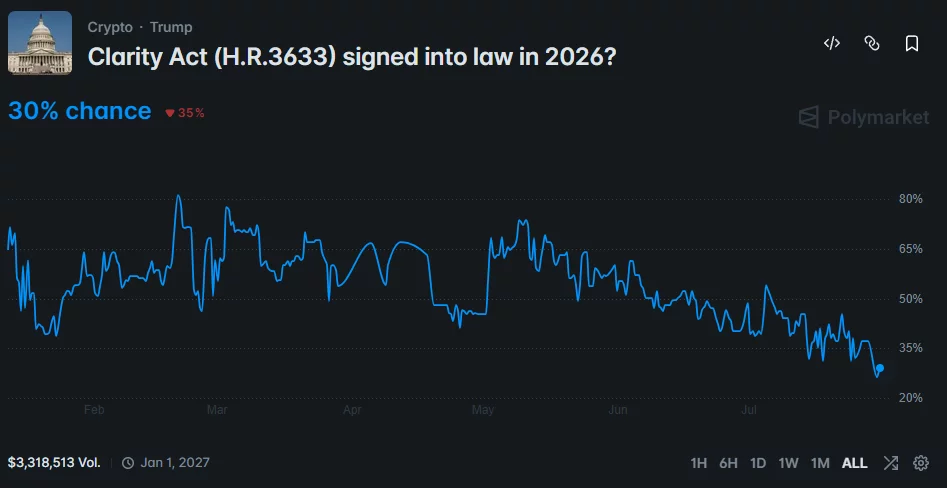
Polymarket chart showing the CLARITY Act’s 2026 passage odds falling to 30%.

A major U.S. police organization has endorsed the latest CLARITY Act draft, but unresolved disputes over political ethics, DeFi protections and stablecoin rewards continue to threaten its passage before the Senate recess.

Summary

  • Major Cities Chiefs Association endorsed the CLARITY Act after lawmakers added new enforcement provisions.
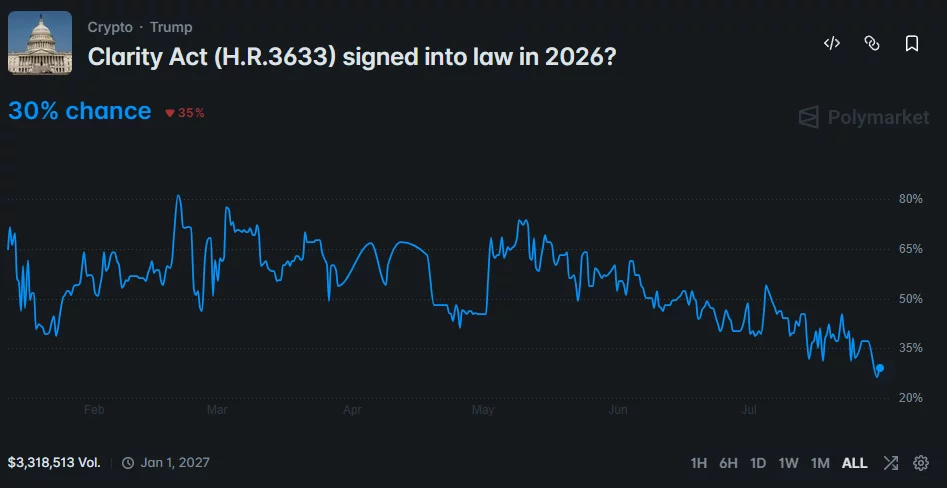
  • Polymarket traders place the bill’s chance of becoming law in 2026 at 30%.
  • Democrats and prosecutors continue to seek changes to the bill’s DeFi developer protections.
  • Banks support federal crypto rules but want tighter restrictions on stablecoin rewards and yield.

Major Cities Chiefs Association backs CLARITY Act

The Major Cities Chiefs Association endorsed the latest version of the CLARITY Act in a letter to Senate Banking Committee Chair Tim Scott and ranking member Elizabeth Warren.

MCCA said recent revisions addressed concerns previously raised by police and prosecutors. The organization specifically pointed to additional law-enforcement provisions and the inclusion of state and local agencies in Sections 10203, 10204 and 10309.

Advertisement

“The inclusion of these provisions represents a meaningful step toward improving the ability of law enforcement to investigate financial crimes involving digital assets,” the association wrote.

MCCA joins several other police organizations that have moved toward supporting the proposed U.S. crypto market structure framework.

The National Organization of Black Law Enforcement Executives became the first major police association to endorse the bill. The Federal Law Enforcement Officers Association later offered conditional support while requesting stronger rules governing accountability in decentralized finance.

The National Fraternal Order of Police, which represents more than 382,000 officers, also reversed its previous opposition after reviewing revisions to the Blockchain Regulatory Certainty Act provisions.

Advertisement

Major County Sheriffs of America has stopped short of endorsing the legislation but withdrew its formal opposition. The group adopted a neutral position while asking Congress to give state and local agencies a role in Treasury studies and advisory panels created under the bill.

Why police groups previously opposed the crypto bill

Earlier law-enforcement resistance focused primarily on the CLARITY Act’s treatment of non-custodial crypto developers.

The Blockchain Regulatory Certainty Act language generally protects developers and infrastructure providers from being classified as money transmitters when they do not control customer funds. Supporters say those protections prevent programmers from being prosecuted solely because criminals use open-source software.

Police groups and prosecutors argued that earlier wording was too broad. They warned that DeFi operators, mixers and other services could use the exemption to avoid registration and accountability, making it harder to trace illicit funds or recover assets for victims.

Advertisement

Revisions clarified that developers may still face prosecution when they knowingly or intentionally facilitate money laundering and other crimes. The updated draft also preserves existing criminal-enforcement powers and gives state and local agencies a larger role.

However, Democrats led by Senator Catherine Cortez Masto and several prosecutors continue to seek additional changes. Their proposal would narrow or remove protections that could shield some crypto service providers from prosecution.

Banks push for tighter stablecoin restrictions

The banking industry supports the broader goal of establishing federal rules for digital assets but wants lawmakers to revise the bill’s stablecoin provisions.

A coalition of 134 banking association officials and senior bank executives has asked the Senate to strengthen Section 10404. That provision restricts stablecoin issuers from paying interest but allows certain rewards tied to payments, memberships and other activities.

Advertisement

Banks argue that exchanges could use those exceptions to provide returns resembling interest on stablecoin balances. They warn that such products could pull deposits away from regulated banks and reduce funding available for mortgages, agricultural credit and small-business loans.

The American Bankers Association and five other financial trade groups have called the legislation an important step toward federal crypto regulation. However, they want Congress to prohibit passive returns tied to the size or duration of stablecoin holdings while preserving legitimate transaction-based rewards.

White House crypto adviser Patrick Witt has disputed the banking industry’s warnings, arguing that banks are seeking protection from competition rather than stronger consumer safeguards.

Ethics dispute leaves passage odds at 30%

Despite growing police support, political ethics remains one of the largest barriers to a Senate agreement.

Advertisement

Democrats want restrictions addressing financial interests in crypto held by elected officials and their families. Republican Senator Thom Tillis has also indicated that he will not support the bill without an acceptable ethics provision.

Tillis reportedly plans to send a bipartisan ethics proposal to the White House for President Donald Trump’s approval. Democrats have not ruled out supporting a vote before the recess, but they are unlikely to back the current text without further changes.

Polymarket traders place the probability of Trump signing the CLARITY Act in 2026 at 30%. The Senate has until its scheduled Aug. 7 recess to reach an agreement and advance the legislation during the current window.

Polymarket chart showing the CLARITY Act’s 2026 passage odds falling to 30%.
Source: Polymarket

MCCA’s endorsement removes one source of institutional resistance, but it does not resolve the ethics, DeFi and stablecoin disputes. Without a bipartisan compromise, the bill may struggle to secure the 60 Senate votes needed to overcome a filibuster.

Advertisement

Source link

Continue Reading

Crypto World

Apple faces Aug. 21 Senate deadline over China chips

Published

on

Apple faces Aug. 21 Senate deadline over China chips

Apple faces bipartisan pressure to rule out memory chips from two Chinese suppliers as an AI-driven shortage tightens global supply and raises production costs.

Summary

  • Six US senators asked Apple to reject memory chips supplied by China’s CXMT and YMTC.
  • Apple must provide a formal commitment by Aug. 21, according to the lawmakers’ letter.
  • Both suppliers appear on the Pentagon’s Section 1260H list of Chinese military companies.
  • AAPL closed 0.56% lower at $338.19 before extending its decline in Thursday trading.

Senators give Apple an Aug. 21 deadline

Six US senators have urged Apple CEO Tim Cook to abandon any plan to source memory chips from ChangXin Memory Technologies, or CXMT, and Yangtze Memory Technologies Co., commonly known as YMTC.

The bipartisan letter was led by Republican Senator Jim Banks of Indiana and Senate Democratic leader Chuck Schumer of New York. Senators Andy Kim, Jeanne Shaheen, Mike Crapo and Pete Ricketts also signed it.

Advertisement

Lawmakers asked Apple to confirm by Aug. 21 that it would not use components made by either supplier, including in devices produced exclusively for the Chinese market. Bloomberg first reported the letter.

“Once a part clears qualification for Apple production, extending it worldwide is a single procurement decision away,” the senators wrote.

The group also asked Apple whether it transferred intellectual property to CXMT or YMTC while evaluating their components. Such transfers could require approval from the US Commerce Department, depending on the technology involved.

Advertisement

Apple had not publicly responded to the letter at the time of writing.

Why US lawmakers oppose CXMT and YMTC

Washington’s concerns center on the suppliers’ alleged links to China’s government and defense industry.

The Pentagon added both companies to its updated Section 1260H list in June. The Defense Department document describes CXMT as affiliated with China’s Ministry of Industry and Information Technology and state-owned asset authorities.

It identifies YMTC as indirectly owned or affiliated with Chinese government and defense agencies. Both companies have denied that they support China’s military.

Advertisement

A Section 1260H designation does not impose the same restrictions as a full trade sanction. However, it limits Pentagon dealings with listed companies and signals possible future procurement or investment restrictions.

YMTC also remains on the Commerce Department’s Entity List, restricting its access to certain US technology, software and chipmaking equipment. CXMT is not currently on that list, although there are reports that a US interagency committee previously approved it for inclusion.

Apple encountered similar opposition in 2022 when it considered using YMTC flash memory in some iPhones. The company dropped those plans after lawmakers raised national security concerns.

AI memory shortage limits Apple’s options

The dispute comes as AI data centers absorb a growing share of global memory production. Samsung, SK Hynix and Micron have directed more capacity toward high-bandwidth memory used in AI accelerators, reducing supplies available for smartphones, computers and other consumer products.

Advertisement

CXMT has become the world’s fourth-largest memory producer, while YMTC has expanded its position in NAND flash storage. The companies are gaining pricing power as buyers compete for limited supply, according to Reuters.

Apple has argued that it needs access to Chinese memory and has sought assurances that CXMT will not be added to the Entity List, Reuters reported, citing people familiar with the discussions.

Blocking both companies would leave Apple more dependent on Samsung, SK Hynix and US-based Micron. That could weaken Apple’s ability to negotiate prices while memory costs remain elevated.

For US investors, the immediate risk is margin pressure. Apple must either absorb higher component costs, pass them to customers through higher product prices, or redesign parts of its supply chain.

Advertisement

Apple stock falls as investors await its response

Apple shares closed at $338.19 on July 29, down 0.56%, after reaching an intraday high of $344.57. The reversal prevented the company from closing above a $5 trillion market value.

AAPL extended the decline during July 30 trading, falling about 1.8% in the morning as investors also prepared for Apple’s quarterly earnings report.

The Aug. 21 response will show whether Apple accepts the senators’ demand or continues evaluating Chinese memory for locally sold devices. Lawmakers also want to know whether Apple sought priority supply from US and South Korean manufacturers, making its answer relevant to the company’s sourcing plans for the 2027 iPhone cycle.

Separately, Apple faces a federal lawsuit from three users who allege that fake apps impersonating Sparrow Wallet appeared on its App Store and caused approximately $1.835 million in Bitcoin losses.

Advertisement

Source link

Continue Reading

Crypto World

Scammers stole millions of XRP tokens from dozens of investors via a fake Flare Network site

Published

on

OpenClaw GitHub phishing scam uses fake $5,000 token airdrops gain wallet access

A fake Flare Network staking site robbed 71 investors of 3.4 million XRP worth roughly $8.5 million last year, Seoul police said.

Two men were detained on aggravated fraud charges and a third alleged scammer is on the loose, South Korean news outlet Chosun reported Thursday.

Authorities said investigations are ongoing as they believe the scam is much larger than they have been able to prove so far, adding that the scammers might have robbed up to $19 million worth of XRP, Chosun stated.

The Cyber Crime Investigation Unit at the Seoul Metropolitan Police said the scammers ran the fake investment site from Oct. 16 to Oct. 23 and tricked victims into believing that if they deposited “Rippke, you will receive a return of 1.5% to 1.8% every month,” Chosun said.

Advertisement

Police officials investigating the case said the alleged scammers created the fraudulent website using the name of a genuine blockchain project. They then disseminated false advertising through Naver blogs, online news articles, Wikipedia and YouTube, the news outlet said.

Source link

Continue Reading

Crypto World

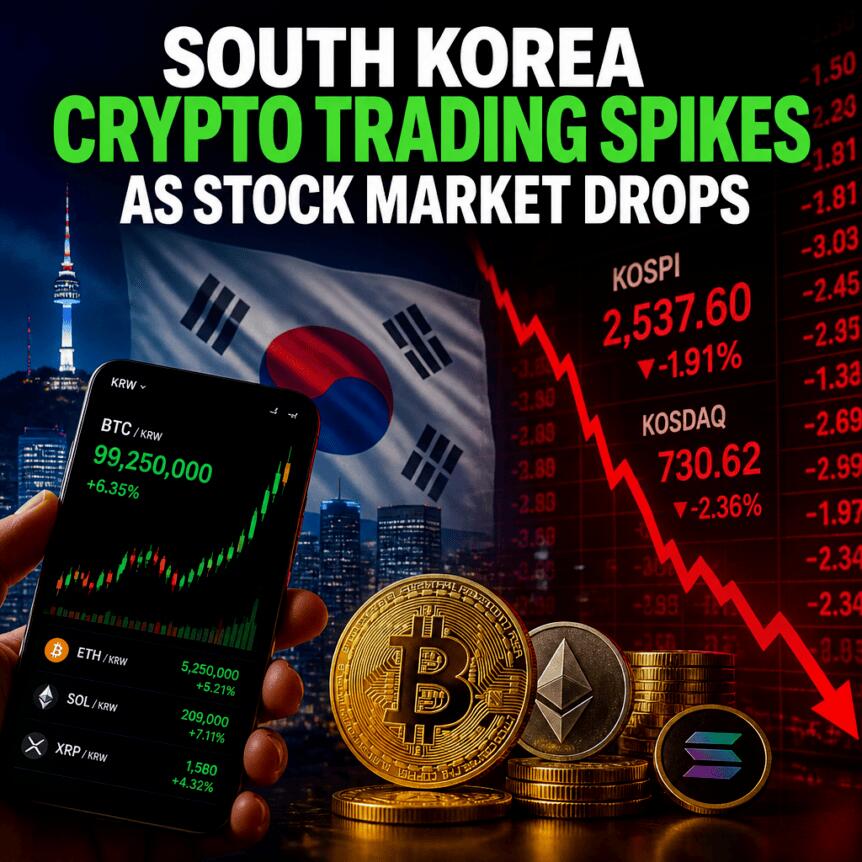
South Korea Crypto Trading Spikes as Stock Market Drops

Published

on

Crypto Breaking News

South Korean crypto markets saw a sharp burst in activity after the KOSPI suffered steep losses this week, highlighting how equity sell-offs can quickly redirect attention toward digital assets—and related products traded overseas. According to data from Upbit, trading between the Korean won and Tether (USDT) accelerated rapidly during the index’s decline.

Meanwhile, analysts are pointing to a different storyline in parallel: despite the macro pressure weighing on risk assets, Bitcoin has shown relative strength compared with large U.S. stock benchmarks. Bitwise’s latest research argues that the cryptocurrency’s performance is increasingly notable as financial conditions tighten.

Key takeaways

  • Upbit KRW/USDT volume nearly hit 200 billion won (about 140 million USDT) on July 29, up from roughly 20 million USDT on July 25—about a 600% jump.
  • Local analysis linked the surge to fund rotation away from Korean equities and toward crypto trading or stock-linked derivatives available through overseas venues.
  • Prior KOSPI volatility showed a similar pattern: Upbit recorded a volume spike after a 10% one-day drop on July 14.
  • Bitwise says Bitcoin has outperformed major U.S. mega-cap stocks and has remained comparatively “flat” since late June’s semiconductor peak.

KRW/USDT trading surges as equities slide

Upbit’s exchange data shows the most direct evidence of the equity-to-crypto link. Trading volume between KRW and USDT climbed rapidly between July 25 and July 29, according to the figures cited in reporting that referenced Upbit’s KRW/USDT market. On July 29, the volume approached 200 billion won (around 140 million USDT), compared with about 20 million USDT on July 25.

That surge arrived alongside a broader wave of downside momentum in South Korea’s KOSPI. The index’s sharp weekly decline—described in the coverage as close to 18% over the period—was tied to weakness in chip-related equities, particularly chip-maker stocks. The implication for investors is straightforward: when liquid, familiar markets begin to fall quickly, some participants look for alternatives that can be traded at any hour and can offer both spot exposure and leveraged strategies.

Local reporting cited analysis from Seoul Economic Daily suggesting that capital may have rotated out of stocks into crypto during the sell-off, or that traders sought access to derivatives tied to Korean equities through overseas exchange platforms. The same coverage also highlighted a possible preference for moving funds to overseas venues or personal wallets to trade perpetual equity futures.

Advertisement

“There is a possibility that demand increased for moving funds to overseas exchanges or personal wallets to trade perpetual stock futures,” said Cho Yoon-sung, a senior researcher at Tiger Research, according to the publication.

In other words, the KRW/USDT spike appears less like random day-trading noise and more like a measurable byproduct of stress in traditional markets. Traders can reposition quickly when the equity tape deteriorates—especially in environments where crypto already functions as a high-velocity risk market.

Stock sell-offs and “overseas” trading pathways

South Korea’s crypto ecosystem continues to be closely intertwined with how local investors express risk. The coverage emphasized that the country’s market remains highly active, with younger participants in particular showing a taste for leveraged products. That appetite tends to amplify volume responses when shocks hit adjacent assets like equities.

There is also a structural element: some investors may prefer to access certain equity-linked exposures through crypto-native derivatives offered by overseas platforms. When KOSPI volatility rises, the willingness to shift capital—either to trade crypto directly or to use perpetual contracts tied to equity themes—can increase.

What’s notable here is that the surge wasn’t entirely new behavior. Earlier in the month, Upbit reportedly registered a conspicuous volume spike after the KOSPI fell 10% in a single day on July 14, as described in earlier coverage referencing Yahoo Finance. That establishes a pattern: large, fast equity moves have previously coincided with elevated crypto trading activity.

Advertisement

Bitcoin’s resilience amid semiconductor pressure

While won-based volumes rose sharply in response to South Korean equity turmoil, analysts elsewhere were examining whether macro weakness would “spill over” into crypto performance. Andre Dragosch, European head of research at Bitwise, argued that Bitcoin has not behaved like a fragile extension of the semiconductor trade.

In commentary shared on social media and referenced by the reporting, Dragosch suggested that Bitcoin has been largely range-bound—“essentially flat”—since semiconductors peaked in late June. His framing is that the expected contagion from a semiconductor-driven risk repricing did not materialize in the way some market participants may have anticipated.

Bitwise’s broader analysis, released earlier in the week, reinforced that view through relative performance. The firm attributed what it called “remarkable outperformance” to Bitcoin versus a set of U.S. mega-cap stocks. In the coverage, Bitwise pointed to comparison benchmarks including large-cap tech exposure and even SpaceX (SpaceX was referenced as part of the comparison set in the text).

Bitwise’s argument went beyond simple relative returns. It linked Bitcoin’s strength to the possibility that the asset may already be pricing early signals of future monetary-policy easing—even while inflation remains a concern and near-term interest-rate hike risks persist. The firm also used the well-known “canary in the macro coal mine” metaphor to describe Bitcoin’s sensitivity to macro conditions.

Advertisement

Bitwise stated in its analysis that Bitcoin continues to show “remarkable outperformance and resilience” versus U.S. mega-cap stocks such as the Magnificent 7 and SpaceX (as cited in the coverage), calling the relative strength “all the more notable” amid tightening financial conditions.

For investors, this matters because it suggests crypto’s behavior is not simply being dictated by the same narrative driving equities. If Bitcoin’s relative strength persists, it may indicate that markets are treating Bitcoin less as an equity proxy and more as a separate macro instrument responding to different expectations—particularly around future policy.

What traders should watch next

The near-term question is whether the KOSPI-driven volume spike is a one-off reaction to a violent week, or a sign that equity volatility is again feeding crypto activity in South Korea. Traders should watch whether KRW/USDT volumes remain elevated through subsequent market days and whether Bitcoin’s outperformance versus U.S. mega-cap benchmarks holds as the macro narrative shifts.

Risk & affiliate notice: Crypto assets are volatile and capital is at risk. This article may contain affiliate links. Read full disclosure

Advertisement

Source link

Continue Reading

Crypto World

A Rocky Year: Ethereum Turns 11 Years as ETH Trades 61% Below the High Set Last August

Published

on

Ethereum’s (ETH) genesis block turned 11 on July 30, closing quite a busy year. The network now runs on a 60 million gas limit, double where it sat two years ago, with rollups carrying roughly 95% of its transactions.

On the morning of the anniversary, blocks were landing about 229 transactions each, close to 21 per second on the base layer, and running 55% full. The base fee sat near 5.3 gwei, which works out to about $0.20 for a plain ETH transfer, $0.52 for an ERC-20 transfer, and $3.79 for a swap, according to data from Etherscan.

Scaling and ETFs

The fund wrappers arrived alongside the scaling. Morgan Stanley began trading the cheapest US ether ETP at a 0.14% expense ratio on Tuesday, staking 50% to 80% of its holdings and passing the rewards through.

Likewise, BlackRock’s ETHB holds spot ETH and stakes a portion of it, the firm’s first crypto fund to do so. Both lean on Revenue Procedure 2025-31, the safe harbor letting exchange-traded products stake and distribute rewards without a separate tax charge.

Advertisement

Two upgrades are queued for this year: Glamsterdam and Hegotá. The 2026 protocol roadmap sets three tracks – scaling, user experience, and hardening the base layer – and targets a gas limit beyond 100 million per block, and names post-quantum readiness a consideration across protocol development.

Despite all of this, it has been a painful year for the native token. ETH traded at $1,920 on July 30, down 49% over the 12 months to the anniversary and 61% below the $4,946 record it set on August 24, 2025. Its market capitalization stood at $231 billion across 120.7 million coins, second behind Bitcoin.

Two Directors Out in Five Months

The network had some interesting developments, and the overall project managed to thrive, despite all the duress the Ethereum Foundation (EF) went through recently.

Around 54 colleagues had departed, close to 20% of its workforce, and reorganized what remained into five clusters covering the protocol, access, user, community and institutional layers, plus operations and management.

Advertisement

Investor Ryan Berckmans, an eight-year figure in the community, attributed the wider wave of exits to disagreements over sub-strategies. He said confidence in the network itself was not the reason. Researchers Carl Beek, Julian Ma, Barnabé Monnot, Tim Beiko, Trent Van Epps and Josh Stark all left during the same stretch.

Tomasz Stańczak stepped down as co-executive director on February 13, effective immediately, with Bastian Aue named interim co-executive director. The board said Stańczak left “after extensive contributions to the Foundation’s mission and operations.”

Hsiao-Wei Wang resigned as co-executive director and board member in June, writing that she had decided to step down “after my sabbatical.” That leaves Vitalik Buterin, Patrick Storchenegger and Aya Miyaguchi on the board.

The post A Rocky Year: Ethereum Turns 11 Years as ETH Trades 61% Below the High Set Last August appeared first on CryptoPotato.

Advertisement

Source link

Continue Reading

Trending

Copyright © 2025