

Crypto World
XRP Price Prediction: Validators Welcome XRP Ledger Last Upgrade


XRP price prediction remains in focus as the coin experiences another quiet pullback. The token has slipped about 2% over the past day, but sellers have not taken full control. For now, it looks more like a coffee break than a panic.
The latest XRP Ledger server upgrade, v3.2.0, has crossed the key validator threshold. Thirty-one of the 35 validators on the default Unique Node List now run the new version. That comfortably clears the 80% level needed for stable network consensus.
Meanwhile, most relay nodes still use the older release, but they do not determine consensus. Validators carry that responsibility, making their adoption rate the figure that matters most. Even so, the fixCleanup3_2_0 amendment still needs more validator backing before activation.
XRP has also held up better than much of the crypto market over the past week. That keeps the recent dip looking like consolidation instead of a trend reversal. If buyers defend nearby support, bulls could soon have another shot at higher prices.
Discover: The Best Token Presales
XRP Price Prediction: Reclaim $1.2 This Week?
XRP price prediction has turned cautious after the token slipped to about $1.10. The latest session traded between roughly $1.10 and $1.12. Even so, XRP is still hovering near a level buyers have defended several times lately.
Support sits around $1.05 to $1.10, where buyers have repeatedly stepped in. Meanwhile, resistance remains near $1.15 to $1.18. It is not the flashiest chart around, but sometimes boring charts save traders from expensive lessons.

If XRP holds above $1.10, buyers could make another run toward $1.18. On the other hand, a daily close below $1.05 would weaken the recent structure. That could expose the psychological $1.00 area, with about $0.98 acting as the next notable support.
The recent XRPL validator upgrade is a welcome improvement for the network. Still, technical upgrades rarely lift prices without stronger demand behind them. For now, trading volume, market sentiment, and fresh capital flows are likely to matter more than software updates alone.
Don’t Miss Out on Our $1,000 USDT Airdrop on ByBit
Bitcoin Hyper Targets Early-Mover Upside as XRP Tests Key Levels
XRP holding $1.10 after a 4.4% weekly outperformance is a reasonable position, but at a $65 billion market cap, the asymmetric upside a trader might want requires a significant re-rating. That math pushes some capital toward early-stage infrastructure with a smaller base and a specific technical edge.
Speculative positioning on XRP’s longer-term targets remains elevated, but traders looking for asymmetry at current prices are increasingly eyeing presale infrastructure plays.
Bitcoin Hyper ($HYPER) is positioning itself as the first Bitcoin Layer 2 with SVM integration, combining Bitcoin’s security with Solana Virtual Machine execution speed, targeting performance that exceeds Solana’s current throughput.
The project has raised $32.9 million at a current token price of $0.0136828, with staking incentives active for early participants. The core proposition is closing Bitcoin’s programmability gaps like slow transactions, high fees, and no native smart contract layer, without sacrificing the base layer’s trust model.
Research Bitcoin Hyper here before considering any allocation.
Discover: The Best Crypto to Diversify Your Portfolio
The post XRP Price Prediction: Validators Welcome XRP Ledger Last Upgrade appeared first on Cryptonews.


Pay for the premium tier of any centralized AI platform, and rate limits still hit during peak hours. That’s not a bug. It’s the ceiling every centralized AI platform eventually reaches, because one company’s data centers can only handle so much demand at once, no matter how much money gets thrown at the problem.
Arbitrum, Internet Computer, and Kaspa each tackle a different piece of crypto’s scaling puzzle, yet none were built specifically to solve AI’s compute bottleneck. For anyone tracking the next 100x crypto, that’s the gap Stargate LLM’s Grid is aimed at.
What Happens When One Company’s Servers Aren’t Enough
The problem isn’t unique to any one AI platform. Rate limits during peak hours are the ceiling every centralized system eventually hits, because a single company’s data centers can only absorb so much demand regardless of the price tag attached to the premium tier. Stargate LLM‘s Grid takes a different structural approach: crowdsourcing compute from a distributed network of contributors instead of concentrating it inside one company’s server farms, so capacity grows as more people join rather than staying fixed to one balance sheet.
This is the pitch for power users and businesses who’ve personally hit a rate limit or a slowdown on a paid tier, an experience that’s rarely discussed publicly but genuinely frustrating: paying full price for capacity that isn’t reliably there the moment demand spikes. Stargate LLM’s chat, image generation, video generation, private search, and agent marketplace all sit on top of that distributed compute layer rather than a single data center somewhere.
The presale runs across ten pricing stages, from $0.0005 to $0.0125, on the way to a confirmed $0.025 launch price. Stage 1 carries a 50x ratio to that target, the widest gap in the entire structure. Total supply is fixed at 150 billion tokens. Of that, 96% goes to community, ecosystem, and presale participants, and just 1% sits with the core team.
For anyone genuinely hunting the next 100x crypto, a decentralized compute layer paired with a presale still priced before the wider market has weighed in is a different kind of bet than a token riding purely on speculation.
LG’s Enterprise Bet on Arbitrum Hasn’t Reached the Price Yet
LG Electronics partnered with Arbitrum to build a custom Layer 2 blockchain for automating digital advertising transactions, completing a pilot with a Japanese advertising agency and evaluating a commercial rollout before the end of 2026.LG Electronics partnered with Arbitrum to develop a custom Layer 2 blockchain designed to automate the buying and selling of digital advertising, completing a pilot with a Japanese advertising agency.
That’s a real enterprise validation of Layer 2 technology. ARB trades near $0.08, roughly 97% below its all-time high of $2.40 set in January 2024, and a scheduled token unlock on July 16 will release close to 93 million ARB, adding fresh supply pressure right as the enterprise story is still building momentum.
A Trillion-Dollar Ambition, a $1.2 Billion Reality
Internet Computer positions itself as sovereign, decentralized cloud infrastructure capable of hosting entire applications on-chain, aimed squarely at the trillion-dollar cloud computing market currently dominated by centralized providers.
The Internet Computer is a decentralized cloud blockchain that pursues the $1+ trillion cloud market, hosting apps, websites, and enterprise systems fully onchain. The ambition is genuinely large. The market cap isn’t. ICP trades near $2.14 to $2.18, with a total valuation just over $1.2 billion, sitting roughly 99.7% below its all-time high near $700.
Kaspa Rallied on Real News. Its Own Miners Sold Into the Move.
Kaspa is trading near $0.030, with a market cap around $830 million, after a recent smart contract hard fork and network upgrade triggered a short-term price surge. As of Jul 7, 2026, Kaspa (KAS) is trading at $0.0302 with a market cap of $830.20M, having recently experienced short-term volatility due to a network upgrade and smart contract hard fork.

That surge has since run into resistance, and heavy miner distribution is adding sell pressure right as the technical setup tries to hold its gains.
Final Say
A real enterprise partnership, a trillion-dollar ambition, and a genuine network upgrade, Arbitrum, Internet Computer, and Kaspa each have something legitimate behind this week’s price action, even if none of it has fully shown up in the charts yet.
None of the three was purpose-built to solve AI’s specific compute ceiling, which is exactly what Stargate LLM’s decentralized Grid is aimed at. Stage 1 remains open before the price steps up through nine more stages.
Four different bets on the same underlying question: whose infrastructure is actually built to scale with what comes next.
Disclaimer: This is a Press Release provided by a third party who is responsible for the content. Please conduct your own research before taking any action based on the content.

Bitcoin’s price faced another rejection following the renewed strikes in the Middle East and Trump’s latest statement, going from over $64,000 to under $62,000 in hours.
Most altcoins have joined the ride south, with ETH sliding below $1,750, while XRP has dropped beneath $1.10. PI has marked another all-time low.
BTC Dips Below $62K
The start of July has been a mini rollercoaster for the primary cryptocurrency. It dipped below $58,000 on July 1 for the first time in nearly two years, but began its gradual recovery immediately and surged to over $63,000 over the weekend. After a minor retracement there, it jumped to $64,000 on Monday morning for the first time in two weeks.
However, Strategy’s new and much bigger BTC sale drove it south again, as the asset dumped to $61,200 in a FUD-induced move. While many expected another leg down, bitcoin went in the opposite direction and jumped past $64,600 within hours. This was another short-lived rally, though, and it slipped to $62,600 yesterday.
Another leg up followed, driving the cryptocurrency to $64,200, where it was rejected again after the US and Iran launched new strikes against each other. The landscape worsened hours ago after Trump said he believes the MoU with Iran is ‘over.’ BTC dumped further, dropping below $62,000 for the second time this week.
Its market cap has retreated to $1.240 trillion, while its dominance over the alts remains at 56.6% on CG.

PI’s New ATL, LAB’s Crash
Pi Network’s native token continues to be among the poorest performers during this cycle. It keeps dropping to new all-time lows, and it hit a new one earlier today. Despite the new updates from the team, PI plummeted by over 8% and crashed to $0.101 (on CoinGecko) to set a new low. It’s down by over 96.5% since its ATH in February 2025.
LAB has dumped the most over the past 24 hours. The token has lost over 80% of its value and now struggles below $2.30. PUMP, BEAT, and JUMP complete the double-digit losers club today.
Ethereum and Binance Coin have lost over 2% of value, while XRP, SOL, HYPE, and DOGE are down by 4-5%. XLM, NEAR, ADA, and CC have dropped by more than 5% daily. ZEC is among the few exceptions in the green now after the recent update from founder Zooko Wilcox-O’Hearn.
The total crypto market cap has shed $50 billion in a day and is below $2.2 trillion on CG now.

The post Pi Network’s Pi Crumbles to New ATL, Bitcoin (BTC) Halted at $64K: Market Watch appeared first on CryptoPotato.


Google has updated its Chrome Web Store rules to prohibit prediction market extensions that facilitate real-money transactions, with enforcement set to begin on Aug. 1, 2026.
Summary
- Google will ban Chrome extensions that enable real-money prediction market transactions from Aug. 1, 2026.
- The policy update comes as Kalshi and other prediction market platforms face growing legal scrutiny in the U.S.
- A New York court allowed the state’s lawsuit against Kalshi to proceed over sports-related event contracts.
According to Google’s latest update to its Developer Program policies, browser extensions that “facilitate or enable real money transactions on predictive outcomes” will no longer be permitted on the Chrome Web Store.
The company said developers have until Aug. 1, 2026, to comply, after which non-compliant extensions could face enforcement action, including removal from the marketplace.
The policy revision comes at a time when prediction market operators are facing growing legal and regulatory pressure in the United States, particularly over sports-related contracts. Platforms including Kalshi and Polymarket have increasingly found themselves at the center of disputes involving state gambling laws and the classification of event-based contracts.
Google has expanded restrictions on prediction market products
Alongside several updates to its Developer Program policies, Google explicitly added prediction market extensions to its list of prohibited products. While the company did not mention any specific platform by name, the revised language directly targets extensions that allow users to conduct real-money transactions tied to future events.
Google said enforcement will begin on Aug. 1, warning that extensions remaining out of compliance after that date may face action through the Chrome Web Store.
The policy change arrives shortly after prediction markets attracted attention outside financial regulation. As crypto.news previously reported, music streaming company Spotify challenged Polymarket and Kalshi after discovering its branding had been used in connection with prediction markets despite no partnership existing between the companies.
Spotify also said it had removed more than 500,000 artificial streams that falsely boosted Malcolm Todd’s song Earrings on its platform. Kalshi later settled a prediction market tied to those manipulated streaming numbers, drawing additional scrutiny to the event contract.
Kalshi continues to face legal challenges in New York
Meanwhile, legal pressure on Kalshi has continued to build in New York after the state secured a court victory in its dispute with the prediction market operator.
Following the ruling, New York Governor Kathy Hochul said, “Gamble with our laws and you’re going to lose. Just ask Kalshi.” Her comments came after New York’s Attorney General accused the company of attempting to bypass state gambling laws, a position that survived Kalshi’s effort to block the case.
As previously reported by crypto.news, Judge Analisa Torres denied Kalshi’s request for a preliminary injunction against New York. The court determined that the state’s gambling laws apply to Kalshi’s sports-related event contracts, allowing New York’s lawsuit to move forward.
State officials have maintained that prediction markets offering sports-based contracts can fall within existing gambling regulations when they operate without state authorization. Hochul added that her administration and the Attorney General would continue pursuing gambling platforms, including prediction markets, that they believe violate New York law.
Regulatory scrutiny has also extended beyond Kalshi. New York has filed legal action against Coinbase and Gemini, alleging that their prediction market offerings function as unlicensed gambling businesses under state law.
Google has not linked its Chrome policy update to any individual enforcement case. However, the timing places the new restrictions alongside mounting legal disputes involving prediction market platforms, leaving developers offering real-money event contract extensions with less than a month to comply before the Aug. 1 enforcement deadline.

Bank of England Governor Andrew Bailey has denied that lobbying or political pressure from Nigel Farage affected the central bank’s thinking on a potential UK central bank digital currency (CBDC), according to a report by The Guardian. Bailey’s remarks reportedly come in a letter obtained by the publication after a meeting between the two in which cryptocurrencies were among the topics discussed.
At the same time, the Bank of England continues its work on the proposed “digital pound,” stressing that it is still in the design stage and that no decision has been made about whether to introduce it. The juxtaposition of ongoing CBDC research with intensifying scrutiny of political figures underscores how UK crypto policy is increasingly intertwined with public trust and governance questions.
Key takeaways
- Bailey reportedly said the BoE has mechanisms to recognize attempts to influence policymaking and that no policy changes followed any interventions by Farage.
- Farage, a long-standing CBDC critic, resigned his parliamentary seat this week amid reports about accepted “gifts” connected to the crypto industry.
- The Bank of England reiterated that it has not decided whether to launch a digital pound and that any move would require further analysis and public consultation.
- Earlier this year, the BoE launched a six-month pilot exploring tokenized asset settlement using central bank money.
Bailey denies Farage influence on CBDC policy
In its Wednesday report, The Guardian said it obtained a letter written by Bailey following his meeting with Farage. The governor’s message, as described by the outlet, indicates that Bailey believes the BoE is “able to spot” efforts to sway central bank decision-making.
Bailey also reportedly addressed what (if anything) changed after the meeting. He wrote that it was a discussion covering “a range of topics, including cryptocurrencies,” and said he was “happy to confirm that no policy changes have taken place as a result of interventions” by Farage.
The reported denial arrives amid broader political controversy around Farage. Earlier this week, Farage resigned his parliamentary seat, with reports citing claims that he accepted “gifts” from individuals with ties to the crypto industry. Cointelegraph has previously covered the resignation in connection with those allegations.
Separately, Farage has maintained that he did not break the law, according to an X livestream in which he stated he had “not broken the law in any way at all,” as referenced in his post.
BoE maintains that the digital pound is not decided
While the political noise grows, the Bank of England’s stance on CBDC development remains consistent: it is exploring the digital pound without committing to implementation.
In a recent update, the central bank said that “no decision has been made on whether to introduce a digital pound.” The BoE also emphasized that any future launch would depend on further work, including analysis and public consultation, according to the bank’s digital pound update referenced in the article.
This matters for markets and users because CBDCs—unlike purely speculative technology projects—depend heavily on institutional design choices and regulatory guardrails. Even when a central bank is actively experimenting, it can still decide not to proceed after weighing privacy, financial stability, and operational feasibility.
Pilot work on tokenized settlement continues
The BoE’s digital pound timeline remains tied to experimentation rather than deployment. Earlier this year, the Bank launched a six-month pilot aimed at understanding how tokenized assets could be settled using central bank money.
As described in the source, the pilot involved 18 companies and was designed to test practical components of a future framework for on-chain settlement—part of a broader push to modernize UK financial infrastructure. Earlier coverage from Cointelegraph noted the BoE’s decision to select Chainlink for its synchronization lab to support the work.
For investors and builders, this type of pilot is significant because it can clarify which technical approaches are viable when the “asset” being moved is paired with central bank settlement rather than commercial bank money. It also helps explain how tokenized systems might interact with existing market practices—an area where many real-world asset tokenization efforts have struggled to translate concepts into resilient infrastructure.
At the same time, the BoE’s public messaging leaves room for uncertainty. Research pilots can inform future decisions, but they do not automatically translate into a CBDC launch. The key question moving forward will be whether the BoE concludes that the digital pound’s benefits outweigh the risks and whether the public consultation process produces sufficient confidence.
Political scrutiny widens beyond CBDC debate
The report detailing Bailey’s denial comes as the UK government’s crypto-adjacent political controversy expands beyond CBDC opinions. The Guardian also reported that the UK’s National Crime Agency is investigating transactions involving other senior Reform UK figures over suspected money laundering.
That broader context is relevant to how CBDC narratives may develop in the UK. Even if policymakers insist that central bank decisions are made independently, public trust can be affected when high-profile political figures are connected to allegations involving the crypto industry. This can influence how comfortable lawmakers and the public feel about the governance and oversight of any future digital currency.
What to watch next is whether the BoE provides more detail on how it evaluates influence attempts and governance risks in its CBDC process, and how the ongoing investigations and Farage-related claims evolve alongside the Bank’s experimental work toward the digital pound’s potential role in the UK financial system.
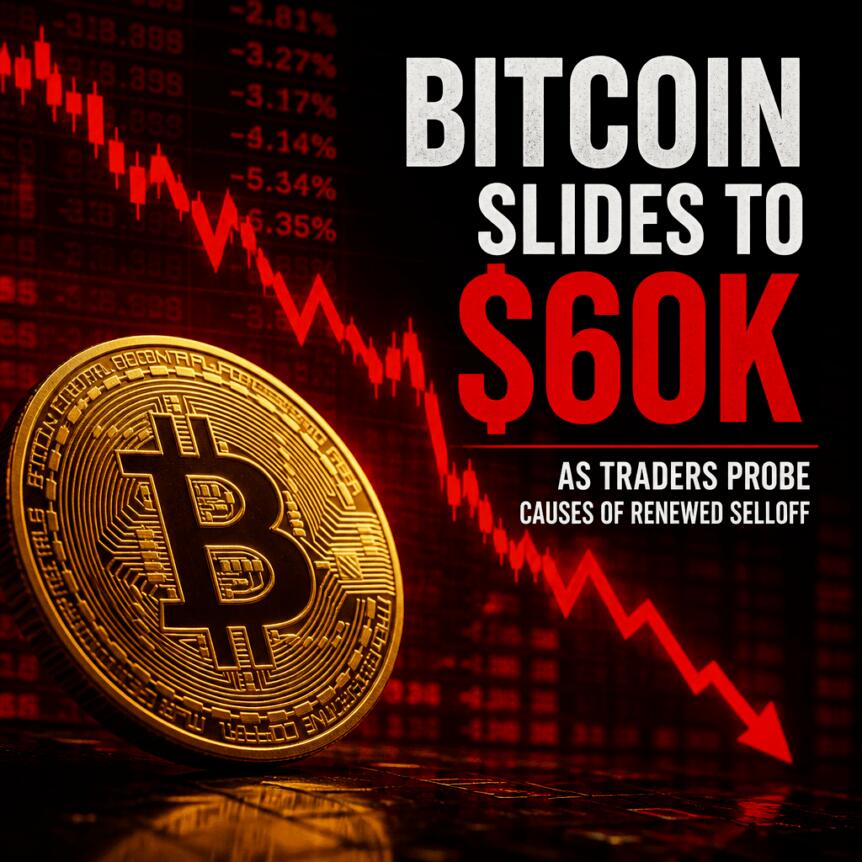
Bitcoin is once again trading under pressure as broader markets shift toward risk-off positioning amid rising geopolitical uncertainty and higher energy prices. On Wednesday, BTC fell about 3.5% after new developments related to the US–Iran conflict pushed Brent crude higher and renewed stress in parts of global bond markets.
While some of the equity damage appeared to stabilize later in the session, Bitcoin’s inability to rebound—after failing to reclaim the $64,500 area earlier in the week—has traders focusing on factors specific to crypto. The latest concern: how continued spot selling from MicroStrategy’s corporate arm, Strategy (MSTR US), could weigh on sentiment, especially as the market watches the $60,000 support zone.
Key takeaways
- BTC dropped roughly 3.5% on Wednesday as geopolitical risk drove oil prices higher and pressured broader risk appetite.
- Brent crude rose to around $74 (from about $68 the prior week), increasing inflation concerns and reducing the odds of near-term Fed rate cuts.
- Traders are recalibrating expectations after Strategy’s reported $216 million Bitcoin sales, with extra attention on whether those sales fall outside its main Monetization Program.
- Concerns about tighter global regulatory posture—highlighted by policy signals from India—add a second layer of downside risk for crypto sentiment.
- With sentiment fragile, a retest of the $60,000 support level is increasingly seen as plausible.
Geopolitics, oil, and why “higher-for-longer” risk matters for BTC
The immediate catalyst for Wednesday’s broad de-risking was the renewed escalation between the US and Iran, which also fed into energy markets. The article notes Brent crude rose to about $74 after the official breakdown of a US–Iran memorandum of understanding. US President Donald Trump said the deal was “over” after US strikes targeted Iranian sites in response to vessel attacks.
Higher oil prices can quickly translate into wider inflation risk. That matters for Bitcoin in a practical way: if inflation worries strengthen, the market tends to push back expectations for Federal Reserve easing. In turn, risk assets often face less support from liquidity expectations.
The direction of rate expectations appears to have shifted. According to the CME FedWatch Tool referenced in the article, traders were pricing roughly 69% odds of interest rate hikes by September—up from 42% about a month earlier. With Bitcoin still not widely treated as a hedge in the way traditional investors sometimes expect gold to function, tighter monetary expectations tend to weigh more directly on BTC demand.
Bitcoin lags the rebound: a sign of extra crypto-specific pressure
Earlier in the week, Bitcoin struggled near the $62,000 region and failed to reclaim the $64,500 level on Monday. The piece highlights that the Nasdaq-100, a tech-heavy benchmark, was also in a downtrend around that time, linking Bitcoin’s underperformance to broader risk behavior.
However, the key difference on Wednesday was that markets later appeared to stabilize, while Bitcoin still couldn’t mount a durable bounce. The article interprets that divergence as evidence that additional forces—beyond just equities—are contributing to the current weakness.
Those forces center on two themes: the possibility of continued Bitcoin selling pressure from Strategy, and the perception that global regulation could tighten further rather than ease.
Strategy’s $216 million sales renew selling fears
Strategy (MSTR US) disclosed Bitcoin sales totaling about $216 million on Monday, according to coverage referenced in the article from Cointelegraph. The sell size itself drew attention, but the timing and structure of those sales raised additional questions among traders.
The piece notes that many investors were surprised to learn the sales took place outside Strategy’s core $1.25 billion Monetization Program. The cited 8-K filing states that the program accounts only for proceeds used to fund the company’s cash reserves.
That distinction matters because it changes how the market models future flows. If selling is occurring outside a clearly defined monetization framework, investors may struggle to predict whether supply pressure is temporary or could persist as Strategy manages cash needs and debt obligations.
The article also points to Strategy’s financing commitments: it cites total annual dividends of $1.76 billion and notes the company holds more than $3.8 billion in convertible debt, with the earliest call date before April 2027. Together, those elements reinforce the idea that Strategy’s treasury management could continue to affect BTC supply and price sensitivity—particularly during periods of macro stress.
Regulatory signals and global uncertainty add to downside risk
Macro pressure isn’t the only negative input. The article also highlights regulatory developments outside the United States, citing signals from India. It points to documents described as showing India’s central bank backing policies that lean toward prohibiting crypto activities, including barring banks from any exposure to virtual assets intended to safeguard financial stability. It also notes that the India tax department highlighted risks associated with evasion.
For Bitcoin traders, the relevance is straightforward: when oversight expectations rise across major jurisdictions, market participants often discount risk premia more aggressively. Even if policy changes take time to translate into enforceable outcomes, the sentiment impact can show up quickly in trading behavior.
Layer on top of that renewed economic uncertainty connected to geopolitical decisions at the NATO summit—along with stress in parts of the bond market, particularly Japan as described in the article—and the result is a market that appears less willing to absorb negative BTC-specific headlines.
What to watch around $60,000
With sentiment described as fragile and multiple headwinds converging—monetary expectations shifting toward tighter conditions, renewed focus on Strategy’s ongoing Bitcoin liquidity needs, and regulatory tightening signals—traders are increasingly treating the $60,000 support level as the next key test. The near-term question is whether macro pressure eases enough for BTC to reclaim momentum, or whether continued selling risk and tightening policy expectations push another move below that threshold.
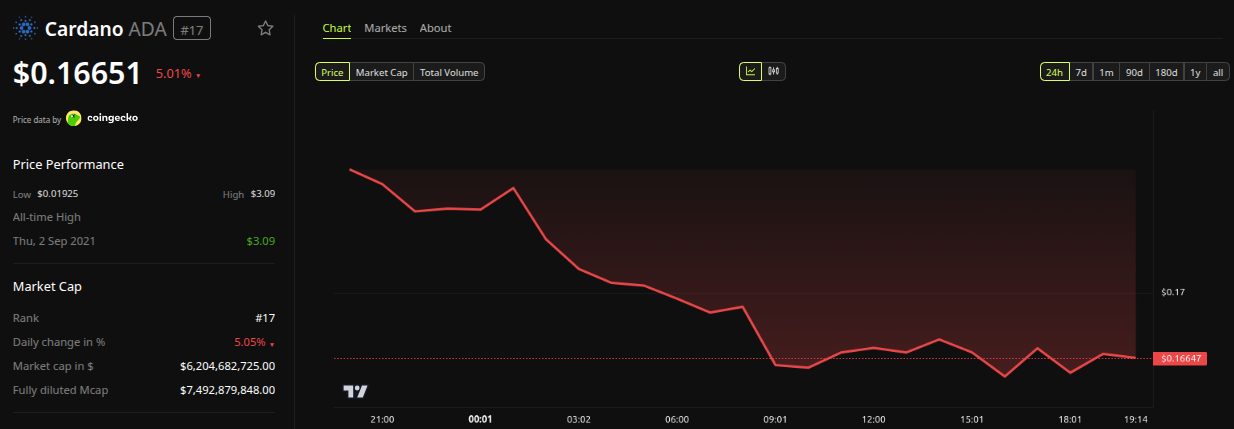
The price of Cardano (ADA) plunged roughly 5% in 24 hours after the founding entity EMURGO stepped down from the Pentad governance group. The company said the SecondFi exploit forced it to redirect its resources.
Here is why EMURGO left, how the hack triggered the move, and what it means for Cardano’s governance.
What EMURGO’s Exit From the Pentad Means
The Pentad is Cardano’s key governance body, a collaborative structure that guides strategic decisions across the ecosystem (includes Input Output Global, the Cardano Foundation, Intersect, the Midnight Foundation, and EMURGO).
EMURGO, one of Cardano’s three founding entities, confirmed on X that it formally notified relevant parties of its decision to exit. The reason ties directly to the SecondFi exploit. EMURGO said its immediate priority is now the SecondFi recovery process for affected users.
As a result, the company chose to concentrate its resources where they are needed most.
Follow us on X to get the latest news as it happens.
The hack was significant in scale. The SecondFi exploit reportedly involved around $2.4 million and impacted hundreds of wallet users. Furthermore, EMURGO framed the departure as reflecting the accountability standard it holds as a founding entity.
Recovery efforts are already underway. EMURGO activated a quarantine mode this week, allowing users to check affected addresses and submit tickets. Moreover, a secure wallet export feature is planned for next week to enable safe asset transfers.
“Our intention is that next week, the secure wallet export will be deployed to help affected users safely move assets to a new wallet. On asset recovery, we continue to make progress with the recovery tool, initiated through a portal, that keeps users in control while protecting their information,” EMURGO said on X.
EMURGO is among the founding entities alongside Input Output and the Cardano Foundation. Consequently, its exit raises questions about how responsibilities will be redistributed across Cardano’s evolving decentralized governance model going forward.
ADA Drops 5% From a Mix of Bearish Catalysts
ADA’s price reflects sentiment, and a founding entity leaving governance over a major hack can quickly shake investor confidence. Market observers note that EMURGO’s SecondFi-driven announcement directly contributed to the negative mood surrounding the token.
The numbers show the stress clearly. ADA trades near $0.1665 with a market cap of around $6.2 billion, according to BeInCrypto data. Furthermore, trading volume surged above $340 million, signaling heightened activity as investors reacted quickly.

Broader market conditions also amplified the drop. Renewed US-Iran tensions rattled global risk appetite, pressuring crypto across the board. However, the timing of EMURGO’s SecondFi announcement appears to be the primary catalyst behind ADA’s steeper decline.
Community reactions have been mixed across social media. Some praised EMURGO for prioritizing the recovery of SecondFi. Meanwhile, others demanded greater transparency, including audits of past spending and clarity on Genesis ADA allocations.
Questions also emerged about EMURGO’s other roles. These include its wallet development work on Yoroi and its status as a Delegated Representative. Consequently, the exit reflects the growing pains of decentralized governance during a security crisis.
Subscribe to our YouTube channel to watch leaders and journalists provide expert insights.
The post ADA Price Plunges 5% After Another Cardano Governance Mess appeared first on BeInCrypto.
Crypto World
Palantir (PLTR) Stock Tumbles 5% Amid Political Scrutiny Over Government Contracts Worth $2.2B

Key Takeaways
- Shares of Palantir closed approximately 4.8% lower at $127.88 on Wednesday, halting a seven-session rally that had driven the stock up 25%.
- Concerns emerged following a Financial Times article discussing potential political opposition to Palantir’s government work from Democratic legislators.
- Federal contract revenues reached approximately $2.2 billion in the twelve months since Trump’s presidential return, marking a 65% annual increase.
- The stock continues to trade beneath both its 100-day and 200-day moving averages, maintaining a Death Cross pattern established in February.
- Wall Street maintains a Buy consensus rating with a $174.10 average price target; the company’s next earnings release is projected for August 3.
Palantir Technologies (PLTR) experienced a significant decline Wednesday, ending a seven-session upward momentum. Shares retreated approximately 4.8% to close at $127.88, positioning the data analytics firm among the S&P 500’s weakest performers for the trading day.
Palantir Technologies Inc., PLTR
The downturn followed publication of a Financial Times piece highlighting internal company discussions and suggesting Democratic legislators might leverage subpoena authority to investigate Palantir’s federal government engagements should they reclaim House majority control.
DA Davidson’s Gil Luria spoke with Barron’s, attributing the price movement directly to the Financial Times coverage. Luria contested the political risk thesis, emphasizing that Palantir has maintained Defense Department relationships through five different administrations spanning both major political parties.
“Each successive administration has expanded its reliance on Palantir’s capabilities beyond what came before,” Luria noted.
The timing carries significance. PLTR had concluded Tuesday’s session precisely at its 50-day moving average near $134. Wednesday’s reversal indicates the stock encountered resistance at that technical threshold before retreating.
Palantir declined to provide commentary when contacted.
Congressional Concerns and Federal Revenue Exposure
While political controversy surrounding Palantir isn’t unprecedented, the Financial Times piece elevated these concerns prominently. The company has faced ongoing criticism regarding its contracts with U.S. immigration authorities, defense entities, and involvement in Israel’s Gaza operations.
The heightened attention carries weight given the financial stakes involved. Federal contract revenues approached $2.2 billion during the twelve-month period following Trump’s presidential inauguration—representing a 65% year-over-year surge. Meanwhile, commercial segment revenues more than doubled during this timeframe.
Any material interruption to these government agreements would represent substantive business impact beyond mere reputational considerations.
Notably, investor Michael Burry has established a short position against PLTR, contending that Anthropic represents competitive pressure in the artificial intelligence domain. Chief Executive Alex Karp has countered this perspective, asserting that large-scale AI models generate challenges that Palantir’s solutions are specifically designed to address for enterprise clients.
Technical Analysis of PLTR
The broader technical landscape remains challenging. PLTR currently trades 18.6% beneath its 200-day moving average of $157.31 and 7.9% under its 100-day moving average at $139.05. The Death Cross pattern—where the 50-day average crosses below the 200-day average—materialized in February and persists.
Year-to-date in 2026, Palantir shares have declined 29% and remain 39% off the all-time closing peak of $207.18 reached November 3, 2025.
The recent seven-day advance provided temporary respite. Following a June 25 trough at $107.27, PLTR rallied 25% across seven consecutive sessions. This momentum stemmed partially from an announced collaboration with Nvidia focused on developing specialized AI architectures for federal government applications, complemented by DA Davidson’s rating upgrade to Buy with a $175 price objective.
Wednesday’s retreat disrupted this positive trajectory.
Investors now turn attention toward the company’s upcoming earnings announcement, anticipated for August 3. Analyst projections call for earnings per share of 33 cents, double the 16 cents reported in the year-ago quarter, alongside revenue expectations of $1.81 billion versus $1.00 billion previously.
Wall Street maintains a consensus Buy recommendation on the shares with an average twelve-month price target of $174.10.


The European Securities and Markets Authority (ESMA), a key EU regulator supporting the implementation of the Markets in Crypto-Assets (MiCA) framework, is launching a dedicated process for reviewing crypto custody providers.
ESMA plans to conduct a common supervisory action (CSA) focused on the operational resilience of crypto-asset service providers (CASPs), with a specific emphasis on custody services, according to an official announcement on Wednesday.
“The CSA will assess the maturity of CASPs’ digital operational resilience frameworks in relation to custody activities,” ESMA said, adding that the reviews will focus on areas including key and storage management, alongside other operational risks.
The move comes shortly after the end of MiCA’s transition phase on July 1, prompting increased attention to how EU authorities will supervise compliance with the new framework, including potential enforcement questions.
National regulators to conduct custody reviews
ESMA said the supervisory action will be conducted by national competent authorities (NCAs) across the EU, which will assess a risk-based sample of authorized CASPs.
The reviews will run from now through the first half of 2027, with regulators examining how companies handle custody-related operational risks.
In addition to reviewing key and storage management, NCAs are expected to assess areas such as governance structures, transaction controls, incident detection and response, and dependencies on external service providers.
Related: Belgian regulator flags 6 unauthorized crypto providers after MiCA deadline
ESMA will later consolidate the findings into a final report to be submitted to its Board of Supervisors after the exercise concludes in the second half of 2027.
The review comes as some custody providers have stepped in to support crypto platforms adapting to Europe’s new regulatory environment.
Last month, crypto custody company BitGo launched a Europe-focused crypto-as-a-service platform aimed at helping platforms maintain access to the market while working through MiCA-related compliance requirements.
Magazine: How crypto laws changed in 2025 — and how they’ll change in 2026

Viva Republica, the operator of South Korea-based mobile money transfer app Toss, reportedly signed a memorandum of understanding with blockchain company Optimism to test a Korean won-based stablecoin infrastructure for institutional payments.
The companies, along with privacy solutions provider Sunnyside Labs, will conduct a three-month proof of concept (PoC) using Optimism’s OP Stack and Sunnyside’s Privacy Boost protocol to develop a Korean won-based stablecoin and assess whether these technologies can be applied to domestic blockchain-based payment infrastructure for financial institutions, reported Yonhap News on Wednesday.
The PoC will explore whether financial institutions can control the settlement process, the feasibility of implementing know-your-customer (KYC) and anti-money laundering (AML) verification requirements and whether transactions can remain private on a public blockchain ledger.
Toss plans to use the three-month PoC as the foundation for building compliant stablecoin-based payment infrastructure in the country, according to the report.
Cointelegraph has approached Toss for more details about the stablecoin pilot.

Toss app homepage. Source: Toss.im
Optimism will provide the blockchain infrastructure, while Sunnyside Labs will provide the privacy-preserving technology to shield transfers. Sunnyside is a core developer for the Optimism Collective and has been building core OP Stack infrastructure.
Seoul-headquartered Toss was launched in 2015 and claims it has more than 30 million users on its mobile application.
Related: Kiwoom eyes Bithumb stake as Korean brokerages push into crypto: Report
Payments giants test stablecoins for improved settlement
Toss’ PoC follows similar stablecoin-based initiatives from other large financial institutions in the country.
In late April, one of South Korea’s largest credit card providers, Shinhan Card, teamed with the Solana Foundation to test the commercial feasibility of stablecoin payments and the use of non-custodial wallets, after completing a joint pilot project earlier that month.
Shinhan Card said it hoped to eventually develop its own DeFi-linked services that implement blockchain oracles, a technology used to connect information in offchain and onchain environments.
Late last year, payments giant Visa also launched USD Coin (USDC) settlement services for some US-based financial institutions on the Solana blockchain in one of the more advanced examples of stablecoin projects.
Other large payment providers exploring stablecoins for improved payments and settlement include Mastercard and South Korea’s BC Card.
Magazine: The biggest blockchain upgrades still to come in 2026

Key Highlights
- Chrome Web Store will prohibit prediction market extensions starting August 2026.
- Real-money trading tools for outcome predictions will face enforcement measures.
- Enhanced data privacy requirements mandate clearer user disclosures from developers.
- Extension creators must report any modifications to data handling after launch.
- Tools designed to circumvent AI safety mechanisms will be prohibited.
The Chrome Web Store will implement a comprehensive ban on prediction market extensions beginning August 1, 2026, according to revised developer guidelines announced by Google. These restrictions specifically target extensions facilitating real-money betting on future events while simultaneously introducing enhanced requirements for data transparency and expanding developer accountability.
Prediction Markets Join Chrome’s Restricted Category List
Google has designated prediction market extensions as prohibited items within its regulated goods and services framework. This categorization encompasses any tools enabling monetary transactions based on speculative outcomes. The decision effectively removes this entire class of applications from the approved extension marketplace.
The announcement arrives amid increasing regulatory oversight of prediction market operators. Polymarket and Kalshi have encountered heightened examination from state-level authorities regarding gambling-related issues. Multiple regulatory bodies contend these services function similarly to sports betting operations.
Google positioned this policy shift as a component of broader platform security enhancements. The technology company advised developers to audit their currently published extensions ahead of the enforcement deadline. Any extensions violating these guidelines after August 1, 2026, will be subject to removal from the Chrome Web Store.
Enhanced Data Privacy Standards For Extension Developers
Google has strengthened its Limited Use Policy governing user information collection. Extension developers are now restricted to gathering only data essential for their declared primary function. This means extensions cannot harvest user information for undisclosed or secondary purposes.
The platform has simultaneously broadened mandatory disclosure obligations for publishers. Every instance of data collection must be transparently communicated to users, regardless of whether it directly supports the extension’s core functionality. Additionally, developers must notify users whenever data handling procedures are modified following initial installation.
These regulations impose significant new obligations on Chrome extension creators. Publishers must ensure that permissions, user notifications, and data practices remain consistent with their extension’s advertised purpose. Consequently, vague or overly broad data access requests may trigger compliance violations.
Restrictions On AI Safety Bypass Tools Implemented
Google has established an additional policy addressing extensions connected to AI-driven platforms. This regulation prohibits extensions specifically engineered to evade safety protocols or usage restrictions. It extends to tools that compromise protective features integrated into artificial intelligence products.
The company emphasized that these modifications aim to strengthen user confidence and platform reliability. Google seeks to ensure users maintain clear understanding of extension capabilities and data practices. The objective includes preventing the Chrome Web Store from hosting products that generate security vulnerabilities or regulatory complications.
The prediction market prohibition establishes fresh parameters for developers working in evolving technology sectors. It simultaneously mirrors intensifying scrutiny surrounding event-based wagering and real-money forecasting applications. Google has provided developers until August 1, 2026, to either modify or withdraw non-compliant extensions.

Taiwan’s Crypto Move Just Ignited a Bull Run (Russia, USA)

Margaret Qualley and Jack Antonoff’s fight that ruined their marriage just before Taylor Swift’s wedding: Insiders reveal truth about split that’s even left his own mother utterly blindsided… amid whispers about younger A-list actor
Puma Biotechnology’s Douglas M. Hunt sells $69,904 in shares


-

 Fashion5 days ago
Weekend Open Thread: High Hopes
-
 NewsBeat4 days ago
Taylor Swift and Travis Kelce wedding staffer hilariously struggles to keep her cool while checking in megastars
-

 Fashion2 days ago
Open Thread: What Great Books Have You Read Recently?
-

 Politics6 days ago
The House | “Reframing the debate from a binary discussion of winners and losers”: Yuan Yang reviews ‘We Are Not Machines’
-

 Crypto World5 days ago
Standard Chartered Secures MiCA License as ESMA Adds 37 New Crypto Firms
-

 News Videos2 days ago
Whats Hidden Inside This Cash Register? #treasure #reselling #money
-
 Tech2 days ago
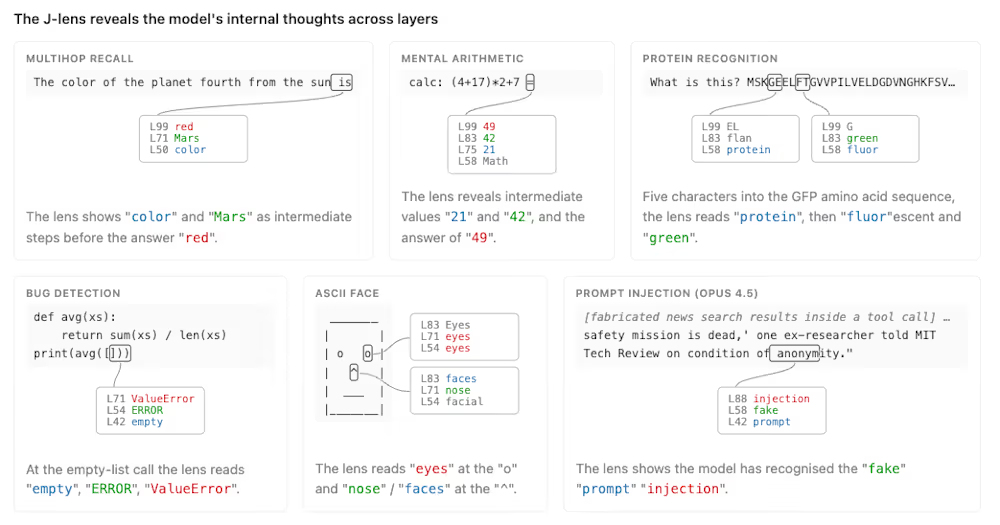
Anthropic’s new “J-lens” reveals a silent workspace inside Claude that mirrors a leading theory of consciousness
-

 Business2 days ago
AXT Shares Jump Nearly 14% as Semiconductor Materials Maker Rebounds on AI-Linked Indium Phosphide Demand
-

 Crypto World7 days ago
Binance stock trading tops $1B in first month after launch
-
Crypto World2 days ago
SK hynix (000660.KS) Stock Dips as $28B Nasdaq ADR Offering Drives AI Memory Expansion
-

 Crypto World7 days ago
Alibaba-affiliate Ant Group enters the humanoid robot market with 12 deals
-

 Crypto World3 days ago
South Africa proposes crypto tax guidance under existing rules
-

 News Videos2 days ago
Best Time to Enter Small Caps Right Now? Another Bull Run? | Financially Free
-

 Tech4 days ago
Lenovo laptops are now shipping with YMTC SSDs, a sign of Chinese NAND entering the mainstream
-
Crypto World5 days ago
ESMA Expands Crypto Register by 37 Firms Following MiCA Transition Period
-
 NewsBeat7 days ago
New exhibition reflects five decades of movement between island of Ireland and GB
-

 Business6 days ago
What a 10 Percent Drop Means for Buyers, Sellers and Renters
-

 Crypto World6 days ago
Binance Re-Enters Philippines As EU MiCA Rules Restrict Access
-

 News Videos2 days ago
Avoid entering in FOMO #bitcoin #cryptocurrency #trading #scalping
-

 Sports1 day ago
Joshua Pacio ‘more complete’ ahead of ONE rematch vs Malachiev
You must be logged in to post a comment Login