
Crypto World
XRP Price Prediction: Wells Fargo Disclosed Millions in XRP Holding


XRP price trades near $1.00, remaining near the key level that separates confidence from doubt for its prediction. That flatline hides a bigger story developing beneath the surface, involving one of America’s largest banks.
Wells Fargo’s latest 13F filing, submitted August 14 and covering positions through June 30, 2026, disclosed exposure to the Bitwise XRP ETF. The filing shows a combined $9.18 million position across two line items tied to the same CUSIP.
— Diana (@InvestWithD) August 15, 2026
 JUST IN: Wells Fargo OFFICIALLY DISCLOSES MILLIONS In $XRP ETF Exposure — Fresh SEC Filing Puts One of America’s LARGEST Banks on the $XRP ETF LIST
 https://t.co/JDD4CGbRlt pic.twitter.com/OxSshswRb4
It’s a notable institutional position in the product, especially considering Wells Fargo’s scale. The bank had approximately $2.2 trillion in assets as of the second quarter, making the XRP ETF exposure worth watching.
Meanwhile, institutional activity around XRP ETFs continues to attract attention. Citadel previously closed its puts on the Canary XRP ETF while retaining call options, while other firms have also disclosed XRP ETF exposure.
The latest Wells Fargo filing, therefore, adds another piece to the institutional XRP story. With XRP hovering around $1, the market now has another reason to watch what happens next.
Discover: The Best Token Presales
XRP Price Prediction: Hold $1 Support This Week?
XRP’s intraday range of $0.98 to $1 tells the story of a token pinned near a psychological ceiling. The 24-hour move is essentially flat, showing neither buyers nor sellers have gained control.
Weekly performance remains negative by several percentage points, following the pullback that pushed XRP below $1 earlier in August. Meanwhile, resistance sits between $1.03 and $1.08, a zone XRP tested before retreating.

However, institutional filings could provide a fresh catalyst ahead of Garlinghouse’s Wyoming Blockchain Symposium appearance from August 17 to 20. ETF holdings near 1 billion XRP could also tighten available supply, while a reclaim of $1.08 would strengthen the bullish case.
For now, XRP could continue to consolidate between $0.98 and $1.03 as the market digests developments in regulatory clarity. A sustained move above $1.03 would give buyers a cleaner path toward the $1.08 resistance.
On the downside, a loss of $0.98 could reopen the path toward August’s lows. Until then, XRP remains stuck around $1, leaving the next decisive breakout to determine its short-term direction.
Trade XRP on Bybit and Get a Chance to Win Our $1,000 USDT Airdrop
LiquidChain Targets Early Mover Upside as XRP Tests Key Levels
Institutional filings validate XRP’s long-term thesis, but a token pinned at $1 with resistance overhead offers limited near-term torque for capital chasing outsized returns. That’s the tension retail traders face right now.
Holding XRP is holding a maturing asset with billions already priced in. Some experienced traders rotate into something still building its base. LiquidChain ($LIQUID) is pitching itself as exactly that alternative: a Layer 3 infrastructure project fusing Bitcoin, Ethereum, and Solana liquidity into a single execution environment.
The candles mark the circle. The L3 connects what sits outside it. — LiquidChain (@getliquidchain) August 17, 2026
 https://t.co/vqvBcdSQYC pic.twitter.com/ub4TiCnHdz
Current presale price sits at $0.01491, with $940K raised so far. The unified liquidity layer and deploy-once architecture mean developers build once and reach three major ecosystems without redundant deployments, a genuinely different approach to cross-chain fragmentation.
Traders weighing rotation candidates can research LiquidChain before the presale window closes.
Discover: The Best Crypto to Diversify Your Portfolio
The post XRP Price Prediction: Wells Fargo Disclosed Millions in XRP Holding appeared first on Cryptonews.

Crypto World
Bitcoin (BTC) price tracks equity bounce while $390 million ETF outflow week restrains the bulls
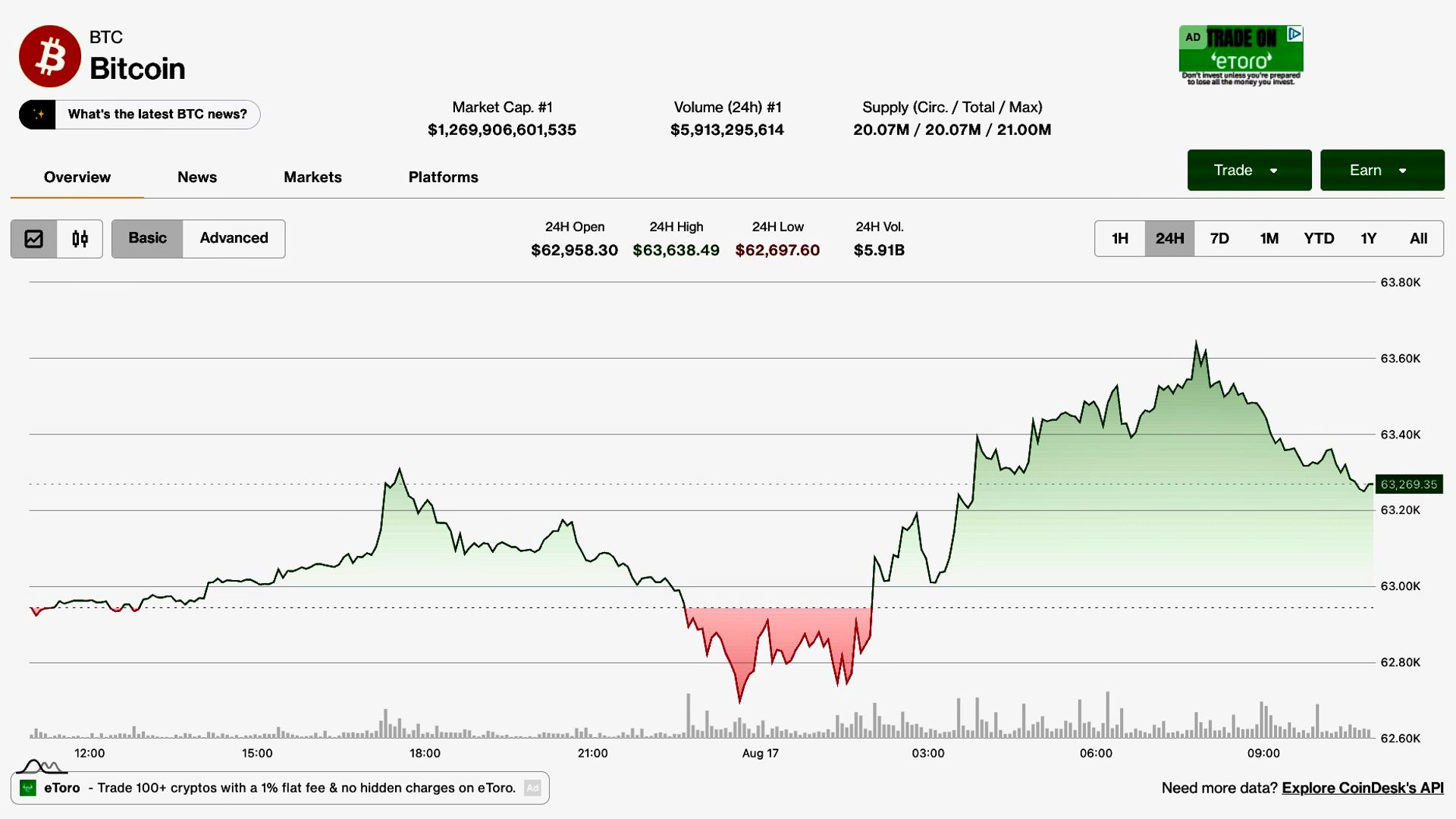
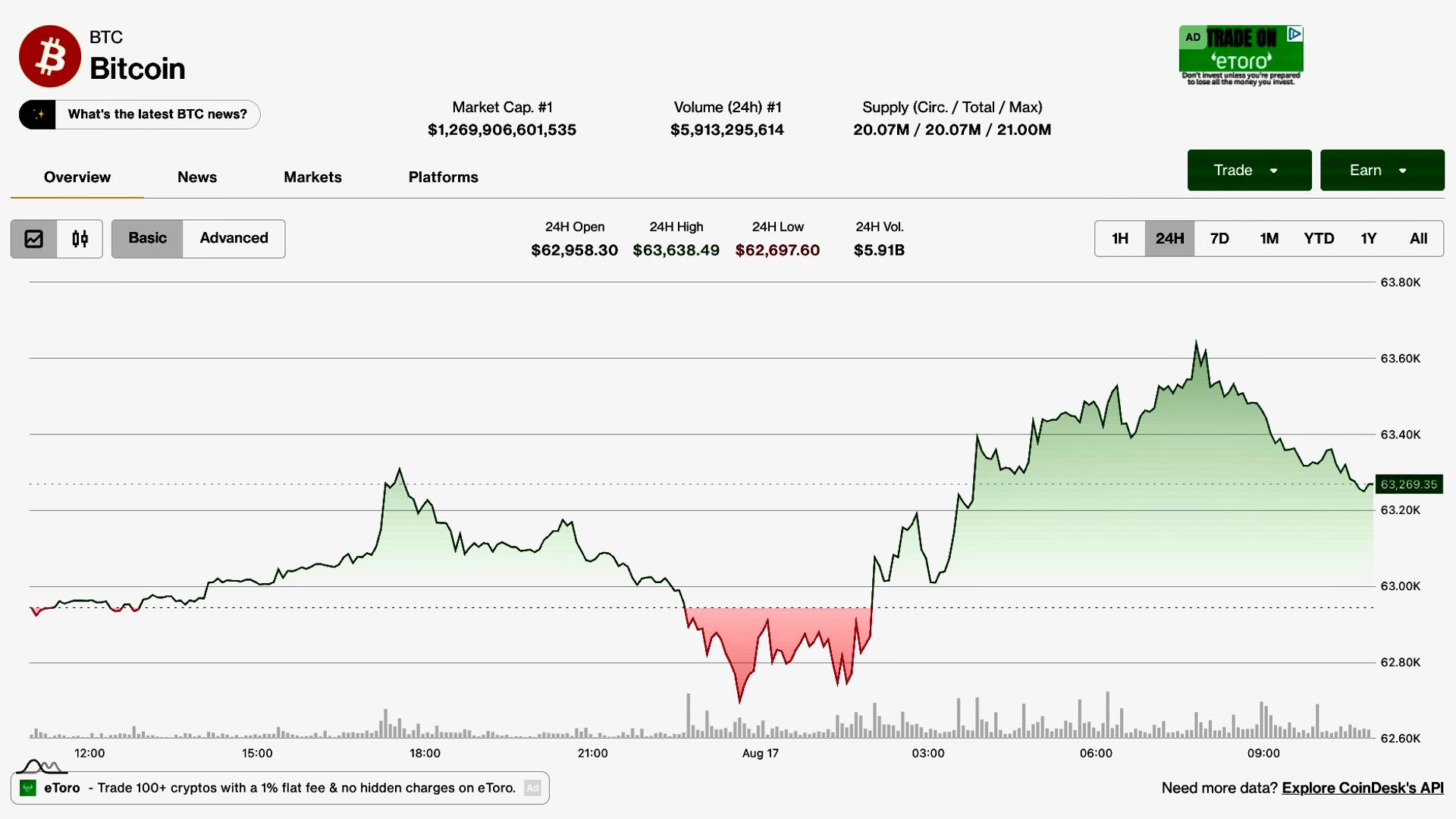
Bitcoin steadied above $63,000 on Monday, clawing back a fraction of last week’s losses with a 0.8% gain since midnight UTC.
Without an obvious catalyst, the largest cryptocurrency appears to be tracking U.S. equities. Nasdaq 100 index futures are up 0.5% to their highest point since July 2.
Any positive reading will need to take into account last week’s net $390 million outflow from spot exchange-traded funds, including the first three-day stretch since the end of July. That was the largest weekly withdrawal from U.S. spot bitcoin products in six weeks.
Ether ETFs flows were limited, and solana (SOL) ETFs bucked the trend with their strongest weekly inflows since mid-May.
The bigger picture is the Clarity Act. Galaxy Research’s head of research, Alex Thorn, cut his odds of the landmark crypto bill becoming law in 2026 to roughly 10% on Aug. 14, joining prediction markets that now put the probability at around 17%. A cloture vote is scheduled for Sept. 15 when the Senate returns from recess, although market observers are expecting another delay.
Derivatives positioning
- Taker ratio stays balanced: the 24-hour long-short volume ratio for takers hangs in balance again, extending Friday’s trend. Takers are entities that pull liquidity from the order book by trading at available prices.
- Thin liquidity raises swing risk: BTC’s notional open interest, at $48 billion, is now nearly double its 24-hour trading volume. XRP’s market shows a similar pattern. That gap means any mass liquidation event could run into thin liquidity, raising the odds of wild price swings.
- BTC OI pulls back, XRP holds firm: in contract terms, BTC’s open interest (OI) has pulled back to 750,000 BTC from Friday’s 760,000 BTC. That’s been a pattern since April, with spikes above 750,000 BTC often proving short-lived. XRP futures show the opposite dynamic, with OI holding steady at 10-month highs. Positioning in ETH and SOL remains relatively light in comparison.
- CC shows bearish buildup: Canton Network’s CC token has dropped over 1.5% in 24 hours, making it one of the biggest losers among the top 100 coins by market value. OI in futures tied to the token has risen more than 5% over the same period. That combination points to shorts, or bearish bets, being built up. Negative annualized perpetual funding rates and a negative OI-adjusted 24-hour cumulative volume delta (CVD) both support that read, indicating bears are leading the market.
- ZEC bucks the trend: Privacy-focused ZEC is also an OI gainer. In this case, a positive 24-hour CVD, is a sign bulls are being more aggressive, taking longs via market orders rather than passive limit orders. ZEC’s funding rate is also positive at +10%, indicating a growing bias toward bullish bets.
- Volatility and fear stay low: Bitcoin and ether’s 30-day implied volatility indexes remain pinned near year-to-date lows, suggesting fear levels and demand for options-based insurance against price swings are both muted. Wall Street’s VIX tells a similar story, sitting at its lowest level since January.
- Options positioning leans bullish near-term: On Deribit, the skew for BTC and ETH shows a bid for calls, or bullish bets, at the front end of the curve. The implied volatility term structure shows no signs of short-term stress either, despite Wednesday’s scheduled release of the Fed minutes.
- Volume rankings show a split: 24-hour volume rankings show a mixed profile, with both BTC calls and puts among the top five most-traded instruments. The same holds for ether.
Token talk
- Pump.fun is one of the standout performers on Monday, adding 7.80% since midnight UTC with daily trading volume rising 55% to $90 million.
- ZEC has gained 4.70% since midnight at $508, extending a notable stretch for privacy coins following XMR’s strong run last week.
- MORPHO advanced by 5% at $2.07, reversing some of Friday’s weakness and leading the DeFi names higher.
- HYPE rose 3.53% to $59.08, continuing its steady grind and now up around 2% on the week.
- FET is one of the weakest altcoins on Monday, down 1.56% since midnight at $0.1196, giving back some of last week’s gains as AI-adjacent tokens lose momentum.
- CoinMarketCap’s “Altcoin Season” indicator is at 46/100, recovering from the Aug. 7 low of 36/100 as optimism slowly returns to the altcoin sector. CoinMarketCap’s Fear and Greed index sits at 38/100, a “fear” reading.
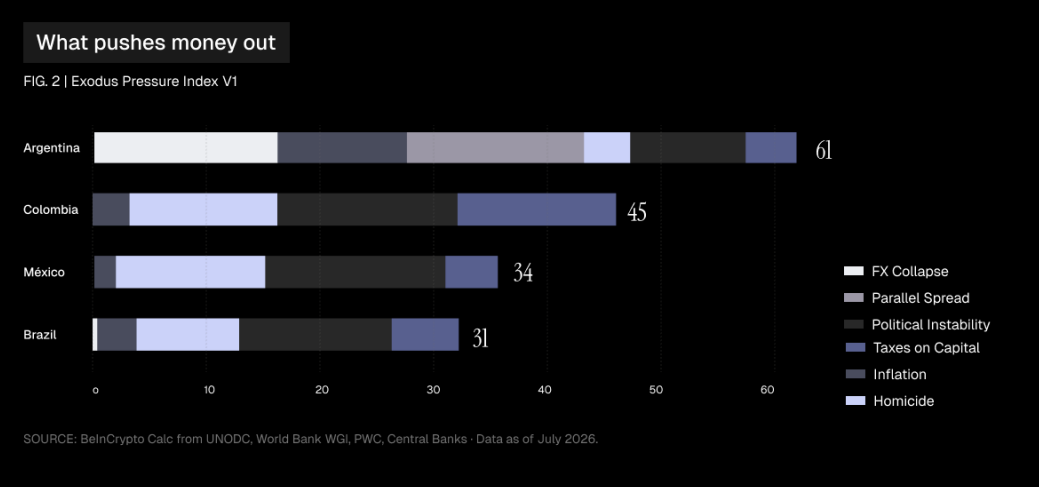
An Argentine who kept the equivalent of $10,000 in peso cash from 2016 to 2026 ended the decade with about $114 in US-dollar value.
That nearly 99% loss explains why the dollar has entered everyday financial life across Latin America. Workers receive salaries in stablecoins, while businesses use digital dollars to collect revenue and pay foreign suppliers.
The Exodus Economy, a new report from BeInCrypto Intelligence, describes this as bottom-up dollarization. People remain at home while more of their financial activity moves beyond domestic banks. The protection behind those dollar balances varies widely.

The Dollar Has Become Working Money
More than 99% of tracked stablecoin withdrawal volume moved onward within 30 days. On Argentine wallet Lemon, the median withdrawal ranged from $150 to $270 during the first half of 2026. The average was $544 across 215,597 transfers.
Separately, Bitso’s tracked stablecoin corridor was running at an annualized $31.5 billion in 2026. The figure measures gross, bidirectional movement rather than money permanently leaving the region.
The activity looks more like a payment network than a savings vault. The money arrives, then moves toward spending or operating costs.
Antônia Souza, Visa’s digital-currency director for Latin America and the Caribbean, said institutions still account for the largest flows.
“The huge numbers that we are seeing on stablecoins are from institutional transactions and cross-border transactions, mainly B2B transactions.”
A Dollar Balance Can Hide Different Risks
BeInCrypto audited 12 dollar-account products available to Latin American customers. Only two placed customer balances in insured US bank deposits. Five used stablecoins.
The dollar label reveals little about the protection underneath it. A balance could represent an insured deposit, a stablecoin claim or an investment product.
Reza Bundy, CEO of Atlas Capital Team, says savers must separate currency protection from wealth preservation.
“For a Latin American saver, nominal dollar exposure and preservation of real purchasing power are separate questions,” Bundy told BeInCrypto. “A stablecoin, bank deposit, Treasury bond and US equity can all be denominated in dollars while carrying very different risks.”
Holding dollars can protect against local-currency depreciation. US inflation can still reduce what those dollars buy. Stablecoins can add issuer, platform and custody risks.
Moving Into Treasuries Creates Another Decision
Some savers move beyond digital cash and buy US government bonds. The maturity of the bond can materially change the outcome.
“Long-duration Treasuries are particularly sensitive to changes in inflation expectations, interest rates and the term premium,” Bundy said. “When yields rise, the market value of a long bond can decline substantially, even though the US government continues making its payments.”
A saver holding the bond to maturity may receive the promised payments. Someone selling earlier could take a loss because bond prices generally fall when rates rise.
Bundy also warns that cap-weighted US technology indices concentrate money in a small group of companies. He favors shorter-duration bonds and assets that respond differently to inflation, while acknowledging that each introduces new risks.
Bottom-up dollarization gives Latin Americans access to a currency that can hold its value better than a weakening local currency. What they hold after making that switch determines the legal protection, liquidity and purchasing power they receive.
Disclosure
Bundy leads Atlas Capital Team, adviser to the Atlas America Fund, and Atlas AI Labs, the planned issuer of USAFi. Atlas has commercial interests connected to asset classes discussed above. USAF is an ETF and may lose value. USAFi remains pre-launch and requires a full VARA licence before issuance. His comments are general market views, not investment advice. The USAF prospectus lists its fees and risks.
The post Latin Americans are Moving Into Digital Dollars. Are Their Funds Safe? appeared first on BeInCrypto.

“We are devastated by what happened. They were among Antonello da Messina’s most important and best-known works. It is a tremendous loss for the museum, the city, the community and the art world,” MuMe director Marisa Mercurio told Italian news agency ANSA on Sunday.
“Messina without Antonello is deprived of the very essence of the greatest artist of the European Renaissance,” Enzo Caruso, Messina culture councillor, told broadcaster Sky Italia.
The theft is the latest high-profile heist in the art world. Days before, Italian police said they recovered three artworks by Renoir, Cézanne, and Matisse that had been stolen from Parma’s Magnani Rocca Foundation in March. Five people were detained in connection with the theft.
MuMe was closed to the public on Sunday amid ongoing investigations.
Here’s what we know so far about the heist.
How the theft happened
At least three masked people approached the museum at around 9:50 p.m. on Saturday, Italian media reported, citing museum officials and preliminary investigative materials. The theft took place during the Vara procession marking the Ferragosto holiday, which commemorates the feast of the Assumption of the Virgin Mary.
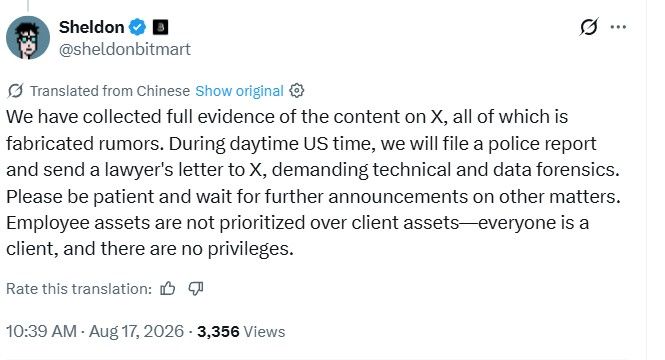
BitMart chief executive Sheldon Lee dismissed accusations circulating on X as fabricated rumors on Monday, hours after a public campaign gave him until August 19 to explain where customer money went.
BitMart announced an orderly wind-down of its trading platform in July. Many users still report blocked withdrawals, and former employees say last month’s salaries remain unpaid.
Why BitMart Users Want Proof of Reserves
A Chinese-language account posting as BitMart 币市 published a five-point accountability demand on Monday. It asks Lee and business partner Yi Li to disclose wallets, assets, liabilities, and usable reserves that a third party can verify.
The account also questions who ordered the withdrawal limits. Moreover, it asks when management first knew the platform could no longer process requests normally.
Strain showed up on-chain almost immediately. Ethereum withdrawals surged to a 2026 high within days of the notice, while BMX crashed 46% as the announcement landed.
The July 26 notice stopped deposits and new Bitmart registrations at once. It also switched futures accounts to reduce-only mode, which lets traders close positions but not open fresh ones.
Staff pay sits at the center of the complaint. Rank-and-file employees never decided how company funds were managed, the account argues, so they should not absorb the cost of that decision.
“Let the fund flows be traced clearly. Let users know where their money is. Let employees get back the pay they deserve.”
BitMart said on X
Legal Threats Replace a Repayment Plan
Lee skipped the demands point by point. Instead, he said the company had gathered evidence and would file a police report and send a lawyer’s letter to X requesting technical forensics.

He added that employee assets carry no priority over client assets. Meanwhile, the reply offered no reserve figures, no liability total, and no repayment timeline.
The campaign wants a repayment plan with an order of priority, a start date, and an independent audit. So far, BitMart has published none of that.
On-chain investigator ZachXBT pushed back within minutes.
“If you actually have the liquidity then simply return the funds to everyone instead of posting vague statements?”
via ZachXBT
The official notice sets August 26 as the final trading day and the recommended cutoff for withdrawal requests. Login access runs until January 31, 2027.
BitMart is one of several venues to exit this year. Analysts read closures as a healthy reset, though staff cuts at Luno pointed to wider stress. European regulators, meanwhile, opened a custody review under MiCA after an earlier exchange collapse.
Wednesday’s deadline now sets the next test. Verifiable reserve data would answer the question quickly, while another statement without numbers likely will not.
The post BitMart CEO Calls Accusations Fabricated as Users Report Frozen Withdrawals appeared first on BeInCrypto.

So, was it a success or a failure? In the final calculation, it was a success for several reasons. First, it engaged people in the importance of physical activity. Second, it proved my hypothesis: setting and declaring a goal takes you further than you would have gone without one. And third, even if you fall short of the destination, the goal—and the journey—will change you.
After my injury, one of my key takeaways was that I had nevertheless made remarkable progress as a runner. So, I set myself another goal: could I run a marathon again—something I hadn’t done in two decades—and do so at a reasonable pace, given my age? This time, I stuck to my training plan, avoided injury, and the answer was an emphatic yes.
In 2025, I ran the London Marathon in 3 hours, 37 minutes and 40 seconds, a time that put me in the top 20% of all finishers. I could never have achieved that time 20 years ago, let alone before my 2022 challenge. This had a positive knock-on effect: my result in London meant I qualified for the Boston Marathon, and I ran an even faster time in that race.


There’s something uniquely irritating about being forced to listen to whatever a stranger has decided to watch on their phone. Suddenly, the airport gate has a soundtrack—and it’s a tinny succession of TikToks, action scenes, and FaceTime chatter that no one else signed up for.
As Sammie Walker Herrera, a communication coach, puts it, you might be screaming internally: “When I said I listen to all kinds of music, I didn’t mean your music.”
Still, it’s one thing to object internally—and another to ask the person to turn it down. What if they get angry, ignore you, or turn up the volume out of spite? We asked etiquette and communication experts how to make the request without turning an annoying situation into an altercation.
First, decide whether you need to say anything at all
Sometimes the easiest solution is simply to get out of earshot. Nicole Del Valle Rose, an etiquette coach and founder of the Las Vegas consultancy Poised & Proper, says the most gracious response is often the least confrontational one.
“Etiquette isn’t about correcting every behavior that bothers us,” she says. “It’s about choosing the response that creates the best outcome for everyone.”
If there’s another table open at the coffee shop or plenty of room elsewhere in the train car, relocate. You’ll solve the problem in seconds and spare both of you an awkward exchange. Save the conversation for situations where you’re truly stuck, like on a plane, in a waiting room, or aboard a packed bus.
Talk about the sound—not the person
It can be tempting to make sure the offender knows they’re being rude. Resist the urge.
“You don’t want to immediately put this person on the defensive,” says Walker Herrera, who runs Speak Y’all, a communication coaching business. “Frame how it’s impacting you, rather than that they’re doing something ‘wrong.’”
Plus, you don’t know why their phone is so loud. They might be hard of hearing, or they may not realize how far the sound is carrying. Treating it as a solvable volume problem—not evidence of a glaring character defect—makes it more likely that they’ll cooperate.
Ask a question instead of making a demand
If you’re comfortable engaging for a moment, it can help to open with a little friendliness. Larry Schooler, an assistant professor of communication studies at the University of Texas at Austin, suggests first asking what the person is listening to. After they answer, he recommends saying: “Oh, cool. I was just wondering if you could maybe lower the volume or listen to it privately; I needed to concentrate on something and was just finding it hard to do.”
Showing interest softens the interaction, Schooler says. Most people would feel uncomfortable if the first words they ever heard from a stranger were instructions to stop what they were doing or change their behavior. Giving a reason for the request also helps them understand where it’s coming from, instead of concluding that you simply dislike their music, video, or podcast.
If you’d rather skip the small talk, Michelle Retsky, a speech-language pathologist and founder of Words in Motion Therapy in New Port Richey, Fla., teaches social communication for a living. She suggests starting with a genuine question: “Excuse me, do you happen to have headphones? I’m having trouble focusing, and the sound is carrying over pretty loudly over here.”
That frames the situation as a problem the two of you can solve together, which “takes pressure off of them,” Retsky says. If they do have headphones and agree to use them, problem solved. If they don’t, follow up with: “Would you mind turning it down?”
Keep it short
There’s no need to deliver a closing argument about the deterioration of public etiquette. The longer you talk, the more uncomfortable—and potentially charged—the exchange can become.
“Short-and-to-the-point requests can be incredibly effective,” says Claudia Johnson, a licensed marriage and family therapist in Seattle. Her preferred script is just five words: “Would you mind using headphones?”
Tone matters more than finding the perfect wording. Ask politely, Johnson says, and assume the person simply didn’t realize they were bothering anyone. Most people will be happy—or at least willing—to turn down the volume.
And if they refuse? Just walk away; don’t argue or try to teach them a lesson. “We can’t change how others act; we can only ask nicely,” Johnson says. “If they say no or act immaturely about it, that says something about them and not if it was OK for you to ask.”
If the noise is making a flight, train ride, or restaurant visit genuinely unbearable, ask an employee to intervene rather than escalating the interaction yourself, Del Valle Rose suggests. And if the person seems agitated or unpredictable, skip the direct request altogether. Your peace and quiet isn’t worth jeopardizing your safety.
Above all, don’t become fixated on finding a magical combination of words that will guarantee a pleasant response. Healthy communication “doesn’t come down to saying the ‘right’ things,” Johnson says. “It’s about having the courage to say what you need in a respectful manner, while giving others the dignity of deciding how they will react.”
The FMA said Bitpanda breached MiCA rules on crypto white papers and marketing communications, with the decision now final.

For years, stablecoins were treated mainly as a safe harbor inside the volatile crypto market—a way to move between trades without converting back to traditional currency.
That perception is changing.
Stablecoins are increasingly becoming the financial infrastructure itself, creating a new category of companies that can be described as stablecoin-native businesses. These businesses are not simply accepting stablecoins as a payment option. They are building their operations, treasury management, payments, payroll, lending, and global settlement systems around programmable digital dollars.
From Crypto Tool to Business Infrastructure
Traditional businesses depend on banks for many essential financial functions: sending money internationally, receiving payments, managing treasury assets, processing payroll, and settling transactions.
Stablecoins can potentially compress many of these functions into programmable, internet-native infrastructure.
A business can receive a dollar-denominated stablecoin, move it across borders, interact with decentralized protocols, or settle with another company without necessarily relying on the same banking rails used by traditional finance.
This creates an important shift:
Stablecoins are moving from being products used by businesses to infrastructure businesses can be built on.
The New Stablecoin-Native Business Model
Imagine a global software company with customers in ten countries.
Instead of maintaining multiple banking relationships and waiting days for certain international settlements, it could use stablecoins for selected parts of its financial operations.
Revenue could arrive in stablecoins. Contractors could be paid through stablecoin rails. Treasury funds could potentially earn yield through regulated or decentralized financial products. Suppliers could receive near-real-time settlement.
The company doesn’t need to become a crypto company.
It simply needs to recognize that money itself is becoming programmable.
This opens the door to businesses specializing in:
- Stablecoin payment processing
- Cross-border payroll
- Global merchant settlement
- Stablecoin treasury management
- On-chain credit
- Automated financial operations
- Stablecoin-based remittances
- Business-to-business settlement
- Stablecoin lending markets
- Compliance and transaction monitoring
The opportunity may be much larger than simply building another payment app.
Why Businesses Are Paying Attention
One of the biggest advantages of stablecoins is their ability to operate on internet-native networks.
Traditional financial systems were designed around institutions, banking hours, correspondent relationships, and geographic boundaries.
Blockchain networks operate differently.
Transactions can be initiated globally and settled on-chain, potentially reducing friction between businesses operating in different jurisdictions.
For companies dealing with international customers and suppliers, this could create a meaningful competitive advantage.
The most interesting use case may therefore not be consumer crypto speculation.
It may be boring business infrastructure.
And boring infrastructure can become extremely valuable when it processes enormous amounts of economic activity.
Stablecoins Could Reshape Corporate Treasury
Treasury management is another area where stablecoin-native businesses could emerge.
Companies constantly manage cash balances, working capital, liquidity, and international payments.
Tokenized dollars could provide businesses with new ways to move and allocate capital while interacting with programmable financial infrastructure.
A future treasury system could automatically route funds according to predefined rules:
Revenue → Operating Wallet → Payroll → Supplier Payments → Reserve → Investment
Smart contracts could potentially automate portions of this process.
That changes the role of treasury from simply managing money to programming capital flows.
The Rise of Stablecoin APIs
Another major development could be the emergence of stablecoin infrastructure companies that operate behind the scenes.
Businesses may not want to understand wallets, private keys, gas fees, blockchains, or smart contracts.
They simply want an API.
The winning infrastructure providers could offer businesses simple tools for:
Deposit → Convert → Send → Receive → Reconcile → Report
Underneath the interface, blockchain networks handle settlement.
This could make stablecoins increasingly invisible to end users.
And ironically, that may be one of the strongest indicators of adoption.
The technology doesn’t need to be visible to become important.
Regulation Will Shape the Market
Stablecoin adoption will not happen in a regulatory vacuum.
Businesses need clarity around reserves, redemption, taxation, accounting, custody, consumer protection, and compliance.
This means the next generation of stablecoin companies will likely need to combine crypto-native technology with traditional financial discipline.
Trust will become just as important as transaction speed.
Businesses will ask:
- Who backs the stablecoin?
- How can it be redeemed?
- Where are reserves held?
- What happens during market stress?
- Which jurisdictions are supported?
- How are transactions monitored?
- Who controls the infrastructure?
The winners may not necessarily be the projects with the most sophisticated technology.
They may be the companies that can make blockchain-based money feel as reliable as traditional financial infrastructure.
Stablecoin-Native Doesn’t Mean Crypto-Only
Perhaps the most important distinction is this:
A stablecoin-native company doesn’t necessarily need to sell crypto products.
It could be a logistics company, payroll provider, SaaS platform, marketplace, remittance business, fintech, or global commerce platform.
The common factor is that stablecoins become part of the company’s underlying financial architecture.
That makes the concept much bigger than DeFi.
It connects DeFi, fintech, payments, commerce, and global finance.
What Comes Next?
The first wave of stablecoin adoption focused heavily on trading and crypto liquidity.
The next wave could focus on economic activity outside crypto markets.
Businesses could begin using stablecoins because they offer practical advantages—not because they want exposure to digital assets.
That distinction matters.
When technology becomes useful enough that people stop caring about the technology itself, adoption can accelerate dramatically.
Stablecoins may be heading toward that point.
The future may not be a world where every company proudly advertises that it is “crypto-native.”
Instead, we could see something more subtle:
Businesses simply operating on stablecoin rails because they are cheaper, faster, programmable, and global.
The rise of stablecoin-native businesses, therefore, represents more than just another crypto trend.
It could mark the beginning of a new financial architecture where money becomes software—and businesses learn to build directly on top of it.
REQUEST AN ARTICLE


Binance cofounder Changpeng “CZ” Zhao said Trust Wallet could make its existing Ignore coins feature easier to access after unsolicited meme tokens complicated management of his public wallet.
Summary
- CZ said Trust Wallet already offers an Ignore coins feature, but access requires five steps.
- Zhao reversed his earlier view after users said hiding unsolicited tokens provides practical wallet management.
- Trust Wallet has not publicly announced a release date or confirmed specific interface changes yet.
- Public addresses can receive tokens without permission, while wallet applications can only hide their display.
- CZ retired his closely watched public wallet after unsolicited meme coins complicated balance management there.
Zhao acknowledged on Aug. 17 that he had misjudged how useful the control could be. He said members of the Trust Wallet team told him that users can already ignore unwanted tokens, although reaching the option requires five steps.
No formal Trust Wallet announcement followed his post. The company has not confirmed a product update, specified which application versions may change or published a release date.
CZ reverses his view on hiding unwanted coins
Zhao initially doubted that most wallet users needed a control for hiding random tokens. He reconsidered after people explained that unsolicited assets regularly appear in public cryptocurrency addresses.
“I misjudged that. A few people mentioned it is a useful feature,” Zhao wrote.
He said the Trust Wallet team had seen the discussion and informed him about the existing Ignore coins option. Zhao then offered a personal expectation rather than a confirmed development plan.
“I assume they will make some updates to this feature soon,” Zhao said. Trust Wallet has not publicly confirmed that assumption.
Making the control easier to find could help users organize wallets filled with spam, dust or unsupported assets. It would not remove the tokens from the blockchain or prevent other people from sending more assets to the same address.
Trust Wallet’s glossary advises users not to move or spend unknown dust. It also recommends using tools that hide or ignore unrecognized small balances.
Trust Wallet cannot remove tokens from a blockchain
Public blockchain addresses can receive compatible tokens without approval from the address owner. A sender only needs the destination address and enough funds to pay the network fee.
Wallet software acts as an interface for reading and displaying blockchain records. It can hide unwanted balances from its portfolio screen, but it cannot reverse a valid transfer or erase the token from the underlying network.
Ignoring a token is also different from burning it. A burn requires sending an asset to an address designed to place it outside normal circulation. Hiding an asset changes only how the wallet application displays it.
The same distinction applies to privacy. Concealing an unwanted balance in Trust Wallet does not make the transfer private. Blockchain explorers can still display the sending address, receiving address, token contract and transaction amount.
Trust Wallet has documented the risks of fraudulent airdrops and copycat tokens in its security guidance. The company warns users against opening links promoted by unknown tokens or approving suspicious transactions.
Meme coin spam pushed CZ to retire his wallet
Zhao’s comments followed his decision to stop using a closely watched public wallet. Community members had repeatedly sent meme coins and other BNB Chain tokens to the address, sometimes hoping that visibility in his wallet would attract attention.
As crypto.news previously reported, Zhao moved roughly $965,000 to Giggle Academy before retiring the address. Onchain trackers reported transfers of approximately 1,440 BNB and 182,620 币安人生 tokens to the education project.
Zhao said it was almost impossible to clean out the wallet because anyone could continue sending new tokens. He described the retired address as effectively serving as a burn address, although it is not a protocol defined burn address.
The private key holder could technically use the address again unless access has been destroyed or permanently surrendered. Zhao has said he will no longer use it, but blockchain records cannot verify a personal promise about future activity.
The episode also shows how public wallets linked to prominent people can become promotional tools. A token appearing in a known address does not prove that the address owner purchased, approved or endorsed it.
Zhao previously warned users not to send tokens to him and suggested that projects burn their tokens directly instead. Community members nevertheless continued monitoring the address and speculating about whether he might test selected meme coins.
Hiding tokens does not remove security risks
Unsolicited tokens are not automatically malicious. Some can result from legitimate airdrops, marketing campaigns or ordinary transfers. Others may contain links or names intended to direct users toward fraudulent websites.
The main risk often begins when a user interacts with an unknown contract, visits a website promoted through a token or grants spending approval to a decentralized application. Simply receiving a token does not give its sender control of the wallet.
Trust Wallet separately allows users to review and revoke token approvals. Its official instructions explain that approvals authorize applications to access tokens, while the Ignore coins control concerns portfolio display.
Users should also distinguish unsolicited tokens from address poisoning. In related coverage, a crypto user lost 100,000 USDT after copying a lookalike wallet address that an attacker had planted in the transaction history. Hiding a token would not prevent that form of attack.
What happens next for the Ignore coins feature
Trust Wallet may move the existing control closer to its main portfolio screen or reduce the number of steps required to use it. Zhao’s comment suggests the team is aware of the feedback, but it does not confirm the design, timing or availability of any change.
A formal application update, release note or statement from Trust Wallet would provide confirmation. Until then, reports that the company has announced a new privacy measure would be inaccurate.
The confirmed development is narrower. Zhao reversed his earlier opinion, identified an existing feature that he considers difficult to reach and said he assumed Trust Wallet would update it.
Users can already hide unwanted assets through the wallet interface. Those assets remain visible onchain, and avoiding interaction with unknown tokens remains the safer approach.
Binance gave Russian authorities customer records later used to charge a Russian IT specialist with financing terrorism over donations to Ukrainian groups, according to a report by Reuters on Monday.
The exchange identified Yuri Belenkiy as the source of transfers worth more than $700, Reuters reported, citing law enforcement documents. Binance also allegedly provided his date of birth, address, phone number and passport number, alongside copies of his Russian passport and Bulgarian residency permit.
Russian authorities detained Belenkiy in September 2025 and he remains in jail awaiting trial.
Russia’s Investigative Committee alleged that Belenkiy made the payments between January 2023 and March 2024 after an appeal by exiled Kremlin critic Arkady Babchenko. The funds were intended for the Ukrainian military and a group associated with the Azov Brigade, which Moscow classifies as a terrorist organization.
Investigators reportedly received two responses from case@binanceholdings.ru after requesting Belenkiy’s transaction history. Binance’s website had directed Russian and Belarusian law enforcement agencies to that address.
Binance’s current law-enforcement guidelines say the exchange requires a valid court order, police order or warrant before providing user information in a criminal investigation.

Gold & Crypto Analysis – Live || 14 Aug || Trade Time with Pranjal – Pranjal Singh

Bolton society to hold memorial walk for much-loved member

'Learn from our culture mistakes': UK Defence minister to WA


-

 Fashion3 days ago
Weekend Open Thread: Ann Taylor
-
 NewsBeat5 days ago
Communication cards help banking customers access services or report scams
-
 Business6 days ago
Oil Price Today (August 11): Crude oil rises to $88 after Trump’s compensation demand dents Hormuz opening. Here’s why
-

 Crypto World6 days ago
Revolut wins French banking licence, creates second EU banking hub
-
 Sports3 days ago
This U.S. Amateur is a glimpse into golf’s future in more ways than you think
-
 Crypto World6 days ago
Why Did Nvidia Stock Fall on Monday Despite a $500 Billion Wall Street AI Deal?
-

 Sports2 days ago
Birmingham 2026: Day 6 Timetable for Irish Athletes
-
 NewsBeat2 days ago
Myanmar says over 300,000 Rohingya refugees verified for repatriation as exodus enters ninth year
-

 Politics2 days ago
SEQ Code: The Three Letter Boarding Pass Code That Could Give You The Worst Seat
-
 Entertainment5 days ago
Keke Palmer Subtly Hints At Sean Evans Drama With Cryptic Post
-
 Crypto World7 days ago
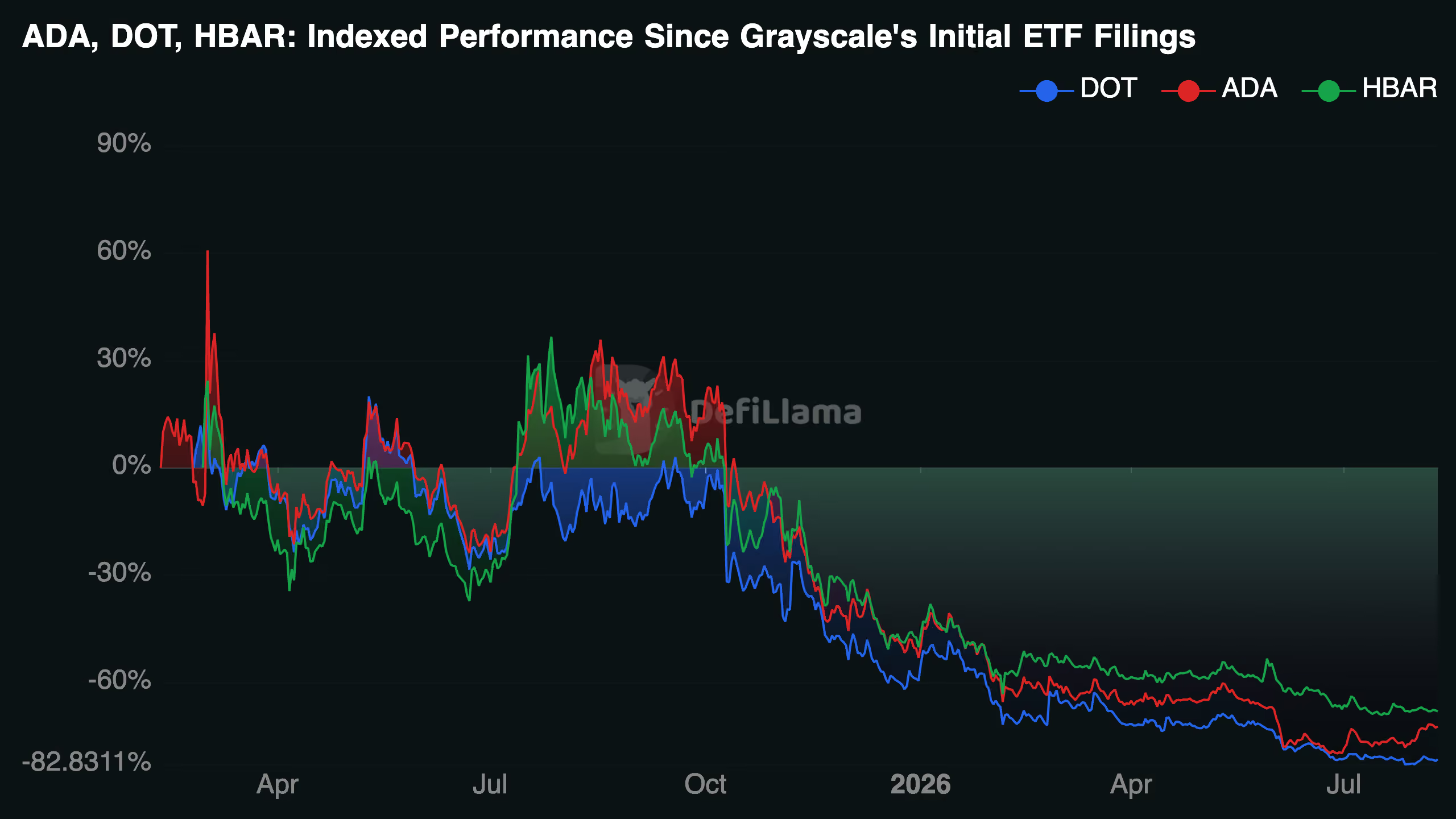
Grayscale quietly drops Cardano, Polkadot and Hedera ETF plans
-

 Fashion7 days ago
Can You Wear Double Cloth Gauze Clothing To Your Office?
-

 Fashion6 days ago
Coffee Break: The Fonteyn Jane Flat
-

 Crypto World6 days ago
Bitcoin's BIP Editors Remove Luke Dashjr Two Days After BIP-110 Fork Stalled
-
 Entertainment6 days ago
57 Years Later, the Best Sitcom Ever Made Still Deserves a Reboot
-

 Tech6 days ago
Zoom Screen-Sharing Bug Let People Fully Take Over Other Devices On A Call
-
 Crypto World7 days ago
Hormuz Nerves Cost Bitcoin $65,000 Mark Despite Solid Institutional Flows
-

 Fashion6 days ago
Claire Life: Kicking Off MVAAFF With the C Suite Luncheon Featuring Phylicia Rashad, Letoya Luckett, and More!
-

 Fashion6 days ago
Should you refinance your debt? Pros, cons, and real numbers
-
 Crypto World5 days ago
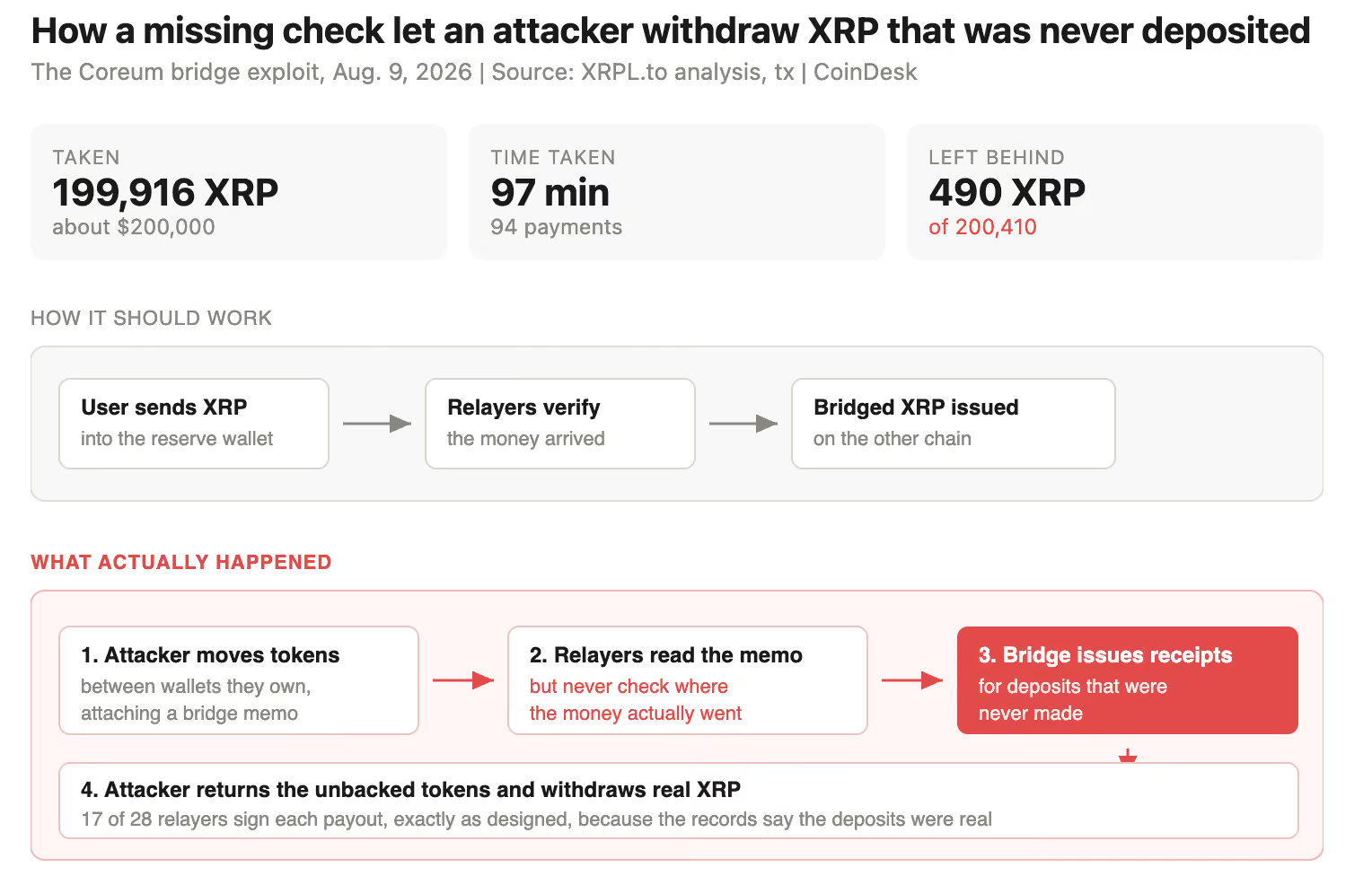
XRP bridge drained after software mistook fake deposits for real ones
You must be logged in to post a comment Login