

Crypto World
XRP Risk Of Sub-$1 Drop Rises But Onchain Data Shows Silver Lining

XRP is trading just above $1, leaving the token at its weakest price level of the year, but onchain data paints a different picture.
The exchange-held XRP supply continues to fall, Binance withdrawals have exceeded deposits for seven straight days, whale flows are holding positive and spot XRP exchange-traded funds (ETFs) have attracted $243 million in inflows since April.
The improving onchain data points to healthy network positioning, even as XRP continues to search for a price bottom.
XRP supply on exchanges continues to shrink
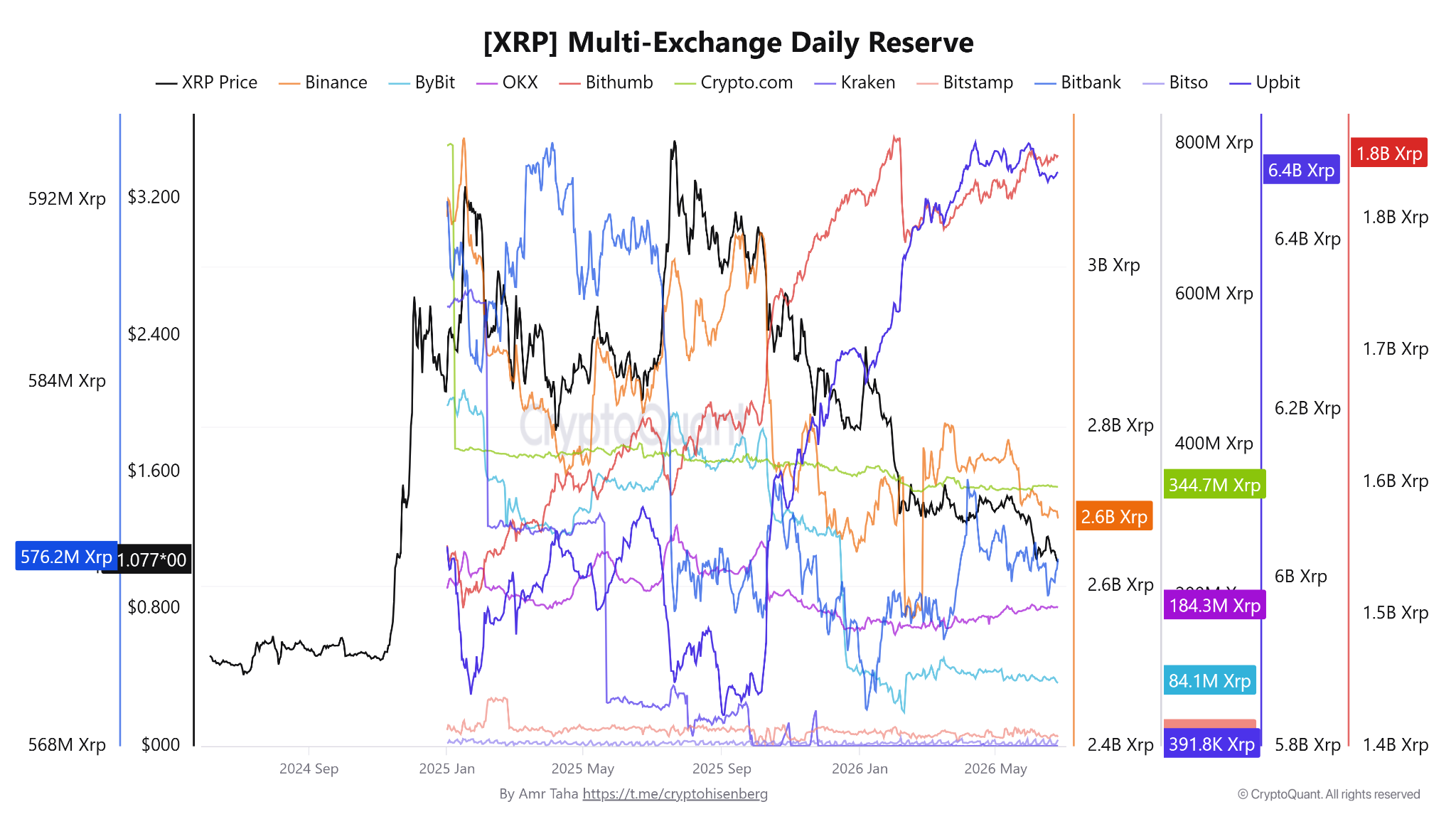
Crypto analyst Amr Taha noted that Binance’s XRP reserve has fallen to its lowest level since March after roughly 100 million XRP left the exchange over the past month. Binance’s balance stood at about 2.68 billion XRP on June 25, down from 2.78 billion XRP on May 12, accounting for the largest outflow among major trading platforms.
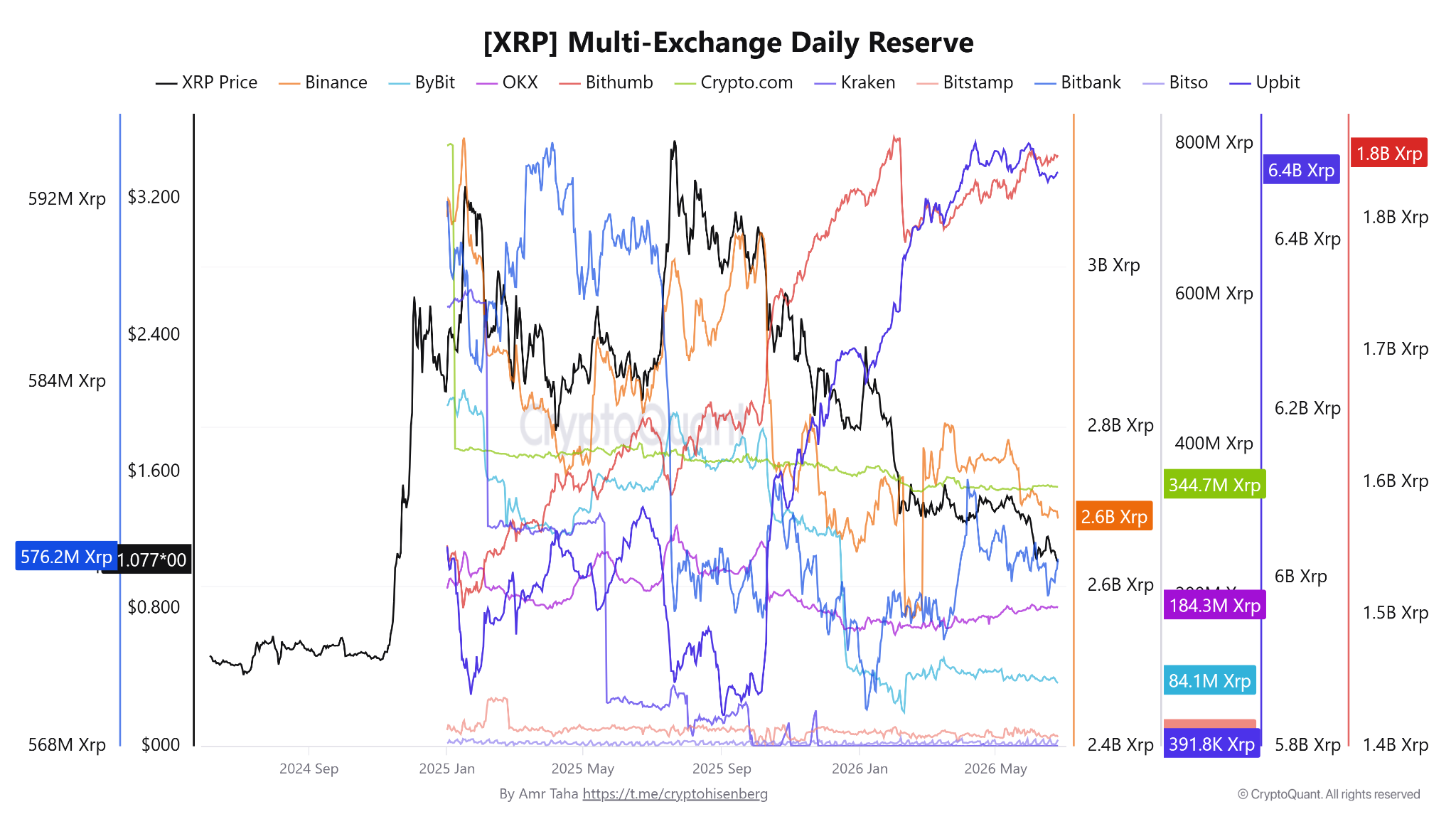
XRP multi-exchange daily reserve. Source: CryptoQuant
Other exchanges also posted smaller declines. Upbit’s reserve fell to 2.48 billion XRP on June 25 from 2.51 billion XRP on May 31, while Bybit’s holdings declined to 82 million XRP from 92 million XRP on June 2. Binance led in absolute outflows, while Bybit recorded the steepest percentage decline.
Taha also highlighted a significant shift in Binance transaction activity. XRP withdrawal transactions have exceeded deposits for seven consecutive days since June 17. The seven-day withdrawal share climbed to 53.8% on June 23, its highest reading since June 2024, while deposits fell to 46.1%, the weakest level since 2024.
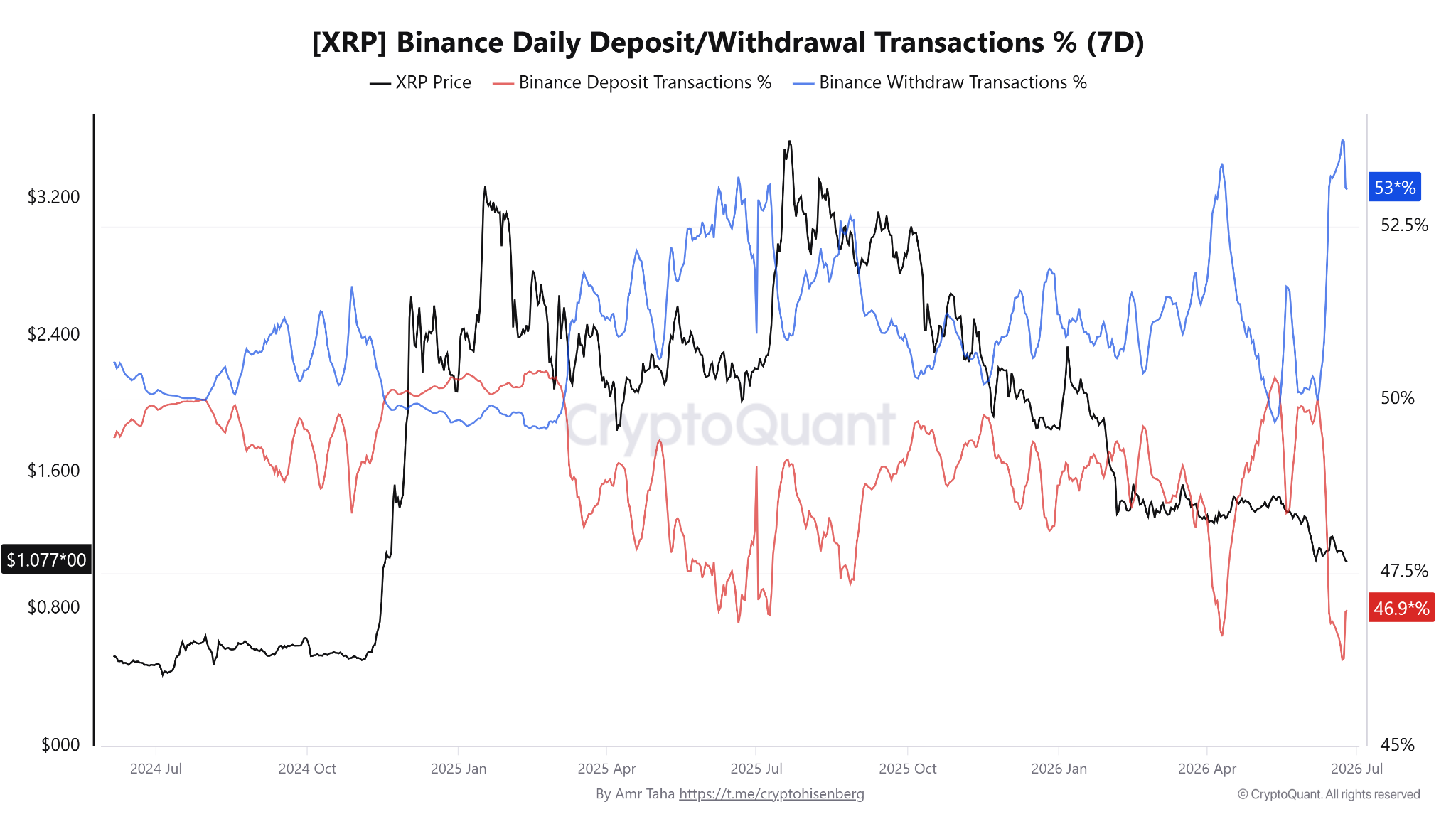
XRP daily deposit/withdrawal transactions (%) on Binance. Source: CryptoQuant
The metric tracks transaction count rather than XRP volume. This indicates users are moving coins off Binance more frequently than sending them to the exchange, marking the longest withdrawal-led stretch in roughly a year.
Large XRP holders supported the trend. XRP whale flow on the 90-day moving average has stayed positive throughout the quarter at 5.143 million XRP per day, showing consistent net accumulation by large wallets instead of distribution.
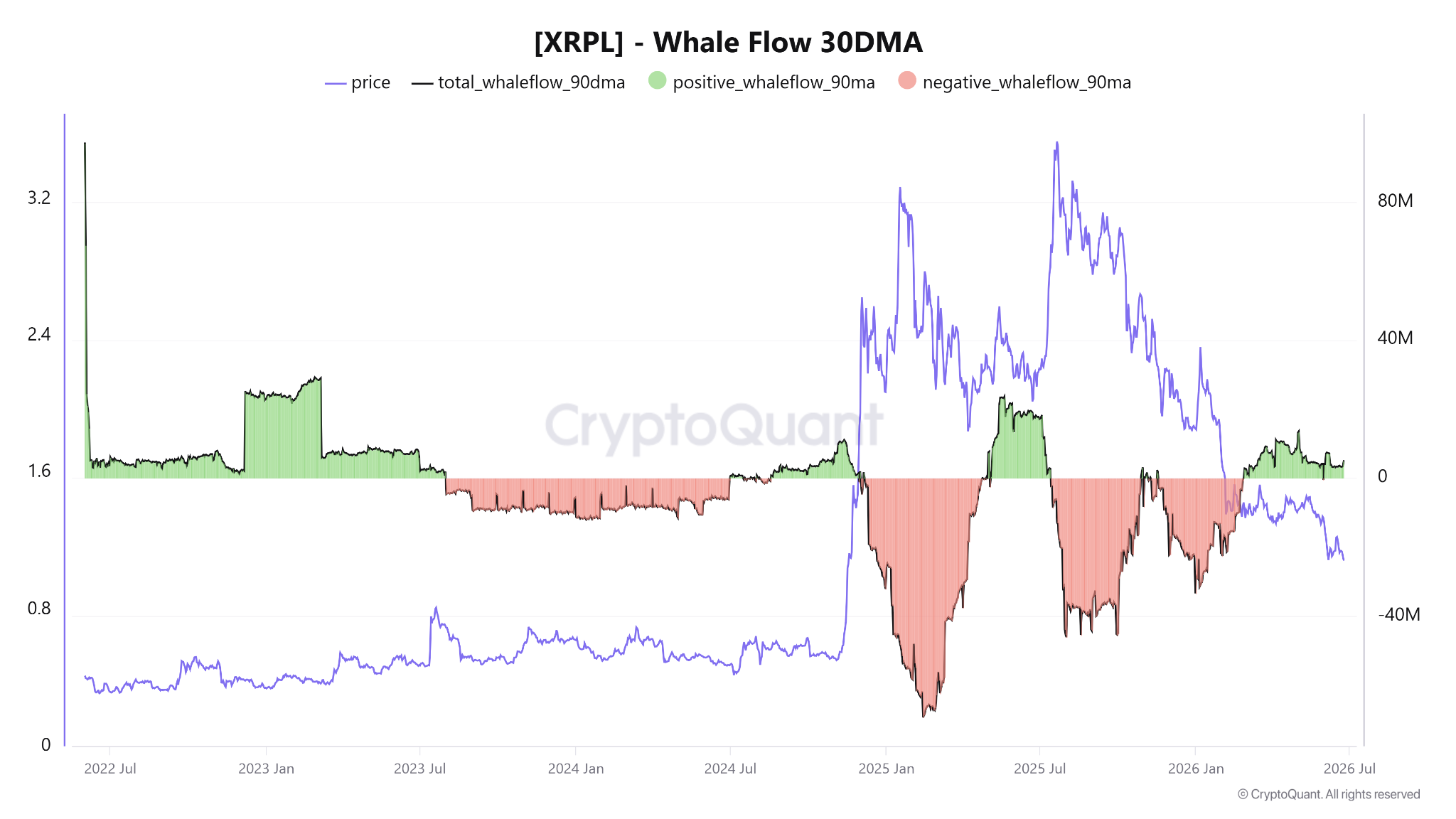
XRP whale flows. Source: CryptoQuant
Institutional demand has also added support. Spot XRP ETFs recorded $2 million in net inflows on June 24, lifting June’s total netflows to $31 million. Since April, the total cumulative inflows have reached $243 million.
Related: SBI to acquire Bitbank in $289M deal creating Japan’s biggest crypto exchange
XRP price approaches a major demand zone
From a technical standpoint, the higher-time-frame market structure remains bearish for the altcoin. XRP touched $1.01 on Thursday, its lowest price of 2026, leaving the token close to its first move below $1 since November 2024. The decline has pushed XRP down 43% year-to-date.
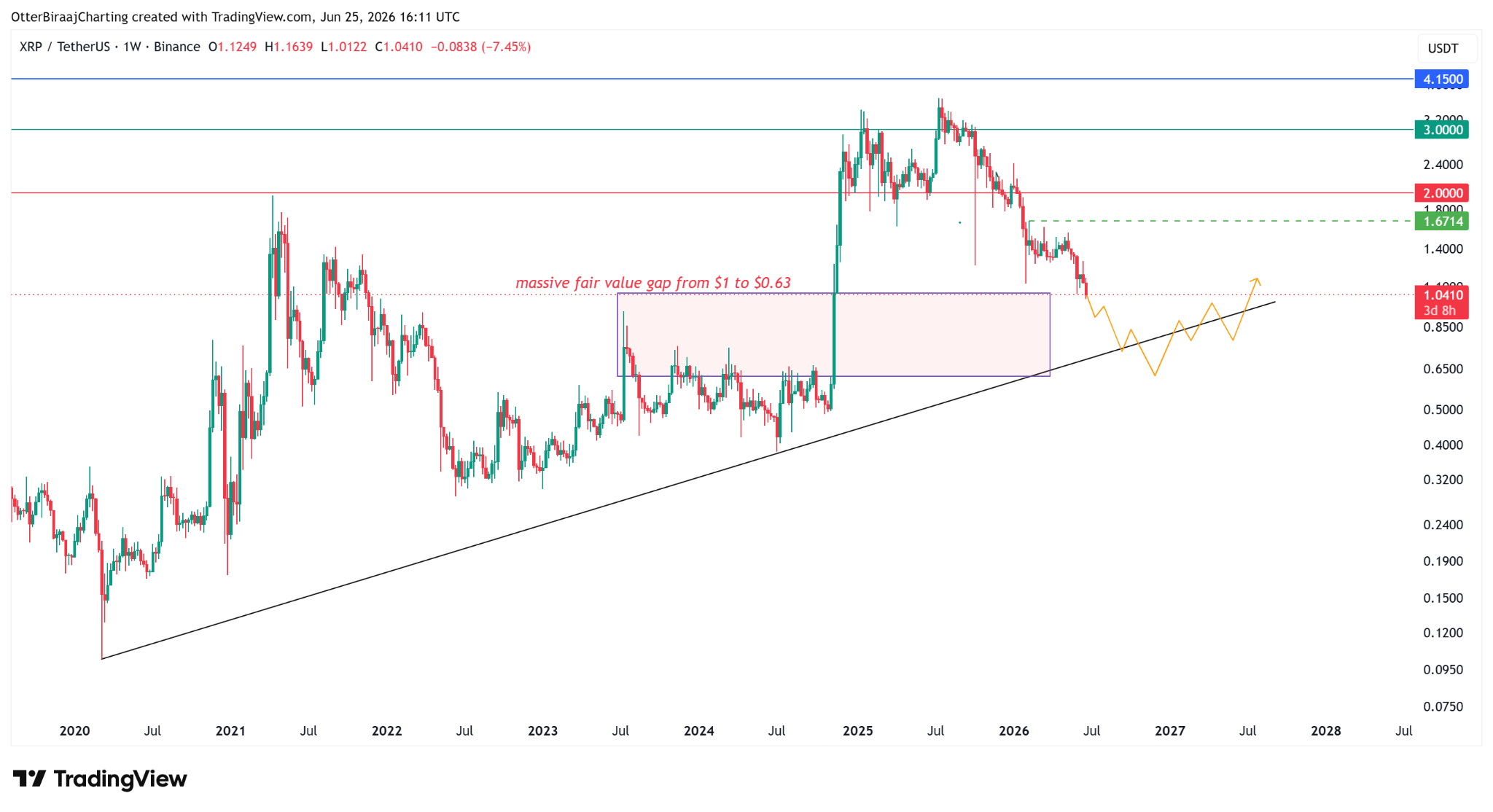
XRP/USDT, one-week chart. Source: Cointelegraph/TradingView
The next key area for XRP sits within the fair value gap between $1 and $0.63, an unfilled price gap created during the sharp rally in late 2024 that could attract buying interest if the decline extends in the coming weeks.
Black Swan Capitalist founder Versan Aljarrah continues to focus on the longer-term chart. The analyst said XRP has spent years building a large accumulation range with higher lows on both weekly and monthly timeframes.
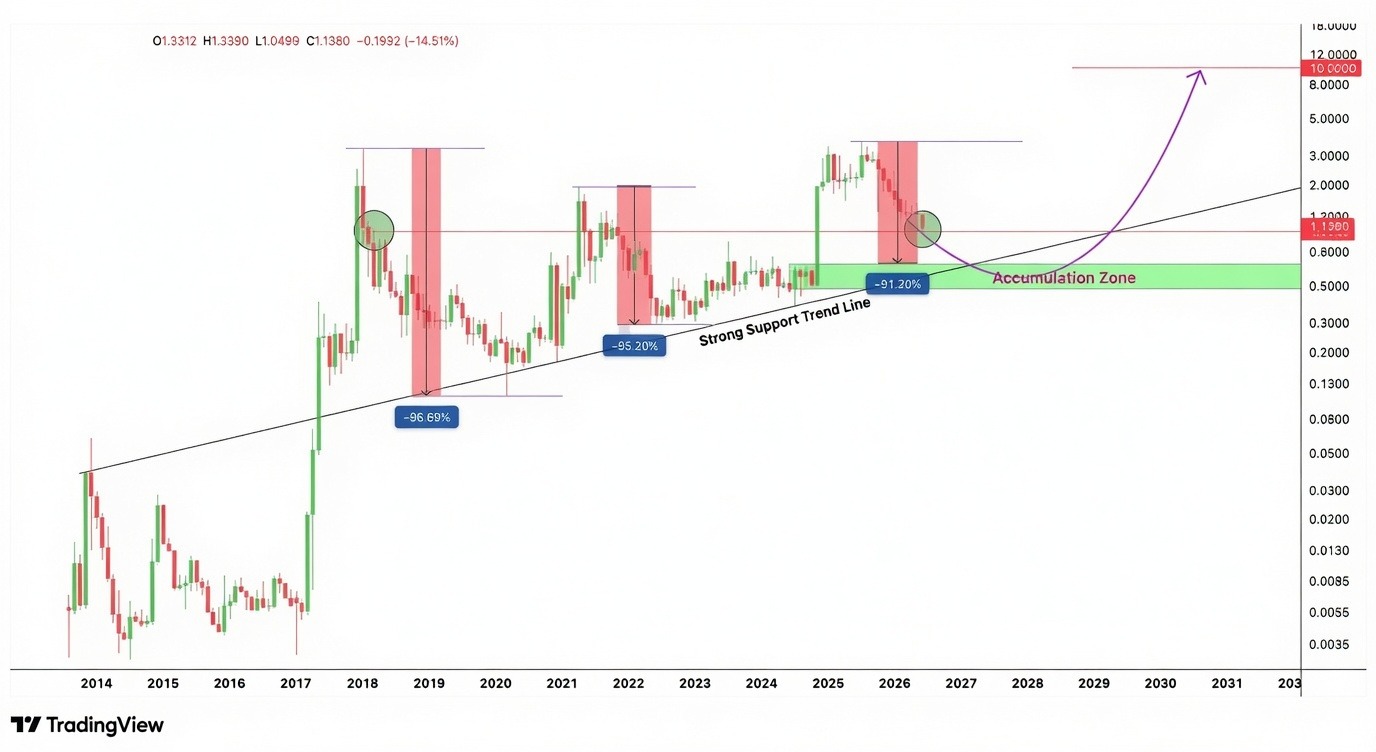
XRP/USD, one-month chart analysis by Versan Aljarrah. Source: X
Aljarrah argued that extended consolidations often produce stronger breakout moves once the price eventually breaks out of the range, with the analyst targeting $10, i.e., a 900% increase from the current price.
Related: HYPE down 22% from record highs: Will spot demand revive the uptrend?

Crypto World
Rain Trade launches decentralized prediction market as the industry rethinks how questions are created and managed


Disclosure: This article does not represent investment advice. The content and materials featured on this page are for educational purposes only.
Prediction market transparency is under scrutiny as decentralized platforms like Rain Trade promote open market creation and broader user participation.
Summary
- Rain Trade promotes decentralized prediction markets as transparency concerns reshape the forecasting industry.
- Rain Trade launched during the FIFA World Cup with onchain prediction markets and community-driven creation.
- Transparency debates in prediction markets spotlight Rain Trade’s decentralized approach to market creation.
Over the past several years, prediction markets have sold themselves as a window into public sentiment, cutting through speculation by putting real dollars behind possible outcomes. But recent news around industry leader Polymarket has raised questions about what happens when the platforms designed to measure public sentiment start influencing the outcomes they’re meant to measure.
Investigations into the company’s marketing practices have alleged that paid influencers and simulated trades blurred the line between genuine market activity and paid promotion, sparking a broader debate about transparency in the forecasting industry.
Their credibility depends on users trusting that markets are being created, promoted, and operated fairly. As forecasting platforms continue to grow, questions about transparency are no longer limited to market outcomes but now extend beyond market outcomes to the centralized systems that control them.
As questions around transparency continue to circulate, Rain Trade offers an alternative model for how prediction markets can operate. Built on decentralized infrastructure, the platform enables users to launch prediction markets on virtually any topic, event, or question. These markets can be public, created in any language, or limited to specific communities through invite-only access. The platform also reduces onboarding friction by allowing users to fund accounts across multiple blockchain networks and automatically converting assets to enable USDT trading.
Rain Trade debuts during the 2026 FIFA World Cup, bringing Mike Tyson in its launch campaign as fans react in real time to goals, injuries, and unexpected moments on the field. Rather than relying on a centralized team to determine which conversations deserve a market, the platform allows users to create forecasts around the moments they believe matter most.
Sharing his perspective on the future of community-driven prediction markets, Roy Shaham, CEO of Rain Protocol, the decentralized protocol layer Rain Trade is built on, explains: “Traditional prediction markets have operated with a backward mentality. They’ve historically focused on controlling what people can predict rather than giving them the opportunity to create markets themselves. Rain Trade is giving users the freedom to decide what deserves a market, and the World Cup is a perfect stage to show how powerful prediction markets can become when they are shaped directly by the communities participating in them.”
The distinction goes beyond market creation. With more attention being put towards how prediction platforms are promoted and managed, Rain Trade’s infrastructure is designed to make market activity visible and verifiable. Market creation, trading activity, and outcomes are recorded onchain, creating a public record that cannot be altered after the fact.
The platform also supports AI-powered and manual resolution, giving creators flexibility in how outcomes are determined. Market creators are rewarded with 1% of the trading volume generated by their markets, incentivizing users to contribute to the ecosystem rather than relying solely on platform operators.
Recent controversy has shown how quickly confidence can be questioned when users believe a platform has too much control over the system it operates. As the industry continues to grow, platforms that separate infrastructure from oversight may play an increasingly important role in restoring confidence in the category.
Disclosure: This content is provided by a third party. Neither crypto.news nor the author of this article endorses any product mentioned on this page. Users should conduct their own research before taking any action related to the company.
Crypto World
Polymarket hack updated to $3.1 million days after the platform promised users full refunds


On Thursday as well, Specter Analyst, another blockchain intelligence platform, said on Thursday that “It appears there may be a phishing attack targeting Polymarket users, with estimated losses of $2.94M so far.”
One of the victims of the hack, Ash, on X wrote that his wallet had been hacked and had no idea why at the time. Ash also shared his and the attacker’s wallet addresses.
Polymarket has suffered other security breaches recently. In March, blockchain investigator ZachXBT highlighted a suspected security breach. He said over $520,000 was reportedly drained from two smart contracts on the Polygon blockchain. Polymarket then said the funds were safe.
In December, the platform confirmed a security incident on its Discord channel after users reported missing funds and suspicious login attempts. It blamed an unidentified third-party login provider for those account breaches.
The news of the phishing attack follows reports that Polymarket is under federal investigation following a Wall Street Journal article into the prediction markets platform deceptive social media promotion of users boasting winnings.

Key Highlights
- Lucid (LCID) shares skyrocketed 15.6% during Friday’s trading session, reaching an intraday peak of $5.95, fueled by heightened enthusiasm surrounding its autonomous vehicle collaboration with Uber and Nuro.
- The EV manufacturer serves as the exclusive vehicle provider for the robotaxi initiative, delivering Gravity SUVs with plans to launch commercial operations in 2027 across San Francisco and Houston markets.
- As part of a broader restructuring initiative, Lucid is trimming its domestic workforce by 18%, a strategic move projected to generate approximately $158 million in annual savings.
- Analyst sentiment remains subdued — the Street consensus stands at a “Reduce” recommendation with a mean price objective of $9.67.
- The company confronts legal challenges through a securities class action lawsuit targeting shareholders who purchased shares between February 25 and April 13, 2026.
Shares of Lucid Group (LCID) surged 15.6% during Friday’s session, peaking at $5.95, while trading volume exploded to 35 million shares — approximately three times typical daily activity. The previous session concluded at $5.12.
The upward momentum reflected renewed investor enthusiasm regarding Lucid’s position as the exclusive vehicle manufacturer for the Uber and Nuro autonomous transportation initiative. The arrangement involves Lucid delivering Gravity SUVs alongside upcoming midsize vehicle models for the robotaxi fleet.
Production-validation units of these autonomous vehicles are currently being manufactured at Lucid’s Arizona manufacturing plant. The commercial rollout timeline targets 2027, with initial operations launching in the San Francisco Bay Area followed by Houston market expansion.
An engineering test fleet comprising nearly 100 Gravity-based autonomous vehicles is being deployed throughout California and Texas for comprehensive testing and safety certification protocols. Uber has already established a 50,000-square-foot operations depot and charging infrastructure in Houston, where supervised on-road testing is currently progressing.
This price surge follows a 7.5% appreciation nine days earlier, triggered by the initial announcement of the Houston expansion by Lucid, Uber, and Nuro. Houston represents the second metropolitan area designated for the program, following San Francisco.
Strategic Cost Reduction Amid Expansion
Beyond the autonomous vehicle headlines, Lucid is executing a comprehensive organizational restructuring. The company plans to eliminate 18% of its U.S. employee base, an initiative anticipated to yield approximately $158 million in annual cost reductions. Management transitions are simultaneously occurring alongside fresh vehicle development strategies.
Despite Friday’s rally, shares remain underwater 50.2% for the year-to-date period. At $5.92, the stock trades 82.3% beneath its 52-week peak of $31.30, achieved in July 2025.
Recent financial performance proved disappointing. Lucid disclosed a Q1 loss of $2.82 per share, falling short of the $2.53 consensus forecast. Revenue registered at $282.46 million, missing analyst expectations of $358.46 million, although this represented a 20.2% year-over-year increase.
Ongoing Legal Challenges and Analyst Hesitation
Several law firms are pursuing a securities class action litigation targeting shareholders who acquired LCID shares during the February 25 through April 13, 2026 timeframe. This legal exposure introduces additional uncertainty the company must navigate alongside operational hurdles.
Wall Street analysts show limited enthusiasm for upgrading their outlook. TD Cowen maintains a “hold” stance with a $7.00 price objective. Morgan Stanley projects a $5.00 target. Citigroup stands as the optimistic outlier with a “buy” rating and $14.00 target. The aggregate consensus reflects a “Reduce” rating with a $9.67 mean price target.
Goldman Sachs expanded its stake during Q1, nearly doubling holdings to 5.44 million shares. Institutional ownership collectively represents 75.17% of outstanding shares.
Lucid maintains a market capitalization of $2.31 billion, carries a debt-to-equity ratio of 3.00, and reports a current ratio of 1.02.

Crypto World
Apple (AAPL) Stock Gains 3% Amid Bid to Source Chips From Sanctioned Chinese Manufacturer CXMT

Key Takeaways
- Apple is petitioning the Trump administration for permission to source memory chips from CXMT, a Chinese semiconductor company designated on the Pentagon’s Chinese Military Company list.
- The tech giant implemented a 20% price increase on MacBook and iPad products driven by escalating memory component costs, prompting the search for alternative suppliers.
- CXMT specializes in standard DRAM production but lacks capabilities in high-bandwidth memory (HBM), the advanced chip category fueling Micron’s artificial intelligence market expansion.
- Shares of Micron (MU) declined 6.69% following the disclosure, though market analysts indicate minimal competitive risk to Micron’s core business.
- Legislative resistance poses a significant obstacle, as Apple’s prior effort to partner with Chinese manufacturer YMTC in 2022 triggered swift congressional opposition.
Apple has initiated discussions with United States government officials seeking authorization to procure memory chips from ChangXin Memory Technologies (CXMT), a Chinese semiconductor producer appearing on the Pentagon’s Chinese Military Company designation list, a Financial Times report revealed Friday.
AAPL stock traded up 3.14% to $283.78 during the reporting period. Micron (MU) dropped 6.69% following the revelation.
Apple has been requesting guarantees from the Commerce Department alongside other administration representatives that procuring components from CXMT wouldn’t result in subsequent restrictions or sanctions. Although purchasing chips from CXMT isn’t explicitly prohibited, proceeding without official approval could subject Apple to political backlash and reputation damage.
This initiative follows Apple’s announcement of price increases across multiple MacBook and iPad configurations by approximately 20%. CEO Tim Cook explained the company could no longer offset the climbing cost of components, especially memory. That disclosure triggered AAPL’s steepest single-day decline in over twelve months.
DRAM pricing has skyrocketed in recent years, propelled by constrained supply and massive demand from AI infrastructure expansion. Apple, representing the world’s largest memory purchaser, now aims to diversify its component sourcing to reduce these expenses.
Understanding CXMT’s Product Portfolio
CXMT manufactures traditional DRAM products — DDR5 for personal computers and servers, LPDDR5X for mobile devices, and enterprise memory solutions. Notably absent from its product lineup is high-bandwidth memory (HBM), the specialized chip driving Nvidia’s AI accelerators and the data infrastructure supporting the ongoing AI investment surge.
This distinction matters significantly for Micron shareholders. HBM represents where Micron’s profit margins and revenue expansion are concentrated. CXMT currently operates outside that segment. If Apple secures approval and begins purchasing from CXMT, Micron’s HBM operations would remain untouched.
Micron, Samsung, and SK Hynix manufacture HBM. CXMT does not.
Apple Contributed to the Supply Crisis It Now Seeks to Escape
The situation contains notable irony. Throughout the previous memory market downturn, Apple leveraged its enormous buying influence to force suppliers like Micron toward bottom-tier pricing. Micron’s Chief Business Officer Sumit Sadana openly criticized Apple’s approach as “not constructive,” noting it discouraged investment in additional manufacturing infrastructure.
Suppliers postponed or abandoned expansion initiatives. Subsequently AI demand emerged, leaving the market without capacity to react swiftly. The scarcity and inflated pricing Apple currently confronts stem partially from that previous cost pressure campaign.
Apple attempted a comparable strategy in 2022, exploring procurement from another blacklisted Chinese company, YMTC. Congressional members immediately cautioned the company against proceeding, referencing national security implications. CXMT encounters identical scrutiny, leaving uncertainty whether the White House would endorse the petition.
CXMT recently obtained authorization to pursue a public listing on the Shanghai stock exchange and has been scaling production with financial support from the Chinese government.
Samsung Electronics declined 5.30% and SK Hynix tumbled 8.36% on the disclosure.

Cardano wallet SecondFi says it has identified a recovery pathway for users affected by a Tuesday exploit and expects to begin returning assets in roughly two weeks. The plan follows forensic work, security reviews, and additional testing to ensure the process can safely operate across the wallet states involved in the incident.
In an update shared on Saturday, Phillip Pon, CEO of SecondFi developer Emurgo, said the company completed its forensic investigation and “established a recovery pathway” for affected users. Pon added that the coming week would be used to build the solution, followed by another week devoted to testing before any assets are returned.
Key takeaways
- SecondFi says recovery should start in about two weeks after building and testing a new solution.
- The affected incident was traced to an address-level issue in SecondFi’s Cardano web wallet generation software that exposed private keys.
- SecondFi transferred approximately 129 million ADA secured via emergency measures to an independent third-party custodian while verification and recovery are pending.
- Users are warned not to migrate funds or follow instructions outside SecondFi’s official guidance, as this could complicate safe returns.
- SecondFi also cautioned that scammers are impersonating the wallet and soliciting private keys, seed phrases, and other access details.
Forensics complete; recovery build then testing
SecondFi’s recovery roadmap is centered on work Pon said has already been completed: forensic investigations and the establishment of a recovery pathway tailored to the wallet conditions created by the exploit. Pon indicated that the company’s next step is engineering the recovery mechanism, with a dedicated testing phase immediately afterward.
Importantly, Pon urged users to avoid moving assets or taking actions outside SecondFi’s official instructions while the recovery process is prepared. He said the recovery approach is designed around existing wallet states, and independent user actions could introduce variables that make a secure return of funds harder to complete.
What the Tuesday breach involved
SecondFi previously disclosed the security breach on Tuesday, reporting that it affected approximately 16 million ADA, worth about $2.4 million at the time, across 374 addresses. According to the wallet’s earlier reporting, the incident was traced to an address-level issue tied to SecondFi’s Cardano web wallet generation software, which exposed users’ private keys.
Separate from the impact on those exposed addresses, SecondFi said it secured roughly 129 million ADA through emergency measures. The company then moved those funds to an independent third-party custodian, where they will remain until SecondFi completes verification and recovery.
As of the Saturday update, SecondFi has not published a full post-mortem describing the vulnerability in detail or outlining precisely how the exploit was carried out.
SecondFi pushes back against recovery-related scams
Alongside the recovery timeline, SecondFi warned that malicious actors are spreading fraudulent messages while its recovery effort is underway. The wallet emphasized that no recovery actions requiring user participation have begun.
SecondFi said it will never ask users for private keys, seed phrases, wallet credentials, or direct wallet access. It urged users to treat any messages instructing them to submit wallet information, migrate assets, or take immediate steps outside verified communication channels as scams.
For users who need help, SecondFi directed them to submit a ticket through its official support portal while the recovery process is still being built and tested.
Why the timeline and custody details matter
For affected users, the most practical element of Saturday’s update is the sequencing: SecondFi is not requesting immediate user action, and it is framing the recovery work around wallet states that already exist from the time of the incident. That matters because ad hoc user behavior—such as moving funds or switching wallet setups during a recovery window—can create mismatches between what a recovery solution expects and what is actually on-chain.
The custodian step also signals that SecondFi is treating the recovered funds as subject to verification before release. While this does not eliminate uncertainty for users whose keys were exposed, it does provide an explicit holding point that, in principle, can reduce the risk of funds being moved without a defined recovery process.
Readers should watch for SecondFi’s testing milestones and any further technical disclosures about what went wrong, as the company has not yet released a comprehensive post-mortem. In the meantime, the practical priority remains clear: follow only verified SecondFi guidance and ignore any unsolicited messages demanding wallet access or recovery “assistance.”
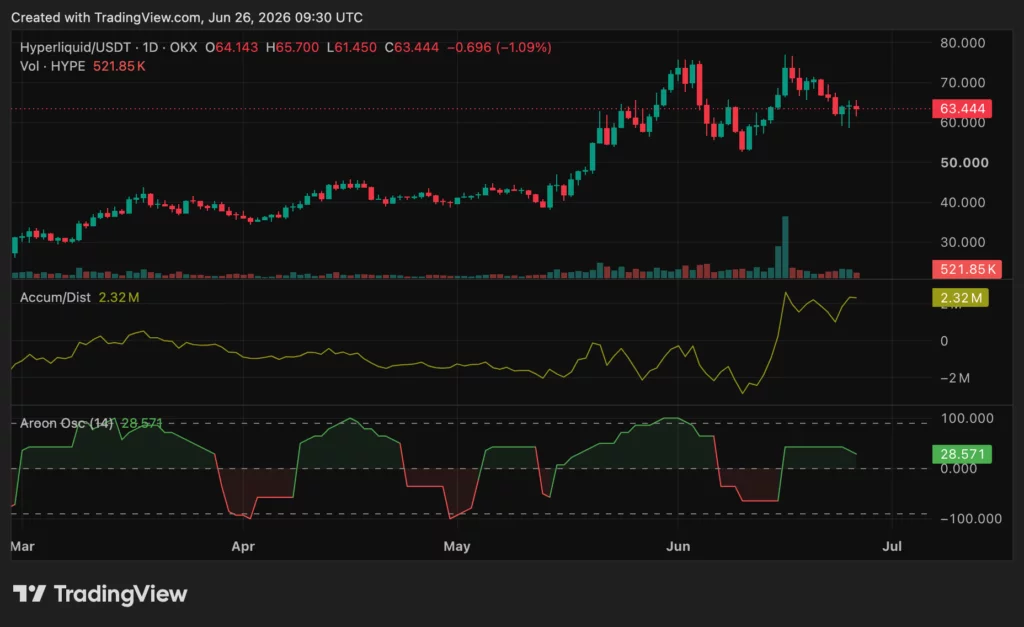
Hyperliquid traded near $63 on June 26 after pulling back from its all-time high of $76.70 earlier this month.
Summary
- HYPE holds above $60 support while whales continue buying during the wider crypto market pullback.
- Multicoin’s $319 target depends on Hyperliquid keeping revenue growth, market share and buybacks strong.
- Technical indicators show cooling momentum, with bulls needing $65-$70 to regain stronger control soon.
According to crypto.news data, the token is down over the past week, but it still holds a large gain over the past year.
The latest Hyperliquid price data shows HYPE trading between $59.48 and $65.17 over the past 24 hours. The token holds a top-10 market rank, with a market cap above $14b and fully diluted value above $60b.
HYPE’s recent move looks like a consolidation phase after a sharp rally from the low $30s in March. Price has cooled near $63, but the $60 area remains the main short-term support zone.
A clean break below $60 would put the next support area near $55-$58 back in focus. A move above $65 would show early strength, while a close above $70 would give bulls a stronger case for a retest of the recent high.
Hyperliquid whales keep buying during pullback
Whale activity remains one of the stronger parts of the HYPE setup. According to Lookonchain, a newly created wallet withdrew 222,493 HYPE, worth about $14.41m, from Coinbase Prime. Another whale received 44,986 HYPE, worth about $2.87m, from FalconX.
Those transfers do not prove long-term holding, but they show large buyers are still active during the pullback. Traders often watch Coinbase Prime and FalconX flows because they can reflect institutional or high-net-worth activity.
Derivatives data also shows active trading. CoinGlass data shows HYPE volume rose 29.79% to $4.59b, while open interest slipped 1.15% to $2.52b. Options open interest rose 10.62%, but options volume fell sharply, showing that most activity remains in spot and perpetual futures.
As previously reported, HYPE rallied more than 40% in one week in May as derivatives activity, ETF demand and protocol buybacks supported the move. The current pullback is testing whether that demand can keep absorbing profit-taking.
Multicoin target lifts long-term debate
Multicoin Capital has published a bullish valuation report on HYPE. In the full analysis, the firm said HYPE is now one of the largest positions in its liquid fund and that it has been accumulating since February.
The firm said Hyperliquid generated about $873m in revenue across roughly $2.9t in trading volume in 2025. It also said the platform grew from about 301,000 to 923,000 users and ended the year with about $6b in open interest.
Multicoin argued that Hyperliquid is taking share from centralized exchanges. It said monthly perpetuals volume is now about 17% of Binance’s level, while open interest has reached about 21% of Binance’s level.
The firm also pointed to HIP-3, HIP-4, portfolio margining, prediction markets, tokenized assets and HyperEVM growth as future drivers.
“We believe Hyperliquid is becoming the everything exchange,” it said.
As crypto.news reported, Multicoin backed a $319 HYPE target by 2028 under its base case. The firm also listed risks, including regulation, governance, competition, bad debt and technical pressure.
Technical signals show cooling momentum
The HYPE/USDT daily chart still shows a broader uptrend from March. Price climbed from the low $30s to above $70 before pulling back. That structure keeps the larger trend constructive, but short-term momentum has cooled.
The Accumulation/Distribution indicator is near 2.32m. It remains elevated after rising sharply earlier in June, which suggests buying pressure improved during the rally. The line has flattened recently, showing that accumulation is no longer accelerating.
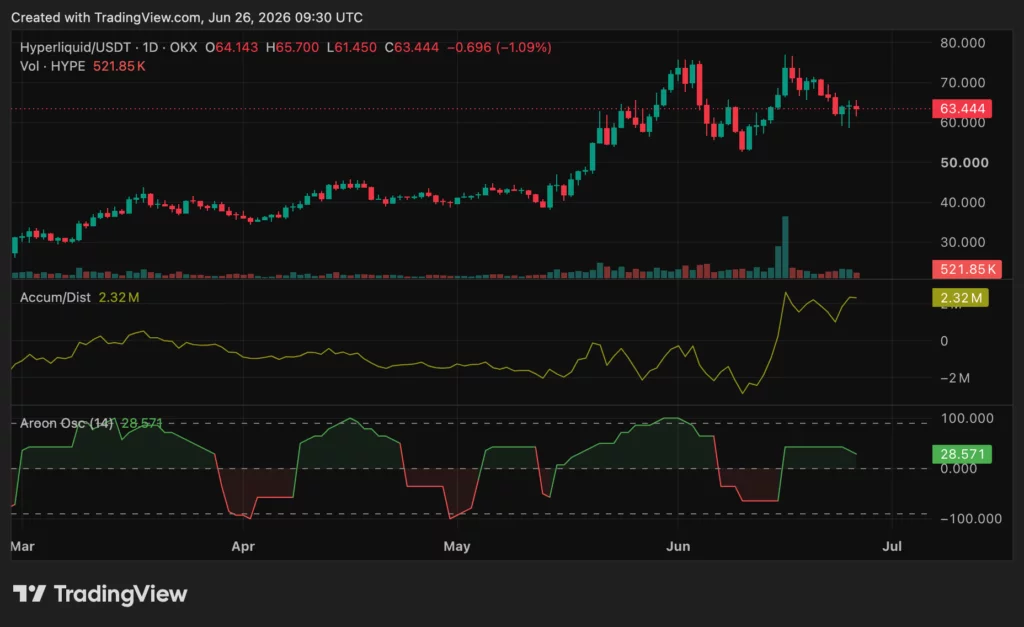
The Aroon Oscillator is positive near 28.57. That keeps the short-term trend bias slightly bullish, but the reading has weakened from stronger levels. This means the uptrend remains alive but has lost some speed.
In a previous article, crypto.news discussed HYPE’s double-top risk after its pullback from the all-time high. That pattern put the $65 and $62 areas in focus. Price is now trading near that same zone.
Previously, crypto.news exploredwhether HYPE can reach $100 in 2026. That scenario depends on buybacks, volume growth, token unlocks and wider market strength.
For now, HYPE remains in a mixed setup. Whales are buying, Multicoin has issued a strong long-term case, and the broader trend still holds above $60. But momentum has cooled, and bulls need a move back above $65-$70 to confirm that the next upside phase is starting.
Disclosure: This article does not represent investment advice. The content and materials featured on this page are for educational purposes only.
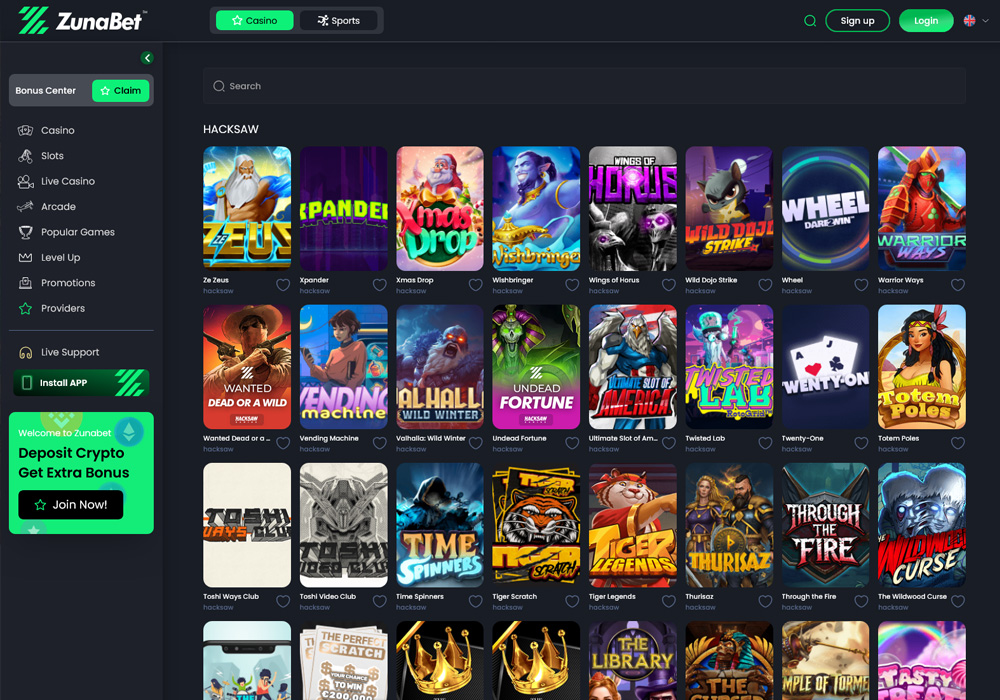
Bet365 and 888casino sit among the most recognized names in online betting, with decades of operation behind each of them. The space they helped shape, though, keeps evolving — and lately, players comparing the veterans have started looking past them too. ZunaBet, which launched in 2026, is one of the names appearing more often in those side-by-side conversations as the crypto-first model continues to gain ground.
What follows is a look at how the established names compare today, and why ZunaBet is drawing attention as players widen the field.
The Veterans of the Space
Bet365 has been running since 2000. Built from the UK and now a global brand, it brings sportsbook, casino, poker, and bingo under one account. Funding moves through cards, bank transfers, and e-wallets, and the operator carries licenses in every region it serves.
888casino goes back even further, to 1997. As one of the first online casinos to launch, it operates under the 888 Holdings umbrella and continues to hold steady positions in European regulated markets and parts of North America. The library leans on slots, table games, and live dealer rooms. Like Bet365, it works on fiat banking under regional licensing.
Both deliver the dependability that long-standing brands tend to provide. Both also work within constraints baked into that model — fiat-only banking, withdrawal speeds tied to chosen methods, libraries smaller than what global crypto brands carry, and loyalty programs that stay close to long-running structures.
ZunaBet Enters the Comparison
ZunaBet went live in 2026 under Strathvale Group Ltd with an Anjouan gaming license. The defining difference between it and the established names is structural. Crypto wasn’t introduced later — the platform was built around it from the start.
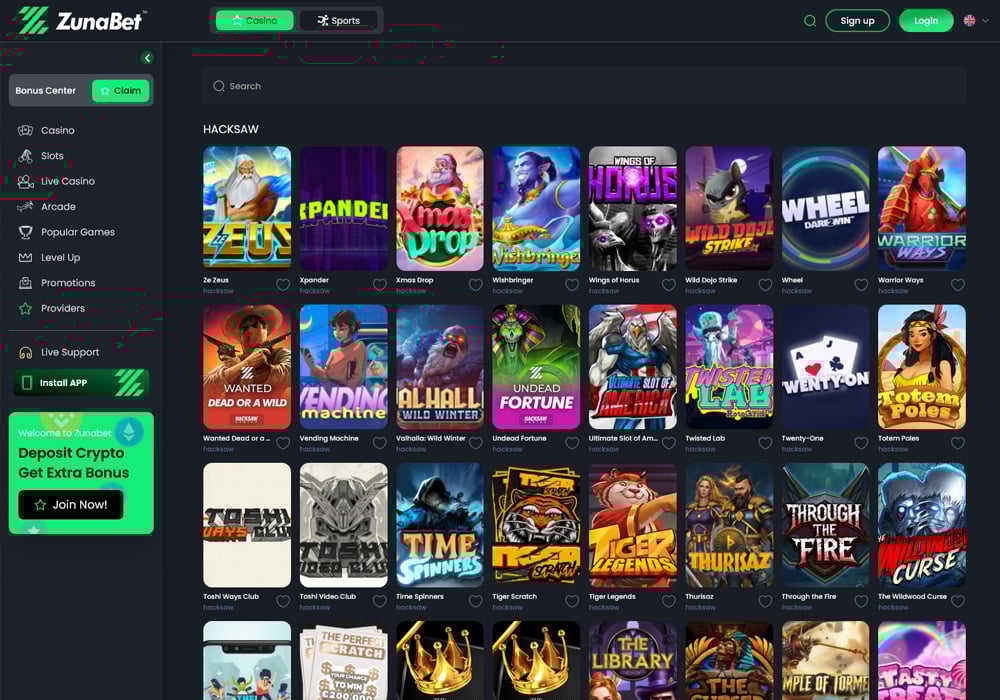
The game catalogue reaches more than 11,000 titles from over 60 providers, including Pragmatic Play, Hacksaw Gaming, Yggdrasil, BGaming, and Evolution. That ranks it among the larger crypto-focused libraries on the market and pushes past what Bet365 and 888casino offer in most of their licensed regions. Slots, table games, and live dealer rooms all share a single account.
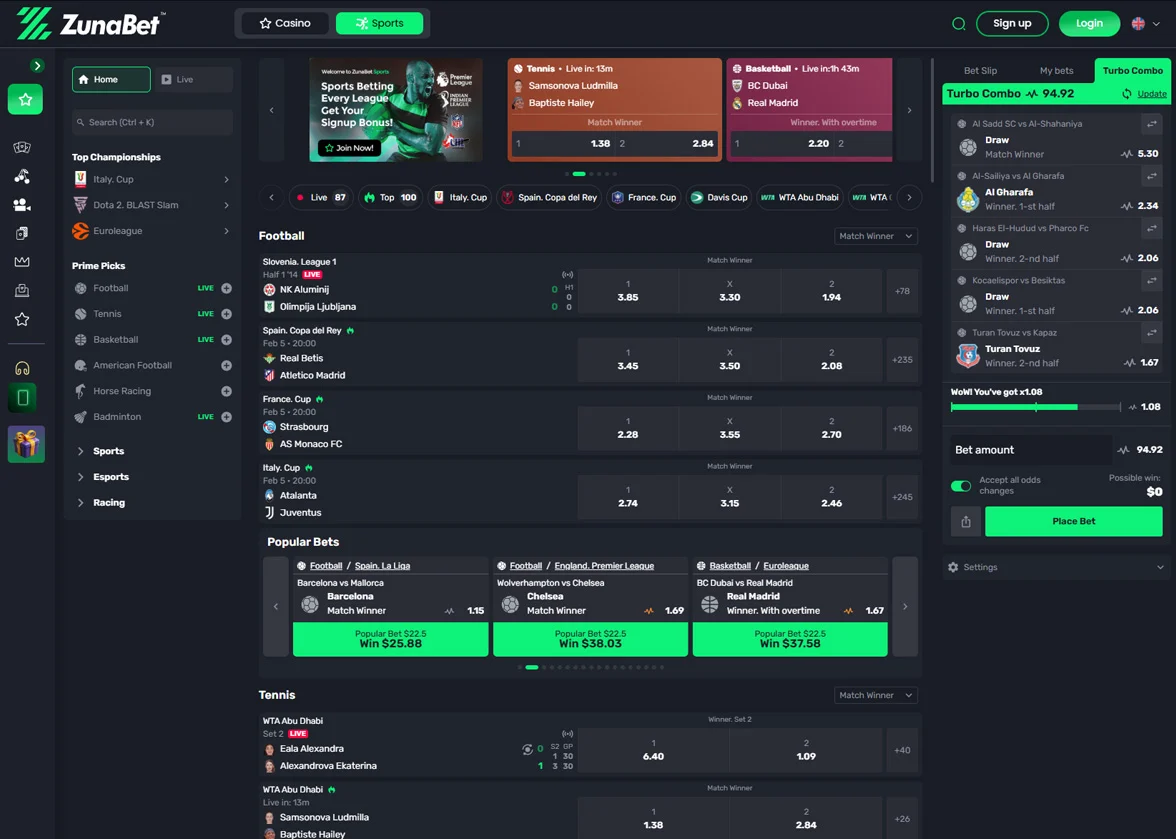
The sportsbook is built into the platform too. Football, basketball, tennis, NHL, and the other major sports sit alongside CS2, Dota 2, League of Legends, and Valorant. Virtual sports and combat sports finish the menu. That makes ZunaBet a hybrid in the same category as Bet365, with wider market coverage under one roof.
How the Payment Models Compare
The operating gap shows up most clearly in banking. Bet365 and 888casino move money through traditional rails. The cost is processing windows, possible holds, and withdrawal speeds that depend on which method players chose.
ZunaBet’s payment stack is entirely crypto. More than 20 currencies are supported, covering Bitcoin, Ethereum, USDT across multiple chains, Solana, Dogecoin, Cardano, and XRP. No platform fees apply, and withdrawals settle fast. For players already comfortable with crypto, the experience cuts out the slower elements that come with banking.
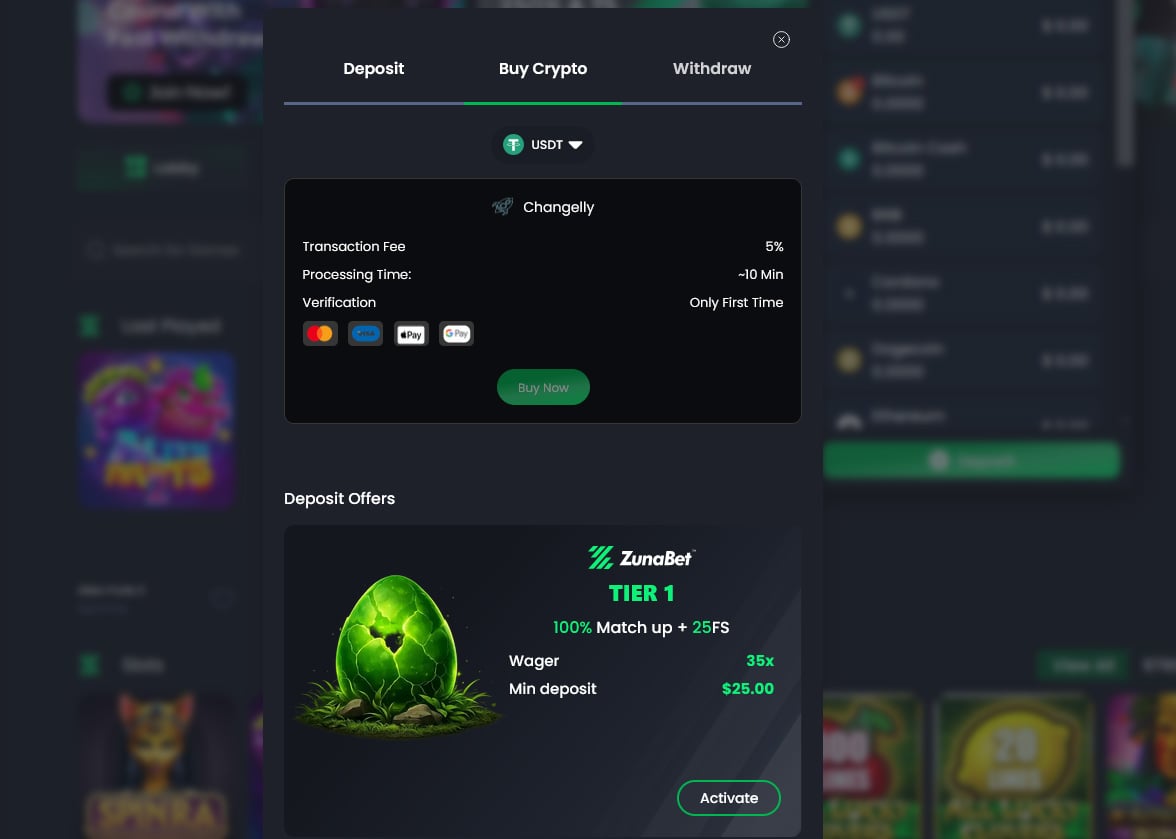
Reach matters here too. Crypto-first operators aren’t tied to the same region-by-region licensing requirements that govern fiat brands. ZunaBet’s full setup is available across many regions where older brands face restrictions. For players already moving in digital, crypto-friendly contexts, that aligns with how they expect modern platforms to work.
Welcome Bonuses Compared
Bet365 and 888casino structure welcome offers by region. Deposit matches or smaller new-player bonuses are typical, with wagering requirements that need close reading on the casino side.
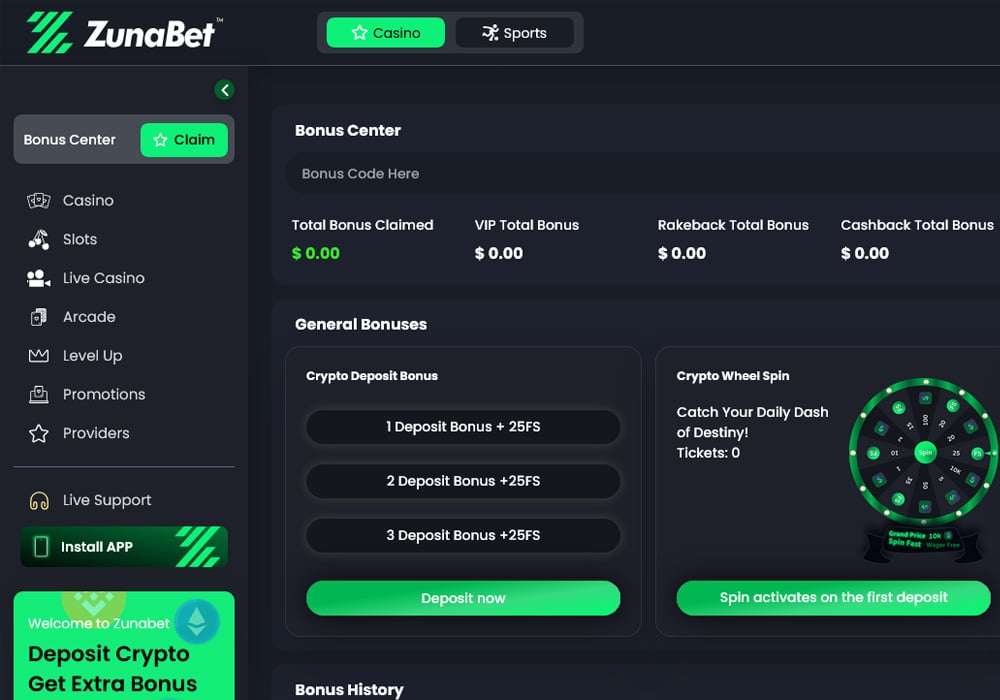
ZunaBet’s welcome package goes up to $5,000 plus 75 free spins, spread across three deposits. The first matches 100% up to $2,000 plus 25 spins. The second adds 50% up to $1,500 plus 25 spins. The third returns to 100% up to $1,500 plus another 25 spins. Marketed as a 250% bonus across three deposits, it gives new players more depth to explore the platform than a single-deposit bonus offers.
Loyalty: Different Approaches
Bet365 takes a low-key approach to loyalty, with personalised offers reaching player accounts based on activity rather than a structured tier system. 888casino runs a more traditional VIP setup with points, free spins, and elevated promos at higher tiers. Both work, but both stay close to the standard loyalty card format.
ZunaBet changes the structure. The program runs on a dragon evolution theme, with a mascot called Zuno guiding players through six tiers. Squire opens at 1% rakeback, then Warden at 2%, Champion at 4%, Divine at 5%, Knight at 10%, and Ultimate at the top with 20% rakeback.
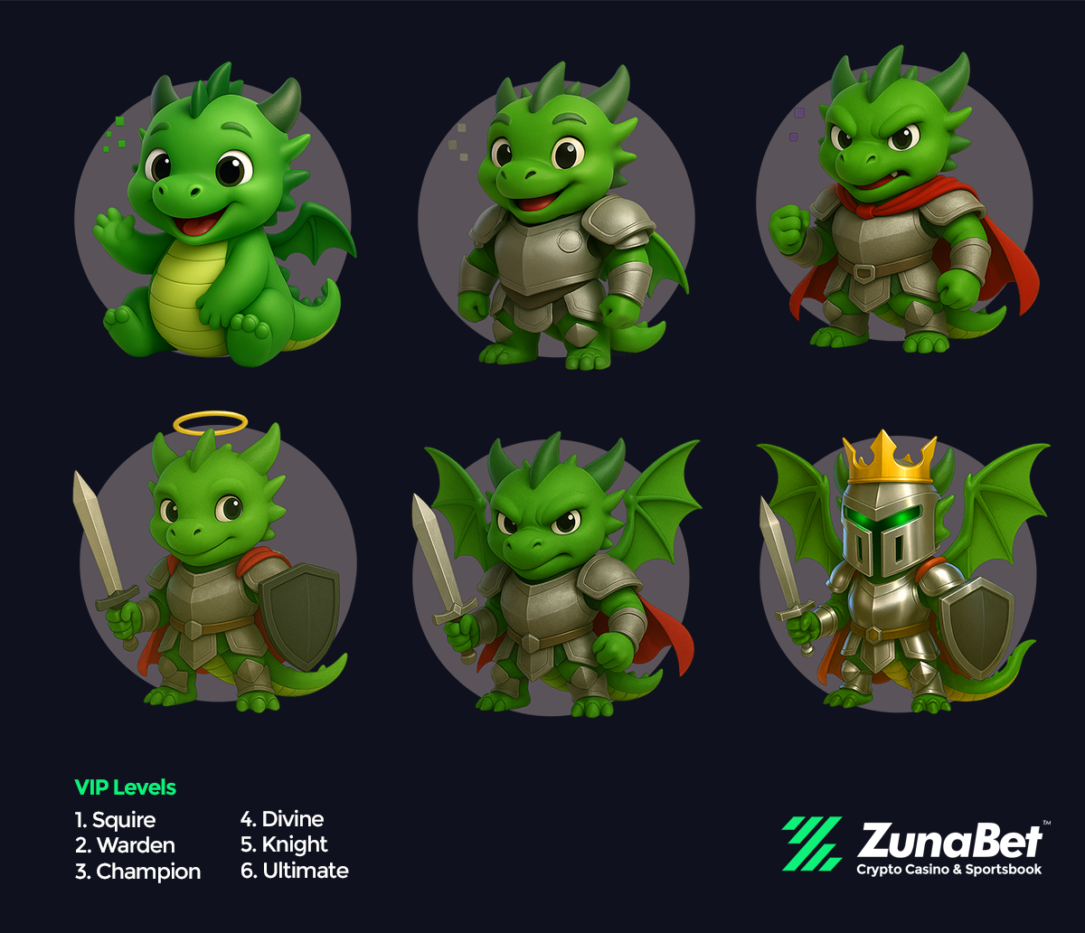
Higher tiers unlock more than rakeback. Tier-based free spins reach up to 1,000 spins, with VIP club access and double wheel spins layered through the journey. The whole format feels closer to progressing through a game than working through a points card. For players already familiar with that kind of mechanic, it changes the feel of regular play.
Why Players Are Looking at ZunaBet
Bet365 and 888casino remain dependable for players who value regulation and a long track record. Neither brand is in any danger of losing its place. But the bar for what an online betting platform should deliver keeps moving. Fast withdrawals, deep libraries, and engaging loyalty mechanics are now expected as standard rather than upsells.
ZunaBet was designed around those expectations from day one. The crypto-first core delivers quick payments and low fees. The library reaches beyond what most established brands carry. The sportsbook integrates traditional sports and esports together. The dragon loyalty program adds direction and progression to regular play.
For players who want speed, variety, and a more current feel, ZunaBet ranks among the more interesting platforms to track right now. It’s still in its early growth phase, but the direction is clear. A new generation of players treats crypto support, gamified rewards, and global access as starting points rather than features that need to be requested.
Bet365 and 888casino built the online betting world that exists today. ZunaBet is one of the platforms shaping what comes next — and the players who notice early are the ones getting the first look.
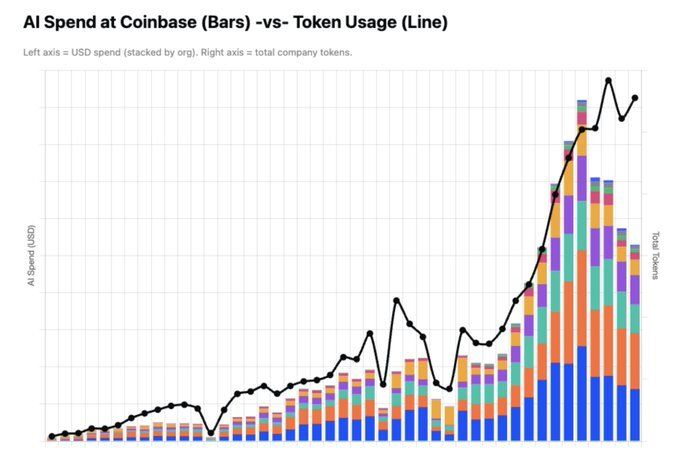
Coinbase CEO Brian Armstrong said the company cut its AI spending nearly in half while token usage grew exponentially, outlining an infrastructure playbook he believes any firm can use to scale AI adoption without treating cost as a ceiling.
Armstrong also offered a sharp reframe of the current Bitcoin (BTC) market cycle
AI Routing, Caching, and Open-Weight Models
Armstrong outlined three techniques behind the savings. The first is smarter model routing, which matches tasks to the cheapest model capable of completing them.
“How to keep AI spend flat while token usage grows exponentially: Not with friction and spend alerts. With better defaults, routing, and caching,” the Coinbase CEO said.
The second is aggressive caching, which eliminates redundant outputs for repeated queries. The third is a shift toward cheaper open-weight models for routine tasks where frontier-model performance adds no value.
The objective, Armstrong clarified, is not to cap usage but to build the infrastructure layer that enables sustainable scale. In early June, he examined AI’s largest bottleneck, contending that access to energy and compute matter more than model quality. The new spending data adds routing efficiency to that framework.

The framing positions cost reduction not as a constraint, but as a prerequisite for broader adoption. As a result, efficiency gains create headroom for usage to compound rather than triggering budget friction later on.
Armstrong did not disclose the absolute cost figures. Still, a company that halves AI spend while usage compounds at an exponential rate has effectively decoupled consumption from cost.
Bitcoin Dip “Barely Even a Winter”
On the Bitcoin front, Armstrong took direct aim at bearish sentiment. He described the current drawdown as far milder than anything long-term holders have seen before.
The data backs that read. River’s historical chart shows the 2025–2026 cycle has erased roughly 53% from Bitcoin’s October 2025 peak of $126,073.
That makes it the shallowest bear market on record. Prior cycles wiped out between 77% and 93%, with two exceeding 12 months.
Armstrong made a $60,000 bottom prediction in mid-June. However, on-chain data has not yet confirmed the capitulation signals that historically mark cycle lows. That gap between price and signal has been a persistent feature of this cycle.
The Coinbase CEO has backed Bitcoin’s four-year cycle consistently and projects prices far above current levels by 2030. Still, the 500-day halving signal most analysts track does not trigger until November 2026. The recovery timeline may be further out than Armstrong implies.
The post Coinbase CEO Halved AI Costs, Calls Bitcoin Downturn a Cool Breeze appeared first on BeInCrypto.

Cardano wallet provider SecondFi says it has built a recovery route for users impacted by a Tuesday exploit that exposed private keys for a portion of its customer base. In an update shared Saturday, SecondFi’s developer Emurgo indicated that asset returns should begin after completion of security testing and internal verification, with the first payouts expected in roughly two weeks.
The company’s CEO, Phillip Pon, said Emurgo finished forensic investigations and designed the process around SecondFi’s existing wallet states—an approach Pon warned users not to disrupt by moving funds independently or following instructions from unofficial sources.
Key takeaways
- SecondFi/Emurgo completed forensics and mapped a recovery pathway for affected users after Tuesday’s Cardano wallet exploit.
- Emurgo expects to start returning assets in about two weeks, after a week building the solution and a subsequent week of testing.
- SecondFi previously linked the incident to an address-level problem in its Cardano web wallet generation software that exposed private keys.
- The wallet provider says it is coordinating recovery without requiring user participation for key handling, and it is warning users about scams that may imitate official guidance.
- SecondFi secured a portion of funds (reported as 129 million ADA) via emergency measures and moved them to an independent third-party custodian for verification.
Recovery plan targets affected users after forensics
According to a Saturday statement from Emurgo CEO Phillip Pon posted on X, SecondFi has reached the stage of producing a recovery solution after finishing forensic work and establishing a pathway intended to safely return assets.
Pon said the immediate focus is the construction phase over the coming week, followed by an additional week of testing and security review before withdrawals or refunds begin. While the company has not published a full technical explanation of the exploit mechanics, its plan is designed to restore user assets in a controlled manner rather than through ad hoc user action.
Crucially, Pon urged users not to migrate assets or take steps outside official instructions during the recovery period. He characterized the workflow as dependent on the wallet states already recorded at the time of the incident, warning that independent actions could complicate efforts to securely reconcile and return funds.
What the Tuesday breach involved
SecondFi disclosed the breach earlier in the week, stating that the incident affected approximately 16 million ADA across 374 addresses. At the time of disclosure, SecondFi estimated the value at about $2.4 million.
In its initial reporting, SecondFi attributed the underlying cause to an address-level issue within its Cardano web wallet generation software. The company said this issue resulted in private keys being exposed for affected users.
Beyond identifying the exposure, SecondFi also said it took emergency measures to secure about 129 million ADA. Those funds were reportedly transferred to an independent third-party custodian and will remain there until the verification and recovery process is fully complete. The separation between the custodied funds and the ongoing recovery workflow underscores the company’s emphasis on verification before any broad asset return.
Scam warnings while recovery is still underway
As SecondFi works toward the next steps of its recovery program, it says scammers are trying to take advantage of the situation. In a separate Saturday update, SecondFi warned that malicious actors have been circulating fraudulent messages impersonating the wallet during the recovery window.
The company said no recovery actions requiring user participation have started. It also reiterated that SecondFi will not ask users for private keys, seed phrases, wallet credentials, or direct wallet access.
SecondFi further cautioned that any message instructing users to submit sensitive wallet information, migrate assets, or act immediately outside of its verified communication channels should be treated as fraudulent. For users seeking help, the company advised submitting a ticket through its official support portal while the recovery process continues.
Why the “two-week” timeline and “no user action” rule matter
The most practical part of SecondFi’s update for impacted users is the operational timeline. By stating that building and testing will consume about two weeks in total before asset returns begin, Emurgo is effectively communicating that this is not a one-day rollback or an instant unlock—rather, it is a staged process with security reviews intended to reduce the risk of further loss.
Just as important is the instruction to avoid migrating funds on one’s own. For wallet incidents, independent user actions can sometimes reduce the amount of verifiable data available to an operator or complicate address-level reconciliation. SecondFi’s stated approach—designing recovery around “existing wallet states”—signals that its engineers are working from a known set of conditions and that changing balances or moving assets independently could create mismatches between what is stored in the wallet records and what needs to be restored.
At the same time, the company’s scam warnings highlight the danger of acting on unofficial guidance. If users were to follow instructions from imposters—especially those asking for seed phrases or direct access—the consequences could compound the original exploit. SecondFi’s emphasis on never requesting private keys or credentials is therefore central to the security posture during recovery.
Still, some key uncertainties remain for the broader community. SecondFi has not published a comprehensive post-mortem that details the full vulnerability or how attackers executed the exploit. Until more technical information is shared, investors and users will likely focus on whether the scheduled testing and review periods end on time and whether asset returns proceed smoothly for all affected addresses.
For users affected by the Tuesday incident, the next watch points are whether SecondFi begins asset returns on the expected schedule and whether the company continues to provide clear, verified updates while discouraging any off-platform recovery attempts. For the wider ecosystem, the incident also serves as a reminder of how web wallet key-generation and address-level logic can become high-risk components—and why disciplined verification during recovery can be as important as the initial patch.
The spot exchange-traded funds tracking the two largest cryptocurrencies by market cap have continued their highly adverse streak, making it now seven consecutive weeks in the red.
The last five trading days were particularly painful as the spot BTC ETFs recorded their second-worst performance in terms of net flows since their inception two and a half years ago.
Spot BTC ETFs Bleed Hard
CryptoPotato has repeatedly reported on the poor performance of the spot Bitcoin ETFs, but the two weeks before the one that ended on June 26 brought some glimmer of hope. Although both were still in the red, the actual withdrawals were more modest, $316 million and $227 million, respectively, down from the $1.72 billion during the first week of June.
However, investors stepped up on the withdrawal button hard once again, pulling out $1.79 billion in total from the funds. This made it the worst week in terms of net flows since late February 2025, when the number stood at $2.61 billion.
The cumulative total net inflows have dropped to $51.61 billion. Recall that the number stood at above $59.30 billion by the middle of May. This means that the ETFs have lost almost $8 billion in less than two months.
If we break the data down to daily net outflows, Thursday stands out as the most painful day with $696 million leaving the funds, followed by $469 million on Wednesday, $444.5 million on Friday, and a more modest $90.66 million on Monday and $68 million on Tuesday.

The continuous outflows from the ETFs are among the most evident reasons why the underlying asset’s price keeps struggling as it plunged to a new multi-year low of $58,000 a few days ago. Analysts are convinced that the flows have to stabilize before BTC has a chance of a more profound recovery.
ETH ETFs in Red, Too
The landscape around the spot Ethereum ETFs is not that much different, just the scale is smaller. The funds have been in the red for seven consecutive weeks as well, and the net outflows from the past week were a lot higher than the previous two. More specifically, the ETFs bled $15 million during the second week of June and $10 million during the third. During the last one, though, investors took out $273.34 million.
The total net flows have dropped from $12.09 billion in mid-May to well under $11 billion as of Friday’s close. Tuesday and Thursday saw the most net withdrawals, with $82.35 million and $81.87 million, respectively.

The post Bitcoin ETFs Set Another Anti-Record as $1.8B Leave the Funds Weekly appeared first on CryptoPotato.

How The Mag 7 Became The Drag 7, And Might Drop The S&P 500 By 30% (Technical Analysis)

Rain Trade launches decentralized prediction market as the industry rethinks how questions are created and managed
Criticism & panic follow Naomi Osaka after Bad Homburg final as fans question retirement decision


-

 Entertainment7 days ago
Renter of Home in Anne Heche Crash Denies Settlement With Son
-
 Sports4 days ago
Two goals and an assist by sheer aura: Cristiano Ronaldo just entered the World Cup chat
-

 Tech5 days ago
Microsoft accidentally kills epic Outlook email threads
-

 Fashion21 hours ago
Weekend Open Thread: Staud – Corporette.com
-

 Business7 days ago
Soccer-U.S. defends Iran World Cup travel restrictions, says discussions ongoing
-

 Politics1 day ago
The House | Manchesterism won’t survive the painful trade-offs unless it gets citizens on board
-

 Politics2 days ago
Potential 2028er World Cup attendee leaderboard
-

 Business1 day ago
Asia stock markets slide as tech shares slump
-

 Tech2 days ago
A Look At A Gaggle Of Transputer Boards
-
Crypto World3 days ago
Bitcoin (BTC) Dips Below $62K, Ethereum (ETH) Plunges 6% Daily: Market Watch
-

 Crypto World3 days ago
Securitize Wraps Roubini's SEC-Registered ETF as Dubai VARA Digital Security
-
 Crypto World2 days ago
Dell (DELL) Shares Tumble Over 5% Following Analyst Downgrade to Hold
-
Business4 days ago
Entergy settles forward sale agreements, raises $672 million in cash proceeds
-

 Sports18 hours ago
FIH Pro League: India defeat Pakistan 7-1, register biggest win of campaign | Other Sports News
-

 Crypto World9 hours ago
Kraken's xStocks Opens Bending Spoons IPO Registration to EEA Retail
-

 Crypto World21 hours ago
RTX holders must register wallets before token distribution begins
-
 Crypto World1 day ago
Hyperliquid Named on Singapore MAS Investor Alert Register
-

 Sports2 days ago
India vs Bangladesh LIVE Score, Women’s T20 World Cup: Bangladesh Opt To Bat; India Enter ‘Do-Or-Die’ Stage As Semi-Final Race Heats Up
-
 Tech6 days ago
Signal’s Meredith Whittaker says AI chatbots ‘are not your friends’ and calls Copilot agents a backdoor
-
Crypto World1 day ago
The DATA Foundation Launches to Tackle AI’s Multi-Billion Dollar Training Data Bottleneck
You must be logged in to post a comment Login