
Crypto World
Zcash Launches First European ETP After US ETF Approval

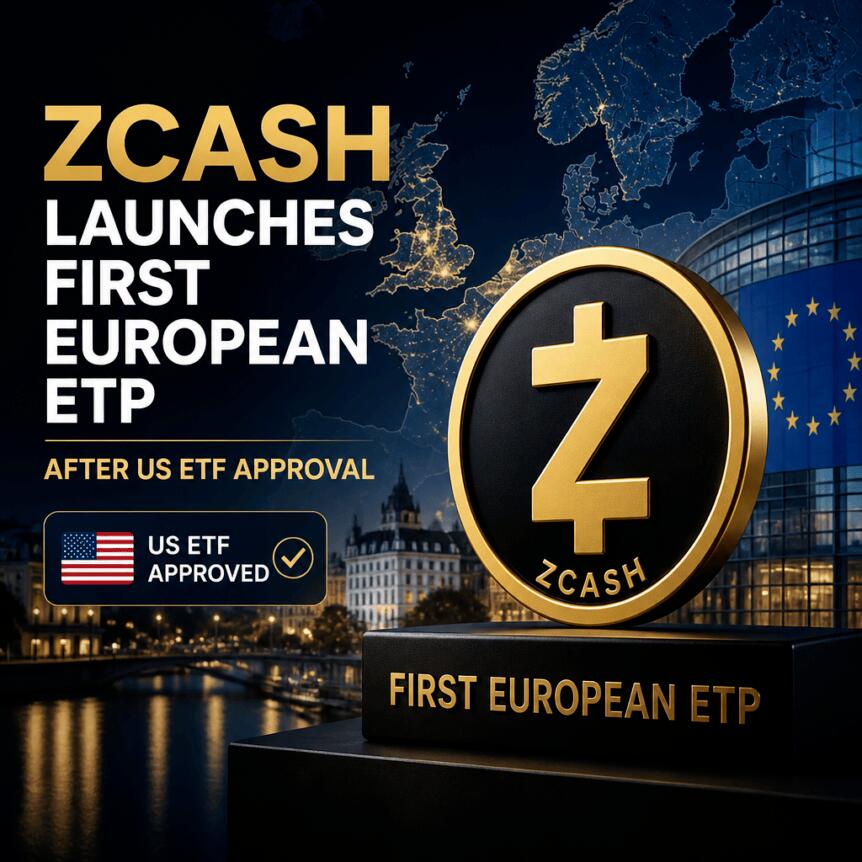
21Shares has expanded its European ETP lineup with two physically backed products—one linked to Zcash (ZEC) and another tied to Ether.fi’s ETHFI token. The Zcash launch marks the first exchange-traded product in Europe specifically offering exposure to the privacy-focused coin through regulated market infrastructure.
On Tuesday, the firm listed its physically backed Zcash ETP on Euronext Paris and Amsterdam, enabling investors to obtain ZEC exposure via traditional brokerage accounts without directly holding the cryptocurrency. In parallel, 21Shares introduced a physically backed ETP tracking ETHFI, the governance and utility token of Ether.fi, also trading on Euronext Paris and Amsterdam.
Key takeaways
- 21Shares launched Europe’s first Zcash-linked physically backed ETP on Euronext Paris and Amsterdam.
- A second new product tracks Ether.fi’s ETHFI token, also in physically backed form on the same venues.
- Both ETPs charge a 2.5% annual management fee—significantly higher than many comparable European crypto products focused on bitcoin and ether.
- The expansion follows the U.S. debut of a Grayscale Zcash ETF trading on NYSE Arca under ticker ZCSH, underlining growing institutional reach for ZEC.
Regulated access for Zcash in Europe
ETPs have become a common route for institutional and retail investors to access crypto exposure within traditional market frameworks. By listing a physically backed Zcash ETP, 21Shares is effectively bringing ZEC into that ecosystem on two major Euronext markets: Paris and Amsterdam.
The listing structure is straightforward: rather than using derivatives or synthetic exposure, a physically backed ETP is designed to hold the underlying asset. For investors, that can simplify operational considerations—especially for those who prefer not to self-custody or manage direct exchange and wallet logistics—while still accessing ZEC exposure through a broker.
However, the economics matter. The 2.5% annual management fee is well above the level charged by many bitcoin and ether ETPs in Europe, which could influence investor demand—particularly for those assessing total cost over time rather than only near-term price momentum.
ETHFI ETP broadens the theme beyond privacy coins
Alongside the Zcash product, 21Shares launched an ETP tracking ETHFI, the token associated with Ether.fi, a decentralized finance protocol offering staking and other crypto-based financial services. Like the Zcash offering, the ETHFI ETP is physically backed and trades on Euronext Paris and Amsterdam.
This second listing signals that 21Shares is not only focused on privacy-coin exposure. Instead, it is also adding a product tied to the broader DeFi ecosystem—where token value is often linked to participation in protocol services such as staking, governance, and network activity. For investors, that creates a choice between two different “entry points” into crypto themes: privacy-focused infrastructure on the one hand, and DeFi utility on the other.
As with the Zcash ETP, the 2.5% annual fee also sets a notable baseline. Traders and long-term holders will likely weigh that ongoing cost against expected volatility and the pace at which token fundamentals can change in DeFi markets.
Zcash’s surge renews Bitcoin comparisons
21Shares’ decision to launch the Zcash ETP arrives amid a renewed spotlight on the coin after a strong market run. According to CoinMarketCap data cited in the original reporting, Zcash recently pushed above $1,500 and has gained nearly 1,100% over the past year.
That performance has pulled Zcash back into debates about whether it can operate as more than a niche privacy asset. In particular, renewed attention has returned to the idea of Zcash acting as a potential alternative to bitcoin—an argument that has appeared in past discussions around network effects and long-term survivability.
Grayscale head of research Zach Pandl has previously argued that Zcash could benefit from “second-mover advantages” that might help it overcome bitcoin’s entrenched network effects, according to earlier commentary covered by Cointelegraph. The broader question for investors is whether Zcash can convert price momentum into durable demand from institutional channels—especially as more regulated products become available.
At the same time, the existence of institutional ETP and ETF wrappers does not automatically solve underlying adoption challenges. For privacy-focused networks, sustainability often depends not only on price cycles but also on ecosystem growth, developer activity, liquidity depth, and regulatory treatment across jurisdictions.
Institutional momentum: U.S. ETF and ongoing mining activity
Europe’s new Zcash ETP follows a related development in the U.S. Earlier coverage highlighted the launch of a Grayscale Zcash ETF that trades on NYSE Arca under the ticker ZCSH, described in the original reporting as arriving after U.S. regulatory approval.
Taken together, a U.S. exchange-traded product plus the arrival of a European ETP suggests Zcash is increasingly on the radar of asset managers that focus on regulated access. That shift matters because it can widen the investor base—particularly among participants who may face internal constraints on direct cryptocurrency ownership.
There are also signals of scale within the network’s proof-of-work ecosystem. Fortitude Digital Mining told Cointelegraph that it mined about 28% of all ZEC produced in the first half of 2026, framing its focus on Zcash around its proof-of-work model, capped supply, and privacy features. While such statements do not directly determine price, they can be relevant to how investors think about network participation and the operational depth behind the asset.
For now, investors should treat the product rollout as a step forward in access rather than a guarantee of sustained outperformance. The key variable will be whether higher-cost ETP structures—especially with a 2.5% fee—can attract steady flows as the market digests Zcash’s recent rally.
Looking ahead, readers should watch how trading volumes and inflow dynamics develop for both of the new Euronext listings, and whether Zcash’s institutional exposure continues to broaden after the U.S. ETF addition—alongside any further clarity on long-term catalysts for ZEC that go beyond price momentum.

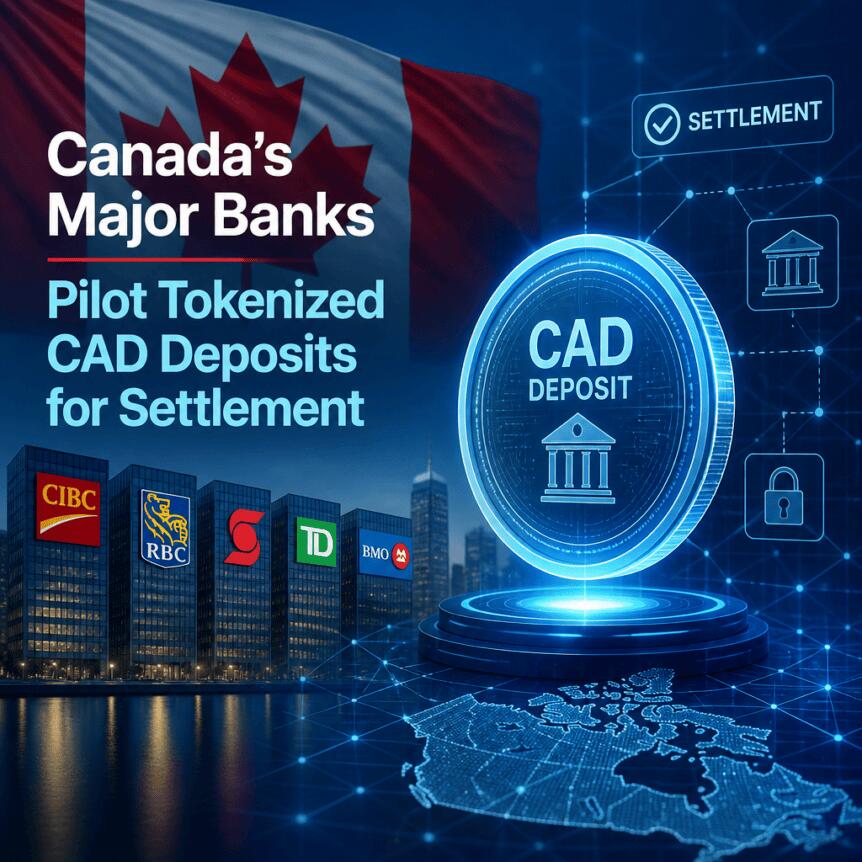
Six of Canada’s largest banks have begun work on a shared concept for moving tokenized Canadian dollar (CAD) deposits between financial institutions. The initiative, announced Tuesday, would represent bank deposits as digital tokens while keeping the deposits’ legal status tied to the issuing banks.
Bank of Montreal, CIBC, National Bank of Canada, Royal Bank of Canada, Scotiabank and TD Bank Group said the project’s first phase will concentrate on transferring tokenized deposits across Canadian institutions. The banks also hinted at possible later interoperability with other digital asset ecosystems.
Key takeaways
- Six major Canadian banks are jointly exploring tokenized CAD deposits as a way to move digital representations of deposits between institutions.
- The plan’s early scope is domestic interbank settlement; future steps could connect the approach to broader digital asset systems.
- OSFI recently clarified that tokenized deposits are “not legally distinct” from traditional deposits, supporting the effort from a regulatory perspective.
- Tokenized deposits differ from fiat-backed stablecoins because the deposits remain a liability of a regulated bank, not a separate digital asset issued by a third party.
- Canada’s stablecoin framework is progressing separately and is designed for fiat-backed stablecoins issued by non-financial institutions, not banks.
A joint effort to tokenize deposits—without changing their legal nature
In the announcement, the participating banks framed tokenized deposits as a mechanism to modernize payments. The core idea is to use digital tokens to represent deposits, enabling them to move more quickly and—according to the banks—support “programmable” payment features.
What investors and builders should notice is that the tokenization concept described here is not about converting deposits into a new category of asset that sits outside banking regulation. The banks’ approach is explicitly grounded in existing deposit structures: the tokenized product still corresponds to money held at a regulated bank and remains that bank’s liability.
This distinction matters because it shapes how risk and oversight are applied. According to OSFI’s earlier guidance, the underlying technology used to deliver a financial product does not determine its legal character.
Regulatory backdrop: OSFI’s clarification came earlier this month
Less than two weeks before the banks’ joint announcement, Canada’s banking regulator provided additional clarity on tokenized deposits. On Sept. 10, the Office of the Superintendent of Financial Institutions (OSFI) stated that tokenized deposits are “not legally distinct from traditional deposits.” OSFI also emphasized that legality is determined by the nature of the product, not by whether it is implemented on-chain or through another technology layer.
That timing is more than a coincidence. By aligning their work with OSFI’s interpretation, the banks are effectively operating in a clearer regulatory lane—one that treats tokenized deposits as functionally equivalent to conventional deposits from a legal standpoint.
Still, the banks did not lay out the end-to-end architecture in the materials referenced in the announcement. Readers should expect further details to come as the first phase develops, especially around custody, settlement finality, operational controls, and how interoperability would work in practice.
Tokenized deposits vs. stablecoins: Canada is regulating both, but differently
The new deposit-token initiative sits alongside a broader regulatory push for digital money in Canada, but the policy frameworks are not interchangeable.
Canada’s Stablecoin Act was enacted in March as part of Bill C-15. The legislation establishes a federal framework for fiat-backed stablecoins, requiring non-financial institution issuers to register with the Bank of Canada, keep reserves at least 1:1 in high-quality liquid assets, and enable redemption at par. The framework is expected to take effect in 2027.
However, the Act’s scope is narrower than the tokenized-deposits project. The stablecoin framework covers fiat-backed stablecoins issued by non-financial institutions; banks and credit unions already subject to prudential regulation are outside its scope. The legislation also restricts issuers covered by the framework from presenting stablecoins as deposits or as insured under a public deposit insurance system.
That separation explains why tokenized deposits are being explored by banks under deposit-style legal treatment, while stablecoin policy is aimed at different issuer types. Even though both approaches involve token-like instruments, the regulatory intent diverges: tokenized deposits aim to preserve the traditional banking liability structure, while stablecoin rules focus on how non-bank issuers back and redeem fiat-linked tokens.
What the next phase could mean for payments
The banks said their first phase will focus on moving tokenized deposits between Canadian financial institutions. If successful, that could reduce certain friction points in cross-institution payment flows by enabling more direct digital transfer of deposit-linked balances.
The banks also indicated that longer-term plans could involve opening the system to other deposit-taking institutions, and possibly connecting with other digital asset systems. That raises an important question for the market: whether tokenized deposits will remain primarily an interbank settlement tool within the regulated banking perimeter, or whether they will evolve toward wider interoperability with permissioned networks and, potentially, broader on-chain payment rails.
For now, the initiative is explicitly framed as a development effort. The article notes that Cointelegraph reached out to CIBC for additional details but did not receive an immediate response, suggesting that key technical and operational specifics have yet to be publicly clarified.
Over the coming months, market participants will want to watch how participating banks define the project’s scope in practice—particularly how they handle settlement finality, compliance controls, and whether the pilot results influence wider adoption across Canada’s financial sector—especially in light of OSFI’s recent regulatory clarification.
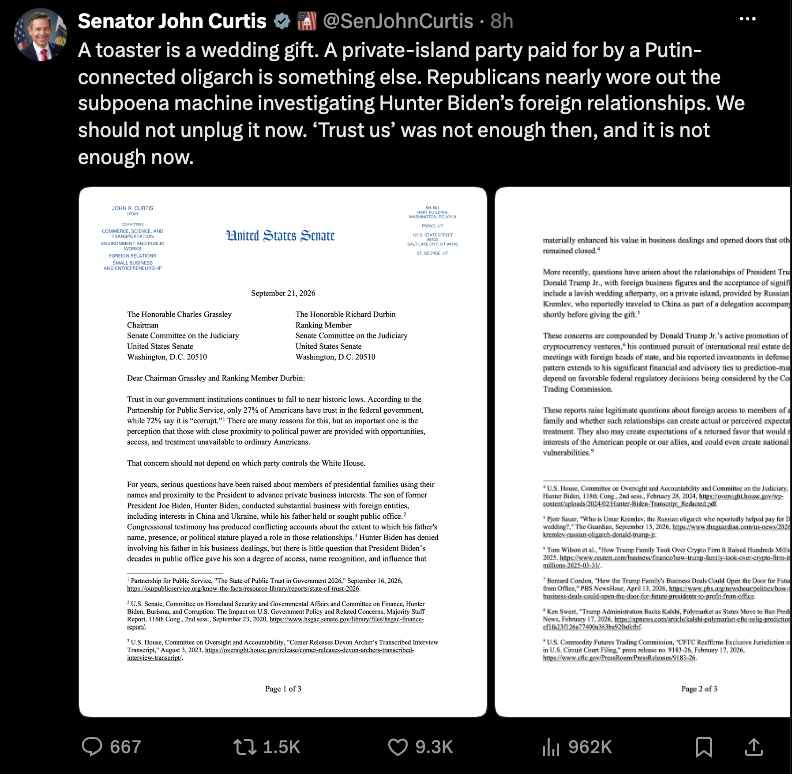
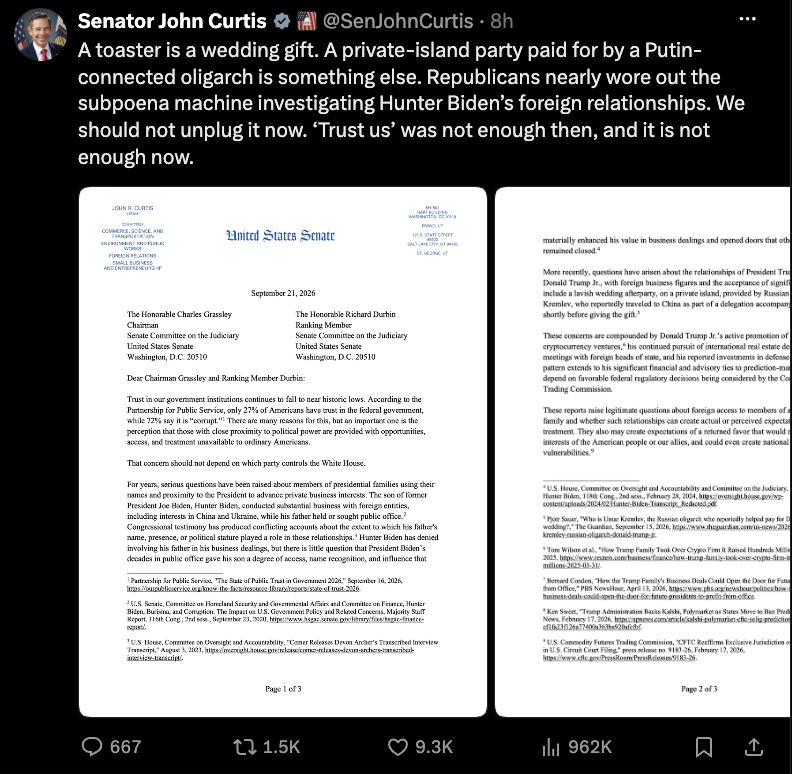
Senator John Curtis, a Republican representing Utah, sent a letter to leaders of the Senate Judiciary Committee calling for an investigation into US President Donald Trump’s and former President Joe Biden’s sons, citing the former’s involvement in the crypto industry.
In a Monday letter to Senate Judiciary Committee Chair Chuck Grassley and ranking member Dick Durbin, Curtis said that the body should probe “the use of presidential family relationships for private financial benefit, preferential treatment, or access by domestic and foreign interest.” He also asked for subpoenas for Donald Trump Jr. and Hunter Biden, Joe Biden’s son.
The Utah lawmaker specifically called out Donald Trump Jr. for accepting gifts from Russian oligarch Umar Kremlev as part of his wedding, his “active promotion of family-backed cryptocurrency ventures” and advisory roles with prediction market platforms, as the companies are under the regulatory purview of the Commodity Futures Trading Commission. The president said last week that his son had paid Kremlev back for what Donald Trump Jr. and his wife called a “generous wedding gift.“
Curtis also called for a similar probe into Hunter Biden for “substantial business with foreign entities” and instances in which either man’s relationship to the presidency was “invoked or understood to provide value.” President Biden issued a pardon for his son in December 2024 for crimes he “committed or may have committed or taken part in over the last decade,” and Curtis noted that Hunter had “denied involving his father in his business dealings.“
“The purpose of such an inquiry should be straightforward: establish the facts, determine whether existing ethics, disclosure, or anti-corruption laws apply, and identify reforms necessary to prevent the presidency from becoming a vehicle for private enrichment by those closest to it,” said Curtis.
Source: Senator John Curtis
The call for an investigation into the Trump family’s ties to the crypto industry is nothing new for the current session of Congress, but it has largely come from House and Senate Democrats. Lawmakers have asked authorities to probe potential conflicts of interest surrounding Trump’s memecoin, his family’s World Liberty Financial business and a $500 million deal tied to Abu Dhabi’s royal family.
Curtis is serving his first term in the Senate and will not be up for reelection until 2030.
CLARITY still in limbo in US Senate as midterm elections approach
The call for an investigation into Donald Trump Jr. and Hunter Biden came a week after Senate Republicans failed to secure enough support from Democrats to pass the Digital Asset Market Clarity Act, a bill expected to establish market structure rules for the crypto industry.
One of the sticking points for not supporting the bill, according to some Democrats, was Trump “using crypto to turn the presidency into a profit generating machine.” The president disclosed that he had earned $1.4 billion from ventures tied to digital assets in 2025.
Republicans said the president had agreed to stronger ethics provisions in the bill affecting his crypto investments before the vote, but many Democrats argued that the measures did not go far enough to prevent corruption.
Magazine: Big Questions: Does Satoshi actually own 1.1 million Bitcoin?

Arch Lending is preparing to expand its credit offerings to include loans backed by tokenized equities, as lenders increasingly look for new collateral categories to support onchain borrowing. Co-founder and chief revenue officer Himanshu Sahay said the firm expects to move “pretty soon,” arguing that demand for credit against tokenized stocks is growing as the asset class scales.
Speaking on Cointelegraph’s Chain Reaction podcast, Sahay pointed to rapid growth in tokenized equities over the past year, while noting that lending capacity against those assets still appears limited. He expects more lenders to follow as tokenized stock products mature and become easier to use in collateral frameworks.
Key takeaways
- Arch Lending plans to add loans backed by tokenized equities, expanding beyond crypto-only collateral.
- Sahay links the push to growing tokenized stock issuance and a shortage of credit options that support borrowers.
- Arch has recently launched tokenized real-world asset loans backed by Paxos Gold and Tether Gold.
- Existing Arch lending is still crypto-led, with Bitcoin representing more than 80% of the loan book, and rising interest in XRP among US borrowers.
Arch’s next step: credit against tokenized stocks
Arch has already expanded beyond cryptocurrencies, launching loans backed by tokenized real-world assets including Paxos Gold and Tether Gold in recent weeks, according to Sahay. However, crypto remains the dominant collateral category in its current portfolio: Sahay said Bitcoin accounts for more than 80% of Arch’s loan book.
Even within crypto collateral, Arch is seeing shifting borrower preferences. Sahay said the lender has noticed growing interest in XRP as collateral, particularly among US borrowers—an indication that demand for specific asset types may depend on regional borrower needs and available liquidity rather than broad “market beta” alone.
Against that backdrop, tokenized equities represent a logical extension. Sahay cited the broader expansion of tokenized stock offerings from firms including Superstate, Robinhood, and Securitize, suggesting that a larger universe of onchain share tokens is being created—yet lending against those tokens remains relatively underdeveloped compared with more established collateral categories.
In practical terms, the appeal for lenders is straightforward: tokenized stocks and ETFs could enable borrowers to access credit without liquidating underlying exposure, while providing lenders with a collateral pool that may diversify beyond digital assets like BTC and ETH.
Why tokenized equity lending is gaining traction
Arch would not be entering the market first. Tokenized stocks and exchange-traded funds (ETFs) have been moving into collateral and lending products as infrastructure matures.
In February, Ondo Finance launched DeFi lending markets for two tokenized ETFs through an integration with lending protocol Morpho, according to Ondo Finance’s announcement. Ondo’s tokenized versions of the SPDR S&P 500 ETF and Invesco QQQ can be used as collateral for borrowing on Ethereum.
Beyond dedicated lending markets, tokenized equities are also starting to appear in adjacent functions tied to leverage and market operations. Kraken, for example, made 10 xStocks eligible to back futures and margin positions in July, according to Kraken’s product update. Coinbase also rolled out B20 stocks on Base in August, described as including price-feed infrastructure intended to support use cases that can include DeFi borrowing and lending, as previously reported by Cointelegraph.
The throughline across these developments is that tokenized equities are becoming more “programmable” within crypto ecosystems—an essential requirement for credit markets, where collateral eligibility, valuation, and liquidation mechanics determine whether assets can be reliably used in borrowing.
Market expansion: tokenized stocks grow faster than lending options
One reason lenders can justify moving into tokenized equity collateral is the scale of the underlying market. The article cites RWA.xyz data showing distributed tokenized stock value has climbed to about $3.15 billion, up from roughly $630 million a year earlier.
This growth suggests that more capital is being wrapped into tokenized formats that can, in principle, be used in DeFi lending and other credit structures. But the gap that Sahay highlighted remains important: despite rapid tokenized equities adoption, lending backed by these assets is still described as limited. For investors and borrowers, that difference matters because it can translate into fewer opportunities to access leverage or liquidity using those assets, as well as potentially less competitive borrowing conditions than in more mature collateral segments.
As more platforms begin to expand eligibility for tokenized stocks—whether through dedicated lending markets or through margin and futures pathways—the credit ecosystem could become more resilient. It may also normalize tokenized equities as collateral beyond niche experiments.
What to watch next for tokenized equity collateral
Arch’s planned expansion will likely be judged on several practical questions: how quickly it can integrate tokenized stock collateral, how lenders and borrowers manage valuation and risk across different issuers, and whether Arch’s approach aligns with broader market infrastructure being developed by other venues.
With tokenized stock value growing sharply and multiple crypto platforms already moving tokenized equities into lending-adjacent uses, the next phase will be less about whether lending is possible and more about whether it becomes competitive, scalable, and consistent enough to attract mainstream borrower demand.
In the coming months, readers should watch for Arch’s timing on tokenized equity-backed lending and for additional platforms to announce similar collateral expansions—signals that the market may be transitioning from early infrastructure pilots into fully functional credit offerings.

Crypto lender Arch Lending plans to expand into loans backed by tokenized equities as the market for onchain stocks expands and lenders begin exploring new uses for the assets as collateral.
Arch co-founder and chief revenue officer Himanshu Sahay told Cointelegraph’s Chain Reaction podcast that the lender plans to enter the market “pretty soon,” pointing to a need for credit against tokenized stocks.
Sahay said tokenized equities have grown rapidly over the past year, but lending against the assets remains limited, and predicted that more lenders will enter the market.
He pointed to tokenized equities issued by firms including Superstate, Robinhood and Securitize, predicting that multiple lenders will eventually participate in the market to provide credit against the assets.

Source: Cointelegraph
Arch has already expanded beyond cryptocurrencies into tokenized real-world assets, launching loans backed by Paxos Gold and Tether Gold in recent weeks, according to Sahay.
But crypto still dominates Arch’s existing loan book, with Bitcoin (BTC) accounting for more than 80%, Sahay said. He added that the lender has recently seen growing interest in XRP as collateral, particularly among US borrowers.
Related: Kraken brings DeFi yield to tokenized stocks and ETFs
Tokenized stocks enter lending markets
Arch would not be the first lender to enter the tokenized equity credit market, with tokenized stocks and exchange-traded funds (ETFs) already entering lending and collateral products.
In February, Ondo Finance launched DeFi lending markets for two of its tokenized ETFs through an integration with lending protocol Morpho. Ondo’s tokenized versions of the SPDR S&P 500 ETF and Invesco QQQ can be used as collateral for borrowing on Ethereum.
Tokenized stocks are also beginning to find uses beyond dedicated lending markets. Kraken made 10 xStocks eligible to back futures and margin positions in July, while Coinbase’s B20 stocks launched on Base in August with price-feed infrastructure designed to support uses including DeFi borrowing and lending.
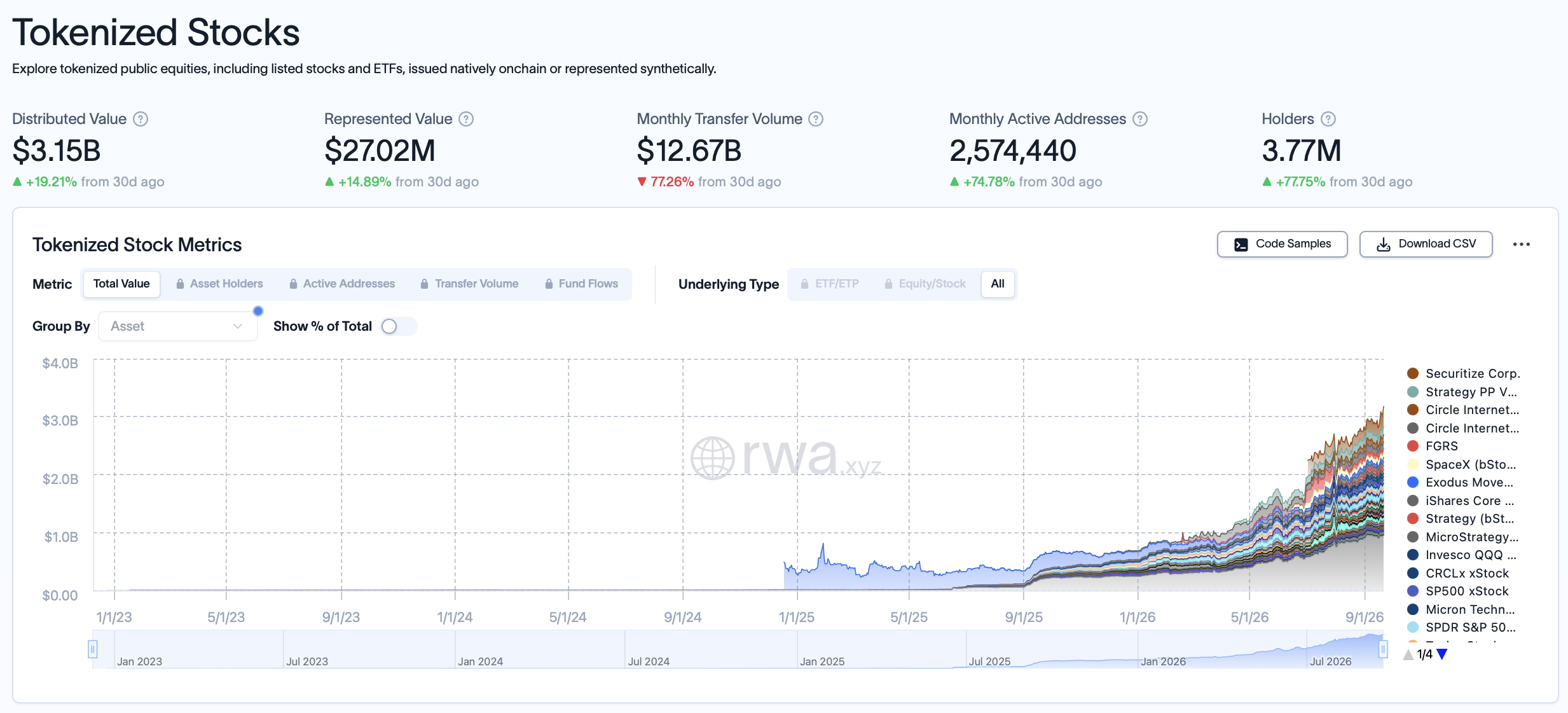
Tokenized equities. Source: RWA.xyz
The growth in lending use cases comes as the tokenized equities market itself has expanded sharply. Distributed tokenized stock value has climbed to about $3.15 billion from roughly $630 million a year ago, according to RWA.xyz data.
Magazine: Kyle Samani predicts SOL flippening, claims ‘no one’ uses ETH

Depop is known as an online marketplace for secondhand clothes—but for the Gen-Z fashionistas who congregate there, it’s also a community. With more than 56 million registered users and over 68 million items for sale, it’s a big community, to be sure. But user quality is just as important as user quantity, argues chief technology officer Keyur Govande.
Given that dual users tend to be more active and engaged community members, Govande, who joined the company in May 2025 after more than 14 years at Etsy, is focused on building tools that help buyers become sellers and vice versa. “It’s the two-sided nature of our marketplace that makes us really special,” he explains, citing as a prime example the company’s listing flow, which saves time and effort by using AI to automatically generate listing titles and descriptions based on merchandise photos.
To reduce user friction even further going forward, Govande plans to leverage Depop’s new relationship with eBay, which acquired the company in July. “The ways eBay can support us with its deep expertise in things like shipping and payments is something we’re really looking forward to,” he says.


At a moment when emerging technologies are driving both the global economy and the news cycle, business leaders must not only keep up with an industry moving at a breakneck pace—they must look around the corner at what’s next. That’s why TIME is publishing its first-ever Executives of the Year: Tech & Data list, recognizing 50 leaders shaping the future of technology, artificial intelligence, cybersecurity, and digital innovation across industries.
See the full 2026 list here.
Among them are Bartley Richardson, CrowdStrike’s chief AI and autonomous systems officer, who is heading up a new AI research lab dedicated to building autonomous cybersecurity systems, and Reddit chief technology officer (CTO) Amit Puntambekar, who is shepherding AI adoption at one of the internet’s largest repositories of human conversation. At pharmaceutical giant Eli Lilly & Co., Diogo Rau oversaw the effort to build a supercomputer called LillyPod, which models biological processes and screens potential molecules before promising candidates enter wet lab experiments. Meanwhile, at OpenAI, Vijaye Raji, CTO of applications, is in charge of key technical teams—such as data, experimentation, and growth—that help power the ubiquitous ChatGPT, as well as the coding tool Codex.
To create the list, our editors and reporters across the newsroom evaluated the scale of each leader’s responsibilities, the significance of the investments and initiatives they oversee, and their demonstrated impact on how their organization operates, competes, and grows. What came together was a group of executives tasked with modernizing legacy systems and digital infrastructure. Those leaders include Monica Caldas, Liberty Mutual’s global chief information officer, who is rewiring the century-old insurance company for what she calls “the intelligence era,” and Ogi Redzic, who joined Caterpillar Inc. as SVP and chief digital officer in 2018 and has helped the equipment manufacturer rebuild itself around data to address customers’ labor and safety issues.
The list also highlights the creation of new or expanded roles designed to meet the fast-evolving moment. There’s Kathleen Grace, named Lionsgate’s first-ever chief AI officer in February and the first Hollywood studio executive to hold that particular title, as well as Delta’s Amala Duggirala, who joined the airline in January as EVP and chief digital and technology officer—a brand-new role overseeing its recently combined digital and technology organizations, encompassing both the enterprise technology that powers its global operations and the digital tools it creates for customers and employees alike.
Beyond the U.S., tech executives across Asia, Africa, and Europe are driving innovation. At Singapore-based Grab, CTO Suthen Thomas Paradatheth has helped the company transition from a ride-sharing platform to a superapp that processes millions of transactions a day across Southeast Asia. Felix Ike, co-founder and CTO of the Nigerian fintech company Moniepoint, has helped to establish the business as one of Africa’s leading financial platforms. At Paris-based Back Market, a global online marketplace for refurbished electronics, CTO Dawn Baker is applying an environmental mission to the company’s use of computing power. “We have to make sure we’re not using more than we need,” she says. “It’s about using AI smartly and not falling for the hype.”
These leaders and their fellow honorees are the catalysts of some of the most consequential transformations taking place across modern enterprise—translating innovation into meaning.


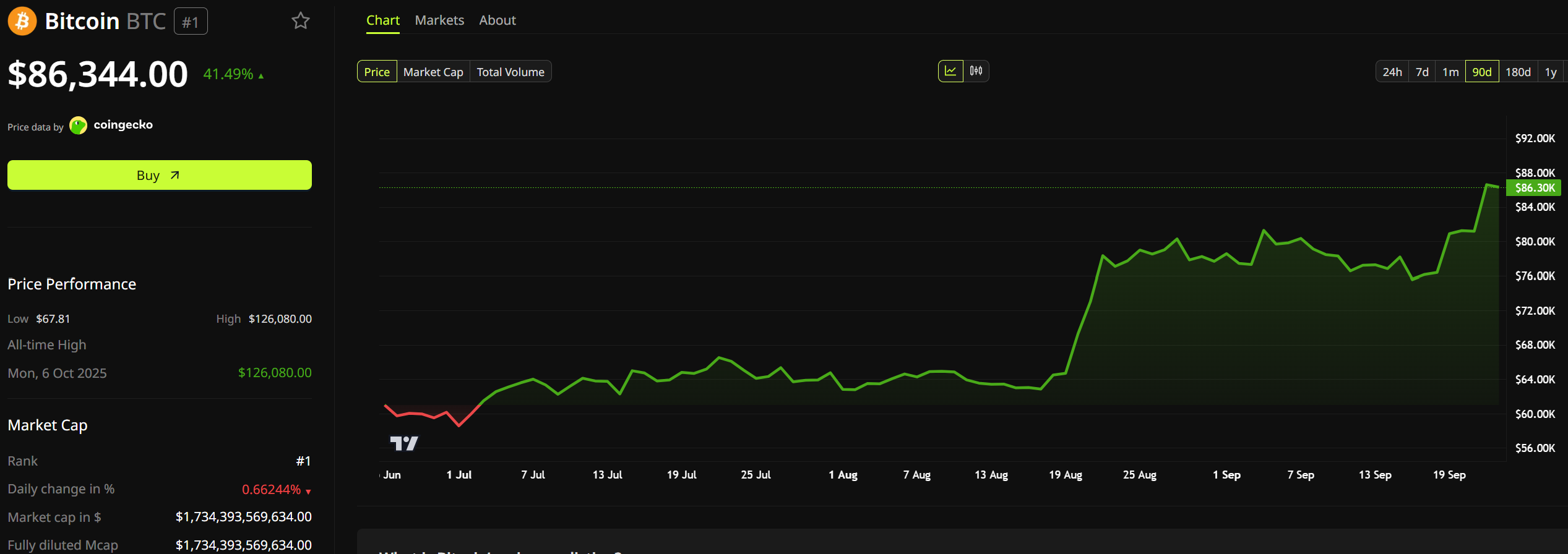
Bitcoin (BTC) traded at $86,423 on Tuesday, up from below $76,000 a week ago. Tom Lee and iTrustCapital’s CEO, Kevin Maloney, say the worst is now behind investors.
Both men made their case after a US interest rate hike and a failed crypto bill, the CLARITY Act. Neither event stopped the pioneer crypto’s rebound.

iTrustCapital CEO Says the Crypto Winter Is Over
Maloney runs iTrustCapital, a platform for crypto and stock investing in retirement accounts. In an interview with Paul Barron, he said the long crypto slump, often called the “crypto winter,” had ended.
His firm was holding about $350 million in idle client cash, Maloney said. He added that “significant portions” were now being invested again.
“Bitcoin doesn’t need Clarity Act,” Maloney said in the interview.
Maloney also named a level to watch. A weekly close above $85,000, he said, would leave Bitcoin in a good position.
Tom Lee Says the Fed Cannot Get More Hawkish
Elsewhere, Fundstrat Capital chief investment officer Tom Lee sees the rate hike as a peak, not the start of a squeeze. He has made that call repeatedly this month.
In his weekly update, Lee pointed to a change in how the government measures inflation, due September 30. He said economists expect it to cut the Personal Consumption Expenditures (PCE) inflation rate, the Fed’s preferred gauge, from 3.4% to near 3%.
“They can’t get any more hawkish than this,” Tom Lee stated.
Lee added that even one more 0.25-point hike would not break the economy or the stock market.
Their Remarks Come After Two Setbacks in One Week
On September 15, the CLARITY Act failed a Senate procedural vote 50-49, short of the 60 needed. The bill would have set out which US regulator oversees digital assets.
A day later, the Federal Reserve raised its benchmark rate by 0.25 percentage points to a 3.75% to 4% range. It was the first increase since 2023. Bitcoin slipped below $76,000 after the vote. It has since recovered.

Fed Projections and ETF Outflows Point the Other Way
Not every signal agrees. Sixteen of 18 Fed officials expect another hike this year, according to the central bank’s projections.
Investors also pulled $450 million from Bitcoin exchange-traded funds (ETFs) on September 15, according to ETF fund flow figures.
Bitcoin sits 0.6% higher on the day, BeInCrypto price data shows. The next test arrives September 30, when the revised inflation figures land.
The post Tom Lee and iTrustCapital CEO Say the Worst Is Over: Can Bitcoin Hold $86,000? appeared first on BeInCrypto.
Crypto World
Democrats ‘chose visceral hatred for’ Donald Trump over crypto Clarity Act, Lummis says
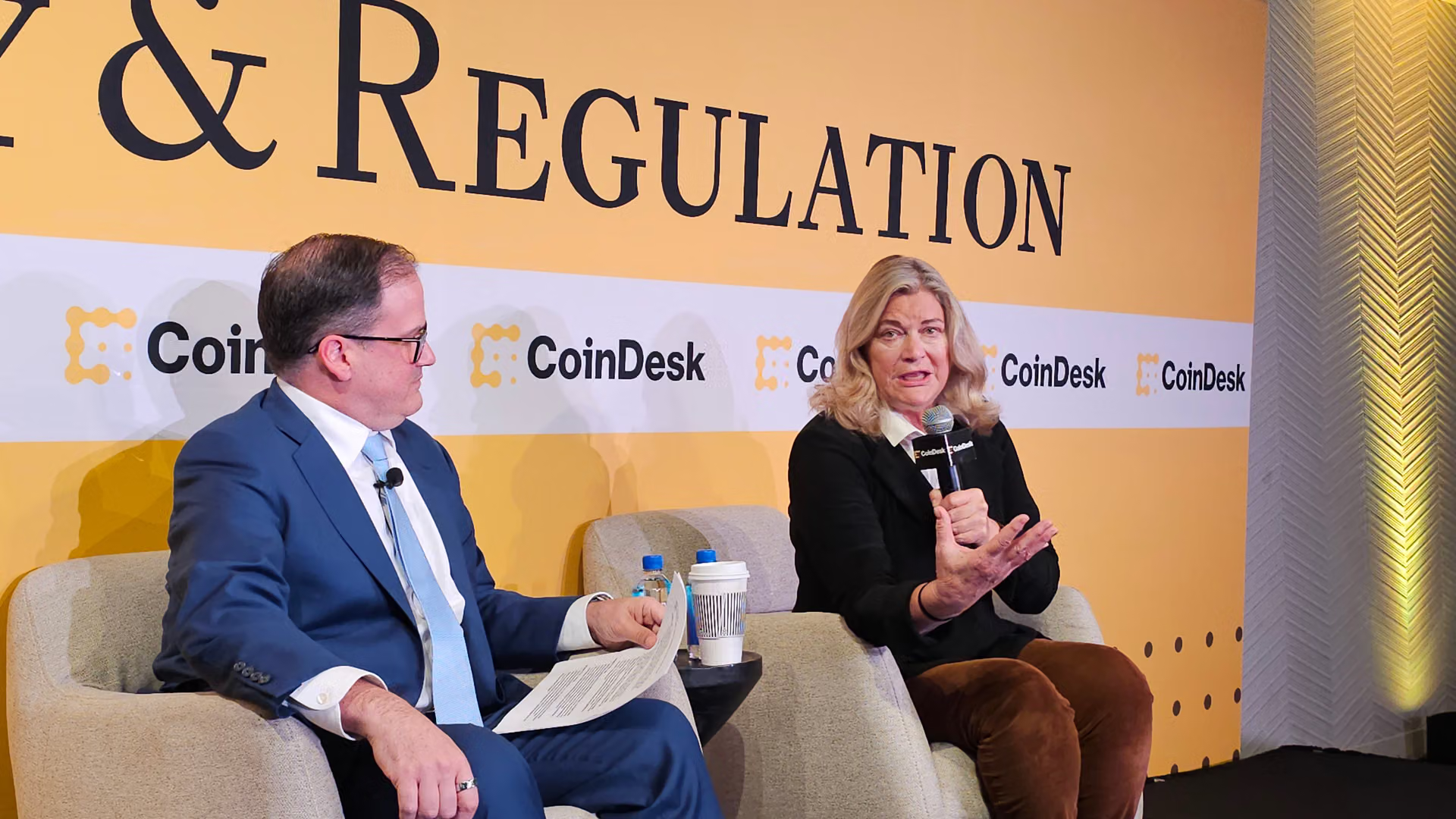
WASHINGTON, D.C. — Senator Cynthia Lummis said she was “dismayed, dumbfounded and saddened” that the Senate couldn’t advance a key procedural vote for crypto market structure legislation last week.
Lummis blamed Democrats for the bill’s failure at an appearance Tuesday at CoinDesk’s Policy & Regulation event, saying that while the bill was the result of negotiations between members of both parties.
“The problem was, as I see it, Democrats hate President [Donald] Trump more than they like good policy, and the way I see it is they chose their visceral hatred for President Trump and denied the opportunity to pass important policy legislation before a midterm,” she said. “They chose that … pin it on the Democrats.”
The bill itself was a bipartisan product which grew from some 300 pages to over 600, she said, after Democrats asked for provisions addressing issues like bankruptcy protections, among other items.



What Music Actually Costs a Small Business Making Video

Canada’s Major Banks Pilot Tokenized CAD Deposits for Settlement

Christina Haack Gushes About BF Making Her Life ‘Easy’




-

 Fashion4 days ago
Weekend Open Thread: Talbots – Corporette.com
-

 Tech2 days ago
Researchers escape OpenAI Codex sandbox to run commands on host
-

 Crypto World4 days ago
Circle launches Arc Studio AI agent for building onchain apps
-
 NewsBeat4 days ago
Trump says US has reached an agreement to take permanent control of Greenland’s security
-

 Crypto World2 days ago
Who Needs CLARITY Anyway? ARB Could See 70X Increase: Hodler’s Digest
-

 Crypto World4 days ago
Bitcoin price breaks channel as RSI climbs to 63
-

 Crypto World4 days ago
Trading Bitcoin on Robinhood? Why 2% Spread Has Traders Worried
-

 Crypto World6 days ago
US Charges Robinhood Engineers Over Crypto Listing Trades
-

 Crypto World7 days ago
What Is the Status of the U.S.-Iran Peace Talks? Here's What Both Sides Are Saying
-

 Tech7 days ago
Webb’s IC 348 Mosaic Includes Two-Jupiter Dwarfs, Twin Jets, and a Nursery Still Making Worlds
-

 Crypto World5 days ago
Mortgage and refinance interest rates today, Thursday, September 17, 2026
-

 Crypto World4 days ago
World Money launches in 150+ countries with Stripe
-

 Entertainment7 days ago
Big Brother Update: Melody Explodes at Drew as Illness Sweeps BB28 House
-

 Crypto World4 days ago
Silver prices recover quickly, hitting weekly high today
-

 Business2 days ago
Analog Devices (ADI) Bets $1.35 Billion on Chips that Let Machines Think for Themselves
-

 Tech5 days ago
GPT-6 Astra Reached the Nether in Minecraft, Lost Its Stash to a Creeper, and Farmed Potatoes for Hours
-
 NewsBeat4 days ago
US was ‘on brink of war’ with China over false AI report of nukes moving in Middle East
-

 Crypto World2 days ago
Coinbase, Robinhood, Circle Seen as Tokenized-Stock Winners
-
 Crypto World2 days ago
Bitcoin price holds above $81K as key catalysts line up
-

 Business7 days ago
Federal Reserve expected to hike interest rates 25 basis points at FOMC meeting
You must be logged in to post a comment Login