

Entertainment
Explosive, R-Rated 70s Sci-Fi Exploitation Is A Proto Mad Max Warzone

By Robert Scucci
| Published

It’s easy to forget that post-apocalyptic thrillers existed before 1979’s Mad Max because George Miller not only perfected the formula, but successfully built out decades of wasteland folklore that most modern counterparts don’t hold a candle to. There are some gems out there, however, like 1975’s A Boy and His Dog, as well as some rough concepts that are great on paper but fumble the execution, like 1978’s Deathsport.
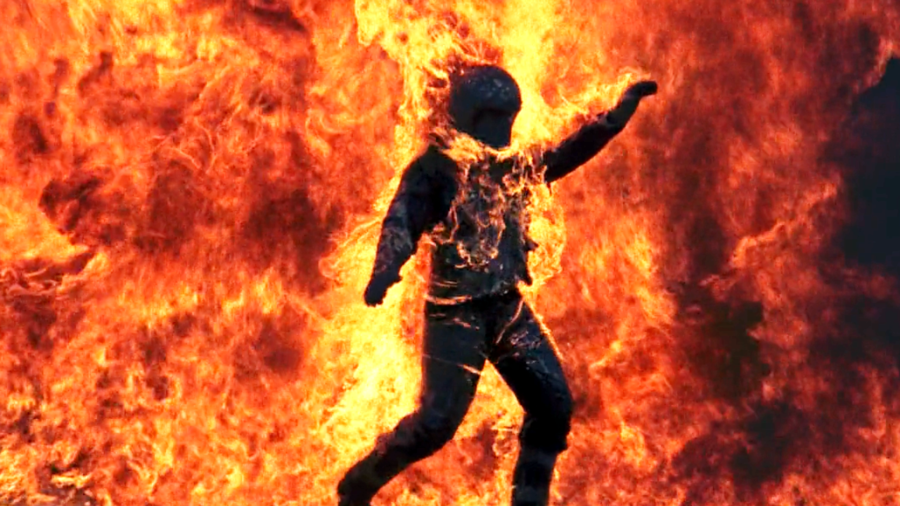
Deathsport has all the trappings of a solid, low-budget, post-apocalyptic sci-fi thriller, but it doesn’t quite have that x-factor that George Miller’s vision proved itself to have. It’s got laser-equipped dirt bikes known as Death Machines and clear power structures at play, but it’s lacking that “every man for himself” vibe portrayed so well in the Mad Max films. But for something made with a $150,000 production budget, Deathsport isn’t without its charm, and there are plenty of bright orange, accelerant-fueled practical explosions to fill the barren scenery with some pretty solid action spectacle.
Let The Games Begin!

Deathsport takes place “a thousand years from tomorrow” after the Neutron Wars have turned the world into a Mad Max-style wasteland. The story follows legendary and curmudgeonly Range Guide Kaz Oshay (David Carradine), a wandering warrior who gets captured by the city-state of Helix and thrown into the brutal spectacle known as Deathsport, which basically involves riding around on dirt bikes with lasers that go “pew pew.” While participating in the game, he teams up with fellow Range Guide Deneer (Claudia Jennings), who has been captured while escorting a group of refugees across the desert away from Lord Zirpola’s (David McLean) deadly regime. The two quickly form an alliance after learning that a young girl named Tara has been taken by mutant cannibals during Deneer’s capture.
After surviving torture, prison, and a rigged Deathsport match filled with unsanctioned landmines, Oshay and Deneer escape Helix and head into the wasteland. Along the way, they rescue Tara, evading pursuing Death Machine riders every step of the way. Meanwhile, Oshay is driven by a personal vendetta against Ankar Moor (Richard Lynch), the man responsible for his mother’s death.

Ultimately, Deathsport is a pretty straightforward tale of two badass drifters escaping an oppressive city-state, rescuing a kidnapped child, and settling an old score in the process.
Proves A Concept George Miller Perfected
While George Miller is far from the first person to explore the wasteland with the Mad Max films, it’s clear to me after watching Deathsport that he’s the one who changed the post-apocalyptic subgenre forever. Deathsport’s fatal flaw is that it throws us into a state of disrepair and then tries to cram a thousand years of societal breakdown into an 82-minute runtime, while Mad Max shows us the beginning of the end and builds out the lore from there. It’s a brilliant way to set up a franchise, whether Miller knew it at the time or not.

It’s worth noting, however, that David Carradine couldn’t have been a more perfect pick for the lead role, as he had already starred in 1975’s Death Race 2000, a brilliant satire that centers around similar gameplay. For my money, Death Race 2000 is the superior film because it’s so tongue-in-cheek that it has you smiling wryly at the fact that everybody thinks it’s socially acceptable to commit vehicular manslaughter so long as it’s gamified in an arena setting.
Deathsport is definitely rough around the edges and plays like a more stripped-down, proto-version of Mad Max, but it’s also a neat look at cinematic history from this era. Economic recession and fuel rationing had a lot of progressive filmmakers worrying about the then-current state of the world, which resulted in an influx of this type of movie over a very short amount of time, with Mad Max leading the charge once it unexpectedly burst onto the scene in 1979.


If you’re looking for a familiar spin on the by-now very popular cinematic setup that the Mad Max universe has dominated for decades, you can stream Deathsport for free on Tubi as of this writing and enjoy a very similar story from a wholly different angle.

Continue Reading
When it comes to horror movies in 2026, there have really only been two major players. Although the likes of Evil Dead director Sam Raimi‘s Send Help, the spine-chilling Hokum, and the genius 28 Years Later: The Bone Temple have all impressed, it is the feature debuts of two YouTuber-turned-filmmakers that have stolen not just the horror spotlight, but the box office spotlight as a whole, sending the likes of The Mandalorian and Grogu tumbling down the charts.
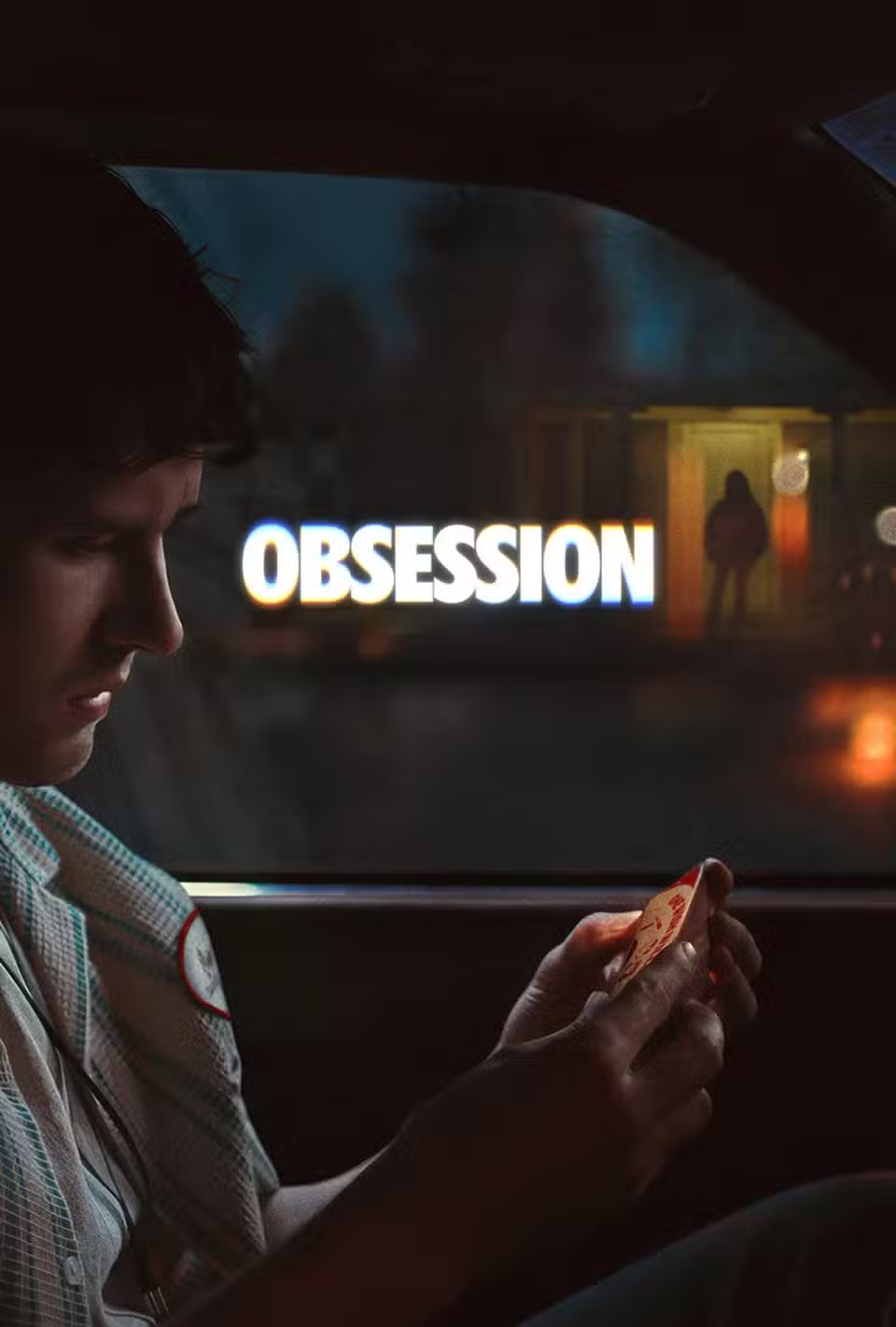
The first of these to debut in theaters in mid-May was Focus Features’ Obsession, Curry Barker‘s breakout masterpiece that features an early career-defining role by Inde Navarrette that has earned plenty of Oscars buzz. Not only has the film been heralded as one of the finest debuts of this decade, but it has also smashed many box office records, including becoming the highest-grossing non-animated original film of the past decade, the only genre film in history to stay in the box office top ten for over 40 days in a row, and now the highest-grossing original horror movie of this century.
Although Obsession eventually won the box office battle, its biggest opponent came in the form of A24’s Backrooms, which itself broke an impressive box office record as 20-year-old Kane Parsons became the youngest director ever to claim the #1 spot on the North American box office charts. Alas, Backrooms‘ $384 million is far short of Obsession‘s near-$450 million, but that hasn’t stopped it from snatching victory back on the streaming charts. At the time of writing, Backrooms is the most-watched movie on the iTunes charts in the U.S., ahead of Obsession in second place.
What Else Are People Streaming on iTunes?
The iTunes charts are a great way to get a feel for what Americans are watching right now. With Backrooms and Obsession at the top, what else is enticing movie-lovers? In third place on the charts is The Devil Wears Prada 2, another 2026 box office success, closely followed by the year’s first billion-dollar movie, The Super Mario Galaxy Movie. Also proving popular on U.S. iTunes are the likes of Antoine Fuqua’s musical biopic, Michael, The Breadwinner, Zendaya‘s The Drama, and more.
Both Backrooms and Obsession are available to rent on iTunes, with the latter also available to stream on Peacock. Stay tuned to Collider for the latest streaming updates.

- Release Date
-
May 15, 2026
- Runtime
-
108 minutes
- Director
-
Curry Barker
If there is one decade that redefined the Hollywood blockbuster, it was the 1990s. The movies of the decade mixed profoundly poignant and artistic films with popcorn flicks that got butts in the seats, slaughtering box office numbers in unimaginable ways. Animated films were no longer just for kids, as horror movies were no longer just a niche genre. Needless to say, the ’90s were an integral era for the trajectory of cinema.
We are embarking on a near-impossible task of celebrating the ten best films of the 1990s. With so many movies to pick from in the ten-year span, selecting ten required intense deliberation. To make this list, the movie should have a healthy mix of artistic merit, a sense of universal adoration, iconic performances, and a lasting impact on the future, as well as pop culture. There are certainly many films that could have found their way here, but these ten are simply the best.
10
‘Fargo’ (1996)

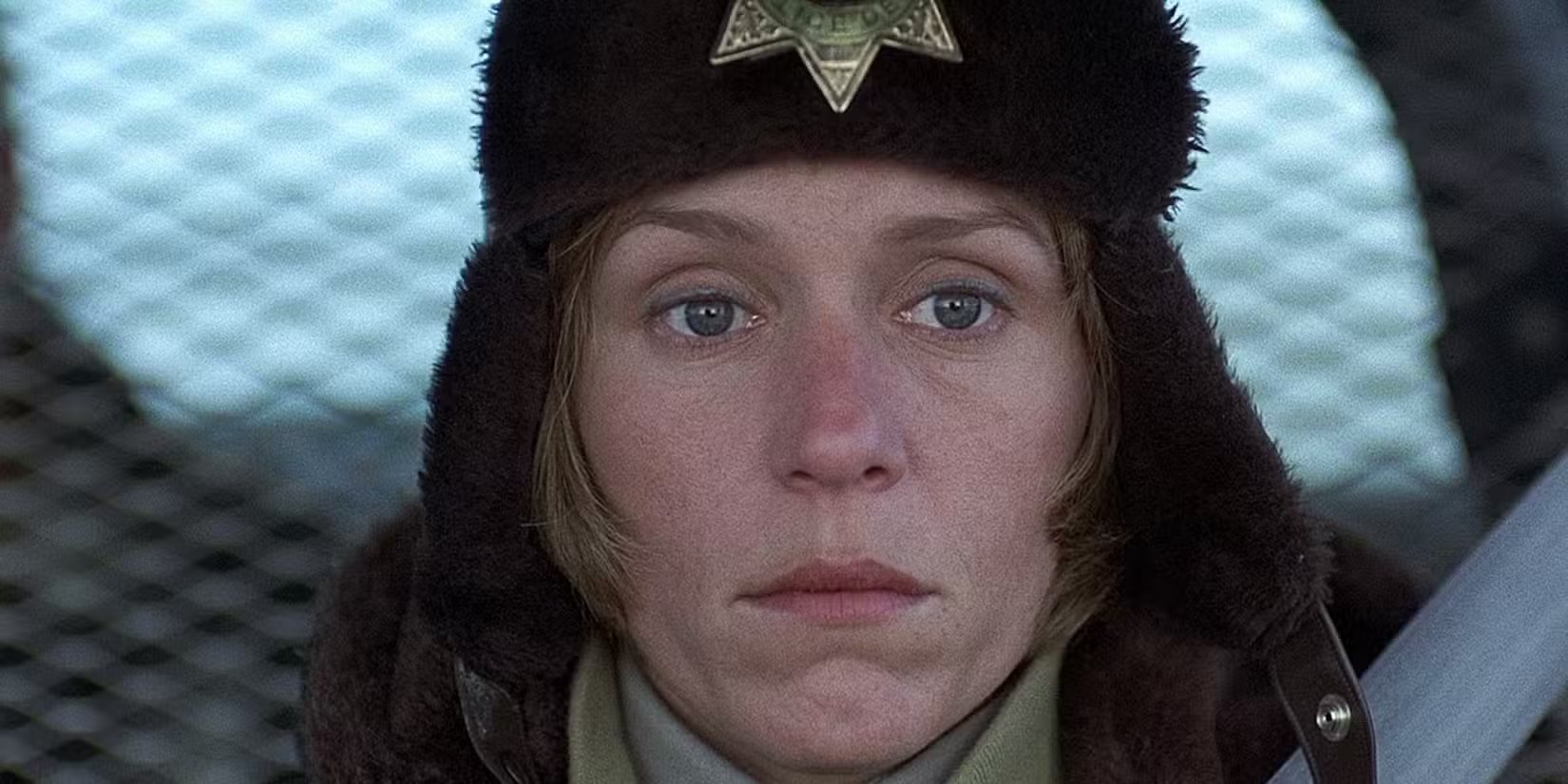
Crime thrillers were all the rage in the ‘90s, but what about infusing some black comedy into it? You get the simply sublime Fargo. Written, directed, produced, and edited by Joel and Ethan Coen, Fargo tells the story of Jerry Lundegaard (William H. Macy), a desperate car salesman in debt. He hires two thugs, Gaear Grimsrud and Carl Showalter (Peter Stormare and Steve Buscemi), to kidnap his wife, Jean (Kristin Rudrüd), to extort a large ransom from his wealthy father-in-law, Wade Gustafson (Harve Presnell). The plan goes wrong when the criminals murder a state trooper, drawing the focus of a pregnant police chief, Marge Gunderson (Frances McDormand). Brilliantly blending dark comedy, brutal crime drama, and unique Midwestern culture into a completely original story, Fargo brought a truly entertaining experience to the screen while subverting expectations.
Often in crime films, the story centers on an invincible hero and a mastermind villain. That’s not the case in Fargo. Instead of a slick, mastermind criminal villain, the plot is driven by incompetent, desperate, and pathetic men. It allows the central theme of greed to take center stage. The movie takes a tragic, botched kidnapping plot and injects absurd, pitch-black humor without making light of the genuine horror. The Coens manage to infuse the perfect tone into a serious story by ensuring the locale and its locals are genuine. They may seem silly with their accents and Midwest niceties, but that’s part of the charm that makes it a shocking series of events. Crime stories don’t need to be told in seedy underbellies of big metropolises. The Coens were cemented as defining voices in cinema thanks to Fargo. The film won two Academy Awards, for Best Actress for McDormand and Best Original Screenplay, heightening its legacy and rewriting the true crime formula. Fargo has lived beyond its initial release, paving the way for one of the greatest anthology television series.
9
‘Pulp Fiction’ (1994)

The rules of cinema were shattered when Quentin Tarantino released Pulp Fiction. Impacting pop culture unlike any film of its kind, Pulp Fiction served as a touchstone of the decade. The nonlinear narrative tells a tale of crime, violence, and redemption in Los Angeles. Two hitmen, Vincent Vega and Jules Winnfield (John Travolta and Samuel L. Jackson) working for mob boss Marsellus Wallace (Ving Rhames) retrieve a stolen briefcase, survive a miraculous near-death shooting, and accidentally kill an informant. Vega is told to take Marsellus’s wife, Mia (Uma Thurman), out for a fun evening, which turns dangerous when Mia suffers an accidental drug overdose. Meanwhile, an aging boxer, Butch Coolidge (Bruce Willis), is paid by Marsellus to throw a fight but wins instead. He risks his life to return for his family’s treasured gold watch and ends up saving Marsellus from a dangerous situation. And then, of course, there are a pair of diner robbers, Pumpkin and Honey Bunny (Tim Roth and Amanda Plummer). Presenting the chapters out of order, the story starts and ends at a diner during an armed robbery, showing how Jules chooses a path of peace over violence. In the process, it established Tarantino as a filmmaking genius, as every element of Pulp Fiction was utilized perfectly.
Pulp Fiction isn’t a mind-bending puzzle, but its non-linear structure tasks the audience with piecing the timeline together as the film goes on. In doing so, it subverts expectations so that major characters in one segment become minor players in another, as Tarantino proves how we are all somehow connected in this very small world. The dialogue is some of the best in his entire body of work. From the rhythmic word symphony to meandering conversations about a Royale with cheese, it comes before high-stakes moments, then blurs the line between high art and lowbrow pop culture references. The film mixes elements of classic gangster films, neo-noir, westerns, and exploitation cinema as it balances shocking, absurd violence with pitch-black comedy. Pulp Fiction boasts one of the greatest movie soundtracks of the decade. Pulp Fiction redefined cool in the ‘90s as it radically altered the movie landscape, as independent projects of a small $8 million budget could achieve a $213 million global cultural phenomenon status. Pulp Fiction inspired a wave of imitators trying to capture its exact blend of stylized violence and cool detachment, but none could achieve the same acclaim.
8
‘The Silence of the Lambs’ (1991)

Horror films tended to be pushed to the side when it came to the discussion of awards. And then The Silence of the Lambs changed the conversation forever. Adapted from Thomas Harris‘ 1988 novel, The Silence of the Lambs follows FBI trainee Clarice Starling (Jodie Foster), who is tasked with interviewing the imprisoned, brilliant cannibalistic psychiatrist Dr. Hannibal Lecter (Anthony Hopkins). The FBI hopes Lecter’s unique psychological insights can help them track down another active serial killer nicknamed “Buffalo Bill” (Ted Levine), who skins his female victims. Lecter agrees to offer psychological clues and profile Buffalo Bill, but only if Clarice reveals painful personal details about her own childhood—specifically her trauma involving slaughtered lambs on a farm. Blending sharp psychological tension in an airtight script with pristine performances, not only was The Silence of the Lambs a brilliant horror film, it rightly walked away with the Big Five at the Academy Awards— Best Picture, Director, Actor, Actress, and Screenplay. Instead of physical action spectacles, the core of the film rests on psychological deconstruction through dialogue and locked-room mental sparring.
Even if you’re weary of horror films, The Silence of the Lambs transcends genres for a truly riveting film. Director Jonathan Demme’s usage of tight close-ups and having actors look straight into the camera exudes a tension that’s inescapable. It also puts the audience in Clarice’s perspective, making viewers share her fear and isolation in a man’s world. With such detail in the script of real FBI training and consultation, the police work feels authentic. The characters, lifted from the novel, are truly remarkable. Foster does remarkable work, especially against the monsters that are Buffalo Bill and Lecter. It’s the latter who has haunted our nightmares ever since. Hopkins literally transformed into the cannibalistic character, cementing him into the villain hall of fame. The Silence of the Lamb proved that a dark, genre-based thriller could achieve the highest level of artistic and critical prestige. The doors that this film opened will never be closed again.
7
‘Goodfellas’ (1990)

It had seemed that The Godfather franchise would serve as the epitome of gangster films, but then Goodfellas arrived, and it rivaled that moniker. Where The Godfather used the mafia as an almost mythological saga, Goodfellas provided ground-level authenticity that has since been unmatched. Directed by Martin Scorsese in one of his best films, Goodfellas is based on Nicholas Pileggi‘s 1985 nonfiction book Wiseguy. It tells the true story of Mafia associate Henry Hill (Ray Liotta) from 1955 to 1980, tracking his rise in the underworld, his marriage to Karen Hill (Lorraine Bracco), and his partnerships with mobsters Jimmy Conway (Robert De Niro) and Tommy DeVito (Joe Pesci) before his ultimate downfall and entry into the witness protection program. Goodfellas treats organized crime not as a distant myth, but as a living, breathing, high-velocity subculture. In turn, it treats breathless, innovative editing and iconic tracking shots with raw, grounded performances to show the seductive highs and brutal reality of the mob.
Scorsese takes Pileggi’s story and elevates it to the next level. Through his direction, the film has an electric, restless pace that mirrors the addictive nature of the lifestyle. With one of the film’s most iconic moments, Scorsese puts the audience in Henry’s shoes through a continuous tracking shot that takes viewers through the kitchens and back alleys into the club. It made the film visceral in a way other mobster movies had not. The pacing of the film is kinetic thanks to Thelma Schoonmaker’s editing. The legendary editor used sharp, rhythmic cuts that matched the diegetic music and quick dialogue. By the time the story reached its final act, it simulated a cocaine-fueled paranoia breakdown with absolute precision. Though it does make way for the appeal of the life, it deconstructs it. Goodfellas ends up showing the mafia as a hollow, paranoid, and destructive trap. Goodfellas has remained a rewatchable crime epic that revolutionized the genre.
6
‘The Lion King’ (1994)

If you’re a millennial, then you most certainly identify the ‘90s as the Disney Animated Renaissance. On the brink of near extinction, Disney sought a resurgence in their animated features, and they found it with a string of instant classics. Though this slot could be offered to another film, the very best of the era was none other than The Lion King. The iconic film tells the story of Simba (Matthew Broderick/Jonathan Taylor Thomas), a young lion cub destined to be king of the Pride Lands. After his treacherous uncle Scar (Jeremy Irons) murders his father, Mufasa (James Earl Jones), Simba is manipulated into exile. He grows up carefree with new friends before returning home to face his past, defeat Scar, and reclaim his rightful throne. Inspired by William Shakespeare’s Hamlet, The Lion King blends a timeless epic narrative with breathtaking hand-drawn animation, legendary musical numbers from Elton John and Tim Rice, and deep, universal themes about life, death, and responsibility that resonate across generations. It bravely addressed heavy, complex themes in a way that resonated deeply with both children and adults while still allowing moments of joy and levity.
Though Disney is notorious for offering parents in their films, never had there been an explanation for the power of loss like in The Lion King. It addressed the circle of life, teaching that existence requires balance and acceptance of our place in the natural world. The Lion King may be a coming-of-age story of a lion cub, but it was more universal than that. It taught children to see themselves in young Simba, while adults deeply connect with the duties and heartbreaks of Mufasa. Hans Zimmer infused an emotional, sweeping African-influenced orchestral score, but the film will forever be connected to the Broadway-style production numbers. From “Can You Feel the Love Tonight” to Hakuna Matata,” there’s not a weak song on the narrative-pushing soundtrack. The Lion King arrived at a time when hand-drawn animation was being married with 3D computer animation. But it was the hand-drawn backgrounds and innovative multi-plane shots that captured the majesty of the African savanna. The Lion King became a crucial cultural milestone whose legacy still rules today. From a Broadway musical that has gone global to a live-action remake, The Lion King remains proudly in our hearts.
5
‘Schindler’s List’ (1993)

Stories about the Holocaust are never going to be an easy pill to swallow. The result of the event will forever be tied to horrid individuals, but in the complete darkness was momentary light. That’s the story of Schindler’s List. Based on the historical novel Schindler’s Ark by Thomas Keneally, the Steven Spielberg film tells the true story of Oskar Schindler (Liam Neeson), a German businessman and Nazi party member who, with the help of a Jewish accountant named Itzhak Stern (Ben Kingsley), saved over 1,100 Jewish people from death in concentration camps during World War II by employing them in his factories. Combining documentary-style realism with profound moral storytelling, Spielberg’s film transformed a vast historical tragedy into an intimate human experience about the capacity for both absolute evil and profound goodness. Shot in black-and-white, the movie exudes the stark, haunting look of 1940s newsreels. But when a pop of red comes in, it’s a recognition of something extraordinarily powerful.
The film features some of the best acting of the decade. Neeson takes on a selfish, money-hungry factory owner who slowly transforms into a selfless protector. It’s an evolution that is earned and deeply human. Opposing Schindler is Ralph Fiennes as Nazi officer Amon Göth. He delivers a chilling unpredictability that avoids playing evil as an over-the-top cartoonish monster, instead presenting it with casual ease. Schindler’s List is more than just a profound historical drama; it’s a pristinely directed masterpiece. Spielberg refused to look away from brutal acts, using hand-held cameras to place the viewer directly inside the terrifying reality of the Holocaust. With stark black-and-white imagery, the rare, single flash of color of the girl in the red dress (Oliwia Dabrowska) serves as a powerful symbol. It draws the eye and breaks the gray monotony to show that every single life holds unique, irreplaceable value. That striking imagery cements the film’s legacy. Before this film, major Hollywood studios largely avoided dramatizing the Holocaust. Spielberg brought the horrors of the camps to a massive global audience. Schindler’s List won seven Academy Awards, including Best Picture and Spielberg’s first Best Director trophy, cementing him as a cinematic auteur.
4
‘The Matrix’ (1999)

The cinematic legacy had nearly been set moving into the new millennium, but the Wachowskis said not so fast with the release of their 1999 megahit The Matrix. Not only did it set the tone for the future of movie-making, but it also revolutionized science fiction action thrillers forever. The Matrix follows a computer hacker named Neo (Keanu Reeves) who discovers that everyday human life is a fake digital simulation created by evil machines to use human bodies as batteries. Recruited by rebel leaders Morpheus (Laurence Fishburne) and Trinity (Carrie-Anne Moss), Neo learns to bend the simulation’s rules to fight the system. As powerful security programs called Agents hunt the rebels inside the simulation, Neo takes on Agent Smith (Hugo Weaving) as he realizes his true power as The One to destroy the system. Through mind-bending revolutionary visual storytelling and deep philosophical questions about reality, identity, and technology, The Matrix emerged as a groundbreaking blockbuster action thriller.
The Matrix is a visual stunner. The Wachowskis used bullet-time, a 360-degree array of still cameras to freeze time mid-action, creating a brand-new visual language for blockbuster. It was such a shockingly cool effect, we all tried to do it in real time. Spoiler: it doesn’t work. Rather than typical action choreography, The Matrix employed wire-fu with traditional kung fu, earning its own fight vocabulary in the process. Through its cinematography, the green digital tint inside the simulation versus the stark, cold tones of the real world defined a distinct cyberpunk style. Once you’re enthralled by the visuals and actions, The Matrix opens up the conversation about elements of Eastern philosophy, cyberpunk literature, computer gaming, and world mythologies to build a cohesive universe in which to play. Amid the digital code and flying bullets, the film’s driving force is human connection and belief. The Matrix arrived at the exact right cultural moment, capturing late-90s anxieties about the rise of the internet, virtual reality, and encroaching technology. Creating a lexicon, including everyday phrases like “taking the red pill” or asking if we are “living in the Matrix,” the film launched a franchise while establishing itself as an important film in the genre.
3
‘Toy Story’ (1995)

We always imagined what might happen to our toys when we left them alone. In 1995, Pixar answered the question. Toy Story tells of a secret world where toys come to life when humans leave. The plot follows Sheriff Woody (Tom Hanks), a cowboy doll who gets jealous when a flashy new action figure named Buzz Lightyear (Tim Allen) replaces him as their owner Andy’s (John Morris) favorite toy. After a scuffle, both toys get trapped by a destructive neighbor and must work together to escape. Defining the timeless phrase “you’ve got a friend in me” through song and plot, Toy Story became a wonderfully whimsical and emotionally resonant buddy comedy about jealousy, identity, and companionship. Toy Story became the first entirely computer-animated feature film; it was so beautifully crafted and well-received that it officially ushered in a new era of animation.
Pixar made history with their animation style. By selecting plastic toys and smooth surfaces, it matched the limits of 1995 software, making the animation look tangible and real. Because of that, Toy Story looked groundbreaking. And now, three decades later, the same style is used, proving that Pixar’s art will always feel timeless. Toy Story was rich in its characters. They may be toys, but they were certainly filled with relatable human emotion. Woody is initially driven by bitter ego and jealousy, making him complex rather than purely good. Buzz Lightyear goes through a hilarious and heartbreaking existential crisis when he realizes he is a mass-produced toy, not a space ranger. The film perfectly captures the fear of replacement and the pure value of friendship. Toy Story also reflected the changing of the guard in animation from traditional animation to computer graphics. At the end of the day, the cross-generational appeal has made it one of the most beloved films of all time. Children connected with the magic of toys coming to life, while adults deeply resonated with themes of growing up, change, and the fear of being replaced. Now, five films deep in the flagship franchise, watching the films today evokes a new set of emotions. No matter what, they will require a tissue or two. Best to have a box handy.
2
‘Jurassic Park’ (1993)

Growing up, we all had a fascination with dinosaurs. Before 1993, it was likely through going to the movies. After that year, it was squarely thanks to Steven Spielberg and Jurassic Park. Taken from Michael Crichton’s novel, the story follows a billionaire, John Hammond (Richard Attenborough), who builds a secret island theme park populated by cloned dinosaurs. When a disgruntled worker Dennis Nedry (Wayne Knight) shuts down the power to steal embryos, the cages fail. Dr. Alan Grant (Sam Neill), Ellie Sattler (Laura Dern), and Ian Malcolm (Jeff Goldblum) must then fight to survive as fierce predators roam free. A genuine cinematic masterpiece that paired revolutionary visuals with a genius script about the dangers of trying to play God with nature, Jurassic Park brought the same wonderment Spielberg introduced in his space films, making it instantly timeless. This film may be single-handedly responsible for the rise of the popcorn movie blockbuster.
Jurassic Park made our wildest imaginations come true with the exceptional dinosaurs. The full-scale dinosaur puppets built by Stan Winston gave actors a real physical presence to react to. And in turn, it all felt incredibly real. The tangibility was simply unmatched at the time. The scope and scale are made grander as the camera angles emphasize the terrifying scale of the creatures and the helplessness of the humans. What made the dinosaurs’ arrival such an incredible moment was that Spielberg delayed the grand reveal, eliciting genuine reactions. This proved to be a masterclass in tension building. By having a sweeping, sunny locale give way to dark, claustrophobic survival moments. When you see the title of a film, an image might pop up. But when John Williams scores your piece, you can hear it when you see the title. Williams provided a legendary musical landscape that moves effortlessly from majestic wonder to mysterious dread. The movie popularized chaos theory and forced pop culture to view dinosaurs as fast, agile animals rather than slow, clumsy monsters. Though the franchise has yet to deliver a sequel or reboot as brilliant as the original, we will always admire where it all started.
1
‘Titanic’ (1997)

At first, the premise of making a big-budget epic inspired by one of the greatest tragedies sounds outlandish. But then we all watched what James Cameron did, and we were simply proven wrong. Titanic is simply the best and most iconic film of the decade. In the modern day, treasure hunters search the ocean floor for a rare blue diamond necklace called the “Heart of the Ocean.” A 100-year-old woman named Rose (Gloria Stuart) sees a drawing of herself on TV and tells the team her life story. Her tale tells of Rose DeWitt Bukater (Kate Winslet), an unhappy young socialite, engaged to the arrogant and snobbish Cal Hockley (Billy Zahn). Jack Dawson (Leonardo DiCaprio) is a free-spirited artist who wins his ticket in a card game. Despite their social classes, the pair begin to fall in love, engaging in the most romantic love story ever told, only for it to be tragically ended by the sinking of the “Ship of Dreams.” Titanic did the unimaginable: the film combined intimate, high-stakes romance with a massive historical disaster told through ground-breaking special effects, meticulous historical detail, and an unforgettable musical score by James Horner featuring the iconic anthem that just so happens to be one of the greatest movie song of all time.
Titanic utilized a common story of forbidden love to serve as an easy hook into the grandeur of the story. Rather than examine multiple individuals on the ship, focusing on Jack and Rose provided an entry point and a pair you simply had to champion. The forbidden love between the free-spirited artist Jack and the constrained upper-class Rose dynamic connects with every generation. The film sharply contrasts the suffocating, rigid expectations of the Edwardian elite with the lively, communal joy of third-class passengers. There was reason to truly emote at the tragedy because you felt for those who weren’t on board for pleasure but saw the journey as a chance for freedom and hope. That pain pivoted into a haunting metaphor for human arrogance, showing nature swiftly dismantling society’s most confident technological achievement. The script is sensational: its first half builds rich character dynamics and dramatic irony, before shifting seamlessly into an unrelenting, terrifying survival thriller. And yes, if you’re as old as I am, you know them based on tape 1 and tape 2 on the VHS set.
Cameron did not skimp on recreating the Titanic. He demanded a massive $200 million budget, built a nearly full-scale replica of the ship in a giant water tank, and pushed digital visual effects forward to honor real historical tragedy with visceral realism. The cultural impact the film made is still felt today. It won 11 Academy Awards, including Best Picture, and became the first film to cross the $1 billion mark globally, proving its enduring cinematic power. It helped Celine Dion earn another iconic track in “My Heart Will Go On.” Together, we now have the stage musical Titanique on Broadway and beyond. A technical marvel. An everlasting romance. Titanic remains a theatrical phenomenon.

Titanic
- Release Date
-
December 18, 1997
- Runtime
-
194 minutes
- Director
-
James Cameron
- Writers
-
James Cameron
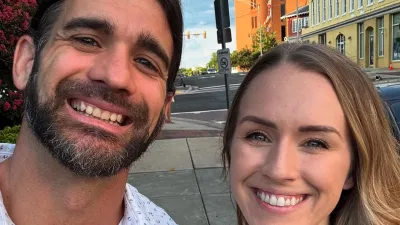
Influencer Jen Hamilton has shared alleged details into her split from estranged husband, Brian Hamilton.
“While I was at the hospital, taking care of people, he found the time to have a whole other life. As someone who’s never even passionately kissed anyone else in my entire life, this has broken me beyond comprehension,” the social media star, 37, alleged in an Instagram video shared late on Sunday, July 26. “I’m done being people’s PR manager. My kids know, everybody in my orbit knows, so I’m just going to give you the nitty gritty details so it can give you enough information to be, like, ‘OK, I get it.’”
The clip, self-filmed within Jen’s bedroom, also featured the caption, “I don’t care anymore.”
Jen, who confirmed via a TikTok statement on June 15 that she was splitting from Brian after a nearly 15-year marriage, continued, “If you don’t want me to talk about this stuff … maybe don’t do it, or don’t do it while you’re married to, like, a super public person who talks about their pubes on the internet.”

Influencer Jen Hamilton raised eyebrows when she posted a cryptic message suggesting that she and her husband, Brian Hamilton, are heading toward a split. “Day 1: absolutely devastated. Please don’t try to reach out to anybody on my behalf. That would make everything so much worse for me,” she wrote alongside a June 2026 TikTok […]
Brian has not publicly commented on the details of his marriage breakdown apart from confirming the split through the joint June 15 announcement.
The labor nurse and author went on to offer further “need to know” details behind the split, including more about the “double life” Brian allegedly led and the couple’s lack of intimacy on his part. “He didn’t ever really have much interest in me in that way. So I repressed my own natural human desires down to nothing,” Jen told fans before sharing intel into an alleged lover of Brian’s.
“A direct quote I got was, ‘I knew about you. He talked about you all the time. But I didn’t know you had so many followers,’” Jen, who shares two sons, Ellis and Luke, with Brian, claimed. “I’ve never ever in my life told this man a lie. Even when I was getting next-to-no physical affection whatsoever, I would not in a million years look at another guy like that.”



Influencer Jen Hamilton confirmed that she is stepping away from her nursing job amid her separation from estranged husband, Brian Hamilton. “I’m taking some time off of work, which is something that I never, ever wanted,” Jen, 37, announced in a vlog on Monday, June 29. “My patients do not deserve the mental state that […]
Fans were quick to share their support for Jen, taking to the comments section with support. “Honey, it makes sense. I completely get it. We didn’t deserve this information but I hope sharing helps heal you,” wrote one follower, while another wrote, “I can’t wait for you to passionately kiss someone and to feel loved and truly appreciated in your life.”
Jen also noted that sharing details of her split from Brian is helping her to heal. “Secrets and hiding are what I believe made all this possible so the way I’m dealing with it is by not having any secrets,” she explained.
Jen’s candid footage comes after she recently revealed that she has joined a support group to help her move through recent trauma. “I literally joined a support group that I’m going to be joining tonight,” she said in a Tuesday, July 21, Instagram clip. “Just for what I’m specifically going through. Because I know that I’m not alone.”


Dan Smith /© Lions Gate Films /Courtesy Everett Collection
Director Guy Ritchie finds himself in a bittersweet situation. Not very many of his recent films have worked at the box office, but virtually all of them have found their audience on home video. Ritchie’s last hit was Wrath of Man, which was released in 2021. The theatrical marketplace was still finding its feet after the pandemic — this was before both Spider-Man: No Way Home and Top Gun: Maverick “saved cinema” — and rather surprisingly, Wrath of Man came along and grossed more than $100 million worldwide. None of Ritchie’s subsequent movies — and there have been four theatrical features since — did well at the box office. One of them was designed as a franchise-starter, and although it remains hugely popular on streaming, chances of a sequel are low.
The movie in question is currently streaming in the United States on Peacock, but it’ll be removed from the platform soon. It was released theatrically in 2024, when it grossed around $29 million worldwide against a reported budget of $60 million. The movie marked the second collaboration between Ritchie and Henry Cavill, who had previously worked together on another failed franchise-starter, The Man From U.N.C.L.E., which made around $110 million globally against a reported budget of $75 million in 2015. They have since collaborated on another film, the recent In the Grey, which grossed just $17 million globally against a reported budget of $70 million.
The Movie Was Widely Embraced by Audiences
Ritchie and Cavill’s 2024 movie was The Ministry of Ungentlemanly Warfare, a World War II-era espionage action movie purportedly based on real events. The film also stars Alan Ritchson, Henry Golding, Hero Fiennes Tiffin, Eiza González, Alex Pettyfer, and more. The Ministry of Ungentlemanly Warfare now holds a 60% critics’ score on Rotten Tomatoes, where the consensus reads, “Cranking up a true story of derring-do into a high-octane action flick that’s heavy on spectacle if not suspense, The Ministry of Ungentlemanly Warfare is another solid entry into Guy Ritchie’s pantheon.” But the movie’s audience score on the aggregator website is far higher, at a “Verified Hot” 91%. You can check it out on Peacock until August 18, and stay tuned to Collider for more updates.

- Release Date
-
April 19, 2024
- Runtime
-
120 minutes
Fantasy movies are in one way the best genre there is because there is a promise most other genres don’t even try to keep. Things will turn out okay in the end. Magic will fix what’s broken. The person who deserves to win will win. That promise is why people still tear up at a fairy tale ending even when they already know exactly how it goes. That happy ending is a real comfort in a story that keeps its word.
These ten movies take that comfort and pull it out from under you, right when you’re leaning on it hardest. Each one plays by fantasy’s rules long enough to earn your trust, real magic, real curses, real quests, and then breaks the one promise the genre is supposed to keep, on purpose. That’s the part that stays with you longer than a happy ending ever could.
10
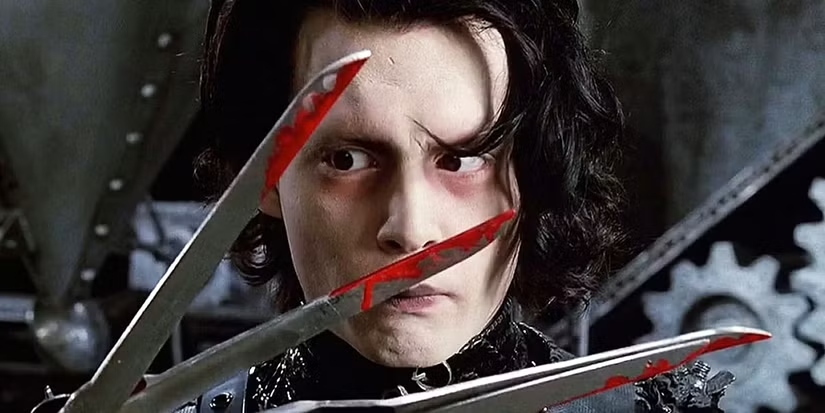
‘Edward Scissorhands’ (1990)

Most fairy tales about outsiders end with the outsider learning to fit in, whether that means a wedding or some kind of big change that finally lets them belong. Edward Scissorhands (Johnny Depp) never gets that kind of ending, mostly because the inventor who built him died before finishing the job, which is why he still has scissors instead of hands. Kim (Winona Ryder) and her mother, Peg (Dianne Wiest), bring him down from his empty castle into their quiet, pastel neighborhood, where everyone treats him like an exciting new toy at first.
That excitement doesn’t last. Once Edward kills Jim (Anthony Michael Hall) in self-defense near the end, the same neighbors who welcomed him turn on him just as fast, chasing him back up the hill to the castle he came from. He stays there alone for the rest of his life, while Kim grows old without him and only tells the story to her granddaughter decades later, as a memory. Tim Burton takes the usual Beauty and the Beast formula, where the beast eventually gets the girl and a place in the world, and simply never lets Edward have either one.
9
‘Beetlejuice’ (1988)

Betelgeuse (Michael Keaton) is the title character, yet he barely shows up in his own movie, adding up to less than twenty minutes of screen time total, and he isn’t even the one the story wants you rooting for. That role belongs to Adam and Barbara Maitland (Alec Baldwin and Geena Davis), a married couple who just died and now find themselves haunting the house they used to live in, trying and failing to scare off the wealthy, rude family that’s moved in and started redecorating.
Most haunted house movies want the audience afraid of the ghosts, but this one flips that completely, since the Maitlands are the gentle, awkward ones who can barely manage a decent scare, while the humans, aside from Lydia (Winona Ryder), the one person who can actually see them, are the real nuisance. Betelgeuse only enters the story because the Maitlands get desperate enough to hire him, and once he’s loose, he nearly wrecks everything for the characters we’ve spent the whole film rooting for.
8
‘The Green Knight’ (2021)

The medieval poem this is based on ends with Gawain surviving his ordeal essentially unscathed, having proven his honor to everyone’s satisfaction. David Lowery’s version doesn’t let him off that easily. Gawain (Dev Patel) spends the whole film wearing a magic girdle that guarantees he can’t be killed, a cheat he never tells anyone about, right up until the moment he’s supposed to keep his promise to the Green Knight and let himself be beheaded.
Before he does, the film shows an entire imagined future where Gawain removes the girdle, flees the challenge, and lives out decades as a hollow, cowardly king, watching everything he built collapse. Then it cuts back to the real moment, where the girdle is still on his waist, and lets him choose. A quest story built entirely around a fight ends instead on a man deciding, alone, whether he’s willing to actually be brave.
7
‘The Shape of Water’ (2017)

Beauty and the Beast stories almost always end with the beast turning human. Guillermo del Toro‘s version ends with the human choosing to become something else instead. Elisa (Sally Hawkins), a mute cleaner at a Cold War research facility, falls for an amphibious creature (Doug Jones) being tortured and studied by Strickland (Michael Shannon), and it is never visible that their relationship is real.
By the end, Elisa doesn’t get her voice back, and the creature doesn’t get legs. Instead, Elisa is pulled into the water and transforms into something that can breathe there alongside him, which reverses the direction every version of this story usually goes. It’s the human who changes to fit the fantasy world, not the other way around, and a genre film built on that premise went on to win Best Picture, a category it almost never gets invited into.
6
‘Pan’s Labyrinth’ (2006)

Guillermo del Toro has never confirmed, in any interview, whether the fantasy world in this film is real or something Ofelia (Ivana Baquero) invented to survive fascist Spain, and he’s said that ambiguity is deliberate. Her stepfather, Captain Vidal (Sergi López), is hunting resistance fighters in the forest above the labyrinth, and every fantastical creature Ofelia meets underground, including a faun (Doug Jones) who sets her three brutal tasks, exists right alongside real torture and real executions happening a few feet away.
Ofelia dies at Vidal’s hands in the last act, shot in the real world with no rescue arriving in time. The film’s final scene shows her reunited with a magical mother and father in an underworld kingdom, crowned and welcomed home. Whether that’s actually happening, or just what a dying child imagined in her last few seconds, is something the film never settles for you
5
‘Being John Malkovich’ (1999)

There’s a door on the 7½th floor of an office building that leads directly into actor John Malkovich‘s mind for exactly fifteen minutes at a time, and the strangest thing about this movie is how fast everyone treats that as a business opportunity. Craig Schwartz (John Cusack) starts charging people two hundred dollars a ride, while his wife, Lotte (Cameron Diaz), and his coworker Maxine (Catherine Keener) start using the portal to work out their own tangled feelings for each other.
John Malkovich plays an exaggerated version of himself, increasingly horrified as strangers start controlling his body from inside his own skull. The story ends with Craig trapped permanently inside the consciousness of a young girl, watching her life through her eyes with no way out, which turns the fantasy of becoming someone else into a life sentence instead of an escape.
4
‘Brazil’ (1985)

Terry Gilliam fought his own studio so hard over this film’s ending that he eventually took out a full-page ad in Variety demanding they release his cut instead of theirs, and once you see the ending, it’s obvious why he refused to budge. Sam Lowry (Jonathan Pryce) spends the film escaping a suffocating, paperwork-choked dystopia through elaborate flying daydreams, and by the final scene, he seems to actually pull it off, rescuing Jill (Kim Greist) and driving free into open countryside.
Then the camera pulls back, and it turns out none of that happened. Sam is strapped to a chair, having just been tortured into a lobotomy by the same bureaucracy he’d been dreaming his way out of, smiling blankly at nothing. The fantasy ending was real inside the film. It just wasn’t real for him.
3
‘Spirited Away’ (2001)

Chihiro’s parents get turned into pigs about fifteen minutes into this movie, punished for eating food that wasn’t theirs without asking first, and Hayao Miyazaki never really lets the story go back to being gentle after that. Chihiro (voiced by Rumi Hiiragi) has to take a job at a bathhouse run by a witch named Yubaba to survive, and the film refuses to give Yubaba a clean villain arc, letting her run the place with genuine competence rather than pure cruelty.
Chihiro and Haku (voiced by Miyu Irino), the boy who helps her, never get a romantic ending, not even a kiss goodbye. She’s told not to look back as she leaves the spirit world, and the film cuts away before showing whether she’ll remember any of it once she’s home. This is a coming-of-age fantasy that hands its hero actual growth and then takes the memory of it away. Very subversive.
2
‘Princess Mononoke’ (1997)

Lady Eboshi (Minnie Driver) gives lepers and former sex workers real jobs and real dignity inside the walls of Irontown, something almost nobody else in the story is willing to offer them. She’s also cutting down the forest that keeps her furnaces running, and by the film’s climax, her hunters are chasing down the Forest Spirit to take its head. Hayao Miyazaki never gives you a clean reason to hate her for either one.
San (Claire Danes), raised by wolves and ready to kill any human who threatens her home, doesn’t get positioned as the clear hero either. Ashitaka (Billy Crudup), the one character trying to hold both sides together, carries a curse on his arm that never fully goes away, not even by the last scene. The forest grows back changed, not restored, and San and Ashitaka choose to live apart instead of ending up together. Nobody wins here the way a fantasy movie usually lets somebody win.
1
‘Shrek’ (2001)

Shrek is based on a girl named Fiona (Cameron Diaz) who spends her whole life locked in a curse, turning into an ogre every night until true love’s kiss can supposedly fix her for good and make the change permanent. She finally gets that kiss from Shrek (Mike Myers), and it does make the change permanent, just not in the direction she or anyone in the castle was expecting.
Lord Farquaad (John Lithgow) had already offered Shrek a kingdom in exchange for rescuing her, a crown and a castle and a permanent place at court, exactly the ending most fantasy movies build their whole story toward. Shrek and Fiona turn it down anyway and go home to the swamp that started this whole mess . There’s no lingering shot of the throne they’re leaving behind at all. They just leave, and Donkey (Eddie Murphy) follows them there too, instead of staying behind in the fancy castle he could have had for himself.

Shrek
- Release Date
-
May 18, 2001
- Runtime
-
90 minutes
- Director
-
Andrew Adamson, Vicky Jenson
- Writers
-
Terry Rossio, Joe Stillman, Roger S.H. Schulman, Ted Elliott, William Steig, J.M. Barrie, Carlo Collodi
-
Shrek / Blind Mouse (voice)
-

Eddie Murphy
Donkey (voice)

Trans actress Dylan Mulvaney has spoken publicly about President Donald Trump comparing her to CNN reporter Katilan Collins.
“To the president — thank you for reminding me that I am more powerful than I even knew. To quote my favorite recording artist, Shea Diamond, I am America,” Mulvaney, 29, said, referencing the 2020 track by fellow trans woman Diamond, 48, in a a Sunday, July 26, TikTok video before concluding her statement with “love ya” and blowing a kiss to the camera.
Trump, 80, compared Collins, 43, to Mulvaney during a speech at the rescheduled White House Correspondents’ Dinner on Friday, July 24. After Collins received an award for her coverage of his highly publicized Oval Office meeting with Ukrainian president Volodymyr Zelenskyy, the president took aim at Collins: “I thought Kaitlan had really made it big with a major new sponsorship, but then I informed that it wasn’t her on the Bud Light can, it was Dylan Mulvaney,” he told the crowd.
Mulvaney’s TikTok response began by congratulating Collins, noting that she felt “incredibly honored to be compared to her in any way, and I hope that she keeps doing all the great work.” Mulvaney then moved onto why she believed the president brought her into his speech.

CNN correspondent Kaitlan Collins seemingly clapped back at President Donald Trump for attacking her at the rescheduled White House Correspondents Dinner. Collins, 34, shared an empowering quote from former first lady Eleanor Roosevelt via her Instagram Story on Saturday, July 25, which read, “No one can make you feel inferior without your consent.” Her response […]
“The president also brought up a video I did over three years ago, and, mind you, I’ve been kind of flying under the radar … doing my little musicals, singing, dancing. And yet, I’m still his hot topic of conversation all these years later. It seems to me like I might be, like, the one that got away,” she told fans, adding that she has made a profound mark on critics of her transgender identity.
“I am permanently burned into their retinas, I am microchipped into their minds,” she joked.
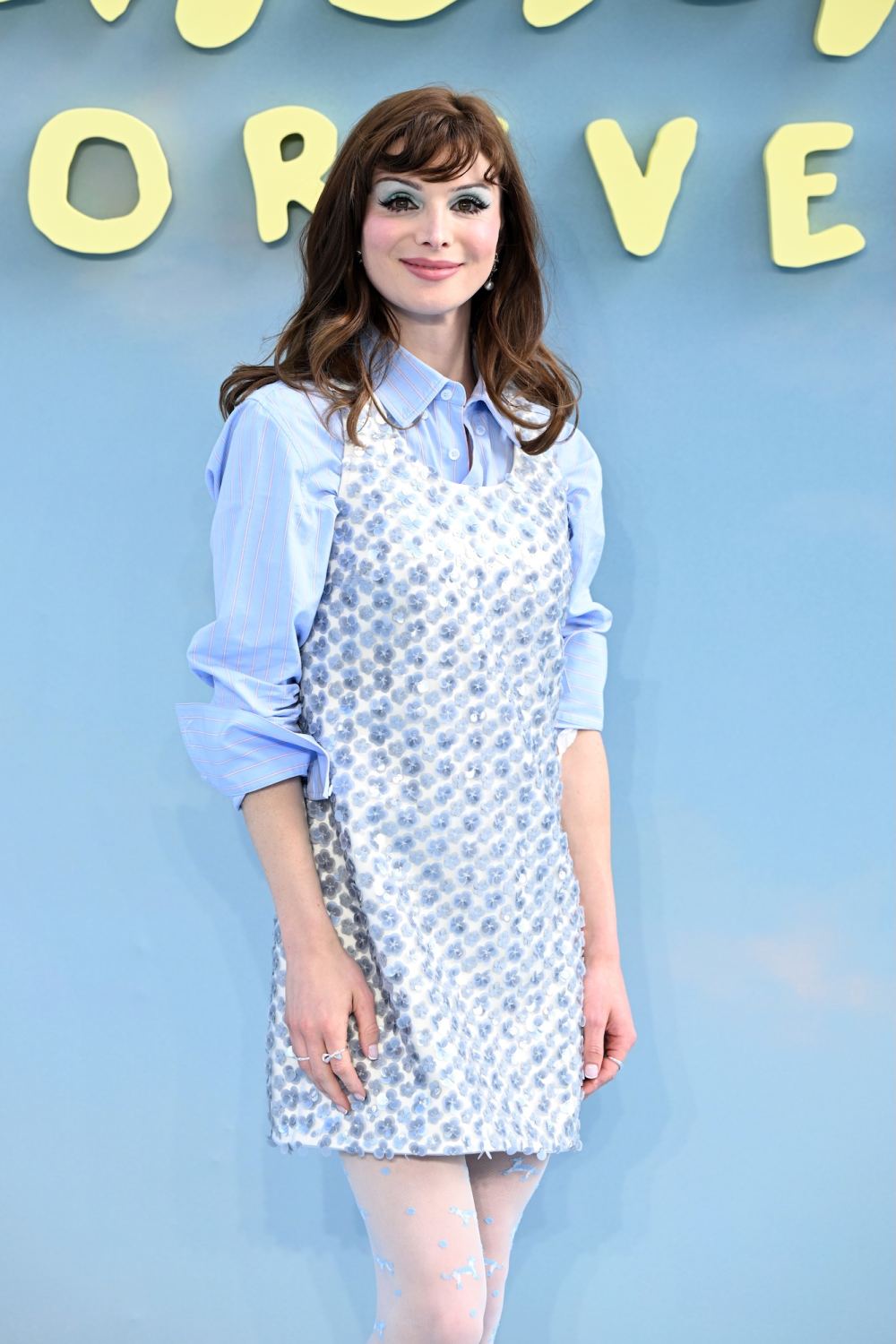
Dylan Mulvaney Jeff Spicer/Getty Images for Netflix
Mulvaney then stated that she refused to let herself get upset over serving as a “diss track” subject for the president. “A few weeks ago, I would have probably been more upset about this, but luckily, I was ghosted last month by a hook up who I really liked, and what I realized was from that experience [was] I shouldn’t want to be with someone who doesn’t really want to be with me,” she explained. “So maybe, I shouldn’t want to be professionally supported by an administration that doesn’t personally support me or so many others in this country.”
Mulvaney then turned her reference within the president’s speech into a positive. “In fact, maybe being publicly mocked and criticized by this administration is actually, like, the greatest compliment of all because it puts me in the company of some of the most brilliant, empathetic people in our world today,” she said. “I do still wonder, like, why is it so important to them that I don’t find success? What is it that I have that they don’t? Oh my God, [it’s] freedom.”
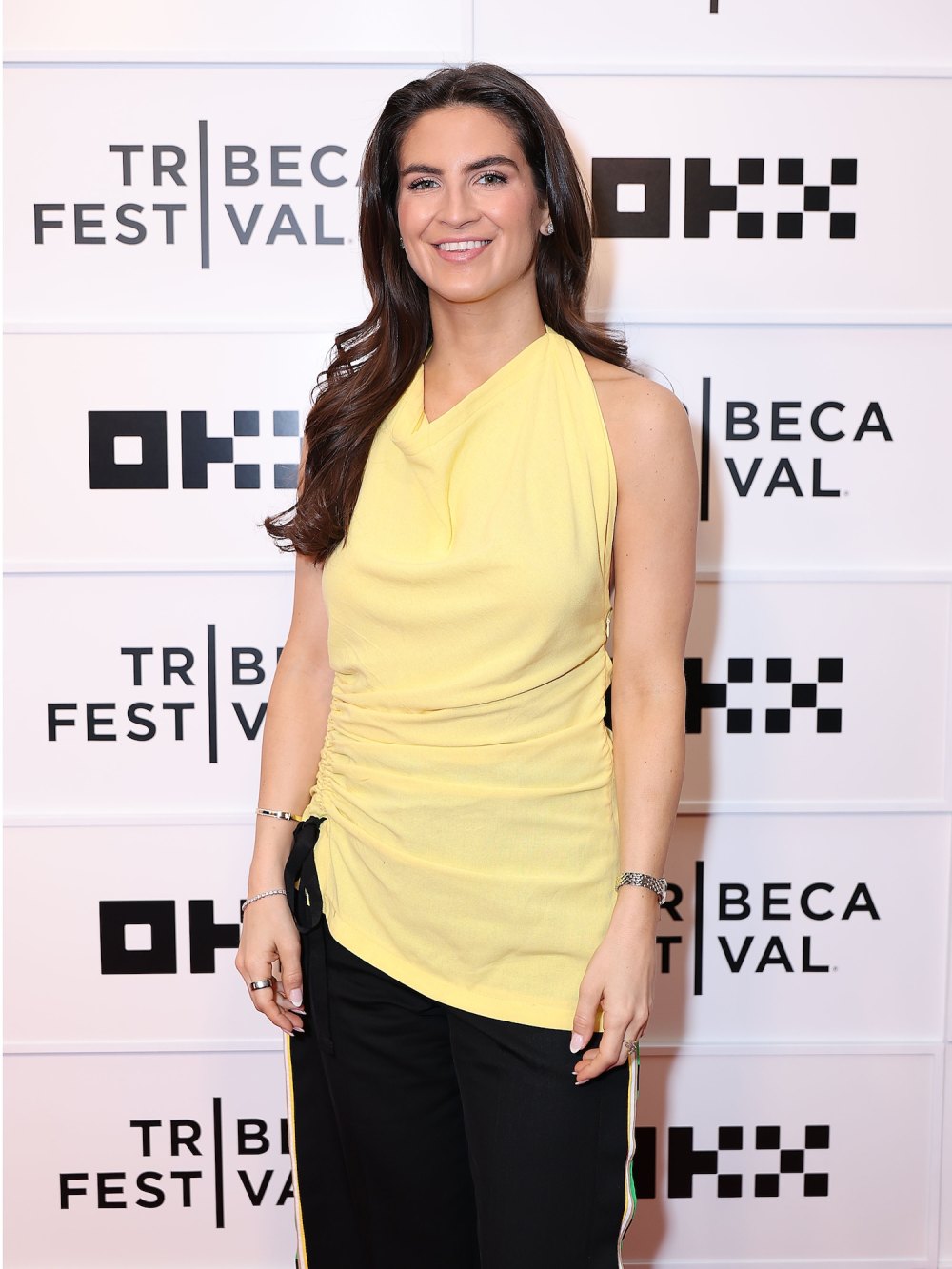
Kaitlan Collins Rob Kim/Getty Images for Tribeca Festival
The TikTok followed Mulvaney’s more subtle support of Collins via her Instagram Stories one day prior. Sharing an inspirational quote attributed to former first lady Eleanor Roosevelt, which was the same quote Collins shared via Instagram in a recap of the annual fundraiser intended to celebrate the First Amendment, Mulvaney seemingly nodded to the reporter.
“No one can make you feel inferior without your consent,” the quote read.
If you or someone you know is struggling or in crisis, help is available. Call or text 988 or chat at 988lifeline.org. https://988lifeline.org/
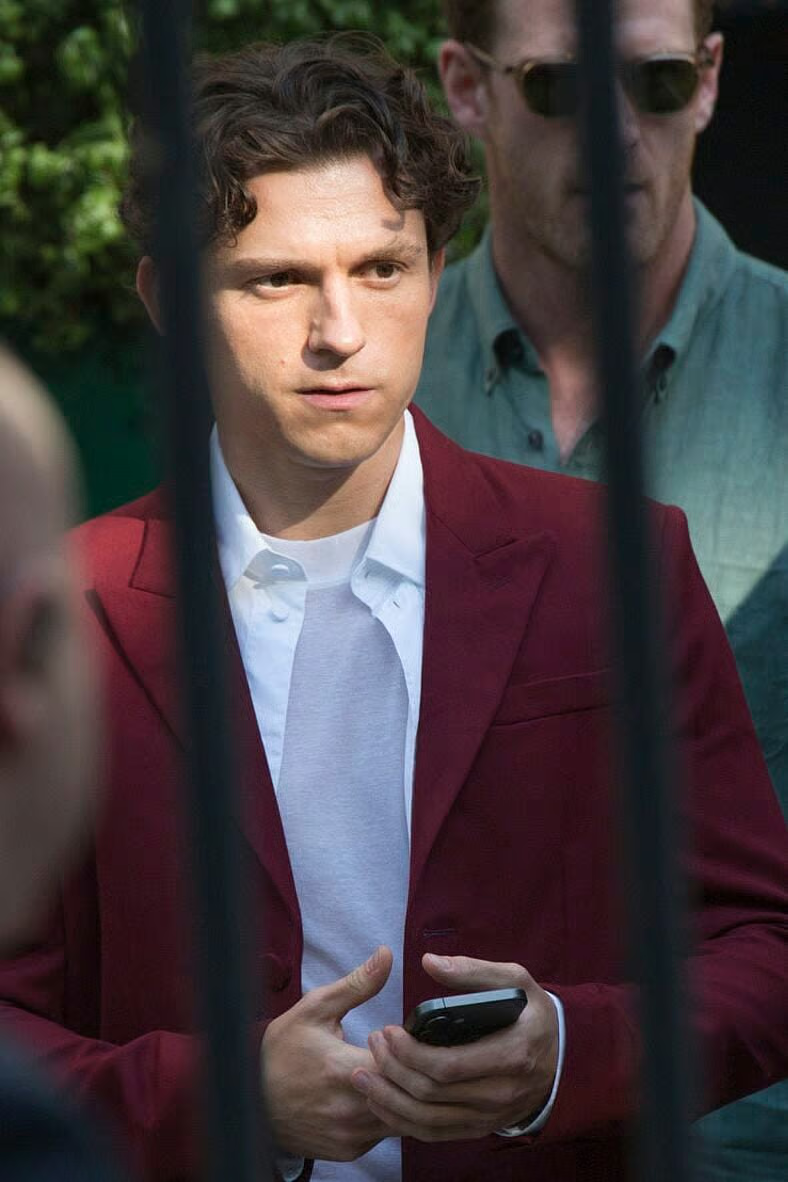
Tom Holland is confirming that he has previously promoted projects he privately believed audiences were better off skipping. The actor said his latest press tour has been far more enjoyable because he is genuinely proud of both “The Odyssey” and “Spider-Man: Brand New Day,” unlike some of his past work.
Holland did not identify the movies he regretted promoting, but several of his poorly reviewed projects have faced harsh criticism over the years.
Holland has admitted that promoting movies he wasn’t proud of was one of the most difficult parts of his job, revealing there were times he had to convince audiences to buy tickets despite privately believing they were better off skipping the film.
Speaking on the “Dish” podcast, the actor said it’s far easier to promote a movie when he genuinely believes in it.
“I’m absolutely loving it. When you’re doing press for movies you’re really proud of, it’s really easy,” Holland said. “I’ve had experiences before when people say, ‘Why should you see this movie?’ And in the back of your mind, you’re like, ‘You shouldn’t, because it’s sh-t.’”
Holland is currently promoting both “The Odyssey” and “Spider-Man: Brand New Day,” projects he described as a “victory lap” because he’s “super proud” of both films.
Holland Has Endured Several Critical Flops

When talking about movies he has done fans should never watch, Holland did not name any titles specifically. However, like most other actors, the Englishman has several critically mauled projects that could fuel speculation about which movies he privately disliked.
His lowest-rated starring films include “Chaos Walking,” “Cherry,” and “Uncharted,” which hold Rotten Tomatoes scores of 21%, 37%, and 41%, respectively. “Dolittle,” in which he voiced Jip, sits even lower at 15%.
“The Crowded Room” also struggled with critics, but Holland publicly stood behind the Apple TV+ series and its message about seeking help for mental health struggles.
Still, he admitted the production took a serious personal toll. Holland said the role left him struggling to separate himself from his character and contributed to his decision to take a year-long break from acting.
Tom Holland’s Career Has Reached A New Peak

Holland’s days of reluctantly promoting movies he disliked could now very well be far behind him, with the actor seemingly enjoying the biggest high of his career. After several years of balancing Marvel blockbusters with more divisive projects, the British star is now leading two of Hollywood’s most anticipated releases.
Christopher Nolan’s “The Odyssey” opened to a massive global debut and has earned widespread acclaim, while “Spider-Man: Brand New Day” is already generating major buzz ahead of its release.
The momentum has also been backed by those around him. Sony Pictures chairman Tom Rothman reportedly described Holland’s work in “Brand New Day” as his “finest performance.”
‘The Odyssey’ Is Already An Oscar Frontrunner

Holland’s role in “The Odyssey” has also placed him closer than ever to Hollywood’s awards conversation.
Although the actor is not currently projected as a leading Oscar contender, Christopher Nolan’s epic has emerged as one of the year’s biggest awards hopefuls, with early forecasts predicting nominations across major categories, including Best Picture and Best Director.
If the film lives up to those expectations, Holland will have played a key role in one of the most acclaimed movies of his career, further cementing his evolution from blockbuster superhero to respected dramatic leading man.
How Christopher Nolan Elevated Tom Holland’s Career

Working with Christopher Nolan also appears to have reshaped Holland’s approach to filmmaking.
Per Variety, the actor was so determined to star in “The Odyssey” that he personally called Sony boss Tom Rothman to request a delay to “Spider-Man: Brand New Day” after the two productions landed on conflicting schedules. The gamble ultimately paid off, with Holland later saying the extra development time helped Marvel make “the best version” of the film.
The London-born star has since credited Nolan’s meticulous process with influencing how he approaches future projects, telling TheWrap there was “a lot more preparation” on the Oscar-winning filmmaker’s sets than he had previously experienced.
“[With Marvel,] sometimes we come to set without scripts and stuff like that, and you’re having to improvise and try and find ways to tell the story. Whereas Chris’s script, I don’t think it really changed at all from the first time I read it to the movie that you saw yesterday,” Holland said, adding that he carried those lessons into the production of his latest “Spider-Man” movie.
This week, it was confirmed that one of the defining action thrillers of the ’90s, the 1991 cult classic Point Break, will be making a splash back in theaters for its 35th anniversary. The film starred Keanu Reeves as FBI Agent Johnny Utah, alongside the likes of Patrick Swayze, Lori Petty, and Gary Busey, and remains one of the biggest early turning points in a career that would soon blossom into Hollywood immortality. Excitingly, Point Break will return to theaters nationwide on August 16 and 19 in the form of a new 4K restoration released by Resurgence Media Group, Saga Arts, and Fathom Entertainment.
The film will technically be the third release for Reeves in 2026, and the second of this summer, following his reprisal of the hilarious Duke Caboom alongside the voices of Tom Hanks, Tim Allen, and Joan Cusack in Toy Story 5. That particular release is certainly his best of the year, receiving widespread acclaim and proving so popular it is expected to become the third film of the year to hit $1 billion at the box office. His other 2026 release is perhaps one Reeves would rather get less noticed, considering the terrible reviews it received upon arrival.
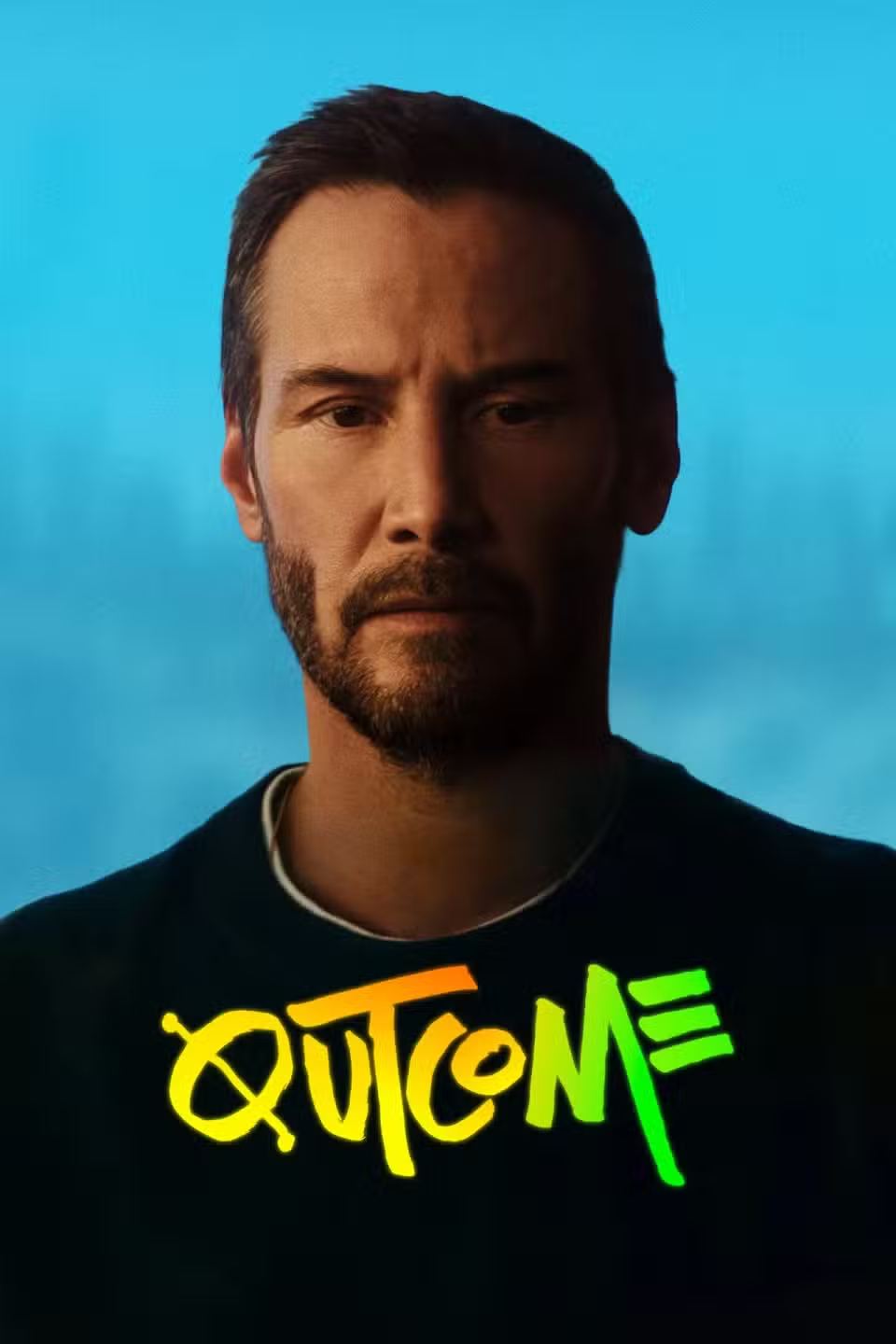
The film in question is Outcome, the latest directorial project from Hollywood funnyman Jonah Hill, which stars Reeves as Reef Hawk, a once globally popular movie star who is forced to take a hiatus from the industry after struggling with heroin addiction, alongside the likes of Matt Bomer, Cameron Diaz, Susan Lucci, Laverne Cox, David Spade, and more. The movie marked Hill’s second narrative feature after his debut with the skateboarding dramedy mid90s in 2018, and was also penned by the Wolf of Wall Street star alongside Ezra Woods.
Critics Weren’t Keen on ‘Outcome’
Despite even featuring a cameo from Hollywood icon Martin Scorsese as a washed-up talent agent, Outcome didn’t impress critics, even being called “a tonal nightmare” in Nate Richard‘s 4/10 review for Collider. Nevertheless, the film has bounced back on streaming, maintaining a consistent popular place on Apple TV. At the time of writing, Outcome has surpassed the 100-day mark on the Apple TV top ten in the U.S.
Outcome is streaming on Apple TV. Stay tuned for more streaming stories.

- Release Date
-
April 10, 2026
- Runtime
-
83 Minutes
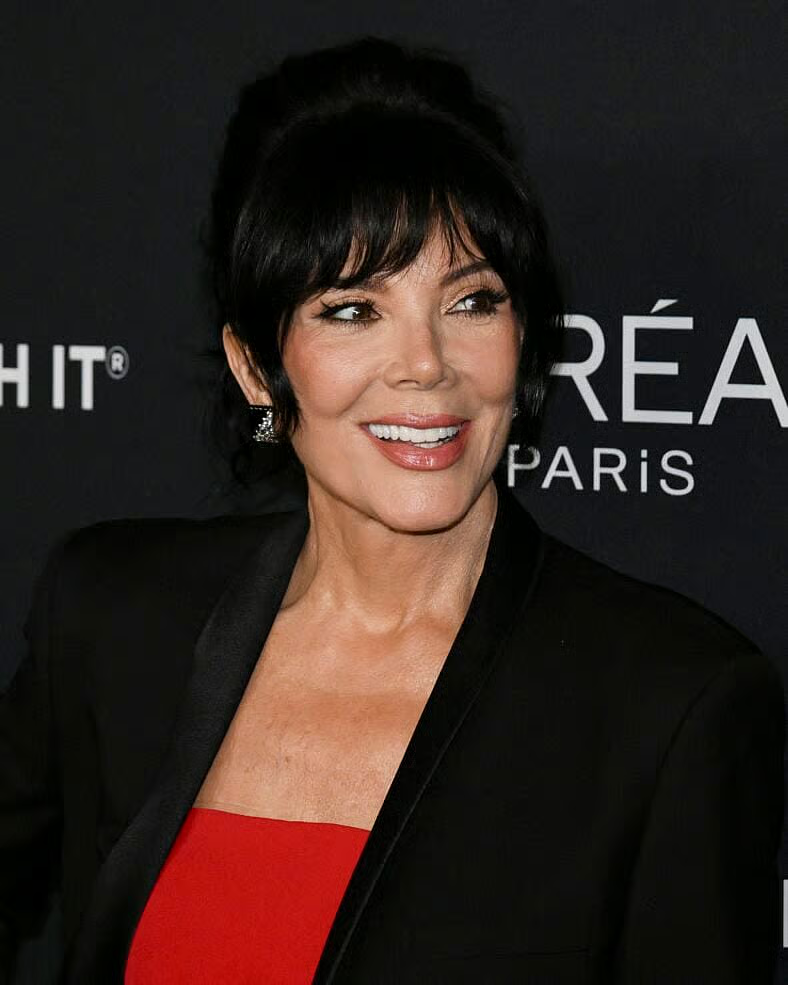
Kris Jenner is facing an emotional milestone just days after saying goodbye to her beloved mother, Mary Jo “MJ” Campbell.
The Kardashian-Jenner matriarch marked her mom’s first birthday since her passing with a heartfelt social media tribute, giving fans another glimpse into the family’s grief.
The touching post came only ten days after MJ died at age 91, as Kris and daughter Kim Kardashian continued honoring the woman they both credited with shaping their lives.
Rather than mourning the day in silence, Kris Jenner chose to celebrate her mother’s life by filling Instagram with photographs spanning decades of family memories.
“Happy Heavenly Birthday Mommy. I love you,” she wrote alongside the touching post honoring what would have been MJ’s 92nd birthday.
The carousel opened with a radiant portrait of MJ wearing a vibrant floral jacket before moving through intimate snapshots of mother and daughter together.
Some captured the pair sharing quiet conversations, while others showed warm embraces that reflected their close relationship.
Kris also included several multi-generational family photos featuring Kim Kardashian, Khloé Kardashian, Kendall Jenner and other relatives gathered around MJ, along with candid images of the beloved matriarch smiling and flashing her trademark peace sign.
Jenner’s Fans Flood Her Tribute With Heartfelt Messages
Kris Jenner’s emotional tribute quickly resonated with fans, many of whom flooded the comments section with messages of love, support and birthday wishes for the late family matriarch.
“Love you Kris. I am so sorry for your loss. We have all lived seeing MJ on our screens for years. A truly classy, wonderful woman,” one supportive fan remarked.
Another user acknowledged how painful the “firsts” after losing a loved one can be, encouraging Kris to give herself grace as she adjusts to life without her mother.
The commenter added, “I’m sure MJ is smiling from above. I believe they can only see the good things there. My heart goes out to you. Thank you for sharing your beautiful mother with all of US.”
A third person also wrote, “Kris. You have always been a wonderful person. Prayers for her and happy birthday to her for blessing this earth.”
Kris Jenner Previously Called MJ ‘The Heart Of Our Family’
The birthday tribute echoed the emotional message Jenner shared when announcing her mother’s death earlier this month.
“There are no words that could ever capture what she has meant to me or the heartbreak of having to say goodbye,” she wrote on Instagram at the time.
The socialite went on to describe MJ as “the heart of our family,” explaining that her mother taught generations of loved ones to put family first, show kindness freely and never take time together for granted.
Those sentiments have continued to resonate throughout the Kardashian-Jenner family. A source told PEOPLE that MJ’s death has been devastating for everyone, describing her as “such an important person for all the girls” and revealing that the family has been left completely “heartbroken” by the loss.
Kim Kardashian Reflected On New Discoveries About Her Grandmother
True to the insider’s words, the heartbreaking loss has been just as difficult for Kris Jenner’s daughter, Kim, who has repeatedly spoken about the special relationship she shared with her grandmother.
The reality TV star also shared her own tribute on MJ’s birthday, revealing that spending the past week sorting through her grandmother’s belongings had introduced her to stories and memories she had never known before.
“Happy Heavenly 92nd Birthday grandma! It’s only been a week but wow the amount of things I’ve learned about you this week from going through all of your stuff with mom has been beautiful!” Kim wrote.
She admitted she thought she already knew everything about MJ before adding, “Makes me respect you and love you more if that’s even possible.”
Kim closed the message by promising to celebrate her grandmother’s life while acknowledging how deeply she missed her.
Kris Jenner’s Daughter Previously Remembered MJ As Her ‘Forever Twin’
The birthday tribute wasn’t the first emotional message Kim shared following her grandmother’s passing.
Days earlier, the SKIMS founder posted another collection of family photos on Instagram while remembering MJ as “My sweet Grandma MJ, my best friend, my gossip buddy, my forever twin…”
She also credited her grandmother with shaping the woman she has become, writing, “You taught all of us the importance of family, and those values are something we’ll carry with us forever!!!!!! You were the woman who showed me what it meant to be a hardworking businesswoman.”
According to the PEOPLE source, MJ’s death has been especially painful for Kim because of the extraordinary bond they shared over the years.
“Kim truly idolized her as a self-made woman. She talked with MJ very frequently, and she feels they had a really special bond,” the insider explained.
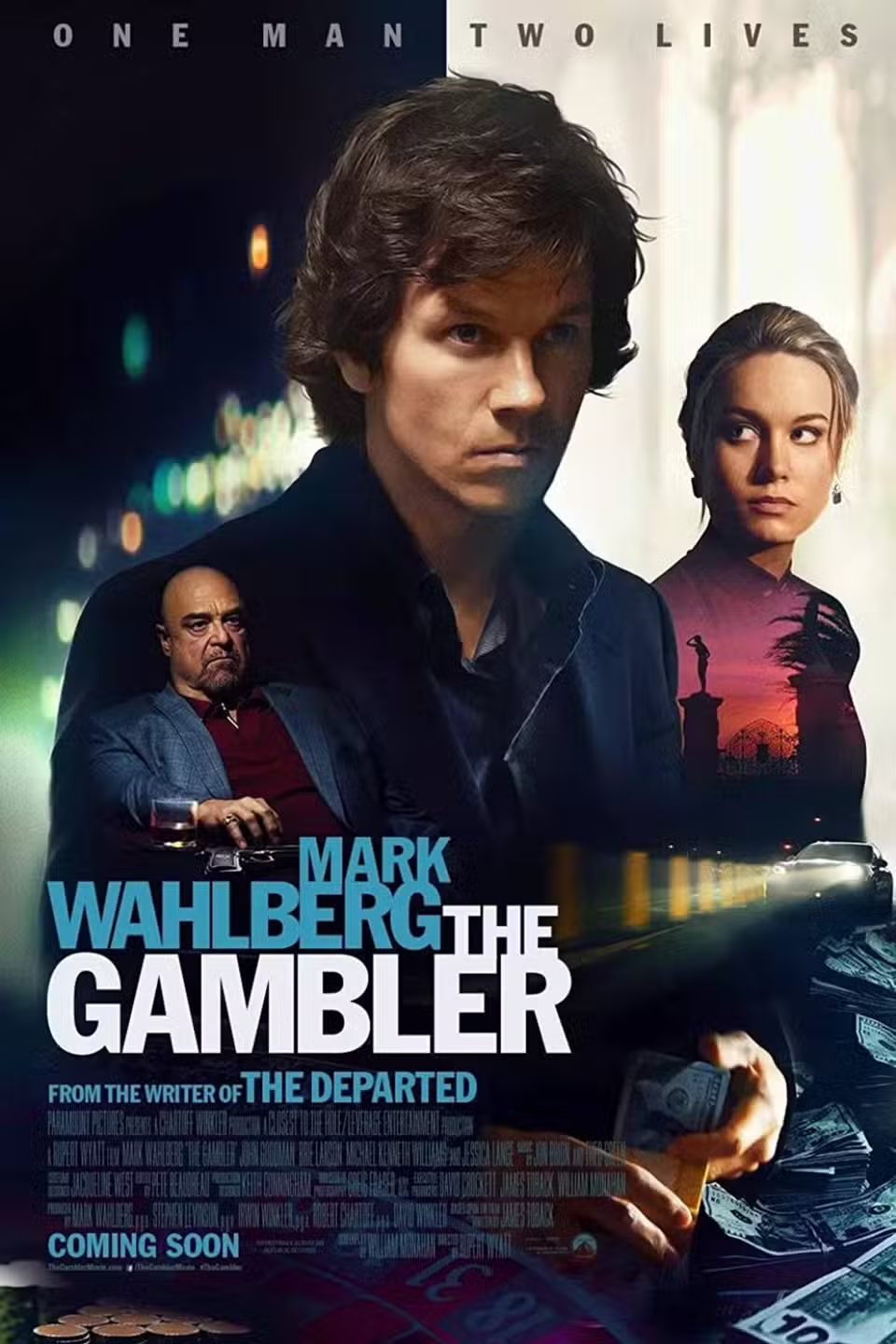
Whether it is as Sonny Corleone in The Godfather or as Walter Hobbs in the Christmas classic Elf, the late, great James Caan has delivered countless iconic performances. In 1974, he reprised his performance as Sonny in a cameo role in The Godfather: Part II, one of three performances he is credited with in that year. Alongside starring as Freebie in the buddy cop black comedy Freebie and the Bean, Caan dazzled audiences as literature professor and gambling addict Axel Freed in The Gambler, based on the novel of the same name by Fyodor Dostoevsky.
As did many other iconic action thrillers from a similar time, The Gambler became the latest of its kind to catch the attention of Hollywood execs in the 2010s, with a remake eventually being released in 2014. Directed by Rupert Wyatt, best known for the 2011 blockbuster Rise of the Planet of the Apes, the remake starred Mark Wahlberg in one of his most surprising performances of the decade, as Jim Bennett, a fill-in for Caan’s Axel Freed.
Sadly, the movie faced a tough run theatrically, earning just $39.2 million worldwide against a reported production budget of $25 million. This was undeniably partially caused by the movie’s negative reception from critics, illustrated by a 43% average score on review aggregator Rotten Tomatoes. “Potentially gripping, but never generates enough tension,” wrote one reviewer, with another saying, “The Gambler is a solidly acted and directed piece that somehow can’t decide what kind of film it is.” 12 years later, it is bouncing back, officially placing as one of the ten most-streamed movies on Paramount+ in the U.S.
What Else Is Popular on Paramount+?
The Gambler might be the most surprising current hit on Paramount+, but it only places tenth, with other movies scoring even higher in the ranks. This includes Johannes Roberts‘ latest horror project, Primate, the latest in a huge horror franchise, Scream 7, the cinema-saving blockbuster Top Gun: Maverick, Channing Tatum‘s true-crime gem Roofman, and the current chart-topper, Rebecca Thomas‘ crime flick Wardriver.
The Gambler is one of the ten most-streamed movies on Paramount+ in the U.S. Make sure to stay tuned to Collider for all the latest streaming stories.

- Release Date
-
November 10, 2014
- Runtime
-
111minutes
- Director
-
Rupert Wyatt
Sports42 seconds ago
A Send Off to Dustin Baker with Gratitude and Thanks

Tech1 minute ago
Apple Watch fall detection saves father

News Videos3 minutes ago
THEY JUST WENT ALL IN ON XRP?!?! (XRP WENT LIVE, THIS IS BIG)


-

 Fashion3 days ago
Weekend Open Thread: Brooks Brothers
-

 Crypto World6 days ago
Grayscale Files For Worldcoin ETF, WLD Registers Sharp Rise
-

 NewsBeat6 days ago
How a former Blue Peter presenter stunned America’s Got Talent judges
-

 Tech12 hours ago
Intel is reversing course and bringing hyper-threading back to its server chips
-

 Tech6 days ago
Sail Virtually Aboard The “Itanic” With IA-64 Emulator
-
 Tech6 days ago
Turtle Beach Command Series KB7 review: a nifty screen-equipped gaming keyboard
-
 Business5 days ago
New Jersey voter registration controversy explained: How 6,600 noncitizens got on the rolls, and what happens next
-
 Entertainment6 days ago
Johnny Depp’s R-Rated Gothic Cult Classic Gets New Release Ahead of Sydney Sweeney Remake
-

 Tech7 days ago
Watch Flock Safety CEO Garrett Langley discuss the future of surveillance at TechCrunch Disrupt 2026
-

 Crypto World5 days ago
Ethics, other provisions in crypto Clarity Act to be further discussed
-
 NewsBeat6 days ago
Shanghai science forum photos show China’s AI and robotics advances in rivalry with US
-
 Sports16 hours ago
Commonwealth Games boxing: Jadumani Singh seals dominant 5-0 win over Pakistan’s Sumama Rehman to enter quarter-finals | Commonwealth Games News
-

 News Videos4 days ago
The Peugeot Family: How 200 Years of an “Old Money” Dynasty Died in A Boardroom
-

 Sports3 days ago
2026 3M Open leaderboard: Scottie Scheffler finds putter in Round 1, sits three back
-

 Politics23 hours ago
Spain sweeps the board at 2026 World Cup with individual awards
-

 Fashion3 days ago
16 Dresses for the High Summer Event
-

 Crypto World6 days ago
Andrew Cuomo joins OKX board as crypto exchange expands in U.S.
-
 Entertainment3 days ago
A New Post-Apocalyptic Gundam Anime Series Blasts Into SDCC
-

 News Videos15 hours ago
BITCOIN JUST ENTERED THIS CRITICAL ZONE…
-

 Crypto World1 day ago
XRP Ledger adds $2.6B as RWA inflows rank second
You must be logged in to post a comment Login