
Related: Bloat? These 17 Loose Fall Dresses Make the Tummy Disappear — From $25
Advertisement



By Robert Scucci
| Published

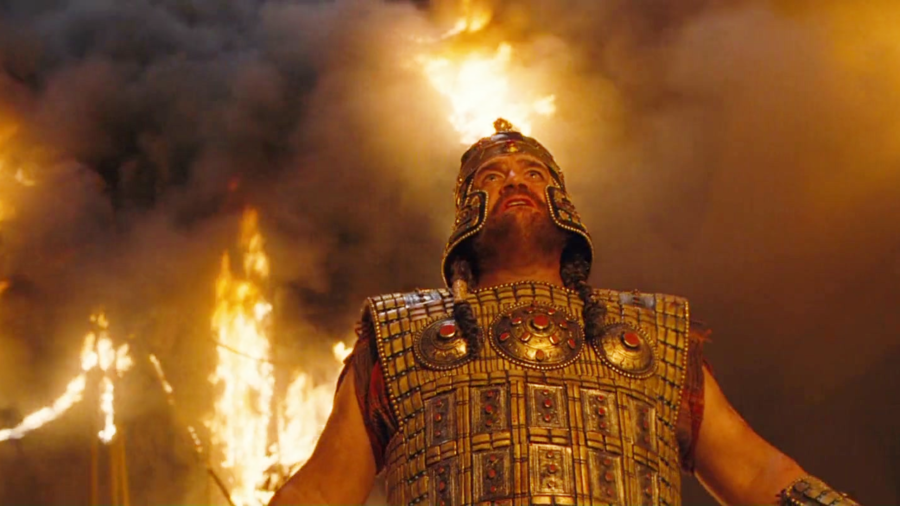
With Christopher Nolan’s adaptation of The Odyssey fast approaching, it’s time to get back into all of the great historical epics that have come out over the years. Gladiator (2000) is always a no-brainer thanks to Russell Crowe’s magnetic performance as Maximus Decimus Meridius, and if you want to channel your inner Spartan while a single tear runs down your cheek because you’re 37 and need to accept the fact that you’re never getting the abs back, you can fire up 300 (2007) to get your fill. Between those two films, though, is a little $185 million historical epic called Troy (2004), which wasn’t exactly a critical darling upon release (53 percent on Rotten Tomatoes), but has remained a fan favorite for decades.
Here’s the thing about historical epics based on Ancient Greek mythology: they almost always lose points for not properly representing the source material. But here’s my counterpoint: this is a movie, everybody speaks American English, and our main hero’s weakness is his heel because his mother dunked him upside down in the River Styx to make him immortal, but the water didn’t touch the spot where she was holding him. In other words, let’s suspend some disbelief, watch some epic battles, and enjoy the show.

I hate long movies that don’t earn their runtime, but Troy is built differently because it fully commits to spectacle. There are plenty of names being said out loud that made me think, “Oh, that’s how you pronounce that, I’ve only ever read it before,” followed immediately by enough cinematic violence to distract me from the fact that I should probably brush up on both my history and my phonics.
Here’s the short and sweet version of what happens in Troy because, if I’m being real, I’m not watching this one for the plot. I’m watching it to see thousands of extras get leveled while armies wage war against each other and burn everything to the ground.

After Paris (Orlando Bloom), a prince of Troy, sparks a forbidden romance with Helen (Diane Kruger), the wife of Spartan King Menelaus, tensions between the two kingdoms explode into all-out war. The Greek armies unite under the ambitious Agamemnon (Brian Cox), bringing along their greatest warrior, Achilles (Brad Pitt), whose legendary fighting skills are matched only by his pride and ego. As Troy braces for invasion, noble prince Hector (Eric Bana) struggles to defend his family and city from destruction. What follows is a massive clash driven by love, revenge, ambition, and the pursuit of glory during a time when nothing else really mattered.
Filmed during that sweet spot in movie history where CGI enhanced a film instead of completely replacing practical filmmaking, Troy never feels like a green screen experience. Sure, digital effects were used to fill out backgrounds with massive armies and sprawling naval fleets, but the production still relied on thousands of extras swinging rubber swords during combat sequences so everybody could safely hack away at each other with reckless, military-sanctioned abandon. It’s even been reported that Brad Pitt and Eric Bana spent days rehearsing their final duel without stunt doubles to make sure audiences got the best fight sequence money could buy.

Speaking of Brad Pitt, his portrayal of Achilles is second to none. He brings a certain level of nonchalance to the role, like he’s a party guy who just so happens to be exceptionally gifted at war. He’s untouchable and unflappable, and he commands the screen whenever he shows up while channeling serious dude-bro energy anytime somebody asks anything of him. When we’re first introduced to him, he effortlessly kills Boagrius (Nathan Jones), a giant hulk of a man, while violently hungover and not even having eaten breakfast yet. It’s poetry in sandals, and it’s ridiculously fun to watch play out.
For every bit of charisma in Troy, however, there’s also a healthy amount of corn you need to chew through. The most egregious moment, to me, is when Ajax lets out his battle cry in the middle of combat, bellowing, “I am Ajax, breaker of stones! Look upon me in despair!” Don’t get me wrong, that’s an objectively badass thing to say, but Troy is set in 1184 BC and he delivers the line like he knows there’s a camera crew behind him and he wants to sound as cool as humanly possible. Moments like that can take me out of movies like Troy, but it’s also worth mentioning that this is still an incredible quote to casually work into real life whenever the opportunity presents itself.

In 2026, Troy’s legacy has far exceeded its initial reputation, which is reflected in its much stronger 74 percent Popcornmeter score on Rotten Tomatoes. The critics may have gone hard on this movie at the time, but it’s also worth remembering that critics don’t always know how to have fun. Troy is fun. It’s pure popcorn spectacle wrapped in armor, and if you’re looking for next-level fight choreography and carnage, it really doesn’t get much better than this.

As of this writing, Troy is not available through standard streaming subscriptions, but it can be rented or purchased on demand through Amazon Prime Video, YouTube, Fandango at Home, and Apple TV+.
Television has always been a powerful vehicle for social development, sparking difficult yet important conversations and challenging long-held beliefs. That’s not an easy thing for everyone to handle, and this aspect of TV has caused polarized reactions for almost as long as the medium has existed. It’s a tricky situation, but in many cases, the controversies also end up becoming the selling points of the shows in question, bringing them recognition from a wider audience.
Some shows do cause controversy by playing up traumatic situations for shock value, but the majority of these series are truly groundbreaking productions that make crucial points about society. Interestingly enough, many of the most controversial shows over the years (the good ones, at least) have been comedies that used humor as a medium to communicate progressive ideas. Without further ado, here’s our ranked selection of some of the most divisive shows of all time, including both landmark classics and more modern fare.

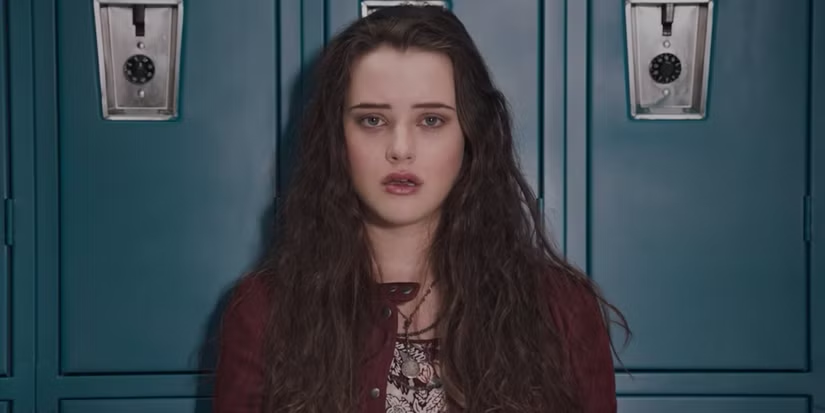
Based on Jay Asher’s eponymous 2007 novel, 13 Reasons Why is a teen drama series that stars Dylan Minnette and Katherine Langford as Clay Jensen and Hannah Baker, both students at the fictional Liberty High School. Two weeks after Hannah’s death by suicide, Clay finds a box of cassette tapes she left behind detailing the reasons why she chose to kill herself. Developed by Brian Yorkey and executive produced by Selena Gomez, the series also stars Christian Navarro, Alisha Boe, Brandon Flynn, Justin Prentice, Miles Heizer, Ross Butler, and more in key roles.
13 Reasons Why’s premise alone was a reason for controversy when it first premiered on Netflix in 2017, but it proved to be a popular watch among streaming audiences, becoming Netflix’s second-most-watched series at the time. The show’s first season was praised by critics and audiences for its themes, emotional depth, character development, and performance, but it was also criticized by mental health professionals and some viewers for its graphic depictions of suicide, sexual assault, and bullying. Subsequent seasons received significantly more negative reviews, especially for a brutal depiction of sexual assault at the end of Season 2.

An adult-animated sitcom, Beavis and Butt-Head was created by Mike Judge, who also voices the titular teenage slackers. The show follows its apathetic, unintelligent, and decidedly lowbrow stars as they find themselves on various misadventures and watch a lot of music videos (their favorites are hard rock and heavy metal). Judge voices most of the characters, but Tracy Grandstaff, Kristofer Brown, and Toby Huss also star.
Beavis and Butt-Head was a massive hit on MTV in the ’90s, with its title characters becoming pop culture icons to Gen X while also drawing conservative criticism for their alleged impact on adolescents. For a while, the show was blamed for practically any sort of violent incident involving children and young adults, but that didn’t stop it from having a successful seven-season run. And though the original series ended in 1997, the show has had two revivals, in 2011 and 2022, and was adapted into two movies, Beavis and Butt-Head Do America (1996) and Beavis and Butt-Head Do the Universe (2022).

Created by Diane English, Murphy Brown is a sitcom that stars Candice Bergen as the titular character, a famous investigative journalist and news anchor. Set in Washington, D.C., the show follows Murphy’s life as the star reporter of a television news magazine series, where she and her co-workers inevitably end up at each other’s throats. Besides Bergen, the series also stars Faith Ford, Pat Corley, Charles Kimbrough, Robert Pastorelli, Joe Regalbuto, Grant Shaud, and more in lead roles.
Murphy Brown’s original run lasted 10 seasons, airing 247 episodes from 1988 to 1998, and it ruffled a lot of feathers over that decade. Like its protagonist, the show was never scared to address complex issues, no matter how much it infuriated some sections of society. Its most notable controversy erupted during the 1991-1992 season, during which Murphy became pregnant and decided to raise the child as a single mother. As divisive as it was in its day, Murphy Brown is now hailed as one of the greatest sitcoms of all time, and a 13-episode revival premiered on CBS in 2018.

Created by Sam Levinson, Euphoria is a psychological teen drama based on the eponymous Israeli miniseries. The show follows a group of high school students as they struggle to navigate drugs, love, and social media. Zendaya leads the ensemble cast as Rue Bennett, a teenage drug addict struggling to get sober and navigate life after rehab. Other main cast members include Maude Apatow, Angus Cloud, Eric Dane, Alexa Demie, Jacob Elordi, Barbie Ferreira, Hunter Schafer, Sydney Sweeney, and Colman Domingo, among others.
Ever since its premiere in June 2019, Euphoria has generated acclaim and criticism alike. The criticisms have been largely about the amount of nudity and sexual content, which some critics find excessive and problematic, considering it’s supposed to be a high school show with teenage characters. Despite the backlash, however, the show enjoys a sizable following and has earned consistent praise for its cinematography and performances. The series has also received several accolades, winning Zendaya two Emmy Awards, a Critics’ Choice Television Award, and a Golden Globe.

Created by Norman Lear and Bud Yorkin, Maude is a TV sitcom that was the first spin-off of All in the Family. Bea Arthur stars as the outspoken, politically liberal title character, who lives in suburban New York with her fourth husband, Walter Findlay (Bill Macy). Besides Arthur and Macy, the show also stars Adrienne Barbeau, Conrad Bain, Rue McClanahan, Esther Rolle, Hermione Baddeley, J. Pat O’Malley, and Marlene Warfield in key roles.
Maude aired six seasons on the CBS network in the 1970s, developing a sizable fan following. Though primarily a topical comedy, the show incorporated a lot of dark humor and drama as well, which attracted controversy. The series became a national talking point in 1972, when it showed Maude deciding to have an abortion in the two-part episode “Maude’s Dilemma,” which aired two months before the Roe v. Wade decision that legalized abortion across the country. And that was just the first season. Later storylines deal with more taboo themes of its time, like suicide, drug abuse, and alcoholism.

Euphoria is hardly the first show to explore the sex lives of teenagers. Created by father-son duo Bryan Elsley and Jamie Brittain, Skins is a British teen drama series that follows a group of teenagers in Bristol, England, as they navigate dysfunctional families, mental illness, sexuality, gender, substance abuse, bullying, and even death. The show’s ensemble cast includes Nicholas Hoult, Hannah Murray, Joe Dempsie, Dev Patel, Daniel Kaluuya, April Pearson, Kaya Scodelario, and more.
At the time of its original broadcast in the late 2000s, Skins was, depending on your perspective, either the most infamous or most revolutionary show on British television. While its mature themes attracted controversy, it was also praised by critics and fans for its accurate representation of the contemporary youth experience. The show launched a number of careers and has developed into a cult favorite, and though it originally ended in 2010, a special seventh and final season was released in 2013.

Created by Justin Simien, Dear White People is a comedy-drama series based on Simien’s eponymous 2014 film. A continuation of the film’s story, characters, and themes, the show follows a group of black college students at a fictional Ivy League institution, exploring modern American race relations from a critical progressive perspective. Logan Browning, Brandon P. Bell, DeRon Horton, Antoinette Robertson, John Patrick Amedori, Ashley Blaine Featherson, Marque Richardson, Jemar Michael, and Courtney Sauls star as lead characters, with recurring roles played by Giancarlo Esposito, DJ Blickenstaff, Caitlin Carver, Ally Maki, and more.
Dear White People caused quite a stir even before its premiere, with the trailer attracting angry responses from certain social media users who felt the show was racist towards white people. Ironically, the backlash brought the series wider recognition, and it also proved the show’s point in many ways. The series is undeniably provocative and smartly funny — an entertaining work of social commentary that asks hard questions and contemplates difficult answers.

Created by Trey Parker and Matt Stone, South Park is an animated sitcom that revolves around the misadventures of four foul-mouthed boys in and around South Park, Colorado. Parker and Stone also voice the four leads, Stan Marsh, Kyle Broflovski, Eric Cartman, and Kenny McCormick, and the series follows their bizarre stories, satirizing practically everything. The show’s voice cast also includes Mary Kay Bergman, Isaac Hayes, Eliza Schneider, Mona Marshall, April Stewart, and Adrien Beard.
Being divisive and infamous is basically what South Park is all about. The show has been controversial ever since its premiere in 1997, and today, over 20 seasons later, it’s still as dark, provocative, and unfiltered as ever. The series regularly draws criticism from both conservative and liberal members of society, which has done nothing to bring down its acclaim in the eyes of critics and fans. The show has also earned numerous accolades, including five Emmy Awards and a Peabody Award. An Academy Award-nominated movie, South Park: Bigger, Longer & Uncut, was released in 1999.

August 13, 1997
Comedy Central
Adrien Beard
David A. Goodman, Nancy M. Pimental, Kenny Hotz, Philip Stark, Dave Weasel, Dan Sterling, Susan Hurwitz Arneson, Trisha Nixon, David R. Goodman, Tim Talbott, Pam Brady, Robert Lopez, Dani Michaeli, Kyle McCulloch, Karey Dornetto, Jonathan Kimmel, Jane Bussmann

Us Weekly has affiliate partnerships. We receive compensation when you click on a link and make a purchase. Learn more!
I don’t know who needs to hear this, but I’m done wearing clingy clothes the second temperatures creep above 70 degrees. The minute I start feeling bloated, sweaty or overly aware of every seam digging into my body, I reach for loose, breezy dresses — and this flowy style may be the best one I’ve found lately. As a shopping editor, it’s practically my duty to implore you to buy multiple colors, because this look is currently 30% off!
What immediately sold me on this layerable style was the silhouette. It has that easy, oversized drape that skims over the stomach instead of clinging to it, plus roomy sleeves that soften the look around the arms and bra line. Basically, it’s the kind of dress I throw on when I want to feel comfortable first but still look like I put in effort.
Get the Anrabess V-Neck Midi Dress for $28 (originally $40) at Amazon! Please note, prices are accurate as of the publishing date but are subject to change.
I’ve tried plenty of loose dresses that end up looking shapeless in person, but this one still has enough structure to feel polished. The lightweight fabric moves easily without feeling flimsy, and the relaxed fit makes it ideal for everything from running errands to casual dinners to long travel days when wearing hard pants feels offensive.

Fall is around the corner, which means cozy weekends, crisp air and yes — a little extra indulging. Pumpkin spiced lattes and apple cider donuts are basically the ultimate fall foods but with them comes inevitable bloating. Luckily, this season’s flowy fall dresses make it easy to look slim and stylish. From draped wrap styles […]
Another thing I appreciate? I don’t have to ‘prepare’ my body for it. No shapewear, no sucking in, no adjusting straps every five seconds. The roomy cut naturally disguises bloating and belly fullness, while the looser upper half smooths over bra bulge in a way fitted dresses just don’t.
One shopper said the dress was “lays nicely” and “doesn’t cling,” especially around the midsection. Another reviewer shared that they loved the “comfortable fit” and get “lots of compliments” when they wear it.
At 30% off, this feels like exactly the kind of low-maintenance staple worth adding before peak sticky-weather season hits. If your closet could use one easy dress that feels comfortable the second you put it on, this is it.
Get the Anrabess V-Neck Midi Dress for $28 (originally $40) at Amazon! Please note, prices are accurate as of the publishing date but are subject to change.
Looking for something else? Explore more loose-fitting dresses and breezy spring styles on Amazon, and don’t forget to check out all of Amazon’s Daily Deals for more great finds!
“Abbott Elementary” star Lisa Ann Walter recently revealed that she was offered a spot on Bravo’s popular reality show, “The Real Housewives of Beverly Hills“; however, she turned it down more than once. During a new interview, the esteemed actress said that hanging with some of 90210’s most elite women wasn’t a high priority for her at the moment.
Speaking with Betches, Walter, 62, said she could’ve held a diamond on Bravo’s “RHOBH” many times, but decided to leave the offer on the table.
“You know, they asked me to be on the show five times,” she said. “And I said, I’m not a housewife — I’m not a wife — I don’t have a house [and] I don’t live in Beverly Hills.”
According to Walter, she spoke with producers about the series, and they told her that the women cast on the show don’t have to “fight” with each other.
Even then, the mother of four said she simply wasn’t interested in the long-running program.
“The only thing I’ve got is real,” she said. “No shade to people who love this. I watch 90 Day Finacé, so who am I to judge?”

Walter isn’t the only popular celebrity to turn down Bravo’s offer to appear on their biggest franchise.
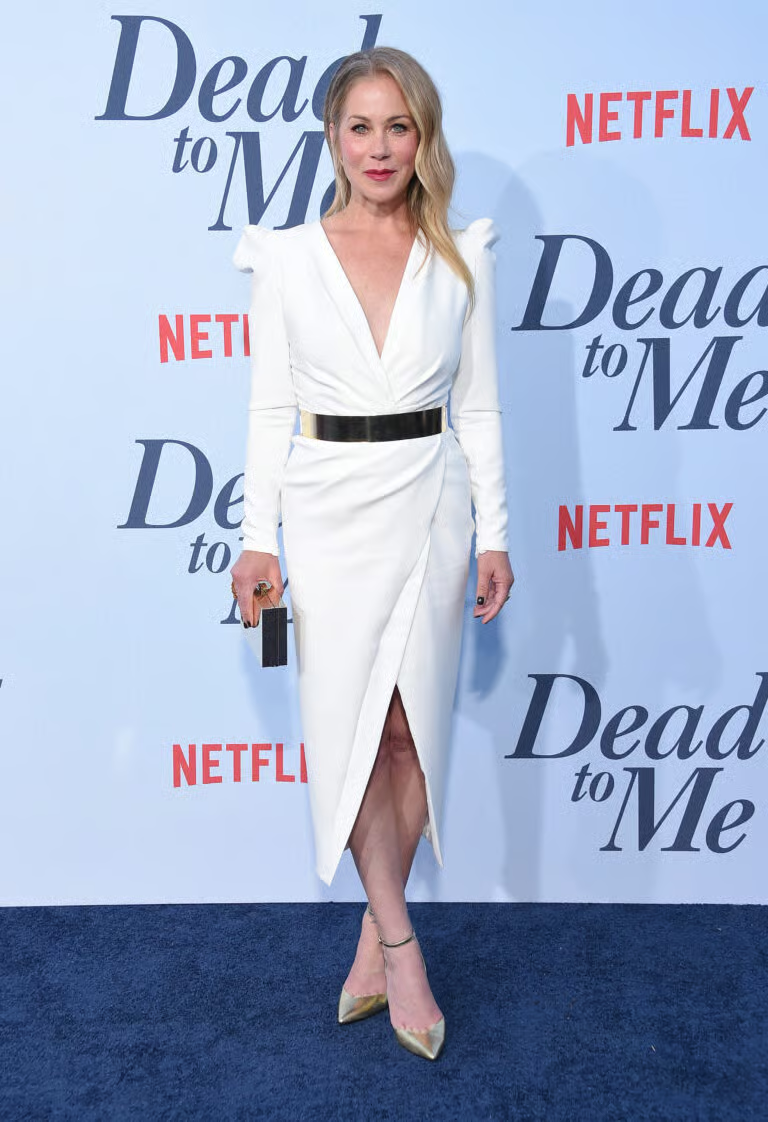
According to BuzzFeed, several other A-listers, such as Christina Applegate, said no to the producers’ offer to get her on board.
“I was asked to be a Housewife for Beverly Hills,” she said, revealing they had asked her a decade ago. Years later, Applegate formed a close friendship with one of the show’s producers and admitted that they told her she wouldn’t have been a great fit for the series.
“I said, ‘Chris, now that you know me, would I have been a fun Housewife?’ He’s like, ‘No, it would’ve been the most boring s— I’ve ever seen in my life,’” she said.
Applegate went on to say that she wouldn’t have wanted to participate in the outings that make the show work, such as group dinners or cast trips. “I would’ve been in my sweatpants and I’d be laying in bed. What fun is that? No, none of that. No, no. I would be the worst housewife anyway,” she said.

Speaking of “RHOBH,” “Friends” actress Lisa Kudrow recently made headlines after appearing to call out Andy Cohen on his show.
According to The Blast, Kudrow admitted she watched the show, but refused to share her thoughts about the series.
“I saw the ‘Beverly Hills’ [episode], you don’t want me to discuss it. I am telling you right now,” she said.
Kudrow then referenced a scene in which Dorit Kemsley left Kyle Richards and Erika Jayne stranded in a small town during their international cast trip to Tuscany, Italy.
“I am just going to say Black Mercedes, sprinter twins. I caught that, I’m sorry,” Kudrow said.
Cohen, however, didn’t seem interested in speaking too much about the moment, saying flatly, “OK, yeah.”

Before Kudrow’s comments made their rounds, Garcelle Beauvais, a former “RHOBH” cast member, got candid about her sudden exit from the series in 2025.
“A line was drawn for me that I no longer wanted to cross. I felt like my spirit could no longer do it. (It was) just drama for the sake of drama,” Beauvais said, per The Blast.
She opened up even more about her five seasons on the show in her new Audible original, “Protecting My Peace… At All Costs.”
“I realized something I couldn’t unsee. I didn’t have an ally. Not one. Not a single friend sitting on that stage with me. No one to lock eyes with, no one to lean toward. No one saying, ‘I see you,’” the “Jamie Foxx” show alum wrote in her book. “The same way I walked in is how I walked out. Alone. I didn’t wanna fight anymore. I didn’t wanna be a grown a, woman, a grandmother, going after other women.”

Another report from The Blast details Kathy Hilton’s thoughts about her role on the series. According to the socialite, she enjoys filming the show because it allows her to be herself.
But according to her, not everything is as it seems. “… you have to realize things are edited,” she said.
Hilton’s comments are about her viral one-liners that often come during the show’s most intense and serious moments, whether that’s an argument with the other women or a charity event.
Hilton explained that the scenes have caused some viewers to think she’s unintelligent, which she severely dislikes.
“When they think that I am cuckoo,” she said. “I don’t consider myself stupid. It’s the way things are cut, and that’s fine. “I get nervous.”
While not necessarily a golden age for the genre, the last quarter-century has still been a pretty solid one for sci-fi writing. On the one hand, it’s given us more than a few crowd-pleasing blockbuster stories like Project Hail Mary and Murderbot. On the other hand, there have been several ambitious, though-provoking projects like The Three-Body Problem and What We Can Know, using their futuristic elements to get deeply philosophical.
With all that in mind, this list attempts to rank some of the finest sci-fi books of the last two and a half decades. Taken together, these literary efforts serve as reminders of what the genre can do at its best. Science fiction is still thriving, and it’s largely because of these works that keep pushing the boundaries of what the genre can be.

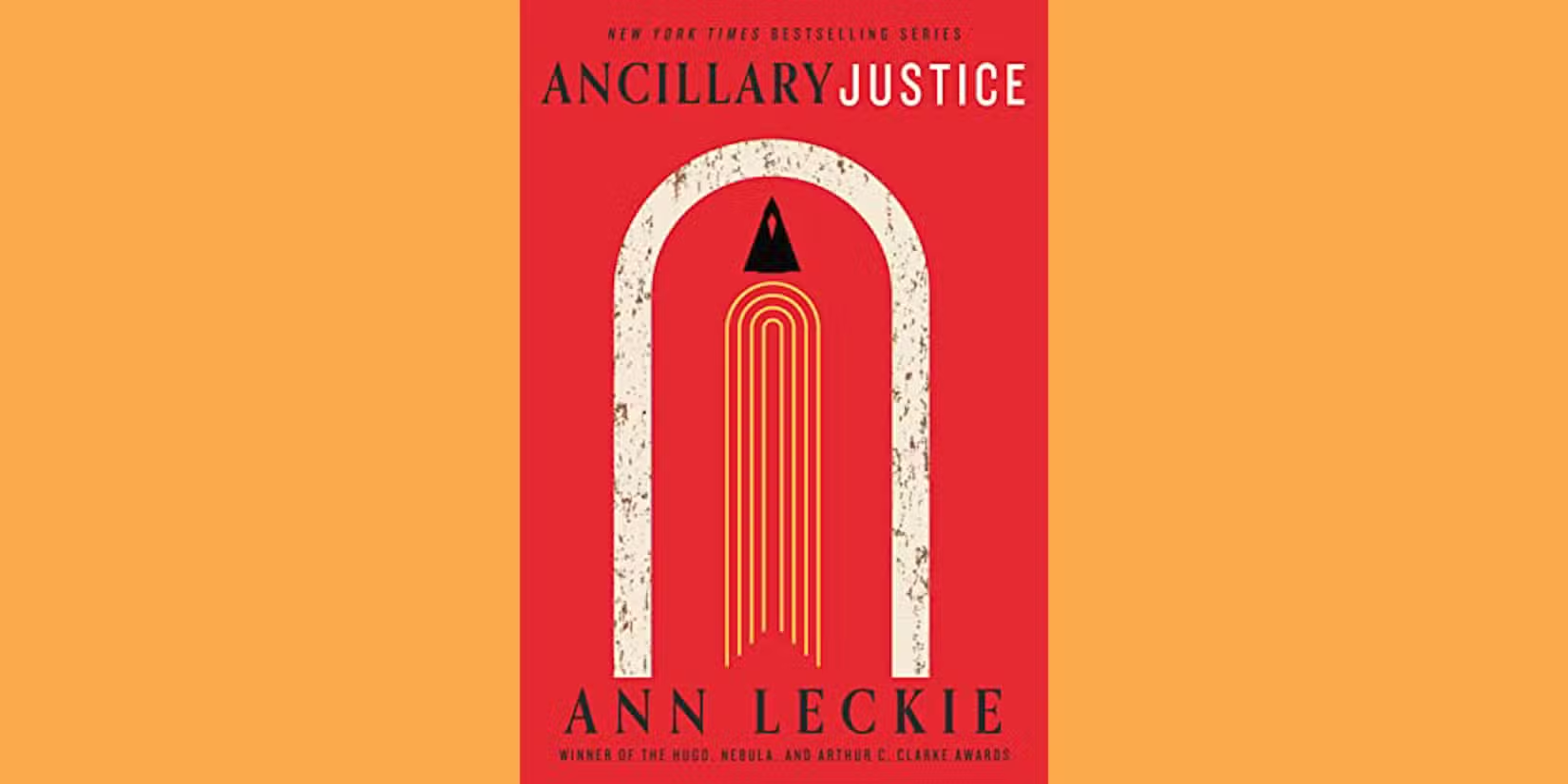
“Justice of Toren once had thousands of bodies.” This space opera focuses on Breq, the last remaining fragment of a once-massive artificial intelligence that controlled an entire starship and its human “ancillaries.” Now confined to a single body, she seeks revenge against the ruler who destroyed her. The novel unfolds across two timelines: Breq’s past as a distributed consciousness and her present journey through a fractured empire.
From here, Ancillary Justice confidently blends older sci-fi traditions with modern sensibilities. You can feel echoes of writers like Ursula K. Le Guin, Iain M. Banks, and Frank Herbert, yet it never feels derivative. The revenge plot reels you in, the political thriller elements raise the stakes, and then, on top of all that, the book throws in some philosophical musing, too. At its core, Ancillary Justice asks what identity even means in a future where consciousness can be fragmented, copied, weaponized, or erased.

“The moon blew up without warning and for no apparent reason.” Seveneves opens with a juicy setup: the moon shatters, and humanity is given a limited window before the resulting debris renders Earth uninhabitable. The story tracks the desperate efforts to preserve the human species in orbit. The novel is divided into distinct phases, leaping from the immediate crisis to the far future. This is very much a work of hard sci-fi, meaning that science and real-world concepts are front and center.
Author Neal Stephenson obsesses over engineering, physics, genetics, and orbital infrastructure in a way that gives the apocalypse impressive realism. Yet beneath the technical detail lies a bleak but compelling portrait of humanity under pressure. Alliances fracture. Politics sabotages cooperation. Personal rivalries become civilization-shaping events. Even in the face of a galactic catastrophe, our biggest problem is ourselves.

“I’m pretty much f—d.” Writer Andy Weir is back in the conversation again thanks to the success of the Project Hail Mary movie, but his overall strongest novel is his first one. In The Martian, astronaut Mark Watney becomes stranded on Mars after his crew believes him dead. He must find a way to stay alive using limited resources and his own ingenuity. Every chapter introduces new complications, failures, or impossible calculations.
Just when Watney solves one disaster, another emerges. Nevertheless, while his situation is pretty grim, the character himself remains energetic throughout, which is a big part of the book’s appeal. Watney’s log entries are packed with dark humor and exhausted optimism even when he’s facing seemingly imminent death. Plus, it’s fun seeing him MacGyver his way out of problems, drawing on his extensive knowledge of math, botany, engineering, and chemistry.

“We’re going to make a new world.” Children of Time boasts a very odd but intriguing premise: as humanity searches for a new home, a terraforming experiment goes wrong, leading to the rise of an entirely different intelligent species: evolved spiders. The narrative (spanning thousands of years) alternates between the remnants of humanity and the development of this new arachnid civilization. Impressively, author Adrian Tchaikovsky ensures that the spider society feels comprehensible without losing its strangeness.
A more mediocre sci-fi novel would’ve made the spiders basically just humans with eight legs. Instead, this book depicts their society, religion, communication, gender dynamics, warfare, and scientific development as fundamentally different from our own, rooted in their very different evolutionary starting points. In the process, Children of Time raises interesting questions around what alien intelligences might look like.

“We have no future because our present is too volatile.” Pattern Recognition is a novel by cyberpunk legend William Gibson, most famous for writing Neuromancer. In contrast to that classic, this book is more rooted in the present, specifically the decade it was written in. In it, Cayce Pollard, a marketing consultant with a unique sensitivity to branding, becomes obsessed with a series of mysterious video fragments appearing online. She seeks to track down their creator, turning this into a postmodern thriller/sci-fi hybrid.
The resulting book is a noirish funhouse mirror reflection of the early 2000s, conjuring up an icy globalized world of airports, fashion labels, internet forums, advertising agencies, corporate paranoia, and post-9/11 anxiety. Gibson writes cities, objects, clothing, and architecture with almost cyberpunk noir intensity, even though the setting is recognizably contemporary. As a result, the novel turns ordinary modernity into something uncanny.

“The universe began as a single point… and it will end as one.” Exhalation: Stories is a short story collection by Ted Chiang, who also penned Stories of Your Life and Others, which served as the basis for the movie Arrival. Here, he takes a different concept in each tale, from entropy and artificial intelligence to time travel and free will, and explores it with both intellectual rigor and emotional clarity. Some are framed as scientific reports, others as personal reflections or speculative histories.
These stories become philosophical thought experiments, often with a focus on ethics and morality rather than on the mechanics of the sci-fi elements themselves. For instance, “The Truth of Fact, the Truth of Feeling” examines how externalized memory technologies might alter human relationships. Similarly, “Anxiety Is the Dizziness of Freedom” explores parallel timelines and choice in a way that becomes less about quantum mechanics and more about regret.

“That’s how the madness of the world tries to colonize you: from the outside in.” Jeff VanderMeer‘s Nebula Award-winning Annihilation book provided the strong foundation for Alex Garland‘s brilliant film adaptation. It follows a team of scientists entering Area X, a mysterious region where the laws of nature seem to have broken down. As the expedition progresses, the environment becomes more disorienting, and the line between external threat and internal perception begins to blur.
That ambiguity is crucial to the story’s power. VanderMeer refuses to provide neat explanations about what Area X is, where it came from, or what it ultimately wants. For some readers, that uncertainty is frustrating; for many others, it’s exactly what makes Annihilation unforgettable. Even fans who’ve already seen the movie may find some more depth to enjoy here.

“Once upon a time, each of us was somebody’s kid.” Saga is the first installment in the phenomenal space opera graphic novel series by illustrator Fiona Staples and writer Brian K. Vaughan, who most famously penned Y: The Last Man. The epic, galaxy-spanning story centers on Alana and Marko, soldiers from opposing sides of a galactic war, as they flee with their newborn child. The narrative is framed by that child, Hazel, whose perspective creates an interesting tension.
The first volume hits the ground running, throwing us into the thick of the plot, mixing space-faring adventure and intimate family drama. The illustrations are vibrant, and the dialogue is killer. Overall, Saga draws on myriad inspirations yet still charts its own course, shifting nimbly between comedy, horror, romance, political satire, and tragedy. One page might contain absurd alien humor; the next might hit a crushing emotional gut-punch.

“In love, we forgot that we too were things that could get broken or lost.” What We Can Know is the latest novel by Ian McEwan, most well-known for writing Atonement. It’s written from the perspective of an academic living in the year 2119 who is working on a project about a lost poem that was read aloud once in 2014. The character lives in a flooded future wracked by global warming, yet the focus is really on our present.
McEwan uses this premise to get really philosophical, exploring everything from artificial intelligence and social media to political instability, ecological collapse, nuclear war, and cultural breakdown. It’s a sharp commentary on the 2010s and 2020s. However, themes aside, What We Can Know simply works as an engrossing mystery and drama, with a surprisingly juicy plot and cast of well-drawn characters.

“The universe is a dark forest.” Perhaps the most ambitious sci-fi novel of the 21st century so far, Liu Cixin‘s The Three-Body Problem begins during China’s Cultural Revolution and gradually expands into a story that spans centuries, civilizations, and the fundamental nature of the universe. At its core is the discovery of an alien civilization and the implications of first contact, but the narrative moves beyond, delving deep into physics, philosophy, and the limits of human understanding.
In particular, the book interrogates whether technological advancement necessarily leads to moral progress. Humanity here is fragmented by nationalism, ideological conflict, ego, and fear. Some characters welcome alien intervention because they have become so cynical about humanity’s future; others see survival as justification for authoritarian control. Once again, a speculative idea is used to hold a mirror up to the issues of our own time.
:max_bytes(150000):strip_icc():format(jpeg)/white-collar-watn-092625-9c130f456d2d491c80b62c6ddc59d5d3.jpg)
Matt Bomer, Tiffani Thiessen, and the late Willie Garson led the USA comedy for six seasons.
:max_bytes(150000):strip_icc():format(jpeg)/The-Batman_2-a8239c19acdb414eac050ace41bdd6b7.jpg)
Director Matt Reeves revealed the actors through individual social media posts.
Thrillers are such a special brand of cinema. Their narratives often eschew anything grandiose or epic in favor of something that cuts right to the bone. Maybe their impact is only skin deep, or maybe it drills deep down into the marrow, but they are more often than not effective and efficient. As a genre, the thriller may be one of the most pliable as well, able to combine with science fiction, horror, Westerns or action with equal ease. It’s maybe because of that pliability that the thriller itself can go a little undervalued.
Thrillers don’t have the devoted fanbase that horror and science fiction do, and even if they have broad appeal, it doesn’t always deliver the same box office success as their more action-packed counterparts. The streaming age has only worsened this situation, with the majority of thrillers bypassing theaters altogether and getting swallowed up by the algorithm. These newer overlooked thrillers are in good company with many older gems that remain hidden. New and old alike, these are ten amazing thrillers that you’ve been sleeping on.

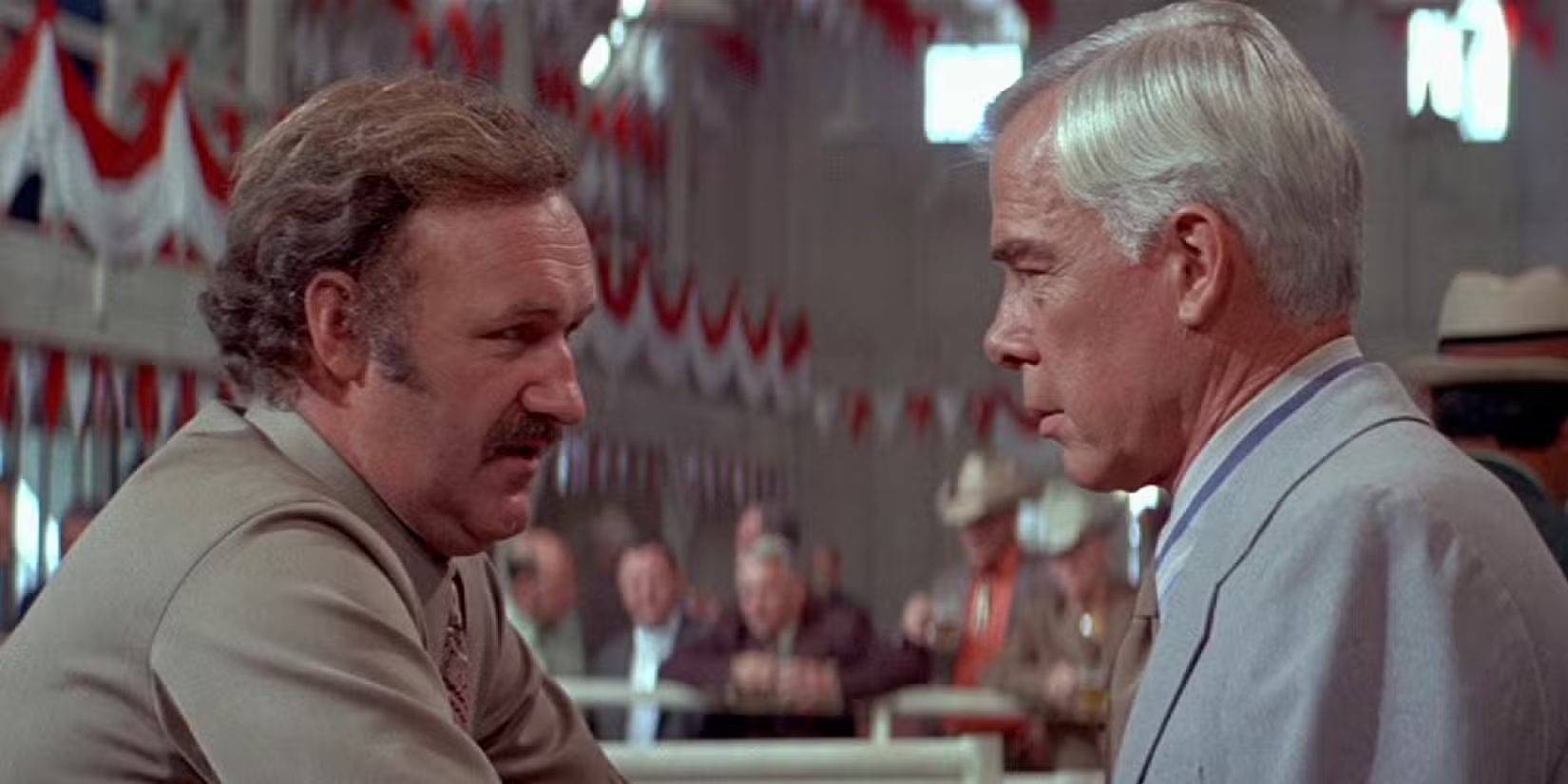
Prime Cut is a nasty little crime thriller that was controversial upon its release for some of its explicitly violent and sexual content. Depicting the conflict between a Kansas meat-packing magnate and a Chicago mob enforcer, the film isn’t afraid to get lurid or downright sleazy. However, it’s elevated above the lowest ranks of exploitation thanks to solid direction, some memorable suspense sequences and an overqualified cast of professionals and rising stars.
Lee Marvin plays Devlin, an enforcer working for the Irish Mob who’s sent to collect a debt from the boss of a meat packing plant in Kansas named Mary Ann, played by Gene Hackman. In the middle of their escalating conflict is the young Poppy (Sissy Spacek in her first screen role), who has been sold into prostitution. Prime Cut was directed by Michael Ritchie, who later became better known for his comedies like Bad News Bears and Fletch, but his direction on this lean piece of pulp shows the same affinity for character. The film isn’t the equivalent of a fine filet mignon, but rather some cheap and juicy chuck that’s still packed with flavor.

City folk getting more than they bargained for on a rural excursion was a popular premise in the ’70s, as best exemplified by movies like The Texas Chain Saw Massacre and The Hills Have Eyes. Also popular during the decade were car chase movies, such as Smokey and the Bandit and Dirty Mary, Crazy Larry. The underrated thriller Race with the Devil combines both these genres with a dash of Satanic panic that makes it the real road trip from hell.
Peter Fonda and Warren Oates, who both separately starred in car movies, play co-owners of a motorcycle dealership who are headed to Aspen in an RV together for a vacation with their spouses, played by Loretta Swit and Lara Parker. The foursome’s plans are derailed when they witness a human sacrifice performed by a Satanic cult. Thus begins a pursuit across Texas as the couples try to survive increasing attacks from the cult and apathy from local law enforcement. Race with the Devil is a unique road thriller that’s had some minor influence, but deserves more eyes, especially for the shocking ending.

Walter Hill knows how to make a lean, mean thriller. The director is responsible for cult classics like The Driver, The Warriors, and Southern Comfort, which all put their protagonists up against a gauntlet of external threats. His most underrated effort, which many haven’t woken up to yet, is the tightly wound 1992 siege thriller Trespass. It’s got an all-star cast, a simple but effective premise, and a clever script that keeps things taut until the end.
Bill Paxton and William Sadler play two firemen who come across a map that leads to a supposed treasure hidden in an abandoned building. When they decide to seek out this treasure for themselves, they get a mountain of trouble for it after they unwittingly witness a gang murder. That puts them up against a dangerous group of criminals, which includes Ice-T and Ice Cube in their only film together. Trespass isn’t overly complex or groundbreaking; it’s just a down-and-dirty thriller with a great cast that should’ve been a hit.

Bill Paxton is the apparent king of underseen thrillers released in 1992. In addition to Trespass, he also played a key role in the massively overlooked neo-noir film One False Move. Co-written by Billy Bob Thornton, who also stars alongside Paxton, and directed by Carl Franklin, the movie received an overwhelmingly positive reception from critics but failed at the box office. Alas, that failure doesn’t diminish its lethal effectiveness.
Thornton is the leader of a trio of criminals who leave a pile of bodies in Los Angeles after they high-tail it out of town to sell a stash of drugs. Paxton is the chief of police of a small town that the trio is headed towards, and he has some secrets of his own. The film has unflinching violence and a stripped-down style that makes it pack a harder punch than you might expect. With a layered script and a perfect cast, One False Move lives up to its title, execution-wise.

For B-movie fans who only know Bruce Campbell as Ash from the Evil Dead franchise, Running Time offers slick, no-frills thrills that prove the actor has more skills than just slaying deadites. Made on a shoestring budget, this heist movie stands out thanks to its gimmick. The entire film takes place in real time and has the added layer of being filmed to appear as if it is one continuous shot, accomplished through old-school ingenuity and hidden cuts, taking a page out of Alfred Hitchcock‘s Rope.
Campbell plays Carl, an ex-con who has a heist planned for the same day he’s released from prison. That plan isn’t foolproof, as several criminally stupid mistakes put Carl and his crew on the run after the botched robbery. Running Time isn’t flawlessly executed, but it isn’t amateur hour either. There’s an undeniable skill to pulling off the film’s visual gimmick, and any rougher moments in the performances or occasionally stilted dialogue don’t take away from its well-timed thrills.

As based on the novella by Jonathan Ames, there’s a version of You Were Never Really Here that could’ve been made as a much pulpier, more action-fueled movie along the lines of the original Taken. They’re all films about men with a certain set of skills that they use to punish criminals and protect innocents. However, Lynne Ramsay’s caustic thriller has a much sharper psychological edge to it, with a protagonist defined by his trauma in a way that breaks from the Hollywood anti-hero mold. The film was given a limited theatrical release before it promptly disappeared on Amazon, but it should not be allowed to fade away.
Joe (Joaquin Phoenix) is a mercenary whose specialty is saving young victims of trafficking. Brutality seems his second nature, rooted in his violent past. Joe is a fundamentally broken man, and no matter how much blood he spills, it will never free him from his trauma. The violence of You Were Never Really Here is fascinatingly filmed, with Ramsay often cutting away in a manner that denies the bloodthirsty catharsis that most action fans would want. It’s one of many ways in which the film makes its violence even more visceral, and it leaves an impact that will not be forgotten by anyone who watches it.

The Lookout was the directorial debut of screenwriter Scott Frank, who had risen to prominence writing crime films like Get Shorty and Out of Sight, and would later find success on streaming with series like The Queen’s Gambit. It’s a small-scale heist film featuring a terrific lead performance from Joseph Gordon-Levitt in the middle of his resurgence as an adult actor.
Gordon-Levitt plays the retroactively distracting Chris Pratt, a once-promising high school hockey phenom who suffered a traumatic brain injury in a car accident, which left him impaired. He works as a janitor at a bank, which is what brings him into the orbit of a former high school classmate, played by Matthew Goode, who manipulates him into robbing the bank. Frank’s script for the film is characteristically clever, and the plot veers in unexpected directions even when it’s repeating beats we’ve seen before. The Lookout is a sublime crime thriller that has been overlooked for far too long.

Another thriller sacrificed to the algorithm gods, Calibre is a menacing British thriller that premiered on Netflix internationally, making it simultaneously instantly accessible and frustratingly hidden. It’s a taut and terrifying thriller, turning the rural fears that have fueled so many films on its head. It’s a truly discomforting and nerve-wracking film to watch, but it is so well-made that you can’t help but admire it even when it’s making you squirm.
Jack Lowden and Martin McCann play friends Vaughan and Marcus, who have taken a weekend hunting trip together in the Scottish Highlands. After an accident leaves two people dead, the men swear each other to secrecy but quickly find themselves stranded in the nearby town, where tensions with the locals quickly begin to rise. Calibre grabs hold of you early and continues to tighten its grip until you can’t bear it anymore.

Bull is another British thriller with far less recognition internationally than it deserves. It’s a brutal and violent revenge thriller that treads over familiar ground, but does it with such an unrelenting tone that it borders on the horror genre. It also benefits from a strong lead performance by Neil Maskell, who also appeared in the similar genre-shifting Kill List. Revenge thrillers, when done well, can offer a nasty bit of violent catharsis, and Bull does that with blood-soaked tenacity.
As Bull, Maskell is a feared enforcer for a dangerous gangster who is also his father-in-law. After being betrayed and seemingly killed, Bull returns to exact vengeance on those responsible as well as to find his son. Bull doesn’t pull its punches in the least. It means to be an old-school violent revenge thriller, and it is exactly that. It also has a twist ending that may hammer the point home a little too strongly, but the film doesn’t suffer drastically because of it. Fans of films like the aforementioned Kill List and Dead Man’s Shoes should check this one out.

Jeremy Saulnier made his name on gritty thrillers like Blue Ruin and Green Room, which both include brutal body counts and bloodletting. His most recent thriller, Rebel Ridge, flips the script on that and presents itself as a non-lethal, or less lethal, action movie that focuses on tension over brutality. It’s been compared to First Blood for its plot that pits a former specialist against a corrupt police department, but even that comparison fails to capture the effectiveness of Saulnier’s thoroughly modern thriller. It’s another film that’s gotten swallowed up by Netflix, but is primed for discovery.
Aaron Pierre gives a star-making performance as Terry Richmond, a former Marine who has traveled to a small town in Louisiana to post bail for his cousin, but has his money unlawfully taken by the local police. That act sets off a chain reaction of escalating events between Terry and the police. It’s a gripping thriller that pulls some of its plot points directly from real issues, but it turns them into fodder for an engaging mystery action thrill ride. Rebel Ridge continues Saulnier’s evolution as a genre director, and it puts all others on notice for how effective its thrills are without riddling bodies with bullets.
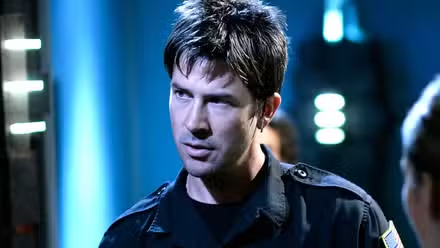
For those who love Stargate, it’s no secret that we’ve been waiting for the franchise to continue for some time. With news that Prime Video is rebooting the science fiction staple, we have hope for the first time since Stargate Universe concluded that more adventures across the galaxy — and through the gate — are underway. But several years back, in honor of Stargate SG-1‘s 20-year anniversary, MGM briefly revisited the franchise in a mythology-rich 10-part miniseries that aired across several weeks in 2018. If you’re looking for a quick sci-fi-flavored binge on Prime Video this weekend, look no further than Stargate Origins.
Stargate Origins was originally released on the now-defunct streaming platform Stargate Command, which was devoted entirely to the Stargate franchise. However, since the streaming platform folded and Amazon purchased MGM, the entire franchise catalog has been folded into Prime Video — which is great news for fans looking for a new binge. Although the last entry in the franchise to date, Stargate Origins is a prequel that takes place even before the original Roland Emmerich-directed film. Set in 1938, several years after Professor Paul Langford (Connor Trinneer) and his team first discovered Earth’s stargate in Giza, the miniseries begins with a brief flashback to the 1994 film’s opening before jumping ahead several years to Langford and his daughter, Catherine (Ellie Gall), who struggle to understand the strange glyphs on the alien device. While Catherine would play a role in both the original feature film and SG-1, this prequel presents viewers with her own adventure through the gate, arriving on the world of Abydos decades before Daniel Jackson (James Spader, Michael Shanks), Jack O’Neill (Kurt Russell, Richard Dean Anderson), and their team would arrive there.
Whether you’ve seen all of SG-1 or only the original Stargate movie, you’ll find yourself up-to-speed for this standalone prequel. The 10-part miniseries — consisting of 10-minute episodes that run around an hour and 40 minutes total — sets up many of the events in the first film after the professor is forced through the gate by a crazed Nazi occultist, Wilhelm Brücke (Aylam Orian), who aims to use the power of the gods to give the Third Reich an edge on the rest of the world. In an effort to save her father, Catherine recruits her boyfriend, Captain James Beal (Philip Alexander), and Egyptian native Wasif (Shvan Aladdin) to jump through the gate, finding themselves on an adventure through the stars. In many respects, Stargate Origins comes across as a revisionist pulp story that seems to infuse 1930s speculative fiction with material meant for 2010s audiences. However, you feel about some of that, Origins is rife with inspired references to and set-up for the original motion picture, which featured an older Catherine played by Viveca Lindfors.

This 2-Part Sci-Fi Epic Is the Most Addictive Binge You’ll Find on Streaming Right Now
This underrated five-season sci-fi gem kicks off with a powerful two-part adventure that will keep you glued to the screen.
While the 10-minute episodes are a perfect way to binge the series over a short weekend, folks wishing to enjoy the miniseries all in one go can do so just as easily. For those unwilling to click “next episode” every 10 minutes (or if you just want a more seamless transition), Stargate Origins was re-edited into a “feature cut” by MGM titled Stargate Origins: Catherine. The re-edited version features a revised score and some updated effects, though the story itself doesn’t change. Of course, if you’re looking for something more like Stargate Atlantis in quality, you’ll be out of luck. While Origins is fun for what it is, the low-budget production is a bit uneven in terms of its performances, adds some strange character choices, and is more akin, in some respects, to a tie-in web-series rather than something of the caliber of SG-1 or its spin-offs. But if you love Stargate, it remains a must-see, if only on the basis that it’s another entry in the overall series — one that ties so directly to the foundation of the franchise.
Of course, if you’re looking to jump into the Stargate franchise and wondering if Origins is a good place to start, despite the name, we wouldn’t recommend it. The best order to watch this sci-fi extravaganza is by starting with the 1994 Stargate film. Although the feature was meant to be the first in a trilogy of Stargate movies, the franchise went a different direction entirely by transitioning to television in the form of Stargate SG-1, which picked up with the characters from the original film and continued their interstellar adventures. At least watch the first movie before diving into Origins (which, again, steals its opening scene directly from the 1994 picture), but if you’re looking to better understand the world, SG-1 is the perfect follow-up that will help set the stage for this quick prequel. Of course, you could always wait for the inevitable reboot…
Stargate Origins is available for streaming on Prime Video.

2018 – 2021-00-00
Stargate Command
Mercedes Bryce Morgan
:max_bytes(150000):strip_icc():format(jpeg)/nicki-minaj-donald-trump-051426-2b09a0c0e1364e259e7e45d6350e38f5.jpg)
“He just completely ignored me, with all the money I spent in taxes,” the rapper said of a key Democratic lawmaker.
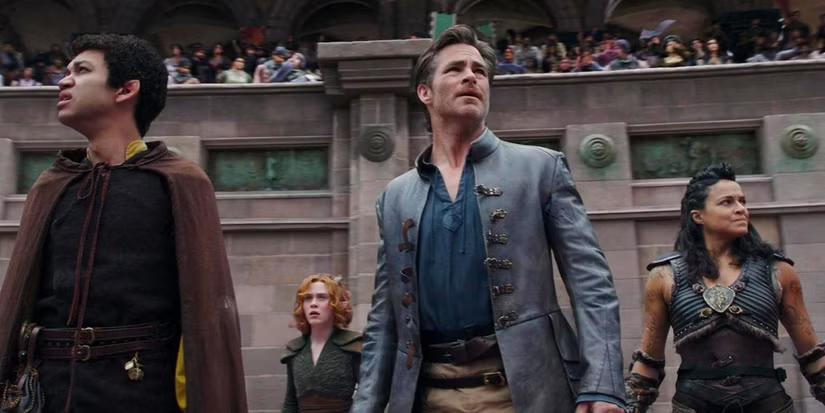
Dungeons & Dragons has evolved from a role-playing game into a cultural phenomenon, impacting pop culture along the way. Without Dungeons & Dragons, Stranger Things wouldn’t have its big narrative hook. Critical Role wouldn’t be a thing, which means no Legend of Vox Machina or Mighty Nein. In 2023, Paramount decided to take the next logical step and make a D&D movie, resulting in Dungeons & Dragons: Honor Among Thieves. Honor Among Thieves is one of the rare films that were both critically acclaimed and box-office flops, which is a shame because it perfectly captures the spirit of Dungeons & Dragons.
As its title suggests, Dungeons & Dragons: Honor Among Thieves is essentially a heist movie set in the world of Dungeons & Dragons. Led by the boisterous bard Edgin Darvis (Chris Pine), the barbarian Holga (Michelle Rodriguez), sorcerer Simon (Justice Smith), and druid Doric (Sophia Lillis) join forces to rob the Lord of Neverwinter, Forge Fitzwilliam (Hugh Grant), of his treasures. They end up embroiled in a sinister plot concocted by the Red Wizard, Sofia (Daisy Head), and wind up having to save Neverwinter. What follows is a fast, funny, and engaging adventure that will appeal to both Dungeons & Dragons super fans and newcomers to the game.

Throughout Dungeons & Dragons: Honor Among Thieves, writer/directors Jonathan Goldstein and John Francis Daley manage to keep up a blend of hilarious and emotional moments that are punctuated by bouts of action. A key example is when the party, led by Paladin Xenk Yandar (Regé-Jean Page), travels into the subterranean realm known as the Underdark to retrieve a magical artifact. They wind up running afoul of Themberchaud, a dragon feared throughout the land…only to discover that Themberchaud has packed on a few pounds over the years. Emotionally, the film doesn’t hold back: Edgin is putting himself through a lot to see his daughter and potentially resurrect his wife; Simon is struggling with his magic; and Doric wishes to protect her people from Forge’s greed.
Goldstein and Daley also manage to introduce plenty of Dungeons & Dragons Easter eggs, showcasing their deep love for the game. Whether it’s creatures like Mimics, the dreaded sorcerer Szass Tam, or the cast of the beloved Dungeons & Dragons animated series, these Easter eggs are skillfully woven into the movie; longtime fans can enjoy them, while newcomers won’t feel lost. Goldstein also told Den of Geek that the heist element of Honor Among Thieves was crafted to appeal to non-D&D fans.
“We wanted to create a film that would be entertaining and appealing to all audiences, whether you knew D&D or not. For that to work, we needed a sort of scaffolding and infrastructure for the movie that would be enjoyable and engaging. We’ve always wanted to do a heist movie.”
The response was extremely positive, as Honor Among Thieves currently holds a 91% rating on Rotten Tomatoes. Most reviews pointed out how it was one of the few modern blockbusters that actually managed to replicate the feeling of a Marvel Studios movie; ironically, Goldstein and Daley previously helped write the screenplay for Spider-Man: Homecoming, while producer Jeremy Latcham worked on some of Marvel’s biggest hits, including Guardians of the Galaxy. Sadly, Honor Among Thieves was released in the same month as other major blockbusters, like The Super Mario Bros. Movie and John Wick: Chapter 4; this resulted in a less-than-stellar box office haul.
Dungeons & Dragons: Honor Among Thieves might not have set the box office on fire, but its story could potentially continue in a different form. Netflix is currently developing Dungeons & Dragons: The Forgotten Realms, a television series that is set in the same fictional realm as Honor Among Thieves. The timing couldn’t be more perfect; fantasy shows are making a splash on streaming services, and Honor Among Thieves was a big streaming hit for Netflix. If Forgotten Realms is a huge hit for Netflix, that could be the push Paramount needs to put another Dungeons & Dragons movie into production. In the meantime, Dungeons & Dragons: Honor Among Thieves is still worth a watch, whether you’re a fan of the game or not.


![[CONFIRMED] Bitcoin Holders...This is BIG!](https://wordupnews.com/wp-content/uploads/2026/05/1778822840_maxresdefault-80x80.jpg)




HarrisX Poll Found 52% of Registered Voters Support the CLARITY Act


Weekend Open Thread: Marianne Dress


Coffee Break: Travel Steam Iron


What to Know Before Buying a Curling Wand or Curling Iron


Auto Enthusiast Carves Functional Two-Stroke Engine from Solid Metal


What to expect when you’re expecting a budget

Ignore market noise, India’s long-term story intact, say D-Street bulls Ramesh Damani and Sunil Singhania


Politics Home Article | Starmer Enters The Danger Zone


GM Agrees To Pay $12.75 Million To Settle California Lawsuit Over Misuse Of Customers’ Driving Data


PROS explodes 48% as Upbit and Bithumb listings ignite demand


CZ says US crypto rivals tried to block Trump pardon


YNW Melly Denied Bond Again Ahead Of Double Murder Retrial


GM agrees to $12.75M California settlement over sale of drivers’ data


Bayern Munich vs PSG UEFA Champions League SF2 live match time, streaming | Football News
The Most Exciting Apple Products In The Pipeline For 2026 And Beyond
The Hantavirus Danger: Can a Potential Outbreak Spark a New Meme Coin Frenzy?


Kraken Parent Seeks OCC Charter, Signaling Regulated Banking Access


David Attenborough ‘Overwhelmed’ By Love Shown Ahead Of 100th Birthday


After Waka Waka, Shakira now drops first teaser for FIFA WC 2026 song | FIFA World Cup 2022


Solana UFO Meme Coins Surge After Pentagon Reveals Alien Files


You must be logged in to post a comment Login