

Crypto World
Lawyer behind Arbitrum crypto seizure fight now targets Tether for $344 million



Charles Gerstein wants a federal judge to order Tether to transfer OFAC-frozen USDT tied to Iran’s Revolutionary Guard to victims holding unpaid terrorism judgments

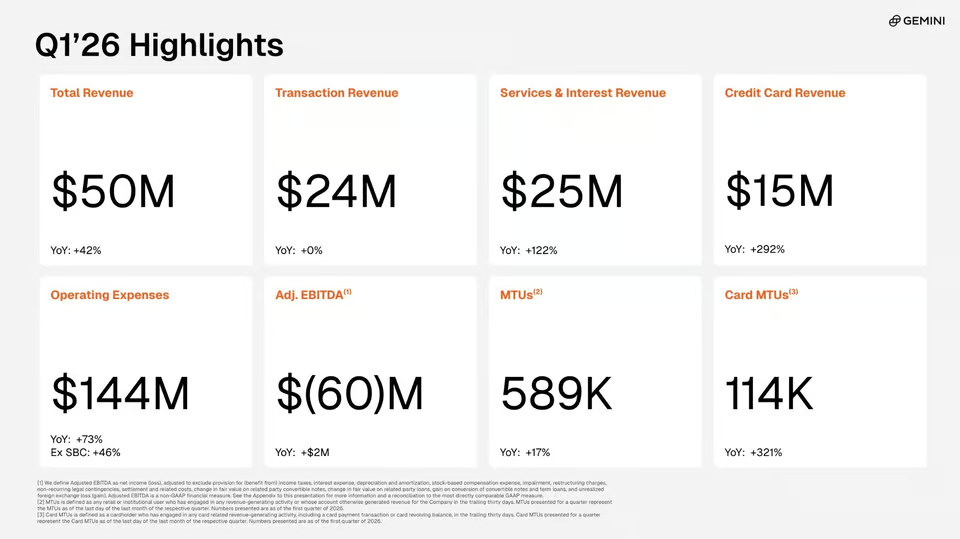
Crypto company Gemini reported a 42% year-over-year increase in revenue in Q1 2026 as it continued its growth from a pure crypto exchange to a financial services company.
Total revenue for the Winklevoss twins’ company grew 42% year over year to $50.3 million in the first quarter, while transaction revenue remained stable at $24 million, the company reported Thursday.
However, its crypto exchange revenue decreased 27% year-over-year to $17.2 million, “reflecting lower spot trading activity and a moderation in crypto market volumes,” while total trading volume declined to $6.3 billion from $13.5 billion in Q1 2025.
The biggest increase was in credit card revenue, which surged nearly 300% to $14.7 million, driven by significant growth in the Gemini Credit Card user base, the company said.
The expansion from crypto into broader financial services began in early 2021, when the company announced consumer finance products such as credit cards. Five years later, services and interest income, driven heavily by credit cards, made up almost half of total revenue, showing how pivotal the expansion has become.
“As Gemini continues to evolve, we expect that the momentum we have built in diversifying our revenue will only accelerate,” said Gemini president Cameron Winklevoss.

Gemini’s revenue increased, but so did operating expenses. Source: Gemini
Other crypto exchanges have been eyeing business outside of digital assets, Coinbase has aggressively expanded into stock and ETF trading in a goal to become an “everything exchange,” while Kraken has made recent acquisitions enabling it to expand into regulated derivatives markets.
Total operating expenses increased
Alongside revenue growth, Gemini also reported a 73% increase in total operating expenses to $144.5 million in the quarter. This was driven primarily by “compensation, marketing and credit card-related costs associated with the significant business expansion,” the company said.
Gemini reported an adjusted EBITDA loss of just under $60 million.
Related: Gemini sued over post-IPO strategy shift, declining stock price
Gemini also disclosed Thursday that it closed a $100 million strategic investment from Winklevoss Capital in exchange for 7.1 million shares of common stock, with the investment funded in Bitcoin.
Path to becoming a full-stack, end-to-end marketplace
In April, the company received a Derivatives Clearing Organization license from the US Commodity Futures Trading Commission, making Gemini one of only a handful of crypto-native platforms in the country to hold both a Designated Contract Market and a DCO license in-house.
“This all represents the next step towards Gemini becoming a full-stack, end-to-end marketplace for crypto trading, predictions, futures, options, and more,” the firm stated.
Gemini’s stock (GEMI) gained 6.9% on Thursday to reach $4.92 in after-hours trading; however, it remains down 47% year-to-date, according to Google Finance.
Last week, Coinbase reported $1.41 billion in total Q1 revenue, down 31% year over year, but it posted a net loss of $394 million. It is much larger than Gemini and also saw strong diversification into derivatives, prediction markets, and stablecoins, which helped offset the decline.
Magazine: eToro founder timed Bitcoin top perfectly due to belief in 4 year cycles


Hana Bank will buy 2.28 million shares in Dunamu, the parent company of Upbit, from Kakao Investments for about 1.003 trillion won, or nearly $670 million.
Summary
- Hana Bank’s Dunamu stake gives it direct exposure to South Korea’s largest crypto exchange operator.
- Kakao Investments will reduce its Dunamu holding as Hana becomes the fourth-largest shareholder.
- The deal comes as Dunamu works through its planned merger with Naver Financial.
The deal gives Hana Bank a 6.55% stake in Dunamu and makes it the company’s fourth-largest shareholder. Reuters reported the deal as a 1 trillion won transaction based on regulatory filings.
The transaction is expected to close on June 15. Kakao Investments will keep 1.4 million Dunamu shares after the sale, equal to a 4.03% stake. The sale changes Dunamu’s investor structure as major Korean finance and technology groups move closer to crypto businesses.
Banking groups move closer to crypto
Hana said the investment aims to “secure competitiveness in the new financial landscape.” The wording shows the bank is treating digital assets as part of its wider financial services plan, rather than a short-term market trade.
The purchase also follows earlier moves by Hana-linked units. Hana Card signed a USDC-related marketing deal with Circle and Crypto.com in March, while Hana Bank and SK Telecom partnered with BitGo in 2024 to set up BitGo Korea, where Hana owns 25%.
Dunamu is already part of a wider corporate process involving Naver Financial. Crypto.news reported in April that South Korea’s Financial Supervisory Service ordered Dunamu to correct major omissions in filings linked to its stock swap with Naver Financial.
The same report said the deal would make Dunamu a wholly owned Naver Financial subsidiary, but regulatory, competition and legislative reviews remain part of the process. Earlier coverage placed Dunamu’s implied value near $10 billion and the broader merger around $14.5 billion.
Upbit dominates Korea’s exchange market
Upbit remains South Korea’s largest crypto trading platform. Reuters reported that the exchange handles more than 80% of the country’s virtual asset trading volume, making Dunamu one of the most watched crypto firms in Asia.
Recent market updates show Upbit still drives activity in Korean crypto trading. Crypto.news reported fresh Upbit actions this week, including a Cosmos ATOM transfer pause for a network upgrade and the planned delisting of NKN’s BTC market in June.
Korea’s rules add to the timing
The Hana-Dunamu deal comes as South Korea works on the Digital Asset Basic Act. Crypto.news reported that the law was delayed into 2026 as regulators debated stablecoin oversight and the role of banks in issuance.
Separate coverage said the ruling party’s draft law includes tighter stablecoin rules, including a 5 billion won capital bar. That makes Hana’s Dunamu stake part of a larger shift, as banks, exchanges and technology groups prepare for clearer digital asset rules.

In crypto, timing matters — but sometimes, simply holding or participating at the right moment matters even more. That’s where crypto snapshots come in.
A crypto snapshot is a recorded capture of blockchain data at a specific moment in time. It’s like taking a “photo” of a network to see who owns what, who participated, or who qualifies for rewards.
Projects use snapshots for many reasons, especially for:
- Airdrop eligibility 🎁
- Governance voting 🗳️
- Reward tracking 📊
Even though snapshots happen quietly in the background, they often decide who receives valuable tokens and who gets left out.
How Does a Crypto Snapshot Work?
A blockchain constantly changes every second as users buy, sell, stake, and transfer tokens.
A snapshot freezes the data at one exact block or timestamp. Once recorded, the project can analyze:
- Wallet balances
- Token holdings
- Staking activity
- Governance participation
- Trading behavior
For example:
If a project announces:
“A snapshot will occur on May 20,”
Then only wallets meeting the requirements at that specific moment will qualify.
It doesn’t matter what happens after the snapshot is taken.
Why Are Snapshots Important?
Snapshots help crypto projects distribute rewards fairly and organize communities efficiently.
Instead of manually tracking thousands of wallets, projects simply record blockchain data at a specific time and use it as an official reference point.
Think of it as a digital attendance sheet for the blockchain.
1. Airdrop Eligibility
One of the biggest reasons snapshots are used is for airdrops.
Projects reward users who:
- Hold a token
- Use a protocol
- Stake assets
- Provide liquidity
- Participate early
The snapshot determines exactly who qualifies.
Example
Imagine a new blockchain wants to reward loyal users.
They may announce:
- Hold at least 100 tokens
- Before Block #25,000,000
- Snapshot date: June 1
Anyone meeting the requirements during the snapshot may receive free tokens later.
This is why many traders closely monitor snapshot announcements 👀
Some of the largest crypto airdrops in history used snapshots to distribute millions of dollars worth of tokens.
2. Governance Voting
Snapshots are also widely used in decentralized governance.
Many DAOs and crypto protocols allow token holders to vote on:
- Protocol upgrades
- Treasury spending
- Partnerships
- Tokenomics changes
But voting power needs to be measured fairly.
Instead of allowing users to buy tokens after voting starts, projects often take a snapshot beforehand.
This prevents manipulation.
Example
If you held:
- 1,000 governance tokens at the snapshot moment,
then your voting power is based on those 1,000 tokens — even if you later sell them.
This creates a more stable and fair governance system.
3. Reward Tracking
Snapshots are also useful for tracking ongoing rewards.
Projects may use snapshots to calculate:
- Staking rewards
- Yield farming incentives
- Loyalty bonuses
- Ecosystem participation rewards
Rather than checking balances every second, protocols can periodically take snapshots to simplify reward distribution.
This helps reduce:
- Network load
- Calculation complexity
- Reward abuse
Different Types of Snapshots
Not all snapshots work the same way.
Manual Snapshots
Projects announce a specific date and time publicly.
These are common for:
- Airdrops
- Governance votes
- Community rewards
Random or Hidden Snapshots
Some projects intentionally keep snapshot timing secret.
Why?
To prevent users from temporarily buying tokens just to qualify.
This encourages genuine long-term participation instead of short-term farming.
Continuous Snapshots
Some protocols continuously monitor activity over time instead of using a single moment.
This creates more accurate reward systems based on long-term behavior.
Risks and Misunderstandings
Snapshots are powerful, but they can also confuse beginners.
Buying Too Late
A common mistake is purchasing tokens after the snapshot has already happened.
At that point, eligibility may already be locked.
Fake Snapshot Announcements
Scammers often create fake airdrop campaigns.
Always verify announcements through official project channels.
Snapshot Doesn’t Guarantee Rewards
Just because your wallet appears in a snapshot doesn’t always guarantee an airdrop or payout.
Projects still decide:
- Distribution amounts
- Vesting rules
- Eligibility filters
Why Snapshots Are Becoming More Important
As crypto ecosystems grow, snapshots are becoming essential infrastructure.
They help projects:
- Reward loyal users fairly
- Build decentralized governance
- Track participation efficiently
- Prevent exploitation
With the rise of:
- DAOs
- Layer 2 ecosystems
- DeFi incentives
- Community-driven protocols
…snapshot systems are becoming increasingly important across Web3.
And because major airdrops can sometimes be worth thousands of dollars, interest in crypto snapshots continues to grow rapidly 🚀
Final Thoughts
Crypto snapshots may sound technical, but the idea is simple:
A snapshot records blockchain activity at a specific moment in time.
That single moment can determine:
- Who receives an airdrop
- Who can vote
- Who earns rewards
For anyone active in crypto, understanding snapshots is becoming an essential skill.
Because in Web3, being early is important — but being present at the right snapshot can matter even more.
REQUEST AN ARTICLE
U.S. President Donald Trump and Chinese President Xi Jinping meet on the sidelines of a visit to Zhongnanhai Garden on May 15, 2026 in Beijing, China.
China Pool | Getty Images News | Getty Images
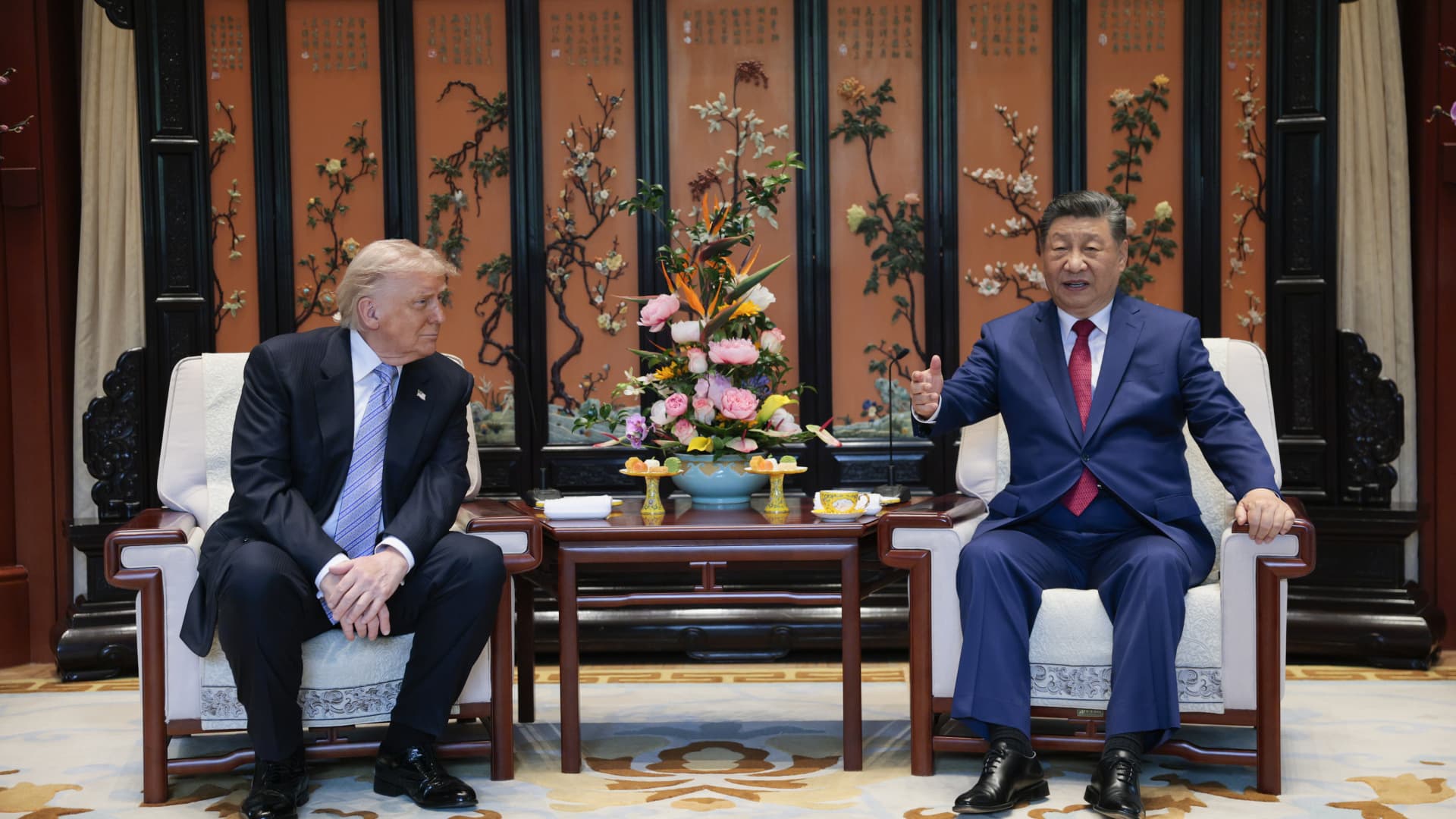
BEIJING — U.S. President Donald Trump has invited Chinese President Xi Jinping to visit the White House on September 24, indicating that trade talks will extend beyond this week’s two-day summit in Beijing.
Trump announced the invitation Thursday evening at a state dinner, according to a video shared by the White House.
Following the two presidents’ meeting earlier that day, Xi said the U.S. and China agreed to “strategic stability” as a framework for the next three years, according to state media.
The main question for the outcome of the summit will be “which of the deals the president would like to strike are ripe enough” to see through, said Ryan Fedasiuk, fellow at the American Enterprise Institute. “Frankly, a lot will be left on the tree to ripen further.”
China has yet to confirm that Xi will accept the invitation to visit. The United Nations General Assembly is scheduled for earlier in September in New York.
The two leaders could also meet around the APEC meeting in Shenzhen in November, and the G20 meeting in Florida in December.
President Trump’s proposal to suspend the federal gas tax is gaining momentum as White House officials race to limit the economic impact of the US-Iran war.
The renewed push comes amid Trump’s remarks during a Monday morning phone interview with CBS News, where he said he wants to pause the federal gas tax “for a period of time.”
Why the White House Is Considering a Pivot to a Gas Tax Cut
Reuters, citing people familiar with the White House’s discussions, reported that suspending the federal gas tax is “gaining urgency” after it was initially dismissed by some aides as unnecessary. Officials are reportedly running out of options to demonstrate they are addressing rising consumer costs.
One source said the proposal was still viewed as a backup plan as recently as late April. However, support for the measure strengthened over the past week as Iran’s ceasefire efforts stalled.
The proposed tax cut would reduce gasoline prices by roughly 18 cents per gallon at a time when the national average has climbed above $4.50. Nevertheless, Trump’s plan would require congressional approval.
“Within the White House, a consensus has emerged that with prices up 50% since the start of the war, Trump needs ‘a visible consumer relief move now,’ one of the people said,” the report read.
Subscribe to our YouTube channel to watch leaders and journalists provide expert insights
How the Iran War Reached US Pump Prices
The shift follows a sharp climb in fuel costs due to the closure of the Strait of Hormuz. Gas prices have climbed by more than 50% since the war began.
Americans have spent an additional $39.6 billion on fuel since the conflict, according to a Brown University tracker. An Ipsos Consumer Tracker wave found that 56% of Americans report higher gas spending over the past 3 months.
That figure stood at 24% in April 2025. At the same time, the US oil reserves are being drained fast.
Follow us on X to get the latest news as it happens
Nonetheless, Trump has dismissed concerns about household budgets.
“I don’t think about Americans’ financial situation. I don’t think about anybody. I think about one thing: we cannot let Iran have a nuclear weapon. That’s all,” he said.
With ceasefire talks faltering and Memorial Day approaching, the relief window is narrowing.
The post White House Searches for a Relief Valve as Iran Conflict Lifts Fuel Costs appeared first on BeInCrypto.
[PRESS RELEASE – Singapore, Singapore, May 15th, 2026]
Singapore, May 15, 2026 — LBank, a leading global cryptocurrency exchange, has officially launched the “Futures Grid Trading New User Growth Program.”The campaign offers a low-barrier, low-risk entry into futures grid trading. Through a three-stage framework of “Experience — Practice — Advancement” and tiered incentives, it helps users understand and participate in grid trading strategies while earning campaign rewards. The campaign runs from May 15 to May 31, 2026, with rewards of up to 1,120 USDT.
During the registration phase of the campaign, eligible new users will receive a 20 USDT futures grid loss-protection voucher upon completing sign-up, which can be used for their first experience with grid trading strategies. This mechanism is designed to reduce the cost of trial and error for users entering futures grid trading. If losses occur during strategy execution, the platform will provide compensation within the defined rules, helping users understand the basic logic and operation of grid trading with lower risk.
For users looking to improve trading performance, the campaign offers incentives for BTC and ETH futures grid trading. Participants can earn futures bonuses based on cumulative investment and strategy runtime, with rewards of up to 100 USDT. LBank AI parameter assistance can also automatically suggest price ranges and grid density based on market conditions, simplifying setup and improving efficiency.
The highlight of this campaign is the “Arbitrage Frequency Leaderboard,” where users are ranked based on the total arbitrage executions across all futures grid strategies under their account, with top users eligible to earn up to 1,000 USDT. To qualify, each bot must have at least 100 USDT margin and run for a minimum of 4 hours. During the campaign, all eligible arbitrage counts will be aggregated for ranking. The 1st place will receive 1,000 USDT, while 2nd–5th places will receive 500 USDT, and the top 100 users will all receive rewards.
Eric He, Community Angel and Risk Control Advisor at LBank, said: “The ‘futures Grid New User Growth Program’ combines practical guidance with risk protection mechanisms, lowering the entry barrier for users while making the learning process more intuitive and efficient. Through this new user growth initiative, we aim to further help users better understand and engage with automated trading. It is also an important step in our efforts to build a smarter and more resilient trading ecosystem.”
The launch of the “futures Grid New User Growth Program” further reflects LBank’s commitment to lowering barriers to intelligent trading and improving user trading experiences. Previously, LBank also launched campaigns such as the “Dual Investment May Challenge” and “Advanced Wealth Management Yield Campaign,” providing diversified incentives and product experiences to help users explore more flexible trading and asset management opportunities.
Looking ahead, LBank will continue to innovate around intelligent trading, quantitative strategies, and user growth ecosystems, providing global users with more efficient, convenient, and diversified digital asset trading and wealth management experiences, while further advancing the adoption of automated trading tools.
About LBank
Founded in 2015, LBank is a leading global cryptocurrency exchange serving over 20 million registered users in 160 countries and regions. With a daily trading volume exceeding $10.5 billion and 10 years of safety with zero security incidents, LBank is dedicated to providing a comprehensive and user-friendly trading experience. Through innovative trading solutions, the platform has enabled users to achieve average returns of over 130% on newly listed assets.
LBank has listed over 300 mainstream coins and more than 50 high-potential gems. Ranked No. 1 in 100x Gems, Highest Gains, and Meme Share, LBank leads the market with the fastest altcoin listings, unmatched liquidity, and industry-first trading guarantees, making it the go-to platform for crypto investors worldwide.
Users Can Follow LBank for Updates:
Website: https://www.lbank.com/
Twitter: https://twitter.com/LBank_Exchange
Telegram: https://t.me/LBank_en
Instagram: https://www.instagram.com/lbank_exchange
LinkedIn: https://www.linkedin.com/company/lbank
For media requests, users can contact:
Email: press@lbank.com
The post LBank Launches Futures Grid Trading New User Campaign With Up to 1,120 USDT in Rewards appeared first on CryptoPotato.
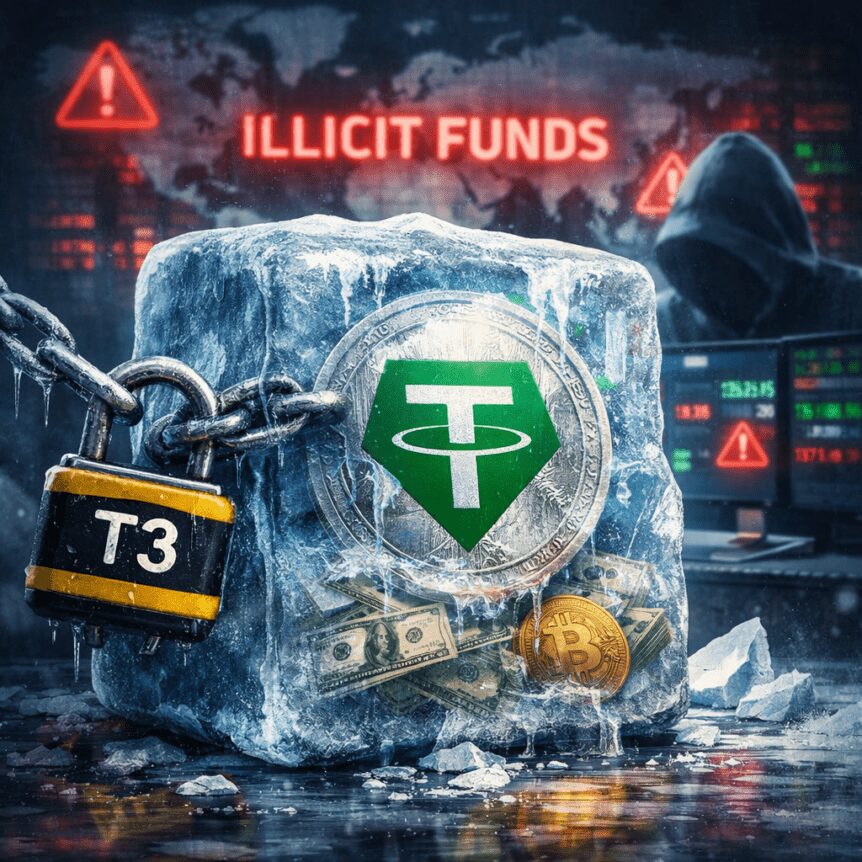
In a development that underscores how public-private partnerships are shaping crypto enforcement, the T3 Financial Crime Unit (T3 FCU) — a joint effort backed by Tether, Tron, and TRM Labs — says it has frozen more than $450 million in assets linked to suspected criminal activity since its 2024 launch. The unit focuses on Tether’s USDT activity on the Tron blockchain and says it has collaborated with law enforcement across 23 jurisdictions to disrupt funds tied to drug trafficking, exchange hacks, North Korea–linked activity, terrorist financing, and violent “wrench” attacks, including kidnappings and extortion. In several emergency cases, authorities requested freezes and assets were blocked within 24 hours. The announcement highlights growing regulatory and enforcement pressure as illicit crypto flows remain a top concern for the industry.
Key takeaways
- More than $450 million in assets linked to illicit activity have been frozen by T3 FCU since its 2024 launch.
- The unit says it has worked with law enforcement across 23 jurisdictions and can execute emergency 24-hour freezes upon request.
- In 2025, illicit proceeds intercepted by the unit rose 43.9% versus 2024.
- TRM Labs estimates that illicit crypto flows reached a record $158 billion in 2025, underscoring the scale of the enforcement challenge.
- BlockSec data indicates more than $500 million in USDT was frozen across a 30-day window, illustrating broader enforcement momentum beyond the T3 FCU’s actions.
A public-private framework targeting illicit funds
The T3 FCU is described as a collaboration among stablecoin issuer Tether, the Tron ecosystem, and blockchain analytics firm TRM Labs. The unit’s remit centers on tracing and freezing Tron-based USDT that finances criminal activity, with the group asserting cross-border reach and rapid response capabilities. The release notes that asset freezes have occurred within 24 hours in multiple emergency cases, reflecting a willingness to move quickly when authorities request intervention. The collaboration—spanning 23 jurisdictions—signals a coordinated approach to cutting off illicit funding at the source and across chains that host stablecoins used for on-chain settlement.
Signals from the numbers: momentum and limits of enforcement
The release frames 2025 as a year of heightened enforcement activity, noting a 43.9% rise in intercepted illicit proceeds compared with 2024. The broader numbers cited by TRM Labs in the same announcement paint a wider picture: illicit crypto flows reached an estimated $158 billion in 2025, illustrating the scale of the challenge for issuers, exchanges, and networks as regulators push for stronger controls. Separately, BlockSec reported a surge in on-chain enforcement activity, indicating more than $500 million in USDT frozen over a recent 30-day period. Taken together, these figures underscore a rising trend of proactive takedowns and the pressure on stablecoins to bolster compliance frameworks.
Industry response and governance tensions
As enforcement intensifies, the ecosystem is facing debates about centralization risk and the balance between security and permissionless finance. Tron has characterized itself as an agnostic technology provider that cannot monitor every user or block every transaction. The network says that the capabilities to identify and stop illicit activity lie with its partners—Tether, TRM Labs—and law enforcement agencies, highlighting a collaborative model rather than a Tron-centric policing of activity. The coalition’s leadership also notes that public-private partnerships can play a crucial role in curbing illicit finance and optimizing regulatory alignment across borders.
Meanwhile, questions persist about how these processes intersect with broader blacklisting practices across chains and how much of Tether’s USDT exposure sits on Tron versus other networks. Cointelegraph reached out to Tether for comment on how the $450 million figure intersects with cross-chain blacklisting and asset freezes; the company did not respond by publication. The industry remains divided over whether such tools are essential for curbing crime or risk consolidating control over permissionless transfers.
The involvement of FATF in recognizing the T3 FCU as an “invaluable resource” for law enforcement underscores the evolving role of public-private models in tackling crypto crime. FATF’s acknowledgment signals growing institutional acceptance of coordinated, cross-border enforcement efforts that pair technology providers, analytics firms, and regulators in a shared mission to curb illicit finance without stifling legitimate innovation.
As the crypto landscape continues to evolve, investors, users, and builders should watch how these enforcement initiatives shape stablecoin governance, cross-chain interoperability, and the balance between security and openness. The coming months will likely reveal more detail about which assets are affected on different networks and how regulated entities adapt their compliance tooling to keep pace with increasingly sophisticated illicit activity.
What remains uncertain is the precise distribution of frozen assets across networks and the extent to which these efforts influence broader market behavior, including user onboarding, treasury management, and on-chain settlement practices. Readers should monitor updates from T3 FCU, TRM Labs, and policy makers as the industry columns tighten on illicit finance while seeking scalable, user-friendly ways to sustain legitimate growth.

Around 25,000 Bitcoin options contracts will expire on Friday, May 15, with a notional value of roughly $2 billion. This event is small, so it is unlikely to have any impact on spot markets.
Crypto prices took a mid-week dip following the US inflation report, but have started to recover a little on Friday, with around $25 billion in total capitalization exiting since Monday.
Bitcoin Options Expiry
This week’s batch of Bitcoin options contracts has a put/call ratio of 0.55, meaning that there are almost twice as many sellers of longs as shorts. Max pain is around $80,000, according to Coinglass, which is a little lower than current spot prices, so some could be out of the money on expiry.
Open interest (OI), or the value or number of Bitcoin options contracts yet to expire, remains highest at the $80,000 strike price on Deribit, with $1.68 billion, but bears still have $1.2 billion in OI at $60,000. Total BTC options OI across all exchanges has been steadily climbing this month and is at $38 billion, according to Coinglass.
“Compared to last week, expiry size has grown materially while put/call ratios moved even lower, showing traders continue rotating toward upside exposure,” said Deribit.
Options Expiry Alert.
At 08:00 UTC tomorrow, over $2.63B in crypto options are set to expire on Deribit.bitcoin:native : $2.01B notional | Put/Call: 0.55 | Max Pain: $80,000
ethereum:native : $625M notional | Put/Call: 0.39 | Max Pain: $2,300Compared to last week, expiry… pic.twitter.com/r0cJwp1eRy
— Deribit (@DeribitOfficial) May 14, 2026
In addition to today’s batch of Bitcoin options, around 274,500 Ethereum contracts are also expiring, with a notional value of $625 million, max pain at $2,300, and a put/call ratio of 0.39. Total ETH options OI across all exchanges is around $7.3 billion.
Spot Market Outlook
Total capitalization is up 1.7% on the day at $2.77 trillion, and today could see some volatility as the US CLARITY Act advanced out of the Senate Banking Committee in a 15-9 bipartisan vote on Thursday. The past six weeks have seen steady gains with markets increasing by 16%.
Bitcoin recovered from its Thursday dip below $80,000 but failed to break resistance at $82,000, falling back below $81,000 again during the Friday morning Asian trading session.
There has been little recovery for Ether, which failed to break above $2,300 and has fallen back again to $2,265 at the time of writing. The altcoins are faring a little better with positive moves for XRP, Hyperliquid, Zcash, and Canton.
The post How Will Markets React When $2B Bitcoin Options Expire Today? appeared first on CryptoPotato.


Art Dubai 2026 uses its 20th anniversary to make digital art a structural pillar, not an NFT-era novelty, with immersive, multisensory work driving both discourse and market.
Summary
- Curated by Ulrich Schrauth and Nadine Khalil, Art Dubai Digital 2026 reframes immersive and computational art as the fair’s conceptual engine rather than a speculative NFT-era add-on.
- Under “Myth of the Digital,” artists turn code, data, sound and scent into sculptural, spatial, multisensory environments tied to crisis, memory and ancient knowledge.
- A smaller “special edition” fair still centers this fifth-year digital section, signalling that digital practice now underwrites Art Dubai’s market and institutional ambitions.
Art Dubai’s 20th‑anniversary edition in 2026 is, bluntly, a stress test for whether “digital art” in the Gulf has matured beyond NFT spectacle into a structurally embedded part of the fair. Early evidence suggests it has: the Art Dubai Digital section is no longer framed as a novelty add‑on, but as a curated engine for the fair’s conceptual and market agenda.
Curated by Ulrich Schrauth and Nadine Khalil under the title “Myth of the Digital,” Art Dubai Digital 2026 explicitly positions immersive and computational practices as a present tense, not a futurist sideshow. The section is described as “a one‑of‑a‑kind” platform that “champions new models for market development in digital art,” foregrounding installation‑led and multisensory practices rather than just screen‑based work, with galleries, independent studios, and collectives using code, data, sound, and scent as core materials.
‘Myth of the Digital’ and the post‑NFT market
The curatorial text for Art Dubai Digital 2026 is unusually direct about wanting to kill the idea of the digital as a marginal, speculative add‑on. The section’s overview stresses that works “draw on both speculative futures and ancient knowledge systems,” and that artists are “transmuting sound, scent, data, and code into image,” effectively reframing digital practice as a kind of media archaeology rather than just generative eye candy. Installations, kinetic works, AI‑informed painting, immersive environments, and “computational sculpture” are singled out as core formats, signalling a deliberate shift away from pure NFT display walls toward spatialized, embodied encounters.
This is reinforced by how the fair has built programming around the digital strand over the last two years. The 2025 edition already hosted a Digital Summit under Gonzalo Herrero Delicado’s theme “After the Technological Sublime,” exploring how artists use AI, VR/AR, and other systems to address environmental, social, and political questions rather than just tech fetishism. That framework flows into 2026’s “Myth of the Digital,” where the focus, according to the fair’s materials and affiliated commentary, is on “how artists transform code, data and technology into sculptural, tactile and multisensory experiences” and on digital culture as a lens on planetary crisis and memory.
AI, myth and memory: Ila Colombo, Isaac Sullivan, Morehshin Allahyari
A different slice of the Art Dubai Digital 2026 program comes through a set of artist mini‑interviews published under the heading “artists on ‘Myth of the digital’,” which focus less on individual titles and more on project logics. Ila Colombo, for example, is presented with the work “The Form of Resonance Looking Outwards” (2024), described as approaching AI “as a site of biological and computational becoming.” The language around her practice is about using machine‑learning systems to model resonances between bodies and environments, folding algorithmic pattern‑finding back into sensory experience. In the Digital section, that kind of work slots neatly into the curators’ insistence on “multisensory encounters” and “embodied seeing,” where code and data are transmuted into images and spatial experiences that the viewer has to feel their way through.
Isaac Sullivan’s contribution, “First Words” (2022), is framed through a screenshot titled “Chyron’s first words,” with the artist described as “materializing algorithmic memory, treating machine perception as archaeological residue.” The implication is a work that turns the outputs of machine vision or language systems into artefacts—chyrons, captions, image residues—that you read the way an archaeologist reads a shard, as evidence of a vanished or opaque process. That sits directly inside the section’s interest in “how we increasingly encounter ourselves through mirrored digital interfaces” and how perception becomes a recursive loop between human eyes and machine filters.
Art Dubai turns inward as regional conflict forces the fair to confront it’s own geography
All of this sits inside a tightened fair: after the original April fair was postponed due to the ongoing conflict in the region, the “special edition” at Madinat Jumeirah from May 15–17 is smaller—around 50 galleries versus more than 120 the previous year—but proportionally heavier on regional and digital programming. In that compressed context, the fact that Art Dubai is still foregrounding a thematically coherent digital section, with its own summit‑style discourse and multi‑sensory installations, is the tell: in 2026, digital art at Art Dubai is no longer the speculative ornament riding the NFT wave, it’s one of the core pillars propping up the fair’s claim to be a serious node in the global conversation about art, technology, and power.
The market structure mirrors this conceptual repositioning. Art Dubai Digital is now in its fifth year and described as “supporting practices that often exist outside traditional frameworks, offering a space to rethink how digital practices intersect with the art market and broader cultural production.” That means galleries and project spaces are not simply hanging token‑linked JPEGs; they’re building room‑scale environments, AR‑layered sculptural work, and time‑based installations where blockchain may exist as infrastructure rather than subject, aligning more with how major museums are now absorbing digital practices.


Dartmouth College’s endowment has disclosed about $14 million in crypto-linked ETF exposure, with new positions tied to Solana and Ethereum staking products added alongside its existing Bitcoin ETF holding.
Summary
- Dartmouth added Solana ETF exposure as endowments keep testing regulated crypto access through public funds.
- The filing shows Bitcoin remains the largest crypto ETF position in Dartmouth’s reported public portfolio.
- Bitcoin ETF outflows added market caution, even as universities continue building selective digital asset exposure.
The filing shows about $3.3 million in the Bitwise Solana Staking ETF, about $3.5 million in the Grayscale Ethereum Staking ETF and about $7.7 million in BlackRock’s iShares Bitcoin ETF.
The move gives the Ivy League school exposure to three major digital assets through regulated public products, rather than direct token custody. Dartmouth’s reported endowment stands near $9 billion, which means the crypto ETF position remains small in size but notable in allocation type. The latest disclosure also shows a change from January, when its Bitcoin ETF stake carried a higher value.
University endowments keep testing crypto access
Dartmouth is not the only university name appearing in crypto ETF filings. Earlier reports said Harvard built a large BlackRock iShares Bitcoin Trust position in 2025 and later raised its exposure, making IBIT one of its larger listed holdings. Brown, Emory and other U.S. universities have also reported Bitcoin ETF or trust positions.
That pattern shows how some endowments are using ETFs to enter crypto markets through familiar structures. These products give institutions exposure to Bitcoin, Ethereum or Solana while keeping the investment inside standard brokerage and reporting systems. For schools, ETF wrappers can reduce custody work and make holdings easier to track.
Solana ETF demand adds a new layer
Moreover, the Solana position is the key change in Dartmouth’s latest disclosure. The Bitwise Solana Staking ETF launched in October 2025 as a U.S.-listed spot Solana product with direct exposure and on-chain staking. Market updates said the fund had already drawn strong demand, while wider Solana ETF flows remained positive after launch.
Separate market data also showed about 30 institutions holding roughly $540 million in Solana ETF exposure. That gives Dartmouth’s position a wider context, as institutional demand for Solana products has moved beyond retail trading and into public portfolio filings. The staking element also makes Solana funds different from plain spot products because rewards can be reinvested into the fund.

Rylan drops surprise ‘marriage bombshell’ on live TV | Lifestyle
Gemini Revenue Jumps 42% With Credit Cards and New Licenses

Tourlite Capital Q1 2026 Investor Letter

Manchester United reach agreement with Casemiro over contract clause amid transfer speculation

US brings back mandatory military draft registration

Steven Gerrard disagrees with Gary Neville over ‘shock’ Chelsea and Arsenal claim | Football


![[CONFIRMED] Bitcoin Holders...This is BIG!](https://wordupnews.com/wp-content/uploads/2026/05/1778822840_maxresdefault-80x80.jpg)
-
 Crypto World7 days ago
HarrisX Poll Found 52% of Registered Voters Support the CLARITY Act
-

 Fashion7 days ago
Weekend Open Thread: Marianne Dress
-

 Fashion4 days ago
Coffee Break: Travel Steam Iron
-

 Fashion4 days ago
What to Know Before Buying a Curling Wand or Curling Iron
-

 Tech5 days ago
Auto Enthusiast Carves Functional Two-Stroke Engine from Solid Metal
-

 Politics3 days ago
What to expect when you’re expecting a budget
-
 Business6 days ago
Ignore market noise, India’s long-term story intact, say D-Street bulls Ramesh Damani and Sunil Singhania
-

 Politics6 days ago
Politics Home Article | Starmer Enters The Danger Zone
-

 Tech4 days ago
GM Agrees To Pay $12.75 Million To Settle California Lawsuit Over Misuse Of Customers’ Driving Data
-

 Crypto World6 days ago
PROS explodes 48% as Upbit and Bithumb listings ignite demand
-

 Crypto World5 days ago
CZ says US crypto rivals tried to block Trump pardon
-

 Tech3 days ago
GM agrees to $12.75M California settlement over sale of drivers’ data
-

 Entertainment6 days ago
YNW Melly Denied Bond Again Ahead Of Double Murder Retrial
-

 Sports7 days ago
Bayern Munich vs PSG UEFA Champions League SF2 live match time, streaming | Football News
-
Tech7 days ago
The Most Exciting Apple Products In The Pipeline For 2026 And Beyond
-
Crypto World7 days ago
The Hantavirus Danger: Can a Potential Outbreak Spark a New Meme Coin Frenzy?
-

 Crypto World6 days ago
Kraken Parent Seeks OCC Charter, Signaling Regulated Banking Access
-

 Politics7 days ago
David Attenborough ‘Overwhelmed’ By Love Shown Ahead Of 100th Birthday
-

 Sports6 days ago
After Waka Waka, Shakira now drops first teaser for FIFA WC 2026 song | FIFA World Cup 2022
-
 Crypto World6 days ago
Solana UFO Meme Coins Surge After Pentagon Reveals Alien Files
You must be logged in to post a comment Login