
Related: Skip Chunky Sneakers — These Rich Mom Walking Sandals Are Comfier
Advertisement




By Joshua Tyler
| Published

Star Trek has never been at a lower point. The franchise’s last batch of shows received almost no ratings, and the brand’s total mismanagement became so bad that it drove away existing Trekkies while failing to attract any new viewers.
With no clear plan to turn it around, Star Trek has been shut down. It’s done. It’s finished. There’s nothing new in production, and there aren’t firm plans to make anything more. Paramount has torn down all its existing sets, and they’re currently auctioning off the Discovery-verse props to the highest bidders, and there aren’t many bidders.
Star Trek has been in a place where there’s nothing new coming before; in fact, it’s happened twice previously in the franchise’s history. But this time it’s different. Those previous Star Trek dark periods happened because of either Hollywood underestimating its potential or a cooling fan interest.
Star Trek enters this new dark age, drowning in hatred and indifference. Trekkies are so burned they’re now happy to see it go, convinced that no Star Trek at all is better than watching their favorite thing ruined over and over and over again. Things got that bad. It means getting out of this mess, if Star Trek ever does, will be harder than ever.

What happened? What went wrong? More than a year ago, we tried to find the answer, but since then, things have gotten so, so much worse. Our warnings weren’t heeded, and now the end times are here.
To find out how Trek can get out of this darkest of all timelines, we’re going to have to take some risks. Luckily, risk is our business. What follows is the full and complete history of how Star Trek self-destructed.

To find the answers we need, we’ll need to visit the Guardian of Forever and peer deep into Star Trek’s past. The year is 2017. Star Trek had been off television for 12 years. The last Trek release, Star Trek: Beyond, turned out to be a box-office disappointment.
Paramount devised a bold new plan to revitalize Star Trek with a prequel series.
Oh, wait, they’d just done that. The entire 2009 Star Trek movie franchise was a prequel.
But that was on the big screen; this time, it would be different. This time it wasn’t a movie, it was a television series.
Oh, wait, they already did that, too. It was called Enterprise, and Paramount pulled the plug on that show after four seasons.

That very recent past somehow totally forgotten, Paramount moved forward with another prequel, their third attempt in a row at making a Star Trek prequel happen. The focus of the plan was that it serve as a flagship show for their new streaming service, CBS All Access.
Oh, wait, they’d already tried that, too. When Paramount launched its own television network in the 1990s, it created Star Trek: Voyager to serve as its flagship program. The UPN network ceased broadcasting in 2005.
Third, and I guess also second, time was not the charm. These obviously stupid decisions began the worst chapter in Star Trek’s history: The Disco era.

The Disco era of Star Trek did not actually begin in the era of disco, the ‘70s, no matter what Bones’ outfit from The Motion Picture might have you believe. The Disco era began with the debut of Star Trek: Discovery in 2017. It ended, spiritually at least, with the cancellation of Starfleet Academy in 2026, a television show widely agreed to be one of the worst things ever made.
Discovery was created by a man named Brian Fuller. Fuller was a well-known television writer and producer. He’d written for both Star Trek: Deep Space Nine and Star Trek: Voyager in the 90s. Since then, he’d established himself as a much sought-after talent, creating critically acclaimed series like Pushing Daisies and Hannibal.

Fuller had the right resume, and so, Paramount hired him to create a new Star Trek series. His initial pitch was for an anthology series, with “diversity” as a focus, and a dark, gritty tone inspired by Game of Thrones.
That’s right, Brian Fuller wanted to turn Gene Roddenberry’s bright and hopeful view of the future into dark, gritty, and violent Game of Thrones.

Fuller worked on the show for 9 months. His tenure was marked by missed deadlines and ever-expanding budgets. Paramount clashed with him over his desire to reboot Star Trek into a gritty Game of Thrones knockoff. The company wanted its brand to stick with the traditions that made Star Trek work, and Fuller wanted to warp it into something entirely different.
Eventually, Paramount grew fed up with Fuller and fired him.

Aside from the fact that no lessons were learned from their previous failures, Paramount had up til this point made at least some reasonable decisions on this project that, probably never should have happened in the first place. Hiring Fuller didn’t work out, but on paper, it should have. And when Fuller failed, Paramount made another good decision by firing him. Paramount’s good decisions stop here.
They replaced Fuller with Gretchen J. Berg & Aaron Harberts. Berg & Harberts were Fuller’s people. They’d worked with him on past projects and were already helping him make Discovery. The ideas Fuller was implementing, the terrible ideas that got him fired, were also their ideas. So they stayed the course and kept working on their Game of Thrones-ification of Star Trek.
Eventually, Berg & Harberts were also fired, amidst accusations of abuse towards the show’s writers.

Alex Kurtzman was put in Berg & Harbert’s place. Kurtzman was the man most responsible for the worst of the recent Star Trek movies, Star Trek: Into Darkness. He now held the future of the entire franchise in his hands. He would remain in charge not just of Discovery, but of the entire Star Trek franchise, throughout the Disco era.
By then, production on Star Trek: Discovery was pretty far along. Kurtzman made tweaks to satisfy some of Paramount’s concerns, but much of what the show would be was already written in stone.
Discovery was the most expensive series Star Trek ever produced. Paramount could have trashed it and taken a tax write-off, but that’s tough to do with so much money on the line. So they released it.

Star Trek: Discovery was poorly received by fans from the beginning. Critics initially praised it, but critics rarely watch shows beyond the first one or two episodes. They ignore it after that, which makes their reviews meaningless.
Reports of Discovery’s ratings were vague and unreliable. Most indications were that after an initially strong showing, people began abandoning the show.
Paramount took note and tried making big changes for season 2. They brought in Anson Mount to play Christopher Pike, and Mount was fantastic.

Unfortunately, the rest of the show was still the show it was always designed to be. Adding one good character to a terrible show cannot save it.
Stuck with a show no one liked, Paramount did the only thing they could do besides cancel it: They quarantined the entire series, separating it from the rest of Star Trek. They did that by time-jumping Star Trek: Discovery so far into the future that nothing it did could have any further impact on the franchise.

Then, they created a spinoff called Star Trek: Strange New Worlds for Pike to rescue him from Discovery’s sinking ship. Though his new series was technically an extension of the Disco-verse, it quickly went to work differentiating itself from Discovery and the mistakes it had made. Strange New Worlds even fixed the Klingons.
That new direction should have been it for the Disco era. The franchise forked away from it; Paramount was working on other Star Trek shows. Discovery limped onward but was soon canceled after five seasons of disinterest
But as Discovery was canceled, Strange New Worlds soon morphed into something different.

Star Trek: Strange New Worlds Season 2 was a distinct decline in quality from season one. By season three, the show had become a vaudeville act for theater kids, filled with musical episodes, puppet episodes, and endless silliness, which had nothing to do with Star Trek.
Paramount finally had enough. With season 3 still airing and two more seasons completed and awaiting airtime, Paramount pulled the plug. The remaining two seasons would eventually be allowed to stream because they’d already been completed, but the sets were torn down and thrown in the trash.

Amidst all of this, Alex Kurtzman had been trying to make a Star Trek: Section 31 spinoff since the first season of Discovery. His plan centered on a widely disliked Star Trek: Discovery character, played by actress Michelle Yeoh.
Fans hated the idea, and no one at Paramount seemed particularly excited about it. They prioritized Strange New Worlds over it, and while a Section 31 series was announced, it never went into full production. Kurtzman’s last update stated clearly that Section 31 was now a very low priority.
And then, in March of 2023, Michelle Yeoh won an Oscar.
In April of 2023, Star Trek: Section 31 went into full production as a full-length feature film. Oscar-winning tends to have that effect.

In January of 2025, Star Trek: Section 31 arrived as a direct-to-streaming movie on Paramount+. It was the first Star Trek movie released in nearly a decade. It’s now the worst-reviewed movie in the entire Star Trek canon, and audiences have given it an appalling 15% fresh score on Rotten Tomatoes.
Star Trek: Section 31 begins when a spitwad flies across the screen, tracing the shape of the Starfleet logo. Viewers would later learn that Spitwad is actually the movie’s hero ship, but that knowledge doesn’t make it any better.
The movie revolves around Michelle Yeoh’s Philippa character, a woman responsible for numerous acts of genocide, and she’s not sorry about any of it. The movie quickly confirms her status as a monster with a flashback, in which she exterminates her entire family for a job promotion, where she’ll get to spend decades committing galactic massacres and torturing the man she loves for fun. This murderous abomination is Philippa Georgiou, played by Michelle Yeoh on Star Trek: Discovery.

The movie flashes forward to a present where she runs a floating space bar. We’re reintroduced to her while the soundtrack blasts badass chick rock music to clue the audience in on the notion that we’re supposed to think she’s really, really awesome, despite being an unapologetic slaughterer of innocents.
Then Georgiou pops a human eyeball into her mouth and savors its taste as the music swells and the camera swirls around her in adoration. Yes, Star Trek: Section 31 is selling the idea of cannibalistic mass murder being super cool, as long as it’s done in high heels. It’s the entire premise of this film.
Hooray for space Hitler?

There are other characters in Section 31, but they’re no better. The super cool Section 31 spy team engages in introductions by shouting at each other, making threats, and posing for the camera. Like Georgiou, they’re also mostly serial killers, and they’re all pretty upset they aren’t able to do more killing.
Luckily, this mission to do a thing takes place in the exact same space bar they’re already standing in. Paramount didn’t need to build any other sets for their heist. What a financially fortuitous coincidence.

There’s a confusing fistfight in front of a bad green screen rendering of a blurry tunnel. A murder mystery that no one cares about. A robot gets incapacitated by being kneed in the crotch. Star Trek: Section 31 ends when Phillipa Georgiou genocides an entire universe on suspicion of possible mischief and then tells her team she’s going to kill them.
If you still have doubts about the quality of Star Trek: Section 31’s writing, please enjoy this actual line of dialogue from the movie: “She died like she lived. By that you know what I mean.”

Using Star Trek to glorify atrocities while offering up a light endorsement of cannibalism in a movie everyone hated and no one watched should have ended the career of Alex Kurtzman and prompted a pause for self-reflection. That didn’t happen.
At the same time, he’d been pushing for this terrible Section 31 movie, Alex Kurtzman’s other pet project was a show set at Starfleet Academy. This idea had been kicking around for a long time as a way to get hot, young people on screen posing for the camera. Obviously, it’s a terrible idea; fans never liked it or wanted it. Which is why it never happened. With the failures stacking up, some coke fiend at Paramount said, ‘Why not?’ and Kurtzman made it.
Starfleet Academy begins with a hero character who is a criminal. It’s the second NuTrek series to be led by a criminal, and the third time a Star Trek project has been centered around a lawbreaker.

A criminal past was Michael Burnham’s introduction, too, on Star Trek: Discovery.
The 2009 Star Trek movie begins with a young James T. Kirk being arrested for stealing a car.
In the future, all the best people will be criminals, I guess? No more high-achieving, hardworking professionals. Something to aspire to, kids.

Star Trek: Starfleet Academy would go on to be the most hated thing in the history of the franchise. You might think otherwise, since Kurtzman did manage to convince critics to give it good reviews by stuffing every episode with woke political propaganda. Critics love that stuff and will praise it any time they see it.
Objective viewers and anyone who likes good writing hated it. The show has some of the lowest audience scores of any series in history. Some reports have Starfleet Academy’s viewership as low as 40,000 tune-ins per episode. For a Star Trek show. Paramount’s flagship Star Trek show.
Starfleet Academy was humiliation on an epic scale. Despite the fact that a second season had already been filmed, Paramount quickly waved the white flag and canceled Starfleet Academy, too.

As of this moment, that’s the end. The end of Star Trek. There’s been some vague talk from Paramount that they’re exploring ideas, but for now, they aren’t making it anymore. It’s also the final legacy of Star Trek’s Disco era. The destruction of everything Star Trek fans loved. The destruction of a franchise 50 years in the making.
Along the way, no lessons were ever learned. Instead, mistakes were repeated over and over and over again.
Did your show about a criminal fail? Make another one.
Did your prequel fail? Make another one.
Did your network fail? Make another one.

It didn’t have to be this way. Even after Fuller’s initial Discovery plans failed, Paramount had ways to correct course.
Developing in parallel with the Disco-verse was a Star Trek animated series called Lower Decks, helmed by Rick & Morty alum Mike McMahan. The show he created was a huge success, and it had nothing at all to do with the Disco-verse. Paramount rewarded McMahan’s success by canceling the show after five seasons and firing him.
There was also Star Trek: Prodigy, an animated series for kids, which was so beloved that fans basically forced Paramount to give it another season with a letter-writing campaign. Paramount gave in and allowed more of the show, but only begrudgingly. They didn’t put it on their streaming app, opting instead to let Netflix have it to defer costs.

Tangential to the Disco-verse was the Picard-verse, a series vanity project developed around Patrick Stewart’s Captain Picard character. The show was a standard Alex Kurtzman disaster for two seasons until the third, when Paramount turned the whole thing over to veteran TV showrunner and legit Star Trek fan, Terry Matalas.
Indications are that Kurtzman wasn’t involved in making the third season, occupied with filming his pet projects, instead. That allowed Matalas to run with it and make Picard season 3 a tribute to the thing he loved most: Actual Star Trek.
Terry jettisoned everything the series had done previously, started over, and, in the process, delivered the best Star Trek season of the modern Trek era. Fans loved it. Audience scores were through the roof.
Matalas lobbied to be given more work, pitching a spinoff series called Star Trek: Legacy. Fans launched petitions to support him, trying to convince Paramount to hand the entire franchise over.
But Kurtzman was still firmly in charge, and if I had to guess, probably jealous over the response Matalas was getting, in comparison to the way people were deservedly shitting on him. So, he responded to that outpouring of support by firing Matalas.

That’s the current state of Star Trek. It’s dead. There are two more seasons of Strange New Worlds in the can to release, and maybe Paramount will also still release that completed second season of Starfleet Academy, but that’s it, and those last few dribbles are likely to do more harm than good since basically everyone hates all of it.
Ok, sure, the .001% of humans who spent their formative years as theater kids may like it. But is that really a demographic worth pursuing? It’s like five people, and four of them are named Skylar.
I get the impulse. The entertainment industry actually is run by theater types. By actors and drama dorks who actually really were theater kids. But that’s not who their audience is. That’s not who they’re making shows for.

Star Trek is supposed to be for people who like Star Trek, and instead of making that, Paramount got a bunch of theater kids together and let them turn Star Trek into something for themselves. It’s next-level narcissism. Rot from the inside. The antithesis of everything that the entertainment industry is supposed to be about.
Your job as a creative is to think outside yourself, to think beyond you to something bigger, greater, and more noble. What you create should be informed by your experiences, not imprisoned by them.
That’s what Star Trek is now: A prison. Let me out!

Us Weekly has affiliate partnerships. We receive compensation when you click on a link and make a purchase. Learn more!
For most of my youth, I had awful skin. I’m talking stubborn cystic acne that only medication could clear up. However, I ended up reaping endless skincare knowledge from those painful years. One of the first things I learned was to only invest in products that absorb into your skin (aka serums, exfoliants, creams — basically anything but face wash). Now, I get compliments on my skin, and I’m finally able to share one of my secrets: PCA Skin Triple Exfoliation Peel Pads.
I’ve tried so many drugstore exfoliating pads and toners, but none compare to PCA Skin peel pads. I was lucky enough to test the newly released product, and I’m happily surprised by the deep chemical exfoliation — so much so, I skipped my most recent facial appointment!
Get the Triple Exfoliation Peel Pads from PCA Skin!
PCA Skin Triple Exfoliation Peel Pads pull triple duty, offering chemical exfoliation, enzymatic exfoliation (to activate cellular renewal) and physical exfoliation. The ingredients list is a homerun for anyone experiencing rough skin texture, acne or bumps.
AHAs — aka lactic, glycolic and mandelic acids — exfoliate the skin’s surface, while the BHAs get deep into pores to clear sebum (otherwise known as the substance that clogs skin). PHAs offer another layer of exfoliation, sans irritation, and prickly pear extract helps shed dead skin cells to deliver a fresh-faced glow. Last, niacinamide, licorice root extract and peptides soothe redness and visibly brighten skin. According to the brand, the pads are clinically proven to smooth texture by 50%, reduce fine lines and wrinkles by 36%, and boost hydration by 48%. How’s that for at-home skincare?
While the peel pads are safe for daily use, you must work up to it. Since I have sensitive skin, I use the peel pads three times per week for now. My skin feels a little tingly after swiping one pad on my chin, nose and T-zone (a sign the exfoliating ingredients are doing the hard work!). But it’s the undeniable, fresh-faced glow that makes these pads stand out.
While some chemical exfoliators and toners can leave skin feeling dry and tight, PCA Skin Triple Exfoliation Peel Pads are the opposite. They clean my pores and somehow leave my skin feeling rejuvenated and spa-level clean.
For best results, use the peel pads at night three times per week, working up to daily use over a few weeks. Follow up with your serums, moisturizers and SPF the next morning like normal. Whether you’re experiencing rough skin texture, clogged pores or pesky bumps, try the Triple Exfoliation Peel Pads from PCA Skin. Trust me, this is one of the most important skincare steps you’ll actually garner results from in such a short period of time!
Get the Triple Exfoliation Peel Pads from PCA Skin!
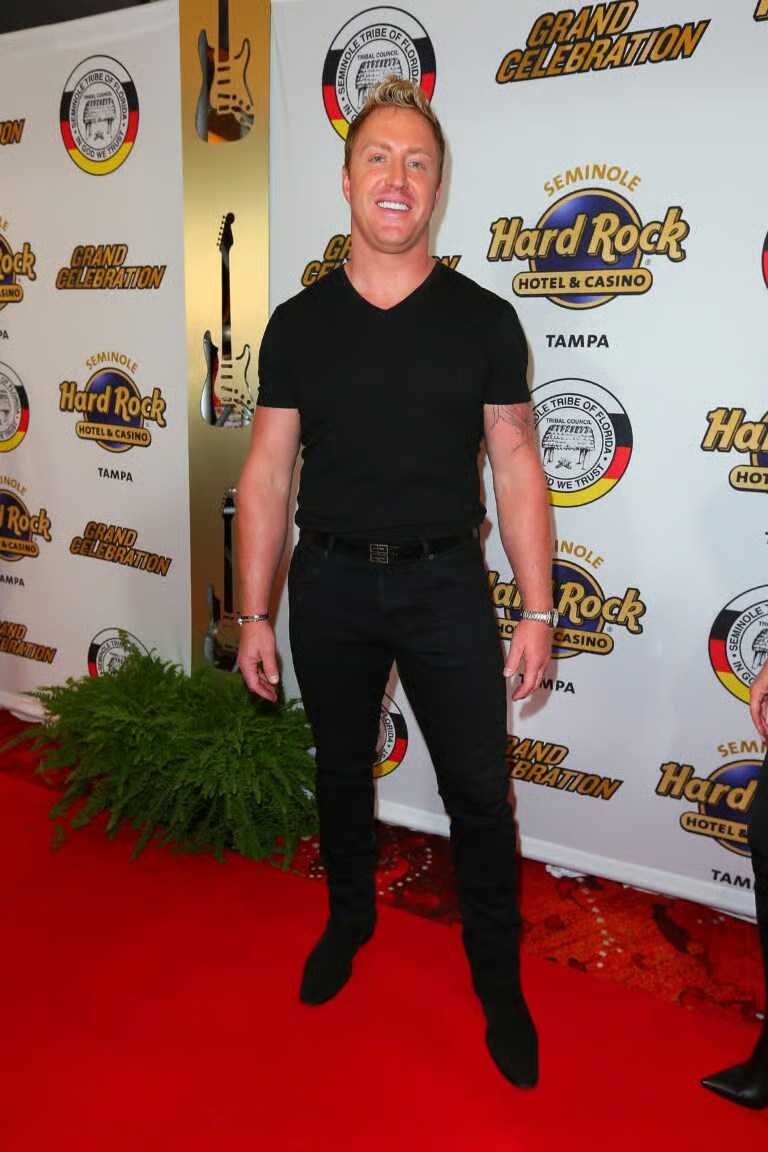
Kim Zolciak and Kroy Biermann are still embroiled in their years-long divorce saga. More recently, custody of their four minor children has become a contentious topic, with both parties launching allegations at one another. Now, the former “Real Housewives of Atlanta” star is accusing Biermann of child abuse and not properly shielding their kids from his sex with random women.
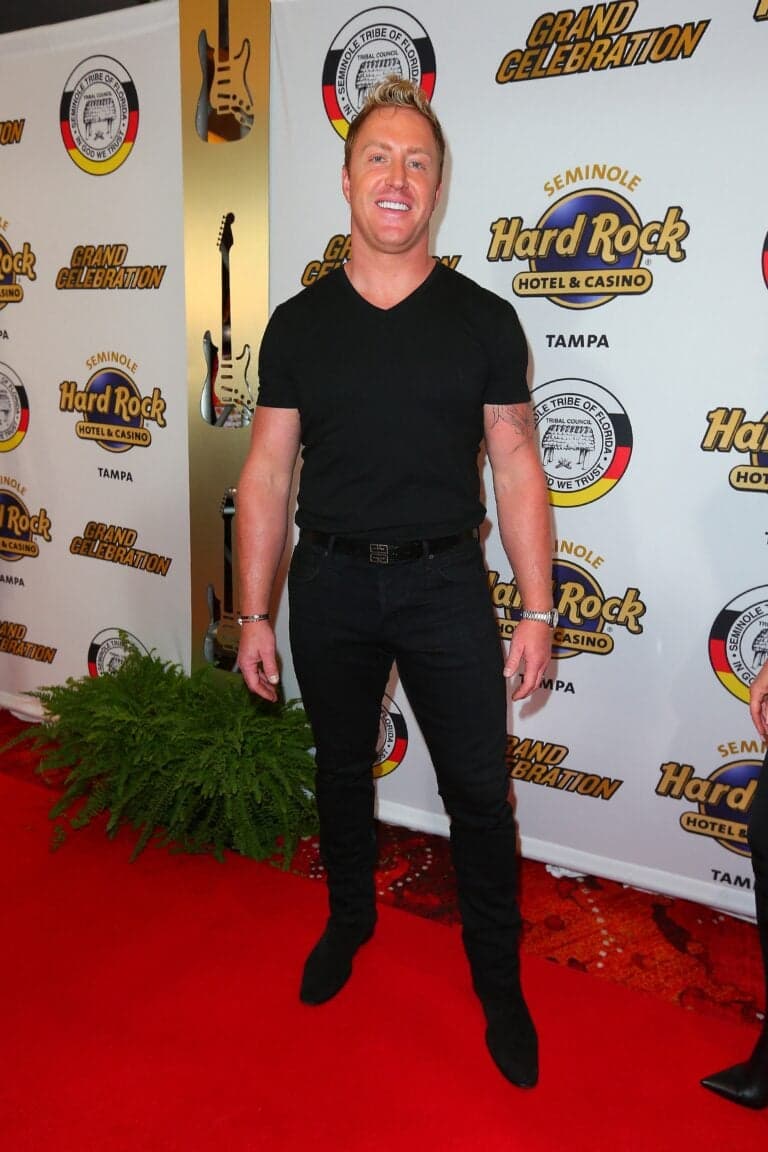
TMZ obtained court documents filed by Zolciak that accuse her estranged husband of being inappropriate with their children. First, she stated that the EX NFL star threw one of their sons over a couch. Specifically, she alleges that this occurred during a passionate argument while at his home.
That’s not all, as she claims Biermann has been sexually active with multiple women recently. The issue is that he’s having sex with them in areas of the home where the children can fully hear them, according to the “RHOA” alum’s court filing. One of the women is said to have vacationed with the kids and Biermann.
Additionally, Zolciak says the kids “have reported on multiple occasions not seeing [Kroy] for hours on end, but hearing him engage in sexual acts with his girlfriend of the moment.”
Regarding abuse, she is also accusing Biermann of throwing a pan at one of the kids’ heads.

Per TMZ, Zolciak claims that the court-appointed guardian was made aware of the incident with Biermann allegedly abusing their son. However, the person is said to have dismissed the claim, stating that the boy was large for his age. Still, Zolciak says his size does not matter as he’s still a legal minor.
Regarding the rest of the kids, the “RHOA” alum stated in court documents that they’ve made it clear which parent they would like to live with, but to no avail from the guardian. She also claimed the person referred to the children as dishonest.
In explaining why there haven’t been changes to the custody agreement following the supposed abuse, she said, “No professionals have sounded an alarm because the abuse did not ‘leave marks.’” According to her, she’s “constantly contacted” by the kids when they are in their dad’s custody.
The reality star also included text messages in her court filing. Notably, it features a text said to be from one of Biermann’s alleged romantic encounters, accusing him of abuse. The text, sent to Zolciak’s boyfriend Kyle Mowitz, said, “I believe Kim. He is abusive. And his abuse is unlike any I’ve ever witnessed.”

Following Zolciak’s latest legal filing against Biermann, social media is reacting with many unsure of which side to take. While some are taking her side, others claim she’s not being fully honest with her accusations against her estranged husband.
One person said on X, “She’s making it sound like they were in the room. Did she expect him to leave his kids at home and take his jump off to a hotel room? Do they even have money for that?”
Someone else wrote, “This divorce has lasted longer than their actual marriage at this point.” A different “RHOA” fan questioned the text message, saying, “Why would his girlfriend reach out to her [married] boyfriend? Why would she even have his number? The best way to test all of Kim’s allegations is to just ask the parties outright; the kids are old enough to testify at this point.”
Another social media user chimed in, writing, “It feels like every day I learn something about Kim Zolciak and Kroy Biermann that I wish I didn’t know.”
Overall, everyone wants what’s best for the children.

Biermann accused Zolciak of neglecting their children and of being out of the country for several weeks at a time. Then, according to TMZ, in early May 2026, a judge ruled on Biermann’s emergency motion, stripping the “Real Housewives of Atlanta” alum of primary physical custody of the kids.
Per the ruling, Zolciak shares joint physical custody with the former NFL player. She also has limited parenting time with the four kids every other week. This arrangement gives Biermann the final say over educational, non-emergency medical, and religious decisions.

According to Variety, Prime Video has greenlit a new series, “Reality Retreat.” The show features well-known reality stars as they attend “a high-stakes wellness retreat designed to challenge their identities, relationships, and personal growth.”
In addition to Zolciak, it features the likes of Kenya Moore, Margaret Josephs, Julie Chrisley, and more. “Reality Retreat” is set to premiere sometime in 2027. Zolciak will also appear on Bravo’s upcoming “The Real Housewives Ultimate Girls Trip: Roaring 20th,” premiering August 9.

MGK is going viral after turning an onstage pyrotechnic glitch into one of the wildest moments of his “Lost Americana” tour. During his June 2 stop at Coastal Credit Union Music Park in Raleigh, North Carolina, the artist, who is also known as Machine Gun Kelly, had a literal flaming moment while performing “papercuts,” and instead of panicking, he leaned all the way in. Videos from the concert quickly spread online after fans captured MGK reacting in an unexpected way when his guitar caught fire mid-performance.

Like many performances on his “Lost Americana” tour, MGK ended “papercuts” with one of his signature pyrotechnic guitar moments. The rocker regularly uses three built-in pyrotechnic devices attached to his guitar during the song’s explosive finale. But this time, things didn’t go exactly according to plan.
After the main burst of flames wrapped, one of the nozzles reportedly failed to shut off, leaving behind a small but very noticeable flame burning on the guitar. Rather than quickly extinguishing it, MGK appeared to embrace the chaos.
In videos from the show, the singer could be seen playfully sticking his tongue onto the flame before asking for the camera to zoom in so he could get a closer look at his still-burning guitar on the venue’s massive screen. Naturally, the bizarre moment immediately sent fans into a frenzy online.
As clips from the concert spread across social media, fans flooded the comments section with reactions ranging from amused to downright thirsty. “That smile and giggle is so pure and beautiful,” one fan wrote. “I can just hear his giggle in my head as he’s doing this…..” another fan wrote.
Some fans appeared completely mesmerized by the moment, with one person admitting, “Is it bad that this turns me on,” while another joked, “Throw me in (that) damn flame.”
Meanwhile, others focused less on the fire and more on the overall concert experience. “I was there for this last night. What a great show !!! Love you COLSON!!” one concertgoer commented, referencing MGK by his real first name, Colson.
Another fan thanked the rocker for the experience, writing, “Thank you mgk and wiz and Dewayne for making my sister’s first ever concert AMAZING!!! A time was for sure had last night!!!!”
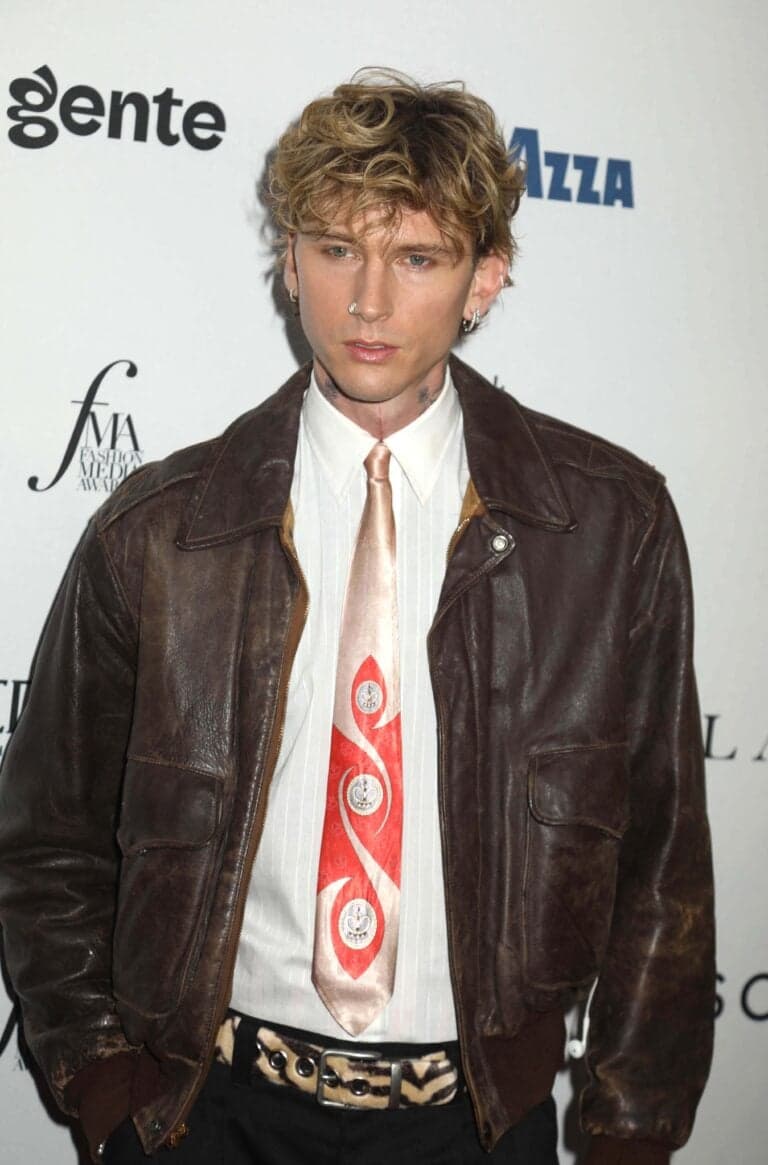
While MGK may be making headlines for his fiery tour antics, the rocker has also recently found himself back in the spotlight for his rumored fallout with former friend and collaborator Yungblud.
If fans forgot, MGK and Yungblud, whose real name is Dominic Harrison, were once incredibly close and collaborated multiple times over the years. Their friendship first blossomed in 2019 when they teamed up on “I Think I’m OKAY” from MGK’s “Hotel Diablo” album. But by 2024, fans began speculating that things had quietly soured between the pair.
Much of the chatter intensified after Yungblud appeared on the Osbourne family podcast, where Sharon and Kelly Osbourne openly criticized mgk. “Don’t get me started on that one,” Sharon said, to which Yungblud simply responded: “Fair.”
Kelly Osbourne also accused MGK of copying Yungblud by incorporating pink into the aesthetic for his 2022 “Mainstream Sellout” album. While Yungblud did not directly join the criticism, he also did not publicly defend MGK, something that appears to have deeply affected the singer.
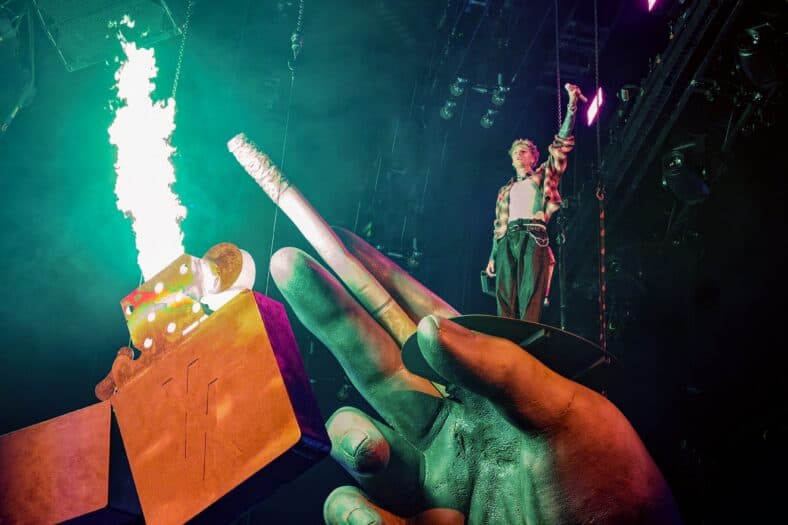
Speculation surrounding the fractured friendship ramped up again after fans theorized mgk referenced Yungblud in his April 2026 track “Fix Ur Face,” particularly the lyric: “Mickey Mouse kids turned rockstars / Leaving private schools, tryna be outlaws.”
Many listeners interpreted the line as a jab at Yungblud, who previously starred in Disney Channel UK’s “The Lodge” before breaking into music and attended a private boarding school in England.
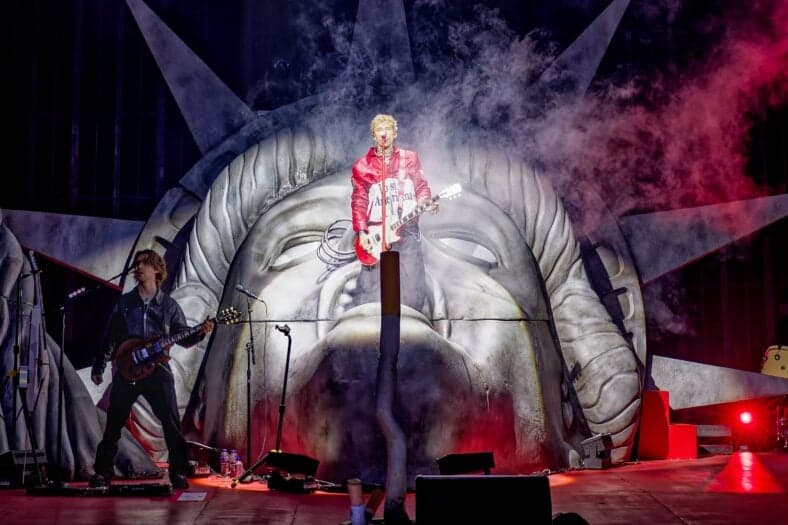
Last month, MGK confirmed on the “Garza Podcast” that the lyric was indeed inspired by the fallout. “The song is three minutes of lines about different things. Yeah, the specific line, I mean, loyalty is really the only thing that matters,” MGK explained. “When I open my heart, that means I’m vulnerable, and I let you in.”
Seemingly referencing Yungblud’s appearance on the Osbournes’ podcast, he added, “When someone’s given an opportunity to defend their friend, and they don’t, that breaks my heart. It shatters me. Be my friend the same way in public that you are in private. But it’s an angry line in an angry song.”
“That sh-t hurt me, and that is that,” MGK continued, before adding of Yungblud: “[He’s] super talented and all that. But what I care about outside of everything, like, when the music’s over, it’s like, what do you stand for and what do you stand on? That principle of loyalty, the way that it was done to me, I wouldn’t have done that. To me, that was just a moment of seeing something and being like, damn, that hurts.”

The drama flared up again a few weeks later after Yungblud shared a video discussing the growing cost of live music and promoting his Bludfest festival, which aims to keep ticket prices low. MGK later appeared to fire back in a since-deleted comment, writing: “You canceled a tour because you couldn’t sell tickets, then blamed it on mental health, then got paparazzi’d at Nobu the next day Pinocchio.”
He added, “And your actual tour tickets are still the same price as every other artist [laughing face emoji]. Shut the f-ck up, you silver-spooned, preachy wanker.”
Comic conventions are great places for pop culture fans to enjoy, shop, and meet like-minded individuals, all while surrounded by the movies, shows, games, and comic books that mean so much to them. From June 5 to June 7, Indiana will take center stage as it hosts the Indiana Comic Convention, an exciting gathering that will feature some of the biggest names in entertainment together at the Indiana Convention Center.
Attending a comic con can be a daunting experience, especially if you don’t know how to manage your time. Indiana Comic Con 2026 will also feature quite a few exciting panels, making the choice of which ones to attend all the more complicated. Luckily, we have you covered there. Here are some of the best things to do at Indiana Comic Convention 2026, including panels, activities, experiences, and even contests. We also have a discount code for all of you who have yet to purchase your tickets: type in COLLIDER in the APPLY PROMO CODE box at checkout and get a juicy deal!

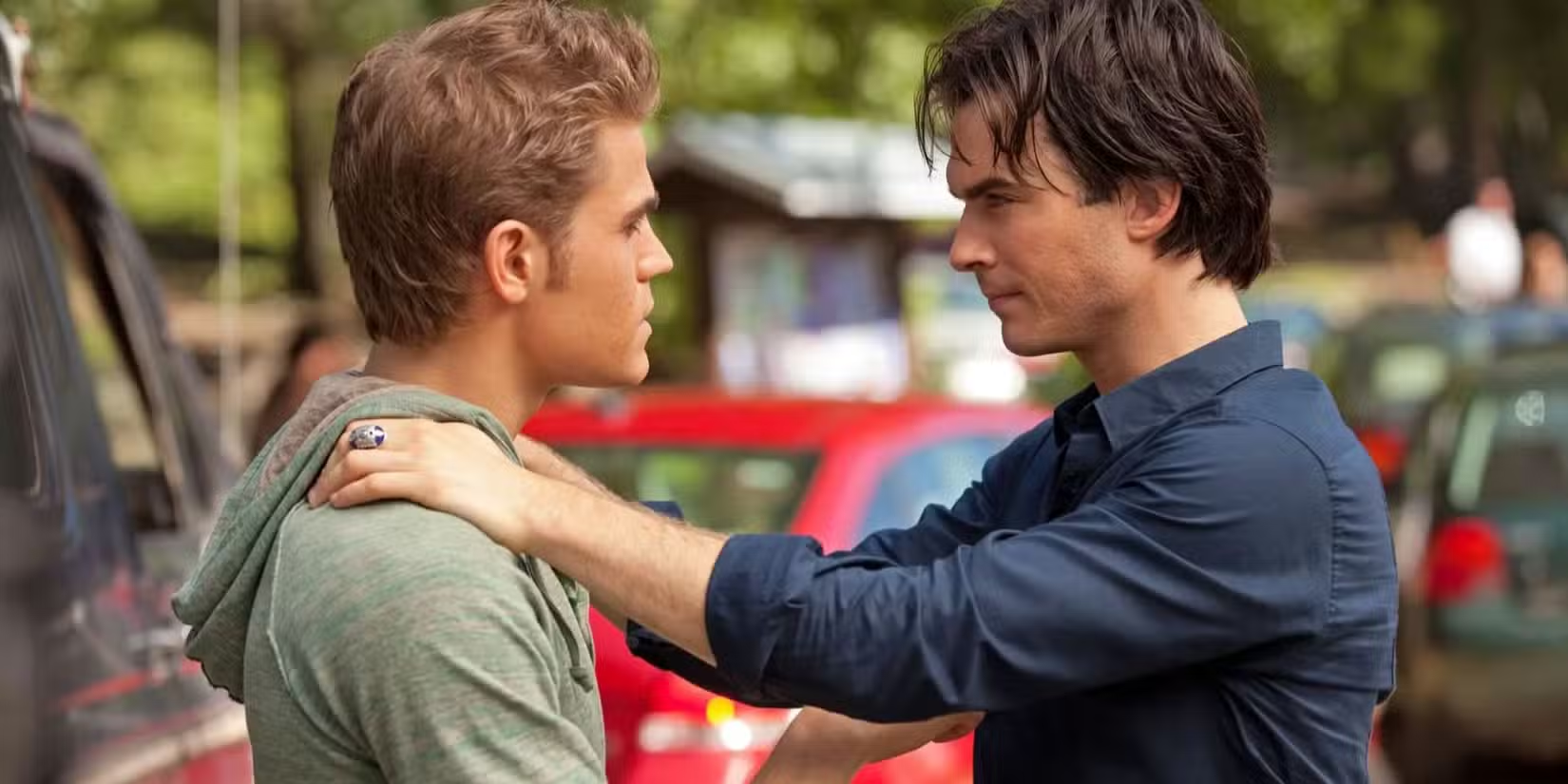
Teen shows absolutely dominated the 2010s, but few were more successful than The Vampire Diaries. Based on L. J. Smith‘s eponymous book series, the show follows the love triangle between teenager Elena Gilbert (Nina Dobrev) and the vampire brothers Stefan (Paul Wesley) and Damon Salvatore (Ian Somerhalder). The show went on for eight seasons and remains an icon of 2010s television.
Indiana Comic Convention 2026 will provide a massive treat for fans of the show, as both Salvatore brothers will reunite on stage in a panel hosted by Collider‘s Maggie Lovitt. Wesley and Somerhalder remain fan-favorites, and their reunion is bound to be one of the con’s most talked-about moments. Together, they’ll discuss the show’s considerable legacy and maybe even share a detail or two of what it was like to bring life to these mysterious and alluring brothers.

Video games are hotter than ever. In fact, the industry is arguably experiencing its highest peak, and it shows no signs of stopping. One of the most acclaimed video games of the 21st century is 2010’s Red Dead Redemption, an action-adventure Western about the exploits of John Marston, a former outlaw who goes on a quest to bring three gang members to justice after the government kidnaps his wife and son.
As one of the best adventure video games of all time, Red Dead Redemption has a large following that will surely be present at Indiana Comic Convention 2026, where Rob Wiethoff will be doing a panel moderated by Collider‘s Maggie Lovitt. Wiethoff will be there to chat about the game and its sequel/prequel, Red Dead Redemption 2, where he returns as a secondary protagonist. This duology is among the most acclaimed in modern gaming, so there won’t be a shortage of topics for Wiethoff to discuss.

Alaqua Cox debuted in the MCU in the surprisingly great 2021 miniseries Hawkeye, playing Maya Lopez, AKA Echo, the deaf commander of the tracksuit mafia and a major antagonist for Clint Barton (Jeremy Renner) and his protegée, Kate Bishop (Hailee Steinfeld). Cox returned three years later as the protagonist in Echo, where Lopez returns to her hometown to reconnect with her family and Native American roots.
At Indiana Comic Convention 2026, Cox will headline a panel, moderated by Collider‘s Maggie Lovitt. There, she’ll discuss both shows, Echo’s importance as a major representative for the deaf community, and perhaps even hint at when we might see her again in the MCU. Unfairly, Cox hasn’t received the same attention as other major players of the MCU, so it’s great that she has these types of opportunities to showcase her artistry and contributions to the franchise.
A revival of the seminal ’90s show X-Men: The Animated Series, X-Men ’97 debuted in 2024 to near-universal fan and critical acclaim. It revitalized mainstream interest for the X-Men and restored their reputation following a series of less-than-ideal movies from the near-defunct 20th Century Studios era. The show’s first season sees the titular team fighting Bastion and his Sentinel program, while the soon-to-be-released second season will focus on their conflict against Apocalypse.
Indiana Comic Convention 2026 will host three cast members of the show — Cal Dodd, who voices Wolverine, Adrian Hough, who voices Nightcrawler, and Alison Sealy-Smith, who voices Storm — in a panel hosted by Collider‘s Maggie Lovitt. The trio will talk about the original show’s enduring appeal and the revival’s continued success. Perhaps they’ll even provide a bit of extra info about the team’s upcoming fight with Apocalypse! Season 2 of X-Men ’97 is among the most anticipated in superhero TV, making this panel even more exciting for fans.

Cosplaying is a must in these types of events. An art form in itself, cosplaying is practically synonymous with conventions, and fans put out all the stops for the occasion. Some of the attendees create spectacular replicas of their favorite pop culture characters, many of which could easily belong in a museum, considering the level of detail and care that go into these costumes.
As expected, Indiana Comic Convention 2026 will indeed host a cosplay contest, which will take place on Saturday, June 6 at 19:00. Lunar Lepus, Nikki Nostalgia, and Scarred Metwo will be the judges for the occasion, and contestants will participate for the chance to win $8000 in prizes and Cosplay Awards “worthy of bragging about.” Pre-judging will happen in Room #132 from 11:00 to 16:00. For cosplayers who don’t want to compete, there will also be meet-ups for Marvel, Star Wars, Star Trek, and more.

If you grew up in the 2010s, chances are you were a fan of Teen Wolf, MTV’s reimagining of the eponymous 1985 movie. Set in the fictional California town of Beacon Hills, the show stars Tyler Posey as Scott McCall, a teenage werewolf who must fight all manner of supernatural threats. Joining his pack is an assortment of allies, including Derek Hale (Tyler Hoechlin), an older werewolf from a prominent family in Beacon Hills.
Indiana Comic Convention 2026 will host the two most famous werewolves from Teen Wolf, as Posey and Hoechlin will headline a panel moderated by Stephanie Carr. The two will surely share stories from their time in the show and the 2023 sequel movie, maybe sharing some stories from the set and discussing the show’s surprising legacy as a gem of 2010s television. The Teen Wolf fandom is still surprisingly active, so expect to see a packed house for this one.

Nicolas Cage is one of the most in-demand actors in Hollywood. The Oscar winner is currently in the middle of promoting his newest show, Spider-Noir, where he reprises the character he first voiced in the Oscar-winning 2018 animated masterpiece Spider-Man: Into the Spider-Verse. Fans have been wanting to see Cage suiting up as the hard-boiled detective for years now, and it’s wild to think we actually got our wish.
At Indiana Comic Convention 2026, Cage will be appearing on Celebrity Row on both Saturday and Sunday. On Saturday, he’ll be present from 10:30 to 18:30 with breaks, while on Sunday, he’ll be there from 10:00 to 14:30. You’ll get a chance to get an autograph, a picture, or both with this pop culture icon, whose career spans forty years and includes some of the most celebrated movies of the 21st century. Cage will undoubtedly be one of the con’s main events, so make sure to secure your place while you still can!

Us Weekly has affiliate partnerships. We receive compensation when you click on a link and make a purchase. Learn more!
Chunky sneakers are already on their way out in favor of sleek black flats, but Kate Hudson dialed up the polish and added so much comfort. Her knit flats are basically elevated slippers, and we found the expensive look on sale for just $33!
Spotted leaving an Italian restaurant in Santa Monica, the actress wore a silky cami, a knee-length skirt and slipper-like flats that quietly stole the attention. It’s no surprise that Hudson’s knit shoe style is now everywhere on the streets of Italy, New York and California.
Get the Frank Mully Knit Ballet Flats for $33 (was $40) at Amazon! Please note, prices are accurate at the date of publication but are subject to change.
These Frank Mully Knit Ballet Flats have the same round toe, classic black color and low-profile silhouette that made Hudson’s pair so effortless. The knit upper hugs your foot the way a sock does, with enough stretch to skip the painful break-in period that most flats demand. Better yet, the soft sole is built for actual walking, not just standing pretty on a red carpet.

‘Walking’ and ‘sandals’ might feel like contradictory terms, and for a while, they were. But it’s 2026. Designers have finally heard our wishes, creating chic walking sandals that deliver the support of sneakers with the style of summer. They’re still hard to come by, but we found 15 comfy sandals that effortlessly balance comfort and […]
Thousands of shoppers agree: These chic flats work with and for everything. Throw them on with a tee and jeans for grocery runs, then copy Hudson with a simple skirt for date night. They’re the polished alternative to chunky sneakers we’ve been hunting for, and they happen to be just as comfy.
One five-star fan wrote, “I’ve worn them for errands, work days and long stretches on my feet, and they continue to feel supportive and lightweight. Another thing I love is how versatile they are. They pair beautifully with jeans, work pants or even a casual dress. Simple, elegant and incredibly comfortable.”
Another happy reviewer shared, “I have a pair of Rothy’s, and these are just as comfortable. On a recent trip to NYC, these were my go-to shoes. Walked many miles in them.”
Black knit flats are already (and always will be) ‘in,’ but Hudson’s version is double-trendy. Slip a pair into your weekly rotation, and you’ll understand why she reaches for the style. It’s hard to believe the look is only $33!
Get the Frank Mully Knit Ballet Flats for $33 (was $40) at Amazon! Please note, prices are accurate at the date of publication but are subject to change.
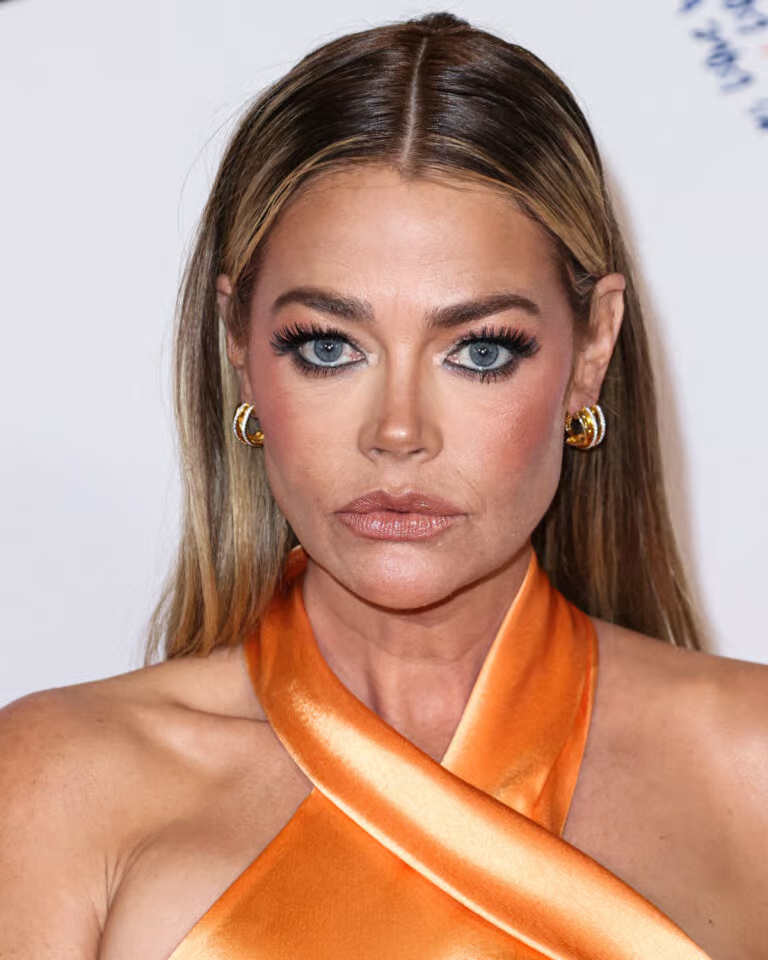
Denise Richards is not about to look bad in front of the press!
The actress is brushing off the criticism surrounding her courtroom fashion choice, insisting that she simply wore what she had in her wardrobe and would not want her estranged husband to make her look bad.
Denise Richards has been in the fashion department for a while now, as she famously rocked a lace romper with a detachable tulle skirt during her wedding to estranged husband Aaron Phypers.

The media personality, in a recent Instagram video, shared with her teeming followers a glimpse into her early-morning preparation routine ahead of another appearance in her ongoing divorce proceedings with Phypers.
Starting her day before sunrise, Richards joked about her appearance before explaining that media attention surrounding the case has influenced how she dresses for court. It is no thanks to her estranged husband, who always makes sure the press are present in court, making her super conscious.
Richards said planning outfits for court has unexpectedly become a stressful experience, as she admitted that the whole topic of her leather outfits has come up.
She defended a later outfit that featured a fitted Gucci leather pencil skirt. The famous TV host said the leather pencil skirt isn’t out of the ordinary or intimidating to her.
The actress also added that she does not have many formal suits, and so it is tough to style her for court, as compared to what others think.
To look the part, Richards wore the leather skirt, which also features Gucci’s signature horsebit detailing, with a fitted long-sleeved black bodysuit, all in her trademark sleek style.
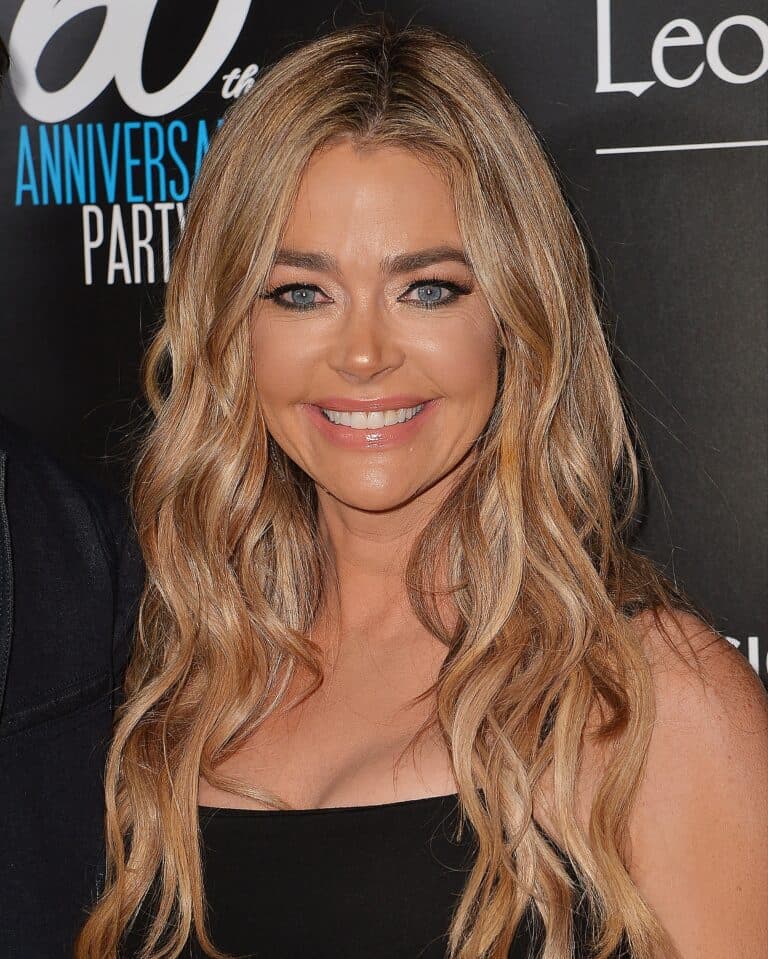
Richards’ Instagram followers and online admirers commended her choice of outfit and decision to take a risk that turned out very classy and stunning. This fan wrote, “You just show up. You are a blessing in this world. You are the most reliable, real deal. Love you to the moon and back.”
Another commenter reassured the actress of her striking natural beauty while wishing her good luck with the divorce process and everything in between. Richards can take solace in the words of this fan who declared that, despite the backlash, she ended up looking fabulous for her day in court.
“You could wear a garbage bag and still look stunning. Good luck, Bella,” this fan noted in the comment section. Regardless of the time or space, the consensus from the fans is that the actress never fails to steal looks.
When the media personality got married in 2018, she did it in grand style, sparking conversations with her choice of outfit, which was a huge detour away from the traditional wedding dress.
She opened up in an interview with PEOPLE that her choice was deliberate, and since she already wore a dress for her first wedding, she opted for a unique and personal option for the second.
She consulted designer Mark Zunino to bring her lace romper vision to life in less than 24 hours, and alongside the unconventional lace romper, she also added a detachable tulle skirt, which she removed during a motorcycle ride with Phypers.
Reacting to the attention that followed Richards’ dress online, Zunino insisted that it was the actress’s vision that they create something she genuinely loved rather than satisfy outside opinions.
Richards, however, remained unfazed by the criticism, noting that she stopped paying attention to online commentary years ago. She insisted that her outfit captured exactly the energy she wanted to showcase a playful, confident, and fitting look for a beach wedding in Malibu.
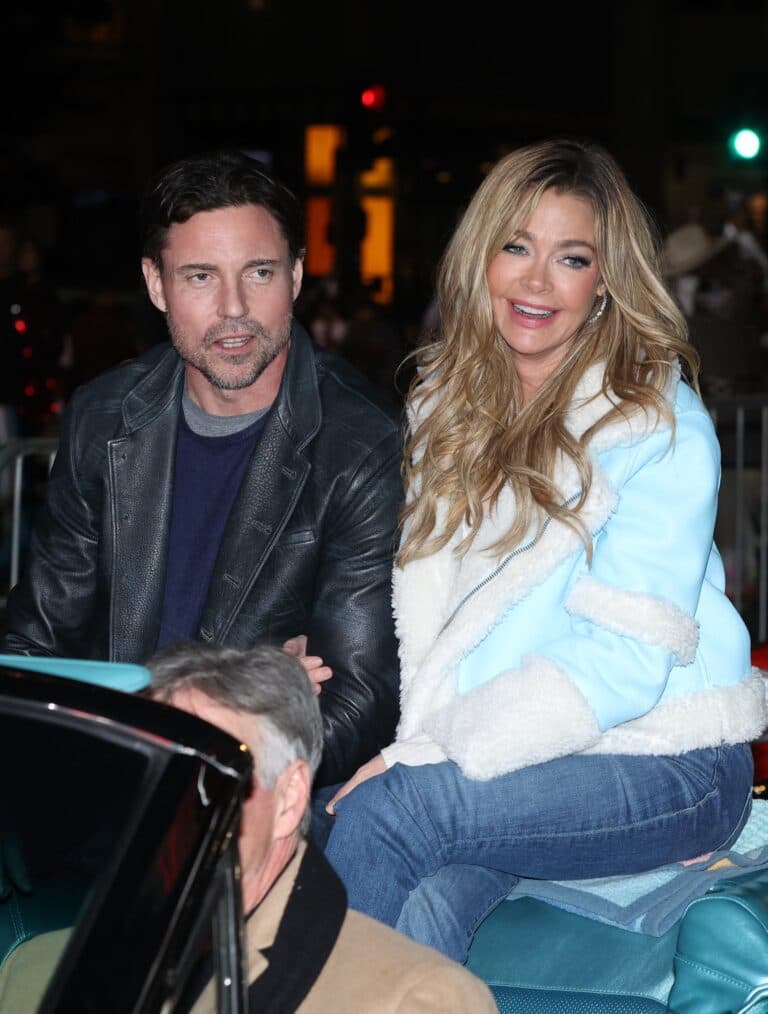
In March, The Blast reported that the reality TV star set the record straight following the rumors of a significant shift in her appearance.
In a subsequent interview with writer and editor Elizabeth Siegel for Allure, Richards admitted she had undergone a complete facelift eight months ago but wanted to keep it a secret until her ex-husband, Phypers, maliciously publicized it.
According to Richards, she had been focused on healing and recently visited an appointment for microneedling to help improve the appearance of her scars when things took a turn.
She stated that a photographer showed up outside the appointment and that her ex told them about the surgery, but that got botched; she vehemently disagreed with this.
Richards said she had been agonizing over whether to talk about the procedure at length, and she had believed that she might have kept it to herself. She then joked that people might have eventually figured it out anyway since the results are so good.

Prior to her facelift story, Richards initially revealed that she experienced a scary yet very painful incident on set while competing on the third season of “Special Forces: World’s Toughest Test.”
Richards shared that during the shoot, one of her breast implants ruptured, forcing her to undergo corrective surgery once again, as she had dealt with ruptured implants in the past.
Richards did not forget to recognize those who stood by her during such a tough time, like her surgeon and her friend Camille Grammer, who linked her up with the surgeon and also supported her throughout the process.
She also shared parts of her recovery journey with fans, celebrating the results and expressing anticipation to take on the bikini season with renewed confidence. Richards added that she was happy to finally speak honestly about living with implants and document that journey publicly alongside Grammer.
What will Denise Richards do next?

Jason George revealed if there are plans for him to return to Grey’s Anatomy for season 23 after the show went through multiple cast exits.
“I think I can confirm that Ben is coming back,” George, 54, exclusively told Us Weekly at the MPTF NextGen Summer Party on Sunday, May 31, confirming his involvement in the hit show’s next season. “I’m pretty certain I’m coming back.”
George, who has played Ben since season 2010, praised the show’s creative team for knowing when to help the story evolve, adding, “They’re not afraid to make the hard decisions in terms of story to keep the story as fresh and alive as possible. But they do it with respect.”
The actor broke down the process of a cast exit.
“As early as possible — as soon as you’re thinking about it — you’ll get a call and a conversation,” he explained. “I remember when I got called to do the spinoff for Station 19. I thought it was a call to [say], ‘Sorry, man, we’re writing Ben off the show.’”
George continued: “I’m thankful because there are shows in Hollywood — you hear the stories — where you find out that you’re leaving the show at the table read. You’re completely notably blindsided. I love the fact that my bosses try to give as much respect as possible in that regard.”

Going into season 23, George is “not worried” about a potential looming exit.
“Every show that gets on the air gets canceled someday,” he continued. “It’s just a matter of if people treat it with respect while you’re going along the path. So that’s what I have and that’s a good time.”
Season 22 of Grey’s Anatomy faced plenty of cast shakeups as the show reduced the minimum guarantees for its veteran cast members to 14 out of its 18 episodes per season. Kim Raver and Kevin McKidd, meanwhile, surprised viewers when they exited the show.


Katherine Heigl, Patrick Dempsey, Justin Chambers and more stars have left Grey’s Anatomy — for various reasons. Created by Shonda Rhimes and starring Ellen Pompeo, Grey’s Anatomy debuted on ABC in 2005. Pompeo (Meredith Grey) left the show as a series regular following season 19 but continued to provide voiceover narration and make special guest […]
“I don’t think they’re going to make a move in the first few episodes. But Kim and Kevin are some of the best people I’ve met my entire time in Hollywood,” George continued during his interview with Us. “We’re dear friends off camera. … I’m sad to see them go. But the fun part is that they’re always gonna be my life.”
Looking ahead, George showed support for the idea of Ben taking a break at Grey Sloan Memorial Hospital to appear on the new ABC spinoff slated for a 2027 debut, adding, “[He] should visit Texas at some point in time because he has the skill sets of an EMT, firefighter, anesthesiologist and a surgeon. What else do you need? He’s an entire department unto himself so he should pop into Texas for a heartbeat. I want Ben to keep exploring.”
Grey’s Anatomy is streaming on ABC.
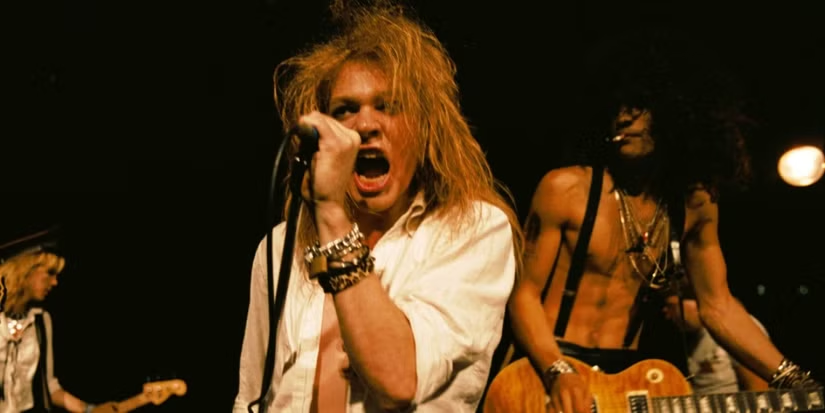
As the summer tour season approaches, fans are gearing up to see shows all over the world. There’s something special about outdoor summer concerts, when fans can let loose and vibe with the crowd and the band. However, not every tour goes off without a hitch and there have been several tours that forever have a black eye.
In the summer of 1992, there were a plethora of great bands on tour. U2, Def Leppard, Aerosmith, Van Halen, Iron Maiden, The Black Crowes, Skid Row, the late Ozzy Osbourne and more brought music to the masses. It was also the year of the first Lollapalooza tour, which featured Red Hot Chili Peppers, Soundgarden, Ice Cube, Pearl Jam, and Jesus and Mary Chain. But, the biggest tour of the summer of 92 was a co-headlining outing featuring the most popular hard rock and heavy metal bands at the time. The tour started off well, but hit a few snags along the way before it deteriorated into a disaster.
Metallica was on top of the world and on their way to becoming the biggest metal band on the planet with the success of The Black Album, which features the huge hits “Enter Sandman,” “Nothing Else Matters,” “The Unforgiven,” and “Wherever I May Roam.” The group was in the midst of a three-year outing that took them around the world promoting their most-popular album. At the same time, Guns n’ Roses were on tour promoting their two albums, Use Your Illusion I and Use Your Illusion II, which spawned hits like “You Could Be Mine,” “Civil War,” “Don’t Cry,” and “November Rain.” The two groups decided to go out on a co-headlining stadium tour with Faith No More opening each night
The 26-date tour kicked off in RFK Stadium in Washington D.C. on July 17, 1992, without a hitch, but things soon began to unravel. There was a tension building between the two acts. Metallica were regimented, playing tight and punctual sets, while GNR were unpredictable and were notorious for late starts. In fact, on their fall tour of 1991, the tickets for Guns N’ Roses concerts stated the band would take the stage “around 9 PM.” In December 1991 at a show in Philadelphia, Guns N’ Roses didn’t take the stage until after midnight, playing until past two in the morning, drawing some ire from an exhausted audience.

Outside GNR’s infamous punctuality troubles, there were a myriad of issues on the tour. In Detroit, GNR frontman Axl Rose vomited onstage as the band ended “You Could Be Mine.” He left the stage for a few minutes and returned to apologize, and the band launched into the song and played it again. During GNR’s set at Giants Stadium in East Rutherford, New Jersey, Axl Rose was hit in the crotch by a lighter thrown by an audience member. He quickly stormed off-stage, leaving bassist Duff McKagen to sing the rest of their cover of Bob Dylan‘s “Knockin’ on Heaven’s Door.” The band left the stage after the song and was supposed to return for an encore. Duff walked out and addressed the audience saying Axl would not be returning, and the show was over.
Axl Rose had been suffering vocal issues on the outing, most likely brought on from the non-stop performances combined with chain-smoking and a lot of drinking. It all came to a head in a perfect storm in Montreal on August 8, 1992. During Metallica’s set, they were playing the intro to “Fade to Black” when James Hetfield accidentally stood on top of a pyrotechnic that was discharged. It sent flames up his body, resulting in second and third-degree burns to his arm, hand, face and back. The band immediately stopped playing and Hetfield was rushed to the hospital. Drummer Lars Ulrich addressed the crowd, explaining James had been injured and was en route to the hospital, and that the band would return to make it up to the fans.

Fans waited over two hours after Metallica’s shortened set for Guns N’ Roses to take the stage. The band had only played a few songs when Axl Rose complained about monitor issues and sound problems. He added that his throat was hurting and left the stage, ending the show. The fans, who were already disappointed by Metallica’s short set, combined with a long wait and then GNR’s lackadaisical and truncated show, hit a breaking point.
Fans erupted into violence inside the only indoor stadium of the tour, storming the stage and merchandise stands. Outside the stadium, people overturned police cars, smashed windows, looted, lit bonfires and fought with police. There were multiple injuries and arrests and the chaos caused more than 400-thousand dollars of damage to the city.
In the aftermath of the riot, the two groups were forced to postpone six shows and cancel one in Vancouver. The tour picked back up over two weeks later in Phoenix. Metallica’s guitar tech, John Marshall, joined the band on rhythm guitar since frontman James Hetfield couldn’t play due to his injuries. Thankfully, his voice was fine, and he fronted the band without his guitar for the remainder of the outing.
Who’s Your Perfect Classic Rock Band?
The tension between the two bands was at an all-time high. Metallica felt like GNR could’ve saved the day in Montreal after Hetfield’s accident, and they were bothered by Axl Rose’s nonchalant behavior about the riot while he complained about his voice problems backstage smoking cigarette after cigarette while Montreal was on fire.

The final incident to take place on the ill-fated tour was during a September show where frontman Mike Patton of Faith No More, took a bottle of urine a fan threw on stage, opened it and poured it all over himself and Axl Rose’s vocal monitor. The band was immediately fired from the tour and replaced with Body Count and Motorhead.
The Guns N’ Roses and Metallica double bill limped to the finish line on October 6, 1992, in Seattle. It was the last big co-headlining rock show of that magnitude for many years as grunge and alternative rock became dominant. Guns N’ Roses kept touring but kept having issues and eventually parted ways, while Metallica just got bigger and bigger, dominating the metal scene for years. Metallica did the right thing and returned to play two shows at the Montreal Forum in February 1993, offering half-priced tickets for fans, while GNR were banned for life from playing Olympic Stadium. A microcosm of the biggest and most disastrous summer tour of 1992.

Roommates, imagine clocking into work one day only to find out your coworker didn’t just quit—they allegedly quit for reality TV. That’s the conversation swirling around Pennsylvania right now, where Sean Reifel’s name has now found its way from police reports to the season 8 ‘Love Island USA’ villa.
Sean Reifel, a Pennsylvania native and former member of the Bethlehem Police Department, has been announced as part of the upcoming season 8 cast of Peacock’s hit dating series ‘Love Island USA.’ Fans were introduced to him on the show’s trailer as “not a model, not an actor, I’m a police officer, actually.” But officials later confirmed that Reifel is no longer with the department, having reportedly resigned before his reality TV debut. His departure has now reportedly left the department short-staffed and searching for a replacement.
According to WAFB, Easton Mayor J. William Reynolds says Reifel’s exit has created frustration within the city, especially after the time and taxpayer money invested in training him. The mayor expressed disappointment over the resignation, noting that the department now faces yet another vacancy that may not be filled until next year. “Our police department spent a lot of time training and we paid thousands of taxpayer dollars to send him to the police academy,” Reynolds said. “I never thought I’d see the day in America where reality show participation wins out over being a police officer.” For context, Reifel took the oath and joined the force in August 2025. However, less than a year later, he walked away from policing to pursue a spot in the ‘Love Island’ villa.
Things took an even more personal turn when Reifel’s mom, @beth.bow819, reportedly caught wind of the online chatter and jumped into the comments herself to share her own thoughts. She didn’t hold back about the discourse around her son’s decision.
“This is Sean’s mom and the statements made by these officials are disappointing and they missed a huge opportunity to make a positive impact. They did not spend taxpayer dollars to send him to a full academy. He came with four years of experience from Northern California where he was a sheriff deputy. Contra Costa County Sheriff Dept paid for him to attend a full academy. Yes they spent some but they are making statements that do not tell the whole story. Also I think it’s interesting that they say he resigned because he was told to put in for leave before going to on the show. And then after arriving in Fiji his leave was denied. I think when the mayor or anyone is speaking on something especially something about another person it is important to share all the facts. I stand with my son. I support him fully and I do proud of him. ❤️”
One Instagram user @brookedabrand said, “This was great promotion for him we now want him to win even more !“
This Instagram user @chuckstarfilms joked, “He submitted to but they ain’t pick him 😂😂😂”
And, Instagram user @jeriah888 added, “Money sir… who turning down that opportunity 😅 y’all gone match the pay or sum? If not hush 😂”
Then Instagram user @itsjasleeee wrote, “Calls him out for what ? Being a grown man and making his own decisions? lol“
Meanwhile, Instagram user @kashmillz claimed, “Yall shoulda let boy use his PTO then .. Now LOOK he gone for good 😭😭😭😭”
While Instagram user @ra.millian commented, “Well sir, you fasure just made him more POPULAR! He’ll be set for a while 💰 now!“
What Do You Think Roomies?

Streamer YourRage believes he may have found Jay Cinco‘s long-lost brother. Now, social media users are comparing the influencer to Sincere Rhea, a new islander on Season 8 of ‘Love Island USA.’ While some fans are convinced the two could be related, others say the comparison is a reach.
On Wednesday, June 3, popular streamer YourRage reposted a photo of ‘Love Island USA’ newcomer Sincere Rhea and tagged Jay Cinco, suggesting the two looked alike.
However, YourRage wasn’t the only person who thought so. As comparisons continued to circulate online, Jay Cinco eventually reposted it to his Instagram Story and responded to the chatter. On his Instagram Story, he joked, “Man watch out 😂😂😂” before adding, “Why everybody keep tagging me in dis shi 😂.”
See below:
The Shade Room Teens shared Jay Cinco’s response alongside a side-by-side photo of him and Sincere Rhea. Many users jumped into the comments agreeing that they could see the resemblance, while others argued that the two look nothing alike.
Instagram user @secretlifeof_tiara wrote, “Is that his brother !?!?
Another Instagram user @blognae.__ wrote, “Sincere looks way better than Cinco”
While Instagram user @sharksleigher wrote, “well he is on there getting ready to shark so lmao”
Instagram user @bighomieduwop wrote, “So that’s not Princeton from Mindless Behavior?”
Another Instagram user @_hendrix1 wrote, “Cut it out that’s Walmart Julian Newman 😂”
While Instagram user @emmi_scott00 wrote, “Thought that was Austin McBroom for a second”
Instagram user @teri.michelle_ wrote, “they don’t look nothing alike.”
Another Instagram user @badinfluence_3 wrote, “Definitely not. cinco got him beat to the max 😭😭😭”
‘Love Island USA’ is just getting started, with the first episode of Season 8 premiering on Tuesday, June 2. While viewers are still getting to know this year’s islanders, the cast has already generated plenty of conversation both inside and outside the villa.
Most recently, Sean Reifel’s mother spoke out after the mayor of her son’s Pennsylvania hometown criticized the former police officer for leaving his law enforcement career to appear on the reality dating series. In her statement, she claimed officials “missed a huge opportunity to make a positive impact” and said the mayor did not “tell the whole story” when it came to Sean’s background, training, and leave request before joining the show.
Meanwhile, Vasana Montgomery broke her silence after being removed from the show, apologizing for using a racial slur in resurfaced videos that circulated online after the Season 8 cast reveal.
With new episodes still ahead, it appears Season 8 is already giving viewers plenty to talk about.
What Do You Think Roomies?




Waymo dominates autonomous vehicle registrations as Tesla trails behind


This is BROKEN! INSANE 5x MONEY CAR WASH WEEK! The NEW GTA Online UPDATE Today! (GTA5 New Update)

SpaceX just won a second Golden Dome contract. This one is $4.16 billion.


Jade Biosciences, Inc. (JBIO) Discusses Positive Interim Results From JADE101 Phase I Healthy Volunteer Study and Development Plans Transcript


SHE IS KILLING XRP!!! WATCH URGENT AND ACT FAST

FIRST NIGHT REVIEW: Take That bring the Circus back to life in spectacular sun-soaked style

Is the Spurs Phenom Already Better Than Prime Diesel?

CFTC Has Approved the First Regulated Bitcoin Perpetual Contract in the U.S.


The House | Inside Andy Burnham’s Makerfield Campaign: “Nobody Thinks This Is In The Bag”


French Open 2026 results: Alexander Zverev beats Rafael Jodar and will play Jakub Mensik in semi-finals
Novak Djokovic v Joao Fonseca LIVE: French Open latest scores and results after Jannik Sinner’s shocking collapse
Weak ‘Supergirl’ Box Office Tracking Amid Milly Alcock Backlash


CryZENx Releases Fresh Playable Content Deep Inside Jabu-Jabu for His Ocarina of Time Remake

Snowflake (SNOW) Stock Rallies on Strong Q1 Results and AI Product Growth

Maddox Jolie-Pitt Legally Requests to Drop Brad’s Surname


Demand Conditions Improve In Chemicals Sector In April 2026

One of the Greatest Sitcoms of All Time Shoots Up Apple TV’s Charts 11 Years Later


MicroStrategy Moves $30 Million in BTC to Coinbase Prime: Is the Bitcoin Sell-Off Already Here?


This Week In Security: Ubiquiti Fixes, And FreeBSD Joins The Club You Don’t Want To Join
Bruce Willis’ Generosity Resurfaces Amid His Dementia



You must be logged in to post a comment Login