

Entertainment
Kendra Wilkinson Slams People Body Shaming Her Breasts


Kendra Wilkinson is firing back after body-shamers suggested she ‘downsize’ her breast implants.
The former Playboy model, 40, posted about her weight-loss journey via an Instagram post on Tuesday, May 26, prompting some of her followers to offer up unsolicited advice about the size of her bust.
“Month two on my GLP-1 journey and I’m still being really intentional about how I approach this. For me, it was never just about the number on the scale,” Wilkinson captioned the post. “It’s about feeling like myself again, having real energy, and actually learning to trust the process without trying to fast forward it. I wanted this to feel honest, sustainable, and actually work for MY life.”
According to screenshots taken of Wilkinson’s Instagram Story and published by The Looker on Wednesday, May 27, some followers criticized her shape.
“The boobs make you look heavier. Bring it down a few sizes. You’ll look smaller,” read one comment.
In response, Wilkinson wrote, “Who’s paying?! “You want my Venmo to support this?”
Another comment read, “Kendra, you’re not overweight. I think your implants make you look heavier than you are. Consider a reduction in your augmentation?”
Wilkinson, who got her breast implants at 18, reacted to this remark by sharing a selfie and hitting back in text overlaid on the image.
“Until I get my GoFundMe breast reduction money, I’m going to love my boobs the way they are,” she wrote.

Kendra Wilkinson. (Photo by Alberto E. Rodriguez/Getty Images)
In the past, Wilkinson has been candid about aging in the spotlight and the criticism that comes with it.
In March, she took to Instagram to speak about “embracing herself” and rejecting any negatively thrown her way about her looks.
“I used to use a light filter on myself but now I’m just embracing myself as it is,” she captioned a selfie. “I’ve seen many people comment saying I’ve aged ‘poorly’ and that is ok. I’m ok with aging ‘poorly.’”

Kendra Wilkinson is continuing to open up about her weight loss journey. “Starting my GLP-1 journey and being really intentional about how I do it 🤍 for me, it wasn’t just about weight… it was about feeling better, having more energy, and actually trusting the process instead of rushing it,” the realtor, 40, wrote in […]
The Girls Next Door star went on to say that she’s the happiest she’s ever been at age 40.


“For some reason I’m happier than I’ve ever been lately, even with a little weight gain and wrinkles,” she wrote. “I’m not going to tie my happiness again into the negative energy.”
Wilkinson gave herself credit for being a “balanced, single, positive, fun woman who loves life” in the social media post.
Wilkinson found fame in the Playboy Mansion as one of Hugh Hefner’s main girlfriends in 2004 (alongside Holly Madison and Bridget Marquardt), after she met the Playboy founder when she was 18 at his 78th birthday party.

Continue Reading

A major federal ruling involving the Trump administration is putting a spotlight on what can—and cannot—be removed from public history spaces, and U.S. District Judge Angel Kelley is at the center of the decision that has sparked national attention over how America’s past is presented in national parks and monuments.
RELATED: One Band, One Sound! Social Media Users Are Crackin’ Up At Crowd’s Reaction To Donald Trump Attending Game 3 Of NBA Finals (VIDEOS)
Judge Orders Slavery And Climate Exhibits Restored In Parks
On Friday, Judge Angel Kelley issued a preliminary injunction ordering the Trump administration to restore exhibits and signage related to slavery and climate change that had previously been removed from national parks. The court noted the removals appeared to be tied to materials that “do not align with its preferred narrative,” according to the ruling. The decision came after a coalition of conservationists, historians, and scientific organizations challenged the policy in court.
Court Battle Details Claims Of History Erasure Campaign
The case centered on claims that the U.S. Department of the Interior had engaged in what plaintiffs described as a “sustained campaign to erase history and undermine science,” pointing to widespread changes across multiple sites. The ruling effectively halts parts of a broader policy linked to a March 2025 executive order from Donald Trump that directed revisions to historical and scientific content displayed in national parks.
According to documentation cited in the case, dozens of exhibits were impacted. This includes materials referencing slavery and enslaved people across multiple national parks. Climate-related displays are also affected, covering topics such as glacial retreat, rising sea levels, shifting weather patterns, and environmental risks to wildlife habitats. Furthermore, these exhibits are now ordered to be reinstated. Some of those signs were flagged, while others were fully removed across multiple historic and natural sites nationwide.
Trump Got The Comments Flooded With Mixed Reactions
As soon as the news hit, folks ran straight to The Shade Room’s Instagram comment section and were all over the place with reactions. Some users claimed the timing felt significant, saying it was “just in time for Juneteenth.” Meanwhile, others took a more spiritual route, calling it “from the ancestors.” And of course, a few admitted the post caught them off guard entirely, initially thinking it was announcing something else altogether.
One Instagram user @blaqbuety shared, “Our Ancestors said… wait.. wait.. wait a minute 💪🏿👏🏿👏🏿🙏🏿❤️🎯”
This Instagram user @therealmalikhall said, “Please Protect That Judge 🙏🏽”
And, Instagram user @daniellealexisb claimed, “Right in time for Juneteenth 🕺🏽💃🏾”
Meanwhile, Instagram user @davydpapi added, “American history will not be erased“
While Instagram user @bando_tez wrote, “You know what 😒…. Nvm don’t even worry about it but that’s cool too ✌🏾”
This Instagram user @karimellis2.0 said, “Reverse. Draw Four. Uno Out!!!“
Instagram user @d.lei.d added, “Thought he got up outta here 😂”
This Instagram user @dougiecash asked, “Why are people acting surprised. Most of the nonsense he did will revert back now or after he leaves office“
This Instagram user @ataviaab shared, “yeah cause wtf was that abt.“
Lastly, Instagram user @lorissa.alexis commented, “Love that a BLACK WOMAN got this done! 👏🏽👏🏽👏🏽”
RELATED: Jasmine Crockett Introduces STOP TRUMP Act & The Internet Has Plenty To Say (PHOTO)
What Do You Think Roomies?

Us Weekly has affiliate partnerships. We receive compensation when you click on a link and make a purchase. Learn more!
Whether Taylor Swift is sitting courtside at a Knicks game or grabbing dinner with fiancé Travis Kelce, the singer is always dressed to the nines. She has a way of mixing together effortless, cool-girl style with timeless pieces, making her outfits feel actually attainable. That statement even rings true when it comes to her latest wedding guest ensemble that made Us want to book a trip to the coast — and it all has to do with her heeled sandals from Reformation.
Wedding guest dresses are usually the most eye-catching part of any look, but Swift proves that your shoes can sometimes make a bigger statement. While attending a wedding in Greece for George Karlaftis and Kaia Harris, the singer wore straight-up designer items that would cost you a pretty penny. The exception? These Reformation heeled sandals that totally embody coastal-chic style, and they’re still in stock in her exact color (for now).
Get the Waldena Block Heeled Mules for $268 at Reformation! Please note, prices are accurate as of the publishing date but are subject to change.
The Reformation Waldena Block Heeled Mules are so on trend for the summer, giving complete oceanic vibes with the shell ‘strap’ design and sandy beige hue. The sandals paired perfectly with Swift’s Zimmerman midi dress, Steven Battelle coin pendant and dangly De Beers earrings. And although all those high-end pieces are out of our budget, we’d happily invest in the star’s exact heeled sandals that look like a luxury designer find, but are listed at a fraction of the price.

Taylor Swift and the color red go together like peanut butter and jelly. The showgirl is known for her signature red lipstick and frequently integrates the bold hue into her wardrobe. Case in point, she just stepped out in buckle-style sandals for a stroll through Manhattan, and the romantic pair had burning red details we […]
In addition to the elegant seashell design, we love the slender silhouette, peep-toe opening and low heel that’s ideal for dancing the night away. Psst, the block heel is just 2 inches high! The sandals also have a heel cushion that provides a comfortable feel while at the ceremony and during the reception thereafter. Read: There’s no reason to walk around barefoot while stunning in these sandals.
You can choose between shades like elegant black and cute light blue, but if you want to truly channel The Life of a Showgirl singer, go with the beachy cream puff option. The neutral color goes with everything from casual mini dresses, satin maxi skirts, wide-leg trousers or wedding guest dresses à la Swift. Honestly, you could probably wear a burlap bag and still get tons of compliments when you slip on these Reformation sandals.
Now’s your chance to get the same exact heeled Reformation sandals that have Swift’s stamp of approval. The only issue is grabbing a pair before they’re gone. If we’ve learned anything, it’s that once the singer wears something, the item won’t be in stock for long.
Get the Waldena Block Heeled Mules for $268 at Reformation! Please note, prices are accurate as of the publishing date but are subject to change.
Looking for something else? Explore more Reformation shoes here!

Wedding season is upon us, and many of us will soon find ourselves cheering for the newlyweds and biting into heavily frosted cake. But until then, the big question remains: what will you wear? While you may have your dress on lock, the shoes to complete your look are an entirely different story, because standing […]

If there’s one weekend this summer you need to spend all your time at home, it’s this one.
Major streamers like Netflix, Prime Video and more have just dropped some of the season’s can’t-miss shows, which is why Watch With Us had to cancel our wedding yet again to make time to watch all of them.
Dramatic weddings? That sounds like Sweet Magnolias to us, and the rumors are true – the hit Netflix series is back for season 5.
There’s also a slew of new shows that will make you beg for more seasons, like Prime Video’s hit YA adaptation Every Year After and HBO Max’s queer coming-of-age tale, Proud.
‘Sweet Magnolias’ Season 5 – Netflix
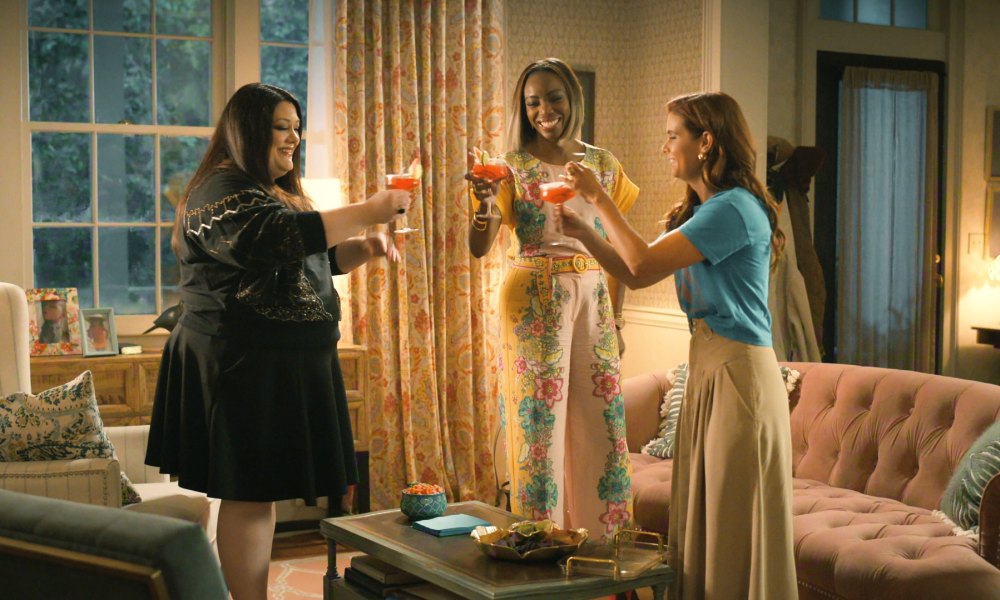
Brook Elliott, Heather Headley, JoAnna Garcia Swisher in Sweet Magnolias season 5 Netflix
The Magnolias are back, and this season, they’re ditching the Deep South for the Big Apple. Well, kinda – bride-to-be Helen (Heather Headley) needs a fancy wedding dress, and only Fifth Avenue can satisfy her cravings for haute couture bridal gowns. Meanwhile, Maddie’s (JoAnna Garcia Swisher) dream job at a Manhattan publisher turns into a nightmare, and she is soon booking a return trip home.

Prime Video is investing in love with a wide variety of steamy rom-coms, star-studded TV shows coming this year— and a fan event to celebrate the upcoming YA titles. The streaming service announced on Thursday, April 30, that Prime Video was branching out with Obsessed Fest, which is described as “an inaugural summer tentpole event […]
Relax, fans – Sweet Magnolias is still largely set in Serenity, that cozy, too-good-to-be-real small town that makes Stars Hollow seem like San Francisco. Helen’s upcoming nuptials provide some of the drama, as does Dana Sue’s (Brooke Elliott) increasingly troubled marriage to hubby Ronnie (Brandon Quinn). Yet no matter what life serves them, the Magnolia ladies can rely on each other to weather any storm – and disappointing men – that cross their paths.
‘Every Year After’ Season 1 – Prime Video

Sadie Soverall as Percy Fraser and Matt Cornett as Sam Florek. Cate Cameron/Prime
It’s a new month, which means there’s another Prime Video adaptation of a massively popular YA novel to bingewatch. After last month’s hit hockey romance Off Campus, the streamer dropped the puck-less Canadian love story Every Year After, based on Carley Fortune’s bestselling novel, Every Summer After. It’s just as addictive as Off Campus, except it’s a little more serious than its YA peer.
Barry’s Bay is a picture-perfect small town, so why has Percy (Sadie Soverall) been away for almost a decade? Something drove her away, and it has to do with childhood crush Sam (Matt Cornett). When her mother, Sue (Elisha Cuthbert), dies, Percy has no choice but to go back to her hometown and face some demons from her past. Will she see Sam again? Does she even want to?
‘Proud’ Season 1 – HBO Max
Live fast, party hard – if Filip (Ignacy Liss), the main character in the new Polish-language series Proud, had a motto, that would be it. He’s young, he’s good-looking and all the guys he encounters either want to be him or hook up with him. But Filip’s hedonistic lifestyle grinds to a halt when his sister dies, leaving him to take care of her infant child. Filip’s never taken care of anyone before, not even himself, so he has his work cut out for him as a de facto dad with no stable income and a lifetime of making bad choices.
Can Filip be responsible? That’s the main question Proud asks, and it answers it by giving an honest portrait of an immature boy who slowly – slowly – matures into a man. It’s not an easy, straightforward path, though, and Filip realizes he has to rely on others for help. Proud consists of eight episodes at approximately 32 minutes each, and it’s just the right length to watch one of summer’s most surprising – and rewarding – dramas.
‘My Adventures With Superman’ Season 3 – HBO Max
Look! Up in the sky! It’s a bird! It’s a plane! It’s … an overused pun connecting a certain all-American comic book character to season 3 of an animated TV show. Yes, My Adventures with Superman is back on HBO Max with a new batch of episodes starting on June 14.
This scene brings back Supes (voiced by Jack Quaid), Lois Lane (Alice Lee) and Jimmy Olsen (Ishmel Sahid) as they hang with new friends like Superboy (Darren Criss) and battle new villains like Cyborg Superman. One of the main plots this time around is The Reign of the Supermen, an adaptation of a very famous ‘90s storyline which sees several successors to Superman’s role as Metropolis’ primary defender.
‘The Listeners’ Season 1 – Starz
Claire’s (Rebecca Hall) life is pretty ordinary until she hears a distant humming noise that completely disrupts her routine. No one else close to her can hear it – not her husband, daughter or her fellow teachers – except for Kyle (Ollie West), a student in her class who is also mystified about the noise. Both wonder where it comes from and why they can only hear it, but as they investigate the source of their disturbance, their initial curiosity gives way to an all-consuming obsession.
With its slow, steady pacing and emphasis on liminal space to conjure a strange, vaguely menacing mood, The Listeners is like an A24 movie stretched across four episodes. That might dissuade people from watching it, but those who enjoyed the recent horror hit Backrooms and the 1995 Julianne Moore film Safe should like this series. As the noise-plagued protagonist, Hall once again shows she’s one of the most underrated actors working today. She’s fantastic, especially in the scenes when her character is slowly losing her grip on her sanity.
Entertainment
Steven Spielberg’s Sci-Fi Comeback Takes Aim at a J.J. Abrams Classic in Box Office Debut


After eight long years, director Steven Spielberg is back with a new sci-fi movie, Disclosure Day. While he has proven himself to be a master at virtually every genre in existence, there’s something about a new Spielberg sci-fi film that simply can’t be replicated. The new movie finds the legendary filmmaker revisiting themes and ideas he explored decades ago, in movies such as Close Encounters of the Third Kind and E.T. the Extraterrestrial, although this one shares more in common with two of Spielberg’s underrated sci-fi films — A.I. Artificial Intelligence and Minority Report. The movie is exceeding expectations at the box office in its opening weekend, on the strength of massive audience interest and positive reviews.
The box office has been on a hot streak for the past several weeks, with hits such as Obsession, Backrooms, and the Scary Movie reboot driving business. Before that, Project Hail Mary deployed Spielbergian tactics to deliver more than $680 million at the worldwide box office. Disclosure Day received positive early reactions, and is now sitting at a “Certified Fresh” 81% score on the aggregator website Rotten Tomatoes. The site’s consensus reads, “A humanistic variation on one of Steven Spielberg’s most revisited themes, Disclosure Day‘s breathless pursuit of optimism in an age of conspiracy gets its biggest boost from career-highlight work by Emily Blunt.”
Here’s How Much ‘Disclosure Day’ Is Projected to Gross at the Box Office
Besides Blunt, the movie also features Josh O’Connor, Eve Hewson, Colman Domingo, Wyatt Russell, and Colin Firth. In his review, Collider’s Nate Richard described Disclosure Day as “a summer blockbuster made for cinephiles, with no IP attachment and no overreliance on obvious Easter eggs.” The movie grossed more than $18 million at the domestic box office on opening day, which includes revenue from Thursday previews. It’s on track to gross around $45 million in its first weekend, which would put it $10 million ahead of the opening weekend haul of J.J. Abrams‘ Spielberg homage, Super 8. The Jaws director served as a producer on Super 8, which ultimately made around $260 million worldwide against a reported budget of $50 million. Disclosure Day comes with a reported production budget of $115 million, and is projected to gross more than $70 million in its global debut. Stay tuned to Collider for more updates.

- Release Date
-
June 12, 2026
- Runtime
-
145 Minutes

It has been more than 15 years since the release of “The Social Network,” the biographical drama centered on the creation of Facebook, and screenwriter Aaron Sorkin is back for its standalone sequel, “The Social Recoking.” Sorkin, who directed the sequel, wanted Jesse Eisenberg to reprise his role as Facebook’s co-founder, Mark Zuckerberg, but the actor refused. The role went to Jeremy Strong, who was eager to step into the role.
In an exclusive interview with Vanity Fair, Aaron Sorkin discussed his upcoming movie, “The Social Reckoning,” the follow-up to 2010’s Academy Award-winning movie, “The Social Network,” written by Sorkin and directed by David Fincher.
Initially, Sorkin said he would only do the project with Fincher as the director. However, the director was busy with other projects, which led Sorkin to take on the role. He did, however, reveal that Fincher was the first person to read the script and also offered help in any way he could.
Talking about the premise of the movie, Sorkin said, “‘The Social Network’ was about how Facebook was invented, and ‘The Social Recoking is what it’s become.”
Jesse Eisenberg Vehemently Refused The Zuckerberg Role

According to Sorkin, his first instinct was to approach Jesse Eisenberg to reprise his role as Mark Zuckerberg. “I felt like it belonged to him, and he was certainly battle-tested,” he said. Eisenberg was nominated for Best Actor at the Academy Awards, Golden Globe Awards, and BAFTA Awards for his portrayal of the Facebook founder.
In an interview in 2011, Eisenberg said while playing the role, he “developed an even greater affection” for the character. “So even if the character is acting in a way that hurts other characters, you still have to understand and ultimately sympathize with all of that behavior,” he said.
For the sequel, however, Sorkin said he tried to convince the actor for three days to come back, to no avail. “He simply did not want to be conflated with Mark Zuckerberg anymore, that he has his problems with the guy,” the director explained.
The Actor Changed His Tune About Zuckerberg

While Sorkin didn’t reveal many details about his conversation with Eisenberg, he further added, “he doesn’t like kids coming up to him in airports with business cards that say ‘I’m CEO, b-tch’ for him to sign.”
In 2025, Eisenberg said he no longer wanted to be associated with Zuckerberg, saying that the CEO “evolved into somebody obsessed with avarice and power.”
He also shared that he disagreed with Zuckerberg’s political views, stating, “These people have billions upon billions of dollars, more money than any human person has ever amassed. And what are they doing with it? Oh, they’re doing it to curry favor with somebody who’s preaching hateful things.”
Aaron Sorkin Found His New Zuckerberg
Sorkin revealed that he first mentioned “The Social Reckoning” to Eisenberg at the 2025 Vanity Fair Oscar Party. At that same event, he ran into Jeremy Strong, and they got to talking. When the screenwriter mentioned that he was working on a sequel to “The Social Network,” the actor said that he would be interested in the role of Zuckerberg if Eisenberg passed on the opportunity.
Strong told Variety in 2025 that he would approach the role just like any other, “with empathy, with objectivity, with care.” He agreed to take on the project, as he was fascinated by the material and thought it was one of the greatest scripts he’s ever read.
When asked whether he’d reach out to Zuckerberg, Strong replied, “no comment,” adding that he did not have a social media presence.
“He showed up on his first day, and when he said ‘good morning’ to me, he was already talking like Mark,” Sorkin said about Strong.
Aaron Sorkin On The Challenges Of Writing The CEO
“The Social Reckoning” will focus on the 2021 Facebook leak by whistleblower Frances Haugen. Documents showed Facebook knew the platform had harmful societal effects, including political polarization, misinformation, and negative effects on mental health, but failed to take sufficient action as they conflicted with the business’ interests.
According to Sorkin, one of the challenges was writing Zuckerberg like any other character and disregarding his personal views about him. “I can’t judge Mark Zuckerberg while I’m writing it. You’ve got to write the character like they’re making their case to God why they should be allowed into heaven,” he explained.
“The Social Reckoning” hits theaters on October 9, 2026.
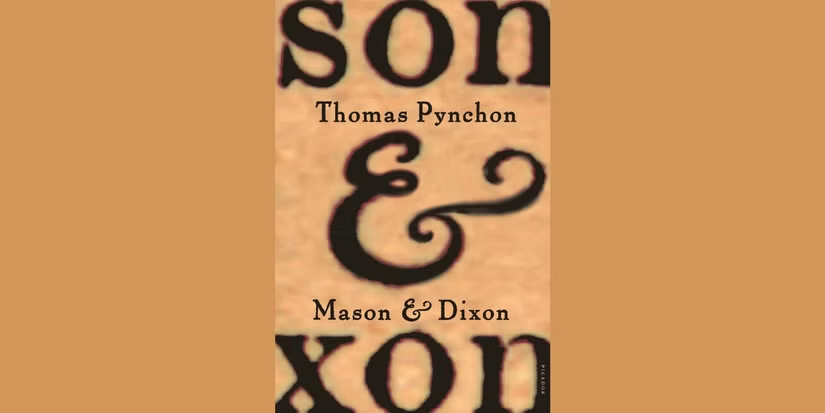
Postmodernism is a term that’s a little hard to define, and the word can mean different things depending on what medium you’re talking about, but postmodernist literature is what’s being stuck to here. It is indeed (and unsurprisingly) a movement that came about after modernism, with postmodernism being a bit more abstract and willing to tackle confounding things in life to an even greater extent than modernist works might’ve.
There’s also some really interesting language used throughout most great postmodernist novels, and it’s therefore not too surprising that some rank among the very best – and most important – books of the second half of the 20th century. Postmodernism, as a literary genre, really came about in the 1950s, and was probably at its peak in the subsequent two decades, with many (but not all) of the following novels, which can be considered among the best postmodern books ever written, being from that time.
10
‘Mason & Dixon’ (1997)

There is probably a Thomas Pynchon book you’re expecting to see here, even if you’ve not read it, because it’s kind of infamous (one that got a shout-out in Knives Out, of all places). And it will be here, a little later. For now, though, here’s another Pynchon novel: Mason & Dixon. This one’s challenging, but not so much because of its disturbing content, as other Pynchon novels are more confronting, as well as probably more confounding when it comes to things like narrative.
The story in Mason & Dixon is almost straightforward, at least by Pynchon’s standards, being a story within a story about Charles Mason and Jeremiah Dixon, who, in the 18th century, surveyed parts of North America together and established the Mason-Dixon line. The perplexing part of Mason & Dixon is the language used, as it’s done in a way that does some combination of homaging and parodying the literature of the time in which it’s set, but once you get used to that style, it’s a compelling read. Hell, it’s compelling in a weird way even if you don’t 100% get used to that style.
9
‘The Curious Incident of the Dog in the Night-Time’ (2003)

Just to show that a book doesn’t have to be grim, confusing, and aimed at an adult audience to technically be postmodern, here’s The Curious Incident of the Dog in the Night-Time. Sure, it’s not as “important” or “classic” as some of the other books mentioned here, but it could work as a great introduction to unconventional literature, for younger readers. It’s postmodernism, but with the postmodernist training wheels still on (postmodernist wheels are like, triangles, or something, and there are two and a half wheels per set, because **** you, that’s why).
The Curious Incident of the Dog in the Night-Time is about a teenage boy who observes the world in a unique way, and what happens when he becomes fixated on solving the murder of a neighbor’s dog. The first-person narration here is really what carries the whole book, and makes it stand out, as does the use of maps and other images used throughout; they help make this somewhat postmodernist, and also, they help elevate what’s an already solid mystery novel into something of a modern classic.
8
‘Underworld’ (1997)

The idea of the “Great American Novel” has been a thing for so long, and the search for it has been so built up, it might well never be a thing. There might well never be a definitive “Great American Novel.” That doesn’t stop there from being contenders, though, with Underworld by Don DeLillo being at least worth considering… and it was even linked to the idea of the “Great American Novel” as early as the year it was first published.
What Underworld does narratively might not sound too wild, since it’s about the baseball that was hit by Bobby Thomson in 1951: the one in the so-called Shot Heard ‘Round the World. It’s about that baseball over the years, and the different people who obtained it at some point, but after the prologue dealing with the New York Giants vs. Brooklyn Dodgers match, Underworld jumps forward to the 1990s, and then each part of the book goes back 10 or so years, until things are back in the 1950s. That structure is very postmodernist, as is DeLillo’s general style, not to mention the sprawl and different tangents of Underworld. It’s huge, strange, overwhelming, and almost always very impressive, as a novel.
7
‘Lolita’ (1955)

You probably know what Lolita is about, and it is, but it’s also very different, in practice, than how some people like to describe it. On one hand, Lolita is easier to read than you might expect a book with such subject matter to have, as it is equal parts witty and poetic. But then it is somehow darker and more uncomfortable than you might be prepared for, and you’re already going to be prepared for something dark and uncomfortable.
It might be the fact that Lolita is funny and horrifying without it feeling like two different books clashing that makes it such a harrowing read. You’re always yanked around, and you feel like you’re being tormented, toyed with, and sometimes controlled by the book’s narrator… a man who infamously exerts control over the young girl he calls Lolita, all while attempting to manipulate other characters alongside those he’s telling his story to, too. The effect is dizzying, impressive, and hard to read, but persevering through this particular book is ultimately worth it.
6
‘The Unbearable Lightness of Being’ (1984)

Of course The Unbearable Lightness of Being is postmodernist, with a title like “The Unbearable Lightness of Being” and all. This is a book about a womanizer and the two women who have had the biggest impact on him, though he does have many more women in his life, and he’s far from a likable protagonist (it doesn’t feel like he’s supposed to be, either, but this still might be a turnoff for some readers).
Well, actually, that synopsis applies to the movie adaptation of The Unbearable Lightness of Being. The book is also somewhat about those things, but is a lot more poetic and kind of dreamlike, de-emphasizing what narrative there is here while often being more concerned with philosophical ideas and other musings on life and love (or a lack thereof) more generally. It’s better – and more readable – than all that might make it sound, promise.
5
‘Slaughterhouse-Five’ (1969)

Slaughterhouse-Five tackles so many genres at once, which is impressive, considering it’s not a long book, by any means. The first edition came in at under 200 pages, but in that time, Slaughterhouse-Five is about World War II, time travel, and trauma, being a satirical book, a work of science fiction, and a war novel (plus some other things, probably) all at once.
It’s the novel for which Kurt Vonnegut is best known, and it’s also up there among the greatest books of the 20th century, however you might be willing to define it; whatever category it gets slotted into. While The Curious Incident of the Dog in the Night-Time might be more approachable, Slaughterhouse-Five is also a good novel to read if you want a (relatively) gentle introduction to postmodern literature, mostly just because it’s quite punchy and a good deal shorter than some of the other books mentioned here. Speaking of longer books being mentioned here…
4
‘Infinite Jest’ (1996)

…Infinite Jest. Hoo boy. This could be the final boss of postmodernist literature, in the sense that it’s unlikely anyone will write something simultaneously as long, unwaveringly ambitious/strange, postmodernist, and genuinely good in the foreseeable future. For starters, there are so many footnotes throughout Infinite Jest that if you exclusively read those footnotes, it still might take quite a bit longer than some full-length novels (based on the uncut audiobook of Infinite Jest being eight hours longer than the audiobook that only features the main novel, with the footnotes not being read).
And you might think that’s well and good and all, “But what is Infinite Jest actually about?,” you might be asking. Whatever you want it to be; whatever you end up thinking it’s about is what it’s about. It is as postmodernist as things get, while still being actually readable and often surprisingly entertaining. It’s a classic that feels like it has to be read, and yet it also feels very hard to actually recommend. Jest, so confusing.
3
‘Gravity’s Rainbow’ (1973)

One of the things that gets brought up quite often, when talking about Gravity’s Rainbow, is how it broke the Pulitzer Prize jury the year it came out. Now, it’s not the only time there was some kind of dispute, and the Pulitzer Prize for Fiction was not given out for a certain year, but it’s still interesting. Sorry if it’s something you already knew, but hey, it is a good way to summarize and succinctly explain the notion of Gravity’s Rainbow being challenging and very much not for everyone.
It’s a wild novel that manages to be incredibly long (more than 750 pages, and closer to 900, sometimes, depending on an edition’s formatting) and also remarkably dense, with plenty of sentences you’ll feel tempted to read again and again to make sense of them. If sense is even something that can be made here. And then there’s the matter of trying all those sentences, pages, and wildly different episodes together. It is postmodernism squared, and then some, but very much worth tackling whenever you find yourself with quite a bit of free time on your hands.
2
‘House of Leaves’ (2000)

The style of House of Leaves is often the story, even more than a book where a distinctive style is used to tell the story. House of Leaves tackles psychological horror in a unique way, and in a manner that could only really be done as a book. If you want a movie that scratches the same itch as some of House of Leaves, there is always Backrooms, and also a rather famous mod for Doom II called MyHouse.wad is almost like a video game adaptation of parts of House of Leaves.
But even with these, it’s mostly just parts of the novel that are represented in these works from different mediums. There are different sorts of horror in House of Leaves, long tangents, supplemental material that helps the overall book (even if such parts aren’t always 100% necessary to read in their entirety), and countless smaller stories told through footnotes. You’ve also got the wild formatting that has to be seen to be believed, and it’s bonkers enough in that department that you probably couldn’t even do an audiobook version of House of Leaves, let alone make it into some kind of movie.
1
‘Libra’ (1985)

It was hard limiting this whole ranking to only featuring two Don DeLillo novels, a little like how it was also hard including “only” two Thomas Pynchon ones. They’re not necessarily the grandfathers of postmodernism, but they’ve both been active for decades, and they’re also living legends in the sense that both have had works published in the 2020s (even if those books haven’t quite been as great as either author’s best works).
With DeLillo, White Noise deserves an honorable mention, but it’s Libra that’s his greatest novel overall. Even if it’s not as aggressively postmodern as Underworld, nor as sprawling, it is DeLillo’s most compelling novel, alongside being the hardest to stop thinking about, once you’ve read it. It’s the best story concerning the John F. Kennedy assassination (and there have been quite a few), and also one of the most paranoia-inducing novels of, potentially, all time. Sorry if that sounds a bit hyperbolic, but it really is something (very) special.
:max_bytes(150000):strip_icc():format(jpeg)/YouTube-free-docs-060326-3eca70ae4c9d406d8c9961213f17b957.jpg)
These in-depth movies explore nature, outer space, basketball, “Star Wars,” and much more.
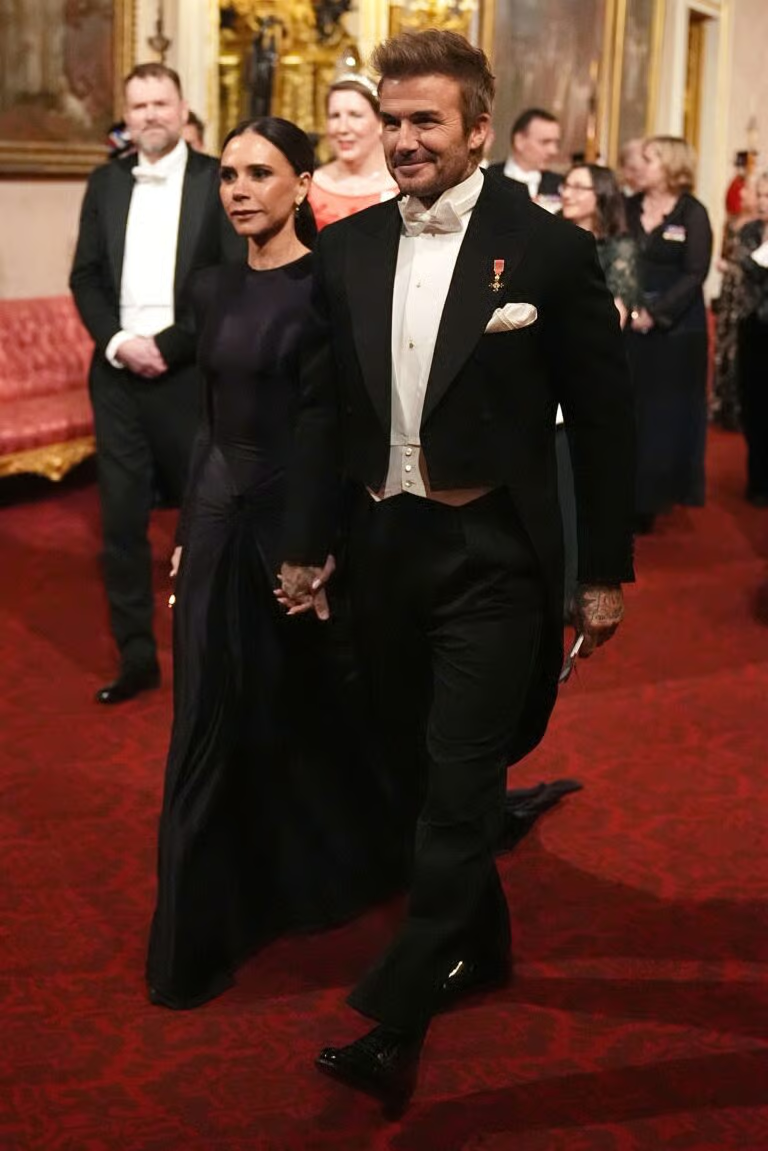
David Beckham was awarded a star on the Hollywood Walk of Fame, the first soccer player to receive the honor. He was surrounded by family and close friends, including his wife Victoria, and three of his four children. Notably absent was his firstborn, Brooklyn Beckham, amid reports of a rift within the family.
Brooklyn cut off all contact with the Beckhams several months ago, but not before releasing a lengthy statement accusing his parents of controlling his life. David and Victoria have since attempted to reconcile with their son to no avail.
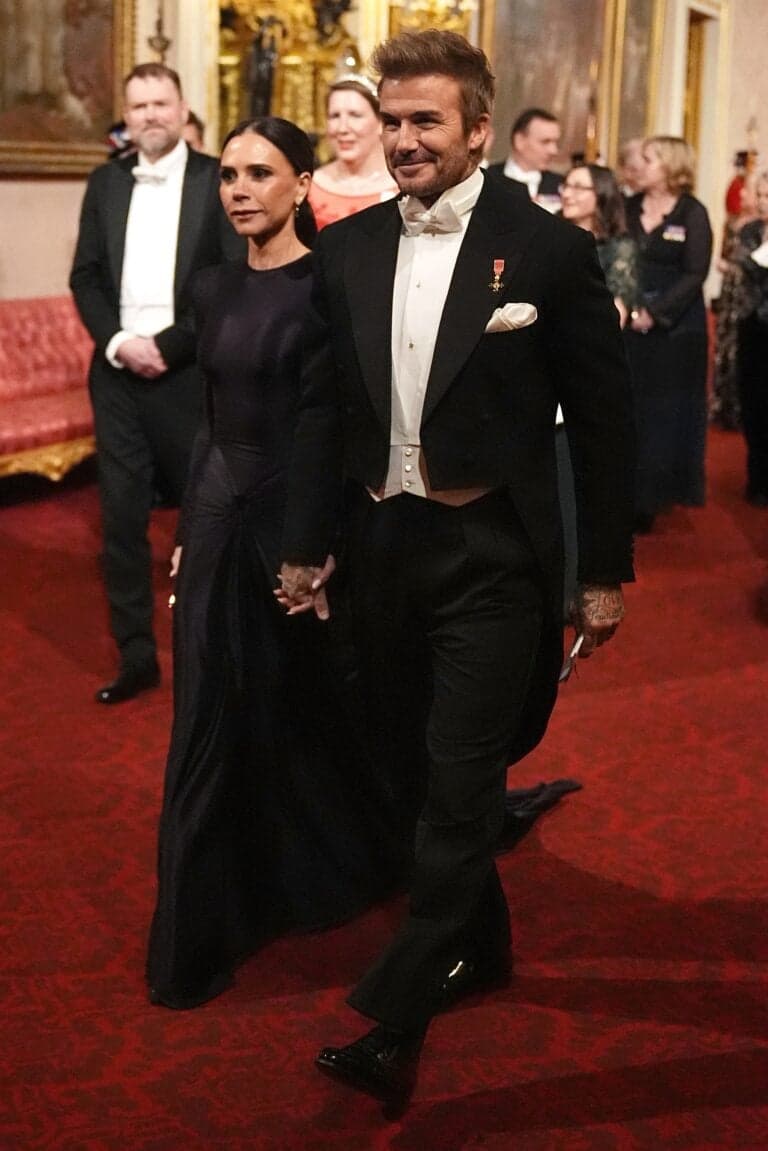
On June 12, David Beckham received the 2,849th star on the Hollywood Walk of Fame under the Sports Entertainment category. It was a momentous occasion for David, who joined other athletes honored by the Hollywood Chamber of Commerce in the past, including Shaquille O’Neal, Billie Jean King, Muhammad Ali, and Magic Johnson. David, however, was the first soccer player to receive a star.
Speaking during the ceremony, David said the moment felt “surreal.” “I’ve always been a dreamer, but I could never have imagined that an honor like this would come to a working class English soccer player like me,” he said.
David is widely regarded as one of the most iconic soccer players of his generation, playing for top clubs such as Manchester United and Real Madrid. He retired from the sport in 2013 and is the co-owner of the U.S. Major League Soccer team Inter Miami CF.
Brooklyn Beckham Skipped The Ceremony

Tom Cruise was in attendance to honor David, and in his speech said, “His is a Hollywood story: a boy who believed in something bigger than himself, had to work for every opportunity he received, and went on to influence his sport, shape culture around the world, and create opportunities for generations who followed.”
Other celebrities present included Eva Longoria and James Corden. David’s family, including his wife Victoria and children Cruz, Romeo, and Harper, were also there to support him. Brooklyn, however, was nowhere in sight.
In January, the eldest Beckham child posted a lengthy note on Instagram Stories, accusing his parents of being controlling and undermining his relationship with his wife, Nicola Peltz, as The Blast previously reported. Before ending his message, he wrote, “I do not want to reconcile with my family.”
Harper Beckham Was Seen Outside Her Brother’s Home
According to Page Six, Harper was seen arriving in an SUV outside Brooklyn’s L.A. home shortly after David’s Hollywood Walk of Fame ceremony concluded. She was wearing the same pink dress she wore at the event.
An insider, however, said that Brooklyn and Nicola were out of town, and Harper left shortly thereafter. The youngest Beckham sibling’s visit may have been another attempt at reaching out to her brother.
In February, Harper also mentioned Brooklyn in a Valentine’s Day post honoring her three brothers. She posted a black-and-white photo of her younger self alongside Brooklyn, Romeo, and Cruz, adding the text, “I love you all so much, words can’t describe it,” and tagging all three.
David Beckham Refuses To Talk Publicly About Rift
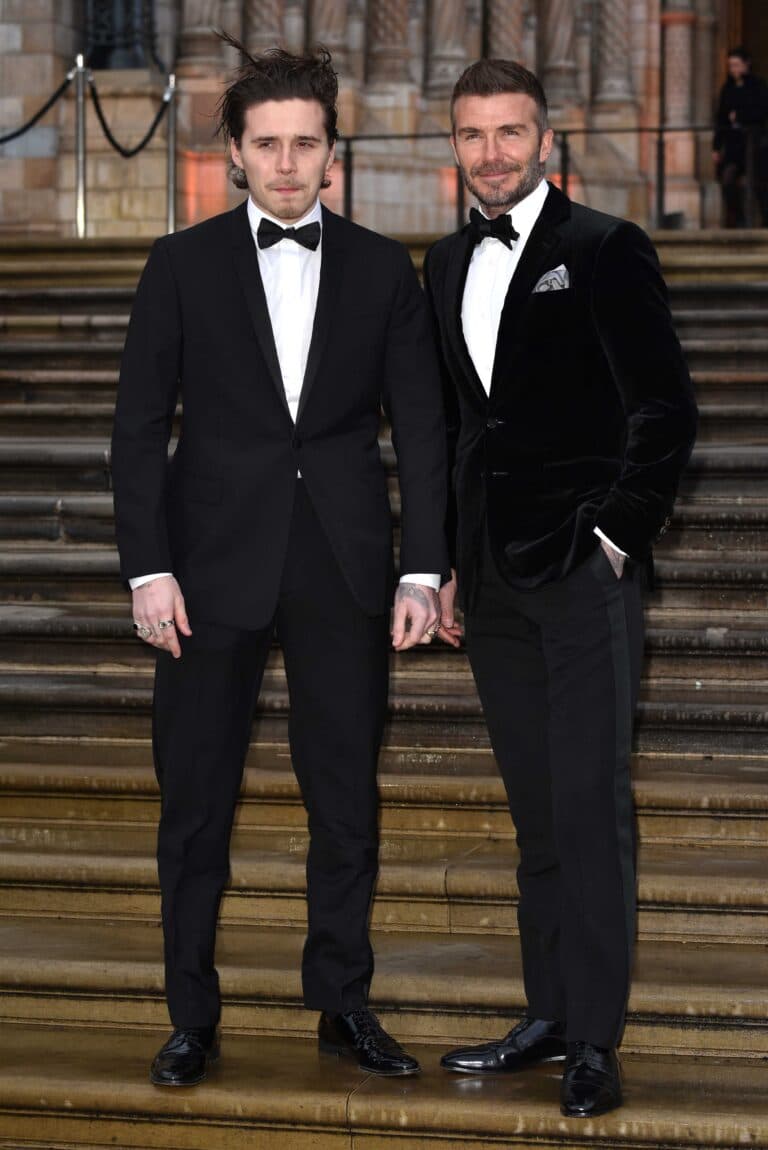
In an interview with Variety, David talked about his Hollywood star, his career, soccer, and his relationship with Victoria. When asked how they keep their relationship solid despite being constantly scrutinized by tabloids, the former athlete said that although they have busy schedules, their relationship and their family always come first.
“That’s our priority, and that’s what makes it work when you’ve been together for so long. Our priority will always be our family,” David explained.
When the topic went to the reported rift in the family, David was quick to say that he didn’t want to address it. “I’m sorry to stop you there, but that’s a private matter. That’s one thing that I don’t want to talk about,” David said.
David And Victoria Beckham Have Repeatedly Reached Out To Brooklyn

According to reports, Brooklyn blocked his parents on social media in December 2025 and stated that any future communication should be conducted only through his lawyers. He also asked them to stop tagging him on social media posts.
In March, on Brooklyn’s 27th birthday, both David and Victoria took to social media to share birthday greetings for their son. The husband and wife posted on their respective Instagram Stories, sharing photos of themselves during happier times with Brooklyn and greeting him a happy birthday. “I love you so much,” Victoria wrote.
In an interview with WSJ in April, Victoria touched on the topic, but didn’t go into specifics. “We’ve been in the public eye for more than 30 years right now, and all we’ve ever tried to do is protect our children and love our children. And you know, that’s all I really want to say about it,” she said.

For a long time, I thought vampire movies had a serious repetition problem. Somebody gets bitten, somebody spends half the film staring sadly out a window, almost everytime somebody (a vampire) falls in love with the wrong person (a human), and eventually somebody ends up dead. After a while, a lot of them started blending together in my memory.
The films on this list broke that pattern. These ten films represent some of the most visually striking, ambitious, and unforgettable examples the genre has ever produced, which is exactly why they still feel so alive decades after many of their contemporaries disappeared.
10
‘Only Lovers Left Alive’ (2013)

Adam (Tom Hiddleston) and Eve (Tilda Swinton) have been together for centuries, and by the time the film begins, they are already exhausted by most of modern life. Adam spends his nights recording music in Detroit and avoiding people whenever possible, while Eve arrives from Tangier carrying books, stories, and enough curiosity to make the world seem interesting again. Their relationship is unusually quiet for a vampire film. They are not chasing victims or fighting enemies. Most of the time they are simply talking, listening to music, driving through empty streets, and trying to find meaning in another century of existence.
What stays with me is how much attention the film gives to small things. Adam can spend several minutes discussing a scientist he admires, and Eve can become excited over a stack of old books. Even the cities matter because Detroit and Tangier feel worn down and beautiful in completely different ways. The vampire story almost becomes secondary to two immortal people trying to hold onto the things they still love.
9
‘Near Dark’ (1987)

Everything changes for Caleb Colton (Adrian Pasdar) after one night with Mae (Jenny Wright), a drifter who bites him before disappearing into the darkness. By sunrise, Caleb can no longer stand daylight, and he is forced into a nomadic vampire group that travels across the American Southwest. The gang includes Jesse Hooker (Lance Henriksen), Diamondback (Jenette Goldstein), and Severen (Bill Paxton), whose idea of passing time usually involves violence, intimidation, and leaving bodies behind.
A lot of vampire films surround their creatures with castles, ancient legends, or aristocratic manners. Near Dark drops them into motels, highways, and roadside bars instead. One of the most memorable scenes takes place inside a crowded bar where Severen spends the evening terrorizing strangers simply because he enjoys it. Caleb never fully fits into that lifestyle, which gives the story its tension. While the rest of the group accepts endless killing as normal, he keeps looking for a way back to the life he had before Mae found him.
8
‘Bram Stoker’s Dracula’ (1992)

Jonathan Harker (Keanu Reeves) travels to Transylvania expecting a routine legal assignment and quickly realizes Count Dracula (Gary Oldman) is nothing like the wealthy client he imagined. The castle feels isolated from the rest of the world, strange things happen at night, and Dracula becomes increasingly interested in Mina Murray (Winona Ryder) after seeing her photograph. Long before the story reaches London, the film already feels dreamlike, as though reality itself is starting to bend around the Count.
Much of the film revolves around Dracula’s obsession with Mina and his belief that she is connected to a love he lost centuries earlier. That idea gives the story a sadness that many vampire films never attempt. At the same time, Francis Ford Coppola fills almost every scene with elaborate costumes, shadows, candles, and practical effects that look handmade. Even people who dislike parts of the adaptation often remember individual images years later because there is so much visual imagination packed into nearly every sequence.
7
‘A Girl Walks Home Alone at Night’ (2014)

Bad City looks like a place people forgot to leave. Oil pumps move endlessly in the distance, streets stay empty for long stretches, and most of the people still living there seem lonely in one way or another. Among them is Arash (Arash Marandi), a young man struggling with his father’s debts and increasingly difficult life. Somewhere else in the city, a vampire known simply as The Girl (Sheila Vand) spends her nights wandering the streets in a black chador, watching the people around her.
The Girl is not interested in random victims. Drug dealers, abusers, and men who prey on others often attract her attention first. One scene involving a skateboard and an empty street somehow becomes as memorable as the horror moments because the film spends so much time creating a mood unlike anything else in the genre. It moves at its own pace and trusts silence far more than dialogue.
6
‘Cronos’ (1993)

Everything begins when Jesús Gris (Federico Luppi), an elderly antiques dealer, discovers a strange mechanical device hidden inside a statue. The object, known as the Cronos device, was created centuries earlier by an alchemist searching for eternal life. When Jesús accidentally activates it, a metal needle pierces his skin and starts changing him in ways he does not immediately understand. His health improves, his energy returns, and he begins craving things that once meant nothing to him.
The film becomes increasingly sad because Jesús is not somebody chasing immortality. He already has a family, a granddaughter who adores him, and a quiet life he seems perfectly happy with. Dieter de la Guardia (Claudio Brook) desperately wants the device for himself, while his nephew Angel (Ron Perlman) spends much of the story carrying out his orders with growing frustration. As Jesús changes, the film keeps returning to his relationship with his granddaughter Aurora (Tamara Shanath), and those scenes give the story far more emotional weight than a traditional monster movie.
5
‘Martin’ (1977)

Martin (John Amplas) arrives in a small Pennsylvania town to live with his elderly cousin Cuda (Lincoln Maazel), who is convinced the young man is a vampire. Martin insists that he is completely ordinary, though his behavior makes that difficult to believe. He stalks women, breaks into homes, and uses syringes to sedate his victims before drinking their blood. Unlike most vampire films, there are no fangs, supernatural powers, or ancient curses here. Everything Martin does could be explained through reality.
That uncertainty hangs over the entire film. Martin tells stories about another life that may or may not have happened, while Cuda treats him as a genuine monster sent from centuries ago. George A. Romero never rushes to answer who Martin really is. Instead, the film becomes a portrait of loneliness, obsession, and a young man who seems completely disconnected from the people around him. Even decades later, very few vampire movies feel this unsettling or this difficult to categorize.
4
‘Let the Right One In’ (2008)

Oskar (Kåre Hedebrant) spends most of his time alone. He is bullied at school, struggles to connect with other children, and often retreats into his own imagination. Then Eli (Lina Leandersson) moves into the apartment next door. She only appears outside at night, rarely seems bothered by the freezing weather, and immediately feels different from everybody else around her. Their friendship develops slowly through conversations, small moments of trust, and shared loneliness.
At the same time, a series of killings begins attracting attention throughout the area. Eli’s connection to those murders becomes increasingly difficult to ignore, though the film never treats her as a simple villain. She remains a child in many ways, despite carrying burdens that nobody her age should understand. The swimming pool sequence near the end has become famous for good reason because it says almost everything about their relationship without showing very much directly. The film is violent when it needs to be, though most of its power comes from watching two isolated children find comfort in each other.
3
‘Shadow of the Vampire’ (2000)

During the production of Nosferatu in 1922, director F.W. Murnau (John Malkovich) becomes obsessed with creating the most realistic vampire film ever made. His solution is simple and completely insane: he hires a real vampire to play Count Orlok. Max Schreck (Willem Dafoe) joins the production, and at first the cast assumes he is merely an eccentric method actor. Before long, however, strange disappearances and unsettling behavior begin making that explanation harder to accept.
One of the film’s greatest strengths is how seriously everyone treats the filmmaking process. Murnau remains so focused on finishing his movie that he keeps ignoring increasingly obvious danger around him. Meanwhile, Schreck often seems more interested in understanding ordinary human behavior than hiding what he is. Watching Dafoe move through scenes with equal parts curiosity, hunger, and confusion becomes one of the film’s biggest pleasures. Instead of telling a vampire story directly, the film turns the making of a vampire movie into the horror story itself.
2
‘Nosferatu the Vampyre’ (1979)

When Jonathan Harker (Bruno Ganz) travels to meet Count Dracula (Klaus Kinski), the journey already feels wrong long before they meet. Villagers warn him not to continue, the landscape grows increasingly empty, and Dracula’s castle appears almost abandoned by the rest of the world. Kinski plays Dracula as a deeply lonely figure rather than a powerful seducer. From his first scenes onward, he seems trapped inside centuries of isolation.
The relationship between Dracula and Lucy Harker (Isabelle Adjani) gradually becomes the center of the story. Dracula’s attraction to her carries genuine sadness because he understands that immortality has left him completely cut off from normal human life. Werner Herzog spends a great deal of time on images that have little to do with plot and everything to do with atmosphere. Empty streets, silent rooms, and entire towns overtaken by plague give the film a strange feeling that never leaves. It is a vampire story, though it often feels closer to a meditation on loneliness and decay.
1
‘Nosferatu’ (1922)

More than a century later, Nosferatu still contains images that instantly come to mind when people think about vampires. Count Orlok (Max Schreck) emerging from the darkness, standing rigid in a doorway, or moving through empty spaces remains unsettling because the character looks unlike almost every vampire that followed. He does not charm people, blend into society, or hide behind elegance. He looks sickly, animalistic, and genuinely disturbing.
The story itself follows Thomas Hutter (Gustav von Wangenheim) as he travels to Orlok’s castle and unknowingly helps bring the creature back to his hometown. Once Orlok arrives, disease begins spreading through the city, and fear quickly follows. Many modern vampire films focus heavily on romance, action, or mythology. Nosferatu strips things down to something much simpler and more primal. It is built around dread. Even with silent-film limitations, shadows, movement, and composition do so much work that many scenes remain more memorable than sequences from horror films made a hundred years later.

Nosferatu
- Release Date
-
February 16, 1922
- Runtime
-
95 Minutes
- Director
-
F. W. Murnau
- Writers
-
Henrik Galeen

Entertainment
The Most Controversial Scene in Robert De Niro’s 95% RT Netflix Mob Epic Works, Actually

With 2019’s The Irishman, director Martin Scorsese and star Robert De Niro reunited for another movie dealing with the history of organized crime in America. This was a seismic event, as the two artists were perhaps most associated with the mob movie, and their last collaboration had been 1995’s Casino, another sprawling mob epic based on real events. Even more encouraging was the return of De Niro’s Casino, Goodfellas, and Raging Bull costar Joe Pesci, and even better than that, Al Pacino would be working with Scorsese for the first time. The movie arguably became the defining mobster film of the 21st century, and the central trio made it even more meaningful, with one caveat: their age.
The Irishman technically spans from the mid-1940s to the 1990s, and De Niro is in nearly every scene throughout the film. The actor was 74 at the time of production, leading to the adoption of controversial “de-aging” technology, which could clean up wrinkles, age spots, and anything else that might make you think you’re looking at a 74-year-old man. But the realities of age and the inconsistency of the visual effects led to an early scene that damaged the movie’s credibility to many: an allegedly middle-aged De Niro kicking a grocer on the sidewalk. We see all of De Niro’s body, including some elderly fragility and leg-shaking, and the scene’s failure to hit its necessary effect might have weakened the impact of the whole film.
‘The Irishman’ Gave Viewers a Young De Niro Who Wasn’t
The Irishman begins at the end, with union truck driver and mafia hit man Frank Sheeran (De Niro) stuttering through the details of a 1970s road trip and then going back even further through multiple layers of flashbacks. Like a lot of Martin Scorsese mob epics, it’s a long movie, but it lacks the trademark snappy, jagged energy of something like Goodfellas or Casino. Instead, it’s a haunting story of an old man looking back, telling half-true stories and recalling his divided loyalties between Teamsters leader Jimmy Hoffa (Al Pacino) and mafioso Russell Bufalino (Joe Pesci, playing a real-life character as he did in Casino). Unlike, say, The Godfather Part II (which also starred Pacino and De Niro), The Irishman didn’t recast for the younger versions of its characters. One unintentionally funny bit has Pesci calling a visibly elderly De Niro “kid.”
Because Scorsese and De Niro’s history of collaboration goes back to 1973’s scrappy gangster classic Mean Streets, the passage of time is visible in their work. In Mean Streets, De Niro played Johnny Boy, a wildly energetic screw-up whose recklessness drags Charlie (Harvey Keitel) and others into a spiral of unpaid bills and violence. And movies like Taxi Driver, Raging Bull, and Cape Fear took their partnership to new and deeper levels, with De Niro finding new modes and often disturbing personalities (Frank, who frames his murders as regular old contract work, may be the most disturbing). Viewers who’ve seen Scorsese’s other movies know what young Robert De Niro looked like – and it’s not how the de-aging effects make him look in The Irishman. There’s a disconnect, and it’s not helped by scenes like him attacking the grocer.

The Grocer Scene Paid Homage to Martin Scorsese’s ‘Goodfellas’

The grocer scene in The Irishman is actually a trope in Scorsese’s mob movies: the explosion of violence in a mundane setting to show how organized crime coexists with polite society. Specifically, it’s echoing a scene from Goodfellas, in which Henry Hill (Ray Liotta) beats down a man who has assaulted his girlfriend. In the Goodfellas scene, the camera pans to follow Henry walking up to the man, and then stands still for about thirty horrific seconds as he attacks him with a pistol. Cinematographer Michael Ballhaus called it the most violent scene he’d ever filmed, according to Glenn Kenny’s making-of book Made Men.
In The Irishman, Frank (who by this point has been welcomed into the Bufalino crime family) is driven to violence by finding out his daughter Peggy (Lucy Gallina) has been harassed by a local grocer. Like Goodfellas, this scene takes place in broad daylight, with a simple wide shot that lets the violence play out in sickening detail. But a 70-something De Niro is going to have a different physicality than young Ray Liotta, and as he pushes his victim through a glass door and kicks him on the sidewalk, the effect isn’t exactly horrifying. The camera stands still on De Niro shuffling, without a lot of drive. While his performance in most of the movie is able to be threatening because of his dull affect and use of guns, this scene comes off more sad and pathetic—which might have been the point.
Why the Scene (and the De-aging) Works for ‘The Irishman’

The focus of the scene is not just on Frank’s ability to act violently in the public eye, but on Peggy’s recognition of the man her father truly is. We see Peggy eventually grow into a young woman (Anna Paquin), whose suspicion and fear of her father becomes the moral engine of the movie. And the final note of the beat down, in which Frank steps on the grocer’s fingers, is only heard as the movie cuts to Peggy’s reaction, which sells the horror of the moment (even if De Niro’s leg wobbles a bit beforehand).
While critics of the movie suggest Martin Scorsese could have filmed the scene in a different manner to accommodate De Niro’s age, that would have gone against the intention of the scene. Same with using a stunt double and plopping De Niro’s face on it. Believability wasn’t the goal of The Irishman. It was to spend a lifetime with De Niro as Frank Sheeran, to show the ravages of age and the regrets of a life of violence, as well as the malleability of memory, effectively summing up Scorsese’s career. Casting others to play the middle-aged versions of him or other characters would have diminished the effectiveness of the theme, even if it made scenes like the grocer beating more believable.

Business2 minutes ago
IMF: Uncorrelated Managed Futures Strategy From Invesco (BATS:IMF)

Politics4 minutes ago
Canada denies Ghana star entry visa as FIFA says it cannot intervene

Sports5 minutes ago
Russell takes pole ahead of Hamilton, Antonelli at Barcelona Grand Prix

Crypto World4 weeks ago
BloFin War of Whales 2026 Grand Prix opens registration for $5M trading championship

Crypto World3 weeks ago
Blockchain.com files with SEC for U.S. IPO

NewsBeat2 weeks ago
Israel says it has killed new Hamas military leader in Gaza City airstrikes

News Videos15 minutes ago
Bitcoin & Ethereum ausgebrochen! Longs laufen, wir warten auf unsere Ziele um auszucashen!

News Videos22 minutes ago
Financial Freedom: Your Ultimate Investing & Budgeting Guide #shorts

News Videos44 minutes ago
Evening vibes@Tabula Rasa Alfresco & Bar, Financial District,Hyderabad#shortsvideo #shorts#ytshorts
-

 NewsBeat6 days ago
Alexander Zverev wins the French Open to finally earn a 1st Grand Slam title
-
 Entertainment7 days ago
The Best Mystery Series of All Time Is Surging on Streaming 30 Years After It Ended
-

 Crypto World5 days ago
Anatomy of the June crypto crash: Fed, Iran, Saylor
-

 Crypto World2 days ago
Oppenheimer backs SpaceX as $70 billion retail frenzy builds
-

 Crypto World2 days ago
Markets Rally as SpaceX IPO Looms Amid Iran Tensions and Inflation Surge
-
 Crypto World7 days ago
Senator Cynthia Lummis Calls CLARITY Act the Most Consequential Financial Legislation of This Generation
-
 NewsBeat6 days ago
Alexander Zverev conquers demons and outlasts Flavio Cobolli to win French Open for first major title
-

 Tech6 days ago
Microsoft unveils seven homegrown AI models in new bid for ‘long term self-sufficiency’
-

 Business5 days ago
High Stakes for Wembanyama as New York Pushes for 3-0 Lead
-

 Tech6 days ago
Notion restores access to Anthropic after service disruption
-
 Business7 days ago
The Pain Points Taking a Fragile Tech Rally Down a Notch
-
 Crypto World5 days ago
Eli Lilly (LLY) Stock Surges 4% Following Breakthrough Sleep Apnea Trial Results
-
 Business6 days ago
The investment to transform historic St Helen’s ground in Swansea
-

 Crypto World6 days ago
Trump’s AI Ownership Plan Could Benefit Anthropic at OpenAI’s Expense
-
 Sports4 days ago
Bangladesh beat Australia after 20 years in ODIs, register only their second win over six-time world champions | Cricket News
-

 Tech14 hours ago
NanoClaw integrates JFrog registries to secure AI agent downloads
-

 Crypto World9 hours ago
Bitget enters Argentina’s regulated crypto market through PSAV registration
-

 Tech1 day ago
This Week In Security: Microsoft On Microsoft, Register Your Domains, Linux On ARM, And FreeBSD Joins The File Cache Club
-

 Politics2 days ago
Politics Home | Healey Resignation Is “Colossal Failure Of Government”, Says Former Labour Defence Secretary
-

 Sports2 days ago
First Time Since 1971: Australia Register Historic Low In ODI Cricket
You must be logged in to post a comment Login