
Entertainment
Man Arrested in Rape, Murder of 5-Year-Old Returned to U.S.


A man formerly on the FBI’s Ten Most Wanted Fugitives list has been returned to Philadelphia following his arrest in connection with the rape and murder of a 5-year-old girl in 2000, according to authorities.
Alexis Flores, 51, was wanted for the killing of Iriana DeJesus when he was apprehended in Honduras in February after several years on the run, WTFX-TV reported.
Now he’s been extradited to Philadelphia and will face criminal charges in connection with the girl’s death, according to the TV station.
“The return of Alexis Flores to Philadelphia demonstrates our unwavering commitment to pursuing fugitives wherever they may run, no matter how much time has passed,” Wayne A. Jacobs, the special agent in charge of the FBI’s Philadelphia office, said in a statement, according to The Philadelphia Inquirer.

A man who was once named to the FBI’s Ten Most Wanted list has been captured 25 years after he allegedly raped and murdered a 5-year-old girl in Philadelphia. Kash Patel, the director of the Federal Bureau of Investigation, announced via X on Thursday, February 12, that officials apprehended fugitive Alexis Flores in Honduras for […]
Flores is facing multiple charges, including kidnapping, murder and rape, authorities said, per the newspaper.
Irina was reported as missing in Philadelphia in July 2000, the newspaper reported. A few days later, her body was found in an empty apartment located above a local store in Philadelphia, authorities said, with evidence indicating the girl was raped and strangled.
Flores was named the suspect in her death about seven years later in 2007 and was sought by the FBI, according to The Philadelphia Inquirer.
He was linked to her killing after DNA had been collected during a separate arrest in Arizona and tied him to the 2000 crime scene, WTFX-TV reported.
When Flores’ name appeared on the FBI’s Ten Most Wanted Fugitives list in June 2007, he was in Honduras, where he had been previously deported to, according to the TV station.

A man who spent nearly 10 years on the FBI’s Ten Most Wanted Fugitive list after allegedly killing his ex-girlfriend and dumping her body in a ravine outside of Charlotte, North Carolina, has been detained south of the border. Alejandro “Alex” Rosales Castillo is in police custody in Mexico, where he was captured on Friday, […]
Following his arrest in the country in February, Iriana’s mother, Lizasuain DeJesus, described her daughter as an “angel,” the TV station reported.
“I know she’s an angel,” DeJesus said. “She was an angel before. She became an angel the minute that she was murdered and she will continue to be my angel watching over us.”


“For more than 25 years, Iriana’s family has lived with an unimaginable loss while waiting for this day,” Philadelphia Police Commissioner Kevin Bethel said in a statement, per WTFX-TV. “Alexis Flores may have crossed borders and spent decades trying to escape responsibility, but our commitment to Iriana and her family never stopped. His return to Philadelphia is the result of extraordinary persistence by our homicide investigators and the FBI, together with our international partners in Honduras.”
“We are deeply grateful to everyone who helped bring him back to face justice,” Bethel’s statement continued. “Iriana was only five years old. We have never forgotten her, and we never will.”
It was not immediately clear whether Flores had retained legal representation.

Continue Reading
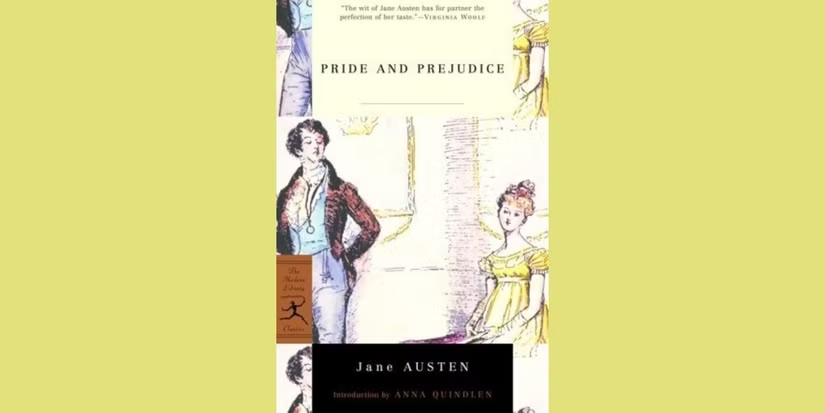
For a bookworm, there’s nothing quite like a truly great book that gets great right as things kick off. Some of the greatest pieces of literature take a while to really get going, but throughout history, ten particular masterpieces have shown that it’s possible to offer a first ten pages that make it abundantly clear that what one is about to read is an absolute masterpiece.
Whether it’s a foundational classic like Jane Austen‘s Pride and Prejudice or a modern piece of speculative fiction like The Name of the Wind, these are the sorts of books that I knew for a fact would be masterpieces from the moment I hit page 10. Unsurprisingly, I wasn’t wrong. These should all be considered essential reading for anyone and everyone who loves genuinely great literature, novels that show just how close books can really come to perfection.
‘Pride and Prejudice’ (1813)

Jane Austen was one of the most important and massively influential authors in the history of English-language literature, a complete master of her craft credited with helping invent the modern realistic novel. She did that with timeless masterpieces of the caliber of Pride and Prejudice, perhaps the single most legendary romance novel in history. It completely redefined the romance genre and the “enemies to lovers” trope, serving as one of the most influential books in the history of the English language.
It’s one of those romance books that are perfect from the first page to the last, and you can tell just how great it’s going to be from just reading its opening 10 pages. What follows one of the most legendary opening lines in all of 19th-century literature is equally perfect in every way, full of masterful dialogue, biting satire, and perfect worldbuilding that makes it clear right off the bat that this is a reality that runs on reputation, not romantic love.
‘Beloved’ (1987)

Winner of the Pulitzer Prize for Fiction and generally regarded as one of the greatest and most important pieces of American fiction of the 20th century, Toni Morrison‘s Beloved is Southern Gothic literature at its very best. One of the best Gothic book masterpieces ever, it fundamentally reshaped how the legacy of slavery in the United States was discussed in literature going forward. Even aside from its Pulitzer victory, the novel’s cultural and artistic impact cannot be overstated.
In that same vein, Morrison is wise enough to not open with the first 10 pages that feel didactic or “educational” in the slightest. Instead of explaining slavery’s legacy after the American Civil War, this wonder of magical realism literature immediately immerses the reader in the physical, emotional, and psychological reality of slavery’s almost supernaturally haunting aftermath. Morrison’s prose in this opening flows like a deeply recollection of memories, and that’s why it packs such a punch.
‘The Secret History’ (1992)

Far more than just the greatest and most important campus novel in the genre’s history, Donna Tartt‘s The Secret History is perhaps one of the greatest books of the 1990s as a whole, a real page-turner from cover to cover. It almost single-handedly created the dark academia aesthetic, offering a completely different kind of detective story whose idiosyncratic uniqueness has allowed it to age like fine wine.
Incredibly well-paced and wonderfully written in every way, The Secret History shows off its creativity right off the bat by functioning as an inverted detective mystery. In the first 10 pages, you find out who was murdered. Though that would be a disastrous way to open any other kind of murder mystery, Tartt leverages the premise to shift the mystery from the question of who committed the murder to the question of why and how they committed it. Thanks to its first 10 pages, The Secret History feels less like a whodunnit and more like some kind of whydunnit.
‘The Name of the Wind’ (2007)

Even though Patrick Rothfuss has kept fans waiting a whopping 15 years by this point for the third installment in his exceptional Kingkiller Chronicle series, the first installment, The Name of the Wind, is undeniably one of the greatest fantasy novels of the last two decades. It’s one of those fantasy books you know will be a masterpiece from the first 10 pages, a riveting character study with some of the strongest world-building the genre has seen in years.
Rothfuss’ prose is beautifully poetic and rhythmic, and you get a feel for how it elevates the story of Kvothe right from the first few pages of the book. Rothfuss is concerned about establishing tone and atmosphere well before he even delves into exposition, allowing the first 10 pages of The Name of the Wind to quietly build toward the mystery of its fascinating protagonist. Rothfuss opens the book by spending a surprising amount of time describing silence, and there could be no better encapsulation of what makes this book so uniquely memorable.
‘The Hobbit’ (1937)

J. R. R. Tolkien‘s The Lord of the Rings is generally recognized as the greatest and most influential fantasy book of the entire 20th century, and for good reason. But all of history’s best book series gems have to start somewhere, and in the case of Tolkien’s Middle-earth, that was the children’s novel The Hobbit. One fateful day, Tolkien thought of the words “In a hole in the ground there lived a hobbit.” From that flash of inspiration came one of the most groundbreaking children’s books in history.
The Hobbit is one of those fantasy books whose every chapter is a masterpiece. The first 10 pages of “An Unexpected Party,” one of the most iconic opening chapters in the history of speculative fiction, are certainly no exception. Tolkien builds an instant sense of curiosity about the ins-and-outs of this enrapturing magical world while also perfectly establishing what makes hobbits like Bilbo Baggins tick. It’s charming, kid-friendly worldbuilding without any fluff or unnecessary lore dumps, the perfect way to kick off one of the most wonderful fantasy books ever written for younger readers.
‘The Stranger’ (1942)

At the age of 44 in 1957, French philosopher, writer, and political activist Albert Camus became the second-youngest recipient of the Nobel Prize in Literature in history. Some call him one of the most important existentialists ever, though he himself firmly rejected the label. The fact of the matter is that he wrote some incredible books and plays throughout his life, including the masterful The Stranger, which is one of the best novellas of all time.
One of the greatest, most irresistibly fascinating and gripping ways of opening a book that the world has ever seen.
“Mother died today. Or maybe yesterday, I don’t know.” One of the greatest, most irresistibly fascinating and gripping ways of opening a book that the world has ever seen. The novella’s first 10 pages instantly and perfectly establish the core philosophical concept that drove pretty much all of Camus’ work: the Absurd, the theory that the universe is irrational and meaningless by nature. We’re probably talking about some of the most stylistically bold and philosophically charged opening 10 pages in the history of literature.
‘The Picture of Dorian Gray’ (1890)

Seeing as he was one of the leading voices of the late Victorian era, saying that Oscar Wilde was one of the most important and influential authors of the 19th century would be an understatement. What’s his magnum opus? Most people would point to his best-known work, the only novel Wilde ever wrote: the Gothic masterpiece The Picture of Dorian Gray. It’s philosophical fiction at its most timeless and fascinating, and even though it was controversial upon release, it has only gotten better and more interesting with age.
Dorian Gray is one of the most perfect horror book masterpieces in history, even though it wouldn’t be until around the 1980s that it would start being pushed into the Gothic mainstream. For one, the book’s first ten pages include some of the most stunning use of language that English literature saw at any point during the Victorian era. The novel’s whole philosophical, thematic, and aesthetic framework is flawlessly established in just these first few pages, instantly captivating the reader with wit, high sensorial descriptiveness, deep character work, and masterful foreshadowing.
‘1984’ (1949)

By this point, George Orwell‘s 1984 and its cautionary messages against totalitarianism, mass surveillance, and the destruction of objective truth have become so well-known that it may be easy to forget just how important, timely, and eternally relevant that messaging is. Indeed, the only reason why 1984, one of the most intense books of all time, became so iconic in the first place is that it completely revolutionized dystopian literature.
The first 10 pages of 1984 instantly hook the reader with worldbuilding that doesn’t take any longer to feel irreparably oppressive and anxiety-inducing. Disorienting, immersive, creatively written, and incredibly potent in how they set the stakes sky-high early on, the first few pages of 1984 should be able to capture anyone’s attention. By the time you hit page 10, the world established by Orwell already feels remarkably well-rounded, and it’s hard to put the book down after that.
‘One Hundred Years of Solitude’ (1967)

Gabriel García Márquez‘s One Hundred Years of Solitude is arguably the most important and colossally influential piece of Spanish-language literature of the 20th century, a work whose mastery of magical realism elements has ensured that it remains one of the most timeless books the genre has ever seen. No matter where they’re from, what languages they speak, or what they typically like to read, everyone should consider this classic a must-read.
From reading One Hundred Years of Solitude‘s first pages, you can know beyond a shadow of a doubt that you’re in for one of the best magical realism books of all time. The 10 pages that follow one of the greatest opening lines ever written for any novel are all equally perfect, with prose that keeps expanding and a world that seems to keep growing more creatively elastic and powerfully surrealistic. It’s impossible to start One Hundred Years of Solitude and not want to finish reading it as soon as humanly possible.
‘Blood Meridian’ (1985)

Few American authors have ever been better or more important than Cormac McCarthy, who—among many other things—wrote one of the best Western books of all time. Indeed, the epic anti-Western Blood Meridian is nowadays widely regarded as McCarthy’s magnum opus, even though critical reception was lukewarm upon its publication. The debate on what The Great American Novel could be is a never-ending one, but many tend to propose that it’s probably Blood Meridian.
But setting those superlatives aside, there’s no denying that the book’s first 10 pages are about as close as literature can come to true flawlessness. We’re talking about an introductory 10 pages that feel quasi-Biblical, perfectly establishing the enrapturing tone and narrative philosophy. Before the plot actually kicks in, McCarthy encapsulates the trajectory of his protagonist’s life in a fascinating microcosm that makes it immediately clear that what we’re reading is one of the English language’s greatest classics.
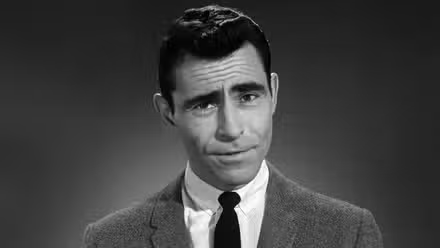
Certain pieces of popular culture are credited with changing the creative model altogether, and The Twilight Zone is among the rare shows that have withstood the test of time. Recently, the iconic sci-fi anthology series has been climbing the charts on the Apple TV store, proving that even 67 years after its premiere and in the streaming age, the series still captivates audiences. The Twilight Zone was an anthology series of horror, supernatural, and science fiction stories that presented bizarre concepts of warped reality. Created and hosted by Rod Serling, the series is responsible for coining many phrases and plot mechanics that have been adopted by filmmakers ever since. Although there are a number of modern masterpieces that can either directly or spiritually be linked to the influence of The Twilight Zone, the original series remains a must-watch for anyone who considers themselves to be a television buff.
The Twilight Zone was an anthology series in the truest form, but it differed from the other television programming at the time of its debut in 1959. Although it was common for there to be anthology shows that collected works of theater, comedy, or literary adaptation that had already been depicted in some form or another, The Twilight Zone was startlingly original and responded to the issues that were relevant to the audience who was engaged. With its allusions to hatred, isolation, mob mentality, xenophobia, and capitalist corruption, The Twilight Zone provoked timely ideas that asked audiences to think about the world in different ways.
‘The Twilight Zone’ Was a Gateway to Imagination
The genius of The Twilight Zone is that the show presented concepts that were extraordinary, but only slightly removed from reality. One example is the Season 1 episode “The Monsters Are Due on Maple Street,” which imagines a power outage that affects a small community, causing panic among the occupants who fear an extraterrestrial invasion. The degree to which the power is disrupted and the suggestion of an alien attack might feel like science fiction, but the portrait that the episode paints of the closely-knit community of a small town, and how it could easily crumble as the result of tension, was startlingly realistic. One of the best aspects of The Twilight Zone is how it forces discussion and debate. There was a conversation to be had at the end of each episode’s airing about how viewers would have reacted if they were in the same situation, and which characters they felt were morally in the right. The series was unique for the sci-fi genre because it often highlighted normal people caught in extraordinary circumstances, and did not center on the sort of superficial heroes that appear in the space opera serials of the ‘30s and ‘40s.
The Twilight Zone had the benefit of an expansive mythology that includes many types of stories, and the show kept audiences on their toes because there was nothing expected about what would happen the next week. Although there were some instances in which Serling seemed to have a more optimistic view of humanity, there are a number of notable twist endings that went in a darker direction in order to prove a point. The supernatural was a constant presence, but The Twilight Zone also dealt with contemporary sore spots, with many of the best episodes exploring the fallout of casualties of a potential nuclear war, which was seen as a real possibility at the height of the Cold War. There was also a platform for individual writers, directors, and actors to get a showcase thanks to the show’s format, which essentially allowed the creators to have a tremendous amount of creative freedom on each episode because they were standalone.
‘The Twilight Zone’ Has a Lasting Cultural Influence
The Twilight Zone became a brand that inspired several offshoots, analysis, expanded universe material, and three separate revivals, none of which ended up surpassing the original show in terms of quality. The Twilight Zone was brought to the big screen in 1985 with an anthology film that consisted of four different chapters helmed by successful filmmakers; there are some compelling stories within the film, but they are unfortunately overshadowed by the tragedy that took place on set. Perhaps the most outstanding legacy of the show is the Twilight Zone Tower of Terror attraction that is stationed at the Disney parks; although the edition at the California location was taken down in 2017, two other rides exist in Florida and Paris.
The Twilight Zone has had a tremendous impact on cinema, as there are many famous films that cite Serling as an inspiration. Richard Kelly’s 2009 science fiction thriller The Box was an expansion of the 1986 episode “Button, Button,” and the Oscar-nominated sci-fi sports film Real Steel was based on the 1963 episode “Steel.” There’s also a number of films that present themselves in the style of a classic The Twilight Zone premise, including everything from The Sixth Sense and Us to this year’s The End of Oak Street. The Twilight Zone has always had something to say about human nature and problem-solving that doesn’t require any historical context; even if the show is now a period piece, its imagination remains timeless.
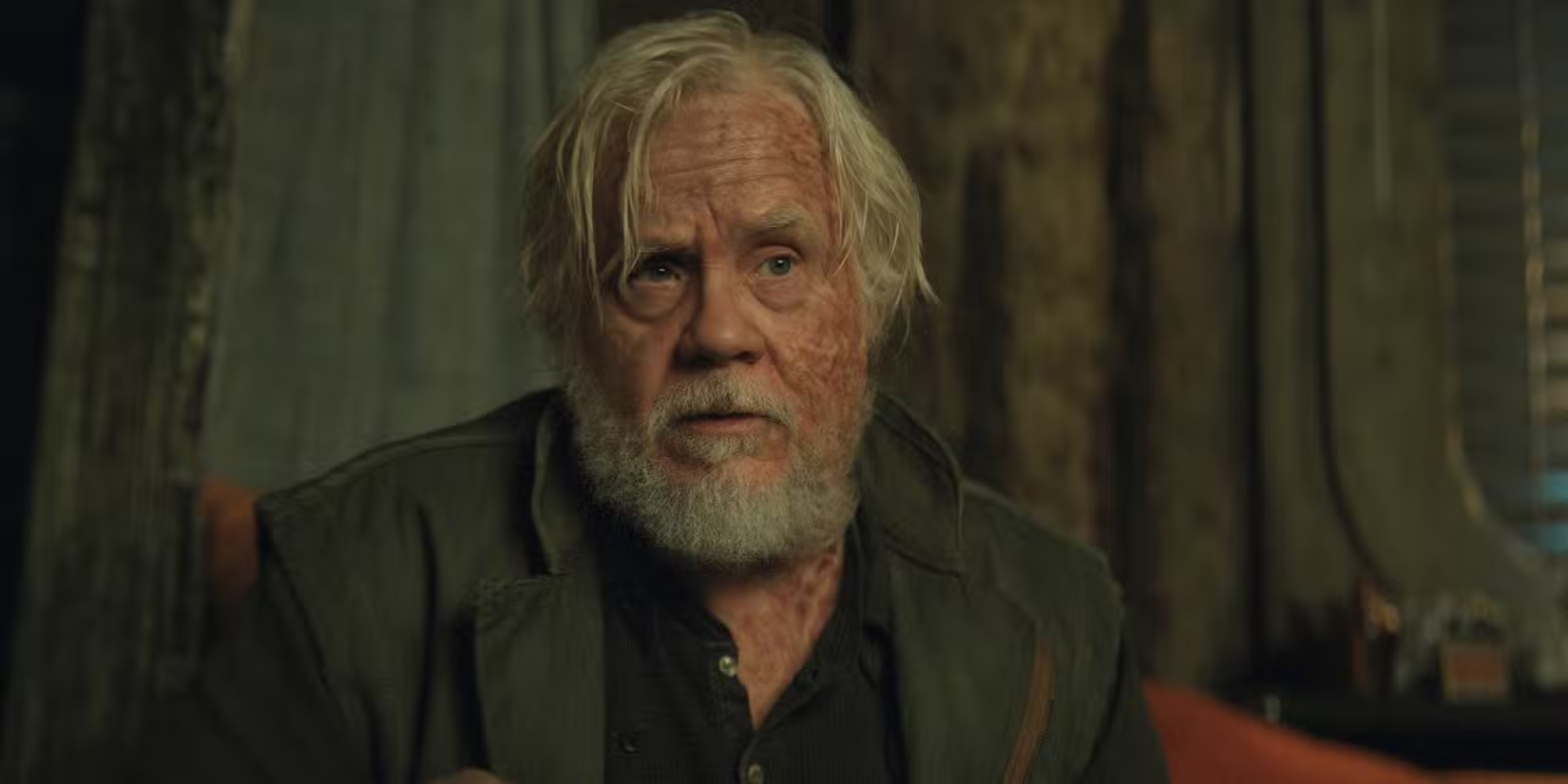
Silo Season 3 isn’t quite over yet, but Episode 9, “Farwell” crossed an important threshold for the series. The episode got the highest rating on IMDb in the series’ history, with a near-perfect 9.3 out of 10 score. That’s the best Silo has seen in years, surpassing the previous record of 9.0 for Season 1, Episode 10. It’s a great sign for the series ahead of the Season 3 finale and the final season coming next year. It’s also an indication that most fans are enjoying this season despite its deviations from the original books by Hugh Howey, and the rapid changes to the scope of the story.
Silo Season 3 has thrown a lot at viewers — a split timeline, revelations about the nature of this apocalyptic future, and ramped-up use of sci-fi concepts like nanobots and memory drugs. All that would have been the case even if the show had stuck with the story in Howey’s novels, but that wasn’t the plan. Instead, Season 3 has twisted and revised Howey’s work more than ever, meaning even those who read ahead were in the dark on several occasions. Through all of that, Season 3 seems to be keeping fans hooked and even winning back some who had begun to doubt the show. That’s very good news as we head into the Season 3 finale, then a final season that is sure to be the most jaw-dropping installment we’ve seen yet.
‘Silo’ Season 3 Has Not Played it Safe

When it comes to science fiction book adaptations, it’s easy to sit back and say they should simply translate every line of the novels onto the screen without changes. It would avoid the most common complaints against these shows, and would give the producers a great counter-argument to any criticisms. However, these productions are rarely 100% faithful to the source material for one reason or another, and Silo has embraced change from the start. By approaching change gradually throughout the story, Silo has built something that feels distinct from the book. Changes feel intentional, not dictated by the limitations of TV budgets or writers’ whims.
That approach is paying off now, as Season 3 has changed the story more than either of the previous installments. Some changes are easy to understand at a glance — the show has a more cinematic pace than the books, with more consideration for cliffhangers and tension. However, when it comes to changes like keeping Bernard (Tim Robbins) alive or giving Juliette (Rebecca Ferguson) amnesia, the trust between the audience and the writers is critical.
It’s encouraging to see a show where the long-term plan has prevailed without pivoting halfway through. Silo Season 2 wasn’t quite as popular as Season 1, and some commenters online even questioned whether the show had strayed too far. That’s reflected in the IMDb ratings that inspired this article — while most episodes of Season 1 were rated an 8 or higher and none were rated below 7.3, most episodes of Season 2 were rated under an 8. The lowest, Season 2 Episode 8, was rated 6.9 out of 10, and the season average dropped by a full half point.
Season 3 has slowly built that score back up by paying off some of the biggest mysteries in the story. It makes the slow-burn approach feel worth it, and in the process reminds viewers why they love a real-time TV event. It all culminated this weekend in a 9.3 out of 10 episode.
‘Silo’ Will Hit the Ground Running in Season 4

It’s safe to assume that the Silo team has saved some of its most climactic moments for the season finale, but the story doesn’t stop there. The series has already filmed its fourth and final season, which is expected to premiere next year on Apple TV. This is a huge advantage in an era when a two-year wait between seasons is becoming the norm. It means all the excitement of Season 3 will still be fresh in our minds when the series returns.
For that to work, this season will need to end on a major high note, and things are looking good in that department. That’s all thanks to the cast and crew of Silo taking risks with this story. Another adaptation might have played it safe by simplifying the weird technology involved in the apocalypse, or the drugs used to induce amnesia. Some might even have tried to keep the story contained underground where it’s more familiar to viewers, but this crew knew when it was worth opening the hatch.
Silo Season 3 concludes on Friday, September 4 on Apple TV. Season 4 will premiere next year. Howey’s novels are available now in print, digital, and audiobook formats.

- Release Date
-
May 5, 2023
- Network
-
Apple TV
- Showrunner
-
Graham Yost
- Directors
-
Morten Tyldum, David Semel, Michael Dinner, Aric Avelino
- Writers
-
Graham Yost, Hugh Howey, Jeffery Wang, Lekethia Dalcoe
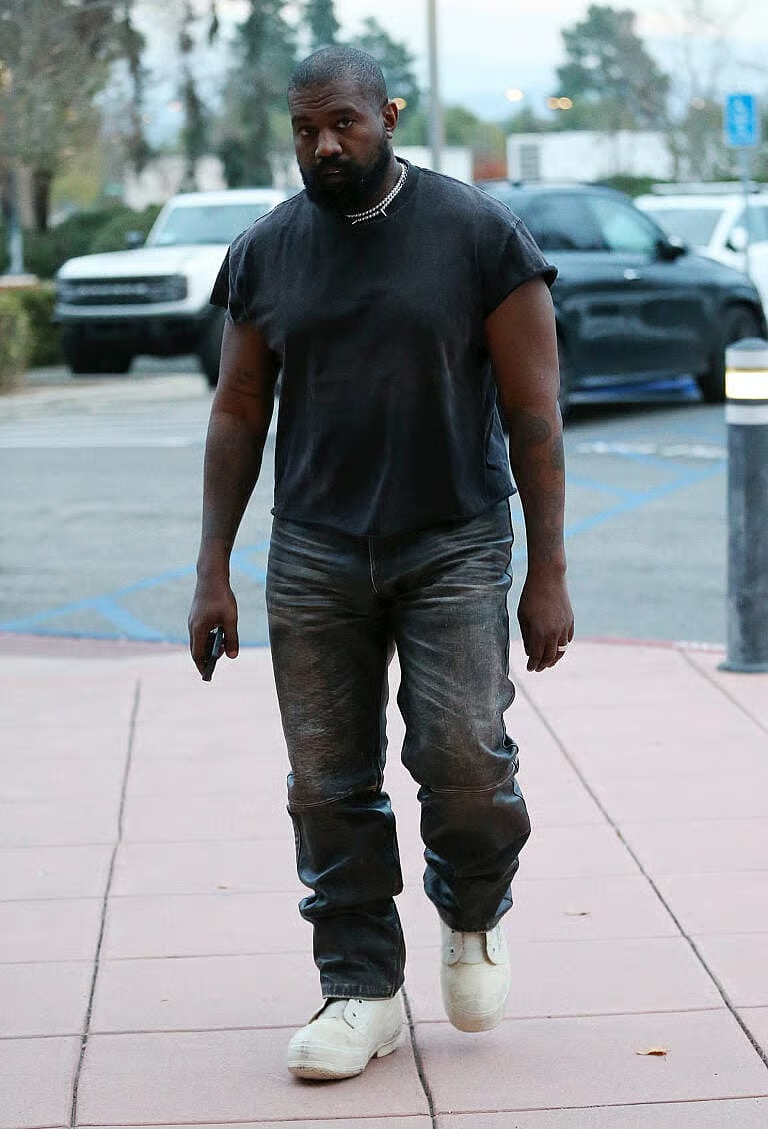
Kanye West’s long-running legal battle with former Donda Academy Employee Benjamin Provo is heating up ahead of trial. Provo is asking the court to stop the rapper from relying on an “Unsound mind” argument when the case reaches a jury.
The former staffer is reportedly turning West’s own words against him. He’s pointing to the rapper’s own deposition testimony where he said he was “close to me being myself” during the period at the center of the lawsuit.
Provo’s legal team argues that the remark undercuts any attempt to suggest that the rapper was not of sound mind at the time.

Per TMZ, which obtained the new court filing, Provo is making an attempt to block West from using an argument regarding his mental state at the trial.
The former security employee claims the rapper failed to produce evidence during the discovery process that would support such a defense.
Provo reportedly argues that West did not provide medical records, expert testimony, or other evidence to establish that he truly was of “Unsound mind” during the period in question. His legal team believes that should prevent the rapper from using the argument once the case reaches a jury.
No ruling has been made on the request at this time.
Kanye West’s Own Deposition Testimony Could Complicate That Defense

Beyond the alleged lack of medical evidence, Provo is also pointing to West’s own sworn testimony as another reason the mental state argument should be kept out.
During his deposition, the rapper was reportedly asked whether he felt he was “not yourself” during the period in question. “No. I think that was close to me being myself,” West allegedly replied. The rapper also reportedly remarked, “Sometimes I intend to do good and still end up in deposition.”
Provo’s legal team is now citing those comments as evidence that West’s own description of his mental state is in direct conflict with any attempt to argue the opposite. Whether the court agrees with that interpretation of events remains to be seen.
This New Motion Comes Just Before Their October Trial

The latest filing comes as West and Provo prepare to take their years-long legal dispute to trial in October. As The Blast previously reported, Provo sued the rapper back in 2024 after working as a security employee for Donda Academy and other properties connected to West.
In his original lawsuit, Provo accused West of discriminating against Black employees and alleged that they were treated differently from their white counterparts. He also claimed that West demanded he cut off his dreadlocks, and later proceeded to fire him after he refused the order.
So far, West has denied any wrongdoing in the case. The new filing does not introduce another allegation against the rapper, but rather focuses on what West will be allowed to argue in his defense once the case reaches a jury.
Kanye West Wants His Controversial Social Media Posts Excluded from Trial

West is making his own effort to limit some of the material that could eventually be presented to the jury. According to a separate TMZ report, the rapper’s legal team has asked the court to prevent Provo from introducing a large collection of West’s controversial posts on social media at the trial.
The rapper’s attorneys reportedly argue that the posts could unfairly influence the jury against West and are not relevant to the former employee’s specific claims. Provo, on the other hand, wants to introduce some of the material as evidence to support his case further.
This gives the judge another major issue to settle before the October trial. The court will have to determine the relevance of the posts, weighed against their potential to create any prejudice on the part of the jury.
Bianca Censori Could Potentially Be Called As A Witness
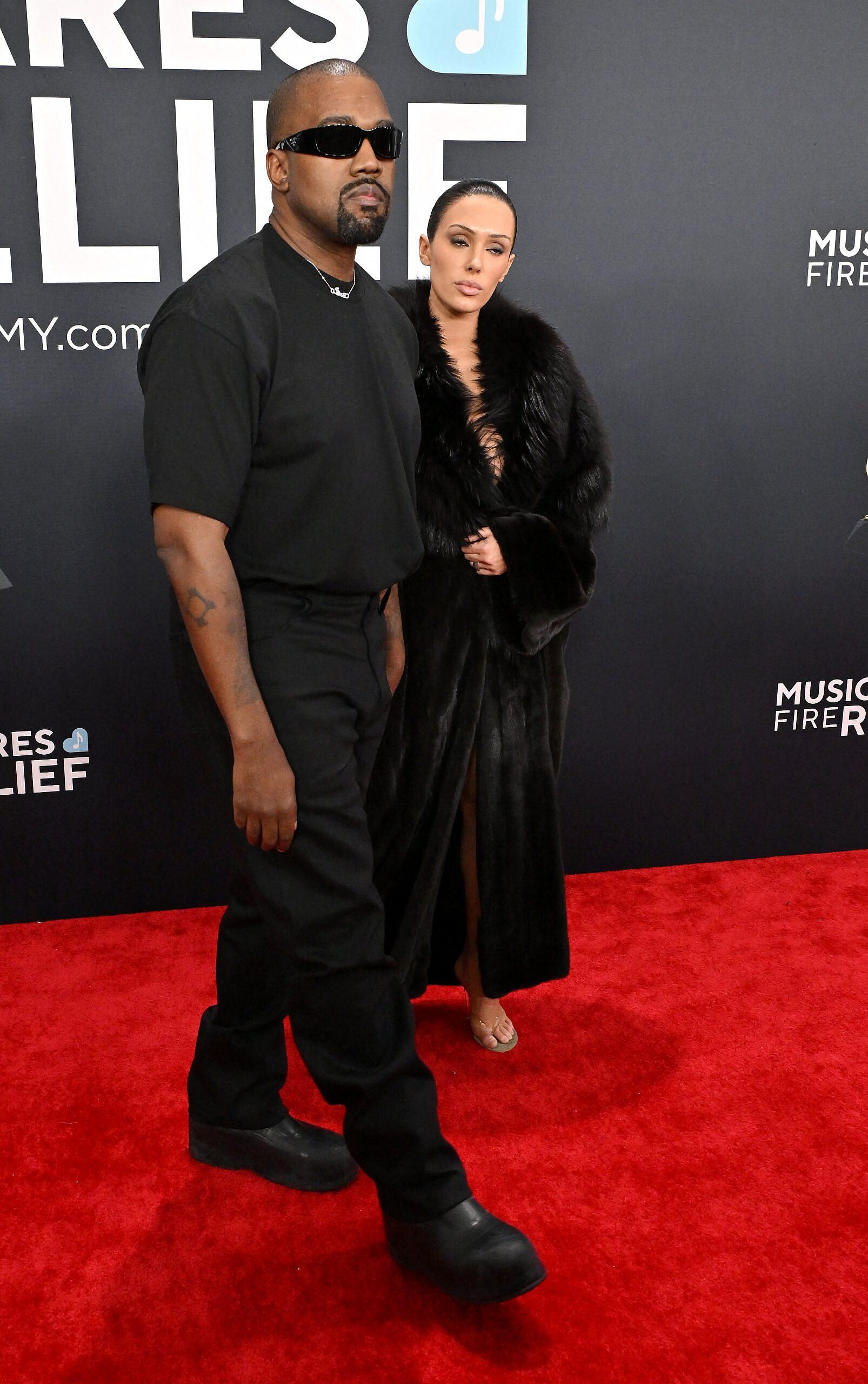
Kanye West’s wife, Bianca Censori, could also be drawn into the courtroom drama when the trial begins in October. She was previously reported to be among 22 potential witnesses who may be called in connection with the case.
She has been closely connected to the rapper’s business world in addition to their marriage, making her knowledge potentially relevant to certain parts of the dispute. West himself and Former Yeezy chief of staff Milo Yiannopoulos is also reportedly among the potential witnesses identified.
However, despite being listed as potential witnesses, there’s no guarantee that any of them would actually be called to testify.

Director Kenneth Lonergan is defending Mark Ruffalo after the actor was accused of being antisemitic.
“Mark Ruffalo has been talking about Israel since long before the Gaza war,” Lonergan, 63, wrote in a letter to The Hollywood Reporter published on Monday, August 31. “Apart from some routine social media ping-ponging, nobody serious I know of had accused him of antisemitism. Now Paramount has done just that, in the face of his sustained attacks on David Ellison and the upcoming Paramount merger.”
On Friday, August 21, Ruffalo, 58, took to Instagram to criticize the proposed Paramount-Warner Bros. Discovery merger while tying billionaire Larry Ellison — father of Paramount CEO David Ellison — and Oracle to Israel’s military actions in Gaza. In his post, he shared a recent clip of Safra Catz, Oracle’s executive vice chair and a Paramount board member, speaking about “profoundly scary technologies” Oracle shared with the Israeli government following the October 7 terror attacks in 2023. (Over 70,000 Palestinians have been killed since Israel launched military operations in the region, according to Gaza’s Health Ministry, including more than 20,000 children.)
Paramount Skydance responded to Ruffalo’s public criticism with a statement the corporation later denounced as antisemitic.

John Cusack is standing in solidarity with Mark Ruffalo after the actor addressed claims he’s antisemitic. “Solidarity — well said,” Cusack, 60, wrote via X on Saturday, August 22, quote-tweeting Ruffalo’s recent statement after coming out in fierce opposition to Paramount Skydance’s executives’ ties to the Israeli government. “The accusation that I am antisemitic is […]
“We are, as always, troubled when antisemitic tropes are invoked in purported service of a business dispute,” a Paramount spokesperson said in a statement on Friday. “Words like ‘genocide’ and ‘apartheid,’ applied to a corporate transaction, aren’t just wrong — they’re a bridge too far, and they cheapen the very real suffering those words are meant to describe. This doesn’t deserve a response in kind — and to be clear, we don’t tolerate prejudice of any kind, against anyone.”
In his letter defending Ruffalo, Lonergan continued, “While I hope I share Mark’s basic humanitarianism, and likewise deplore the conduct of the war as I understand it, I disagree profoundly with many of his positions on the Middle Israel, Gaza, and Iran’s constellation of fanatical Islamic fundamentalist proxies. I think we share an equally dim view of fanatical Messianic Zionist fundamentalism.”
Lonergan, who worked with Ruffalo on the 2000 drama You Can Count on Me, added that he and the Marvel actor have been friends for 30 years.
“The notion that he is antisemitic is overtly preposterous, and the accusation itself a cynical and disgusting lie. I wish the Simon Wiesenthal Center, at least, would review his remarks and their own response, and clarify where exactly they detect any antisemitism,” he noted. “A similar indictment of Mark for his latest social media screed — a screed, mind you, as it was characterized this week by K.J. Yossman of Variety — comes from Ari Infel and the Creative Community for Peace. It is likewise evidence-free, scurrilous and shameful. Shame on its authors and signers — especially those few signatures who know Mark, have worked closely with him and know better.”

Listen up, fellas! Mark Ruffalo, Ryan Gosling and more of Hollywood’s leading men have staunchly supported their female colleagues and utilized their platforms to speak out in celebration of feminism and gender equality. Thank You! You have successfully subscribed. Subscribe to newsletters Enter your email Please enter a valid email. Subscribe By signing up, I […]
Lonergan concluded, “I have no problem with anybody who wants to contest Mark’s – or anyone’s – ideas. But like all such deflections, the tissue-paper accusations levied at him by his targets lead directly back to the soft places in their own positions, which they can’t or won’t defend by actually addressing what he has to say. It’s an old trick, and a sorry one.”
Ruffalo previously defended his remarks in an X post on Saturday, August 22.
“The accusation that I am antisemitic is appalling and fundamentally dishonest,” the 13 Going on 30 actor wrote. “Criticizing the actions of the Israeli prime minister, a military technology contract, or the executives who supply it is not the same as criticizing Jewish people. This critical and necessary dialogue is then dishonestly framed as being anti-Israel.”
He continued, “To be clear, my views come from my own political convictions and should never be interpreted as hostility toward Jewish people, for whom I have deep love and respect. Everything I know about acting, activism, and humanism has been profoundly shaped by the Jewish friends, colleagues, and loved ones who have been integral and family throughout every point of my life.”

Pastor John-Paul Miller found himself at the center of a headline-making cyberstalking case after his estranged wife, Mica Miller, died by suicide in April 2024.
As Netflix’s August 2026 docuseries Death of a Pastor’s Wife reintroduces viewers to the controversial faith leader and the disturbing details of the tragic case, many are asking one urgent question: Is John-Paul currently behind bars?
The short answer? No. Despite federal charges and a looming trial, John-Paul remains a free man — and Us has the full breakdown of where his case stands today.
Is John-Paul Miller in Jail?
John-Paul is not currently in jail. He was arrested in November 2024 and later indicted by a federal grand jury in December 2025 on charges of cyberstalking and making false statements to federal investigators. However, he was released after posting a $100,000 bond.

Secret Lives of Mormon Wives’ Mikayla Matthews shut down claims that she’s not supporting Taylor Frankie Paul and Jessi Draper. Matthews, 26, is “fed up” after seeing comments suggesting she isn’t standing by her costars Paul, 31, and Draper, 33, amid their respective healing journeys. On Thursday, May 6, Matthews clapped back at a fan […]
He has pleaded not guilty to all charges and continues to live in Myrtle Beach, South Carolina, where he preaches to a small congregation while awaiting his day in court.
What John-Paul Miller Is Accused of Doing to Mica Miller
Prosecutors allege that John-Paul cyberstalked his estranged wife from November 2022 until her death in April 2024. The allegations are extensive and, according to investigators, escalated over time.
Among the most serious claims are that John-Paul allegedly contacted Mica more than 50 times in a single day, placed tracking devices on her vehicles, interfered with her finances and daily activities and posted a nude photo of her online without her consent. Prosecutors also say he lied to federal investigators during the course of the probe.
John-Paul has offered his own explanation for monitoring Mica’s whereabouts. He has claimed he tracked her to “protect Mica from purchasing firearms” because of concerns about her mental health.
In the months before she died, Mica went to police at least four times to report she was being stalked. One month before her death, she told authorities she was “afraid for her life” after discovering a tracking device on her car.
What Happened to Mica Miller?
Mica was 30 years old when she was found dead at Lumber River State Park in North Carolina on April 27, 2024. Medical examiners officially ruled her death a suicide.
At the time of her death, Mica and John-Paul were in the middle of a contentious separation. She had filed for divorce in February 2024, but the divorce was never finalized. Speculation about the circumstances surrounding her death intensified when the extent of her earlier stalking reports came to light — and when investigators identified John-Paul as the person behind the harassment.

Netflix’s A Toxic Love Story has drawn fresh attention to the shocking scheme orchestrated by Ian Diaz, leaving many wondering where he is today. The documentary unpacks how the former deputy U.S. Marshal and his then-wife Angela Connell (formerly Angela Diaz) aimed to mastermind a web of deception to frame Diaz’s ex-girlfriend Michelle Hadley for […]
Before the case was reopened, John-Paul addressed his Solid Rock Church congregation about Mica’s death, calling it “self-induced.”
“Y’all knew that she wasn’t well mentally,” he said, according to the Netflix docuseries. “And that she needed her medicine that was hard to get to her…just keep our family in your prayers.”
In Death of a Pastor’s Wife, Mica’s siblings offered a portrait of a marriage marked by control. They claimed John-Paul had Mica involuntarily committed to mental health facilities multiple times during their relationship. Mica was diagnosed with bipolar disorder while engaged to John-Paul, and as her spouse, he was designated to oversee her care.
Her siblings alleged that her final hospitalization was involuntary and that John-Paul contacted a mental health facility and made false claims about her mental state to have her committed. According to the family, Mica later told police that during that final stay, John-Paul took her car, phone and laptop — both devices, they said, contained nude photos of her.
When Is John-Paul Miller’s Trial?
John-Paul’s trial has been rescheduled multiple times. Originally set for spring 2026, it was pushed several times before it was scheduled for October 2026. A court-ordered continuance filed in mid-August 2026 confirmed the latest delay.
“It was supposed to happen back in the spring. It got pushed in June, to August, and now it’s October,” Death of a Pastor’s Wife codirector Michael Gasparro told Netflix’s Tudum.
If convicted, John-Paul faces a maximum penalty of five years in prison for cyberstalking and two years in prison for making false statements to federal investigators. He could also be ordered to pay a fine of up to $250,000.
Mica’s brother, Nate Francis, told Netflix’s Tudum that he doesn’t believe the charges reflect the full scope of what his sister endured. “These charges only reflect a fraction of what he did to her,” he argued.

When Michaela Medek died after an alleged fatal fall in September 2025, it was initially believed that her death was an accident. However, her husband, Austen Medek, was arrested three months later in December 2025 for his alleged involvement in her killing. Austen’s arrest shocked many people following the case and has created a new […]
Where Is John-Paul Miller Now?
While he waits for trial, John-Paul is living a strikingly different life from the one he led before Mica’s death. The Solid Rock Church building in Myrtle Beach has been sold, but John-Paul has continued to serve as a pastor. Those interviewed in Death of a Pastor’s Wife said he now preaches to a congregation of about 15 to 20 people at pop-up gatherings around Myrtle Beach.
He has also remarried. In June 2025 — roughly one year after Mica’s death — John-Paul wed Suzie Skinner, who now leads the worship portion of his services. Skinner is his third wife. He was previously married to Alison Williams for 16 years before filing for divorce in 2016.
Suzie’s own history has drawn scrutiny in the Netflix docuseries. She was previously married to Chris Skinner, whom she met while working as his physical therapist after a car accident left him paralyzed from the neck down. The couple married in 2004 and welcomed twins in 2007.
Suzie and Chris met John-Paul when they moved to Myrtle Beach and began attending Solid Rock Church. In the docuseries, Chris’ sister, Tamara, claimed her brother had grown uncomfortable with the church in the months before his death.
“The last three or four months of his life, he started telling me he didn’t like that pastor and that he wanted to stop attending the church and to find a new church,” Tamara said. “But Suzie didn’t want to stop attending. She would go without him.”
Chris was found dead in a community pool in September 2021, and he died of asphyxiation due to drowning. Throughout Death of a Pastor’s Wife, Mica’s loved ones speculated that John-Paul and Suzie had been having an affair before Mica’s death.
For now, John-Paul remains free on bond, preaching to his small circle of followers and awaiting an October 2026 trial that has already been rescheduled more than once.
If you or someone you know is struggling or in crisis, help is available. Call or text 988 or chat at 988lifeline.org.
This story was compiled with the help of AI tools and edited by journalists.
The Pulitzer Prize for Fiction, one of the 23 annual prizes handed out by Columbia University in New York City, was one of the original Pulitzer Prizes. It was originally called the Pulitzer Prize for the Novel in 1917, and its name wouldn’t be changed until 1948. Since then, an American author has been rewarded every year for having written a piece of fiction so remarkable, so unforgettable, and so reflective of the high standards of American literature that they proved themselves worthy of such a prestigious honor.
In the 2020s, eight books have made their way to a Pulitzer Prize for Fiction, and they’re all absolutely remarkable works that deserved every last bit of that love. They deal with a vast array of subjects and themes, covering all manner of tones and genres and written in all sorts of different styles. Indeed, reading the Pulitzer winners of the last six years is a perfect way of getting a feel for the remarkable contemporary state of American literature.
8
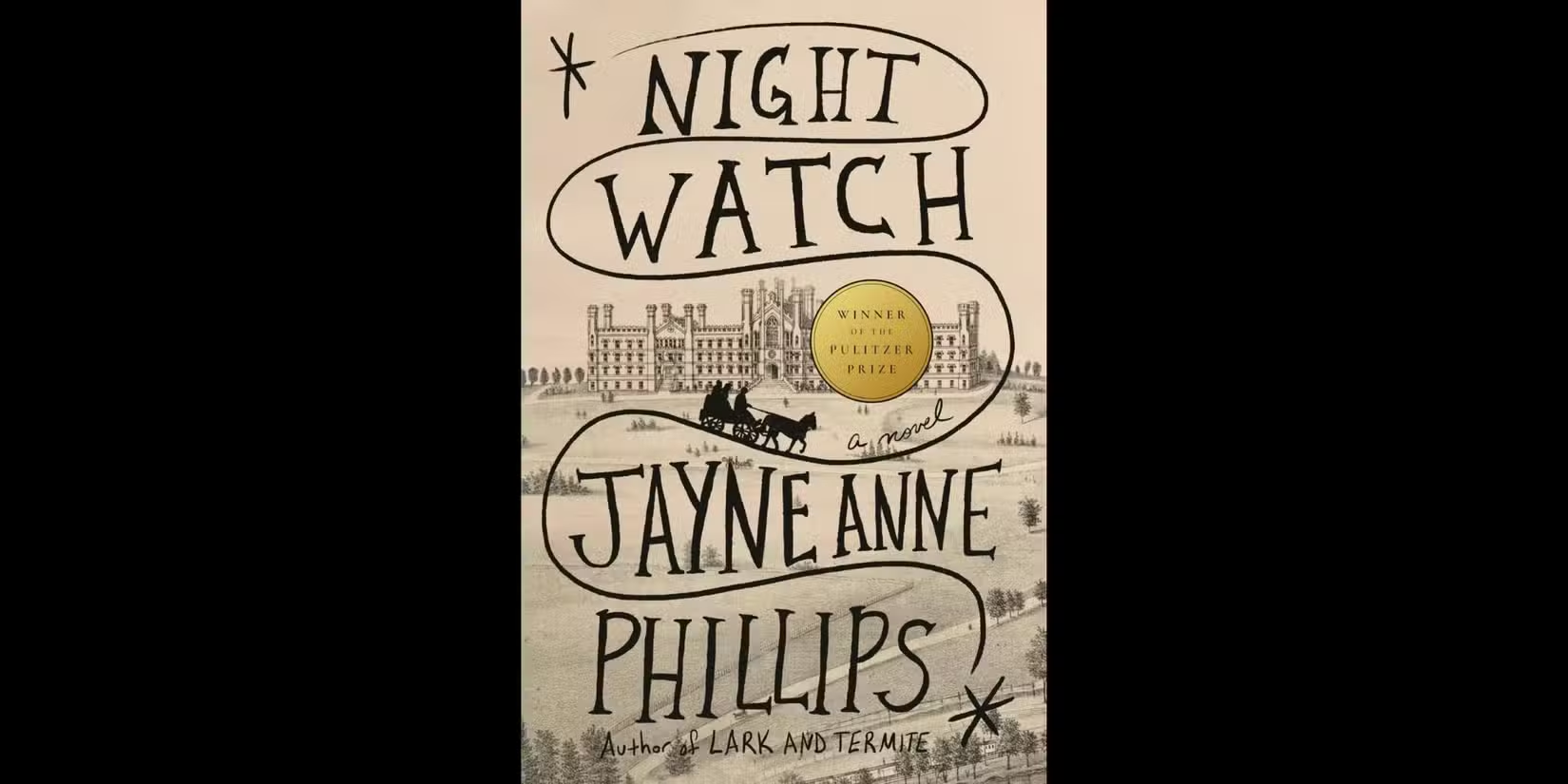
‘Night Watch’ (2023)

Winner of the 2024 Pulitzer, Jayne Anne Phillips‘ Night Watch is one of the most remarkable pieces of historical fiction to have come out of the American publishing space throughout the last decade. In it, a traumatized mother and her young daughter find refuge at a West Virginia asylum after the Civil War, discovering ways to restore their scarred identities. Phillips has said that she didn’t outline the plot in advance, and that the characters and their stories instead kept coming to her as naturally as if they had been real.
It was precisely that realism, as well as the harrowing way in which Phillips deals with such complex subject matter, that allowed Night Watch to become a Pulitzer recipient. Combining some beautifully lyrical prose with a level of historical, emotional, and thematic scope that only a Pulitzer-winning novel could have possibly hoped to contain, Night Watch may be a bit too dense and melodramatic to really stand out as one of the best Pulitzer winners of the 2020s, but it’s a must-read nonetheless.
7
‘The Netanyahus’ (2021)

The full title of Joshua Cohen‘s winner of the 2022 Pulitzer for Fiction is The Netanyahus: An Account of a Minor and Ultimately Even Negligible Episode in the History of a Very Famous Family, and it’s just as complex and layered a novel as that title would have you hope. The book is a fictionalized account of the encounter between American critic and Yale Sterling Professor of Humanities Harold Bloom, and Benzion Netanyahu and his family at an upstate New York college in the late ’50s. Needless to say, it’s daunting subject matter, which only makes it more remarkable that Cohen handled it well enough to earn a Pulitzer.
Is The Netanyahus one of the best American book masterpieces of the 21st century? Perhaps not, seeing as some critics have pointed to its structure as odd and to Cohen’s prose as somewhat pretentious. What, then, earned it a Pulitzer? Perhaps it’s the exceptional balance between sharp humor, well-researched history, and powerful drama. Perhaps it’s the ways it blends genres more consistently and intelligently than most 21st-century American books. Perhaps it’s the way Cohen confronts two competing visions of Jewish identity in a post-Holocaust society. Either way, The Netanyahus is a fascinating read.
6
‘Trust’ (2022)

There has only ever been one tie in the history of the Pulitzer Prize for Fiction, and that was 2023. However, saying that Argentine-American author Hernan Diaz‘s Trust is the lesser of that year’s two winners barely means anything at all, because it’s still one of the most acclaimed American books of the decade so far. The story centers on a powerful Wall Street tycoon and his wife in New York City in the ’20s, as he’s accused of having caused the 1929 stock market crash after he makes a fortune from it.
Composed of four fragmented texts that at times contain mutually conflicting information, leaving it up to the viewer to determine the truth (and wonder who controls it), Trust is narratively, formally, and thematically genius. Its delectably meta novel-within-a-novel format allows Diaz to deconstruct the very nature of truth and interrogate the way personal myths are manufactured, while also serving as a potent critique of greed and a powerful celebration of women who have been rendered invisible by history. The framing device inevitably sacrifices some character depth and narrative momentum, but it’s difficult to even notice when Diaz’s writing is so enrapturing.
5
‘Angel Down’ (2025)

Best known for his work in horror and pitch-black thrillers, Daniel Kraus has collaborated with creatives of the stature of George A. Romero and Guillermo del Toro, but Angel Down (whose Pulitzer was handed out last May) is his most ambitious creative endeavor to date. It’s one of the best historical fiction books of the decade so far, a World War I novel written as a single, unbroken sentence about a cynical draft dodger and con man who unexpectedly finds a fallen angel on the battlefield. It’s not exactly a horror novel, but then again, what’s scarier than a 300-page book that’s written in a single sentence?
That may sound like an incredibly daunting prospect, but that’s the entire point of Angel Down. Kraus wanted to find a way to explore the psychological horror and existential dread of World War I and its inescapable cycle of death, and the solution he came to was so inventive and effective that its Pulitzer victory seems entirely unsurprising in retrospect. Is it a relentlessly exhausting novel? Sure, but its grittiness, surreal tone, and genre-bending style are absolutely irresistible, offering a novel whose artistic and thematic depth American literature has very rarely seen throughout the last six years.
4
‘The Night Watchman’ (2020)

Louise Erdrich of the Turtle Mountain Band of Chippewa Indians of North Dakota is widely recognized as one of the leading voices of the second wave of the Native American Renaissance, which has been completely revolutionizing American fiction since the ’60s. She herself was a Pulitzer finalist back in 2009 for The Plague of Doves, but it was The Night Watchman that finally made her a Pulitzer winner in 2021. It’s about Thomas, a night watchman at a factory in North Dakota, leading his community’s fight against a 1953 US government bill seeking to take their land.
Deeply moving period piece written with such profound humanity that the stakes really do feel sky-high throughout.
The plot may at times feel a little overstuffed or overly slow, but Erdrich balances those issues out with a perfectly researched and deeply moving period piece written with such profound humanity that the stakes really do feel sky-high throughout. It’s an epic filled with hard-hitting political activism, righteous rage, and Erdrich’s love for her community and her roots, which is nothing if not infectious. Her writing is beautifully compassionate and complex, because while The Night Watchman certainly has moments of injustice, it’s the moments of joy and humor that end up sticking out the most.
3
‘Demon Copperhead’ (2022)

Along with Trust, it was Barbara Kingsolver‘s Demon Copperhead that went on to win the 2023 Pulitzer Prize for Fiction, and there’s a very strong argument to be made that it’s the stronger novel of the two. Inspired by Charles Dickens‘ David Copperfield, it’s a historical fiction coming-of-age set in the impoverished mountains of Southern Appalachia in the late ’90s and early 2000s, following a boy thrust into a system seemingly designed to make him invisible.
The result is nothing short of one of the best American books of the 21st century. Kingsolver’s voice may at times feel a little didactic when going into explanations of modern American socioeconomic issues, but that often only adds to the book’s unique sense of personality. The way the author translates the general spirit of David Copperfield to a tale about the opioid crisis and structural poverty in rural Appalachia is so brilliant that Demon Copperhead should be considered essential reading for pretty much anyone, regardless of whether they’re from the US or not.
2
‘James’ (2024)

It seems that the Pulitzer Prize Board went out of 2023 and into 2024 still with a love for novels based on old English-language classics on their mind, because the 2025 Pulitzer recipient was Percival Everett‘s James, a reimagining of Adventures of Huckleberry Finn by Mark Twain, one of the best American books of all time. The book is told from the perspective of Huck Finn’s companion and protector, the escaped former slave Jim.
For one, Everett proves that creativity can come from even the most unexpected of places, because even though James takes an already-existing text as its scaffolding, what it builds around it feels entirely unique and fresh in every sense imaginable. Subversive in its look at Antebellum America, unapologetically scathing in its satirical sense of humor, and razor-sharp in how it blends genres to bring a whole new dimension to a strong contender for the title of The Great American Novel, James will likely only get better as it ages.
1
‘The Nickel Boys’ (2019)

There’s really no question about it: Colson Whitehead‘s The Nickel Boys, recipient of the 2020 Pulitzer Prize for Fiction, is not only the best of the last eight winners of the award, but even a strong contender for the title of best American novel of the last decade. With Whitehead also having won the Pulitzer in 2017 for The Underground Railroad, Nickel Boys made him the fourth (and latest) author ever to win two Pulitzers for Fiction. Based on the hugely abusive Dozier reform school in Florida, the story follows a young Black teenager in Jim Crow-era Florida who is wrongfully sent to a reformatory similar to Dozier School.
Whitehead’s style and voice are absolutely devastating in how they unflinchingly explore and dissect this gut-wrenching subject matter, examining America’s long history of systemic racism with a surprisingly restrained yet powerful prose. It’s perfectly paced, absolutely masterful in its level of character and thematic depth, and potently rooted in real history that everyone should know about. It’s also structurally flawless, with a final twist that completely recontextualizes everything that came before. That would make a re-read irresistibly tempting if it didn’t sound like such a gut-punch of an idea.
Normally, when movie-licensed video games come out, they come off as a quick cash grab, usually meant to coincide with the release of the film. They’re not usually very good, though there are a few notable exceptions. Lately, however, there has been a bit of a trend in that horror games are coming out years or even decades after the release of the films upon which they were based. This gives the game more time to flourish, blossom, and establish itself as something actually enjoyable rather than a money-making device.
These horror games have come as marvellous homages to some of the greatest and most classic horror films, and pay respect to the long-established fans while also raking in newcomers. All in all, these games provide fans with a new way to experience their favourite franchises, in a whole new medium that is evolving more and more by the day.
10
‘World War Z’ (2019)
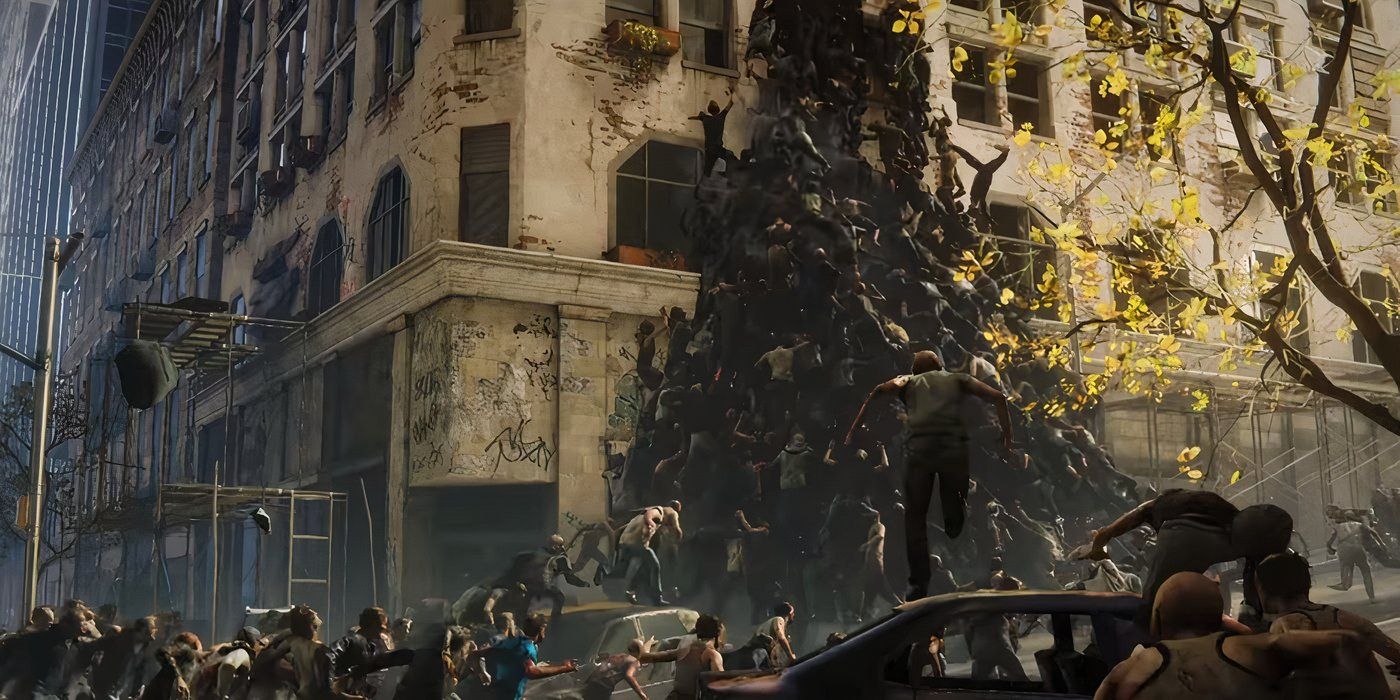
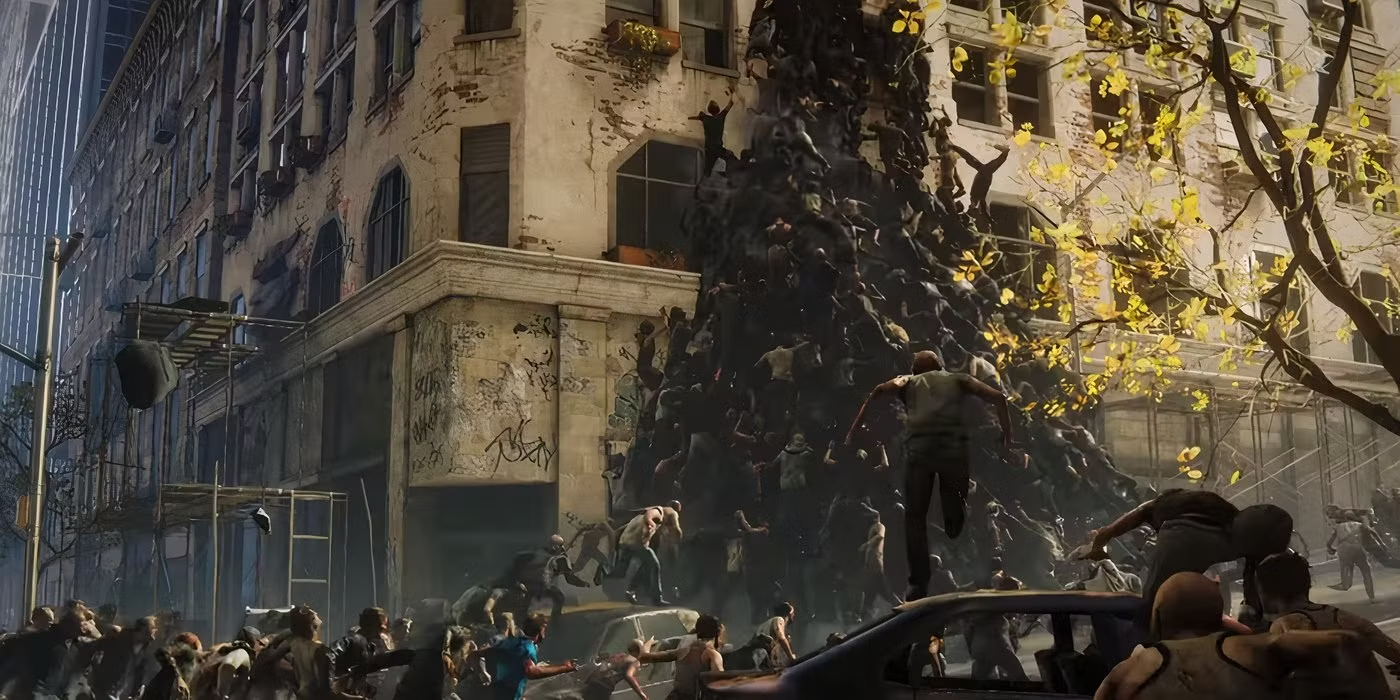
World War Z is actually based on the original novel, but takes place in the same universe as the film, so it still technically counts. In this zombie shooter, players are placed into a team of four who must work together to fend off the rising army of the undead in various locations around the globe. With eight different classes to choose from, each with their own distinct advantages and disadvantages, and five thrilling game modes, there’s never a dull moment in this co-op shoot ’em up.
The reason it isn’t the best is that it doesn’t really bring anything new to the table in terms of mechanics, and feels fairly similar to many other games that exist. But it’s still a really fun experience, one involving strategy as players must consider which classes their team should consist of based on the location, and which objectives they ought to complete first. If you’re a fan of zombie movies or games, this is one that is definitely worth playing.
9
‘Saw’ (2009)

Have you ever watched a Saw film and thought that it would probably be really fun to solve all the puzzles minus the risk of getting killed or seriously injured? Well, with the Saw video game, you can! The game stars a police detective who is thrown into a derelict asylum by the serial killer known as Jigsaw. This detective must then use their skills to navigate a series of deadly traps and puzzles in order to escape unharmed.
The game was actually really good, allowing players to pick and choose which specific routes to take, some of which led to different traps or obstacles, and even included a few combat aspects. But perhaps most importantly, it still had that morbid sense of creativity that comes with implementing the most brutal Saw traps imaginable, which will spell death if not solved properly or in the given time limit. This is a must-play for fans of the Saw franchise, and even earned itself a sequel, though it wasn’t as good.
8
‘Blair Witch’ (2019)

The Blair Witch game picks up two years after the events of The Blair Witch Project, with a small search party being sent out into the woods to find a missing person. Players assume the role of a traumatized military veteran named Ellis, accompanied by his loyal dog, Bullet, who can be customized as the players see fit. As with many who enter the woods, though, Ellis begins to experience some weird occurrences, with many paranormal events happening.
The game was received mostly well by fans, but was criticized for how its ending tends to drag on and on and on. Sure, it could have been a lot better, but overall, it is a wonderfully nostalgic and spooky experience for fans of the original film with many callbacks to the original, even if some elements of the game felt a bit underdeveloped.
7
‘Paranormal Activity: The Lost Soul’ (2017)

Paranormal Activity: The Lost Soul is an experience that is exclusively in VR, which kind of limits the pool of people who get to play it, because not everyone is going to be willing to dish out hundreds of dollars for a VR headset, never mind the fact that some players cannot tolerate it due to motion sickness. But if you do have a VR headset and are a fan of horror, this is one that you simply cannot miss.
Many reviews have claimed that this is by and large the most frightening game ever produced in the VR format, and was commended for how it lets players go at their own pace and explore the house as they see fit. The Paranormal Activity film franchise has seen a string of box office bombs, so this game could have breathed new life into the franchise had it been made to appeal to a broader demographic. But that’s about its only flaw—everything about the gameplay is absolutely stellar.
6
‘A Quiet Place: The Road Ahead’ (2024)

A Quiet Place: The Road Ahead just came out in October 2024, and is a single-player game set in the same terrifying world. As with the A Quiet Place trilogy of films, the villains are an alien species that hunt through sound, meaning any tiny noise could attract their attention. Players must be careful, utilizing stealth and keeping aware of their surroundings. It also comes with a really brilliant mechanic where, if the player so desires, the game can use a microphone to pick up surrounding noise, meaning the player must actually be careful of any noise they make in the real world, too.
So far, the game has received reviews that are good, but not great. Fans of the franchise are finding it a wonderful addition to the IP, and are praising it for how immersive it is. It’s the perfect game to play for fans of survival horror, and may even warrant a movie adaptation of its own one day due to how close it comes to the source material.
5
‘The Thing’ (2002)

The Thing is a third-person shooter at heart, but it’s unlike any typical shooter. Like the film, the game follows a group of people sent to Antarctica who come into contact with an alien life form that had previously been frozen in a research base, and has now been unleashed. Only this time, the player is a soldier and is fully capable of defending themselves against the alien threat. It sounds like a pretty standard ordeal on the surface, but don’t let that fool you.
See, the player encounters various NPCs throughout the journey, and can have these people join their squad. The player can order them around or have them perform specific duties based on what their job is. The catch is that the alien life forms may infect one of these NPCs without you knowing it, and they can abruptly turn on you without any warning. Players must constantly watch their back in this action-horror game, which gives it a similar feel to John Carpenter’s original film. There’s no telling who could be the wolf in sheep’s clothing, much like the film.
4
‘The Texas Chain Saw Massacre’ (2023)

The Texas Chainsaw Massacre is a multiplayer horror game based on the ’70s slasher series of the same name, in which two teams compete to finish their various objectives before the other. One team plays as victims, who must free themselves from the clutches of the villainous Leatherface and his family before finding an escape route. But this is very much easier said than done.
The other time is, of course, Leatherface and his family, who are tasked with hunting the town’s victims to feed their grandfather. If the grandfather isn’t fed in a specific amount of time, he will actually reveal the positions of the victims to the family. So the players who are victims can’t always rely on hiding. This game is tense and exciting, but sometimes lacks a bit of variation, as some things are in the same place every single time. But that’s okay because it’s still fun and is a faithful adaptation of the films.
3
‘Evil Dead: The Game’ (2022)
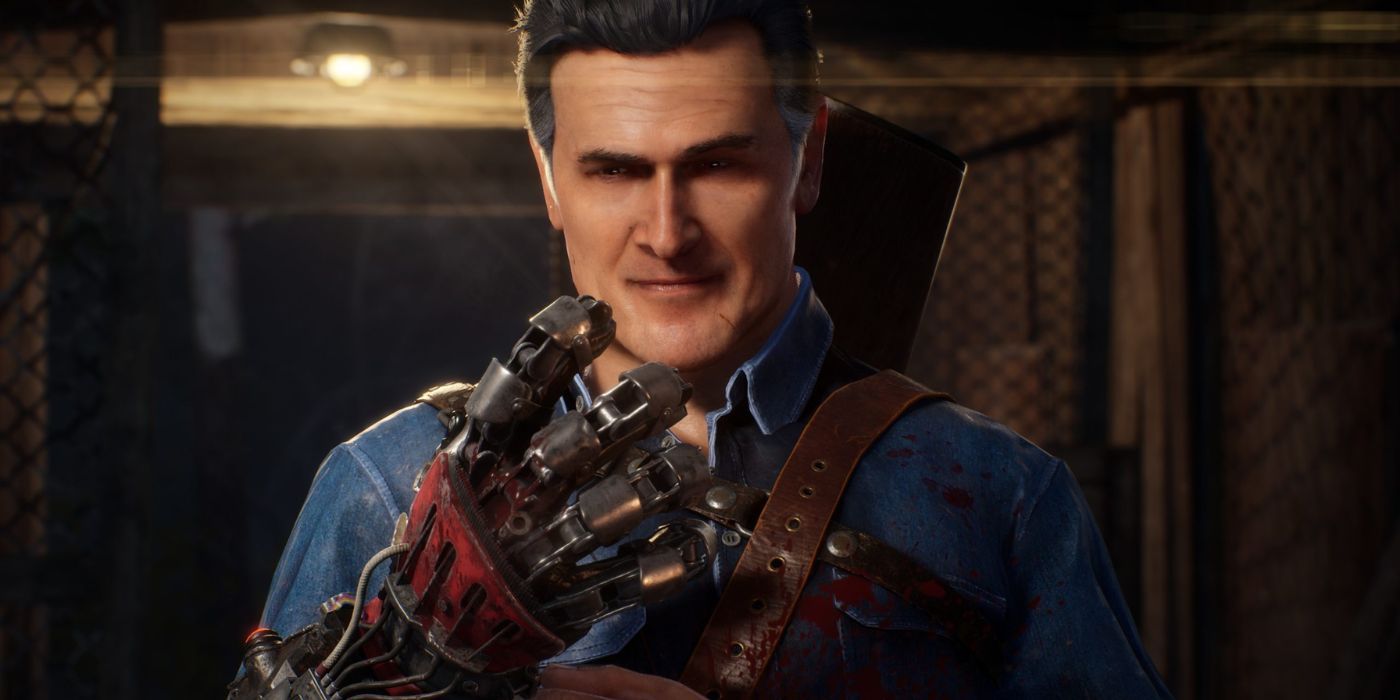
Evil Dead: The Game is a multiplayer experience in which teams of human survivors must perform a series of objectives to fight off the horde of the living dead and banish them back to Hell. Some of these survivors are established characters from Sam Raimi‘s Evil Dead franchise, while there are some fresh faces as well. The best part of this game is that it forces everyone to work as a team to get the job done, utilizing their own customizable weapons and skills to fend off the villains.
But the survivors are only one half of the game: the other half is that the opposing team can actually play as various forms of demons to combat the survivors, and must do everything in their power to avoid being sent back to Hell. The game is a nostalgic and insanely fun throwback to the original indie-horror film, coming with all of the guts, gore, and humour that made the original so great. It was lacking in a few aspects, but overall, it gets the job done.
2
‘Friday the 13th: The Game’ (2017)

Friday the 13th: The Game is a multiplayer-based horror game that offers a really unique and interesting experience unlike that of any other multiplayer game. In each game, players are thrown into the woods surrounding Camp Crystal Lake, and must collect various machine and engine parts distributed randomly across the map to fix up an old car and escape. But they are not alone. One player in each game assumes the role of the iconic slasher series’ antagonist, Jason Voorhees, and is tasked with killing each and every one of the players.
The players can do very little to fight back, so must focus on hiding and running away from the threat if they encounter it. It actually delivered a really fun Friday the 13th experience, with Jason being able to pull off some really gory and unconventional kills reminiscent of the films. And with different objectives and supplies being randomized with each game, it never gets boring and leaves players constantly on edge throughout the whole match.
1
‘Alien: Isolation’ (2014)

Alien: Isolation follows the adventures of Amanda Ripley, the daughter of the main protagonist of several Alien films, Ellen Ripley (Sigourney Weaver). While perusing space, Amanda and her ship crew stumble upon a distress beacon sent out from Sevastopol station, and go to investigate. Following in the footsteps of her mother, Amanda encounters the Xenomorph aboard the Sevastopol. This vicious alien species is the apex predator and is out for blood.
Things pick up a little slowly, but eventually, the alien reveals itself to the player. Once the alien is seen for the first time, the hunt is on, and it never lets up, not even for a second until the game ends. Alien: Isolation captured the essence of the original film so well, perfectly encapsulating the fear of the unknown and the dread of knowing that the thing is out there, waiting for you. It doesn’t rely heavily on jump scares, focusing instead on the oppressive weight of knowing that you are the prey in this situation. It is by far the best video game adaptation of a horror movie, and honestly deserves a movie of its own with how well it recreates the original film’s atmosphere.

Alien: Isolation
- Released
-
October 7, 2014
- ESRB
-
M for Mature: Blood, Strong Language, Violence
- Developer(s)
-
Creative Assembly
- Engine
-
Cathode
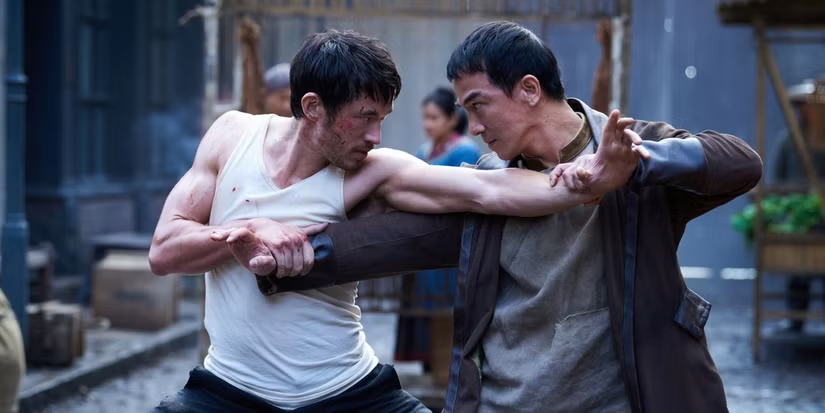
Martial arts television has come a long way from putting two skilled fighters in a room and letting the choreography do all the work. Obviously, great fights are still essential to the genre — if the movement looks too perfect, or the technique feels fake, the audience is going to notice immediately — however, modern martial arts shows also understand that a fight only lands when there is something behind it.
The genre has slowly evolved into focusing heavily on personal rivalries and philosophies long before anyone throws the first punch. That doesn’t mean older martial arts series suddenly feel outdated, though. If anything, the classics proved they could carry the genre long before modern shows started chasing bigger, faster fight scenes. The six shows on this list represent the best of both worlds and prove just how much martial arts television can do when the story is as strong as the action.
1
‘Warrior’ (2019–2023)

Warrior is a martial arts series that goes beyond great fight sequences and actually gives the audience a character to root for. The show, based on an original concept developed by Bruce Lee, drops viewers into San Francisco’s Chinatown during the Tong Wars of the late 1800s. The story follows skilled martial artist Ah Sahm (Andrew Koji), who arrives from China in search of his sister, Mai Ling (Dianne Doan). However, he gets recruited as a hatchet man for the Hop Wei tong and quickly finds himself stuck in the middle of a violent power struggle against the rival Long Zii.
Things become even messier once Ah Sahm discovers that Mai Ling isn’t exactly waiting to be rescued. In fact, she has built power of her own within Chinatown and is willing to play the same brutal political game as everyone else. The action in Warrior is obviously phenomenal, but Ah Sahm’s backstory adds weight to every kick. The build-up before a fight matters just as much as the speed and precision of the choreography. The series covers Chinatown politics, racism, immigration, labor conflict, and police corruption, which gives weight to the narrative. The audience knows that in this world, alliances can shift in seconds, and even the strongest fighter can end up on the wrong side of a brutal power play.
2
‘Bloodhounds’ (2023–2026)

Bloodhounds deserves way more recognition than it gets. The series builds its action around footwork and body shots instead of trying to show its characters utilizing superhuman techniques or flinging each other across rooms. This grounded approach to martial arts is one of the show’s greatest strengths, aside from its compelling narrative, of course. The story follows young boxers Kim Gun-woo (Woo Do-hwan) and Hong Woo-jin (Lee Sang-yi), who meet in the ring before becoming close friends. They soon find themselves entangled in Seoul’s criminal moneylending world after Gun-woo’s mother is targeted by a predatory loan operation run by Kim Myeong-gil (Park Sung-woong).
The friends eventually join forces with benevolent moneylender President Choi (Huh Joon-ho) to fight back, and that sets the stage for an epic saga about friendship and loyalty. The chemistry between Gun-woo and Woo-jin is honestly just as important as the central conflict. The two train, eat, and get beaten up together, but keep showing up for each other. Their bond gives the fights emotional stakes because the audience isn’t watching to simply see which side has the better technique. The series is a modern martial arts masterpiece because it respects the sport, but understands that the viewers need more than just that to keep tuning in.
3
‘Kung Fu’ (1972–1975)

Kung Fu is as old-school as it gets, but that’s what makes the show special. It aired long before martial arts became a regular part of Western action television, and has truly stood the test of time. The series follows David Carradine as Kwai Chang Caine, a half-Chinese, half-American Shaolin priest who flees China and travels through the Old West while searching for his half-brother, Danny (Tim McIntire). Most episodes place Caine in a new town where he encounters corruption, prejudice, or someone being exploited. Initially, he is always reluctant to fight, but when he decides that violence is unavoidable, his opponents have a tough time escaping him. Kung Fu unfolds with a restraint that modern martial arts have lost somewhere along the way.
Caine’s first instinct is rarely to prove that he is the toughest person in the room. The series keeps flashing back to his Shaolin training, where he learned patience and discipline alongside the actual fighting. Kung Fu actually drew many of its philosophical ideas from Taoist thought, including concepts associated with the Tao Te Ching. When a fight finally happens, it feels like the conclusion to a moral conflict rather than an action sequence inserted just for the heck of it. Of course, the choreography in the show is slower and more theatrical than what martial arts fans are used to today. However, that dated quality just adds to Kung Fu’s charm.
4
‘My Name’ (2021)

My Name wastes absolutely no time getting ugly and immediately hooks the audience in. The series follows Yoon Ji-woo (Han So-hee), whose life falls apart after her father is murdered right in front of her home. She then turns to Choi Mu-jin (Park Hee-soon), the powerful leader of the Dongcheon crime organization and one of her father’s closest associates, to seek revenge. Mu-jin takes Ji-woo in, trains her, and eventually places her inside the police force under a new identity so she can investigate her father’s death from the inside. That setup leads to Ji-woo hunting for a killer while constantly risking exposure as a mole living among the very detectives she is supposed to deceive.
The emotional stakes are high, but My Name hits hard because of how physical Ji-woo’s journey feels. The protagonist is not a naturally gifted prodigy who becomes unbeatable overnight. Her training is brutal, and her technique is messy, but that gives the action a rawness that perfectly suits the story. Ji-woo is constantly being pulled between Mu-jin, the police, and her own growing doubts about what really happened to her father. Her partnership with detective Jeon Pil-do (Ahn Bo-hyun) complicates things even further because the closer she gets to the truth, the harder it becomes to keep up her double life. My Name is fast-paced and intentional with every episode, which makes it the perfect martial arts series to binge in one night.
5
‘Cobra Kai’ (2018–2025)

Many initially thought that Cobra Kai was just trying to cash in on nostalgia, but that could not be further from the truth. The series serves as a sequel to Robert Mark Kamen’s three Karate Kid films and flips the perspective by following Johnny Lawrence (William Zabka), who is now completely broke and still carrying the humiliation of losing to Daniel LaRusso (Ralph Macchio) back in 1984. Johnny eventually reopens the Cobra Kai dojo and takes bullied teenager Miguel Diaz (Xolo Maridueña) under his wing, while Daniel responds by reviving Miyagi-Do. This age-long rivalry then escalates into a much larger narrative involving an entirely new generation that inherits grudges they barely understand. There’s no denying that Cobra Kai is ridiculous, given that these two middle-aged men refuse to get over something that happened years ago.
However, the show knows exactly when to take karate seriously and when to acknowledge how absurd the central rivalry really is. Aside from its high-octane action sequences, the show also features some of the most well-done tournament arcs in the martial arts genre. The action gets bigger as the show goes on, but the best moments still come from seeing characters finally apply something their sensei has been trying to teach them for years. The show went on for six seasons, which is enough proof that it definitely holds its own ground.
6
‘Daredevil’ (2015–2018)

Daredevil is technically a superhero show, but some of its best moments come directly from martial arts storytelling. The series follows blind lawyer Matt Murdock (Charlie Cox), who spends his days defending people in court and his nights fighting criminals across Hell’s Kitchen. Matt can do all this thanks to his heightened senses and eventual training under the brutally demanding Stick (Scott Glenn), who teaches him how to turn those abilities into something genuinely dangerous.
The protagonist eventually crosses paths with the diabolical Wilson Fisk (Vincent D’Onofrio), and that sets up one of the most personal rivalries Marvel has ever put on screen. The fight sequences in Daredevil are definitely memorable, but at the end of the day, Murdock is not a traditional hero. He gets hit, loses his breath, and wins out of sheer coincidence many times. The show refuses to make him look invincible, which is what makes the stakes feel real. Daredevil is the perfect blend of character drama, martial arts, and superhero spectacle that never lets one element overpower the other.

Daredevil
- Release Date
-
2015 – 2018-00-00
- Network
-
Netflix
- Showrunner
-
Steven S. DeKnight
- Directors
-
Phil Abraham, Stephen Surjik, Peter Hoar, Euros Lyn, Ken Girotti, Farren Blackburn, Alex Garcia Lopez, Marc Jobst, Adam Kane, Alex Zakrzewski, Andy Goddard, Brad Turner, Floria Sigismondi, Guy Ferland, Jennifer Getzinger, Jennifer Lynch, Julian Holmes, Lukas Ettlin, Michael Uppendahl, Nick Gomez, Sam Miller, Nelson McCormick, Toa Fraser

It may have been over a decade since The Girls Next Door first aired on E!, but it still hasn’t been forgotten quite yet.
The Girls Next Door — which ran for six seasons from 2005 to 2010 — gave viewers an inside look at the eventful lives of the late Hugh Hefner’s three main girlfriends: Holly Madison, Bridget Marquardt and Kendra Wilkinson. In the show’s final season, however, the focus was shifted towards Heftner’s new girlfriends: Crystal Hefner and twins Kristina Shannon and Karissa Shannon. (Hugh and Crystal eventually tied the knot in 2012 and stayed together until Hefner’s death in 2017.)
While their lives may have seemed glamorous on the show, some of the girls have come out with claims that their lives in the Playboy Mansion were not as great as they may have seemed.
“Life in the mansion wasn’t the fairy tale I had once hoped it would be,” Crystal wrote in her January 2024 memoir, Only Say Good Things: Surviving Playboy and Finding Myself. “From the outside, sure, it had all the trappings of a fairy tale. But it wasn’t, and everyone who lived there knew it.”
In the book, Crystal also shared that there were various “unspoken rules” after moving into the Playboy Mansion including having to always adore Hugh and another was that the girls were pressured to get plastic surgery, which Crystal claimed made the women in the house “competitive.”
“It was unspoken but also very clear that there was no other option if I wanted to stay,” she explained.
Keep scrolling to learn what happened to The Girls Next Door cast members:

Business2 minutes ago
TikTok, Whatnot livestream shopping gains steam in the U.S.

Crypto World3 minutes ago
Strategy’s STRC remains below $100 despite $635 million in buybacks
Entertainment4 minutes ago
10 Perfect Books That I Knew Would Be Masterpieces From the First 10 Pages





-

 Crypto World7 days ago
SpaceX stock could rise 75% to $240, JPMorgan says
-

 Fashion4 days ago
Weekend Open Thread: Maeve – Corporette.com
-

 Crypto World5 days ago
Bitcoin’s 22% rally now needs real demand to outlast Treasury liquidity boost
-

 Crypto World6 days ago
Warsh Jackson Hole keynote puts financial innovation first
-

 Business5 days ago
Salesforce Stock Soars 19% as Blowout Earnings and Agentforce AI Growth Silence Software Skeptics
-

 Business5 days ago
Apple Confirms September 9 Keynote and Reveals Its Full Pre-Order Schedule
-

 Crypto World6 days ago
Elon Musk Grok Bot Promise: We Will Make You Whole if AI Loses Your Money
-

 Crypto World6 days ago
Did Trump Just Move SpaceX Stock With One Truth Social Post?
-

 Business3 days ago
Onto Innovation Stock: AI’s Next Bottleneck Is Yield (NYSE:ONTO)
-

 Business6 days ago
Walmart takes aim at younger shoppers with new fashion brand
-
 NewsBeat6 days ago
Lindsay Clancy jury braces for closing arguments as judge tells court: ‘You’ve heard all the evidence’ – Live updates
-

 Crypto World4 days ago
Bitcoin price tests $82K resistance as Brandt stays long
-

 Crypto World5 days ago
NVIDIA revenue hits $96.2B as AI demand doubles
-

 Business7 days ago
Thailand’s Eastern Economic Corridor Capital City (EECiti): Key Developments and Investment Opportunities
-

 Business4 days ago
iPhone 18 Pro Pre-Orders Could Shift to Saturday as Apple Reportedly Avoids September 11 Anniversary
-

 NewsBeat7 days ago
Trump’s trade truce with China faces test with Iran effort
-
 Crypto World6 days ago
Nvidia Q2 Earnings Reveal $96.2 Billion Beat, So Why Is NVDA Falling?
-
 Tech3 days ago
Hugging Face built a $4.5 billion empire on free AI models. Now Nvidia is buying it for $12.9 billion
-

 Tech5 days ago
Claude Cowork gets its own browser that doesn’t touch your tabs, bookmarks, or saved passwords
-

 Crypto World5 days ago
Truflation calls for Fed rate cut after PCE forecast
You must be logged in to post a comment Login