Roomies, Mo’Nique is once again making it very clear she’s not here for how some of Hollywood’s most powerful voices handle stories about the late Whitney Houston. And this time, she’s directly addressing Oprah Winfrey in a conversation that’s reigniting old tensions and sparking fresh debate online.
Mo’Nique Calls Out Oprah For Sharing Whitney Houston Moment
During a recent appearance on the ‘My Husband Is My Best Friend’ YouTube channel, Mo’Nique responds to questions about Oprah Winfrey revisiting a moment involving Whitney Houston allegedly falling during a 2009 taping of ‘The Oprah Winfrey Show.’ The Oscar-winning actress pushes back and questions why people publicly discuss private or sensitive details about someone who is no longer alive. “How do you speak about someone that can’t defend it?” Mo’Nique says, adding that it becomes unfair when audiences get expected to accept one narrative without hearing from the person involved. She also emphasizes that her comments don’t come from disrespect, but from accountability, noting, “I still love my sister, Oprah Winfrey… it’s simply just correction.”
What Sparked Mo’Nique’s Latest Call-Out Of Oprah?
The discussion stems from Oprah’s recent remarks at Cannes Lions, where she reflected on Whitney Houston’s final appearance on her talk show. Oprah claimed Whitney had “gone back on drugs” and referenced a moment where she said the singer “fell off of the stage,” adding that she discouraged audience members from sharing images out of concern for Whitney’s public image. Those comments quickly sparked pushback from Whitney Houston’s estate, which disputed the implication that drugs played a role in the fall. The estate maintains that Whitney slips during a soundcheck in a darkened area and is “absolutely not high,” urging that people don’t tie her personal struggles to every professional moment.
Mo’Nique also pointed out what she sees as a double standard, referencing Oprah’s own onstage fall in 2020 where she publicly attributed the incident to wearing the “wrong shoes.” While used as a comparison, Mo’Nique argued that living individuals are able to explain their experiences in real time, unlike Whitney, who can no longer respond for herself.
Advertisement
Wait… Don’t They Already Have Beef?
The conversation also ties into Mo’Nique’s long-standing tensions with Oprah, Tyler Perry, and Lee Daniels, dating back to the fallout from ‘Precious.’ Mo’Nique says Hollywood blackballs her after she speaks out about industry treatment following her Academy Award-winning role. She also calls out Oprah over a past episode involving her estranged family, saying she gets misled about who appears on camera and later feels blindsided by how the segment unfolds.
During the Friday, June 26, episode, Zach got on top of Bryce and mimicked humping him while they were in bed. This came after a past episode where Bryce showed Zach his penis and asked for a “girth check.”
Zach brought it up later, saying, “That f**king snake you got down there.” After Bryce asked for Zach’s opinion on his anatomy, his friend called it “long.”
“It is nearly my f**king boner, that was. I am not going to lie,” Zach added. “That was good s***.”
Advertisement
Love Island USA follows a group of singles who must pair off in order to stay in the show’s luxury villa. The contestants — referred to as Islanders — live in isolation in a villa under constant video surveillance. They must be coupled up to remain on the show and earn a shot at the $100,000 prize.
While the islanders are filming nonstop for weeks, viewers are watching daily episodes and casting votes that affect the couples and the fate of the contestants.
While the Islanders paired off during Day 1, it didn’t take long for those bonds to shift. There was also the arrival of bombshells, who tempted several Islanders to reconsider their connections.
Before viewers tuned in, Peacock issued a message to remind the audience to be kind.
Advertisement
“The Villa runs on good vibes, and so does this community. We love seeing your reactions, opinions, and debates, but everyone deserves to feel safe and respected,” read their statement. “This is a space for fun, not negativity – so keep it kind, keep it positive, and remember: this is LOVE Island!”
Host Ariana Madix has also had to previously issue a message for those Love Island USA viewers who are taking things too far when expressing their frustrations with the show.
“I do want to say something to some of those people who are online,” she said during a June 2025 episode of Aftersun. “Don’t be contacting people’s families. Don’t be doxxing people.”
“Don’t be going on islanders’ pages and saying rude things. You still have time to delete all of that because the islanders don’t have their phones,” she noted. “So we are giving you a chance because this is a fun, amazing and beautiful show. We should be thanking each one of these islanders every single day for giving us themselves.”
New episodes of Love Island USA are released six days a week — except for Wednesdays — on Peacock.
Advertisement
Join Us Weekly and Bracketology.tv in our first-ever Love Island USA fantasy league! This is your chance to predict who you think will win Season 8 and rank the Islanders weekly based on how confident you are that they will survive the next elimination. You will be playing against our editors, get access to exclusive content and have the chance to win fun prizes. Sign up for free today!
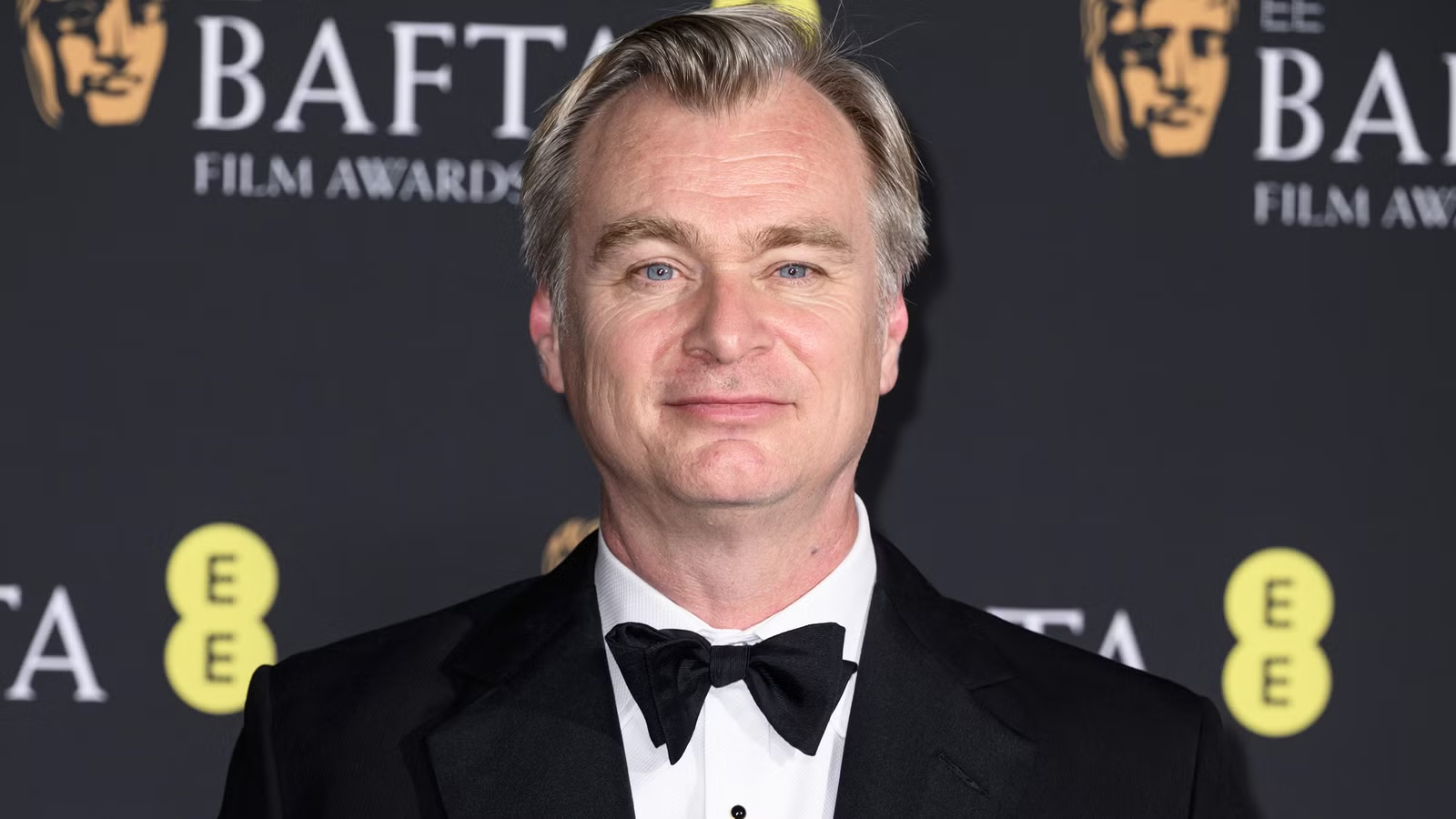
Christopher Nolan on the red carpet at the BAFTAsImage via PA Images/INSTARimages
The summer box-office is already heating up, and Christopher Nolan‘s The Odyssey is still several days away from release. Easily the most-anticipated film of 2026,The Odyssey is also the most expensive project of Nolan’s career, which has almost exclusively unfolded in the big-budget arena. Nolan is coming off his first-ever Best Picture and Best Director wins at the Oscars, taking him to a level that even he hadn’t experienced before. Oppenheimer, the epic biographical thriller that won Nolan his Best Director Academy Award, grossed nearly $1 billion at the worldwide box office, and The Odyssey is expected to eclipse it. So steep has been his career trajectory that one of his older classics was able to gross around $100 million globally via its re-release alone.
The movie in question turned 10 a couple of years ago, and was re-issued in Nolan’s preferred format, IMAX, in theaters worldwide to mark the occasion. The re-release took the movie’s global haul from around $670 million in 2014, to more than $770 million in 2025, against a reported budget of around $165 million. During this 10th-anniversary re-release, the film was also able to pass the $200 million mark domestically. Ahead of The Odyssey‘s release in July, Nolan’s 2014 classic — featuring Matthew McConaughey and Anne Hathaway — is being released on the Hulu streaming service domestically.
Advertisement
Advertisement
Collider Exclusive · Sci-Fi Survival Quiz Which Sci-Fi World Would You Survive? The Matrix · Mad Max · Blade Runner · Dune · Star Wars
Five universes. Five completely different ways the future went wrong — or sideways, or up in flames. Only one of them is the world your instincts were built for. Eight questions will figure out which dystopia, galaxy, or desert wasteland you’d actually make it out of alive.
💊The Matrix
🔥Mad Max
🌧️Blade Runner
Advertisement
🏜️Dune
🚀Star Wars
Advertisement
01
You sense something is deeply wrong with the world around you. What do you do? The first instinct is often the truest one.
Advertisement
02
In a world of scarcity, what resource do you guard most fiercely? What we protect reveals what we believe survival actually requires.
Advertisement
03
What kind of threat keeps you up at night? Fear is useful data — if you’re honest about what you’re actually afraid of.
Advertisement
04
How do you deal with authority you don’t trust? Every dystopia has a power structure. Your approach to it determines everything.
Advertisement
05
Which environment could you actually endure long-term? Survival isn’t just tactical — it’s physical, psychological, and very much about where you are.
Advertisement
06
Who do you want in your corner when things fall apart? The company you keep is the clearest signal of who you actually are.
Advertisement
07
Where do you draw the line — if you draw one at all? Every survivor eventually faces a moment that tests what they’re actually made of.
Advertisement
08
What would actually make survival worth it? Staying alive is one thing. Having a reason to is another.
Advertisement
Your Fate Has Been Calculated You’d Survive In…
Your answers point to the world your instincts were built for. This is the universe your temperament, your survival instincts, and your particular brand of stubbornness were made for.
Advertisement
The Resistance, Zion
The Matrix
You took the red pill a long time ago — probably before anyone offered it to you. You’re a systems thinker who can’t help but notice the seams in things.
Advertisement
You’re drawn to understanding how the system works before figuring out how to break it.
You’d find the Resistance, or it would find you — your instinct for spotting constructed realities is the machines’ worst nightmare.
You function best when you have access to information and the freedom to act on it.
The Matrix built an airtight prison. You’d be the one probing the walls for the door.
The Wasteland
Mad Max
The wasteland doesn’t reward the clever or the well-connected — it rewards those who are hard to kill and harder to break. That’s you.
Advertisement
You don’t need comfort, community, or a cause larger than the next horizon.
You need a vehicle, a clear threat, and enough fuel to outrun it — and you’re good at all three.
You are unsentimental enough to survive that world, and decent enough — just barely — to be something more than another raider.
In the wasteland, that distinction is everything.
Los Angeles, 2049
Blade Runner
You’d survive here because you know how to exist in moral grey areas without losing yourself completely.
Advertisement
You read people accurately, keep your circle small, and ask the questions others prefer not to answer.
In a city where humanity is a legal designation rather than a feeling, you hold onto something that keeps you functional.
You’re not a hero. But you’re not lost, either.
In Blade Runner’s world, that distinction is everything.
Arrakis
Dune
Arrakis is the most hostile environment in the known universe — and you are precisely the kind of person it rewards.
Advertisement
Patience, discipline, and political awareness are your core strengths — and on Arrakis, they’re survival tools.
You understand that the long game matters more than any single victory.
Others come to Dune and are consumed by it. You’d learn its logic and earn its respect.
In time, you wouldn’t just survive Arrakis — you’d begin to reshape it.
A Galaxy Far, Far Away
Star Wars
The galaxy far, far away is vast, loud, and in a constant state of violent political upheaval — and you wouldn’t have it any other way.
Advertisement
You find meaning in being part of something larger than yourself — a cause, a crew, a rebellion.
You’d gravitate toward the Rebellion, or the fringes, or whatever pocket of the galaxy still believes the Empire’s grip can be broken.
You fight — not because you have to, but because standing aside isn’t something you’re capable of.
In Star Wars, that willingness is what makes all the difference.
Advertisement
Here’s When You Can Watch Nolan’s Sci-Fi Epic on Hulu
By now you’ve probably guessed that we’re talking about Interstellar, the epic space adventure that saw Nolan revisiting some of his favorite themes and concepts. Nolan was coming off The Dark Knight Trilogy, and had already established himself as an A-list filmmaker who could pull audiences on the strength of his name. Interstellar now holds a “Certified Fresh” 73% score on the aggregator website Rotten Tomatoes, where the consensus reads, “Interstellar represents more of the thrilling, thought-provoking, and visually resplendent filmmaking moviegoers have come to expect from writer-director Christopher Nolan, even if its intellectual reach somewhat exceeds its grasp.” The movie famously featured Matt Damon in an extended cameo; Damon also played a supporting role in Oppenheimer, and will headline The Odyssey next. Interstellar will be made available to stream on Hulu on July 1. Stay tuned to Collider for more updates.
It’s been a bumpy start to the year for Jason Statham, who starred in one of the biggest financial disappointments of his career with Shelter. What made the film’s box office bombing even more shocking is that it came out of the gates with some of the best reviews of any Statham-led actioner in 10 years. The Stath will see redemption this August in a new action thriller, Mutiny, which hails from Plane director Jean François-Richet. The action thriller also stars Annabelle Wallis, famous for her role as Grace in Peaky Blinders. Fans won’t have to wait long once the ball drops in 2027 to see a new Statham action movie, as he’s been confirmed to reprise his role as Adam Clay in a sequel to The Beekeeper, which is coming to theaters on January 15, 2027.
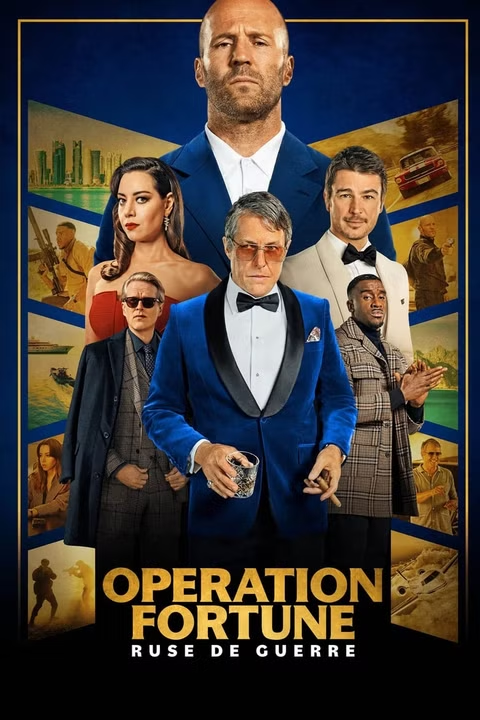
One of Jason Statham’s most frequent collaborators over the years has been acclaimed action director Guy Ritchie. The duo first worked together all the way back in 1998 for the release of Lock, Stock and Two Smoking Barrels, which was also Statham’s feature acting debut. After reuniting a few years later for Snatch, co-starring Brad Pitt, the duo worked together a few more times until their most recent release briefly brought things to a halt. The last Jason Statham and Guy Ritchie movie, Operation Fortune: Ruse de Guerre, came out in 2023, and despite the combined star power of Statham and other big names like Aubrey Plaza and Josh Hartnett, the film bombed at the box office. Three years later, Operation Fortune: Ruse de Guerre has found redemption on streaming as one of the top 10 most popular VOD titles on various platforms around the world.
Advertisement
Collider Exclusive · James Bond Personality Quiz Which James Bond Actor Are You Most Like? Connery · Moore · Dalton · Brosnan · Lazenby · Craig
Advertisement
Six actors. Six completely different visions of the same man — dangerous, charming, complicated, and almost certainly wearing a very good suit. Only one of them shares your particular way of moving through the world. Eight questions will figure out which Bond you really are.
🏴Connery
😄Moore
🎭Dalton
✨Brosnan
Advertisement
🤵Lazenby
💠Craig
Advertisement
01
How do you carry yourself when you walk into a room? Bond is always the most interesting person in the room. The question is how he makes you feel it.
Advertisement
02
How do you handle a dangerous situation? Every Bond faces it differently. What does your version look like?
Advertisement
03
How do you charm someone you need on your side? Bond always gets what he needs. The method varies considerably.
Advertisement
04
How do you handle your emotions on the job? Every Bond deals with this differently. Most of them not particularly well.
Advertisement
05
How would your colleagues describe your working style? MI6 has opinions about all of its 00s. What are theirs about you?
Advertisement
06
How do you feel about operating within the rules? The licence to kill comes with terms and conditions. Not everyone reads them.
Advertisement
07
What is your relationship with love? Every Bond has a different answer. None of them have found it easy.
Advertisement
08
When the mission is over, how do you want to be remembered? The name is Bond. The rest is entirely up to the man behind it.
Advertisement
The Name Has Been Determined Your Bond Is…
Six actors. One role. Your answers point to the Bond who shares your presence, your method, and your particular way of carrying the weight of being the most dangerous person in the room.
Advertisement
Dr. No — You Only Live Twice · 1962–1967
Sean Connery
You are the original — and you carry that fact without needing to announce it. There is an authority in the way you occupy a room that others spend careers trying to replicate.
Advertisement
You don’t explain yourself, justify yourself, or soften yourself for anyone’s comfort. The confidence is structural, not performed.
Connery’s Bond established everything — the tone, the danger, the cool — because Connery himself had the innate presence to make something that had never existed feel inevitable.
You share that quality: the sense that you were always going to end up exactly here, doing exactly this.
The name is Bond. In your case, it always was.
Live and Let Die — A View to a Kill · 1973–1985
Roger Moore
You understand something that more serious people miss: that wit is its own form of intelligence, and that making people laugh is not a retreat from danger but a way of mastering it.
Advertisement
Moore’s Bond is underrated precisely because the effortlessness looks easy — and effortlessness is the hardest thing to manufacture.
You have the same quality: a lightness that disarms people before they realise how sharp you actually are.
The raised eyebrow, the perfectly timed quip, the refusal to be rattled — these are not affectations. They are a philosophy about how to move through a world that would like to take itself too seriously.
You have never let it.
The Living Daylights · Licence to Kill · 1987–1989
Timothy Dalton
You took the role seriously when everyone wanted you to coast — and that refusal to take the easy version of anything is the most defining thing about you.
Advertisement
Dalton’s Bond has genuine moral weight: he feels the cost of what he does, he has lines he won’t cross, and he is not interested in the version of himself that pretends otherwise.
You share that intensity. You push harder than the situation technically requires, because you have a standard and you hold yourself to it.
He was ahead of his time — the Bond the franchise wasn’t quite ready for yet, arriving exactly when he was meant to.
You know what that feels like.
GoldenEye — Die Another Day · 1995–2002
Pierce Brosnan
You are the complete package — and you know it, which is part of what makes you so effective and occasionally so infuriating to the people around you.
Advertisement
Brosnan arrived at the role looking exactly like Bond was supposed to look, and he delivered on that expectation with a professionalism that made it seem effortless.
You have the same quality: a smooth competence, a charm that operates like a precision instrument, and the ability to make even difficult things look like they weren’t.
His era was the most commercially successful in the franchise’s history. There is a reason for that.
The reason is that some people simply fit their moment perfectly. You are one of those people.
On Her Majesty’s Secret Service · 1969
George Lazenby
You stepped into something enormous with less preparation than anyone around you thought was sufficient — and you delivered something genuine anyway, which is the more impressive achievement.
Advertisement
Lazenby’s single outing is, by many measures, one of the finest Bond films ever made — and he is not a small part of why.
You share his quality of raw authenticity: less polished than the alternatives, more honest for it, capable of something real that technique alone can’t produce.
He was underestimated, and then he wasn’t, and then history caught up with him.
You are the kind of person history catches up with. Give it time.
Casino Royale — No Time to Die · 2006–2021
Daniel Craig
You stripped everything back and found what was underneath — and what was underneath was harder, more honest, and more human than anyone expected.
Advertisement
Craig’s Bond is the franchise’s most psychologically complete: a man doing a brutal job, carrying its costs imperfectly, capable of love and loss in ways that can’t be dismissed.
You share that depth. You don’t hide behind the role or the charm or the suit — you let the work show what it actually costs.
He was controversial from the moment he was announced and definitive by the time he was finished. The sceptics became the believers.
That arc — of being underestimated and then undeniable — is one you know intimately.
Advertisement
What Is ‘Operation Fortune: Ruse de Guerre’ About?
An official synopsis of Operation Fortune: Ruse de Guerre, which also stars Hugh Grant and Cary Elwes, reads as follows:
“Elite spy Orson Fortune is reluctantly recruited by British intelligence to thwart the sale of a deadly weapons technology to the highest bidder. Forced to enlist the help of Hollywood’s biggest action star, Fortune and his crack team deploy charm, deception, and brute force across sun-drenched international locales in a slick, globe-trotting caper.”
Operation Fortune earned a poor 51% from critics but a solid 82% from audiences on the aggregate site Rotten Tomatoes. The film cost $50 million to make, which left it with a break-even point of around $100 million, but it grossed only $48 million at the global box office. The film has shades of both James Bond and The Italian Job, perfect for fans of sleek spy thrillers with a splash of the classic heist adventure.
Check out Operation Fortune: Ruse de Guerre on VOD platforms like Prime Video, and stay tuned to Collider for more streaming updates and coverage of Guy Ritchie and Jason Statham’s future projects.
In the last few years, Jason Statham has been primarily focused on starring in original action movies, but the famous movie star has plenty of experience with franchise work. One of his first big roles that immediately comes to mind is Deckard Shaw, who he’s been playing for years in the Fast & Furious franchise. Statham’s Deckard Shaw was such a hit with fans that he and Dwayne Johnson were recruited to lead the 2019 spin-off film, Hobbs & Shaw, which grossed over $700 million at the global box office. It’s expected that Statham will return and star as Deckard Shaw in the eleventh and final Fast & Furious movie coming to theaters in 2028, and while this has yet to be officially confirmed, it was alluded to in the 2023 blockbuster, Fast X, when he briefly returned.
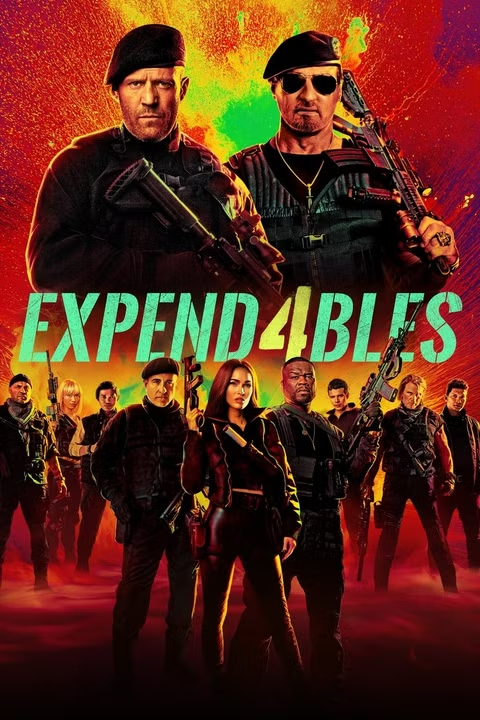
Another massive franchise role for Statham has been that of Lee Christmas, who he has played in four Expendablesmovies over the course of nearly 15 years. Back in May, it was reported that a new Expendables movie was in the works, but Statham is not expected to star in the project, as it will focus on an all-female team, shifting the focus away from Statham and other stars like Sylvester Stallone. Following the announcement of the next Expendables movie, fans have been rushing to check out Statham’s final outing as Lee Christmas in droves, which has led Expend4bles back into the global VOD top 10 in a handful of countries around the world. The Expendables 4 is also widely viewed as Statham’s biggest financial misfire — the film grossed only $37 million at the box office against a $100 million budget.
Advertisement
Collider Exclusive · Action Hero Quiz Which Action Hero Would Be Your Perfect Partner? Rambo · James Bond · Indiana Jones · John McClane · Ethan Hunt
Advertisement
Five legends. Five completely different ways of getting out alive — with style, with muscle, with charm, with luck, or with a plan so intricate it probably shouldn’t work. Ten questions will reveal which action hero was built to have your back.
🎖️Rambo
🍸James Bond
🏺Indiana Jones
🔧John McClane
Advertisement
🎭Ethan Hunt
Advertisement
01
You’re dropped into a dangerous situation with no warning. What do you need most from a partner? The first few seconds tell you everything about who belongs beside you.
Advertisement
02
You have to get somewhere dangerous, fast. How do you travel? How you get there is half the mission.
Advertisement
03
You’re pinned down and outnumbered. What does your ideal partner do? This is when you find out what someone is really made of.
Advertisement
04
The mission is paused. You have one evening to decompress. What does your partner suggest? Who someone is when the pressure drops is who they actually are.
Advertisement
05
How do you prefer your partner to communicate mid-mission? Good communication is the difference between partners and a liability.
Advertisement
06
Your enemy is powerful, well-resourced, and has the upper hand. How should your partner approach them? The approach to the enemy defines the partnership.
Advertisement
07
Things go badly wrong and you’re captured. What do you trust your partner to do? Who someone is when you need them most is the only thing that matters.
Advertisement
08
What does your ideal partner bring to the table that you couldn’t replace? A great partner fills the gap you didn’t know you had.
Advertisement
09
Every partnership has a cost. Which of these can you live with? No one comes without baggage. The question is whether you can carry it together.
Advertisement
10
It’s the final moment. Everything is on the line. What do you need from your partner right now? The last question is the most honest one.
Advertisement
Your Partner Has Been Assigned Your Perfect Partner Is…
Your answers have pointed to one action hero above all others. This is the person built to have your back — for better or considerably, spectacularly worse.
Rambo
Advertisement
Your partner doesn’t talk much, doesn’t need to, and will have assessed every threat in your immediate environment before you’ve finished your first sentence. John Rambo is not a man of plans or politics — he is a force of nature shaped by survival, loyalty, and a capacity for endurance that goes beyond anything training can produce. He will not leave you behind. He has never left anyone behind who deserved to come home. What you get with Rambo is the most capable, most quietly ferocious partner imaginable — one who has been through things that would have broken anyone else, and who chose to keep going anyway. You’ll never need to ask if he has your back. You’ll just know.
James Bond
Your partner will arrive perfectly dressed, perfectly briefed, and with a cover story so convincing it’ll take you a moment to remember what’s actually true. James Bond is the most professionally dangerous person in any room he enters — and the most disarmingly charming, which is the point. He operates in a world of layers, where nothing is what it appears and every advantage is used without apology. You’ll never be bored. You’ll occasionally be furious. But when it matters — when the mission is genuinely on the line and the margin for error has collapsed to nothing — Bond is exactly the partner you want. He has survived things that have no business being survivable. He does it with style. That is not nothing.
Advertisement
Indiana Jones
Your partner will know the history, the language, the cultural context, and exactly why the thing everyone else is ignoring is actually the most important thing in the room. Indiana Jones is brilliant, reckless, and occasionally impossible — but he is also one of the most resourceful, most genuinely knowledgeable partners you could find yourself beside. He approaches every situation with a scholar’s eye and a brawler’s instinct, which is an unusual combination and a remarkably effective one. He hates snakes and gets personally attached to objects of historical significance, both of which will slow you down at least once. It doesn’t matter. What Indy brings is irreplaceable — and the adventures you’ll have together will be the kind people write books about. Assuming you survive them.
Advertisement
John McClane
Your partner was not supposed to be here. He does not have the right equipment, the right information, or anything approaching the right odds. He has a sarcastic remark and an absolute refusal to accept that the situation is as bad as it looks. John McClane is the greatest accidental hero in the history of action cinema — a man whose superpower is stubbornness, whose contingency plan is improvisation, and whose capacity to absorb punishment and keep moving would be alarming if it weren’t so useful. He will complain the entire time. He will make it significantly more chaotic than it needed to be. And he will absolutely, unconditionally, without question come through when it counts. Yippee-ki-yay.
Ethan Hunt
Advertisement
Your partner has already run seventeen scenarios by the time you’ve finished reading the briefing, and the plan he’s settled on involves at least two things that should be physically impossible. Ethan Hunt operates at the absolute edge of human capability — technically, physically, and intellectually — and he brings the same relentless precision to protecting his partners that he brings to dismantling organisations that shouldn’t exist. He is not easy to know and he will never fully tell you everything. But he will carry the weight of the mission so completely, so absolutely, that your job is simply to trust him — and the remarkable thing is that trusting him always turns out to be the right call. The mission will be impossible. He will complete it anyway.
Advertisement
What Is ‘The Expendables 4’ About?
An official synopsis for Expend4bles, which also stars Megan Fox and 50 Cent, reads as follows:
“When the world needs its last line of defense, it calls the Expendables. Barney Ross and Lee Christmas lead their elite crew of mercenaries on a mission to Libya to stop ruthless arms dealer Rahmat from seizing nuclear warheads for a shadowy terrorist known only as Ocelot. But with betrayal from within and a plot to ignite World War III, the old guard and a lethal new generation must unite to save the world — or die trying.”
Expendables 4 is one of the lowest-rated movies of Statham’s career, earning an abysmal 14% approval rating from critics on Rotten Tomatoes. Audiences were kinder to the film, rating it a solid 69% on the Popcornmeter.
Advertisement
Check out The Expendables 4 on VOD platforms like Prime Video and stay tuned to Collider for more updates and coverage of Jason Statham’s future projects.
Advertisement
Release Date
Advertisement
September 15, 2023
Runtime
103 minutes
Advertisement
Writers
Max Adams, Kurt Wimmer, Spenser Cohen, Tad Daggerhart
Producers
Advertisement
Jason Statham, Jeffrey Greenstein, Jonathan Yunger, Kevin King Templeton, Les Weldon, Yariv Lerner
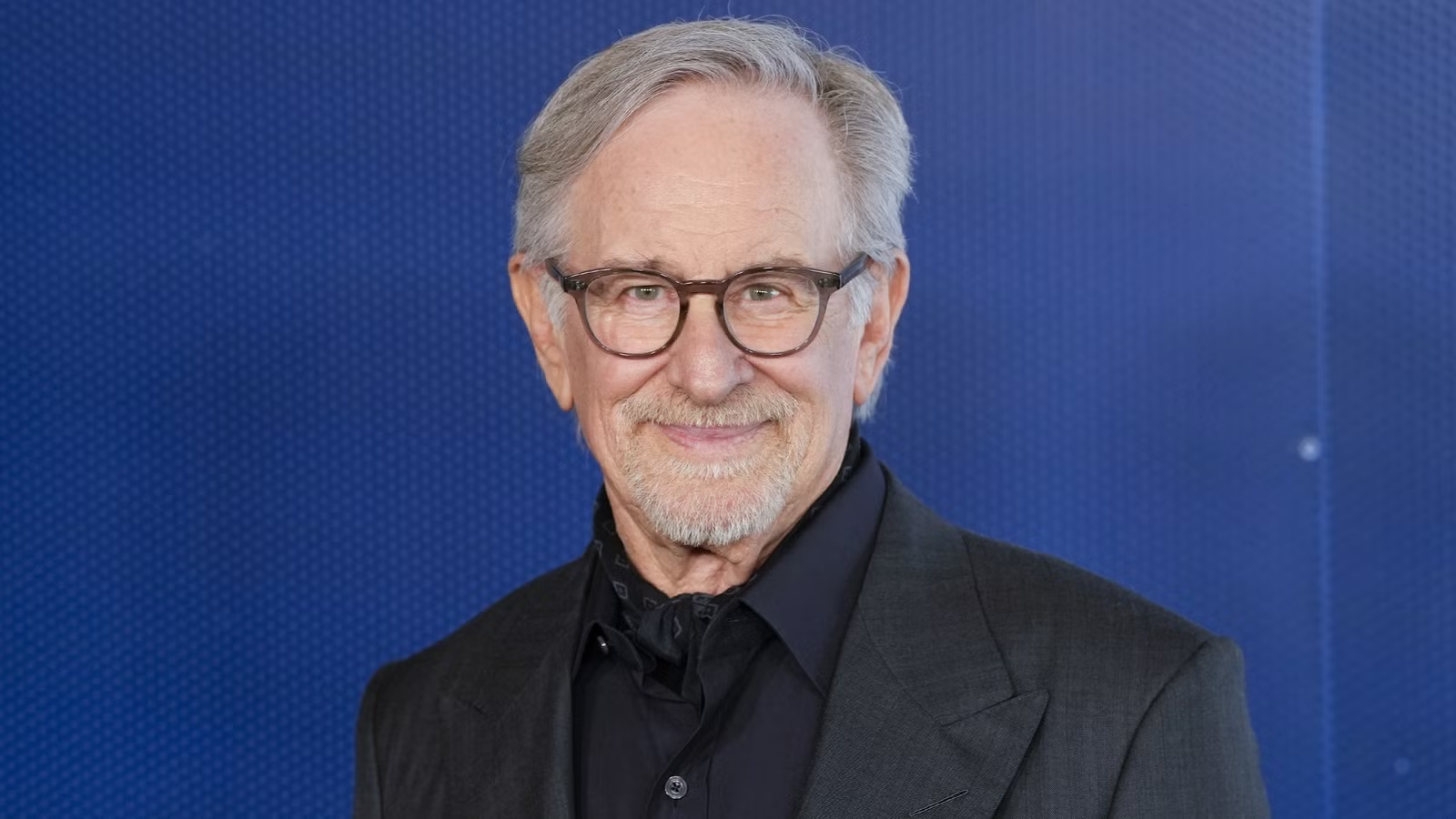
Steven Spielberg on the red carpetJennifer Graylock/INSTARimages
It’s unclear if Steven Spielberg‘s first new sci-fi film in nearly a decade, Disclosure Day, is the hit that he so desperately needs. Spielberg is coming off two back-to-back box-office underperformers — the musical West Side Story and the semi-autobiographical drama The Fabelmans— and needs Disclosure Day to gross at least $150 million more at the global box office. The film’s current worldwide haul stands at $160 million, against a reported budget of $115 million. The movie received mostly positive reviews from critics, but audiences seem to be more divided in their opinion. On CinemaScore, Disclosure Day received a so-so B+ grade from opening day crowds, which explains its steep second-weekend drop at the box office. However, Spielberg remains perhaps the most influential filmmaker of all time, and the release of any new movie results in a viewership spike for his older titles.
For instance, in the days leading up to the release of Disclosure Day, Spielberg’s 2018 sci-fi movie, Ready Player One, spiked on streaming. But several titles that he was attached to as a producer remain under the radar. One such movie is currently available to stream on Paramount+, and Spielberg completists might want to check it out before it’s removed from the streamer. The film in question was released theatrically in 1985, and directed by Barry Levinson — yes, he’s the father of Euphoria creator Sam Levinson.
Advertisement
Advertisement
Collider Exclusive · Action Hero Quiz Which Action Hero Would Be Your Perfect Partner? Rambo · James Bond · Indiana Jones · John McClane · Ethan Hunt
Five legends. Five completely different ways of getting out alive — with style, with muscle, with charm, with luck, or with a plan so intricate it probably shouldn’t work. Ten questions will reveal which action hero was built to have your back.
🎖️Rambo
🍸James Bond
🏺Indiana Jones
Advertisement
🔧John McClane
🎭Ethan Hunt
Advertisement
01
You’re dropped into a dangerous situation with no warning. What do you need most from a partner? The first few seconds tell you everything about who belongs beside you.
Advertisement
02
You have to get somewhere dangerous, fast. How do you travel? How you get there is half the mission.
Advertisement
03
You’re pinned down and outnumbered. What does your ideal partner do? This is when you find out what someone is really made of.
Advertisement
04
The mission is paused. You have one evening to decompress. What does your partner suggest? Who someone is when the pressure drops is who they actually are.
Advertisement
05
How do you prefer your partner to communicate mid-mission? Good communication is the difference between partners and a liability.
Advertisement
06
Your enemy is powerful, well-resourced, and has the upper hand. How should your partner approach them? The approach to the enemy defines the partnership.
Advertisement
07
Things go badly wrong and you’re captured. What do you trust your partner to do? Who someone is when you need them most is the only thing that matters.
Advertisement
08
What does your ideal partner bring to the table that you couldn’t replace? A great partner fills the gap you didn’t know you had.
Advertisement
09
Every partnership has a cost. Which of these can you live with? No one comes without baggage. The question is whether you can carry it together.
Advertisement
10
It’s the final moment. Everything is on the line. What do you need from your partner right now? The last question is the most honest one.
Advertisement
Your Partner Has Been Assigned Your Perfect Partner Is…
Your answers have pointed to one action hero above all others. This is the person built to have your back — for better or considerably, spectacularly worse.
Advertisement
Rambo
Your partner doesn’t talk much, doesn’t need to, and will have assessed every threat in your immediate environment before you’ve finished your first sentence. John Rambo is not a man of plans or politics — he is a force of nature shaped by survival, loyalty, and a capacity for endurance that goes beyond anything training can produce. He will not leave you behind. He has never left anyone behind who deserved to come home. What you get with Rambo is the most capable, most quietly ferocious partner imaginable — one who has been through things that would have broken anyone else, and who chose to keep going anyway. You’ll never need to ask if he has your back. You’ll just know.
James Bond
Advertisement
Your partner will arrive perfectly dressed, perfectly briefed, and with a cover story so convincing it’ll take you a moment to remember what’s actually true. James Bond is the most professionally dangerous person in any room he enters — and the most disarmingly charming, which is the point. He operates in a world of layers, where nothing is what it appears and every advantage is used without apology. You’ll never be bored. You’ll occasionally be furious. But when it matters — when the mission is genuinely on the line and the margin for error has collapsed to nothing — Bond is exactly the partner you want. He has survived things that have no business being survivable. He does it with style. That is not nothing.
Indiana Jones
Your partner will know the history, the language, the cultural context, and exactly why the thing everyone else is ignoring is actually the most important thing in the room. Indiana Jones is brilliant, reckless, and occasionally impossible — but he is also one of the most resourceful, most genuinely knowledgeable partners you could find yourself beside. He approaches every situation with a scholar’s eye and a brawler’s instinct, which is an unusual combination and a remarkably effective one. He hates snakes and gets personally attached to objects of historical significance, both of which will slow you down at least once. It doesn’t matter. What Indy brings is irreplaceable — and the adventures you’ll have together will be the kind people write books about. Assuming you survive them.
Advertisement
John McClane
Your partner was not supposed to be here. He does not have the right equipment, the right information, or anything approaching the right odds. He has a sarcastic remark and an absolute refusal to accept that the situation is as bad as it looks. John McClane is the greatest accidental hero in the history of action cinema — a man whose superpower is stubbornness, whose contingency plan is improvisation, and whose capacity to absorb punishment and keep moving would be alarming if it weren’t so useful. He will complain the entire time. He will make it significantly more chaotic than it needed to be. And he will absolutely, unconditionally, without question come through when it counts. Yippee-ki-yay.
Advertisement
Ethan Hunt
Your partner has already run seventeen scenarios by the time you’ve finished reading the briefing, and the plan he’s settled on involves at least two things that should be physically impossible. Ethan Hunt operates at the absolute edge of human capability — technically, physically, and intellectually — and he brings the same relentless precision to protecting his partners that he brings to dismantling organisations that shouldn’t exist. He is not easy to know and he will never fully tell you everything. But he will carry the weight of the mission so completely, so absolutely, that your job is simply to trust him — and the remarkable thing is that trusting him always turns out to be the right call. The mission will be impossible. He will complete it anyway.
Advertisement
Watch the Underseen Sherlock Holmes Movie on Paramount+
We’re talking about the Amblin-produced Young Sherlock Holmes, which grossed more than $60 million worldwide against a reported budget of less than $20 million. The film was written by Chris Columbus, who’d go on to direct the first and second installments of the Harry Potter franchise.Young Sherlock Holmes hasn’t exactly remained at the top of people’s watchlists, but it remains known for being the first major Hollywood movie to feature an entirely computer-generated character. The movie now holds a 71% score on the aggregator website Rotten Tomatoes, where the consensus reads, “Young Sherlock Holmes is a charming, if unnecessarily flashy, take on the master sleuth.” A more recent streaming series, also about the legendary sleuth’s younger days, was executive-produced by Guy Ritchieand released to positive reviews on Prime Video. You can watch Levinson and Spielberg’s Young Sherlock Holmes on Paramount+ until July 1. Stay tuned to Collider for more updates.
Advertisement
Advertisement
Release Date
December 4, 1985
Advertisement
Runtime
109 minutes
Writers
Advertisement
Chris Columbus
Producers
Frank Marshall, Henry Winkler, Kathleen Kennedy, Mark Johnson, Roger Birnbaum
There’s been a lot of talk recently about how the big sci-fi franchises are all in trouble. No one’s watching the old standbys anymore; everyone’s upset with them, and none of it makes any sense.
This is a disaster that’s been twenty-four years in the making, and you can trace its roots back to 2002, when Star Trek released Star Trek: Nemesis, a movie meant to be a big send-off for its most beloved cast and crew. A movie that was supposed to take an existing world into a new era of special effects and modern sensibilities.
Instead, Star Trek: Nemesis ended the franchise and sent Hollywood into a tailspin of recycled failure. And we still haven’t recovered. Maybe sci-fi never will.
Advertisement
This is why Star Trek: Nemesis failed.
The Worst Script In Star Trek
Star Trek: Nemesis ends with one of the best space battles in science fiction, and the second-best space battle in all of Star Trek, next to that unstoppable banger in Wrath of Khan. It’s a 20-minute, technically proficient masterclass and the only Star Trek space battle that actually takes the time to think about things like real tactics and technical details, such as keeping strong shields toward the enemy and rolling your ship to improve weapons targeting.
If the rest of the movie were even half this good, then Nemesis would likely have celebrated and extended the Next Generation era of Star Trek, instead of being the final nail in its coffin. But the rest of the movie isn’t this good. It’s not even half this good.
Captain Picard’s dune buggy adventure.
Star Trek: Nemesis begins with a ridiculous scene in which Captain Picard drives around in a dune buggy wearing safety googles and shooting at random aliens who appear out of nowhere.
Along the way, Picard finds another Soong android, which they call B4. B4 is basically Data if he had Down syndrome.
The whole sequence feels like a non-sequitor, and while they do tie it into the plot at the end, it’s shot as if it takes place in a different movie. That may be because it sort of is.
Advertisement
Down syndrome Data in Star Trek: Nemesis
Part of the story for this movie was dreamed up by actor Brent Spiner as a way to kill off his character. Brent’s ideas involving Data were developed separately from the main plot of the movie and then just sort of shoehorned in.
That main plot, by the way, is the worst thing about Star Trek: Nemesis, and as soon as someone had this as their idea for the movie, the entire project was probably doomed. Maybe a great writer could have saved it with the right kind of script, but John Logan is not a great writer. In fact, he’s a terrible one, and he makes this bad idea worse.
I know, John Logan has supposedly done good work. He co-wrote movies like Gladiator and Skyfall. But given the garbage he typed out for this movie, I suspect his co-writers may have done most of the heavy lifting.
Logan’s terrible Star Trek: Nemesis script uses a cringe cloning plot in a shallow attempt to rip off Star Trek II: The Wrath of Khan. The Romulans have cloned Jean-Luc Picard for bizarre hand-wave reasons, and then decided not to use that clone for other vague hand-wave reasons, and then, instead of killing that clone, dropped it in a mine for still more vague hand-wave reasons, where it grew up plotting revenge.
Why John Logan Replaced Romulans With Remans
That clone is named Shinzon, and now that he’s all grown up, he’s teamed up with the hideous-looking Reman slaves in the mines to take over the entire Romulan Empire. Why not just make the slaves Romulans instead of inventing this new species of randomoids who live with the Romulans? This was another terrible John Logan idea.
John Logan was tasked with writing a Romulan plot, but he thought Romulans looked boring and wanted to have some sort of obviously monstrous-looking characters. So he invented Remans and replaced the Romulans with his idiotic pet Gargoyles.
Advertisement
I say again: John Logan is not a good writer.
John Logan’s pet gargoyles
So Shinzon and the Remans take over the entire Romulan Star Empire, and they do it with the willing help of the entire Romulan military. This happens despite the fact that we’re told the Romulans and their military all hate Shinzon, hate Remans even more, and also it obviously means both they and their entire civilization will be totally wiped out by angry hordes of rampaging Reman slaves with absolutely no positive benefits of any kind to anyone involved.
Instead of dealing with these lingering Romulan issues, Shinzon decides he must wipe out all life on the planet Earth. Why? Vague hand-wave. Who knows?
Also, he decides that he must kill Captain Picard, even though Captain Picard has done nothing to him. Also, Shinzon will die unless he can get a living Captain Picard to give him a blood transfusion.
Captain Picard’s Nap Gets Data Killed
This all culminates in a scene where there’s a one-minute countdown, and if Captain Picard doesn’t stop it, everyone on planet Earth will die. Picard, having defeated Shinzon, spends this minute in which he could be turning the weapon off in quiet contemplation, staring blankly off into space. With ten seconds to go, Data shows up, beams the inexplicably catatonic Picard to safety, and, because thanks to Picard, there’s no longer any time to do anything else, Data randomly shoots the super weapon with a phaser, blowing up both himself and the ship it’s on.
Remember when Spock died in Wrath of Khan? Remember that heart-wrenching funeral with a big crowd of people where Scotty plays the bagpipes, and Kirk starts sobbing and crying over the death of his friend? Don’t worry, the crew of the Enterprise E also holds a funeral to honor their longtime crewmate, friend, and the savior of Earth.
Advertisement
Time to get a new toaster!
Well, six of them do anyway. They stand around awkwardly in Picard’s ready room for a couple of minutes. They drink a glass of wine, and Jean-Luc makes a vague statement about “absent friends” without mentioning Data’s name.
Riker does tell a very brief anecdote about the first time he met Data, but he doesn’t actually remember what happened, suggesting none of it is important to him. Then everyone gets on with things, and the movie ends.
Why Star Trek: Nemesis Failed
There are a lot of technical, timing, and marketing reasons you could list to explain why Star Trek: Nemesis failed. But the biggest one, the only one that really matters, is the movie’s script. It’s a piece of garbage.
If you listen to what the cast has to say about the movie, they tend to blame the film’s director, Stuart Baird, for its failure. That’s ridiculous, because everything else about Nemesis is actually kind of great. The production is lavish and beautiful. The space sequences, in particular, are stunning.
The hand-to-hand combat action bits aren’t at all terrible, especially given that they’re being executed by an elderly, totally out-of-shape cast. That cast does seem a little bored and confused, probably because they have to read lines off John Logan’s terrible script, but they’re all pros and game to do whatever is needed to make this adventure work.
Not this again.
Everything about Star Trek: Nemesis mostly does work, too. Except for the script. You don’t have a movie without a script.
Nemesis opened to $18.5 million in North America but collapsed quickly, finishing with only $43.3 million domestically and about $67 million worldwide, against a reported $60 million production budget. That made it the lowest-grossing Star Trek movie of the entire original theatrical era, trailing even the much-maligned Star Trek V. That’s right, it did worse than the one where God needed a starship for a joyride.
Advertisement
As you’d imagine with a script composed primarily of dumpster dive, critics were largely unimpressed. They saw Nemesis as the recycled flotsam that it was.
Bye Data.
Maybe fans would have been more forgiving, but then the movie killed Data and treated his death like someone had just unplugged an old toaster. They were pissed. Fans wanted the heads of everyone involved. And they definitely didn’t want more Star Trek done this way.
So that was it for the golden age of Star Trek. Nemesis ended it right then and there. Paramount went into full reboot mode, and by 2009, that’s exactly what we got. A reboot.
No Lessons Were Learned
Of course, if they’d actually listened to any of the criticism being leveled at Nemesis, a reboot is the exact opposite of what they should have done. The main problem everyone had with Nemesis is that it recycled Star Trek II: The Wrath of Khan.
So Paramount responded to criticisms of recycled plots by rebooting the franchise and recycling everything Star Trek had ever done for their 2009 movie. Then they specifically recycled Wrath of Khan yet again for the reboot sequel Star Trek: Into Darkness.
Star Trek: Nemesis failed, no lessons of any kind were learned, and Star Trek as a whole was sent spinning off into an increasingly terrible oblivion from which the franchise never recovered.
Maybe I’m becoming jaded in my old age, but I’ve found it impossible to get excited about most theatrical releases these days. The last time I actually went to the theater was eight months ago when Predator: Badlands released, and before that, I hadn’t been to a theater in over a year. With Marvel offering diminishing returns post-Endgame and streaming getting better and better, it takes a lot for a trailer to get me out of my seat, and into the box office. That’s why it came as such a surprise to me when the trailer for The Social Reckoning released last week, and immediately solidified itself as a theater watch.
From Visionary To Villain
I recall watching The Social Network upon release all the way back in 2010. The combination of Aaron Sorkin’s quirky dialogue, David Fincher‘s impeccable directing, and one of the greatest original scores in cinema history made it an instant favorite. Though I still revisit that movie from time to time, I rolled my eyes when a legacy sequel titled The Social Reckoning was first announced.
Once the media blitz for the new film kicked off, every headline just made me more ambivalent to the production. Jesse Eisenberg won’t be returning for the sequel, so why should I? David Fincher isn’t attached to direct, so why even bother? When the trailer began circulating social media, I considered skipping it entirely. Still, it produced enough buzz that I figured I’d give it a spin, just so I could participate in the cultural moment.
Advertisement
Almost immediately I recognized the value in this film. Sorkin’s feelings on the central character, real-life Facebook founder Mark Zuckerberg, seem to have changed in lockstep with the rest of the world. Back in 2010, we all saw the scrappy Harvard dropout as a brilliant, rough-around-the-edges geek who revolutionized the way that friends stay in touch. Fast forward nearly two decades, and Facebook has done insurmountable damage to the world, from harming teenagers’ mental health, to aiding in the worsening partisanship of politics, and even serving as a powder keg in an actual genocide in Myanmar.
To that end, The Social Reckoning looks like it’s bridging the gap between the Zuckerberg we knew and loved in Eisenberg’s portrayal, to the megalomaniac billionaire who testified before congress in 2024. Succession‘s Jeremy Strong has now taken on the mantle, with a pitch-perfect impression of the Meta CEO, played against a room full of PR crisis experts. Boston’s own Bill Burr seems to have a prominent role, as the only PR guy willing to push back against Zuckerberg’s stilted, awkward delivery. Meanwhile, The Bear‘s Jeremy Allen White investigates the 2021 Facebook memo leak which exposed a wide array of corruption at the site.
Obviously, it’s too soon to tell if The Social Reckoning will stand up alongside its predecessor as a five star film. But, the trailer does a great job of making the new movie look highly promising. When it releases in theaters on October 9, I’ll definitely be in the crowd with my phone silenced and my Facebook page suspended.
Love Island USA‘s Kenzie Annis enjoyed making Dylan Wrona “horny” after he massaged her on a date.
During the Friday, June 26, episode of the hit Peacock show, Dylan invited Kenzie on a date that involved him massaging her. Kenzie was thrilled at the attention she received from the newcomer.
“He was thinking above and beyond,” she gushed. “I haven’t had a guy do that for me in here and I think he got a little horny.”
The Love Island franchise began in the U.K. in 2002 before expanding worldwide with various spinoffs, including Love Island USA. Each season, a new group of singles live in isolation in the show’s luxury villa, where they must stay coupled up in order to stand a chance at receiving the $100,000 prize.
Advertisement
The contestants — referred to as Islanders — are under constant video surveillance during filming, leading to plenty of raunchy moments ending up on screen.
Season 8 took the heat to a new level with multiple couples going all the way while sharing a bedroom in the villa. The introduction of Casa Amor only upped the potential for sexy scenes.
Thursday’s episode also featured an update on bombshell Alannah Keyser, who was removed from the show after facing backlash for a resurfaced video that allegedly showed her using a racial slur.
The video and other posts were not shared publicly until after Alannah’s appearance on the show and thus were not accessible during the vetting process.
Love Island USA is all about coupling up — so which Islanders are currently together and which have already called it quits in the villa? Peacock’s popular dating show returned in June 2026 with contestants Aniya Harvey, Beatriz Hatz, Bryce Alakai Dettloff, KC Chandler, Mackenzie “Kenzie” Annis, Melanie Moreno, Sincere Rhea, Sean Reifel, Trinity Tatum […]
Earlier this season, another contestant, Vasana Montgomery, was cut from the show after resurfaced social media posts showed her using a slur. Similar issues arose during season 7 last year, with Yulissa Escobar leaving days into the experience after clips of her using racial slurs on a podcast circulated online.
Advertisement
Cierra Ortega also faced backlash for using a slur in her own resurfaced social media post. She was pulled from the villa and later issued an apology for her past actions.
Thank You!
You have successfully subscribed.
New episodes of Love Island USA are released six days a week — except for Wednesdays — on Peacock.
Advertisement
Join Us Weekly and Bracketology.tv in our first-ever Love Island USA fantasy league! This is your chance to predict who you think will win Season 8 and rank the Islanders weekly based on how confident you are that they will survive the next elimination. You will be playing against our editors, get access to exclusive content and have the chance to win fun prizes. Sign up for free today!
For a long time, fans of comic book movies dreaded one thing: the origin story. Whenever we got a new movie featuring characters like Batman and Spider-Man, we had to spend way too long watching an origin for a character we are very familiar with. Like, how many times can we watch Peter Parker’s Uncle or Bruce Wayne’s parents get brutally murdered before we just mentally tune everything out? Eventually, superhero directors came to the same conclusion. That’s why the MCU ditched showing the origin story for Spider-Man and, more recently, the DCU ditched showing the origin story for Superman.
This is a philosophy that has mostly been embraced by Supergirl, the latest superhero film to fly into theaters. I say “mostly” because we do get some flashbacks that explain the title character’s backstory in dribs and drabs, but they are interspersed throughout the movie. Unfortunately, since audiences are far less familiar with this character, Supergirl is one film that really would benefit from more of an upfront origin story. Additionally, making her origin story front and center would help give this new tights-and-flights film the proper emotional arc that it so desperately needs.
Dazed And Confusing
Fair warning: this article is going to touch on some mild spoilers for Supergirl that mostly pertain to the character’s origin. With that out of the way, let’s begin! The movie begins with our heroine going on a multi-day, multi-planet bender to celebrate her 23rd birthday. While she loves to party, she’s not really a people person: she’s terse with everyone she encounters, including the future kid sidekick whose circumstances set the whole plot in motion. Heck, she’s even snippy towards Superman, the sugary sweet superhero who wants nothing more than for his cousin to come home. Considering she’s young, beautiful, and has godlike powers, you might start asking, “What’s your problem, lady?”
The answer, of course, is trauma! Supergirl didn’t ditch Krypton right before it exploded as Superman did. Rather, her father activated a force shield meant to protect his city and its people. At first, it worked: Krypton exploded, but Argo City floated through space safe and secure, an island among the stars. However, its residents discovered years later that their escape had unearthed Krpytonite that had poisoned the soil. This killed many, including Supergirl’s mother, and she was sent to Earth to save her from a similarly slow and debilitating death.
The Key To A More Sympathetic Superhero
Pretty gloomy, huh? At first glance, you can imagine why DC didn’t want this at the beginning of a film they marketed as the lighthearted love child of Guardians of the Galaxy and Mad Max. Why do I think Supergirl should have started with this, or at least moved it far closer to the start of the film? For one thing, it instantly explains our heroine’s snarky ennui. A good chunk of the early movie is spent showing Supergirl as someone who’d rather drink and party than help anyone, even a teen whose family just got murdered. Honestly, it makes her seem more than a bit selfish.
With the origin moved up front, though, Supergirl would be instantly more sympathetic. We’d understand that she had to say goodbye to an entire world in a way that Superman never did, and, as a result, she is afraid to make meaningful connections with others. Seeing the Krypton scenes in later flashbacks provides belated context, but by then, it’s too little and too late. Not only have audiences largely made their minds up about the character by then, but putting those flashbacks later in the film also caused pacing problems that practically ground Supergirl to a halt when the film should have been moving, well, faster than a speeding bullet.
Advertisement
Obviously, simply moving the origin story to the beginning of the film would not have been enough to keep Supergirl from being relatively mediocre. But it would have made for a better introduction to the title character, one that makes her sympathetic even as it clarifies her character arc. Plus, while your mileage may vary, I thought Krypton was the coolest alien planet in the film; if we couldn’t see more of it, it would be good to at least see it sooner. At this rate, though, fans will have to do what they once did with the DCEU: wait for a fan editor to splice together something truly great.
Severance has inspired plenty of recommendations, from workplace satires to twisty psychological thrillers, but one of its closest thematic cousins isn’t another TV series at all. It’s Klara and the Sun, Kazuo Ishiguro’s 2021 novel, a deceptively quiet work of science fiction that asks many of the same unsettling questions about identity, personhood, and what remains of us when our lives are reduced to a single purpose.
On the surface, the two stories couldn’t look more different. Severance confines office employees within a corporate dystopia that bifurcates their memories between work and home. Klara and the Sun describes Klara, an artificial companion who was bought to help combat the social isolation associated with being a sick child. Put simply, one unfolds like a mystery box, the other moves with the patience of a literary drama; look closer, though, and they’re exploring the same fear of what happens when a person — or something that looks like one — is valued only for what it can do.
Advertisement
‘Klara and the Sun’ Explores Identity From the Opposite Direction
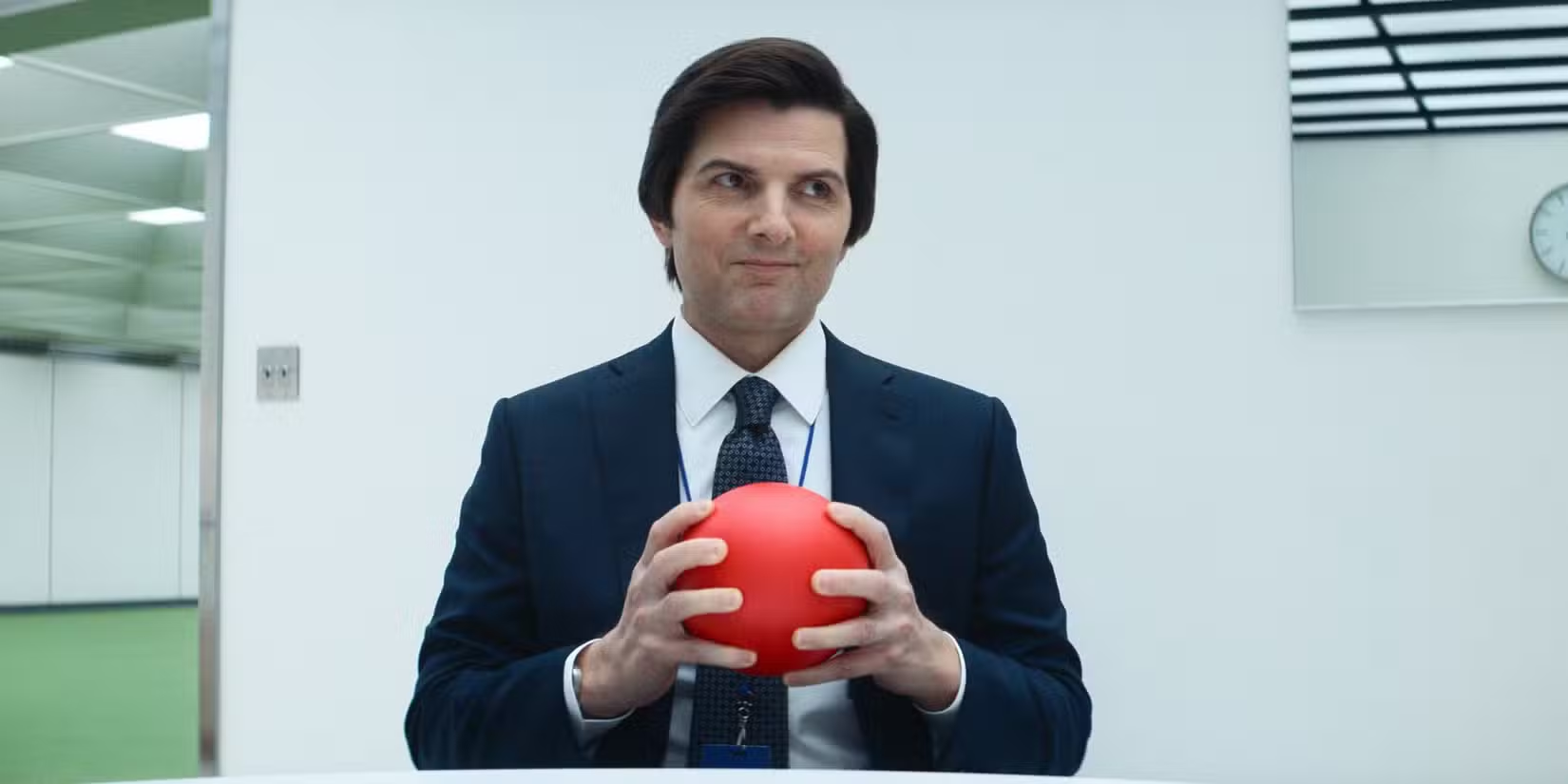
Adam Scott holding a ball in Severance.Image via Apple TV+
Like Severance, Klara and the Sun explores divided identities, and both arrive at this theme from different angles. Dan Erickson’s series asks what happens when a single person is split into two selves. Lumon’s employees become “innies” and “outies,” each living an incomplete life with no access to the other’s memories. The show turns memory into the foundation of identity; without it, even the same body can house two different people.
Ishiguro poses a parallel question through Klara. She’s designed to observe people so closely that she can imitate them with uncanny precision. At one point, she’s even considered a possible continuation of Josie, a sick child, should the girl die, prompting the novel to ask whether perfect imitation is the same as becoming someone. The answer, much like Severance’s, is no. Both stories reject the comforting idea that a person can be reduced to information. Memory, behavior, and personality matter, but they aren’t enough on their own. There’s always something left over that can’t be copied, programmed, or divided into neat categories.
Advertisement
‘Severance’ and ‘Klara and the Sun’ Treat People Like Products
Patricia Arquette and Tramell Tillman in ‘Severance’Image via Apple TV
The most unsettling connection between Severance and Klara and the Sun is utility. At Lumon Industries, employees exist to perform “mysterious and important” work while the company strips away everything that makes them whole. Their value comes from productivity, not individuality, and they become interchangeable pieces in a machine whose purpose they’re never allowed to understand.
Klara has her own distinct form of existence; nonetheless, this new existence closely resembles what Artificial Friends experience in another way; i.e., their owners buy them, use them, and then dispose of them when their assigned duties have been performed. Klara does not rebel against these realities, nor is she concerned with revolting against or showing superiority over humans. Rather, Klara’s primary existence revolves around her desire to assist Josie, who has a limited lifespan, even if it causes long-term harm to herself.
Most science fiction about artificial intelligence imagines machines desperate to become human, but Ishiguro flips that expectation, as Klara doesn’t crave freedom or power. She just wants to do the job she was created to do as well as she possibly can, and ironically, it’s the human characters who keep trying to erase the line between person and machine.
Advertisement
Both stories ultimately arrive at the same philosophical question: If technology can perfectly reproduce our behavior, what, then, makes us unique? Severance frames that question through memory, where every elevator ride creates a new version of the same person, forcing viewers to decide whether the innie and outie are equally real.
Klara and the Sun reaches a similar conclusion through observation, on the other hand. Klara can learn speech patterns, habits, and expressions with extraordinary accuracy, but she gradually realizes that people aren’t defined solely by what they do but are also shaped by the relationships around them — one of Ishiguro’s most powerful ideas, that a person’s identity doesn’t exist in isolation. It lives in the memories, love, and connections they share with others. Those things can’t simply be transferred into another body, no matter how advanced the technology becomes. It’s an idea that echoes throughout Severance, where the innies constantly fight for recognition as complete individuals rather than disposable extensions of their outies. Both works suggest that personhood isn’t something institutions get to define.
They’re Both Quiet Warnings About the Future
Mark S figure laying on a bed in Severance’s opening sequence for Season 2 created by Oliver LattaVia Apple TV+
Advertisement
Neither Severance nor Klara and the Sun relies on robot uprisings or apocalyptic spectacles. Instead, they imagine futures that feel only a few steps removed from our own. In Severance, workers willingly surrender parts of themselves in exchange for professional success, and in Klara and the Sun, artificial companions become the solution to childhood loneliness while genetic enhancement reshapes social class behind the scenes. Neither world arrives through catastrophe, but emerges through small compromises that gradually become the norm. Both stories are much more focused on how humans will gradually reshape themselves due to advances in technology than on the possibility that technology would eventually surpass humans.
If Severance captured your imagination with themes of identity, consciousness, and the difference between being alive and simply being a machine or an object, then Klara and the Sun should be one of your must-reads. While Klara and the Sun explores these same themes, it does so in a different way — from bright artificial light in an office building to wide-open sky and private moments between two people. Long story short, Klara whispers where Severance screams.





























































You must be logged in to post a comment Login